Hollywood myths harming the whole world: Ken O’Keefe
Press TV – February 3, 2013
A prominent human rights activist says Hollywood films and other media portray a false account of US history, perpetuating great harm to Americans and the rest of the world.
On the latest episode of Press TV’s Cinepolitics, panelists discuss Hollywood’s impact on global politics and society, with a particular examination of Steven Spielberg’s use of psychological manipulation and disinformation in his recent film “Lincoln”.
Press TV has conducted an interview with Ken O’Keefe, human rights activist, to further discuss the issue. O’Keefe is joined by Maria Duarte, a film critic with The Morning Star. The following is a rough transcription of the interview.
Press TV: How accurate was this portrayal?
O’Keefe: It was another nauseating example of Hollywood propaganda and it really has no resemblance to the truth.
In fact, there was another Lincoln movie that came out earlier that year, Lincoln the Vampire Slayer, and I reckon that there was just about as much – I’m not kidding when I say there’s just about as much evidence to support Lincoln as a vampire slayer as there is about him wanting the end of slavery and freeing black people. There’s no historical truth to that whatsoever.
Lincoln’s life is a testament to the fact that he was a man of his time. He used the word n***** repeatedly in his life. He never had any kind of an epiphany and changed his perspective. He never cared anything about freeing the slaves.
This was all about concentrating power, maintaining the union and concentrating more power in the Federal government.
The implications of that bloody war, Civil War, and concentration of power into the Federal government, we see to this very day. That’s why I’m not going to forgive Spielberg or the propagandists of Hollywood for this kind of junk because it perpetuates myths that cause great harm in this world.
Press TV: I have a letter from president [Lincoln] himself to Horace Greeley where he says, “My paramount object in this struggle is to save the union; it is not either to save or to destroy slavery.” He goes on to say, “What I do about slavery and the colored race I do because I believe it helps to save this union.”
…Do you think that this Lincoln movie corrects his image? -Because historically, I believe that he was shown as a villain.
O’Keefe: Well, there’s no question that in America there’s a cult surrounding the mythological Lincoln and it protects him very, very well.
I suppose there are many important reasons why the powers that be want to maintain this myth because the American people in general don’t want to face many facts about their country. Hell, they’re not even able to understand the fact that it’s not actually a democracy; it’s a republic.
Under a republic, the states are supposed to have rights.
In fact, the Federal government – the original founding fathers envisioned the United States of America, i.e. nation states of America, was that the states would be able to determine their own political reality and that the Federal government would only have so much power as would be required for it to maintain certain duties.
Instead, what we have, and that’s where the implications of this film are quite so profound, is the beginning of the concentration of power to the point that we see the American empire now at this point in time running roughshod over the world.
If that Federal government had been kept in check and the states had been allowed to make up their own minds and decisions, slavery would have ended. Let us not mistake the fact that America’s the only nation in the world that had a bloody civil war that had to deal with slavery.
Every other country in the world managed to do this without such a bloody war. They did it before the United States, as well.
Lincoln was not this great emancipator.
In fact, the Emancipation Proclamation did not free any slaves at all. It only provided the means for slaves in the South that were rebelling against the Union because they were trying to increase taxes and so on and so forth. That’s the only people that it dealt with.
It didn’t do anything to free the slaves up North, and there were slaves there as well.
Really, there’s just so many myths. Again, the implications of maintaining these myths is that the American people and others around the world continue to be in the dark about the real reality of American history. I think that’s an important subject for us to be aware of.
Press TV: Ken, what do you think about that scene [in the beginning of the movie]?
O’Keefe: It was a noxious scene, and it was the first scene in the film.
There is simply no way that black men would have had an audience with the president in that kind of context and actually been affectively sort-of chastising Lincoln for more equality not coming that much quicker. It’s ridiculous!
I can see how it would work on much of the American population because it’s been so dumbed down that most people will swallow whatever is put into their mouths no matter how much rubbish it is. That was an absolutely ridiculous scene. There’s more such scenes like that later on in the film.
Press TV: Ken, what do you think [of the relationship between Lincoln and his wife]?
O’Keefe: Wherever it can take liberty with issues that we can’t possibly know the real details, it does. And where it comes to historical realities, it just blatantly, intentionally, willfully deceives the viewers.
I wouldn’t be surprised if these kind of exchanges are so far from the truth that it bears no resemblance to anything that actually happened. At the same time, I don’t know enough about their personal relationship to say it’s accurate or not.
Press TV: In the House of Representatives there’s obviously a lot of interaction – the Republicans and Democrats are actually at each other’s throats. How do you think they’ve been portrayed? Was it accurate, their view towards slavery?
O’Keefe: Party politics obviously was a factor then as it is now. So, that was definitely somewhat accurate, I would say.
The truth of the matter is that the abolitionists were clearly in the minority. This idea that all the Republicans were very much in agreement about freeing slaves and what not is again completely ridiculous.
Again, when we see these sort of debates and the idea that Republicans are for this and the Democrats are against it, that’s simply not true.
The abolitionists – if you want to give credit to anyone in America for actually helping to bring about the end of slavery or at least get that issue to the floor, it is a very small minority of abolitionists who really did stand for that. It certainly wasn’t Lincoln, that’s for sure.
Press TV: Somebody, I think a historian, accused the film of exaggerating the possibility that by January the war might have ended with slavery still intact. Do you think that’s an accurate statement to make?
O’Keefe: It’s true but the fact is that slavery would have ended one way or the other. In fact, it was becoming quite unprofitable.
The Civil War was really sort of a tax revolt. The union, the Federal government, was exercising powers that were being abused and those abusive powers were translating into higher taxes for the Southerners. This was making life too difficult for them. That is why, ultimately, they revolted. That’s really what this is about.
Press TV: And the wealth was actually in the South, the cotton mills, the plantations…
Do you think that Spielberg is guilty of presenting possibly a utopian vision of the US?
O’Keefe: Yeah, it’s perpetuating the myth. The myth of America is freedom and democracy and so on and so forth. In fact, it’s an empire. It’s the latest empire. Like all other empires, it’s falling and it’s going to continue to go down.
Also, in that scene it shows another one of those lies, that Lincoln was somehow a most adored and loved president. Actually, he was probably one of the most hated, certainly one of the most hated.
Press TV: Mary says this on the film. His wife, she says you’re one of the most loved.
O’Keefe: Yeah, that’s not true at all. Only after he was killed did we find some sympathy for him. Actually, many people in America, in facts large numbers of people would have celebrated his death. He was in fact one of the most hated presidents.
This is just another blatant lie. You cannot say that that is an accident. It’s intentional. It’s a willful intent to deceive the audience.
Press TV: I read an academic online. She said she was going to be using this film as part of an aid in her history classrooms. I thought, is this the version of events that’s being presented to future generation in textbooks?
O’Keefe: I think there are some good teachers out there who will teach in a more accurate understanding.
But largely there is a cult protecting the myth of not only Lincoln but of the US as a whole. Of course, it would be no surprise at all that students are being cheated out of a real understanding of history and ultimately being told this sort of rubbish. This will help perpetuate that kind of misunderstanding.
Press TV: You’ve mentioned something earlier. Yes, the acting was superb but if you’d done it with the accurate facts, it would have made it all the more better.
O’Keefe: With that kind of resource, you know, that kind of acting talent, the producers, everything that’s involved in a movie of that magnitude, if it were done accurately, it would have been a hugely important and beautiful film. I’ll agree, the acting, it’s incredible.
But if you had given the actors a real script that reflected an honest understanding of what had really happened, then it would have been a magnificent film.
Of course, Spielberg is not in the business of making historically accurate films. He’s in the business of propaganda and he’s done it well once again.
Related articles
- Abe Lincoln, Racist Fascist?
- Pictures Speak Volumes in Oscar-nominated Israeli Films
- Oscar-nominated Palestinian director detained at LAX
- Hollywood’s Imperial Propaganda
- Academy Awards for the Promotion of Torture?
- Oscar Prints the Legend: Argo’s Upcoming Academy Award and the Failure of Truth
February 3, 2013 Posted by aletho | Deception, Ethnic Cleansing, Racism, Zionism, Mainstream Media, Warmongering, Timeless or most popular | Abraham Lincoln, American Civil War, Emancipation Proclamation, Hollywood, Horace Greeley, Lincoln, Steven Spielberg, United States | Leave a comment
The Radical History of Mother’s Day
Nation of Change | May 12, 2012
There’s a good number of us who question holidays like Mother’s Day in which you spend more time feeding money into a system that exploits our love for our mothers than actually celebrating them. It’s not unlike any other holiday in America in that its complete commercialization has stripped away so much of its genuine meaning, as well its history. Mother’s Day is unique in its completely radical and totally feminist history, as much as it has been forgotten.
Mother’s Day began in America in 1870 when Julia Ward Howe wrote the Mother’s Day Proclamation. Written in response to the American Civil War and the Franco-Prussian War, her proclamation called on women to use their position as mothers to influence society in fighting for an end to all wars. She called for women to stand up against the unjust violence of war through their roles as wife and mother, to protest the futility of their sons killing other mothers’ sons.
Howe wrote:
Arise, then, women of this day!
Arise, all women who have hearts, Whether our baptism be of water or of tears!
Say firmly: “We will not have great questions decided by irrelevant agencies, Our husbands will not come to us, reeking with carnage, for caresses and applause. Our sons shall not be taken from us to unlearn All that we have been able to teach them of charity, mercy, and patience. We, the women of one country, will be too tender of those of another country To allow our sons to be trained to injure theirs.”[Read the remainder of Howe’s quote here]
The holiday caught on years later when a West Virginia women’s group led by Anna Reeves Jarvis began promoting it as a way to reunite families after the Civil War. After Jarvis’ death, her daughter began a campaign for the creation of an official Mother’s Day in honor of peace. Devoting much of her life to the cause, it wasn’t until 1914 when Woodrow Wilson signed it into national observance in 1914.
The holiday flourished, along with the flower industry. The business journal, the Florists Review, actually admitted to its desire to exploit the holiday. Jarvis was strongly opposed to every aspect of the holiday’s commercialization, arrested for protesting the sale of flowers, and petitioning to stop the creation of a Mother’s Day postage stamp.
Today we are in multiple wars that continue to claim the lives of thousands of sons and daughters. We are also experiencing a still-rising commercialization of nearly every aspect of life; the exploitation of every possible human event and emotion at the benefit of corporations.
Let’s take this Mother’s Day to excuse ourselves from the pressure to consume and remember its radical roots – that mothers, or rather all women, in fact, all people, have a stake in war and a responsibility as American citizens to protest the incredible violence that so many fellow citizens, here and abroad, must suffer through.
The thousands of civilian casualties in Afghanistan and Iraq as well as the devastating impact of post-traumatic stress disorder on our veterans are just the beginning of the terrible repercussion of war. As we saw last week an announcement of an extension of the military occupation of Afghanistan, let this mother’s day be a day after Julia Ward Howe’s own heart as we stand up and say no to 12 more years of war.
Related articles
- Julia Ward Howe: Mother’s Day Tribute to Mothers and to Their Gifts Making All Possible: Peace (peoplesadvocacycouncil.wordpress.com)
May 13, 2012 Posted by aletho | Militarism, Timeless or most popular, War Crimes | American Civil War, Franco-Prussian War, Julia Ward Howe, Mother's Day Proclamation, Mothers Day, United States | Leave a comment
The Civil War: an Eerie Silence
By ROBIN BLACKBURN | CounterPunch | April 18, 2011
The news and entertainment media love anniversaries. So it is strange that the 150th anniversary of the start of the Civil War has been so low key. The BBC has a regular item each evening explaining the Secession crisis, in contrast to the shrugs of the US channels. The New York Times has been the only publication to pay some attention but on April 12 it ran a piece by Ken Burns, co-director of the celebrated PBS series, pointing out that notwithstanding its centrality in the national story the conflict does not always receive the attention it merits. He compared this phenomenon to the ‘acoustic shadow’ noticed during the Civil War itself whereby towns quite close to a battlefield were bathed in silence while quite distant locations could distinctly hear the roar of the fusillades and the canon’s bark. PBS is airing a re-run of the Civil War programmes but extensive cuts have reduced the fascinating and acute commentaries of the featured historians.
Harold Meyerson has argued in the Washington Post (14/04/11) that the issues that sparked the mighty conflict continually re-appear in new forms. In the 1860s the roots of the clash lay in rival labor systems, with Northerners fearing the expansionist longings of the ‘Slave Power’. Today, Meyerson points out, the Republicans – the then champions of an expansive ‘free labor’ regime embracing public education and the right to organize, are now the sworn foes of public expenditure and trade union rights.
While this observation is on the mark it still does not explain why so many avoid the topic. Apparently – even a century and a half later – there is no commonly-agreed narrative of the meaning of the war. What can still be called Northern opinion insists that the war was about slavery and race, something that many Southerners will not accept. Those South Carolinians who observed the anniversary of their own state’s secession last December portrayed it as a brave blow for state’s rights and minimal government.
It is easy for Northerners to see the bad faith in Southern denials that the glorious cause was no more than a wretched defense of racial bondage. The most insistent secessionists were indeed the large slave-owners, and the Confederacy’s very belated recourse to the freeing of some slaves to form a Confederate regiment cannot alter the fact that the rebellion was animated by the desire to insulate slavery from the peril of a Republican president and the persisting contempt of so many Northerners. Slavery was a delicate institution that could not be subjected to the rough and tumble of party politics.
But if Northerners can spot the beam in the eyes of the Southerners they don’t notice the mote in their own. This is the more difficult to do because it requires simultaneous attention to two considerations. Firstly, in April 1861, and for many months thereafter, slavery remained entirely lawful in the Union. Secondly, so long as both sides remained attached to slavery, the Union case against secession would remain flawed at best. Modern liberal and democratic theory allows for a right of self-determination and each of the seceding states had agreed the fateful step only after the deliberation of a representative body as determined by the prevailing authorities. Of course the slaves themselves had no say in the matter, but neither did they at most places in the North.
Indeed in February 1861 the Congress had endorsed a Thirteenth Amendment – never subsequently ratified by the states and very different from the later one — which would have renounced any right or ability to challenge slavery and reserved to the slave states themselves the entire responsibility for regulating slavery. Lincoln gave his support. Many urged that the Constitution itself already entailed such a concession but it remained unfortunate nevertheless. Lincoln wished to re-assure loyal slaveholders that they had nothing to fear from his administration.
Until president and Congress could agree initiatives to suppress slavery they could not offer abolitionism as the justification for making war against the rebels. Of course the Union had the right to condemn and deplore Secession, and even to refuse to recognise it, and to devise peaceful ways of dissuading them. But Lincoln himself in his first speech to the House of Representatives had insisted in the most emphatic terms that all peoples have a right of revolution and that this extended to communities that were in a minority nationally so long at they had a local majority.
In fact nineteenth-century democrats generally supported national secessions where this received local support, as it did when Belgium seceded from the Netherlands in 1830 or Norway from Sweden in 1905. However Lincoln was to specify an exception to this rule in his speech in Peoria in 1854. In that speech he says that slaveholders cannot claim this right as against a free community. In the US case acquiescence in secession would have allowed the North and the West to become a large and progressive state, a sort of vast and diversified Canada, hospitable to free labor, social protection and gun control. The Confederacy meanwhile, would have become a republican version of the ramshackle Brazilian Empire, a major slave society that eventually managed to shed slavery in a largely peaceful manner.
So the Emancipation Proclamation and the Thirteenth Amendment had a bearing on the legitimacy of the war against the secession, clearly putting the Union in the right. The virtuous measures taken in 1863 and after lent a quite new purpose to the struggle, rescuing it from its deficiency deficit. Karl Marx went further, since he was confident that the slavery issue could not be kept out of the conflict and the North would be driven to attack slavery since it was the very basis of the Confederate regime.
The coming months and years are going to furnish a succession of thorny topics for the commemoration industry – dating from Reconstruction as well as the War – and it will be fascinating to see how they are navigated. The terrible destructiveness of the war and its very unsatisfactory ultimate outcome for African Americans are issues that will have to be addressed.
But however the later sequence of events is addressed it remains highly unsatisfactory to allow the war’s inception to be enveloped by the ‘acoustic shadow’. We live in a world where the US and other Western governments believe themselves entitled to resort to military intervention almost at will, though the more scrupulous crave the rubber stamp of the UN Security Council, notwithstanding that the stamp of approval is issued from a supine position.
In this context a willingness on the part of the United States to admit the possibility that the war was not the best response to Secession would be a healthy sign. (Recent books by Drew Gilpin Faust, — This Republic of Suffering — and Louis Menand, The Metaphysical Club is encouraging auguries.) A willingness to grant this, even if combined with the severest stricture on slavery and Jim Crow, could help the US to find a post-imperial vocation and to defeat threats to free and thriving labor. It would also help to clarify how Washington would react to any future wish of a state to withdraw from the Union. If that wish was reached by clear majorities, after democratic debate, is it really conceivable that anyone would wish the matter to be settled by tanks and aerial bombardment.
~
Robin Blackburn teaches at the University of Essex in the UK and is the author of An Unfinished Revolution: Karl Marx and Abraham Lincoln, and The American Crucible, both Verso 2011. He can be reached at robinblackburn68@hotmail.com
Related articles
- You Have the Right To Secede (lewrockwell.com)
- 10 facts about secession from U.S. (politico.com)
April 18, 2011 Posted by aletho | Deception, Mainstream Media, Warmongering, Militarism, Timeless or most popular | American Civil War, Civil War, Confederate States of America, Emancipation Proclamation, Lincoln, Secession, United States | Leave a comment
Featured Video
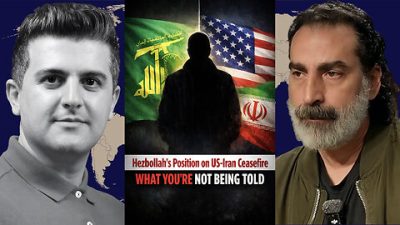
Laith Marouf: Hezbollah’s position on US-Iran ceasefire
or go to
Aletho News Archives – Video-Images
From the Archives
The Dirty Little Secret behind the “Global Terrorism Index”
The Omission of Israeli Terrorism in the Occupied Palestinian Territories
By Karin Brothers | Global Research | December 6, 2014
… The Israeli settlements — all of which are illegal – have been identified as a major impediment to peace. The refusal of a major “global” terrorism report to name the Israeli settlers as one of the groups most responsible for terrorism not only misrepresents a major source of regional violence but exposes the Global Terrorism Index as a propaganda tool that supports a U.S. agenda.
In recent years, governments have been attempting to thwart terrorism by blocking supportive fund-raising. When it comes to Israeli settlements, however, the US and Canada actually encourage fund-raising by giving organizations (such as Christian Friends of Israeli Communities (CFOIC) and the Jewish National Fund) financial support in the form of donor tax-deductions.
Charities which provide funds for the Israeli settlements should be regarded as terror-financing organizations. They should not only lose their tax-deductible status, but they should be banned because they support the violation of international humanitarian law. The terror-financing laws that are being strictly enforced for Muslim charities should be applied to Christian and Jewish charities as well. … Read full article
Blog Roll
-
Join 2,451 other subscribers
Visits Since December 2009
- 7,443,210 hits
Looking for something?
Archives
Calendar
Categories
Aletho News Civil Liberties Corruption Deception Economics Environmentalism Ethnic Cleansing, Racism, Zionism Fake News False Flag Terrorism Full Spectrum Dominance Illegal Occupation Mainstream Media, Warmongering Malthusian Ideology, Phony Scarcity Militarism Progressive Hypocrite Russophobia Science and Pseudo-Science Solidarity and Activism Subjugation - Torture Supremacism, Social Darwinism Timeless or most popular Video War Crimes Wars for IsraelTags
9/11 Afghanistan Africa al-Qaeda Australia BBC Benjamin Netanyahu Brazil Canada CDC Central Intelligence Agency China CIA CNN Covid-19 COVID-19 Vaccine Donald Trump Egypt European Union Facebook FBI FDA France Gaza Germany Google Hamas Hebron Hezbollah Hillary Clinton Human rights Hungary India Iran Iraq ISIS Israel Israeli settlement Japan Jerusalem Joe Biden Korea Latin America Lebanon Libya Middle East National Security Agency NATO New York Times North Korea NSA Obama Pakistan Palestine Poland Qatar Russia Sanctions against Iran Saudi Arabia Syria The Guardian Turkey Twitter UAE UK Ukraine United Nations United States USA Venezuela Washington Post West Bank WHO Yemen Zionism
 Aletho News
- Trump Administration Moves To Automate U.S. Military Draft Registration
- Spain orders reopening of Tehran embassy, condemns Israel’s carpet bombing of Lebanon
- Israel faces ‘unsustainable’ strategic crisis following 40-day war against Iran: Analyst
- Iran restricts Hormuz access to 15 vessels per day under ceasefire terms: Report
- The ‘Opposition Party’ Has Done Nothing to Stop the Iran War and Much to Goad Trump Into Continuing It
- Moscow backs Tehran on status of Lebanon in US-Iran deal
- How UK Regulator Ofcom Quietly Bypassed International Law to Police American Speech
- The Black Cube Files: How Former Mossad Operatives Flipped a Nation
- Laith Marouf: Hezbollah’s position on US-Iran ceasefire: What you’re not being told
- Israel’s priority lies in destroying chances of peace between Iran, US: Ex-UN nuclear chief
- If Americans Knew
- The gallows law: Israel moves toward executing Palestinian children
- Tucker Carlson: The Path to Peace requires ending ‘special alliance’ with Israel
- This is ceasefire? Israel’s biggest massacre yet in Lebanon, another journalist killed in Gaza – Daily Update
- Tucker Carlson on Israel: This Is the Behavior of an Ally? Really?
- Gazans face a triple crisis: severe shortages of water and bread, healthcare in tatters
- NY Times reports how Netanyahu took the US into Iran War
- A sigh of relief over Iran, but Gaza and Lebanon in dire straits – Daily Update
- Thousands dead and neighborhoods razed to the ground: Aid agencies fear southern Lebanon is becoming the new Gaza
- The war the US is fighting for Israel could cost trillions
- ‘Cigarette Burns, Nail Wounds’: Toddler Tortured in Gaza to Coerce Father
- No Tricks Zone
- An Inconvenient Tree: Uncovered In Alps… Europe Much Warmer Than Today 6000 Years Ago
- New Study Reports A 60% Slowdown In Greenland’s Ice Loss Rate In The Last Decade
- Low Intensity Tornado Wrecks Major Solar Farm, Creating A Potential Toxic Dump
- New Study Finds Warming Saves Lives…Cold Temperatures 12 Times More Deadly Than Excess Heat
- German Science Blog Accuses PIK Climate Institute Of Hallucinating Climate Tipping Points
- Devastating Assessment Of Comirnaty Vaccine By Former Senior Pfizer Europe Toxicologist
- New Study: CO2 Is ‘Effectively Negligible’ As An Explanatory Climate Change Factor Since 2000
- Former Pfizer Toxicologist Dr. Helmut Sterz Tells Bundestag Hearing Pfizer Vaccine Should Have Never Been Approved
- Energy Expert: Germany’s Nuclear Phaseout Was A “500 Billion Euro Mistake”
- New Research: South Australia’s Mid-Holocene Sea Surface Temperatures Were 4°C Warmer Than Today
Contact:
atheonews (at) gmail.com
Disclaimer
This site is provided as a research and reference tool. Although we make every reasonable effort to ensure that the information and data provided at this site are useful, accurate, and current, we cannot guarantee that the information and data provided here will be error-free. By using this site, you assume all responsibility for and risk arising from your use of and reliance upon the contents of this site.
This site and the information available through it do not, and are not intended to constitute legal advice. Should you require legal advice, you should consult your own attorney.
Nothing within this site or linked to by this site constitutes investment advice or medical advice.
Materials accessible from or added to this site by third parties, such as comments posted, are strictly the responsibility of the third party who added such materials or made them accessible and we neither endorse nor undertake to control, monitor, edit or assume responsibility for any such third-party material.
The posting of stories, commentaries, reports, documents and links (embedded or otherwise) on this site does not in any way, shape or form, implied or otherwise, necessarily express or suggest endorsement or support of any of such posted material or parts therein.
The word “alleged” is deemed to occur before the word “fraud.” Since the rule of law still applies. To peasants, at least.
Fair Use
This site contains copyrighted material the use of which has not always been specifically authorized by the copyright owner. We are making such material available in our efforts to advance understanding of environmental, political, human rights, economic, democracy, scientific, and social justice issues, etc. We believe this constitutes a ‘fair use’ of any such copyrighted material as provided for in section 107 of the US Copyright Law. In accordance with Title 17 U.S.C. Section 107, the material on this site is distributed without profit to those who have expressed a prior interest in receiving the included information for research and educational purposes. For more info go to: http://www.law.cornell.edu/uscode/17/107.shtml. If you wish to use copyrighted material from this site for purposes of your own that go beyond ‘fair use’, you must obtain permission from the copyright owner.
DMCA Contact
This is information for anyone that wishes to challenge our “fair use” of copyrighted material.
If you are a legal copyright holder or a designated agent for such and you believe that content residing on or accessible through our website infringes a copyright and falls outside the boundaries of “Fair Use”, please send a notice of infringement by contacting atheonews@gmail.com.
We will respond and take necessary action immediately.
If notice is given of an alleged copyright violation we will act expeditiously to remove or disable access to the material(s) in question.
All 3rd party material posted on this website is copyright the respective owners / authors. Aletho News makes no claim of copyright on such material.
 Aletho News