Index on Disgrace
By Craig Murray | April 22, 2018
The second half of my life has been a continual process of disillusionment with the institutions I used to respect. I suppose it started with the FCO, where I went from being Britain’s youngest ambassador to being sacked for opposing the use of intelligence from torture, at the same time having an insider view of the knowing lies about Iraqi WMD being used as a pretext for invasion and resource grab.
I still had some residual respect for the BBC, which respect disappeared during the Scottish independence referendum where BBC propaganda and disregard for the truth were truly shameless. My love of the universities was severely tested during my period as Rector of Dundee University, when I saw how far the corporate model had turned them from academic communities developing people and pursuing knowledge, to relentless churners out of unconsidered graduates and financially profitable research, with nearly all sense of community gone. My respect for charities vanished when I discovered Save the Children was paying its chief executive £370,000 and had become a haven for New Labour politicos on huge salaries, which was why it was so involved in pushing a pro-war narrative in Syria. When Justin Forsyth and Brendan Cox – both massively salaried employees who came into Save the Children from the revolving door of Gordon Brown’s office – were outed over sexual predation, that seemed a natural result of “charities” being headed by rich party hacks rather than by simple people trying to do good. As for respect for parliament, well the massive troughing expenses scandal and all those protected paedophiles…
It has become difficult to hang on to respect for any institution, and that is unsettling.
Which brings me to last week’s annual awards from Index on Censorship. The winners of the awards – from Cuba, the Democratic Republic of Congo, Honduras and Egypt – all seem worthy enough, and there is even some departure from the neo-con narrative in recognising a human rights problem in Egypt.
But the Chairman of Index on Censorship is, incredibly, Rupert Murdoch lead hack David Aaronovitch, and he presided over the awards, in the very week in which the newspaper for which he writes produced this appalling attack on freedom of expression:

Inside there was a further two page attack on named academics who have the temerity to ask for evidence of government claims over Syria, including distinguished Professors Tim Hayward, Paul McKeigue and Piers Robinson. The Times also attacked named journalists and bloggers and, to top it off, finished with a column alleging collusion between Scottish nationalists and the Russian state.
That the Chairman of “Index on Censorship” is associated with this kind of attack on freedom of speech, freedom of thought and freedom of research is sadly unsurprising. The guest list of the Index ceremony had a distinct right wing tinge including A C Grayling and Sara Khan, as well as a good smattering of the BBC, which was also represented on the judging panel. The irony of the state broadcaster being part of a panel on freedom of expression is plainly lost.
I realised something was very wrong with Index on Censorship when I contacted them over a decade ago, when Jack Straw attempted to ban the publication of my book Murder in Samarkand, after it had passed successfully through the exhaustive FCO clearance process over a time-consuming year. I tried to interest them again when my second book The Catholic Orangemen of Togo was dropped by my publisher following libel threats from mercenary commander Tim Spicer of Aegis/Executive Outcomes/Sandline. On both occasions I was told that then Chief Executive of Index, John Kampfner, did not regard these attempted book bannings as incidents of censorship. Presumably because they weren’t somewhere like Cuba or Zimbabwe…
The truly appalling Times attack on academics was part of a coordinated and government-led campaign to delegitimise anybody doubting the official narrative on Salisbury and Syria. The BBC weighed in with this horrible effort:
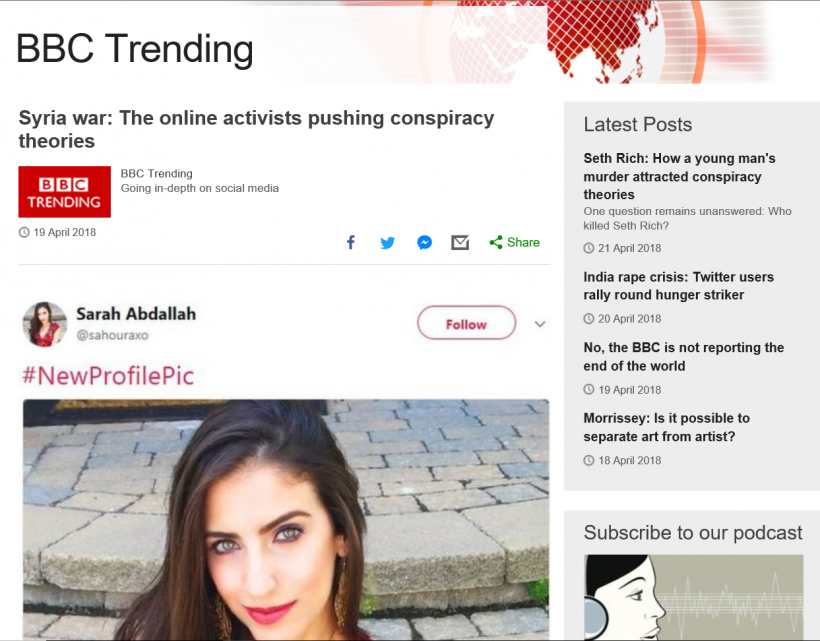
The government then issued a ridiculous press release branding decent people as “Russian bots” just for opposing British policy in Syria. In a piece of McCarthyism so macabre I cannot believe this is really happening, an apparently pleasant and normal man called Ian was grilled live on Murdoch’s Sky News, having been named by his own government as a Russian bot.
The Guardian uncritically published the government’s accusations in full, and astonishingly seemed proud that it had made no attempt to investigate their veracity but had merely published what the government wished them to publish:

The Guardian naturally was just as reliable as the BBC in driving home the message that anybody who doubted the government’s word on Syria was a flat-earth denier of the truth:

Mr Freedland is of course a perfect representation of an interesting fact. Those who are most active in telling us that we must attack Syria, and that anybody who questions the government’s pretexts is insane or evil, are precisely the same individuals who supported the war in Iraq and attacked those who doubted the existence of Iraqi WMD. Indeed these people – Jonathan Freedland, David Aaronovitch, Oliver Kamm, Alan Mendoza, Andrew Rawnsley, John Rentoul, Nick Cohen – are the leaders of the tiny, insignificant number of people who still believe that the invasion of Iraq was both justified and beneficial in its result.
Yet these people of proven terrible judgement, they and others of their media class, are the arbiters who are allowed to dictate the terms of what is and what is not an acceptable public utterance on the situation in Syria.
When Jeremy Corbyn became leader of the opposition, one of two things had to happen. Either the Overton window had to shift to allow for the reflection of views held by the leader of the official opposition and his myriad supporters, or the leader of the opposition had to be castigated and humiliated as an unreasonable lunatic. Corbyn’s rational scepticism on British involvement in the conflict in Syria is a key moment in this process. Despite the fact Corbyn’s scepticism is supported by a wide swathe of diplomatic and military opinion within the UK, it has to be portrayed as fringe, extreme and irrational.
We thus have the extraordinary spectacle of a coordinated government and media onslaught on anybody who doubts their entirely fact free narratives. Those who were demonstrably completely wrong over Iraq are held up as infallible, and given full control of all state and corporate media platforms, where they deride those who were right over Iraq as crackpots and Russian bots.
Meanwhile public trust in the state and corporate media hits new lows, which is the happy part of this story.
Support Craig Murray’s continued writing.
Media Support US Violence Against Syria, but Long for More
By Gregory Shupak | FAIR | April 20, 2018
Corporate media outlets were glad that the US, France and Britain bombed Syria in violation of international law (FAIR.org, 4/18/18), but lamented what they see as a dearth of US violence in the country.
In The Atlantic (4/14/18), Thanassis Cambanis described the war crime as “undoubtedly a good thing,” and called for “sustained attention and investment, of diplomatic, economic and military resources”—though the latter rubbed up against his assessment in the same paragraph that “a major regional war will only make things worse.” Moreover, he described “the most realistic possibility” for the US and its partners in Syria as “an incomplete and possibly destabilizing policy of confrontation [and] containment. But a reckoning can’t be deferred forever.”
This “reckoning” was his somewhat oblique way of referring to a war pitting the US and its allies against the Syrian government and its allies, the very “wider regional war” he just warned against. In Cambanis’ view, “confrontations” between nuclear-armed America and nuclear-armed Russia are “inevitable,” which implies that there is no sense in trying to avoid such potentially apocalyptic scenarios.
A Washington Post editorial (4/14/18) said that “Mr. Trump was right to order the strikes.” The paper was glad that Defense Secretary Jim Mattis and President Donald Trump “properly left open the possibility of further action.” The Post’s rationale for continuing to attack Syria was that “the challenge to vital US interests in Syria is far from over,” and that Trump was therefore wrong “to call Friday’s operation a ‘Mission Accomplished.’” These “interests” include ensuring that Iran does not “obtain the land corridor it seeks across Syria.” (Cambanis, similarly, described as “justified” US efforts to “contain Syria and its allies.”)
The paper was concerned because Trump says that he’d like to subcontract US activities in Syria to US regional partners like Saudi Arabia, the United Arab Emirates, Qatar and Egypt. None of these states, the Post fretted, “are capable of working with local forces [in Syria] to stabilize and hold the large stretch of [Syrian] territory now under de facto US control east of the Euphrates River.”
The editorial failed to note that this territory amounts to “about one-third of the country, including most of the oil wealth” (New York Times, 3/8/18) and “much of Syria’s best agricultural land” (Syria Comment, 1/15/18). The legitimacy of “de facto US control” over Syrian territory and some of its most valuable resources is apparently beyond question, as is the US’s alleged right to determine which governments are allowed to be friendly with each other: The Iranian “land corridor” refers to the Iranian government having warm relations with the governments of Syria, Iraq and Lebanon, something the Post appears to regard as a grave danger.
The editorial says that the US and its allies sought to “minimize the risk of a direct military confrontation with Russia or Iran” and that this was “prudent,” but that “if Russia takes retaliatory action, including in cyberspace, the United States must be ready to respond.” According to this view, projecting US power in Syria is so essential that no form of opposition to US violence in Syria can be brooked, the concern for prudence having vanished.
The Post contended that the US must demand “an acceptable political settlement brokered by the United Nations”—“acceptable” signifying “the departure” of the Syrian government. Functionally, this means keeping the war going: Saying that negotiations should take place but that the only “acceptable” outcome is the dissolution of the Syrian government amounts to the same thing as saying that no negotiations should take place, particularly now that the Syrian government is working from a position of strength and unlikely to agree to its own surrender as a pre-condition for talks.
Andrew Rawnsley, writing in the Guardian (4/15/18), supported US violence in Syria by attacking its critics. He said that those who oppose the Anglo-American-French airstrikes on Syria out of “indifference” to Syria’s plight have the “sole merit of being candid,” unlike those who are
less honest . . . the self-proclaimed peace-lovers. Mainly to be found on the hand-wringing left, they are too busy looking in the mirror admiring their own halos to face the moral challenges posed by a situation like Syria.
Luckily Rawnsley has the requisite courage to meet “the moral challenges” and advocate more war: He says that the West should have “impos[ed] no-fly zones” early in the war in Syria, a policy that would have entailed attacking Syria’s air forces, an act of war by any definition. No-fly zones over Iraq and Libya ultimately led to regime change in both countries, with hideous results for their people.
Rawnsley’s complaint that the West applied “no meaningful pressure” to “bring [the Syrian government to the negotiating table” is wildly misleading; the Western powers in fact applied “meaningful pressure” to prevent negotiations.
Rawnsley also legitimized US violence against Syria by expunging the damage it has inflicted. He trotted out the well-worn lie that the West “stood by” and “fail[ed] to act” in Syria, a canard that FAIR has repeatedly de-bunked (e.g., 9/20/15, 4/7/17, 3/7/18). He characterized the West’s approach to seven years of war in Syria as “years of unmasterly inactivity,” having their hands “wedged firmly under their bottoms,” an “impotent posture,” “failures to act,” making the “grav[e] decision not to act,” “inaction,” “non-interventionist” and as “inaction” a second time. Yet the CIA’s effort to oust the Syrian government has been one of the costliest covert-action programs in the agency’s history; has built ten military bases in the country, with two more on the way; and has killed thousands of Syrian civilians in a bombing campaign ostensibly aimed at ISIS (Jacobin, 4/18/18).
“Non-interventionists,” Rawnsley concludes his article, “the horrors of Syria are on you.” Yet there is no shortage of horrors that are on the interventionists. Sanctions imposed by the US and its allies have punished the Syrian population (9/28/16). These states are implicated in sectarian violence that anti-government armed groups have carried out against minorities (Electronic Intifada, 3/16/17). The US bombed a mosque in Aleppo, Syria, in the name of fighting Al Qaeda, killing almost 40 people (Independent, 4/18/17), and America used toxic depleted uranium against ISIS-held territory in Syria (Foreign Policy, 2/14/17): It would be rather difficult to claim that these horrors were caused by “non-interventionists.”
Cambanis, moreover, exclusively listed Syria, Iran and Russia among those governments who “have serially transgressed the laws of war” and “gotten away with murder” in Syria, but the atrocities attributable to the US and its allies surely constitute “serially transgress[ing] the laws of war” and having “gotten away with murder.”
The Syrian government and its partners are also responsible for a substantial share of carnage in the war, but Rawnsley’s accusation that “non-interventionists” are to blame for Syria’s bloodshed is completely untenable. His argument that Western states have inflicted insufficient harm on Syrians amounts to war propaganda.
And he’s far from the only media figure about whom this can be said.
Gregory Shupak teaches media studies at the University of Guelph-Humber in Toronto.
Featured Video

Rewriting the risk? Inside the government’s vaccine safety messaging
or go to
Aletho News Archives – Video-Images
Book Review
“Davos Can Really Replace the UN”
Inside the book that maps the architecture behind global governance — from the Epstein files to the Pact for the Future
Lies are Unbekoming | April 1, 2026
On June 13, 2019, the United Nations and the World Economic Forum signed a partnership deal to “accelerate the implementation of the 2030 Agenda for Sustainable Development.” That same evening, WEF president Börge Brende — Norway’s former Foreign Minister — had dinner with Jeffrey Epstein at Epstein’s Manhattan townhouse. The Epstein files, released January 2026, contain an exchange between the two from the previous year. Epstein to Brende: “Davos can really replace the UN. C21, cyber, crypto . genetics… intl coordination.” Brende back to Epstein: “Exactly — we need a new global architecture. World Economic Forum (Davos) is uniquely positioned — public private.”
The next day, the UN General Assembly adopted the framework for restructuring global governance.
That sequence — the partnership signing, the Epstein dinner, the candid admission about replacing the UN with a public-private architecture, and then the formal adoption — opens Jacob Nordangård’s The Digital World Brain. Pages two and three. Footnoted to the UN resolution number, the Epstein files, and the General Assembly record.
I keep coming back to it because it captures what this book does that almost nothing else in the independent research space manages. I’ve followed Jacob’s work for years now and interviewed him about his research. Each book peels back another layer of the same institutional architecture, and each time I think he’s reached the limit of what can be documented, the next one goes further. Nordangård doesn’t speculate. He doesn’t editorialize much. He lays institutional actions next to each other in chronological order and lets the pattern announce itself. … continue
Blog Roll
 Aletho News
- How I fell foul of the BBC thought police
- The End of NATO
- 37 days of war on Iran cost US staggering $42bln, tracker shows
- Baghdad tells Asian refiners, traders to begin loading Iraqi crude amid Iranian exemption
- Under fire, Moscow and Tehran close ranks
- Iran, US receive Pakistan-mediated plan for ceasefire then final deal
- Iran submits demands for end to war as mediators scramble ahead of Trump deadline
- Iran Threatens Retaliatory Strike on Stargate AI Project in UAE
- US sent ‘a lot’ of arms to Iranian protesters – Trump
- Barak Ravid Launders Deception To Allow Trump To Back Off Of His Power Plant Threat – Again
- If Americans Knew
- U.N. experts demand Israel release prominent Gaza doctor after reports of ‘severe torture’
- Israel’s Latest Genocide Is Against the Shias of Lebanon. Why Is the World Silent?
- How Eliot Cohen’s influence over U.S. war-making paved the way for Trump’s war crimes in Iran
- Israelis don’t pay for the weapons we ‘sell’ to them — US taxpayers do
- While Distancing from AIPAC, Most 2028 Democratic Hopefuls Are Still Embracing Israel
- A brief history of the Israeli nuclear program, the open secret at the heart of the Iran war
- Israeli Settlers Killed a Palestinian Farmer on His Own Land, in Front of His Father. Yes, Again
- The US-Israeli War on Science is an Assault on our Future
- 100+ International Law Experts Say US Strikes on Iran Violate UN Charter, Could Be War Crimes
- ‘Vile, Horrifying, Evil’: Trump Threatens to Bomb Nation of 90 Million People ‘Back to the Stone Ages’
- No Tricks Zone
- An Inconvenient Tree: Uncovered In Alps… Europe Much Warmer Than Today 6000 Years Ago
- New Study Reports A 60% Slowdown In Greenland’s Ice Loss Rate In The Last Decade
- Low Intensity Tornado Wrecks Major Solar Farm, Creating A Potential Toxic Dump
- New Study Finds Warming Saves Lives…Cold Temperatures 12 Times More Deadly Than Excess Heat
- German Science Blog Accuses PIK Climate Institute Of Hallucinating Climate Tipping Points
- Devastating Assessment Of Comirnaty Vaccine By Former Senior Pfizer Europe Toxicologist
- New Study: CO2 Is ‘Effectively Negligible’ As An Explanatory Climate Change Factor Since 2000
- Former Pfizer Toxicologist Dr. Helmut Sterz Tells Bundestag Hearing Pfizer Vaccine Should Have Never Been Approved
- Energy Expert: Germany’s Nuclear Phaseout Was A “500 Billion Euro Mistake”
- New Research: South Australia’s Mid-Holocene Sea Surface Temperatures Were 4°C Warmer Than Today
 Aletho News