Pashinyan’s war on the Armenian Church signals a deepening national crisis
By Lucas Leiroz | Strategic Culture Foundation | October 22, 2025
The authoritarian spiral of Armenian Prime Minister Nikol Pashinyan has entered a dangerous new phase: a systematic campaign of repression against the Armenian Apostolic Church — one of the world’s oldest Christian institutions and the cornerstone of the Armenian national identity. In a desperate attempt to consolidate his crumbling political legitimacy and strengthen alignment with the Western liberal order, Pashinyan has now turned his sights on religious leaders and sacred institutions, undermining the spiritual and historical foundations of the Armenian state.
In recent weeks, state-led persecution of religious figures has reached alarming levels. The arrest of Bishop Mkrtich Proshyan, head of the Diocese of Aragatsotn, marks just the most visible example of a broader, coordinated crackdown. Alongside him, five other clergymen were detained on vague and politically motivated charges, including “fraud” and “abuse of power.” The allegations, notably lacking in credible legal grounding, reveal the instrumental nature of the operation — a political purge disguised as law enforcement.
This assault on the Church is not an isolated event. Months earlier, Archbishop Mikael Ajapahyan was sentenced to two years in prison for allegedly “inciting a coup” — a vague accusation increasingly used as a catch-all label for dissent. What is unfolding appears to be a deliberate campaign to silence religious voices that challenge the government’s ideological alignment with Brussels and its Western patrons.
Behind Pashinyan’s rhetoric of “fighting corruption” and “institutional modernization” lies a far darker reality: the calculated dismantling of Armenia’s last bastion of traditional resistance. With roots tracing back to the early 4th century, the Armenian Apostolic Church is not merely a religious authority — it is a symbol of moral unity, historical continuity, and cultural cohesion. For many Armenians, the Church is the guardian of the national soul — a role that naturally places it in opposition to a regime advancing policies that many view as anti-national and externally imposed.
The conflict is also ideological in nature. By attempting to reshape Armenian society in accordance with secularist, progressive values favored by the European Union, Pashinyan inevitably comes into conflict with the conservative and patriotic worldview still prevalent among the Armenian population. In such a context, any institution that resists this forced social transformation becomes a target — and the Church, as the most prominent voice of cultural continuity, is perceived as the primary obstacle.
The deeper backdrop to this crackdown is the widespread public disillusionment with Pashinyan’s leadership following the catastrophic military defeat to Azerbaijan and the total loss of Nagorno-Karabakh. The dissolution of the Republic of Artsakh not only represented a strategic failure but served as a powerful symbol of Pashinyan’s political project collapsing under its own contradictions. In the wake of that defeat, his administration has increasingly relied on authoritarian tactics and scapegoating internal “enemies” — including the conservative opposition and the Church — in an effort to deflect from its failures.
The arrest of Russian-Armenian businessman and vocal government critic Samvel Karapetyan further illustrates the broader context of political persecution. However, unlike typical political repression, the offensive against the clergy reveals something deeper: a systematic attempt to reengineer the Armenian national identity along foreign lines, disregarding the popular will and erasing centuries of religious and cultural continuity.
The mass demonstrations erupting in Yerevan since October 18 are a direct response to this rupture. Opposition movements like Mer Dzevov (Our Way) are channeling a growing national anger that transcends the arrests of individual figures — it reflects a public rejection of a government that has positioned itself as an adversary of Armenia’s historical institutions and spiritual heritage. The presence of thousands in the streets, demanding not only the release of political and religious prisoners but also the end of state hostility toward the Church, suggests that the divide between the regime and the population may now be irreversible.
Pashinyan continues to rely on international backers to maintain his grip on power, but even his Western sponsors may soon realize they cannot indefinitely prop up a government that has lost all domestic legitimacy. Meanwhile, the Armenian Apostolic Church retains the moral authority of history, faith, and national identity — forces that no imported ideology or political alliance can replace.
If internal stability is to be preserved, the Armenian government must immediately halt its campaign against the clergy and initiate dialogue with the legitimate representatives of civil and religious society. Failing to do so risks not only further loss of authority but a slide into institutional collapse — with unpredictable and potentially irreversible consequences.
The forced replacement of Armenian heritage with foreign ideological frameworks is a blueprint for national ruin — and in attacking the Church, Pashinyan is not merely repressing dissent; he is waging war on the very soul of his people.
Armenian opposition mayor detained in government crackdown
RT | October 20, 2025
Armenian law enforcement has detained the mayor of the country’s second-largest city along with several municipal staff and dozens of locals, sparking protests.
Gyumri Mayor Vardan Ghukasyan and seven others now face corruption charges. The arrests come amid an ongoing political standoff in the country between the government and opposition.
Ghukasyan, elected from the Communist Party of Armenia in April 2025, is a known critic of Prime Minister Nikol Pashinyan’s pro-Western foreign policy shift. Pashinyan previously threatened to “throw him out of the politics,” vowing to “resolve” the issue.
Video circulating online showed Ghukasyan being escorted by security forces into a vehicle, reportedly bound for questioning in the capital, Yerevan. When his supporters blocked the exit, armed police used force in an operation involving over 100 officers.
The situation prompted an immediate public backlash, with angry residents gathering outside the city hall, whistling at police and chanting “shame.” Law enforcement effectively locked down the area, blocking streets and dispersing the crowds. Twenty-three people were detained, among them a member of the opposition Mer Dzevov (Our Way) movement, led by jailed businessman Samvel Karapetyan. The movement had expressed unconditional support for Ghukasyan.
Pashinyan has been previously accused of targeting his opponents. In June, Russian-Armenian billionaire Karapetyan was arrested on charges of inciting a coup and money laundering. The businessman had publicly condemned the prime minister’s crackdown on the clergy of the Armenian Apostolic Church, which the government accuses of corruption and political meddling.
Tensions between Pashinyan and the church began in 2020 when the nation’s top cleric, Catholicos Garegin II, called on the prime minister to resign amid mass protests over territorial concessions to Azerbaijan.
Last week, police detained Bishop Mkrtich Proshyan, the head of the Diocese of Aragatsotn, and five other clergymen on charges of abuse of power and fraud. Earlier this month, Archbishop Mikael Ajapahyan was sentenced to two years in prison for inciting a coup, a case he described as politically motivated.
The fallacy of Armenian ‘Europeanness’: Emotional nationalist rhetoric in service of Atlanticism
By Lucas Leiroz | Strategic Culture Foundation | September 10, 2025
The recent shift by Armenian elites toward the European Union is not merely a geopolitical mistake — it is a clear manifestation of a historical and cultural fallacy. By invoking a supposed “Europeanness” of Armenia as a justification for its pro-Western pivot, the leadership in Yerevan resorts to a nationalist rhetorical myth with no grounding in objective reality. It is a fabricated narrative, sustained by emotional discourse and by inferiority complexes typical of post-Soviet elites who reject their own identity.
By any reasonable criterion — geographic, cultural, or even genetic — Armenia is an integral part of Asia. It is located south of the Caucasus, a region historically considered a transitional zone, but unmistakably Asian. Forcing its insertion into Europe is an act of geopolitical distortion that ignores physical geography and rewrites the map according to Atlanticist interests.
The only tangible “argument” used to support this supposed European connection is linguistic. Indeed, Armenian is an Indo-European language — just like Portuguese, Tajik, or Sinhala. But no one in their right mind considers Brazil, Tajikistan, or Sri Lanka to be European countries. Language alone does not define civilizational belonging, nor does it align peoples with geopolitical blocs.
In practice, the Armenian people possess a genetic and cultural composition derived from the autochthonous peoples of the Caucasus, with some minor external influences resulting from centuries of invasions and migrations. Their religion, Miaphysite Christianity, links them more closely to the Egyptian Copts, the Ethiopian Tewahedo Church, and the Assyrians than to Eastern Orthodoxy or Catholicism. The very ecclesiastical structure of the Armenian Apostolic Church reflects this Asian and Oriental specificity.
Armenian “Europeanness,” therefore, is nothing more than an ideological discourse, rooted in a desperate attempt to detach from its geographic and historical neighborhood — Russia, Iran, and the Turkic world — and artificially insert itself into a Europe that doesn’t even recognize them as “equals.” The alliance with the West is not based on “cultural affinity,” as claimed, but on an illusory calculation of “protection” from its regional neighbors, especially Azerbaijan and Turkey. A strategic misjudgment with high political cost.
Furthermore, the Armenian nationalist obsession with the so-called “Armenian hypothesis” — which postulates the origin of Indo-European languages in historical Armenian lands — is another rhetorical element without mainstream scientific acceptance. The dominant theory in historical and linguistic sciences remains the Pontic-Caspian steppe hypothesis, which holds that the Indo-Europeans originated in the Eurasian steppes, not on the Armenian Highlands.
Curiously, this rejection of Asian identity is shared by their Azerbaijani rivals, who in turn deny their Caucasian origins in favor of a “Turkic” link to Central Asia, justified solely by their use of the Turkic language. Both sides reveal the same symptom: rejection of local reality and glorification of external identities as a form of psychological compensation and a bid to integrate into geopolitical projects alien to their own history.
At its core, Armenia’s rapprochement with the European Union has nothing to do with “European values” or “shared identity.” It is a project of subordinate integration, in which Brussels offers vague promises in exchange for geopolitical loyalty. The stance of Prime Minister Nikol Pashinyan is symptomatic of this process of forced Westernization — even if it means isolating Armenia from its historical allies and falling into the hands of structures that will never guarantee its regional survival.
Russia, on the other hand, has always been the true guarantor of Armenian sovereignty — including during the most critical moments of its recent history. The attempt to break with Moscow in the name of an artificial identity project reveals the strategic myopia of Yerevan. True national freedom is not achieved by serving Ursula von der Leyen or Kaja Kallas, but by reaffirming a realistic and independent position within Greater Eurasia, under the multipolar security umbrella led by Moscow and its allies.
Armenian Apostolic Church Urges Authorities to Stop Pressure Campaign Against Its Spiritual Center
Sputnik – 21.07.2025
YEREVAN – The Armenian Apostolic Church (AAC) on Monday called on the state to stop the encroachment announced by Armenian Prime Minister Pashinyan against its spiritual center, the Mother See of Holy Etchmiadzin (MSoHE).
On July 20, Pashinyan announced plans to hold a rally against the hierarchs of the AAC in Vagharshapat, where the center is located. He described it as a “spiritual meeting” and called on supporters to prepare for it. This follows almost two months of demands by Pashinyan that the Catholicos of All Armenians, Karekin II, resign.
“The MSoHE condemns this attempt to incite attacks and violence, which is an open interference in the life of the Armenian Church and its self-government,” the ACC said in a statement, urging ruling political forces to stop the unlawful anti-Church campaign and focus on addressing the serious challenges facing the country instead.
“At the same time, we appeal to the competent authorities and state officials to take all necessary and legal measures to prevent this illegal event,” the statement said. “We urge the sons of our people not to succumb to the provocations of the authorities, to remain vigilant and prudent, and to unite in faith and prayer to overcome current difficulties.”
Relations between the Armenian authorities and the Armenian Apostolic Church deteriorated sharply after Pashinyan posted offensive remarks about the Church on social media in late May, and proposed changing the procedure for electing the Catholicos of All Armenians and granting the state a decisive role in the process.
Businessman and philanthropist Samvel Karapetyan, who came out in defense of the Church, was arrested on trumped up coup plot charges, sparking outrage among Armenians worldwide. Archbishop Bagrat Galstanyan, head of the Sacred Struggle movement who led protests to demand Pashinyan’s resignation in 2024, was also arrested.
Lasha Kasradze: Azerbaijan as the Next Frontline Against Russia & Iran?
Glenn Diesen | July 13, 2025
As Azerbaijan takes an increasingly hostile approach to both Russia and Iran, it risks becoming a proxy in a wider regional war. Azerbaijan’s Zangezur corridor connects Azerbaijan closer to Turkey, and thus NATO. Many uncertainties emerge in terms of what happens to Armenia, to what extent Turkey and NATO can project power that deep into the South Caucasus, and how Russia and Iran will react. Lasha Kasradze is an international affairs analyst from Georgia, and an expert on the wider region.
Kremlin weighs in on unrest in Armenia
RT | June 29, 2025
Political turmoil in Armenia is an internal matter, Kremlin spokesman Dmitry Peskov has said, following the arrests of senior clerics and a Russian-Armenian businessman accused of plotting to overthrow Prime Minister Nikol Pashinyan’s government.
Earlier this month, the Armenian authorities took into custody Archbishop Bagrat Galstanyan, the leader of the Sacred Struggle opposition movement, and Archbishop Mikael Adjapahyan. They are both accused of plotting a coup. The arrests sparked a public outcry and protests, which devolved into clashes with police.
The archbishops are key members of the Armenian Apostolic Church (AAC), which was the main driver of protests against Pashinyan. The unrest was sparked by the prime minister’s decision to return several border villages to Azerbaijan. While Pashinyan portrayed the land transfer as necessary to normalize relations with the neighboring state, many in Armenia saw it as a betrayal of national interests.
The authorities also arrested Samvel Karapetyan, a Russian-Armenian billionaire and supporter of the AAC, on charges of calling for the overthrow of the government.
In an interview with Russian journalist Pavel Zarubin, Peskov said Moscow is closely monitoring the situation but will not interfere.
“This is, of course, an internal matter for Armenia,” he stated. “We are, of course, interested in the preservation of law and order in Armenia, so that Armenia is a prosperous, stable country, friendly to Russia.”
Peskov noted that Russia has a large Armenian diaspora, many of whom “are watching these events with pain,” adding: “Many, of course, do not accept how this is happening.”
Russia and Armenia have historically had close cultural and religious ties. In recent months, however, Yerevan has distanced itself from the Collective Security Treaty Organization (CSTO), which comprises many former Soviet republics. Armenia has accused Russia of failing to provide adequate support during its stand-off with Azerbaijan – in particular, over the region of Nagorno-Karabakh.
Russia has argued that Armenia never recognized Nagorno-Karabakh as its own territory, meaning the CSTO could not consider Azerbaijan’s military operation in the enclave as aggression against an alliance member. President Vladimir Putin has also said that Russia has on numerous occasions floated a territorial compromise that could have settled the conflict between the two states, and that Armenia rejected the initiative.
Globalist Blueprint: Pashinyan Seeks to Silence Church as Armenia Becomes NATO Proxy – Analyst
By Svetlana Ekimenko – Sputnik – 26.06.2025
Western globalists installed Nikol Pashinyan as prime minister to wrench Armenia away from its historical alliance with Russia, says international affairs expert Iskandar Kfoury.
The arrest of Archbishop Bagrat Galstanyan, a prelate of the Armenian Apostolic Church, is just the latest chapter in an effort to weaponize Armenia against its neighbors – especially Russia, Iskandar Kfoury told Sputnik.
The South Caucasus has always been a battleground for global powers, and now, under Pashinyan, American and NATO labs are conducting biological warfare research on Armenian soil, he said.
Furthermore, US military exercises have been welcomed on Armenia’s soil as part of a drastic geopolitical realignment.
The church – one of the last standing moral authorities in the country – is refusing to stay silent on this betrayal of Armenia’s national identity and sovereignty.
It was the church’s response that triggered the crackdown by Armenia’s authorities, Kfoury said.
What will a “European Armenia” bring?
By Erkin Oncan | Strategic Culture Foundation | January 14, 2025
The Armenian government has approved a draft law to initiate the country’s accession process to the European Union (EU). This proposal will be discussed in parliament before being put to a referendum.
European Parliament rapporteur Miriam Lexmann celebrated this development, stating, “I wholeheartedly welcome the Armenian government’s decision to begin the EU accession process.”
However, the Russian side has reacted negatively to this decision. Kremlin spokesperson Dmitry Peskov declared that Armenia cannot simultaneously be a member of both the EU and the Eurasian Economic Union (EAEU).
Russian Deputy Prime Minister Alexey Overchuk also commented, “We interpret this as the beginning of Armenia’s withdrawal from the Eurasian Economic Union. The Russian Federation will shape its economic policy toward Armenia accordingly,” comparing EU membership to “purchasing a ticket for the Titanic.”
Armenia’s Journey Towards Europe
Armenia and the EU have a long history of interaction.
In 1996, Armenia signed a Partnership and Cooperation Agreement with the EU, and in 2001 it became a member of the Council of Europe. Moreover, Armenia has benefited from the TACIS program, a European Commission initiative that provided technical assistance to former Soviet states to adapt to market-oriented economic systems.
In 2004, Armenia strengthened its ties with the EU under the European Neighbourhood Policy (ENP), joined the Eastern Partnership initiative in 2009, and, despite joining the Eurasian Economic Union in 2013, approved the Comprehensive and Enhanced Partnership Agreement (CEPA) with the EU in 2017. In 2018, the Velvet Revolution brought Nikol Pashinyan to power, accelerating democratic reforms.
Armenia has now become the seventh former Soviet country to initiate European integration. This political shift mirrors the tug-of-war between the EU and EAEU, as well as NATO and the Collective Security Treaty Organization (CSTO).
Can Armenia Join the EU?
Although Armenia is not geographically part of Europe, like Georgia, it strives to align itself with “European values and cooperation processes.” From a European perspective, Armenia’s significance stems not from its adherence to these values but from its geographic proximity to Russia and Iran.
EU membership is a challenging and lengthy process—a path that only three former Soviet states (Estonia, Latvia, and Lithuania) have successfully completed. Other countries like Ukraine, Moldova, and Georgia have long been politically shaped by their EU aspirations, experiencing intense internal conflicts between pro-Russian and pro-EU factions, often tied to so-called “color revolutions.” These parallels suggest that Armenia’s membership process could also stretch over many years. Furthermore, Armenia’s economic ties with Russia present significant challenges.
According to data from the Armenian Statistical Committee covering January-April 2024, trade between Armenia and Russia increased 3.1 times, while trade with EU countries decreased by 24.3%. During this period, Armenia’s trade volume with Russia reached $6.3 billion, whereas its trade volume with the EU was $695.5 million—making trade with Russia nearly nine times greater than that with the EU. Military ties between Armenia and Russia also remain a major topic of public debate.
For Armenia to fully “Europeanize,” it must entirely overhaul its economic system. However, the insistence of both the EU and Pashinyan’s administration on this path could lead to a deep economic crisis and political instability. This might result in Armenia entering the EU as a weakened state, perceived as a burden by EU leadership.
The EU’s primary objective appears to be not Armenia’s full membership but the continuation of the accession process, using it to advance strategic interests. A “European” Armenia would serve as a geopolitical defeat for Russia.
Broader Implications
Discussions around Armenia’s regional and international dynamics are often shaped in Turkey by nationalist narratives sown by imperialist forces, perpetuating historical prejudices that undermine solidarity among neighboring peoples. However, developments in Armenia carry significant clues about the future of the broader region.
Erkin Öncan, Turkish journalist focusing on war zones and social movements around the world.
Twitter: https://twitter.com/erknoncn Telegram: https://t.me/erknoncn
Iran expects boom in trade after gaining EAEU’s observer status
Press TV – December 29, 2024
Iran expects a major boom in trade ties with members of the Eurasian Economic Union (EAEU) after the country gained observer status in the bloc and just months before the two sides enter into a free trade agreement.
Iran’s trade minister Mohammad Atabak said on Sunday that observer membership in the EAEU will enable Tehran to increase its presence in the bloc’s meetings and exchange more trade and economic information with its members.
Atabak made the remarks after returning from an EAEU Supreme Council meeting in Saint Petersburg, Russia, where he signed the agreement for Iran to become an observer member in the bloc on December 26.
During the meeting, EAEU members also gave their final endorsement to a free trade agreement signed between Iran and the bloc last year. The agreement, which has been ratified by parliaments of both Iran and five EAEU members, will officially come into effect in the next two months after Iran’s Guardian Council, which vets legislation passed by parliament, approves the deal.
Atabak said that the free trade deal with the EAEU will eliminate tariffs on nearly 87 percent of Iranian exports to members of the bloc, namely Russia, Belarus, Kazakhstan, Kyrgyzstan, and Armenia.
He expected that trade between Iran and the EAEU would increase several times with the implementation of the free trade deal.
“The Eurasian region is a very good market for Iranian goods. Iranian technical and engineering companies can also expand their activities in these countries,” he said.
The minister said that Iran is planning to hold a major trade exhibition in Tehran in the coming months to showcase its economic and trade potential to EAEU countries.
The U.S. pressures Armenia to buy gas from Azerbaijan instead of Russia

By Steven Sahiounie | Strategic Culture Foundation | July 28, 2024
Ambassador Samantha Power, former U.S. Ambassador to the UN, and now director of USAID, an office of the U.S. State Department, traveled to Armenia on July 10 to strong-arm Prime MInister Nikol Pashinyan into buying gas from Azerbaijan, instead of Russia.
Armenia currently imports almost all of its hydrocarbons from Russia and Iran via gas pipeline.
The President Joe Biden administration supports the war in Ukraine by providing billions of dollars of weapons to Ukraine to fight Russia.
Prior to the Nord Stream 2 pipeline being destroyed, Biden had made a speech promising that the U.S. would prevent Russia from selling gas to Germany and Europe. It is an economic war waged on Russia, as well as militarily on the battlefields.
On February 28, 2023, the American Pulitzer Prize winning journalist, Seymour Hersh, published an article exposing how the Biden administration had blown up the Nord Stream 2 underwater pipeline designed to deliver gas to Germany and Europe.
The Nord Stream 2 had been sanctioned by Germany, and Biden was afraid that Germany would lift the sanctions because of a bad winter.
According to Hersh, Biden was obsessed with reelection in 2024, and wanted to win the war in Ukraine. Biden’s advisors in the Oval Office feared that Germany and Western Europe might stop weapons support to Ukraine, and the German chancellor could turn the pipeline on.
Biden placed winning the war in Ukraine above the warmth and health of the German people, even though winning a war in Ukraine is improbable, according to military experts.
The Armenian National Committee of America (ANCA), has criticized Power’s trip to Armenia because USAID hasn’t provided financial support to Armenians who left Karabakh and returned to their homeland Armenia as displaced persons, and victims of ethnic cleansing.
Despite previous visits and flowery speeches, Power has not initiated any funding programs for the Karabakh Armenians who lost their homes, possessions, lands and livelihoods.
In September 2023, almost 200,000 ethnic Armenians fled the battles, and eventual defeat in Nagorno-Karabakh following Azerbaijan’s victory ending three decades of ethnic Armenian separatist rule there.
Protesters on the streets of Yerevan blamed the policies of Pashinyan for the defeat.
Power arrived in Yerevan on September 25 and said, “The United States is deeply concerned about reports on the humanitarian conditions in Nagorno-Karabakh and calls for unimpeded access for international humanitarian organizations and commercial traffic.”
The ANCA say the needy are still waiting for help from Power and the Biden administration.
During Azerbaijan’s attacks on the Armenian people living in the Nagorno-Karabakh region, the U.S. supported the Azerbaijan government. There is no reason for the government of Armenia to view the U.S. as a friend, or supporter.
By contrast, the Russian peace-keeping troops tried to perform their job in the Nagorno-Karabakh armed conflict, but in the end, Armenia was defeated.
Armenia and Azerbaijan have made peace; the armed conflict is over, but the pain of hundreds of Armenian deaths at the hands of the Azerbaijanis remains fresh in the minds and hearts of Armenians.
Now, Ambassador Power is asking Yerevan to buy their gas from a former enemy, instead of a loyal friend.
On July 15, just days after Power visited, joint military drills with the U.S. began, and reflects the pressure Power and the Biden administration are putting on Armenia to forge closer ties with the U.S.
Russia had been Armenia’s main economic partner and Armenia hosts a Russian military base. Armenian authorities accused Russian peacekeepers who were deployed to Nagorno-Karabakh of failing to stop Azerbaijan’s onslaught. Moscow rejected the accusations, arguing that its troops didn’t have a mandate to intervene.
American military help was completely absent in the struggle for Nagorno-Karabakh.
“Has she no shame?” asked Sossy Saroyan in Latakia, Syria while referring to Power.
After the attack and massacre in Kessab, carried out by the U.S. supported Free Syrian Army (FSA) and their allied Al Qaeda terrorists, U.S. Ambassador to the UN Samantha Power, was asked to comment on what happened in Kessab.
Power said, “The U.S. is very concerned about what happened in Kessab, but unfortunately the armed groups there are not ones we have leverage on.”
Power had lied. The FSA was the armed wing of the Syrian National Coalition (SNC), based in Istanbul, Turkey and headed by its President, Ahmed Jarba. Both the FSA and SNC received their support, funds, training and weapons from the U.S. government through Congressional funding, and through the CIA program, “Sycamore Timber”.
To prove the U.S. connection to the attack, destruction, occupation, massacre and kidnapping in Kessab in March 2014, Jarba visited the FSA stationed in occupied Kessab on April 11, 2014.
On May 23, 2014, Jarba was sitting in the Oval Office with U.S. President Barak Obama and Susan Rice. On Jarba’s visit he met with Secretary of State John Kerry and received the use of two offices in Washington to be used as a U.S. base of operation for the SNC and FSA.
On the same day that Jarba was in Kessab, U.S. Ambassador to Turkey, Francis J. Riccardone, Jr. visited the 26 very elderly kidnap victims from Kessab who had been taken at gunpoint to Vikifly, Turkey as captives of the FSA.
Ambassador Riccardone had brought his wife with him, as she was a language specialist, and they also had a translator with them.
Ambassador Riccardone had just one question to ask of the captives who all but one was over the age of 80. His question posed to the group of captives was, “Are any of you American citizens?”
Kessab, Syria does have a number of dual citizens, Syrians by birth, who have obtained U.S. citizenship after living, working and paying incomes taxes in the U.S. in the past. In fact, at least four American citizens had lost their homes, farms and businesses when the U.S. sponsored terrorists attacked Kessab.
However, the group collectively answered, “No, we are just Syrians.”
At that point, Ambassador Riccardone and his entourage got up to leave. He was there for one purpose only, to free any U.S. captive, but none were U.S. citizens so he left them.
The very elderly Syrian Christian Armenian kidnap victims were captives of an armed group whose stated goal was to establish an Islamic government in Damascus, and to remove the existing secular government which had protected the rights of all Christians in Syria. The victims begged Ambassador Riccardone to please not leave them in captivity in Turkey, which had massacred 1.6 million Armenians in the 1916 Armenian Genocide, but to transport them to Latakia, Syria where all the residents of Kessab were sheltering at the Armenian Church.
The dozens of elderly, infirm, and immobile Armenians of Kessab were forced by Ambassador Riccardone to remain captives in a foreign country historical known for its genocidal hatred of Armenians, for three months, until they were transported by the Turkish government, allied with Obama, to Beirut, Lebanon and from there they were bused to Latakia, Syria.
Kessab has never recovered, and is a partial ghost-town because of the Obama-Biden administration.
The Armenians of Syria could teach the Armenian government a hard lesson learned from bitter experience: don’t expect help from the U.S., because they do not have friends, they only have interests.
Biden wanted to win the Ukraine war, and secure a ceasefire in Gaza to ensure reelection. Instead he has failed at both, and has lost the election.
The Caucasus and West Asia are joined at the hips
BY M. K. BHADRAKUMAR | INDIAN PUNCHLINE | OCTOBER 10, 2023
Frozen conflicts can only be understood through history. That is why the ‘erasure’ of Nagorno-Karabakh from the map by Azerbaijan is an incredibly tumultuous development for Transcaucasia and its surrounding regions.
The backdrop is the breakup of the Soviet Union, which left us with a rather odd map. Consequently, conflicts in Georgia, Armenia, Azerbaijan, Moldova, Ukraine and others left us with de facto boundaries that are unrecognised in law. There is an imperative need for a peace treaty that reflects the new facts on the ground.
At issue is the status of Nakhchivan, which still remains the landlocked exclave of Azerbaijan located near the Turkish border. Azerbaijan, emboldened by its annexation of Nagorno-Karabakh last month, is on the lookout for a direct land link to Nakhchivan, which Baku regards as unfinished business.
To attain this audacious objective, Azerbaijan — once again, with Turkey’s support — hopes to seize control of a hefty slice of Armenia’s territory, which is also that country’s borderland with Iran to the south. Unsurprisingly, both Yerevan and Tehran oppose any such move, which would otherwise mean that Armenia and Iran cease to be neighbours and get encircled by the Azeri-Turkish strategic axis.
Through dialogue and negotiations a mutually acceptable formula must be found for any land link — known as “Zangezur Corridor” — guaranteed under international law, which preserves Armenia’s territorial integrity and its border with Iran, even while providing Baku with free access to Nakhchivan.
What complicates matters is the geopolitics, involving the 3 immediate stakeholders — Armenia, Azerbaijan and Iran — and two other regional states — Russia, Turkey — as well as certain intrusive extra-regional powers and entities — the United States, European Union and NATO.
While Russia and Iran are also stakeholders, the same cannot be said for the extra-regional powers and entities who are meddling in a highly competitive regional environment. The “butterfly effect” of the Zangezur Corridor will be profoundly consequential to the Black Sea and Caspian regions and could impact the Middle East and Central Asia as well.
Among the regional states, Iran stands out for its anti-revisionist approach. During separate meetings last Wednesday in Tehran with visiting Armenian and Azerbaijani officials, Iranian President Ebrahim Raeisi reiterated amid persisting tensions over the Karabakh region Iran’s opposition to the opening of the Zangezur Corridor, saying Tehran is against geopolitical changes in the region.
Raesi reportedly stated that the Zangezur corridor would be “a NATO foothold, a national security threat for countries, and is thus resolutely opposed by Iran,” as his political chief of staff Mohammad Jamshidi put it. Tehran cannot but factor in that Israel has a strong intelligence presence in Azerbaijan.
Speculation is rife that Azerbaijan might use force to open the Zangezur Corridor, Iran’s opposition notwithstanding. Turkey, the region’s number one revisionist power is a mentor and ally of Azerbaijan with whom it claims ethnic affinities. Turkey harbours grand visions of expanding its economic reach and political influence through a land route that extends from its European border in Eastern Thrace to the Caspian Sea and over to its ancestral lands of Central Asia that border China.
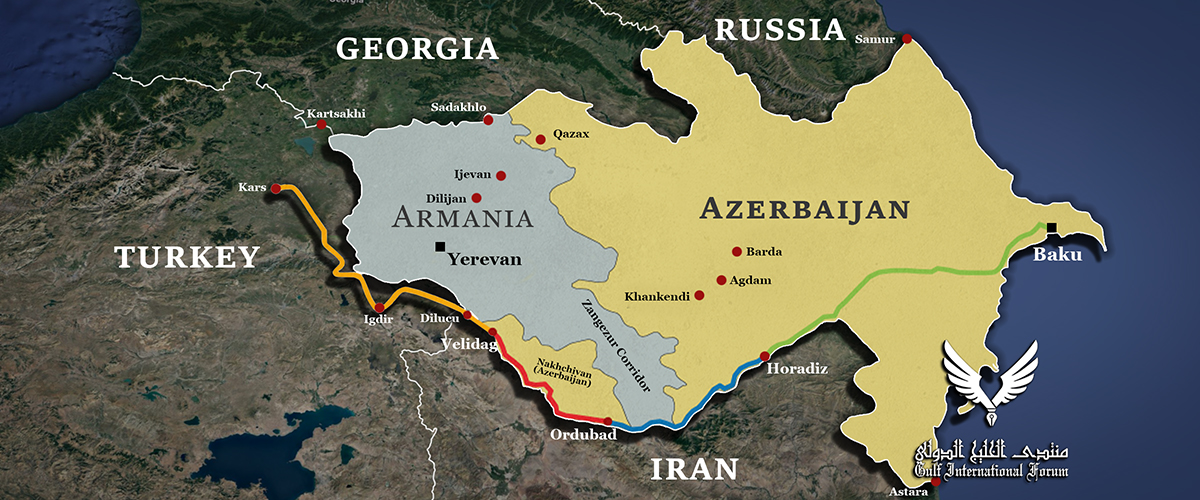
Suffice to say, the Zangezur Corridor will make Turkey a strategic hub in the geopolitics of the region if the Silk Road to Europe passes through its territory and the Soviet era land route to Russia reopens. Russia has separately promised to make Turkey an energy hub for export of its gas as well.
Much to Iran’s discomfiture, Turkey is exploiting Moscow’s dependence on Ankara in the conditions under western sanctions and the Ukraine conflict — Turkey controls the straits leading to the Black Sea from the Mediterranean— to muscle its way into the Caucasus and the Caspian, which has been traditionally Russia’s sphere of influence.
Meanwhile, Russia’s influence in the Caucasus suffered a setback as Armenia’s gradual drift toward Western benefactors following the colour revolution and regime change in Yerevan in 2018 has dramatically accelerated lately and taken an overt form. The Western powers are encouraging Armenia’s current leadership to leave the CSTO and seek the closure of the Russian bases on its soil where 5000 troops are garrisoned.
However, Armenia cannot do without Russia’s help. And Russia has strategic reserves to play itself back into the centre stage of the Caucasian chessboard. Of course, an optimal Russian comeback in the Caucasus will have to wait for its victory over the US and NATO in Ukraine, possibly by next year. Thus, Moscow seems confident that its pre-eminence in the Caucasus is a given.
Russia’s trump card, ultimately, is that much as the US and/or EU may try to get a toehold in the Caucasus, they are faraway powers and pretty much exhausted today with economic anxieties and growing war fatigue in Ukraine, amidst signs of disunity within the EU itself.
Indeed, a summit gathering close to 50 European leaders, dozens of aides and legions of journalists in Grenada, Spain, on October 5, which was billed as an opportunity to broker peace between Armenia and Azerbaijan, ended as a damp squib when Azerbaijan’s Ilham Aliyev and Turkey’s Tayyip Erdogan decided to skip the gathering and Azerbaijan accused France of bias in negotiations.
The bottom line is that in the power dynamic in the Caucasus, Iran is Russia’s natural ally and the two regional powers can be a factor of regional security and stability. This is important, since all sorts of dangers are lurking in the shade in the geopolitics of the Black Sea and Eastern mediterranean and Central Asia, and the darkening horizon presages storms ahead.
To flag a few ominous signs, the US has seized Israel’s escalating confrontation with Hamas and Hezbollah to resort to a major show of force in the Eastern Mediterranean — as if it is preordained. Such force projection cannot be an end in itself. Can it be coincidental that US-trained jihadi groups are also stirring up the Syrian pot lately?
Again, last week, a series of Ukrainian attacks in the Black Sea with Western-supplied cruise missiles forced Russian vessels to relocate from their main base in Sevastopol to the port of Novorossiisk 300 km to the east. British Defence Minister James Heappey promptly called it the “functional defeat of the Black Sea Fleet.”
Moscow is now reportedly planning to build a permanent naval base on the Black Sea coast in the breakaway Georgian region of Abkhazia.
Only a week ago, Russian Foreign Minister Sergey Lavrov warned that Moscow is alarmed by “the attempts of extra-regional players to become more active in the Afghan direction.”
Make no mistake, the US has not reconciled to the ascendance of Russian and Chinese influence in the Middle East or the Iran-Saudi rapprochement that led to an overall easing of tensions, especially Syria’s normalisation with its Arab neighbours, all of which which has drained America’s regional influence and weakened Israel.
Equally, with the spectre of a humiliating defeat in Ukraine haunting the Biden Administration, the temptation must be there to assert American hegemony. A confrontation with Iran is just what may suit Washington as ramp to cover its retreat from Ukraine’s battlefields.
Fundamentally, the US strategy is to get Russia bogged down on multiple fronts and prevent it from advancing Syria’s stabilisation optimally or consolidate its alliances with North African states — Egypt, Libya and Algeria — and expand its presence in the Sahel region which effectively thwarts NATO’s expansion plans in Africa.
Similarly, Iran’s surge as regional power has been to the detriment of Israel’s regional supremacy. Success of the US-Israeli strategy depends on piling pressure on Iran and Hezbollah, who were game changers in the Syrian conflict, and eroding the Russian-Iranian axis in West Asia, the Caucasus and the Caspian.
Armenia’s defection from the Russian orbit and the conflict situation currently developing in Gaza (and Lebanon) provide a window of opportunity to challenge Russia and Iran in the Levant. A vast armada of US warships is approaching the Eastern Mediterranean to intimidate Iran.
Meanwhile, the US hopes to undermine Saudi Arabia’s normalisation process with Iran and create contradictions within BRICS and OPEC Plus.
In sum, like in the famous play by the German modernist playwright Bertolt Brecht, The Caucasian Chalk Circle, we are currently witnessing a play within a play in the great game in Transcaucasia — an extraordinary blend of high theatricality, folk storytelling, music and even dialectical inquiry.
Featured Video
Yemen joins the war – Red Sea could be blocked next – Saudi regime at risk
or go to
Aletho News Archives – Video-Images
From the Archives
Should Europeans ‘Thank’ the Americans for Destroying Nord Stream?
By Robert Bridge | Strategic Culture Foundation | September 29, 2022
With an investigation continuing into the destruction of the Nord Stream gas pipeline that provided energy supplies to Europe from Russia, there appears to be just one prime suspect, and that should surprise nobody.
Following the sabotage of the Nord Stream 1 and 2 gas pipelines, former Polish Foreign Minister Radoslaw Sikorski already seemed to know the identity of the perpetrator when he tweeted out: “Thank you, USA.”
At first glance, it seemed that Sikorski was speaking sarcastically, berating Washington for carrying out an attack that will have severe repercussions for the people of Europe. After all, how could anyone see any good coming from the termination of Europe’s primary source of gas reserves with winter just around the corner? It was Sikorski’s homeland of Poland, after all, that urged its citizens to collect firewood in the face of dwindling gas reserves.
In fact, the Polish diplomat was speaking one-hundred percent literally… continue
Blog Roll
 Aletho News
- Russian Oil Tanker Arrives in Cuba Amid U.S. Blockade
- America Racing to Strategic Defeat in Iran: Lt Col Daniel Davis
- FTC Warns Visa, Mastercard, PayPal, Stripe Over Political Debanking
- Russian tanker approaches Cuba despite US oil blockade
- Marandi: Yemen joins the war – Red Sea could be blocked next – Saudi regime at risk
- Pro-Palestinian French member of European Parliament denied entry to Canada
- Pakistan to Host US-Iran Talks
- How Indonesia’s tilt toward the US left it stranded in the Strait of Hormuz
- US has no choice but to retreat from Iranian borders: Top commander
- Iran Retaliation Strikes Chemical Plant Near Dimona
- If Americans Knew
- Israeli police block Catholic cardinal from entering Church of the Holy Sepulchre on Palm Sunday
- Israel is assassinating journalists again, more than any other nation, anywhere, ever – Not a ceasefire Day 170
- Over 300 US service members wounded, majority have brain injuries – Not a ceasefire Day 169
- Researchers at Human Rights Watch Resign Over Blocked Report on Palestinian Refugee Return
- Jewish Groups Are Backing a War Americans Don’t Want
- Eric Fingerhut Thinks He’s the President of the Jews
- Top Jewish Philanthropists, Rabbis Urge Israeli President to Take Action Against ‘Jewish Extremists’
- Don’t Be Fooled. Zionist Leaders Have Always Wanted to Control Southern Lebanon
- Israel’s widespread use of torture is a core element of its genocide against the Palestinian people
- In Israel’s War on Iran, Many Middle East US Bases Rendered “All But Uninhabitable”
- No Tricks Zone
- New Study Finds Warming Saves Lives…Cold Temperatures 12 Times More Deadly Than Excess Heat
- German Science Blog Accuses PIK Climate Institute Of Hallucinating Climate Tipping Points
- Devastating Assessment Of Comirnaty Vaccine By Former Senior Pfizer Europe Toxicologist
- New Study: CO2 Is ‘Effectively Negligible’ As An Explanatory Climate Change Factor Since 2000
- Former Pfizer Toxicologist Dr. Helmut Sterz Tells Bundestag Hearing Pfizer Vaccine Should Have Never Been Approved
- Energy Expert: Germany’s Nuclear Phaseout Was A “500 Billion Euro Mistake”
- New Research: South Australia’s Mid-Holocene Sea Surface Temperatures Were 4°C Warmer Than Today
- Storing Green Energy To Last Germany 10 Days Would Require A 60-Million Tonne Battery
- New Studies: UK Sea Levels Were 4 Meters Higher Than Today During The Mid-Holocene
- Destructive Green New Deal: German Energy And Metal Group Warns Of Drastic Crisis
 Aletho News