On August 22 Facebook and its CEO Mark Zuckerberg announced that they had arbitrarily removed 652 accounts, groups and pages allegedly linked to Russia and Iran for “coordinated inauthentic behavior,” by which we’re safe in assuming is meant political information inconvenient for the US power structure and its “Euro-Atlantic” elite allies in Europe and elsewhere.
The purpose pursued and the criteria employed are both explicitly political, focusing especially on federal elections. Facebook boasted of recent successes in this regard in France and Mexico.
There are historically-decisive Senate and Congressional elections this November 6th in the US.
At the beginning of this month several major conservative and libertarian Facebook, YouTube and other social media accounts were closed by the above and other parties in a heavy-handed, coordinated manner. The sites and individuals banned are ones that have urged cooperation between the US and Russia and warned against worsening political and potential military conflict between the world’s two major nuclear powers.
What connects the two unprecedented social media purges is an agreement reached in May of this year between Facebook and the Atlantic Council.
The Atlantic Council of the United States was established in 1961 by former Secretaries of State Dean Acheson and Christian Herter to bolster support for NATO. Atlantic Councils were set up in other member states for the same purpose, and at the present time they now number more than 40 in NATO and Partnership for Peace countries. The name is derivative of North Atlantic Council, the highest governing body of NATO.
Due to its efforts, NATO has grown from 16 to 29 members since the end of the Cold War and in addition has recruited at least forty military partners throughout the world. With Colombia joining its Partners Across the Globe program earlier this year, NATO now has members and partners on all inhabited continents.
The partnership between Facebook and the Atlantic Council was described by the Atlantic Council’s president and CEO Fred Kempe as follows:
This partnership will help our security, policy and product teams get real-time insights and updates on emerging threats and disinformation campaigns from around the world. It will also increase the number of ‘eyes and ears’ we have working to spot potential abuse on our service – enabling us to more effectively identify gaps in our systems, preempt obstacles, and ensure that Facebook plays a positive role during elections all around the world.
The collaboration, like NATO and Facebook themselves, are not only avowedly political but unabashedly global in scale.
In the interim Facebook has announced it’s hired “additional third-party reviewers” for the purpose advancing the aforesaid political censorship and furtherance of NATO’s international agenda.
Failing such methods, there are also those proposed by then-president presumptive Hillary Clinton two years ago: “As president, I will make it clear that the United States will treat cyberattacks just like any other attack. We will be ready with serious political, economic and military responses.”
August 29, 2018
Posted by aletho |
Full Spectrum Dominance | Atlantic Council, Facebook, Human rights, NATO |
Leave a comment
This is not at all comforting: during a week that’s witnessed Alex Jones’ social media accounts taken down by Facebook, Apple, Spotify and Google, and what appears to be a growing crackdown against alternative media figures including several prominent Libertarians, notably the Ron Paul Institute director, and the Scott Horton Show, who found their Twitter accounts suspended — we learn that the Atlantic Council is directly advising Facebook on identifying and removing “foreign interference” on the popular platform.
While the initiative was initially revealed last May through an official Facebook media release, more details of the controversial think tank’s role have been revealed.
Supposedly the whole partnership is aimed at bringing more objectivity and neutrality to the process of rooting out fake accounts that pose the threat of being operated by nefarious foreign states.
And yet as a new Reuters report confirms, Facebook is now itself a top donor to the Atlantic Council, alongside Western governments, Gulf autocratic regimes, NATO, various branches of the US military, and a number of major defense contractors and corporations.

What’s more is that the team of four total individuals running the Atlantic Council’s Digital Forensic Research Lab (DFR Lab) is headed by a former National Security Council advisor for the last four years of the Obama administration, Graham Brookie, who is also its founder.
Apparently the group’s work has already been instrumental in Facebook taking action against over two dozen “suspicious pages” flagged potential foreign actors such as Russia. According to Reuters:
Facebook is using the group to enhance its investigations of foreign interference. Last week, the company said it took down 32 suspicious pages and accounts that purported to be run by leftists and minority activists. While some U.S. officials said they were likely the work of Russian agents, Facebook said it did not know for sure.
This is indeed the shocking key phrase included in the report:“Facebook said it did not know for sure.” And yet the accounts were removed anyway.
The Facebook-Atlantic Council alliance reportedly springs from the social media giant’s finding itself desperate for outside “neutral” help after a swell of public criticism, mostly issuing from congressional leaders and prominent media pundits, for supposedly allowing Russian propaganda accounts to operate ahead of the 2016 elections.
And in perhaps the most chilling line of the entire report, Reuters says, “But the lab and Atlantic Council bring geopolitical expertise and allow Facebook to distance itself from sensitive pronouncements.” This is ostensibly to defuse any potential conflict of interest arising as Facebook seems a bigger presence in emerging foreign markets.
Facebook’s chief security officer Alex Stamos recently told reporters, “Companies like ours don’t have the necessary information to evaluate the relationship between political motivations that we infer about an adversary and the political goals of a nation-state.” He explained further that Facebook would collect suspicious digital evidence and submit it to “researchers and authorities”.
Since at least May when the relationship was first announced, the DFR Lab has been key to this process of verifying what constitutes foreign interference or nefarious state propaganda.
But here’s the kicker. Reuters writes of the DFR Lab’s funding in the following:
Facebook donated an undisclosed amount to the lab in May that was enough, said Graham Brookie, who runs the lab, to vault the company to the top of the Atlantic Council’s donor list, alongside the British government.
Facebook employees said privately over the past several months that Chief Executive Mark Zuckerberg wants to outsource many of the most sensitive political decisions, leaving fact-checking to media groups and geopolitics to think tanks.
Facebook has defended the process as part of ensuring that it remains politically neutral, yet clearly the Atlantic Council itself is hardly neutral, as a quick perusal of its top donors indicates.

Among the DFR Labs partners include UK-based Bellingcat, which has in the past claimed “proof” that Assad gassed civilians based on analyzing YouTube videos and Google Earth. And top donors include various branches of the US military, Gulf sates like the UAE, and notably, NATO.
The Atlantic Council has frequently called for things like increased military engagement in Syria, militarily confronting the “Russian threat” in Eastern Europe, and now is advocating for Ukraine and Georgia to be allowed entry into NATO while calling for general territorial expansion of the Western military alliance.
Further it has advocated on behalf of one of its previous funders, Turkish dictator Recep Tayyip Erdoğan and gave a “Distinguished International Leadership” award to George W. Bush, to name but a few actions of the think tank that has been given authorization to flag citizens’ Facebook pages for possible foreign influence and propaganda.
Quite disturbingly, this is Mark Zuckerberg’s outside “geopolitical expertise” he’s been seeking.
August 8, 2018
Posted by aletho |
Civil Liberties, Fake News, Full Spectrum Dominance, Mainstream Media, Warmongering | Atlantic Council, Facebook, Human rights, NATO, United States |
Leave a comment
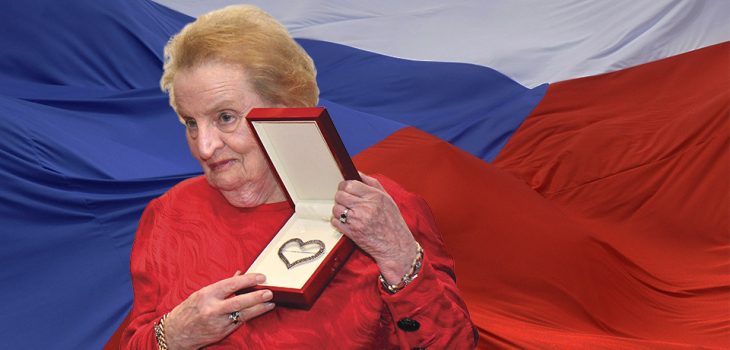
MICHAL CIZEK/AFP/Getty Images
Just when we thought the over-used Bana al-Abed story was in the war propaganda dustbin, the wonder-child theme has again been re-hashed, this time by the Atlantic Council.
The so-called “think tank” recently highlighted the nine-year old at a conference that also included former US secretary of state Madeleine Albright.
Bana, the child presented to the world in late 2016 as tweeting from eastern Aleppo about wanting peace, Russia being bad, Assad being bad, etcetera, became colonial media’s darling, the perfect cover for war propaganda. We are told that Bana al-Abed has written a memoir. She has attended galas, met the Turkish president, and hobnobbed with movie stars and UN officials. Now, the girl has been trotted out on stage to receive an award from the Atlantic Council.
Critical-thinkers aren’t fooled by the Bana story. As I wrote earlier:
Critiques on Amazon reveal that thinking people aren’t buying brand Bana, in spite of her UN appearance and rehearsed speech about children dying from bombs and hunger (which the United Nations retweeted, as all good neutral and credible institutions might).
That her father was a member of a terrorist organization in Aleppo and worked in a Sharia Court has been documented, as has her family’s close proximity to numerous terrorist headquarters in their area of Aleppo alone.
But still, her official story is dragged on, endlessly.
Last April, after the world declared, with zero evidence, that Syria had used a toxic chemical on civilians in Douma, when Syrians testified to the contrary, Western leaders and corporate media labeled giving their testimony as a “masquerade,” “obscene.” They ignored the words of 11-year-old Hassan Diab from Douma. They ignored numerous reports of independent journalists whose reporting from Douma corroborate the testimonies. These people, corporate media tell us, are not to be believed.
Yet, as I wrote earlier, “Corporate media and Western leaders had no issues with the credibility of Bana, who was living surrounded by 25 terrorist cells in her district alone.”
What is the Atlantic Council?
Is the Atlantic Council some benevolent organization handing out awards to do-gooding people?
No. It’s a Washington DC-based think tank, which promulgates lies and propaganda to further imperialist wars and weapons sales, among other things. One of its Syria “experts” is none other than Bellingcat’s Eliot Higgins, who recently took to social media to tell people to suck his “big balls,” making him more of a laughing stock than this backgrounder on the man with no qualifications to his title.
Some of the Atlantic Council’s funders include: the US State Department, oil and weapons manufacturing companies, banks, NATO, various nations’ ministries of defence, and the US Air Force, Army, Marine Corps and Navy.
Even just based on funding alone, and ignoring their pro-NATO policy papers, the Atlantic Council clearly exists to further the interests of those involved in weapons manufacturing, wars, and oil.
‘Banging’: Bellingcat’s interview with Bana
In her interview with Bellingcat, Bana seems more natural than in her early 2017 “save, save the children of Syria” interview (her reply to what kind of food she liked). This time, she can answer basic ‘how are you’ questions. Her replies are met with “cool, cool, cool,” and “banging,” by Bellingcat’s Nick Waters.
After the chit-chat, Bana begins what is clearly a scripted soliloquy, staring forward, possibly concentrating on repeating what is likely being transmitted to her ear, speaking about children and war, destroyed schools, and of course not ever mentioning the terrorists who surrounded her home and occupied schools as headquarters, nor that her own father was a terrorist.
It is a transparently unauthentic recitation, with Bana continually pausing mid-sentence, presumably to hear the rest of what she is told to say. After two and a half minutes of this cringeworthy monologue, she breaks into song, singing “We shall overcome.”
When later receiving her Atlantic Council “Freedom Award,” she gives another rehearsed speech, again halting mid-sentence throughout her five minutes of talking.
These theatrical performances, hosted and encouraged by the Atlantic Council and Bellingcat, epitomize the depth that the NATO alliance is willing to stoop to, grasping desperately at legitimacy in their transparent war propaganda.
It was not only a shameful, but an embarrassing, fail for the Atlantic Council. As of two days later, there isn’t a single positive comment on the Youtube video of her interview. To the contrary, comments speak of child abuse, war propaganda, and that the girl is likely being fed her lines by an earpiece.
On the Atlantic Council’s Youtube channel, comments are disabled for Bana’s award speech.
Failed Sherlocks accuse a non-bot of being a troll
The DFRLab is a project of the Atlantic Council, ostensibly to identify those prolific (Russian) bots and trolls out there.
On June 22, Atlantic Council CEO and President Fred Kempe tweeted:
“Checking in at the 360 / OS #DigitalSherlocks! The @DFRLab team is working together with activists and journalists from all around the world to enhance our ability to identify trolls in the web spreading disinformation and fake news that pollute our open societies.”
The second photo in the tweet identifies three Twitter accounts as possible “trolls”: @Malinka1102, @ian56789, and @bowhunter_va.
One of the accused, @Malinka1102, tweeted about her preference for privacy and not being subjected to witch-hunts and harassment.
Having myself been a target of endless harassment and smear campaigns, I can appreciate her concerns, some of which are also included in a book by Phil Butler’s book.
In fact, a new article by Ben Nimmo—who previously targeted @ian56789 as a “Russian bot” (an accusation revealed to be baseless when Ian gave a live Sky News interview, revealing himself to be a concerned British man)—now targets a number of twitter profiles as “trolls”, including yours truly.
So basically, people who challenge the State Department, sorry, Atlantic Council, Human Rights Watch, and all the other arms of the US and UK governments on their war propaganda are not thinking people with consciences, they are just “trolls”. That’s what DFRLab wants you to believe.
Atlantic Council awards its own war propaganda
On awarding Bana al-Abed, the Atlantic Council tweeted about her humanizing the “Syrian civil war.”
Oh, the irony. The exploited child’s Twitter account has called for World War Three, has whitewashed Al-Qaeda and indeed Bana’s own father Ghassan, a terrorist with the Safwa Brigade.
The irony of also awarding Madeleine Albright — known for her lack of remorse over the 500,000 Iraqi children who died as a result of sanctions — was not lost on people.
Every new Bana production mocks the children in Syria who are actually starving — like those in Ghouta when under terrorist rule, those when under terrorist rule in eastern Aleppo, in Madaya, in al-Waer — and who are being maimed or murdered by terrorist bombings.
The Atlantic Council and Bellingcat are guilty of war propaganda. As @ian56789 wrote to me in a message:
“The members of the Atlantic Council and DFRLab should be indicted as accomplices to War Crimes, for providing actual material support to al-Qaeda terrorists, and for Treason (actively supporting official enemies of the US & UK). They should be spending the rest of their lives in jail and fined every penny they’ve got.”
And those abusing and exploiting Bana al-Abed in their ongoing war propaganda should join them.
Eva Bartlett is a freelance journalist and rights activist with extensive experience in the Gaza Strip and Syria. Her writings can be found on her blog, In Gaza.
June 28, 2018
Posted by aletho |
Mainstream Media, Warmongering, Timeless or most popular, War Crimes | Atlantic Council, Bana al-Abed, Bellingcat, DFRLab, Madeleine Albright |
Leave a comment
The pro-NATO Atlantic Council think tank is set to honor former US Secretary of State Madeleine Albright and Syrian child activist Bana Alabed at its Freedom Awards this week.
The Freedom Awards honor individuals who “defend and advance the cause of freedom around the world” and will be hosted in Berlin later this week — but the nominations have caused quite a few puzzled reactions online.
According to the Atlantic Council website, Albright will be recognized for her “championing of global democracy” and as an exemplar of “the power of diplomacy in achieving solutions to the most pressing challenges facing our world.”
Albright seems like an odd choice, however, given she is known around the world for defending US sanctions on Iraq which caused the deaths of more than half a million Iraqi children.
When asked in an infamous 1996 interview if she thought the sanctions were “worth” the price — the price being hundreds of thousands of dead children — Albright replied almost without hesitation, that “the price is worth it.”
Alongside Albright will be a 9-year-old Twitter activist who is no stranger to controversy herself. Numerous Syrian and international commentators have argued that Syrian opposition icon Bana Alabed has been exploited by her parents and others as a propaganda tool for a pro-war agenda.
Bana began tweeting pro-US intervention messages on Twitter when she was just seven years old. Her tweets were written in perfect English and often incendiary. On one occasion, Bana’s Twitter account posted that it was “better to start 3rd world war instead of letting Russia & assad commit #HolocaustAleppo.”
Despite the controversy surrounding her account and accusations of child exploitation, Alabed will be honored by the Atlantic Council for her “use of social media to bring global attention to the plight of children in rebel-held areas of Syria.”
But maybe the Atlantic Council’s choice of nominees for its Freedom Awards shouldn’t be so surprising. In 2016, the think tank chose to bestow the award on the Syrian Civil Defence, also known as the White Helmets – a controversial outfit which bills itself as a first-responders group in the Syrian war, but operates exclusively in militant-held areas and has been accused of links to terrorist groups, including Al Qaeda.
June 22, 2018
Posted by aletho |
Mainstream Media, Warmongering, War Crimes | Atlantic Council, Middle East, United States |
Leave a comment
Facebook has engaged a think tank funded by weapons manufacturers, branches of the US military and Middle-Eastern monarchies to safeguard the democratic process. It’s akin to hiring arsonists to run the fire brigade.
If Facebook truly wanted to “protect democracy and elections worldwide,” it would build a broad coalition of experts and activists from a wide and disparate range of the countries it serves. Instead, the American social media giant has outsourced the task to NATO’s propaganda wing.
For the uninitiated, the Atlantic Council serves as the American-led alliance’s chief advocacy group. And its methods are rather simple: it grants stipends and faux academic titles to various activists that align with NATO’s agenda. Thus, lobbyists become “fellows” and “experts,” while the enterprise constructs a neutral sheen, which is rarely (if ever) challenged by Western media outlets – often reliant on its employees for easy comment and free op-eds.
While that has always been ethically questionable, Facebook’s latest move, given its effective monopoly position, is far more sinister. Because it is now tied to a “think tank” which has proposed terrorist attacks in Russia and has demanded Russian-funded news outlets be forced to register as “foreign agents” in the United States.
Make no mistake: this is a dream scenario for NATO and those who depend on it for their livelihoods and status. Because the Atlantic Council is now perfectly positioned to be the tail wagging the Facebook dog in the information space.
On Thursday, the social network announced how it was “excited to launch a new partnership with the Atlantic Council, which has a stellar reputation looking at innovative solutions to hard problems.” It then added that “experts” from the Atlantic Council’s Digital Forensic Research Lab (DFRL) will liaise closely with Facebook’s “security, policy and product teams” to offer “real-time insights and updates on emerging threats and disinformation campaigns from around the world.”
Now, this sort of talk would be fine if Facebook had assembled a diverse group, comprised of stakeholders from a wide range of democracies. But, by selecting a clearly biased actor to police “misinformation and foreign interference” during “elections and other highly sensitive moments” and also work to “help educate citizens as well as civil society,” Mark Zuckerberg’s team has essentially made their company a tool of the US military agenda.
Just look at who funds the Atlantic Council: donors include military contractors such as Lockheed Martin, Boeing and Raytheon, all of whom directly profit from tensions with powers like Russia and China. Meanwhile, in addition to NATO itself, there are also payments made by the US State Department, along with bungs from the US Air Force, Army, Navy and Marines.
Other major paymasters include the government of the United Arab Emirates, which is, of course, an absolute monarchy. And more UAE cash comes via the Abu Dhabi state oil company and Crescent Petroleum. Not to be outdone, Morocco, again not noted for its freedoms, also throws significant coin into the bucket.
Clear bias
And here’s the absurdity inherent in Facebook’s approach. It has essentially handed over control to activists who are funded by enemies of democracy and entities which benefit from stirring up hysteria about malevolent external influence in Western elections. Not forgetting, naturally, how the US itself has been, by some distance, the biggest election meddler around.
What’s more, the paucity of Western media coverage of Thursday’s announcement is alarming, because big-hitters like CNN, the Washington Post, BBC and the New York Times (who all frequently use Atlantic Council lobbyists as guests, “experts” or analysts) more-or-less ignored the story. And the outlets who have covered it, such as CNET and The Hill, failed to reference the think tank’s agenda. Notably, influential media journal Adweek even began its report with a description of the lobby group as “non-partisan.”
Now, if you are sitting in Washington, non-partisan may mean supporting neither the Democratic or Republican parties, but in the rest of the world, the Atlantic Council is clearly factional. Because it exists to promote, via NATO, US foreign policy objectives, particularly in Europe.
And, let’s be clear, without Moscow as an enemy, NATO ceases to exist. Which means smearing Russia is an existential matter for the Atlantic Council.
As a result, Facebook’s new partners bear a vested interest in creating the impression that Moscow is interfering in Western elections. Indeed, given the platform’s penetration rates in the country itself, they now also have the power to potentially meddle in Russia’s own polls. This hasn’t been lost on officials in Moscow who appeared alarmed at the development on Friday.
As for why the Atlantic Council was chosen? Well, only last month Mark Zuckerberg was the subject of an intense grilling at the US House of Representatives. And what better way to assuage the Washington establishment’s fears than to employ workers from NATO’s own propaganda adjunct as fact-checkers?
Bryan MacDonald is an Irish journalist based in Russia.
Read more:
May 19, 2018
Posted by aletho |
Deception, Fake News, Full Spectrum Dominance, Mainstream Media, Warmongering, Militarism, Russophobia, Timeless or most popular | Atlantic Council, Facebook, NATO, United States |
Leave a comment
Would you like a think tank advocating acts of terrorism, war and suppression of the media working with Facebook to protect democracy and elections worldwide? If so, great news!
Facebook is “excited to launch a new partnership with the Atlantic Council, which has a stellar reputation looking at innovative solutions to hard problems,” Katie Harbath, Facebook’s director for global politics and government outreach, announced on Thursday.
“Experts” from the Atlantic Council’s Digital Forensic Research Lab (DFRL) will work closely with Facebook’s “security, policy and product teams” to offer “real-time insights and updates on emerging threats and disinformation campaigns from around the world,” Harbath added.
But wait, there’s more! The Atlantic Council’s Digital Research Unit Monitoring Missions will help Facebook watch out for “misinformation and foreign interference” during “elections and other highly sensitive moments” and also work to “help educate citizens as well as civil society.”
While this will likely be cheered by those who still believe that Russian agents acting on personal orders of President Vladimir Putin’s pet bear used Facebook to hack American democracy, everyone else just got a whole list of reasons to be worried about Mark Zuckerberg’s ability to suppress what he believes to be Wrongthink.
The Atlantic Council is basically the academic arm of NATO, an aggressive military alliance that equates freedom and democracy with depleted uranium and regime change in places like Yugoslavia and Libya. The think tank itself hosts lively debates between people who hate Russia and people who really hate Russia. Such is its commitment to Western liberal values, the think tank actually advocated terrorist attacks in Russia and demanded that Russian news outlets be forced to register as foreign agents – a demand that was actually put into effect shortly thereafter.
As for the haughtily named Digital Forensic Research Lab, it employs such luminaries as “couch analyst” Eliot Higgins, aka Bellingcat, and is led by Ben “grammar errors make you a Russian bot” Nimmo.
A recent “expert analysis” by DFRL commissioned by the British government resulted in accusations that real, live people are “Russian bots” only because they dared express opinions differing from those officially sanctioned by the mainstream media. Yet the top two examples used in the report, Ian56 and Partisangirl, both turned out to be real human beings – one a British man and the other a Syrian living in Australia.
Nimmo then tried to wiggle out of the hole he dug for himself by calling the two “trolls” rather than bots, but nonetheless guilty of pushing “Russian” narratives.
This, then, is the outfit Facebook has chosen to team up with “to protect free and fair elections across the world.”
Another reason for teaming up with the Atlantic Council is buried towards the end of Harbath’s blog post, where she says that preventing electoral abuse “requires the right policies and regulatory structures,” and the think tank’s “network of leaders is uniquely situated to help all of us think through the challenges we will face.”
Having connections and access to power and influence certainly doesn’t hurt, especially when Facebook is being raked over hot coals by politicians eager to blame Zuckerberg’s multibillion-dollar enterprise for failing to win elections they believed they were entitled to.
Last month, Facebook also announced it would rank news sites based on “trust.” No details were given as to how that scheme might work, but Facebook has already partnered up with several mainstream media outlets to “fact-check” news.
You know, the same mainstream media who on Wednesday breathlessly reported the fake news that President Donald Trump had called illegal immigrants “animals.” Even a cursory viewing of the event, live-streamed on YouTube, could reveal he was talking about the notorious gang MS-13, but very few outlets bothered to check.
So far, only the Associated Press has retracted the report, acknowledging that it was erroneous. That leaves the question of who will fact-check the fact-checkers. Facebook seems to believe the Atlantic Council will.
Read more:
May 18, 2018
Posted by aletho |
Fake News, Full Spectrum Dominance, Mainstream Media, Warmongering, Timeless or most popular | Atlantic Council, Facebook, United States |
Leave a comment
I sometimes try to get establishment loyalists to explain to me exactly why we’re all meant to be terrified of this “Russian propaganda” thing they keep carrying on about. What is the threat, specifically? That it makes the public less willing to go to war with Russia and its allies? That it makes us less trusting of lying, torturing, coup-staging intelligence agencies? Does accidentally catching a glimpse of that green RT logo turn you to stone like Medusa, or melt your face like in Raiders of the Lost Ark ?

“Well, it makes us lose trust in our institutions,” is the most common reply.
Okay. So? Where’s the threat there? We know for a fact that we’ve been lied to by those institutions. Iraq isn’t just something we imagined. We should be skeptical of claims made by western governments, intelligence agencies and mass media. How specifically is that skepticism dangerous?
Trying to get answers to such questions from rank-and-file empire loyalists is like pulling teeth, and they are equally lacking in the mass media who are constantly sounding the alarm about Russian propaganda. All I see are stories about Russia funding environmentalists (the horror!), giving a voice to civil rights activists (oh noes!), and retweeting articles supportive of Jeremy Corbyn (think of the children!). At its very most dramatic, this horrifying, dangerous epidemic of Russian propaganda is telling westerners to be skeptical of what they’re being told about the Skripal poisoning and the alleged Douma gas attack, both of which do happen to have some very significant causes for skepticism.
When you try to get down to the brass tacks of the actual argument being made and demand specific details about the specific threats we’re meant to be worried about, there aren’t any to be found. Nobody’s been able to tell me what specifically is so dangerous about westerners being exposed to the Russian side of international debates, or of Russians giving a platform to one or both sides of an American domestic debate. Even if every single one of the allegations about Russian bots and disinformation are true (and they aren’t), where is the actual clear and present danger? No one can say.
No one, that is, except the Atlantic Council.
In an absolutely jaw-dropping article that you should definitely read in its entirety, Elizabeth Braw took it upon herself to finally answer the question of why Russian propaganda is so dangerous, using the following hypothetical scenario:
What if Russia suddenly announced that its Baltic Fleet had dispatched an armada towards Britain? Would most people greet the news with steely resolve in the knowledge that their governments would know what to do, or would constant Kremlin-influenced reports about the incompetence of British institutions make them conclude that any resistance was pointless?
I mean, wow. Wow! Just wow. Where to even begin with this?
Before I continue, I should note that Braw is a Senior Fellow at the Atlantic Council, the shady NATO-aligned think tank with ties to powerful oligarchs whose name comes up when you look into many of the mainstream anti-Russia narratives, from the DNC hack to the discredited war propaganda firm Bellingcat to Russian trolls to the notorious PropOrNot blacklist publicized by the Washington Post. Her article, published by Defense One, is titled “We Need a NATO for Infowar”, and it argues that westerners need to be propagandized by an alliance of western governments for our own good.
Back to the aforementioned excerpt. Braw claims that if Russian propaganda isn’t shut down or counteracted, Russia could send a fleet of war ships to attack Britain, and the British people would… react unenthusiastically? Wouldn’t cheer loudly enough as the British Navy fought the Russians? Would have a defeatist emotional demeanor? What exactly is the argument here?
That’s seriously her only attempt to directly address the question of where the actual danger is. Even in the most cartoonishly dramatic hypothetical scenario this Atlantic Council member can possibly imagine, there’s still no tangible threat of any kind. Even if Russia was directly attacking the United Kingdom at home, and Russian propaganda had somehow magically dominated all British airwaves and been believed by the entire country, that still wouldn’t have any impact on the British military’s ability to fight a naval battle. There’s literally no extent to which you can inflate this “Russian propaganda” hysteria to turn it into a possible threat to actual people in real life.
It gets better. Check out this excerpt:
Such responses to disinformation are like swatting flies: time-consuming and ineffective. But not addressing disinformation is ineffective, too. “Western media still have this thing where they try to be completely balanced, so they’ll say, ‘the Russians say this, but on the other hand the Americans say this is not true,’ They end up giving a lie and the truth the same value,” noted Toomas Hendrik Ilves, the former president of Estonia.
I just have so many questions. Like, how desperate does a writer have to be for an expert who can lend credibility to their argument that they have to reach all the way over to a former president of Estonia? And on what planet are these people living where Russian narratives are given the same weight as western narratives by western mainstream media? How can I get to this fantastical parallel dimension where western media “try to be completely balanced” and give equal coverage to all perspectives?
Braw argues that, because Russian propaganda is so dangerous (what with the threat of British people having insufficient emotional exuberance during a possible naval battle and all), what is required is a “NATO of infowar”, an alliance of western state media that is tasked with combatting Russian counter-narratives. Because, in the strange Dungeons & Dragons fantasy fairy world in which Braw penned her article, this isn’t already happening.
And of course, here in the real world, it is already happening. As I wrote recently, mainstream media outlets have been going out of their minds churning out attack editorials on anyone who questions the establishment narrative about what happened in Douma. A BBC reporter recently admonished a retired British naval officer for voicing skepticism of what we’re being told about Syria on the grounds that it might “muddy the waters” of the “information war” that is being fought against Russia. All day, every day, western mass media are pummeling the public with stories about how awful and scary Russians are and how everything they say is a lie.
This is because western mass media outlets are owned by western plutocrats, and those plutocrats have built their empires upon a status quo that they have a vested interest in preserving, often to the point where they will form alliances with defense and intelligence agencies to do so. They hire executives and editors who subscribe to a pro-establishment worldview, who in turn hire journalists who subscribe to a pro-establishment worldview, and in that way they ensure that all plutocrat-owned media outlets are advancing pro-plutocrat agendas.
The western empire is ruled by a loose transnational alliance of plutocrats and secretive government agencies. That loose alliance is your real government, and that government has the largest state media network in the history of civilization. The mass media propaganda machine of the western empire makes RT look like your grandmother’s Facebook wall.
In that way, we are being propagandized constantly by the people who really rule us. All this panic about Russian propaganda doesn’t exist because our dear leaders have a problem with propaganda, it exists because they believe only they should be allowed to propagandize us.
And, unlike Russian propaganda, western establishment propaganda actually does pose a direct threat to us. By using mass media to manipulate the ways we think and vote, our true rulers can persuade us to consent to crushing austerity measures and political impotence while the oligarchs grow richer and medicine money is spent on bombs. When we should all be revolting against an oppressive Orwellian oligarchy, we are instead lulled to sleep by those same oligarchs and their hired talking heads lying to us about freedom and democracy.

Russian propaganda is not dangerous. Having access to other ways of looking at global geopolitics is not dangerous. What absolutely is dangerous is a vast empire concerning itself with the information and ideas that its citizenry have access to. Get your rapey, manipulative fingers out of our minds, please.
If our dear leaders are so worried about our losing faith in our institutions, they shouldn’t be concerning themselves with manipulating us into trusting them, they should be making those institutions more trustworthy.
Don’t manipulate better, be better. The fact that an influential think tank is now openly advocating the former over the latter should concern us all.
May 5, 2018
Posted by aletho |
Full Spectrum Dominance, Mainstream Media, Warmongering, Russophobia, Timeless or most popular | Atlantic Council, Elizabeth Braw, NATO |
Leave a comment
When US President Donald Trump fired a barrage of Tomahawk missiles at Syrian government targets last week, it was a good day for defense contractors, at least.
In the aftermath of the strike, which Trump claimed was in retaliation for an alleged chemical attack by the Syrian government, stocks in Tomahawk missile manufacturer Raytheon surged. Raytheon stock has climbed more than 18 percent in 2018 so far. In fact, stocks in defense companies have been climbing in general since Trump entered office promising “historic” increases in military spending.
Almost a year ago to the day, Trump delivered another bump to the defense companies after attacking Syrian government positions for the first time – also in response to an alleged chemical attack, evidence for which remains in question.
After that strike Boeing, Lockheed Martin, Northrop Grumman and General Dynamics also rose, gaining nearly $5 billion in market value when trading began the next day, even as the wider market slumped.
Later, when Trump appointed the famously militaristic John Bolton as his national security adviser in March, guess what happened? Shares in US energy and defense companies surged yet again. It doesn’t take a rocket scientist to figure this one out: war is profitable. The more missiles Trump fires, the more money these companies make.
But where do the think tanks come in?
There is a pervasive myth that Washington DC ‘think tanks’ are neutral and unbiased players in foreign policy analysis. But where do these centers for foreign policy ‘analysis’ get their money from? You guessed it: defense companies.
There are a few think tanks which dominate in American foreign policy debates. They include the Center For European Policy Analysis (CEPA), the Atlantic Council, the German Marshall Fund (GMF), the Brookings Institution and the Heritage Foundation. All five of them receive generous donations from Lockheed Martin and Raytheon. Three of them also receive funding from the Boeing Company.
Corporations like Exxon Mobil, Northrop Grumman, BAE Systems, and Bell Helicopter are also big donors to think tanks. Bell Helicopter is a funder of CEPA, while Exxon funds Brookings, GMF and the Atlantic Council. BAE Systems donates to CEPA, while Northrop Grumman gives to the Atlantic Council. This is not to even mention the money they get directly from US government departments and NATO, which also helps explain their consistently anti-Russian analysis.
Nonetheless, these think tanks enjoy an undue air of independence. Experts who work for these defense contractor-funded institutes are quoted frequently in mainstream newspapers and invited on mainstream channels, where they are presented as independent voices. But those independent voices somehow always seem to be in favor of policies that benefit weapons manufacturers.
War profiteers are filling their coffers in return for ‘analysis’ which promotes military action and massively inflates the threat posed to America by countries like Russia, for example.
A glance at the Twitter feed of CEPA reveals almost obsession-like focus on the so-called threat from Russia. In 2016, the Lockheed and BAE Systems-funded think tank suggested in a report on information warfare that people who have “fallen victim to Kremlin propaganda” should be “deradicalized” in special programs.
The NATO-funded Atlantic Council has consistently lobbied for regime change in Syria. In the days surrounding Trump’s military actions against Syria last week, the Atlantic Council published multiple pieces of analysis and interviews with a single theme: that Trump did not or would not go far enough with one night of strikes. Earlier, when the alleged chemical attack took place, the think tank argued that Syrian President Bashar Assad was “indulging an addiction” and called on the US to take new military action against him. For some reason, diplomacy does not seem to be high on the Atlantic Council’s agenda.
It seems the more money defense contractors throw at think tanks, the more those think tanks will argue in favor of the military policies that will make those companies the most money. It’s a vicious cycle, but one which doesn’t take much think tank-style ‘analysis’ to figure out.
The sad thing for the think tank lobbyists, is that the money they make calling for war is nothing in comparison to the money Lockheed, Raytheon, Boeing and the rest make from it. Maybe they should ask for a raise.
April 17, 2018
Posted by aletho |
Corruption, Deception, Full Spectrum Dominance, Mainstream Media, Warmongering, Militarism, Russophobia | Atlantic Council, Boeing, General Dynamics, Lockheed Martin, Northrop Grumman, United States |
Leave a comment
Two weeks ago, Saudi Crown Prince Mohammed bin Salman carried out a brutal crackdown on his political opponents, arresting dozens of high-ranking relatives, kidnapping the prime minister of Lebanon, and seeing eight of his political rivals die in a convenient helicopter crash. The “consolidation of power” by the de facto Saudi ruler comes as his government ramps up its siege of Yemen and gets even closer to its US sponsor, thanks to a Trump’s dopey love affair with—and direct assistance of—the regime.
The cynical plan has been met, in some media quarters, with condemnation, but for many in the Western press, Mohammed’s self-serving power grab is the action of a bold “reformer,” a roguish bad boy doing the messy but essential work of “reforming” the kingdom—the “anti-corruption” pretext of the purge largely repeated without qualification. The most prominent sources for this spin were two major newspapers, the New York Times and Guardian:
- Guardian (11/5/17): “Royal Purge Sends Shockwaves Through Saudi Arabia’s Elites: Move Consolidates Power of Prince Mohammed Bin Salman as He Attempts to Reform Kingdom’s Economy and Society”
- Guardian (11/5/17) : “Saudi Arrests Show Crown Prince Is a Risk-Taker With a Zeal for Reform: Mohammed Bin Salman Is Confronting Some of the Kingdom’s Richest and Most Powerful Men in His Anti-Corruption Drive—but Is He Taking on Too Much Too Fast?”
- Guardian (11/6/17): “Oil Price Rises to Two-Year High After Saudi Arabia Purge: Markets Push Price Up to $62 a Barrel After Anti-Corruption Purge by Billionaire Crown Prince Who Backs Prolonging Oil Production Curbs”
- Guardian (11/7/17): “‘This Is a Revolution’: Saudis Absorb Crown Prince’s Rush to Reform: Consolidation of Power in Mohammed Bin Salman’s Hands Has Upended All Aspects of Society, Including Previously Untouchable Ultra-Elite”
- New York Times (11/5/17): “Saudi Crown Prince’s Mass Purge Upends a Longstanding System”
- New York Times (11/14/17): “The Upstart Saudi Prince Who’s Throwing Caution to the Wind”
While the text of the Times articles was far more skeptical about Mohammed’s motives, the Guardian’s (11/5/17) initial coverage of the bloody purge—not just the headlines—was written in breathless press release tones:
Saudi Arabia’s leadership has pulled off its boldest move yet to consolidate power around its young crown prince, Mohammed bin Salman, arresting 11 senior princes, one of the country’s richest men and scores of former ministers in what it billed as a corruption purge.
The move sidelined at least 20 senior figures, among them outspoken billionaire, Prince Alwaleed bin Talal, sending shockwaves through the ranks of the kingdom’s elites, who had long viewed senior royals as immune.
Lots of glowing prose to unpack here. Longtime Mideast correspondent Martin Chulov began by referring to “Saudi Arabia’s leadership,” which is a nice, sterile way of referencing the country’s unelected hereditary king and crown prince. Then he pivoted into marketing pablum about “bold moves” and “consolidating power,” before unironically framing the purge as an “anti-corruption” gesture designed to stick it to the “kingdom’s elites.” One could come away from reading this lead with the impression that the billionaire aristocrat was a populist folk hero in the vein of Robin Hood or John Dillinger. The thrilling profile continued:
Prince Mohammed will oversee the corruption commission, adding to his already formidable list of responsibilities, including his role as Defense minister and champion of the economic transformation, dubbed Vision 2030, that aims to revolutionize most aspects of Saudi life within 12 years.
Prince Mohammed told the Guardian last month that the kingdom had been “not normal” for the past 30 years and pledged to return Saudi Arabia to moderate Islam.
While the author had a “to be sure” paragraph, citing “others” calling it a “naked attempt to weed out dissent,” the overall thrust of the article was that a roguish billionaire Boy King was earnestly seeking “reform” and opposing “elites.”
A follow-up piece (11/7/17) took flattering coverage to new extremes. The dispatch, again by Chulov, cited nothing but anonymous Saudi court hanger-ons and a Gulf-funded talking head from the NATO-aligned Atlantic Council think tank. The article, “‘This Is a Revolution’: Saudis Absorb Crown Prince’s Rush to Reform,” was populated with blind quotes from such adversarial voices as a “senior minister,” “a senior Saudi official,” a “senior figure,” a “senior Saudi businessman” and “veteran business leaders.” (Evidently no junior officials or rookie business leaders were available for comment.)
The article painted the “consolidation of power” by Mohammed as an inevitability with broad support—using the dubious “reform” narrative without irony. With Guardian editors again painting Mohammed as a populist hero by insisting he “upended” “previously untouchable ultra-elite,” one is left to wonder why they don’t consider the absolute-monarch-in-waiting—who just bought a $590 million yacht—part of the “ultra elite.” It’s a curious framing that reeks more of PR than journalism.
This was a trope one could see emerging over the past few months. Similar “bold reformer” frames were used in New York Times editorials (“The Young and Brash Saudi Crown Prince,” 6/23/17) and straight reporting (“Saudi Arabia’s Grand Plan to Move Beyond Oil: Big Goals, Bigger Hurdles,” 10/24/17). Everything’s new and exciting. The brutal, routine functions of the Saudi state are seen as laws of nature—and those in charge of it are the reformers of the very oppression they initially authored.
A Guardian editorial on November 7 was critical of the government, calling it “regressive” and Mohammed “belligerent,” but ultimately rested on “both sides” framing of recent events. The only meaningfully critical coverage of Saudi Arabia coming from the Guardian since the purge has been in two articles (11/12/17, 11/16/17), both in the context of Saudi Arabia’s war on Yemen. Neither mentioned bin Salman, and both stressed how the Saudis are responding in earnest to international pleas to stop their mass-murdering blockade of the Arab world’s poorest country.
Per usual, the Guardian reserves the label “regime” for Official Enemies like Syria and North Korea; Saudi Arabia doesn’t have a regime, it has “leadership.” Unlike adversary governments, often seen in need of “regime change,” the Saudi government merely requires “reform”—and a bold new “reformer,” of the sort championed by the likes of the Guardian and New York Times.
You can send a message to the New York Times at letters@nytimes.com , and to the Guardian at guardian.letters@theguardian.com (Twitter: @NYTimes, @Guardian). Please remember that respectful communication is the most effective.
November 18, 2017
Posted by aletho |
Deception, Fake News, Mainstream Media, Warmongering, Timeless or most popular | Atlantic Council, Middle East, New York Times, Saudi Arabia, The Guardian, Yemen |
Leave a comment
Declassified records from the Reagan presidential library show how the U.S. government enlisted civilian agencies in psychological operations designed to exploit information as a way to manipulate the behavior of targeted foreign audiences and, at least indirectly, American citizens.
A just-declassified sign-in sheet for a meeting of an inter-agency “psyops” committee on Oct. 24, 1986, shows representatives from the Agency for International Development (USAID), the State Department, and the U.S. Information Agency (USIA) joining officials from the Central Intelligence Agency and the Defense Department.
Some of the names of officials from the CIA and Pentagon remain classified more than three decades later. But the significance of the document is that it reveals how agencies that were traditionally assigned to global development (USAID) or international information (USIA) were incorporated into the U.S. government’s strategies for peacetime psyops, a military technique for breaking the will of a wartime enemy by spreading lies, confusion and terror.
Essentially, psyops play on the cultural weaknesses of a target population so they could be more easily controlled or defeated, but the Reagan administration was taking the concept outside the traditional bounds of warfare and applying psyops to any time when the U.S. government could claim some threat to America.
This disclosure – bolstered by other documents released earlier this year by archivists at the Reagan library in Simi Valley, California – is relevant to today’s frenzy over alleged “fake news” and accusations of “Russian disinformation” by reminding everyone that the U.S. government was active in those same areas.
The U.S. government’s use of disinformation and propaganda is, of course, nothing new. For instance, during the 1950s and 1960s, the USIA regularly published articles in friendly newspapers and magazines that appeared under fake names such as Guy Sims Fitch.
However, in the 1970s, the bloody Vietnam War and the Pentagon Papers’ revelations about U.S. government deceptions to justify that war created a crisis for American propagandists, their loss of credibility with the American people. Some of the traditional sources of U.S. disinformation, such as the CIA, also fell into profound disrepute.
This so-called “Vietnam Syndrome” – a skeptical citizenry dubious toward U.S. government claims about foreign conflicts – undermined President Reagan’s efforts to sell his plans for intervention in the civil wars then underway in Central America, Africa and elsewhere.
Reagan depicted Central America as a “Soviet beachhead,” but many Americans saw haughty Central American oligarchs and their brutal security forces slaughtering priests, nuns, labor activists, students, peasants and indigenous populations.
Reagan and his advisers realized that they had to turn those perceptions around if they hoped to get sustained funding for the militaries of El Salvador, Guatemala and Honduras as well as for the Nicaraguan Contra rebels, the CIA-organized paramilitary force marauding around leftist-ruled Nicaragua.
Perception Management
So, it became a high priority to reshape public perceptions inside those targeted countries but even more importantly among the American people. That challenge led the Reagan administration to revitalize and reorganize methods for distributing propaganda and funding friendly foreign operatives, such as creation of the National Endowment for Democracy under neoconservative president Carl Gershman in 1983.
Another entity in this process was the Psychological Operations Committee formed in 1986 under Reagan’s National Security Council. In the years since, the U.S. administrations, both Republican and Democratic, have applied many of these same psyops principles, cherry-picking or manufacturing evidence to undermine adversaries and to solidify U.S. public support for Washington’s policies.
This reality – about the U.S. government creating its own faux reality to manipulate the American people and international audiences – should compel journalists in the West to treat all claims from Washington with a large grain of salt.
However, instead, we have seen a pattern of leading news outlets simply amplifying whatever U.S. agencies assert about foreign adversaries while denouncing skeptics as purveyors of “fake news” or enemy “propaganda.” In effect, the success of the U.S. psyops strategy can be measured by how Western mainstream media has stepped forward as the enforcement mechanism to assure conformity to the U.S. government’s various information themes and narratives.
For instance, any questioning of the U.S. government’s narratives on, say, the current Syrian conflict, or the Ukraine coup of 2014, or Russian “hacking” of the 2016 U.S. election, or Iran’s status as “the leading sponsor of terrorism” is treated by the major Western news outlets as evidence that you are a “useful fool” at best, if not a willful enemy “propagandist” with loyalty to a foreign power, i.e., a traitor.
Leading mainstream media outlets and establishment-approved Web sites are now teaming up with Google, Facebook and other technology companies to develop algorithms to bury or remove content from the Internet that doesn’t march in lockstep with what is deemed to be true, which often simply follows what U.S. government agencies say is true.
Yet, the documentary evidence is now clear that the U.S. government undertook a well-defined strategy of waging psyops around the world with regular blowback of this propaganda and disinformation onto the American people via Western news agencies covering events in the affected countries.
During more recent administrations, euphemisms have been used to cloak the more pejorative phrase, “psychological operations” – such as “public diplomacy,” “strategic communications,” “perception management,” and “smart power.” But the serious push to expand this propaganda capability of the U.S. government can be traced back to the Reagan presidency.
The Puppet Master
Over the years, I’ve obtained scores of documents related to the psyops and related programs via “mandatory declassification reviews” of files belonging to Walter Raymond Jr., a senior CIA covert operations specialist who was transferred to Reagan’s National Security Council staff in 1982 to rebuild capacities for psyops, propaganda and disinformation.
Raymond, who has been compared to a character from a John LeCarré novel slipping easily into the woodwork, spent his years inside Reagan’s White House as a shadowy puppet master who tried his best to avoid public attention or – it seems – even having his picture taken.
From the tens of thousands of photographs from meetings at Reagan’s White House, I found only a couple showing Raymond – and he is seated in groups, partially concealed by other officials.
But Raymond appears to have grasped his true importance. In his NSC files, I found a doodle of an organizational chart that had Raymond at the top holding what looks like the crossed handles used by puppeteers to control the puppets below them. The drawing fits the reality of Raymond as the behind-the-curtains operative who was controlling the various inter-agency task forces that were responsible for implementing psyops and other propaganda strategies.
In Raymond’s files, I found an influential November 1983 paper, written by Col. Alfred R. Paddock Jr. and entitled “Military Psychological Operations and US Strategy,” which stated: “the planned use of communications to influence attitudes or behavior should, if properly used, precede, accompany, and follow all applications of force. Put another way, psychological operations is the one weapons system which has an important role to play in peacetime, throughout the spectrum of conflict, and during the aftermath of conflict.”
Paddock continued, “Military psychological operations are an important part of the ‘PSYOP Totality,’ both in peace and war. … We need a program of psychological operations as an integral part of our national security policies and programs. … The continuity of a standing interagency board or committee to provide the necessary coordinating mechanism for development of a coherent, worldwide psychological operations strategy is badly needed.”
One declassified “top secret” document in Raymond’s file – dated Feb. 4, 1985, from Secretary of Defense Caspar Weinberger – urged the fuller implementation of President Reagan’s National Security Decision Directive 130, which was signed on March 6, 1984, and which authorized peacetime psyops by expanding psyops beyond its traditional boundaries of active military operations into peacetime situations in which the U.S. government could claim some threat to national interests.
“This approval can provide the impetus to the rebuilding of a necessary strategic capability, focus attention on psychological operations as a national – not solely military – instrument, and ensure that psychological operations are fully coordinated with public diplomacy and other international information activities,” Weinberger’s document said.
An Inter-Agency Committee
This broader commitment to psyops led to the creation of a Psychological Operations Committee (POC) that was to be chaired by a representative of Reagan’s National Security Council with a vice chairman from the Pentagon and with representatives from CIA, the State Department and USIA.
“This group will be responsible for planning, coordinating and implementing psychological operations activities in support of United States policies and interests relative to national security,” according to a “secret” addendum to a memo, dated March 25, 1986, from Col. Paddock, the psyops advocate who had become the U.S. Army’s Director for Psychological Operations.
“The committee will provide the focal point for interagency coordination of detailed contingency planning for the management of national information assets during war, and for the transition from peace to war,” the addendum added. “The POC shall seek to ensure that in wartime or during crises (which may be defined as periods of acute tension involving a threat to the lives of American citizens or the imminence of war between the U.S. and other nations), U.S. international information elements are ready to initiate special procedures to ensure policy consistency, timely response and rapid feedback from the intended audience.”
In other words, the U.S. government could engage in psyops virtually anytime because there are always “periods of acute tension involving a threat to the lives of American citizens.”
The Psychological Operations Committee took formal shape with a “secret” memo from Reagan’s National Security Advisor John Poindexter on July 31, 1986. Its first meeting was called on Sept. 2, 1986, with an agenda that focused on Central America and “How can other POC agencies support and complement DOD programs in El Salvador, Guatemala, Honduras, Costa Rica and Panama.” The POC was also tasked with “Developing National PSYOPS Guidelines” for “formulating and implementing a national PSYOPS program.” (Underlining in original)
Raymond was named a co-chair of the POC along with CIA officer Vincent Cannistraro, who was then Deputy Director for Intelligence Programs on the NSC staff, according to a “secret” memo from Deputy Under Secretary of Defense Craig Alderman Jr.
The memo also noted that future POC meetings would be briefed on psyops projects for the Philippines and Nicaragua, with the latter project codenamed “Niagara Falls.” The memo also references a “Project Touchstone,” but it is unclear where that psyops program was targeted.
Another “secret” memo dated Oct. 1, 1986, co-authored by Raymond, reported on the POC’s first meeting on Sept. 10, 1986, and noted that “The POC will, at each meeting, focus on an area of operations (e.g., Central America, Afghanistan, Philippines).”
The POC’s second meeting on Oct. 24, 1986 – for which the sign-in sheet was just released – concentrated on the Philippines, according to a Nov. 4, 1986 memo also co-authored by Raymond.
But the Reagan administration’s primary attention continued to go back to Central America, including “Project Niagara Falls,” the psyops program aimed at Nicaragua. A “secret” Pentagon memo from Deputy Under Secretary Alderman on Nov. 20, 1986, outlined the work of the 4th Psychological Operations Group on this psyops plan “to help bring about democratization of Nicaragua,” by which the Reagan administration meant a “regime change.” The precise details of “Project Niagara Falls” were not disclosed in the declassified documents but the choice of codename suggested a cascade of psyops.
Key Operatives
Other documents from Raymond’s NSC file shed light on who other key operatives in the psyops and propaganda programs were. For instance, in undated notes on efforts to influence the Socialist International, including securing support for U.S. foreign policies from Socialist and Social Democratic parties in Europe, Raymond cited the efforts of “Ledeen, Gershman,” a reference to neoconservative operative Michael Ledeen and Carl Gershman, another neocon who has served as president of the U.S.-government-funded National Endowment for Democracy (NED), from 1983 to the present. (Underlining in original.)
Although NED is technically independent of the U.S. government, it receives the bulk of its funding (now about $100 million a year) from Congress. Documents from the Reagan archives also make clear that NED was organized as a way to replace some of the CIA’s political and propaganda covert operations, which had fallen into disrepute in the 1970s. Earlier released documents from Raymond’s file show CIA Director William Casey pushing for NED’s creation and Raymond, Casey’s handpicked man on the NSC, giving frequent advice and direction to Gershman. [See Consortiumnews.com’s “CIA’s Hidden Hand in ‘Democracy’ Groups”]
While the initials USAID conjure up images of well-meaning Americans helping to drill wells, teach school and set up health clinics in impoverished nations, USAID also has kept its hand in financing friendly journalists around the globe.
Last year, USAID issued a fact sheet summarizing its work financing “journalism education, media business development, capacity building for supportive institutions, and strengthening legal-regulatory environments for free media.” USAID estimated its budget for “media strengthening programs in over 30 countries” at $40 million annually, including aiding “independent media organizations and bloggers in over a dozen countries,”
In Ukraine before the 2014 coup, USAID offered training in “mobile phone and website security,” which sounds a bit like an operation to thwart the local government’s intelligence gathering, an ironic position for the U.S. with its surveillance obsession, including prosecuting whistleblowers based on evidence that they talked to journalists.
USAID, working with billionaire George Soros’s Open Society, also funded the Organized Crime and Corruption Reporting Project (OCCRP), which engages in “investigative journalism” that usually goes after governments that have fallen into disfavor with the United States and then are singled out for accusations of corruption.
The USAID-funded OCCRP also collaborates with Bellingcat, an online investigative website founded by blogger Eliot Higgins, who is now a senior non-resident fellow of the Atlantic Council, a pro-NATO think tank that receives funding from the U.S. and allied governments.
Higgins has spread misinformation on the Internet, including discredited claims implicating the Syrian government in the sarin attack in 2013 and directing an Australian TV news crew to what looked to be the wrong location for a video of a BUK anti-aircraft battery as it supposedly made its getaway to Russia after the shoot-down of Malaysia Airlines Flight 17 in July 2014.
Despite his dubious record of accuracy, Higgins has gained mainstream acclaim, in part, because his “findings” always match up with the propaganda theme that the U.S. government and its Western allies are peddling. Though most genuinely independent bloggers are ignored by the mainstream media, Higgins has found his work touted by both The New York Times and The Washington Post, and Google has included Bellingcat on its First Draft coalition, which will determine which news will be deemed real and which fake.
In other words, the U.S. government has a robust strategy for deploying direct and indirect agents of influence who are now influencing how the titans of the Internet will structure their algorithms to play up favored information and disappear disfavored information.
A Heritage of Lies
During the first Cold War, the CIA and the U.S. Information Agency refined the art of “information warfare,” including pioneering some of its current features like having ostensibly “independent” entities and cut-outs present U.S. propaganda to a cynical public that would reject much of what it hears from government but may trust “citizen journalists” and “bloggers.”
USIA, which was founded in 1953 and gained new life in the 1980s under its Reagan-appointed director Charles Wick, was abolished in 1999, but its propaganda functions were largely folded into the new office of Under Secretary of State for Public Diplomacy and Public Affairs, which became a new fount of disinformation.
For instance, in 2014, President Obama’s Under Secretary for Public Diplomacy Richard Stengel engaged in a series of falsehoods and misrepresentations regarding Russia’s RT network. In one instance, he claimed that the RT had made the “ludicrous assertion” that the U.S. had invested $5 billion in the regime change project in Ukraine. But that was an obvious reference to a public speech by U.S. Assistant Secretary of State for European Affairs Victoria Nuland on Dec. 13, 2013, in which she said “we have invested more than $5 billion” to help Ukraine to achieve its “European aspirations.”
Nuland also was a leading proponent of the Ukraine coup, personally cheering on the anti-government rioters. In an intercepted phone call with U.S. Ambassador to Ukraine Geoffrey Pyatt, Nuland discussed how “to glue” or “midwife this thing” and who the new leaders would be. She picked Arseniy Yatsenyuk – “Yats is the guy” – who ended up as Prime Minister after elected President Viktor Yanukovych was overthrown.
Despite all the evidence of a U.S.-backed coup, The New York Times simply ignored the evidence, including the Nuland-Pyatt phone call, to announce that there never was a coup. The Times’ obeisance to the State Department’s false narrative is a good example of how the legacy of Walter Raymond, who died in 2003, extends to the present.
Over several decades, even as the White House changed hands from Republicans to Democrats, the momentum created by Raymond continued to push the peacetime psyops strategy forward.
In more recent years, the wording of the program may have changed to more pleasing euphemisms. But the idea is the same: how you can use psyops, propaganda and disinformation to sell U.S. government policies abroad and at home.
Investigative reporter Robert Parry broke many of the Iran-Contra stories for The Associated Press and Newsweek in the 1980s.
October 14, 2017
Posted by aletho |
Deception, Full Spectrum Dominance, Timeless or most popular | Atlantic Council, Carl Gershman, CIA, Latin America, Michael Ledeen, NED, Nicaragua, United States, USAID |
Leave a comment
Anyone who watches the news knows that Russian hackers gave Democratic National Committee documents to WikiLeaks and hacked voter databases in 21 states. Prominent Democrats call these shenanigans “a political Pearl Harbor.”
On the blog Daily Kos, one contributor cries “we were robbed!” (arguing that somehow Russian meddling gave Trump a victory in North Carolina, where his margin was 180,000, and where no evidence whatsoever indicates a successful hack of voter databases).
In a new video propamentary, er, docuganda, or something like that, Morgan Freeman declares “we have been attacked. We are at war. This is no movie script.”
Before we hop on the Morgan Freeman train, we might want to consider some history. In 1898, the American press — taking the word of naval investigators — reported that a Spanish mine had destroyed the battleship, U.S.S. Maine. Leading newspapers promptly called for war, and the U.S. government obliged.
Finally, the U.S. became an imperial power with the acquisition of Cuba and the Philippines and a few other odds and ends, at the bargain cost of 2,500 American soldiers dead, plus another 4,000 lost in the Filipino rebellion that followed, not to mention the lives of tens of thousands of Filipino opposition fighters. Only later did it come to light that the Maine was destroyed by a boiler explosion.
In 1915, leading newspapers again whipped up the American public by announcing that a German submarine had sunk the unarmed passenger ship, Lusitania. Two years later — and in part due to lingering outrage over the Lusitania — the U.S. went to war, this time costing 116,000 American lives and over 200,000 wounded, not to mention creating a patriotic frenzy at home that led to beatings, lynchings, and attacks on civil liberties. Decades later, divers proved that the Lusitania was carrying arms to Britain — contrary to government assurances — thus violating international law. German naval intelligence had proved correct.
In 1950, Senator Joseph McCarthy claimed he had a list of men in the State Department who were communists. A credulous press played up his accusations, despite the fact that the numbers on his supposed list kept shifting. McCarthy and his allies in Congress recklessly charged Americans in Hollywood and in government with being either communists or “fellow travelers,” often ruining their careers.
Congress meanwhile passed the McCarran Internal Security Act, which required suspected “subversives” to register with the government. It also permitted the government to round up and hold those same suspected “subversives” on the order of the President. McCarthy, of course, had no real list, and finally ruined his own reputation by accusing Army brass of communist sympathies. McCarthy’s many allies, however, paid no penalty for overreach.
Fake Intelligence
In 1964, President Lyndon Johnson announced that the North Vietnamese had attempted a second torpedo attack on an American destroyer in the Gulf of Tonkin, then used the incident to get Congress to give him the power to make war.
Thanks to the press endorsing the war effort and cheerleading on the nightly news (at least until the Tet Offensive four years later), the Vietnam War led to 58,000 American deaths and over a million war deaths altogether. Covert U.S. forces, meanwhile, kick-started a civil war in Cambodia that ended in genocide after the Khmer Rouge took power. Cambodia lost over half of its population of 7 million between 1970 and 1980.
It later became clear that there had been no second attack on the destroyer in the Gulf of Tonkin; its crew had misread radar signals.
In 2002, U.S. intelligence, via George W. Bush’s administration, told the American public that Iraq had a hand in planning the 9/11 attacks and, moreover, that Iraq secretly maintained an arsenal of weapons of mass destruction that might be shared with Al Qaeda. Both claims were utterly false, yet the American press — particularly the New York Times, the Washington Post, and CNN — led Americans to believe they were true. Far from questioning authority, the press became its servant. The result: 4,500 American war deaths; at least 110,000 Iraqi deaths (some estimates put the figure at over a million); and a destabilized Middle East, wherein both Iran and ISIS (who are bitter enemies) were empowered. In all likelihood, moreover, there would have been no Syrian war had there been no Iraq War.
When the American press and American political leaders loudly accuse another country of “an act of war,” in short, the American public needs to be on the alert. Rather than marginalizing and belittling skeptics, the press and public should give them a fair hearing. Far better to have a spirited debate now than to come to the realization in the future that groupthink created catastrophe.
Hack or Leak? It’s Worth Asking
With all that history in mind, we should be grateful that William Binney, the National Security Agency’s former technical director, is shouting with everything he can muster that the U.S. intelligence community has no solid evidence that Russians hacked the Democratic National Committee. The NSA, he says, would have a record of any overseas exfiltration and could release that data without danger to national security; yet the NSA hasn’t. Though Binney left the NSA 16 years ago, he should know: he created the powerful cyber-vacuum that the NSA still uses.
Binney’s organization, Veteran Intelligence Professionals for Sanity (VIPS), has produced a report in which they argue that forensic evidence from documents produced by Guccifer 2.0 (G2) suggests — strongly — that G2 was a hoaxer. Skip Folden, a VIPS associate and a former elite tech executive with IBM, has issued his own report that buttresses the VIPS report. Adam Carter (a pseudonymous investigator) and Forensicator (another pseudonymous investigator) have also buttressed the VIPS Report, as have cybersecurity expert Jeffrey Carr and former U.N. weapons inspector Scott Ritter (Ritter disagrees with VIPS in part but not on the basic charge of insufficient evidence).
To the extent they mention the skeptics, American journalists dismiss them as fringe. Yet the skeptics deserve a hearing. Among the important points they make is that U.S. intelligence has only identified the Advanced Persistent Threat (APT) groups (APT 28 and 29 to be precise) associated with the hacking, and not the hackers themselves. An APT is a set of common parameters — tools, modes of operation, target patterns — used by hackers. But how certain are our intelligence agencies that Russians stand behind APT 28/29?
It happens that Dimitri Alperovitch of CrowdStrike — the cybersecurity entity that analyzed DNC servers — was asked that question in June 2016. His answer: “medium-level of confidence that FancyBear is [Russian intelligence agency] GRU… low-level of confidence that CozyBear is [Russian intelligence agency] FSB.”
Skip Folden suggests that Alperovitch’s estimates equal a 37-38 percent probability that Russian intelligence stands behind APT 28/29. It’s not clear how Folden came up with that figure. We should note here that Alperovitch subsequently raised his confidence levels to “high,” but then had to reduce them again in March 2017 after realizing that his new assessment was based on phony data published by a Russian blogger. Meanwhile, in January, Director of National of Intelligence James Clapper’s hand-picked team had used Alperovitch’s “high confidence” assessment of Russian hacking of the DNC, which every major network reported dutifully without so much as a blink.
It’s hard to say what additional evidence the NSA/CIA team might have had — or whether there was any — though there are rumors that a Kremlin mole working for Latvia confirmed that Putin ordered his cyber-warriors into action. The NSA, however, didn’t consider the source fully trustworthy (remember Curveball, the wonderful gift of German intelligence?), hence it committed itself to only “moderate confidence” even as the CIA stated “high confidence.” At any rate, the January report lacked both solid technical evidence and more traditional evidence confirming Russian hacking.
Not Making Sense
Several other oddities stand out: first, why would G2 announce himself two days after the DNC reported being hacked, brag he was the hacker, and add that he had given his material to WikiLeaks? WikiLeaks exists for one reason: to give whistleblowers deniability. Normally, people don’t give material to WikiLeaks and then brag about it publicly.
Least of all would Russian intelligence do such a thing, assuming — as some allege — that they routinely use WikiLeaks to disseminate hacked data. Why would Russia implicate its proxy? Why, indeed, would Russia not only cast aspersions on Julian Assange’s honesty, but also cast doubt on the authenticity of the DNC data, given that intelligence services are known to doctor hacked documents? Why, moreover, would G2 give information to WikiLeaks in the first place, given that he had the ability to curate it and disseminate it on his own, as he showed by distributing “choice” (but actually innocuous) data to journalists?
Then there’s the forensic evidence, which shows that (1) G2 put DNC documents into a Russian template; and (2) G2 made those changes on the computer in an East Coast U.S. time zone. Plus, linguistic evidence suggests that G2 showed none of the typical speech idiosyncrasies of a native Russian speaker.
Metadata can be fudged, so it’s possible that (1) and (2) don’t matter. If that is the case, however, one must explain why G2 would drop deliberate clues indicating that he’s Russian — including leaving the name of the founder of the Soviet secret police in one document, along with Cyrillic error messages in another — while also dropping deliberate clues indicating he’s an American leaker. Tricky indeed.
Then there’s another important piece of forensic evidence: the transfer speed, which corresponds to the speed of a download to a local thumb drive rather than to an overseas exfiltration. Critics — including a few VIPS dissenters — promptly insisted that the VIPS report was wrong to assume that such speeds could not be attained in an overseas exfiltration in 2016. Signers of the original VIPS report, however, subsequently conducted multiple experiments to prove or disprove that hypothesis; not once did they achieve a transfer speed anywhere close to that indicated in the DNC metadata.
Critics have also argued that the DNC documents transfer speed may refer to a download to a thumb drive after the initial hack, yet the download would nevertheless have had to have been done on the East Coast of the U.S., since transfer speed metadata correlate to time stamp data. Why would a hacker exfiltrate data to Romania or Russia, then return to the U.S. to download the material to a thumb drive?
Inconsistencies and Uncertainties
The above inconsistencies, I should add, apply to the DNC data, not the Podesta emails. No one, so far as I know, has cast doubt on the theory that the Podesta emails were phished via APT 28. Still, the same rules of caution apply. As Alperovitch himself testified in June 2016, APT 28 does not necessarily prove Russia involvement, and even if it did, no one has proven that Russians gave the Podesta emails to WikiLeaks. There are many other possibilities.
The Wall Street Journal, for instance, reported that Republican operatives were desperately reaching out to the hacking community to locate Hillary Clinton’s 30,000 missing emails. They made contact with several hacking groups including some that claimed to have the emails and even sent samples. The Republicans told the hackers to turn over the emails to WikiLeaks, but — supposedly — offered no payment. It’s not inconceivable, however, that the same Republican dirt-diggers — or others — indeed did pay hackers to turn over materials to WikiLeaks. Even if that occurred, however, the hackers might well have been non-state actors who occasionally work with Russian intelligence, but who otherwise work independently (more on that later), and who were not under orders from Putin. Or, they may have been hackers who have no connection to Russia whatsoever.
Regarding Roger Stone’s infamous remark that “it will soon be Podesta’s time in the barrel,” which has been cited as proof that Stone had foreknowledge of WikiLeaks’ publication of Podesta’s emails, Stone explained on Tuesday that he was referring to his own research on Podesta’s consulting work for foreign governments in the context of similar complaints being lodged against Stone’s friend and Trump’s erstwhile campaign manager Paul Manafort.
Questioning the Investigation
There are worrisome implications here. First, if we are “at war with Russia”; if the hacking was “the crime of the century”; if it’s “bigger than Watergate”; why didn’t the FBI examine the DNC server, given that James Comey admitted that was “best practice”? Why did he rely on CrowdStrike’s analysis, especially given CrowdStrike’s strong ties to the Atlantic Council (created solely to support NATO and heavily funded by foreign entities) and CrowdStrike’s grossly mistaken charges of Russian hacking in other contexts?
Second, why has there been no comprehensive or coordinated Intelligence Community Assessment or a full-scale National Intelligence Estimate — weighing evidence of Russian culpability against contrary theories — by the U.S. intelligence community, given that it has known about alleged Russian election hacking of both the DNC and state voter databases for well over a year?
What we got in January was a hurried intelligence assessment put together by a “hand-picked” team from three agencies, not a consensus of “17 agencies,” as the U.S. press wrongly blared for months. If Russia had committed an “act of war,” then surely President Obama would have ordered the fullest assessment of intelligence that the U.S. is capable of producing; yet he didn’t.
Third, why would Putin order an enormous campaign against Hillary Clinton, knowing that she would very likely win anyway (and did win the popular vote). Would Putin risk the likelihood of President Hillary Clinton finding out about his shenanigans? What implications would that have for the repeal of the Magnitsky Act, for additional sanctions, for Syria, for Ukraine, for NATO funding, for the possibility of renewed Cold War? Perhaps — as James Comey contends — Putin hated Clinton so much that he was willing to play “Russian roulette.” Yet one wonders.
Has the Press Fed Hysteria?
Why, moreover, has the U.S. press barely mentioned the fact that U.S. intelligence services — and the press itself — wrongly accused Russia of the Macron hack? France’s head of cyber intelligence, after finding no evidence of Russian hacking, said this: “Why did [NSA Director Michael] Rogers say that, like that, at that time? It really surprised me. It really surprised my European allies. And to be totally frank, when I spoke about it to my NSA counterparts and asked why did he say that, they didn’t really know how to reply either.”
Think about those words for a moment; they were not meant to be diplomatic. They were unabashedly chastening.
Why, too, has the U.S. press barely mentioned the fact that German intelligence, after a months-long investigation, found no Russian meddling in its recent election (and moreover, found that the supposed Russian hack of the Bundestag in 2015 was likely a leak after all), despite U.S. intelligence agencies’ insistence that Germany was Russia’s next target?
Why do we not hear that Britain found no evidence of Russian efforts to influence Brexit, despite allegations to that effect? Why has the U.S. press wrongly reported a Russian hack of a Vermont utility; a Russian hack of an Illinois water pump; a Russian hack of north Texas voter rolls; a Russian hack of Qatari news media? Add to those examples the latest round of debunkings: there was no Russian attempt to hack Wisconsin voter rolls, nor any Russian attempt to hack California’s. Despite all the debunked stories, the U.S. press eagerly reports new Russia-done-it stories every time some anonymous source breathes a leak.
Here’s a test you can do at home: Type “Germany Russia hacking” into your search engine and see what comes up. Then type “Brexit Russia hacking.” Then try “France Russia hacking.” You’ll get an absolute barrage of stories — hundreds of links — that melodramatically attest to Russian hacking and/or meddling in all three situations, but you’ll struggle mightily to find stories refuting those charges.
One can readily see why some curious soul sitting at home who takes it upon himself to do a little internet research would come away utterly convinced of Russian perfidy. Google here becomes an instrument not of truth-finding, but of algorithmic fake news.
Why, too, did former Assistant Secretary of Department of Homeland Security for Cybersecurity, Andy Ozment, insist in September 2016 that hacking attempts on voter rolls were not of Russian origin, but rather were criminal attempts to steal identification data for sale on the dark net? Why did DHS say as late as October that they lacked evidence to blame Russians? Were they simply protecting the nation against mass hysteria that could cast doubt on the presidential vote?
And yet the basic evidence pattern for attributing the attempted hacks to Russia (or anyone else) hasn’t changed; it’s not as if some new damning piece of evidence emerged after September. Even Reality Winner’s leaked NSA document from June 2017 notes uncertainty about the identity of the hackers. If one looks at the leaked chart showing details of the flow of hacked information, one notes that the final arrow on the left pointing to Russian intelligence (GRU) is marked “probably.” Click here and scroll down to see the blown-up chart.
Incidentally, if you think the case of Reality Winner is a bit suspect — i.e., a cleverish ruse to undermine The Intercept (publisher of the “Winner leak”) and puff up the Russia hysteria — you might want to check out this story. I withhold judgment, personally.
What I Am Arguing
Am I implicating Obama in a conspiracy? No way. Am I suggesting that G2 was a DNC actor seeking to blame Russia for a damaging insider leak to Assange? Not necessarily, but not “not necessarily,” either. There is reason for suspicion at least.
Am I suggesting that U.S. intelligence agencies are lying in order to protect massive U.S. funding for NATO and to force Russia to loosen its ties to Iran and Syria, not to mention lay off Ukraine? No, I am not suggesting any deliberate lie, though yes, wishes can father thoughts. Certainly Trump’s campaign talk of defunding NATO, friendship with Russia, and leaving Syria to Assad ruffled feathers in the intelligence community.
I am far from being a cyber-security expert, let alone knowledgeable about IT, so I write all this in modesty. And yet I find myself agreeing with experts who say that APT associations are not grounds for “high confidence” intelligence assessments, and that the American public deserves to see strong evidence not just of hacking — but of actual Russian hacking — given the magnitude of the issue.
I also find myself agreeing with cyber-security experts who tell us that U.S. intelligence agencies — as well as private cyber-security firms like CrowdStrike — tend to build the evidence around hypotheses, rather than letting the evidence lead to its own conclusions.
I don’t think there’s a conspiracy; I think there’s bias, groupthink, and boss-pleasing — in both the press and the intelligence agencies — just as there was in the Iraq WMD fiasco.
As Folden points out, there are numerous international crime organizations (an $800 billion industry last year) that might well stand behind APT 28/29. Given the sloppiness of the DNC and Podesta hacks (assuming they were hacks), what’s probable is that Russia isn’t doing the work directly, but might be paying a third party that sells its wares to bidders. Or, perhaps Russia isn’t involved.
As Folden notes, numerous states and international crime organizations have strong economic and/or strategic interests in both internal U.S. campaign information and in U.S. elections outcomes. The same observation goes for allegations of hacked voter databases. Any number of entities have both the wherewithal to employ APT 28/29 and an economic interest in harvesting voter identification data.
We should pause to note here that almost all the state database attacks were just that — attacks — not breaches. Unsuccessful attacks cannot be traced to APT groups, only to IP addresses, which are highly unreliable evidence. What few confirmed breaches there were (e.g., Illinois), moreover, did not change election results, and — as with the alleged DNC hack — can only be traced to APTs, not to actual hackers.
Here’s an aside just for fun: why would Russian hackers imagine for a second they could turn Illinois into a Trump state? Clinton won that state by a million votes. Sure, one can understand why Russians might want to meddle with voter roles in a swing state, but Illinois? More likely the hackers were criminals seeking voter identification info, which is precisely why they downloaded 90,000 registration records. The FBI absurdly claimed that Russians needed all those records to figure out precisely how Illinois voter registration works, thus to improve their dirty work. Really? They needed 90,000 records for that?
Pressuring Facebook
Of course, if the voter database attacks turn out to be no-big-deal, the press still will find some new way to exploit the Russia hysteria. The Washington Post and the New York Times — along with the House and Senate Intelligence Committees — are now investigating Russian attempts to use Facebook ads and posts to help Trump win the election. Facebook — thanks to subpoenas from Special Prosecutor Robert Mueller and pressure from congressional Democrats — has turned up $100,000 of suspicious ad buys from phony accounts.
Think of that for a moment: Russians (supposedly) mustered fully $100,000 for ads in a presidential campaign that cost $2.4 billion. Talk about bang for your buck! The current allegation is that over the past three years, a few hundred Russian trolls armed with $100,000 and 470 Facebook accounts (compared to Facebook’s $27 billion in annual revenue and 2 billion monthly users) deployed issues ads (not primarily attack ads against specific candidates) to out-brigade millions of ordinary Americans who posted campaign pieces on Facebook every day, not to mention Clinton’s public relations army.
Poor David Brock paid a million dollars for his own pro-Clinton troll brigade, but they were children compared to these nefarious Russians. It’s a feat right up there with Xenophon’s Anabasis … a tiny force of foreigners, slashing their way through the Persian hordes! Someone get an epic poet!
Of course Sen. Mark Warner, a hawkish vice-chair of the Senate Intelligence Committee, informs us that the $100,000 is just the “tip of the iceberg.” Who knows, maybe the Russians spent $200,000.
Even if these propaganda charges turn out to be 100 percent true — and even if the Russians were clever enough to target voters in the Upper Midwest — it is highly unlikely that they had more influence on the election than a host of other factors, ranging from Clinton’s bad campaign decisions to emailgate to anti-establishment fervor to Trump’s 4-Chan volunteers (did he really need several hundred Russians? Surely he had plenty of home-grown trolls).
Silencing Dissent
So, maybe the Russians did play some small role on Facebook — though I suspect this suspicion, too, will be challenged — but should we therefore conclude that we’re at war, as Morgan Freeman declares? Should we demand that Facebook and Google continue to rework algorithms to shut down posts or ads deemed pro-Russian? Doesn’t that remind anyone of the anti-German hysteria — and censorship — during World War I?
Should we demand, moreover, that the tiny Russian-owned media outlet RT register as a foreign agent — as the Atlantic Council has insisted, and as the Justice Department is now demanding — but not require the same of the BBC and CBC, which are financed by the British and Canadian governments respectively?
What about the Atlantic Council itself, which, receives much of its funding from foreign nations that seek to strengthen NATO? Should the Atlantic Council be required to register as a foreign agent? Does anyone seriously think the Atlantic Council doesn’t propagandize for NATO and for hawkish policies more generally? Or what about the hawkish Brookings Institution, or a host of other think tanks that welcome money from foreign powers?
The unspoken assumption here is that only Russia propagandizes; no other nation is so shifty. Surely Saudi Arabia wouldn’t do such a thing, nor Israel, nor Ukraine, nor countless other nations that seek to influence American policy. After all, they have their paid lobbyists and press buddies working for them every day; they don’t need several hundred trolls.
Let’s be honest, we live in a world in which foreign powers seek to influence American public opinion, just as we seek to influence public opinion in other nations. Which brings to mind a bill that President Obama signed in December, at the outset of the Russia hysteria: “The Countering Disinformation and Propaganda Act,” which created the State Department’s “Global Engagement Center,” which seeks to “recognize, understand, expose, and counter foreign state and non-state propaganda and disinformation efforts aimed at undermining United Sates national security interests.”
The act also offers grants to organizations (think news agencies and research groups) that promise to “counter efforts by foreign entities to use disinformation, misinformation, and propaganda to influence the policies and social and political stability” of the U.S. and allied nations. (Shout out to Rob Reiner; did you apply for one of those grants? Might be a good opportunity for you.)
Does no one see a problem with this? What exactly is foreign propaganda? Is it RT’s occasional charges that the U.S. press treats Trump unfairly? Is it RT’s penchant for left-wing, anti-establishment commentary, e.g., Chris Hedges, Thom Hartmann, and Lee Camp? Our intelligence elites certainly think so, judging from the seven pages they dedicated to RT’s supposed rascally programming in the January intelligence assessment.
And what exactly will it mean to “counter … foreign … disinformation, misinformation, and propaganda”? Will it mean countering any news or commentary deemed anti-NATO or pro-Russian? Any news or commentary deemed pro-Iranian? How exactly will our government define “foreign propaganda”? How, moreover, will it define “national security”? What lengths will it take to deny the American public — not to mention foreigners — access to legitimate opinions?
Alien and Sedition Acts
Perhaps the real analogue here isn’t World War I after all, but the Alien and Sedition Acts of 1798. Of course it wasn’t Russians that President John Adams worried about; it was hot-blooded Irish radicals and French émigrés with their revolutionary idealism, which was ostensibly corrupting the nation. Ordinary Americans were suddenly refusing to vote for their Federalist political betters, and those betters determined to make them pay. Far better to jail Jeffersonian editors and drive out foreigners than to let them endanger America’s “national security.”
We are forsooth reliving the age of Hamilton, I fear, when political elites dance to Wall Street theatricals about anti-democrats while feeling virtuous about opposing “deplorables.” Just don’t expect them to care about free speech. Thanks to our government’s push against so-called fake news, both Google and Facebook have already altered algorithms to such an extent that they have pushed down readership for one old progressive venue, AlterNet, by fully 40 percent (other progressive venues have seen similar declines), thus starving them for ad revenue. Meanwhile neoconservative researchers are trumpeting inch-deep investigations into supposed Russian propagandizing that — thanks to vast funding — may get churned out for years to come.
Let’s not kid ourselves; this project isn’t about shutting down “fake news.” From the moment the Washington Post ran its infamous PropOrNot story in November 2016, the message has been clear: the real threat isn’t Russians, it’s any media outlet that fuels anti-establishment politics.
The Universality of Hacking
All that said, it is still very possible that CrowdStrike and the intelligence community are correct to attribute at least some DNC exfiltration of data to Russians or to loose-leashed teams working as subcontractors, or, alternatively, criminal organizations that sometimes answer to Russia. The one thing that the skeptics (of whom I am obviously one) have not answered is why the CrowdStrike investigation found uniquely modified X-TUNNEL source code in DNC servers, which would seem to have been created for this particular hack.
Since I don’t have years to become a cyber-security expert, I’ll leave the technical experts to further argue that question. However, I am left to wonder whether X-TUNNEL indeed betrays a Russian hack of at least some DNC emails, but that another party altogether — a leaker — was nevertheless responsible for handing the full complement of DNC documents to Wikileaks.
None of the skeptics are claiming that the Russians for certain didn’t hack the DNC (which wouldn’t be that surprising, really; we probably hack their political entities, too). The skeptics are only claiming that G2 was an insider who downloaded documents onto a thumb drive. Both claims can be true.
I’ll add — just to be clear — that I am quite certain that the U.S. intelligence community is correct that the Russian government is engaged in broad hacking attempts aimed at targets all over the world, many of them associated with APT 28/29. But that doesn’t mean they carried out the particular hacks at issue here (or, at least, it doesn’t mean that Russian state actors were behind the WikiLeaks releases, or the attacks on state databases).
And it certainly doesn’t mean — contrary to what over-wrought bloggers claim — that Russians changed 2016 vote tallies. The answer isn’t to shout “war” and create hysteria; the answer is to secure U.S. infrastructure.
I’ll also add that even “high confidence” that Russia hacked the DNC, Podesta, and/or state databases is insufficient grounds for aggressive policy — e.g., harsh sanctions and diplomatic ejections, not to mention military action — let alone grounds for announcing “we are at war.” Suppose for the sake of argument that “high confidence” is 75 percent probability. Would we convict an accused murderer on 75 percent probability?
If we did that — and if the accused were then put to death — we would be knowingly killing 25 innocents out of every 100 we adjudge. The same logic should apply to foreign policy. We should not be taking punitive measures unless we can assess culpability with greater certitude, else we risk harming millions of people who had no role in the original crime.
Where We Stand
It seems to me that we are in uncharted waters. Not everyone can be a cyber-security expert; we must trust those who are. And yet in doing so, we put enormous powers into the hands of unelected technocrats with their own biases and agendas. As others have noted, moreover, the cyber-war community is at odds with the cyber-security community.
On the one hand, intelligence operatives are constantly developing new tools to exploit cyber vulnerabilities of other nations and criminal actors. On the other hand, cyber-security people (e.g., DHS) seek to patch those same vulnerabilities to protect U.S. infrastructure. The problem is that the people who know how to exploit the vulnerabilities don’t want to report those vulnerabilities because it means years of work down the drain. Why make your tools obsolete?
We need to resolve these contradictions in favor of security, not cyberwar.
I cannot say this loudly enough. This whole episode isn’t just about Hillary Clinton losing the election, or Russian hacking of the DNC, or Deep State bias and boss-pleasing. The upshot is that we are entering a cyber-arms race that is going to become ever more byzantine, hidden, and dangerous to democracy, not just because elections can be stolen, but because in guarding against that, we are handing over power to unelected technocrats and shutting down dissenting speech. We are entering a new era; this won’t be the last time that hacking enters political discourse.
We might already be in the midst of a cyber Cold War, though the American public has no idea — flat zero — what sort of offensive gamesmanship our own cyber-warriors are engaging in. (One interesting theory: The Russians deliberately implicated themselves in the DNC hack in order to send a warning to U.S. cyber-warriors: we can play dirty, too).
Presumably not even our cyber-security experts at the DHS and FBI know what the CIA and NSA’s cyber-warriors are up to. Thus Russian hacking becomes “Pearl Harbor” rather than an unsurprising reciprocal response. Both the State Department and the CIA, after all, have been in the foreign propaganda business for decades; the American public, however, has not the vaguest idea of what they do.
We might also be on the brink of something else nightmarish: an international cyber-war with multiple parties participating — attacking one another while no-one-knows-who-did-what.
The intelligence community’s whispered “trust us, we’re the experts” simply isn’t good enough. If we don’t demand hard evidence, then we’re following the same path we took in 1898, 1915, 1950, 1964, and 2003. Let’s not go there.
Daniel Herman is Professor of History at Central Washington University. He specializes in American cultural history and the American West.
September 29, 2017
Posted by aletho |
Deception, Fake News, Mainstream Media, Warmongering, Russophobia, Timeless or most popular | Atlantic Council, Brookings Institution, CIA, DNC, Google, NATO, United States |
Leave a comment
Make no mistake about it: the United States has entered an era of a New McCarthyism that blames nearly every political problem on Russia and has begun targeting American citizens who don’t go along with this New Cold War propaganda.
A difference, however, from the McCarthyism of the 1950s is that this New McCarthyism has enlisted Democrats, liberals and even progressives in the cause because of their disgust with President Trump; the 1950s version was driven by Republicans and the Right with much of the Left on the receiving end, maligned by the likes of Sen. Joe McCarthy as “un-American” and as Communism’s “fellow travelers.”
The real winners in this New McCarthyism appear to be the neoconservatives who have leveraged the Democratic/liberal hatred of Trump to draw much of the Left into the political hysteria that sees the controversy over alleged Russian political “meddling” as an opportunity to “get Trump.”
Already, the neocons and their allies have exploited the anti-Russian frenzy to extract tens of millions of dollars more from the taxpayers for programs to “combat Russian propaganda,” i.e., funding of non-governmental organizations and “scholars” who target dissident Americans for challenging the justifications for this New Cold War.
The Washington Post, which for years has served as the flagship for neocon propaganda, is again charting the new course for America, much as it did in rallying U.S. public backing for the 2003 invasion of Iraq and in building sympathy for abortive “regime change” projects aimed at Syria and Iran. The Post has begun blaming almost every unpleasant development in the world on Russia! Russia! Russia!
For instance, a Post editorial on Tuesday shifted the blame for the anemic victory of German Chancellor Angela Merkel and the surprising strength of the far-right Alternative for Germany (AfD) from Merkel’s austerity policies, which have caused hardship for much of the working class, or from her open door for Mideast refugees, which has destabilized some working-class neighborhoods, to – you guessed it – Russia!
The evidence, as usual, is vague and self-interested, but sure to be swallowed by many Democrats and liberals, who hate Russia because they blame it for Trump, and by lots of Republicans and conservatives, who have a residual hatred for Russia left over from the Old Cold War.
The Post cited the Atlantic Council’s Digital Forensic Research Lab, which has been pushing much of the hysteria about alleged Russian activities on the Internet. The Atlantic Council essentially is NATO’s think tank and is financed with money from the U.S. government, Gulf oil states, military contractors, global financial institutions and many other sources which stand to gain directly or indirectly from the expanding U.S. military budget and NATO interventions.
Blaming Russia
In this New Cold War, the Russians get blamed for not only disrupting some neocon “regime change” projects, such as the proxy war in Syria, but also political developments in the West, such as Donald Trump’s election and AfD’s rise in Germany.
The Atlantic Council’s digital lab claimed, according to the Post editorial, that “In the final hours of the [German] campaign, online supporters of the AfD began warning their base of possible election fraud, and the online alarms were ‘driven by anonymous troll accounts and boosted by a Russian-language bot-net.’”
Of course, the Post evinces no evidence tying any of this to the Russian government or to President Vladimir Putin. It is the nature of McCarthyism that actual evidence is not required, just heavy breathing and dark suspicions. For those of us who operate Web sites, “trolls” – some volunteers and some professionals – have become a common annoyance and they represent many political outlooks, not just Russian.
Plus, it is standard procedure these days for campaigns to issue last-minute alarms to their supporters about possible election fraud to raise doubts about the results should the outcome be disappointing.
The U.S. government has engaged in precisely this strategy around the world, having pro-U.S. parties not only complain about election fraud but to take to the streets in violent protests to impugn the legitimacy of election outcomes. That U.S. strategy has been applied to places such as Ukraine (the Orange Revolution in 2004); Iran (the Green Revolution in 2009); Russia (the Snow Revolution in 2011); and many other locations.
Pre-election alerts also have become a feature in U.S. elections, even in 2016 when both Donald Trump and Hillary Clinton raised questions about the legitimacy of the balloting, albeit for different reasons.
Yet, instead of seeing the AfD maneuver as a typical ploy by a relatively minor party – and the German election outcome as an understandable reflection of voter discontent and weariness over Merkel’s three terms as Chancellor – the Atlantic Council and the Post see Russians under every bed and particularly Putin.
Loving to Hate Putin
In the world of neocon propaganda, Putin has become the great bête noire, since he has frustrated a variety of neocon schemes. He helped head off a major U.S. military strike against Syria in 2013; he aided President Obama in achieving the Iran nuclear agreement in 2014-15; Putin opposed and – to a degree – frustrated the neocon-supported coup in Ukraine in 2014; and he ultimately supplied the air power that defeated neocon-backed “rebel” forces in Syria in 2015-17.
So, the Post and the neocons want Putin gone – and they have used gauzy allegations about “Russian meddling” in the U.S. and other elections as the new propaganda theme to justify destabilizing Russia with economic sanctions and, if possible, engineering another “regime change” project in Moscow.
None of this is even secret. Carl Gershman, the neocon president of the U.S.-government-funded National Endowment for Democracy, publicly proclaimed the goal of ousting Putin in an op-ed in The Washington Post, writing: “The United States has the power to contain and defeat this danger. The issue is whether we can summon the will to do so.”
But the way neocon propaganda works is that the U.S. and its allies are always the victims of some nefarious enemy who must be thwarted to protect all that is good in the world. In other words, even as NED and other U.S.-funded operations take aim at Putin and Russia, Russia and Putin must be transformed into the aggressors.
“Mr. Putin would like nothing better than to generate doubts, fog, cracks and uncertainty around the German pillar of Europe,” the Post editorial said. “He relishes infiltrating chaos and mischief into open societies. In this case, supporting the far-right AfD is extraordinarily cynical, given how many millions of Russians died to defeat the fascists seven decades ago.”
Not to belabor the point but there is no credible evidence that Putin did any of this. There is a claim by the virulently anti-Russian Atlantic Council that some “anonymous troll accounts” promoted some AfD complaint about possible voter fraud and that it was picked up by “a Russian-language bot-net.” Even if that is true – and the Atlantic Council is far from an objective source – where is the link to Putin?
Not everything that happens in Russia, a nation of 144 million people, is ordered by Putin. But the Post would have you believe that it is. It is the centerpiece of this neocon conspiracy theory.
Silencing Dissent
Similarly, any American who questions this propaganda immediately is dismissed as a “Kremlin stooge” or a “Russian propagandist,” another ugly campaign spearheaded by the Post and the neocons. Again, no evidence is required, just some analysis that what you’re saying somehow parallels something Putin has said.
On Tuesday, in what amounted to a companion piece for the editorial, a Post article again pushed the unproven suspicions about “Russian operatives” buying $100,000 in Facebook ads from 2015 into 2017 to supposedly influence U.S. politics. Once again, no evidence required.
In the article, the Post also reminds its readers that Moscow has a history of focusing on social inequities in the U.S., which gets us back to the comparisons between the Old McCarthyism and the new.
Yes, it’s true that the Soviet Union denounced America’s racial segregation and cited that ugly feature of U.S. society in expressing solidarity with the American civil rights movement and national liberation struggles in Africa. It’s also true that American Communists collaborated with the domestic civil rights movement to promote racial integration.
That was a key reason why J. Edgar Hoover’s FBI targeted Martin Luther King Jr. and other African-American leaders – because of their association with known or suspected Communists. (Similarly, the Reagan administration resisted support for Nelson Mandela because his African National Congress accepted Communist support in its battle against South Africa’s Apartheid white-supremacist regime.)
Interestingly, one of the arguments from liberal national Democrats in opposing segregation in the 1960s was that the repression of American blacks undercut U.S. diplomatic efforts to develop allies in Africa. In other words, Soviet and Communist criticism of America’s segregation actually helped bring about the demise of that offensive system.
Yet, King’s association with alleged Communists remained a talking point of die-hard segregationists even after his assassination when they opposed creating a national holiday in his honor in the 1980s.
These parallels between the Old McCarthyism and the New McCarthyism are implicitly acknowledged in the Post’s news article on Tuesday, which cites Putin’s criticism of police killings of unarmed American blacks as evidence that he is meddling in U.S. politics.
“Since taking office, Putin has on occasion sought to spotlight racial tensions in the United States as a means of shaping perceptions of American society,” the article states. “Putin injected himself in 2014 into the race debate after protests broke out in Ferguson, Mo., over the fatal shooting of Michael Brown, an African American, by a white police officer.
“‘Do you believe that everything is perfect now from the point of view of democracy in the United States?’ Putin told CBS’s ’60 Minutes’ program. ‘If everything was perfect, there wouldn’t be the problem of Ferguson. There would be no abuse by the police. But our task is to see all these problems and respond properly.’”
The Post’s speculative point seems to be that Putin’s response included having “Russian operatives” buy some ads on Facebook to exploit these racial tensions, but there is no evidence to support that conspiracy theory.
However, as this anti-Russia hysteria spreads, we may soon see Americans who also protest the police killing of unarmed black men denounced as “Putin’s fellow-travelers,” much as King and other civil rights leaders were smeared as “Communist dupes.”
Ignoring Reality
So, instead of Democrats and Chancellor Merkel looking in the mirror and seeing the real reasons why many white working-class voters are turning toward “populist” and “extremist” alternatives, they can simply blame Putin and continue a crackdown on Internet-based dissent as the work of “Russian operatives.”
Already, under the guise of combating “Russian propaganda” and “fake news,” Google, Facebook and other tech giants have begun introducing algorithms to hunt down and marginalize news that challenges official U.S. government narratives on hot-button issues such as Ukraine and Syria. Again, no evidence is required, just the fact that Putin may have said something similar.
As Democrats, liberals and even some progressives join in this Russia-gate hysteria – driven by their hatred of Donald Trump and his supposedly “fascistic” tendencies – they might want to consider whom they’ve climbed into bed with and what these neocons have in mind for the future.
Arguably, if fascism or totalitarianism comes to the United States, it is more likely to arrive in the guise of “protecting democracy” from Russia or another foreign adversary than from a reality-TV clown like Donald Trump.
The New McCarthyism with its Orwellian-style algorithms might seem like a clever way to neutralize (or maybe even help oust) Trump but – long after Trump is gone – a structure for letting the neocons and the mainstream media monopolize American political debate might be a far greater threat to both democracy and peace.
Investigative reporter Robert Parry broke many of the Iran-Contra stories for The Associated Press and Newsweek in the 1980s.
September 27, 2017
Posted by aletho |
Fake News, Mainstream Media, Warmongering, Russophobia | Atlantic Council, United States, Washington Post |
Leave a comment



 Aletho News
 Aletho News