Ivermectin ban lifted: Australia
The ban on off-label prescribing of the anti-viral drug has been in place for over 18 months
By Rebekah Barnett | Dystopian Down Under | May 3, 2023
Doctors will be free to prescribe ivermectin ‘off-label’ from 01 June 2023, the Therapeutic Goods Administration (TGA) announced today.
This is a reversal of a national ban on off-label prescribing of ivermectin, which the TGA enacted on 10 September 2021, in an attempt to prevent doctors from prescribing the drug to treat Covid.
At the time, the TGA stated that the restriction was necessary because:
- People would be at risk if they took ivermectin instead of getting vaccinated
- People who took ivermectin may choose not to get tested or to seek medical care if they had symptoms
- Social media posts were promoting higher doses of ivermectin than what is normally recommended for approved uses
- There had been a 3-4 fold uptake in ivermectin and the TGA was worried about a shortage disadvantaging vulnerable people who really needed the drug
So, instead of launching a nationwide education campaign and recommending that the Australian Government throw a few million dollars at bolstering the national stockpile of ivermectin, the TGA effectively banned the drug for all but a narrow set of uses.
The TGA has now relaxed the ban because, “there is sufficient evidence that the safety risks to individuals and public health is low when prescribed by a general practitioner in the current health climate.”
It would seem, though, that there was sufficient evidence of ivermectin’s safety all along. In July 2021, Rebecca Weisser wrote in Ivermectin. It’s as Aussie as Vegemite, for Spectator Australia:
As for safety, 3.7 billion doses of ivermectin have been used since 1987 and in 30 years, only 20 deaths following its use have been reported to the UN’s Vigi-Access database. Compare that to remdesivir, which has been given emergency use authorisation to treat Covid in Australian hospitals. In 12 months, there have been 551 deaths reported. Indeed, a study published in the prestigious Journal of the American Medical Association this week found remdesivir did not increase survival, just time spent in hospital.
The TGA’s stated concerns over ivermectin’s safety back in September 2021 seem incoherent when taken alongside its authorisation of remdesivir.
An Australian doctor, who prefers to remain anonymous, was suspended by industry regulator AHPRA for prescribing ivermectin off-label during the pandemic. He says,
“I think the restriction on prescribing ivermectin off-label was disingenuous from the start. It was always about coaching people toward the option of vaccination by removing a legitimate off-label therapeutic option. The decision effectively punished Australians for being self-educated and aware of the scientific evidence supporting ivermectin.
The reversal of the ban is a good step and it appears that doctors may be restored their full rights to off-label prescribing.
But, there remains the question of whether lives have in fact been lost due to the limitation of ivermectin through this policy.”
This is the question posed by Kara Thomas, Secretary of the Australian Medical Professionals’ Society, and Andrew McIntyre, Gastroenterologist and Coordinator of the Doctors Against Mandates legal action, in an op-ed from March this year, also for Spectator Australia. The article raises more questions than answers, but serves to highlight the disparity between the safety profiles of ivermectin (better) and Covid vaccines (worse), as well as a summary of the scientific evidence for ivermectin’s effectiveness.
The effectiveness of ivermectin in treating Covid is hotly argued in all corners of the internet, but it is worth noting that internationally renowned ICU doctor Paul Marik wept when his hospital enforced a policy preventing him from using it in combination with other therapeutics. There are numerous other frontline doctors who similarly expressed dismay at being prevented from administering the drug, after seeing lives saved under their care.
Though prescribing restrictions on ivermectin are to be lifted, the TGA does not endorse off-label prescribing of ivermectin for the treatment or prevention of Covid.
”A large number of clinical studies have demonstrated ivermectin does not improve outcomes in patients with COVID-19. The National Covid Evidence Taskforce (NCET) and many similar bodies around the world, including the World Health Organization, strongly advises against the use of ivermectin for the prevention or treatment of COVID-19.”
It will now be at the discretion of Australian doctors to make their best clinical judgement on a case by case basis.
Monash University, Melbourne, is running a blinded and randomised clinical trial to test ivermectin’s efficacy for Covid prevention. The trial is led by Dr Kylie Wagstaff, whose preliminary in vitro study in collaboration with the Doherty Institute (April 2020) found that ivermectin stopped the replication of the SARS-CoV-2 virus in cell culture within 48 hours.
Just 3% of Australians Are Aware That the Great Barrier Reef is at a Record High, Survey Finds
BY CHRIS MORRISON | THE DAILY SCEPTIC | APRIL 25, 2023
Three-quarters of sampled Australian green voters believe the Great Barrier Reef (GBR) is doing worse than usual, with 44% stating the coral is at a record low. Overall only 3% of all Australian voters knew that the coral was at a “record high” – the correct answer following two years of record growth that has broken all previous records. These findings are not a surprise, since the true picture on the reef has been downplayed, even hidden, by mainstream interested parties in the media and in science.
The results come from a survey carried out by the Australian Environment Foundation (AEF) and is the work of coral authority Dr. Peter Ridd and science journalist Jo Nova. They note that the poor scores reflect badly on media coverage that reports every local coral bleaching event, but rarely the rapid recovery. “It’s almost as if Australians have been subject to years of misinformation,” they say. The silence on the health of the corals is “deafening”. Jo Nova has an idea why the media work so closely with the science establishment to suppress the real story: “Corals are thriving but Australians are spending half a billion dollars to save them.” As atmospheric scientist Richard Lindzen says, the climate narrative is absurd, but trillions of dollars say it is not absurd.
It can be argued that few scientific propositions are more absurd than the suggestion that the recent gentle warming spell is leading to the destruction of coral reefs around the world. In a recent report, Dr. Ridd noted that the IPCC said in 2018 “with high confidence” that corals would decline worldwide by 70-90% if temperatures rose just 0.4°C. Data on coral in many parts of the world are less reliable than for the GBR, but Ridd said it seemed that across the globe there has not been a major drop in coral cover to date.
Corals grow in waters between 24°C and 32°C, and in fact often grow quicker in higher temperatures. But they dislike sudden changes in local water temperature caused by natural weather events such as El Niño oscillations. As a result they often bleach, but the evidence suggests they rapidly return to health as natural conditions become more stable. On the GBR, conditions have been testing until recently with powerful El Niños causing rapid temperatures changes, and cyclones smashing the shallow corals. For decades, scientists and their media messengers have hyped up the temporary loss of coral to secure grants and promote political causes surrounding climate Armageddon.
It obviously worked – and is still working.
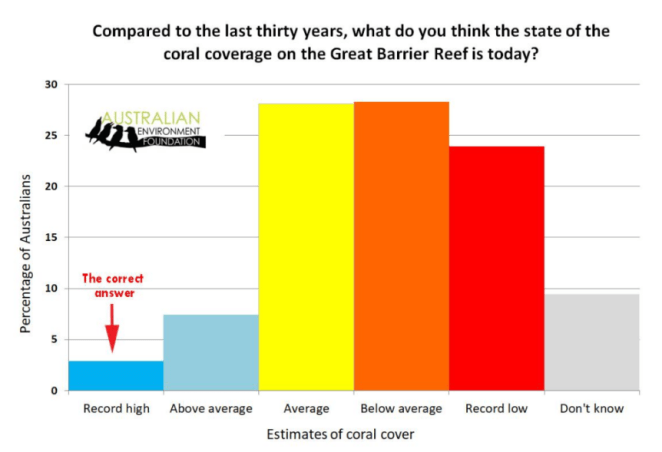
As can be seen, only 3% of Australians know the true state of the coral. Barely 10% knew coral cover was above average, while 80% thought erroneously that the situation was average or worse. Ridd and Niva note that ten years after coral cover hit a record low, half the country still doesn’t realise the reef has recovered. The “phenomenal health” of the GBR is said to be virtually unknown, yet the public are paying half a billion dollars in taxes to save it. In addition the country is “being misled into thinking that expensive low carbon policies and Net Zero targets will help protect the reef, when there is no correlation between CO2 levels and coral cover”.
The authors point some fingers at those responsible for the ignorance about the current condition of the reef among the general population. Four years ago, the State of the Climate report from the national science agency CSIRO and the national weather service the BoM noted that 30% of all coral cover across the entire GBR was lost. “This year, they told us ‘more frequent and severe coral bleaching events are likely’, but did not even mention the excellent health of the reef.” How is that reasonable, they ask. Where are the media, they also ask. “Journalists are supposed to grill professors to make sure they are providing value for taxpayers, not sensationalist, self-serving hyperbole.”
It is often found that those on the Left are more inclined to accept the ‘settled’ climate science narrative, promoting as it does the collectivist Net Zero agenda. A major recent survey in the U.S. found higher levels of belief in the suggested dominant role played by humans in altering the climate among Democrats than Republicans. Nevertheless, the proposition that humans cause all or most global warming has seen general support fall in the U.S. from 60% to 49% in just the last five years. Of course there is lack of sceptical enquiry and there is ignorance, and echo chamber greens seem to score high on both counts.

Record ignorance levels of the true state of the GBR were found among green voters. The populist right of centre One Nation voters recorded much better levels of awareness. Voters for the Liberal party seem to be marginally better informed than Labour.
The AEF results were compiled by a polling company asking 1,004 Australians about the current state of coral coverage on the GBR. The full question and suggested answers are shown in the first graph above. The poll was conducted soon after the news came out of last year’s record high coverage. The authors note that the results largely confirm an earlier similar survey of 1,007 of people in 2022. In that survey, only 7% of voters correctly said that coral cover on the GBR was “well above average”.
Chris Morrison is the Daily Sceptic’s Environment Editor.
Australia’s Defense Review Shows Its Readiness to Side With US in Possible Conflict With China
By Oleg Burunov – Sputnik – 25.04.2023
Implementing all the tasks outlined in Australia’s defense review is a challenge that will take plenty of time, Professor Joe Siracusa, US political expert and dean of Global Futures at Curtin University, told Sputnik.
Australia has rolled out its new defense strategic review, billed by the government as the most significant update of its military planning in nearly 40 years.
The document outlined at least six “priority areas for immediate action,” including the development of Australia’s nuclear-powered submarine capability and longer-range strike capacity, speeding up the integration of new technologies into the military, defense workforce retention and recruitment, plus improving strategic cooperation between Canberra and its key partners in the Indo-Pacific.
“These are major changes which are going to take a great deal of effort to realize, because they have neither the capability to produce the boats right now or the ability to manufacture the missiles unless they buy them off the shelf from the Americans,” Siracusa said, referring to nuclear-powered submarines.
The expert argued that the review “does two things: shows that [Australia’s] Labor [Party] is changing the battle plan for the country, and number two, that it’s serious about funding it.”
“It’s been very hard to get this kind of money up in Australia because Australians don’t like to pay a lot of money for defense. […] And so this is a major decision. And once again, it’s a decision taken by a government on a proposal that will take years to come to fruition, when and if it does. This defense plan is sort of a promissory note,” Siracusa claimed.
Joseph Camilleri, emeritus professor at La Trobe University in Melbourne and one of Australia’s leading international relations scholars, in turn, told Sputnik that the goal of the country’s new defense review is “to equip Australian military forces to support the US in any future military confrontation with China.”
According to him, the Australian government looks “to demonstrate that it remains a close ally of the United States and that it will side with it in any future conflict with China.”
Camilleri was echoed by Scott Burchill, Honorary Fellow in International Relations at Deakin University and author of The National Interest in International Relations Theory and Misunderstanding International Relations.
He recalled that the review stipulates a shift in Australian defense policy towards a closer alignment with the US military in the Asia-Pacific outlined under the AUKUS arrangements, which he said “is an incremental rather than a revolutionary change.”
“The emphasis on greater ‘self-reliance’ is welcome and sensible, but the purchase of nuclear-powered submarines and the ‘interchangeability’ foreshadowed under the AUKUS procurements suggest Australia is heading in the opposite direction: to an even closer alignment with US maritime interests in the region,” Burchill pointed out.
He said that Canberra deciding to side with Washington is “a development that will not be lost on the other countries of the region, Australia’s neighbors, who will again question the sincerity of Australia’s desire to more fully integrate with the Asia-Pacific.”
Climate Change Scandal in Australia Heating Up
BY CHRIS MORRISON | THE DAILY SCEPTIC | APRIL 17, 2023
Further significant doubts have been cast on the accuracy of global surface temperature results following the discovery that electronic thermometers in Australia have read up to 0.7°C higher than traditional mercury glass units. The Australian dataset is a major component of global compilations since it provides an important guide to one of the largest land masses in the southern hemisphere. After many years of trying, local freedom of information requests from scientists have forced the Australian Bureau of Meteorology (BoM) to release comparative information from the two measuring devices around Brisbane airport. It shows that automatic readings are higher 41% of the time, compared with 32% when the temperatures were the same.
Electronic temperatures devices have been in general use in Australia since 1995. The guidance of the World Meteorological Organisation suggests averaging temperatures over a minute to remove corruptions caused by temporary effects such as a sudden gust of hot air. But the BoM records highs for just a second, something that basic mercury thermometers cannot do. For years, the BoM has refused to release comparative instrument data.
The Australian journalist Jo Nova takes a sceptical view as to why the BoM has been so stubborn. Potentially, the electronic sensors “offer a bonanza of propaganda headlines for the Green Blob to pick from, especially when ‘coldest ever days’ get ignored by the media”. The sensors are offering many more headlines of records for heat, heatwaves, hottest nights, more days over 35°C, she continued, adding, “there are many cherries to be picked here”.
The use of highly sensitive measuring equipment to produce temperature records and hence whip up climate emergency fears is common throughout the world. Last year In the U.K., the Met Office promoted a ‘record’ high of 40.3°C halfway down the runway at RAF Coningsby on the afternoon of July 19th. Admittedly, the record was declared to have stood for longer than a second – 60 seconds to be precise. To this day, the Met Office has refused to answer a number of Daily Sceptic enquiries about possible non-climatic causes of this widely promoted record. In the light of the Australian disclosures, we wonder if the Met Office should re-examine the way it declares heat records and compare the results of its measuring devices with those produced by basic mercury thermometers.
Dr. Jennifer Marohasy analysed the three years of Australian data that was eventually squeezed out of the BoM and found significant differences between the two measuring devises. In the most extreme cases, the modern probe was 0.7°C hotter than the mercury reading. She said it contradicted claims by the Bureau’s director Andrew Johnson that measurements from the two instruments are equivalent. Marohasy estimates the BoM holds data for a total of 38 different locations across Australia. The small Brisbane airport cache is thought to be the first public release of this data.
The former Liberal MP and noted climate sceptic Craig Kelly was merciless in his condemnation of the BoM actions. Noting the Bureau’s decision to reduce the size of protective Stevenson screens, which he said was known to artificially increase temperature recordings by up to 1°C, he concluded that Australia’s temperature records “have been cooked to artificially manufacture ‘hottest day ever’ headlines in the media”. Heads must roll, he demanded, but with the new Labor Government protecting this “malfeasance” at the BoM “they’ll get away with it”.
The Australian weighed in by suggesting that the Brisbane revelations raised some “difficult questions” about the BoM’s ability to claim new temperature records are being broken. “Given that new records are claimed on the basis of readings that are only a tiny fraction of a degree warmer, the problem is obvious,” it said in an editorial. The lengths to which the Bureau has gone not to cooperate with FOI requests, it continued, “gives the impression of an organisation with something to hide”. The newspaper said it was “truly astonishing” that the Bureau should suggest that understanding the effect of instrumentation was of no public interest. “This is particularly so given the Bureau was simultaneously publishing reports and giving media interviews claiming that a temperature increase of 1.5°C would have devastating consequences for the planet,” the editorial said.
The BoM information from 38 sites is of more than academic interest, noted the newspaper. This is because much of it eventually finds its way into what becomes the international global temperature record, on which climate change policy is based. The information is the property of the public, it states, and all the parallel records “should be made immediately available alongside all of the other data the Bureau prides itself on making public”.
These disturbing revelations about temperature gathering in Australia add to the numerous concerns that are mounting about the entire global surface temperature record. The Daily Sceptic has covered this story in great detail (see here, here and here). In this case, it seems that modern gauges have been used to establish new ‘records’, compared with the old mercury recordings. In addition, there may be a slight warming bias over the last 30 years, and if confirmed this will add to further corruption of global results. The BoM claimed its new electronic sensors were adjusted in light of mercury readings, but the Brisbane release suggests otherwise. It is particularly disturbing when public officials refuse to release scientific figures for no apparent good reason. The example of Climategate shows that when activists and scientists refuse to release basic data, it is time to start counting the spoons, if not undertaking an audit of the whole canteen.
Chris Morrison is the Daily Sceptic’s Environment Editor.
JOE BIDEN ‘LED THE CHARGE’ FOR TRANS ACTIVISM WITH AN ‘ABSURD STATEMENT’: NASHVILLE SHOOTING
Sky News Australia | April 2, 2023
US President Joe Biden “led the charge” in transgender activism following the Nashville school shooting by releasing an “absurd statement” about Transgender Americans shaping the “nation’s soul”, Sky News host Rita Panahi said.
“That is the state of the culture right now, celebrities, corporates and the overwhelming majority of the media relentlessly pushing the trans activist rhetoric,” Ms Panahi said.
Australian senators refuse to investigate the WHO pandemic treaty
By Tom Parker | Reclaim The Net | March 29, 2023
An Australian senator’s motion to hold an inquiry into the World Health Organization‘s (WHO’s) controversial international pandemic treaty was blocked after Labor and Greens voted against it.
The treaty, which will be legally binding under international law, will expand the WHO’s surveillance powers, allow the unelected global health agency to target “misinformation,” and more. The next stage of discussions on the treaty will begin next week.
The motion, which was introduced by Senator Malcolm Roberts, called for the WHO’s international pandemic treaty to be referred to the Foreign Affairs Defense and Trade References Committee for an inquiry.
Numerous lawmakers supported the motion and blasted the pandemic treaty during a debate.
Senator Roberts accused WHO Director-General of “misleading the public about what the WHO is doing with the pandemic treaty.”
Senator Ralph Babet warned about the “ever-encroaching power of the WHO” and blasted those who had dismissed criticism of the pandemic treaty as a “conspiracy theory.”
Senator Geraard Rennick said that Australia risks being influenced by the “vibe” of the WHO if the treaty passes and pointed to the way where Australia would “religiously… follow the orders or the proclamations from the WHO without any questioning” during the Covid-19 pandemic.
Senator Alex Antic highlighted the mass censorship that occurred during the Covid-19 pandemic and criticized the way people were branded “conspiracy theorists” if they went against the establishment’s Covid narrative.
“Anyone who defied the WHO’s supposedly expert advice, including emminent medical professionals, were censored and vilified by the media and Big Tech at the behest of government and these organizations and… the only narrative that was allowed oxygen were those parroting the WHO,” Antic added. “Many Australian Health Care Providers were suspended for contradicting what was ultimately the WHO’s position on Covid-19 vaccines. Their predictions and observations have turned out to be correct and we’ll see how that narrative is slowly changing.”
Senator Matthew Canavan said Australia “should be getting out of the World Health Organization because of their negligent handling of the coronavirus” and pointed to several of the unelected health agency’s missteps during the pandemic.
However, several senators opposed the motion and praised the WHO.
“This is actually a good thing,” Senator Dorinda Cox said in reference to the treaty. “It’s important that we learn from the responses of governments right across the world so that we can do better next time.”
Senator David Shoebridge claimed that criticism of the WHO’s pandemic treaty was “disinformation” being pushed by a “conspiracy club.”
Despite strong support for the motion from several senators, it was ultimately defeated by two votes, with Labor and Greens voting against it.
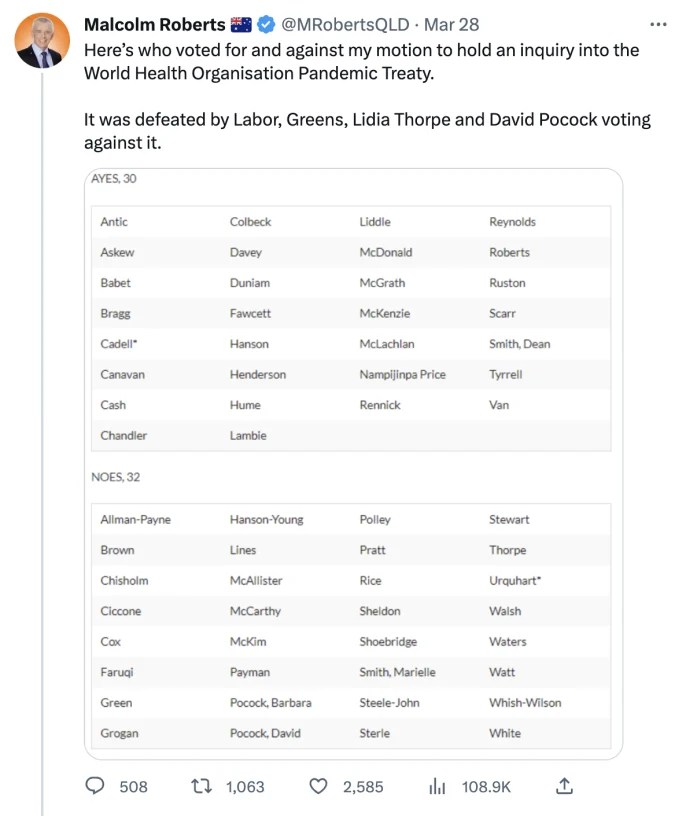
You can watch the full debate on this motion here.
This is one of several recent efforts to shine a light on the WHO’s far-reaching pandemic treaty. United States (US) Senator Ron Johnson recently introduced an amendment to require Senate ratification for any pandemic agreement with the WHO. However, Johnson’s attempt to scrutinize the treaty was also defeated.
Jabbed pilots’ roll call of death and injuries
By Sally Beck | TCW Defending Freedom | March 27, 2023
‘Mayday! Mayday!’ is something no airline pilot wants to say, and no passenger wants to hear, but this month Virgin Australia, Emirates, United and Southwest airlines have all turned back aircraft or made emergency landings because air crew have suffered serious health incidents. A British Airways pilot died of a heart attack just before he was due to fly a plane from Egypt.
Here’s the timeline:
· March 3: Virgin Australia crew received a memo describing why flight VARA A320 from Adelaide to Perth returned 30 minutes into the journey: ‘The First Officer [co-pilot] became unwell. A return to Adelaide was considered the best course of action by the captain.’
· March 11: United flight 2007 from Guatemala to Chicago was diverted because the captain had chest pains, landing at George Bush airport in Houston.
· March 12: It is reported that a British Airways pilot collapsed and died in a hotel in Cairo, Egypt, shortly before he was due to fly.
· March 13: Emirates flight EK205 from Milan turned back because the co-pilot felt unwell 90 minutes after take-off.
· March 22: Josh Yoder, President of US Freedom Flyers, an organisation fighting vaccine mandates for airline staff, tweeted: ‘On a Southwest flight departing Las Vegas, the captain became incapacitated soon after take-off. He was replaced by a non-Southwest pilot who was commuting on that flight.’
According to pilot and medical aviation doctor Jackie Stone, airline pilots have Class One medical clearance. This means they are extremely fit and extremely healthy, with less than a 1 per cent chance per year of having a medical incident that could immobilise them. They receive extensive annual medicals and are grounded if an incapacitating condition is picked up.
This makes the above highly unusual, and the favourite explanation for this increase is vaccine injury. Especially as we now know vaccines can cause myocarditis, heart inflammation which can cause heart attacks, and blood clots, which can lead to heart attacks and strokes, although authorities claim these are ‘rare’.
Glen Waters, a member of Aussie Freedom Flyers, a group fighting aviation vaccine mandates, is a former captain with Virgin Australia whose career was terminated on its twentieth anniversary for refusing the Covid jab. He said: ‘Injuries in aviation following Covid-19 vaccination are occurring and data is not being vigilantly collected or reported. We have a growing list of anecdotal post-vaccination injury reports from pilots, and other staff, across the airline industry.’
Captain Lee Maisey, who worked for Jetstar, New Zealand (owned by Qantas), was fired after 13 years for not being fully vaccinated. She not only suffered vaccine injury but felt her employer was unsympathetic. She said: ‘In November 2021, I reluctantly took a first dose of Pfizer vaccine because I was threatened with being fired. Ten days later I was walking on the beach when my feet went a funny colour, then my legs started going numb and tingly. By the end of the day both arms and both legs were just fizzing.
‘My heart would miss beats and I’d have palpitations.
‘Then came the insomnia. I lay down in bed and my eyes just didn’t shut. It was like that all night. I found out later that this is a side-effect of the vaccine.
‘I told my bosses at Jetstar what was happening. They were not sympathetic. They arranged for me to speak with an aviation medical doctor over the phone. His response to my side-effects was “Yes, that’s normal.”
‘The second was the head of medical. I spent over two hours on the phone, and I was particularly worried about the insomnia. On any other occasion that would be enough to pull my medical [clearance to fly]. I asked her if this would happen, and she said: “It’s up to you.” Which I found remarkable.’
International airline pilot Brit Malone (not his real name) was injured by the AstraZeneca vaccine, not recommended by the FAA but available to pilots outside the US. He was advised not to have another AZ vaccine, but his airline then insisted he get a dose of Pfizer so that he had received the recommended two doses.
Mr Malone said: ‘I succumbed to pressure and had the first dose of AstraZeneca. While I was flying, I was aware of this pain forming in my leg. I didn’t pay too much attention, I go to the gym a lot and thought I’d pulled a muscle.
‘I woke up one morning and found a blue line up the inside of my leg. It was a blood clot. I was off work for three months on blood thinners. It’s been confirmed by a number of specialists that it was vaccine-related.’ Mr Malone has since been diagnosed with cancer and has a 17cm tumour in his liver.
Josh Yoder of US Freedom Flyers said: ‘To ensure passenger safety the pilot medical should be updated to include d-dimer tests, which pick up blood clots, and troponin tests, which measure troponin proteins released when the heart muscle has been damaged.’
Many airlines mandated Covid-19 vaccines even though pilots are not allowed to take part in drug trials and are allowed to receive only approved medication which has been in general use for a minimum of 12 months. The Covid vaccines were, and are still, experimental and we are currently in phase four trials, so pilots should have been exempt.
The US Federal Aviation Administration (FAA)’s recommendations are followed globally by all aviation governing bodies. The FAA website says: ‘The FAA generally requires at least one year of post-marketing experience with a new drug before consideration for aeromedical certification purposes. This observation period allows time for uncommon, but aeromedically significant, adverse effects to manifest themselves.’
Some airlines, especially in Australia and New Zealand, simply sacked pilots refusing to have a Covid vaccination with the result that those still in service and suffering health conditions potentially caused by the jab are trying to hide it. Glen Waters said: ‘The most worrying is flight deck crew failing to disclose medically significant conditions for fear of losing their pilot’s licence.’
Airlines are aware that Covid vaccinations are being questioned for causing serious adverse events but have chosen to ignore all safety signals.
Dr Kate Manderson, the principal medical officer of Australia’s Civil Aviation Safety Authority (CASA), says she has no concerns about Covid vaccinations although she is aware of the case of American Airlines pilot Bob Snow, who suffered a heart attack last year, six minutes after landing his plane in Dallas, Texas. Citizen journalist and entrepreneur Steve Kirsch talked directly to Susan Northrup, who is the Federal Air Surgeon for the FAA, the top medical officer. She has never talked to Snow either although Kirsch provided her with Snow’s phone number. Bob Snow says that he has never been contacted by any authority for information about his vaccine-induced heart attack.
In June 2021, I reported that four British Airways pilots had died unexpectedly but BA refused to confirm or deny whether vaccines were implicated.
Fed up with negotiating with their airlines, pilots are fighting back. Qantas pilot Alan Dana, who set up Aussie Freedom Flyers, and former Virgin Australia captain Shane Murdock have launched a legal action on behalf of pilots, engineers, ground staff, and cabin crew, against Qantas and Virgin for breach of contract and unfair dismissal. They say aviation staff cannot be legally injected if they are being coerced, while both airlines argue this is not the case.
To support Aussie Freedom Flyers’ class action please donate here or here.
US Freedom Flyers have also launched a legal action.
The FAA issued this statement: ‘The FAA’s Federal Air Surgeon determined that pilots and air traffic controllers can safely receive the Pfizer, Moderna, Johnson & Johnson or Novavax vaccine. The FAA has seen no credible evidence of aircraft accidents or incapacitations caused by pilots suffering medical complications associated with COVID-19 vaccines.’
A Jetstar spokesperson said: ‘All New Zealand-based pilots, irrespective of the airline they work for, were required under New Zealand government health orders to be fully vaccinated in order to fly. All Jetstar employees are required to comply with government requirements at all times.’
We contacted all five airlines mentioned at the top of this article and Australia’s Civil Aviation Safety Authority but received no response.
USA criticized globally over MQ-9 drone incident
By Vladimir Danilov – New Eastern Outlook – 20.03.2023
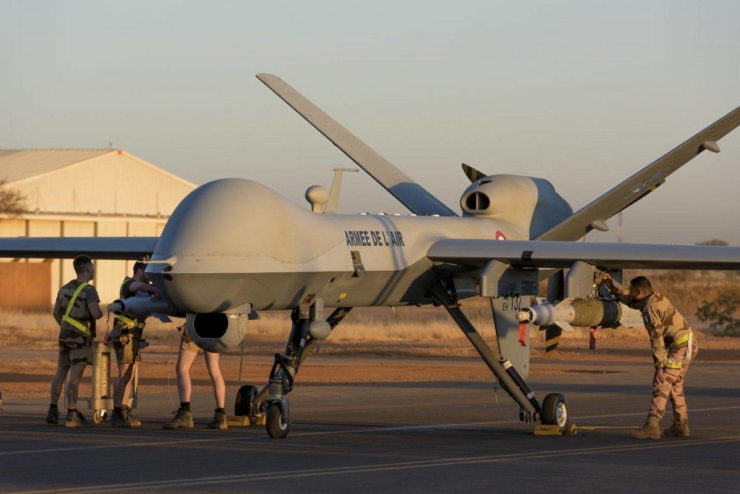
The crash of an American MQ-9 drone heading for the Russian border in the Black Sea near the Crimean Peninsula on March 14 in the morning is likely one of the most discussed topics in the global media in recent days.
According to an official communication from the Russian Defense Ministry, the US UAV’s flight was in violation of the temporary airspace use regime established in accordance with international norms for the area’s boundaries due to the special military operation, and its transponders were turned off. Fighter jets from Russian Aerospace Forces were deployed in the air to identify the intruder. The MQ-9 made a quick maneuver that caused it to lose control of its flight and crash into the water. The Russian fighter jets did not engage the unmanned aerial vehicle during the incident and did not fire any of their on-board weaponry.
The MQ-9 Reaper is a modular reconnaissance and strike US UAV that can carry a variety of combinations of weapons and electronic equipment depending on the mission, including carrying an arsenal of tactical nuclear weapons. As a result, there is no doubt about Russia’s eligibility for protective measures against the United States’ hostile use of the said UAV against Russia. Especially in light of recent open calls by various US representatives for the armed destruction of the Russian Federation. In particular, former US National Security Adviser John Bolton’s call to define the objectives of the US-Russia war.
In contrast to US military officials’ attempts to portray the incident as a “wrongful act by Russia,” particularly Gen. James Hecker, Commander of US Air Forces in Europe and Air Forces Africa, ordinary Americans are discussing the blatantly “insane” US version of the incident that caused the MQ-9 UAV to crash into the Black Sea. Thus, US armed forces veteran Noctis Draven emphasized that Washington’s anti-Russian propaganda narrative is “easily disproved,” and that if Russia had hostile intentions, the MQ-9 would have been shot down without endangering the pilot or the aircraft.
The MQ-9 incident has been widely discussed in the US media, noting that it is in fact the first direct military confrontation between Russia and the US since Moscow launched its special operation in Ukraine.
For example, Joe Rogan in his podcast PowerfulJRE pointed out that the current White House administration is actively pushing the US to an outright war with Russia, bringing about the feeling of chaos in the country.
According to Fox News host Tucker Carlson, an administration like this could lead to a hot war with Russia and China whether you want it or not.
According to a CNN report, the MQ-9 incident in the Black Sea may contribute to growing support in the United States for the view that aid to Ukraine is not a national security issue for Washington.
The international public has also reacted strongly to the incident, in a way that is clearly unfavorable to the United States and US propaganda.
According to the Chinese Global Times tabloid, such incidents have become more common in recent years around the world. It is emphasized that the United States is surprisingly involved most of the time. The publication stresses that this has become a habitual tactic of provoking enemies, and that a couple more such cases will cause the world to explode.
Guancha readers openly mocked Washington for the botched spying mission in the Black Sea, pointing to the US’s incompetence, whose drone crashed into the water. They praised Russia for “teaching a lesson” to America, self-assured in its permissiveness, without even opening fire, causing the MQ-9 to fall into the water in fear of the Russian Su-27.
As the Global Times correctly points out, the White House clearly requires such incidents in order to complicate the global situation and fight “against the unwanted.” How else can the provocative flight of the American MQ-9 Reaper drone near the Russian state border and the incident in the Black Sea be explained? Since the Cold War’s end, Washington has routinely staged such incidents, frequently targeting countries that the US publicly refers to as enemies.
The Austrian media, which is aghast at the prospect of the United States starting World War III, also points out that America recently staged a provocation with a B-52 bomber, and now the MQ-9 Reaper drone incident. The Austrian journalists wonder what Washington hopes to accomplish by conducting such dangerous “tests” of Russia’s defense capabilities. After all, today, it is clear to everyone that provocations like the ones on March 14 in the Black Sea and the day before with the B-52 bomber near St. Petersburg could be used as a pretext for war.
The opinions of the readers of the French Le Figaro are also quite revealing. Some of them believe that the USA was very “unprofessional” trying to spy on Russia and got what it deserved, while others admit that it was a “flawless operation” by Moscow. The video of the MQ-9 downing in the Black Sea, released by the US, caused no distress among French media readers. They called it “just another batch of oil the Americans poured on the fire.”
Readers of the German magazine Der Spiegel support Russia and are perplexed as to why the West is outraged by its actions. They suggest we look at the map to see for ourselves that American drones have no business over the Black Sea.
Australia’s The Sydney Morning Herald does not rule out that the US drone incident in the Black Sea could trigger a new round of tensions, becoming the first very dangerous incident of its kind since the Cold War. The majority of the publication’s readers blame Washington, specifically asking: what was that drone doing there?
According to some political analysts, the March 14 MQ-9 incident is unlikely to cause any serious consequences in relations between Russia and the US or result in a military clash between the two countries. After all, Washington’s remaining “cool heads” only need to take the necessary steps.
Following the MQ-9 Reaper drone incident over the Black Sea, the US has already begun analyzing the costs and benefits of such missions, weighing the potential value of intelligence obtained in this manner against the risk of escalation in relations with Russia, according to recent information. The US military is specifically instructed to “carefully study” UAV routes and assess ways to reduce the risk of conflict with Moscow, especially considering Russian aviation operations in the Crimea.
However, similar risks exist not only in the Black Sea region, but also in the Baltic Sea, as evidenced by an incident 200 kilometers away from St. Petersburg the day before the MQ-9 events. Then, as you may know, B-52 Stratofortress US strategic bomber capable of carrying nuclear weapons and accompanied by Polish fighters, flew over Lithuanian airspace, approached the Russian border at the greatest possible distance, and went into position, simulating bombing readiness. Similar incidents may occur in the Arctic, near Russia’s borders in the Asia-Pacific region, if Washington makes new anti-Russian or anti-Chinese provocations there.
In any case, the US must temper its aggressive cowboy zeal, lest its provocative actions push the world dangerously close to the outbreak of World War III. Especially since there is still no clarity in identifying those responsible for the terrorist attack on the Nord Stream pipelines in the Baltic Sea.
The AUKUS nuclear submarine deal is part of an imperialist crusade against China
By Timur Fomenko | RT | March 17, 2023
Earlier this week, a trilateral summit was held with the leaders of Australia, the United Kingdom and the US in San Diego to flesh out the details of an AUKUS deal providing Canberra with nuclear-powered submarines, with the intention of containing China in the Indian and Pacific Oceans.
The pact will also create a rotational presence of UK and US nuclear submarines near Perth, Western Australia, starting from 2027. The goal is to integrate the US and UK’s nuclear sub fleet while Australia “builds the necessary operational capabilities” of its own.
It is no coincidence that the deal was announced on Commonwealth Day, an annual celebration of the former dominions of the British Empire. On the same day, the UK government released its “integrated review,” whereby it vowed to increase defense spending. Prime Minister Rishi Sunak then proceeded to describe China as an “epoch-defining challenge,” framing the UK, and the AUKUS alliance at large, as a benevolent force dedicated to keeping the Indo-Pacific open and free. China reacted by harshly condemning the meeting, decrying it for a “typical Cold War mentality” that “will only exacerbate [an] arms race, undermine the international nuclear non-proliferation regime and hurt regional peace and stability.”
China’s interpretation of the AUKUS submarine deal is correct. The Biden administration is aggressively expanding its alliance system in a bid to militarily contain Beijing. Along with the AUKUS pact, it is also pushing for trilateral cooperation with South Korea and Japan, something South Korean President Yoon Seok Yeol is open to, expanding its military presence in the Philippines, and taking part in other regional groups such as the Quad. However, AUKUS is unique because it consists solely of Anglosphere nations, and as such, embodies the neo-imperialist sentiment of Anglophone exceptionalism.
The UK’s decision to pursue an increasingly anti-China foreign policy is, of course, influenced by the US and against Britain’s best interests. However, its foreign policy narrative, especially in light of Brexit, is clothed in imperial nostalgia, which reflects back on the British Empire as a “force for good.” It drums up not memories of enslavement, exploitation, or aggression against other countries, but the idea of Britain as a “benevolent” empire which enforced the “rules of the world” acting as a “global policeman,” using its unmatched naval power to beat back aggressors and enforce its will.
Anyone who knows a thing or two about history will be aware that this is an idealistic and revisionist view, and that China was subjected to extreme aggression as Britain sought to forcibly open the country, seize ports and annex territory in the name of Hong Kong, giving way to what Beijing describes as “the century of humiliation.” Although the British Empire no longer exists, the country’s leaders continue to live in the past and the legacy of British Imperialism lives on through the hegemony of the United States and the countries the Empire gave birth to, such as Australia. These offspring continue to “carry the baton” through what they now proclaim to be the “rules-based order.” As a result, they frame continued military expansionism against Beijing as a morally, ideologically, and justified cause.
In reality, AUKUS is a destabilizing force in the Asia-Pacific region, inducing arms races and raising tensions. Neutral countries, who the West would normally hope to align with, such as Indonesia, are wary about AUKUS. This is because it threatens the strategic balance of the region. Moreover, while AUKUS claims to prevent war, it in fact encourages it. As scholar Adam Ni aptly described “it’s like paying insurance premium to increase the likelihood of a car crash.” China is now forced to respond to AUKUS by increasing its own defense spending and military presence and more deeply aligning with countries such as Russia. This plays into US hands by creating a vicious circle, further increasing the likelihood of war.
AUKUS is a post-Imperialist crusade, part of the Biden administration’s multi-faceted campaign to upend peace in Asia and transform the region into a military arena. It is a bid to create a NATO-like system in the Pacific which may be expanded in the future. It is not a commitment to peace, but a commitment to war and destabilization, with an explicit intention to target China. The alliance is laden with the identity, ideology and nostalgia of British imperialism, which shows no respect for the region, its history or its people, and as such peace-loving nations should reject it. Although it is likely to be years before any practical results are seen from this alliance, the projected tensions and political sentiment are going to be felt immediately and abruptly.
Australian premiers spar over nuclear sub waste disposal
RT | March 16, 2023
The Australian political establishment is divided as to where the federal government should dispose of nuclear waste associated with the country’s expanded submarine deal with its AUKUS allies.
An accord was struck by the leadership of the countries which make up the trilateral AUKUS alliance – Australia, the United States and the United Kingdom – when they met in San Diego, California earlier this week, which rubber-stamped the sale of nuclear-powered submarines by Washington to Canberra.
In addition, Australia Prime Minister Anthony Albanese confirmed that his country would construct its own fleet of nuclear submarines, which will be delivered in the early 2040s. The terms of the agreement stipulate that the Australian government will be responsible for the disposal of nuclear waste from the vessels – but this appears to have opened a new political front for the country’s various state leaders.
“I think the waste can go where all the jobs are going,” said Victorian Premier Daniel Andrews via the Australian Broadcasting Corporation on Thursday, referencing the 8,000 jobs which are expected to be generated in South Australia during the construction of the military submarines. “I don’t think that’s unreasonable, is it?”
West Australian Premier Mark McGowan has also indicated that nuclear waste disposal sites are unwelcome in his state, joining Andrews in suggesting South Australia as the most appropriate location.
Susan Close, the acting South Australian premier who doubles as the region’s environment minister, responded to the suggestions by saying the decision on nuclear waste locations should be dictated by science and not by “state leaders trying to move nuclear waste that doesn’t yet exist across the border.”
A final decision on the location of the site is not expected for another 12 months, and the site that is eventually selected won’t be required for use until around 2055.
The AUKUS deal will see Australia become the seventh nation with nuclear-powered submarines in its military arsenal, and comes amid Western concerns about China’s military expansion in the Indo-Pacific region. Beijing has rebuked the AUKUS nuclear submarine agreement, saying it contradicts accepted norms of nuclear non-proliferation.
AUKUS deal ‘worst in history’ – former Australian PM
RT | March 15, 2023
Former Australian Prime Minister Paul Keating has fired a broadside against the current government for its endorsement of the AUKUS security bloc and the purchase of American submarines. It doesn’t help protect the country and drags it into the US attempt to preserve its hegemony by containing China, he has argued.
Keating, who chaired the Australian government in the 1990s, reiterated his negative view of the purchase of Virginia-class nuclear-powered boats in a lengthy rebuke this week. He branded it the “worst international decision” by an Australian Labor government since conscription in World War I. Speaking to journalists from the National Press Club of Australia on Wednesday to make the case for his position, he added “it must be the worst deal in all history.”
Prime Minister Anthony Albanese formally confirmed the acquisition on Monday during a visit to California, where he and British Prime Minister Rishi Sunak were hosted at a naval base by US President Joe Biden. The plan was first announced in 2021, with Keating blasting the then-Conservative government in Canberra.
Figures in the British government were “looking around for suckers,” the famously acerbic Aussie politician said of the prelude to the announcement two years ago. “And they found – whoo! – here is a bunch of accommodating people in Australia.” The Albanese cabinet was just as eager to push the deal forward, he added.
The Australian Royal Navy is buying up to five attack submarines from the US and possibly building three more with the UK’s help. The deal is estimated to cost 360 billion Australian dollars ($240bn).
With that investment, Australia could have 40 to 50 domestically-built Collins-class diesel-electric submarines instead, Keating suggested.
A larger fleet would be far better at protecting Australia from a possible invasion, which would require an “armada of troops ships” reaching its coast, he believes. Meanwhile, the nuclear subs would be sent to the Chinese coast to potentially take part in a US-Chinese conflict, the former prime minister suggested.
“It’s a strange way to defend Australia to have your submarines sunk on the Chinese continental shelf chasing Chinese submarines,” Keating mused.
“We are part of a [US] containment policy against China,” he added. “It’s about one matter only: the maintenance of US strategic hegemony in Southeast Asia.”
The politician dismissed as “rubbish” the idea that China poses a military threat to Australia in the first place and shamed national journalists peddling it.
Featured Video

Stanislav Krapivnik: Russia-Iran Cooperation & Escalation in Ukraine
or go to
Aletho News Archives – Video-Images
Frlom the Archives
A dark page from the CIA’s history: What was Project Artichoke, launched 74 years ago?
By Erkin Oncan | Strategic Culture Foundation | August 22, 2025
One of the most useful instruments hidden behind the U.S. empire’s rhetoric of “freedom and democracy” was the Central Intelligence Agency, founded on September 18, 1947, as the successor of the Office of Strategic Services (OSS).
Since its creation, the CIA has carried out countless inhumane operations: assassinations, coups, drug trafficking, support for terrorism, conspiracies. The list of its crimes is endless. But among the darkest and most inhumane chapters of its record lie the notorious “mind control” experiments. … continue
Blog Roll
 Aletho News
- Stanislav Krapivnik: Russia-Iran Cooperation & Escalation in Ukraine
- Indonesia suspends participation in Board of Peace following attack on Iran
- ‘Operation Epic Fury’ burns an estimated $5.82 billion in just 100 hours
- Zionism’s grip over the world: From Epstein to Greater Israel
- How Israel and the FBI manipulated assassination plots to goad Trump into Iran war
- Iranian Strikes Dispel the Illusion of US Security Umbrella
- US Boasts of Destroyed Iranian Launchers Lack Credibility – Ex-DoD Official
- Europe not in position to cooperate with US and Israel against Iran
- Iran Has ‘Broken the Myth’ of Israeli Military Power: Former Pakistani Envoy
- How, and why, US data centers in the Gulf became targets of war
- If Americans Knew
- US troops were told war on Iran was ‘all part of God’s divine plan’, watchdog alleges
- Trump wants to run the show in Iran, but doesn’t know what he’s doing – Not a ceasefire Day 147
- ‘Dirty Work’ :The truth about how Israel was founded
- Mass Expulsion in Lebanon as Israel Expands War: “We Don’t Know Where to Go”
- Lies, distortions, and propaganda: how the U.S. mainstream media coverage on Iran hides the truth
- Palestinians in Gaza fear famine returning as Israel cuts off food amid Iran war
- AIPAC, other pro-Israel groups enter midterms with $100 million to spend
- Iranian girls killed by ‘double-tap’ strikes on Minab school
- Bari Weiss Is Going Full ‘Propaganda-Palooza’ With the Iran War
- Inside the Pro-Israel Campaign to Stop ‘The Voice of Hind Rajab’ From Winning an Oscar
- No Tricks Zone
- Televised! Leading German Political Candidate Tells Schoolchildren CO2 Makes Sun Hotter!
- New Study: A Century Warming Of 1.1°C Is ‘Commonplace’ And ‘Not Unusual’ During This Interglacial
- New Study: ‘Internal Noise’ And Volcanic Forcing Can Trigger 10-15°C Warming Within Decades
- Glaciers Worldwide Are Suddendly Surging, Experts Blame Warming!
- Surprising Discovery: Sahara Is Greening…Billions Of Trees Where Once Thought To Be Barren
- New Research Reaffirms Clouds, Aerosols, And Surface Solar Radiation Are ‘Driving The Climate System’
- Germany: Electric Car Catches Fire At Charging Station, Sets Off Local “Inferno”, Widespread Damage
- New Study: Canada’s New Brunswick Was 1°C Warmer Than Today During The Medieval Warm Period
- Coal Power Back In Trend As Globe Tries To Keep Pace With Growing Demand For Power
- New Study: A 4°C Warmer Beaufort Sea Had ‘No Sea Ice’ 11,700 – 8200 Years Ago
 Aletho News