De-Transitioning: Jillian Spencer extended interview
7NEWS Spotlight | September 3, 2023
By Didi Rankovic | Reclaim The Net | September 22, 2023
A “global” declaration – that only manages to garner the support of 27 out of 193 UN member countries. How dreadfully humiliating – some might say.
But rest assured, Canada’s government will find a way to spin this abysmal result of its effort to use this year’s (likely, as ever, a waste of time and taxpayer money) UN General Assembly gathering in NYC to push some of its own agenda – or the agenda it’s tasked to push.
First, what is this yet another “global declaration” – and why has it failed so spectacularly? (The answer may in fact be the same.)
According to an announcement by the Canadian government, cited by the press, the purpose of the “global” declaration is to combat “disinformation.”
“Global Declaration on Information Integrity Online,” is what it’s called, and besides the “trusty” Canadians, the Dutch were also seemingly randomly thrown (an EU country, one or the other) into drafting it.
And look who was readily on the side, to sign it: the US, the UK, Germany, Australia, Japan, Korea, etc.
There are (not many, though) more countries here, but their alignment on “issues” was never in question; and now, instead of a UN General Assembly as a place of the meeting of the minds and meaningful discussions, we have it as a showdown for a world aligning into different, this time huge and truly global blocs, to showcase their different allegiances.
How dreadful – for world peace, going forward.
Meanwhile – what does the Canadian document that only managed a meager backing at the UN have in mind?
It’s “necessary and appropriate measures, including legislation, to address information integrity and platform governance.”
If any of us tried to make the Canadian proposal more ludicrously broad-worded than this is, I’m sure we’d not succeed. But there is an attempt to narrow the “declaration” down. If suitable, “we” go back to “international human rights law.”
So – those who sign the document will do so in a way that complies “with international human rights law.” (?)
Problem: a number of full-fledged UN members are saying, the very UN founding Charter really any longer means anything – having been broken by the likes of Canada, time and time again.
There’s other usual declarative tosh as you might see from these governments’ daily briefings – the only time they ever try to narrow down or clearly define any of the “definitions” is when they mention the tech they’d like to better control – such as ChatGTP.
By David James | Brownstone Institute | September 4, 2023
Laws to ban disinformation and misinformation are being introduced across the West, with the partial exception being the US, which has the First Amendment so the techniques to censor have had to be more clandestine.
In Europe, the UK, and Australia, where free speech is not as overtly protected, governments have legislated directly. The EU Commission is now applying the ‘Digital Services Act’ (DSA), a thinly disguised censorship law.
In Australia the government is seeking to provide the Australian Communications and Media Authority (ACMA) with “new powers to hold digital platforms to account and improve efforts to combat harmful misinformation and disinformation.”
One effective response to these oppressive laws may come from a surprising source: literary criticism. The words being used, which are prefixes added to the word “information,” are a sly misdirection. Information, whether in a book, article or post is a passive artefact. It cannot do anything, so it cannot break a law. The Nazis burned books, but they didn’t arrest them and put them in jail. So when legislators seek to ban “disinformation,” they cannot mean the information itself. Rather, they are targeting the creation of meaning.
The authorities use variants of the word “information” to create the impression that what is at issue is objective truth but that is not the focus. Do these laws, for example, apply to the forecasts of economists or financial analysts, who routinely make predictions that are wrong? Of course not. Yet economic or financial forecasts, if believed, could be quite harmful to people.
The laws are instead designed to attack the intent of the writers to create meanings that are not congruent with the governments’ official position. ‘Disinformation’ is defined in dictionaries as information that is intended to mislead and to cause harm. ‘Misinformation’ has no such intent and is just an error, but even then that means determining what is in the author’s mind. ‘Mal-information’ is considered to be something that is true, but that there is an intention to cause harm.
Determining a writer’s intent is extremely problematic because we cannot get into another person’s mind; we can only speculate on the basis of their behaviour. That is largely why in literary criticism there is a notion called the Intentional Fallacy, which says that the meaning of a text cannot be limited to the intention of the author, nor is it possible to know definitively what that intention is from the work. The meanings derived from Shakespeare’s works, for example, are so multifarious that many of them cannot possibly have been in the Bard’s mind when he wrote the plays 400 years ago.
How do we know, for example, that there is no irony, double meaning, pretence or other artifice in a social media post or article? My former supervisor, a world expert on irony, used to walk around the university campus wearing a T-shirt saying: “How do you know I am being ironic?” The point was that you can never know what is actually in a person’s mind, which is why intent is so difficult to prove in a court of law.
That is the first problem. The second one is that, if the creation of meaning is the target of the proposed law – to proscribe meanings considered unacceptable by the authorities – how do we know what meaning the recipients will get? A literary theory, broadly under the umbrella term ‘deconstructionism,’ claims that there are as many meanings from a text as there are readers and that “the author is dead.”
While this is an exaggeration, it is indisputable that different readers get different meanings from the same texts. Some people reading this article, for example, might be persuaded while others might consider it evidence of a sinister agenda. As a career journalist I have always been shocked at the variability of reader’s responses to even the most simple of articles. Glance at the comments on social media posts and you will see an extreme array of views, ranging from positive to intense hostility.
To state the obvious, we all think for ourselves and inevitably form different views, and see different meanings. Anti-disinformation legislation, which is justified as protecting people from bad influences for the common good, is not merely patronising and infantilising, it treats citizens as mere machines ingesting data – robots, not humans. That is simply wrong.
Governments often make incorrect claims, and made many during Covid.
In Australia the authorities said lockdowns would only last a few weeks to “flatten the curve.” In the event they were imposed for over a year and there never was a “curve.” According to the Australian Bureau of Statistics 2020 and 2021 had the lowest levels of deaths from respiratory illness since records have been kept.
Governments will not apply the same standards to themselves, though, because governments always intend well (that comment may or may not be intended to be ironic; I leave it up to the reader to decide).
There is reason to think these laws will fail to achieve the desired result. The censorship regimes have a quantitative bias. They operate on the assumption that if a sufficient proportion of social media and other types of “information” is skewed towards pushing state propaganda, then the audience will inevitably be persuaded to believe the authorities.
But what is at issue is meaning, not the amount of messaging. Repetitious expressions of the government’s preferred narrative, especially ad hominem attacks like accusing anyone asking questions of being a conspiracy theorist, eventually become meaningless.
By contrast just one well-researched and well-argued post or article can permanently persuade readers to an anti-government view because it is more meaningful. I can recall reading pieces about Covid, including on Brownstone, that led inexorably to the conclusion that the authorities were lying and that something was very wrong. As a consequence the voluminous, mass media coverage supporting the government line just appeared to be meaningless noise. It was only of interest in exposing how the authorities were trying to manipulate the “narrative” – a debased word was once mainly used in a literary context – to cover their malfeasance.
In their push to cancel unapproved content, out-of-control governments are seeking to penalise what George Orwell called “thought crimes.” But they will never be able to truly stop people thinking for themselves, nor will they ever definitively know either the writer’s intent or what meaning people will ultimately derive. It is bad law, and it will eventually fail because it is, in itself, predicated on disinformation.

By Dr. Binoy Kampmark | Global Research | August 30, 2023
The Vietnam War tormented and tore the societies who saw fit to participate in it. It defined a generation culturally and politically in terms creative and fractious. And it showed up the rulers to be ignorant rather than bright; blundering fools rather than sages secure in their preaching. Five decades on, the political classes in the United States and Australia are still seeking to find reasons for intervening in a country they scant understood, with a fanatic’s persuasion, and ideologue’s conviction, a moralist’s certainty. Old errors die hard.
Leaders are left the legacy of having to re-scent the candle, hoping that no one notices the malodorous stench left by history. Errors can be ignored in the aromatic haze. Broadcasters and producers of celluloid scutter about to provide softening programs explaining why soldiers who had no valid reason fighting a conflict, could find themselves in it. The ABC in Australia, for instance, released their series called Our Vietnam War, narrated by Kate Mulvany, whose bridge to the war was via her father. The very title is personal, exclusive, and seemingly excludes the Vietnamese who found themselves pawns, rebels, collaborators and insurgents.
The production also received the approval of the Australian Department of Veterans’ Affairs. “The series provides a unique opportunity for viewers to gain insights into the personal stories of veterans and the broader impact of conflict on Australia’s history and identity.”
The Australian Prime Minister, Anthony Albanese, has made 2023 a calendar year for reminding Australians about the Vietnam experience, albeit in a most slanted way. On March 29, he acknowledged veterans visiting Canberra in an address to parliament. The words “courage”, “sacrifice” and “bonds of camaraderie forged under fire, and cruel realities of loss”, were noted. Adversaries are not mentioned, nor was, curiously enough, opposition to the war that was expressed at the time from a number of brave Labor Party stalwarts, Arthur Calwell being foremost among them.
The speech continued in a more plangent tone.
“Let us stand in this place, in this Parliament, and speak – loudly and clearly – about those who were sent to war in our name, who did their duty in our name, but whose names we did not hold up as proudly as we should have.”
On Vietnam Veterans’ Day (August 18), Albanese gave another speech, this time in Ipswich, Queensland, where he again apologised to the veterans. “We should have acknowledged you better as a nation then. But the truth is, as a nation we didn’t.” The platitudes are piled up, and merely serve to blunt the nature of Australia’s involvement in a brutal, rapacious conflict. “You upheld Australia’s name. You showed the Australian character at its finest.”
This distraction serves to cover the tracks of those who erred and bungled, not merely in committing the troops, but in ignoring the consequences of that deployment. The mistreatment dished out to the returnees was as much a product of civilian protest as it was a conscious effort on the part of veterans from previous conflicts to ignore it. It was a war never formally declared, conducted in conditions of gross deception.
A half-century on, it is striking to see the apologetics gather at the podium. The New South Wales branch of the Returned and Services League of Australia (RSL), for instance, went out of its way to issue one for the way thousands of defence personnel were treated in the aftermath of the conflict. “RSL NSW acknowledges a generation of veterans who are still healing and we publicly recognise our charity’s past mistakes this Vietnam Veterans Day,” came the statement the organisation’s president Ray James.
In the making of war, those behind the policies for waging it tend to escape culpability. The Australians in this affair were, to put it politely, compliant, featherbrained creatures upset by the Yellow Peril north of Papua New Guinea and easily won over through invocations of the “Red Under the Bed”.
Canberra went out of its way to send material and aid to South Vietnam not merely to fight Asiatic atheists of a red hue, but to impress their increasingly bogged-down US allies. To aid the enterprise, the Menzies government introduced national service conscription in November 1964, a policy that became the source of much parliamentary acrimony, notably from the Labor Party.
In July 1966, on an official visit to Washington, Australian Prime Minister Harold Holt emetically appropriated the Democratic Party’s own campaign slogan by declaring that Australia was “All the way with LBJ”. At the National Press Gallery that same month, Holt declared that, “When it comes to American participation and resolution to see the war in south Vietnam through, Australia is undoubtedly all the way”. Spinelessness and crawling in a military alliance became political virtues, or what Albanese might like to call “values”.
Australia’s commitment was marred by problems of strategic worth, something which officials were well aware of as early as April 1967. As a government paper titled “Australia’s military commitment to Vietnam” documents, requests for a larger Australian commitment by US military sources in Saigon and Washington were made despite the open-ended nature of the conflict. The planners lacked certitude on basic objectives, not least on the issue of victory itself. The views of US Defence Secretary Robert S. McNamara, as expressed in meetings with his Australian counterparts, are expressly mentioned in all their obliqueness. The secretary “had no doubt that America could no longer lose the war, but they still had the problem of winning and that could be long and hard and there was no easy way which could point directly to victory.”
Add to this the fantastic delusion that the Vietnamese communist movement was a Peking-directed affair rather than an indigenous movement keen to remove foreign influence, and we have a conflict not merely futile on the part of Canberra and Washington, but wasteful and criminal. Fifty years later, and officials from both countries have the chance to make another round of potentially graver, more calamitous decisions.
Dr. Binoy Kampmark was a Commonwealth Scholar at Selwyn College, Cambridge. He currently lectures at RMIT University. He is a regular contributor to Global Research and Asia-Pacific Research. Email: bkampmark@gmail.com
The False Claims (Pseudoscience) Provided by Governments and Doctors over the Last Three Years
By Judy Wilyman Phd | Vaccination Decisions | August 24, 2023
Not only are you not unprotected due to natural immunity if you did not get the COVID injections, but the COVID injections were NOT vaccines. Therefore, you are also not ‘unvaccinated’ or an ‘antivaxxer’. Here are the reasons why the genetically engineered COVID injections were NOT vaccines:
Question 1: How can a synthetic (man-made) drug be claimed to be ‘safe and effective’ or that the benefits far outweigh the risks, without this long-term data?
Question 2: Why did governments claim that it “would prevent people getting COVID disease” from the beginning of the roll out, when it was never tested in clinical trials, to see if it prevented COVID disease?
Welcome to the first Vaccination Decisions Substack. I have been writing newsletters for over a decade attempting to provide the knowledge that people need to understand the influence of the pharmaceutical companies and the UN’s World Health Organisation (WHO), in the Australian government’s decisions on public health policy.
This became necessary because the diversity of media ownership laws in Australia were removed over the last two decades, and this has led to a lack of independent vaccine information being provided to the general public.
Democracy only exists when the people can hold their government to account. This ability is removed once there is a lack of independence in the media. In Australia we have a corporate-sponsored media that is ~80% owned by Murdoch News Corp.
In this situation reality can be inverted as you have seen over the last three years: black becomes white due to the mis- and disinformation presented when governments collaborate with a corporate-sponsored media to control the information you receive. This is also described as public-private partnerships. Australia’s politicians are heavily influenced by corporate lobby groups, financial bonus’s and being required to present the government narrative through party policy.
Australia is in a Pre-Police State (Independent, Andrew Wilkie, Australian Parliament 10th September 2015)
Currently, the Australian government is attempting to further this censorship by pushing through new legislation in the Australian Communications and Media Authority (ACMA) Amendment (Mis and Disinformation) Bill 2023. This bill will allow the government to continue promoting the medical fraud that the UN/ WHO is directing (with financial incentives) to all member countries in global health policies.
There is a clause in this ACMA amendment bill that exempts politicians from being censored for the mis or disinformation that they provide on social media platforms. This legislation will completely remove the façade of democracy that still exists in Australia.
I have provided below a list of some of the false claims that governments and the medical-industry have made over the last three years that are now putting global populations at risk. It is time for everyone who has this knowledge to stand up visibly for the truth to ensure that ethics and principles can be restored to our society and institutions.
“If we lose courage we lose the truth and without the truth there is no other virtue” (Sir Walter Scott).
The False Claims Provided by Governments and the Medical industry in 2020-22:
The book “Slaying the Virus and Vaccine Dragon” by John O’Sullivan et el, exposes the psychological strategies that were used by governments (directed by the WHO’s public-private partnerships) to predict and manipulate a global ‘pandemic’ based only on an industry-designed mathematical model that had hidden assumptions about viruses and vaccines. (Book Review).
References exposing these false government claims are:
1. Dr. Paul Marik, the Truth about the Shots
2. The mRNA Vaccines are Neither Safe Nor Effective
3. Pfizer, FDA, CDC Hid Proven Harms to Fertility from Vaccine Ingredients.
BY CHRIS MORRISON | THE DAILY SCEPTIC | AUGUST 10, 2023
Coral at the Great Barrier Reef (GBR) faces another year of exile from the climate scare headlines with news that the record levels reported in 2021-22 have been sustained in the latest annual period to May 2023. A small drop in the three main areas of the reef was well within margin of error territory, with the Australian Institute of Marine Science (AIMS) reporting that regional average hard coral cover in 2022-2023 was similar to last year at 35.7%. Most reefs underwent little change during the year.
Coral at the reef has been bouncing back sharply for a number of years, with a record 36-year high reported in 2022. But the news of this spectacular recovery has been largely ignored in most media since it had previously been a go-to poster scare story for collectivist Net Zero promoters. But connecting the fate of tropical corals to global warming was always a difficult ask since they grow in waters between 24-32°C. Short boosts in local temperatures can cause temporary bleaching, but it is scientifically impossible to pin it on human-caused climate change, although pseudoscientific ‘attribution’ computer models try very hard.
In the latest year, there was a short local temperature rise, but little bleaching was reported during the 2023 summer. No cyclones hit the reef and crown-of thorns starfish attacks were limited. Nevertheless, natural stresses will always affect the eco-system and AIMS states that these paused the growth of hard coral on some of the reefs.
Like most state-funded scientific bodies, AIMS is fully signed up to climate extremism and delivering politically correct messages to promote the Net Zero solution. Despite reporting what is now a substantial multi-year recovery, it notes that the future is predicted to bring more frequent, intense and enduring marine heatwaves, alongside the persistent threat of crown-of thorns starfish outbreaks and tropical cyclones. More frequent mass coral bleaching is a sign that the GBR is experiencing the consequences of climate change, it claims. However, in a different part of its latest report, AIMS accepts that the recent substantial recovery occurred despite two mass coral bleaching events in 2020 and 2022. There is an acceptance that this underlines that “widespread coral bleaching does not necessarily lead to extensive coral mortality”.
But pockets of extremist catastrophism remain in the mainstream media, notably in the Guardian, fighting to keep the coral destruction story going. A year ago, the newspaper reported that the GBR still had “some capacity” for recovery, but the window was closing fast as the climate continued to warm. Of course the Guardian has form as long as your arm on this score. Back in 1999, George Monbiot told its readers that the “imminent total destruction of the world’s coral reefs is not a scare story but a fact”.
In last year’s Guardian report, Dr. Mike Emslie, who leads the AIMS monitoring service, said he felt a “couple of bullets” had been recently dodged. While the recovery is great, “the predictions are the disturbances will get worse”, he suggested. “The naysayers can put their heads in the sand all they like, but the frequency of disturbances is going gangbusters,” he claimed. Dr. David Wachenfeld from the Great Barrier Reef Marine Park Authority claimed “global heating” of 1.5°C is considered a “guardrail for reefs”, after which the bleaching comes along too quickly for strong recovery.
Coral reefs have been around in one form or another for hundreds of millions of years. Current global temperatures are towards the lower end of the paleoclimatic record. One might wonder how corals manage to survive temperatures up to 10°C higher in the past?
Back in the real world, we can see how the recent solid recovery was sustained across the three main areas of the GBR.
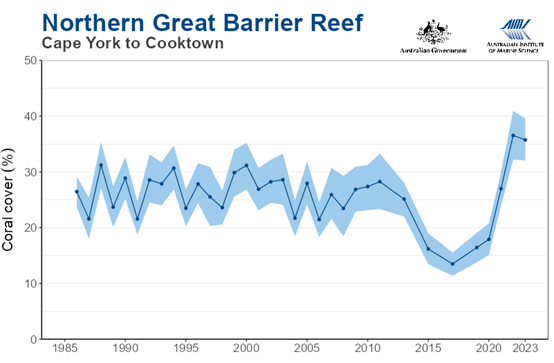
The recovery in the northern GBR actually started around 2017. Last year the coral declined slightly from 36.5% to 35.7%, and was easily within the margin of error calculated by the AIMS. Typhoon Tiffany passed through at the end of the previous reporting season, and could have been responsible for some loss.
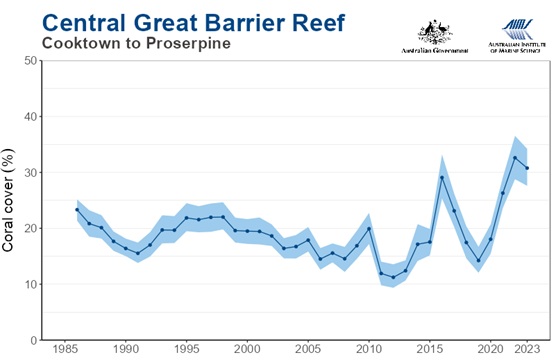
In the centre of the reef, the strong recovery of hard coral cover to 32.6% last year eased slightly, but again, as the AIMS noted, it was within the margin of error.
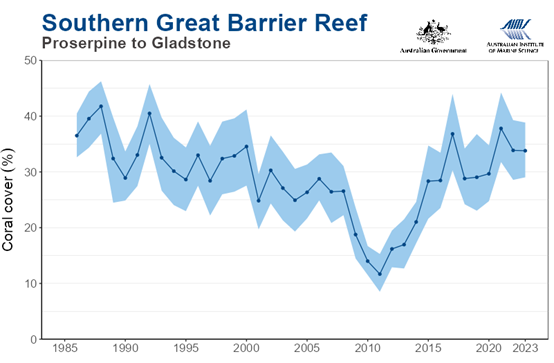
The southern end of the GBR has generally had higher coral cover than elsewhere, but has shown greater variability over the observed record. Last year’s cover was 33.8%, compared with 33.9% the year before. Some coral was reported to have been lost due to starfish predations.
The GBR is the largest reef system on Earth and runs for over 1,400 miles down the eastern side of Australia. It is also the most surveyed reef in the world and the results of scientific endeavour are widely distributed. While this work is often politicised, it is clear that recent evidence shows that temporary spikes in temperature, which occur naturally in the oceans, can cause bleaching. However, this bleaching process can rapidly go into reverse when local conditions stabilise. These findings have been confirmed elsewhere, notably in the remote Palmyra Atoll, 1,200 kms south of Hawaii. A 10-year survey recently observed sudden changes in temperature up to 3°C on two occasions, leading to substantial damage to the coral. A 2015-16 spike led to 90% of the coral bleaching, but the researchers found that within a year only 10% of the coral had died. Within two years, the corals had returned to pre-bleached levels.
The researchers concluded that the coral structures “show evidence of long-term stability” – but don’t hold that front page.
Chris Morrison is the Daily Sceptic’s Environment Editor
By Christina Maas | Reclaim The Net | August 2, 2023
In a robust appeal for accountability, Australian intelligence agencies have been encouraged to counter online “misinformation” that potentially endangers national security. The recommendation comes from a parliamentary committee overseeing Australia’s six intelligence bodies, including the Australian Security Intelligence Organisation (ASIO), the Australian Signals Directorate, and the Australian Secret Intelligence Service.
The committee’s chair, Peter Khalil, announced the recommendation during a parliamentary session. “The committee sees an opportunity for Australia’s intelligence agencies to take an increasing role in sharing information with the Australian public – where appropriate – on matters relating to misinformation, disinformation, and harmful propaganda,” Khalil stated, as reported by Perth Now.
This push follows a significant increase in misinformation during the turbulent years of 2020 and 2021, a period accompanied by COVID-19 lockdowns and a rapidly fluctuating security environment. Surprising to some, the parliamentary committee found that this wave of misinformation significantly amplified security concerns, necessitating its robust redressal.
The suggestion to publicly tackle misinformation, while controversial to many free-speech advocates who caution about overreach, is among four recommendations proffered in the committee’s recent annual review. These include enhancing inter-agency information sharing and finding effective solutions to workforce issues within the intelligence community.
Khalil remains steadfast in his conviction that this human-centric approach could be transformative. “The people who work in Australia’s intelligence agencies are our greatest asset,” he said. “By developing a whole of national intelligence community recruitment and retention strategy, Australia will be better positioned to deliver on its intelligence priorities.”
By Christina Maas | Reclaim The Net | July 31, 2023
The Australian Government’s tyrannical Communications Legislation Amendment (Combating Misinformation and Disinformation) Bill 2023 is facing formidable resistance from the Victorian Bar, as it sounds the alarm over a grave assault on freedom of speech and expression.
This Orwellian legislation, pushed by the communications minister since January, seeks to arm the Australian Communications and Media Authority (ACMA) with oppressive powers to tackle online “misinformation and disinformation.” Its draconian provisions include a mandate for the ACMA to hawkishly monitor progress in stifling online “misinformation” on various digital platforms, and enforce industry standards designed to muffle free speech under the guise of fighting disinformation.
The Victorian Bar has courageously voiced “serious objections” to this bill in a recent deposition to the Law Council of Australia. Their argument? The bill woefully neglects to respect the sanctity of free expression and associated privacy rights.
Victorian Bar president, Sam Hay KC, drove home the significance of this protest, underscoring the Bar’s trepidation about the invasive impact of the proposed bill on free speech and privacy. The Bar is particularly concerned about the threat to freedom of speech, calling it “the lifeblood of democracy.”
The Bar’s thorough critique continues, predicting a wave of self-censorship as users of online services retreat in fear of being branded as purveyors of misinformation. The bill’s very necessity is challenged, as it points out the effectiveness of recent countermeasures against the propagation of online falsehoods.
The Bar paints a grim picture of the bill’s proposed solution, arguing it could worsen the problem by alienating those already suspicious of the state and marginalized in small online communities. It cautions against a silencing approach and promotes persuasion and the dissemination of accurate information as a counter to misinformation.
They raise the issue of an “illiberal double standard,” potentially advantaging government supporters at the expense of critics. Moreover, the Bar criticizes the bill’s vague and impracticable definition of misinformation. While they say they recognize a need to counter harmful online information, the Victorian Bar takes a stand, asserting the proposed measures are disproportionately intrusive and likely ineffective against their intended targets.
Sputnik – 24.07.2023
Australia will buy 20 new C-130J Hercules aircraft from the United States for $9.8 billion, with first deliveries expected in late 2027, the Australian Defense Ministry said on Monday.
The first aircraft is expected to be delivered beginning in late 2027, according to the statement.
“The Albanese Government will purchase 20 new C-130J Hercules aircraft for the Royal Australian Air Force for $9.8 billion. This will provide the Air Force with state of the art C-130 Hercules to meet the air transport needs of the future,” the ministry said in a statement.
The new acquisitions will replace and expand the 12 Hercules aircraft currently in service, the ministry added. The aircraft are used by the Australian military to transport personnel, equipment and humanitarian supplies, as well as for search and rescue operation, disaster relief and medical evacuation missions, the statement said.
The C-130J Hercules are designed by US aerospace giant Lockheed Martin.
By Cindy Harper | Reclaim The Net | July 17, 2023
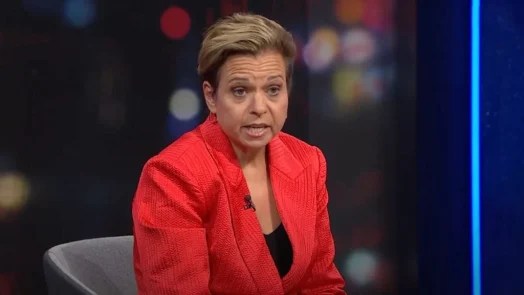
Australian Communications Minister Michelle Rowland is trying to push back against claims by Coalition MPs that the proposed upcoming legislation would lead to an Orwellian “Ministry of Truth.”
The newly proposed legislation aims to strengthen the Australian Communications and Media Authority’s (ACMA) abilities to manage digital platforms that are seen to propagate “misinformation and disinformation.” However, critics rightly know that the move will threaten the very essence of free speech.
Despite these assurances, skeptics like Coalition communication spokesman David Coleman argue that the regulator will inevitably need to form an opinion on what constitutes misinformation to ensure platforms comply with the new legislation.
“For government to start defining what can and cannot be said in a democracy is hugely concerning. This bill would allow that to happen,” Coleman said, to the Sydney Morning Herald.
The proposed bill gives ACMA the authority to collect information from digital platforms about how they adhere to existing codes.
Moreover, ACMA will have the power to introduce a new “code” for companies that repeatedly fail to address so-called misinformation and disinformation or establish an industry-wide “standard” requiring the removal of harmful content.
Failing to adhere to these standards will carry significant penalties. These include substantial fines, either $6.88 million or 5% of a company’s global turnover, whichever amount is higher.
This policy approach is not without its opponents. Critics argue the broad definitions of misinformation and disinformation as material that is “false, misleading or deceptive” and “reasonably likely to cause serious harm” could be abused by political subjectivity, potentially stifling legitimate views.
Coleman expresses concern over potential self-censorship by digital platforms due to fear of incurring hefty fines. The proposed legislation, in his view, could lead to the suppression of Australians’ authentic opinions. The exemptions within the bill for professional news content, authorized electoral content, and satirical material do little to assuage such fears.
Meta, the parent company of Facebook and Instagram, also expressed apprehensions about the bill’s potential to chill legitimate political expression online, due to the potential for imposing “binding standards” with severe penalties.
Despite previous attempts to increase ACMA powers by the former Morrison government in March 2022, draft legislation was never released. Rowland asserts the Albanese government’s openness to “constructive suggestions” to enhance the bill and is holding public consultations for feedback. However, the opposition has yet to take a formal stance on the legislation.
RT | July 10, 2023
NATO has no place in Asia and should stick to its original focus, that is the security of the Transatlantic region, former Australian Prime Minister Paul Keating has argued. The Labour politician, who served in office from 1991 to 1996, also warned against attempts to “circumscribe” China.
In his statement published on Sunday, Keating appeared to refer to a recent report in Politico, which claimed French President Emmanuel Macron had blocked NATO’s plans to establish a liaison office in Japan.
The former premier lauded the French head of state for “doing the world a service” by apparently emphasizing the military bloc’s focus on Europe and the Atlantic.
According to Keating, the alliance’s very existence past the end of the Cold War “has already denied peaceful unity to the broader Europe.”
Exporting such “malicious poison to Asia would be akin to Asia welcoming the plague upon itself,” he insisted. The former prime minister warned that NATO’s presence on the continent would negate most of the region’s recent advances.
Keating went on to describe NATO Secretary General Jens Stoltenberg as the “supreme fool” on the international stage who is conducting himself like an “American agent.”
He cited a comment Stoltenberg made back in February when he called for the West not to repeat the “mistake” it had made with regard to Russia, suggesting it should work to contain China.
The former Australian leader noted that the NATO chief conveniently ignored the fact that “China represents twenty per cent of humanity and now possesses the largest economy in the world.” He added that Beijing, unlike Washington, “has no record of attacking other states.”
Over the weekend, Politico cited an anonymous Elysee Palace official who claimed that Paris is against NATO expansion beyond the North Atlantic. “NATO means North Atlantic Treaty Organization,” the French presidential staffer reportedly emphasized.
Back in May, the Japanese ambassador to the US, Koji Tomita, revealed that his country was working toward opening a NATO liaison office in Tokyo, which would become the bloc’s first in Asia. Prime Minister Fumio Kishida confirmed the plans to Japanese lawmakers, noting that Tokyo did not intend to join the US-led organization.
Commenting on the news, Chinese Foreign Ministry spokesperson Mao Ning advised NATO against “extending its geopolitical reach.” The diplomat pointed out that the “Asia-Pacific does not welcome bloc confrontation or military blocs.”
By Viktor Mikhin – New Eastern Outlook – 05.07.2023
There are increasing reports in the world media that the US-led NATO military alliance is planning to expand into the Asia-Pacific region. The idea was originally introduced by US President Joe Biden at the East Asia Summit on October 27, 2021, where he said: “We envision an Indo-Pacific region that is open, interconnected, prosperous, resilient and secure – and we are ready to work together with each of you to achieve this.” The White House later issued a report titled “Indo-Pacific Strategy of the United States” on February 11, 2022, outlining President Joe Biden’s strategy to reestablish “American leadership in the Indo-Pacific region.”
Among the remarks in the so-called “newsletter” that stood out was the declared necessity for the US to strengthen ties with Asian countries in order to tackle the “urgent” task of “competing with China.” But, according to its authors, NATO, which was formed to defend Europe against a fabricated Soviet threat, is allegedly a peace-loving alliance. In reality, it has evolved into a militarily aggressive bloc with a dominant presence in the North Atlantic region. This “peace-loving” coalition has militarized the continent to the point where war has broken out in Europe for the first time since World War II.
The question arises, do the countries of the Asia-Pacific region want to see their region also heavily militarized under the strict “guardianship” not only of the United States, but also of European “peace-loving” NATO? Jens Stoltenberg, the secretary general of this “peace-loving” bloc, insists on increasing the military alliance’s activities in Asia, as he stated publicly earlier this year during a meeting with Japanese Prime Minister Fumio Kishida. The “peacemaker” from Europe said: “What happens in Asia matters for Europe and what happens in Europe matters for Asia, and therefore it is even more important that NATO Allies are strengthening our partnership with our Indo Pacific partners.”
According to Japan’s Nikkei newspaper, NATO will establish a liaison office in Tokyo in 2024 and use it as a center for cooperation with Australia, Japan, New Zealand and South Korea. Geographically, these four countries are close to China and other states in the region. It should be emphasized that they are all strategically placed in the Asia-Pacific region and have common interests with the US and NATO, or serve them faithfully.
It doesn’t take a genius to figure out that their target in this situation is China. Speaking at a May 26 press briefing, a Chinese Foreign Ministry spokesperson rightly noted that NATO’s attempt to intervene in the Asia-Pacific region eastward would inevitably undermine regional peace and stability. For example, Japan intends to attend the upcoming NATO summit in Lithuania in July, where discussions on the development of the military bloc’s liaison office are expected to continue. Apparently, the Japanese leadership has already forgotten the tragic consequences of their country’s participation in World War II and the terrible consequences it had for the Japanese people.
The United States’ plan to establish a military alliance in the Asia-Pacific area, similar to NATO, will have disastrous effects. That is why this insidious scheme does not have the support of many Asian countries, which see all these maneuvers of the United States and NATO as aimed at limiting their freedom and security. In the past, the US tried to create a replica of NATO in the Persian Gulf, but failed in that endeavor. The countries of the region soon realized the instability that results from such a move and are now instead working together to bring security back to their own region. The desire of many Gulf countries to join the BRICS and build a new world without conflicts and wars at least testifies to this.
This is why the replica of NATO in Asia is also likely to fail, because no matter how much the Joe Biden administration insists on pursuing it, the idea lacks the support of many countries in the region. Asian states strongly oppose actions aimed at creating military blocs in the region and fomenting discord and conflict. “The majority of Asia-Pacific countries don’t welcome NATO’s outreach in Asia and certainly will not allow any Cold War or hot war to happen,” the Chinese Foreign Ministry stated earlier in May.
The position of most countries in the region is very clear. They oppose the emergence of military blocs in the region, do not welcome NATO expansion in Asia, do not want a repeat of bloc confrontation in Asia, and certainly will not allow a repeat of cold or hot war in Asia. If a NATO-like, US-led alliance were formed in Asia, it would put the region at risk of insecurity and possible conflict, as countries would be divided into alliances and military blocs.
But another stumbling block to the American move to create an Asian NATO is France. President Emmanuel Macron opposed the creation of the first NATO office in Asia, calling the move a “big mistake.” Macron recently made an official trip to China to strengthen bilateral ties and afterwards began to make the same argument as Beijing. Incidentally, US-led NATO activities have a clause in their charter that clearly limits the scope of the bloc to the North Atlantic. Expanding NATO beyond the North Atlantic would require the consent of all members of the alliance, and France could technically veto such a move.
Many, even members of NATO, understand why such a plan could lead to a serious escalation, with devastating economic and security consequences that would be felt negatively around the world, including Europe, a continent that has long been in deep crisis because of the United States.
Asia is famously one of the most economically developing regions in the world. This, in fact, is what the US is deathly afraid of – a new economically developed giant that poses a threat to limit US military and economic expansion. “Thinking” heads in Washington are unable to realize that China, becoming the world’s number one economy and a leading expert in technology and other major sectors, has no intention of competing with or challenging the US on a global scale.
This is where the paranoia of today’s American politicians and their unstable psyche, little adapted to the realities of the modern world, come into play. Washington and its masters are struggling to hold on to what few fragments remain of their once global hegemony, now going like the Titanic to the bottom of world politics. The US ruling elites no longer pursue their own country’s interests, bearing in mind that China is one of America’s largest trading partners, bringing them enormous benefits in various trade and industry. China’s rise as a superpower and its peaceful view of the world have had a dramatically negative impact on Washington, which has watched with apprehension as more and more countries have sought to strengthen ties with Beijing and join the BRICS.
On the security front, the world has witnessed US military adventurism and its disastrous consequences. And this at a time when China has one military mission outside its borders, and it is part of the UN peacekeeping mission in Africa. In essence, China maintains peace in an unstable part of the world, while the US provokes conflicts in crises it itself created, trying, as the proverb says, to fish in troubled waters of misfortunes and troubles of the peoples of the world.
On the technology front, more and more countries are buying from China as it quickly becomes a technological superpower. This has reduced US profits and caused Washington to bully the world against China over issues such as Huawei, Tiktok and semiconductors. In fact, this is all part of a broader US attempt to limit Chinese exports. But the world is different now than it was after World War II. The influence of the US has weakened dramatically, and many states prefer to build a new world on terms that are agreeable to them, put forward by Russian President Vladimir Putin.
There is also some danger here as US hegemony wanes and in a desperate attempt to maintain its influence it plays dangerous games around the world. It unleashed the crisis in Ukraine and pitted Ukrainians against Russians, and now it seeks to create similar crises in other countries, such as China and North Korea, instead of following the diplomatic path and coming to realize a multipolar world. But this would be asking too much of the current American leadership, too difficult for their heads and limited thinking, accustomed to think and act only in terms of war.

or go to
Aletho News Archives – Video-Images
By Donald Neff | Washington Report On Middle East Affairs | January 1996
On January 4, 1948, Jewish terrorists drove a truck loaded with explosives into the center of the all Arab city of Jaffa and detonated it, killing 26 and wounding around 100 Palestinian men, women and children.[1] The attack was the work of the Irgun Zvai Leumi – the “National Military Organization,” also known by the Hebrew letters Etzel – the largest Jewish terrorist group in Palestine. The Irgun was headed by Revisionist Zionist Menachem Begin and had been killing and maiming Arabs, Britons and even Jews for the previous ten years in its efforts to establish a Jewish state.
This terror campaign meant that at the core of Revisionist Zionism there existed a philosophical embrace of violence. … continue
 Aletho News If Americans Knew No Tricks Zone
