Failed Zero Covid Policy Cost Australia Over $938 Billion, Report Finds
BY MORGAN BEGG | THE DAILY SCEPTIC | SEPTEMBER 22, 2022
The danger in the post-lockdown era is that in our rush to move on we forget the hard lessons that have been learned about this catastrophic public policy failure.
On the basis of alarmist modelling, often commissioned by governments and amplified by sensationalist media, panicked politicians discarded all basic ideas about proportionality and the rule of law to criminalise everyday life and exert unprecedented controls over the citizenry.
From the beginning of the pandemic in March 2020, all Australian governments adopted the attitude that any public health mitigation measure was on the table, and little to no consideration was given to the costs of the measures that were adopted.
This is the subject of new research published by the Institute of Public Affairs, which for the first time in Australia calculates many of the costs of the nation’s Covid zealotry up to June 2022. In the report, Hard Lessons: Reckoning the Humanitarian, Economic, and Social Costs of Zero-Covid, we find that the total economic and fiscal cost of the Australian COVID-19 response was no less than A$938.4 billion (£550.6 billion) to June 2022. This report identifies:
- $595.8 billion in state and federal Government to enforce Covid policies and stimulate the economy;
- $259.8 billion in lost economic activity because of the restrictions and economic shutdowns;
- $82.8 billion in inflation related costs due to expansive monetary and fiscal policies, a cost which is set to only increase more and more over the next couple of years.
The research also calculates how much children suffered in terms of schooling. Despite being the safest cohort in society when it comes to COVID-19, children were routinely sent home to learn remotely or not learn at all. We estimate children in the state of Victoria would have lost about 12 weeks of reading skills and 17 weeks of numeracy skills, something which for many will never be recovered.
Even on the most basic metric, lockdowns failed. In terms of the number of years of life, the costs of joblessness because of the initial nationwide lockdowns in March and April 2020 were about 31 times more costly than the maximum possible years of life saved by lockdowns throughout 2020 and 2021.
Even in the state of Victoria, whose Labor Government enthusiastically established a world-renowned Covid police state, politicians are no longer touting their pandemic response in the lead up to the state election in November.
Likewise, the former federal Liberal/Nationals Coalition Government, which was voted out of office earlier this year, rarely boasted of its Covid response.
Governments of the Covid era appear to have accepted the failure of the Covid-elimination approach, but rather than confront the reality of this failure are just pretending that it never happened.
This is not about living in the past, because the reality is we are still bearing the costs now. In terms of the resulting mental health crisis, lost learning, shuttered businesses, Government debt and inflation, we are not likely to know the full costs of the Covid response for many years to come.
Our future wellbeing as a society also demands that we remember the hard lessons of the Covid response.
We will need to deal with pandemics in the future, and it is critical to know what went wrong, and how these failures came to be.
Australians were subject to the harshest restrictions on their way of life in their history, and we should be demanding not that it should be forgotten, but that it should be remembered so that it doesn’t happen again.
Morgan Begg is the Director of the Legal Rights Program at the Institute of Public Affairs in Melbourne, Australia.
A 5th jab? Implications for the immune system
FDA advisory member hints at ‘original antigenic sin’
By Maryanne Demasi, PhD | September 6, 2022
Following the recent authorisation of the new omicron boosters, the former US Surgeon General encouraged Americans to receive two to four mRNA jabs annually.
Residents in northeast Australia have been told they might need a fifth dose by the end of the year.
In fact, it wasn’t that long ago that New South Wales’ top doctor said that people should expect to receive covid-19 booster shots “indefinitely.”
But could repeated boosters at close intervals be causing more harm than good? I speak with experts concerned that policymakers are not following the science.
Earlier this year, the European drug regulator sent a dire warning to the world. The agency was concerned that repeated boosters every four months could weaken a person’s immune response to the coronavirus.
Marco Cavaleri, the agency’s head of vaccines strategy, said that regular boosters might be “overloading people’s immune systems and leading to fatigue.”
I spoke with Cody Meissner, an FDA advisory member, ahead of the agency’s April 6 meeting, during which experts were to discuss the evidence for a fourth dose. He told me that he was not convinced by the data at the time.

Prof Cody Meissner, FDA advisory member
“I personally don’t think that we have sufficient basis on which to recommend a fourth dose, and we don’t know what the harm will be,” said Meissner.
“The reason we’re giving the vaccine is to keep people out of the intensive care unit and to keep people from dying, or even going into the hospital. So, before we vigorously endorse a fourth dose of this vaccine, I think we have to understand not only more about the immune response, but also about how much severe disease is occurring after three doses,” he added.
Meissner blamed socio-political interference for many of the questionable covid-19 strategies. “I think that the politicians and certain groups within society, such as the teacher’s union here in the United States, have driven a political agenda that is certainly not based on science. People like to say it’s based on science. It’s not. It’s based on emotion and generating great fear,” said Meissner.
Despite the concerns, most policymakers have forged ahead with recommending third, fourth and fifth doses for large swathes of the populations.
But over the past year, observational data have emerged from countries like the UK, Scotland and Australia showing that the most highly vaccinated people are acquiring the highest rates of covid-19 infections, suggesting that the vaccines have lost their effectiveness or something unexplained is happening.
Meissner hinted at a possible explanation for why someone’s immune response could be suppressed after multiple covid-19 shots. “It gets into this issue of ‘original antigenic sin’, which is still a theoretical issue, but may have some validity it seems to me,” said Meissner earlier this year.
Original antigenic sin – scientifically referred to as immune imprinting – is a phenomenon whereby prior exposure to one virus strain (e.g. wuhan stain) limits the development of immunity against new variants (omicron strain), because the immune system has been “imprinted” to favour the original strain.
This leaves the immune system trapped because the antibodies it prefers to produce against the original strain are ‘mismatched’ for the new strain.
Meissner said, “To keep vaccinating with very similar [wuhan] antigens, may or may not be beneficial — or the benefit may not outweigh the harm. I think we need to look at that.”
Since then, the data suggesting that immune imprinting is occurring, has only strengthened says Nikolai Petrovsky, Professor at Flinders University and developer of a protein-based covid-19 vaccine called SpikoGen® in use in Iran.

Prof Nikolai Petrovsky, Flinders University
“I feel the evidence for immune imprinting is increasingly compelling. It’s a known phenomenon with flu where it was first described, and the data now suggests it’s happening with covid-19,” said Petrovsky.
“The omicron vaccines may struggle to switch the immune system of a heavily vaccinated person to making omicron-specific antibodies, as their immune system is so heavily biased toward the Wuhan spike protein in the original vaccines. In the end, this could be harder to achieve in a vaccinated person than someone who has not yet been exposed to any spike protein, for example, someone unvaccinated,” he added.
Petrovsky says not only do too many shots of the mRNA vaccines increase the risk of immune imprinting, but they also seem to be uniquely pushing the immune system into “tolerance” against the virus.
“Immune tolerance” occurs when the immune system becomes unresponsive to a particular antigen after repeated exposure. This is the principle for desensitising people to allergy, i.e. by repeatedly injecting them with small doses of the offending allergen over time.
Petrovsky points to a recent pre-print study out of Germany. “People who’ve had three or more doses of mRNA showed a change in their antibodies to IgG4 which is typically an antibody associated with allergy desensitisation but not a normal antibody seen produced after infectious disease vaccines,” said Petrovsky.
Petrovsky said, “What this means, we simply don’t know as this has never been seen before. That in itself is concerning as it indicates just how little we understand about what these new mRNA vaccines are doing and how they work. But to me, it raises a red flag that repeated doses of the mRNA vaccines might be driving immune tolerance against the virus. Maybe this could explain why the more doses of these vaccines, the less they seem to work, and more and more people are getting breakthrough infections?” Interestingly, the study did not find a similar shift in antibody patterns after AstraZeneca’s covid-19 vaccine.
Now, that the FDA has authorised the new bivalent boosters – which code for the original wuhan strain plus BA4/BA5 omicron lineages – without first requiring any human data to be collected, it has left many doubting that our public health authorities are even paying attention to the science.
Australian Painter Forced to Remove His Mural Showing Russian, Ukrainian Soldiers Hugging

‘Peace before Pieces’ by Peter Seaton, AKA CTO. Image from http://www.ctoart.com
Samizdat – September 5, 2022
Australian artist Peter Seaton was forced to paint over his latest work, dubbed “Peace Before Pieces” showing a Russian and a Ukrainian soldier hugging each other, after pressure from the local Ukrainian community and Ambassador to Australia Vasyl Myroshnychenko, who branded the work “offensive”. The mural, was painted on a building in Melbourne, just a couple days ago, but the artist has been forced to remove his creation.
Seaton apologized for painting the mural and explained that his intention has always been to emphasize the importance of reaching peace. He noted that he has dedicated a lot of thought to the issue before coming up with the painting and said he discussed it a lot with other people.
“The original intention was to focus our efforts on this war towards a negotiation of peace, to avoid nuclear disaster […] I felt it was the best way I could portray a message of peace which is something I am fundamentally about,” Seaton said.
His efforts, however, did not impress Ambassador Myroshnychenko, who claimed the peace-promoting work of the artist was “utterly offensive to all Ukrainians” and he said that Seaton should have “consulted the Ukrainian community in Melbourne” before painting the mural. Myroshnychenko demanded that the work be promptly removed.

The Russian embassy in Australia reacted to the news of mural’s removal sarcastically:
“A mural recently unveiled in Melbourne was slammed for not reflecting the concept of fighting Russia to the last Ukrainian. The artist had to destroy his work. New normal for freedom of artistic expression in Australia: check with Ukrainian Embassy before painting,” the embassy said.
Russia proposed a diplomatic resolution to the conflict to Ukraine soon after the start of the special military operation on February 24th, but after a month of talks, Kiev halted the process for good.
Instead, the Ukrainian leadership has since been claiming it would fight Russia until it seizes the territories it sees as theirs and will hold talks only after that. Moscow maintains that it is always ready to return to the negotiations table but sees no initiative on the Ukrainian side.
Australia’s excess death toll just keeps getting worse
By Dr Ah Kahn Syed | Arkmedic’s blog | August 27, 2022
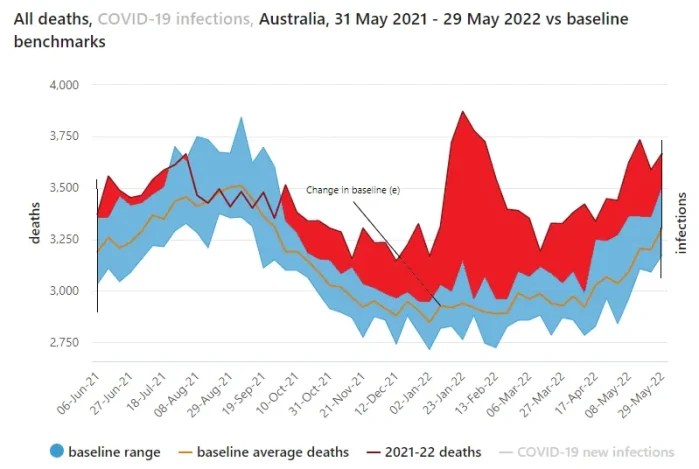
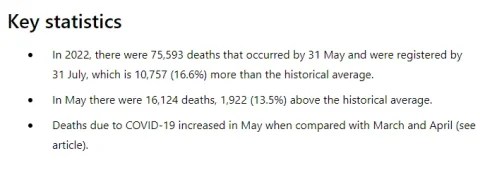
The Australian Bureau of Statistics just released its latest all-cause mortality statistics which are about 3 months behind real time. It paints a horrific picture of the effects of public health policy with around 15,000 excess deaths since October 2021 (the red shaded area represents excess deaths over the prior upper limits). In July 2021 – when there were no excess deaths of any significance there was a coordinated effort from health ministers to “get vaccinated” and the “Warsaw ghetto” treatment of anybody that didn’t.
In fact the health departments went to such extremes that they chose to mispresent the death of Adriana Takara (and others) in order to sell the “if you don’t get vaccinated you will die” message.
Yet 80% of the adult population of Australia had received their COVID vaccine by the 5th October 2021. Then something happened as can be seen by the graphic. The all-cause mortality rate went up – and never came down again. It continues at 10% over baseline which is equivalent to about 15,000 deaths a year.
Given that the government themselves set the bar that their “job was to prevent you dying” – by which they meant “We are going to imprison or remove the rights of anyone that won’t do as they are told because we know better than you” – then I would like to know who is going to take responsibility for the manslaughter of 15,000 Australians?
You see, it isn’t enough that they thought they were doing the right thing. The government imposed “health orders” that were not only never shown to be of any benefit and contravened the established pandemic plan, but the evidence base for them was hidden from the public. Those health orders destroyed lives and are continuing to destroy (and, seemingly, end) lives. The government is not some abstract entity, it is people – and those people are subject to the same laws that the rest of us are, even if they think are are not.
It is not enough that we forget and just get on with it. Somebody needs to answer for 15,000 deaths that they took responsibility for when they imposed health orders that had consequences that they were warned about in September 2021. And that, presumably, has to include those that enabled the decision makers.
Children Don’t Need COVID Vaccines, Canadian and Australian Groups Tell Public Health Officials
By Julie Comber, Ph.D. | The Defender | July 25, 2022
Groups in Canada and Australia are urging public health officials to reconsider rolling out COVID-19 vaccines for young children, following the authorization earlier this month in both countries of Moderna’s COVID-19 vaccine for children ages 6 months to 5 years.
The Australian Vaccine-risks Network (AVN) on July 19 sent an open letter to Dr. Brendan Murphy, secretary of Australia’s Department of Health and Aged Care, voting members of the Australian Technical Advisory Group on Immunisation and members of parliament threatening to “move forward with preparations for seeking the intervention of the Federal Court of Australia” if officials don’t respond.
The Canadian COVID Care Alliance (CCCA) on July 14 published an open letter to Canadian health officials stating their members would “be happy to meet you to discuss findings documented in this letter in greater detail.”
Both letters emphasized three arguments against authorizing the mRNA shots in young children and babies:
- Children don’t need COVID-19 vaccination because they are at extremely low risk of COVID-19.
- In any case, the mRNA shots don’t work well.
- The potential harm from the mRNA shots outweighs the benefits for young children.
Both letters also referenced the June 30 open letter to U.K. health officials from more than 70 physicians and scientists warning against vaccinating younger children against COVID-19.
The U.K. letter, written in response to the U.S. Food and Drug Administration’s (FDA) Emergency Use Authorization (EUA) in mid-June of the Moderna and the Pfizer-BioNTech COVID-19 shots for children as young as 6 months, urged U.K. health officials to not “make the same mistake” the FDA made.
All three letters referenced Søren Brostrøm, director of the Danish Health and Medicines Authority, who in June said, “We did not get much out of having children vaccinated against coronavirus last year.”
Australia’s Therapeutic Goods Administration on July 18 provisionally approved a pediatric dose of Moderna’s Spikevax COVID-19 shot for children ages 6 months to 5 years old. Rollout of the vaccines is contingent on input from the Australian Technical Advisory Group on Immunisation.
A few days earlier, on July 14, Health Canada authorized the use of Spikevax for children 6 months to 5 years of age. According to the statement, “As a result of this authorization, approximately 1.7 million children are now eligible for vaccination against COVID-19.”
Risks ‘far outweigh’ benefits for children
The 11-page CCCA letter contains 117 references and six pages of figures and graphs to support the group’s argument that “the data shows that, in the Omicron era, when population-based immunity is widespread, the risks associated with COVID-19 mRNA vaccines far outweigh the benefits in children.”
The authors of the CCCA letter criticized the FDA, stating, “no gold standard, placebo-controlled disease endpoint trials, large enough [with at least 800,000 participants] to categorically establish the clinical safety and long-term efficacy of the Pfizer COVID-19 mRNA vaccinations in children 12- to 15-years-old, 5- to 11-years-old, 2- to 4-years-old, and 6-months-old to 23-months-old have been undertaken.”
Instead, the EUA for Pfizer was “based on the preliminary results of four very small immuno-bridging trials, enrolling fewer than 3,000 participants each.”
The CCCA letter presented data from the Canadian province of Ontario, which “reported a negative dose-response effect for the COVID-19 vaccinations [original emphasis].”
The letter continued:
“In other words, the proportion of cases of COVID-19 were highest among those who had been ‘boosted,’ lower among the ‘fully inoculated’ and least among the ‘not fully inoculated’ (which includes the ‘uninoculated’).”
The authors presented graphs from the Public Health Ontario website, noting a similar pattern was observed in the 12- to 17-year-olds and the 5- to 11-year-old age groups.
“Additionally, a greater proportion of ‘boosted’ Ontarians have died, revealing that the vaccinations may be associated with serious secondary effects.”
The CCCA letter concludes:
“We trust that our research has provided you with evidence needed to adjust Canadian health policy to protect our children from undue harm. We would be happy to meet you to discuss findings documented in this letter in greater detail.”
‘Huge gap’ in Pfizer’s vaccine trial documentation
According to the authors of the AVN letter, the Pfizer documentation presented to the FDA had huge gaps in the evidence provided.
For example, the letter stated:
“The protocol was changed mid-trial. The original two-dose schedule exhibited poor immunogenicity with efficacy far below the required standard. A third dose was added by which time many of the original placebo recipients had been vaccinated.”
The AVN letter argued the Moderna shot for young children fails to meet Australia’s regulatory requirements to be granted “provisional determination” (similar to EUA in the U.S.) under regulation 10L(1)(a) of the Therapeutic Goods Regulations.
To receive provisional determination, there must be “an indication of the medicine is the treatment, prevention or diagnosis of a life-threatening or seriously debilitating condition,” the letter stated.
The authors said Australia’s health department and TGA did not “show any data or science to support a conclusion that COVID-19, and particularly the Omicron variant now widespread across Australia, is ‘life-threatening’ to infants aged 6 months up through 4 years, nor indeed that infants 6 months up through 4 years suffer ‘seriously debilitating’ symptoms when infected with COVID-19.”
The authors also addressed the issue of manipulative strategies used to promote COVID-19 vaccination of children, and said pushing unnecessary and novel mRNA-based vaccines onto young children risks undermining parental confidence in routine immunization programs.
Julie Comber is a freelance science reporter for The Defender.
© 2022 Children’s Health Defense, Inc. This work is reproduced and distributed with the permission of Children’s Health Defense, Inc. Want to learn more from Children’s Health Defense? Sign up for free news and updates from Robert F. Kennedy, Jr. and the Children’s Health Defense. Your donation will help to support us in our efforts.
WHO Wants To Run the World?
By Paul Frijters, Gigi Foster, Michael Baker | Brownstone Institute | July 11, 2022
In Geneva in late May at the 75th meeting of the WHO’s decision-making body, the World Health Assembly (WHA), amendments to its International Health Regulations (IHRs) were debated and voted upon. If passed, they would grant the WHO the right to exert unconscionable pressure on countries to accept the WHO’s authority and health policy actions if the WHO decides that there is a public health threat that might spread beyond a country’s borders.
As Ramesh Thakur, the second man at the UN for years, noted, the amendments would mean “the rise of an international bureaucracy whose defining purpose, existence, powers and budgets will depend on outbreaks of pandemics, the more the better.”
This is the first clear instance of a globalist coup attempt. It would subvert national sovereignty worldwide by putting real power into the hands of an international group of bureaucrats. It has long been suspected that the authoritarian elites arisen during covid times would try to strengthen their positions by undermining nation states, and the this 75th jamboree is the first solid evidence of this being true.
What an opportunity then to see who is in the conspiring club. Who drafted the amendments? What was in them? Which individuals supported them or spoke out against them?
WHO were the conspirators?
The amendments on the table at the May WHA meeting had been transmitted to the WHO by the US Department of Health and Human Services on January 18, circulated by WHO to its member states (‘States Parties’) on January 20 and formally introduced to the WHA on April 12.
The proposals, according to an announcement on January 26, were co-sponsored by 19 countries plus the European Union. Even if some co-sponsors had little direct involvement in drafting them, they all would have approved in principle the overarching goal of tightening up the WHO’s authority over member states in the face of a public health event.
Loyce Pace, the HHS’s Assistant Secretary for Global Affairs – the leading US official nominally responsible for the proposed amendments – arrived at the Biden administration fresh from a stint as executive director of an advocacy organization called the Global Health Council.
That council receives funding from the Bill & Melinda Gates Foundation and its members include Eli Lilly, Merck, Pfizer, Abbott Labs, and Johnson & Johnson. You get the idea. Via one of the foxes-turned-chicken-guard, it appears the HHS ‘worked closely’ on these amendments with large pharmaceutical companies, who will be chomping at the bit for a more proactive (read: profitable) response to any public health emergency, real or imagined.
So the conspiring club consists primarily of the US government and its Western allies in lockstep with Big Pharma, and they are looking to undermine both the sovereignty of their own governments and that of other countries, presumably with the idea that the Western elites would do the running.
What was in them? A blizzard of acronyms and euphemisms
To understand what the US proposed at the WHA, we need first to understand how things have worked in the WHO to this point.
The IHRs in their current form have been in force as international law since June 2007. Among other things, they impose requirements on countries to detect, report and respond to ‘public health events of international concern,’ or PHEICs. The WHO Director-General consults with the state where a possible public health event has occurred, and within 48 hours they are meant to come to a mutual agreement on whether or not it actually is a PHEIC, whether or not it needs to be announced to the world as such, and what counter-measures, if any, should be taken. It’s essentially an early-warning system on major health crises. This is a good thing if it’s run by people you can trust and if it has checks and balances to rein in expansionary tendencies.
The proposed amendments would greatly strengthen the power of the WHO relative to this baseline, in a number of ways.
First, they lower the threshold for the WHO to declare a public health emergency by empowering its Regional Directors to declare a ‘public health event of regional concern’ (PHERC, italics ours) and for the WHO to put out a new thing called an ‘intermediate public health alert.’
Second, they permit the WHO to consider allegations about a public health event from non-official sources, meaning sources other than the government of the state concerned, and allow that government only 24 hours to confirm the allegations and a further 24 hours to accept the WHO’s offer of ‘collaboration.’
Collaboration is essentially a euphemism for on-site assessment by teams of WHO investigators, and concomitant pressure at the whim of WHO personnel to enact potentially far-reaching measures such as lockdowns, movement restrictions, school closures, consumption of medicines, administration of vaccines and any or all of the other social, economic, and health paraphernalia that we have come to associate with the covid circus.
Should the state’s government acceptance of the WHO’s ‘offer’ not be forthcoming, the WHO is empowered to disclose the information it has to the other 194 WHO countries, while continuing to pressure the state to yield to the WHO’s invitation to ‘collaborate.’ A non-collaborating country would risk becoming a pariah.
Third, the proposal includes a new Chapter IV, which would establish a ‘Compliance Committee’ consisting of six government-appointed experts from each WHO region tasked with permanently nosing around to ensure the member states are complying with IHR regulations.
There are more crossings-out of the existing IHR language and new language added in, but the flavour of what the US-led alliance is shooting for is a WHO that can unilaterally decide whether there is a problem and what to do about it, and can isolate countries that disagree.
Compliant WHO member states could act as a supporting cast in the isolation effort, through the distribution of their own health budgets and their ‘health-related’ policies, which would include travel and trade restrictions. The WHO would become a kind of command-and-control center for globalist agendas, pushing the produce of (Western) Big Pharma.
Why and how would this work?
We learned during covid times why it would make sense that the US and its allies are insisting on these amendments.
Lowering the bar for declaring a global (or regional) public health threat triggers a huge opportunity for Western pharmaceutical companies. As legal experts have observed: “WHO emergency declarations can trigger the fast-track development and subsequent global distribution and administration of unlicensed investigational diagnostics, therapeutics and vaccines.
This is done via the WHO’s Emergency Use Listing Procedure (EULP). The introduction of an ‘intermediate public health alert’ in particular will also further incentivise the pharmaceutical industry’s move to activate domestic fast-track emergency trial protocols as well as for advance purchase, production and stockpile agreements with governments before the existence of a concrete health threat to the world’s population has been detected, as is already the case under WHO’s EULP via the procedures developed for a ‘pre-public health emergency phase’.”
You can bet that the WHO ‘expert teams’ sent in to make on-the-ground assessments, under the banner of ‘collaboration’ with the host country experiencing the health event, will be chock-a-block with operatives from the CDC and who knows what other Western agencies, all poking around potentially sensitive facilities that a host government might justifiably claim a sovereign right to keep to itself. Likewise with the ‘Compliance Committee’ proposed by the US under the new Chapter IV of the IHRs: its government-appointed members have an open-ended brief, enshrined in international law, to be busybodies.
In layman’s terms, the WHO would be turned into an international thug, with its member states offered the role of backyard gang members.
As a bonus for Western elites, the proposals are a sneaky form of rewriting history. By cementing authority within an international organisation to determine the existence of public health crises and direct potentially draconian emergency responses, Western governments would get to enshrine and legitimise their own extreme responses to the covid outbreak, as we have pointed out previously. Their backsides would thereby be given some protection from legal challenges.
The refusniks: Developing countries
The proposals were pushed primarily by Western countries: the US was joined by Australia, the UK and the EU in arguing for passage. The resistance was led by developing countries who saw it as a colonialist ambush in which their ability to set policy and respond to health threats in a manner commensurate with their domestic situations would be overridden.
Brazil reportedly went so far as to threaten to withdraw from the WHO, and the African group of almost 50 countries, along with India, argued that the amendments were being rushed through without adequate consultation. Russia, China and Iran also objected.
Failure on the first try, but the US and its allies in the West will get more shots to push it through.
How do we expect them to do this? Well, when a proposal gets bogged down inside a giant bureaucratic machine like the WHO, the inevitable response is to set up committees to work in the background and circle back with a new set of proposals to be presented at a future meeting. True to form, a ‘working group’ and ‘expert committee’ are being assembled to accept member state proposals on IHR reform by the end of September this year. These will be ‘sifted through’ and reports will be prepared for review by the WHO’s executive board in January next year. The objective is to have a fresh set of proposals on the table when the WHA convenes for the 77th time in 2024.
Not all was lost
Salvaging something from the fact that the WHA failed to get a consensus around its biggest agenda item, the US and its allies got a small victory on the point of when they can try again – though in their desperation they needed to violate the IHRs’ own rules to accomplish it. Article 55 of the IHRs states unambiguously that a four-month notice period is required for any amendments.
In this instance, revised amendments were presented on May 24, the same day that the first lot were rejected. These were discussed, further amended on May 27 and then adopted on the same day. The approved amendments halve the two-year period for any (further) approved amendments to the IHRs to take effect. (The IHRs that came into force in 2007 were agreed to in 2005 – but under the new resolution, anything agreed to in 2024 would come into effect in 2025 rather than 2026.)
Yet, what was achieved in terms of fast-tracking the force of new amendments was lost in slow-tracking their implementation. Nations would have up to 12 months – double the previous suggestion of six months – to implement any IHR amendments that newly enter into force of law.
State of play
Where is all this going?
If the WHO takes the reins on decisions about what constitutes a health crisis, and can pressure every country into a one-size-fits-all set of responses that it, the WHO, also determines, that’s bad enough. But what about if its invitation to ‘collaborate’ with countries is backed up with teeth, such as sanctions against those who demur? And what about if it then broadens the definition of ‘public health’ by, for example, declaring that climate change falls under that definition? Or racism? Or discrimination against LBTQIA+ people? The possibilities thereby opened up for running the world are endless.
A global ‘health’ empire would bring huge harms to humanity, but a lot of power and money is pushing for it. Don’t think it can’t happen.
Paul Frijters is a Professor of Wellbeing Economics at the London School of Economics: from 2016 through November 2019 at the Center for Economic Performance, thereafter at the Department of Social Policy
Millions Face New Fluoridation Threats
By Stuart Cooper | Fluoride Action Network | June 21, 2022
The published science over the past decade has taught us a lot about water fluoridation, about both the very real and significant side effects inflicted on the public, but also about the credibility of those who continue to vouch for its safety.
At this point, the question we must ask isn’t whether the overwhelming risks outweigh the theoretical scant benefits, or whether more research is needed to draw strong conclusions. No, the only appropriate question now is: How much more harm will the promoters and regulators of fluoridation allow the practice to inflict on the public?
Without the Fluoride Action Network, our coalition partners, and people like you taking a stand, their answer will be a resounding, “a lot more harm!” With their credibility and influence at stake after defending fluoridation for more than 75 years, they’ve sadly shown that they’ll not only be the last to act, but that they plan to double down until we stop them.
As we speak, tens of millions of residents currently living on community water systems with no added fluoride throughout the United States, Canada, the United Kingdom, Australia and New Zealand are facing the imminent threat of having their water dosed with hazardous fluoridation chemicals.
The CDC has announced a new strategy and helped develop a new technology to fluoridate an addition 19+ million Americans, which will also eventually expand to Canadians, Australians and likely others.
Meanwhile, the governments in the U.K. and New Zealand have exploited the recent pandemic to pass sweeping health care reform bills that effectively include nationwide fluoridation mandates due to decades of strong pushback from residents and elected officials at the local level, keeping fluoridation at bay.
Fluoride Has Already Damaged the Teeth of Millions
The U.S. Centers for Disease Control’s own data taken from the National Health and Nutrition Examination Surveys (NHANES) has repeatedly found that our children in the United States are significantly overexposed to fluoride, evidenced by skyrocketing rates of dental fluorosis.
Fluorosis is a biomarker of toxicity from ingested fluoride, and is a permanent tooth defect, causing unsightly discoloration and mottling of the teeth, weakening the enamel and resulting in increased dental decay.
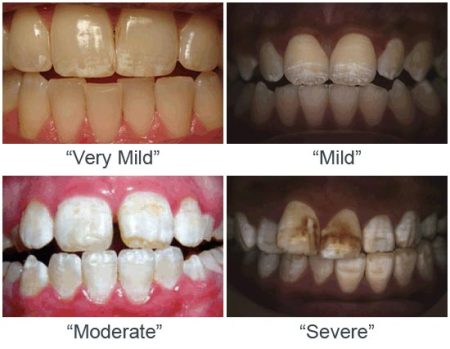
Ingesting fluoridated water — particularly in reconstituted infant formula — and processed foods made with fluoridated water are recognized as the primary sources of exposure, though swallowing toothpaste and fluoride prescriptions also contribute.
A 2015 review of the practice of fluoridation by the Cochrane Collaboration, the gold standard for evidence-based reviews of health interventions, found that “there is a significant association between dental fluorosis (of aesthetic concern or all levels of dental fluorosis) and [water] fluoride level.”
The CDC reported that 41% of adolescents (12 to 15) had dental fluorosis in 2004. At the time this was an increase of over 400% from the rates found 60 years prior. Then the 2012 survey found that the rate jumped significantly to 65+% of adolescents with dental fluorosis.
Now, according to a recent study (Yang, June 2021) published in the journal Ecotoxicology and Environmental Safety using the data from the NHANES 2015-16 survey, the “prevalence of dental fluorosis was 70% in the U.S. children.”
This means that the teeth of millions of children, teens and adults have already been damaged by overexposure to fluoride during development, and the CDC, along with the other promoters of fluoridation are fully aware. However, the teeth are not the only tissues in the body that are harmed by or accumulate fluoride. There is no apparent reason, therefore, why fluoride’s effects on the body would be limited to the teeth. As noted by renowned dentist and researcher Dr. Hardy Limeback:
… it is illogical to assume that tooth enamel is the only tissue affected by low daily doses of fluoride ingestion.
NHANES data has been used in recent published and peer-reviewed studies to link fluoridated water with a number of additional side-effects, including earlier onset of menstruation for black teens, sleep disorders in adolescents, increase uric acid levels in the blood, and kidney and liver impairment in adolescents.
Additional studies on fluoridation have also recently found higher rates of hip fractures, disruption of the endocrine system, and increased rates of hypothyroidism.
Fluoride Is the New Lead
There is now a large body of government-funded research indicating that fluoride is neurotoxic, and is associated with lowered IQ in children and a significant increase in ADHD diagnosis and related behaviors in children at doses experienced in fluoridated communities. Experts in the toxicology have likened the size of the effect to that from lead.
To date, 69 human studies, most from endemic fluorosis areas in China, have associated lowered IQ with fluoride exposure. The highest quality fluoride brain studies have been published since 2017, when the first of five NIEHS-NIH (National Institutes of Health) funded prospective-cohort studies was published (Bashash et al., 2017) finding an association between fetal exposure to fluoride and lowered IQ in Mexico.
A year later, another NIH-funded study found an increase in ADHD symptoms associated with in utero exposure to fluoride (Bashash et al., 2018).
Over the next two years, two more of these government-funded studies found similar results, linking fetal exposure to fluoridated water in Canada to lowered IQ (Green et al., 2019), and finding that bottle-fed infants in fluoridated communities in Canada had a significantly lowered IQ compared to bottle-fed infants in non-fluoridated communities (Till et al., 2020).
And just last year, the fifth NIH-funded study (Cantoral et al, 2021), found that for every 0.5 mg increase in dietary fluoride intake during pregnancy was associated with a 3.10 to 3.46-point lower cognitive score in boys. The authors stated:
“Fluoride is not an essential nutrient and … fluoride ingestion in pregnancy does not strengthen enamel during tooth formation in the fetus but has been associated with increased risk of neurotoxicity, even at optimal exposure levels …
These findings suggest that the development of nonverbal abilities in males may be more vulnerable to prenatal fluoride exposure than language or motor abilities, even at levels within the recommended intake range.”
I strongly urge you to watch and share this recent 20-minute PowerPoint presentation by professor Christine Till, Ph.D., lead author of some of these landmark fluoride studies, explaining her team’s research and findings.
In 2021, the first benchmark dose analysis conducted on maternal fluoride exposure and neurotoxicity to the fetus was published in the journal Risk Analysis (Grandjean, 2021). Benchmark doses analyses are used by the EPA and toxicologist to determine at what level a substance starts to cause harm. It is well established that a loss of one IQ point leads to a reduced lifetime earning ability of $18,000.
The analysis confirmed that extremely low fluoride exposure during pregnancy impairs fetal brain development, finding that a maternal urine fluoride concentration of only 0.2mg/L — which coincides with the level in water (0.2ppm) — was enough to lower IQ by at least 1 point.
This is four times lower than the current government “recommended” level of 0.8ppm in fluoridated communities. It’s also six times lower than the level that was recommended as “safe” by the CDC, HHS, and the American Dental Association for over 60-years up until 2011 (1.2ppm).
For perspective, A urinary fluoride (UF) concentration of 0.2mg/L is far below what a pregnant woman in a fluoridated community would have, as confirmed by two recent studies. A recent study of pregnant women in fluoridated San Francisco, California, found a mean UF concentration of 0.74mg/L. A second study with participants in fluoridated communities across Canada found a mean UF concentration of 1.06mg/L.
Both studies also found that the UF levels were significantly lower for the participants living in the non-fluoridated communities. The authors of the benchmark dose analysis stated:
“These findings suggest that fetal brain development is highly vulnerable to fluoride exposure … and provide additional evidence that fluoride is a developmental neurotoxicant (i.e., causing adverse effects on brain development in early life).
Given the ubiquity of fluoride exposure, the population impact of adverse effects from fluoride may be even greater than for other toxic elements like lead, mercury, and arsenic … and the benchmark results should inspire a revision of water fluoride recommendations aimed at protecting pregnant women and young children.”
These authors are hardly alone in comparing fluoride’s neurotoxic impact to the well-established harm of lead:
- Dr. Dimitri Christakis, MPH, and Dr. Frederick Rivara, MPH, editors for the Journal of the American Medical Association (JAMA) on their podcast (around 4:25): “[The 4.5 IQ loss is] An effect size which is sizeable — on par with lead.”
- Christine Till, PhD, co-author of several landmark fluoride/neurotoxicity studies, on Canada’s CTV: “4.5 points is a dramatic loss of IQ, comparable to what you’d see with lead exposure.”
- David Bellinger, Ph.D., MSc, Harvard professor of neurology, on NPR: “It’s actually very similar to the effect size that’s seen with childhood exposure to lead.”
Other experts, including Linda Birnbaum PhD, former Director of the National Toxicology Program, stress the need to avoid fluoride:
“Given the weight of evidence that fluoride is toxic to the developing brain, it is time [to] protect pregnant women and their children [and recommend they] reduce their fluoride intake.”
There are now nine fluoride mother-offspring studies linking fluoride exposure to harm, and 23 studies published on the association between fluoride exposure and reduced IQ since 2017.
How FAN Responded to the Science
Because of the growing list of published fluoride-IQ studies, and the downplaying of their importance by pro-fluoridation advocates such as the Division of Oral Health at the CDC and the American Dental Association, FAN embarked on two initiatives in 2016.
First, we requested the National Toxicology Program undertake a systematic review of ALL the studies (animal, human and cellular) pertaining to fluoride’s potential to damage the brain. The NTP agreed with our request, and they plan to publish the final results of their multiyear review of fluoride neurotoxicity any day now. In the two first drafts the NTP concluded, “that fluoride is presumed to be a cognitive neurodevelopmental hazard to humans …”
The review drafts identified over 100 studies showing adverse effects including IQ loss and increased ADHD. Among 27 studies designated as high quality, 15 show fluoride injury at the same exposure levels found in community fluoridation programs.
Second, we petitioned the EPA under provisions in the Toxic Substances and Control Act to ban the deliberate addition of fluoridation chemicals to the drinking water supply because it poses an unreasonable risk to the developing brains of children. The EPA’s lack of action led to FAN suing them in federal court.
The initial phase of the trial was held in June 2020, concluding with the judge saying, “I don’t think anyone disputes that fluoride is a hazard.” However, the court is awaiting the final NTP report before moving forward with the final phase of the trial. Here is a short video update on the lawsuit from FAN’s attorney.
This past year, FAN embarked on a two more initiatives. We communicated with the U.S. surgeon general about the risk posed by fluoridation to developing children, and asked that he take action to warn parents.
We also initiated a dialogue with CDC officials (see initial letter signed by 112 professionals) that ultimately led to them organizing presentations for their leadership from several fluoride/neurotoxicity study authors, Dr. Bruce Lanphear, Christine Till, Ph.D., and Dr. Philippe Grandjean on their research.
How Promoters Have Responded to the Science: A New Threat
It has been six months since the CDC heard the presentations on neurotoxicity from the three veteran researchers, and it’s been over a decade since the CDC acknowledged that fluoridation has damaged the teeth of millions.
Yet, the CDC, along with the EPA, World Health Organization, American Academy of Pediatrics, American Dental Association and their state level peers not only have failed to warn residents about the dangers posed by fluoridation, but have continued advocating for fluoridation expansion in spite of the science.
The CDC has partnered with the chemical industry to target 19 million residents in 32,000 small and medium sized communities across the United States that do not add fluoridation chemicals to the public drinking water. Using your tax dollars, the CDC provided upward of $2 million dollars in funds to private business to develop a fluoridation delivery product for water systems serving between 50 and 10,000 people.
The widespread sale and promotion of this new product began in January throughout the U.S., but is also planned for Canada and Australia in the near future. The American Dental Association has joined the CDC in pushing this new strategy.
In July of 2021, the CDC held a “Public Health Grand Rounds” presentation on fluoridation. While there was no mention of the large number of new studies linking low levels of fluoridated water to neurotoxicity, it was an infomercial for a new technology that the CDC and ADA were calling “a game changer” in their efforts to expand fluoridation.
Below is a slide from that presentation, where you can see they intend to increase the percentage of fluoridated water systems from 73% to 77% — representing 19 million people on 32,000 water systems — by 2030.

This goal isn’t exactly new. The CDC and ADA have utilized a number of strategies over the past decade to expand the practice, but largely due to FAN and our network of local volunteers and professionals, the number of fluoridating communities has actually decreased, while the population served has increased slightly due to urban growth.
To accomplish this significant increase over the next eight years, they intend to utilize a new fluoridation system specifically designed to be simple and cheap enough for even the smallest water systems, which could include private systems, or even colleges and public schools.
They’re calling it the “New Wave Fluoridation System.” It utilizes compacted sodium fluorosilicate in a tablet form designed to dissolve over time in a small amount of water, much like the deodorizer tablets used in urinals.

We have learned that this process started in 2013, when CDC’s chief fluoridation engineer, Kip Duchon, suggested that the CDC help develop a product that was feasible for small and rural communities. Soon thereafter the CDC announced a Small Business Innovation Research grant opportunity — providing upward of $2 million — for private business to develop and test the idea.
KC Industries, of Mulberry, Florida, was awarded at least two large grants, one to develop the tablet and the other to develop the injection/feeder system.
KC Industries is a small chemical manufacturer with a handful of employees. According to their website, “The plant was built by Kaiser Aluminum & Chemical Corporation and began producing Sodium Fluorosilicate in 1957 as a raw material to manufacture aluminum.”
KC Industries purchased the facility in 1999 and appears to have focused heavily on the “dry” fluoride drinking water additive market with sodium fluoride. Here is their page on their sodium fluoride product; it’s worth a quick look.
Over the past 20 years, more communities have switched their additive to fluorosilicic acid, which is an incredibly dangerous and corrosive liquid, but is cheaper. This led to a massive decline in sales of dry additives, and KC Industries’ profits.
According to their press release, they were struggling until the CDC’s grant, which they say provided “a new lease on life” for the chemical company. They’re expecting “an immediate return on investment” as communities clamor for the new system.
KC Industry representatives have said that interest in the system has come from around the world. The first community to use the product as part of a free pilot project is Cleveland, Georgia. Other communities that have signed on include Marathon, Wisconsin; Center, Colorado; and Aulander, North Carolina. The Missouri state legislature has also included nearly $4 million in funding over the next few years to go toward grants to expand the program in their state.
The CDC employee who initiated this process, Kip Duchon, has retired from the CDC and is now a consultant to the ADA’s National Fluoridation Advisory Committee.
The ADA has already called it a “game-changer” and lobbied Congressional members to include taxpayer funding for this technology in the recent infrastructure bill intended to help economy out of the pandemic.
Meanwhile, the CDC also continues to give very large taxpayer-funded grants to states to pay for public relations campaigns to promote fluoridation.
Pandemic Exploited to Mandate Fluoridation in UK, New Zealand
Even worse than what is happening in North America with the new tablet fluoridation system, is the recent passage of legislation in both the United Kingdom and New Zealand, transferring authority over fluoridation from local officials (and indirectly the public) to unelected public health bureaucrats who have vowed to mandate the practice throughout their respective nations without concern for what the public wants.
Both nations include fluoridation resolutions as part of a much broader legislative effort to centralize public health decisions in response to the pandemic. The U.K. and New Zealand will now join Ireland and Singapore as the four public health outliers in a world that has overwhelmingly rejected fluoridated water.
Last year, the New Zealand government revived, amended and passed a bill that was introduced in 2016, but lacked enough support for passage. As introduced, the bill would have moved fluoridation decisions from local councils — where they reside presently — to district health boards.
However, the current government amended the language to centralize fluoridation authority even further, by giving full control to the director-general of health, Dr. Ashley Bloomfield. Using this process defied the normal democratic process, with no select committee, community consultation or public input. Local councils (and local taxpayers) will be responsible for all capital and operational costs.
Like the CDC, government officials and public health officials were warned in advance of the harm their decision would cause, yet they ignored it.
Some local leaders have quickly made their opposition to this proposal heard, including the mayor of Whangarei, Sheryl Mai, who said, “People who drink water from the tap will be mass medicated whether they want to be or not.”
Mayor Greg Lang of Carterton, and Mayor Alex Beijen of South Wairarapa, both opposed the measure because it took councils, consumers and ratepayers out of the decision. Officials in Christchurch and Southland have also recently voiced opposition, saying safety is a greater priority than fluoride. Clearly, there is still a chance for those communities that push back against this proposal.
In the U.K., decades of efforts by the government to expand fluoridation stalled having reached only 10% of the population. Efforts to fluoridate Northern Ireland failed miserably with 22 councils voting against the measure. Scotland too remained unfluoridated. Efforts over the last two decades to fluoridate Southampton, Manchester, and Hull also failed.
As a result, Prime Minister Boris Johnson proposed an addition to the large Health and Care Act that would effectively mandate fluoridation by giving the health secretary, Sajid Javid, unilateral power to force communities throughout the country to add fluoridation chemicals to the public water supplies.
FAN coordinated with locals to mount opposition to this proposal, including a series of public letters from British scientists accusing public health officials of ignoring the science. The opposition culminated on the floor of the House of Lords, where a number of members spoke out against the proposal, including Lord Reay, who warned of the dangers posed to developing children.
Since passage into law, FAN has made an official submission to the government urging the Department of Health and Social Care to perform a health risk assessment on the effects of fluoridated water on the pregnant woman, the fetus and the formula-fed infant, before implementing fluoridation into the U.K. No regulatory agency in any fluoridating country has ever done this.
However, as the U.K. is contemplating expanding fluoridation to the whole country, it is essential that this is done before they embark on this program.
The Last Line of Defense
I want to conclude by asking the same question I asked at the beginning of this article, but rephrased: How much more harm will YOU allow the promoters and regulators of fluoridation to inflict on the public?
As I write this, millions of developing babies and infants are being overexposed to fluoride from their fluoridated tap water. The research has shown that there is no safe amount of fluoride for the fetus or infant. All will be impacted, some significantly more than others.
Please help us defend these vulnerable children and give them the gift of normal brain development. Help us also protect other vulnerable subpopulations, including those with hypersensitivities, dental fluorosis, bone brittleness and kidney, liver, or thyroid impairment.
The Fluoride Action Network is a nonprofit advocacy group set up in 2000 to broaden awareness among citizens, scientists and policymakers on the toxicity of fluoride compounds. It maintains the largest online database for fluoride toxicity studies, and has helped many of the 300+ communities that have ended or rejected fluoridation chemicals since 2010.
We’re amplifying the voices of a growing chorus of renowned international experts in toxicology, neurology and environmental toxins, warning the public about fluoridation, and educating and recruiting more to speak out.
We’ve captured the surgeon general’s and the CDCs’ attention, made progress with our federal lawsuit against the EPA, helped communities come together to fight fluoridation, and worked with state legislators to defeat mandate bills and support prohibition efforts.
Can you help us continue defend our water and our health, and expand our efforts as new threats arise here in North America and around the world in the United Kingdom and New Zealand? Will you stand with FAN?
Fluoride Awareness Week – Your Help Is Needed
On June 20 to June 26, we launch Fluoride Awareness Week. We set aside an entire week dedicated to ending the practice of fluoridation. There’s no doubt about it: Fluoride should not be ingested. Even scientists from the Environmental Protection Agency’s (EPA) National Health and Environmental Effects Research Laboratory have classified fluoride as a “chemical having substantial evidence of developmental neurotoxicity.”
The only real solution is to stop the archaic practice of artificial water fluoridation in the first place. Fortunately, the Fluoride Action Network (FAN), has a game plan to END fluoridation worldwide.
Clean pure water is a prerequisite to optimal health. Industrial chemicals, drugs and other toxic additives really have no place in our water supplies. So please, protect your drinking water and support the fluoride-free movement by making a tax-deductible donation to the Fluoride Action Network today.
More Vaccine-Injured Pilots Speak Out as Groups Pressure Airlines, Regulators to End Mandates
By Michael Nevradakis, Ph.D. | The Defender | June 17, 2022
Sharp chest pains. Myocarditis and pericarditis. Heart attacks. Strokes and subsequent blindness.
These are just some of the many COVID-19 vaccine-related adverse events reported by commercial airline pilots and by a growing number of advocacy groups representing aviation industry workers.
According to these individuals and groups, the number of pilots speaking out about their vaccine injuries is dwarfed by the number of pilots who are still flying despite experiencing concerning symptoms — but not speaking out because of what they describe as a culture of intimidation within the aviation industry.
These individuals fear they will lose their jobs and livelihoods in retaliation if they reveal their symptoms or go public with their stories, sources told The Defender.
Still, a growing number of pilots are coming forward.
Last month, The Defender published the accounts of several pilots — and of the widow of a pilot who died from a vaccine-related adverse event.
Since then, more pilots have shared their stories, including one who is currently flying for a commercial airline.
A growing number of advocacy organizations, representing workers across the aviation industry and in several countries, are joining these pilots in speaking out.
The Defender previously reported on actions by the U.S. Freedom Flyers (USFF) and other legal advocates in the U.S.
Since then, representatives from the Global Aviation Advocacy Coalition (GAA) and the Canada-based Free To Fly also spoke with The Defender about their initiatives.
Meanwhile, pilots in Canada and the Netherlands recently reported significant legal victories in separate vaccine-related cases.
More pilots come forward, speak to The Defender
Steven Hornsby, a 52-year-old pilot with a legacy passenger airline company, was once an active weightlifter and cyclist, biking 10-26 miles every other day.
He is also a veteran of the U.S. Marine Corps and Operation Enduring Freedom. Per FAA requirements, he passed 24 medical exams in the past 12 years, including 12 electrocardiograms (ECGs).
Hornsby told The Defender, “I’ve never had any cardiovascular issues in my life, nor have I ever had any major health issues … I eat healthy and live what I believe to be a balanced lifestyle.”
Hornsby, however, is not flying today because, he said, he was “coerced … to get the COVID-19 vaccine,” and his employer “made it very clear that all employees would be required to get it and that medical/religious exemptions would be very difficult to get.”
Hornsby’s difficulties began after receiving the second dose of the Pfizer COVID-19 vaccine.
“After my second shot, I initially had zero issues, with little more than light fatigue on day two, Hornsby said. “The 12th day, however, was the culmination of the vaccine and the continuous stress I was adding to my heart from rigorous exercise.”
As he was driving with family, Hornsby said he felt sharp chest pains, “pain radiating through my left arm, and my heart rate spiked as if beating in my neck.”
Hornsby said it took several different diagnoses from doctors and medical practitioners to make a connection between his health issues and the vaccine.
A nurse at an urgent care facility first told him his symptoms did not correlate to a heart attack and were most likely unrelated to the vaccine. Later, at a hospital emergency room, he was again told his symptoms were not likely to be related to the vaccine.
“At that point,” Hornsby said, “I was indignant. Why would a healthcare provider dismiss that perspective? This was my eye-opening reality that a major cover-up was in play.”
Hornsby was ultimately diagnosed with elevated blood pressure but was told he had not suffered a heart attack. Doctors advised him to follow up with a cardiologist, and told him they would not report his case to the Vaccine Adverse Event Reporting System (VAERS).
Hornsby said his cardiologist, after performing blood work, told him his heart was healthy, and though the doctor didn’t dismiss the possibility that his heart issues were connected to the vaccine, he told him the symptoms were “most likely from stress or a musculoskeletal problem.”
“I had to stop trying to force my perceived diagnosis — bias against the vaccine — and listen to the professionals,” Hornsby said, adding “I needed to be patient,” even after a union doctor also dismissed Hornsby’s concerns that his symptoms were related to the vaccine.
Hornsby continued experiencing “intermittent pains,” despite taking home remedies such as tea and supplements to calm his heart rate, which he said were helpful.
It was only in December 2021, when his medical certification was due for renewal, that his aeromedical examiner (AME) advised him to wear a Holter monitor (a type of portable ECG) for one week to monitor his heart.
“That is when I discovered that I had arrhythmia issues, heart palpitations and [an] irregular heart rate, which was occurring almost exclusively at night,” said Hornsby. “I reported back to my AME, who then told me I was grounded and that I should go find a good cardiologist and get healthy.”
The following month, another cardiologist diagnosed Hornsby with vaccine-induced myocarditis.
“My heart was inflamed,” said Hornsby. “After an echocardiogram, it showed my heart mildly dilated with fluid behind my heart.”
Hornsby said he’s “doing much better,” but he’s still not flying. He’s disappointed with the dismissive manner in which several doctors addressed his concerns.
“Had doctors been willing to view my case — and I suspect others — with an open mind, this could have been diagnosed much, much earlier,” he said. “Looking back, had my heart not been healthy, I would have surely died from cardiac arrest like you’re seeing in young athletes.”
Hornsby said he believes other pilots with similar symptoms are still flying.
“I suspect there are many pilots flying around with minor and perhaps major issues,” Hornsby said. “The vaccine is/was experimental and for good cause. No one knows the long-term effects.”
He added:
“How many years have been shaved from my life? Will I develop scar tissue in my heart? Will I get cancer as a result? Has this trash degraded my immune system? Only God knows.”
Pilot injured by Moderna shot: ‘I have a family to feed’
In fact, The Defender interviewed another pilot — currently flying for a commercial airline in the U.S. — who is experiencing such health difficulties.
The pilot, who spoke to The Defender on condition of anonymity, said:
“I was experiencing chest pain, usually at night, almost like somebody had their hand around my heart and was squeezing.
“Generally, [the pain] would subside during the day, but … would appear occasionally out of nowhere and I would need to lie down.
“It would manifest as pain, but also like something was lodged deep in my esophagus, like I had a piece of food or air that was pressing upon my chest area.”
According to the pilot, his symptoms “began about a week after the second Moderna vaccination.”
He said the airline he works for threatened to terminate anyone who didn’t get the vaccine. “I have a family to feed, so I was left with little choice.”
He said he is “on reserve” and not flying often. While his symptoms have recently subsided, he felt that “looking into further treatment would result in an answer that would be unfavorable to my medical [certification].”
He added:
“In the back of my mind though, the thought of what it could mean for my future health is there.
“The current situation I am faced with is that supporting a family is what is most important to me. Fear of loss of my pilot medical [certification] after being mandated to get this vaccine is the path I am currently on.”
Terminated after 19 years for refusing COVID shot, former Australian pilot advocates for others
Australia, like Canada, has a government-level vaccine mandate for airline crew and airport workers. In Australia, this mandate went into effect on Nov. 15, 2021.
Glen Waters is a former captain with Virgin Australia who is now a spokesman for a group of employees from the same airline.
Waters, who had held the rank of captain for 19 years before being terminated by Virgin Australia for refusing the vaccine, spoke to The Defender on behalf of several pilots who are suffering from vaccine injuries.
According to Waters, “none of the pilots suffering from injuries are prepared to talk” because “the company is actively trying to terminate anyone reporting vaccine injury.”
Waters said employees whose health issues are characterized as “unrelated” to the vaccine are being treated by Virgin Australia “as you would expect a company to care for its employees.”
Waters stated “there are several reasons injured pilots will not come forward,” including:
- “There is a stigma attached to anti-vaccine sentiment in any form.
- There is a reluctance on the part of the medical community to get involved with possible vaccine injuries.
- Vaccine makers will actively fight against injury claims.
- Insurance companies have distanced themselves from claims involving the vaccine.
- Pilots don’t want to lose their medical certifications, jobs or careers.
Waters said of approximately 900 pilots flying with Virgin Australia, he is aware of nine who are no longer flying because of medical complications that could be linked to the vaccine.
“No doubt there are many more who are continuing to fly with troubling symptoms,” he said.
These symptoms, according to Waters, most commonly include myocarditis and pericarditis. Some symptoms, however, are even more serious.
Waters told The Defender :
“We have one captain [who had] a stroke and went blind, and another had a heart attack and fell down the boarding stairs after landing.
“There have been complaints of constant headaches and numerous reports of chest pains and shortness of breath.
“A number of cabin crew have reported pins and needles in their limbs, almost like electric shocks that persist for hours at a time.
“I have heard [about cases of] tinnitus, vertigo and brain fog, including temporary blindness, in several crew. Disrupted menstrual cycles are reported frequently, perhaps affecting dozens [of employees].”
However, according to Waters, perhaps due to the work environment, not all pilots are comfortable in stating openly that there may be a connection between their health difficulties and the vaccines.
“I’m only aware of three who say the symptoms started within an hour of the vaccine, one within seven days,” he said.
“The stroke and heart attack victims are not attributing their medical event to the vaccine as far as I am aware. Neither [did] the captain who died of a sudden onset of cancer early this year.”
Some employees may not understand their symptoms might be related to the vaccine, Waters said. “Many of the early warning signs — persistent headaches, chest pains, breathlessness — are not recognized by aircrew as possible adverse reactions,” Waters said.
“The heart attacks and strokes are occurring in otherwise fit and healthy individuals. They are sudden and are a real risk to flight safety.”
Waters explained that Australia’s Civil Aviation Safety Authority, similar to other such bodies globally, has “a 1% rule” for pilots: If they have a medical condition “that presents a greater than 1% chance of resulting in an incapacitation event within the next 12 months, then they are considered medically unfit to fly.”
In light of this, according to Waters, “numerous aviation doctors, including Lt. Col.Theresa Long and Lt. Col. Peter Chambers, have recommended tests that will help determine the real risk to pilots.”
These include the D-dimer test for blood-clotting conditions, a complete blood count, post-vaccination ECG analysis, a cardiac MRI and others.
As pilots speak out, there are some legal victories
Despite what numerous pilots call a hostile environment in the aviation industry toward claims of vaccine injury, a recent series of legal decisions were in pilots’ favor and more legal actions are in progress.
A judge at the Amsterdam Court of Appeals in the Netherlands on June 2 ruled in favor of the Dutch Airline Pilots Association, in a case that challenged vaccine mandates introduced by Dutch airline KLM for new pilots.
According to the ruling:
“It is considered that requesting and demanding a vaccination against corona constitutes an unjustified infringement of the fundamental rights of the candidate pilots.
“In particular, it infringes the privacy (Article 8 ECHR) [the European Convention on Human Rights] of the candidate pilots.
“After all, the decision whether or not to have yourself vaccinated is something that belongs pre-eminently to this private sphere.
“Requiring the candidate pilot to be vaccinated and to give a positive answer to that question about vaccination status, therefore, violates this. KLM thus leaves no choice to candidate pilots who want to join KLM.”
Per the June 2 ruling, KLM is prohibited from requesting or collecting such information from candidate pilots, or rejecting candidates on the basis of their vaccination status, under penalty of €100,000 (approximately $105,000) per violation.
Following the ruling, the Dutch Pilots Association issued a statement, remarking:
“The [association] endorses the government’s position that vaccination is important, but that compulsory vaccination by the employer is not permitted.
“We were of the opinion that KLM did not comply with this and, moreover, violated our agreements about this, without there being any operational necessity.”
In Canada, the federal government on June 14 announced most travel-related vaccine mandates would be lifted as of June 20.
Responding to this announcement, in a statement sent to The Defender, Free to Fly credited those who opposed the mandates, stating:
“This dark season helps reinforce an important maxim; true change only comes about through tenacity, courage, and the relentless pursuit of truth by principled men and women.
“Across our nation, many Canadians refused to give up on freedom and fought for our fragile democracy. We feel no ‘gratitude’ towards an emboldened state for ceasing to violate God-given freedoms.
“We must never forget our recent travails, and cannot be lulled into complacency, certainly with Trudeau’s government openly threatening reinstatement of mandates with any ‘new variant’.
“We will continue to pursue them, insisting on uncompromising standards in our industry and the assurance we never again go down this road of medical segregation.”
In another recent development, Canadian pilot Ross Wightman became just one of a small number of people who have received compensation from Canada’s Vaccine Injury Support Program.
Wightman was diagnosed with Guillain-Barré Syndrome, a rare condition that affects the nervous system and may cause muscle weakness, paralysis or even death.
He developed the condition within days of receiving his first and only dose of the COVID-19 vaccine. For the past year, Wightman has been unable to work, as he has substantially limited mobility in his arms and legs.
Global Aviation Advocacy Coalition pens open letter to aviation industry
In an open letter to the aviation industry, the GAA raised serious allegations regarding industry vaccine mandates, which the GAA said resulted in a growing number of vaccine-injured pilots who are unable to fly and who may never do so again — and an increasing number of pilots who continue to fly while experiencing potentially serious symptoms.
The letter was signed by organizations including the USFF, Free To Fly Canada, the Aussie Freedom Flyers, the UK Freedom Flyers, the International Medical Alliance, the Global Covid Summit, the Canadian Covid Care Alliance, the UK Medical Freedom Alliance, the Association of American Physicians and Surgeons, and several other groups in the U.S., France, the Netherlands, Switzerland and the U.K., as well as more than 17,000 physicians and medical scientists from around the world and “thousands of pilots at over 30 global airlines.
The GAA said it is in communication with pilots at the following U.S.-based airlines: Alaska, American, Delta, Frontier, JetBlue, Southwest, Spirit and United, and 12 major air carriers in Australia, Canada, France, Germany and the Netherlands.
According to the GAA’s open letter, the organization and the scientists and doctors it works with “are hearing daily from vaccine-injured airline pilots” about conditions including “cardiovascular issues, blood clots [and] neurological and auditory issues.”
The injured pilots are experiencing a broad spectrum of symptoms, “ranging up to death,” the GAA wrote, adding the symptoms “at least correlate to receiving COVID-19 vaccinations.”
The GAA wrote that in many instances, these conditions are serious enough that “pilots have lost medical certification and may not recover the same,” while others “are continuing to pilot aircraft while carrying symptoms that should be declared and investigated, creating a human factors hazard of unprecedented breadth,” and “a landscape which should greatly concern airlines and the traveling public.”
Pilots continue to fly despite experiencing such symptoms, said the GAA, because those “who report their injury face possible loss of licensing, income, and career while receiving little to no support from their unions, and a prosecutorial invective from employing airlines.”
The GAA said many pilots were reluctant to receive the COVID-19 vaccine and opposed mandates:
“Pilots are trained to be careful analysts of their environment, recognizing risks and actively mitigating. For many, their training and differential risk analysis led to concerns and negative conclusions regarding the compatibility of COVID-19 vaccination with health and flight safety.
“Not only did many pilots disagree with arbitrary requirements embodied in vaccination mandates, but they also saw risks in the unanswered questions and unjustified speed and pressure behind the vaccine rollouts. They lobbied their airlines and politicians, recommending caution and opposing mandates.”
However, stated the GAA, for many pilots, it was a choice between vaccination and job loss:
“Once airlines mandated vaccination, many pilots steadfastly refused based on risk and were subsequently put on unpaid leave or outright terminated.
“Principled professionals were forced out of aviation and the industry lost hundreds of thousands of hours of experience. Now, the global airline industry is heading into a dire staffing crisis.
“Thousands of other pilots were coerced into vaccination to provide for their families. This has taken a toll on their mental health.”
For the GAA, blame lies with the mandates — and more broadly, with the airlines, regulators and unions:
“ … there appears to be no evidence of aviation regulators, airlines or unions having performed any of their own due diligence into COVID-19 vaccines and the impact on pilot health or performance.
“This is at complete odds with existing aviation medical standards. Questions exist around competence and possible negligence.
“Failure to address this potential medical watershed will make the airlines and unions complicit in a culture shift that has rocked the aviation mantra of ‘safety first, always.’”
The GAA called on civil aviation authorities such as the Federal Aviation Administration, Transport Canada, UK Civil Aviation Authority, the European Union Aviation Safety Agency and Australia’s Civil Aviation Safety Authority to begin fulfilling their regulatory obligations.
“The crisis in pilot health must be publicly addressed by airlines and representing unions to restore flight safety to what we once knew,” their letter stated.
GAA called for:
- “Where it exists, mandated COVID-19 vaccination for aviation workers must be discontinued.
- A permissive environment for self-reporting needs to be reemphasized by regulators and airlines.
- Thorough and objective aviation medical screenings of pilots and cabin crew need to be a high priority. These must be backed by the regulator and should focus on high prevalence harms which are now showing up in the general public and in our flight crews.
- Airlines and regulators hold data about sickness and medical certificate suspension, including symptoms and causal reasons. This data should be analysed by independent third parties to establish or rule out COVID-19 vaccination as a possible cause.”
Free to Fly pursues legal action against Canadian authorities, airline
Canada-based Free to Fly represents close to 3,000 aviation professionals, according to its director, Greg Hill, who spoke to The Defender.
These professionals include pilots, flight attendants, air traffic controllers, maintenance workers and customer service representatives.
According to Hill, industry workers have reported a wide range of health issues, including “generalized chest pains, myocarditis, enlarged heart, blood clots, hearing loss, partial paralysis, lymph issues [and] broad autoimmune dysfunction.”
Some of the injured pilots are “high-end athletes” who experienced a “major decrease in their performance capacity.”
“We’ve had some inexplicable deaths at unreasonably young ages,” Hill said, and “an increase in in-flight diversions with one of our airlines in particular.”
While Hill left open the possibility that at least some of these incidents weren’t vaccine-related, he said that Canadian authorities show “an unwillingness to do a proper investigation.”
“Transport Canada, the airline industry, the airlines and the unions have been uniformly silent on the matter,” Hill said.
Indeed, Hill said the aviation industry, regulators and unions in Canada have not been responsive to outreach from Free to Fly.
Referring to a document, prepared in conjunction with the Canadian COVID Care Alliance, that said flight crew pilots were most at risk of vaccine-related adverse effects due to their work environment, Hill said:
“We gave this to the two largest pilot unions in the country, the Air Canada Pilots Association and ALPA, the Airline Pilots Association … they have refused to respond to it.
“We also sent it to management at two of our largest airlines … they also have refused to even respond to it. And this was raising very explicitly the risks that these medical professionals felt needed, at the very least, to be investigated.
“And as yet, we’ve had nothing but silence formally as far as a response from these groups, as far as adverse events, vaccine injuries.”
The document provides: information on a union’s obligation to its members; a differential risk analysis of COVID-19 versus the vaccines; an analysis of natural versus vaccine-induced immunity; an analysis of adverse reactions to the vaccines and particular risks faced by flight crews; a list of alternate treatment options for COVID-19; and a discussion of informed consent and coercion.
According to Hill, the policy is “no jab, no job” for pilots and aviation professionals in Canada, unless they are granted religious or medical exemptions.
But, said Hill, even in the rare instance when an exemption is granted, those employees nevertheless have found themselves out of work, due to airline practices that Hill described as extortionate.
Hill told The Defender :
“If you’re not willing to take the jab and you can’t be accommodated with a religious or medical exemption, then you are either on unpaid leave or outright terminated. Some of our pilots have already been terminated.
“The vast, vast majority of these accommodations were outright denied … some of the stories of people that were denied medical accommodations are truly shocking, the same on the religious aspect.
“The handful that were approved … are simply another round of extortion. Some of them were denied, then they were approved retroactively … essentially they were approved, but then it didn’t change anything … you continue your unpaid leave, but you’re allowed your benefits.”
Similar to claims made in an open letter hand-delivered to the U.S. Federal Aviation Administration (FAA) and major U.S. air carriers in December 2021, Free to Fly also alleged a violation of existing aviation regulations, this time in Canada.
According to Hill:
“There was, at one point, on the Transport Canada website, this was July 2021, a line that specifically said it remains a general position of Transport Canada … that participation in medical trials is not considered compatible with aviation medical certification.
“A number of us were asking questions … and saying, ‘Well, what’s up with this?’ And the answer was these [vaccines] are approved. And we said, ‘No, they’re not fully approved, they’re approved under interim order.’”
Hill said if you read that interim order, it was quite laughable. It basically said, ‘We’ll roll these vaccines out and we’ll gather data. Right now we feel that they’re okay and we’ll continue to assess as we continue to jab people,’ which just seems insane.
“So we asked these explicit questions, got no suitable answers,” Hill said. “And the week following … they simply memory-holed it, they removed that line and it’s no longer on the website. That was their response.”
Hill also described a culture of intimidation in Canada among pilots and flight crews, resulting in a reluctance to come forward with vaccine injury claims:
“Unless the individuals involved are willing to speak to it, I can’t say … every pilot that’s currently still employed … is living in fear of speaking explicitly, certainly in any public forum … for fear of the retribution that has been rolled out against those of us who no longer have work because we refuse to go down this road and insisted upon medical freedom and in doing a proper analysis of what we’re up against here.”
This has not stopped Free To Fly from pursuing legal action in Canada. According to Hill, in Canada, “… you can’t seek private representation against your company. You have to do it through your union. And when the unions decide to not engage, you’re left between a rock and a hard place.”
Hill added:
“ … if you read through the case law precedent over the past year or two in Canada, the courts have very, very much chosen a side. And the concern is within an English common law system, if we continue to litigate, litigate and lose and lose and lose, you create precedent that makes it harder and harder to dig your way out.
“Unfortunately, in this country, the law is downstream of politics. It’s heavily influenced by it, certainly in my opinion. And politics, of course, is downstream of culture. So unless you impact culture and impact the broader narrative, it’s very difficult to see legal solutions.”
Free to Fly on June 6 sent a letter to Canada’s minister of transport, co-signed by the GAA, containing “important, detailed questions regarding COVID-19 vaccines and flight safety,” according to Hill.
As of this writing, the minister has not responded.
Hill said:
“It’s just mind-boggling … we’ve literally stood the [aviation industry’s] safety culture on its head, and that’s the greatest concern to us.
“It’s not an interest in a desire for conflict. I long for the world before this became an all-consuming role, where we’re pushing to try and get ourselves back to a sense of normalcy and proper risk assessment and risk mitigation, which is what pilots are really dedicated to.
“So that’s all we want: that ability to look at this properly and analyze it properly … aviation medical screenings focusing on some of the high prevalence harms that we’ve seen, that we’re hearing about … these screenings need to be backed by the [Canadian] regulator who, in our opinion, has not done their job properly over the past couple of years.”
As far as suspensions, Hill said, pilots who are off and on have not been able to get their medical [certification] back. And these need to be analyzed by independent third parties.
Some pilots and aviation professionals, in addition to speaking out, are joining advocacy groups.
For instance, Hornsby and the pilot quoted in this story who opted to remain anonymous, have joined USFF, according to its co-founder, Josh Yoder, as are the pilots and air traffic controllers who previously shared their stories with The Defender.
USFF has recently begun filing a series of lawsuits against airlines and federal agencies in response to the vaccine mandates and their aftermath.
Ultimately, though, the public — not just pilots and aviation professionals — must also speak out, according to Hill.
“Whether it’s Canada, the United States, Australia, the United Kingdom, etc., we’d like to see the public as a whole rising up and speaking out publicly about these issues, asking why the regulators haven’t done proper risk assessments in regards to where we’re at with these jabs.”
Michael Nevradakis, Ph.D., is an independent journalist and researcher based in Athens, Greece.
© 2022 Children’s Health Defense, Inc. This work is reproduced and distributed with the permission of Children’s Health Defense, Inc. Want to learn more from Children’s Health Defense? Sign up for free news and updates from Robert F. Kennedy, Jr. and the Children’s Health Defense. Your donation will help to support us in our efforts.
Lockdowns: the evidence revisited
Professor Marilyn James, Professor of Health Economics, Professor David Paton, Professor of Industrial Economics | Health Advisory & Recovery Team | June 10, 2022
“It is possible that lockdown will go down as one of the greatest peacetime policy failures in modern history” – Professor Douglas Allen[1]
In March 2021, we wrote two sections in ‘Covid-19 the evidence’, namely ‘Economic impacts – the true cost of lockdown’ and ‘Lockdowns – do they work?’. Over a year later, we have revisited not only the financial costs of lockdowns but also the societal costs, the impact on healthcare and the lack of evidence for overall benefit.
Assessing the economic costs of lockdowns and other Covid-19 restrictions is not easy, partly because the pandemic itself would have impacted economic activity independent of Government restrictions. However, we do now have considerable evidence that both voluntary behaviour change and government restrictions have significant economic effects.[2],[3] Further, voluntary changes tend to have most impact on the activity of groups most vulnerable to Covid, whilst Government restrictions have a disproportionate effect on those least vulnerable. This means that not only do most mandatory restrictions have a significant economic impact, but any benefits in terms of reductions in hospitalisations or deaths are minimal.[4]
Many of the immediate economic consequences of lockdowns were masked by the eye-watering amount of money spent by governments on furlough and business support schemes. Given the limited evidence that stay-at home measures and business closures have any significant impact on infection rates[5], the question needs to be asked whether the billions spent paying business to shut down and people not to work could have been used better by building up capacity in the health system. The stay at home message of “protect the NHS” may have been no more than elaborate code for don’t highlight years of dwindling funding that failed to keep pace with growing population and demand in health care, with the NHS entering the pandemic with spending per GDP at the lowest level since 2009.[6]
Although furlough and business support schemes have had success in limiting the impact on unemployment, the longer-term economic consequences of lockdowns are now becoming clear. The lack of spending opportunities during lockdown contributes to a build-up of personal and corporate savings. As restrictions have eased, people begin to spend these savings and, combined with the supply chain issues that have built up in the meantime, sustained inflation is the inevitable result. Even worse, having spent about £70 billion[7] paying healthy people not to work via the furlough scheme and some £150 billion in total on support measures[8], the ability of the government to respond to this lockdown-induced cost-of-living crisis via either tax cuts or increased benefits, is limited due to the hit to public finances caused by lockdown-induced government spending.
It is perhaps no surprise that a series of research papers looking at data from Australia[9], the UK[10], Canada[11] and the US[12], have concluded that the costs of lockdowns exceed any plausible estimate of the benefits many times over.
The pandemic saw one disease prioritised over all others. It is now painfully clear that the “all others” are set to suffer with longer and larger health consequences than those of the covid-19 crisis itself. The report issued by the BMA is terrifying in every sense.[13] At the start of the pandemic 4.24m were waiting for elective treatment this now stands at 6.18m. Ridsdale makes the point “stay home” may well have contributed to excess deaths as people died at home without access to care and government policy prioritised covid above all other health concerns[14]. This figure of 6.18m masks and continues to mask the lack of referrals that occurred. There is no reason to suppose demand has dropped for elective care, yet, since the pandemic there have been 4.51 m fewer elective referrals. The latest figures show some 300,000 are waiting over a year for treatment. Again, this figure is masked by GPs under referring, reporting their ability to make referrals is severely constrained, yet the patients are still sitting at primary care level needing care. If the elective surgical figure continues to remain well below pre pandemic levels, NHS waiting lists will only continue to rise. Add to this routinely soaring long waits of over 12 hours at emergency department level and the gap between target time for cancer surgery and actual time to getting surgery increasing, the health picture created by covid prioritisation in the UK is frightening.
Lockdowns created isolation from our social and working worlds. The latest report from MIND states “Isolation and loneliness have made people’s mental health worse – with young people particularly badly affected.”[15] Similar can be said for older people especially those in care homes. The unintended consequences of removing activity, family and social interaction from the elderly may be more serious than the direct disease consequences of covid, with isolation being listed as cause of death in a number of care homes in the USA.[16]
Given what we now know, it is hard to disagree with the conclusion of Professor Doug Allen’s analysis of lockdown costs and benefits in Canada that “lockdown will go down as one of the greatest peacetime policy failures in modern history.” 1
References
- https://doi.org/10.1080/13571516.2021.1976051
- www.sciencedirect.com/science/article/pii/S0047272720301754?dgcid=rss_sd_all
- https://direct.mit.edu/rest/article-abstract/doi/10.1162/rest_a_01108/107399/Do-Stay-at-Home-Orders-Cause-People-to-Stay-at
- https://link.springer.com/article/10.1007/s42973-021-00077-9
- https://onlinelibrary.wiley.com/doi/10.1111/eci.13484
- https://www.health.org.uk/news-and-comment/charts-and-infographics/health-spending-as-a-share-of-gdp-remains-at-lowest-level-in
- Coronavirus Job Retention Scheme: statistics – House of Commons Library (parliament.uk)
- https://commonslibrary.parliament.uk/research-briefings/cbp-9309/#:~:text=Current%20estimates%20of%20the%20cost,per%20person%20in%20the%20UK
- https://link.springer.com/content/pdf/10.1007/s40592-021-00148-y.pdf
- https://www.cambridge.org/core/journals/national-institute-economic-review/volume/87652BB968C8244B2E478DAA353C7DF9
- https://doi.org/10.1080/13571516.2021.1976051
- https://sites.krieger.jhu.edu/iae/files/2022/01/A-Literature-Review-and-Meta-Analysis-of-the-Effects-of-Lockdowns-on-COVID-19-Mortality.pdf
- https://www.bma.org.uk/advice-and-support/nhs-delivery-and-workforce/pressures/nhs-backlog-data-analysis
- http://dx.doi.org/10.1136/bmj.m3515
- https://www.mind.org.uk/media/8962/the-consequences-of-coronavirus-for-mental-health-final-report.pdf
- https://www.nbcnews.com/news/us-news/hidden-covid-19-health-crisis-elderly-people-are-dying-isolation-n1244853
Featured Video

The Attack on Pearl Harbor Was No Surprise (Part V)
or go to
Aletho News Archives – Video-Images
From the Archives
The Old Testament and the Genocide in Gaza
“You will chase your enemies, and they shall fall by the sword before you. Five of you shall chase a hundred, and a hundred of you shall put ten thousand to flight; your enemies shall fall by the sword before you.” – Leviticus, Chapter 26, verses 7-9
“When the Lord your God brings you into the land you are entering to possess and drives out before you many nations… then you must destroy them totally. Make no treaty with them and show them no mercy.” – Deuteronomy 7:1-2,
“…do not leave alive anything that breathes. Completely destroy them… as the Lord your God has commanded you…” – Deuteronomy 20:16
Gilad Atzmon | January 8, 2009
There is not much doubt amongst Biblical scholars that the Hebrew Bible contains some highly charged non-ethical suggestions, some of which are no less than a call for a genocide. Biblical scholar Raymund Schwager has found in the Old Testament 600 passages of explicit violence, 1000 descriptive verses of God’s own violent actions of punishment, 100 passages where God expressly commands others to kill people. Apparently, violence is the most often mentioned activity in the Hebrew Bible.
As devastating as it may be, the Hebrew Bible saturation with violence and extermination of others may throw some light over the horrifying genocide conducted momentarily in Gaza by the Jewish state. … continue
Blog Roll
Recent Comments
papasha408 on Trump’s war posturing against… Coronistan on This is How We Should Have Res… Coronistan on NO MANDATES, NO PROFITS: MODER… Lutz Barz on Russia Vows to Protect Its Oil… loongtip on Russia Vows to Protect Its Oil… loongtip on Hamas never agreed to lay down… eddieb on Conspiracy Denial eddieb on WEF Calls for ‘Cultural Revolu… loongtip on Trump wanted to play peacemake… Coronistan on EU member to sue bloc over ‘su… loongtip on Vicious loongtip on EU turns to India for defense…


 Aletho News
- The Attack on Pearl Harbor Was No Surprise (Part V)
- How Human Rights Watch Shattered Yugoslavia
- Hamas rejects Israeli accusations as “lies meant to justify its massacres in Gaza”
- Interior ministry: Israeli strike on police building in Gaza shows disregard for mediators
- West’s hypocrisy over Iran and Gaza proves a regime-change operation in Tehran
- Trump’s war posturing against Iran traces back to Bush’s infamous 2002 ‘axis of evil’ speech
- The Streetlight Effect
- NO MANDATES, NO PROFITS: MODERNA CEO TELLS THE TRUTH
- UK Health Officials Covered Up Reports of Heart Damage Linked to AstraZeneca Vaccine
- This is How We Should Have Responded to COVID-19
- If Americans Knew
- Is Israel opening the Rafah border to depopulate Gaza? – Not a ceasefire Day 113
- NBA Star Stephen Curry’s Ties To Israeli Military Intelligence
- ‘Apocalyptic wasteland’: Biden admin. blocked warning on deteriorating Gaza situation after Oct. 7
- Why Israeli counterterrorism tactics are showing up in Minnesota
- Israel Went to Extremes to Return Ran Gvili’s Body. Why Doesn’t It Accord Dead Palestinians the Same Respect?
- Across the West, speaking for Palestine is now a crime
- A West Bank Bus Trip Through ‘the Best Documented Ethnic Cleansing in History’
- Mike Huckabee’s distorted theology does not speak for Christians worldwide
- CBS Evening News” With Tony Dokoupil Is Ellisons’ & Weiss’s Pro-Israel Show
- A Generation on Hold: Inside Gaza’s Collapsing Education System
- No Tricks Zone
- One Reason Only For Germany’s Heating Gas Crisis: Its Hardcore-Dumbass Energy Policy
- 130 Years Later: The CO2 Greenhouse Effect Is Still Only An Imaginary-World Thought Experiment
- New Study Affirms Rising CO2’s Greening Impact Across India – A Region With No Net Warming In 75 Years
- Germany’s Natural Gas Crisis Escalates … One Storage Site Near Empty …Government Silent
- Polar Colding…Antarctica Saw Its Coldest October In 44 Years!
- New Study: Sea Levels Rose 20 Times The Modern Rate During The Roman Warm Period
- As German Gas Storage Dips Dangerously Low…Shortage Hardly Avoidable
- New Study: Brazil’s Relative Sea Level Was 2+ Meters Higher And SSTs 3-4°C Warmer 6000 Years Ago
- Philosopher Schopenhauer: Climate Science Certainty Stems From Stupidity, Ignorance
- New Study: Species Extinction Rates Declining Since 1980 – ‘Climate Change Is Not An Important Threat’
 Aletho News