Trump-Zelensky-Ukraine: What is really going on here?
By Tony Kevin | OffGuardian | October 2, 2019
I have over several days reflected on the official White House record of the Trump-Zelensky conversation on Ukraine-US relations on 25 July 2019, a conversation held soon after Zelensky’s confirmed election victory, and declassified by Trump’s presidential order of 24 September 2019.
I have also been reflecting on the more recent Democratic Party decision to explore possibilities for impeachment of Trump, a decision fortified by the so-called ‘CIA whistleblower’ and his/her rather unimpressive revelations.
Here is my hypothesis of what may be going on here. As always, it is a complex mixture of domestic US politics, and Trump’s and Zelensky’s foreign policy goals. And a footnote follows on Downer.
Let’s start with the foreign policy goals. Both Trump and Zelensky are operating in highly constrained and threatening foreign policy environments at home. At the time of their phone call, Trump still had the warmonger Bolton to deal with inside the house: and even now he is still under the watchful scrutiny of the Russophobe imperial state figure of his Secretary of State Pompeo, closely though undeclaredly linked to the Washington imperial party on Ukraine-Russia as on other East-West issues.
Zelensky is similarly constrained and threatened in Kiev by the anti-Russian fanaticism that has been indoctrinated in large sections of the Ukrainian population by decades of nationalist, often neo-Nazi, Russophobe propaganda.
It is a tribute to the instinctive good sense of the Ukrainian electorate that Zelensky was able to defeat in the polls the discredited NATO stooge Poroshenko so comprehensively and decisively. The maturity of this vote gives me renewed hope for Ukraine. But there is a long way to go still towards political normalisation and economic recovery there.
Zelensky is smart enough to see that his country must achieve a normalisation of relations with Russia, but knows that he cannot yet say this openly. Putin wants this also, very much. But both men know it will take a very long time after the accumulated bitter grievances on both sides over recent decades, and especially since the lethal and destructive civil war on Eastern Ukraine that was begun by Poroshenko in April 2014 – no doubt on American advice.
This war has had terrible human consequences: loss of life, wounded and disabled casualties, destroyed communities, massive forced refugee outflows. Neither side can get over this easily or quickly.
The reciprocal prisoner release on 7 September was an essential symbolic action. Putin’s release of the navy crews who took part in the provocative and foolish Ukrainian raid on the Kerch Strait bridge a year ago was a key part of building Ukrainian confidence and trust in Zelensky’s leadership.
Russophobes in the West are in consternation at new green shoots of possible hope for progress towards Kiev-Moscow normalisation under the Normandy diplomacy format.
They are desperate to derail this hope, by proposing impossible conditions for normalisation: in particular that any self-determination elections for Donbass (while remaining within sovereign Ukraine) could only be held under an ‘internationally supervised’ election and with ‘international peacekeepers’ in charge.
See for example this recent piece by a European analyst, Gustav Gressel. East Ukrainians rightly see such a formula as a sure recipe for US infiltration and black regime change operations in Donbass. So it will not happen.
As I interpret the Trump-Zelensky conversation, both leaders were cautiously but in a friendly way exploring the boundaries of what might be possible for each of them as presidents to revisit the troubled history of the past few years. I see nothing dishonourable or intimidating in this conversation. Trump critics are reading into it only what they want to read.
Here I turn to the US domestic politics aspect.
Trump is still bitterly opposed by the US imperial state represented by people like Biden, Clinton, Bolton and McFaul (and increasingly, I suspect, by Obama), but also the FBI-CIA national security dissident faction represented by people like Brennan, Comey and Clapper. These people have learned nothing from the embarrassing failure of the Mueller investigation to prove the false Russiagate allegations.
They are keen still to bring Trump down by whatever possible means.
They see the threat to the credibility of their cause if Trump and Zelensky should together succeed in finding evidence of Ukrainian underpinnings of the 2016-17 Russiagate conspiracy against Trump. They are desperate to have a last bash at Trump before he might finally expose any such improprieties, through evidence from Ukraine (or, for that matter, Australia – see below).
They were powerful enough in the Democratic Party to finally overcome the experienced Nancy Pelosi’s prudent and well-founded resistance to their plans. She knows that this impeachment process could destroy any Democratic Party hopes for power next year.
But these fanatics are ready to go for broke, in their rage and despair against Trump. The ‘CIA whistleblower’, whoever he or she may be, is their last desperate throw.
The pathetic, compromised figure of Joe Biden, with his damning Ukrainian nationalist connections, is their unlikely standard-bearer. Elizabeth Warren is a possible backstop.
For these folk, either Sanders or Gabbard would be a disaster as a candidate – because neither shares the imperial agenda, and both are morally strong enough to resist it.
Nancy Pelosi and Tulsi Gabbard know the realities. I suspect Bernie Sanders does too, but is awaiting his moment to speak out on this.
The US liberal print media led by the New York Times and Washington Post, and more sympathetic networks like MSNBC and CNN, are trying to keep the impeachment fire alive. Other networks like FoxNews are standing back from it more sceptically.
I predict – analytically – that Trump will survive this latest impeachment wave and come out even stronger for the 2020 election as a result. His indignant base will be energised to vote in strategically important numbers sufficient to regain for him the US presidency for four more years.
This is good news for prospects for peace between Ukraine and Russia, however problematical it may be in other areas of the world diplomatic arena (and I am no supporter of Trump).
But I do not expect early miracles in Ukraine, rather a slow normalisation and contact-building process between these two closely related nations.
* * *
And a late footnote on Trump, Morrison and Downer: with exquisite timing, Trump has now put the acid on Morrison to give his Attorney-General Barr access to Australian intelligence files on Downer’s alleged attempt to collect intelligence from, and possibly incriminate, George Papadopoulos in their alleged wine rooms encounter in London, while Downer was still Australian High Commissioner.
It would seem, according to the allegations, that Downer was trying to collect intelligence to support the Russiagate allegations against Trump.
Morrison is now between a rock and a hard place. He cannot reject Trump’s request outright. (As Australian Labor figures are thoughtlessly urging him to do). But nor can he pursue Trump’s request enthusiastically enough to expose any alleged anti-Trump secret activities of Australian intelligence agencies, who were under pressure at the time from visiting figures in the US FBI and intelligence world – Comey, Clapper and Brennan – to help them build the Russiagate case against Trump in the first year of his presidency.
A Five-Eyes operational dilemma indeed, that will test Morrison’s loyalties.
How to Evaluate the Evidence of Contrarians – Scientifically
By Jennifer Marohasy | September 21, 2019
FUNDAMENTAL to the scientific method is the assumption that reality exists independently of our belief systems; that there is such a thing as evidence, and that it matters.
There seems to be general agreement on this point from both the left and right sides of Australian politics.
Indeed, in an article in The Weekend Australian newspaper (page 18) written by Graham Lloyd entitled ‘No place in debate for contrarian hijackers’, Misha Ketchell who is the editor of the influential academic publication The Conversation is quoted claiming to care so much about the evidence that the opinions of ‘sceptics’ must be excluded.
But this begs the question: how do we define scepticism, and on what basis do we discount the opinion of a so-called sceptic?
If their opinions are at complete odds with the evidence: then wouldn’t it be more useful to show this? To use them, and their wrong claims, to explain the truth within the theory of human-caused global warming?
It is claimed that sceptics like myself have an undue and powerful political influence, repeatedly successfully thwarting attempts to implement necessary public policy change.
Indeed, if my arguments are so devoid of evidence, this should be easily proven. Except that the skills scores from my rainfall forecasts, when compared with reality, are far superior to anything forecast by the Australian Bureau of Meteorology.
There has always been a role in science for models and predictions — that can be objectively tested against reality/the evidence —- so the predictions of sceptics could be juxtaposed against predictions from the consensus.
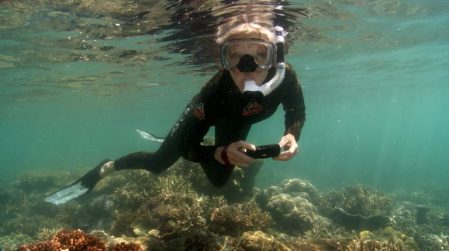 Another way of finding universal truths is through simple observation. If we have catastrophic sea level rise, for example, then this should be evident when we visit the beach, or somewhere like Sydney Harbour. It should be evident in our coastal landscapes. I explained some of this in a recent talk I gave at the Maroochydore Surf Life Saving Club that the Institute of Public Affairs had filmed and that is now available on YouTube.
Given science is about real world phenomena, it should not be that difficult for Misha Ketchell to test the evidence repeatedly being put forward by particular individuals, like myself, against what comes to pass in the real world — what is observed.
But instead of relying on such simple tests of the truth — in my rainfall forecasts or in a coastal landscape or at a coral reef — those in authority, and who edit important journals and websites, have decided that I should be banned.
As Graham Lloyd explains on page 18 of today’s Weekend Australian, I’m listed, in, of all places, the journal Nature as a dangerous dissident who must be shunned, and denied, because, it is claimed, that I misrepresent the evidence. That so many of us are actively de-platformed is only just now being acknowledged, and I am grateful that it has today been explained in The Weekend Australian.
The conspiracy against me dates to at least 2008 when Bryant MacFie gifted $350,000 to the University of Queensland (UQ) in a donation facilitated by the Institute of Public Affairs to pay for environmental research scholarships. After I set all of this up, the Federation of Australian Scientific and Technological Societies (FASTS) intervened and told the Law and Agricultural facilities that if the program was to go ahead it must be without me … because as someone sceptical of global warming I lacked integrity.
I was replaced by Richard Burns, as the team leader. And more recently, in January just this year, after another strategic intervention perhaps involving the Bureau this time, I was removed as team leader from a project with the Queensland University of Technology (QUT).
The University of Queensland program did go ahead without me back in 2008.
I moved to Katoomba in the Blue Mountains, west of Sydney. The Blue Mountains is, of course, a great place for bush walking, which is a great way to reconnect with the natural world. It is in nature that we find evidence for the universal truths that exist independently of any and everything Misha Ketchell, and other such Australian opinion leaders, choose to publish — or not.
So, while I have repeatedly tried to escape to nature, it draws me back to science … as a method for transcending the chatter now everywhere in our scientific institutions and their publications.
I have kept showing that David Jones and Blair Trewin at the Bureau of Meteorology keep changing the temperature record, and more recently that the journal Nature publishes incorrect information from David Wachenfeld, the chief scientist at the Great Barrier Reef Marine Park Authority, as detailed in the article that follows.
Science is a method, science is never settled. We must therefore always be open-minded, tolerant and ready to be proven wrong. But history will eventually show that it is Misha Ketchell who is wrong and that this editor is not using a reasonable, or in any way evidence-based, criteria for deciding what should be published. This is so very wrong and so very harmful to science, democracy and the capacity of other opinion leaders and academics to evaluate the evidence which is so necessary if they are to get to the truth in such matters as climate change.
****************
The following article was published in The Weekend Australian on 7th September 2019.
Coral death knell exaggerated, says rebel quality assurance survey
The death of inshore corals near Bowen had been greatly exaggerated, according to the findings of a rebel quality assurance survey by reef-science outsiders Peter Ridd and Jennifer Marohasy.
The shallow reef flats of Stone Island have played a key role in divisions over the health of the – inshore Great Barrier Reef and the impact of run-off from agriculture.
Dr Ridd was disciplined for attempting to blow the whistle on the widespread use of before and after pictures taken a century apart near Stone Island that suggested coral cover had disappeared.
A follow-up paper by Queensland University reef scientist Tara Clark, co-authored by Great Barrier Reef Marine Park Authority chief scientist David Wachenfeld, confirmed the coral loss.
Despite winning his unfair dismissal case against JCU and being yesterday awarded more than $1.2m by the Federal Court, Dr Ridd effectively has been dismissed as a crank by other scientists.
An expert scientific panel last month accused him of spreading scientific misinformation like pro- tobacco lobbyists and anti-vaccination campaigners.
But Dr Ridd and Dr Marohasy have spent the past two weeks documenting the corals around Stone Island, which they found were still very much alive. … continue
Australia Furthers Its Cooperation With NATO
By Ramona Wadi | Strategic Culture Foundation | August 29, 2019
In 2001, Australia became involved in the US “war on terror”, coined by former US President George W Bush as the pretext for invading Afghanistan. The rationale behind Australia’s decision was the ANZUS Treaty – a non-binding security between Australia, New Zealand and the US purportedly in line with the principles of the UN Charter.
Despite the treaty relating to possible attacks on either party in the Pacific, former Australian Prime Minister John Howard invoked Article VI to justify Australia’s involvement in Afghanistan, which states, “This treaty does not affect and shall not be interpreted as affecting in any way the rights and obligations of the Parties under the Charter of the United Nations or the responsibility of the United Nations for the maintenance of international peace and security.”
Since 2001, Australia has maintained a presence in Afghanistan and Iraq. Adopting US rhetoric on security and terrorism, the Australian Defence Ministry described its presence in Afghanistan thus: “Our fundamental objective in Afghanistan is to combat a clear threat from international terrorism to both international security and our own national security. Australia cannot afford, and Australians cannot afford, to let Afghanistan once again become a safe haven and training ground for terrorist organisations.”
Needless to say, the war on terror accomplished a continuation of the terrorism fomented by the US in its plans to permanently destabilise the region. Following its involvement in Afghanistan and Iraq, Australia has also cooperated with the North Atlantic Treaty Organisation (NATO) since 2005, thus prioritising security discourse at a national level.
In 2012, the Australia-NATO Joint Political Declaration established the foundations for cooperation and strategy – in other words, the prolongation of intervention abroad upon pretexts of security. The document recognises Australia as “one of the leading contributors to the NATO-led ISA mission in Afghanistan, which works under a UN Security Council mandate.”
Additionally, the declaration whitewashes foreign intervention through security concerns: “We understand the need to manage effectively risks and threats to our mutual interest, such as political instability from failed states, terrorism, the proliferation of weapons of mass destruction and their means of delivery, and cyber-attacks.” This statement has been reflected in the recent partnership agreement signed by NATO and Australia earlier this month.
NATO Secretary General Jens Stoltenberg described Australia’s role as “helping us to prevent Afghanistan from becoming a safe haven for international terrorists.” Days later, US President Donald Trump spoke about US presence in Afghanistan as a purported deterrent to prevent the country from becoming “a laboratory for terror.”
Far from deterring terrorism, international involvement in Afghanistan has created networks of terror which cannot be dissociated from foreign intervention. Dismantling terrorism in a failed state created by foreign intervention is the pretext for prolonged international presence.
Australia’s involvement in Iraq and Afghanistan as a non-NATO member has been one of the most prominent and reportedly in relation to training missions, although it was also involved in capturing and detaining alleged terror suspects.
As early as 2003 while working in close cooperation with the US, Australia not only was knowledgeable about the torture and abuse meted out at Abu Ghraib in Iraq – it was also a participant. Documents reveal that Australia’s representative at Abu Ghraib, officer and military lawyer George O’Kane, blocked the International Committee of the Red Cross access to detainees undergoing torture sessions. The Australian Government’s response to the revelations refuted responsibility, stating that the techniques applied against detainees were in concordance with the Geneva Conventions.
Australia was also one of the countries, among them NATO members and allies, participating in the Central Intelligence Agency’s (CIA) extraordinary rendition program, which involved the transfer of individuals suspected of terrorism to secret US detention and torture centres.
Speaking about the recently agreed framework, Stoltenberg highlighted Australia’s cooperation with NATO as focusing on preventing terrorism. “Training local forces is the best thing we can do in fighting terrorism; helping countries to stabilise their own countries.”
False premises instigated the war on terror. Maintaining it requires the regurgitation of past, dangerous lies. The West’s appropriation of what constitutes “individual liberty, democracy, human rights and the rule of law” has fomented perpetual war and subjugation to imperialist powers.
In the words of Australian Defence Minister as to the level of involvement of Australia in the region, “what we’re doing at the moment is assessing the ask from the United States, assessing what other allies are doing and how they’re considering this.” A simple statement that shows the Australian government has no consideration for the countries invaded by NATO, the mutating violence, dispossession of people and permanent instability. Neither, for that matter, will Australia assess its own involvement in terms of the human rights violations it helped to propagate. Dropping bombs in Iraq? Australia seems to have no problem with furthering an oppressive legacy.
Australia joins US-led anti-Iran flotilla… in the name of national security & economic interests
RT | August 21, 2019
Australia will send a frigate and a spy plane in support of Washington’s dubious initiative to boost security in the Straits of Hormuz by filling it with foreign warships, increasing the risk of miscalculations and provocations.
“The government has decided that it is in Australia’s national interest to work with our international partners to contribute,” Prime Minister Scott Morrison said on Wednesday morning. “Our contribution will be limited in scope and it will be time-bound.”
Following the US and UK lead, the former British colony will reinforce the sparse coalition with a P-8A Poseidon maritime surveillance plane this year and will dispatch a frigate next January for at least six months’ patrol, foreign affairs minister Marise Payne and defense minister Linda Reynolds said in a statement.
Besides this ‘limited’ contribution, Canberra also agreed to provide intelligence and other assistance, as the US faces an uphill battle trying to muster support for its “maritime policing” initiative. Previously, only the UK and Israel had volunteered to battle the much-hyped Iranian threat, following a series of mysterious attacks on oil tankers that were pinned on Tehran and reciprocal vessel seizures by Iran and the UK.
The Islamic Republic, meanwhile, believes the US is simply trying to enforce its unilateral oil sanctions through military pressure after failing to do it via political extortion.
Did Bill Barr Call His Shot? Unanswered Questions about FBI’s Foreknowledge of the El Paso Shooting
William Barr’s warning that a “major incident” could occur “at any time” and “galvanize public opinion” around the unpopular encryption back-door policy he has been seeking seems to have come true in the weeks since the attorney general made those statements.
By Whitney Webb | MintPress News | August 7, 2019
As a series of recent mass shootings have brought renewed demands for the U.S. government to do something to address the spike in “lone wolf” violence, the Trump administration’s decision to blame internet privacy, controversial websites like 8chan, and social media for the shootings has raised eyebrows from across the political spectrum, particularly in light of claims that Trump’s recent rhetoric about immigrants may have incited some of the shooters.
During a press conference on Monday, Trump blamed the internet for the three most recent mass shooting events:
We must recognize that the internet has provided a dangerous avenue to radicalize disturbed minds and perform demented acts. We must shine light on the dark recesses of the internet and stop mass murders before they start…. The perils of the internet and social media cannot be ignored, and they will not be ignored… We cannot allow ourselves to feel powerless. We can and will stop this evil contagion.”
Yet, not long before the recent spate of mass shootings began, U.S. Attorney General William Barr gave a speech on July 23 in which he spoke of the need for all consumer electronic devices and encrypted software to have a backdoor for the government to bypass encryption, essentially calling for many of the same measures that Trump has proposed following the recent shootings.
Notably, Barr concluded his speech by stating that he anticipated “a major incident may well occur at any time that will galvanize public opinion on these issues.” In other words, just a few days prior to the recent spate of mass shootings, William Barr stated that he anticipated a public safety crisis that “may well occur at any time” and would reduce public resistance to the further erosion of civil liberties that he was advocating for in his speech.
Furthermore, the FBI, which operates under the jurisdiction of the Department of Justice and reports directly to William Barr, has now stated that it was aware of the El Paso shooter’s plan to murder civilians via a post made on 8chan at least two hours before the shooting took place. 8chan — a controversial website that the FBI is known to have used to incite violence as part of its controversial terrorist entrapment strategy — has since been banned in the shooting’s aftermath. In addition, less than two months ago, the FBI obtained a warrant for 8chan’s host — Ch.net — in which the Bureau demanded access to the entire contents of the accounts that were of interest in that specific investigation, suggesting that the FBI had increased access to information of hundreds of 8chan accounts in the lead-up to the recent shootings.
The overlap between Barr’s recent speech and Trump’s proposed solution to the massacres, as well as the FBI’s unusual recent relationship with 8chan, has led some to suggest that the Trump administration is taking advantage of the tragedy at El Paso and of other recent mass shootings to impose unpopular restrictions on civil liberties and increase the mass surveillance of innocent Americans.
An uncanny prediction
On Tuesday, July 23, Attorney General William Barr gave the keynote address at the 2019 International Conference on Cyber Security (ICCS) at Fordham University. The focus of Barr’s speech was the need for consumer electronic products and applications that use encryption to offer a “backdoor” for the government, specifically law enforcement, to obtain access to encrypted communications as a matter of public safety.
Early in his speech, Barr stated:
Service providers, device manufacturers and application developers are developing and deploying encryption that can only be decrypted by the end user or customer, and they are refusing to provide technology that allows for lawful access by law enforcement agencies in appropriate circumstances….
While encryption protects against cyberattacks, deploying it in warrant-proof form jeopardizes public safety more generally. The net effect is to reduce the overall security of society.”
Barr went onto say that “warrant-proof encryption is also seriously impairing our ability to monitor and combat domestic and foreign terrorists.” Barr stated that “smaller terrorist groups and ‘lone wolf’ actors” — such as those involved in the series of mass shootings in California, Texas and Ohio that would occur in the weeks after his speech — “have turned increasingly to encryption.” Barr later notes that he is specifically referencing encryption used by “consumer products and services such as messaging, smart phones, email, and voice and data applications.”
Barr then laid out his vision of what the solution to this challenge posed by “warrant-proof encryption” would look like:
We believe that when technology providers deploy encryption in their products, services, and platforms they need to maintain an appropriate mechanism for lawful access. This means a way for government entities, when they have appropriate legal authority, to access data securely, promptly, and in an intelligible format, whether it is stored on a device or in transmission.
We do not seek to prescribe any particular solution. Our private-sector technology providers have immensely talented engineers who have built the very products and services that we are talking about. They are in the best position to determine what methods of lawful access work best for their technology.”
After laying out his vision, Barr stated that, while he would like to give private companies time to willingly cooperate and comply with his suggested solution to “warrant-proof encryption,” “the time to achieve that [government back-doors into electronic consumer apps and products] may be limited.”
To overcome the resistance by some private companies — who do not want to renege on their right to privacy by giving the government back-door access to their devices — and American consumers, Barr tellingly anticipates that a “major incident” will soon take place that will mold public opinion in favor of his proposed solution.
Barr concluded his speech by stating:
I think it is prudent to anticipate that a major incident may well occur at any time that will galvanize public opinion on these issues.
As this debate has dragged on, and deployment of warrant-proof encryption has accelerated, our ability to protect the public from criminal threats is rapidly deteriorating. The status quo is exceptionally dangerous, unacceptable, and only getting worse.
The rest of the world has woken up to this threat. It is time for the United States to stop debating whether to address it, and start talking about how to address it.” (emphases added)
On Thursday, July 25, the last day of the ICCS conference, FBI Director Christopher Wray also echoed Barr’s call for government back-doors into encrypted software and apps, stating in his speech:
Cybersecurity is a central part of the FBI’s mission. But as the attorney general discussed earlier this week, our request for lawful access cannot be considered in a vacuum. It’s got to be viewed more broadly, taking into account the American public’s interest in the security and safety of our society, and our way of life. That’s important because this is an issue that’s getting worse and worse all the time.
There’s one thing I know for sure: It cannot be a sustainable end state for us to be creating an unfettered space that’s beyond lawful access for terrorists, hackers and child predators to hide. But that’s the path we’re on now, if we don’t come together to solve this problem.”
A new phase of an old campaign
The speeches given by Barr and Wray are the most recent iterations of the Department of Justice’s years-long effort to evade and weaken the encryption used by certain electronic products and applications, particularly encrypted messaging apps. Indeed, the DOJ was particularly active in late 2017 in pushing for back-doors into encrypted software, citing the encrypted devices of past perpetrators of mass shootings as proving the need for federal law enforcement to easily and quickly bypass encryption in criminal investigations.
However, Barr’s and Wray’s speeches mark a new phase of this government campaign targeting encryption, a campaign that has picked up in the past two weeks just as a series of mass shootings in the United States have led to widespread calls for the government to do something to prevent further massacres.
At a Monday press conference, President Donald Trump gave his official response to the most recent shootings in Ohio and Texas, tragedies that he largely blamed on the internet and its “dark recesses” that are inaccessible to the government. “We must recognize that the internet has provided a dangerous avenue to radicalize disturbed minds and perform demented acts,” Trump stated, before adding: “We must shine light on the dark recesses of the internet and stop mass murders before they start.”
“The perils of the internet and social media cannot be ignored and they will not be ignored,” the president emphasized.
One of the main solutions Trump offered to what he alleged caused the recent shootings was to mandate the DOJ “to work in partnership with local, state and federal agencies as well as social media companies to develop tools that can detect mass shooters before they strike.” Some interpreted this statement as suggesting the more widespread implementation of “pre-crime” software, such as Palantir, which was co-founded by billionaire Trump backer Peter Thiel, who is also on Facebook’s board.
Conveniently for William Barr, Facebook announced in May that the company is already developing just the “backdoor” that the attorney general has sought. This new initiative would implement AI-powered surveillance measures onto consumer devices, which would bypass end-to-end encryption on both the recently encrypted Facebook Messenger and the popular encrypted messaging app WhatsApp, acquired by Facebook in 2014. Though the measure was announced in May, it has received media attention only in the last week, following Barr’s speech at the 2019 ICCS.
Following Trump’s proposal for social media and the Barr-led DOJ to work together to monitor encrypted messages, it seems that Facebook will be one of the first major tech companies to offer its ready-made solution to the U.S. government. It is also worth considering the possibility that Barr may use the threat of his Silicon Valley antitrust probe to potentially strong-arm tech companies that would otherwise be unwilling to create a government back-door in their software or products. That probe was announced the same day that Barr spoke about anti-encryption measures at the 2019 ICCS.
In addition, between Barr’s July 23 speech and Trump’s August 5 press conference, there has been a concerted push from not only the DOJ but also the Five Eyes intelligence alliance, of which the U.S. is part, to weaken encryption or give governments access to encrypted applications.
On the heels of the 2019 ICCS, at which Barr and Wray spoke, there was a related cyber security summit in London — called the Five Country Ministerial — where “senior ministers from the U.K., Australia, Canada, New Zealand and the United States … reaffirmed their commitment to work together with industry to tackle a range of security threats.”
According to the U.K. government’s press release on the summit, which took place from July 29 to 30, the ministers in attendance “stressed that law enforcement agencies’ efforts to investigate and prosecute the most serious crimes would be hampered if the industry carries out plans to implement end-to-end encryption, without the necessary safeguards.” William Barr attended that summit, representing the U.S., and echoed his speech given a week prior, stating:
We must ensure that we do not stand by as advances in technology create spaces where criminal activity of the most heinous kind can go undetected and unpunished.”
Notably, Australia last year implemented a law similar to that which Barr is seeking to enact in the United States. It has since been lampooned by expert cryptographers for its ineffectiveness and has caused damage to Australia’s tech industry. According to the Guardian, Microsoft revealed in March that companies and governments it works with say they “are no longer comfortable about storing their data in Australia as a result of the encryption legislation.” Perhaps predictably, what has happened since Australia’s enactment of this controversial encryption legislation is the Australian government’s use of its new “back-doors” to widely surveil its civilians without a warrant.
Barr’s Orwellian bent
Barr’s outsized involvement in this recent push for a government back-door into all encryption apps is notable given his past. For instance, prior to becoming attorney general under Trump, Barr worked at the law firm Kirkland & Ellis, a firm that “represent[s] clients on matters relating to data and network security.” Kirkland & Ellis, in describing its own services, notes:
These matters are increasingly important to national security and international trade concerns such as government surveillance issues, state-sponsored cyber-attacks and espionage, and legal limitations on cross-border data transfers. The Firm represents clients in navigating these legal matters, including with respect to investigating security incidents/breaches and handling resulting litigation or government relations aspects of such incidents.”
Furthermore, Barr’s previous stint as attorney general, during the administration of George H.W. Bush, saw him push for increasing mass surveillance of innocent Americans. According to USA Today, in 1992, while serving as Attorney General under Bush Sr., Barr “launched a vast surveillance program that gathered records of innocent Americans’ international phone calls without first conducting a review of whether it was legal.” The program “ultimately gathered billions of records of nearly all phone calls from the United States to 116 countries, with little oversight from Congress or the courts” and also “provided a blueprint for far broader phone-data surveillance the government launched after the terrorist attacks of Sept. 11, 2001.” The program was partially carried out by the then-head of the DOJ’s Criminal Division, former FBI Director Robert Mueller.
Barr’s history of pushing for reducing privacy for citizens is troubling considering that, earlier in his career, he pushed for increased government secrecy while he was employed by the CIA in the late 1970s. For instance, while working at the CIA’s Office of Legislative Council, Barr attempted to circumvent the moratorium placed on the CIA that prevented it from destroying records and also stonewalled the Church Committee’s investigation into CIA abuses. Thus, Barr’s push for reduced privacy for citizens but increased privacy for the government bodes poorly for those who see government transparency and citizen privacy as important to keeping government overreach in check.
FBI foreknowledge
In the hours before the shooting at a Walmart in El Paso, Texas — and less than two weeks after Barr warned of an imminent “major incident” that would “galvanize public opinion” in favor of ending encryption free from a government back-door — the FBI was made aware of a manifesto published on the controversial website 8chan that is alleged to have been authored by the shooter, Patrick Crusius.
According to NBC News, the FBI was aware of the document prior to the shooting, but was unable to act quickly enough to prevent the attack. There have, however, been conflicting reports about exactly how long the FBI was aware of the alleged manifesto prior to the shooting.
For instance, soon after the shooting, CNN stated that three different sources had told the outlet that the manifesto had been “posted days before the shootings.” However, the FBI later stated less than a half hour before the shooting, while separate law enforcement sources told reporters that it was actually two hours before the shooting.
There is also a discrepancy regarding whether the manifesto was originally posted on 8chan and whether the shooter himself even posted it. Jim Watkins, who owns the 8chan message boards and has alerted federal authorities previously when past shooting manifestos were published at the site, stated:
First of all, the El Paso shooter posted on Instagram, not 8chan… Later, someone uploaded the manifesto. However, that manifesto was not uploaded by the Walmart shooter. I don’t know if he wrote it or not, but it was not uploaded by the murderer; that is clear.”
Facebook, which owns Instagram, said that it had disabled an Instagram account that belonged to Crusius and also noted that that account had been inactive for over a year.
In the past, 8chan administrators had deleted manifestos minutes after they were posted and warned federal authorities that the documents had been published. In the case of the El Paso shooting, Watkins claimed that the site had informed federal authorities as soon as they were aware that the manifesto had been uploaded to its page.
The facts that the FBI knew in advance of the manifesto, that the manifesto may not have been uploaded by the shooter, and that the FBI was quick to link that document to the shooting event soon after it took place have led to speculation about how the FBI was able to make that connection so quickly. For instance, lawyer Robert Barnes stated the following on Twitter:
How did [the] FBI identify the shooter before he began his attack from a post on an anonymous chat board? Usually, this means the shooter tipped them off either directly or indirectly (informant). Misuse of informants (including encouraging violence) is an underexplored problem.”
In addition, journalist Rachel Blevins posed a similar question on social media following the revelations, writing:
It took just hours for the FBI to both identify the suspect in the El Paso shooting and connect him to a manifesto posted on 8chan, which raises the question… was the suspect included in the FBI’s surveillance, and were their agents in contact with him before the shooting?”
This possibility is worth considering, given the well-documented history of the FBI’s policy of manufacturing domestic terror plots within the United States, most of which are ultimately foiled at the last minute by the Bureau. In many of those cases, many alleged terrorists would not have planned or attempted those attacks without goading and support from the FBI, leading critics to accuse the FBI of deliberately using entrapment. For instance, a 2014 study by Human Rights Watch and Columbia Law School’s Human Rights Institute found that “many of these people [in the cases examined in the study] would never have committed a crime if not for law enforcement encouraging, pressuring, and sometimes paying them to commit terrorist acts,” according to the study’s co-author Andrea Prasow.
There are several instances where the FBI sought out mentally handicapped and unstable individuals with no resources of their own, giving them incentives, fake weapons and even driving them to the scene of the planned fake terror attack. Two high-profile domestic terror cases have also had hints of FBI involvement — including the Pulse nightclub shooting, where the shooter’s father was later revealed to be a FBI informant and the FBI had attempted to goad the Pulse shooter into committing a terror attack years prior to the Pulse shooting. In addition, the family of the Boston Marathon bombers claimed that the FBI regularly visited their family home and had cultivated a close relationship with one of the bombers, Tamerlan Tsarnaev, prior to the bombing.
Since late 2016, the FBI’s controversial policy of inducting individuals to commit acts of terror in the United States has expanded after a federal appeals court ruling in December of that year said that federal agents were allowed to target a person’s religious affiliation in order to “probe the attitudes” of an individual who may want to “do something to America” by entrapping them in fake terror act schemes. The ruling also permitted federal agents to create false friendships, referred to in the ruling as the “illusory cultivation of emotional intimacy,” as a means of manipulating individuals to commit acts of terrorism — as well as providing these unstable individuals with money, vehicles, businesses and even vacations to get them to agree to participate in fake attacks.
As a result of this troubling trend, and given the FBI’s foreknowledge of the manifesto and its ease in connecting that document to the shooter, it becomes important to ask whether the FBI had more foreknowledge of the situation than it has publicly let on.
Though history indicates that FBI foreknowledge of the shooter is definitely plausible, 8chan has been a recent focus of the FBI in recent months. For instance, after the alleged manifesto of the shooter responsible for the massacre at the Poway Synagogue earlier this year was published on 8chan, the FBI issued a warrant for hundreds of 8chan user accounts that had commented on the Poway Synagogue shooter’s thread, including both users that supported his statement of intent and those who were appalled by it.
According to the Bureau’s application for a search warrant, the FBI was seeking the “IP address and metadata information about [Poway shooter John] Earnest’s original posting and the postings of all of the individuals who responded to the subject posting and/or commented about it.” The FBI further instructed Ch.net, which hosts 8chan, “to make a digital copy of the entire contents of the accounts subject to seizure.”
It goes without saying that with the information on hundreds of 8chan users, the FBI would have had access to potential future informants and potential targets to be “groomed” by the FBI for a future domestic terrorism entrapment case. This is especially likely given that the FBI’s reasoning for obtaining this large amount of information in the warrant was to identify “individuals who are inspired by the subject posting [i.e., the Poway shooter manifesto].” One 8chan user who was contacted by the FBI after this search warrant and filmed the encounter, was asked by federal agents to help them with information-gathering on other 8chan users.
This possibility is further supported by the fact that the FBI agent who filed the search warrant application, FBI Special Agent Michael Rod, revealed that he had been active on 8chan and (perhaps inadvertently) revealed his user name on 8chan to be user “8f4812.” An archive of the Poway shooter’s 8chan thread, available here, reveals that Rod stated in that 8chan thread that Russia was to blame for the Poway shooting and Rod also claimed that he knew of the Poway shooting 15 minutes before it happened but was unable to warn the authorities because he “was shit posting and got tied up.”
In the wake of the recent shootings in El Paso, Texas and Dayton, Ohio, 8chan was taken offline after internet infrastructure company Cloudflare declined to continue supporting the website.
A tragedy foretold and exploited
William Barr’s warning that a “major incident” could occur “at any time” and “galvanize public opinion” around the unpopular encryption back-door policy he has been seeking seems to have come true in the weeks since the attorney general made those statements. Given Barr’s influence over the FBI, which operates under his jurisdiction, it is important to scrutinize the evidence that the FBI had apparent foreknowledge of at least one of these recent shootings, and consider that the Bureau may have failed to act to prevent the tragedy, allowing Barr’s prediction just weeks earlier to become a self-fulfilling prophecy.
Trump’s proposed solution to the recent spate of mass shootings is focused on giving Barr a mandate to work with social media and tech companies to prevent another mass shooting before it occurs. It seems evident that this solution is set to involve surveilling encrypted communications to ostensibly prevent another shooting while also providing Barr, and the DOJ at large, the back-door into encrypted apps and consumer products that they have long sought but have been unable to sell to either the public or those same tech companies.
Now, a public safety crisis has emerged in the wake of Barr’s recent speech, tipping the scales — as Barr had predicted — so the public would favor further reductions to their civil liberties and right to privacy so that the federal government could provide increased public safety through increased surveillance. Yet, taking this alongside the well-documented fact that the FBI regularly manufactures domestic terror plots, it is worth asking whether some of these recent shootings were allowed to happen and whether public officials like William Barr are manipulating the public’s reaction to these tragedies to advance their own political agendas and further the build-up of state power.
Whitney Webb is a MintPress News journalist based in Chile. She has contributed to several independent media outlets including Global Research, EcoWatch, the Ron Paul Institute and 21st Century Wire, among others. She has made several radio and television appearances and is the 2019 winner of the Serena Shim Award for Uncompromised Integrity in Journalism.
Australia not going to host US missiles: PM Morrison
Press TV – August 5, 2019
Australian Prime Minister Scott Morrison has announced that missiles belonging to the United States will not be deployed in Australia.
Morrison, who held talks with US officials over the weekend, said on Monday that Australia will not be hosting US intermediate-range missiles.
His comments came hours after US Defense Secretary Mark Esper and Secretary of State Mike Pompeo departed Sydney following US-Australia talks.
The talks ended with a joint statement in which the two sides agreed to create a stronger front against Chinese advancement in the Asia-Pacific region.
The US won’t “stand by idly” while China “attempts to reshape the region to its favor,” Esper was quoted by US media as saying.
However, in an interview on Saturday after pulling out of a landmark arms control treaty, the new Pentagon chief told reporters that he aimed to deploy ground-launched, intermediate-range missiles in the Asia-Pacific region in the coming months, raising serious concerns among the advocates of arms control.
China has described Beijing’s bilateral relationship with Australia as “unsatisfactory”.
After meeting his Australian counterpart last week, China’s top diplomat insisted that Beijing’s strained ties with Canberra needed to be ameliorated.
“During our diplomatic and strategic dialogue in Beijing last November, we agreed to calibrate and relaunch China-Australia relations, but the process of improving our ties has not been satisfactory,” said State Councilor, Wang Yi, after the Bangkok meeting which took place on the sidelines of a regional security forum.
Canberra claims the reason for severed ties was that Beijing had attempted to interfere in its internal affairs. Beijing rejects the claim, insisting it is does not, on principle, meddle in other countries’ domestic affairs.
Will the Australian Government Join in a “Nuremberg Class” Attack on Iran?

U.S. Secretary of State Michael R. Pompeo welcomes Australian Foreign Minister Marise Payne to the U.S. Department of State in Washington, D.C., on January 30, 2019.
Credit: U.S. Department of State/ flickr
By David Macilwain | American Herald Tribune | June 24, 2019
As my father used to say in response to difficult questions – “ask no questions and you’ll be told no lies”. This seems to be the approach of Australia’s media organizations to our government’s extraordinary silence over events in the Gulf of Oman. Barring an anodyne statement condemning the attacks on civilian shipping, neither Australia’s foreign minister Marise Payne nor Prime Minister Scott Morrison has ventured an opinion on who might have been responsible for these provocative actions. This remains the case even when subsequent developments included a narrowly averted war with global repercussions, with no questions asked and no lies proffered.
In the aftermath of recent attacks on journalistic freedoms and intimidation of whistleblowers, many people have expressed the view that it is the job of journalists to hold governments and public servants to account. That the governments of both Australia and its parent Britain seek to avoid such scrutiny is clear from their actions. Draconian punishments now apply to those who are thought to “threaten national security” by revealing inconvenient truths.
So we might wonder whether the ABC’s failure to ask questions of Government ministers about the dangerous confrontation in the Persian Gulf is connected to these recent developments, which included a highly provocative police raid on the headquarters of the ABC. The ABC purports to be independent of Government, and is expected to interview ministers on behalf of the public when necessary, as well as seeking the view of shadow ministers from the opposition Labor party.
In those recent raids, which concerned an Australian equivalent of the “Collateral Murder” crime exposed by an insider in Australia’s Special Forces in Afghanistan and leaked to an ABC journalist two years ago, there was a widespread shock at the actions authorized under the police warrant. In examining the ABC’s files relating to the case, it was revealed that the recently expanded powers of police forensic officers included the deletion and alteration of computer files – though this was explained as limited to the removal of irrelevant material and identities. This could be true given that the need to rewrite history is now minimized thanks to current controls over access to information.
What was more shocking to some, however, was a widely expressed but ill-informed view from the “Murdoch Right” that the ABC raids were justified, as its actions had endangered national security. Similar views were expressed over the alleged crimes of Julian Assange, whether “narcissist” or “cyber-terrorist”, with little sympathy from fellow Australians for his persecution and torture by the UK regime.
Australian sentiment towards the Islamic Republic of Iran is similarly prejudiced, so persuading the public that Iran would have launched an attack on two tankers near the Straits of Hormuz on the basis of minimal evidence was never going to be difficult; a mere dog-whistle sufficed. What now seems worrying is that “Central Narrative Control” knew this in advance – that they could show a blurry video of Iranian forces rescuing a ship’s crew, while saying it showed them “removing a limpet mine”, and the US aligned media audience would believe that this was what they saw.
But how could people be fooled by this ridiculous story, presented with a video that didn’t stand the slightest scrutiny? Why anyway would Iran sabotage two ships as a direct provocation, while trying to make it look as though the US or its allies were responsible? This wouldn’t make any sense, as the US would have no motive for such an attack – other than to frame Iran for it as a pretext for what has now followed!
The corollary of this perverse provocation by the US or its local agents is that while an Iranian strike on the two tankers could have been understood as a response to newly imposed sanctions targeting Iran’s petrochemical industry, such an attack on civilian shipping by the US with the sole object of framing Iran would be an undoubted war crime. As in fact, it was – and we need to remember this as subsequent events and silence from the media relegate it to a later investigation, or the memory hole. (Iran has also registered a protest over the US accusations with the UN)
Those subsequent events, which we now discover have brought us to the point of a major military escalation, allow current news reports to state that “following the Iranian attack on two ships in the Gulf of Oman” – tensions on both sides are increasing; no longer is the ship attack “alleged”. Instead, a new “limpet mine” narrative has been created to reinforce the idea of the Iranian threat, and this, in turn, feeds into talk of new Uranium enrichment above the agreed levels in the JCPOA, despite this being an entirely legitimate Iranian response to the US’ failure to keep to the agreement. Contrary to the immediate wild accusations from the usual suspects that Iran is now “again” working on a nuclear bomb (it never was, since 2003 [if ever] ), the renewed enrichment remains only to the 3.7% base limit, as those nuclear-armed suspects know perfectly well.
The need to be reminded of these stages in the development of the false narrative that Iran is the aggressor is that the silence from both media and politicians has actually enabled it, simply by drawing on the prejudices of the population. It seems that only those who doubt or deny the US-led accusations against Iran have noticed the deafening silence of Australia’s leaders and the failure of the main media to ask them to show their hand. Is it possible that we could find ourselves supporting the real aggressors in a criminal attack on a peaceful and friendly nation – a classic case of “sleepwalking into war”?
Well, now it appears that this is the case. The ABC hasn’t thought to ask the foreign minister whether we agree with the US story, and whether we would support them in military action against Iran despite the lack of evidence, because there is already that assumption. Despite the early skepticism of US claims from some mainstream commentators, and parallels drawn with the proverbial Iraqi WMD fraud, those reservations appear to now be forgotten. With this comes the realization that my father’s riposte does not apply to our national broadcaster; it doesn’t fear being told lies but rather fears having to admit the obvious truth, which is that of course, we believe the US story, and will support any action that our alliance demands.
Such blindness to the truth, and blind submission to the whims of the world’s most dangerous state, was brought home by this quote from Sydney Morning Herald correspondent Michael Bachelard:
“Some have likened the escalating atmosphere to the feeling leading up to George Bush’s invasion of Iraq in 2003. So why are we suddenly using the “w” word in the Middle East again, and should Australia brace to be invited into another Coalition of the Willing?”
Bachelard presents – and perhaps believes – “Australia” to be a well-intentioned onlooker on the mixed-up politics of the Middle East, whose “contribution” would always be towards peace and security and resolution of conflict. It is a rosy-eyed view of Australia sadly prevalent amongst people whose own intentions are honorable – assuming that the leaders of our traditional allies and partner “democracies” share their honesty and integrity and benevolence. By contrast, these same people seem happy to assume the worst about our “enemies”; Bachelard’s inappropriate use of a photo of a smiling President Assad greeting Ayatollah Khamenei in Tehran in February in the above article nicely reflects this ingrained prejudice.
The reality of Australia’s role in Middle Eastern politics, on the battlefields of Syria, Iraq and Afghanistan and over Palestine and Israel is sadly very different. Despite a “modest contribution” to the Iraq invasion force, John Howard was George Bush’s closest ally, notably refusing to accept that Saddam Hussein had no WMD until around 2010. More recently the involvement of Australian fighter jets in the 2016 US coalition attack on the Syrian Army near Deir al Zour was symptomatic of Australia’s illegitimate presence in Syria, and complicity in NATO allies’ support for the insurgent forces. This intimate alignment with the US also saw Australia copying Trump’s “recognition” of Jerusalem as Israel’s capital, despite the damage this did to relations with our closest neighbor Indonesia.
In the light of this record, and the catalog of unasked questions and untold lies, we can only speculate on the Australian Government’s RSVP to America’s “invitation” to join in a “Nuremberg class” attack on Iran. With Foreign Minister Marise Payne’s record of meetings with both Pompeo and Bolton, and our shared bases and assets in the region, it seems likely such an invitation was a mere formality, likely preceding the first strikes on tankers in the Gulf of Oman.
And as with the story of the war crimes in Afghanistan, there won’t be any desire to rewrite the history of how the third Great War began, should the truth finally surface. That history has already been certified as true by the silence of “Australia’s most trusted news source” and recorded in the mind of the nation; no-one would now believe otherwise.
Australian feds raid broadcaster’s office over Afghan war crime stories
RT | June 5, 2019
Australian police have raided national broadcaster ABC’s headquarters over a 2017 story series exposing crimes committed by special forces in Afghanistan, the second raid on journalists in two days.
Six officers, including three police technicians, descended on the broadcaster’s Sydney offices with a warrant explaining the raid was “in relation to allegations of publishing classified material, contrary to provisions of the Crimes Act 1914.” The classified material in question? Hundreds of pages of leaked defense documents marked AUSTEO (Australian Eyes Only) that formed the basis of ABC’s 2017 story series ‘The Afghan Files.’ The warrant names the report’s authors, Dan Oakes and Sam Clark, as well as ABC news director Gaven Morris.
The officers rounded up ABC’s IT staff to assist in examining their email server looking for “a series of key words,” while others scoured a hard drive, according to John Lyons, ABC executive editor and head of investigations department, who live-tweeted the raid. Officers helpfully told him they were interested in “very specific matters” and “certain things,” dryly noting “this could take some time,” Lyons reported. Four hours into the raid, they had collected over 9,200 files and were deciding which could be seized under the warrant.
“It is highly unusual for the national broadcaster to be raided in this way,” ABC managing director David Anderson told news.com.au, promising to support its journalists, protect its sources, and “continue to report without fear or favor on national security and intelligence issues when there is a clear public interest.”
The federal police released a statement after the raid on Wednesday claiming “no arrests are planned today as a result of this activity” and denying it was connected to an intimidating visit paid to another journalist in Canberra the previous day – though it’s hard not to see a connection, given both were publishing stories on government misconduct based on documents unavailable to the public.
Officers raided News Corp journalist Annika Smethurst’s home on Tuesday, triggered by a story she wrote last year revealing the government’s plans to dramatically expand the Australian Signals Directorate’s spying on its own citizens, giving the agency power to secretly access bank records, text messages, and emails without an individual’s knowledge. Officers reportedly spent seven hours picking through Smethurst’s possessions; an unauthorized “leak of national security information” was cited as the cause.
That same day, 2GB radio host Ben Fordham said he had been contacted by the Department of Home Affairs in an effort to find out how he’d obtained “highly confidential” information for his reporting on asylum seeker vessels.
Condemning the “disturbing pattern of assaults on Australian press freedom,” the Media, Entertainment and Arts Alliance, Australia’s journalists’ union, called the raids “nothing short of an attack on the public’s right to know.”
“It seems that when the truth embarrasses the government, the result is the Federal Police will come knocking at your door.”
The Afghan Files describes a number of incidents in which Australian special forces shot civilians in addition to the insurgents they were supposed to be fighting and reveal Afghan authorities “were becoming increasingly agitated over Australians allegedly killing unarmed civilians” to the point that they “threatened to stop working with Australians.”
PM Scott Morrison has refused to condemn the raids, declaring all Australians must abide by national security laws. He won a “miracle” reelection last month, giving his Liberal National party a third straight term in power. Morrison appears to be using his mandate to crack down on antagonistic journalism, the MEAA noted.
Aussie Feds Raid News Corp Journalist’s Home After Government Spying Exposé
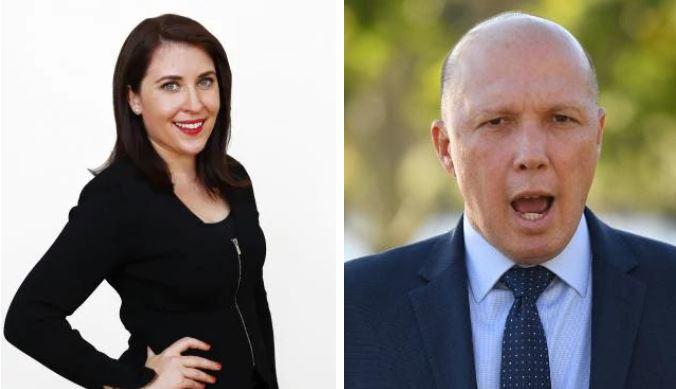
News Corp Australia’s Annika Smethurst, Home Affairs minister Peter Dutton
By Tyler Durden | Zero Hedge | June 3, 2019
Australian federal police officers are raiding the home of News Corp Australia journalist Annika Smethurst over an April, 2018 story accusing the government of radical new espionage powers allowing the Australian Signals Directorate (ASD) to monitor citizens for the first time, according to the Daily Telegraph (via the Herald Sun).
Ms Smethurst, the political editor for News Corp Sunday titles including The Sunday Telegraph, was at home preparing to leave for work this morning when several Australian Federal Police officers arrived with a warrant from an ACT magistrate giving them authority to search her home, computer and mobile phone.
Ms Smethurst complied with the warrant and is presently waiting for the raid to be completed. She has declined to answer questions apart from confirming her identity. –Herald Sun
Smethurst’s article revealed that the emails, bank accounts and text messages of Australian citizens could be secretly accessed by government spies without a trace under the proposal, as long as the Defense and Home Affairs ministers approved the plan.
The raid comes three weeks after the federal election returned the Morrison government to power, leaving Home Affairs minister Peter Dutton at the helm.
Ms Smethurst’s original story included images of top-secret letters between the secretary of Home Affairs, Mike Pezzullo, and his counterpart in Defence, Greg Moriarty, outlining a plan to potentially allow government hackers to “proactively disrupt and covertly remove” onshore cyber threats by “hacking into critical infrastructure.” –Herald Sun
Current Australian law prohibits the ASD from spying on citizens – a power left to the Australian Federal Police (AFP) and the Australian Security Intelligence Organization, the country’s domestic spy agency.
Smethhurt revealed that Dutton and former Defense Minister Marise Payne had reviewed the proposal, however it had not moved beyond that stage to be formally presented to the government.
Aussie Election Lesson: Climate Activism is a Game for Lazy Rich Elitists
By Eric Worrall | Watts Up With That? | May 18, 2019
One of the most intriguing takeaways from the 18th May Federal Election in Australia is how poorly Labor’s climate action political campaign focus played in working class areas:
Scott Morrison has earnt a permanent place as a Liberal Party legend — returning the Government in what was meant to be an unwinnable election for the Coalition.
Mr Morrison smashed the doctrine that disunity will lead to electoral death.
Despite three prime ministers in two terms of government, the Queensland swing to back the Coalition and swings in Tasmania and WA showed that ultimately jobs and fear of change are too dominant.
The Prime Minister made the campaign all about economic management and himself — out-campaigning Labor by running a brutal and stunning campaign demolishing Labor’s big-target policy agenda.
Mr Morrison made the campaign a referendum on him and Bill Shorten, and downplayed the Liberal brand — cultivating a new Scott Morrison image and promising to be a steady pair of hands on the economy.
He told a packed crowd of Liberal supporters in Sydney he had always believed in miracles.
“And tonight we’ve been delivered another one,” he said.
… Read more: https://www.abc.net.au/news/2019-05-19/federal-election-result-morrison-turn-labor-strategy-into-weapon/11116468
This isn’t the first time the climate movement has misjudged their audience. The wealthy elitism of the climate movement was on full display during the recent Extinction Rebellion shutdown of central London.
During the “rebellion”, leisure rich dilettante hippies partied in London, creating commuter misery for people who have to work for a living. Yet the out of touch Extinction Rebellion hippies somehow thought that raising “awareness” of climate change, by mocking workers with their privilege, would somehow win support from the victims of their disruption.
The Australian Labor Party was traditionally the party of workers. But like Extinction Rebellion in the UK, and the Democrats in the USA, the Australian Labor Party has lost touch with their base, and become the plaything of rich champaign socialists who want to assuage their self indulgent liberal angst by virtue signalling issues like climate activism.
The May 18 2019 Australian election is a message to the climate movement, and to out of touch politicians everywhere who somehow think climate messages are a way of connecting with voters; it’s not working.
Australia’s electoral officials ‘work with social media to tackle misinformation
RT | April 18, 2019
Australian electoral authorities have for the first time set up a cybersecurity task force, an official said on Thursday.
They are also working with social media companies to tackle misinformation in the run up to general elections on May 18.
Australian Electoral Commissioner Tom Rogers said safeguarding the election’s integrity gained priority “due to experiences in other countries,” AP reported.
Rogers is having daily briefings with the Electoral Integrity Assurance Task Force, which comprises the nation’s major security agencies and government departments. He declined to detail the task force’s functions, saying they included dealing with disinformation spread through social media.
Australian Defence Strategy Still Locked in A Past Era
By James O’Neill | American Herald Tribune | March 28, 2019
According to a report in the Sydney Morning Herald (25 March 2019) the coalition government, if re-elected, would spend $2.5 billion on an air defence system. The object of the expenditure is said to “bolster Australia’s capacity to intercept enemy aircraft”. The new system will also defend against helicopters, cruise missiles and unmanned aerial systems.
The cost is divided between an initial acquisition price of $1.5 billion and a further $1 billion to operate and maintain it over two decades. The Minister for Defence, Linda Reynolds, said that the project had great export potential.
Once again, one has to wonder exactly what planet our defence politicians and their advisors actually inhabit. While the cost of this touted new system is small change compared to the tens of billions of dollars being lavished on expensive boondoggles such as the F35 joint strike fighter and the French built submarines, it is another illustration of wasted expenditure on military equipment not fit for purpose.
The stated object is to be able to defend against four intruders: helicopters; unmanned aerial systems; enemy aircraft and cruise missiles. Why one would need a $1 billion system to defend against helicopters, with their low altitude, short range, slow moving and noisy character simply boggles the mind.
Exactly what is meant by ‘unmanned aerial systems’ is not defined, but presumably refers to drones. The same point applies here as to helicopters. The more serious question relates to enemy aircraft and cruise missiles, and the source of those hostile intruders.
There is no obvious reason for Australia to be attacked by Indonesia, Papua New Guinea or any other country for whom Australia would be within the range of its bombers. The unspoken “enemy” here is presumably China, although again that raises the obvious question as to why China would wish to attack Australia. The only obvious answer to this is as a defensive reaction to an attack upon China itself.
Australia would only do that as part of yet another United States led “Coalition”, but why Australia would wish to be involved in such a foolhardy exercise against its largest trading partner should not be seriously contemplated by our defence planners, and if it is they need to spell out their rationale in clear terms.
Let us assume for arguments sake that China did attack Australia. It would not be with helicopters, unmanned aerial vehicles, cruise missiles or bombers. It would be done with one or more of its repertoire of supersonic missiles from the Dong Feng family of missiles, most probably the DF41. This missile system travels at hypersonic speed (Mach 20) and has 8 to 10 independently targetable nuclear warheads.
There is nothing in the current repertoire of United States or Australian missile defence systems that can defend against such an attack, and the heroic claims of former defence minister Christopher Pyne that it will be a “highly effective defence system” is simply nonsense.
If Australia did get into a shooting war with China, that war would likely involve China’s strategic partner Russia, whose missile systems (for example, Zircon, Burevestnik, Avangaard and Kinzhal) are decades ahead of US military technology, as even the United States itself admits (www.news.com.au 19 December 2018). For details of these Russian systems see Martyanov www.unz.com 5 March 2018; and Vineyard of the Saker www.thesaker.is 24 January 2019.
If Australia was serious about having a missile defence system then the world leader by a significant margin is the Russian S400 system, recently bought by China, Turkey, Saudi Arabia and India among others. Turkey, a NATO member, is proceeding with the purchase of the S400 despite overt threats by the Americans. The Saudis, huge purchasers of US military equipment in the past, also know where to go in order to purchase the best available system. Quite why a similar degree of realism is not allowed to intrude upon discussions of Australian defence strategy remains a puzzle. Has Australia become so “joined at the hip” with the Americans that it is willing to compromise on real military defence strategy? Instead of coherent debate we are fed the mindless pap exemplified in the SMH article referenced above.
Featured Video
Stanislav Krapivnik: Russia-Iran Cooperation & Escalation in Ukraine
or go to
Aletho News Archives – Video-Images
Frlom the Archives
Are the Jews indigenous to Palestine?
By David Miller | Al Mayadeen | August 3, 2022
There is a rising tide of claims from apologists for the crimes of Zionism that they have been misunderstood. Palestinians might be indigenous to Palestine, but the Jews definitely are. What is called the ‘Israel-Palestine’ conflict, they say, is competition over the same small piece of land by two rival groups of indigenous people. But are the Jews indigenous to the Levant? And what are the consequences of the argument?
In fact, most of the power structure of the Zionist state is dominated by Ashkenazi Jews who have no ancestral link to Palestine. Overall despite very significant financial and infrastructural contributions from Western European countries (especially the US, UK and France, for example via the Rothschild family), Eastern European Ashkenazim have been at the centre of the Zionist power structure since the early years of the 20th Century. … continue
Blog Roll
 Aletho News
- Iran warns of consequences after US strike on water plant
- US Bases in Middle East Fail to Secure Nations & Become Safety Risk – Expert
- Iranian Crisis Becomes Embarrassment for US Military That Can’t Protect Anyone – MidEast Analyst
- IAEA Never Had Reasons to Forgo Talks With Iran — Russian MFA Spox
- Iran pledges to ‘respect sovereignty of neighbors’, declares US-Israel assets ‘primary targets’
- USA and Israel: Who is the lord and who is the colony?
- Indian journalist reveals severe Israeli censorship after escape from occupied territories
- Majority of Israelis Back War with Iran as Anti-War Minority Faces Stigmatization
- Are the Jews indigenous to Palestine?
- Stanislav Krapivnik: Russia-Iran Cooperation & Escalation in Ukraine
- If Americans Knew
- US, Israel ravage Iran and Lebanon; 4 killed in Gaza – Not a ceasefire Day 148
- US troops were told war on Iran was ‘all part of God’s divine plan’, watchdog alleges
- Trump wants to run the show in Iran, but doesn’t know what he’s doing – Not a ceasefire Day 147
- ‘Dirty Work’ :The truth about how Israel was founded
- Mass Expulsion in Lebanon as Israel Expands War: “We Don’t Know Where to Go”
- Lies, distortions, and propaganda: how the U.S. mainstream media coverage on Iran hides the truth
- Palestinians in Gaza fear famine returning as Israel cuts off food amid Iran war
- AIPAC, other pro-Israel groups enter midterms with $100 million to spend
- Iranian girls killed by ‘double-tap’ strikes on Minab school
- Bari Weiss Is Going Full ‘Propaganda-Palooza’ With the Iran War
- No Tricks Zone
- Televised! Leading German Political Candidate Tells Schoolchildren CO2 Makes Sun Hotter!
- New Study: A Century Warming Of 1.1°C Is ‘Commonplace’ And ‘Not Unusual’ During This Interglacial
- New Study: ‘Internal Noise’ And Volcanic Forcing Can Trigger 10-15°C Warming Within Decades
- Glaciers Worldwide Are Suddendly Surging, Experts Blame Warming!
- Surprising Discovery: Sahara Is Greening…Billions Of Trees Where Once Thought To Be Barren
- New Research Reaffirms Clouds, Aerosols, And Surface Solar Radiation Are ‘Driving The Climate System’
- Germany: Electric Car Catches Fire At Charging Station, Sets Off Local “Inferno”, Widespread Damage
- New Study: Canada’s New Brunswick Was 1°C Warmer Than Today During The Medieval Warm Period
- Coal Power Back In Trend As Globe Tries To Keep Pace With Growing Demand For Power
- New Study: A 4°C Warmer Beaufort Sea Had ‘No Sea Ice’ 11,700 – 8200 Years Ago
 Aletho News
