University Professor Sacked for Telling-the-Truth

Peter Ridd as a first year undergraduate science student at James Cook University back in 1978 – forty years ago.
By Jennifer Marohasy | May 19, 2018
BACK in 2016, when I asked Peter Ridd if he would write a chapter for the book I was editing I could not possibly have envisaged it could contribute to the end of his thirty-year career as a university professor.
Considering that Peter enrolled at James Cook University as an undergraduate back in 1978, he has been associated with that one university for forty years.
Since Peter was fired on 2 May 2018, the university has attempted to remove all trace of this association: scrubbing him completely from their website.
But facts don’t cease to exist because they are removed from a website. The university has never challenged the veracity of Peter’s legitimate claims about the quality of much of the reef science: science on which billions of dollars of taxpayer-funded research is being squandered. These issues are not going away.
Just yesterday (Friday 18 May), Peter lodged papers in the Federal Court. He is going to fight for his job back! […]
Peter deliberately choose to frame the book chapter about the replication crisis that is sweeping through science.
In this chapter – The Extraordinary Resilience of Great Barrier Reef Coral and Problems with Policy Science – Peter details the major problems with quality assurance when it comes to claims of the imminent demise of the reef.
Policy science concerning the Great Barrier Reef is almost never checked. Over the next few years, Australian governments will spend more than a billion dollars on the Great Barrier Reef; the costs to industry could far exceed this. Yet the keystone research papers have not been subject to proper scrutiny. Instead, there is a total reliance on the demonstrably inadequate peer-review process.
Ex-professor Peter Ridd has also published extensively in the scientific literature on the Great Barrier Reef, including issues with the methodology used to measure calcification rates. In the book he explains:
Like trees, which produce rings as they grow, corals set down a clearly identifiable layer of calcium carbonate skeleton each year, as they grow. The thicknesses and density of the layers can be used to infer calcification rates and are, effectively, a measure of the growth rate. Dr Glenn De’ath and colleagues from the Australian Institute of Marine Science used cores from more than 300 corals, some of which were hundreds of years old, to measure the changes in calcification during the last few hundred years. They claimed there was a precipitous decline in calcification since 1990, as shown in Figure 1.2.
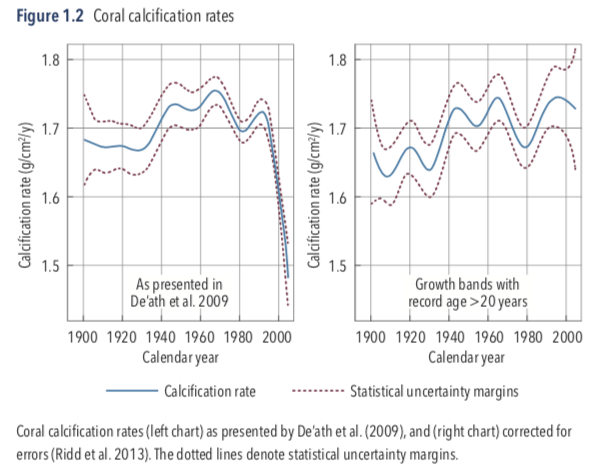
The LHS chart suggests a problem with coral growth rates – but the real problem is with the methodology. When corals of equivalent age are sampled, there has been no decline in growth rates at the Great Barrier Reef – as shown in the RHS chart.
However, I have two issues with their analysis. I published my concerns, and an alternative analysis, in the journal Marine Geology (Ridd et al. 2013). First, there were instrumental errors with the measurements of the coral layers. This was especially the case for the last layer at the surface of the coral, which was often measured as being much smaller than the reality. This forced an apparent drop in the average calcification for the corals that were collected in the early 2000s – falsely implying a recent calcification drop. Second, an ‘age effect’ was not acknowledged. When these two errors are accounted for, the drop in calcification rates disappear, as shown in Figure 1.2.
The problem with the ‘age effect’, mentioned above, arose because in the study De’ath and colleagues included data from corals sampled during two distinct periods and with a different focus; I will refer to these as two campaigns. The first campaign occurred mostly in the 1980s and focused on very large coral specimens, sometimes many metres across. The second campaign occurred in the early 2000s due to the increased interest in the effects of CO2. However, presumably due to cost cutting measures, instead of focusing on the original huge coral colonies, the second campaign measured smaller colonies, many just a few tens of centimetres in diameter.
In summary, the first campaign focused on large old corals, while, in contrast, the second campaign focused on small young corals. The two datasets were then spliced together, and wholly unjustifiable assumptions were implicitly made, but not stated – in particular that there is no age effect on coral growth…
Dr Juan D’Olivo Cordero from the University of Western Australia collected an entirely different dataset of coral cores from the Great Barrier Reef to determine calcification rates. This study determined that there has been a 10% increase in calcification rates since the 1940s for offshore and mid-shelf reefs, which is the location of about 99% of all the coral on the Great Barrier Reef. However, these researchers also measured a 5% decline in calcification rates of inshore corals – the approximately 1% of corals that live very close to the coast. Overall, there was an increase for most of the Great Barrier Reef, and a decrease for a small fraction of the Great Barrier Reef.
While it would seem reasonable to conclude that the results of the study by D’Olivo et al. would be reported as good news for the Great Barrier Reef, their article in the journal Coral Reefs concluded:
Our new findings nevertheless continue to raise concerns, with the inner-shelf reefs continuing to show long-term declines in calcification consistent with increased disturbance from land-based effects. In contrast, the more ‘pristine’ mid- and outer-shelf reefs appear to be undergoing a transition from increasing to decreasing rates of calcification, possibly reflecting the effects of CO2-driven climate change.
Imaginatively, this shift from ‘increasing’ to ‘decreasing’ seems to be based on an insignificant fall in the calcification rate in some of the mid-shelf reefs in the last two years of the 65-year dataset.
Why did the authors concentrate on this when their data shows that the reef is growing about 10% faster than it did in the 1940s?
James Cook university could have used the chapter as an opportunity to start a much-needed discussion about policy, funding and the critical importance of the scientific method. Instead, Peter was first censored by the University – and now he has been fired.
When I first blogged on this back in February, Peter needed to raise A$95,000 to fight the censure.
This was achieved through an extraordinary effort, backed by Anthony Watts, Joanne Nova, John Roskam and so many others.
To be clear, the university is not questioning the veracity of what ex-professor Ridd has written, but rather his right to say this publicly. In particular, the university is claiming that he has not been collegial and continues to speak-out even after he was told to desist.
New allegations have been built on the original misconduct charges that I detailed back in February. The core issue continues to be Peter’s right to keep talking – including so that he can defend himself.
In particular, the university objects to the original GoFundMe campaign (that Peter has just reopened) because it breaches claimed confidentiality provisions in Peter’s employment agreement. The university claims that Peter Ridd was not allowed to talk about their action against him. Peter disputes this.
Of course, if Peter had gone along with all of this, he would have been unable to raise funds to get legal advice – to defend himself! All of the documentation is now being made public – all of this information, and more can be found at Peter’s new website.
Russian diplomat says Britain deserves title of world’s worst genocide perpetrator
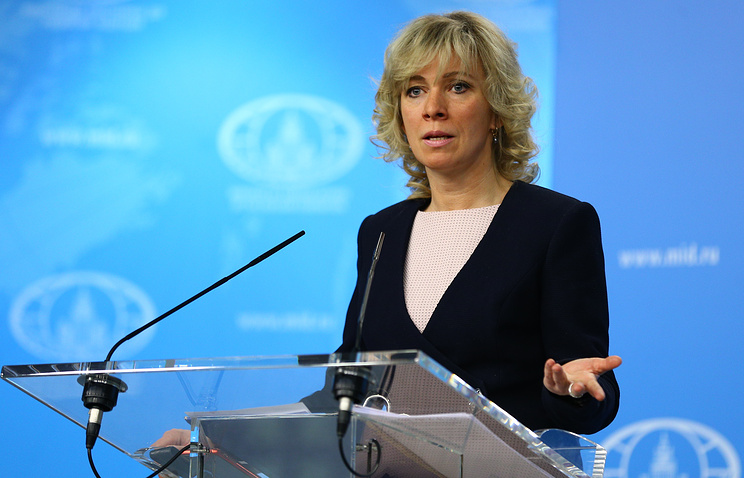
Russian Foreign Ministry spokeswoman Maria Zakharova
TASS | April 19, 2018
MOSCOW – Britain may well be described as the holder of the world’s genocide record, Russian Foreign Ministry spokeswoman Maria Zakharova told a news briefing on Thursday in response to claims by UK ambassador in Moscow Laurie Bristow to the effect Russia was allegedly behind a number of contract killings.
“Britain is the world’s worst genocider,” she said. “The thought of how many millions of innocent people were put to death in the British colonies is terrifying.”
Zakharova recalled that according to various estimates, British colonists exterminated up to 90%-95% of the aborigines in the process of colonizing Australia.
In the 1870s, Britain conducted genocide against the Zulus in Cape Colony, and in 1954-1961, against the Kikuyu people in Kenya, she recalled.
“In retaliation for the killing of 32 white colonists the British authorities exterminated 300,000 members of the Kikuyu people and drove another 1.5 million into concentration camps,” she said.
In all, Zakharova made public 17 pages of archive information describing Britain’s unseemly actions in the world scene over many years.
How Fake News Becomes Fake History: British Propaganda and World War 1
By Corey Schink | Sott.net | April 2, 2018
While it took a while to pick up steam, the Skripal Salisbury poisoning incident has lately dominated Western media headlines. Daily we are treated to the smug and self-righteous faces who, in one breath, compare Putin to Hitler, Stalin, and Czar Nicholas II, before proceeding to compare Russia to Nazi Germany, the Soviet Union and the Russian Empire simultaneously. This would surely be the height of all evil, assuming it were true!
And of course we are supposed to assume it is true because this latest fake news is built on an edifice of an entire history of fake news. Simon Tisdall recently wrote in one of the largest purveyors of fake news, The Guardian:
It has taken a long time for western politicians to recognise the extent and depth of the threat represented by Vladimir Putin’s Russia. Some in the Labour party still don’t. It is also plain, as Theresa May embarks on an open-ended confrontation with Moscow, that the dispute provoked by the Salisbury outrage could take years to resolve.
Cold or hot, overt or covert, this is going to be a long war – and Britain will need all its friends and allies if it is to prevail against a ruthless opponent. Whether sincere, sufficient and timely support will be forthcoming is in serious doubt.
The ‘war’ has been declared – and to dissent is to be a traitor, not so much to one’s country but to amorphous ‘Western values’. Tisdall continues:
Justified perceptions of Western weakness, ambivalence and division have since encouraged Putin in a pattern of escalating, aggressive behaviour. Its main features include wars in Georgia and Ukraine, cyber-attacks against Nato countries, election meddling and destabilisation operations, and the bloody Syrian intervention.
Putin was further emboldened by his domestic dominance, achieved through manipulation of elections, the rustication of the Duma into a rubber-stamp parliament, and the elimination, by various means, of leading opponents, critics and free media. Boris Nemtsov, a liberal reformer killed in 2015, and Anna Politkovskaya, an investigative journalist murdered in 2006, are but two names on a long list that could ultimately include Sergei and Yulia Skripal.
Unsubstantiated claims apparently add up to substantial threats which warrant immediate action. To paraphrase Franz Kafka, “It is not necessary to accept everything as true, one must only accept it as necessary – thus lying turns into a universal principle.” I would only add that believing in lies turns people’s brains to mush, rendering them easily exploited by the liars.
So we watch again as many Western governments expel large numbers of Russian diplomats with absolute disregard for international law and norms. Donald Trump, the man who promised to mend relations with Russia has succumbed to the ‘swamp’ that he set out to drain. We can hope that he has now, at least, discovered how naive he was to believe he could actually do it.
While uniquely shrill and apparently novel, the anti-Russia hysteria in recent years – culminating recently with the Skripal incident and ‘Russiagate’ – has a long historical precedent and, over the course of at least the last couple of centuries, has been used primarily for one thing: war. War distracts the people from apparently insoluble social and political issues, and it presents major opportunities for enrichment to those positioned for it. But it takes two to tango, and ‘the East’ has learned that there will be no war if they don’t show up. While ‘the West’ continues to play a game of deception, the East has moved on, and we Westerners are – for now at least – left only to war with ourselves.
The central role played by the UK in recent ‘Russian incidents’ echoes the central role that country played in historical incidents which led us to this moment today. For over a century now, the role of the British elite in starting World War 1 has been almost completely overlooked. A proper appraisal of that world-changing event, which shaped the rest of the 20th century and our world today, has only recently been undertaken by historians and researchers. Far from being exclusively Germany’s fault, the ‘war to end all wars’ was deliberately brought about by a network of corporate, financial and imperial interests that met in and operated through the seat of the British Empire.
List of Suspects
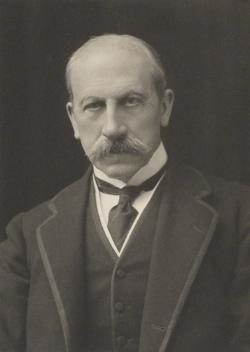
Lord Alfred Milner, British Colonial Secretary, and architect of the Union of South Africa
Britain in the early 1900s underwent a gradual though sustained period of anti-German hystericization which culminated in the outbreak of WW1. Despite relentless media propaganda demonizing Germans and increasing signs that war could break out in Europe, the British public in 1906 voted overwhelmingly for a new Prime Minister, Sir Henry Campbell-Bannerman, a staunch critic of the recent Boer wars and an advocate for a policy of ‘Peace and Retrenchment’ in the increasingly fragile British Empire.
Referred to as “Britain’s first, and only, radical Prime Minister,” in foreign affairs Campbell-Bannerman was neutered by a warmongering elite before he even began his term, and he died in office just two years later. Instead of peace, the British public received a war that produced in a single day the combined military and civilian casualties in all of Europe’s conflicts from the previous 100 years.1 So much for democracy and highfalutin ‘Western values’.
While the British voted resoundingly for a policy of Peace and Retrenchment, powerful forces would stop at nothing to get the war they desired, and the control over the world it afforded them.
Lord Alfred Milner: Despite being born in Germany to mixed British-German parents, Milner’s ethos was formed entirely by an ardent belief in the “superiority of the British race.” An Oxford-educated imperialist, Milner began as a journalist at the Pall Mall Gazette before joining, together with fellow journalist William Stead, a secret society set up by the influential oligarch and colonialist Cecil Rhodes. By the time WW1 broke out, this sinister organization was entirely Milner’s, and went by the name ‘Round Table Group’, or ‘Milner’s Kindergarten’, influencing British, and thus global, foreign policy from the shadows. It was, in essence, the precursor to today’s ‘Deep State’.
Milner served as Rhodes’ ‘clean-up man’ following the disastrous attempt to provoke an uprising among British expatriates in the Transvaal colony of southern Africa. Soon after Milner was rewarded with the office of High Commissioner for Southern Africa in 1897. From that post Milner would wage a campaign of deception to initiate the second Boer war, overseeing the highly controversial use of concentration camps to humiliate and punish the citizenry. These camps and other brutal methods used in the Boer wars would shock both the British public and the armed forces. Under Milner’s rule, 28,000 of the 115,000 people put into camps died, nearly 22,000 of them children. On this Milner wrote,
“The theory that, all the weakly children being dead, the rate would fall off is not so far borne out by the facts. The strong ones must be dying now and they will all be dead by the spring of 1903.”
Perhaps no one exemplified the British Elite’s attitude better than Milner. But for all his barbarism, he was very successful. Having secured British territories in the ‘Scramble for Africa’, Milner carefully manipulated the cabinet of the newly elected Henry Campbell-Bannerman, ensuring that his pro-imperialist forces were well-represented within. Succeeding in the dark arts of imperialism, Milner turned down lucrative offers to work for JP Morgan and instead returned to London in 1905 to pursue a much larger project: conquering the globe.2
Sir Edward Grey was appointed Foreign Minister in Henry Campbell-Bannerman’s cabinet on the insistence of King Edward. One of Milner’s inside men, he ensured that British foreign policy was pointed towards war preparations, and was party to a secret military alliance with France in 1904. This secret agreement between five ministers – Asquith, Haldane, Grey, Churchill and Lloyd George – promised military ‘reciprocities’ to the French in the event of war.
Grey stated categorically that there had been no ‘secret agreement’ to come to France’s aid in case of attack:
“First of all let me try to put an end to some of the suspicions with regard to secrecy — suspicions with which it seems to me some people are torturing themselves, and certainly worrying others. We have laid before the House the Secret Articles of the Agreement with France of 1904. There are no other secret engagements. The late Government made that agreement in 1904. They kept those articles secret and I think to everybody the reason will be obvious why they did so. It would have been invidious to make those articles public. In my opinion they were entirely justified in keeping those articles secret because they were not articles which commit this House to serious obligations.3
But, as Sir Bertrand Russell noted at the time, “I had noticed during previous years how carefully Sir Edward Grey lied in order to prevent the public from knowing the methods by which he was committing us to the support of France in the event of war.”4
King Edward VII: Prince of Wales, Albert Edward, became King Edward VII upon taking the throne in 1901. In the following years he busied himself with diplomatic meetings to arrange secret agreements that effectively encircled Germany and made the German military paranoid.
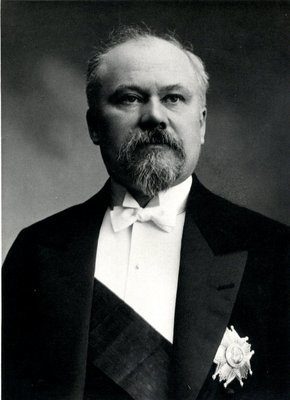
He drove a wedge between Germany and the Italian monarch, and conducted diplomacy with nearly all of Germany’s neighbors. When Germany mobilized her forces, she was unwittingly springing the trap set for her by Edward and the secret elite.
Raymond Poincaré: A French statesman, three-time Prime Minister and President in 1913, Poincare exemplified the hysterical anti-German hatred of the French elite. France, which lost the territory of Alsace-Lorraine to Prussia after Napoleon III foolishly went to war with an insufficient army to win it, was prepared to do whatever it took to win it back and check Germany’s rise. As Poincare would announce in an address to university students,
“In my years at school, my thought, bowed before the spectre of defeat, dwelt ceaselessly upon the frontier which the Treaty of Frankfurt had imposed upon us, and when I descended from my metaphysical clouds, I could discover no other reason why my generation should go on living except for the hope of recovering our lost provinces.”
Richard Burdon Haldane: Haldane was one of Milner’s closest confidants, and would become the Secretary of State for War in 1905, instituting a massive military revolution in the organisation of the British Army. He set up the Territorial Army, the Office Training Corps, and the Special Reserve, and spearhead a pro-French military policy in opposition to many who had served under a pro-Belgian policy for decades.
Théophile Delcassé: A French foreign minister with a rabid hatred of Germany, Théophile was bent on establishing a military alliance between Britain, France and Russia that would support France’s desire to regain her lost territories. He was forced to resign after he nearly brought his country to the brink of war with Germany in the First Moroccan Crisis of 1905-1906. However, he wormed his way back into power to replace the more cool-headed foreign minister, Gabriel Hanotaux, and then became President of France in 1913.
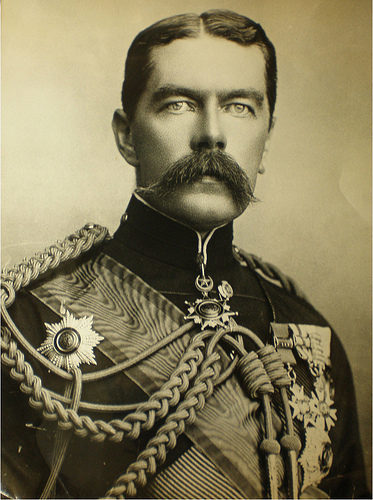
Horatio Herbert Kitchener
Horatio Herbert Kitchener: A general during the Boer wars, Kitchener oversaw the implementation of concentration camp policy in South Africa. He then ran British foreign affairs out of Cairo and designed plans for the division of the Middle East, fanning the flames of rebellion and separatism in the Ottoman Empire. The end result (though not according to his plan) was the rise of the House of Saud and its peculiar brand of Islam that served Anglo-American dominance of the region via the ‘War on Terror’ a century later. David Fromkin noted in A Peace to End All Peace that:
Restoring the caliphate to Arabia, where it and Mohammed were born thirteen centuries before, was Kitchener’s strategy for preparing for the rivalry with Russia which was bound to follow the conclusion of the war against Germany.5
If that was indeed Kitchener’s strategy a century ago, then it is remarkably consistent with current Crown Prince of Saudi Arabia’s recent statement that Wahhabism was encouraged throughout the 20th century by the anglo-Americans as a means of keeping Russia out of the Middle East.
Kitchener, like all the upper-class aristocrats and oligarchs who engineered WW1, had stunning disdain for ordinary people, his own troops included. At one point early in World War 1, it looked like the Russians were going to pull out and make peace with Germany. This would have been disastrous for the Anglo-French forces because Germany could then concentrate its forces on the Western Front.
The secret elite promised Russia that, in exchange for joining Britain’s ‘Triple Entente’, Constantinople – a kind of Orthodox Mecca – would become Russian property in a post-war world. Kitchener conspired with Winston Churchill, then First Lord of the Admiralty, to arrange a suicidal assault on the Dardanelles, which links the Mediterranean and Black Seas. They did this in order to trick Russia into believing that Britain was upholding its end of the bargain, and thus continuing its military engagement with Germany, Austria-Hungary and the Ottoman Empire in eastern Europe. This worked, but at the cost of tens of thousands of British, French and Australian lives in a landing invasion the elite knew would not work against formidable Ottoman defences. Furthermore, they never had any intention of ceding Constantinople to Russia.
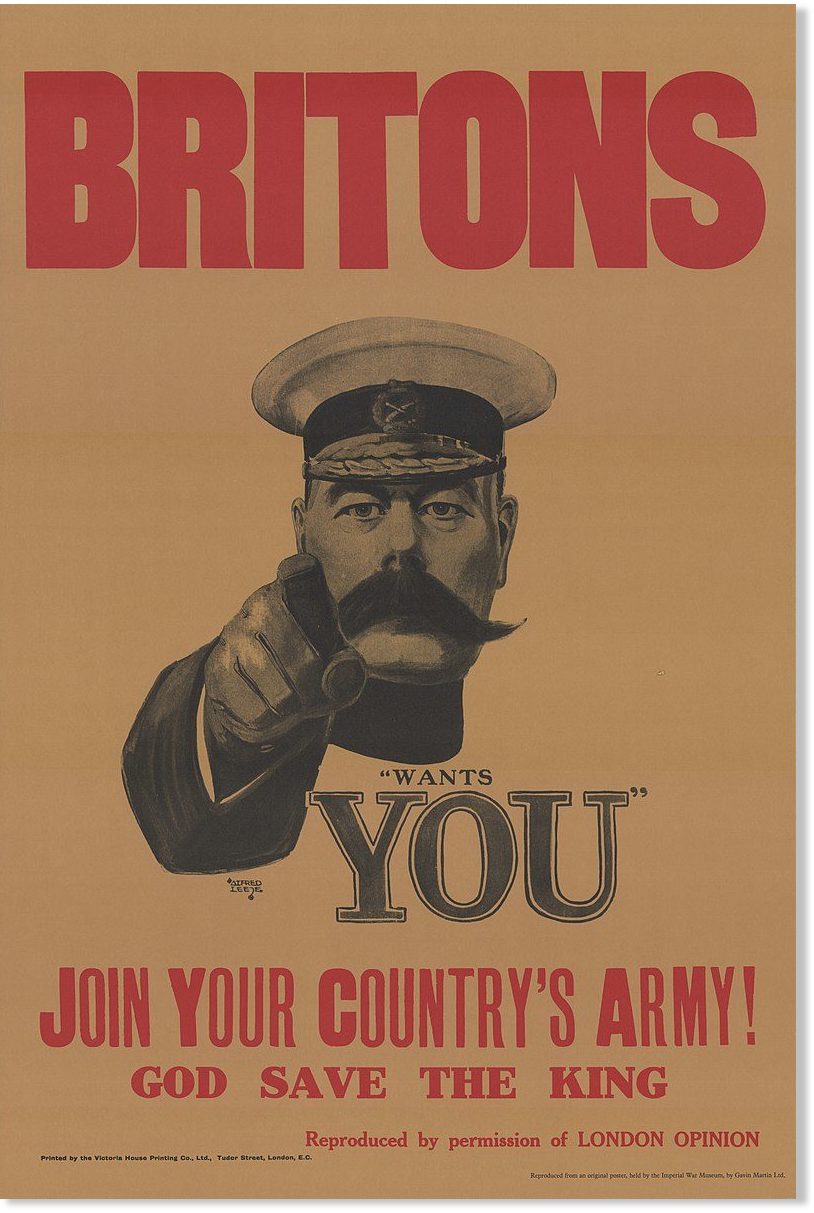
The iconic, much-imitated 1914 Lord Kitchener Wants You poster
Kitchener’s death-dealing career hit its highest point when he was appointed Secretary of State for War, but was abruptly ended when his ship was hit by a German u-boat, although there are various other theories about the cause of his death.
This list covers just a few of the conspirators, but enough to paint a rough picture of the individuals who worked tirelessly to engineer a war that would end peace for much of the century – a war that would result in the rise of Hitler, the Soviet Union, an apartheid Israeli state, and the spread of Radical Islamic Terrorism. The following is the general strategy they followed.
Seeking the War Trigger
Scottish researchers Gerry Docherty and Jim Macgregor conducted an exhaustive study of the ways in which British officials paved the road to war in their book Hidden History: The Secret Origins of the First World War. I think it’s a must-read for any student of Western history, but my one criticism of their work is that they tend to portray Germany as a victim and thereby cast a shadow over the generalized hysteria – which affected everyone, Russia included – and poor thinking that the German military and Kaiser succumbed to – and indeed the war crimes committed by the Germans. Nevertheless, their argument that the British were the primary instigators of the war rests in part on the following cases:
Cracks in the British Empire: At the onset of the war it seemed that every nation except Germany had reason to engage in a global Holocaust. The English had dominated European and world affairs to that point, but the sheer cost of occupying and managing many far-flung colonies was hitting its national coffers hard. Germany’s unification under Bismarck and rapid industrialization, meanwhile, was leading it to overtake the British empire in some key sectors. As F. William Engdahl notes “fear of the emerging German economic challenge towards the end of the 1890s was so extreme among the leading circles of the British establishment, that Britain made a drastic change in its decades-long Continental alliance strategy, in a bold effort to tilt European events back to England’s advantage.”6
This change in strategy saw Britain make geopolitical concessions to both Russia and France while manipulating them into adopting antagonistic positions towards Germany. Having been engaged in ‘the Great Game’ with Russia throughout the 19th century to check Russian expansion and influence in India and Afghanistan, Britain’s sudden alliance with Russia only came about after Japan, armed with British battleships and financed by British and American banks, defeated Russia in its Far East region in 1904-1905. Contained in the east by the rising Japanese, Russia’s gaze inevitably swung westwards to the Balkans and to the Mediterranean Sea access she coveted, and which the British pretended to agree she could have.
French Hysteria: Napoleon III, the nephew of Napoleon, was as ambitious as his uncle. In a brash attempt to destroy the growing Prussian state, Napoleon III ordered the mobilization of a far inferior French force that was immediately crushed by the Prussian military machine. As a result, France lost Alsace-Lorraine and was humiliated due to the ridiculous actions of a reckless leader.
As a British newspaper, the Sheffield and Rotterdam Independent, noted on October 11, 1870, “France has ever coveted the boundary of 1810. She has wanted power to cross the Rhine at her pleasure, to set up a Rhenish Confederation under her control, and to occupy at her convenience, as the first Napoleon did, the German capitals.”
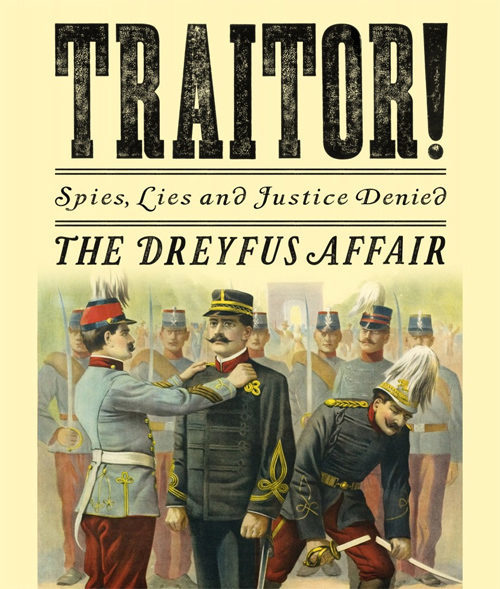
The Dreyfuss Affair: Gabriel Hanotaux, French minister of foreign affairs from 1894 to 1896, was a notable exception in the general trend of increasing hysteria. His efforts, however, could not arrest the slide to war. When Hanotaux sought to develop peaceful relations with Germany, General Albert Dreyfuss was charged with treason for allegedly communicating secrets to German spies. He was later exhonerated and the case remained a symbol of trial-by-propaganda. As Engdahl writes:
Hanotaux intervened into the initial process in 1894, correctly warning that the Dreyfus affair would lead to “a diplomatic rupture with Germany, even war.” Dreyfus was exonerated years later, and it was revealed that Count Ferdinand Walsin-Esterhazy, in the pay of the Rothschild banking family, had manufactured the evidence against Dreyfus. By 1898, Hanotaux was out of office, and succeeded by the malleable anglophile, Theophile Delcassé.7
Fashoda Incident: In 1898 a military incident between Kitchener’s British forces and French forces in Egypt, dubbed the Fashoda Incident, forced the French out of that country and caused an international crisis. The British then exploited the situation to secure a future alliance with France lest she be cornered by Germany and Russia and lose control of her other territories. By 1904 the British had secretly arranged to take complete control of Egypt while giving France control of Morocco, which was in violation of Franco-German treaties.
Fake News
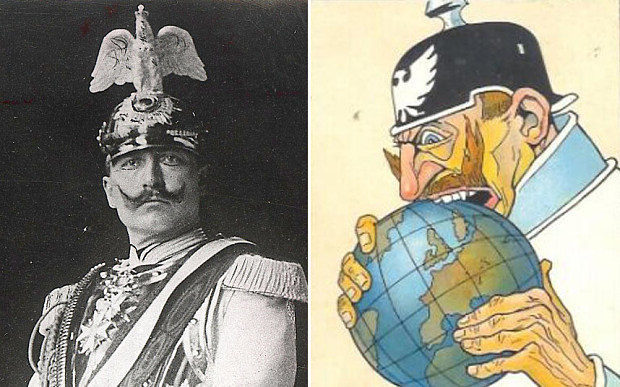
Emperor Wilhelm II and an Italian poster from 1915 showing the Kaiser biting into the world
Fake news becomes fake history. Today British war-mongers expect us to believe, without any reasonable proof, that Putin will kill ‘thousands and thousands and thousands’ of Britons without provocation. Similarly, the propaganda mill before and during World War 1 was hard at work convincing the world that Germany was the devil incarnate – and that the coming bloodbath was justified.
Germany was consistently portrayed in the press as an ‘aggressor nation’. This despite the fact that the UK, France, and Russia “spent £657,884,476 on warships in that same decade, while Germany and Austria-Hungary spent £235,897,978. The peacetime strength of the German army was 761,000, while France stood at 794,000 and Russia 1,845,000, yet the claim that militarism had ‘run amok’ in Germany was presented as the given truth.”9
While accusing Germany of war-mongering, British preparations for war were so intense that it led senior military officers to claim that war with Germany was inevitable.10 Milner would go on a ‘world tour’ organizing imperial conferences designed to rally support for Britain in the event of war and to “foster imperial cooperation in both defence and communications.”11
In 1896 Lord Nortchliffe created the Daily Mail newspaper which, within years, had reached millions of mostly lower and middle-class readers.12 In 1897 he commissioned the publication of a series titled Under the Iron Heel, which predicted the German Army would soon invade Britain. Northcliffe also commissioned the writing of a fictional account of a German invasion called The Invasion of 1910. The Daily Mail even printed special maps showing where these ‘Huns’ (slang for Germans) would invade. Northcliffe was also a financier of The Poison Bullet, a spy scare novel designed to indulge base anti-German sentiment among the British public.13 He also penned pamphlets predicting inevitable war with Germany.
As J. Lee Thompson writes, “by 1914 Northcliffe controlled roughly 40 percent of the morning, 45 percent of the evening, and 15 percent of the Sunday total newspaper circulations.”14 Thus, by the time of war, British society had been effectively whipped into war-readiness by decades of anti-German propaganda, with pamphlets and literature convincing the public that German spies were around every corner. Today the evening news and the internet have replaced “pamphlets and literature” and Russia has replaced Germany.
In 1909 a bill was rammed through parliament establishing the British secret service – today’s MI5 and MI6 – while another imposed unprecedented police state powers on the country.15
Pulling the Trigger
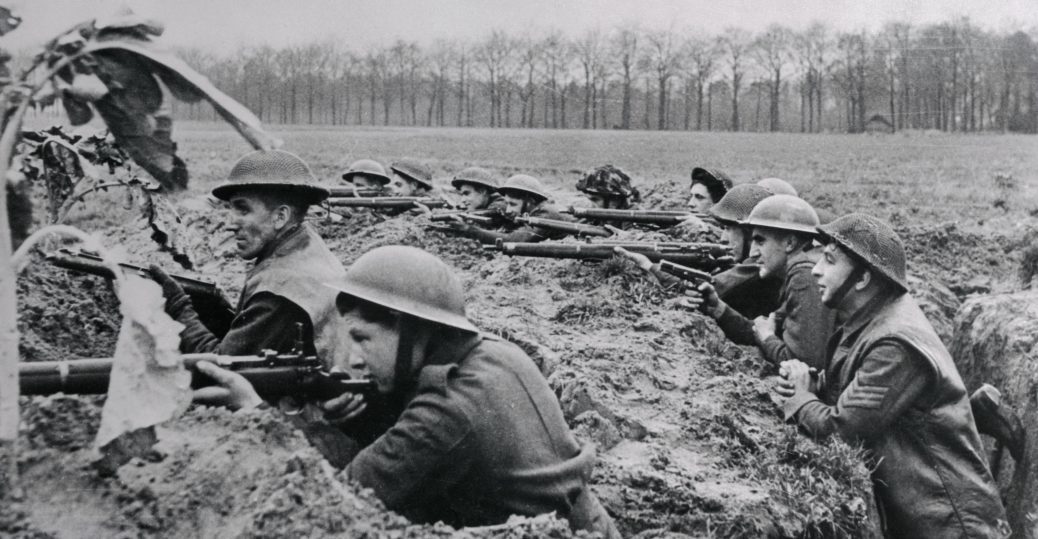
With Germany diplomatically isolated and secret military preparations and agreements signed by France, Britain, and Russia, the only thing missing was a “catastrophic and catalyzing event” to justify a declaration of war. Just such an event occurred in the Balkans, a region that had been in utter turmoil for some years.
In the build-up to World War 1, Serbia, Bulgaria, Macedonia and Bosnia were at war with each other, divided internally, and in conflict with both the Ottoman Empire and the Austro-Hungarian Empire. Bitter ethnic and nationalist sentiment was whipped into a frenzy by successive crises. Anglophile Russian diplomat Alexander Isvolsky agreed (without the Czar’s or the Russian government’s approval) that Russia would support Austria-Hungary’s ‘right’ to annex Bosnia-Herzegovina at a time of its choosing in exhange for Austro-Hungarian support for Russian control over the Dardanelles. As a result, and in violation of international law, on October 6, 1908, Austria-Hungary announced its annexation of Bosnia-Herzegovina immediately provoking outrage from Serbia that saw Bosnia as theirs. This entanglement was the fuse that ignited the first World War when the Austrian Archduke Ferdinand was assassinated by a Bosnian Serb. As Alan Cassels wrote in his Ideology and International Relations in the Modern World, this event “fanned pan-Slavism in the Balkans to a frenzy.”17
When World War I broke out, Isvolsky is reputed to have remarked, “C’est ma guerre!” (“This is my war!”)
On June 28th, 1914 Archduke Ferdinand was shot and killed in Sarajevo. Austria-Hungary blamed the Serbs. Determined to hold Serbia accountable, European diplomats indicated to Austria-Hungary that she had every right to do so. Austria-Hungary therefore sent Belgrade a note in which it demanded the following items:
- The end to anti-Austrian propaganda in Serbian media and education
- The right for Austrian police to investigate the assassination on Serbian soil
- Public apologies from the King and the government
- The immediate surrender of those responsible
They told Serbia it had 48 hours to comply. Once the note was delivered, and well aware that Serbia could not possibly comply, the previously supportive Russian, British, and French governments now expressed outrage at Austria-Hungary.
Serbia, emboldened by Entente’s display of indignation, refused to comply.18 In return, Austria-Hungary turned to Germany for support in military action, and Germany agreed. Until the 11th hour however, Germany’s Kaiser Wilhelm tried in vain to convince his cousin Nicholas II of Russia not to mobilize Russia’s forces. Germany thus gave Austria-Hungary the historical ‘blank check’ that has been cited ever since as proof of German war guilt.
French President Poincare visited St. Petersburg and guaranteed Russia that “France would not only give Russia strong diplomatic support, but would, if necessary, fulfill all the obligations imposed on her by the alliance.”20 A summary of his visit was sent to Edward Grey at the Foreign Office and, from July 25th onward, Grey made overtures about solving the crisis while Russia and France began mobilizing their armies. Four days later, Britain began mobilizing her own fleet.
On July 29th Czar Nicholas II officially ordered Russian mobilization. But then he received a telegram from the Kaiser:
My ambassador is instructed to draw the attention of your government to the dangers and serious consequences of a mobilisation. If, as appears from your communication and that of your Government, Russia is mobilising against Austria-Hungary … The whole burden of decision now rests upon your shoulders, the responsibility for peace or war.
Nicholas backed down.
But then, on July 30th, Russian foreign minister (and anglophile) Sergei Sazanov spent hours convincing Nicholas II of German treachery, urging him to reorder the mobilization of the armed forces. The Czar was deeply troubled with the weight of the decision, but in the end he capitulated to pressure and the Russian war machine lurched forward:
Nicholas II was still understandably hesitant; according to the French ambassador, “The Czar was deadly pale and replied in a choking voice: ‘Just think of the responsibility you are advising me to assume! Remember, it is a question of sending thousands and thousands of men to their death.'”
Germany was the last country to announce militarization. The key to Britain’s war plan was that Germany would follow its Schlieffen Plan, where German forces would quickly march through Belgium in order to avoid the mountainous Ardennes region, put the french army in its place, then turn around to face east and join Austria-Hungary in squaring off with Russia’s giant army. Unbeknownst to Germany, however, Belgium was not as neutral as it had led everyone to believe, and had started mobilizing its military – which had been secretly prepared and trained by the British – at the same time as France and Russia. But Germany’s invasion of hapless, ‘neutral’ Belgium gave Britain its ‘just cause’ for declaring war on Germany.
As the war began Britain cut Germany’s underseas communication lines, thus ensuring that all information to and from the outside world would be under its control. A year or two later, a poem written from the horrors of the trenches gave evidence of an awareness of the deception that came too late.
Waves of strong men
That will surge not again,
Scattered and riven
You lie, and you rot;
What have you not given?
And what – have you got?
What did we get? We got the imposition of an Israeli apartheid state and an Islamic State (Saudi Arabia) in the Middle East. The world also received the ‘gift’ of a Russian Revolution that gave way to the Soviet Union and the pathocracy which it spread across a large swathe of Eurasia. As German General Ludendorff would lament, foreshadowing the horrors that would come following Germany’s collapse, the Versailles Treaty ‘sent the German people into bondage, into an absolutely crushing one. All delusions have vanished’, he wrote. ‘We look into nothingness. Something else is needed’. Hitlerism would blot out the sun of Europe for decades. And the British Elite? They still refer to themselves as ‘Sir’ and ‘Honorable’ while pointing the finger at Russia as the ‘source of all evil’.
In short, history is proof that no one should ever trust a word the British establishment says.
Back to Today
Throughout modern history, we see the same ‘elite’ pushing, prodding, gaslighting, promising one thing to one country and something entirely different to another. In their pure malevolent instinct, we see the ‘essential psychopath’ at work spinning his web effortlessly across entire nations and generations. The biggest vulnerability? The average person’s tendency to engage in emotional thinking and the chaos it engenders when entire nations are infected by it.
But, as Russian ambassador to the US Anatoly Antonov has stated, “The truth will come out. We will not let ourselves to be provoked into an emotional breakdown.” Modern Russia is not Germany under the naive leadership of Kaiser Wilhelm II, who believed his relations with the Russian Tsar and the King of England would safeguard his country from war.
Modern Russia also isn’t Iraq – a small country easily overwhelmed by the superior military strength of NATO with an isolated leader easily smeared due to his past aggression. Modern Russia is a nuclear armed superpower that is organized by some of the most brilliant statesmen this planet has seen – they won’t be deceived, they won’t be out-gunned, and any attack on them will be an act of suicide.
So, for those pushing for war against Russia, their only viable outlet for their destructive anti-Russian impulse is more false flags, more black propaganda and all manner of dirty tricks. In other words they will attempt to poison, sanction, scream, rig, and otherwise sabotage us all into oblivion, and then blame it all on Russia.
References
1. David Fromkin’s A Peace to End All Peace: The Fall of the Ottoman Empire and the Creation of the Modern Middle East p. 232
2. Gerry Docherty & Jim Macgregor’s Hidden History: The Secret Origins of the First World War p. 214
3. P. Hof’s The Two Edwards: How King Edward VII and Foreign Secretary Sir Edward Grey Started The First World War p. 4
4. David Fromkin’s A Peace to End All Peace: The Fall of the Ottoman Empire and the Creation of the Modern Middle East p. 125
5 Ibid p. 104
6. F. William Engdahl’s A Century of War Anglo-American Oil Politics and the New World Order p. 39
7. Ibid. p. 31
8. Gerry Docherty & Jim Macgregor’s Hidden History: The Secret Origins of the First World War p. 135
9. Ibid. p. 133
10. Ibid. p. 155
11. J. Lee Thompson’s Politicians, the Press, and Propaganda: Lord Northcliffe and the Great War, 1914-1919 Kindle Edition Location 175
12. Gerry Docherty & Jim Macgregor’s Hidden History: The Secret Origins of the First World War p. 148- 149
13. J. Lee Thompson’s Politicians, the Press, and Propaganda: Lord Northcliffe and the Great War, 1914-1919 Kindle Edition Location 175
14. Gerry Docherty & Jim Macgregor’s Hidden History: The Secret Origins of the First World War p. 151
15. Andrew Feinstein’s The Shadow World: Inside the Global Arms Trade p. 5
16. Alan Corssal’s Ideology and International Relations in the Modern World p. 121
17. Gerry Docherty & Jim Macgregor’s Hidden History: The Secret Origins of the First World War p. 257
18. Ibid p. 267
19. Ibid p. 293
Corey Schink was born and raised in the Midwestern United States, where he worked on farms and as a welder, musician, and social worker. His interests in government, philosophy and history led to his writing for SOTT in 2012 and to becoming a SOTT editor and Truth Perspective co-host in 2014.
Australia sees opportunity in China’s rise
By M K Bhadrakumar | Indian Punchline | February 27, 2018
From an Indian perspective, the visit to the United States by the Australian Prime Minister Malcolm Turnbull and his meeting with President Donald Trump on February 23 turns out to be a reality check on the power dynamic in the Asia-Pacific. Australia is torn between two vital partners – the US in the security sphere and China in the economic sphere. The dilemma is acute insofar as Turnbull has voiced opinions on threat perceptions regarding China, which are contrary to the Trump administration’s assessment and, yet, the US and Australia are key allies.
A month ago, Australian Foreign Minister Julie Bishop pointedly distanced her country from the US’ assessment of China (and Russia) being a strategic threat. The US National Security Strategy issued in January said, “China is a strategic competitor using predatory economics to intimidate its neighbors while militarizing features in the South China Sea… It is increasingly clear that China and Russia want to shape a world consistent with their authoritarian model — gaining veto authority over other nations’ economic, diplomatic, and security decisions.”
Bishop refused to share that assessment, saying, “We have a different perspective on Russia and China clearly — we do not see Russia or China posing a military threat to Australia, we continue to work closely with China in fact we undertake military exercises with China as well as with other countries in the region and we will continue to do so.”
Turnbull openly endorsed Bishop’s remarks. In his words, “Apart from North Korea, there is no country in the region that shows any hostile intent towards Australia,” Mr Turnbull said, “We don’t see threats from our neighbours in the region, but, nonetheless, every country must always plan ahead and you need to build the capabilities to defend yourself, not just today, but in 10 years or 20 years, hence.”Turnbull reverted to the topic as he was embarking on the visit to the US last week. In remarks to Sky News, Turnbull said:
- A threat, technically, is a combination of capability and intent. China has enormous capability of course, it’s growing as the country becomes more prosperous and economically stronger. But we do not see any hostile intent from China.
- We don’t see the region through what is frankly an out-of-date Cold War prism. Neither, by the way, does Donald Trump. President Trump has a long experience in this part of the world as a businessman. He understands the significance, the economic significance of China’s rise and its opportunity.
Indeed, the joint statement issued after Turnbull’s meeting with Trump in the White House contains no reference to China or the disputes in the South China Sea. (Nor on ‘Quad’!) It doesn’t mention ‘freedom of navigation’, either. At the joint press conference with Turnbull, Trump said he’d “love” to have Australia back the US effort to assert the right to maritime freedom in South China Sea – “We’d love to have Australia involved and I think Australia wants us to stay involved.”
But Turnbull was unmoved. He made no commitments about Australia joining the US naval display. On the other hand, he emphasized the economic opportunities from China’s rise. Turnbull had hopes of persuading Trump to take a fresh look at the Trans-Pacific Partnership agreement, but Trump repeated his distaste of the trade pact. Trump said, “The TPP was a very bad deal for the United States, it would have cost us a tremendous amount of jobs, it would have been bad.”
Equally, in the run-up to Turnbull’s visit, there was speculation that a possible economic front comprising the US, Japan, India and Australia could be in the making to “answer Chinese and Russian infrastructure-building efforts” in the Asia-Pacific. But it turned out to be mere drum-beating. (Reuters / Bloomberg) The Trump administration is focused single-mindedly on America First and has no interest in doing the diplomatic heavy lifting to push back at China’s Belt and Road Initiative.
Clearly, one substantive outcome of Turnbull’s visit has been in the launch of an Australia-US Strategic Partnership on Energy in the Indo-Pacific. This must be seen against the backdrop of the US gearing up to export LNG to the Asian market, especially China. While on the one hand runaway gas demand in China is transforming the outlook for LNG in Asia and could see a return to the seller’s market in 2018, on the other hand, Australia’s rapidly growing LNG exports are already finding a ready market. A joint press release in Washington spelt out the “core principles” and outlined a “work plan” for the proposed US-Australia energy partnership. (here)
China would be quietly pleased with the outcome of the Trump-Turnbull meeting in Washington. An editorial in the government newspaper China Daily noted, “if Turnbull is now choosing to look at China through a more objective prism that would obviously help build more trust between the two countries, which will only usher in a more cordial atmosphere for relations to deepen and grow. Yet the Australian government still needs to match words with deeds… In its most recent foreign policy white paper, Australia proposes that it can act as an honest broker between China and the US.”
The Global Times in an editorial, also commended that Turnbull’s remarks “show positive signs for the Sino-Australian relationship.”
New US National Defense Strategy Is Again Offensive

By David Macilwain | American Herald Tribune | January 23, 2018
Last week “Mad Dog” Mattis announced a new US Defence Strategy, the first for a decade and with a radical change of focus, from fighting terrorism to fighting Russia and China. The US DoD put it like this:
“The National Defense Strategy seeks to implement the pillars of the National Security Strategy: peace through strength, the affirmation of America’s international role, the U.S. alliance and partnership structure and the necessity to build military advantage to maintain key regional balances of power.”
According to Deputy Defense Secretary Elbridge A. Colby this strategy is necessitated because of:
“the erosion of U.S. military advantage vis-a-vis China and Russia, which, if unaddressed, could ultimately undermine our ability to deter aggression and coercion and imperil the free and open order that we seek to underwrite with our alliance constellation.”
“The strategy aims at thwarting Chinese and Russian aggression and use of coercion and intimidation to advance their goals and harm U.S. interests, and specifically focuses on three key theaters: Europe, the Indo-Pacific and the Middle East, Colby said.”
Whether this is a new strategy or just a new declaration of the existing one depends on your point of view. In announcing it at the press conference Jim Mattis stressed the supposed shift from fighting terrorism to countering Russia and China, as well as their effective allies North Korea and Iran. Following hot on the heels of Tillerson’s confrontational outburst, and refusal to get out of Syria following the defeat of Islamic State, the sudden shift looks rather convenient – the US can now claim it must stay in Syria to counter Russia’s growing influence in the region.
What’s new! Wasn’t this always the US plan, as laid out a decade earlier in “Which path to Persia?” – a plan that seems to be relentlessly moving forward despite all obstacles, including particularly international law?
While there have been a few setbacks in the US project to advance its goals around the globe against the interests of Russia and China and their allies, the escalation in aggressive US confrontations in those “key theatres” since Trump came to power makes nonsense of Colby’s claim that the new policy is “not a strategy of confrontation, but it is strategy that recognizes the reality of competition.”
Even if that were true, it only emphasizes the fundamental difference in approach between the great powers. Neither Russia nor China see competition or confrontation as their goals, leave alone the insulting and ludicrous “aggression, coercion and intimidation” which the US attributes to them. Faced with a rational and responsible partner rather than the expansionist and exceptionalist US, it is a desire for collaboration and co-existence that evidently motivate China and Russia, and also lie at the center of their own developing cooperation.
Symbolizing this difference – or rather conflict – between world views, is the ongoing dispute over the South China Sea. Just before Mattis announcement, the US sent a ship into the disputed waters as part of its “freedom of navigation” exercises, and received an immediate demand to leave from China, which has long lost patience with this serial provocation. In this area one of America’s “constellation” allies Australia is forced to take sides, and reveals itself as an accomplice to the ongoing Imperial crimes.
Despite Australia’s crucial economic dependence on China, its current government seems to be going out of its way in provoking and insulting Chinese leaders and representatives. As Mattis made his announcement, PM Malcolm Turnbull was in Japan visiting a missile defense base and talking about joint exercises and military cooperation. Australia also took part in the provocative exercises against North Korea with the US and South Korea at a time of high tension last year, despite Russian and Chinese warnings against them.
And when it comes to the South China Sea issue, it must be pointed out that China’s legitimate concerns are to maintain the freedom of navigation through its main transport artery to the West and Australia. Given the US coalition’s participation in exercises simulating a blockade of these channels it’s not hard to see and support China’s defensive stand on this issue.
Part of the “new strategy” in the Indo-Pacific is also likely to be an expansion of the US presence and bases in Australia. “In the new security environment” – whatever that is – the stationing of US strategic bombers in Northern Australia is now being proposed. Along with the massive regional US surveillance base in Pine Gap, nuclear-armed bombers will make us a prime target for one of China’s ICBMs, so no doubt we’ll also be getting THAAD missile defense systems.
On reflection it appears that the “new” US “National Defense” Strategy is little more than the one pursued fifty years ago against the Soviets and the Chinese Communists. Fifteen years of the “Global war on Terror”, culminating with the scourge of “Islamic State” was just means to the same end, and can now be discarded.
The tragedy is that with Vladimir Putin and Xi Jing Ping we really had a chance for diplomacy, law and peace to prevail.
*(Secretary of Defense James N. Mattis announces the National Defense Strategy at Johns Hopkins University School of Advanced International Studies in Washington, Jan. 19. Image credit: DoD photo/ Navy Mass Communication Specialist 1st Class Kathryn E. Holm/ flickr)
Analyst Dismisses White House Claims Pyongyang Behind WannaCry
Sputnik – 20.12.2017
In a Wall Street Journal op-ed Monday, White House Homeland Security Adviser Tom Bossert announced that North Korea is responsible for the May 2017 “WannaCry” global cyberattack that targeted Windows computers and was allegedly aided by leaked National Security Agency technology.
In the article titled, “It’s Official: North Korea Is Behind WannaCry,” Bossert points the finger at North Korea for being behind the cybercrime in which millions of users’ computer data was encrypted and then ransomed for bitcoins. The attack slowed down after a mistake in WannaCry’s code revealed a kill switch that prevented infected computers from spreading the virus.
“Cybersecurity isn’t easy, but simple principles still apply. Accountability is one, cooperation another,” Bossert wrote in his article. “They are the cornerstones of security and resilience in any society. In furtherance of both, and after careful investigation, the US today publicly attributes the massive ‘WannaCry’ cyber attack to North Korea.”
In a White House press briefing Tuesday morning, Bossert claimed that the US came to this conclusion after a “careful investigation.”
“We don’t do this lightly,” Bossert said during the briefing. “We do so with evidence and with partners,” adding that Canada, New Zealand, Japan, Australia and the United Kingdom all agree that North Korea is responsible.
“While victims received ransom demands, paying did not unlock their computers,” the homeland security adviser wrote. “It was cowardly, costly and careless. The attack was widespread and cost billions, and North Korea is directly responsible.”
On Radio Sputnik’s Loud & Clear, financial policy analyst Daniel Sankey asserted his belief that North Korea is not behind the cyberattack.
“I’m a little suspicious myself. The drums of war have been beaten against [North Korea] for some time now and it’s very convenient that now this severe cyberattack is being laid against the doors of North Korea,” Sankey told hosts John Kiriakou and Brian Becker.
“And of course, as usual, we can take the intelligence community’s word for it because they know better than us and they published it in the Wall Street Journal — so it must be North Korea,” he added sarcastically.
“I am a little skeptical because a big part of the virus was extorting various users to send bitcoin in exchange for access to their files again. In the end, they stole about $55,000 in bitcoin and that’s not enough money for North Korea to trouble itself with,” Sankey said.
“Also, what is North Korea going to do with bitcoin? They need commodities, they need cash, they need access to different markets. They don’t need bitcoin. How are they going to turn that into oil or coal or various other things they need? How are they going to convert that into a convertible currency? It’s really not feasible.”
Although Bossert said that the US did “not make the allegation lightly,” he didn’t provide any solid evidence and simply alluded to National Security Agency and Microsoft research. He also referred to the UK’s determination in October that North Korea was responsible for the attack.
In May, security firms discovered a link between the ransomware and southern China during an investigation of the code’s notes, which revealed that WannaCry’s creators were fluent in a form of Chinese very common in that region.
According to security firm Flashpoint, which conducted the analysis, “A typo in the note, “帮组” (bang zu) instead of “帮助” (bang zhu) meaning “help,” strongly indicates the note was written using a Chinese-language input system rather than being translated from a different version. More generally, the note makes use of proper grammar, punctuation, syntax, and character choice, indicating the writer was likely native or at least fluent.”
Although the linguistic analysis of the code did not reveal any Korean, the US has still confidently asserted that North Korea is responsible, and Sankey believes it’s because the underlying problem behind the attacks actually has nothing to do with the hackers but with intelligence communities, who may be actually be responsible for the crimes.
“I think that the real problem is that intelligence communities are becoming aware of vulnerabilities in these systems, and rather than working with the private sector to protect consumers and peoples’ data, they are just sitting on those vulnerabilities so that they can use them later to hack systems.”
In his editorial, Bossert concludes, “Mr. Trump has already pulled many levers of pressure to address North Korea’s unacceptable nuclear and missile developments, and we will continue to use out maximum pressure strategy to curb Pyongyang’s ability to mount attacks, cyber or otherwise.”
With the Trump administration’s increased use of aggressive language against North Korea’s continued nuclear weapon tests and with this new allegation that the country is responsible for WannaCry, it doesn’t appear that the relationship between the two is going to be getting better anytime soon.
Featured Video
Stanislav Krapivnik: Russia-Iran Cooperation & Escalation in Ukraine
or go to
Aletho News Archives – Video-Images
Frlom the Archives
Are the Jews indigenous to Palestine?
By David Miller | Al Mayadeen | August 3, 2022
There is a rising tide of claims from apologists for the crimes of Zionism that they have been misunderstood. Palestinians might be indigenous to Palestine, but the Jews definitely are. What is called the ‘Israel-Palestine’ conflict, they say, is competition over the same small piece of land by two rival groups of indigenous people. But are the Jews indigenous to the Levant? And what are the consequences of the argument?
In fact, most of the power structure of the Zionist state is dominated by Ashkenazi Jews who have no ancestral link to Palestine. Overall despite very significant financial and infrastructural contributions from Western European countries (especially the US, UK and France, for example via the Rothschild family), Eastern European Ashkenazim have been at the centre of the Zionist power structure since the early years of the 20th Century. … continue
Blog Roll
 Aletho News
- UK readies deployment of Prince of Wales carrier amid war on Iran
- Iran warns of consequences after US strike on water plant
- US Bases in Middle East Fail to Secure Nations & Become Safety Risk – Expert
- Iranian Crisis Becomes Embarrassment for US Military That Can’t Protect Anyone – MidEast Analyst
- IAEA Never Had Reasons to Forgo Talks With Iran — Russian MFA Spox
- Iran pledges to ‘respect sovereignty of neighbors’, declares US-Israel assets ‘primary targets’
- USA and Israel: Who is the lord and who is the colony?
- Indian journalist reveals severe Israeli censorship after escape from occupied territories
- Majority of Israelis Back War with Iran as Anti-War Minority Faces Stigmatization
- Are the Jews indigenous to Palestine?
- If Americans Knew
- US, Israel ravage Iran and Lebanon; 4 killed in Gaza – Not a ceasefire Day 148
- US troops were told war on Iran was ‘all part of God’s divine plan’, watchdog alleges
- Trump wants to run the show in Iran, but doesn’t know what he’s doing – Not a ceasefire Day 147
- ‘Dirty Work’ :The truth about how Israel was founded
- Mass Expulsion in Lebanon as Israel Expands War: “We Don’t Know Where to Go”
- Lies, distortions, and propaganda: how the U.S. mainstream media coverage on Iran hides the truth
- Palestinians in Gaza fear famine returning as Israel cuts off food amid Iran war
- AIPAC, other pro-Israel groups enter midterms with $100 million to spend
- Iranian girls killed by ‘double-tap’ strikes on Minab school
- Bari Weiss Is Going Full ‘Propaganda-Palooza’ With the Iran War
- No Tricks Zone
- Televised! Leading German Political Candidate Tells Schoolchildren CO2 Makes Sun Hotter!
- New Study: A Century Warming Of 1.1°C Is ‘Commonplace’ And ‘Not Unusual’ During This Interglacial
- New Study: ‘Internal Noise’ And Volcanic Forcing Can Trigger 10-15°C Warming Within Decades
- Glaciers Worldwide Are Suddendly Surging, Experts Blame Warming!
- Surprising Discovery: Sahara Is Greening…Billions Of Trees Where Once Thought To Be Barren
- New Research Reaffirms Clouds, Aerosols, And Surface Solar Radiation Are ‘Driving The Climate System’
- Germany: Electric Car Catches Fire At Charging Station, Sets Off Local “Inferno”, Widespread Damage
- New Study: Canada’s New Brunswick Was 1°C Warmer Than Today During The Medieval Warm Period
- Coal Power Back In Trend As Globe Tries To Keep Pace With Growing Demand For Power
- New Study: A 4°C Warmer Beaufort Sea Had ‘No Sea Ice’ 11,700 – 8200 Years Ago
 Aletho News