Iran Voices Readiness to Help Ease Tensions between Azerbaijan, Armenia
Al-Manar | July 16, 2020
Iran’s Foreign Ministry expressed the Islamic Republic’s readiness to mediate between Azerbaijan and Armenia in the wake of deadly border clashes between the two countries.
“As soon as clashes erupted between Armenia and Azerbaijan, Iran’s diplomatic apparatus got active to mediate and soothe this tension as the region cannot afford another conflict,” ministry spokesman Abbas Mousavi told reporters in the northwestern city of Ardabil on Thursday.
He further called on both sides to show restraint, voicing Iran’s readiness to help bring an end to tensions between the two former Soviet republics, Tasnim news agency reported.
The clashes broke out on the volatile Armenia-Azerbaijan border on Sunday and have continued over the past days.
At least 16 people, including four Armenian troops, 11 Azeri servicemen and one Azeri civilian, have been killed in the latest outbreak of hostilities between the two neighbors.
Turkey supports Azerbaijan to cause instability in the Caucasus
By Lucas Leiroz | July 16, 2020
The conflict between Azerbaijan and Armenia has become increasingly serious. Both countries claim the territory of Nagorno-Karabakh and between the late 1980s and early 1990s there was a war between them to decide the control of the region. Tens of thousands of people died in the conflict, which ended in 1994 with a ceasefire agreement, without a winner. The agreement places the Nagorno-Karabakh region as a de facto autonomous republic, remaining de jure as part of Azerbaijan. This agreement gave a break in the massacres but did not prevent the continuation of the territorial disputes between both countries, which until today claim the region, and the situation has worsened even more recently.
On July 12, there was an armed clash in the region, with an uncertain number of victims. Azerbaijani forces accuse Armenia of violating territorial limits. In contrast, the Armenian government blames the opposing country for such violations. Since then, according to Armenian observers, bombings on the border have been reported every 15 to 20 minutes. Data on the dead or injured people remain uncertain.
Armenian Prime Minister Nikol Pashinyan accuses Azerbaijan of initiating hostilities and says that no violence will go unpunished, promising to react to every move by the enemy country. Data from the Armenian Ministry of Defense points to records of artillery attacks against Armenian territory in the early hours of July 12, when the fighting was recorded. According to the Armenian government, Armenian troops only retaliated against the attacks received. Pashinyan accuses not only Azerbaijan, but also Turkey of involvement in the attacks.
The charges are not unfounded. Turkey has shown support for Azerbaijan in the dispute, encouraging annexation and not a peaceful resolution of the impasse. The day after the clashes at the border, the Turkish foreign minister, Mevlut Cavusoglu, spoke in defense of Azerbaijan, saying that this country “is not alone” in the conflict. The statement becomes controversial and dangerous amid an escalation of violence, as it connotes not only support from Ankara, but also an interest in intervening in the conflict. Armenia reacted with severe criticism, blaming Ankara for the return of the violence. According to the Armenian government, Turkey has an interest in destabilizing peace in the region to gain greater control and influence over neighboring territories.
In return, the European Union issued a public note calling on both parties to reduce violence and to avoid the use of force. Likewise, the US State Department classified violence in the region as unacceptable and urged both parties to seek a peaceful solution to the dispute. In the same vein, the Russian government has called on both countries for a peaceful resolution, without showing support for either party. Foreign Minister Sergey Lavrov urged Armenia and Azerbaijan to an immediate ceasefire and to comply with the terms of the Minsk Group, a committee created in 1992 to manage peace in the region. Since both countries are former Soviet republics, the role of Russian diplomacy in managing the conflict is essential, due to the weight of its influence in the region.
It is important to note the difference in the approach of the Russians, Americans and Europeans to the Turkish stance to the crisis. Demonstrating open support for any party in the current phase of the conflict can be crucial to intensify disputes and encourage an increase in violence. Being a military potency, Turkey’s declared support in a conflict in its early stages may encourage the progress of hostilities. In this sense, it is likely that Azerbaijan, with the support of Ankara and possible Turkish intervention, will continue the bombing, assuming strategic advantage and superiority over its opponent. This is the great danger behind the Turkish pronouncement.
The situation, however, must be analyzed in a complete context. Turkey has shown interest in increasing its regional and international geopolitical relevance and, for this purpose, it has called for bold and provocative acts, such as, for example, its role in the Syrian War and the recent conversion of Hagia Sophia into a mosque, which provoked outcries all over the world for being an unnecessary attack on the memory of Greek Christianity, provoking the resurgence of religious tensions in the region that had not existed for a long time.
In fact, Erdogan has clear plans to constitute a neo-Ottoman geopolitical projection, regaining power and influence at a regional level throughout the territory where the Ottoman Empire, predecessor of the modern Turkish state, operated in the past. Relations between Turks and Armenians, in this sense, do not have a good record and are alive in Armenian memory with the ethnic-religious genocide perpetrated against Christian Armenians in the early 20th century.
In this sense, Turkish interest in creating an area of instability that favors its regional influence can be costly. Russia, as the regional power with the greatest historical influence in the Caucasus, must counterbalance Turkish advances through diplomacy, while Erdogan must be internationally pressured to avoid any intervention in the dispute between neighboring countries.
Lucas Leiroz is a research fellow in international law at the Federal University of Rio de Janeiro.
Germany Can’t Give Up on Cooperation With Russia in Oil and Gas – Merkel
Sputnik – 24.08.2018
Germany has greenlighted the Nord Stream 2 project to bring Russian gas to Europe and is under strong pressure from the US, which warns that the project is making Germany dependent on Russia. Berlin insists that the project is entirely commercial.
A planned sub-sea pipeline that will bring gas directly from Russia under the Baltic Sea will not make Germany dependent on Russia for energy, Chancellor Angela Merkel told university students in the Georgian capital Tbilisi on Friday, on the second day of her trip to the Caucasus.
Angela Merkel described continued Russian oil and natural gas supplies to Germany as an important factor in ensuring the country’s energy security.
”We have a decades-long history of economic cooperation with Russia, including on CO2 emissions. We have consistently been reducing our use of coal and we need natural gas coming to us via Belarus, Ukraine and Poland, that’s why we support Nord Stream 1 and 2,” Merkel noted.
She noted that Germany wanted to make sure that Russia continued delivering some gas via Ukraine even after the Nord Stream 2 pipeline was finished.
Mentioning the importance of expanding the so-called “Southern Corridor” for natural gas supplies also from Azerbaijan, she still pointed out that buying gas from Russia was cheaper than buying it elsewhere.
“Europe and Russia, then the Soviet Union, had very close energy cooperation during the Cold War. We can’t afford giving up on cooperation with Russia in oil and gas. Of course, we can have natural gas coming from Azerbaijan, but the truth is that it will not be available at the price we are paying for Russian gas,” Merkel said.
Some countries that are afraid of losing revenues from Russian gas transit, above all Ukraine, are opposed to Nord Stream 2.
The project is also facing opposition from the United States, which has ambitious plans of LNG exports to Europe.
Russia has repeatedly urged its European partners not to perceive the Nord Stream pipeline as an instrument of influence insisting that the project is an entirely economic one.
Is This The Most Important Geopolitical Deal Of 2018?
By Olgu Okumus | Oilprice.com | August 13, 2018
The two-decade-long dispute on the statute of the Caspian Sea, the world largest water reserve, came to an end last Sunday when five littoral states (Russia, Iran, Turkmenistan, Kazakhstan and Azerbaijan) agreed to give it a special legal status – it is now neither a sea, nor a lake. Before the final agreement became public, the BBC wrote that all littoral states will have the freedom of access beyond their territorial waters, but natural resources will be divided up. Russia, for its part, has guaranteed a military presence in the entire basin and won’t accept any NATO forces in the Caspian.
Russian energy companies can explore the Caspian’s 50 billion barrels of oil and its 8.4 trillion cubic meters of natural gas reserves, Turkmenistan can finally start considering linking its gas to the Turkish-Azeri joint project TANAP through a trans-Caspian pipeline, while Iran has gained increased energy supplies for its largest cities in the north of the country (Tehran, Tabriz, and Mashhad) – however, Iran has also put itself under the shadow of Russian ships. This controversy makes one wonder to what degree U.S. sanctions made Iran vulnerable enough to accept what it has always avoided – and how much these U.S. sanctions actually served NATO’s interests.
If the seabed, rich in oil and gas, is divided this means more wealth and energy for the region. From 1970 until the dissolution of the Soviet Union (USSR) in 1991, the Caspian Sea was divided into subsectors for Azerbaijan, Russia, Kazakhstan and Turkmenistan – all constituent republics of the USSR. The division was implemented on the basis of the internationally-accepted median line.
After the dissolution of the Soviet Union, the new order required new regulations. The question was over whether the Caspian was a sea or a lake? If it was treated as a sea, then it would have to be covered by international maritime law, namely the United Nations Law of the Sea. But if it is defined as a lake, then it could be divided equally between all five countries. The so-called “lake or sea” dispute revolved over the sovereignty of states, but also touched on some key global issues – exploiting oil and gas reserves in the Caspian Basin, freedom of access, the right to build beyond territorial waters, access to fishing and (last but not least) managing maritime pollution.
The IEA concluded in World Energy Outlook (WEO) 2017 that offshore energy has a promising future. More than a quarter of today’s oil and gas supply is produced offshore, and integrated offshore thinking will extend this beyond traditional sources onwards to renewables and more. Caspian offshore hydrocarbon reserves are around 50 billion barrels of oil equivalent (equivalent to one third of Iraq’s total oil reserves) and 8.4 trillion cubic meters of gas (almost equivalent to the U.S.’ entire proven gas reserves). As if these quantities were not themselves enough to rebalance Eurasian energy demand equations, the agreement will also allow Turkmenistan to build the Trans-Caspian pipeline, connecting Turkmenistan’s resources to the Azeri-Turkish joint project TANAP, and onwards to Europe – this could easily become a counter-balance factor to the growing LNG business in Europe.
Even though we still don’t have firm and total details on the agreement, Iran seems to have gained much less than its neighbors, as it has shortest border on the Caspian. From an energy perspective, Iran would be a natural market for the Caspian basin’s oil and gas, as Iran’s major cities (Tehran, Tabriz, and Mashhad) are closer to the Caspian than they are to Iran’s major oil and gas fields. Purchasing energy from the Caspian would also allow Iran to export more of its own oil and gas, making the country a transit route from the Caspian basin to world markets. For instance, for Turkmenistan (who would like to sell gas to Pakistan) Iran provides a convenient geography. Iran could earn fees for swap arrangements or for providing a transit route and justify its trade with Turkey and Turkmenistan as the swap deal is allowed under the Iran-Libya Sanctions Act (ILSA, or the D’Amato Act).
If the surface water will be in common usage, all littoral states will have access beyond their territorial waters. In practical terms, this represents an increasingly engaged Russian presence in the Basin. It also reduces any room for a NATO presence, as it seems to be understood that only the five littoral states will have a right to military presence in the Caspian. Considering the fact that Russia has already used its warships in the Caspian to launch missile attacks on targets within Syria, this increased Russian presence could potentially turn into a security threat for Iran.
Many questions can now be asked on what Tehran might have received in the swap but one piece of evidence for what might have pushed Iran into agreement in its vulnerable position in the face of increased U.S. sanctions. Given that the result of those sanctions seems to be Iran agreeing to a Caspian deal that allows Russia to place warships on its borders, remove NATO from the Caspian basin equation, and increase non-Western based energy supplies (themselves either directly or indirectly within Russia’s sphere of geopolitical influence) it makes one wonder whose interests those sanctions actually served?
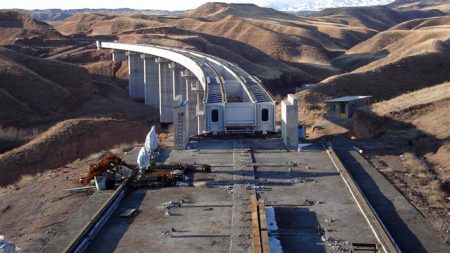
‘Russia set to fund railway line between Iran, Azerbaijan’
Press TV – July 3, 2016
Russia is reportedly poised to finance a railway line connecting Iran with its northern neighbor Azerbaijan.
According to Tasnim news agency, head of the press service of Azerbaijan Railways OJSC Nadir Azmammadov, has said that Russian Railways OJSC has discussed the terms of its participation in the financing of the Rasht-Astara (Iran)-Astara (Azerbaijan) railway with the related parties in the Azeri capital, Baku.
The report said representatives of the railways of Azerbaijan, Iran and Russia attended the talks in which the Azeri side informed the partners about the projects and tasks ahead.
Baku believes the international transport corridor will improve Azerbaijan’s transit potential as well as its ties with the other two countries.
Participants in the talks reportedly signed a final protocol.
The trilateral railway project is aimed at connecting Northern Europe with Southeast Asia.
The railway line will initially transport five million tonnes of cargo when it is launched in the near future.
Last November, Iran and Russia signed an agreement worth 1.2 billion euros to electrify a train line, linking north-central Iran to the northeastern border with Turkmenistan.
The agreement signed between Russian Railways and the Islamic Republic of Iran Railways (RAI) envisages constructing power stations and overhead power lines along the Garmsar-Sari-Gorgan-Inche Burun route in Iran.
“The implementation of the contract will improve the capacity of passenger trains and raise transit to 8 million tonnes,” said RAI Managing Director Mohsen Poursaeed-Aqaei who signed the document.
The train line, among the first in Iran with a history of 80 years, extends to Turkmenistan and Kazakhstan and links the Central Asia to the Persian Gulf and beyond.
The project was also set to be financed by the Russian government and would be implemented in 36 months, which includes manufacturing all electric locomotives inside Iran, electrifying 495 kilometers of railway and building 32 stations and 95 tunnels.
Azerbaijan to perform military drills with Turkey, Georgia
Press TV – May 15, 2016
The Republic of Azerbaijan has declared joint military drills with Turkey and Georgia, a move which is likely to increase tensions with neighboring Armenia prior to talks with Yerevan over the disputed region of Nagorno-Karabakh.
“To increase the combat capabilities and combat readiness of the Azerbaijan, Turkey and Georgia, we deemed it worthwhile to carry out joint military exercises,” Azerbaijan’s Defense Minister Zakir Hasanov said on Sunday, without specifying when the exercises would be carried out.
At least 46 people have been killed since April 1, when fighting broke out between Armenia and Azerbaijan over Karabakh.
On Friday, Azerbaijan’s Defense Ministry said an Azeri soldier had been killed by Armenian fire on Thursday.
On the Armenian side, a serviceman died of wounds on Saturday after reportedly being targeted by an Azeri sniper near southwestern Armenian border.
On April 3, Baku announced a “unilateral” ceasefire as a gesture of goodwill, warning, however, that it would strike back if its forces came under attack. Bouts of fighting were reported soon afterward.
The landlocked Karabakh region, which is located in the Azerbaijan Republic but is populated by Armenians, has been under the control of local ethnic Armenian militia and Armenian troops since a three-year war, which claimed over 30,000 lives, ended between the two republics in 1994 through mediation by Russia.
The presidents of the Republic of Azerbaijan and Armenia, as well as diplomats from Russia, the US and France, are to meet in the Austrian capital of Vienna on Monday to discuss the situation in the volatile Nagorno-Karabakh.
What’s Israel’s Role in the Nagorno-Karabakh Conflict?
Sputnik – April 17, 2016
With the decades-long Azeri-Armenian conflict over the disputed Nagorno-Karabakh region burning out of control for four intense, blood-soaked days at the beginning of this month, questions have emerged over the secretive role played by Israel in the conflict.
Late last week, commenting on the recent escalation of the conflict between Armenia and Azerbaijan over the disputed region of Nagorno-Karabakh, former Israeli foreign minister Avigdor Lieberman blamed Armenia for provoking four days of clashes which left over a hundred dead and dozens wounded.
Azerbaijan, Lieberman said, had “no reasons for escalating the conflict,” despite extensive reports confirming that Azerbaijan was the party that launched offensive operations to regain control of territory in the Armenia-backed Nagorno-Karabakh Republic.
For its part, the Azeri Defense Ministry called the operation, which resulted in the taking of several strategic heights and settlements, a successful ‘counteroffensive’ launched in response to Armenian shelling.
Lieberman’s words would be echoed by retired Israel Defense Forces general Ephraim Sneh, who emphasized in a Friday op-ed for Al-Monitor that Azerbaijan is Israel’s “strategic ally,” and that at the moment, Baku “needs all the diplomatic help [Israel] can muster.”
Sneh slammed Tel Aviv for “staying silent” in Baku’s hour of need, explaining that Azerbaijan is one of Israel’s only friends in the Islamic world, and adding that Israel needs Azerbaijan to ensure its energy security, with Baku providing the Jewish State with some 40% of its oil.
Russia’s mediation of the conflict, Sneh suggested, has been disastrous for Baku, with the “status quo” that emerged in 1994 following the six-year war which began in the late 1980s “convenient for everyone, except for Azerbaijan.”
Blaming Armenia for violations of the ceasefire (and absolving the Azeris of their own violations), Sneh candidly admitted that Baku started the latest bloodshed, and suggested that Azerbaijan’s challenging of the status quo may actually work in its favor.
Saying that the current Moscow-brokered ceasefire, is “tenuous at best and not expected to last long,” the general says that he is hopeful that “now that Azerbaijan has proved its military superiority, there is a chance for real diplomatic negotiations that could lead to an agreement between the two countries,” i.e. for the ethnically Armenian Nagorno-Karabakh Republic to give its territory. In this sense, Sneh says, the Azeris could take a lesson from Tel Aviv and negotiate according to a formula of “land for peace,” which Israel used in the late 1970s in negotiations with Egypt to return the Sinai Peninsula.
This time, Sneh argues, the Azeris should do the same, but in reverse, promising Armenia peace in exchange for Nagorno-Karabakh. “Armenia’s weak economy could stand to benefit from such an agreement.” Moreover, “improved economic relations with Turkey are just one important economic benefit that Armenia can be assured of as soon as it withdraws from the occupied Azeri territories.””Meanwhile, Azerbaijan needs much more robust diplomatic support than it is receiving today.” Unfortunately, Sneh complains, Baku hasn’t been getting it from Israel.
But just how silent has Tel Aviv actually been?
To begin with, hints of the extensive military cooperation between the two countries emerged in the first days of the conflict, indicating that Israeli ‘suicide drones’ were being used by Azeri forces in the course of their offensive. The Harop unmanned aerial vehicle, which acts as a ‘kamikaze’ capable of destroying targets by ramming into them, is produced by Israeli Aerospace Industries (IAI).
According to French intelligence newsletter Intelligence Online, in addition to drones, Israel also provides Baku with advanced radar systems, control and command posts, and other intelligence-collection equipment, and has even entered a bid to provide Baku with a $150 million observation satellite.
Israel has refused to confirm or deny its sale of drones, or other weaponry, to Azerbaijan. However, Meretz party chairwoman Zehava Galon came out publicly warning that Israel intends to send more drones to Baku. In a letter addressed to Defense Minister Moshe Ya’alon, Galon urged that the Israeli government should stop weapons deliveries to the Azeris until it could be assured that Baku would halt the fighting in Nagorno-Karabakh.
At the same time, Israeli security and intelligence specialist Yossi Melman says that Israel has a massive, but highly secretive, defense footprint in Azerbaijan.
In his analysis for The Jerusalem Post, Melman explained that Israel and Azerbaijan enjoy annual trade which is “$5 billion larger than between Israel and France.” Moreover, he said, “most of the content remains confidential, and consists of Azeri oil sold to Israel and Israeli weapons and intelligence technologies purchased by Azerbaijan.”
From modest beginnings in the early 1990s, Azerbaijan has grown to become “the second-biggest market in Asia, after India, for Israeli weapons,” with Israeli defense companies enjoying literally billions of dollars in sales in the Caucasian state. At the same time, Melman indicates, “the best promoters of the military sales and ties are Israeli ministers and officials who visit the Caucasian nation.”
“This week,” the analyst recalls, “The Washington Post enabled the world to have a peeping window into the secret relations [between the two countries] when it published a photo of an Israeli-made ‘suicidal drone’ exploding itself on a bus leading Armenian combatants to the front lines. Seven people were killed, and the Armenian government protested to Israel.”
“A few days after the incident, military journalists visited Israeli Aerospace Industries facilities and were briefed on the various products, from drones to satellites, which the company has to offer. An IAI spokeswoman was asked if the company was behind the Washington Post revelation. She refused to answer but openly smiled when one reporter commented that such a photo is good for business and promotes sales of products that can be labeled ‘battle proven’.”
In addition to military ties, Melman notes that the two countries also have strong intelligence ties, with Mossad given permission to set up a large station in Azerbaijan, taking advantage of the region’s geography to run operations throughout the North Caucasus.
Both Russian and Iranian officials have previously accused Azerbaijan of allowing Mossad to use their territory for espionage activities, the latter indicating that the Israeli missions included everything from “recruiting and planting agents,” to “communication interception and aerial reconnaissance,” Melman explained. Moreover, he added, “more than a year ago Iran claimed to have shot down an Israeli-made drone,” claims which Israeli officials have refused to comment on.
Pointing to the secretive nature of political, defense and intelligence cooperation between the two countries, the analyst noted that “it was [Azeri President Ilham] Alieyev himself who was quoted in a WikiLeaks cable sent from the US Embassy in Baku [saying] that ‘bilateral relations between Azerbaijan and Israel are like an iceberg. Nine-tenths are below the surface.'”
Ultimately, Melmen notes, “seemingly, Israel and Azerbaijan are an odd couple, not meant to be with each other,” with the Caucasian nation not really serving as a model of Western democracy, being run by the same family since 1991, and facing issues including corruption and the suppression of free media. “On the other hand, Israel is not too selective in choosing friends when it comes to weapons sales and national interests. A quick look at the map,” showing that Azerbaijan borders Iran, Israel’s sworn enemy, “can explain Israeli priorities.”
Read more:
Nagorno-Karabakh Crisis Could Get Messy If New Arms Suppliers Emerge
Turkey Claims Azerbaijan ‘Patient’ Over Nagorno-Karabakh Conflict
Armenia Rejects Israeli Proposal on Arms Purchase – Defense Minister
Azerbaijan’s President Thanks Russia for Deescalating Karabakh Conflict
Sputnik – 08.04.2016
BAKU – Azerbaijani President Ilham Aliyev thanked Russia on Friday for its efforts in deescalating the conflict in the de facto independent Nagorno-Karabakh Republic during a meeting with Russian Prime Minister Dmitry Medvedev.
“Your visit comes amid the deterioration of the situation in the zone of the Armenian-Azerbaijani Nagorno-Karabakh conflict. Unfortunately, for many years we haven’t been able to find a solution there, periodically we are faced with armed provocations of the Armenian side. Another attempt was made in the beginning of this month,” Aliyev said.
“As a result of the efforts a truce has been restored, although it is not always observed, but in general over the last few days, we’ve seen deescalation, and we believe that this is a positive sign,” Alyiev said.
Medvedev said he hopes for long-lasting peace in Karabakh.
“I hope that the peace established at this moment will be long-lasting and the parties will continue discussions on the settlement at the negotiating table,” Medvedev said.
Nagorno-Karabakh and the Passover Feast: Hollywood’s Glorification of the Arms Trade

David Packouz (L) and Efraim Diveroli
By Richard Edmondson | Fig Trees and Vineyards | April 7, 2016
From Ukraine to North Africa to the Middle East, and most recently in the Caucasus with the outbreak of hostilities between Azerbaijan and Armenia, death and destruction are on the prowl in multiple wars, while at the same time international laws governing armed conflict are rapidly being cast onto the rubbish heap.
Many of these wars have been instigated by powers outside the countries in which they are being fought, and the tide of violence threatening to engulf the world now is unprecedented in history. You would think that at such a time, Hollywood would have better taste than to make a movie glorifying the arms trade.
But of course, you would be wrong.
Scheduled for release in August, “War Dogs” is based on the real life story of Efraim Diveroli and David Packouz, two twenty-something Jews who got involved in the arms trade and ended up bidding on Pentagon contracts, in the process scoring deals to supply weapons, ammo, and other military equipment to forces the US was arming in both Iraq and Afghanistan.
Their story was told in a 2011 Rolling Stone article which detailed their passion for money-making, recreational drug use, and their predilection for shady business dealings. “Packouz and Diveroli met at Beth Israel Congregation, the largest Orthodox synagogue in Miami Beach,” the story informs us, and then goes on to describe how they landed some lucrative contracts, including one worth $300 million, all while operating a small company known as AEY, a shell company Diveroli’s father had set up. All of this was in the years 2005-2007.
For decades, weapons had been stockpiled in warehouses throughout the Balkans and Eastern Europe for the threat of war against the West, but now arms dealers were selling them off to the highest bidder. The Pentagon needed access to this new aftermarket to arm the militias it was creating in Iraq and Afghanistan. The trouble was, it couldn’t go into such a murky underworld on its own. It needed proxies to do its dirty work — companies like AEY. The result was a new era of lawlessness…
One evening, Diveroli picked Packouz up in his Mercedes, and the two headed to a party at a local rabbi’s house, lured by the promise of free booze and pretty girls. Diveroli was excited about a deal he had just completed, a $15 million contract to sell old Russian-manufactured rifles to the Pentagon to supply the Iraqi army. He regaled Packouz with the tale of how he had won the contract, how much money he was making and how much more there was to be made….
Diveroli, by the way, is the nephew of celebrity rabbi Shmuley Boteach, a staunch supporter of Israel and author of several books, including one entitled “Kosher Sex”–a book in which he “breaks down sexual taboos” while pioneering “a revolutionary approach to sex, marriage, and personal relationships, drawing on traditional Jewish wisdom.” Boteach has also run inflammatory ads in the New York Times defending Israel, and in 2012 was bankrolled by Las Vegas casino magnate Sheldon Adelson in an unsuccessful campaign for Congress.
So in other words, while Boteach was doing the TV talk show circuit advising Americans how to improve their sex lives, his nephew Diveroli was finding his niche in the “murkey underworld” of arms trafficking.
Above all, Diveroli cared about the bottom line. “Efraim was a Republican because they started more wars,” Packouz says. “When the United States invaded Iraq, he was thrilled. He said to me, ‘Do I think George Bush did the right thing for the country by invading Iraq? No. But am I happy about it? Absofuckinglutely.’ He hoped we would invade more countries because it was good for business.”
The big $300 million deal they landed found them purchasing stocks of Chinese-made ammunition in the Balkans and transporting them to Afghanistan, but a US embargo against Chinese weapons meant the whole thing had to be carried out clandestinely. The ammo was repackaged in cardboard boxes with no Chinese lettering. But some of the ammo was quite old, a number of the crates were infested with termites, and the two ended up being indicted for fraud and pleading guilty. And now we have a forthcoming Hollywood movie about their endogamic escapades.
It’s tempting to dismiss “War Dogs” as just another piece of Hollywood trash, but of course it comes as millions are coping with the destruction of homes and lives in the bogus war on terror and as whole nations are being torn apart. In Syria, the US has aligned itself with so-called “moderate” rebels, equipping them with vast stocks of weapons, many of which have ended up in the hands of ISIS, while in Yemen, we have assisted Saudi Arabia in an air campaign which, as of January 2016, had resulted in 2,795 killed and 5,324 wounded. At least 62 civilians were killed by coalition airstrikes in December alone, reports the UN, which was more than twice the number killed in the previous month. Many others have been left homeless.

A girl drinks from a leaking street pipe in Yemen, where millions now have no access to drinking water
But this hasn’t stopped the US from continuing to fuel the fire, so to speak. According to Defense News, the State Department has facilitated $33 billion worth of weapons sales to its Arab Gulf allies since May of 2015. The weapons–including anti-armor missiles, attack helicopters, and ballistic missile defense capabilities–have been sold to the six countries that make up the Gulf Cooperation Council, or GCC. These would of course be some of the same countries that have been supplying arms to ISIS while also carrying out war crimes in Yemen.
“In addition, the U.S. government and industry also delivered 4,500 precision-guided munitions to the GCC countries in 2015, including 1,500 taken directly from U.S. military stocks — a significant action given our military’s own needs,” said David McKeeby, a spokesman with the State Department’s Bureau of Political-Military Affairs.
How much of this ordnance may have ended up in the hands of not-so-moderate terrorists is unclear, but in December of 2015, Amnesty International published a report entitled “Taking Stock: The Arming of the Islamic State,” which found that the terrorist army “now deploys a substantial arsenal of arms and ammunition, designed or manufactured in more than 25 countries.”
A lot of this was looted or captured from poorly secured Iraqi military stocks, says the report, but illicit weapons transactions also seem to have played a considerable role in building up the ISIS arsenal–and some of the “chain of custody” evidence cited in the report, including a cache of weapons transferred from Croatia to the Free Syrian Army, sounds almost eerily similar to the sort of shady weapons trafficking operation run by Packouz and Diveroli.
Of course there is the old adage about art imitating life, and, on some level the fact that Hollywood would make a film about two Jews and then go on to entitle it “War Dogs” is perhaps not surprising. This, keep in mind, coming at a time when evidence of Israel’s support for terrorists in Syria is as clear as the hand in front of your face. And of course who could forget the lovable Victoria Nuland and her famous “f**k-the-EU” comment, mouthed off at a time when her State Department was busy engineering a coup in Ukraine?
In fact, efforts by Zionist Jews to create instability and instigate wars are getting to be about as common as fireflies on a summer night. They’re not always easy to spot, but you know they’re out there because they occasionally involuntarily light up, as when someone like Nuland gets caught in a taped phone conversation.
And now it looks like certain fireflies have moved into the Caucasus where they seem to be taking advantage of a long-simmering dispute between Azerbaijan and Armenia over the region of Nagorno-Karabakh. On April 2, intense fighting broke out followed by a series of charges, counter-charges, claims and counterclaims, made by both sides. According to the Armenians, it started with an offensive launched by Azerbaijani troops using tanks and artillery. Azerbaijan, on the other hand, insists it was responding to large-caliber weapons fire from inside the ethnic Armenian-controlled Nagorno-Karabakh area. So who is telling the truth? Or are both sides lying?
Hard to say for sure, but a couple of knowns are worth mentioning: A) Armenia is closely allied with Russia, and, B) Azerbaijan, too, has ties, including trade ties, with Russia, but it also is closely aligned with Turkey and maintains extensive trade relations with Israel. And the trade with Israel has been especially heavy in the area of military procurement.
Israeli drones, anti-aircraft and missile defense systems have been supplied to Azerbaijan in the wake of a $1.6 billion agreement struck between the two countries in 2012. Israeli companies are also active in the Azerbaijani telecommunications, agriculture, water supply medical technology, and energy sectors. That makes for a lot of sayanim on the ground inside a relatively small country.
Perhaps no surprise, then, that Armenian forces shot down an Israeli drone on April 2–the very day hostilities broke out.
The ThunderB drone is known for its light weight, 62 pounds, and its long flying time–25.5 hours–on a single tank of fuel. It is made by an Israeli company known as BlueBird, which reportedly may be about to be purchased by Elbit Systems.
And then on Tuesday came news of yet another Israeli drone spotted over Nagorno-Karabakh–this one believed to be a Harop drone, made by Israeli Aerospace Industries. The Harop is also known as a “suicide drone” in that rather than firing a missile at a target it simply becomes the missile itself, ramming the target and destroying it.
According to Gordon Duff, senior editor at Veterans Today, the key to understanding the Armenian-Azerbaijani conflict is to recognize “that Azerbaijan is a client state of Israel and the CIA.” He adds that Azerbaijan has as well become “the regional operating center for Google Idea Groups,” which he refers to as the “shadow CIA.”
Google Ideas was formed in 2010. At that time Google CEO Eric Schmidt tapped the State Department’s Jared Cohen to direct the new venture, dubbed as a “think/do tank.” In late 2015, Google was reorganized under a parent company called Alphabet, Inc., and in February of this year Google Ideas was rebranded as “Jigsaw”–although it is still run by Cohen and still affiliated with Google.
Cohen, by the way, is also an adjunct senior fellow at the Council on Foreign Relations, and during his years with the State Department (2006-2010) he worked closely with Condoleezza Rice and Hillary Clinton, and became a strategic advisor in US policy toward Iran. Jigsaw’s mission is to “use technology to tackle the toughest geopolitical challenges, from countering violent extremism to thwarting online censorship to mitigating the threats associated with digital attacks,” says Schmidt.
Sounds nice, but a purview of Jigsaw’s website–fittingly kind of creepy and dark-looking–suggests that virtually all of the “activists” it has provided support to seem to be from countries with governments the US seeks to overthrow. And indeed, in 2012 Wikileaks released a cache of emails concerning Cohen’s activities in the Middle East, including one, apparently written by Cohen himself, in which he discusses efforts to stir up trouble in Iran:
I wanted to follow-up and get a sense of your latest thinking on the proposed March trip to UAE, Azerbaijan, and Turkey. The purpose of this trip is to exclusively engage the Iranian community to better understand the challenges faced by Iranians as part of one of our Google Ideas groups on repressive societies. Here is what we are thinking: Drive to Azerbaijan/Iranian border and engage the Iranian communities closer to the border (this is important because we need the Azeri Iranian perspective).
So here, it seems, we have Cohen basically setting up shop on the Iran-Azerbaijan border. It should be noted that both Azerbaijan and Armenia border Iran, while Azerbaijan also shares a border with Russia. A conflict breaking out in this region could easily spill over into Russia or Iran–both of which have called for the two warring parties to adhere to a 1994 ceasefire agreement.
But of course, such a spillover would advance certain geopolitical interests. For one thing, it would pose a dilemma for Russia at a time when it is engaged in Syria. Sergei Zheleznyak, vice speaker of the Russian state Duma, has voiced the view that a “third force” is behind developments in Nagorno-Karabakh. According to the Russian News Agency Tass :
“It is clear that the force that continues to fan the flames of war in the Middle East, Central Asia and the Caucasus dissatisfied with the peacekeeping and counter-terror success of Russia and our allies in Syria is interested in the speedy exacerbation of the protracted conflict in the Nagorno-Karabakh region,” the parliamentarian wrote on his Facebook page on Saturday.
According to Zheleznyak, “neither Azerbaijan nor Armenia essentially need this exacerbation now.” He noted that “there is every likelihood that this provocation has been organized by a third force,” adding that “information on its presence is beginning to leak out.” In view of this, he drew attention to the fact that “at night in the mountains it is enough to have a few trained armed persons who know the opposing sides’ balance of forces to provoke them to open reciprocal ‘reprisal’ fire.”
Most people probably assumed Zheleznyak, in talking about a “third force,” was referring to Turkey–and certainly Turkey’s downing of a Russian jet in Syria factors into the equation. But another element that perhaps figures even more prominently is the “clash of civilizations” that hardcore Zionists have long salivated over the thought of.
We might theorize that ISIS was created with a two-fold objective: one was to break apart Syria and bring about the overthrow of Bashar Assad, while the other was to jockey into existence a clash of civilizations between Christians and Muslims. In both of these objectives it has failed. Assad is still standing, and while the rise of ISIS certainly inflamed anti-Muslim sentiments in the West, it has not resulted in the all-out war between Christianity and Islam that would have played so well into the hands of the Jewish state.
But where the ISIS plan failed, the conflict in the Caucasus could well succeed. Armenia is predominantly a Christian state, while Azerbaijan is mostly Muslim. A war between these two could galvanize public opinion in the region along religious lines. Regional political alignments and the history of the Armenian genocide are also to be considered. Turkey, though sharing a border with Armenia, has openly sided with Azerbaijan. Russia, on the other hand, has remained officially neutral. However, an RT report filed April 5 shows journalist Murad Gazdiev reporting from inside Armenian Karabakh trenches.

Armenian Genocide–young girls crucified on crosses
So where is Israel in all of this? Officially it doesn’t seem to be saying much about it, but in May of 2015, the Jewish Daily Forward published an article entitled, “Why Israel’s Alliance with Azerbaijan is so Shortsighted.” The writer, Christopher Atamian, takes the Jewish state to task over its refusal to recognize the Armenian genocide as well as for its lucrative arms contract with Azerbaijan, a country he refers to as an “authoritarian regime that is fueling regional conflict.”
“This is the same country that attempted to wipe out the entire Armenian population of Nagorno Karabakh in 1991 before losing a bloody war against the Armenians,” he adds.
What he leaves unspoken, of course, is that Israel’s refusal to recognize the Armenian genocide is tantamount to holocaust denial. More than 1.5 million Armenians were massacred from the years 1915 to 1922, and the Jewish state’s silence on the matter became a particularly hot-button issue last year on the genocide’s 100th anniversary.
Zheleznyak, the Duma vice speaker, seems for his own part to be offering sage advice to both parties in the current conflict, noting that Russia’s president as well as its government agencies “urge Armenia and Azerbaijan to cease fire and not to allow to draw them into someone else’s insidious game, as long as it is still possible.”
“As long as it’s still possible” is of course the key question. The more people die, the further recede the possibilities of the regional players not getting trapped or caught up in the “insidious game”–and the greater grow the chances of the conflict’s becoming the parabolic curve that ignites World War III.
Should that come to pass, maybe Diveroli and Packouz will vie for ringside seats–although it doesn’t appear they’ll especially want to sit next to each other. According to the article in Rolling Stone, the two had a major falling out.
“Listen, dude, if you f**k me, I’m going to f**k you,” one of them warned during an argument over money.
“Whatever,” replied the other.
One wonders why they didn’t name the movie “War Pigs” rather than “War Dogs.” Perhaps it wouldn’t have been kosher enough.
In the past year in Israel we’ve seen an arson attack on a Palestinian home which left a mother, father and their 18-month-old baby dead; we have seen a video of Jewish settlers dancing and celebrating the attack by stabbing a photo of the baby; we have observed continued expropriation of Palestinian land in the West Bank, including one of the biggest land grabs in recent years–579 acres near the Dead Sea; and more recently we have seen a second video showing an Israeli soldier executing a wounded Palestinian with a gunshot to the head.
The execution video showed Israeli soldier Elior Azaria pump a bullet into the head of 21-year-old Abdul Fattah Sharif, as he lay on the ground wounded and barely moving. The murder took place on Purim, the Jewish holiday which celebrates the massacre of thousands of Gentiles, as told of in the Book of Esther. The next holiday on the Jewish calendar is Passover, coming up on April 22-23. The significance of Passover is laid out in twelfth chapter of Exodus:
On that same night I will pass through Egypt and strike down every firstborn–both men and animals–and I will bring judgement on all the gods of Egypt. I am the Lord. The blood will be a sign for you on the houses where you are; and when I see the blood I will pass over you. No destructive plague will touch you when I strike Egypt.
This is a day you are to commemorate; for the generations to come you shall celebrate it as a festival to the Lord–a lasting ordinance… And when your children ask you, ‘What does this ceremony mean to you?’ then tell them, ‘It is the Passover sacrifice to the Lord, who passed over the houses of the Israelites in Egypt and spared our homes when he struck down the Egyptians.’
It seems that both Purim and Passover are in essence celebrations of the deaths of non-Jews. Suppose Gentiles observed holidays each year in which we celebrated Jewish deaths? What do you suppose would be said of it?
Whatever one’s views of Judaism may be (there are some admirable sentiments expressed in the Old Testament as well as some repellent ones), Zionism has morphed from the simple idea of a homeland for a specific group of people into a supremacist ideology that has had appalling consequences–not only for its victims but also even for its adherents, dehumanizing them to a degree never thought imaginable.
Zionism is the great Passover feast that has become a celebration of war.
Nagorno-Karabakh Conflict Escalated: In Pursuit of Hidden Agenda
By Pyotr ISKENDEROV – Strategic Culture Foundation – 06.04.2016
The sudden aggravation of the situation in Nagorno-Karabakh is fraught with serious consequences. The warring sides, as well as the OSCE (the Organization for Security and Cooperation in Europe) Minsk Group, have to realize that the situation may get out of hand and entail irreversible consequences against the will of the belligerents.
Armenian First Deputy Defense Minister David Tonoyan said in a statement made at the Sunday (April 3) briefing with foreign defense attaches that Armenia is ready for any scenario as the events unfold, «including direct military assistance to the security of the Nagorno-Karabakh republic».
The statement indicates that things will never be the same as before, especially after Turkey, Pakistan and some other countries have voiced their support for Azerbaijan. Once made public, the statements cannot be taken back. The development of events suggests that some forces pursue a hidden agenda in an effort to unfreeze the Nagorno-Karabakh conflict and make the escalation irreversible.
In recent years, the situation in Nagorno-Karabakh worsened from time to time, but it never escalated to large-scale operations involving aviation and heavy equipment. Moreover, decisions to start combat actions can not be taken in absence of state leaders. Azerbaijan’s President Ilham Aliyev and Armenia’s President Serzh Sargsyan were in Washington when the situation escalated overnight on April 2.
The outside factors probably play a much bigger role than it may seem at first glance.
Evidently, some countries, like Russia, for instance, have no interest in the escalation of the conflict in the Caucasus. Moscow plays the leading role in the crisis management efforts. It has always strived for developing mutually beneficial ties with both Armenia and Azerbaijan.
The aggravation of the conflict creates a problem for the Collective Security Treaty Organization (CSTO). Unlike Azerbaijan, Armenia is a member of the CSTO, which is to defend it if attacked. But the organization has no obligations to defend the self-proclaimed Republic of Nagorno-Karabakh. Article 4 of the Treaty states «If an aggression is committed against one of the States Parties by any state or a group of states, it will be considered as an aggression against all the States Parties to this Treaty. In case an act of aggression is committed against any of the States Parties, all the other States Parties will render it necessary assistance, including military one, as well as provide support with the means at their disposal through an exercise of the right to collective defense in accordance with Article 51 of the UN Charter».
The conflict in Nagorno-Karabakh is not covered by the Treaty, but the broad interpretation of its text may lead to misunderstanding inside the CSTO between Russia and Armenia on the one hand, and Kazakhstan, Kyrgyzstan and Tajikistan on the other hand.
Obviously, the bloodshed does not meet the interests of Armenia and Azerbaijan. Nevertheless, outside forces have entered a «window of opportunity» to incite Baku.
Now who gains as a result of Azerbaijan’s involvement in the conflict? There are at least three parties to benefit.
Turkey tops the list. Having suffered a defeat in Syria and in face of growing impact of the Kurdish factor, Erdogan could go as far as sparking the Caucasian hotbed to entangle Russia. His plans may envision provoking a confrontation between the Russian Federation and NATO. If so, he could have given certain assurances and guarantees to Azerbaijan’s President Aliyev during his visit to Turkey on March 15.
Director of US National Intelligence James Clapper warned about possible escalation of the conflict in February.
The information was confirmed by the fact that the air forces of Azerbaijan and Turkey held March 7-25 joint military exercises TurAz Shahini-2016 in the Turkish province of Konya as part of the TurAz Qartali program of military cooperation. The exercises were held in accordance with the annual plan of joint training events that kicked off last September.
The United States, or, to be more precise, the circles in Washington interested in keeping up tensions in the relationship with Moscow, is the second party, which has a stake in the conflict’s flare up. The goal is to weaken the Collective Security Treaty Organization and create snugs on the way of post-Soviet space integration. Sparking a conflict in Nagorno-Karabakh is the best way to do it.
The third party interested in the conflict is the Cooperation Council for the Arab States of the Gulf, especially Qatar. This country has close ties with Turkey. It challenges Saudi Arabia as the leader of the organization. Besides, there are heightened tensions between the Gulf Cooperation Council members and Iran. Iranian Azerbaijanis account for 15-16% of the country’s population. Tehran has had good relations with Erevan ever since early 1990s. Like Russia, it has no interest in inciting the Nagorno-Karabakh conflict. Qatar and Turkey enjoy special relationship. They are known for tacit support of Muslim Brotherhood. It would be logical to surmise that both countries coordinate policies on the Nagorno-Karabakh dispute.
Azerbaijan and the breakaway region of Nagorno-Karabakh said on April 5 they were halting hostilities after four days of intense fighting.
The world community pins great hopes on the ability of the OSCE to prevent the worst from happening .
Featured Video

AIDS Inc. by Gary Null (2007)
or go to
Aletho News Archives – Video-Images
From the Archives
Clash of Civilization, Iran Part II
By Jamal Kanj – Intifada-Palestine.com – January 14, 2011
Israel’s survival kit is: perpetuate conflict, insecurity to rationalize collective hate and finally playing victim.
Devoid of conflict, Israel implodes internally; without hate, Zionism loses its justification; and playing eternal victim to continue blackmailing the West. Absence of this holy trinity, Israel ceases to exist.
From its inception, the house of Zion has mastered exploiting adversarial powers to advance Israel’s cause. For instance, their influence over the Democratic Party in the US began with President Truman’s bid for 2nd term election in 1948.
Responding to strong opposition from Secretary of State General George Marshall and Department experts urging against recognition of Israel, President Truman replied: “I’m sorry gentlemen but I have to answer to hundreds of thousands [Jewish voters] who are anxious for the success of Zionism. I do not have hundreds of thousands of [voting] Arabs among my constituents”
Zionists influence over liberal American politics was matched with the doctrinal school of Conservative theoreticians aligning the Republican Party’s platform with Israel’s objectives. The Neoconservative Zionists, coined Zioncons, invented the “Clash of Civilization” concept to fight Israel’s wars. … continue
Blog Roll
 Aletho News
- 12 Things Your Psychiatrist Was Trained Not to Tell You
- From Unipolar Universalism to Multipolar Civilizational Distinctiveness
- RSF military group defects, joins Sudanese army: State media
- Ireland goalkeeper refuses to play ‘Israel’ as squad weighs boycott
- China pushes back against US on Cuba, Iran
- Ukrainian Soldiers, Potential Mercenaries: Have Gun, Will Travel!
- Burnham’s UN debut… A masterclass in British disinformation
- Iran flights continue despite US aviation sanctions
- Global Tipping Points Lead the World Into a State of Entropy
- The day-after at the White House: USA and Xi Jinping
- If Americans Knew
- Israel forces Gazans to live in constant peril – Daily Update
- Deconstructing Netanyahu’s pants-on-fire UN rant – Daily Update
- Trump betrayed voters with his campaign lies and prioritized a foreign country once he took office
- Netanyahu calls Israel’s war in Gaza ‘opposite of genocide’ in UN speech to near-empty hall
- Settler Kidnappings: Torture, Sexual Abuse and Terrorisation of Palestinian Abductees as Israel Deepens Annexation of West Bank
- Gaza winter nears as 162,000 tents become unusable, raising fears of humanitarian crisis
- Netanyahu says, “It’s the opposite of genocide”; UN says Gaza economy is world’s ‘most severe crisis on record’ – Daily Update
- Israel’s US-Backed Assault on Gaza Has Created the ‘World’s Most Severe Economic Crisis on Record’: UN
- ‘Protecting U.S. Citizens’… From Israel
- ‘This is where I live now, the back of a truck’: a day in the life of a grandmother in Gaza
- No Tricks Zone
- New Study: Earth And Venus Surface Warmth Largely Explained By Convection And Lapse Rate, Not CO2 Or Radiation
- 2025 Nature Paper Claiming Worsening Global Drought Gets RETRACTED …Heavily Flawed
- New Study: ‘Global Drought Shows No Detectable Recent Acceleration Under Climate Warming’
- Economic Masterminds: German Socialists Suggest Taxing Productivity Gains Stemming From Using AI
- The South China Sea Has Not Been Cooperating With The Climate Change Narrative
- Energy Crisis: Germany Enters Heating Season With Historically Low Gas Reserve Fill Levels
- New Study: The Antarctic Ice Sheet Gained Mass From 2020-2024 Due To Staggering Snow And Ice Accumulation
- Study: Ocean Heating Rates From Thousands Of Years Ago ‘Dwarf’ Modern Ocean Heating Rates
- Climate Extremists Target, Attack Large-Scale Power Grid Infrastructure In Germany!
- New Study: Antarctic Ice Melt Has Contributed Less Than 1 Centimeter To Sea Level Rise In The Last 30 Years

