Keir Starmer Is Self-Isolating Now. I Call Bullshit
By Richie Allen | July 21, 2021
Labour Party leader Keir Starmer has gone home to self-isolate this afternoon. The media has been told that one of his children has tested positive for covid.
According to the BBC:
A statement from his office said one of his children tested positive at lunchtime, but Sir Keir was doing daily tests and tested negative this morning.
Sir Keir was in the House of Commons for PMQs earlier. The PM and chancellor are also self-isolating after contact with the health secretary who tested positive.
This is the fourth time Sir Keir has had to self-isolate since the pandemic began. His spokesman said his family will also be self-isolating.
I’ve no proof whatsoever, but I call bullshit. The media has spent much of the past 48 hours discussing the NHS app and “pingdemic.” Millions of people have been pinged by the app and told to go home and isolate. It’s led to total chaos.
Business owners are tearing their hair out as staff shortages threaten the post-lockdown economic bounce. There are widespread reports that millions of younger people are deleting the app from their phones. Nobody wants to be forced into isolation, especially at this time of year.
The managers of the scamdemic, the entire political class and the media, are horrified that so many are deleting the wretched app. Maybe Johnson, Health Secretary Sajid Javid and Labour leader Keir Starmer have been sent to self-isolate to set an example.
You’d be well within your rights to ask me why. Because chaos is their desired outcome. They want to destroy the economy and cause a shortage of food and other products. They want to bankrupt businesses. They want to bankrupt you. Chaos is the plan.
Ordo Ab Chao. Order out of chaos. All roads lead to The World Economic Forum’s Great Reset. The people will only accept it when their worlds are turned upside-down.
The public is being manipulated 24/7 by the political class and the media working in tandem. They want you in a perpetual state of agitation and confusion. You become even more suggestible while in that low vibrational state.
There’s no covid now. There’s no threat if there ever was one. People should not be taking instructions from their phones to drop everything and rush home to isolate. It’s tyranny. People seem to be wising up to it and ditching the app. It’s about bloody time.
How convenient then, that the PM and the leader of the opposition party should be pinged and sent home, while at the same time the media is attacking anyone who suggests it’s time to move on and get on with our lives.
The BBC vs Donald Trump
By Freddie Attenborough | The Daily Sceptic | July 19, 2021
In March 2021, the BBC reported that one of their investigative teams had, “Been tracking the human toll of coronavirus misinformation”. During this investigation they claimed to have found links to “assaults, arsons and deaths”. Worryingly, experts also told them that, “The potential for indirect harm caused by rumours, conspiracy theories and bad health information could be much worse”. Sounds like an interesting investigation, doesn’t it? Public service output at its finest, you might think. Just the kind of article we’d all like to read.
Alas. Not quite.
The problem with the BBC is that it simply can’t help itself. Having teed an ostensibly interesting story up in this open, investigatory journalistic type of way, its authors then proceed to devote a good-ish chunk of what follows to that most favourite of all BBC pastimes, namely, implicating Donald Trump in the act of mass murder. As with the butterfly so beloved of chaos theory (you know the one: that little blighter who’s always flapping his wings and causing tsunamis to crash into the coast of Bangladesh) no sooner have the BBC shown us Trump tweeting about the FDA’s preliminary research into hydroxychloroquine as a prophylactic against Covid than the magic of non-deterministic linear physics kicks in and people all over Nigeria and Vietnam suddenly start mopping up the old bleach-based products like vacuum cleaners.
In the end, then, the only interesting thing about this article is the way it reminds us just how little time and attention the BBC have paid to exploring the link that surely must exist between Covid ‘misinformation’ (as they themselves insist on calling it) and the huge rise in cases of psychosomatic disorder – health anxiety in particular – that we’ve witnessed in the UK since the dawn of the Age of Lockdown (2020-present). Let me explain what I mean.
And to do so, let me start by asking a question: what might disinformation likely to precipitate new, or to heighten existing, levels of anxiety amongst those suffering from psychosomatic disorders look like? How, in other words, might we define such a thing? Well, perhaps we might say that it would be information that unduly exaggerated the risks associated with Covid. Perhaps we might go further and say that it would represent the risks associated with Covid in a highly misleading and/or a sensationalist way. Come to think of it, perhaps we might end up concluding that it would look rather like the BBC’s recent article, ‘Long COVID funding to unearth new treatments.’ Below is the thumbnail picture accompanying the piece.
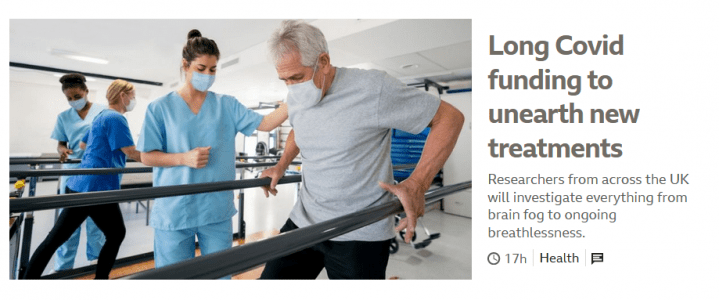
As you can see, it depicts two masked patients, chaperoned by two masked nurses, who look unmistakably like they’re having to learn how to walk again. (And by the way, anyone who’s going to counter that it could just as plausibly be a depiction of two patients being tested for, say, oxygen carrying capacity or pulse rate during recovery from a respiratory illness like Covid would need to explain to me why it is that neither patient is shown to be wearing any tracking/monitoring equipment, and, in addition, why neither nurse is shown to be holding/studying any data monitors). The male patient in the foreground of the image looks particularly unsteady on his feet, relying heavily on the metal frame surrounding him for bodily support. One of the masked nurses stands next to him, watching his legs and feet intently, presumably scanning for any warning signs of imminent collapse or a stumble. Her right arm is stretching out towards him, and no doubt a guiding/supportive hand is resting on the patient’s shoulder. Just behind the male patient, you can also see the lower half of the wheelchair in which he will have been brought from his hospital ward and into this rehabilitation class.
But if that’s what it shows, then what kind of patient might actually need rehabilitation of this kind; rehabilitation, that is, in which patients are having to learn how to walk again? It’s the type of thing that you’d imagine is normally reserved for patients needing post-surgery rehabilitation; patients who’ve suffered spinal cord injuries, neurological disorders, car-crashes, amputations and the like. That’s big league, serious stuff. We’re essentially talking about a type of rehabilitative treatment for people who’re on the cusp of, or who’re already suffering from, life-changing injuries/illnesses.
So is this the type of treatment that people suffering from Long Covid are likely to need? I ask because as we’ve already established, it’s the type of treatment that’s depicted in the image the BBC have attached to an article entitled, “Long Covid funding to unearth new treatments” the first paragraph of which reads: “Thousands of people with ‘long Covid’ could benefit from the funding of 15 new studies of the condition, its causes and potential treatments”. To help us on the way towards answering this question, here’s what the NHS guide to the symptoms currently associated with ‘Long Covid’ has to say for itself:
Common Long Covid symptoms include:
- extreme tiredness (fatigue)
- shortness of breath
- chest pain or tightness
- problems with memory and concentration (‘brain fog’)
- difficulty sleeping (insomnia)
- heart palpitations
- dizziness
- pins and needles
- joint pain
- depression and anxiety
- tinnitus, earaches
- feeling sick, diarrhoea, stomach aches, loss of appetite
- a high temperature, cough, headaches, sore throat, changes to sense of smell or taste
- rashes
Now I’m no doctor, admittedly, but I’m not entirely satisfied that a programme of rehabilitative walking usually reserved for wheelchair bound patients in post-surgery recovery is going to prove particularly efficacious when it comes to the treatment of long Covid patients with earache, diarrhoea and changes of smell or taste. In fact, I’m not satisfied at all.
Indeed it rather seems to me that the BBC’s choice of image, when considered as an accompaniment to this particular article, might justifiably be described as misinformation; that is, as information that unduly exaggerates the risks associated with long Covid in a highly misleading or a sensationalist way.
By the way, do you like my definition of misinformation? Thanks. Perhaps it might interest you, then, to know it’s culled from the BBC’s own editorial guidelines. Specifically, therein we find “Section 3, Accuracy”, and, more particularly, “Sub-section 3.3.24”, which states that, “Reconstructions [which this image undeniably is] are when events are quite explicitly re-staged”, and that in order to abide by the BBC’s editorial guidelines, “They should normally be based on a substantial and verifiable body of evidence… [and they] should not overdramatise in a misleading or sensationalist way”.
On this basis, then, is it not the case that the BBC’s own reality-check team, that bastion of fairness and impartiality in a world gone wrong, should hold the organisation to account for spreading long Covid misinformation? Is it not an article that exaggerates and sensationalises the effects of long Covid? Further, is it not likely to generate additional, or indeed to heighten existing cases of, psychosomatic health disorders in the U.K.?
I guess if you’re the type of person who’s already suffering from heightened worry about your health, about lockdown, about physical contact with others, about viruses, about disease; I guess if you surf the web but never really read anything carefully; if you scan the thumbnails on the BBC’s news homepage but never click through to the articles; if you look at an article’s opening image and then only scan the first two or three paragraphs of text thereafter… then I guess, absolutely, it might indeed be considered ‘misinformation.’
“But isn’t this all just a little pedantic?” I hear you ask. “A bit nit-picky?” Oh, absolutely. And doesn’t it feel good to be playing the BBC at their own game for a change. So good, in fact, that you really must forgive me. I’m enjoying myself so much that I’m going to continue to be pedantic for a little while yet.
Because you see I guess, too, that if you’re prone to experiencing psychosomatic disorders of one kind of another, if you’re already well-known to your local GP surgery and A&E, then it might panic you quite a bit to think that the image the BBC have chosen to use here depicts a fate that might lie in store for you too if you ever contracted Covid and then experienced Long Covid. I guess too that if you’re that way inclined, then you might even feel you needed to take the vaccine, any vaccine, right this minute, no questions asked, jab jab jab, please, put it in me doctor, oh God, put it in me… and to hell with any kind of informed consent.
Jabbed or not, if you’re that way inclined then I guess you might nevertheless see that picture, that image of the Long Covid patient struggling to walk in the BBC’s article, and then, at some point later, get around to thinking that you’re experiencing the symptoms of Long Covid, that you’re really ill, that you’re dying, that you’re in need of immediate and very urgent medical attention, that you’ve got to go to A&E immediately because you might end up in a wheelchair unable to walk; I guess, too, that you might see that picture and then end up yo-yo-ing in and out of the healthcare system for the rest of your life, costing the taxpayer money, wasting valuable medical time, worrying that there’s a direct line of causality that “the science” has established between you coughing, you sneezing and you ending up in hospital needing a wheelchair to get you to your rehabilitative walking therapy sessions.
It’s strange, isn’t it? I mean, the BBC is normally so keen, so eager, to castigate others for disseminating what they’ve decreed to be Covid misinformation capable of causing or exacerbating existing physical disorders. Yet in the case of psychosomatic disorders – i.e. panic, hyperventilating, health anxiety, generalised anxiety, hypertension, depression, chills, gastrointestinal disturbances – they’re curiously reluctant to take up those same sanctimonious ‘fact-checking’ cudgels.
It’s a reluctance that matters, though, isn’t it? The sad and unfortunate thing about psychosomatic disorders is that those suffering from them are more likely than almost any other group in society to place unnecessary pressure on the NHS. After all, if you’re worried that you’re seriously unwell and/or in imminent danger of dying, where’s the first place you’re going to go? That’s right: a primary or secondary healthcare provider. The problem, of course, is that people who suffer from those types of disorders are neither seriously ill nor in imminent danger of dying. What they ‘are’ is suffering from severe anxiety. That’s not nothing, of course; but it’s hardly first responder or A&E type stuff, is it?
That this might constitute a problem during a global pandemic of a mild respiratory illness in which we’ve all been told to put our lives, businesses, careers on hold because the NHS is under massive existential pressure, seems obvious. If the NHS is already clogged up with respiratory tract illness and you then go and add a whole bunch of psychosomatic patients to the mix… well, you’ve got a problem, haven’t you? You’d think the BBC would care about that sort of thing, particularly given the pious, reverent tone it normally adopts when it’s representing the NHS. You’d think they’d want to provide balanced, calm, rational reportage of what was going on; reportage that was clear about the extremely low risk Covid poses to the vast majority of people in this country.
I wonder. Could it be that if we were to widen the scope of the concept of ‘misinformation’ to include not only information capable of causing physical harm, but also that likely to cause psychosomatic harm, we’d be forced to conclude that the BBC, with all its Covid exaggerations, its hyperbole, its uncritical, unreflexive treatment of “the science” handed down to it by SAGE, its failure to hold the Government to account, to approach statistics sceptically, to put case numbers into perspective, its obsession with filming death porn reports from inside hospitals (etc etc)… if we were to consider all of that as misinformation too, might we not end up concluding that the BBC has done as much damage to the psychological health and wellbeing of the nation it purports to inform, educate and entertain as Donald Trump ever did with his tweety-tweety chit-chat about preliminary research into hydroxychloroquine as a prophylactic against Covid? I wonder indeed.
Dr Freddie Attenborough is a former academic. You can see his substack account here.
Rotten To The Core
NOT A LOT OF PEOPLE KNOW THAT | JULY 18, 2021
There has been a longstanding concern about blatant bias at the BBC, not least in matters of climate change. This certainly dates back at least to January 2006, when they held a seminar of “top scientific experts” to advise them on climate change. The BBC fought tooth and nail to conceal the identity of these experts, but it was subsequently discovered that they were not experts at all, but the usual collection of green lobbyists.
Ever since, the BBC’s coverage of global warming has been woefully one sided and at times inaccurate,
This year they have been publishing a monthly feature, Then and Now, purportedly showing how climate has been changing in a warming world.
One article looked at the recent drought in California, while another claimed that the Victoria Falls had dried up. Both implied that climate change was to blame, with the usual weasel words that while one weather event cannot be linked to climate change, “scientists” say that such events are likely to get worse with global warming.
However both stories omitted crucial information, which would have shown such claims to be nonsensical and untruthful.

https://www.bbc.co.uk/news/science-environment-56902340
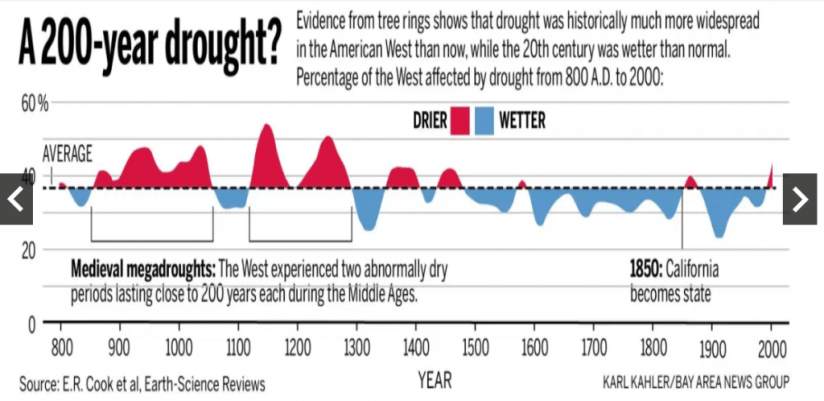
California, for instance, has had droughts in the 20thC every bit as bad as the current one. Moreover the official data clearly shows megadroughts there were much worse for much of the last thousand years or so. In short, California is a land of drought. The modest amount of warming there since the Little Ice Age has altered nothing.
The BBC claims about the Victoria Falls were even more absurd. For a start, the Falls did not run dry; every dry season lake levels drop. As the Zambian side is at a higher elevation, the Falls there dry up, while continuing at the other end. This happens every year, but the BBC deceitfully misled readers by showing a split image comparing Jan 2019 with Dec 2019. In January every year water levels rise sharply, and Jan 2020 was no exception.
It is certainly true that there was a drought in the region in 2019, and water levels were lower than average. But the Zambesi River Authority say that there have been six occasions since 1914 when water levels were lower, the worst being in 1995.
Just as with California, the BBC have picked on a drought, but ignored all of the data showing that they are both natural events, with no evidence that droughts are getting more severe or common.
This sort of misreporting of the Victoria Falls is of extreme concern to Zambia’s tourist industry and local businesses, who are naturally worried that tourists may stop visiting if they think the Falls are no longer there.
Which brings us to the point of the story. I complained to the BBC that both stories were grossly misleading and omitted crucial information.
Complaints to the BBC go through three stages. The first response appears to be written by the office junior, who tries to fob you off with a few bland statements.
If you are unhappy, you can resubmit the complaint, which usually gets the same response, though dressed up in sciency sounding language.
Finally you can appeal to the Executive Complaints Unit.
As is usually the case, I effectively received the same reply at all three stages, viz:
- There was a drought
- “Scientists say” climate change is making droughts worse
None of the replies actually addressed my complaint, that the actual data shows droughts are not unusual or getting worse at either location.
The real issue here of course is that the BBC Complaints Dept is all in house, even the ECU. In effect the BBC is marking its own homework.
In theory it is possible to appeal to OFCOM. In practice however they have no obligation to investigate, and would only consider doing so for substantive cases.
Clearly BBC bias will never be addressed until they are subject to a fully independent process, just as the press is.
In the meantime, if Tim Davie is serious about cleaning the stables, he should start by taking his axe to the bloated, fourteen strong Environmental Dept, which is now clearly out of control.
Instances of bias and misinformation, such as these two, are now commonplace in their output, and they seem to believe that they don’t even have to pay lip service to editorial guidelines anymore.
Gemma Peters- did I hear you right?
By Roger Watson | Unity News Network | July 12, 2021
Unfortunately, I did. I caught snippets on 9 July of an interview on the BBC Radio 4 Today programme with Gemma Peters, Chief Executive of the charity Blood Cancer UK. Ms Peters has already declared and tweeted that ‘19 July won’t be freedom day for everyone’ so she is going to keep wearing her mask. Fair enough, I don’t care if she wears a paper bag over her head. But why tell us about it? And then I heard something so absurd that I had to go to BBC Sounds to re-run that section of the Today programme to verify it. And I had heard right.
According to Gemma Peters, many people with blood cancer and who may thus be immune system compromised either do not know they are compromised (something to do with ‘saving the NHS’ apparently) and others who do and who may or may not have been vaccinated may still be vulnerable to COVID-19. The answer? You probably worked it out. We should all be wearing masks all the time and socially distanced indefinitely to protect this group of people. We never know when we might be sitting next to someone who is vulnerable due to being immune compromised. I could, perhaps, appreciate this advice: 1. if face masks were effective; 2. if immune compromised people were coming down our streets in droves. But we all know masks are ineffective and the risk that Gemma Peters was pointing to applies, in the UK, to half a million people; 0.7% of the population.
So, Ms Peters, the immune compromised tail must wag the immune competent dog. Of course, that will be interpreted by my detractors as insensitivity to people with blood cancer. But what have these poor people, for whom I have every sympathy, done during influenza, norovirus and common cold epidemics? In fact, is this what they want? Do they really want to impose an ineffective and damaging restriction on the rest of the population? To tweak the heartstrings, the slot on Today opened with an interview with a man suffering from blood cancer who said how difficult it would be for him to get to work using public transport if people were unmasked. Hardly a representative sample but, of course, it gives meddling do-gooders like Gemma Peters the excuse to lecture the rest of us on how we should behave.
It strikes me that Gemma Peters and her executive team may not have enough to do. After all they have changed the name of their charity twice in four years. This undoubtedly involved a consultancy company and a fat fee. Now they have decided it is their job to try to control the lives of the rest of the population. I can imagine a host of other charities jumping on this bandwagon. How long before The Stroke Association, The Alzheimer’s Society and the British Heart Foundation weigh in? If they do, we must resist this ‘tyranny of niceness’.
They Denied A Lab Leak At Wuhan. They Are Wrong About Other Things.
By Mary Beth Pfeiffer | Trial Site News | June 16, 2021
After months of denial, the U.S. government has acknowledged that the COVID-19 catastrophe may indeed have originated in a leak from a laboratory in Wuhan, China.
We are now allowed to talk about what until May 13 was a debunked conspiracy theory. Like many facets of the pandemic of our age, Wuhan was censored with the dreaded “disinformation” label, on Facebook and just about everywhere else. Not anymore.
The Wuhan debacle shows what happens when public health institutions have too much power, and the media plays mouthpiece rather than watchdog. Truth suffers. So does trust.
This commentary isn’t about the media’s wholesale buy-in of a possibly mythical pangolin that caused a pandemic.
This is about other potential Wuhans — issues that social and mainstream media have put to rest and closed to honest examination. We are told: Vaccines are safe. Lockdowns are just. We must protect, and be protected from, children. All those statements should be open to debate — and dispute.
I have spent the last eight months attacking another insidious COVID myth. It holds that there is no early treatment.
This actual disinformation has led to deaths and debility. In reporting it, the guardians of media have endowed public figures and institutions with wisdom they surely did not and do not have. Once definitive, Dr. Anthony Fauci of the National Institutes of Health and Dr. Tedros Ghebreyesus of the World Health Organization have reversed themselves on a potential Wuhan lab leak.
Then: “Extremely unlikely,” WHO said after a cursory probe.
Now: “Not convinced” the virus came from nature, said Fauci.
What else might they have gotten wrong?
‘Trusted’ News
Just months into the pandemic, research suggested that a handful of approved generic drugs could potentially quell COVID and save lives. By late last year, a safe drug that won its developers the Nobel Prize in Medicine in 2015 had risen to the top: ivermectin.
Fifty-eight trials now show this 40-year-old drug, off patent since 1997, greatly reduces the ravages of COVID. It lessens severity, lowers hospitalization, and saves lives. Significantly, it also prevents infection.
That few Americans know this is a direct result of two things: First is an unreasonably high, and shifting, bar set by the NIH, FDA and WHO, which collectively reject, cherry-pick or ignore what is now a trove of studies. Second is a media campaign that upholds the anti-IVM dictum, using charged language – from “controversial” to “snake oil” — that makes doctors, medical journals and other media fearful of backlash.
In a case of government propaganda, the Food and Drug Administration actually warned against ivermectin last spring, based, it said, on “multiple” people sickened by an animal formulation, which turned out to be four. Moreover, FDA admitted it “hadn’t studied” the considerable data then available on treatment with the human form.
As government failed us, mainstream and social media did something unique in modern history. Google, YouTube, Facebook, BBC, Washington Post, Associated Press, Reuters and others conspired to shape content and coverage in the government’s image.
They called it, ironically, the Trusted News Initiative. It existed to ferret out falsehoods and declare certainty in a rapidly changing information landscape. The media became a COVID fact-checking apparatus, devoid of nuance or meaningful investigation.
In the wake of Wuhan relevations, some outlets are now correcting the record.
Vaccine OR Treatment
From the start, there was no room for both vaccines and treatments under the statute that has allowed millions of Americans to be vaccinated with an unlicensed, largely unstudied substance. The key mechanism on which this turned was the vaccine’s “Emergency Use Authorization,” which can be granted by the FDA only if there is “no adequate, approved, and available alternative to the product for diagnosing, preventing or treating” a disease.
But even as the vaccine was minimally tested and maximally hyped, there was an alternative. Ivermectin.
“It’s the most effective antiviral agent we have,” Dr. Paul E. Marik, co-founder of Front Line COVID-19 Critical Care Alliance, said in a conversation for this article. “If the WHO was to say that or the NIH — were they to approve ivermectin — the EUA for all the vaccines would become invalid.”
Ivermectin, said FLCCC president Dr. Pierre Kory, “would kneecap the entire global vaccine policy around the world.”
The choice was always vaccines OR treatment. Not both. Operation Warp Speed spent three times as much — $18 billion — to develop a vaccine as it did to develop a treatment. Moreover, money for therapeutics went largely toward costly new drugs, some of which failed and others still in development.
The media did not question the oversight of existing drugs and emerging research. Instead, it became an arm of government in a shared single fixed goal: Vaccinate quickly and at any expense.
A Year Lost
America’s COVID Czar Anthony Fauci predicted in July of 2020 that an antiviral would be available by that fall. Then, last December he said his “highest priority” was a quick-acting COVID drug. In reality, NIH waited until April 29, 2021 to announce a large study of safety-tested, FDA-approved drugs. That was roughly 400 days – and nearly 600,000 U.S. deaths — into the pandemic.
Forget a few dozen studies – most from other countries — that universally agreed on ivermectin’s efficacy. Forget a peer-reviewed meta-analysis that showed 83 percent fewer deaths. Forget the experiences of hundreds of real treating doctors in the U.S. and around the world.
Viewed in the kindest possible way, that delay, that lost year, wasn’t so much intentional as institutionalized. U.S. treatments are driven by the integral and outsized influence of pharmaceutical money on the regulatory process, and no one was putting up $20 million for what are considered, questionably, the “gold-standard” of evidence-based medicine: randomized control trials.
Dr. Robert Malone, a vaccine researcher and inventor of mRNA technology, went bankrupt trying to repurpose old antiviral drugs to treat the Zika virus in the 2010s. “The investment community had zero interest because there’s no way to make a buck,” he said in a must-see podcast on pandemic missteps. “The financial incentives around drug repurposing are such that it doesn’t get done.”
Ivermectin is the penicillin of COVID, particularly when combined with other generics like fluvoxamine and the vilified but effective hydroxychloroquine. Now, however, as at the start of COVID, newly infected patients are still denied treatment and turned back into the community, often to infect others.
As Malone put it, “We’re sending people home and telling them not to come back until your lips are blue.”
“Were this a hundred years ago,” a Pennsylvania opthamologist named Neil Chasin told me months ago, “and Ivermectin was available, it would be used everywhere.”
Media Sees No Evil
The dereliction of duty, by the New York Times, Washington Post, Wall Street Journal (with the Wuhan exception), Associated Press, USA Today and other media giants, likely cost many thousands of lives. The questions that were never asked, the issues never investigated, include:
–In April 2020, Fauci endorsed the high-priced anti-viral remdesivir, calling it the “standard of care” before the first study was published. Did anyone in those investigative powerhouses question the financial ties between the NIH and the drug’s maker, Gilead? Did they care that the study showed no mortality improvement, and the trial’s endpoint was changed to improve benefits so marginal that the WHO advises against the drug?
–Hospitals vehemently oppose ivermectin, forcing some patients’ families to obtain court orders to get it. Does this comport with their liberal use of treatments like monoclonal antibodies and convalescent plasma that are still considered experimental? Just 19 deaths were associated with ivermectin in 20 years; 503 were linked to remdesivir in its first year. Annualized, that’s roughly a 500-fold higher toll for remdesivir. Why is ivermectin — safe, FDA-approved — not used off-label, especially in dying ICU patients, when the potential harm is miniscule?
–The COVID pandemic has led to the most widespread, government-sanctioned wave of censorship and authoritarian message control in American history. Rather than fighting this, the media carries the water. When Merck disingenuously disavowed ivermectin’s safety — a drug it gave away by the billion in a life-saving campaign against parasites — widespread media reports failed to note the company’s potential to make big money on patented new drugs on which it was already working.
–More importantly, the evidence in favor of ivermectin aligns so uniformly that the odds of it being wrong are infinitesimal. Why not read the studies? Why not talk to doctors who have used the drug and patients who have taken it?
The unholy alliance of media and money was foreshadowed at a 2016 conference on preparation for the next SARS epidemic. There, Peter Daszak, whose NIH funding for virus research in China is under scrutiny, emphasized the need to use the press. He is quoted in the proceedings:
“A key driver is the media, and the economics follow the hype. We need to use that hype to our advantage … Investors will respond if they see profit at the end of process, Daszak stated.”
So far, the hype has prevailed. But it can be wrong. Can we now talk about ivermectin?
***
Mary Beth Pfeiffer is an investigative journalist and author of two books. A list of her article links can be found here.
BBC Victoria Falls Complaint Escalated
By Paul Homewood | Not A Lot Of People Know That | June 10, 2021
You will recall the BBC’s fake news story of how the Victoria Falls was drying up due to climate change:

https://www.bbc.co.uk/news/science-environment-56902340
I submitted this short complaint at the time:

I have now received this response:
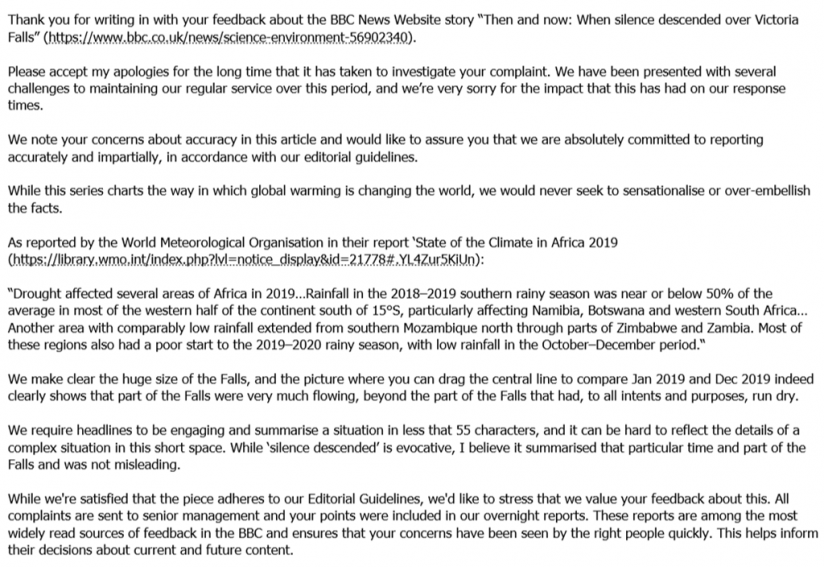
In short, they are just saying “Look, there was a drought, so go away!”
You will have noticed that they have not actually answered any of the points I made.
Needless to say, I have now resubmitted my complaint, as follows:
Dear Sirs,
Thank you for your response, but it does not address my complaint.
You state that there was a drought in the region 2019, but this is not in dispute. According to the Zimbabwe Tourism Office in December 2019:
Historical data provided by the Zambezi River Authority, who monitors the water level flows in the region daily, provide evidence that the annual mean water levels of the river have in fact been lower in at least six prior examples of a period spanning 1914 to the current date period.
Whilst Zimbabwe has indeed experienced an extensive drought over the course of this year, the water levels of the Zambezi and indeed the flow levels over Victoria Falls, have remained above those recorded over the drought period of 95 / 96.
https://www.zimbabwetourism.net/news-update-on-the-state-of-vic-falls/
In other words, such droughts are common, and the 2019 one was not as bad as that of 1995/96. They are normal meteorological events, and nothing to do with climate change, as you claim.
To recap, your report states:
In our monthly feature, Then and Now, we reveal some of the ways that planet Earth has been changing against the backdrop of a warming world. Here, we look at the effects of global heating on Victoria Falls,
In 2019, however, Victoria Falls was silenced. In a drought described as the worst in a century, the flow of the Zambezi was reduced to a relative trickle and the Falls ran dry.
A single extreme weather event cannot, in isolation, be viewed as a consequence of climate change.
But the region is recording a sequence of extreme droughts that reflect what climate modellers have predicted will occur as a result of an increase in greenhouse gases in the world’s atmosphere as a result of human activity.
As already noted, there was nothing unusual about the 2019 drought, nor have you provided any evidence that extreme droughts are increasing in the region. The predictions of computer modellers are therefore irrelevant.
It is therefore misleading and inaccurate to claim that this perfectly common event is an “effect of global heating”.
Also your claim that it was the worst drought in a century is also false, as we know 1995/96 was much worse.
Moreover you grossly mislead readers with your image of the Falls supposedly drying up. This is something that happens every year between October and December.
Again according to Zimbabwe Tourism:
The seasonal rise and fall of the Zambezi River changes the look of Victoria Falls on a daily basis. The western side of the falls is lower than the eastern side and therefore carries the most water all year round. This fluctuation is less noticeable at Devil’s cataract and the Main Falls. From Livingstone Islands onwards, this ebb and flow becomes more apparent and at low water, this portion of the Falls dries up almost completely.
https://www.zimbabwetourism.net/news-update-on-the-state-of-vic-falls/
Although water levels are low during dry season, it is inaccurate for you to claim:
The flow of the Zambezi was reduced to a relative trickle and the Falls ran dry
There was still plentiful water at the time of year, it is simply that the eastern end is at a higher elevation that the water stops flowing over.
Worse still your image contrasts January 2019 with December 2018, with the caption “how the falls have changed over time”. But the two months are totally different in terms of water levels. As already noted, December always sees low lake levels, coinciding with the dry rock face you show.
According to Lonely Planet:
Every single year the Eastern Cataract of the Victoria Falls exposes a dry rock face, normally between the months of October to December,” explains Wilma Griffith, a marketing executive at the Wild Horizons Lookout Café, a restaurant overlooking the Batoka Gorge. “Historical figures show that on or around 14 November the river is at its lowest and then gradually starts to rise again around 14 December, once the localised rains start having an impact on the Zambezi.”
November and December are the end of spring and the beginning of summer in the southern hemisphere, but it can take time for the post-winter rainfall in the DRC and Angola to travel downstream to Victoria Falls, and eventually to in the Indian Ocean.
https://www.lonelyplanet.com/articles/victoria-falls-drought-climate-change
By January the heavy spring rains upstream lead to a large rise in lake levels, as the chart below from the Zambezi River Authority shows:
http://www.zambezira.org/hydrology/river-flows
The correct comparison should have been between December 2018 and December 2019. Instead your readers are left with the false impression that the drying up from January 2019 and December 2019 was not a natural event that occurs every year, but something to do with climate change.
To summarise:
- You have claimed that the “drying up” of the Victoria Falls in December 2019 was the effect of “global heating”.
- You also erroneously claim that the 2019 drought was the worst in a century
- You dishonestly publish a flagrantly misleading comparison of photos of the Falls, comparing the dry season in December 2019 with the wet season in January 2019.
But you fail to disclose:
- There have been many worse droughts there in the past
- The drought of 1995/96 was much worse
- The aforesaid “drying up” is a normal annual event, which occurs every dry season because the eastern side of the falls is at a higher elevation, and not because the river dries up to a trickle.
- The Falls were back in full spate by January 2020, just as they are every year as a result of spring rainfall, and just as they were a year previously.
There is no evidence whatsoever that climate change, which you ludicrously label global heating, has had any impact whatsoever on the Victoria Falls.
The Notorious London Spy School Churning Out Many of the World’s Top Journalists
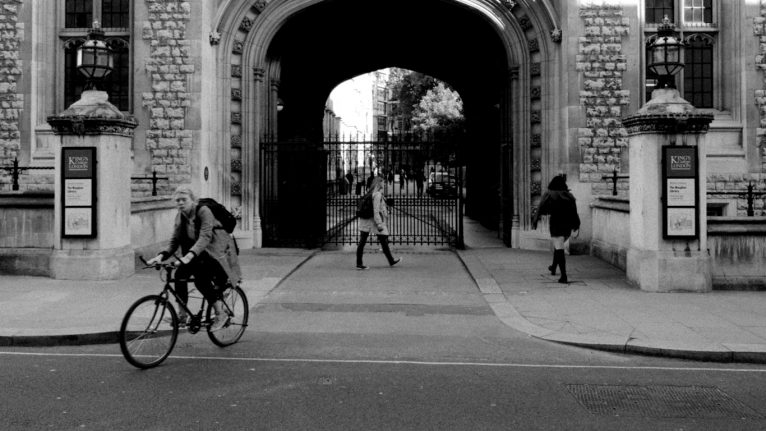
The Maughan Library Gate at Kings College London, UK. David JC | Alamy
By Alan MacLeod | MintPress News | June 4, 2021
LONDON — In a previous investigation, MintPress News explored how one university department, the Department of War Studies at King’s College London, functions as a school for spooks. Its teaching posts are filled with current or former NATO officials, army officers and intelligence operatives to churn out the next generation of spies and intelligence officers. However, we can now reveal an even more troubling product the department produces: journalists. An inordinate number of the world’s most influential reporters, producers and presenters, representing many of the most well-known and respected outlets — including The New York Times, CNN and the BBC — learned their craft in the classrooms of this London department, raising serious questions about the links between the fourth estate and the national security state.
National security school
Increasingly, it appears, intelligence agencies the world over are beginning to appreciate agents with a strong academic background. A 2009 study published by the CIA described how beneficial it is to “use universities as a means of intelligence training,” writing that, “exposure to an academic environment, such as the Department of War Studies at King’s College London, can add several elements that may be harder to provide within the government system.”
The paper, written by two King’s College staffers, boasted that the department’s faculty has “extensive and well-rounded intelligence experience.” This was no exaggeration. Current Department of War Studies educators include the former Secretary General of NATO, former U.K. Minister of Defense, and military officers from the U.K, U.S. and other NATO countries. “I deeply appreciate the work that you do to train and to educate our future national security leaders, many of whom are in this audience,” said then-U.S. Secretary of Defense (and former CIA Director) Leon Panetta in a speech at the department in 2013.
King’s College London also admits to having a number of ongoing contracts with the British state, including with the Ministry of Defence (MoD), but refuses to divulge the details of those agreements.
American connections
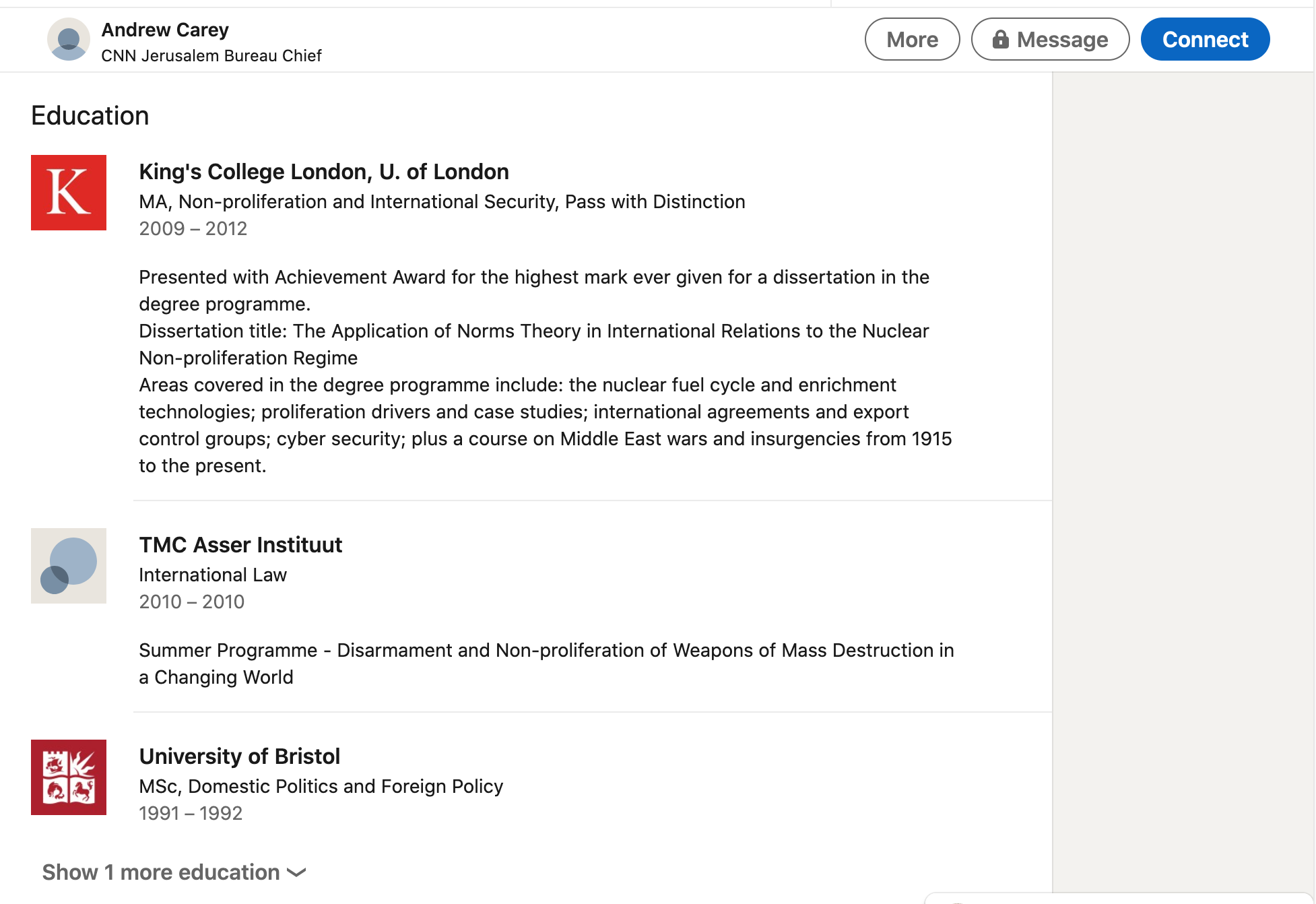
Although a British university, King’s College markets itself heavily to American students. There are currently 1,265 Americans enrolled, making up about 4% of the student body. Many graduates of the Department of War Studies go on to attain powerful positions in major American media outlets. Andrew Carey, CNN’s Bureau Chief in Jerusalem, for example, completed a master’s there in 2012. Carey’s coverage of the latest Israeli attack on Gaza has presented the apartheid state as “responding” to Hamas rocket attacks, rather than being the instigator of violence. A leaked internal memo Carey sent to his staff last month at the height of the bombardment instructed them to always include the fact that the Gazan Ministry of Health is overseen by Hamas, lest readers begin to believe the well-documented Palestinian casualty figures brought on by days of bombing. “We need to be transparent about the fact that the Ministry of Health in Gaza is run by Hamas. Consequently, when we cite latest casualty numbers and attribute to the health ministry in Gaza, we need to include the fact that it is Hamas run,” read his instructions.
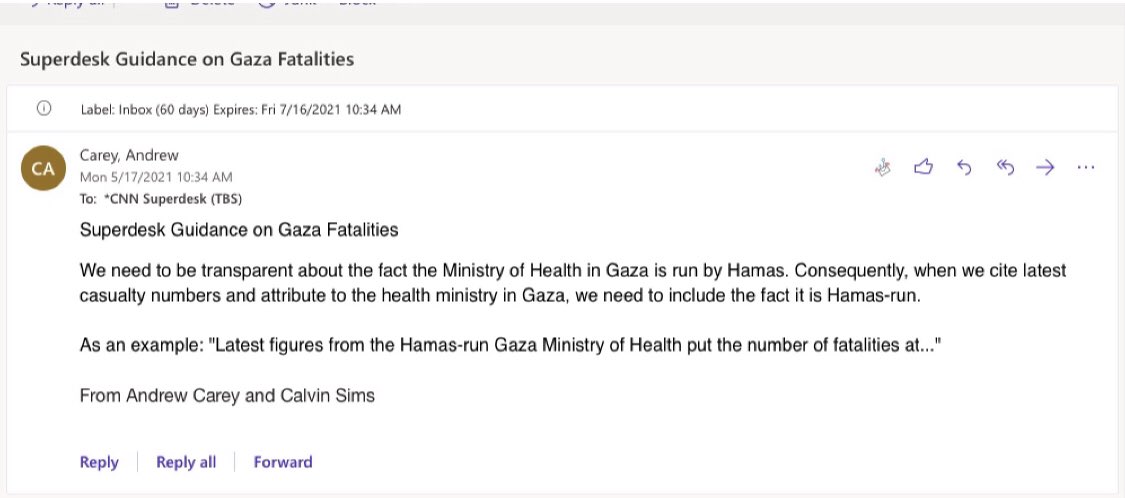
King’s College alumnus turned CNN Jerusalem bureau chief Andrew Carey instructed reporters on how to cover Israel’s latest assault on Gaza
Once publicized, his comments elicited considerable pushback. “This is a page straight out of Israel’s playbook. It serves to justify the attack on civilians and medical facilities,” commented Al-Jazeera Senior Presenter and Producer Dena Takruri.
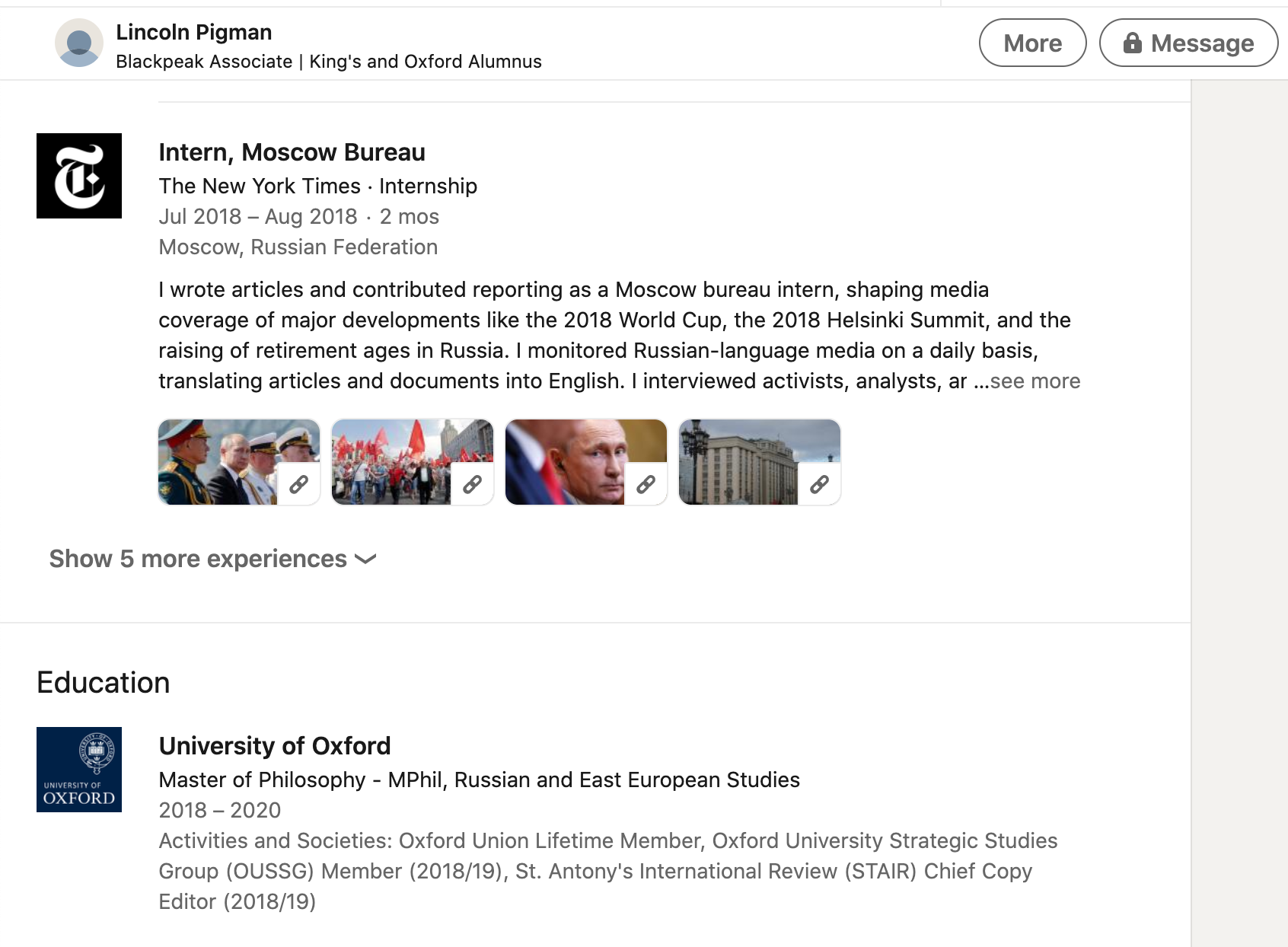
The New York Times, the United States’ most influential newspaper, has also employed Department of War Studies alumni. Christiaan Triebert (M.A., 2016), for example, is a journalist on their visual investigations team. He even won a Pulitzer Prize for “Revelations about Russia and Vladimir Putin’s aggressive actions in countries including Syria and Europe.” Hiring students from the school for spooks to bash Russia appears to be a common Times tactic, as it also employed Lincoln Pigman between 2016 and 2018 at its Moscow bureau.
Josh Smith, senior correspondent for influential news agency Reuters and formerly its correspondent in Afghanistan, also graduated from the department in question, as did The Wall Street Journal’s Daniel Ford.
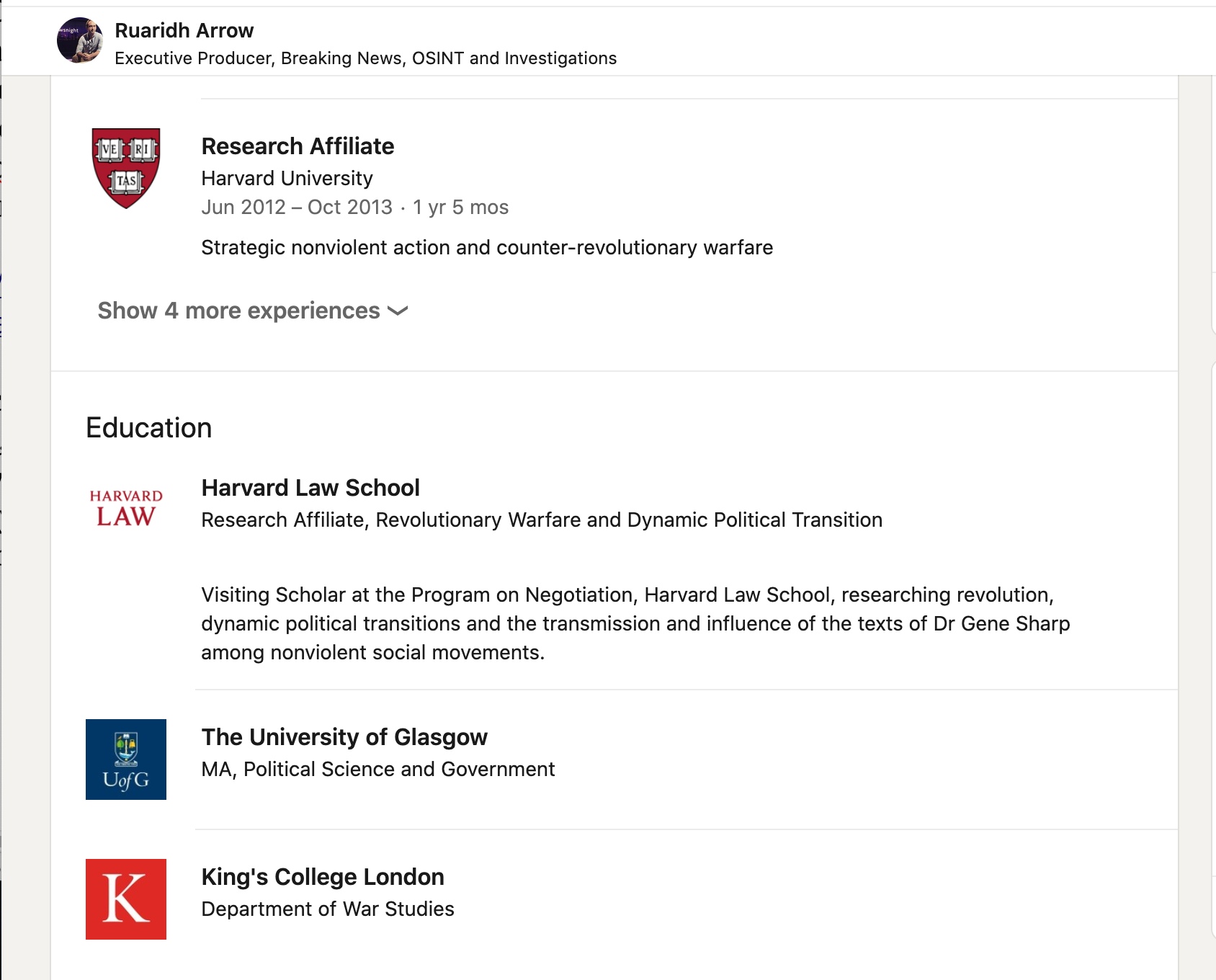
Arguably the most influential media figure from the university, however, is Ruaridh Arrow. Arrow was a producer at many of the U.K.’s largest news channels, including Channel 4, Sky News and the BBC, where he was world duty editor and senior producer on Newsnight, the network’s flagship political show. In 2019, Arrow left the BBC to become an executive producer at NBC News.
The British invasion
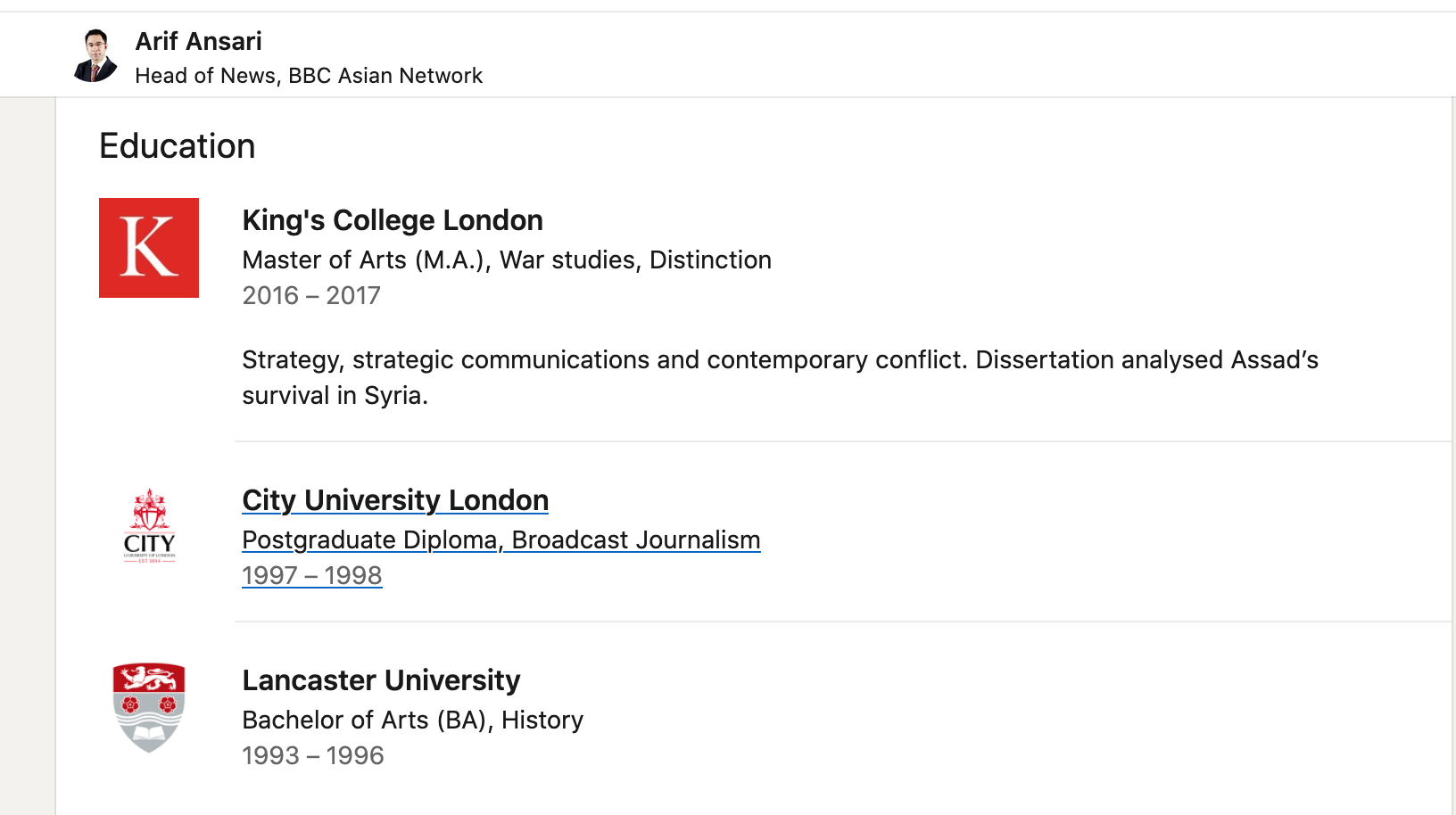
Unsurprisingly for a university based in London, the primary journalistic destination for Department of War Studies graduates is the United Kingdom. Indeed, the BBC, the country’s powerful state broadcaster, is full of War Studies alumni. Arif Ansari, head of news at the BBC Asian Network, completed a masters analyzing the Syrian Civil War in 2017 and was soon selected for a leadership development scheme, placing him in charge of a team of 25 journalists who curate news primarily geared toward the substantial Middle Eastern and South Asian communities in Great Britain.
Many BBC employees begin studying at King’s years after their careers have already taken off, and balance their professional lives with pursuing new qualifications. Ahmed Zaki, Senior Broadcast Journalist at BBC Global News, began his master’s six years after he started at the BBC. Meanwhile, Ian MacWilliam — who spent ten years at BBC World Service, the country’s official news broadcast worldwide, specializing in sensitive regions like Russia, Afghanistan and Central Asia — decided to study at King’s more than 30 years after completing his first degree.
Another influential War Studies alumnus at the World Service is Aliaume Leroy, producer for its Africa Eye program. Well-known BBC News presenter Sophie Long also graduated from the department, working for Reuters and ITN before joining the state broadcaster.
“It’s an open secret that King’s College London Department of War Studies operates as the finishing school for Anglo-American securocrats. So it’s maybe not a surprise that graduates of its various military and intelligence courses also enter into a world of corporate journalism that exists to launder the messaging of these same ‘security’ agencies,” Matt Kennard — an investigative journalist for Declassified U.K. who has previously exposed the university’s connections to the British state — told MintPress. “It is, however, a real and present danger to democracy. The university imprimatur gives the department’s research the patina of independence while it works, in reality, as the unofficial research arm of the U.K. Ministry of Defence,” he added.
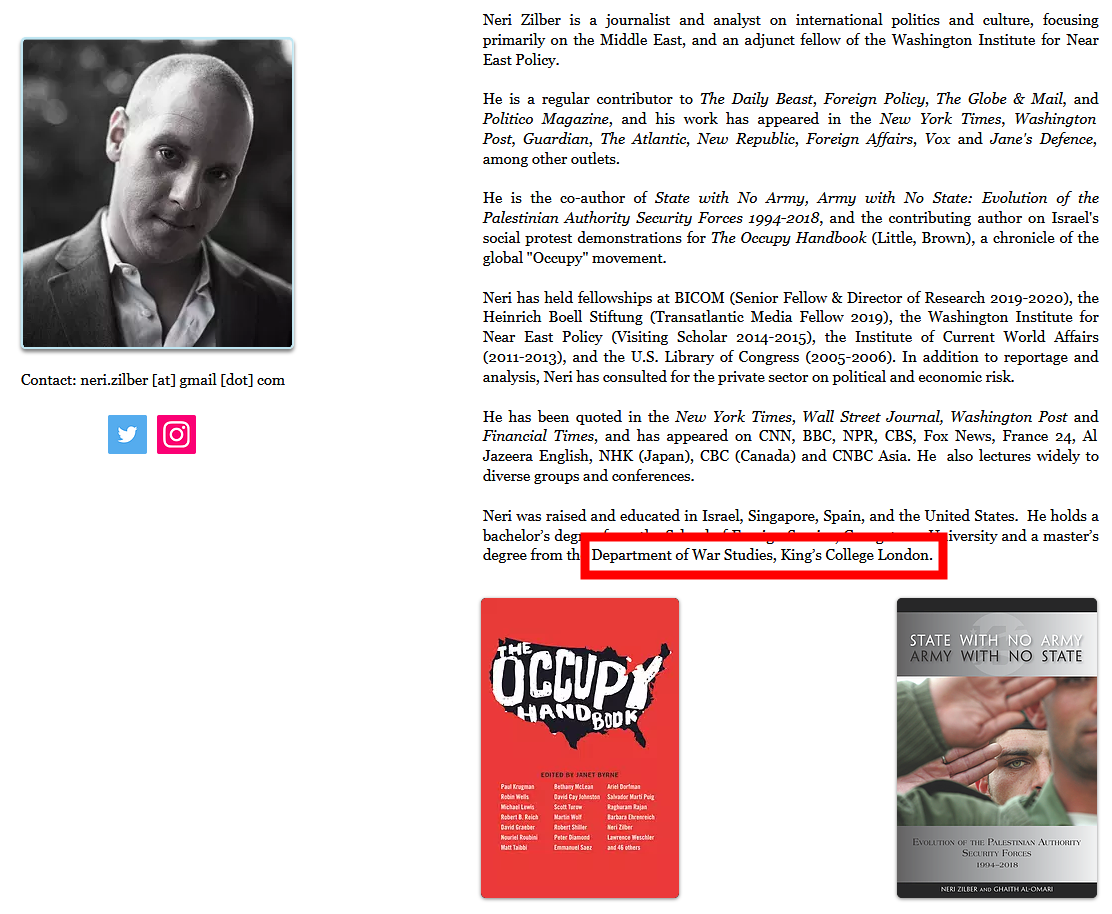
Israeli writer and King’s College alumnus Neri Zilber has bylines in many of the media’s most important outlets
The Department of War Studies also trains many international journalists and commentators, including Nicholas Stuart of the Canberra Times (Australia); Pakistani writer Ayesha Siddiqa, whose work can be found in The New York Times, Al-Jazeera, The Hindu and many other outlets; and Israeli writer Neri Zilber, a contributor to The Daily Beast, The Guardian, Foreign Policy and Politico.
What’s it all about?
Why are so many influential figures in our media being hothoused in a department well known for its connections to state power, for its faculty being active or former military or government officials, and for producing spies and operatives for various three-letter agencies? The point of this is not to allege that these journalists are all secretly card-carrying spooks: they are not. Rather, it is to highlight the alarmingly close links between the national security state and the fourth estate we rely on to be a check on their power and to hold them accountable.
Journalists trained in this sort of environment are far more likely to see the world in the same manner as their professors do. And perhaps they would be less likely to challenge state power when the officials they are scrutinizing were their classmates or teachers.
These sorts of questions abound when such a phenomenon exists: Why are so many journalists choosing to study at this particular department, and why do so many go on to be so influential? Are they being vetted by security agencies, with or without their knowledge? How independent are they? Will they just repeat British and American state talking points, as the Department of War Studies’ publications do?
On the question of vetting, the BBC admitted that, at least until the 1990s, it conspired with domestic spying agency MI5 to make sure that people with left-wing and/or anti-war leanings, or views critical of British foreign policy and empire were secretly blocked from being hired. When pressed on whether this policy is still ongoing, the broadcaster refused to comment, citing “security issues” — a response that is unlikely to reassure skeptics.
“While it strikes me as very interesting that a single academic institution could play such a major role in the recruitment of pro-establishment activist intellectuals and delivery of the same to the media, it is not so surprising,” Oliver Boyd-Barrett, Professor Emeritus at Bowling Green State’s School of Media and Communication and an expert in collusion between government and media, told MintPress, adding:
Elite institutions in the past and doubtless still today have been major playgrounds for intelligence services. The history of the modern nation-state generally, not just the USA, seems to suggest that national unity — and therefore elite safety — is regarded by elites as achievable only through careful management and often suppression or diversion of dissent. Far more resources are typically committed to this than many citizens, drilled in the propaganda of democracy, realize or care to concede.
The Bellingcat Boys
While the journalists cataloged above are not spooks, some other Department of War Studies figures working in journalism could possibly be described as such, particularly those around the influential and increasingly notorious investigative website Bellingcat.
Cameron Colquhoun, for instance, spent almost a decade at GCHQ, Britain’s version of the NSA, where he was a senior analyst running cyber and counter-terrorism operations. He holds qualifications from both King’s College London and the State Department. This background is not disclosed in his Bellingcat profile, which merely describes him as the managing director of a private intelligence company that “conduct[s] ethical investigations” for clients around the world.
Bellingcat’s senior investigator Nick Waters spent four years as an officer in the British Army, including a tour in Afghanistan, where he furthered the British state’s objectives in the region. After that, he joined the Department of War Studies and Bellingcat.
For the longest time, Bellingcat’s founder Eliot Higgings dismissed charges that his organization was funded by the U.S. government’s National Endowment for Democracy (NED) — a CIA cutout organization — as a ridiculous “conspiracy.” Yet by 2017, he was admitting that it was true. A year later, Higgins joined the Department of War Studies as a visiting research associate. Between 2016 and 2019 he was also a senior fellow at the Atlantic Council, the brains behind the North Atlantic Treaty Organization (NATO).
Higgins appears to have used the university department as a recruiting ground, commissioning other War Studies graduates, such as Jacob Beeders and the aforementioned Christiaan Triebert and Aliaume Leroy, to write for his site.
Bellingcat is held in very high regard by the CIA. “I don’t want to be too dramatic, but we love [Bellingcat],” said Marc Polymeropoulos, the agency’s former deputy chief of operations for Europe and Eurasia. Other officers explained that Bellingcat could be used to outsource and legitimize anti-Russia talking points. “The greatest value of Bellingcat is that we can then go to the Russians and say ‘there you go’ [when they ask for evidence],” added former CIA Chief of Station Daniel Hoffman.
Bellingcaught
A recent MintPress investigation explored how Bellingcat acts to launder national security state talking points into the mainstream under the guise of being neutral investigative journalists themselves.
Newly leaked documents show how Bellingcat, Reuters and the BBC were covertly cooperating with the U.K.’s Foreign and Commonwealth Office (FCO) to undermine the Kremlin and promote regime change in Moscow. This included training journalists and promoting explicitly anti-Russian media across Eastern Europe. Unfortunately, the FCO noted, Bellingcat had been “somewhat discredited,” as it constantly spread disinformation and was willing to produce reports for anyone with money.
Nevertheless, a new European Parliament proposal published last month recommends hiring Bellingcat to assist in producing reports that would lay the groundwork for sanctioning Russia, for throwing it out of international bodies, and to “assist Russia’s transformation into a democracy.” In other words, to overthrow the government of Vladimir Putin.
An academic journalistic nexus
The Department of War Studies is also part of this pro-NATO, anti-Russia group. Quite apart from being staffed by soldiers, spooks and government officials, it puts out influential reports advising Western governments on foreign and defense policy. For instance, a study entitled “The future strategic direction of NATO” advises that member states must increase their military budgets and allow American nuclear weapons to be stored in their countries, thereby “shar[ing] the burden.” It also recommended that NATO must redouble its commitment to opposing Russia while warning that it needed urgently to form a “coherent policy” on the Chinese threat.
Other War Studies reports claim that Russia is carrying out “information-psychological warfare” through its state channels RT and Sputnik, and counsel that the West must use its technical means to prevent its citizens from consuming this foreign propaganda.
King’s College London academics have also proven crucial in keeping dissident publisher Julian Assange imprisoned. A psychiatrist who has worked with the War Studies department testified in court that the Australian was suffering only “moderate” depression and that his suicide risk was “manageable,” concluding that extraditing him to the United States “would not be unjust.” As Matt Kennard’s investigation found, the U.K. Ministry of Defence had provided £2.2 million ($3.1 million) in funding to the institute where he worked (although the psychiatrist in question claimed his work was not directly funded by the MoD).
King’s College London markets the War Studies department to both graduates and undergraduates as a stepping stone towards a career in journalism. In its “career prospects” section for its master’s course in war studies, it tells interested students that “graduates go on to work for NGOs, the FCO, the MoD, the Home Office, NATO, the UN or pursue careers in journalism, finance, academia, the diplomatic services, the armed forces and more.”
Likewise, undergraduates are told that:
You will gain an in-depth and sophisticated understanding of war and international relations, both as subjects worthy of study and as intellectual preparation for the widest possible range of career choices, including in government, journalism, research, and humanitarian and international organisations.
Courses such as “New Wars, New Media, New Journalism” fuse together journalism and intelligence and are overseen by War Studies academics.
It is perhaps unsurprising that the department has taught many influential politicians, including foreign heads of state and members of the British parliament. But at least there is considerable overlap between the fields of defense policy and politics. The fact that the very department that trains high state officials and agents of secretive three letter agencies is also the place that produces many of the journalists we rely on to stand up to those officials and keep them in check is seriously problematic.
An unhealthy respect for authority
Unfortunately, rather than challenging power, many modern media outlets amplify its message uncritically. State officials and intelligence officers are among the least trustworthy sources, journalistically speaking. Yet many of the biggest stories in recent years have been based on nothing except the hearsay of officials who would not even put their names to their claims.
The level of credulity modern journalists have for the powerful was summed up by former CNN White House Correspondent Michelle Kosinski, who last month stated that:
As an American journalist, you never expect:
- Your own govt to lie to you, repeatedly
- Your own govt to hide information the public has a right to know
- Your own govt to spy on your communications
Unfortunately, credulity stretches into outright collaboration with intelligence in some cases. Leaked emails show that the Los Angeles Times’ national security reporter Ken Dilanian sent his articles directly to the CIA to be edited before they were published. Far from hurting his career, however, Dilanian is now a correspondent covering national security issues for NBC News.
Boyd-Barrett said that governments are dependent on “the assistance of a penetrated, colluding and docile mainstream media which of late — and in the context of massive confusion over Internet disinformation campaigns, real and alleged — appear ever more problematic guardians of the public right to know.”
In recent years, the national security state has increased its influence over social media giants as well. In 2018, Facebook and the Atlantic Council entered a partnership whereby the Silicon Valley giant partially outsourced curation of its 2.8 billion users’ news feeds to the Council’s Digital Forensics Lab, supposedly to help stop the spread of fake news online. The result, however, has been the promotion of “trustworthy” corporate media outlets like Fox News and CNN and the penalization of independent and alternative sources, which have seen their traffic decrease precipitously. Earlier this year, Facebook also hired former NATO press officer and current Senior Fellow at the Atlantic Council Ben Nimmo to be its chief of intelligence. Reddit’s Director of Policy is also a former Atlantic Council official.
Meanwhile, in 2019, a senior Twitter executive for the Middle East region was unmasked as an active duty officer in the British Army’s 77th Brigade, its unit dedicated to psychological operations and online warfare. The most notable thing about this event was the almost complete lack of attention it received from the mainstream press. Coming at a time when foreign interference online was perhaps the number one story dominating the news cycle, only one major outlet, Newsweek, even mentioned it. Furthermore, the reporter who covered the story left his job just weeks later, citing stifling top-down censorship and a culture of deference to national security interests.
The purpose of this article is not to accuse any of those mentioned of being intelligence agency plants (although at least one person did actually work as an intel officer). The point is rather to highlight that we now have a media landscape where many of the West’s most influential journalists are being trained by exactly the same people in the same department as the next generation of national security operatives.
It is hardly a good look for a healthy, open democracy that so many spies, government officials, and journalists trusted to hold them accountable on our behalf are all being shot out of the very same cannon. Learning side by side has helped to create a situation where the fourth estate has become overwhelmingly deferential to the so-called deep state, where anonymous official’s words are taken as gospel. The Department of War Studies is just one part of this wider phenomenon.T
Alan MacLeod is Senior Staff Writer for MintPress News. After completing his PhD in 2017 he published two books: Bad News From Venezuela: Twenty Years of Fake News and Misreporting and Propaganda in the Information Age: Still Manufacturing Consent, as well as a number of academic articles.
Global heating: Study shows impact of ‘climate racism’ in US – BBC
By Paul Homewood | Not A Lot Of People Know That | May 26, 2021
The clown Matt McGrath is at it again:
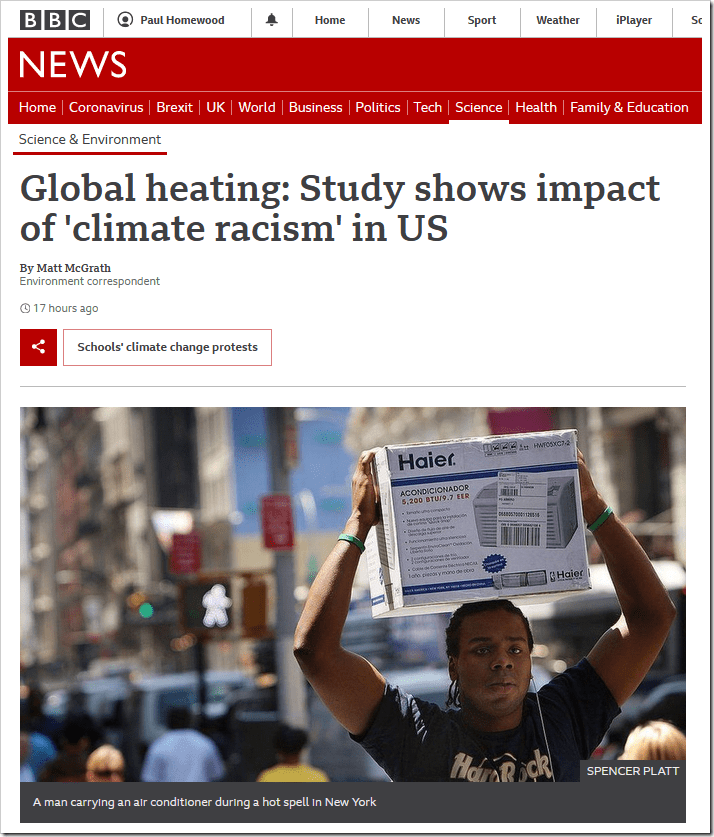
A new study says that black people living in most US cities are subject to double the level of heat stress as their white counterparts.
The researchers say the differences were not explained by poverty but by historic racism and segregation.
As a result, people of colour more generally, live in areas with fewer green spaces and more buildings and roads.
These exacerbate the impacts of rising temperatures and a changing climate.
Cities are well known magnifiers of a warmer climate.
The surface urban heat island effect is the technical term for the impact that the buildings, roads and infrastructure of cities have on temperatures.
All that concrete and asphalt attracts and stores more heat, ensuring that both days and nights in big urban areas are much warmer than the surrounding locations.
But, within cities, there are often large differences in this heat island impact, with areas rich in trees and green spaces noticeably cooler than those that are dense with housing and industry.
A previous study in the US found a correlation between warmer neighbourhoods in big cities with racist housing practices dating back to the 1930s.
Back then, areas with large African-American or immigrant populations were “redlined” in documents by federal officials, and deemed too hazardous for home loans and investment.
This led to a concentration of poverty and low home ownership rates in some parts of big cities.
This new study takes a broader look at these warmer neighbourhoods and the people who are affected by them.
Using satellite temperature data combined with demographic information from the US Census, the authors found that the average person of colour lives in an area with far higher summer daytime temperatures than non-Hispanic white people.
The actual paper, which is here, does not mention “racism” at all. So why does McGrath introduce it as a concept, never mind inventing the term “climate racism”?
Quite what the “racist” housing policies of the 1930s have to do with 21st century America is beyond me. There has been nothing to stop people moving out of those areas since, as millions have. (This is known as “black flight”, with first the black middle class, followed by the working class, moving out to the suburbs, as the whites did before them. What is left tends to be the “underclass”. See here for more details.)
It is well known that poor people, particularly in inner cities, all around the world suffer worse outcomes in all sorts of ways, for instance healthcare, education and job prospects. And, as McGrath now seems to have realised, the urban heat island effect is far more significant than the tiny amount of climate warming seen in the last century.
Maybe instead of wasting trillions on fighting climate change, we should spend a fraction of it on improving inner cities.
As US regime-change agency NED admits interference in Belarus, leaked documents also implicate UK Foreign Office
By Kit Klarenberg | RT | May 21, 2021
The full extent of Western meddling in Belarus prior to the country’s contested August 2020 election may never be known. Yet the outlines of a wide-ranging foreign effort to destabilize the government are becoming ever clearer.
As RT reported earlier this week, a pair of Russian pranksters posing as Belarusian opposition figures have duped high-ranking representatives of US regime-change arm the National Endowment for Democracy (NED) into exposing the extent of Washington’s clandestine involvement in the unrest that erupted across the country throughout 2020.
Among other bombshell disclosures, Nina Ognianova, who oversees the NED’s work with local groups in the country, suggested “a lot of the people” who were “trained” and “educated” via the organization’s various endeavors there were pivotal to “the events, or the build-up to the events, of last summer.”
Long-time NED chief Carl Gershman – who in September 2013, less than six months prior to the coup that shifted Kiev’s political orientation, dubbed Ukraine “the biggest prize” for Washington – added that his organization was working with controversial opposition figure Svetlana Tikhanovskaya and her team “very, very closely.” In all, the agency bankrolled at least 159 civil society initiatives in Belarus, costing $7,690,689, from 2016 to 2020 alone.
The team’s unguarded comments represent a rare public admission of the insidious, destabilizing role played by the NED – in 1991, its then-president acknowledged, “a lot of what we do today was done covertly 25 years ago by the CIA.” However, leaked UK Foreign, Commonwealth & Development Office (FCDO) files indicate that the US is far from the only foreign power attempting to undermine the country’s government.
In 2017, then-Prime Minister Theresa May unveiled a £100 million kitty, ostensibly for battling Kremlin disinformation. In practice, internal FCDO files leaked by hacktivist collective Anonymous made clear the effort was primarily concerned with “weakening the Russian state’s influence,” particularly in its “near abroad.” As a close neighbor and arguably most important ally of Moscow, Belarus was unsurprisingly very much in the FCDO’s crosshairs.
In January of that year, Whitehall commissioned an extensive analysis of Belarusian citizens’ perceptions, motivations, and habits, in order to “identify opportunities” to “appropriately communicate” with them. In particular, London was interested in “existing or potential grievances against their national government” that could be exploited, and “channels and messages” by which the UK government could “appropriately engage with different sub-groups.”
The analysis was conducted by shadowy FCDO contractor Albany Associates, which has, in recent years, also conducted numerous information warfare operations in the Baltic states, in order to “develop greater affinity” among the region’s Russian-speaking minority for the UK, European Union and NATO. While carrying out another Whitehall-funded project targeted at Moscow, the firm closely collaborated with NED-connected French NGO IREX Europe.
An accompanying bio notes IREX has been working in Belarus since 2006 “with print, online and radio outlets,” to “improve the quality of their coverage,” and “increase their understanding of the EU and EU member states.” As part of its youth audience offering in the country, the organization was said to have founded the Warsaw-based Euroradio, along with online outlet 34mag.
Footage produced by Euroradio of violent crackdowns on protesters in Minsk was regularly aired by the Western media, including the BBC, during the strife. The outlet even specifically amplified calls from the British state broadcaster for activists to submit pictures and videos for use in news coverage. Franak Viacorka – an Atlantic Council senior fellow, and now senior advisor to Svetlana Tikhanovskaya – prominently hailed its “fearless” reporting of the upheaval.
Euroradio also repeatedly crops up in documents related to the Open Information Partnership (OIP), which is the “flagship” strand within Whitehall’s multi-pronged propaganda assault on Russia. Bankrolled by the FCDO to the tune of £10 million, the organization maintains a network of 44 partners across Central and Eastern Europe, including “journalists, charities, think tanks, academics, NGOs, activists, and factcheckers.” One of the collective’s primary, covert objectives is influencing “elections taking place in countries of particular interest” to the FCDO.
The classified files make clear the OIP has engaged in numerous astroturfing initiatives throughout the region, helping organizations and individuals produce slick propaganda masquerading as independent citizen journalism, which is then amplified globally via its network.
For instance, in Ukraine, the OIP worked with a 12-strong group of online ‘influencers’ “to counter Kremlin-backed messaging through innovative editorial strategies, audience segmentation, and production models that reflected the complex and sensitive political environment,” in the process allowing them to “reach wider audiences with compelling content that received over four million views.”
In Russia and Central Asia, the OIP established a covert network of YouTubers, helping them create videos “promoting media integrity and democratic values.” Participants were also taught how to “make and receive international payments without being registered as external sources of funding” and “develop editorial strategies to deliver key messages,” while the consortium minimized their “risk of prosecution” and managed “project communications” to ensure the existence of the network, and indeed the OIP’s role, were kept “confidential.”
It would be entirely unsurprising if similar efforts were being undertaken in Belarus. After all, the country – along with Moldova and Ukraine – is referred to in the leaked documents as “the most vital space in the entire network,” and a “high-impact priority” for London, suggesting its 2020 election was very much “of interest” to Whitehall. If so, it would likewise be entirely unsurprising if many of the alleged so-called citizen journalists and media outlets covering the unrest in Minsk received funding and training from the OIP.
All along, too, MEMO 98, an OIP member coincidentally also funded by NED, kept a close eye on the incendiary proceedings, publishing several analyses of media coverage and social media activity related to the protests. It drew particular attention to the output of Belsat TV, a Warsaw-based channel – founded in December 2007 by the Polish Ministry of Foreign Affairs, it seeks to influence political change in Belarus. MEMO 98 praised the station’s “extensive coverage of protests and related intimidation of activists.”
Strikingly, the leaked FCDO files indicate that Belsat TV received intensive, Whitehall-financed support from the Thomson Reuters Foundation, the newswire’s international “charitable” wing, including 150 days’ consultancy in improving “TV output quality and audience reach.”
While the protests have largely fizzled out in recent months, and Svetlana Tikhanovskaya’s calls for Western leaders to recognise her as the legitimate president of Belarus continue to fall on deaf ears, there are clear signs many other media platforms in Belarus receive life-giving sponsorship from London to this day.
In March 2021, the FCDO published an update on the progress of its global ‘Media Freedom Campaign’, which revealed that, over the past year, Whitehall had allocated £950,000 in financing to Belarusian news outlets, enabling them to “remain open and maintain a functional level of equipment.”
“Without this support, they would otherwise have been forced to close by government measures,” the document stated. “The funding has saved jobs and ensured that independent media can still hold the government to account during a period of increasingly violent action by the security forces.”
Evidently, even during a global pandemic, the regime-change show must go on – and the UK government is committed to ensuring people the world over continue to receive a steady deluge of slanted agitprop from the streets of Minsk, in order to turn public opinion against the government not only of Belarus, but of Russia too.
Kit Klarenberg is an investigative journalist exploring the role of intelligence services in shaping politics and perceptions.
BBC gets government funding for global crusade against ‘fake news’
RT | May 3, 2021
UK Foreign Secretary Dominic Raab has given the BBC World Service an £8 million funding boost to “tackle harmful disinformation.” What that means is unclear, but the BBC has a history of waging infowars for the UK government.
Broadcast in more than 40 languages to 350 million listeners per week, the BBC World Service brings news and debate from London to the furthest reaches of the globe. Funded by the Foreign, Commonwealth and Development Office (FCDO), the British taxpayer, and some limited advertising, the service gives the British government worldwide messaging power via a news organization Raab described on Saturday as “unbiased and impartial.”
Behind the veneer of impartiality, the World Service is viewed by the British government as a tool. This year’s ‘Integrated Review’, a document that lays out London’s foreign policy and defense priorities, identified the World Service as an instrument of “soft power” for Britain – one of a range of tools to be used against “systemic competitors like Russia and China.”
Based on that report, Raab announced on Saturday that the World Service would receive £8 million in extra funding to “tackle harmful disinformation, challenge inaccurate reporting around the world and improve digital engagement.” The fresh funding comes on top of the £378 million the service has received from the FCDO since 2016.
Raab accused “some states” of producing “harmful content” and “fake news around the coronavirus pandemic,” including content “encouraging scepticism around vaccines.” Promoting vaccines has been a key goal of the British government for several months now, to the point where military intelligence units and Government Communications Headquarters spies have reportedly been deployed to wage “information warfare” against anti-vaxx internet posts.
The messaging war around the coronavirus is the only clear example cited by Raab, and his announcement speaks of a broader war against “global disinformation,” “inaccurate reporting,” and “states and criminal gangs” who “twist the news to exploit others.” These terms are not backed up with examples, and are contentious in their own right. “Fake news,” for instance, was a term made famous during Donald Trump’s presidency, and was used by both Trump and the press to describe each other’s messaging.
The BBC’s funding, as well as its vague mission to fight “fake news,” may indicate that it will engage in an information campaign for the geopolitical benefit of the British government. The broadcaster reportedly has a history of doing this, and documents leaked in March revealed that BBC Media Action, the outlet’s charitable arm, overtly cultivated Russian journalists, established influence networks within and outside Russia, and promoted pro-Whitehall, anti-Moscow propaganda in Russian-speaking areas, all at the FCDO’s behest.
FCDO Counter Disinformation & Media Development chief Andy Pryce, explained the government’s mission in no uncertain terms at a 2018 meeting, during which he said its ultimate goal was to “weaken the Russian state’s influence” via the co-option of journalists and media organizations.
The BBC isn’t the only “impartial” news service involved in the FCDO’s influence campaign. The Thomson Reuters Foundation (TRF) also volunteered its services, establishing news outlets in “countries of interest” to the FCDO. A cited example of this activity is Aswat Masriya, an “independent” media outlet in Egypt, created by TRF in the wake of the 2011 Egyptian revolution.
Given the history of partnership between the BBC and the FCDO, the latest investment is likely aimed more at ensuring the British government’s version of the truth wins out against foreign powers than it is in fighting falsehood and disinformation.
Featured Video
Prof. Ted Postol: Iran Already Achieved Nuclear Deterrence Against Israel
or go to
Aletho News Archives – Video-Images
From the Archives
How the occupied mentality syndrome works
Saudi Arabia on the American chessboard – Part 3
By B. J. Sabri | American Herald Tribune | June 27, 2016
Read part 2: “The occupied mentality Syndrome“
Previously I argued whether Saudi Arabia’s repeated involvements in U.S. interventions and wars stem from free national will or in response to a specific condition. For starters, in Saudi Arabia there is no national will. In Saudi Arabia, the national will is the will of the Al Saud clan. Still, when a major Arab state allies itself with a superpower that committed unspeakable crimes against humanity in almost every Arab country, then something is wrong. This fact alone should compel us to examine the U.S.-Saudi relation for one exceptional reason. As a result of the U.S.-Saudi wars, hundreds of thousands of people in Afghanistan, Iraq, Iran, Libya, Syria, Yemen, and Somalia have lost their lives. Millions became displaced in their own homelands. And millions more rendered refugees.
Attributing the Saudi policies to the bonds of “partnership” with the U.S. is frivolous. There are no bonds between these two thugs except those of business, military deals, secret plots, and wars. Proving this point, bonds such as these have no space for the American and Saudi peoples to share significant cultural or societal exchanges. If partnership is not the reason for the Saudi contribution to the U.S. strategy of empire and imperialism, then another reason must exist.
This leads to three possibilities. … continue
Blog Roll
 Aletho News
- Hezbollah hits Israeli warship off Lebanon’s coast, sets it aflame
- Iran slams US strikes on B1 bridge, Mahshahr petrochemical plants as ‘blatant acts of state terrorism’
- In letter to UN chief, Araghchi warns of dire consequences of US-Israeli attacks on Iran’s nuclear facilities
- Why the CIA conspiracy to invade Iran with Kurdish militias failed
- Why Are Upbeat US Claims About Mission to Rescue Pilot ‘Highly Questionable’?
- Aircraft destroyed during US ‘rescue’ of downed F-15 pilot cost more than $100 million each
- Washington University removes professor who condemned US-Israeli war on Iran
- Russia Warns of Retaliation as UK Authorizes Seizure of Vessels
- Serbia thwarts plot to bomb Russia-Hungary gas pipeline – Vucic
- Al Mayadeen voices solidarity with Dr. Marandi amid death threats
- If Americans Knew
- In Iran, Israel-US take aim at “reason, research, and freedom of thought” – Daily Update
- US loses planes over Iran, Israel downgrades Lebanon war goals – Daily Update
- Israel Is Blocking Palestinians from Easter at Church Where Jesus Resurrected
- Plot to assassinate Palestinian activist follows harassment campaign promoted by Zionist groups and elected officials
- Prominent New York synagogue hosts presentation on why U.S. Jews should support the ethnic cleansing of Gaza
- Tapper vs. Piker: Is the CNN Anchor Auditioning for David Ellison?
- Shouldn’t Democrats Be Able to Condemn Genocide?
- Israel-US kill negotiators, destroy civilian structures, but Iran’s military capabilities still largely intact – Daily Update
- ‘War crime’: Global condemnation as Israeli ministers celebrate death penalty law targeting Palestinian prisoners
- 7 Ways Israel Is Turning Lebanon Into Gaza
- No Tricks Zone
- An Inconvenient Tree: Uncovered In Alps… Europe Much Warmer Than Today 6000 Years Ago
- New Study Reports A 60% Slowdown In Greenland’s Ice Loss Rate In The Last Decade
- Low Intensity Tornado Wrecks Major Solar Farm, Creating A Potential Toxic Dump
- New Study Finds Warming Saves Lives…Cold Temperatures 12 Times More Deadly Than Excess Heat
- German Science Blog Accuses PIK Climate Institute Of Hallucinating Climate Tipping Points
- Devastating Assessment Of Comirnaty Vaccine By Former Senior Pfizer Europe Toxicologist
- New Study: CO2 Is ‘Effectively Negligible’ As An Explanatory Climate Change Factor Since 2000
- Former Pfizer Toxicologist Dr. Helmut Sterz Tells Bundestag Hearing Pfizer Vaccine Should Have Never Been Approved
- Energy Expert: Germany’s Nuclear Phaseout Was A “500 Billion Euro Mistake”
- New Research: South Australia’s Mid-Holocene Sea Surface Temperatures Were 4°C Warmer Than Today
 Aletho News