Real ‘obscene masquerade’: How BBC depicted staged hospital scenes as proof of Douma chemical attack
By Vanessa Beeley | RT | February 16, 2019
In an extraordinary turn of events, corporate media appears to have been exposed again as an extension of state foreign policy, by a member of the establishment media cabal, manufacturing consent for regime change in Syria.
Riam Dalati is on the BBC production team based in Beirut and describes himself, on his Twitter page, as an “esteemed colleague” of Quentin Sommerville, the BBC’s Middle East correspondent. Dalati broke ranks with his UK Government-aligned media, on Twitter, to announce that “after almost 6 months of investigation, I can prove, without a doubt, that the Douma hospital scene was staged.”
The scenes in question are those manufactured by the White Helmet pseudo-humanitarian group and activists affiliated to Jaish al-Islam, the extremist armed group in charge of Douma at the time of the alleged chemical weapon attack on April 7, 2018. The scenes of children being hosed down, following a “chemical attack” were immediately accepted as credible and appeared alongside sensationalist headlines in most Western media outlets, including the BBC, CNN and Channel 4. Simon Tisdall of the Guardian wrote an opinion piece, with the headline ‘After Douma the West’s response to Syria regime must be military’ – only two days after Douma, effectively calling for all out war.
While Dalati’s tweets have clearly distressed some notables in the establishment camp, Dalati is no stranger to such controversy. Almost immediately after the alleged incident in Douma, he tweeted out his frustration that “activists and rebels” had used “corpses of dead children to stage emotive scenes for Western consumption.” The emotive wording of Dalati’s tweet, he was “sick and tired” of such manipulation of events, suggested that this was not the first time children had been used as props in a macabre war theatre designed to elicit public sympathy for escalated military intervention in Syria disguised as a necessary “humanitarian” crack down on “Assad’s gassing of his own people.”
Dalati had been referring to the arranging of two children’s corpses into a “last hug” still life composition, a photo that went viral, rocketed into the social media sphere by activists who had collaborated with the brutal Jaish al-Islam regime while it tortured and abused the Syrian civilians under its control.
Perhaps Dalati’s apparent outburst could be explained by his participation in the production of the controversial September 2013 BBC Panorama documentary, ‘Saving Syria’s Children’. An independent researcher, Robert Stuart, has made it his life’s work to present a compelling argument that “sequences filmed by BBC personnel and others at Atareb Hospital, Aleppo on August 26, 2013 purporting to show the aftermath of an incendiary bomb attack on a nearby school are largely, if not entirely, staged.” Perhaps Dalati had witnessed one too many stagings of events that would precipitate the potential for war in Syria between the US and Russia.
Whatever the reason for Dalati’s exasperation, the tweet was deleted before a watered down version appeared. Dalati claimed that a “breach of editorial policy” and lack of context was behind this alteration. Apparently BBC employees are not allowed to be “sick and tired” of the exploitation of children to promote a war that will inevitably kill more children. Simultaneously, Dalati’s account was protected, making tweets visible only to approved followers.
On two significant occasions to date, Dalati appears to deviate from the BBC narrative road map in Syria. However, Dalati had participated in the corporate media lynching of journalists and academics who had dared to question the dominant “chemical attack” narrative, at the time of the alleged incident in Douma, dismissing them as conspiracy theorists. These “conspiracy theorists” included acclaimed journalist, Robert Fisk and Uli Gack, an experienced war correspondent with ZDF, a German public media outlet. Independent journalist, Eva Bartlett, and Pearson Sharpe of One American News Network also reported evidence of staging and mainstream media distortion of events in Douma.
I visited Douma shortly after the alleged attack. I interviewed medical staff and civilians who were adamant that a chemical attack had not taken place. Doctors and nurses, some of whom were on duty on the night in question, told me that adults and children were suffering the effects of smoke inhalation. They described the panic generated by the activists and White Helmet operatives who arrived crying “chemical attack” before they hosed down the traumatised patients.
20-year-old Suleiman Saour told me: “At 7pm we had been receiving wounded people all day long. At 7pm someone came in carrying a little boy, he laid him on a bed and said he had been hit with chemical weapons. Basically I checked the boy […] he was suffering from smoke inhalation […] we washed his face, used a spray and Ventolin. Later on we found out the child had asthma and it got worse because of the smoke.”
Academics, Professors Piers Robinson and Tim Hayward, came under concerted attack as did other members of the Working Group on Syria, Propaganda and Media when they analysed the events and questioned the veracity of it being a chemical attack. In the UK, the Times published no less than four articles labeling myself and the “rogue” academics as “Assad’s useful idiots,” timed to perfection on the day that the UK, US and France launched their unlawful bombing campaign against Syria. A bombing campaign that was fully enabled by the ignominious rush to judgement by corporate media in the West.
It has taken Dalati six months to arrive at the same conclusion as those he condemned as compromised “conspiracy theorists,” therefore we must question his motives for suddenly releasing these conclusions. Peter Ford, former UK Ambassador to Syria, gave me his opinion on Dalati’s revelations.
“The UK joined Trump and Macron in illegally bombing Syria largely on the basis of a video clip shown ad nauseam on the BBC, which a BBC Syria producer has now said he has evidence was staged. The BBC in their statement are not denying the claim. The implications are shattering: firstly that the state broadcaster effectively connived at a manipulation of public opinion, and secondly that the British government launched its attack on Syria on a false and fabricated premise. This demands a public enquiry.”
Ford’s statement highlights the seriousness of Dalati’s statement which must surely raise questions about the possibility of previous “chemical attack” narratives also being manipulated, staged or fabricated. Swedish Doctors for Human Rights investigated the alleged chlorine gas attack in Sarmin, March 2015 and found the medical procedures conducted by doctors at the scene to be extremely questionable.
Dr Leif Elinder, a Swedish medical doctor and paediatric specialist, found that “after examination of the video material, I found that the measures inflicted upon those children, some of them lifeless, are bizarre, non-medical, non-lifesaving, and even counterproductive in terms of life-saving purposes of children.” This video, produced and presented by the White Helmets and their colleagues at the Syrian American Medical Society (SAMS), was shown during a UN Security Council “closed door” session to promote a no-fly zone which translates to protection for the US coalition-backed terrorist forces on the ground in Syria.
As BBC producer has stated publicly that the hospital scenes during the Douma “attack” are staged, the BBC has distanced itself by stating that these are the personal claims of an employee which do not mean an attack did not take place. The July 2018 OPCW interim report has already discredited the early sensationalism of western media reporting. “No organophosphorus nerve agents or their degradation products were detected, either in the environmental samples or in plasma samples from the alleged casualties,” it stated. No Sarin.
The OPCW Fact Finding Mission (FFM) has not yet reached a conclusion that a chemical attack of any kind took place in Douma. The environmental samples were reported to contain chlorinated organic molecules such as trichloroacetic acid and chloral hydrate, which could be attributed to something as basic as chlorinated drinking water. Despite this ambiguity, the BBC initially ran with the headline that ‘Chlorine was used’ in the Douma attack before altering to ‘Possible Chlorine at Douma Attack Site’. Another mistake? Or another deliberate attempt to mislead and shore up the UK FCO regime change storyline in Syria?
Dalati’s revelations must also be viewed in context. They follow similar conclusions arrived at by corporate media colleague and journalist, James Harkin, a Guardian contributor who published a long-winded Douma investigation in the Intercept. Harkin also conceded that the Douma hospital scenes were likely staged and that the Sarin canard was a non-starter.
It is very unlikely, despite the BBC protestation, that Dalati would risk publishing his claims without approval from BBC hierarchy. Timing is always crucial when examining events that have the potential to expose colonial media, particularly the BBC, as the refined state PR agencies they are in reality.
Based on an informed and intelligent interpretation of events with historical context, we could speculate that the OPCW is about to release its final findings on the Douma attack. A report which has the potential to lay bare the full extent of the BBC’s deception and falsification of facts in Douma. A report which could raise unpleasant questions about corporate media reporting, particularly on alleged chemical weapon use by the Syrian government, throughout the 8 year conflict in Syria. Was Dalati’s shock information release nothing more than a damage limitation tactic by the BBC or is Dalati genuinely a rogue truth-teller? Only time will tell.
What Dalati has done is highlight the hypocrisy and bias of Western media and government officials. The BBC report on the Russian “production” of Douma-chemical-attack-denying witnesses at the HQ of the OPCW in the Hague emphasises the dismissal of the event as a “despicable stunt” by the UK, US and France who boycotted the proceedings. French ambassador to the Netherlands described the Syrian civilian testimonies as an “obscene masquerade.” The Guardian ran with this statement as its headline, reducing Russia’s attempt to bring some clarity to the Douma attack to the unveiling of “supposed witnesses” in order to discredit such attempts to derail their preferred narrative.
Now, it appears that the real obscene masquerade took place in the Medical Point in Douma, was constructed by the UK FCO-financed White Helmets, and was adopted by the BBC and other state stenographers as gospel in order to further criminalise the Syrian Arab Army just as the final liberation of Douma from Jaish al-Islam brutal rule was fast approaching. This obscene masquerade resulted in the unlawful bombing of Syria by the US, France and the UK. As Peter Ford stated, “this demands a public enquiry.”
‘Western Media Haven’t Covered Syria the Way They Should’ – Prof
Sputnik – February 14, 2019
The video of people being treated after an alleged chemical weapons attack in the Syrian city of Douma was fabricated. This is what BBC Syria producer Riam Dalati wrote on his Twitter account on Wednesday.
Sputnik has discussed the development with Piers Robinson, co-director of the Organisation for Propaganda Studies and professor at the University of Sheffield.
Sputnik: What is your reaction to Mr Dalati’s tweets?
Piers Robinson: It’s obviously very interesting that somebody in his position is now declaring that it’s his opinion that there was some element of manipulation or fabrication occurring in the events surrounding Douma. In some ways, of course, as you see in the recent Intercept article by [James] Harkin, the message of his idea is that there was an attack of some kind and Riam Dalati is saying that there was an attack.
But what kind of attack is unclear. So we really need to hear more from him. But at the very least, if it is the case that it is established that there were staging and manipulation going on, then it really just starts to raise a whole series of further questions about staging and manipulation in the case of Douma, running all the way through to the obvious question which is whether it was some kind of a false flag event.
That it was something that was carried out by opposition groups, Jaish al-Islam, in order to try to enable a military intervention, which obviously did occur six or seven days later with the bombing against Damascus. All of that is on the table now, undoubtedly.
And in some ways what Riam is saying does confirm what myself and many other academics, independent researchers and journalists have been saying for some time that there are serious questions about the official claims being brought forward by Western governments about what happened in Douma.
Sputnik: Moscow is now waiting for an official response from BBC to this tweet. What’re your thoughts? Will the BBC respond and what we can expect from them in the way of some kind of response based on, perhaps, past incidents?
Piers Robinson: I’m really not quite sure if I can guess how the BBC might respond. I think we need to wait and see what more comes out. I mean, it’s not very clear if Riam Dalati is referring to an article he has coming out, if that’s an article which is going to go to the BBC or independently, we just don’t know.
I guess most media organisations in general when they’ve got it wrong in the past tend to be fairly mealy-mouthed in their ability to either correct the record or to apologise for what has happened. We saw that in the case of the 2003 Iraq War, with some very limited apologies about their failure to scrutinise Western governments over WMD claims in Iraq.
So, I would suspect nothing more than a very cautious response from the BBC and they will probably want to wait and see what more Riam Dalati comes out and says over the coming days and weeks.
Sputnik: It’s interesting that there aren’t really [any] mainstream media reports about this at all. Do you think it’s just too early, or do you think there are some other reasons for that nobody has really picked up on this?
Piers Robinson: I think the reasons are well-known. We know that when it comes to, especially foreign policy, war and conflict, media in Western democracies, as is the case in pretty much every other country in the world, tend to toe the line of what governments are doing and saying. This is well established across the critical political communication literature; it’s for a whole number of reasons that this occurs.
Mainstream media, in the case of Syria, haven’t been covering it in the way they should have been because they have been beholden and co-opted by the government position and so on in relation to this conflict. We see it in every war time and time again; and it’s no different in the conflict in Syria than it was on the case of Iraq or going all the way back to Vietnam in the 1960s.
You see a real timidity and lack of confidence amongst journalists and editors to really ask difficult questions of their governments when their countries are involved in some kind of war.
READ MORE:
BBC Says Its Producer Expressed ‘Personal Opinions’ on Douma Incident
BBC Producer Says Footage of Alleged Gas Attack Victims in Syria’s Douma Staged<
BBC “Trying to Limit Damage” After Fake News of Syrian Chemical Attack – Journo
Sputnik – February 14, 2019
BBC Syria producer Riam Dalati tweeted on Wednesday that the video of people treated after an alleged chemical weapons attack in the Syrian city of Douma had been fabricated. Sputnik has discussed the development with Vanessa Beeley, an independent investigative journalist who specialises in the Middle East and Syria in particular.
Sputnik: This doesn’t really look good though, does it, for Mr. Dalati. Why do you think he decided to speak up now? He is now contradicting himself basically.
Vanessa Beeley: Well, yeah, and effectively this is a damage limitation operation. One of their own, so to speak, James Harkin, who is a mainstream journalist, he writes in the Internet and he also writes for the Guardian, and the Guardian’s Simon Tisdall I believe it was, almost immediately after the alleged attack in Douma, which has, of course, been largely discredited by the OPCW report that has told us that no organic phosphates were used, there is still an element of doubt over whether chlorine was used. But the OPCW report itself has already negated the use of sarin in this attack.
But when Harkin himself is saying that this event was staged, then, of course, the BBC and Louisa Loveluck of Washington Post are immediately, in my opinion, trying to limit damage.
Sputnik: What do you think the BBC is going to do next? Do you think that they are going to have an official statement out on this? What can we expect?
Vanessa Beeley: I guess we should be waiting for Riam Dalati’s full investigation. He’s told us on Twitter that he’s been looking into this for six months and he’ll be providing further details soon. So we should be waiting to see whether the BBC will retract its previous statements; I mean it put out a very misleading report even on the use of chlorine after the release of the OPCW interim report. It basically stated on its leading report that chlorine had been used, it later changed that but it didn’t retract its storyline.
And I’ve just checked, for example, the Telegraph, on its timeline of chemical weapon attacks or alleged chemical weapon attacks inside Syria, it’s still stating that it is alleged that sarin was used in Douma. So, that is still standing on the Telegraph website.
So, fundamentally what these mainstream outlets do is put out a narrative which, as I’ve pointed out, effectively manufactured consent for the unlawful bombing of a sovereign nation, Syria, by the US, France and the UK post- the Douma alleged attack. But these storylines and these narratives are never retracted; so it remains to be seen whether the BBC will apologise to Syria for having manufactured the consent for the bombing, and whether Riam Dalati and the BBC will apologise to academics and to independent journalists that they smeared at the time for arriving at the same conclusion they’ve now arrived at.
Sputnik: If Mr. Dalati’s tweet is proven, what will it say about the White Helmets and their trustworthiness, not to mention their, perhaps, role in the whole event?
Vanessa Beeley: Of course, this raises huge questions. I mean, I’ve proven and I’ve written an open investigation based on testimony from civilians in Eastern Ghouta of the White Helmets staging at least one chemical weapon attack one month before Douma… which was actually derailed by the civilians themselves who exposed it on social media etc. The White Helmets have been proven time and time again to be staging events in order to serve the NATO member states’ regime change narrative inside Syria. This might start to raise questions over the veracity of the White Helmets reports, bearing in mind that the UK government document has publicly stated that Amnesty International and Human Rights Watch, for example, rely extensively on the evidence of the White Helmets to produce their reports that, again, largely criminalise the Syrian government.
Sputnik: This alleged attack was actually used to justify a response, the bombing of the area by the US, UK and France; it was quite a significant military strike that was perpetrated after that attack. What would this mean for evaluating the legality or the justification of that attack?
Vanessa Beeley: The very fact that France, the UK and the US went ahead and bombed Syria, and as you said it was an extensive bombing operation that targeted alleged chemical weapons manufacturing facilities that were proven afterwards and also reported by OPCW to not be chemical weapons manufacturing facilities, brings into question the legality of that attack. It brings into question the legality of the entire regime change war that has been waged against Syria since 2011, of course instigated by those same nations that bombed after Douma.
But the fact that that the bombing went ahead without any OPCW investigation having been able to take place and based entirely on what is now proven or thought to be spurious information from groups like the White Helmets, that are being funded by the nations that carried out the bombing attack, I mean, this is an extraordinary event; this basically means that the US, the UK and France have completely violated international law time and time again inside Syria and this must be brought into the light, it must be investigated. And the media’s role in enabling this unlawful act must also be investigated.
READ MORE:
Assad Calls Douma Chemical Attack ‘British PR Stunt’ Straight to UK Media’s Face
BBC Producer Says Footage of Alleged Gas Attack Victims in Syria’s Douma Staged
Militants Engaged in Chemical Attacks Are Under Western Patronage – Sec. Council
BBC-staged footage on Syria’s Douma Western media’s ‘theater of absurd’: Russia
Press TV – February 14, 2019
Russia says the latest revelations by BBC that the footage of an April chemical attack near the Syrian capital was fabricated proves the “theater of absurd” in Western media’s coverage of events in the Arab country.
“Over the past few years, and not just in Syria, we have been witness to a travesty being staged by the West and its media agencies, which on [the one] hand brags about brilliant democratic goals and support for civilians of a sovereign state, but on the other does not … give a damn about … international law, various forms of freedom and rights of a nation or a certain minority,” the spokeswoman for the Russian Foreign Ministry, Maria Zakharova, told reporters in Moscow on Thursday.
The footage broadcast by BBC showed people being treated after a chemical attack in Douma.
BBC Syria producer Riam Dalati wrote on Twitter on Wednesday that the issue had been investigated for six months.
Zakharova added, “The culmination of this theater of absurd may be a statement by a BBC producer, who confirmed based on his own research that the footage [in Douma] had been staged with direct participation of [the so-called civil defense group] White Helmets.
She further pointed out that Russia wanted to listen to BBC’s explanation because it actively covered the events in favor of the US-led coalition purportedly fighting the Daesh Takfiri terrorist group.
The Western-backed White Helmets group, which has been repeatedly accused of cooperating with Takfiri terrorists and staging fictional chemical attacks, published a video in April 2018, alleging that Syrian government forces had launched a chemical assault in the city of Douma, located about 10 kilometers northeast of Damascus.
The US has warned it would respond to any possible chemical weapons attack by Syrian government forces with retaliatory strikes, stressing that the attacks would be stronger than those conducted by American, British and French forces last year.
On April 14, 2018, the US, Britain and France carried out a string of airstrikes against Syria over a suspected chemical weapons attack on the city of Douma.
Washington and its allies blamed Damascus for the Douma attack, an allegation rejected by the Syrian government.
On September 11 last year, Russian Deputy Foreign Minister Sergei Ryabkov censured the US threats to use military force against Syria as part of Washington’s blackmail policy.
“Unlike the United States, Britain and their allies, Russia provides particular facts on a daily basis through its Defense Ministry, the Foreign Ministry as well missions in New York, The Hague and Geneva. We particularly name geographical points, where preparations are underway for certain terrorist groups backed by the US and its allies to carry out provocations,” Ryabkov said.
BBC Says Its Producer Expressed ‘Personal Opinions’ on Douma Incident
Sputnik – February 14, 2019
BBC Syria producer Riam Dalati, who wrote on Twitter that he could prove the video of the victims of the alleged chemical attack in Douma being treated in hospital was staged, was expressing his own opinion and did not deny the fact of the attack itself, the broadcaster’s spokesperson told Sputnik on Thursday.
“The producer was expressing his personal opinions about some of the video footage that emerged after the attack but has not claimed that the attack did not happen”, the BBC spokesperson said.
On Wednesday, the journalist tweeted that he could “prove without a doubt” that the Douma hospital footage had been staged and no fatalities had occurred in the hospital. He said the attack did take place but without the use of sarin gas and that the nature of any chemical used would have to be verified by the Organisation for the Prohibition of Chemical Weapons.
Previously, the RT broadcaster reported that Dalati had already expressed his scepticism about the Douma hospital video in a Twitter post. However, the journalist subsequently deleted his tweet, citing a breach of editorial policy.
The same month, Hassan Diab, 11, who was featured in the White Helmets video, in an interview with a Russian media outlet alongside his father, gave a detailed description of how the footage of people treated in the hospital was filmed. Diab said, among other things, that children were given food for participating in the video.
Moreover, Douma residents, interviewed by Sputnik, were unable to confirm that the attack had taken place there. They said they knew nothing about it and were not aware of anybody having been affected by toxic chemicals.
The reports about the attack and the publication of the footage by the White Helmets were followed by missile strikes carried out by France, the United Kingdom and the United States targeting alleged chemical weapons production facilities in Damascus.
Western states have repeatedly accused the Syrian authorities of having carried out the Douma attack, while Damascus denied any involvement in the incident. The Russian Foreign Ministry has said that the claims about the alleged use of toxic chemicals by the Syrian government were aimed at justifying external military action.
READ MORE: German Journalist Federation Calls on Regulators to Deny Broadcast License to RT
NewsGuard: A Neoconservative Contrivance Which Promotes an Establishment View
By Philip Giraldi | American Herald Tribune | January 28, 2019
There’s a new thought policeman in town. He calls himself NewsGuard and he promises to restore “Trust and Accountability” to what one reads online. His website elaborates that “NewsGuard uses journalism to fight false news, misinformation, and disinformation. Our trained analysts, who are experienced journalists, research online news brands to help readers and viewers know which ones are trying to do legitimate journalism—and which are not… Our Green-Red ratings signal if a website is trying to get it right or instead has a hidden agenda or knowingly publishes falsehoods or propaganda.”
One might well stop reading immediately after running into “our trained analysts” with all that implies, but that would deny the greater pleasure derived from considering news-sites that have “… a hidden agenda or knowingly [publish] falsehoods or propaganda.” Excuse me, but hidden agendas, lies and propaganda are what the mainstream media is all about, note particularly the recent feeding frenzy over the Covington school incident at the Lincoln Memorial. Catholic racist white boys vs. elderly Native American war hero was how the story was framed all over the mainstream media before it became clear that the entire chosen narrative was upside down. Only a couple of news outlets bothered to apologize when the truth became known.
NewsGuard claims to have a staff of 50 that evaluates 2,000 websites in something like real time. How exactly it does that is not clear, but The New York Times repeats company claims that “the sites it rates account for 96% of online news and information engagement in the U.S.” NewsGuard also told The Times that it intends to quadruple its vetting of sites and seeks to make its coverage “ubiquitous.”
Make no mistake, NewsGuard is a neoconservative contrivance which promotes an establishment view of what is true and what is false. Its co-founder Gordon Crovitz is an ex-editor of The Wall Street Journal, who has enthused over the project, saying that it is “a milestone in the fight to bring consumers the information they need to counter false information, misinformation and disinformation online.” Crovitz has also been associated with the leading neocon foundation The American Enterprise Institute while the NewsGuard advisory board includes Tom Ridge, who was head of the Department of Homeland Security under George W. Bush, and Michael Hayden, who directed both the CIA and NSA. It is as government-establishment in orientation as it is possible to be.
In a sense seeking to establish “accuracy” in news reporting is nothing new as the social media, to include Facebook and Twitter, have had that objective for some time, but NewsGuard defines itself as having as its target the screening of the entire media in a politically impartial fashion, as “an information resource.” And the real danger is that it will soon be appearing on your computer or phone whether you want it there or not. It is already installed on local library computers in Hawaii and Ohio and is working with university and even high school libraries to include its software on all public computers. Worse still, NewsGuard is in partnership with Microsoft as part of the latter’s Defending Democracy Program. Microsoft currently has NewsGuard on its Edge browser and it intends to install the tool on its Microsoft 10 operating system as a built-in feature. Microsoft 10 is the standard operating system on nearly all computers sold in the United States.
When you go to a news site NewsGuard has a little shield that pops up in the corner of your screen that will tell you whether that site is a reliable source or not. A green tag displays for approved and red for not compliant. Similarly, if you do a search the responses that come up will feature a green or red shield as part of the results. The site for NBC news shows green, approved, with the heading “this website generally maintains basic standards of accuracy and accountability.” It then uses what it calls a “nutrition label” to break down the nine specific areas that were assessed, each of which also receives and individual green check for NBC. Under “Credibility” appears “Does not repeatedly publish false content; Gathers and presents information responsibly; Regularly corrects or clarifies errors; Handles the difference between news and opinion responsibly; and Avoids deceptive headlines.” Under “Accountability” appears “Website discloses ownership and financing; Clearly labels advertising; Reveals who’s in charge including any possible conflict of interest; and The site provides names of any content creators along with either contact or biographical information.”
The first thing one might observe about the system is that it is designed to favor large, well-funded establishment news sources that are staffed to go through the motions of fact checks and corrections. All of the major news networks are approved, including Fox, MSNBC and CNN, all of which editorialize heavily, almost constantly, in their news coverage. Voice of America, which is a U.S. government propaganda instrument by design, also is approved. NewsGuard also has approved all major newspapers to include The New York Times, which frequently gets the story wrong, and The Washington Post, where news stories are nearly indistinguishable from editorials through the use of evocative headlines and slanted narrative. All the U.S. media currently lead off, for example, with stories about Russia that include the assertion that the Kremlin interfered in the 2016 election, a claim that has yet to be confirmed through actual evidence.
Russian media operating in the U.S. including RT America and Sputnik get red ratings with a warning “Proceed with caution: this website fails to basic standards of accuracy and accountability.” RT is apparently guilty of “repeatedly publishing false content,” “not gather[ing] and publish[ing] information responsibly,” “not handl[ing] the difference between news and opinion responsibly” and “not provid[ing] the names of creators.” Al-Jazeera, another news service that often criticizes the United States and its governmental policies also is rated red, suggesting that the true criterion for rejection by NewsGuard is one’s relationship to the official establishment and globalist/interventionist line being promoted by the United States.
A glaring example of NewsGuard’s political bias relates to BuzzFeed, which is an approved site. The Washington Post reported recently how a BuzzFeed story about Michael Cohen and President Trump claimed that the president had directed his lawyer to lie to Congress regarding a proposed office tower project in Moscow, which would have been both a crime and impeachable. A day later Special Counsel Robert Mueller’s office intervened and described the story as untrue. The New York Times ran the first story on page one but the retraction that followed appeared on page 11.
And it was not the first major bit of fake news for BuzzFeed. The same two journalists had previously reported that Russia had financed the 2016 election.
CNN, another NewsGuard green authority, inevitably bemoaned possible consequences arising from the Cohen-Trump story by complaining that it would be used to justify “bad stereotypes about the news media,” had its own Russiagate misstep when it falsely claimed that Donald Trump Jr had had access to WikiLeaks’ DNC emails before their 2016 publication.
The BBC, yet another reliable source approved by NewsGuard, reported back in September that the U.S. government had evidence that the Syrian “regime” was continuing to develop chemical weapons. It added an assessment from the completely befuddled U.S. envoy for Syria James Jeffrey that “President Assad had ‘no future as a ruler’ in Syria… Right now [the Syrian government] is a cadaver sitting in rubble with just half the territory of Syria under regime control on a good day.”
The fact is that Jeffrey was completely wrong about developments in Syria, where the government had been extremely successful in re-asserting control over nearly all of the country, while the claims of chemical weapons use have been rebutted many times, including by actual witnesses and journalists on the ground during the alleged attack at Douma in April.
Reuters news agency, yet another NewsGuard green light, is also into the game. In November 2013 it published an article, part of a series, entitled “Khamenei controls massive financial empire based on property seizures,” which claimed that an Iranian government charitable foundation called Setad (also known as EIKO) actually exists to take control of property for the use of the government’s religious leadership.
A subsequent news report that appeared in January in the alternative media revealed that the investigative journalists who wrote the story did so from Dubai, London and New York and never visited the properties they identified, in most cases completely misrepresenting what could be seen on the ground.
Robert Fontina at Counterpunch has also rejected the depiction of Setad as anything but a charitable foundation. The truth is that Setad engages in major social projects, including rural poverty alleviation, empowering women, home and school building, and provision of healthcare. Fontina observes that American sanctions against it and similar entities hit ordinary Iranians’ lives by producing food insecurity while also restricting the supplies of needed medications. Ahmad Noroozi of the Barakat Foundation claims that numerous Iranians have already been affected by U.S.-initiated sanctions directed against his country, restricting access to cancer treatments and other pharmaceuticals.
So who gets the endorsement from NewsGuard? Those who toe the line on U.S. policy and the establishment globalist/interventionist agenda. It would be interesting to know what NewsGuard’s staff of analysts is really looking for when it researches a site or media outlet. As the examples cited above demonstrate, NewsGuard has nothing to do with taking pains to report the news accurately, nor is there any evidence of real accountability. It is all about who pays the bills and who is in charge. They give the orders and one either falls in line or goes out the door. That is the reality of today’s mainstream media.
Philip M. Giraldi is a former CIA counter-terrorism specialist and military intelligence officer who served nineteen years overseas in Turkey, Italy, Germany, and Spain.
Marie Colvin, Homs and Media Falsehoods about Syria
By Rick Sterling | Dissident Voice | January 20, 2019
Introduction
In April 2014 I was part of an international delegation which visited Syria for five days. The delegates came from many different countries. Among the notables were the Irish Nobel Laureate Mairead Maguire, a Syrian-British heart surgeon and Julian Assange’s father. We spent time in Damascus, then traveled by bus to Latakia and then Homs. In each city we had meetings with political, religious and social leaders but also had time to wander about and talk with people on the streets.
In Latakia, I met Lilly Martin, an American woman who married a Syrian and has lived there, raising a family for the past twenty-five years. She told me how wrong the western media coverage was. Contrary to media claims, she said protests in Latakia were violent from the start. After the first outbreak of violence, Syrian police and military were ordered to not carry weapons. Protesters continued to burn and destroy government offices with incidents of knifing and shooting unarmed police.

Peaceful Homs Street (Photo: Rick Sterling)
When we visited Homs I was struck by how normal it looked. The streets were full of people and the city looked fine. It was dramatically different than the images portrayed in western media. It was only when we were driving out of Homs that we passed an area where there was widespread destruction and battle damage. There was a sharp contrast between most of the city and the few neighborhoods where battle had raged.

Homs (Photo: Rick Sterling)
The American journalist Marie Colvin died in February 2012 in one of those neighborhoods. It was called Baba Amr. Ten days after her death, the militants and remaining civilians had all departed Baba Amr. It’s unfortunate that Marie Colvin did not talk with Lilly Martin or visit the majority of Homs where the war was not raging. It could have provided much needed balance to her perspective.
Marie Colvin and Homs
According to many of her colleagues, Marie Colvin was charming and courageous, ambitious and fun to be with. She had a knack for including personal details, descriptions and emotions that engaged the reader. Unfortunately, Colvin’s reports and interviews from Syria were inaccurate and a huge distortion of the situation.
It is useful to examine Colvin’s reporting now, seven years later, because there is a wave of new articles, books and movies about her and how she died in Syria.
Colvin and photographer Paul Conroy were smuggled into Syria from Lebanon in February 2012. They spent some days in the town of Al Buwaydah and then were taken into the city of Homs using a drainage culvert to avoid Syrian Army checkpoints. Their guides and minders for the trip were from the Farouq Battalion associated with the Free Syrian Army (FSA).
Beginning in the Fall 2011, militants from the Farouq Battalion set up checkpoints, killed security and soldiers and gradually took control of the Homs neighborhood called Baba Amr. They called it a “liberated zone”. By the time Marie Colvin and other journalists arrived, most of the civilians had fled the fighting to stay with friends and family in other parts of the city.
Colvin and Conroy spent a few days in Baba Amr but then left through the tunnel when it was rumored that Syrian forces were going to attack. After learning that the attack did not take place, the journalists made the difficult journey back into Baba Amr. The second morning after returning, Marie Colvin and French photographer Remi Olchik died as the Syrian forces launched mortar and missile attacks.
Biased and Inaccurate Reporting from Syria
Marie Colvin’s reports and interviews from Syria were broadcast widely in the UK and USA. She wrote an article titled “A vet is only hope for Syrian wounded“. The article begins “Wounded civilians arriving at a makeshift clinic in the Syrian city of Homs are relying on a vet to save their lives because there is no doctor to treat them.” As documented in Conroy’s book, they were not in Homs; they were in the town Buwaydah when they observed a vet working as a medic. Actually, there were hundreds of doctors performing medical duties and treating civilians and soldiers injured in the conflict in Homs.
Colvin’s major story for the Sunday Times was titled “Final dispatch from Homs, the battered city“. It begins by describing a “widows basement” with 300 “frightened women and children trapped in the horror of Homs”. The report of 300 women and children is an exaggeration. Another journalist estimated half that number which is likely an exaggeration itself, since the photos and video show fewer than 50 women and children.
Colvin continued her report saying, “The widows’ basement reflects the ordeal of 28,000 men, women and children clinging to existence in Baba Amr.” This is a huge falsehood; there was a tiny fraction of that number of civilians remaining in the neighborhood. Paul Conroy wrote as follows: “It became increasingly unbelievable that there were an estimated 28,000 people still living in Baba Amr. I hadn’t seen a single one.” (page 188, “Under the Wire”)
The night before her death, Marie Colvin did live interviews on BBC, Channel 4 and CNN. The CNN interview began by showing video of a baby dying from a shrapnel wound. CNN believed Marie Colvin was an eye-witness to the baby’s death. Anderson Cooper asked Colvin what it was like to be in the room. Marie Colvin replied that the room was chaotic and the baby’s death heartbreaking. She dramatized the situation by speaking about the baby’s grandmother being a volunteer in the room when the baby arrived. However, Colvin was not in the room at all. Marie Colvin and the media activists were shown the video on a laptop computer by their FSA guide. (page 155, “Under the Wire”).
In her CNN interview Colvin described Baba Amr as “28,000 civilians, men, women and children, hiding, being shelled, defenseless…. There are no military targets here…. So it’s a complete and utter lie that they (Syrian military) are only going after terrorists…. The Syrian Army is simply shelling a city of cold, starving civilians.” In reality, Baba Amr was the primary base for militants of the Farouq Battalion. If there was an “utter lie”, it was pretending that this was primarily a civilian neighborhood.
The Syrian Reality Which Colvin Did Not Report
Like most western coverage of Syria, Colvin’s reporting did not provide important context such as the following:
* How the conflict began in Homs. An eyewitness reported “From the start, the protest movements were not purely peaceful. From the start I saw armed demonstrators marching along in the protests, who began to shoot at the police first. Very often the violence of the security forces has been a reaction to the brutal violence of the armed rebels.”
* How Baba Amr was taken over. In October 2011 militants from the Farouq Battalion set up checkpoints within Baba Amr, attacked and killed Syrian Army soldiers and other security forces, and killed or expelled government supporters. The process was similar to what was documented by a civilian in Aleppo: “Nine days from my window in Aleppo“.
* Attacks on infrastructure. In December 2011, militants blew up the pipeline to Homs’ oil refinery, a major source of oil for the country.
In mid January, an Arab League report documented the results of their investigation. They said:
The Observer Mission witnessed acts of violence being committed against Government forces and civilians that resulted in several deaths and injuries. Examples of these acts include the bombing of a civilian bus, killing eight persons and injuring others, including women and children, and the bombing of a train carrying diesel oil. In another incident in Homs, a police bus was blown up, killing two police officers. A fuel pipeline and some small bridges were also bombed.
Militants in Baba Amr destroyed government tanks and used their own tank to attack government forces.

Abu Sa’eed, Free Syrian Army Unit Commander
On 2 February 2012, FSA militants attacked a government checkpoint, killing ten soldiers and taking another 19 as prisoners. That was evidently the last straw for the government. The next day, February 3, the intense bombardment of Baba Amr began.
Promoting External Intervention
Marie Colvin’s reports from Baba Amr had a political goal of spurring Western intervention. This is made clear in emails to her Sunday Times editor. “It is sickening that the Syrian regime is allowed to keep doing this …. I think again to focus on Baba Amr, 28,000 defenceless under shelling….” (pp 196-197, “Under the Wire”).
Her reports were missing crucial facts, sensationalized the suffering on one side, ignored the suffering on the other side and demonized the government which was the target for overthrow.

Amateur Video Homs
In her interview with CNN, Colvin used the video of the dying little baby to urge western intervention. “That baby probably will move more people to think, ‘What is going on, and why is no one stopping this murder in Homs that is happening every day?”
In her final article for the Sunday Times Colvin says, “In Baba Amr, the Free Syrian Army (FSA)…. have virtually unanimous support from civilians who see them as their defenders.” This claim is highly dubious. The vast majority of civilians had left Baba Amr. All that were left were family members of FSA militants and others who had nowhere to go.
The bias in Marie Colvin’s reports and interviews was not unique. On the contrary, nearly all NATO and Gulf state reporting on Syria has been biased. Stephen Kinzer would later write “The media are misleading the public on Syria.” Patrick Cockburn would later write that “Nearly everything you have read about Syria and Iraq could be wrong“.
How Marie Colvin Died
It is claimed that Marie Colvin was intentionally targeted by the Syrian government. This is unlikely. Her death brought opprobrium on Damascus and helped the militant opposition. A few months after Marie Colvin’s death, a prominent British journalist reported that the same Syrian rebels tried to get him and his team killed. “I’m quite clear the rebels deliberately set us up to be shot by the Syrian Army. Dead journos are bad for Damascus.”
It is also claimed that Syrian intelligence determined the location of Marie Colvin by identifying a satellite phone signal used in her interviews. This is false. Colvin told her editor at the Sunday Times that the Thuraya satellite phones did not work. For her Skype interviews she used the same antenna uplink used night and day by media activists in Baba Amr.
Marie and Remi were working in a battle zone, guided and effectively embedded with armed insurgents. Their deaths were another tragic consequence of the war.
Ten days after Colvin’s death, the militants and remaining civilians withdrew from Baba Amr. There was no massacre, just a street parade and celebration in other parts of Homs.
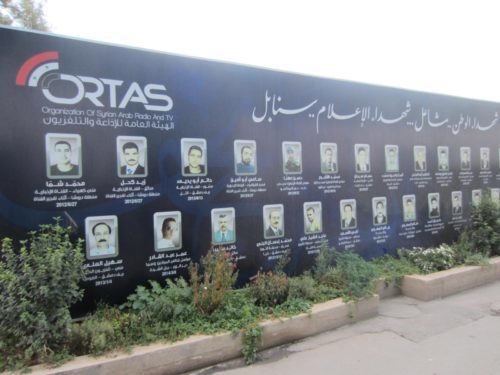
Syrian Journalists Killed (Photo: Rick Sterling)
The deaths of Marie Colvin and Remi Olchik sparked many tributes and widespread publicity. Largely unknown in the West, hundreds of Syrian journalists have also died in the conflict. In a sense, they are all victims of the proxy war on Syria. In another sense, the equivalence is not fair. The war has been encouraged by some and imposed on others.
Rick Sterling is an investigative journalist who grew up in Canada but currently lives in the San Francisco Bay Area of California. He can be reached at rsterling1@gmail.com.
Another Climate Propaganda Story Promoting the Normal as Abnormal
By Dr. Tim Ball | Watts Up With That? | January 8, 2019
Almost every day there are stories in the media about weather or climate events that create the impression that they are new and outside of the normal pattern. None of them are. The objective is to sensationalize the story, even if it means using a meaningless period. A simple trick is to pick a period in which your claim is valid. This practice of cherry-picking the period of study is not exclusive to the media. It was a clear sign of corruption of climatology brought to a head with Roseanne D’Arrigo’s infamous comment to the 2006 National Academy of Science (NAS) panel that “if you are going to make a cherry pie, you have to pick cherries.”
That doesn’t condone the media use of the technique. All it does is illustrate why it was a convenient technique for creating a deception about what is normal. For example, a 2017 BBC headline said “Hottest June day since summer of 1976 in heatwave.” That is 41 years, which is statistically significant but not climatologically significant. A Youtube story reports “Sydney has wettest November day since 1984.” CBS Pittsburgh reported “NWS: 2018 is the 2nd Wettest Year on Record in Pittsburgh.” The record began in 1871 or 147 years ago, but even that is not climatologically significant. The ones I like are this one from North Carolina, that says, “A Look Back at the Coldest day Ever in North Carolina.” “Ever” is approximately 4.5 billion years.
Other stories focus on a pattern or change in a pattern again with the idea that it is new or abnormal. Headlines like this one from 2012, “Why have there been more tornadoes than usual this year?” Often, they are suggestive such as this 2017 New York Times story. “The 2017 Hurricane Season Really Is More Intense Than Normal.” When you read the story, you find, as is usually the case, that the caveats at the end indicate it is not unusual. The problem is the headline already set the pattern in the public mind.
The headline says, “Forget El Nino, StormFest Is about To Hit The West Coast.” The author is talking about a series of storms tracking on to the west coast of North America. The story told us
Things often calm down after January 1 during El Nino years… but not this year… with the U.S. West Coast from central California to Washington State about to be pummeled by a series of storms. Rain, snow, wind? Plenty for everyone. A view of the latest infrared satellite imagery shows an amazing line-up of one storm after another stretching way into the Pacific. A traffic jam of storms.
The terms, “pummeled” and “traffic jam” are evocative and imply the pattern is unusual. In fact, it is perfectly normal to the point that there is a descriptive term for it, the Pineapple Express. This refers to the establishment of the Polar Front along the northwest coast of North America after it migrates south from its summer position off the coast of Alaska and northern British Columbia. Low pressure systems known as anti-cyclones develop along the Front all year round. The areas affected by these systems changes as the Front migrates between its more northerly summer position and more southerly winter position. The term Pineapple Express refers to the situation in the winter when these anti-cyclones generate in the region of Hawaii and track along the Front hitting the northwest coast in a series of storms. The pattern does not stop in an El Nino year but takes a different path.
These anti-cyclone systems are also the focus of exploitation of normal weather events as abnormal, in Europe. The southerly shift of the Polar Front in the Northern Hemisphere occurs around the globe. Two major factors influence the weather pattern, sea surface temperatures that fluctuate with ocean circulation, and the Rossby Wave pattern in the Circumpolar Vortex. This pattern of anti-cyclones hitting western Europe in the winter was added to the propaganda list when they started naming the storms. It linked them to hurricanes in the public mind, and it implied they were a recent phenomenon.
They are not recent, new, or of greater intensity.

A significant part of professor Hubert Lamb’s ground-breaking and monumental work on historical climatology was a long-term reconstruction of the pattern of these anti-cyclones. It fit with his claim about why he established the Climatic Research Unit (CRU) at the University of East Anglia.
“… it was clear that the first and greatest need was to establish the facts of the past record of the natural climate in times before any side effects of human activities could well be important.”
Once he created a long-term record of these anti-cyclonic systems, there was a better chance of determining the underlying mechanisms. From this, he could achieve his final objective of better forecasting. The ability to forecast defines science. If that is not the final objective the work is mostly irrelevant.
Consider the destructive and history-altering impact of storms like the one that hit the Spanish Armada that attempted to invade England in 1588. Ironically, Phil Jones, who ran the CRU reputation into the ground while under his direction, wrote a good synopsis of Lamb’s work. There is also the storm of 1703 reported in great detail in the book “The Storm” by the famous author Daniel Defoe.
Marcel Leroux was an early major skeptic of the claim of anthropogenic global warming (AGW). His 2005 book “Global Warming: Myth or Reality” was impactful because Leroux was well qualified. As one review of his book notes,
In the global-warming debate, definitive answers to questions about ultimate causes and effects remain elusive. In Global Warming: Myth or Reality? Marcel Leroux seeks to separate fact from fiction in this critical debate from a climatological perspective. Beginning with a review of the dire hypotheses for climate trends, the author describes the history of the 1998 Intergovernmental Panel on Climate Change (IPCC) and many subsequent conferences. He discusses the main conclusions of the three IPCC reports and the predicted impact on global temperatures, rainfall, weather and climate, while highlighting the mounting confusion and sensationalism of reports in the media.
The comment about sensationalism in the media is relevant to this article because Leroux, like Lamb, also worked on a reconstruction of the anti-cyclonic systems in the North Atlantic. Leroux also worked on another later exploitation of the normal by John Holdren, Obama’s Science Advisor, the so-called “Polar Vortex.” Leroux’s 1993 work on the impact of the “The Mobile Polar High: a new concept explaining present mechanisms of meridional air-mass and energy exchanges and global propagation of palaeoclimatic changes” showed how these outbreaks of cold Polar air are a normal weather event that enter the climate record because of their regular but variable appearance and impact.
We are confronted by the unholy alliance between the political use of science by the Intergovernmental Panel on Climate Change, the spin doctors or, as I prefer, the professional liars, and the mainstream media, that create fake news by making the normal appear abnormal. As the Yiddish proverb observes, “Truth never dies but lives a wretched existence,” especially under such a deliberate onslaught.
Wag the Dog… British Media Watchdog Accuses Russia of Bias
By Finian CUNNINGHAM | Strategic Culture Foundation | 27.12.2018
Irony is dead when British state media controllers accuse Russian news outlets RT and Sputnik of “imbalance” over their reporting on the Skripal alleged poisoning affair.
In the past week, Ofcom, the British media watchdog, condemned seven programs aired during March and April this year following the apparent poisoning of former Russian spy Sergei Skripal in Salisbury. The Russian outlets may be fined or denied future broadcasting rights in Britain. The latter suggests what the real, ulterior agenda is all about.
It remains a mystery as to what happened exactly to Skripal and his daughter when they reportedly fell ill on March 4 in the famous south of England cathedral town. Neither Sergei nor Julia have been seen in public since, apart from a brief and carefully controlled interview given by Julia to Reuters a few months ago, apparently having recovered from her stricken condition. Russian consular services have been denied access to Julia by the British authorities, despite her being a Russian citizen.
The murkiness of the affair, the flagrant obfuscation by the British authorities and their violation of diplomatic norms speaks of a British state intrigue aimed at provoking international recriminations against Russia. Such is the outrageous apparent skullduggery by the British state, it is arguably very appropriate therefore for critical media coverage of the incident and the subsequent prevarication by London.
However, in a staggering inversion of reality, British media regulators complain that Russian news outlets have broken “impartiality rules” in their reporting on what is a bizarre de facto disappearance of a Russian citizen and her father while in the custody of British authorities. The protagonists are off-limits from criticism; their ropey claims must be treated as the sane version of events.
Within days of the Salisbury incident, senior British officials, including Prime Minister Theresa May, were accusing Russia of an assassination attempt against the Skripals, allegedly with a Soviet-era nerve poison.
London’s narrative inculpating the Kremlin and Russian President Vladimir Putin continues, despite Russia’s vehement denial of involvement and despite the lack of independently verifiable evidence.
This week, in her Christmas speech to the nation, premier May again repeated her condemnation of the “nerve agent attack in Salisbury” and she praised British armed forces for “protecting the country’s waters and skies from Russian intrusion”.
So, Russian media are castigated for “bias”, but British media are evidently permitted to report and broadcast official British assertions that are unproven and wildly sensational, if not tantamount to inciting international conflict. Just who is breaking journalistic standards?
Among the news outlets reporting May’s words were the BBC. The government-owned British broadcaster routinely and snidely refers to Russian news outlets RT and Sputnik as “Kremlin-backed”. As if the state-backed BBC is somehow immune from disseminating British government propaganda.
May’s assertions in her Christmas speech about Russia carrying out an alleged assassination and threatening Britain with invasion went unchallenged by the BBC. Nor were her other claims about chemical weapons being used by Syrian government forces against civilians.
On Syria, May was referring to an incident near Damascus in April this year when toxic chlorine was purportedly used in an assault on civilians. Back then, the British prime minister joined with US President Trump and France’s President Macron to order air strikes on Syria, supposedly in retaliation for the Syrian army’s use of chemical weapons. But it soon transpired that the incident was a provocation staged by jihadist militants and their media operatives, the so-called White Helmets. In other words, the British, American and French carried out a criminal act of aggression against Syria under false pretenses.
Yet May in her solemn set-piece nationwide Christmas speech this week was allowed by British media to repeat blatant lies against Syria, and brazenly avoid the issue of justice facing her government over illegal air strikes on Syria, as well as to continue smearing Russia over the murky Skripal affair.
The arrogant hypocrisy of British media and the state regulator is astounding. British citizens are compelled by law to pay an annual license fee of £150 ($190) per household for possessing a television set. Failure to pay can result in a jail sentence. The TV license fee collected by the British state is handed over to the BBC. So, here we have a state-owned media channel that is funded through a compulsory tax on citizens, and yet this same channel willingly broadcasts British government propaganda claims denigrating Russia and covering up for British war crimes in Syria. If that sounds Orwellian, that’s because it is.
The BBC’s corporate advertising claims to be the “world’s leader in breaking global news”. It also assures its listeners and readers that it produces “news you can trust”.
There are countless cases where the BBC’s pompous self-importance can be exposed, revealing an altogether more malevolent purpose. One of the most notorious cases was its complicity in orchestrating the 1953 coup in Iran carried out by the American CIA and Britain’s MI6. In his book, Web of Deceit, British historian Mark Curtis details the crucial role played by the BBC and its Persian service in helping to foment the coup against the elected premier Mohammad Mosaddegh.
More recently, BBC coverage of the war in Syria over the past eight years has been a relentless propaganda assault on the government of President Bashar al Assad. It is not merely about omission or biased distortion. The BBC has been caught out actually fabricating fake news in Syria, such as the case when it accused the Syrian army of using napalm on civilians near Aleppo in 2013. Those reports were later exposed as deliberate fabrications.
More generally on Syria, the BBC, as with other Western news media, are serving as facilitators of the criminal regime-change objective of their governments. May’s grotesque falsehoods reiterated this week – in a Christmas speech of all things! – about chemical weapons are afforded respectability and apparent credibility by the way the BBC and other British outlets dutifully report her words without any qualification, let alone criticism.
It is a measure of how distorted the British media landscape is when alternative news channels which do raise critical viewpoints and insights on propaganda narratives are then accused of being “imbalanced” and “in breach of broadcasting rules”.
In response to Britain’s Ofcom regulator condemning Russia’s RT and Sputnik, Moscow is now saying that its own state regulator is considering filing a case against the BBC and how it operates in Russia. Given how the BBC tried to tie Russia to instigating the Yellow Vest protests in France and how it recently ran an article accusing the Kremlin of “weaponizing satire”, there seems much more credibility to Russian claims that the “British state-backed outlet” is in breach of journalistic standards.
The broader background of how the BBC serves British state propaganda is panoramic in its scope. But such is official British hypocrisy, the authorities attack critical news outlets that happen to expose their propaganda service posing as “news you can trust”.
Free speech in Britain? Yes, as long as you freely speak in the service of British state propaganda.
Don’t Laugh – It’s Giving Putin What He Wants
By Caitlin JOHNSTONE | Medium | December 15, 2018
The BBC has published an article titled “How Putin’s Russia turned humour into a weapon” about the Kremlin’s latest addition to its horrifying deadly hybrid warfare arsenal: comedy.
The article is authored by Olga Robinson, whom the BBC, unhindered by any trace of self-awareness, has titled “Senior Journalist (Disinformation)”. Robinson demonstrates the qualifications and acumen which earned her that title by warning the BBC’s audience that the Kremlin has been using humor to dismiss and ridicule accusations that have been leveled against it by western governments, a “form of trolling” that she reports is designed to “deliberately lower the level of discussion”.

“Russia’s move towards using humour to influence its campaigns is a relatively recent phenomenon,” Robinson explains, without speculating as to why Russians might have suddenly begun laughing at their western accusers. She gives no consideration to the possibility that the tightly knit alliance of western nations who suddenly began hysterically shrieking about Russia two years ago have simply gotten much more ridiculous and easier to make fun of during that time.
Couldn’t possibly have anything to do with the emergence of a demented media environment wherein everything around the world from French protests to American culture wars to British discontent with the European Union gets blamed on Russia without any facts or evidence. Wherein BBC reporters now correct guests and caution them against voicing skepticism of anti-Russia narratives because the UK is in “an information war” with that nation. Wherein the same cable news Russiagate pundit can claim that both Rex Tillerson’s hiring and his later firing were the result of a Russian conspiracy to benefit the Kremlin. Wherein mainstream outlets can circulate blatantly false information about Julian Assange and unnamed “Russians” and then blame the falseness of that reporting on Russian disinformation. Wherein Pokemon Go, cutesy Facebook memes and $4,700 in Google ads are sincerely cited as methods by which Hillary Clinton’s $1.2 billion presidential campaign was outdone. Wherein conspiracy theories that Putin has infiltrated the highest levels of the US government have been blaring on mainstream headline news for two years with absolutely nothing to show for it to this day.
Nope, the only possibility is that the Kremlin suddenly figured out that humor is a thing.
The fact of the matter is that humorous lampooning of western establishment Russia narratives writes itself. The hypocrisy is so cartoonish, the emotions are so breathlessly over-the-top, the stories so riddled with plot holes and the agendas underlying them so glaringly obvious that they translate very easily into laughs. I myself recently authored a satire piece that a lot of people loved and which got picked up by numerous alternative media outlets, and all I did was write down all the various escalations this administration has made against Russia as though they were commands being given to Trump by Putin. It was extremely easy to write, and it was pretty damn funny if I do say so myself. And it didn’t take any Kremlin rubles or dezinformatsiya from St Petersburg to figure out how to write it.
“Ben Nimmo, an Atlantic Council researcher on Russian disinformation, told the BBC that attempts to create funny memes were part of the strategy as ‘disinformation for the information age’,” the article warns. Nimmo, ironically, is himself intimately involved with the British domestic disinformation firm Integrity Initiative, whose shady government-sponsored psyops against the Labour Party have sparked a national scandal that is likely far from reaching peak intensity.
“Most comedy programmes on Russian state television these days are anodyne affairs which either do not touch on political topics, or direct humour at the Kremlin’s perceived enemies abroad,” Robinson writes, which I found funny since I’d just recently read an excellent essay by Michael Tracey titled “Why has late night swapped laughs for lusting after Mueller?”
“If the late night ‘comedy’ of the Trump era has something resembling a ‘message,’ it’s that large segments of the nation’s liberal TV viewership are nervously tracking every Russia development with a passion that cannot be conducive to mental health — or for that matter, political efficacy,” Tracey writes, documenting numerous examples of the ways late night comedy now has audiences cheering for a US intelligence insider and Bush appointee instead of challenging power-serving media orthodoxies as programs like The Daily Show once did.
If you wanted the opposite of “anodyne affairs”, it would be comedians ridiculing the way all the establishment talking heads are manipulating their audiences into supporting the US intelligence community and FBI insiders. It would be excoriating the media environment in which unfathomably powerful world-dominating government agencies are subject to less scrutiny and criticism than a man trapped in an embassy who published inconvenient facts about those agencies. It certainly wouldn’t be the cast of Saturday Night Live singing “All I Want for Christmas Is You” to a framed portrait of Robert Mueller wearing a Santa hat. It doesn’t get much more anodyne than that.

Russia makes fun of western establishment narratives about it because those narratives are so incredibly easy to make fun of that they are essentially asking for it, and the nerdy way empire loyalists are suddenly crying victim about it is itself more comedy. When Guardian writer Carole Cadwalladr began insinuating that RT covering standard newsworthy people like Julian Assange and Nigel Farage was a conspiracy to “boost” those people for the advancement of Russian agendas instead of a news outlet doing the thing that news reporting is, RT rightly made fun of her for it. Cadwalladr reacted to RT’s mockery with a claim that she was a victim of “attacks”, instead of the recipient of perfectly justified ridicule for circulating an intensely moronic conspiracy theory.
Ah well. People are nuts and we’re hurtling toward a direct confrontation with a nuclear superpower. Sometimes there’s nothing else to do but laugh. As Wavy Gravy said, “Keep your sense of humor, my friend; if you don’t have a sense of humor it just isn’t funny anymore.”
Featured Video
Prof. Ted Postol: Iran Already Achieved Nuclear Deterrence Against Israel
or go to
Aletho News Archives – Video-Images
From the Archives
How the occupied mentality syndrome works
Saudi Arabia on the American chessboard – Part 3
By B. J. Sabri | American Herald Tribune | June 27, 2016
Read part 2: “The occupied mentality Syndrome“
Previously I argued whether Saudi Arabia’s repeated involvements in U.S. interventions and wars stem from free national will or in response to a specific condition. For starters, in Saudi Arabia there is no national will. In Saudi Arabia, the national will is the will of the Al Saud clan. Still, when a major Arab state allies itself with a superpower that committed unspeakable crimes against humanity in almost every Arab country, then something is wrong. This fact alone should compel us to examine the U.S.-Saudi relation for one exceptional reason. As a result of the U.S.-Saudi wars, hundreds of thousands of people in Afghanistan, Iraq, Iran, Libya, Syria, Yemen, and Somalia have lost their lives. Millions became displaced in their own homelands. And millions more rendered refugees.
Attributing the Saudi policies to the bonds of “partnership” with the U.S. is frivolous. There are no bonds between these two thugs except those of business, military deals, secret plots, and wars. Proving this point, bonds such as these have no space for the American and Saudi peoples to share significant cultural or societal exchanges. If partnership is not the reason for the Saudi contribution to the U.S. strategy of empire and imperialism, then another reason must exist.
This leads to three possibilities. … continue
Blog Roll
 Aletho News
- NIAID/NIH and USDA Fund Bioengineered Chimeric Influenza Viruses Built Using Pandemic H1N1 Components: Journal ‘Science Advances’
- Hezbollah hits Israeli warship off Lebanon’s coast, sets it aflame
- Iran slams US strikes on B1 bridge, Mahshahr petrochemical plants as ‘blatant acts of state terrorism’
- In letter to UN chief, Araghchi warns of dire consequences of US-Israeli attacks on Iran’s nuclear facilities
- Why the CIA conspiracy to invade Iran with Kurdish militias failed
- Why Are Upbeat US Claims About Mission to Rescue Pilot ‘Highly Questionable’?
- Aircraft destroyed during US ‘rescue’ of downed F-15 pilot cost more than $100 million each
- Washington University removes professor who condemned US-Israeli war on Iran
- Russia Warns of Retaliation as UK Authorizes Seizure of Vessels
- Serbia thwarts plot to bomb Russia-Hungary gas pipeline – Vucic
- If Americans Knew
- In Iran, Israel-US take aim at “reason, research, and freedom of thought” – Daily Update
- US loses planes over Iran, Israel downgrades Lebanon war goals – Daily Update
- Israel Is Blocking Palestinians from Easter at Church Where Jesus Resurrected
- Plot to assassinate Palestinian activist follows harassment campaign promoted by Zionist groups and elected officials
- Prominent New York synagogue hosts presentation on why U.S. Jews should support the ethnic cleansing of Gaza
- Tapper vs. Piker: Is the CNN Anchor Auditioning for David Ellison?
- Shouldn’t Democrats Be Able to Condemn Genocide?
- Israel-US kill negotiators, destroy civilian structures, but Iran’s military capabilities still largely intact – Daily Update
- ‘War crime’: Global condemnation as Israeli ministers celebrate death penalty law targeting Palestinian prisoners
- 7 Ways Israel Is Turning Lebanon Into Gaza
- No Tricks Zone
- An Inconvenient Tree: Uncovered In Alps… Europe Much Warmer Than Today 6000 Years Ago
- New Study Reports A 60% Slowdown In Greenland’s Ice Loss Rate In The Last Decade
- Low Intensity Tornado Wrecks Major Solar Farm, Creating A Potential Toxic Dump
- New Study Finds Warming Saves Lives…Cold Temperatures 12 Times More Deadly Than Excess Heat
- German Science Blog Accuses PIK Climate Institute Of Hallucinating Climate Tipping Points
- Devastating Assessment Of Comirnaty Vaccine By Former Senior Pfizer Europe Toxicologist
- New Study: CO2 Is ‘Effectively Negligible’ As An Explanatory Climate Change Factor Since 2000
- Former Pfizer Toxicologist Dr. Helmut Sterz Tells Bundestag Hearing Pfizer Vaccine Should Have Never Been Approved
- Energy Expert: Germany’s Nuclear Phaseout Was A “500 Billion Euro Mistake”
- New Research: South Australia’s Mid-Holocene Sea Surface Temperatures Were 4°C Warmer Than Today
 Aletho News