Guardian Pushes Alarmist Claim That Climate Change Threatens Coffee Production as Yields Soar
BY CHRIS MORRISON | THE DAILY SCEPTIC | MARCH 14, 2023
There is no animal or plant in the natural world that cannot be used to promote climate Armageddon and its collectivist Net Zero political solution. On Sunday, the WWF, also known as the World Wildlife Fund, started running a series of Wild Isles co-produced propaganda films narrated by Sir David Attenborough on the BBC. These include finely-crafted messages of improbable extinctions culled from computer models.
From the absurd to the ridiculous, we had National Margarita Day recently hijacked by CNN running a story about the ‘climate crisis’ affecting tequila production – a story easily debunked by the news that since 1995, tequila production had increased six-fold, and in four years it had doubled. Now the increasingly unhinged Guardian is giving us its ‘Net Zero, or else the coffee gets it’ story.
According to the newspaper, new research suggests that climate conditions that reduce coffee yields have become more frequent over the past four decades, with rising temperatures from “global heating” likely to lead to ongoing systemic shocks to coffee production globally.
Note the use of the phrase “climate conditions” for what in effect is weather, and the suggestion that it reduces coffee yields. These climate conditions are said to have become more frequent over the last four decades. But one can only read the Guardian for so long. Let us look at actual coffee yields over the last four decades.
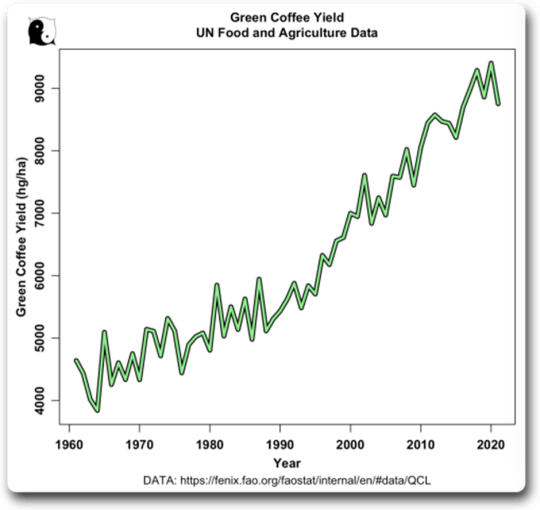
Far from declining due to all this weather, yields have shown dramatic improvement since at least 1960. Over this period, particularly between 1980-98, temperatures have risen, but there is no sign of “ongoing systemic shocks” to coffee production globally.
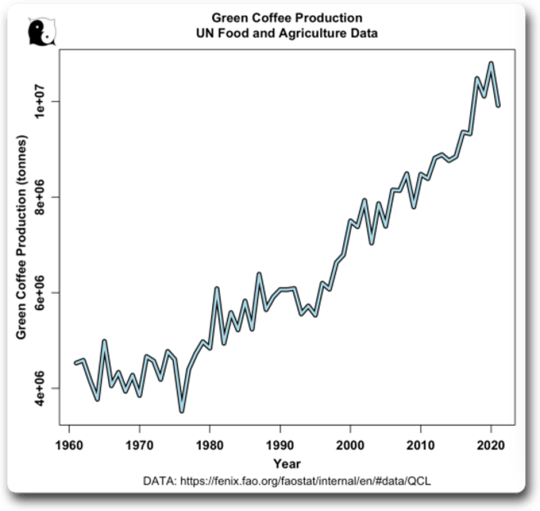
Global coffee yields have been a great agricultural success story, along with actual bean production. Like yields, tonnes produced have soared in the last 40 years.
The key Guardian get-out phrase of course is “new research suggests”. The Guardian story was taken from an academic study led by Dr. Doug Richardson, published in PLOS Climate. He told the newspaper that a shift from cool and wet to hot and dry conditions “we’re pretty confident is a result of climate change”.
In fact if the Richardson paper is read, a more nuanced view on coffee and weather over the last 40 years is discovered.
Our results suggest that ENSO [El Niño Southern Oscillation] is the primary mode in explaining annual compound event variability, both globally and regionally. El Niño-like sea surface temperatures in the Pacific Ocean are associated with decreased precipitation and increased temperatures in most coffee regions, and with spatially compounding warm and dry events. This relationship is reversed for La Niña-like signatures.
As it happens, the last 40 years saw three very powerful El Niños occurring in 1982, 1998 and 2016. These pushed temperatures up around the planet, a natural weather oscillation that had nothing to do with any human-caused increase in atmospheric carbon dioxide. The current eight-year pause in the satellite temperature record is partly explained by three recent La Niña events.
The vast majority of the world’s coffee is grown with just two species – Arabica and Robusta. Arabica is more sensitive to growing conditions, and requires temperatures around 18-22°C. In the tropics, these are more common in higher elevations. Robusta is less highly prized, has a wider geographical spread and grows between 22°C and 28°C. Richardson claims that human-caused climate change is “expected” to alter the geographical suitability for growing coffee. The area of land suitable for coffee cultivation “may” be reduced by up to 50%.
This is unlikely. For a start, it assumes temperatures will rise significantly, but with global warming running out of steam over the last two decades, this seems unlikely. This is particularly so in the tropics. Historical records show that during periods of global warming, the tropics warm less and temperatures are more stable. In addition, coffee is a versatile crop, and selective breeding has produced varieties that can adapt to lowland conditions with temperatures outside normal growing ranges. If climate should change in any significant way, new coffee farming could switch to more propitious areas.
But where is the fun in explaining all that when Net Zero propagandising is afoot. MIT Emeritus Professor Richard Lindzen is fond of noting that the current climate narrative is absurd, but trillions of dollars paid to many, including “grant-dependent” academics, says it is not absurd. This money pays for a constant drip, drip, nudge, nudge wave of climate scaremongering eagerly promoted by controlling elites seeking to take away personal and economic freedoms under cover of saving the planet.
Study Finds Zero Loss of Antarctica Sea Ice – But BBC Spins as “New Record Low”
BY CHRIS MORRISON | THE DAILY SCEPTIC | FEBRUARY 21, 2023
The catastrophisation of natural events and weather is relentless across the mainstream media as populations continue to be nudged towards an elitist command-and-control Net Zero future. The BBC recently copied a headline from the U.S.-based National Snow and Ice Data Center (NSIDC) claiming Antarctica sea ice had hit a “new record low”. Inexplicably missing from the story was the later observation from the NSIDC that since accurate satellite records began in 1979, the trend in the minimum ice extent is “near zero”. Any loss was said to be “not statistically significant”.
To be fair to the writer, BBC science correspondent Jonathan Amos, he did report later in the story that scientists consider the behaviour of Antarctica sea ice to be a “complicated phenomenon which cannot simply be ascribed to climate change”. Of course, as regular Daily Sceptic readers are aware, the Antarctic is a difficult hunting ground for climate catastrophists since over the last seven decades there has been little or no warming over large areas of the continent.
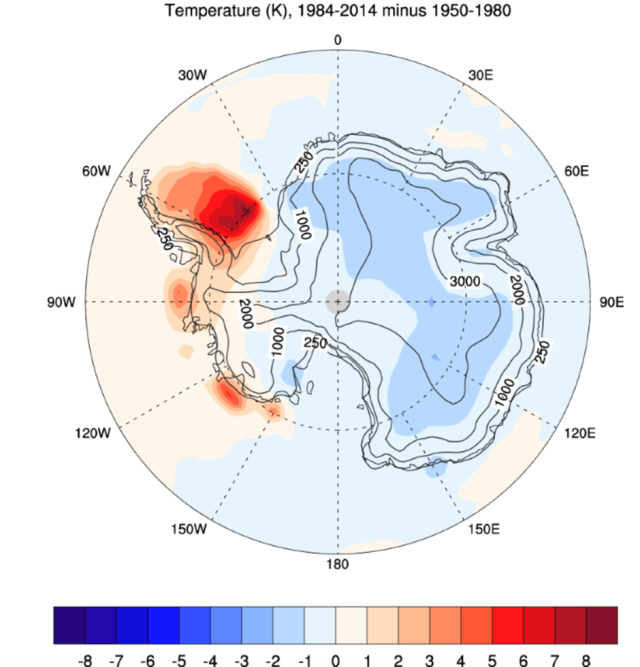
According to a recent paper (Singh and Polvani), the Antarctica sea ice has “modestly expanded”, and warming has been “nearly non-existent” over much of the ice sheet. According to NASA figures, the ice loss is 0.0005% per year. Down at the South Pole, even the most inventive climate alarmists are defeated. In 2021 it recorded its coldest six-month winter since records began, and last year the temperature was 0.4°C colder than the average over the last 30 years. In addition, the Pole recorded no less than seven new daily temperature lows.
The map above shows some warming in the western part of Antarctica, and it is to this area that climate warriors return – again and again. The day before his sea ice story was published, Amos ran with a routine BBC house scare about the Thwaites glacier, often known in green circles as the ‘Doomsday Glacier’. Amos states that glaciers such as Thwaites located in the west may be more sensitive to changes in sea temperature than was thought. “Its susceptibility to climate change is a major concern to scientists because if it melted completely, it would raise global sea levels by half a metre,” he said.
Many of the problems surrounding the unproven hypothesis of human-caused global warming is that it often fails to correlate with observable reality. Why would well-mixed atmospheric carbon dioxide produce a relative warm spot in Antarctica, but leave the rest of the vast continent in a static deep freeze? In 2017, scientists discovered 91 volcanoes in the West Antarctica Rift System. It brought the number of volcanoes discovered in the area to 138. Their heights ranged from 300 to 12,600 feet, with the tallest as high as Mount Fuji in Japan. The scientists noted that even dormant volcanoes can melt ice because of the high temperature they generate. “Volcanic activity may increase and this, in turn, may lead to enhanced water production and contribute to further potential ice-dynamical instability,” the scientists stated.
Again, to be fair to Amos, he does consider other causes of Antarctica ice stability, although the article is headlined “climate change”. His reporting is mercifully free of the emotional gushings produced by the BBC’s green activist-in-residence Justin Rowlatt. When Rowlatt flew to the area, he witnessed “an epic vision of shattered ice”. To him, the Antarctic is the “frontline of climate change”. Amos does note that Thwaites, a glacier the size of Florida, has retreated in some places by 14 km since the late 1990s. But such movement does not seem unusual. Recently a group of oceanographers discovered that parts of Thwaites had retreated at twice the rate in the past, when human-caused CO2 could not have been a factor. The retreat could have occurred centuries ago, and is said to have been “exceptionally fast”.
Meanwhile, research has just been published that indicates Antarctica could have been warmer in the recent past from 7,000 to 500 years ago. This type of research is always interesting since it helps debunks a common claim made by alarmists that current temperatures are the highest over the last three million years. But numerous scientific studies have shown that temperatures across the planet have been much warmer for recent periods in the Holocene. This latest study in Antarctica found remains of elephant seals along the Victoria Land Coast of the Ross Embayment, which borders both the West and East Antarctic ice sheets. These days, the area is largely free of elephant seals because of shelves of permanent sea ice frozen to the beaches. It is suggested that seals were able to occupy the beaches in a period of warmth before extensive sea ice pushed them off the present day coast.
“Our work shows that for much of the Holocene, the Ross Sea was less icy and presumably warmer than it is today, and this warmth may have driven retreat of the West Antarctica ice sheet from the Ross Sea during the last 8,000 years, and future warming could continue to push ice retreat,” conclude the researchers.
For climate alarmists, the ice is the gift that keeps on giving – every day is a “new record low”.
The climate scaremongers: Are hurricanes becoming more powerful?
By Paul Homewood | TCW Defending Freedom | February 17, 2023
If you believe what the media tell you, you would think so. But you would be wrong. As the chart below for 1980 to 2022 shows, there is no obvious trend in the frequency of major hurricanes worldwide during the satellite era.

http://tropical.atmos.colostate.edu/Realtime/index.php?arch&loc=global
The IPCC, the UN climate panel, can also find no evidence either, stating in their latest climate assessment: ‘There is low confidence in most reported long-term (multi-decadal to centennial) trends in Tropical Cyclone frequency- or intensity-based metrics due to changes in the technology used to collect the best-track data.’
The US National Oceanic & Atmospheric Administration says the same about Atlantic hurricanes: ‘There is no strong evidence of century-scale increasing trends in US landfalling hurricanes or major hurricanes. Similarly for Atlantic basin-wide hurricane frequency (after adjusting for observing capabilities), there is not strong evidence for an increase since the late 1800s in hurricanes, major hurricanes, or the proportion of hurricanes that reach major hurricane intensity.’
But facts don’t matter to the climate warriors at the BBC, who published a ‘Reality Check‘ following Hurricane Ian last summer, which claimed that there was evidence that hurricanes were getting more powerful.
I fired off a complaint to the BBC at the time, which their Executive Complaints Unit (ECU) have now rejected. They presented no real data to counter any of the evidence I have outlined above. Instead they relied almost entirely on computer modelled projections of what might happen in future.
Their dismissal of my complaint sums it up better than I can: ‘The evidence would therefore appear to indicate climate scientists who have studied hurricanes and the effect of human-induced climate change agree the proportion of tropical cyclones which develop into hurricanes or major hurricanes is expected to increase, and those hurricanes are expected to have higher peak wind speeds ‘
Of course, it was not what could happen in the future which I was complaining about. It was their claim that such changes are already happening. In short, they created a straw man and knocked it down, while ignoring the actual complaint!
The real problem, of course, is that the ECU is part of the BBC, and will always back them up even when the evidence against them is overwhelming. The BBC will never be properly held to account until a truly independent complaints unit is set up.
Media Ignores Evidence That West Opposed Ukraine Peace Deal
BY NOAH CARL | THE DAILY SCEPTIC | FEBRUARY 14, 2023
As I noted in a previous article, the former Israeli Prime Minister Naftali Bennett revealed in a recent interview that in March of last year Western leaders blocked a draft peace deal between Russia and Ukraine.
There seems to be some disagreement over exactly what he said, as the interview was in Hebrew. Based on the English subtitles on YouTube, I quoted him as saying, “They blocked it.” But others insist he said, “They broke off negotiations.” Either way, he clearly implied that the West stymied negotiations that might have led to a peace deal.
What’s more telling is the reason he gave as to why the West did so, namely “to keep smashing Putin”. This tallies closely with Roman Romanyuk’s account of why Western leaders opposed negotiations in April:
Behind this visit and Johnson’s words lies much more than a simple reluctance to engage in agreements with Russia. The collective West, which back in February suggested that Zelenskyi surrender and run away, now felt that Putin is actually not as all-powerful as they imagined him to be. Moreover, right now there was a chance to “press him”. And the West wants to use it.
As Caitlin Johnstone points out, it also lines up with what the Turkish Foreign Minister Mevlut Cavusoglu said on April 20th last year:
Following the NATO foreign ministers’ meeting, it was the impression that … there are those within the NATO member states that want the war to continue, let the war continue and Russia gets weaker. They don’t care much about the situation in Ukraine.
So we now have a NATO Foreign Minister, a journalist with sources “close to Zelensky” and a former Israeli PM all saying that Western leaders opposed a peace deal because they wanted to “weaken”, “press” or “smash” Putin.
These seem like newsworthy revelations, don’t they? Not according to the mainstream media.
I checked whether the revelations have been mentioned by any of the following outlets: the BBC, CNN, the Times, the Guardian, the Telegraph, the New York Times, the Washington Post, or the Wall Street Journal. With the exception of one op-ed in the New York Times which quoted Cavusoglu’s statement, they’ve been completely ignored.
The point here isn’t that there definitely would have been a peace deal if not for the actions of Western leaders. We can’t know that. The point is: there’s credible evidence that Western leaders stymied negotiations which might have led to a peace deal because they wanted to weaken Russia.
With the exception of Tucker Carlson and a few lesser-known outlets, why hasn’t the media covered this? One of the current headlines on the BBC News homepage is ‘Rihanna reveals pregnancy at Super Bowl show’. Which is more newsworthy: Rihanna’s personal life, or the revelation that Western leaders may have sabotaged peace? I’m reminded of this meme:
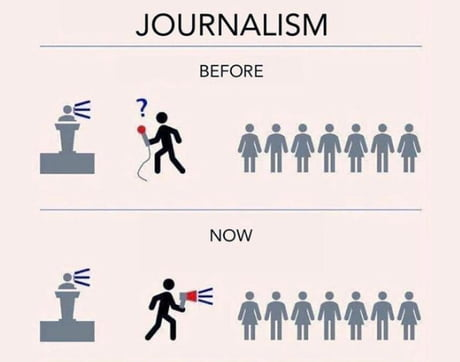
A few days ago, in fact, a BBC Ukraine journalist got up and hugged Zelensky at a press conference. However much you support a particular cause, as a journalist you’re supposed to show a modicum of impartiality. Based on this incident, I wouldn’t expect any dramatic shifts in coverage.
BBC’s Solar Power Misinformation
By Paul Homewood | Not A Lot Of People Know That | February 10, 2023
More disinformation from the BBC:

https://www.bbc.co.uk/news/science-environment-64553915
Amidst the backslapping about how wonderful solar power is, the BBC present this graph:
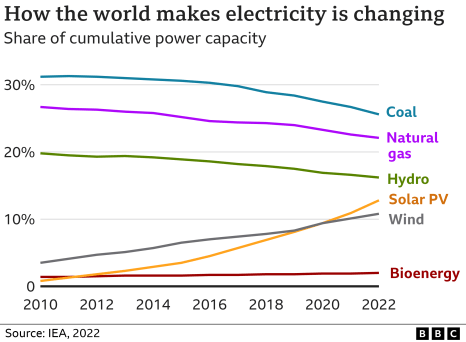
WOW!! Most people reading this would believe that electricity from fossil fuels is declining rapidly, while solar and wind power now claim a share well over 20%.
Most of those same readers would be unaware what the BBC mean by “capacity”, or that “capacity” and “generation” are two totally separate and different things.
And when we look at generation, we can see how badly misled those readers have been:

BP Energy Review
Far from being major players, wind and solar together only supply 10% of the world’s electricity. And since 2010, the increase in fossil fuel generation has exceeded that of wind and solar.
A rather different picture to the one the BBC would like you believe, I think you might agree!
What looks, acts and smells like a Global News Cartel and just got hit by an Antitrust lawsuit…
By Jo Nova | February 5, 2023
What if the news media formed a global monopoly to control the news?
Imagine if the media and tech giants of the world banded together behind-the-scenes to rule certain stories were “misinformation” and all their agencies thus reported the same “news”?
That’s what the Trusted News Initiative aimed to do — decide what ideas were and were not allowed to be discussed.
It’s like “free speech” but without the free part.
Not only could the media bury things but they could get away with it if no upstart competitor could red-pill their audience.
It would be the death of the Free Press
In a world like that the people would be ruled mostly by whomever it was that decided what was “misinformation”. Those controllers would be the defacto Ministry of Truth.
We all saw it happen over the last three years, so it’s good to put a name on the beast, but even better, Robert F Kennedy is suing them for anti-trust violation.

Trusted News Initiative, TNI
The Trusted News Initiative is everything journalists should hate. It’s basically there to “protect” voters from hearing about things like the Hunter-Biden Laptop, good climate news and bad vaccine reactions. TNI practically told us that in 2020:
The Trusted News Initiative (TNI) was set up last year [2019, just in time, eh?] to protect audiences and users from disinformation, particularly around moments of jeopardy, such as elections.
Nearly everyone’s on board:
Core partners in the TNI are: AP, AFP, BBC, CBC/Radio-Canada, European Broadcasting Union (EBU), Financial Times, Information Futures Lab, Google/YouTube, The Hindu, The Nation Media Group, Meta [Facebook], Microsoft, Reuters, Reuters Institute for the Study of Journalism, Twitter, The Washington Post, Kompass – Indonesia, Dawn – Pakistan, Indian Express – India, NDTV – India, ABC – Australia, SBS – Australia, NHK – Japan.
Which is a handy list of “where not to get your news”.
It’s a news cartel begging to be busted
Tony Thomas at Quadrant not only alerted me to the TNI but also to the news that a lawsuit has been filed in the US for damages and to break it up:
… on January 10 President John Kennedy’s nephew, Robert F Kennedy Jr, in a Texas District Court launched an anti-trust lawsuit for treble damages from TNI’s biggest news providers, namely the BBC, Washington Post, and global news syndicators Reuters and Associated Press. He wants TNI disbanded as an unlawful cartel. He cites the BBC because of its TNI lead role and US commercial operations involving millions of users.[1] The Kennedy lawsuit is here.[2] His brief says “It is also an action to defend the freedom of speech and of the press.”
This is rather like the Big Money Cartel of bankers and asset managers like BlackRock who are now facing anti-trust legal action all of their own.
The suit names the BBC because they were “the leaders” in at the start. But Thomas points out that the consequences are uncertain for the ABC, SBS and others. Though they are not named in the suit, they can still be liable:
The suit says,
Each participant in an antitrust conspiracy is jointly and severally liable for all the damages (including treble damages and attorneys’ fees) caused by the conspiracy, and the victims of an unlawful antitrust conspiracy are not required to sue all participants therein. (My emphasis, p93).
Thomas sent questions to the ABC and SBS in Australia asking them if they are involved in the lawsuit; whether they had advised their Minister about the potential legal exposure, and for details of how they had been implementing TNI policies. None have so far replied.
Perhaps it’s time for an FOI?
By the way, this is an actual BBC header, not a satirical dig.

The only thing “beyond” fake news is 100% managed propaganda.
By combining the major news and social media outlets, little competitors could be crushed
Even the media outlets that are not members of TNI would get this message — stray from the line and Google, Microsoft, Facebook and Twitter (pre Elon Musk) will hurt you:
Robert Kennedy’s own newsletters had 680,000 followers before being de-platformed, censored and shadow-banned by Google/YouTube, Twitter, and Facebook/Instagram. His writ says BBC’s Jessica Cecil, TNI’s head in 2020-21, took evident pride in the assertion that the TNI’s suppression of others’ online reporting did not “in any way muzzl[e] our own journalism”. He adds, “It was apparently of no consequence that the TNI muzzles other news publishers’ journalism.” (p44). Cecil spoke of TNI’s “clear expectations” for members to “choke off” alleged online misinformation. This incidentally prevents any one member gaining traffic by publishing “prohibited reporting” the others have binned.
Kennedy says TNI’s Big Tech members collectively have a gatekeeping power over at least 90 per cent of online news traffic. De-platforming a small news publisher typically costs at least 90 per cent of its traffic. Even well-known major online news publishers can lose up to 50 per cent of their traffic from a seemingly minor change to Google’s search algorithms. Smaller online news publishers have been destroyed completely when shadow-banned, throttled, de-monetized, or de-platformed.
The real free press are the bloggers now
The big threat to the legacy media and corruptocrats everywhere was the rise of the independent bloggers and influencers who could easily outscore the boring media bloc that repeated the same tedious lies. Ten years ago an army of blogs like this were growing every year and getting front page in many searches:
Kennedy’s lawsuit, less kindly, claims TNI’s commercial goal is to deplatform and crush the myriad of upstart online publishers who are contradicting the official lines and reducing trust in big media, along with its ad revenues. The legacy, high-cost media are smarting over competition from bloggers in the shift to digital publishing, with 85 per cent of Americans now getting their news online. US newspapers’ ad revenue between 2000 and 2020 plummeted from $US48.7 billion to only $US9.6 billion, Kennedy says (p28).
A further motive for the TNI censorship, Kennedy says, is to placate governments that are threatening adverse new regulations, potentially costing Big Pharma billions in fines, liabilities and lost revenue. US conservative pundit Tucker Carlson has satirised the Big Media censorship as: “We have a monopoly on telling lies. No one else can talk.”
In a free market for news, the same players compete with each other to get to the truth the fastest. In the TNI cartel, all the decisions about what “the truth is” are played out behind closed doors. The ABC News Director Justin Stevens claims the TNI is just a system of “fast alerts” about disinformation and “information sharing” about things like “how audiences react to disinformation”. But in a free market all that happens all the time. Stupid ideas get crushed by great responses. That’s how it works.
The best answers win in the court of public opinion. It’s democratic, people vote with their remotes, their wallets and on their ballots. TNI wants to hide that debate, take it away from the people, and put it in the hands of The Ministry of Truth.
Nice racket you have there
Read it all at Quadrant — as Tony Thomas tells it, it’s a profit making cartel. The Kennedy suit explains how the TNI members were promoting vaccines while silencing all the cheaper medicines. And Big Pharma was sending money back to TNI members in advertising. The conflicts of interest are brazen — the President of Reuters News, James C Smith, sits on the board of Pfizer. When someone pointed this out on Linked In they were banned for life. See how this works?
Why is a single dollar of our tax money supporting a news service that doesn’t know what journalism is? If cartels like this are not exactly the kind of thing we pay the ABC to expose, why pay them at all?
Pfizer: sales before child safety
The inside story of how we held Pfizer to account for misleading parents about Covid vaccine safety
UsForThem · Broken Custodians · February 2, 2023
Free pass promotional opportunity given by BBC to Pfizer
On 2 December 2021, the BBC published on its website, its popular news app and in the BBC News at One programme, a video interview and an accompanying article under the headline ‘Pfizer boss: Annual Covid jabs for years to come’.
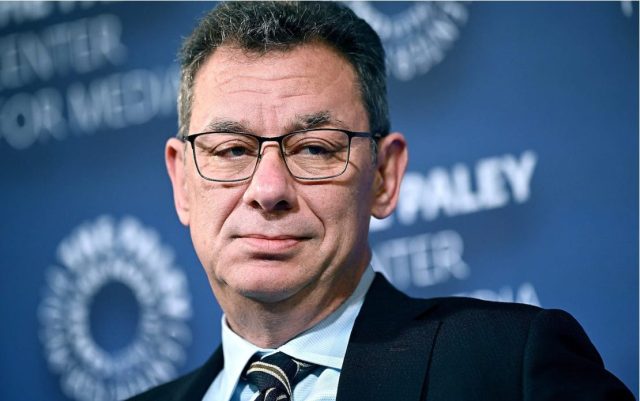
The interview by the BBC’s medical editor, Fergus Walsh, conducted as a friendly fireside chat, gave Dr Albert Bourla, the Chairman and CEO of Pfizer, a free pass promotional opportunity that money cannot buy — as the UK’s national public service broadcaster, the BBC is usually prohibited from carrying commercial advertising or product placement.
Perhaps unsurprisingly, Pfizer made the most of that astonishing opportunity to promote the uptake of its vaccine product. As the BBC’s strapline suggests, the key message relayed by Dr Bourla, responding to an obediently leading question from Mr Walsh, was that many more vaccine shots would need to be bought and jabbed to maintain high levels of protection in the UK. He was speaking shortly before the UK Government bought another 54 million doses of Pfizer vaccines.
Misleading statements about safety
Among his explicit and implicit encouragements for the UK to order more of his company’s shots, Dr Bourla commented emphatically about the merits of vaccinating children under 12 years of age, saying “[So] there is no doubt in my mind that the benefits, completely are in favour of doing it [vaccinating 5 to 11 year olds in the UK and Europe]”. No mention of risks or potential adverse events, nor indeed the weighing of any factors other than apparent benefits: Dr Bourla was straightforwardly convinced that we should immunise millions more children in the UK. In fact, it later emerged that the BBC’s article had misquoted Dr Bourla who in the full video interview recording had ventured the benefits to be “completely completely” in favour of vaccinating young children.
Despite the strength of Dr Bourla’s unconditional and superlative pitch for vaccinating under-12s, the UK regulatory authorities would not authorise the vaccine for use with those children until the very end of 2021; and indeed this came just a few months after the JCVI — the body which advises the Government on whether and when to deploy vaccines in the UK — had already declined to advise the Government to roll out a mass vaccination programme for healthy 12 to 15-year-olds on the basis that “the margin of benefit, based primarily on a health perspective, is considered too small to support advice on a universal programme of vaccination of otherwise healthy 12 to 15-year old children…”.
In response, soon after the interview aired, UsForThem submitted a complaint to the UK’s Prescription Medicines Code of Practice Authority (PMCPA) — the regulator responsible for policing promotions of prescription medicines in the UK. The complaint cited the overtly promotional nature of the BBC’s reports and challenged the compliance of Dr Bourla’s comments about children with the apparently strict rules governing the promotion of medicines in the UK.
A year-long, painful process
More than a year later, following a lengthy assessment process and an equally lengthy appeal by Pfizer of the PMCPA’s initial damning findings, the complaint and all of the PMCPA’s findings have been made public in a case report published on the regulator’s website.** Though some aspects of that complaint ultimately were not upheld on appeal, importantly an industry-appointed appeal board affirmed the PMCPA’s original findings that Dr Bourla’s comments on vaccinating 5 to 11-year-olds were promotional, and were both misleading and incapable of substantiation in relation to the safety of vaccinating that age group.
Even after UsForThem involved a number of prominent Parliamentarians, including Sir Graham Brady MP, to help accelerate the complaint, the process was dragged on — or perhaps ‘out’ — while the roll-out of Pfizer’s vaccine to UK under-12s proceeded, and the BBC’s interview and article stayed online. Even now the interview remains available on the BBC’s website, despite the PMCPA in effect having characterised it as ‘misinformation’ as far as vaccinating children is concerned.
When news of the appeal outcome was first revealed in November 2022 by a reporter at The Daily Telegraph newspaper, Pfizer issued a comment to the effect that it takes compliance seriously and was pleased that the “most serious” of the PMCPA’s initial findings — that Pfizer had failed to maintain high standards and had brought discredit upon and lowered confidence in the pharmaceutical industry — had been overturned on appeal.
It must be an insular and self-regarding world that Pfizer inhabits, that discrediting the pharmaceutical industry is considered a more serious matter than making misleading and unsubstantiated statements about the safety of their products for use with children. This surely speaks volumes about the mindset and priorities of the senior executives at companies such as Pfizer.
And if misleading parents about the safety of a vaccine product for use with children does not discredit or reduce confidence in the pharmaceutical industry, it is hard to imagine what standard can have been applied by the appeal board which overturned that initial finding. Perhaps this reflects the industry’s assessment of its own current reputation: that misinformation promulgated by one of its most senior executives is not discrediting. According to the case report, the appeal board had regard to the “unique circumstances” of the pandemic: so perhaps the view was that Pfizer can’t always be expected to observe the rules when it gets busy.
Multiple breaches. No meaningful penalty
Indeed, a brief look at the PMCPA’s complaints log confirms that Pfizer has been found to have broken the UK medicines advertising rules in relation to its Covid vaccine a further four times since 2020. Astonishingly, though, for their breaches in this most recent case, and in each of the other cases decided against it, neither Pfizer nor Dr Bourla will suffer any meaningful penalty (the PMCPA will have levied a small administrative charge to cover the cost of administering each complaint). So in practice, neither has any incentive to regret the breach, or to avoid repeating it if it remains commercially expedient to do so.
And this is perhaps the crux of the issue: the PMCPA, the key UK regulator in this area, operates as a division of the Association of the British Pharmaceutical Industry, the UK industry’s trade body. It is therefore a regulator funded by, and which exists only by the will of, the companies whose behaviour it is charged with overseeing. Despite Pharma being one of the most lucrative and well-funded sectors of the business world, the largely self-regulatory system on which the industry has now for decades had the privilege to rely has been under-resourced and has become slow, meek and powerless.
The UK Medicines and Healthcare Products Regulatory Agency (MHRA) in principle has jurisdiction to hold the BBC accountable for what seems likely to have been mirroring breaches of the medicines advertising rules when it broadcast and promoted Dr Bourla’s comments, but no action has yet been taken.
This case, and the apparent impunity that companies such as Pfizer appear to enjoy, evidence that the system of oversight for UK Pharma is hopelessly outdated and that the regulatory authorities are risibly ill-equipped to keep powerful, hugely well-resourced corporate groups in check. The UK regulatory system for Big Pharma is not fit for purpose, so it is time for a rethink. Children deserve better, and we should all demand it.
** Endnote: an undisclosed briefing document
As part of its defence of UsForThem’s complaint, Pfizer relied on the content of an internal briefing document that had been prepared for the CEO by Pfizer’s UK compliance team before the BBC interview took place. Pfizer initially asked for that document to be withheld from UsForThem on the grounds that it was confidential. When UsForThem later demanded sight of the document (on the basis that it was not possible to respond fully to Pfizer’s appeal without it), UsForThem was offered a partially redacted version, and only then under terms of a perpetual and blanket confidentiality undertaking.
Without knowing the content of that document, or the scope of the redactions, UsForThem was unwilling to give an unconditional perpetual blanket confidentiality undertaking, but reluctantly agreed that it would accept the redacted document and keep it confidential subject to one limited exception: if UsForThem reasonably believed the redacted document revealed evidence of serious negligence or wrongdoing by Pfizer or any other person, including evidence of reckless or wilful damage to the public health of children, UsForThem would be permitted to share the document, on a confidential basis, with members of the UK Parliament.
This limited exception to confidentiality was not accepted. Consequently, UsForThem never saw the briefing document and instead drew the inference that it contained content that Pfizer regarded as compromising and which it therefore did not wish to risk ever becoming public.
Johnson lied about Putin missile ‘threat’ – Kremlin

RT | January 30, 2023
Allegations that Russian President Vladimir Putin threatened then-UK Prime Minister Boris Johnson with a missile strike are “a lie,” Kremlin press secretary Dmitry Peskov said on Monday. Johnson’s accusations have emerged in a new BBC documentary about the crisis in Ukraine.
Recalling a telephone call with Putin on February 2, 2022, just over three weeks before tensions over Ukraine escalated into full military action, Johnson claimed the Russian leader “threatened me at one point.”
“He said, ‘Boris, I don’t want to hurt you but, with a missile, it would only take a minute’ or something like that… jolly,” the former PM told the British broadcaster.
“There were no missile threats,” Peskov told reporters on Monday. “When he explained challenges to the security of the Russian Federation, President Putin remarked that if Ukraine joins NATO, the potential deployment of NATO or American missiles at our borders would mean that any missile could reach Moscow in mere minutes.”
The Russian official wondered if Johnson had lied deliberately or “simply didn’t understand what President Putin was talking about.” If the latter is true, people should be concerned for Johnson, Peskov added.
Putin has publicly voiced Russian concerns over NATO infrastructure in Ukraine and other parts of Eastern Europe for decades. Russia began military operations against Ukraine after failing to get security guarantees from Washington, which would have rolled back the deployment of NATO assets in Eastern Europe and suspended its expansion in the region. The US dismissed Moscow’s concerns and claimed that Ukraine was free to seek membership as a sovereign nation.
Could this US case explode the global censorship cartel orchestrated by the BBC?
By Serena Wylde | TCW Defending Freedom | January 19, 2023
As the legacy media are showing no let-up in their vicious mendacity, particularly concerning Andrew Bridgen MP, it seems pertinent to highlight the likely next steps in the landmark case against the BBC-orchestrated cartel, the ‘Trusted News Initiative’, recently filed in Texas by Children’s Health Defense, their founder Robert F Kennedy Jr and others. As we reported here, the TNI, comprising the BBC, the Associated Press, Reuters, the Washington Post and a raft of others, stand accused by the plaintiffs of both violating the anti-trust laws which protect against collusion between commercial competitors, and the First Amendment of the US Constitution which protects freedom of speech, on the grounds that the purpose of the cartel is to prevent anyone publishing content that undermines the commercial and reputational interests of its members.
Jed Rubenfeld, the lawyer responsible for crafting the case against the media giants, foresees that they will throw unlimited funds at legal teams to generate a barrage of motions to have the case dismissed on one basis or another before it reaches court. They will argue on every pretext that the plaintiffs don’t have a claim. As each of these motions will have to be fought by the plaintiffs, this is a tactic of drowning the adversary in paperwork to exhaust its resources before any damage can be done in the form of exposure by the case coming to court. RFK’s legal team expect to be out-resourced and outspent by TNI’s deep pockets, and because the secretive cartel has everything to lose if the case proceeds to trial. But they will fight the motions tooth and nail as they believe the facts and the law are on their side, and once this major hurdle is surmounted, the plaintiffs will then be granted ‘discovery’.
The potential discovery process has RFK highly motivated, not only because it grants access to the internal communications between the defendants, essential to proving the case, but because he wants to interrogate each defendant as to why they signed up to being a part of a worldwide censorship campaign in direct betrayal of their role as the gatekeepers of liberty, in service of the people against the oppressive tendencies and overreach of government. In his words, he wants to confront each and every one of them and ask them what individual advantage they saw from this secret arrangement, and whether they believe in censorship.
Prior to the American Revolution, suppression and censorship of free speech in the American Colonies was fiercely pursued under the laws of the British Crown, which mercilessly prosecuted the dissemination of information unfavourable to it under the crime of ‘seditious libel’. This is why James Madison introduced his original version of the First Amendment in the Bill of Rights of 1789 by stating: ‘The people shall not be deprived or abridged of their right to speak, to write, or to publish their sentiments; and the freedom of the press, as one of the great bulwarks of liberty, shall be inviolable.’ And why in the First Amendment jurisprudence of the US Supreme Court, a judgment from some eighty years ago contains the words: ‘The freedom of speech depends on the widest possible dissemination of information from diverse and antagonistic sources. It is vital to the welfare of the Republic.’
The American War of Independence was won in 1783. Two hundred and forty years on, it is hard to imagine Providence will reverse the most vital of principles it led to. But we have some way to go yet. If the case proceeds, RFK’s legal team have asked for a trial by jury, a fitting request for a case which breaches everyone’s rights, and thus should be adjudicated by a jury of regular people. Litigation is expensive, which raises the question: if the BBC is funded by the licence-paying public, who will foot their bill? Initially, lawyers for them will be preparing to prevent the case from being heard. But if that fails and the case proceeds, there will be legal fees for defending the case in court. And if they lose in court, there will be very considerable damages to pay, plus the adversary’s legal fees. As for the reputational damage to the corporation, that will be for the demos to decide.
Jane Goodall isn’t a kindly grandmother; she’s a promoter of eugenics and a global population of 450 million
By Rhoda Wiloson • The Exposé • December 29, 2022
Yesterday we published an article that highlighted that the United Nations’ (“UN’s”) “30×30” goal is the biggest land grab in the history of the world. It is the theft of land and natural resources on a grand scale. To convince the public the UN’s goal is a “good thing,” the World Economic Forum (“WEF”) and the World Wildlife Fund (“WWF”) have chosen three leading influencers – Greta Thunberg, Jane Goodall and David Attenborough – to market the ideology under the guise of a “new deal for nature.”
But these three marketeers aren’t just mis-selling the “new deal for nature,” at least two of them – Goodall and Attenborough – are openly marketing depopulation, the killing of billions of people, under the fraudulent “climate change” ideology. Perhaps Thunberg is their apprentice and will take over the reins when one of her mentors has been “depopulated.”
In this article, we take a brief look at Goodall who is portrayed as a kindly grandmother that wouldn’t hurt a fly and someone even our youngest can trust. However, as with the wolf in Little Red Riding Hood, she is not as her public image or name suggests. After learning a little about Goodall’s underlying beliefs, wisdom would say that children should stay well clear. Children should only watch documentaries or films associated with these marketeers in the presence of responsible adults. Adults who can negate any nuances which have been deliberately included to “nudge” or manipulate beliefs towards ideologies that are harmful not only to us but also to our natural world.
Jane Goodall is best known for her work with primates – her image of kindness has given her enormous credibility. But do not be fooled by the public image the propaganda machine portrays. To demonstrate Goodall’s underlying beliefs, we look at some of the remarks she has made over the years.
Wikispooks has noted two quotes from Goodall. The first was made in 2007:
“It’s our population growth that underlies just about every single one of the problems that we’ve inflicted on the planet. If there were just a few of us, then the nasty things we do wouldn’t really matter and Mother Nature would take care of it — but there are so many of us.” – Jane Goodall, November 2007
And the second was made in 2020. Goodall was chosen to take the podium at the 2020 WEF annual meeting where she could help prepare business and government managers for the need for a drastic population reduction. Goodall was speaking at a panel discussion called ‘Securing a Sustainable Future for the Amazon’. She proclaimed:
“All these [environmental] things we talk about wouldn’t be a problem if there was the size of population that there was 500 years ago.”
World Economic Forum: Securing a Sustainable Future for the Amazon, Davos 2020, 22 January 2020
PolitiFact rushed to Goodall’s defence, albeit from a “Goodall’s population comments didn’t spark the pandemic” angle. “Goodall did make the human population growth comments seen in the video, but she has been making the same arguments for years,” the blogging site PolitiFact wrote. This is true. In the video below, Goodall admits that what she sees as a population problem “really hit” her in 1990, over 30 years ago. It was her perception of the “population problem” in Africa that convinced her.
Population Matters: Jane Goodall at Population Matters Conference 2019, 29 April 2019 (4 mins)
The Critic sums it up succinctly: “When eco-warriors talk of population control, they mean the world would be better off with fewer poor black people.” In other words, it is a eugenics programme hiding behind a purposefully manufactured “climate change” narrative. This is an appropriate conclusion in the context that this particular comment is raised and is bad enough on its own, but the implications are much larger than depopulating Africa.
Returning to her remarks in 2020, although Goodall doesn’t indicate what she believes the population of the world to be 500 years ago, according to Worldometer the global population in 1500 is estimated at 450 million. The current global population is estimated at a little over 8 billion. So, using simple mathematics, Goodall is promoting the death of more than 7.5 billion people. “This session was developed in partnership with the BBC,” WEF noted.
Repeatedly promoting depopulation increases Goodall’s guilt not diminishes it, a fact PolitiFact’s blogger doesn’t appear to be concerned with. Additionally, we can assume from the point of view of the blog’s publisher, PolitiFact, that advocating for the “depopulation” of over 7.5 billion people is all right as long as you’ve been at it for a long time.
As an article published by The Conversation quite rightly noted, “this remark might seem fairly innocuous, but it’s an argument that has grim implications … As these escalate, people must be prepared to challenge and reject the overpopulation argument.”
For those who struggle to translate what the term “depopulation” means in practical terms: It translates to enforcing a decline in birth rates – through infertility, miscarriages and abortions – and/or enforcing an increase in death rates – through mass murder and “nudging” people, including children, to commit suicide. Surely PolitiFact’s blogger understands that Goodall sees him and his loved ones as part of the “population problem” and so is in her sights to be “depopulated.”
If you’re wondering why PolitiFact would defend someone who promotes eugenics and genocide, looking at who provides the funds for their operations will give some clues. PolitiFact, unsurprisingly, receives large donations for “support of content and training” from all the usual propagandists such as Google News Initiative, Meta/Facebook, Microsoft, Omidyar Network/Luminate, WhatsApp and so on. PolitiFact is merely publishing blogs that conform with the ideologies of their funders. Their blogs should be read and understood within that context – that they are promoting an agenda and not presenting unbiased facts.
Never take anything at face value that has been developed or promoted by tools – such as WEF, BBC and PolitiFact – used by the propaganda machine. Things are not as they portray.

No rise in temps or rainfall in Bangladesh for 100 years, despite alarmists pointing to it as ‘canary in the coalmine’
BY CHRIS MORRISON | THE DAILY SCEPTIC | DECEMBER 28, 2022
The country of Bangladesh is mostly a floodplain. Over 80% of the territory is classified as such, while 75% of the land is less than 10 metres above sea level. Heavy monsoons and widespread flooding are common. In an average year, 18% of the landmass is inundated, a figure that rose to 75% in 1988. What better place for western guilt-trippers to highlight and claim that all the natural tribulations are down to humans changing the climate? And what better ‘poster child’ for grant-hungry activists and local politicians to highlight when demanding large amounts of ‘compensation’ from developed nations to assuage the sins of industrialisation?
Earlier this year, Bangladesh was hit by the regular monsoon rains and flooding. Sky News reported that “experts say that climate change is increasing the frequency, ferocity and unpredictability of floods in Bangladesh”. Needless to say, the BBC made the same point, adding that “experts say that climate change is increasing the likelihood of events like this happening around the world”.
Presumably, when they talk about climate change, Sky and the BBC are worried about flooding being caused by rising temperatures and increased rainfall. It might therefore be considered curious that these climate changes do not seem to have affected Bangladesh.
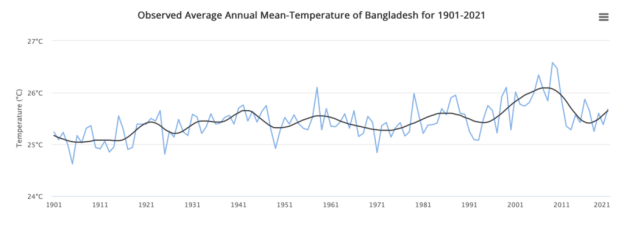
According to figures compiled for the World Bank, the average temperature in Bangladesh is the same today as it was 100 years ago. There are the usual cyclical changes, but global warming is not much in evidence around the Bay of Bengal.
Let’s try rainfall.
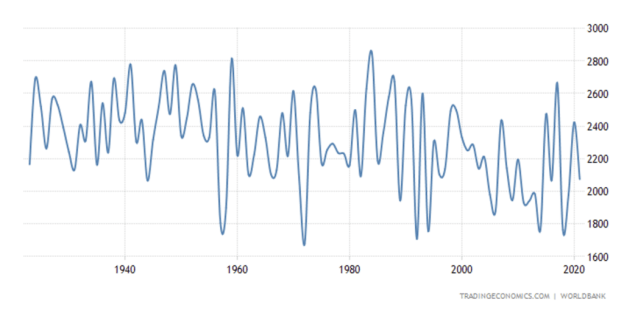
Again according to the World Bank, we see little change in the overall trend going back 100 years. If anything, rainfall has slightly decreased, and there‘s certainly nothing unusual in the recent past. The graph shows that rainfall can vary widely between years. Severe monsoons in the past have caused enormous damage and heavy loss of life. Six catastrophic floods were recorded in the 19th century and 18 in the 20th. These days, hundreds of people can die in the flooding; in the past the figures could run into hundreds of thousands.
In a recent article in Climate Home News, it was said that Bangladeshis were dealing with wave after wave of climate chaos. The article “sponsored” by the international ngo Helvetas told its Western audience that one of the impacts of these disasters is “forced migration”. Of course, this plays into another common climate scare, suggesting, without any discernible evidence, that huge numbers of people will become ‘climate refugees’ in the future, mostly from tropical areas, and inevitably seeking to move northwards to ‘safety’.
Making Bangladesh a poster country for Western Armageddonites spreading the pseudoscientific notion that humans are causing the climate to radically change, does the country few favours. It is sited in many geographically fragile areas, and is prone to tropical cyclones. But over 160 million people are sustained by good agriculture, increased manufacturing development, and economic growth of around 6% per annum.
As countries become more prosperous, they can become more resilient in the face of what nature has always thrown at them. This appears to have happened in the case of Bangladesh, where the number of fatalities from flooding has significantly declined over the last 50 years. Surely, this is the good news story that should be spread in mainstream media, and probably would be if the climate change narrative was not embedded in every part of the discourse.
As we have reported throughout the year, it has been a disastrous period for climate alarmists preaching their gospel of doom to inflict a controlling Net Zero political agenda across the world. Global warming ran out of steam years ago, and no amount of ‘adjusting’ of surface temperature databases can hide that fact. Weather events are cyclical, and attributing any one event to human activity is model-driven junk science. Summer Arctic sea ice stopped declining over a decade ago, but David Attenborough still says it could all be gone by 2035. Polar bears, penguins and coral – all doing nicely thank you. More prosperous and healthier societies are learning to protect themselves against the ravages of Mother Nature. Small increases in carbon dioxide, otherwise known as plant food, continue to green up the planet, leading to higher food yields, reduced famine and healthier eco systems.
Featured Video
Now everyone is dumping US government bonds
or go to
Aletho News Archives – Video-Images
From the Archives
Experts Warned For Years That A War With Iran Would Happen This Way
By Caitlin Johnstone | April 3, 2026
… It’s so wild how we keep seeing reports that Iran’s retaliation caught the US off guard. For all the years I’ve been paying attention to this issue I’ve been reading experts and analysts saying if the US attacks Iran, Iran can close the Strait of Hormuz and strike US bases and the energy infrastructure of US allies in the region.
A few examples:
A 2006 Oxford Research Group paper titled “Iran: Consequences of a War” warned that Iran has numerous options at its disposal in the event of a US attack, and that the “most significant of these would be any possible retaliatory Iranian action to affect the transport of oil and liquefied natural gas through the Straits of Hormuz,” adding that stopping Iran from doing this “would be difficult if not impossible to achieve, leading to a fear of attack which alone would have a formidable impact on oil markets.”
A 2007 Cato Institute paper titled “The Iraq War and Iranian Power” warns that “Iran possesses the largest ballistic-missile inventory in the Persian Gulf — missiles which can reach Israel, Saudi Arabia and US military bases in Iraq,” and that “experts argue Iran could also use the ’oil weapon’: blocking the 34km-wide Strait of Hormuz and conducting submarine and anti-ship missile attacks against ports and oil facilities in Saudi Arabia, Kuwait and other Gulf Cooperation Council states.”
A 2012 NPR article titled “Can Iran Close The World’s Most Important Oil Route?” features then-chairman of the Joint Chiefs of Staff acknowledging that Iran absolutely can block the Strait of Hormuz, saying Tehran has “invested in capabilities” which specifically enable them to do so.
A paper from the Columbia Center on Global Energy Policy and the Center for a New American Security titled “IN DIRE STRAITS? IMPLICATIONS OF US-IRAN TENSIONS FOR THE GLOBAL OIL MARKET” warns of a potential scenario “that includes damage to Gulf oil infrastructure and a temporary closure of the Strait of Hormuz.”
These weren’t a bunch of keffiyeh-wearing peaceniks making these assessments, they were deeply entrenched swamp monsters entirely loyal to the US empire. They opposed war with Iran not because it would be an evil act of unforgivable mass murder, but because it would be bad for the imperial power structure. … Full article
Blog Roll
 Aletho News
- US dismantling international law in its war against Iran while claiming ‘false’ victory: Legal scholar
- One martyr, 5 injuries in US attack on Iraqi border crossing with Iran
- ‘This war is Israel’s war’: World facing ‘security breakdown’, says Qalibaf
- IRGC decries attack on US embassy in Riyadh, says executed by ‘Israel’
- Iran blasts EU hypocrisy as EU invokes international law over Hormuz
- There is no military solution to Strait of Hormuz
- NATO’s structural collapse – the outcome of deviation from reality
- Poll finds world views China better than US
- One Of America’s Leading Neo-Cons Has Turned Against The Iran War And Israel
- Attack in the Bosphorus exposes NATO weaknesses and tensions among allies
- If Americans Knew
- US loses planes over Iran, Israel downgrades Lebanon war goals – Daily Update
- Israel Is Blocking Palestinians from Easter at Church Where Jesus Resurrected
- Plot to assassinate Palestinian activist follows harassment campaign promoted by Zionist groups and elected officials
- Prominent New York synagogue hosts presentation on why U.S. Jews should support the ethnic cleansing of Gaza
- Tapper vs. Piker: Is the CNN Anchor Auditioning for David Ellison?
- Shouldn’t Democrats Be Able to Condemn Genocide?
- Israel-US kill negotiators, destroy civilian structures, but Iran’s military capabilities still largely intact – Daily Update
- ‘War crime’: Global condemnation as Israeli ministers celebrate death penalty law targeting Palestinian prisoners
- 7 Ways Israel Is Turning Lebanon Into Gaza
- World’s Leading Football Bodies Under Fire Over Israel Policies
- No Tricks Zone
- Low Intensity Tornado Wrecks Major Solar Farm, Creating A Potential Toxic Dump
- New Study Finds Warming Saves Lives…Cold Temperatures 12 Times More Deadly Than Excess Heat
- German Science Blog Accuses PIK Climate Institute Of Hallucinating Climate Tipping Points
- Devastating Assessment Of Comirnaty Vaccine By Former Senior Pfizer Europe Toxicologist
- New Study: CO2 Is ‘Effectively Negligible’ As An Explanatory Climate Change Factor Since 2000
- Former Pfizer Toxicologist Dr. Helmut Sterz Tells Bundestag Hearing Pfizer Vaccine Should Have Never Been Approved
- Energy Expert: Germany’s Nuclear Phaseout Was A “500 Billion Euro Mistake”
- New Research: South Australia’s Mid-Holocene Sea Surface Temperatures Were 4°C Warmer Than Today
- Storing Green Energy To Last Germany 10 Days Would Require A 60-Million Tonne Battery
- New Studies: UK Sea Levels Were 4 Meters Higher Than Today During The Mid-Holocene
 Aletho News