White Helmets: War by Way of Deception
By Vanessa Beeley | thewallwillfall | October 23, 2015
“The Ivy League bourgeoisie who sit at the helm of the non-profit industrial complex will one day be known simply as charismatic architects of death. Funded by the ruling class oligarchy, the role they serve for their funders is not unlike that of corporate media. Yet, it appears that global society is paralyzed in a collective hypnosis – rejecting universal social interests, thus rejecting reason, to instead fall in line with the position of the powerful minority that has seized control, a minority that systematically favours corporate interests.” ~ Cory Morningstar
In his recent speech Hezbollah leader, Sayyed Nasrallah, alluded to a multi-phase “soft war” which relies upon the mass media complex to disseminate propaganda and bias, propelling the Middle East into, primarily, a sectarian crisis before descending even further into regionalism and finally a devastating individualism.
Cory Morningstar’s body of work does more than any other to expose the bare bones of the non-profit propaganda industry that governs both our reactions – and inactions, through a network of multi-layered and multi-faceted media manipulation campaigns, of which the end result is mass thought control. She explains:
“The 21st century NGO is becoming, more and more, a key tool serving the imperialist quest of absolute global dominance and exploitation. Global society has been, and continues to be, manipulated to believe that NGOs are representative of “civil society” (a concept promoted by corporations in the first place). This misplaced trust has allowed the “humanitarian industrial complex” to ascend to the highest position: the missionaries of deity – the deity of the empire.”
In a paper entitled, Foreign Aid and Regime Change: A Role for Donor Intent, written just prior to NATO intervention in Libya, Prof. Sarah Blodgett Bormeo describes the “democratization” process for target nations. Unwittingly or wittingly, Bormeo perfectly outlines the role played by NGOs in this process. Bormeo even goes so far as to pinpoint the lack of impartiality rife among NGOs large and small, the majority of whom, receive their funding directly from western government and major corporation sources – all of whom have a vested interest in the outcome of their NGO’s activities and ‘intervention’ in a particular location. Bormeo emphasises the importance of “picking winners” in this scenario, as opposed to respecting and supporting the will of the people in any sovereign nation.
“Thus, it is possible that aid donors, in an effort to avoid further entrenching an “authoritarian” [my edit: this status is decided by donor] regime and perhaps increase the likelihood of democratization, channel funds through NGOs and civil society organizations in authoritarian states.”
In this short video below, we are introduced to the US military’s symbiotic relationship with NGOs in countries [in this instance, Iraq] where the policy is to Induce Pacification & Advance Western Ideologies. NGOs are cynically used to “soften” cultures and render entire communities dependent upon foreign aid in order to facilitate “Democratization”.
In this role, and dependent upon their donor support, NGOs cease to be the neutral, unbiased ‘humanitarian’ organisations they publicly purport to be, and instead become actual covert tools for foreign intervention and regime change. By default, they are assimilated into the Western modus vivendi of “waging war by way of deception” and their purpose is to alter public perception of a conflict via a multitude of media and “marketing” channels.
Following this formula, let’s examine, once more, the role of the Syria Civil Defence aka,’The White Helmets’ currently operating in Syria and take a closer look at their financial sources and mainstream media partners in order to better determine if they are indeed “neutral” as media moguls proclaim these “humanitarians” to be.
White Helmets: Follow the Money
The White Helmets were established in March 2013, in Istanbul, Turkey, and is headed by James Le Mesurier, a British “security” specialist and ‘ex’ British military intelligence officer with an impressive track record in some of the most dubious NATO intervention theatres including Bosnia and Kosovo, as well as Iraq, Lebanon, and Palestine. Le Mesurier is a product of Britain’s elite Royal Military Academy at Sandhurst, and has also been placed in a series of high-profile pasts at the United Nations, European Union, and U.K. Foreign and Commonwealth Office.
The origins of The White Helmet’s initial $300k seed funding is a little hazy, reports are contradictory but subsequent information leads us to conclude that the UK, US and Syrian opposition [Syrian National Council] are connected. Logistical support has been provided by given by Turkish elite natural disaster response team, AKUT.
A further $13 million was poured into the White Helmet coffers during 2013 and this is where it gets interesting. Early reports suggest that these “donations” came from the US, UK and SNC with the previously explored connections to George Soros in the US.
Soros in Syria: ‘Humanitarian’ NGO Deployed For Regime Change, Not Aid
However, subsequent investigations reveal that USAID has been a major shareholder in the White Helmet organisation.
The website for the United States Agency for International Development (USAID) claims that “our work supports long-term and equitable economic growth and advances U.S. foreign policy objectives by supporting: economic growth, agriculture and trade; global health; and, democracy, conflict prevention and humanitarian assistance.”
In a USAID report update in July 2015 it is clearly stated that they have supplied over $ 16m in assistance to the White Helmets.

The USAID track record as a primary US Government/CIA regime change facilitator is extensively documented. From South America to the Ukraine and in the Middle East, USAID serve a malevolent and ultimately destructive role in the dismantling of sovereign nations and their reduction to Western hegemony vassal states, as always, all in the name of freedom and democracy.
“The United States does not lack institutions that continue to conspire, and that’s why I am using this gathering to announce that we have decided to expel USAID from Bolivia” ~ Bolivian President Evo Morales
“USAID and NED are in the business of “Democracy Promotion” which uses public money (from U.S. taxpayers) for secretive operations with the intention to support pro-U.S. governments with the help of political and social movements abroad. The goal is regime change.” ~ Timothy Alexander Guzman
With recent developments in Syria and as a consequence of the Syrian Government requested Russian intervention, we have seen a scramble to justify the shambolic US foreign policy and its clandestine terror operations in Syria. We have previously established the White Helmet connections to this US regime change operation and their undisputed exclusive integration into the Al Nusra and Free Syrian Army [Muslim Brotherhood] and even ISIS networks and strongholds.
Humanitarian’ Propaganda War Against Syria – Led by Avaaz and The White Helmets
After RT and Sott.net among others, exposed the gaping holes in White Helmet propaganda over recycled photographs tweeted even before the alleged Russian bombing had occurred, the propaganda “war” ramped up. The Russian involvement in Syria, did not only betray the US military deception, it also brought some heavyweight media giants of its own into the fray who set about de-constructing the Western media and NGO indoctrination that had, for so long, been largely unchallenged.
At this point the London Telegraph went into damage limitation mode. It published an article expounding the White Helmet humanitarian role in Syria but with admissions of UK Government “majority” funding and that the White Helmets are embedded with ISIS (“in at least one ISIL held area”), claims previously vehemently denied but rendered indisputable after discovery of the photo showing an ISIS mercenary posing directly in front of a White Helmets depot located deep in ISIS held territory south of Yarmouk.

“The Foreign Office is currently the largest single source of funding. It is an irony that if Britain does effectively become an ally of Assad, and starts raids against Isil in Syria, it will be bombing from the air and paying for the bodies to be dug out on the ground. The White Helmets are also operating in at least one Isil-held area.”
Interestingly, the Telegraph stated clearly that the UK Foreign Office is the “largest single source of funding” for the White Helmets which may be perceived as an attempt to draw fire away from the USAID funding which still outstrips official figures released by the British Gov’t who “gifted” £ 3.5 million in equipment to “civil defence teams” in Syria [Report March 2015]. However, the British Government also committed to an additional £ 10m to “increase coordination between the Syrian Interim Government and civil defence teams” to be funded by: UK Government’s Conflict, Security and Stability Fund (CSSF).
It should also be noted here that although cries of ‘regime change!’ from both Washington and London have been muted since Russia entered the Syria conflict, both Washington and London have been supporting their own parallel, hand-picked ‘interim government’ for Syria since at least 2012.
So, with millions in hard cash and equipment being invested into the White Helmets by US & UK donors who have a very clear regime change objective in Syria, it becomes increasingly difficult to perceive their role as anything other than donor-biased propaganda merchants and a ‘humanitarian’ extension of a clandestine terror operation allied to the NATO proxy armies in the region.
White Helmet Leadership
James Le Mesurier: James Le Mesurier has been portrayed as a Humanitarian maverick hero, miraculously in the right place (Istanbul) at the right time, just as the need arose for the formation of a Syria Civil Defence team, perhaps coincidentally, only a few months prior to the now infamous and universally (except for a few diehard propagandists) discredited Ghouta ‘chemical weapon’ attack in August 2013, an event which has already been proven beyond a doubt to be a false flag attack, as well as subsequent accusations levied at the Syrian Government which narrowly failed to precipitate the NATO desired ‘No Fly Zone’.
However, when we delve deeper into the life and times of Le Mesurier we see that it was no happy accident that he was in Istanbul at this juncture. As Sandhurst Military Academy’s top student and recipient of the Queen’s Medal, his chequered career took him from OHR [Office of High Representative] in Bosnia to intelligence co-ordinator in NATO’s newly won prize, Kosovo. We’re told that Le Mesurier left the British Army in 2000 and joined the UN serving as deputy head of the Advisory Unit on ‘Security and Justice’, and Special Representative of the Secretary General’s security policy body within the UN mission in Kosovo. His career then took him to Jerusalem where he worked on implementing the Ramallah Agreement, then to Baghdad as a special advisor to Iraqi Minister of Interior, and to the UAE to train their gas field protection force, and later to Lebanon during the 2006 war. In 2005 he was made Vice President for Special Projects at private mercenary firm Olive Group, and in January 2008 he was appointed as Principal for Good Harbour International, both based in Dubai.
Le Mesurier is also the founder of Mayday Rescue, a “non profit” organisation providing SAR [search & rescue] training to civilians enduring conflict. According to Mesurier’s own biography on the website, Mayday Rescue was founded in 2014, after he had established Syria Civil Defence/White Helmets.

A quick flick through the other Mayday team members reveals some very interesting connections.
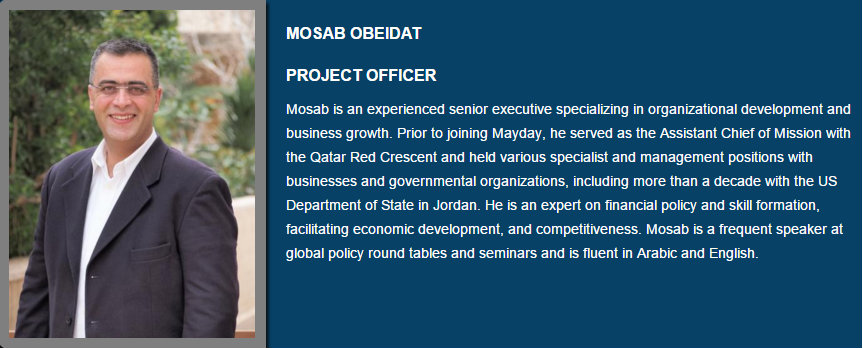
Mosab Obeidat, previous Assistant Chief of Mission with the Qatar Red Crescent, one of whose officials, Khaled Diab was accused of supplying $ 2.2 m to secure arms for the terrorist groups in Syria. Details of this transaction and its exposure can be found in this Al Akhbar article from June 2013.
At least three other members of the team were a part of the Syrian “revolution” including Farouq al Habib, one of the 3 most prominent White Helmet leaders who was also a leader of the Homs uprising against the Syrian government and according to his testimony, was tortured by the Syrian “regime” security forces in 2012 for smuggling a journalist into Syria to “cover” the “peaceful protests”. Habib was a founder member of the ‘Homs Revolutionary Council’ (the CIA have been linked to nearly all ‘Revolutionary Councils in Syria) before fleeing to Turkey in 2013 (A more in-depth analysis of his anti-Syrian government testimony will be presented in Part II of this article).

Le Mesurier is heavily involved in several organisations not mentioned in this article, but for the purposes of demonstrating that the White Helmets should not be considered impartial or neutral as they claim, we will focus on those that best substantiate that argument.
Both Olive Group and Good Harbour International are experts in private “security”. Taken from Sourcewatch on Olive Group:
“Olive Security was founded in 2001 by Harry Legge Burke. Olive lends their quick success to strong relations in the government and military industry. Harry Legge-Burke is an ex-Welsh Guard, and a former aid to chief of defence staff Sir [Charles Guthrie]. He can claim Prince William as a skiing partner and his sister was a nanny to the royal children.
Iraq: Olive were on the ground since the invasion began in 2003, and were able to deploy 38 former SAS employees within two days of the invasion’s completion in 2004
Jonathan Allum, Olive’s former director and co-owner, is also the son of Tony Allum, who is the chairman of the engineering company Halcrow and also the head of the UK government’s Iraq Industry Working Group. It was in the latter position that Tony Allum went to Washington to meet with Bechtel leaders, where he suggested, among other UK companies, Halcrow and Olive as companies worth considering for subcontracted work, all stemming from Bechtel’s $680 million contract with USAID. They were considered and contracts followed, though both Legge-Burke and Allum deny one had anything to do with the other”
In May 2015 Olive Group merged with Constellis Holdings, in whose portfolio we can also find Academi, previously the notorious Blackwater Group [ Nisour Square massacre, Iraq 2007]. Taken from The Atlantic July 2012: Post 9/11, Bush enabled the CIA to subcontract assassinations allegedly targeting Al Qaeda operatives. Blackwater was awarded this contract.
“Running operations through Blackwater gave the CIA the power to have people abducted, or killed, with no one in the government being exactly responsible.”
The CIA can no longer hide its Blackwater/Academi connections, especially after this week’s Wikileaks data dump of CIA director John Brennan’s emails, whose contact list included now spy chief Robert Richer at his Blackwater contact address.
The outsourcing of intelligence operations was in full-swing. What Bush initiated, Obama ran with, awarding Blackwater/Academi a $ 250m contract in 2010 to offer “unspecified” services to the CIA, thus maintaining the apparatus for “unaccountable” covert assassinations.
It is true that James Le Mesurier only joined Olive Group in 2005 and left them in 2008, but his involvement with them and their subsequent merger with Constellis and by default, Blackwater/Academi, gives a degree of valuable insight into the elite intelligence and Pentagon circles that Le Mesurier moved in prior to working for Good Harbour International and creating Syria Civil Defence (not forgetting the USAID funding & influence that underpins both Olive and SCD/White Helmets).
In 2008, Le Mesurier joined Good Harbour International, another private “security” expert organisation, whose CEO is none other than former terror advisor to the Bush administration, the Terror Czar himself, Richard A Clarke.

The jury is still out on whether Clarke was indeed the “whistleblower” he fashioned himself as, post 9/11, or a merely a high-level gatekeeper who aided in preventing a full and detailed investigation into Bush and Rumsfeld’s roles in 9/11.
Patrick Henningsen, a political analyst and writer for 21st Century Wire believes the latter is more likely:
“On first glance, one might buy into the mainstream media’s characterization of him, but it’s more likely that Richard Clarke is not a whistleblower at all. While appearing to oppose the Bush administration from a safe enough distance, I believe his role was inserted into the mix in the period of 2004-2005 in order to VALIDATE the bin Laden mythology and help to portray al Qaeda as an organic, independently run terror organization. He also claimed that Bush and Rumsfeld committed war crimes, but this means nothing because everyone knows that no US official will ever face ‘war crimes’ charges in any court of law anywhere on the planet. It’s effectively a straw man narrative that distracts from the real scandal in the US which is that the entire premise of the war on terror is completely contrived. Clarke’s ‘whistleblower’ status gives him brilliant cover from too much public scrutiny. I remain skeptical of his whole public narrative. He was, is, and always will be an insider.”
What is perhaps even more telling, is Clarke’s reported close ties with Israeli-US operative Rita Katz of the SITE Intelligence Group, another supposedly independent, albeit ‘private’ intelligence firm located in Bethesda, Maryland, a stone’s throw away from CIA headquarters. SITE are said to be responsible for the media release of the harrowing ISIS execution videos, al Qaeda videos, and their credibility has been extensively questioned.
Katz’s long term working relationship with Clarke began before 9/11 when she and her research associate Steve Emerson were commissioned by Clarke to identify Islamic radicals within the US. Over time, Katz’s relationship with Clarke blossomed into a much more extensive one that included regular briefings at both the Clinton and Bush White Houses.
“One of SITE’s founders, Rita Katz, is a government insider with close connections to former terrorism czar Richard Clarke and his staff in the White House, as well as investigators in the Department of Justice, Department of the Treasury, and the Department of Homeland Security, according to SourceWatch. Her father was executed in Iraq as an Israel spy, a fact that suggests a connection to Israeli intelligence.” ~ Mark Taliano
This background on Le Mesurier should at least make us question the media portrayal of an affable, debonair and philanthropic leader of a civilian humanitarian mission. His military & intelligence roots, the fact that despite working for OHR in Bosnia, no visible record of his employment can be found there, his private security-centric career path, his appearance in Istanbul at just the right moment to partner USAID, the UK government & Syrian opposition in creating just the sort of “democratization” enabling NGO as described in our introduction, MUST at least cause us to doubt the transparency and neutrality of the White Helmets in Syria.
In addition, the White Helmet leadership consisting of known Syrian opposition protagonists such as Raed Saleh and Farouq al Habib must make us more cynical about the claims of impartiality and lack of bias and for those who will defend the “peaceful” revolution narrative upheld by Habib and Saleh, please take the time to read Professor Tim Anderson’s in depth analysis of events in Syria pre NATO intervention.
“I have seen from the beginning armed protesters in those demonstrations … they were the first to fire on the police. Very often the violence of the security forces comes in response to the brutal violence of the armed insurgents” – Jesuit priest Father Frans Van der Lugt, January 2012, Homs Syria
“The claim that armed opposition to the government has begun only recently is a complete lie. The killings of soldiers, police and civilians, often in the most brutal circumstances, have been going on virtually since the beginning.” – Professor Jeremy Salt, October 2011, Ankara Turkey
Our presentation of the White Helmets as regime change propagandists & terrorist allies in this article will be further explored and verified in Part II.
“Existing soft power initiatives and agencies, particularly those engaged in development and strategic communications, must be reinvigorated through increased funding, human resources and prioritization. Concurrently, the U.S. government must establish goals, objectives and metrics for soft power initiatives. Furthermore, the U.S. government can better maximize the effectiveness of soft power instruments and efforts through increased partnerships with NGOs. By providing humanitarian and development assistance in areas typically inaccessible to government agencies, NGOs are often able to access potential extremist areas before the government can establish or strengthen diplomatic, developmental or military presence, including intelligence.” — Joseph S. Nye, former US assistant secretary of defence, June 2004
Obama pledged to reduce nuclear arsenal, then came this weapon
By Len Ackland and Burt Hubbard | Reveal | July 14, 2015
 ALBUQUERQUE, N.M. – Standing next to a 12-foot nuclear bomb that looks more like a trim missile than a weapon of mass destruction, engineer Phil Hoover exudes pride. “I feel a real sense of accomplishment,” he said.
But as Hoover knows, looks can be deceiving. He and fellow engineers at Sandia National Laboratories have spent the past few years designing, building and testing the top-secret electronic and mechanical innards of the sophisticated B61-12.
Later, when nuclear explosives are added at the federal Pantex Plant near Amarillo, Texas, the bomb will have a maximum explosive force equivalent to 50,000 tons of TNT – more than three times more powerful than the U.S. atomic bomb dropped on Hiroshima, Japan, 70 years ago this August that killed more than 130,000 people.
The U.S. government doesn’t consider the B61-12 to be new – simply an upgrade of an existing weapon. But some contend that it is far more than that.
Hans Kristensen, a nuclear weapons expert at the nonpartisan Federation of American Scientists in Washington, is resolute that the bomb violates a 2010 Obama administration pledge not to produce nuclear weapons with new military capabilities.
“We do not have a nuclear guided bomb in our arsenal today,” Kristensen said. “It is a new weapon.”
Kristensen’s organization was formed in 1945 by nuclear scientists who wanted to prevent nuclear war. And it’s not the maximum force of the B61-12 that worries him the most on that front.
Instead, he says he fears that the bomb’s greater accuracy, coupled with the way its explosive force can be reduced electronically through a dial-a-yield system accessed by a hatch on the bomb’s body, increases the risk that a president might consider it tame enough for a future conflict.
Congress shared similar concerns in rejecting other so-called low-intensity nuclear weapons in the past. But most of the national criticism of this bomb has focused on its price tag. After it goes into full production in 2020, taxpayers will have spent about $11 billion to build 400 B61-12 bombs. That sum is more than double the original estimate, making it the most expensive nuclear bomb ever.
To Kristensen and others, if President Barack Obama’s pledge was serious, the bomb shouldn’t exist at any price.
How the B61-12 entered the U.S. arsenal of weapons is a tale of the extraordinary influence of the “nuclear enterprise,” as the nuclear weapons complex has rebranded itself in recent years. Its story lies at the heart of the national debate over the ongoing modernization of America’s nuclear weapons, a program projected to cost $348 billion over the next decade.
This enterprise encompasses defense contractors, including the subsidiary of Lockheed Martin Corp. that runs the Sandia labs for the government, as well as the U.S. Department of Energy and the nuclear weapons-oriented wings of the U.S. military – particularly the Air Force and Navy. With abundant jobs and dollars at stake, the nuclear enterprise is backed by politicians of all stripes.
A review of several thousands of pages of congressional testimony, federal budgets and audit reports, plus an analysis of lobbying and campaign contribution data, shows that the four defense contractors running the two New Mexico nuclear weapons labs, Sandia and Los Alamos National Laboratory, enjoy a particularly symbiotic relationship with Congress.
That relationship begins with money.
Since 1998, these four contractors have contributed more than $20 million to congressional campaigns around the nation. Last year alone, they spent almost $18 million lobbying Washington to ensure that funding for nuclear weapons projects continues even as nuclear stockpiles shrink.
Sheila Krumholz, executive director of the Center for Responsive Politics, said the outlay is a bargain considering what’s at stake for the contractors.
“It’s an insignificant cost of doing business relative to the potential income from these contracts,” she said.
In arid, impoverished New Mexico, the nuclear weapons enterprise thrives on particularly close connections between business interests and politicians, doors revolving in both directions and successful efforts to minimize oversight of corporate behavior.
Lawmaker-turned-nuclear consultant
Republican Heather Wilson left Congress in January 2009 after a decade as a New Mexico congresswoman. She had lost her bid to jump up to the Senate seat vacated by her mentor, Pete Domenici.
After losing, she set up a consulting business and, within days of leaving office, Wilson – an Air Force veteran – was consulting mainly for the two New Mexico weapons labs.
Over the next two years, Wilson was paid more than $400,000 by Lockheed’s Sandia Corp. and the consortium of contractors running the Los Alamos lab – to help them extend and expand federal contracts and get more business, according to the first of two scathing inspector general reports. Eventually, the contractors were forced to reimburse the government for the federal funds they used to pay Wilson for her advocacy work.
Asked about the significance of that outcome, the Lockheed communications office responded to Reveal via email: “With regards to the inspector general’s report, Sandia has cooperated with the Inspector General’s review and will continue to do so.” Wilson declined to comment.
Wilson’s support for the labs persisted after she left the consulting business in early 2012 and ran for the Senate again. When the Obama administration cut funding for a Los Alamos lab project, Wilson told the Albuquerque Journal : “Not only is this bad for our country and its national security, it’s bad for New Mexico and our economy.”
For New Mexico, the second-poorest state after Mississippi, nuclear weapons and military bases are undeniably a lifeblood. Out of the $27.5 billion in federal dollars poured into the state in 2013, according to a Pew Charitable Trusts study, about $5 billion went to Los Alamos, Sandia and the Waste Isolation Pilot Plant, the nuclear weapons waste facility east of Carlsbad, where accidents last year exposed dozens of workers to radiation.
Billions more were spent on the state’s four main military bases. The city of Alamogordo, next to Holloman Air Force Base and the Army’s White Sands Missile Range – home of the Trinity Site, where the first atomic bomb was tested in July 1945 – benefits from $450 million a year in military spending, according to the local chamber of commerce.
The labs and bases, and the defense contractors that run or contract with them, also are an integral part of New Mexico’s economic fabric. Los Alamos, Sandia and White Sands are three of the state’s top 10 employers, together providing about 24,000 jobs.
New Mexico politicians helping the labs has a long history in the state, said local political analyst Joe Monahan. It dates back to World War II and the development of the first nuclear bomb under Los Alamos Director J. Robert Oppenheimer.
“The economic impact is the driver of the politics,” Monahan said.
The engineers behind the weapons
At Sandia labs today, engineers such as Hoover and his boss Jim Handrock, director of weapons system engineering, populate the well-paid professional ranks. They turn ideas into weapons.
Nuclear specifications come to them from the two national security physics labs – Los Alamos and Lawrence Livermore National Laboratory in California. They marry those specifications to Pentagon military requirements and design bombs and missile warheads to carry nuclear explosives.
The secrecy of the work is so high that no outside cellphones may be brought into the building, even by Sandia’s public affairs escort. Hoover and Handrock take off their badges before being photographed. National security is their mantra, a value that gained urgency following recent criticism by the National Nuclear Security Administration that Sandia experienced 190 “security incidents” in fiscal year 2014 and the agency’s proposed $577,500 fine for Sandia’s earlier mishandling of classified information.
“We need to make sure that should the president of the United States choose to use the weapons, they will always work, but they will never work in any other situation,” Handrock said.
He joined Sandia labs in 1987 after earning his doctorate in mechanical engineering at the University of Illinois. He has been with the company ever since – first in its small California lab and then in Albuquerque – aside from a several-month special assignment with an Air Force general in Washington in 2008-09.
When Sandia hired Handrock, it was run by a Western Electric Co. subsidiary. He got a new employer in 1993, when Martin Marietta Corp. acquired Sandia Corp. Two years later, Lockheed Corp. and Martin Marietta merged to form the nation’s largest defense contractor.
Similarly influential and powerful companies run New Mexico’s other nuclear facilities. Bechtel Corp., URS Corp. and The Babcock & Wilcox Co. partner with the University of California, Berkeley to operate Los Alamos. URS and Babcock & Wilcox, along with Areva Inc. North America, an offshoot of a large French nuclear company, also manage the Waste Isolation Pilot Plant.
Those four contractors and Areva are heavy hitters in Washington, with a combined 164 lobbyists at their disposal – 70 percent of them former members of Congress, congressional aides or federal officials, according to Reveal’s analysis of Center for Responsive Politics data.
“An army of lobbyists is great,” the center’s Krumholz said. “But an army of insiders who know how to navigate the halls of power, can socialize with politicians on weekends and ultimately play the system like a violin is so much better.”
Lockheed said it simply needs to get its perspectives across to federal officials.
“We routinely communicate our point of view with members of Congress and customers who oversee our programs as well as leaders of congressional districts where Lockheed Martin has a significant business presence,” the company said in its emailed response.
Come campaign season, the contractors remember the New Mexico delegation. In the past two decades, the contractors’ political action committees have donated $430,000 to the state’s senators and members of Congress. Hundreds of company officials chipped in another $350,000. Wilson received more than $250,000 of that between 1998 and 2012, the year she ran for the Senate again – and lost again.
New Mexico senators advocate for labs
New Mexico’s current senators are Democrats Tom Udall and Martin Heinrich. Contributions to their campaigns from defense contractors and company officials fall far short of Wilson’s – less than $100,000 each since 1998. Nonetheless, the two play important roles, sitting on subcommittees that determine funding and policy for the nuclear labs.
Both voted for a December budget bill that funds the labs even though it also waters down campaign finance controls and Wall Street reforms they had embraced.
“Udall and Heinrich are both incredibly liberal in their own way on some issues,” said New Mexico-based political analyst Heath Haussamen. “But they still have to balance that with what people in New Mexico want as far as those jobs and research.”
Jennifer Talhelm, Udall’s spokeswoman, described the budget vote as difficult, given the conflicting priorities
“There’s no question that the labs are a major portion of the economy, especially in Albuquerque and northern New Mexico,” she said. “They employ thousands of people.”
She said Udall also has been a strong supporter of the B-61 bomb program both because of the jobs it brings to New Mexico and its role in national security, though she emphasized that he does not get involved in contract funding decisions.
“You could say he is a big part of why the B-61 program still exists,” Talhelm said.
Heinrich, while a congressman from 2009 to 2013, routinely pressed the Obama administration and Republican leaders to spare the labs from budget cuts and government shutdowns. After he joined the Senate in 2013, he advocated for the extension of a Sandia Corp. federal contract during confirmation hearings for a new energy secretary, Ernest Moniz.
“It is now almost a certainty that the current contract will need to be extended further,” Heinrich wrote in a question submitted to the nominee. “This protracted uncertainty, is beginning to impact Sandia’s leadership and ability to fill key management positions.”
In an email to Reveal, Heinrich’s office said the senator is committed to making sure the labs get full funding.
“The labs also strengthen New Mexico’s economy by providing high-paying, high-skilled technology jobs in our state and Senator Heinrich will always fight to protect their missions,” the statement said.
Another New Mexico lawmaker, Democratic Rep. Ben Ray Luján, formed a congressional caucus with three other representatives in 2012 specifically to look out for the interests of the national labs. He has received $32,000 in donations since 2008 from the contractors’ PACs and company officials. Luján’s office did not respond to requests for comment.
The contractors and labs gain influence and access in other ways as well.
Pete Lyons, a top science adviser to Domenici when he was senator in the mid-1990s, came from the Los Alamos lab, where he was an associate director of various programs. Lyons initially was kept on the Los Alamos payroll and assigned to Domenici as a congressional fellow, according to the news release published when he was named a top Energy Department official.
The Los Alamos lab provided the last two science advisers to New Mexico’s governor, too. Current Gov. Susana Martinez’s office did not respond to requests for comment.
Haussamen, the analyst, said such cozy business-political arrangements are not unusual in New Mexico. “Our state ethics laws are weaker than the federal ones. It’s easier to move back and forth between jobs on the state level.”
Energy Department faces congressional criticism
At Sandia, sand-colored office buildings and an array of laboratories and test facilities dot a 22-square-mile area of Kirtland Air Force Base. Most are identified only by numbers. Building 898 is an exception, its big silver letters spelling out: Pete V. Domenici National Security Innovation Center.

Domenici was a patron of the New Mexico weapons labs and renowned as the Senate’s strongest champion of nuclear weapons for more than three decades, until his 2009 retirement.
His support was crucial in the 1990s after the Cold War ended and the United States and Russia focused on reducing their huge nuclear weapons arsenals.
At the time, many analysts – including Ash Carter, then an assistant secretary of defense and now the secretary – challenged the need for the traditional triad of nuclear weapons delivery systems, which relies on airplanes, intercontinental ballistic missiles and submarines. Many considered nuclear-armed submarines, invulnerable when launched, sufficient to deter the Russians or anyone else from launching a first strike.
During the Cold War, the weapons labs had designed and engineered new nuclear bomb and warhead models almost as fast as Detroit released new car models. After the 1992 U.S. moratorium on explosive nuclear testing, they were instructed to shift their focus to keeping weapons in the nuclear stockpile reliable.
The change at the labs was just one challenge for the Energy Department, which had been reeling since the 1980s from charges that it was mismanaging the nuclear weapons complex – highlighted by the extraordinary FBI raid on the Rocky Flats plutonium bomb factory near Denver in 1989.
Congressional criticism grew as the department closed production plants, shrank its bureaucracy and cut jobs.
In 1999, in the wake of a well-publicized but ultimately unsubstantiated security breach at Los Alamos, Domenici championed a bill to create a new agency to oversee nuclear plants and labs: the National Nuclear Security Administration. An independent agency would give the nuclear enterprise more autonomy.
Domenici tangled with then-Energy Secretary Bill Richardson, a Democrat and former New Mexico congressman, over the department’s role. Richardson, who would become New Mexico’s governor four years later, argued that the Energy Department was addressing its problems and that a new agency was unnecessary.
In the end, a compromise was reached. The new agency became semiautonomous, with its own bureaucracy but Energy Department oversight.
Domenici declined to comment. Robert Alvarez, then a senior policy adviser to Richardson, told Reveal that even though Domenici succeeded in establishing the national nuclear agency, “it didn’t work out so well for Domenici, because he had an archenemy running the House energy and water subcommittee – David Hobson.”
Hobson was a conservative Ohio Republican who shot down several nuclear weapons enterprise proposals before leaving office. “He didn’t have any (Department of Energy) facilities in his backyard, and he was basically being fiscally responsible,” Alvarez said.
Foreshadowing the current B61-12 program, the national nuclear agency proposed new warheads and a new plant at Los Alamos to replace Rocky Flats, the by-then-closed bomb factory near Denver. Hobson led a congressional charge that at first seemed to derail the proposal.
“We cannot advocate for nuclear nonproliferation around the globe and pursue more usable nuclear options here at home,” he said in August 2004.
But Hobson’s concerns proved no match for the nuclear enterprise.
Defense contractors assail oversight agency
Eventually, the national nuclear agency came under fire from the defense contractors, which claimed that it was stifling and nitpicking by, for instance, micromanaging lab decisions.
The Energy Department’s inspector general, Gregory Friedman, laid out the problems to a House oversight committee in September 2012. The lab directors complained that “the effectiveness and efficiency of their operations” were being impeded, he told the committee.
“The heart of these assertions,” he continued, “is that oversight of contractors has been excessive, overly prescriptive and burdensome.”
Three months later, Tom Udall – the New Mexico senator – co-sponsored an amendment to the defense budget with Sen. Jon Kyl, R-Ariz., to create a 12-member congressional advisory panel to overhaul lab oversight. Jennifer Talhelm, Udall’s spokeswoman, said he wanted to address what he considered legitimate concerns about oversight.
The measure passed as part of the defense spending bill, the piece of legislation most lobbied by Lockheed that year. Half of the panel members eventually appointed by Congress had connections to the nuclear labs.
One of the panel’s co-chairmen was the former chairman of Lockheed, and its other co-chairman was on the board of Babcock & Wilcox. Heather Wilson was appointed, too, even as the audits scrutinizing her consulting work continued.
Others included a former Los Alamos executive director, a member of the Sandia Corp. board and a former California congresswoman, Ellen Tauscher, a member of the Los Alamos Board of Governors.
As the panel deliberated over the next year and a half, Lockheed and Babcock & Wilcox together spent $16 million lobbying the federal government and donated $3 million to members of Congress.
The panel’s report, issued late last year, blasted the national nuclear agency, calling it dysfunctional because, among other things, it lacked “proven management practices.” It said the agency’s oversight of the labs had generated “misunderstanding, distrust, and frustration.” The report called for the Energy Department to reduce the agency’s lab audits, inspections and general oversight.
Energy Department officials did not respond to requests for information on whether any changes have occurred.
Inspector general’s second audit
While that panel was finishing up its report, a second special audit of Wilson’s contract work by the inspector general delved into the question of whether taxpayer dollars had been used illegally for lobbying. In outlining its findings, the audit offered a rare behind-the-scenes look at pressure from Lockheed and Sandia officials to get their federal contract extended without an open bidding process.
In September 2012, the Sandia labs’ federal contract had been set to expire, and the Energy Department already had signaled that it would open it for bids.
Three years earlier, the audit found, a team of Lockheed and Sandia officials had come up with a detailed plan that included enlisting the New Mexico congressional delegation to pressure then-Energy Secretary Steven Chu to extend the contract by lobbying the chairmen and members of key committees.
One memo advised Sandia officials to tell members of the New Mexico delegation to contact Chu directly and let him know that they expect “a contract extension and will follow the matter with personal interest,” the inspector general wrote.
Another memo described a meeting with the national nuclear agency administrator. It said the administrator told company officials that he “has no problem interfacing with Congress and committees on the matter of a Sandia contract extension.”
Other documents showed that one Lockheed official had sent a memo to Chu saying the company wanted the contract extended under the “same terms and conditions,” and another official recommended “if the answer was not in the affirmative, then Lockheed Martin/Sandia should seriously consider initiating some heavy Congressional support.”
Sandia also hired two former employees of the National Nuclear Security Administration as consultants, at least one of whom previously had oversight authority at the lab, according to the full version of the inspector general’s internal report. Their names were redacted from the report, released to The Center for Public Integrity earlier this month.
The investigation also unearthed notes from a meeting during which Wilson’s firm advised that “Lockheed Martin should aggressively lobby Congress, but keep a low profile.”
The contract, giving Sandia Corp. control of an annual lab budget of about $2.4 billion, was extended four times, initially for a year and then twice more for three months each. Finally, in March 2014, it was extended for two more years with the possibility of a third year.
The approach was nothing new: The inspector general unearthed an earlier Sandia Corp. memo that said similar tactics had been used in 2003 to secure a no-bid extension.
The inspector general’s report also exposed details of the relationship between the labs and New Mexico politicians, noting that the delegation routinely received legislative wish lists from Sandia.
“Specifically, each year the New Mexico Congressional Delegation requested that SNL (Sandia National Laboratories) provide them with information on ongoing and future national security and science research,” the report said. “Included in this package was a ‘Next Steps’ or ‘What Could Congress Do’ section, which sometimes included funding requests or expressed an opinion on a Congressional matter.”
This, the inspector general said, could be construed as using federal funds for lobbying activity.
After the audit’s release in November, Wilson issued a statement denying that she lobbied any federal officials to extend the contract and called the report wrong.
Sandia Corp. said it took “these allegations seriously” and was confident it could work out the issues with the Energy Department.
But in its email to Reveal, the Lockheed communications department said such efforts are part of its job. “Sandia routinely provides the New Mexico delegation with information concerning the labs,” it responded. “As a federally funded research and development center, an aspect of Sandia’s performance of its mission encompasses providing information to the federal government including Congress.”

Initially, the inspector general’s report stirred up some public furor, recalled political analyst Joe Monahan, but it quickly died down.
“There is a long leash on this stuff because, again, money talks,” he said. “You’re talking about billions of dollars, thousands of employees, and no one wants to see the egg crack.”
U.S., Russia agree to reduce stockpile
The nuclear weapons enterprise has had plenty at stake in recent years.
In Prague in 2009, Obama called for the elimination of nuclear weapons. A year later, he and Russian leader Dmitry Medvedev signed the New Strategic Arms Reduction Treaty calling for each country to reduce its deployed strategic warheads to 1,550 by 2018, down from estimates of more than 1,900 for the United States and more than 2,400 for Russia.
Ratification of the treaty required a two-thirds majority vote in the Senate, which followed in December 2010 after considerable debate and negotiation. Defense hawks and their allies exacted a price for the treaty vote: an Obama administration agreement to support $85 billion in nuclear weapons modernization over a decade.
That number has more than quadrupled since to $348 billion, according to the Congressional Budget Office. Other studies say the cost of nuclear weapons could top $1 trillion over the next 30 years, not counting hundreds of billions of dollars for related projects, such as the cleanup of former nuclear weapons production sites.
Sandia and Los Alamos benefited greatly from the Capitol Hill bargaining. Ten of the 19 modernization capital projects approved by the national nuclear agency and 15 of the 36 proposed capital projects for the nuclear security system are based at the two labs, according to the Government Accountability Office.
The B61-12 bomb’s Life Extension Program at Sandia is among those projects. This year, the $643 million for that program accounts for more than a third of Sandia’s $1.8 billion Energy Department budget.
“It’s the largest nuclear weapons program we have going on at Sandia currently,” said Jim Handrock, the lab’s weapons systems director.
But the program hasn’t experienced perfectly smooth sailing in Congress.
A 2012 Pentagon study concluded that the B61-12 bombs would cost $10.4 billion for development and production, excluding at least $1 billion for the new tail kit, more than double the national nuclear agency’s original estimate. That overrun influenced the Senate Appropriations Committee’s vote the following year to chop by one-third the Obama administration’s $537 million budget request for fiscal year 2014, over strong objections from committee member Udall.
House-Senate negotiations on the omnibus budget bill at the end of 2013 restored the full amount for the B61-12. Udall trumpeted the outcome.
“I’m also very pleased that we were able to reverse an attempt to cut funding for the B61” Life Extension Program, his news release said. “A cut would have harmed our effort to keep our nuclear weapons stockpile safe and secure, and it would have put jobs at risk at our national labs.”
Concern over bomb’s capabilities
The bomb’s name, B61-12, reflects its position as the 12th model of what the government calls a family of bombs. It is descended from the first U.S. hydrogen bomb tested in the Marshall Islands in 1952, which used a plutonium bomb to detonate a thermonuclear explosion 520 times more powerful than the plutonium bomb tested seven years earlier at the remote Trinity Site south of Albuquerque.
Today’s stockpile contains five B61 models, including three tactical versions intended for short-range warfighting. The new B61-12 will consolidate those three models and one more highly explosive strategic bomb, using the nuclear package from one of the existing models.
Unlike the free-fall gravity bombs it will replace, the B61-12 will be a guided nuclear bomb. Its new Boeing Co. tail kit assembly enables the bomb to hit targets precisely. Using dial-a-yield technology, the bomb’s explosive force can be adjusted before flight from an estimated high of 50,000 tons of TNT equivalent force to a low of 300 tons.
And that’s where the debate over the B61-12 moves beyond cost overruns, zeroing in on the granular details of its capabilities.
Congress rejected funding for similar nuclear weapons at least twice during the past 25 years, saying enhanced precision coupled with less force would lead to less collateral damage – such as radiation fallout that could harm allies – and thus a greater likelihood that the military would recommend that the president use the weapons.
Obama, following the lead of Presidents Bill Clinton and George W. Bush, laid out the role of nuclear weapons in U.S. strategy in an April 2010 document entitled the “Nuclear Posture Review Report.” It stated that the fundamental role of nuclear forces is to deter nuclear attack.
“Indeed, as long as nuclear weapons exist, the United States will sustain safe, secure, and effective nuclear forces,” the review said. “These nuclear forces will continue to play an essential role in deterring potential adversaries and reassuring allies and partners around the world.”
Obama pledged that the United States would produce no new nuclear warheads and that life extension programs of existing weapons would not provide “new military capabilities.”
Officials from the Obama administration, Pentagon and Energy Department continue to argue that the B61-12 stays within the bounds of that pledge by modernizing an aging family of bombs and in the process ensuring a reliable nuclear arsenal to scare off adversaries.
Air Force Gen. C. Robert Kehler, then the commander of the U.S. Strategic Command, testified about the B61-12 program at an October 2013 congressional subcommittee hearing.
“This consolidation offers opportunities for cost savings and significant stockpile reductions while maintaining U.S. national security objectives and extended deterrence commitments,” Kehler said.
After that hearing, subcommittee member Rep. Jim Cooper, D-Tenn., submitted a written question to Assistant Secretary of Defense Madelyn R. Creedon, who also had testified at the hearing. He noted that the administration had pledged to add no new nuclear weapon capabilities.
“Specifically on the B61, the lower yield is being compensated by higher accuracy provided by a new tailkit … would this provide new capability?” Cooper asked.
Creedon responded in writing that “the B61-12 tail-kit assembly (TKA) does not provide a new capability to the weapon. The TKA simply improves the reliability of the bomb.”
Today, Cooper indicates he was satisfied with that response.
“Ms. Creedon is a dedicated public servant who testifies before our subcommittee in both public and classified hearings,” he told Reveal in an email. “The transition of the B-61 from a gravity bomb to one with a tail kit should make it a more reliable weapon without changing its basic nature.”
Back at Sandia, engineer Phil Hoover is the one in charge of integrating the tail kit instruments with those inside the footwide weapon’s body, which includes more than 30 major components such as radar along with thousands of other parts.
“The tail kit provides the ability to get more accuracy,” he said. “We’re reducing the potential for collateral damage.” This kind of guided system, he continued, is “consistent with our digital aircraft today.”
High on the list of aircraft that could carry the bomb is Lockheed’s new F-35 fighter jet. This stealth plane, designed to evade radar, is a $400 billion weapon delivery system that has been plagued by technical problems and cost overruns.
The idea of stealth fighters carrying B61-12 nuclear bombs worries some outside experts, including Hans Kristensen of the Federation of American Scientists.
“If the Russians put out a guided nuclear bomb on a stealthy fighter that could sneak through air defenses, would that add to the perception here that they were lowering the threshold for the use of nuclear weapons?” he asked. “Absolutely.”
Hoover said questions about warfighting scenarios involving the B61-12 are not his purview.
“It’s something the Air Force and the warfighters should address,” he said. “It’s really not for us to comment on.”
Hoover referred Reveal to the U.S. Strategic Command, or STRATCOM, a command of the Defense Department that is in charge of nuclear weapons. After requesting written questions, STRATCOM referred Reveal to the Air Force.
Maj. Kelley Jeter, an Air Force spokeswoman, declined Reveal’s interview request but agreed to answer questions via email. Asked what effect stealth fighter jets carrying low-yield B61-12 nuclear bombs would have on an adversary during a conflict, she responded: “To effectively deter potential adversaries, the weapons and platforms fielded by the Air Force must credibly provide options for the President to demonstrate U.S. resolve and support deterrence options for the President to deal with emerging crises.”
But, she added, “the B61-12 will not provide new military capabilities.”
This story was edited by Amy Pyle and copy edited by Sheela Kamath and Nikki Frick.
Len Ackland can be reached at lenackland@gmail.com, and Burt Hubbard can be reached at burt.hubbard@gmail.com.
Nuclear Site Safety Official Fired After Her Repeated Warnings of Safety Problems
By Noel Brinkerhoff | AllGov | February 21, 2014
Yet another official at the nation’s most challenging environmental cleanup project has been fired after raising serious safety concerns.
This time it was Donna Busche, the head of nuclear safety for cleaning up the former nuclear weapons site at Hanford, Washington, which sits atop 53 million gallons of radioactive waste stored in underground tanks.
Busche, a nuclear engineer who oversaw a staff of 140, was fired by her employer, URS Corp., one of the federal contractors hired by the U.S. Department of Energy to resolve the Hanford mess.
“The Energy Department’s overall safety culture is broken and all they are doing now is sitting idly by,” Busche told the Los Angeles Times.
Her termination came after she repeatedly warned company executives that the radioactive-waste solution being used was flawed and posed safety problems.
URS denied that her firing had anything to do with her safety complaints, saying she was let go for “unprofessional conduct.”
Busche was the second senior project official fired at Hanford. A third official resigned, after citing safety-related concerns with the $13.4-billion construction project.
Walter Tamosaitis, who headed research at URS, was fired in 2013 after he questioned whether the company’s decision to mix the waste in large tanks might result in a buildup of hydrogen gas, which can explode.
In addition, Gary Brunson, the Energy Department’s engineering division director at Hanford, quit after warning of nearly three-dozen problems not being addressed by another site contractor, Bechtel.
But the worries don’t stop there. The Energy Department’s inspector general and other federal investigators have also warned of management and safety issues at Hanford. With 150 aging nuclear-waste tanks, many of which are leaking, it’s the largest cleanup project leftover from the Cold War.
To Learn More:
Official Who Raised Safety Concerns at Hanford Nuclear Site is Fired (by Ralph Vartabedian, Los Angeles Times)
Whistle-Blower Fired From Hanford Nuclear Site (by Nicholas K. Geranios, Associated Press)
As Hanford Radioactive Leak Continues, Clean-Up Contractor Pays Fraud Penalty (by Noel Brinkerhoff, AllGov)
Six Underground Tanks Leaking Nuclear Waste in Washington State (by Noel Brinkerhoff and Danny Biederman, AllGov)

Featured Video
Prof. Ted Postol: Iran Already Achieved Nuclear Deterrence Against Israel
or go to
Aletho News Archives – Video-Images
From the Archives
How the occupied mentality syndrome works
Saudi Arabia on the American chessboard – Part 3
By B. J. Sabri | American Herald Tribune | June 27, 2016
Read part 2: “The occupied mentality Syndrome“
Previously I argued whether Saudi Arabia’s repeated involvements in U.S. interventions and wars stem from free national will or in response to a specific condition. For starters, in Saudi Arabia there is no national will. In Saudi Arabia, the national will is the will of the Al Saud clan. Still, when a major Arab state allies itself with a superpower that committed unspeakable crimes against humanity in almost every Arab country, then something is wrong. This fact alone should compel us to examine the U.S.-Saudi relation for one exceptional reason. As a result of the U.S.-Saudi wars, hundreds of thousands of people in Afghanistan, Iraq, Iran, Libya, Syria, Yemen, and Somalia have lost their lives. Millions became displaced in their own homelands. And millions more rendered refugees.
Attributing the Saudi policies to the bonds of “partnership” with the U.S. is frivolous. There are no bonds between these two thugs except those of business, military deals, secret plots, and wars. Proving this point, bonds such as these have no space for the American and Saudi peoples to share significant cultural or societal exchanges. If partnership is not the reason for the Saudi contribution to the U.S. strategy of empire and imperialism, then another reason must exist.
This leads to three possibilities. … continue
Blog Roll
 Aletho News
- NIAID/NIH and USDA Fund Bioengineered Chimeric Influenza Viruses Built Using Pandemic H1N1 Components: Journal ‘Science Advances’
- Hezbollah hits Israeli warship off Lebanon’s coast, sets it aflame
- Iran slams US strikes on B1 bridge, Mahshahr petrochemical plants as ‘blatant acts of state terrorism’
- In letter to UN chief, Araghchi warns of dire consequences of US-Israeli attacks on Iran’s nuclear facilities
- Why the CIA conspiracy to invade Iran with Kurdish militias failed
- Why Are Upbeat US Claims About Mission to Rescue Pilot ‘Highly Questionable’?
- Aircraft destroyed during US ‘rescue’ of downed F-15 pilot cost more than $100 million each
- Washington University removes professor who condemned US-Israeli war on Iran
- Russia Warns of Retaliation as UK Authorizes Seizure of Vessels
- Serbia thwarts plot to bomb Russia-Hungary gas pipeline – Vucic
- If Americans Knew
- In Iran, Israel-US take aim at “reason, research, and freedom of thought” – Daily Update
- US loses planes over Iran, Israel downgrades Lebanon war goals – Daily Update
- Israel Is Blocking Palestinians from Easter at Church Where Jesus Resurrected
- Plot to assassinate Palestinian activist follows harassment campaign promoted by Zionist groups and elected officials
- Prominent New York synagogue hosts presentation on why U.S. Jews should support the ethnic cleansing of Gaza
- Tapper vs. Piker: Is the CNN Anchor Auditioning for David Ellison?
- Shouldn’t Democrats Be Able to Condemn Genocide?
- Israel-US kill negotiators, destroy civilian structures, but Iran’s military capabilities still largely intact – Daily Update
- ‘War crime’: Global condemnation as Israeli ministers celebrate death penalty law targeting Palestinian prisoners
- 7 Ways Israel Is Turning Lebanon Into Gaza
- No Tricks Zone
- An Inconvenient Tree: Uncovered In Alps… Europe Much Warmer Than Today 6000 Years Ago
- New Study Reports A 60% Slowdown In Greenland’s Ice Loss Rate In The Last Decade
- Low Intensity Tornado Wrecks Major Solar Farm, Creating A Potential Toxic Dump
- New Study Finds Warming Saves Lives…Cold Temperatures 12 Times More Deadly Than Excess Heat
- German Science Blog Accuses PIK Climate Institute Of Hallucinating Climate Tipping Points
- Devastating Assessment Of Comirnaty Vaccine By Former Senior Pfizer Europe Toxicologist
- New Study: CO2 Is ‘Effectively Negligible’ As An Explanatory Climate Change Factor Since 2000
- Former Pfizer Toxicologist Dr. Helmut Sterz Tells Bundestag Hearing Pfizer Vaccine Should Have Never Been Approved
- Energy Expert: Germany’s Nuclear Phaseout Was A “500 Billion Euro Mistake”
- New Research: South Australia’s Mid-Holocene Sea Surface Temperatures Were 4°C Warmer Than Today
 Aletho News