Iran condemns ‘biased’ IAEA, announces enrichment countermeasures
Al Mayadeen | June 12, 2025
Iran has sharply rejected a resolution passed by the International Atomic Energy Agency’s (IAEA) Board of Governors, accusing it of being “politically driven” and “biased”. In a joint statement released Thursday by the Foreign Ministry and the Atomic Energy Organization of Iran (AEOI), Iranian officials condemned the resolution and unveiled a series of countermeasures aimed at accelerating the country’s nuclear program.
This comes shortly after the IAEA Board of Governors passed a resolution against Iran on Thursday, claiming Iran was in breach of non-proliferation obligations. The vote passed with 19 countries voting in favor, 3 opposing, and 11 abstaining, according to diplomats cited by Reuters. Two countries were absent and thus did not vote.
The resolution, marking the first formal accusation in nearly two decades that Iran has violated its nuclear non-proliferation obligations, was passed during a closed-door session of the 35-member board. The move, described as “politically motivated” by Iranian officials, was initiated by the United States along with the E3, Britain, France, and Germany.
IAEA resolution lacks ‘neutrality’
The joint statement asserted that Iran remains committed to its obligations under the Safeguards Agreement, adding that no IAEA report to date has ever confirmed any deviation or non-compliance. Iranian authorities described the IAEA’s latest move as lacking “neutrality” and being manipulated by Western powers, particularly the United States, Britain, France, and Germany, to pursue geopolitical goals.
In a direct response, Iran announced the activation of a new uranium enrichment facility at a secure site and plans to upgrade the Fordow nuclear plant by replacing older centrifuges with sixth-generation advanced models.
Iran blasts Western double standards on nuclear disarmament
Iranian officials criticized the IAEA and its Western backers for what they described as selective enforcement of nuclear obligations. The joint statement accused the US and its European allies of reviving “25-year-old allegations” that had already been settled under the 2015 nuclear deal, while turning a blind eye to “Israel’s” undeclared nuclear arsenal and refusal to adhere to the Non-Proliferation Treaty (NPT).
“The United States, Britain, and France have failed to comply with Article VI of the NPT regarding nuclear disarmament,” the statement read, adding that Germany remains in possession of “inhumane weapons of mass destruction.”
Iran further warned that continued political maneuvering within the IAEA would render any future engagement futile. “This political approach toward Iran, which has always honored its obligations and cooperated extensively with the Agency, forces us to conclude that the path of engagement and cooperation is futile,” the statement asserted.
Iran thanks allies opposing the resolution
Iran’s Foreign Ministry spokesperson, Esmaeil Baghaei, strongly condemned the resolution passed Thursday by the IAEA Board of Governors, calling it a politically motivated effort by Western powers to undermine the peaceful nature of Iran’s nuclear program.
Baghaei specifically denounced the role of the United States, the United Kingdom, France, and Germany, accusing them of exploiting the IAEA to “cast doubt on the peaceful nature of Iran’s nuclear program.”
He firmly rejected the allegations outlined in the resolution, which he said were based on “baseless and unfounded claims” and stemmed from a political report by the IAEA Director General. The resolution, jointly submitted by the four Western states, was described as “an unjustified, groundless, and cruel move,” aimed at exerting “maximum pressure on Iran to deviate from the legitimate rights and interests of the Iranian people in the peaceful use of nuclear energy.”
Baghaei warned that those behind the resolution will be held accountable for its repercussions. “The Islamic Republic of Iran will take proportionate measures in response to this move to secure and protect the interests and inalienable rights of the Iranian nation in benefiting from peaceful nuclear energy,” he said.
He also expressed deep concern over the conduct of the IAEA Director General, criticizing his public statements and what he described as provocative interviews on Iran’s nuclear activities. Baghaei accused the agency chief of undermining the organization’s neutrality, stating that he “must adhere to his missions and duties in accordance with the Agency’s statute.”
Furthermore, the Iranian diplomat extended gratitude to China, Russia, Venezuela, Cuba, Nicaragua, and Belarus for issuing a joint statement rejecting the resolution. He praised their “responsible and legal positions” and reaffirmed the Iranian nation’s determination to defend its rights and interests as outlined in the United Nations Charter and the Non-Proliferation Treaty.
Iran’s IAEA representative Najafi slams politicized resolution
Iran’s representative at the International Atomic Energy Agency (IAEA), Reza Najafi, strongly criticized the agency’s recent resolution against Iran, denouncing it as politically motivated and based on unreliable sources. Speaking on Thursday, Najafi warned that such moves undermine the IAEA’s credibility and threaten the rights of member states under its founding charter.
Najafi emphasized that any draft resolution brought forward by the Board of Governors should rely strictly on unbiased, verifiable evidence, not intelligence supplied by specific states with vested interests. “Basing reports on questionable or politicized information undermines the agency’s objectivity,” he stated, in clear reference to data provided by Western governments and the Israeli occupation.
US current approach risks setting a dangerous precedent
He warned that the United States’ current approach risks setting a dangerous precedent, one that could erode trust and cooperation between the agency and its member states. Najafi asserted that such behavior contradicts the IAEA’s stated commitment to impartiality and transparency.
Reaffirming Iran’s position, Najafi made it clear that the Islamic Republic would not tolerate any attempt to erode its sovereignty through international pressure.
“Iran categorically rejects any pressure or mediation that seeks to undermine its sovereignty. We will defend our national interests, independence, and dignity,” he declared.
Politicized resolution in disguise
Najafi also expressed Iran’s outright rejection of what he described as a politicized resolution disguised as a technical safeguard concern, echoing Tehran’s longstanding understanding that the IAEA is being used as a tool for Western geopolitical agendas.
In a pointed warning to the E3, Britain, France, and Germany, as well as the United States, Najafi made it clear that Iran’s response would be firm. “These measures will not pass without consequences. They must take full responsibility for the repercussions and Iran’s strong reaction,” he said.
Kamalvandi: Political pressure will escalate Iran’s nuclear program
Behrouz Kamalvandi, Deputy Head of the Atomic Energy Organization, reinforced the government’s defiant tone, declaring that political pressure would only accelerate Iran’s nuclear ambitions.
“It is a strategic mistake to think that political pressure will push Iran to abandon its legitimate positions,” Kamalvandi said, warning that the current approach would “backfire”.
He confirmed that Iran would soon launch a third uranium enrichment facility, in addition to boosting enrichment capacity at existing sites. “We will develop sixth-generation centrifuges and increase uranium enrichment significantly,” he stated.
More Western pressure, more Iranian countermeasures
Iran’s latest response underscores its growing rejection of Western pressure and marks a new phase in the country’s nuclear trajectory, one increasingly independent of multilateral negotiations and oversight mechanisms perceived by Tehran as compromised.
This development comes just days ahead of the sixth round of indirect nuclear talks between Iran and the United States, set to take place this Sunday in Muscat, Oman. The announcement was confirmed by Omani Foreign Minister Badr Albusaidi, who wrote in a post on X: “I am pleased to confirm the 6th round of Iran-US talks will be held in Muscat this Sunday, the 15th.”
Tehran and Washington have held five rounds of talks since April to carve a new nuclear deal to replace the 2015 accord that Trump unilaterally withdrew from during his first term in 2018.
Iran expects boom in trade after gaining EAEU’s observer status
Press TV – December 29, 2024
Iran expects a major boom in trade ties with members of the Eurasian Economic Union (EAEU) after the country gained observer status in the bloc and just months before the two sides enter into a free trade agreement.
Iran’s trade minister Mohammad Atabak said on Sunday that observer membership in the EAEU will enable Tehran to increase its presence in the bloc’s meetings and exchange more trade and economic information with its members.
Atabak made the remarks after returning from an EAEU Supreme Council meeting in Saint Petersburg, Russia, where he signed the agreement for Iran to become an observer member in the bloc on December 26.
During the meeting, EAEU members also gave their final endorsement to a free trade agreement signed between Iran and the bloc last year. The agreement, which has been ratified by parliaments of both Iran and five EAEU members, will officially come into effect in the next two months after Iran’s Guardian Council, which vets legislation passed by parliament, approves the deal.
Atabak said that the free trade deal with the EAEU will eliminate tariffs on nearly 87 percent of Iranian exports to members of the bloc, namely Russia, Belarus, Kazakhstan, Kyrgyzstan, and Armenia.
He expected that trade between Iran and the EAEU would increase several times with the implementation of the free trade deal.
“The Eurasian region is a very good market for Iranian goods. Iranian technical and engineering companies can also expand their activities in these countries,” he said.
The minister said that Iran is planning to hold a major trade exhibition in Tehran in the coming months to showcase its economic and trade potential to EAEU countries.
Kremlin comments on Türkiye’s SCO bid
Türkiye’s obligations to the US-led military bloc are not consistent with the Eurasian organization’s values, Moscow has said.
RT | July 12, 2024
Türkiye’s bid to become a full member of the Shanghai Cooperation Organization (SCO) is not compatible with its membership in NATO, Kremlin spokesman Dmitry Peskov said on Friday.
Last week, Turkish President Recep Tayyip Erdogan attended a summit of the Eurasian mutual defense group, in which his nation has observer status. While returning home from Kazakhstan, he told journalists that Ankara wants to “further develop” ties with the SCO and its founding members Russia and China. During the NATO leaders’ summit in the US this week, he said Türkiye wants to join the SCO as a permanent member.
Asked by journalists when Turkish accession could be expected, Peskov said there was a problem with such a proposal.
“There are certain contradictions between Turkish commitments and [its] position on fundamental issues as a NATO member and the worldview formulated in the founding documents of the SCO,” he explained.
The expansion of the SCO is of interest to many nations and remains on its agenda, but there is no specific timeline for accepting new members, he added. Commenting later during a press call on bilateral relations with Türkiye, Peskov said Russia was “open for attempts to reach agreements based on a certain worldview.”
Moscow perceives NATO as a hostile, aggressive military organization, which serves US geopolitical interests and is currently conducting a proxy war against Russia in Ukraine.
Despite being a NATO member state, Türkiye has maintained a neutral stance on the Ukraine conflict, refusing to impose economic sanctions on Russia and serving as an intermediary between Moscow and Kiev on several occasions. Ankara helped to mediate a nascent peace deal in the early months of the hostilities, which Kiev eventually ditched in favor of continued fighting. The Russian government believes that the US and its allies, particularly the UK, forced Ukraine to reject the proposal.
The SCO was founded in 2001 and currently has ten full members: Russia, China, India, Iran, Kazakhstan, Kyrgyzstan, Pakistan, Tajikistan, Uzbekistan, and Belarus. Kazakhstan holds the rotating presidency this year and hosted the leaders of member states on July 3 and 4 in Astana.
One of the key pledges to which SCO members subscribe is not to seek the improvement of their own national security at the expense of the national security of other parties. NATO policy does exactly that, according to its critics, including Russia.
Putin affirms Taliban as allies against terrorism
Al Mayadeen | July 4, 2024
Russian President Vladimir Putin affirmed the Taliban’s role as allies in the fight against terrorism during a press briefing on Thursday.
Despite the Taliban being under UN sanctions for terrorism, Putin acknowledged their control over Afghanistan and stressed the necessity of maintaining relations with the country’s real political forces.
“The Taliban movement have made certain commitments … but in general we have to assume that the Taliban control the power in the country. And in that sense, the Taliban are certainly allies for us in fight against terrorism,” Putin stated, noting ongoing signals of cooperation from the Taliban on counterterrorism efforts.
Regarding Afghanistan’s potential full membership in the Shanghai Cooperation Organization (SCO), Putin remarked that this decision concerns all SCO members, and not solely Russia.
Russia-Belarus Union State Unified Parliament
Switching focus, Putin addressed internal matters, including the creation of a unified parliament for the Union State of Russia and Belarus.
He described it as a matter of time, suggesting readiness for deeper integration, potentially including a common currency in the future.
“We also have intra-parliamentary structures and intergovernmental ones. Is it necessary now to move, as it was initially stated, to the creation of a unified parliament? It is a matter of time,” Putin told reporters.
Turko-Russian Relations
Furthermore, Putin expressed Russia’s keen interest in developing relations with Turkey, despite challenges.
“In general, on both sides there is interest in this… natural [interest], related not to the fact that someone is standing in our way, but to the real development of events in Turkey,” Putin told reporters, acknowledging Turkish President Recep Tayyip Erdogan’s political will as conducive to strengthening Ankara-Moscow ties.
Ending Ukraine Conflict
Conclusively, on the topic of resolving the Ukraine conflict through mediators, Putin asserted that while Russia remains open to negotiations, a resolution solely through mediation appears unlikely due to the complexities involved.
“We have always been in favor of negotiations, you know it well, we have never given up on them. The question of finalizing the conflict with the help of mediators and only through them seems to me unlikely. First of all, because it is unlikely that a mediator will be empowered to sign final documents,” Putin told reporters.
Strategic developments in Ukraine – a new Cuban missile crisis?
By Patrick Poppel | June 3, 2024
Since the beginning of the conflict in Ukraine in 2014, there has been repeated talk of NATO’s expansion to the east and the advance of Western strategic missile systems.
At that time, the head of the Russian Institute for Strategic Research, General Leonid Reshetnikov, also mentioned this when he gave an interview for Austrian media.He spoke of the possibility that one day there could be American missiles in Kharkov. He also mentioned Ukraine’s possible accession to NATO.
We are currently seeing how Ukraine is successfully attacking several targets in Russia, which are located far behind the front, using Western weapon systems. This increases the radius of the zone that can be assessed as a conflict area. More and more new weapons with longer ranges are now being used. This development is very dangerous because Russia must respond to this situation. Russia cannot possibly accept this.
The deployment of long-range weapons in Ukraine reminds us of the 1962 Cuban Missile Crisis in the Cold War. At that time, the USA also could not accept the stationing of soviet nuclear weapons on Cuba. There are red lines in matters of national security interests and these must be observed by all participants in a conflict.
At that time, the crisis was resolved through the clear and deliberate actions of statesmen from the United States and the Soviet Union. Today, with the Biden administration, we have a completely different prerequisite. Since Obama and the Maidan coup, the flag has been pointing to escalation and President Biden is continuing this course.
It can be assumed that the West will supply all weapons to Ukraine that are requested. Now it is clear to everyone that Ukraine is being used as a battering ram against Russia. The attacks of the last few weeks have clearly shown that it is also about destroying strategic targets in Russia. The attack on the early warning system is the best example of this. Such an attack is unacceptable in the age of nuclear weapons.
Of course, the legitimate question arises as to whether this specific attack was carried out on Ukraine’s own initiative or on the orders of someone else. And if it was really Ukraine’s initiative, there should be clear consequences from the West, as this created a very dangerous situation.
It is always important to monitor the Western media, as political wishes and ideas are always discussed there. There has been repeated talk of the possible use of tactical nuclear weapons, especially since 2022. The Ukrainian ambassador in Berlin also called for the delivery of nuclear weapons to Ukraine. This was, of course, an absurd request, but it was discussed for a long time in the media. So you can say that the smell of nuclear war has been in the air for at least 2 years. Since then, many reports on the topic of nuclear conflict have been produced in the German media. This is how Western societies are preparing for the possible use of these weapons.
The situation is really dangerous and, at the latest after the attack on the Russian early warning system, one should really consider ending this conflict as quickly as possible. Let’s think about what the next level of escalation is. If things continue to develop like this, we will be very quick to use tactical nuclear weapons. This point gets closer and closer with each passing week.
By continuing to support Ukraine and, above all, by supplying weapons with a longer range, it cannot be ruled out in the long term that the conflict could also affect other states in Europe.
There is currently discussion as to whether Russian military targets in Belarus should be attacked. This would of course also clearly drag Belarus into this conflict.
Particularly due to the threat to the Russian exclave of Kaliningrad, an extension of the conflict to the Baltics can no longer be ruled out. But then there would be a direct confrontation between NATO and Russia.
The greatest danger at the moment is that there is less and less inhibition to use larger and more far-reaching weapons. This spiral of escalation must be stopped by the West, otherwise the nuclear component of this conflict will become increasingly likely.
This development and the fact that we have already reached such a point also shows the inability of European politicians, who have not been able to freeze this conflict or find another solution since 2014.
It started with an uprising in Kiev and now we are on the brink of nuclear war.
Patrick Poppel, Center for Geostrategic Studies, Belgrade.
Minsk Forced to Suspend CFE Treaty to Ensure National Security – Foreign Ministry
Sputnik – 29.05.2024
MINSK – The decision of Belarus to suspend the Treaty on Conventional Armed Forces in Europe (CFE) is a forces response step aimed at ensuring the country’s national security, the Belarusian Foreign Ministry said on Wednesday.
On Tuesday, Belarusian President Alexander Lukashenko signed a bill to suspend the CFE Treaty into law, according to the country’s legal portal.
“The decision of the NATO member states to suspend the CFE Treaty left us no choice. The suspension of the CFE Treaty by Belarus is a forced response step aimed at ensuring the country’s national security against the backdrop of the destruction of the existing conventional arms control regime in Europe and the continuing escalation of military-political tensions in the region,” the ministry said in a statement.
Minsk was ready to implement the CFE Treaty, even despite the unfriendly steps of some countries, the ministry said, adding that Belarus will be ready to resume the agreement provided that NATO countries return to its implementation as well.
Belarus remains committed to conventional arms control to ensure security and is ready for dialogue with all interested countries, the statement read.
Tensions rise as Poland accelerates military buildup on border with Belarus
By Drago Bosnic | August 22, 2023
The geopolitical situation in Eastern Europe has gone through numerous shifts in the last 30+ years, ranging from massive Soviet military presence to near-complete demilitarization that reached its peak in the late 1990s/early 2000s. Ever since, but particularly after Poland joined NATO, the course has slowly but steadily reversed. However, while the process was incremental up until early 2022, since then, it has escalated to almost unimaginable levels. Warsaw’s ambitions to build perhaps the most powerful ground force in the European Union are not only an expensive endeavor, but also an extremely dangerous one.
Namely, the plan to acquire massive amounts of weapons from the United States and its vassals and satellite states, particularly South Korea, includes a plethora of systems, the purpose of which can hardly be described as anything but offensive. Since last year, Poland announced it will acquire 250 US-made “Abrams” main battle tanks (MBTs), hundreds of HIMARS and “Chunmoo” multiple launch rocket systems (MLRS), K9 self-propelled 155 mm howitzers, up to 50 FA-50 trainer/light combat aircraft, as well as 1000 K2 tanks, 820 of which are projected to be produced in Poland. Warsaw also plans to procure at least 32 F-35 fighter jets.
It’s worth noting that, apart from “Abrams”, HIMARS and F-35, all of the aforementioned weapon systems are South Korean, (in)famous for their extreme cost. For instance, the K2 stands at a staggering $8.5 million apiece, making it one of the most expensive MBTs in the world. In fact, it’s so expensive that South Korea, whose economy is almost three times larger than that of Poland, approved mass production for K2 only after Poland announced its intention to acquire them. Even Turkey, which has an economy that’s approximately 20% larger than Warsaw’s, plans to procure no more than 100 “Altay” MBTs (these are essentially a licensed copy of K2).
Poland’s military spending currently stands at 3.9% of GDP, nearly twice that of NATO’s 2% requirement. For comparison, Germany is spending less than 1.5% of its GDP on the military, even though its economy is well over six times larger. In addition, Polish Defense Minister Mariusz Blaszczak just announced that Warsaw plans to deploy at least 10,000 soldiers to the Polish-Belarussian border, further reinforcing the notion that the militarization of Poland is escalating to proportions never seen since the early 1980s. In the last several years, Warsaw announced its intention of nearly doubling the number of active troops to 300,000 (currently, there are over 160,000).
According to South Front, in the last few months, the 12th Mechanized Division and the 11th Armored Division of the Polish Land Forces were transferred from the German border to the area of Bialystok and Biala Podlaska. And at the end of July, their forward command posts and field communication centers were deployed near these cities. In turn, the 18th Mechanized Division was urgently transferred from near Rzeszów to the area of Bielsk-Podlaska. Thus, Poland deployed three divisions on the border with Belarus, specifically in the area between Grodno and Brest. It should be noted that these divisions are all fully equipped for offensive military operations.
At the moment, it’s estimated that up to 15,000 soldiers, several hundred tanks, artillery and missile systems, and several thousand combat vehicles are deployed in areas close to the Belarussian border. This also includes the redeployment of military aircraft and airborne troops, both of which are considered offensive assets. Having such forces in the area shows that Warsaw’s belligerence toward Minsk is bound to escalate further. This is particularly true when considering the fact that Poland actively took part in attempts to destabilize Belarus in the last several years, including by providing logistics and Intelligence support to various foreign-backed groups within the country.
On the other hand, Belarus is not sitting idly. On the contrary, its Ministry of Defense just confirmed that a five-day training exercise for its Ground Forces, including assault and airborne brigades, is being conducted in Brest. The training area is only a few kilometers away from the Bug River, which marks the border with Poland in the southwestern part of the country. Approximately a month ago, precisely in the vicinity of Brest, a training site was set up for use by the “Wagner” PMC (private military company), which is now actively working with the Belarussian military to share its extensive battlefield experience. According to various reports, some of the most battle-hardened “Wagner” veterans are actively taking part in intensive training.
In addition, Belarus also announced its intention to strengthen military cooperation with China, including through participation in joint military exercises. On August 16, General Li Shangfu, the Chinese National Defense Minister since March, arrived in Belarus for a three-day official visit. General Shangfu was greeted by his Belarussian counterpart Lieutenant General Viktor Khrenin at the Minsk National Airport. The Chinese Defense Minister flew from Russia, where he took part in the 11th Moscow Conference on International Security held in Kubinka, in the Moscow oblast (region). This was the first high-level visit in approximately five years.
Apart from China, a growing superpower whose unrivaled economic might is rapidly translating to military power, Belarus also enjoys unequivocal Russian support. President Vladimir Putin himself has repeatedly warned that any attack on Belarus would be tantamount to aggression against Russia and that such actions will be met with an adequate response. In addition, Minsk already has access to Russian tactical nuclear weapons, meaning that attacking Europe’s last truly sovereign nation would simply be suicidal.
Drago Bosnic is an independent geopolitical and military analyst.
Americans urged to ‘immediately’ leave Belarus
RT | August 21, 2023
Any US citizens in Belarus should leave right away, the State Department said in a bulletin on Monday, citing new closures of border crossings by Lithuania and the possibility of more to come.
“The Lithuanian government on August 18 closed two border crossings with Belarus at Tverecius/Vidzy and Sumskas/Losha,” the department said. “The Polish, Lithuanian, and Latvian governments have stated that further closures of border crossings with Belarus are possible.”
“US citizens in Belarus should depart immediately,” the bulletin added.
Americans were urged to travel by land using the “remaining border crossings with Lithuania and Latvia,” because Poland has closed the border, or by plane, though not to Russia or Ukraine.
The Ukraine-Belarus border has likewise been closed. Meanwhile, most Western airlines have halted flights to Minsk and Western nations have closed their airspace to Belarusian and Russian flights, so it was unclear how Americans might fly out without passing through Russia.
Washington has urged its citizens not to travel to Belarus for years, first citing the Covid-19 pandemic, then the 2020 unrest following the presidential election – which the US claims to have been rigged or stolen – and since February 2022, Minsk’s support for Moscow’s military operation against Kiev.
According to the State Department, Belarus is also dangerous due to “the arbitrary enforcement of local laws, the potential of civil unrest, the risk of detention,” and the inability of the US to assist its citizens, since the embassy in Minsk “suspended operations” at the end of February 2022 .
The Polish government has increased its military presence along the border with Belarus over the past month, citing what they called a threat of “hybrid warfare” by Wagner Group fighters who left Russia at the end of July, following a failed mutiny.
Minsk has repeatedly insisted that there is no threat and that Warsaw is getting hysterical due to domestic politics ahead of the general election. Meanwhile, Moscow has warned that any attack on Belarus would be treated as an attack on Russia itself.
Sino-Belarussian strategic alliance and Eurasian security
By Drago Bosnic | August 17, 2023
Greater Eurasia has the capacity to become the world’s most powerful geopolitical entity, particularly when it comes to the combined might of the countries in this massive region, be it in terms of economy, human and natural resources, military, population, high-tech, etc. And while there might be many diverging interests between various Eurasian powers, the effort to build a geopolitically discernible Greater Eurasia that will be more in line with the overall global power shift is well underway. Still, it’s important to note that the region needs an even more robust military cooperation framework that will be a true analog to NATO. Even separately, the most powerful Eurasian militaries are an insurmountable obstacle for the belligerent alliance, as evidenced by NATO’s inability to defeat Russia, despite a nominal “defense” budget that is several dozen times greater than Moscow’s.
On the other hand, a united Greater Eurasia would be a truly unbeatable force, one that the belligerent alliance would be unable to match even if it somehow managed to double in size, which is partially what the US-led political West is trying to accomplish by pushing NATO to global proportions. A big part of this effort is its expansion in the Asia-Pacific region, critically important for China and its ever-growing exports, the lifeline of its gigantic economy. In part to strengthen cooperation with its Eurasian partners, and in part to show the political West that it can easily reach the heart of Europe, Beijing is building even closer ties with Belarus. This is continually reciprocated by Minsk, which is also keen on greater integration with allied countries. Namely, General Li Shangfu, the Chinese National Defense Minister since March, arrived in Belarus on August 16 for a three-day official visit.
General Shangfu was greeted by his Belarussian counterpart Lieutenant General Viktor Khrenin at the Minsk National Airport. The Chinese Defense Minister flew from Russia, where he took part in the 11th Moscow Conference on International Security held in Kubinka, in the Moscow oblast (region). Although Shangfu and Khrenin already met once at the Shanghai Cooperation Organization’s Defense Ministers meeting in late April, this was the first high-profile visit related to the growing Sino-Belarussian military cooperation in the past five years. The two defense ministers are expected to map out the enhanced cooperation framework for the near future and exchange views on their respective security concerns. The visit comes on the heels of neighboring Poland’s announcement that it would significantly strengthen and expand its military presence in border areas with Belarus.
For years, Minsk has been raising concerns about the ever-growing expansion of NATO’s offensive potential on Belarus’ borders with Lithuania and Poland. And indeed, the belligerent alliance keeps conducting its crawling aggression against both Moscow and Minsk, particularly by using the pretext of supposedly “protecting” the so-called Suwalki Gap, a sparsely populated, albeit strategically important area situated on the border of Lithuania and Poland. For this reason, Belarus has significantly strengthened its armed forces. In addition (and perhaps even more importantly), Minsk has also drastically expanded its already very close cooperation with Russia, particularly since 2020, when Belarus was faced with repeated destabilization attempts, with NATO hoping to conduct yet another Maidan-like coup in the country and snatching it for “Barbarossa 2.0” purposes.
The drastically strengthened military ties with Moscow were primarily demonstrated by having multiple large air defense, tactical ballistic missile and fighter jet units redeployed from the Russian Far East to bases all across Belarus. However, by far the most important move for bolstering Minsk’s strategic security was the deployment of Moscow’s nuclear weapons in Belarus, as well as the implementation of the nuclear sharing agreement that would allow the country to use these weapons in case of a direct NATO attack. And yet, Minsk still wants to expand its cooperation with other Eurasian powers, which is why it hosted the Chinese National Defense Minister. China and Belarus established close defense cooperation in the early 1990s, as Minsk managed to not only keep most (if not all) of its Soviet-era military-industrial potential intact, but also significantly expand and modernize it.
This turned Belarus into one of the most prominent defense suppliers to Beijing, as China at the time was still working on modernizing both its own military industry and the PLA (People’s Liberation Army). This fruitful cooperation resulted in several joint projects, such as the very capable “Polonez” 300 mm MLRS (multiple launch rocket system), comparable to similar Russian long-range rocket artillery/tactical missile systems such as the legendary BM-30 “Smerch” and its recent modern iteration designated as “Tornado-S”. The development of this Sino-Belarussian MLRS also marked the very first time that Chinese rocket and missile technologies were transferred to a European country. An upgraded version called “Polonez-M” has an increased range of just under 300 km, as well as a higher share of domestic components to ease logistics and drive down costs. It can also fire the improved Chinese A-300 missiles.
Having such domestically developed capabilities is certainly a boon for a relatively small country like Belarus. It serves not only as a way to bolster the country’s security, but also its robust military industry, and thus, its economy as well. Beijing is particularly important in this regard, as it’s Minsk’s main trading partner, with Chinese goods, services and technologies being of crucial importance to allow Belarus to weather the storm of a combined Western sanctions warfare and subversion attempts.
Drago Bosnic is an independent geopolitical and military analyst.
Iran inks defense deal with Russia ally Belarus
The Cradle | August 2, 2023
Iran and Belarus signed a defense agreement on 31 July, enhancing the already existing cooperation between the two countries.
Iranian Defense Minister Mohammad Reza Ashtiani signed a memorandum of understanding with his Belarusian counterpart Viktor Gennadievich Khrenin during a meeting in the Iranian capital.
The two officials held discussions on a number of topics, including the war in Ukraine, Iranian media reported.
“Belarus holds a special place in Iran’s foreign policy,” the Iranian defense minister said.
The news was also confirmed on social media by the Belarusian defense ministry.
The agreement comes as the two countries have been exploring prospects for military cooperation, particularly in relation to drone technology and the production of Iran’s Shahed drones, which last year appeared on the Ukrainian battlefield.
In May, a delegation of Iranian engineers sponsored by Moscow visited Belarus to study the idea of producing Shahed drones there.
Months earlier, Belarusian President Alexander Lukashenko visited Iran for talks with his Iranian counterpart.
Belarus is considered one of Russia’s most strategic economic and political allies. Last month, Lukashenko announced that Russia was deploying nuclear warheads to Belarus in the first transfer of such weapons outside of Russia since the fall of the Soviet Union.
The boost in Iranian-Belarusian defense ties comes as the eastern European nation has followed in the footsteps of Iran and many other countries in applying to join the BRICS group, a rapidly expanding economic partnership between nations with emerging economies that aims to create an alternative to the dominant western-led financial system.
It also comes in the wake of a defense deal between Iran and Bolivia, which was latest Latin American country to sign a defense deal with the Islamic Republic, following in the footsteps of Nicaragua and Venezuela.
Following the signing of the defense deal between Iran and Bolivia last week, US National Security Council Coordinator for Strategic Communications, John Kirby, told Voice of America (VOA) that Washington is concerned about the export of Iranian technology and its “destabilizing” role.
In response, former Bolivian president Evo Morales condemned the “interventionist attitude” of the US towards deal.
“We emphatically condemn the interventionist attitude of the US that, with double standards, tries to question Bolivia’s interest in acquiring drones from Iran. The same country that uses these remote-controlled aircraft as a weapon of war tries to prevent other states like Bolivia from using them for security tasks and the fight against drug trafficking,” he said.
The coming Russian – Polish war
By Gilbert Doctorow | July 23, 2023
This evening’s News of the Week program on Russian state television opened with a 30 minute documentary survey of Polish-Russian relations from the end of WWI and during the period of the Russian Civil War, when the government under Marshall Pilsudski wrested substantial territory from Russian control. It also dealt extensively with Poland’s well documented role as aggressor and occupier of Czechoslovak, Lithuanian, Ukrainian and Belarus lands from before the start of WWII and until Hitler overran Poland.
This reportage was all built around Vladimir Putin’s speech to the RF Security Council on Friday which was partly broadcast then. Excerpts from that speech were used to introduce segments of the overall documentary.
Let us recall that on Friday, Putin explained how and why we may expect the formal entry into the war of a Polish-Lithuanian-Ukrainian joint military force that will officially be presented as defending Ukrainian statehood by occupying the Western Ukraine. However, Putin described this as an occupying force which once installed in Lvov and Western Ukraine would never leave. This would in effect be a repeat of the sell-out of Ukrainian interests to Poles and cession of territory to Poland such as had been perpetrated by their leader Semyon Petlyura in April 1920 and has now been repeated in the secret agreements between presidents Zelensky of Ukraine and Duda of Poland.
However, that was not the only pending Polish aggression announced by Vladimir Putin on Friday. He said that Poland also had designs on Belarus land. The documentary this evening fleshed out that remark and reminded us of what Belarus territory Poland had grabbed by force in the 20th century when it had the opportunity. It also pointed a finger at those Belarus fighters abroad who will be used by Poland to spearhead their move against Minsk from Polish territory, and what armaments they are receiving from the United States and NATO member countries.
With respect to Polish designs on Ukraine, Putin did not tip his hand on what Russia’s response may be. But as regards Belarus, he stated directly on Friday that any act of aggression against Belarus will be considered an attack on Russia and Russia will respond with all the military force at its disposal. He warned Warsaw to consider the consequences of their actions.
Putin’s speech on Friday appeared to be directed at Warsaw. The program this evening was clearly directed at the broad Russian public, to prepare them for the onset of a possible Russian-Polish war in the immediate future.
This point was highlighted by the ongoing visit of Belarus president Lukashenko to Petersburg. There has been pomp and ceremony in this visit. Both presidents today visited Kronstadt, touring its principal church, which is the spiritual home of the Russian Navy. They also visited the about to be opened new museum of the Russian Navy, and its featured exhibit, which is Russia’s first nuclear submarine, the country’s answer to the American Nautilus at the time. And they held talks on the military and political threats their countries face. These talks unexpectedly will continue in the Konstantinovsky Palace outside Petersburg tomorrow. The reason for extensive consultations was clear from remarks that Lukashenko made to the press during his meeting with Putin: namely that Belarus military intelligence has been following very closely the massive build-up of Polish forces including tanks, helicopters and other heavy military equipment close to the Belarus border at several locations.
Tonight’s News of the Week program explained to the Russian public that the Poles’ new aggressive plans are proceeding only because of their confidence that Uncle Sam supports them. And they named the person embodying this link as former Foreign Minister of Poland Radoslaw Sikorsky (2014-15), who is today a Member of the European Parliament and delegate responsible for relations with the United States. A photo of Sikorski’s latest meetings with Pentagon officials and with Joe Biden and his advisers was put on the screen. For those who may wonder about Sikorsky’s political views, it pays to remember that he is the husband of neo-con, Russia-hating journalist Anne Applebaum, who is very well known to American audiences for her regular columns in The Washington Post.
From Russian talk shows of the past several days, it is easy to understand the Kremlin’s reading of the present proxy war in and around Ukraine: Washington sees that the Ukrainian counter-offensive is a complete failure that has cost tens of thousands of lives among the Ukrainian armed forces and has seen the destruction of a large part of the Western equipment delivered to Ukraine over the past months. Instead of suing for peace, Washington seeks to open a ‘second front,’ using Poland for this purpose.
One possible Russian response to any move against Belarus has also been discussed on air: to seize the Suwalki corridor that connects Kaliningrad to Belarus across Polish territory. Taking control of that corridor would have the effect of isolating the Baltic States from Poland and thereby put their security at peril.
The inescapable conclusion from the latest news is that Washington’s incendiary policies and continuing escalation of the conflict cannot secure Russia’s defeat. On the contrary, they may well lead to the total collapse of the NATO alliance once its military value is disproven in a way that cannot be talked away or papered over by the most creative propagandists in DC.
©Gilbert Doctorow, 2023
Ukraine drone attack on Russian oil pipeline to EU failed, official says
RT | June 17, 2023
Ukrainian drones have attempted to strike the Druzhba pipeline that delivers Russian oil to several European countries, Bryansk Region governor Alexander Bogomaz has said. He added that the attack was thwarted by Russian air defenses.
On his Telegram channel on Saturday, Bogomaz wrote: “Last night, air defense units of the Russian armed forces… repelled the Ukrainian military’s attack on the oil-pumping station ‘Druzhba’.” According to the official, a total of three UAVs were brought down.
Last month, the Washington Post claimed, citing leaked Pentagon documents, that back in February Ukrainian President Vladimir Zelensky had suggested to Deputy Prime Minister Yulia Sviridenko that Kiev “should just blow up the [Druzhba] pipeline,” which pumps oil to Hungary and other states.
According to the report, Zelensky described the destruction of “Hungarian [Prime Minister] Viktor Orban’s industry” as one of his goals.
While Zelensky dismissed the allegations as “fantasies,” Hungarian Foreign Minister Peter Szijjarto several days later accused Kiev of “virtually attacking Hungary’s sovereignty” by supposedly plotting to undermine the security of Budapest’s energy supply.
Around that same time, a loading station of the Druzhba oil pipeline in Bryansk Region was shelled by Ukrainian forces, with three fuel storage tanks, all of them empty, damaged as a result.
In March, Transneft, the pipeline operator, reported that several drones had dropped explosives in the vicinity of an oil-pumping station. Multiple incidents of shelling had taken place before that as well.
The Druzhba (Friendship) pipeline is one of the largest oil-transport networks in the world, spanning some 4,000 kilometers (2,485 miles) and transporting oil from Russia to Ukraine, Belarus, Poland, Hungary, Slovakia, the Czech Republic, Austria and Germany.
Bryansk Region, which is adjacent to Ukraine, has repeatedly been targeted by cross-border strikes.
In March, a Ukraine-based neo-Nazi unit conducted a sortie into the region.
Featured Video
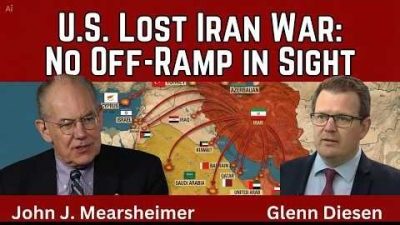
John Mearsheimer: US Already lost Iran war – No off-ramp in sight
or go to
Aletho News Archives – Video-Images
Frlom the Archives
70 Neocons Petition Congress To Effectively Allow Israel To Say When The US Should Attack Iran
By Damian Lataan | January 10, 2014
Seventy senior Israeli-centric neoconservatives have written an open letter to Congress imploring them to do more to ensure Iran complies with the conditions of any agreement finally reached with the P5+1 over Iran’s nuclear program.
While the neocons are ostensibly asking Congress to ensure compliance, it is clear that their real aim is to convince members of Congress to support the bill currently passing through the Senate which calls for tighter sanctions against Iran in the event of any waywardness on Iran’s part.
The neocons are eager to see the bill currently passing through the Senate with enough support to make it veto-proof, not so much because they are concerned about Iran’s so-called nuclear weapons program – there’s still not a skerrick of hard evidence that Iran has a nuclear weapons program – but, rather, because embedded within the bill is this clause:
… if the Government of Israel is compelled to take military action in legitimate self-defense against Iran’s nuclear weapon program, the United States Government should stand with Israel and provide, in accordance with the law of the United States and the constitutional responsibility of Congress to authorize the use of military force, diplomatic, military, and economic support to the Government of Israel in its defense of its territory, people, and existence…
Essentially, the clause is an automatic trigger for the US to attack Iran at any time the Israelis choose to launch a first strike – regardless of whether President Obama is in favour or not.
Partial list… continue
Blog Roll
 Aletho News
- John Mearsheimer: U.S. Already Lost Iran War – No Off-Ramp in Sight
- UK Parliament Plans ISP Blocking and Age Verification Powers
- World cannot remain silent as US and Israel attack ‘heritage of humankind’: Iran
- Emirati billionaire rebukes US senator over call for Gulf states to join war with Iran
- Op. True Promise 4: Iran’s missile blitzkrieg dismantles US war machine in West Asia
- Aramco CEO warns ‘catastrophe’ imminent if Strait of Hormuz remains shut
- What If Iran Says No?
- Trump Threatens to ‘Hit’ Iran ‘Twenty Times Harder’ Over Strait of Hormuz Oil Flows
- Spare the hypocrisy: Baghaei slams Ursula’s support for US
- Iran War Supporters Invent a New and Absurd Justification: It Is All About China
- If Americans Knew
- Israel Decided the War, But Trump’s America Fights and Pays the Bill
- Conscientious Objector Group: Phone ‘Ringing Off Hook’ As Huge Mobilization Underway
- U.S. support for Israel continues to plummet, despite media’s best efforts
- Threats and missiles fly, death tolls soar in Iran, Lebanon, Gaza – Not a ceasefire Day 151
- Lebanon: Israel’s White Phosphorous Use Risks Civilian Harm
- Corporate Media Go All Out To Support The US-Israeli War On Iran
- US-Israel war on Iran is creating a steady growing number of amputees
- Israel planned this war on Iran for 40 years. Everything else is a smoke screen
- The wrong question about the war in Iran
- ‘Your Tax Dollars Being Used to Raise Your Gas Prices’: US-Israel Bomb Major Iranian Oil Depots
- No Tricks Zone
- Wake-up Call: Survey Shows Majority Of Germans Now Favor Postponing Climate Targets!
- Televised! Leading German Political Candidate Tells Schoolchildren CO2 Makes Sun Hotter!
- New Study: A Century Warming Of 1.1°C Is ‘Commonplace’ And ‘Not Unusual’ During This Interglacial
- New Study: ‘Internal Noise’ And Volcanic Forcing Can Trigger 10-15°C Warming Within Decades
- Glaciers Worldwide Are Suddendly Surging, Experts Blame Warming!
- Surprising Discovery: Sahara Is Greening…Billions Of Trees Where Once Thought To Be Barren
- New Research Reaffirms Clouds, Aerosols, And Surface Solar Radiation Are ‘Driving The Climate System’
- Germany: Electric Car Catches Fire At Charging Station, Sets Off Local “Inferno”, Widespread Damage
- New Study: Canada’s New Brunswick Was 1°C Warmer Than Today During The Medieval Warm Period
- Coal Power Back In Trend As Globe Tries To Keep Pace With Growing Demand For Power
 Aletho News