Is Belarus a color revolution? The real problem is that ANY protest these days may be
By Nebojsa Malic | RT | August 20, 2020
Whenever there is a mass protest against a government somewhere in the world, one of the first questions from skeptics will be whether it’s a ‘color revolution,’ a technique of turning legitimate grievances into a coup d’etat
The recent events in Belarus are a perfect example. It’s not a color revolution, but President Alexander Lukashenko “repeating Soviet mistakes,” argues Bradley Blankenship. While he is looking at the behavior of the protesters on the ground, however, Caitlin Johnstone is looking at the State Department. Foggy Bottom’s actions and “imperial narrative management” by official US propaganda outlets have her convinced it is a color revolution. She’s not the only one.
That’s precisely the problem, however: in a world where “color revolutions” have become normalized, it’s nearly impossible to tell if a mass protest is a spontaneous, grassroots event or an astroturfed regime-change operation. To the creators of color revolutions, this is a feature, not a bug.
The tactic has been around for two decades now, first tested following the September 2000 elections in Serbia. It involves activists trained by US-backed “NGOs,” copious amounts of cash, strategies and tactics outlined in a manual written by the late Gene Sharp. The key element is narrative management, through which the revolutionaries usurp the initial protests and direct them towards their own ends.
One distinguishing feature of astroturf campaigns is a visual marketing campaign, such as the stenciled fists of Otpor in Serbia (used elsewhere since), or the 2004 orange scarves and banners in Ukraine. The sudden omnipresence of white-red-white flags in Belarus – used briefly in 1918 and again under Nazi occupation – seems to fit this pattern. So do the signs like “Belarusian Lives Matter,” appealing not to the locals but to the West.
Washington’s hand in these “spontaneous” uprisings. Stories about “suitcases full of cash” that fueled the revolt in Serbia appeared shortly after the coup in Belgrade. In November 2004, the Guardian wrote approvingly about how the US has created a “slick” operation of “engineering democracy through the ballot box and civil disobedience,” developing since Belgrade a “template for winning other people’s elections.”
These days, there is no boasting, but the practice continues nonetheless. Most recently, the scenario played itself out in Bolivia (successfully), Venezuela (not) and Hong Kong, where “pro-democracy” protests against an extradition bill lasted long after it was withdrawn.
What changed is that the US and its media machine switched to denying involvement and pretending the “color revolutions” were actually genuine expressions of democracy, after some targeted governments managed to defeat these astroturf rebellions. This remained the case even as color revolution tactics came home to the US this summer.
Back in June, Franklin Foer of the Atlantic magazine – a megaphone of the establishment – actually wrote a favorable comparison of the riots across the US, posing as peaceful protests for “racial justice,” to the color revolutions in places like Ukraine and Serbia. Note that Foer believes these revolutions were good and genuine things, rather than a hostile takeover tactic that was basically a mockery of democracy.
Democracy, at its essence, it’s a straightforward deal. Citizens vote on an issue or for a candidate, and agree to abide by the rules whether they win or lose. But what happens when that vote is manipulated – through street violence, in this case – by outsiders, and the rulebook gets thrown out the window?
This is what makes color revolutions not just wrong, but evil. They literally destroy democracy, by corroding the very rules it is founded on. When they fail, things can escalate along the lines of Libya, Syria or Ukraine.
Even when they fail peacefully, like the 2006 “jeans revolution” in Belarus, they poison a country’s politics so thoroughly, that the government sees any street demonstrations going forward as foreign-sponsored coup attempts. Especially when foreign powers openly express support for it, as has been the case with recent events.
Whatever may be happening in Belarus right now, democracy it is not. The US may not be one for long, either, if things carry on as they have. Two decades of color revolutions have made sure of that.
Weaponized media coverage & off-the-scale hypocrisy as the West promotes ‘regime change’ in Belarus
By Neil Clark | RT | August 19, 2020
Lukashenko has always admitted his style is authoritarian but notwithstanding this, media coverage of the crisis in Belarus has been slanted and the West’s condemnation of the crackdown on protests reeks of double standards.
You can tell a ‘regime change’ is afoot in Minsk simply by looking at the coverage of Radio Free Europe/Radio Liberty. Their website at the weekend was headed by a large caption ‘Post election crackdown in Belarus’, which has now changed to ‘Crisis in Belarus‘. The five lead articles on Sunday were all about Belarus. It’s the same on Tuesday.
Radio Free Europe/RL is funded by the US Congress through the United States Agency for Global Media. Up to the early 1970s it was funded covertly by the CIA.
It was a soft-power tool of the old Cold War, sometimes with calamitous consequences. In their book ‘Cold War’, Jeremy Isaacs and Taylor Downing tell how in the Hungarian Uprising of 1956 “Radio Free Europe, the CIA-backed station that broadcast into Eastern Europe, was dramatically talking the situation up, proclaiming the West’s backing for what it called Hungary’s ‘freedom fighters.‘”
But the backing never came, and indeed was never likely to come and the uprising, having been encouraged by RFE, was ruthlessly suppressed.
You might have thought RFE/RL would have been wound up in 1989 when the Berlin Wall came down, but there was still a job to do.
It says it reports the news in countries where a free press is banned by the government or not fully established and while some of its journalism is perfectly fine the truth is that it usually stops reporting once a country is locked into Euro-Atlantic security structures. When it starts broadcasting to a country it’s invariably a sign that the US ‘Deep State’ wants its government toppled. For example, in 1998 it began broadcasting to Iraq, and we all know what happened there five years later. RFE/RL is undoubtedly ‘state-affiliated media’ yet you won’t see that warning attached to its tweets, as you now see attached to RT when it tweets this article.
It’s no great surprise that Franak Viacorka, the journalist and social media promoter of the anti-Lukashenko protests has worked for RFE/RL. As flagged by Ben Norton last week, Viacorka’s organization DigiCom.Net details his close link to US bodies. Viacorka works for the US Agency for Global Media, the parent of RFE/RL and has served as a ‘creative director’ for the Belarus service of Radio Free Europe, as well as being a consultant for the US State Department-funded ‘Freedom House’. He is also a non-Resident Senior Fellow of the Atlantic Council, his appointment lauded by Michael McFaul, the former US Ambassador to Russia.
To be fair to Viacorka he is absolutely open about his US connections and in fact seems very proud of them. And they don’t mean the 32-year-old isn’t genuine about his commitment to ‘democracy and personal freedom’. That’s even though he appeared to make criticism of Lukashenko’s Covid-19 policies (the Belarusian leader failed to impose a draconian lockdown such as we’ve seen in many Western countries), on a NBC programme earlier in the year. (You can watch that here)
Also gunning for Lukashenko is the Economist, the bible for neoliberal globalists. This week, the magazine denounced the “West’s response” to what was going on in Belarus as “feeble.”
It referred to Lukashenko as “a 65-year-old dictator.” The language of the Economist has been unusually emotional of late, showing they want regime change in Minsk quite badly. Yet in January 2019 they referred to the Belarusian leader more respectfully as “Mr Lukashenko” and said he was “no ordinary politician.” That was when they thought he was upsetting Vladimir Putin and “cosying up to the West.”
One suspects that if Lukashenko announced he had won 80 percent of the vote but then said he was going to promptly apply to join NATO, the EU and sell off the entire economy to Western finance capital, as well as imposing a ‘Covid lockdown’, the Economist would not be quite so angry.
Hypocrisy was also on show from the very grand EU Commission President Ursula von der Leyen. “We need additional sanctions against those who violated democratic values or abused human rights in Belarus,” von der Leyen declared on Twitter.
We are still of course waiting for the EU sanctions, additional or otherwise on Spain for the authorities’ crackdown on Catalan protesters in 2017 and the jailing of nine separatist leaders.
Or sanctions on France for the brutality meted out to the ‘Gilets Jaunes’ street protesters, who did not receive globalist approval.
How convenient after all that has gone on in 2020, that Belarus and the big bad Lukashenko is there to allow Western virtue signallers and self-proclaimed ‘liberals’ the chance to show off how much they care about ‘democracy’ again. While supporting the curtailing of basic human freedoms still further in their own countries.
Neil Clark is a journalist, writer, broadcaster and blogger. His award winning blog can be found at http://www.neilclark66.blogspot.com. He tweets on politics and world affairs @NeilClark66
Kremlin denies Russian military convoys heading to Belarus, says no need right now for CSTO or Union State assistance to neighbor
RT | August 19, 2020
Vladimir Putin’s spokesman has rubbished speculation that Moscow is either conducting or is preparing to carry out some sort of military intervention in neighboring Belarus, with which it has mutual-assistance agreements.
Dmitry Peskov said that while Russia is treaty-bound to assist Minsk, the conditions for such support don’t currently exist.
Both countries form a Union State, under a 1999 agreement, and are also members of the Collective Security Treaty Organisation (CSTO), a Moscow-led security alliance that serves as an alternative to NATO. Peskov explained that these treaties “indeed, stipulate a number of commitments of the sides on mutual assistance.” He was answering a reporter’s question on the circumstances in which such assistance would be possible.
“But, as you know, now there is no such need and the Belarusian leadership has itself admitted that there is no such need now,” he added. “In this case, any hypothetical deliberations are absolutely unacceptable and impossible.”
“We believe that Belarusians will iron out their own problems in the framework of dialogue, within the legal framework, and without any foreign meddling,” the Kremlin spokesman said.
Commenting on media reports that convoys of Russian military equipment were allegedly heading to the Belarusian border, the presidential spokesman emphasized that “Russian military equipment is on Russian territory and that’s why there is nothing to comment on here.”
Meanwhile, Alexander Lukashenko’s spokeswoman has claimed that the President of Belarus regards the CSTO and Union State agreements as paramount. “Consultations between the Belarusian and Russian presidents are currently underway. The heads of state coordinate their actions, primarily within the framework of the existing agreements. These are both the Union State and the CSTO,” Natalya Eismont said. She also noted that the two leaders had held several phone calls.
Lukashenko: Videos of Russian troops in Belarus are ‘fake’ – Minsk more worried about NATO movement in Poland & Lithuania
By Jonny Tickle | RT | August 19, 2020
Belarusian President Alexander Lukashenko has completely denied that there are any foreign troops in the country, rejecting online “fakes” that claim to show columns of Russian troops heading towards the border.
Instead he says Belarusian officials should carefully monitor NATO troops at the country’s western borders. “The defense ministry should pay special attention to movements of NATO forces in Poland and Lithuania,” state news agency BelTA quoted him as saying. “We should track all directions of their movements, and their intentions.”
Lukashenko is currently facing mass unrest following the results of a national election on August 9, deemed by many to be falsified. Some internet commenters have claimed that the Belarusian president has called for Russian military assistance, but this has been denied.
“As for foreign troops, today there is not a single one from another state in Belarus,” he said, according to BelTA.
“Another problem is fakes. People are blatantly lying on the internet, saying that there are foreign troops in Belarus, and equipment from Russia,” the President complained. Lukashenko noted that videos are published online showing military vehicles driving down a road, but nobody knows when or where these were filmed.
In particular, Lukashenko mentioned a viral image showing a convoy of Belarusian military vehicles said to be moving towards the city of Orsha, which had been widely speculated to be Russian.
On Tuesday, Lukashenko announced that the Belarusian army had been deployed in the west of the country and put on full alert. Along this frontier, Belarus shares borders with Lithuania, Poland, and Ukraine.
Since 1994, Russia and Belarus have been part of a group called the Collective Security Treaty Organization (CSTO), a collection of six former Soviet countries who have pledged to protect each other in case of war.
The Belarusian Labor Strike Movement Could Bring Down Lukashenko
By Andrew Korybko | One World | August 19, 2020
“The Economic Factor In Belarus”
The Hybrid War on Belarus is increasingly focusing more on the economic dimension for catalyzing regime change than the kinetic one commonly associated with EuroMaidan. The nationwide labor strike movement is gaining steam, which risks crashing the country’s economy if workers from its five biggest businesses that disproportionately contribute to its national budget join in and succeed in suddenly stopping production at these firms. According to Swedish neoliberal economist and Senior Fellow at the Atlantic Council (banned in Russia as of last summer for meddling in its internal affairs) Anders Aslund, these are “the potash company Belaruskali, the two largest oil refineries, the Minsk Tractor Works (MTZ), and the Minsk Automobile Plant (MAZ)”. He listed them off in his article about “The Economic Factor In Belarus” for the partially Soros-funded “Project Syndicate” international media organization, where he strongly lobbied for the country’s radical neoliberalization if Lukashenko is forced to leave office.
Five Targets For The Labor Strike Movement
It shouldn’t be seen as a coincidence then that these same companies are targeted by the nationwide labor strike movement. Ore mining at Belaruskali, described by Russian publicly financed international media outlet TASS as “one of the world’s biggest producers and exporters of potash fertilizer”, was halted as of Wednesday (19 August). The outlet also reported on the same day that “two people were detained during an unauthorized mass rally” at the Minsk Tractor Works. Considering the outsized economic impact that a comparatively tiny percentage of the country’s population employed in these companies could cause if they participated en masse in this movement, these industries can rightly be regarded as Belarus’ “Achilles’ heel”. The government would have immense difficulty meeting its generous social obligations to the people which form the basis of its legitimacy should the situation worsen, which is why it’s possible that the authorities might deploy the security services to quell any unrest at those five companies so as to stave off that scenario.
Approaching The Peak
Lukashenko himself warned on Tuesday that “this is not even a peak yet” when commenting on the ongoing Color Revolution against him, perhaps hinting that events might inevitably move in the previously mentioned direction. The government is very concerned about the consequences of such a scenario. Prime Minister Golovchenko, while claiming on that same day that “all enterprises of the real sector of the economy are working as usual” (though a lower official later said that there was already $500 million in damages), also said that Belarus would lose its hard-earned market position in those affected industries to its competitors if “any downtime” occurs. To prevent this from happening, workers are being educated about how the consequences would directly harm their living standards. The premier observed that “when convincing and simple words are used to explain what losses the enterprise is experiencing, how the standing of the specific worker, his or her salaries, bonuses will be affected, they come to realize that it is necessary to step down emotions a bit.”
The “Elite Proletariat”
The problem, however, is that an uncertain percentage of those “elite proletariat” (“elite” in the sense that their participation in the nationwide strike movement more so than any other industries’ workers could crash the economy) might be under the influence of fake news narratives such as the one promising them that “the new management will double the salaries of employees and make them shareholders” if the regime change campaign succeeds and their companies are privatized. This claim was made by someone in Minsk whose account was shared by the Federal City information outlet and republished at Yandex Zen (in Russian). Those high hopes are bound to be shattered because Western-backed regime changes have never resulted in such an outcome. Furthermore, opposition leader Svetlana Tikhanovskaya’s “Emergency Package of Reforms for Belarus” program (which was pulled offline but reported upon by Sputnik ) makes its neoliberal intentions clear and even hints at cutting off Belarus’ trade with Russia, which would disastrously slash GDP by 25-50%.
The Struggle For Workers’ Hearts & Minds
Taking this strategic insight into account, it’s increasingly obvious that the Hybrid War on Belarus is moving from the streets to the factories as the regime change organizers and the authorities struggle to “win the hearts and minds” of the country’s “elite proletariat”. The former will say whatever is needed to convince them to strike and subsequently hand over their quasi-“socialist” economy to Western neoliberals while the latter must educate this tiny class of workers about the game that’s being played against them. The authorities might even decide to raise workers’ wages (perhaps paid for by an emergency loan from Russian in exchange for intensifying Belarus’ integration with it through the “Union State” framework) in order to disincentivize them from striking. No financial cost or relative weakening of its sovereignty is too high of a price to pay Russia either since neither the Belarusian state nor its workers (including the “elite proletariat”) would survive the planned post-Lukashenko neoliberalization that the pro-Western opposition is eagerly preparing for.
Concluding Thoughts
The greatest threat presently facing Lukashenko isn’t from street protests but from the possibility of large-scale labor strikes suddenly shutting down production at Belarus’ five main enterprises. The country simply wouldn’t be able to survive such a worst-case scenario for long, except perhaps if it sought emergency financial assistance from Russia in exchange for Belarus’ accession to the Russian Federation by referendum via the “Union State” framework considering the immense financial burden that would be placed upon Moscow if it subsidized Minsk’s survival under those pressing circumstances while Belarus remained a separate state. Lukashenko might not be able to swallow his pride and accept his potential future as just another Russian functionary instead of the leader of an independent country so there’s a chance that he might order the security services to intervene in stopping the strikes if the authorities can’t first succeed in convincing the workers to reconsider. Either way, events seem to be rapidly approaching a peak, and it’s all due to the strikes.
Andrew Korybko is an American political analyst.
Russia takes Europe’s support to calm Belarus
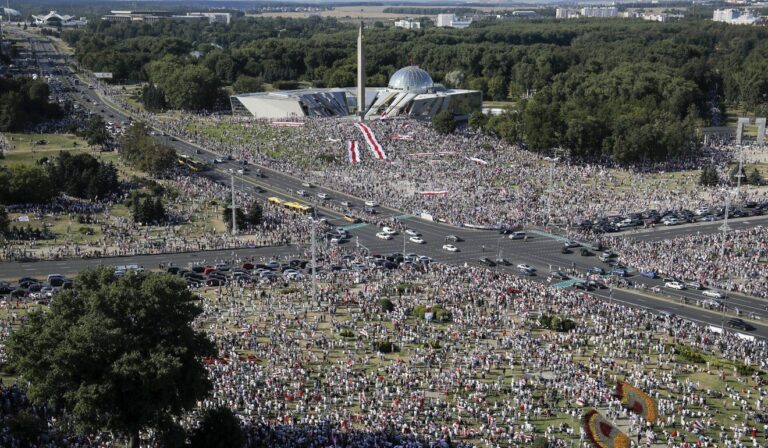 Opposition protests in Minsk, Belarus, August 16, 2020
By M. K. BHADRAKUMAR | Indian Punchline | August 18, 2020
The mercurial Belarus President Alexander Lukashenko has not been an easy ally for the Kremlin. But the growing interference by Belarus’ “New European” neighbours is setting the stage for a “colour revolution” with potentially anti-Russian orientation. Poland, egged on by the US, has convinced itself that it has become a regional heavyweight and eyes Belarus as a valuable piece of real estate that could shift the military balance on Russia’s western borders.
Indeed, historically, present-day Belarus figured in all four major invasions of Russia since the 18th century — by Sweden allied with Poland (1708-1709); by Napoleon through the North European Plain (1812); and by Germany, twice (1914 and 1941). Plainly put, Belarus forms a buffer zone crucial to Russia’s national security.
In post-Soviet history, with the Baltic states and Poland having been integrated into NATO and a pro-western regime installed in power in Ukraine since 2014, the western alliance has advanced closer to Russia than ever before. If during the Cold War era, the nearest NATO power was 1,600 kms from St. Petersburg, that distance has shrunk to a mere 160 kms today.
Furthermore, the signing of an Enhanced Defence Cooperation Agreement between the US and Poland on August 15 has made the latter “a lynchpin of regional security” (as the US state department describes Poland.) The agreement signed in Warsaw provides the legal basis for the establishment of American military bases in Poland, which harbours historical animosity against Russia.
The Russian Foreign Ministry said on August 17 that increased US military presence in Poland “aggravates the difficult situation near Russia’s Western borders, facilitating an escalation of tensions and increasing the risk of inadvertent incidents.” It flagged that the latest US-Poland defence agreement “will help qualitatively strengthen the offensive capability of the US forces in Poland.”
To be sure, the Belarus developments cannot be seen in isolation. A Kremlin statement said that on August 15 Lukashenko reached out to President Vladimir Putin to brief him on the developments. It said that the two leaders discussed the unrest in Belarus following the presidential election of August 9 and and both sides “expressed confidence that all existing problems will be settled soon.”
However, the next day, Putin called Lukashenko for another discussion. The Kremlin readout said that after a discussion touching on the external interference fuelling the unrest in Belarus, the “Russian side reaffirmed its readiness to render the necessary assistance to resolve the challenges facing Belarus based on the principles of the Treaty on the Creation of a Union State, as well as through the Collective Security Treaty Organisation, if necessary.”
That was a dramatic announcement, with ominous overtones of past Russian doctrines of collective security. Clearly, the announcement had the desired effect. Lukashenko has voiced on August 17 his readiness to hold fresh elections in accordance with a new constitution to be drafted in the coming few months.
The protests in Belarus may not subside easily. A transfer of power has become inevitable at some point and Moscow senses that the priority should be to navigate the developing situation toward an orderly transition. But Moscow’s capacity to navigate Belarus to calmer waters and stimulate a rational political dialogue is limited when external interference to stir up tensions continues.
Indeed, for the first time since protests began in Belarus a week ago, Washington has openly warned Moscow to stay out of the situation. An unnamed “senior Trump administration official” told the media on August 17, “The massive number of Belarusians peacefully protesting make clear that the government can no longer ignore their calls for democracy… Russia must also respect Belarus’ sovereignty and the right of its people to freely and fairly elect their own leaders.”
US Secretary of State Mike Pompeo also said on August 15 (while on a visit to Poland) that the US is discussing with the European Union to “try to help as best as we can the Belarusian people achieve sovereignty and freedom.”
To be sure, a Russian intervention in Belarus would be viewed by Europe as a negative development. Therefore, Putin is moving cautiously. But the fact is also that the European countries are struggling with the pandemic and a grave economic crisis. It’s unclear whether the major European powers would be inclined to follow the lead of Washington and Poland to provoke Russia.
Significantly, German Chancellor Angela Merkel telephoned Putin on August 19 in the first such contact since protests erupted in Minsk. A Kremlin statement said Putin and Merkel “thoroughly discussed” the emergent situation and “Russia pointed out that foreign attempts to interfere in the country’s domestic affairs were unacceptable and could further escalate tensions.”
Summing up Merkel’s conversation with Putin, the German Spokesman Steffen Seibert stated, “The chancellor said the Belarusian government must refrain from the use of force against peaceful demonstrators, immediately release political prisoners and enter into a national dialogue with the opposition and society to overcome the crisis.”
A Russian-German convergence seems possible over Belarus. Significantly, French President Emmanuel Macron has since called Putin and the latter again “emphasised that interfering in the (Belarus) republic’s domestic affairs and putting pressure on the Belarusian leadership would be unacceptable.” The Kremlin readout said Putin and Macron “expressed interest in the prompt resolution of the problems.”
Subsequently, Putin also reached out to the President of the European Council Charles Michel where, again, he expressed concern over “some countries’ attempts to put pressure on the Belarusian leadership and destabilise the internal political situation.” This was a reference to Poland and Lithuania, two EU member countries and strong allies of the US, who are principally culpable for destabilising Belarus.
But the big question is whether the Cold Warriors in Washington and the “New Europeans” in Central Europe would be satisfied with anything less than a regime change in Belarus that brings that country into their orbit. A Russian military intervention would lend credibility to their thesis of “revanchist Russia”.
A sub-text here is that the German-Russian proximity greatly annoys Washington and Warsaw. A recent paper by the Center for Strategic and International Studies in Washington, DC, noted, “Compared to many of its neighbours, Germany has longstanding political, economic, and cultural ties to Russia—not to mention a streak of skepticism toward the United States that inclines parts of the German political class to sympathise with Russian views about the need for a less U.S.-centric international order.”
Equally, there is growing acrimony lately in German-American relations following Washington’s recent threats of “crushing legal and economic sanctions” if German companies took part in any form in the Nord Stream 2 gas pipeline project, which would carry natural gas from Russia to Germany. (Incidentally, Poland also staunchly opposes the Nord Stream 2 project, which bypasses it.)
The German Minister of State Niels Annen has “firmly rejected” the proposed US sanctions and hit back saying, “Threatening a close friend and ally with sanctions, and using that kind of language, will not work. European energy policy will be decided in Brussels, and not in Washington, DC.”
These acerbic exchanges between German and American politicians as well as the recent move by the Trump administration to withdraw over 12,000 troops from Germany (and to divert some of them to Poland) highlight the complexities of Germany’s relationship with the US and Poland. The right-wing Polish government is happy to perform as the US’ Trojan horse within the EU.
However, so long as the EU refuses to rally behind Poland, whose rightwing populist leadership is already viewed with scepticism as something of an enfant terrible in the portals of Old Europe, Moscow gets diplomatic space. Putin’s calculus is working on this basis.
The bottom line is that Russia has legitimate interests in Belarus and Moscow’s preference is for an orderly transition in Belarus through consultations between Lukashenko and the political opposition. A helpful stance by the EU, therefore, matters to Putin.
The latest reports from Brussels disclosed that in the 30-minute phone conversation earlier today between Putin and Charles Michel, they “discussed options to facilitate a dialogue between Minsk and the opposition, including with the OSCE mediation.”
Poland and Lithuania are escalating events in Belarus as they did with Maidan
By Paul Antonopoulos | August 18, 2020
On August 9, presidential elections were held in Belarus with five candidates bidding to be head of state. According to the Central Election Commission, the incumbent president, Alexander Lukashenko, won in the first round with over 80% of the votes. Mass protests began in Belarus right after the announcement of the preliminary election results. People went to the streets, expressing their dissatisfaction with the results of the elections that they believe were unfair. Mass protests turned into riots and there were clashes between rioters and the police. Many people were detained and injured, and two protestors died.
Representatives of the European Union and the U.S. stated that they did not consider the presidential elections fair and appealed to the Belarusian authorities to have a second election. As both the EU and U.S. condemned Lukashenko’s re-election, it was therefore unsurprising that the deputy head of the Polish Ministry of Foreign Affairs, Paweł Jabłoński, stated that Poland did not want the EU to limit itself to only introducing sanctions against Belarus, as he claims it will push Belarus deeper into the sphere of Russian influence.
Tomorrow’s EU summit to discuss the situation in Belarus, and possibly pass sanctions, resulted from Warsaw’s call for prompt action, and above all, Prime Minister Mateusz Morawiecki who personally exerted pressure immediately after the Belarusian elections.
“We do not want the EU’s reaction to be limited only to presenting an idea for sanctions and adopting a joint statement, which is obviously needed, but to give Belarusians something more,” said Paweł Jabłoński in an interview with PAP. “The point is that we should present a real offer to resolve this conflict in a stable and lasting manner, and this is only possible if we, as the EU, offer Belarus a real perspective of cooperation if a solution based on dialogue is reached.”
Jałoński also pointed out that EU member states should jointly adopt a common position on the events in Belarus.
“We will want to send a signal that if Belarus begins the process of reforms leading to a system in which citizens decide on the direction of changes, the EU is ready for real cooperation with Belarus – primarily economic,” said Jabłoński, adding that “Belarusians should be able to choose their own development path and have a real choice here – our role is to propose this choice.”
This suggests that Warsaw’s main concern is to see the liberalization of the Belarusian economy to follow the same path as the other post-Soviet countries in Eastern Europe. The World Bank estimates that 75% of industrial output comes from state-owned companies, with the state sector employing about half of the Belarusian workforce. Because of this, unemployment in Belarus was at 4.6% in 2019, significantly lower than neighboring Ukraine (8.8%), Latvia (6.52%) and Lithuania (6.35%), with only Poland having a lower figure at 3.47%. Belarus is also capable of consistent GDP growth without having to rely on remittances like its neighboring countries which are also experiencing population decline due to emigration.
Effectively, what Lukashenko has done is protected the country from neo-liberal policies that spread throughout Eastern Europe after the Soviet Union collapsed in 1991, which resulted in many of the industries being shut down or privatized, impoverishing much of the population. Because of this action, Lukashenko earned the nom de guerre of “the last dictator of Europe” and Belarus the title of “mini-Soviet Union.”
Although Lukashenko has a complicated relationship with Moscow, one that can be cold at times, but generally speaking, Belarus, which gets its etymology from “White Rus(sia)”, has positive relations with its larger neighbor. Lukashenko, who at times panders towards the West, has amicable relations with Syria, Venezuela and other states that are targeted by the U.S. and Western Europe. Due to Lukashenko’s strong relations with these states and his sternness in preventing the liberalization of the economy, it is expected that when an opportunity is presented for the West, a Maidan-like event will begin in Belarus.
Although Poland is pushing for a Maidan-like event to occur, it is not the only neighbor of Belarus that wants this. A faction of the Homeland Union-Lithuanian Christian Democrats in the Seimas, the unicameral parliament of Lithuania, called for the immediate announcement of Lithuanian sanctions against the 39 most influential representatives of the “Alexander Lukashenko regime,” as they termed it.
“Lithuania must clearly, quickly and unambiguously formulate and consolidate strategic provisions for the Belarusian regime at the European Union and transatlantic level, be an icebreaker in the fight for freedom and against tyranny. Sanctions must also send a signal to other influential members of the regime that continued to support Lukashenko, will mean a stalemate and further sanctions against a wider range of the current elite,” said leader of the Seimas opposition, Gabrielius Landsbergis.
It was recently revealed that Lithuania had a key role in the Ukrainian Maidan events, and Poland’s involvements are also well noted. It is unsurprising that both countries are once again united in their demands to escalate tensions and hostilities with Belarus in their mad drive in what they perceive to be the de-Sovietizing and de-Russification of Eastern Europe. Perceiving that Russia and Belarus could be a threat to their security, both Warsaw and Vilnius have taken the opportunity to escalate the protests through rhetoric in the hope that a Maidan-like event will occur in Belarus, thereby further weakening Russian influence in Eastern Europe.
Paul Antonopoulos is an independent geopolitical analyst.
FCO promoting intervention in Belarus via OSCE
Press TV – August 17, 2020
After days of posturing and pugilistic rhetoric the UK has upped the ante on Belarus by calling the result of the recent presidential election in the pro-Russian country “fraudulent”.
Foreign Secretary, Dominic Raab, tweeted that not only the UK does not recognize the election result but it is also calling for an “urgent investigation” by the Organization for Security and Co-operation in Europe (OSCE), an inter-governmental organization focused on European security.
Raab’s hardline position is reinforced by a Foreign and Commonwealth Office (FCO) statement whereby the UK appears to call for an intervention in Belarusian politics via the OSCE.
Belarus has experienced political unrest since a disputed presidential election on August 09 in which the incumbent, Alexander Lukashenko, reportedly secured 80 percent of the vote.
However, opposition candidate, Sviatlana Tsikhanouskaya, refuses to accept the result and has instead declared herself the winner.
Tsikhanouskaya has since fled to Lithuania, whose government is openly calling for the overthrow of the Lukashenko administration.
Strongly aligned to Russia, Belarus has long been targeted by Nato states as part of a broader destabilization program focused on Russia’s immediate neighborhood.
In recent years the UK has stepped up diplomatic and intelligence activity related to Belarus.
In March the UK even sent 30 Royal Marines to Belarus as part of a plan to foster ties with the Belarusian armed forces, which have traditionally looked to Moscow for training and support.
UK adopts interventionist role in Belarus political crisis
Press TV – August 16, 2020
As Belarus continues to grapple with post-election unrest, the British government is showing stronger signs of wanting to influence the outcome by potentially fomenting the overthrow of long-time President Alexander Lukashenko.
In the immediate post-election environment the UK Foreign and Commonwealth Office (FCO) published a statement where it called on the “Government of Belarus” to “refrain from further acts of violence” following the “seriously flawed Presidential elections”.
In the presidential election of August 09 Lukashenko was re-elected to a sixth term in office with just over 80 percent of the vote.
But opposition candidate Sviatlana Tsikhanouskaya refused to accept the result and instead declared herself the winner.
Nato countries have generally supported her position with the Lithuanian foreign minister, Linas Linkevicius, taking the extraordinary step of calling Lukashenko “the former president of Belarus”.
The FCO statement complained of a “lack of transparency” in the electoral process even though the UK had no monitors on the ground and therefore cannot make a definitive conclusion on that issue.
The statement concludes with an interventionist tone by asserting that the UK “calls on the Government of Belarus to fulfill its international commitments and the aspirations of the people”.
Beyond the FCO, the British media have thrown their weight behind Belarus “protesters” and by extension appearing to support calls for Lukashenko’s ouster.
The BBC ran an incendiary headline claiming “mass protest eclipses defiant Belarus leader’s rally”.
For its part, Sky News has tried to depict Lukasheno as on the defensive by talking up his claim that Nato forces are “massing” on Belarus’ border.
In recent years the UK has shown growing interest in enhancing its diplomatic and political presence in Minsk, Belarus’ capital.
Earlier this year the UK even deployed 30 Royal Marines from 42 Commando to Belarus to ostensibly take part in an unprecedented joint exercise with the Belarus armed forces.
Belarus is universally regarded as a stalwart Russian ally, and for that reason alone Nato countries, including the UK, have long sought to create political distance between Minsk and Moscow.
‘Regime Change’ in Belarus Looks Like an Objective of Both the Trump Administration and the Biden Campaign
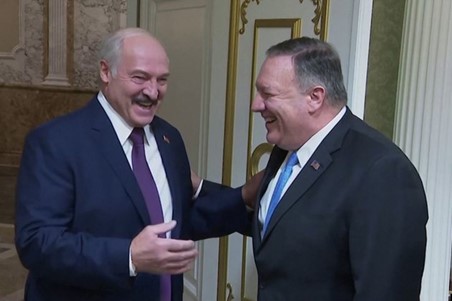
By Adam Dick | Ron Paul Institute | August 14, 2020
It seems that whoever wins the presidency, United States foreign policy will keep chugging away at intervening across the world, including via “regime change” efforts. Over the last couple decades, targets for US-government-supported overthrow have included Afghanistan, Iran, Iraq, Libya, Syria, Ukraine, and Venezuela. Belarus also appears to be in the US government’s crosshairs. If its government holds back through January the effort seeking to topple it, Belarus looks sure to remain a US target for regime change during either a second term of President Donald Trump or a first term of President Joe Biden.
On Monday, as revolutionaries in Belarus capital Minsk attempted to oust the Belarus government, US Secretary of State Mike Pompeo and Democratic Party presidential nominee Joe Biden issued interchangeable statements regarding Belarus and US policy toward it. Both Pompeo’s statement and Biden’s statement condemned the government of Belarus, called fraudulent the country’s recent national election in which President Aleksander Lukashenko won reelection by a wide margin, and made demands upon the Belarus government.
The statements of Pompeo and Biden may not seem so threatening if you imagine them coming from the government of a country of average population, economic strength, military power, and tendency to intervene in other countries. The comments could then just be understood as politicians spouting off or being relatively harmless buttinskis.
It is different when the pronouncements are made by a top foreign affairs official of the US and the potential next president of the US. The US presides over a large population country with major economic resources. The US has military bases and ships, as well as covert operatives, across the world. The US has a long and ongoing history of pursuing, and often achieving, the overthrow of governments through actions including invasions, assassinations, sanctions, election meddling, and the financing and coordinating of coups and revolutions.
In 2015, during the Barack Obama administration in the US and after another wide-margin reelection win by Lukashenko in Belarus, Ron Paul Institute Executive Director Daniel McAdams discussed the US government’s disdain for Lukashenko and the Belarus government. McAdams wrote in part:
Lukashenko has been a favorite punching bag of the US and western neocons for a number of years because he has not shown the required level of deference to his would-be western overlords compared to, say, the Baltics. He routinely wins re-election even as the US government has funneled millions of dollars into the political opposition in hopes of somehow fomenting a regime change.
Don’t believe the sanctimonious comments, whether from the Trump administration or the Biden campaign, about the US seeking to promote democracy and human rights in Belarus. This is about power. The US has let slide and continues to let slide democratic and human rights shortcomings of countries across the world where benefit can be obtained. Dictatorship? No problem. The expression of concern about democracy and human rights is propaganda selectively applied to stir up support for, or at least quell opposition to, US intervention abroad.
Pompeo and Biden’s statements regarding Belarus help make clear that overthrowing governments appears set to remain a feature of US foreign policy no matter if Trump wins a second term or Biden defeats him in the upcoming November presidential election.
Lukashenko Says There Will be No ‘Maidan’ in Belarus, ‘We Won’t Let the Country Be Torn Apart’
By Ilya Tsukanov – Sputnik – 10.08.2020
Alexander Lukashenko has commented on the large-scale street protests in the Belarusian capital, saying he would not allow for a Ukraine-style ‘Maidan revolution’ to take place in his country.
“Everything I was talking about is being confirmed. If someone didn’t believe it – they believe it now… I had warned: there will be no Maidan, no matter how much someone might want it. Therefore everyone needs to settle down and calm down,” Lukashenko said, speaking to journalists on Monday.
According to the president, over two dozen members of law enforcement suffered injuries during Sunday night’s protests. “There are broken arms and legs. They deliberately targeted them. They fought back. Why cry about it now? The response will be adequate. We will not allow for the country to be torn apart,” he said.
Earlier, Belarusian news agency BELTA reported that over 50 demonstrators, as well as 39 police had been injured in the protests across the country, with unrest concentrated in the capital of Minsk. 3,000 protesters were arrested for taking part in the demonstrations.
According to Belarusian Internal Affairs Ministry spokeswoman Olga Chemodanova, protesters lit flares, threw nails and barbs onto roads, attempted to build makeshift barricades, dismantled parts of sidewalks and threw paving stones at police. One group of protesters in the city of Pinsk reportedly wielded sharpened poles and stones to attack police. Criminal proceedings have been launched against persons accused of violent behaviour.
Chemodanova stressed that lethal weapons were not used by police in their response, and described earlier reports of a fatality among protesters as “nothing but fake news.”
Opposition Contests Results
Sunday’s violence came in the aftermath of the presidential election, in which preliminary estimates concluded that incumbent president Alexander Lukashenko received 80.23 percent of the vote, with opposition candidate Svetlana Tikhanovskaya receiving 9.9 percent, Anna Kanopatskaya receiving 1.68 percent, Andrei Dmitriyev receiving 1.04 percent, Sergei Cherechen getting 1.13 percent, and 6.02 percent of voters choosing ‘against all’.
Russian President Vladimir Putin, Chinese President Xi Jinping, and Kazakhstan President Kassym-Jomart Tokayev have congratulated Lukashenko on his reelection, with Sergei Lebedev, chairman of the Commonwealth of Independent States mission in Belarus, saying there were no issues which could call the legitimacy of the vote into question.
Tikhanovskaya’s campaign said the candidate did not recognize the results, and is demanding a “peaceful” transfer of power. Polling conducted by pro-opposition researchers suggests that Tikhanovskaya should have received around 70 percent of the vote, with Lukashenko supposedly trailing with only 15 percent.
Belarus’s election campaign has been fraught with scandal and intrigue, with some would-be opposition candidates denied registration and others facing administrative pressure from the government. Late last month, Vitaly Shklyarov, an advisor to Tikhanovskaya’s campaign, was arrested by authorities. Before working for her, the political scientist had worked on the election campaigns of Germany’s Angela Merkel, Barack Obama and Bernie Sanders in the US in 2008 and 2016, and Russian opposition candidate Kseniya Sobchak in 2018. Tikhanovskaya herself became the candidate after her husband, Sergei Tikhanovsky, a Belarusian blogger and pro-democracy activist, fled the country. Tikhanovsky has called Lukashenko a “cockroach,” while the president has accused him of being a foreign agent sponsored from abroad.
Featured Video
John Mearsheimer: US Already lost Iran war – No off-ramp in sight
or go to
Aletho News Archives – Video-Images
Frlom the Archives
70 Neocons Petition Congress To Effectively Allow Israel To Say When The US Should Attack Iran
By Damian Lataan | January 10, 2014
Seventy senior Israeli-centric neoconservatives have written an open letter to Congress imploring them to do more to ensure Iran complies with the conditions of any agreement finally reached with the P5+1 over Iran’s nuclear program.
While the neocons are ostensibly asking Congress to ensure compliance, it is clear that their real aim is to convince members of Congress to support the bill currently passing through the Senate which calls for tighter sanctions against Iran in the event of any waywardness on Iran’s part.
The neocons are eager to see the bill currently passing through the Senate with enough support to make it veto-proof, not so much because they are concerned about Iran’s so-called nuclear weapons program – there’s still not a skerrick of hard evidence that Iran has a nuclear weapons program – but, rather, because embedded within the bill is this clause:
… if the Government of Israel is compelled to take military action in legitimate self-defense against Iran’s nuclear weapon program, the United States Government should stand with Israel and provide, in accordance with the law of the United States and the constitutional responsibility of Congress to authorize the use of military force, diplomatic, military, and economic support to the Government of Israel in its defense of its territory, people, and existence…
Essentially, the clause is an automatic trigger for the US to attack Iran at any time the Israelis choose to launch a first strike – regardless of whether President Obama is in favour or not.
Partial list… continue
Blog Roll
 Aletho News
- ‘Heinous crime’: Iran denounces Israeli assassination of 4 Iranian diplomats in Lebanon
- John Mearsheimer: U.S. Already Lost Iran War – No Off-Ramp in Sight
- UK Parliament Plans ISP Blocking and Age Verification Powers
- World cannot remain silent as US and Israel attack ‘heritage of humankind’: Iran
- Emirati billionaire rebukes US senator over call for Gulf states to join war with Iran
- Op. True Promise 4: Iran’s missile blitzkrieg dismantles US war machine in West Asia
- Aramco CEO warns ‘catastrophe’ imminent if Strait of Hormuz remains shut
- What If Iran Says No?
- Trump Threatens to ‘Hit’ Iran ‘Twenty Times Harder’ Over Strait of Hormuz Oil Flows
- Spare the hypocrisy: Baghaei slams Ursula’s support for US
- If Americans Knew
- Israel Decided the War, But Trump’s America Fights and Pays the Bill
- Conscientious Objector Group: Phone ‘Ringing Off Hook’ As Huge Mobilization Underway
- U.S. support for Israel continues to plummet, despite media’s best efforts
- Threats and missiles fly, death tolls soar in Iran, Lebanon, Gaza – Not a ceasefire Day 151
- Lebanon: Israel’s White Phosphorous Use Risks Civilian Harm
- Corporate Media Go All Out To Support The US-Israeli War On Iran
- US-Israel war on Iran is creating a steady growing number of amputees
- Israel planned this war on Iran for 40 years. Everything else is a smoke screen
- The wrong question about the war in Iran
- ‘Your Tax Dollars Being Used to Raise Your Gas Prices’: US-Israel Bomb Major Iranian Oil Depots
- No Tricks Zone
- New Study Documents A 20-Year Pause In Arctic Sea Ice Decline – Driven By Internal Variability
- Wake-up Call: Survey Shows Majority Of Germans Now Favor Postponing Climate Targets!
- Televised! Leading German Political Candidate Tells Schoolchildren CO2 Makes Sun Hotter!
- New Study: A Century Warming Of 1.1°C Is ‘Commonplace’ And ‘Not Unusual’ During This Interglacial
- New Study: ‘Internal Noise’ And Volcanic Forcing Can Trigger 10-15°C Warming Within Decades
- Glaciers Worldwide Are Suddendly Surging, Experts Blame Warming!
- Surprising Discovery: Sahara Is Greening…Billions Of Trees Where Once Thought To Be Barren
- New Research Reaffirms Clouds, Aerosols, And Surface Solar Radiation Are ‘Driving The Climate System’
- Germany: Electric Car Catches Fire At Charging Station, Sets Off Local “Inferno”, Widespread Damage
- New Study: Canada’s New Brunswick Was 1°C Warmer Than Today During The Medieval Warm Period
 Aletho News