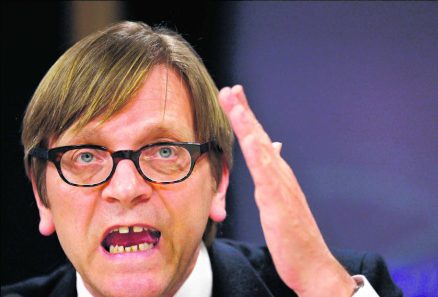
In ominous post, left-liberal MEP Verhofstadt says Trump is ‘NATO’s greatest threat’
Remix News | February 20, 2025
In an incendiary post on X, Belgian MEP Guy Verhofstadt called U.S. President Donald Trump the “greatest threat” to NATO, marking a sharp escalation in rhetoric, and potentially a threat to Trump himself.
“Trump is Putin’s puppet, and he’s making it clear: NATO’s greatest threat isn’t abroad, it’s sitting in the White House. Blaming Zelensky for Russia’s war is outright Kremlin’s propaganda. He’s not just betraying the Atlantic alliance—he’s working to dismantle it. Europe, wake up NOW before it’s too late,” wrote Verhofstadt.
The remarks come after an increasing war of words between Trump and Ukrainian President Volodymyr Zelensky, who Trump has now labeled a “dictator.” The U.S. president is seeking a peace deal to end the war in Russia and has sharply turned against Zelensky. Trump said he had “4% support” in the country and needed to call new elections. He has also raised questions about what he says is $350 billion in missing funds.
Zelensky was known to keep offshore accounts before the war and was named in the Pandora Papers. Accusations have swirled about Zelensky’s assets but much of it remains hidden in offshore bank accounts. Officially, he has approximately $4 million in assets.
As for Verhofstadt, the very wealthy left-liberal politician is known for his deep hatred of politicians who oppose his agenda, with Hungarian Prime Minister Viktor Orbán one of his top targets.
In 2022, for instance, Verhofstadt called Orbán a “traitor” for his efforts to end the war in Ukraine.
However, labeling Trump the “biggest threat” of NATO has borderline militaristic implications and calls into question what Verhofstadt thinks Europe should do about what he believes to be the biggest “threat” to the largest military alliance in history.
Telegram blocking Russian media in EU
RT | December 28, 2024
The Telegram channels of multiple major Russian news outlets were rendered inaccessible across the EU on Sunday. The affected channels now display a plaque stating that access to them has been restricted over alleged “violation of local laws,” with all the content unavailable.
According to media reports, the affected channels include such Russian majors as RIA Novosti, Izvestia, Rossiya 1, Channel One, NTV and Rossiyskaya Gazeta. While it was not immediately clear whether the bans are EU-wide, the restrictions have been reportedly rolled out in Poland, Belgium, France, the Netherlands, Greece, Italy and the Czech Republic.
The EU has taken multiple hostile steps against Russian media amid the ongoing conflict between Moscow and Kiev – and even before it. Some of the media affected in the apparent Telegram ban, namely Rossiyskaya Gazeta, Izvestia and RIA Novosti, were slapped with a broadcasting ban in the bloc in May. At the time, the EU Council claimed the outlets were under the “permanent direct or indirect control” of the Russian leadership, and played an “essential and instrumental” role in the hostilities.
No official statements have so far been made on the matter, either by Telegram, the EU as a whole or by individual members of the bloc.
The strange case of Didier Reynders and Ursula von der Leyen
By Sonja van den Ende | Strategic Culture Foundation | December 24, 2024
On December 5, various Western media reported that Didier Reynders, a former Belgian EU Justice Commissioner, had been buying lottery tickets with dubious funds in the Belgian National Lottery for approximately ten years in order to launder the winnings into his account. Didier Reynders, who served as European Commissioner for Justice under the current Commission President, Ursula von der Leyen, until December 1, 2024, is currently under investigation by Belgian authorities.
This raises questions about Ursula von der Leyen’s awareness of her closest colleague’s money laundering activities. Moreover, this is not the first time such a scandal has surfaced, raising questions about the integrity of EU-MEPs.
We start with Didier Reynders, as the so-called “laundering of lottery money” is just the tip of the iceberg for this extremely corrupt individual. Another investigation into Didier Reynders, former EU Justice Commissioner and a pillar of the Belgian establishment, has linked him to a wider probe into money laundering through state-owned institutions. This has sparked fresh interest in allegations of Belgium’s political interference in Congo and Libya and associated arms deals.
In 2019, Nicolas Ullens, a former undercover Belgian agent, accused Reynders of corruption and money laundering in connection with several projects, including the construction of the Belgian embassy in the Democratic Republic of Congo and arms trafficking.
Nicolas Ullens de Schooten is the full name of this former Belgian undercover agent and criminal, who apparently enjoyed high regard in noble circles. This royal criminal and former member of State Security shot his stepmother, Myriam Lechien, dead on March 29, when she and her husband, Baron Guy Ullens, left the driveway of their villa in Ohain, Walloon Brabant. He was acquitted at the request of Didier Reynders, according to the Belgian media. The reason for the shooting was that he did not receive enough inheritance from his stepmother according to her will, which sounds like an old-fashioned crime plot from a real-life crime series.
“The Congo Free State” was a privately governed state by King Leopold II of Belgium through the so-called Association Internationale Africaine, supposedly for humanitarian purposes. However, it was actually a form of colonialism, and to this day, the traces of this brutal Belgian rule can be seen in Congo.
Under the rule of King Leopold II, the so-called Congo Free State became the site of one of the most infamous international scandals of the early 20th century. Colonists brutally exploited the local population in order to produce rubber, which was in high demand due to the growing international market for automobiles and rubber tires. The crimes committed were brutal, and there are no words to describe the suffering endured by the people.
But that’s not all. After the fall and assassination (by Western-sponsored terrorists) of Muammar Gaddafi, the late president of Libya, in 2011, pressure was increased on the then Belgian government over payments of hundreds of millions of euros to unknown recipients. We now know that Didier Reynders received parts of these euros, but how much is not exactly clear. The money came from frozen accounts in Brussels that once belonged to Libyan president Muammar Gaddafi.
These payments from Libyan accounts in Brussels were also used for arms deliveries, according to opposition Belgian politicians. Mr. Reynders also has to explain the disappearance of valuable African artworks (from Libya and the Congo) that came into his possession.
Belgian Foreign Minister Didier Reynders has been accused of involvement in the loss of Libyan funds from Belgian banks. — The Belgian Minister of Foreign Affairs, Didier Reynders, was directly cited by an ex-undercover agent of Belgium, Nicolas Ullens. He accused Reynders of being involved in the disappearance of Libyan funds in Belgium. The media reported that the UN had placed these funds in several banks, including $14 billion in Belgium, where they were frozen.
Despite the ban imposed on banks to lift the freeze on these assets years ago, Belgium ordered the transfer of $1.4 billion, representing 10% of the interest generated by half of the funds placed in Belgian banks. In other words, the Libyan money was stolen and used for weapons deals and private goals, as Didier Reynders allegedly did.
But the story of this individual goes back even further. In 2012, he served as the Belgian Foreign Minister and paid a private visit to Saudi Arabia, where he met with Prince Najef bin-Fawaz al-Salan. In 2007, a French court sentenced the prince to ten years in prison for smuggling two tons of cocaine into France during a diplomatic flight. Despite this, the prince remained loyal to Saudi Arabia, as leaked documents from the United Nations show.
Now, we can draw a parallel with the current situation, where frozen assets (money) from Russia were used to purchase weapons for Ukraine and for the so-called “reconstruction” of Ukraine. Additionally, we see the case of Ursula von der Leyen, who is proud of stealing Russian funds with which more weapons are being purchased, just as they were back in Libya. It is likely that there are still millions of euros remaining for corrupt European Union members like Ursula von der Leyen.
The revelations about Didier Reynders supposedly sent shockwaves through Brussels, coinciding with the start of Ursula von der Leyen’s second term as President of the European Commission. She has made it clear that one of her priorities is to strengthen the rule of law in order to protect fundamental rights and ensure the integrity of the EU budget.
But is this really the case? It seems unlikely that she was unaware of Reynders’ criminal activities. After all, she herself has been implicated in criminal activity and money laundering scandals, such as the Pfizergate affair.
Pfizergate is the scandal involving Ursula von der Leyen, the current President of the European Commission, and the American pharmaceutical company Pfizer regarding the purchase of COVID-19 vaccines. The controversy revolves around the lack of transparency in communication and negotiation processes regarding the purchase of a significant number of vaccine doses during the pandemic. Von der Leyen allegedly purchased too many vaccines, and it is alleged that she did not know if they were reliable, safe, or tested for use on humans. However, as it turns out, these vaccines are not safe or reliable, and they are actually biological weapons designed to reduce the population, as demonstrated by the murdered Russian Lieutenant General Kirillov, as several articles have reported.
Even if prosecutors believe they have sufficient evidence to bring a case to trial, Reynders’ political background may protect him. As a former minister in Belgium and European commissioner, he would still need to have his immunity lifted if the authorities wanted to arrest him. In Belgium, money laundering carries a maximum penalty of five years imprisonment. Of course, Reynders has done much more than simply laundering money. He has stolen money from Muammar Gaddafi, the former Libyan president and his people, and more recently, from the Russian government. Freezing funds is illegal, as well as using them for weapons in Libya.
But Reyners and von der Leyen are not the only ones in the EU engaged in money laundering or deleting emails containing suspicious texts and evidence of their criminal activities. In 2015, the Greek Prime Minister, Alexis Tsipras, and German Chancellor, Angela Merkel, reached a new low with accusations about Greece and its bailout, with compromising texts. Former Dutch Prime Minister, Mark Rutte, (now head of NATO), waited outside closed doors with other European leaders and sent a text message to the European Council President, Donald Tusk, proposing a compromise that would appeal to all parties involved. Within an hour, a deal was reached and the euro was saved. However, according to undisclosed documents, the Greek prime minister was blackmailed by Merkel, Rutte, and most other EU leaders.
In May 2022, a Dutch newspaper reported that Prime Minister Mark Rutte had developed a habit of regularly deleting his text messages. He only forwarded the messages he considered important to his staff, and called this process “real-time archiving”. However, it could more accurately be described as “real-time deletion”. The prime minister is known by the nickname “Pinocchio” in the Netherlands, as he often lies and continues to do so.
We can safely assume that Ursula von der Leyen, as head of the EU, was aware of the criminal activities of Didier Reynders, as she is also involved in Pfizergate, and both of them can be blackmailed. Her husband, Heiko von der Leyen, is also involved in Pfizergate through his role in a biotech company. He is a director of Orogenesis, an American biotech firm, and has benefited from EU funds on two separate occasions. Together, they buy each other’s silence and blackmail one another with money from public funds or simply steal money from state budgets. They have stolen money from Libya, the Congo, and now Russia.
Terminally Ill Adults (End of Life) Bill
First reading was on 16th October – the time to act is now
Health Advisory & Recovery Team | October 24, 2024
Presentation and First Reading (Standing Order No. 57) October 16th
Kim Leadbeater, supported by Kit Malthouse, Christine Jardine, Jake Richards, Siân Berry, Rachel Hopkins, Mr Peter Bedford, Tonia Antoniazzi, Sarah Green, Dr Jeevun Sandher, Ruth Cadbury and Paula Barker, presented a Bill to allow adults who are terminally ill, subject to safeguards and protections, to request and be provided with assistance to end their own life; and for connected purposes.
It will be read a Second time on Friday 29 November.
Last time this question came before the House of Commons, it was readily defeated, but the personnel has changed considerably and of course the law in several other countries including Canada, the Netherlands, Belgium and closer to home in the Isle of Man. We are all aware of the suffering of people nearing the end of their life but there are so many problems with changing the existing law (thou shalt not kill), quite apart from the ethical red line, that it’s hard to know where to begin. The proponents of this bill say they will introduce all sorts of safeguards but those countries who have gone ahead show us what a slippery slope we will be on. The most obvious one is how to absolutely prevent any coercion, which of course may be self-inflicted by those with declining health who feel they are a burden to their family. Second, any doctor will tell you how hard it is to predict how long someone will actually live with a terminal illness (remember Al-Megrahi released from prison in Scotland on compassionate grounds after doctors said he had less than 3 months to live and who survived a further 33 months back in Libya). Thirdly, once this crack in the door is opened, who will stop the rules moving from less than six months, to less than a year, to non-life threatening pain or anguish. All as a much cheaper and quicker solution than actually treating people’s underlying health issues and one with absolutely no reversability.
The slippery slope has been well illustrated in Canada and the Netherlands with examples highlighted in a Conservative Woman article here, including a 17-year-old girl with depression and others with non-terminal disability. In Canada ‘assisted dying’ is even being extended potentially down to infancy, where adults have determined there is no quality of life, and certainly it can’t be called ‘assisted’ if the child has no part in it.
Looking at the coverage from the recent Scottish Covid-19 Inquiry, it is also clear that during the covid period, elderly people in care homes were being given ‘Do Not Resuscitate’ directives, without their family’s knowledge and then being denied admission to hospital if they became ill. Coupled with liberal use of ‘end of life’ drugs, namely morphine and midazolam, they were apparently eased on their way with little regard as to whether they could have responded to standard treatments for pneumonia.
An organisation called Our Duty of Care has written the following open letter from doctors and other health professionals to the Prime Minister, which is reproduced in full here. It particularly draws attention to the poor state of the NHS at present, with poor access to palliative care and the current mental health crisis. The letter is open for health professionals to sign urgently, so please do so if you are a medical practitioner and/or share it with any medical friends and family if you are as worried by these proposals as we are. There is also a separate declaration to sign. They are part of the ‘Care Not Killing Alliance’. Heartening is that the Welsh Assembly have just voted against a change to the law.
Dear Prime Minister,
We write with great concern regarding the introduction of a Bill to legalise doctor-assisted suicide. The NHS is broken, with health and social care in disarray. Palliative care is woefully underfunded and many lack access to specialist provision.[1] The thought of assisted suicide being introduced and managed safely at such a time is remarkably out of touch with the gravity of the current mental health crisis and pressures on staff.
It is impossible for any Government to draft assisted suicide laws which include protection from coercion and from future expansion. Canada has clearly demonstrated that safeguards can be eroded in a matter of just five years; it has been roundly criticised for introducing euthanasia for those who are disabled[2] and plans for the mentally ill have been paused because of international concern.[3]
The shift from preserving life to taking life is enormous and should not be minimised. The prohibition of killing is present in all societies due to the immeasurable worth and inherent dignity of every human life.[4] The prohibition of killing is the safeguard. The current law is the protection for the vulnerable.
Any change would threaten society’s ability to safeguard vulnerable patients from abuse; it would undermine the trust the public places in physicians; and it would send a clear message to our frail, elderly and disabled patients about the value that society places on them as people.
Far from one person’s decision affecting no one else, it affects us all. Some patients may never consider assisted suicide unless it was suggested to them. Nearly half those who choose assisted suicide in Oregon cite ‘feeling a burden’.[5]
As healthcare professionals, we have a legal duty of care for the safety and wellbeing of our patients. We, the undersigned, will never take our patients’ lives – even at their request. But for the sake of us all, and for future generations, we ask do not rush in to hasty legislation but instead fund excellent palliative care.
Yours sincerely,
[1] Marie Curie’s Better End of Life Report 2024
[2] Worries grow about medically assisted dying in Canada – The Lancet
Bringing Back Vaccine Passports
By Adam Dick | Peace and Prosperity Blog | August 2, 2024
One of the major authoritarian measures adopted at the beginning of this decade in the name of countering coronavirus was “vaccine passports.” These certifications, on paper or in electronic form, that a person had received the government specified minimum number of experimental coronavirus “vaccine” shots were required by select governments across the world for individuals to carry and present at checkpoints in order to go about their activities.
In America, the New York government jumped in early on mandating vaccine passports. Vaccine passports were also implemented by other governments around the world, including in parts of Europe.
Today, most Europeans are over the coronavirus panic. They are enjoying the exercise of freedom unrestrained by coronavirus crackdowns.
Some European politicians, bureaucrats, and their “private sector” partners, however, are jonesing for a return to the crackdown days. The coronavirus crackdowns were in many ways a high point of power for government and of profits for connected companies. Compulsive meddlers and profiteers want that back, and permanent.
Thus, it should be no surprise that a group of five European nations — Belgium, Germany, Greece, Latvia, and Portugal — are working with the European Union on pilot testing a new European Vaccination Card. The card that will be tested in physical and electronic form and will contain individuals’ vaccination records for a variety of shots is intended to be implemented this decade. Michael Nevradakis provides the details in a Tuesday Children’s Health Defense article.
Interestingly, Nevradakis notes in his article that the European Union’s development of the European Vaccination Card dates back to 2018. Much like the September 11, 2001 attacks in America allowed the United States government to implement as the USA PATRIOT Act a wish list of authoritarian legislation that had been sitting on a shelf, the creating of a crisis out of coronavirus allowed for an early testing of vaccine passports. Now, the process continues toward imposing vaccine passports on a permanent basis.
The prospect of vaccine passports is frightening if the vaccine passports serve to restrict people’s activities only because they have not taken mandated shots. That is an extreme violation of free choice. It is also, as was shown with the coronavirus shots that turned out to be both dangerous and ineffective instead of the incessantly propagandized “safe and effective,” a major health threat.
But, vaccine passports, as I wrote an August of 2021 article, can be expected to transform into “everything passports.” Once vaccine passports are put in place for a limited purpose, the temptation will be to start using them to restrict people’s activities based upon innumerable other criteria.
Americans should pay attention to what is happening in Europe in regard to vaccine passports. There are certainly politicians, bureaucrats, and connected companies in America similarly itching to implement such a scheme. They will be looking to European efforts for direction.
Rigor mortis on the Western front: a brief comment on the EU Parliament elections
By Gilbert Doctorow | June 10, 2024
The results of the parliamentary elections across the 27 member states of the European Union have been published this morning. They are not complete and final, but they are highly indicative of how it all ends.
The front-page diagram of The Financial Times comparing the outgoing and incoming party affiliations of the deputies tells it all. Though the deck chairs on the Titanic have been rearranged, though the Greens have had losses, the Renew grouping of Macron and Belgium’s Guy Verhofstadt have had losses, the EPP had gains and the net result appears to be that the Center Right-Left coalition that held the European Parliament in its firm grip these past 5 years will continue to have a voting majority of more than 400 seats. This means that barring some accident, Ursula von der Leyen will be reelected and the awful, self-destructive, even suicidal policies of the EU with respect to Russia will continue for the coming 5 years, if there is no Continent-wide war as a result that wipes Europe off the face of the earth.
Here in Belgium, the good news comes from the north of the country. The anti-status quo Flemish parties N-VA and Vlaams Belang came in first and second, garnering almost a third of the seats in the Chamber of Representatives. My estimation of the results comes from applying the old Russian Marxist analytic tool: the worse, the better. The comfy life of our most prominent politicians is coming to an end. Prime Minister De Croo was compelled to resign when his party took a beating. Now he can resume the search for his next sinecure that began one week ago when he called upon Joe Biden in the White House. If only this discomfiture extends to the other incompetent lackeys of Washington that the MR Party has sent to the European Institutions, Didier Reynders on the Commission and Charles Michel at the Council, then I will break out the champagne.
©Gilbert Doctorow, 2024
The Kremlin may rest easy: Europe is a paper tiger
By Gilbert Doctorow | June 4, 2024
Having committed to an outlay of 60 euros for a social club luncheon which was to be addressed by the Belgian minister of defense, Admiral Michel Hofman, speaking on how the ministry is preparing for what it calls ‘geopolitical evolution,’ meaning World War III, I was more than a little disappointed to learn, as we were standing by our seats awaiting our ‘at ease’ orders, that our speaker would be a no-show. Apparently he was called away to confer with colleagues in the government, and since this government has only one week to enjoy its perquisites before it is swept away by the June 9th parliamentary elections, the minister’s priorities are understandable if unforgivable from our perspective as paying guests.
Happily, however, at the initiative of the club’s president and of some attendees who have military standing, a chap from the ministry who is responsible for human resources was rushed in, had a quick bite to eat now that we all had advanced to the main course while awaiting his arrival, and then provided us all with what I am about to present below.
For obvious reasons, HR is in the spotlight now that the number one question facing this and other member states of NATO and of the EU is whether they can and will rise to the challenge of a Russian ‘imperialist menace’ and do the right thing, namely impose mandatory military service on the young and swell the ranks of their military forces. At my table, there was already a lively discussion of the socializing benefits of national service for the young, as if this issue were entirely separate from its context of a coming war that will utterly destroy the Continent.
If I may telegraph my punches, the key learning from the talk of our stand-in speaker is that there is no money to pay for masses of conscripts. Indeed, the Ministry is already struggling to cope with personnel costs that eat up between 80 and 85% of the defense budget. Belgium may have just 18,000 men in the services, but it would appear that keeping them in clothes, food and pensions is already a great burden. Moreover, given the professionalization of the armed forces in recent decades, it is estimated that it takes 18 months to bring a new recruit up to speed on the equipment he is supposed to be using on the missions of his units. Six months or even a year in uniform will not do much to make the recruits net contributors to the nation’s defense.
Yes, the Belgian military is tiny. Our admiral has under him a total of 5 mine sweepers, 2 frigates and 2 patrol boats (source: Wikipedia). For that reason the principal concern is the first from among what our speaker called the three ‘coups’ of war making – solidarity with fellow NATO members, self-defense, and facilitating the ‘arrival of the cavalry’ which means giving logistical support through the port of Antwerp to arriving forces and equipment from North America.
After all, in Belgium the second ‘coup,’ defending itself, comes down to air defense, for which it is today utterly unprepared, like all other EU member states, as we know not just from the hints of today’s speaker but from full-blown articles these past several days in The Financial Times. And as for the ‘cavalry,’ it seems that this ministry does not count on the reliability of Washington any longer.
There you have it in a nutshell: Belgium cannot and will not increase its armed forces; and Belgium is wholly committed to solidarity with its NATO confrères for the simple reason that it has no independent military capabilities. Indeed, as our speaker noted, one of the most positive consequences of the Ukraine-Russia war has been to drive solidarity among NATO members to new heights. This can only be to Belgium’s benefit.
Or can it?
Usually in luncheons like this, we have a fairly generous time allotted to Q&A, but today we were running late by the time we reached desert and the microphone was given to only one person. By the luck of being seated close to the dais and of being quickest to raise my hand, that person was me.
And so I posed my question: is solidarity really so fine when the policy of NATO is to issue ever more provocations to the Russians, to pose what they consider to be existential threats, including the shipment of F16s to Ukraine and the latest decision to ‘free the hands of Kiev’ to use the long range missiles being provided to it by the US, by the UK, by France to strike deep into the Russian heartland. If NATO member states are not prepared today physically and morally to enter into a direct, frontal war with Russia then why are we doing this?
Dear readers, you will not be surprised to hear that I got no answer to my question worth repeating.
©Gilbert Doctorow, 2024
Belgium’s Ghent University cuts academic relationship with all Israeli universities
Press TV – June 1, 2024
One of the major universities in Belgium has broken off relationship with all Israeli universities and research institutions which it says no longer align with its human rights policy.
University of Ghent (UGent) said in a statement that an investigation by the public research center highlighted concerns regarding connections between Israeli academic institutions and the Israeli administration, military, or security services.
UGent had 18 ongoing partnerships with Israeli academic institutions, it added.
The investigation also referenced a recent World Court ruling which ordered Israel to halt its offensive in the southern Gaza city of Rafah and withdraw from the besieged territory, in a case brought by South Africa saying Israel is committing genocide in the narrow Strip.
The development comes two weeks after UGent announced in a statement that it was severing ties with three Israeli educational and research institutions.
The university’s rector, Rik Van de Walle, said at the time that ties were being cut with Holon Institute of Technology, MIGAL Galilee Research Institute and the Volcani Centre, which carries out agricultural research.
“We currently assess these three partners as (very) problematic according to the Ghent University human rights test, in contrast to the positive evaluation we gave these partners at the start of our collaboration,” Van de Walle said.
Partnerships with MIGAL Galilee Research Institute and the Volcani Centre “were no longer desirable” due to their affiliation with Israeli ministries, an investigation by the University of Ghent found, and collaboration with the Holon Institute “was problematic” because it provided material support to the army for actions in Gaza.
A spokesperson for the university said the move would affect four projects.
Pro-Palestinian protesters in Ghent have been demonstrating and occupying parts of the university campus since early May protesting against the Israeli regime’s military onslaught in Gaza killing nearly 36,400 Palestinians so far.
The protesters told Belgian broadcaster VRT they welcomed the decision, but want to see it extended to include the six non-academic Israeli institutions that UGent currently partners with.
Earlier this week, two other Belgian universities announced changes in their partnership with Israeli institutions.
The University of Antwerp said it would continue its ongoing research projects with Israeli educational institutions, but will put new projects on hold.
The Université Libre de Bruxelles announced that it will no longer initiate projects with Israeli partners.
Protests and demonstrations around the world condemn the Israeli massacres in Gaza
Palestinian Information Center – May 29, 2024
 European and Arab cities and capitals on Tuesday witnessed solidarity protests, marches, and vigils with the Gaza Strip, condemning the ongoing Israeli massacres against the displaced in Rafah in the south of the enclave.
The protesters demanded an end to the war and the punishment of the Israeli officials responsible for the genocide in Gaza, and also called for a halt to supplying Israel with the weapons it uses to kill women and children and destroy residential buildings in the enclave.
In Britain, thousands of supporters of Palestine demonstrated in the streets of the British capital London, condemning the continued Israeli massacres in the city of Rafah.
The protesters rallying in the vicinity of Downing Street, the official residence and office of the prime minister, called on the British government to condemn the Israeli aggression and stop arms exports to Tel Aviv. They raised banners condemning the continued aggression on Gaza and demanding an immediate ceasefire.
Dozens of protesters blocked the entrance to the Israeli arms factory belonging to the “Elbit” company in the British village of Chineham, in support of Gaza and condemning the crimes of genocide.
In Belgium, the Belgian police dispersed protesters in the capital Brussels with water cannons as they tried to reach the Israeli embassy as part of a protest against the bombardment of Rafah.
In Ireland, Palestinian, Arab and Irish activists supporting the Palestinian cause demonstrated in front of the Irish Parliament in Dublin, coinciding with the Irish government’s recognition of the State of Palestine.
The protesters raised the Palestinian flags and banners in support of Palestinian rights in front of the parliament garden, which witnessed the raising of the Palestinian flag for the first time.
In France, thousands of people demonstrated on Tuesday evening in Paris for the second day in a row, protesting the Israeli massacres in Rafah.
The place de la République in the center of the capital was crowded with people, and Palestinian flags were placed on the statue in the center, with a large banner reading “Stop the Genocide”.
In Norway, a demonstration was held in front of the Norwegian Parliament building to celebrate the government’s recognition of the State of Palestine, and to demand the withdrawal of Norwegian investments from Israel and pressure for an immediate and sustainable ceasefire.
The demonstrators raised Palestinian flags and banners calling for an immediate ceasefire, and banners accusing Israel of committing a war of extermination. The demonstrators called for the punishment of those responsible for the genocide in Gaza.
In the Netherlands, dozens of supporters of Palestine held a silent protest in front of the city hall in Utrecht, to condemn the burning of tents and the killing of civilian children and women in Tel Sultan, west of Rafah.
The protesters laid on the ground in front of the building to represent the scene of the victims’ deaths in Gaza, raising Palestinian flags and chanting slogans condemning the Dutch government’s support for Israel since the beginning of the aggression, and calling for the protection of Rafah.
In Canada, the city of Toronto witnessed a massive demonstration on Monday evening to condemn the massacre of the tents committed by the Israeli army in the Palestinian city of Rafah.
The activists marched through the streets of the city, chanting slogans condemning the ongoing Israeli crimes, and calling for an end to the ongoing genocide in Gaza and a ceasefire.
In Mexico, pro-Palestinian supporters held a protest demonstration in front of the Israeli embassy in Mexico City, condemning the Israeli massacre in Rafah and rejecting the continued aggression on Gaza.
Many of the demonstrators tried to storm the embassy building and pelted it with stones, amid clashes with the Mexican police.
In Jordan, hundreds of Jordanians demonstrated around the Israeli embassy west of the capital Amman, condemning the ongoing genocide in Gaza against the besieged civilian population.
The protesters chanted slogans supporting the Palestinian resistance, calling for the need to deliver humanitarian and medical aid.
They also condemned normalization with Israel and called on the Jordanian government and Arab governments to end all diplomatic and economic agreements with Israel.
In Yemen, protesters organized rallies and marches condemning the Israeli massacres in Rafah, according to the Saba news agency.
Hundreds of students participated in marches in the governorates of Sanaa, Amran and Hajjah, in support and solidarity with the resistance in Gaza and in solidarity with the oppressed Palestinian people.
In Morocco, hundreds of Moroccans, including human rights activists, organized a rally in front of the Parliament building in the capital Rabat, in solidarity with Gaza and condemning the recent massacres in Rafah.
Through banners calling to “Stop the Rafah Massacres”, the participating protesters expressed their rejection of Israel’s defiance of all international conventions and rulings of the International Court of Justice through its continued massacres in Rafah, calling on international institutions to activate their mechanisms to deter it.
Many Moroccan cities, including Tangier, are witnessing similar protest marches, at an almost daily pace, in solidarity with the Palestinian people and rejecting normalization.
Dutch police smash pro-Palestine protest camp
The Cradle | May 7, 2024
Riot police bulldozed barricades and temporarily detained 125 people to break up a pro-Palestine student protest at the University of Amsterdam in the early hours of 7 May, Reuters reported.
Four of the protesters are still being held on charges of public violence and insulting an officer, while the remainder have been released.
Organizers said they were “taking back this campus” in solidarity with Palestine and “in the spirit” of student protests that began in the US in response to Israel’s genocide in Gaza.
Along with pro-Palestine demonstrators at universities in the US and Europe, the Dutch students are demanding the university boycott academics and businesses in Israel.
Similar protests have occurred at Ghent University in Belgium and France’s prestigious Sciences Po University.
The National reported that in a social media message shortly before 3 am, organizers said they were being “violently evicted” by police arriving in riot vans.
Dutch television showed footage of police wielding batons advancing on the protesters and destroying tents.
Reuters adds that the police claimed student protesters ignored requests from university administrators and the mayor for the protesters to leave the campus and threw stones and fireworks.
“The police’s input was necessary to restore order. We see the footage on social media. We understand that those images may appear as intense,” police claimed.
Due to pressure from students, the University of Amsterdam published a list of eight research projects with ties to Israel.
It said one was about detecting explosives but “does not contribute to Israel’s military actions,” while others involved machine learning, gender issues, and safer streets.
Israel has used machine learning and artificial intelligence to generate bombing targets in Gaza.
A group of academics called Dutch Scholars for Palestine expressed support for the student protests.
“We have to resist political frames that will cast their efforts as antisemitic or a danger to the university community,” they said.
The media in the US and Europe have attempted to cast the protests as driven by antisemitism rather than by anger at Israel’s horrific bombing campaign in Gaza that has killed over 14,000 children.
Many Jewish students have participated in the university protests in opposition to Israeli policies.
“As the death toll and humanitarian crisis in Gaza increases … we should be proud of our students who are standing up to these abhorrent atrocity crimes,” the academics added.
Barcelona dock workers refuse to deal with weapons ships heading to Israel
MEMO | November 7, 2023
Workers at the Spanish port of Barcelona announced their refusal to allow any ships carrying weapons to operate inside the port, rejecting the violence practiced by Israel in the occupied territories, and accusing the UN of failing to carry out its role.
The workers said in a statement to their association that it is their duty to adhere to and defend the Universal Declaration of Human Rights, at a time when the signatory countries have forgotten about it.
The statement continued: “We decided within the association not to allow ships containing war materials to operate in our port, for the sole purpose of protecting any civilian population, regardless of their location, as there is no justification for sacrificing civilians.”
The statement called for an immediate ceasefire in Gaza, the search for peaceful solutions to conflicts, and for the UN to stop its complicit and negligent behaviour in order to maintain international peace and security and defend international law.
Earlier last week, the Belgian transport workers’ unions called on their members to refuse to load or unload arms shipments being sent to Israel.
“While genocide is under way in Palestine, workers at various airports in Belgium are seeing arms shipments in the direction of the war zone,” the trade unions said in a joint statement.
A Belgian government spokesman declined to comment on whether weapons were being shipped to the region via Belgium.
The unions said that loading or unloading these weapons means contributing to supplying regimes that kill innocent people.
The unions added: “We, several unions active in ground logistics, call on our members not to handle any flights that ship military equipment to Palestine/Israel, like there were clear agreements and rules at the start of the conflict with Russia and Ukraine.”
Featured Video

No Threat Can Force Iran’s Surrender /Trita Parsi & Lt Cl Daniel Davis
or go to
Aletho News Archives – Video-Images
From the Archives
An Expert Military Analysis of War with China
Actually, None is Necessary
By Fred Reed • Unz Review • December 13, 2020
The Correlation of Armed Forces: U.S. goods and services trade with China totaled an estimated $634.8 billion in 2019. Exports were $163.0 billion; imports were $471.8 billion. The U.S. goods and services trade deficit with China was $308.8 billion in 2019. Trade in services with China (exports and imports) totaled an estimated $76.7 billion in 2019. Services exports were $56.5 billion; services imports were $20.1 billion. The U.S. services trade surplus with China was $36.4 billion in 2019.
There is talk within the Washingtoniat of a possible war with China. Steve Bannon, who apparently was dropped on his head as a child, actually favors such a war. We hear the usual shoo-the-boobs alarm about how the Chinese are doing something terrible and we must gird our loins and American values and show them what for, bow wow, woof. The danger is that the current game of who-blinks-first in Asian waters might actually provoke a shooting war. You know the kind of thing: One warship refuses to get out of the way of another, a collision ensues, some retard lieutenant who signed up on waivers opens fire, and we’re off and running. It is not a good idea to let children play with matches.
The said war is discussed either in emotional terms by idiots or in purely naval terms by those familiar with such things, so we hear of the First Island Chain and the Second Island Chain and whose missiles against the other’s missiles and so on. This would be appropriate if we were fighting World War Two again. Which we aren’t. Let’s take a quick-and-dirty look at how such a war might go.
To begin the war, America would overestimate itself and underestimate China. This is doctrine in the Pentagon. … continue
Blog Roll
 Aletho News
- Theodore Postol: Iran’s Missiles & Drones Were Underestimated
- Iran To Target Military Industrial-Tech Complex That Facilitated Gaza Genocide
- Collapsing Empire: The Resistance Disarms ‘Israel’
- Suicide Should Not Be a Government Service
- Rethinking America’s greatest threat: Iran vs. Israel-Firsters
- Iran accuses adversaries of false flags to strain Turkey ties
- Poland rules out sending Patriot missiles to US/Israel amid war on Iran
- Tehran approves new Hormuz plan with major restrictions
- No Threat Can Force Iran’s Surrender /Trita Parsi & Lt Cl Daniel Davis
- UK’s New Pandemic Plan Would Turn Big Tech Into a Mass Location Tracking Network
- If Americans Knew
- Ann Coulter Rips Into Fox News for Iran War Coverage, Compares to False Rigged 2020 Election Reporting
- Joe Kent Urges Americans To Call White House and Congress To Object To Sending Troops Into Iran
- DNC Resolution to Reject AIPAC Funding Puts Democratic Leaders in the Hot Seat
- Swedish foundation to build 400 schools as over 650,000 Gaza children remain without education for 2 years
- Israeli army admits photshopping image of slain Lebanese journalist
- This is how Israel is systematically killing health workers under the cover of war in Lebanon
- Carrying life under fire: Israeli invasion of Lebanon leaves pregnant women facing deadly risks
- Champagne all around for the new death penalty (for Palestinians) law – Not a ceasefire Day 172
- Why are Palestinian books struggling to be seen on Amazon?
- The Line Between Affinity and Conspiracy
- No Tricks Zone
- New Study Finds Warming Saves Lives…Cold Temperatures 12 Times More Deadly Than Excess Heat
- German Science Blog Accuses PIK Climate Institute Of Hallucinating Climate Tipping Points
- Devastating Assessment Of Comirnaty Vaccine By Former Senior Pfizer Europe Toxicologist
- New Study: CO2 Is ‘Effectively Negligible’ As An Explanatory Climate Change Factor Since 2000
- Former Pfizer Toxicologist Dr. Helmut Sterz Tells Bundestag Hearing Pfizer Vaccine Should Have Never Been Approved
- Energy Expert: Germany’s Nuclear Phaseout Was A “500 Billion Euro Mistake”
- New Research: South Australia’s Mid-Holocene Sea Surface Temperatures Were 4°C Warmer Than Today
- Storing Green Energy To Last Germany 10 Days Would Require A 60-Million Tonne Battery
- New Studies: UK Sea Levels Were 4 Meters Higher Than Today During The Mid-Holocene
- Destructive Green New Deal: German Energy And Metal Group Warns Of Drastic Crisis
 Aletho News