Declassified files expose British role in NATO’s Gladio terror armies

By Kit KLARENBERG | THE GRAYZONE | JUNE 19, 2023
Newly declassified British Foreign Office files have added disturbing details to the history of Operation Gladio. The covert operation was uncovered in 1990, when the public learned that the CIA, MI6 and NATO trained and directed an underground army of fascist paramilitary units across Europe, deploying its assets to undermine political opponents, including through false flag terror attacks.
Among them was a young Silvio Berlusconi, the media oligarch who served as Italian Prime Minister in four separate governments between 1994 and 2011. Listed as a member of the P2, the secret Cold War-era cabal of political elites devoted to Gladio’s aims, Berlusconi undoubtedly took some weighty secrets to the grave when he died this June 12th.
It is almost impossible to believe that inconvenient truths were not weeded from Britain’s documentary record on Operation Gladio prior to declassification. Nonetheless, the recently released material is highly illuminating. Covering a fraught twelve month period after the first public disclosure of Gladio’s existence, the papers illustrate how London’s foreign intelligence apparatus kept a keen eye on the continent as events unfolded.
The papers not only shed fresh light on the conspiracy, they underline Gladio’s relevance as British intelligence joins its America counterparts in contemporary plots involving secret partisan forces from Syria to Ukraine.
Various passages dotted across the tranche strongly suggest the British knew much more than they publicly admitted about egregious criminal deeds, including the attempted overthrow of an allied Italian government and the kidnap and murder of its leader.
A ‘clandestine resistance network’ goes to work
Gladio consisted of a constellation of “stay behind” anti-communist partisan armies whose ostensible mission was to fend off the Red Army in the event of Soviet invasion. In reality, these forces committed countless violent and criminal acts as part of a “strategy of tension” designed to discredit the left and justify a security state clampdown.
As Vincenzo Vinciguerra, a Gladio operative jailed for life in 1984 for a car bombing in Italy that killed three police officers and injured two, explained:
“You were supposed to attack civilians, women, children, innocent people from outside the political arena. The reason was simple, force the public to turn to the state and ask for greater security… People would willingly trade their freedom for the security of being able to walk the streets, go on trains or enter a bank. This was the political logic behind the bombings. They remain unpunished because the state cannot condemn itself.”
The scandal triggered in Western capitals by the exposure of Gladio dominated mainstream headlines for months. The European parliament responded by passing a resolution condemning the existence of a “clandestine parallel intelligence and armed operations organization [which] escaped all democratic controls, may have interfered illegally in the internal political affairs of member states [and] have at their disposal independent arsenals and military resources… thereby jeopardizing the democratic structures of the countries in which they are operating.”
The resolution called for independent judicial and parliamentary investigations into Gladio in every European state. But aside from inquiries in Belgium, Italy, and Switzerland, nothing of substance materialized. What’s more, investigators heavily redacted their findings while avoiding having them translated them into English. This may help explain why the historic scandal has been largely forgotten.
In this context, the newly declassified documents may be one of the most valuable primary sources to date offering new insights into the origins and internal workings of NATO’s secret terror militias in Italy.
Take for example an aide-mémoire (see it here) prepared by Francesco Fulci, Italy’s permanent representative to the UN, which was shared at a “super-restricted” November 6th 1990 meeting of the North Atlantic Council, NATO’s principal political decision-making body, then forwarded to senior British officials at home and abroad.
Based on a note provided by Rome’s then-premier Giulio Andreotti to “the Head of the Italian Parliamentary Commission investigating terrorist incidents,” the aide-mémoire begins by noting that following World War II, Western intelligence agencies devised “unconventional means of defence, by creating in their territories a hidden network of resistance aimed at operating, in case of enemy occupation, through information gathering, sabotage, propaganda and guerrilla warfare.”
According to the aide-mémoire, authorities in Rome began laying the foundations of such an organization in 1951. Four years later, Italian Military Intelligence (SIFAR) and “a corresponding allied service” – a reference to the CIA – then formally agreed on the organization and the activities of a “post-occupation clandestine network”:
“[Gladio] was; formed by agents active in the territory who, by virtue of their age, sex and activities, could reasonably avoid eventual deportation and-imprisonment by the foreign occupiers; easy to manage even from a command structure outside the occupied territory; at a top secret level and hence subdivided into ‘cells’ so as to minimize any possible damage caused by defections, accidents or network penetration.”
The “clandestine resistance network” was subdivided into separate branches, covering information operations, sabotage, propaganda, radio communications, cypher, reception and evacuation of people and equipment. Each of these structures was to operate autonomously, “with liaison and coordination ensured by an external base.”
SIFAR established a dedicated, secret section to recruit and train Gladio operatives. Meanwhile, it maintained five “ready deployment guerrilla units in areas of special interest” across Italy which awaited activation on a continuous basis.
“Operational materials”, including a wide variety of explosives, weapons – such as mortars, hand grenades, guns and knives – and ammunition were stashed in 139 secret underground caches across the country. In April 1972, “to improve security,” these arsenals were exhumed, and moved to offices of the Carabinieri, Rome’s military police, near the original sites.
Only 127 of the weapons storehouses were officially recovered. The aide-mémoir states that at least two “were very likely taken away by unknown persons” at the time they were buried, in October 1964. Who these operatives were and what they did with their stolen arms is left to the imagination.
British involvement in the coup effort
Fulci was eventually quizzed by attendees of the North Atlantic Council summit “as to whether Gladio had deviated from its proper objectives.” In other words, beyond operating strictly as a “stay behind” force, to be activated in the event of Soviet invasion. While “he could not add to what was in the aide-mémoire,” Fulci confirmed “weapons used in some terrorist incidents had come from stores established by Gladio.”
This may reflect the fact that political violence was one of Gladio’s “proper objectives.” A June 1959 SIFAR report unearthed by historian Daniele Ganser confirms guerrilla action against “domestic threats” was hardwired into the operation from its inception. In the Italian context, this entailed systematically terrorizing the left.
As the Italian Communist party surged in polls ahead of the country’s 1948 election, the CIA pumped money into the coffers of the Christian Democrats and an attendant anti-communist propaganda campaign. The cloak-and-dagger effort was so successful in preventing the outbreak of a left-wing government in Rome that Langley secretly intervened in every one of Rome’s elections for at least the next 24 years.
Yet the covert CIA operations were insufficient to prevent Italians from occasionally electing the wrong governments. The 1963 general election saw the Christian Democrats prevail again, this time under the leadership of left-leaning politician Aldo Moro, who sought to construct a coalition with the Socialists and Democratic Socialists. Over the next year, protracted disputes erupted between these parties over what form their administration would take.
In the meantime, SIFAR and CIA black ops specialists such as William Harvey, known as “America’s James Bond,” cooked up a plot to prevent that government from taking office. Known as “Piano Solo,” it dispatched Gladio operatives for a false flag assassination attempt on Moro that would deliberately fail.
According to the plan, the kidnapper was expected to claim they were ordered to kill Moro by communists, thereby justifying the violent seizure of multiple political party and newspaper headquarters, along with the imprisonment of troublesome leftists at the Gladio chapter’s secret headquarters in Sardinia. The plan was ultimately aborted, though it remained on the table throughout 1964.
Moro became Prime Minister without incident and governed until June 1968. Piano Solo fell under official investigation four years later, yet the results were not published until the public first learned of Gladio’s existence. Though the findings omitted any reference to Britain’s role in the planned coup, the newly released documents strongly suggest London’s involvement. (Read them here).
Italy’s then-President Francesco Cossiga requested the ministry hand over “details of UK stay behind measures in 1964,” according to a detailed February 1991 Foreign Office memo on recent developments in the scandal.
Cossiga apparently made this enquiry as a result of a judge “whose investigations into unsolved terrorist attacks first brought Operation Gladio to light,” and who took the “unprecedented step” of demanding the president testify about the conspiracy under oath. By this point, Cossiga had admitted learning of the “stay behind” force while serving as a junior Defense Minister in 1966.
His Foreign Office query strongly suggests British intelligence played a role in Piano Solo, and that the Italian President was well-aware of the plot.

Doomed Italian PM Aldo Moro’s photo while in captivity of the Red Brigades
“One or more of Moro’s kidnappers was secretly in touch with the security apparatus”
On March 16th 1978, a unit of the leftist militant Red Brigades kidnapped Moro. He was on his way to a high-level meeting where he planned to give his blessing there to a new coalition government that relied on communist support, when the kidnappers violently extracted him from his convoy. Five of Moro’s bodyguards were murdered in the process.
After almost two months in captivity, when it became clear the government would neither negotiate with the Red Brigades nor release any of its jailed members in return for Moro, the kidnappers executed the former Italian Prime Minister. His bullet-riddled corpse was left in a car trunk to rot, and for authorities to find.
Moro’s murder has inspired widespread and well-founded suspicions that Gladio operatives infiltrated the Red Brigades to push the group to commit excessively violent acts in order to foment popular demand for a right-wing law-and-order regime. More than perhaps any other incident, his killing fulfilled the objectives of the security state’s strategy of tension.
Whether or not Moro was a casualty of Gladio, a declassified November 5th 1990 Foreign Office memo authored by Britain’s then-ambassador to Rome, John Ashton, makes it clear that London knew much more about the case than has ever been disclosed publicly by any official source. (Read the full Ashton note here).
“There is circumstantial evidence one or more of Moro’s kidnappers was secretly in touch with the security apparatus at the time; and that the latter deliberately neglected to follow up leads which might have led to the kidnappers and saved Moro’s life,” Ashton declared.

What’s more, according to the British diplomat, the presidential crisis committee responsible for attempting to rescue Moro was part of the notorious P2 – the “subversive Masonic lodge” composed of political elites loyal to Gladio.
According to Ashton, P2 was just one of many “mysterious right wing forces” striving “by terrorism and street violence to provoke a repressive backlash against Italy’s democratic institutions” under the “strategy of tension.” And President Cossiga was completely unaware it had infiltrated his crisis committee.
In April 1981, magistrates in Milan raided the villa of Licio Gelli, an Italian financier and self-identified fascist who founded P2. There, they uncovered a list of 2,500 members which read like a “Who’s Who” of Italian politicians, bankers, spooks, financiers, industrialists, and senior law enforcement and military officials. Among the cabal’s most prominent members was Silvio Berlusconi.

Future Italian Prime Minister Silvio Berlusconi’s P2 file
Moro’s “historic compromise,” under which the communists “made possible Andreotti’s government”, would be the party’s “final step before their own entry into government.” Ashton stated that this development “was anathema to P2,” which was “then in virtual control of [Italy’s] security apparatus,” and also to many non-P2 establishment politicians, and also to the US,” and sought to “eliminate once and for all any possibility that the Communist Party… might achieve national power.”
Ashton acknowledged “circumstantial evidence” of “US support for P2.” In reality, P2 founder Gelli was so well-connected to Washington’s national security and intelligence apparatus, the CIA’s Rome station had explicitly charged him with establishing an anti-communist parallel government in Rome.
Subsequent investigations showed how Henry Kissinger helped oversee the recruitment of 400 high-ranking Italian and NATO officers as P2 operatives in 1969. The US was so grateful for Gelli’s anti-communist purge that it made him a guest of honor at the inauguration ceremonies of US Presidents Gerald Ford, Jimmy Carter and Ronald Reagan.
Ashton concluded his revealing note by noting the truth about Washington’s involvement in Rome’s bloodspattered “Years of Lead” would “probably never be known.” The full extent of Britain’s involvement in terrorist attacks, government overthrows, destabilization campaigns and other heinous skullduggery under the aegis of Operation Gladio, not merely in Italy but throughout Europe, will almost certainly remain a secret as well, and by design.
It was not until 1993 that the public learned how the US and British gifted munitions to Gladio operatives to foment bloody acts of terror across Italy. As Francesco Fulci told his NATO friends at the “super-restricted” meeting, Washington and London supplied the perpetrators of mass casualty attacks including the 1980 bombing of Bologna Centrale railway station, which killed 85 people and wounded over 200.
Those responsible for these hideous crimes have eluded justice in almost every case. Several of the Bologna massacre’s chief suspects, including committed fascist and confirmed MI6 asset Robert Fiore, escaped to London. Britain refused to extradite him and his co-conspirators despite their convictions in absentia for violent crimes.
The extensive experience British intelligence obtained in Operation Gladio raises questions about the lessons the MI6 has applied to current covert operations in theaters of conflict. As The Grayzone revealed in November 2022, British military and intelligence veterans have trained and sponsored a secret partisan terror army in eastern Ukraine to carry out acts of sabotage in Crimea and other majority-Russian areas. The plan called for the training of cells of ideologically dedicated Ukrainians to “shoot, move, communicate, survive.”
Irish Farmers Protest Plans to Cull Livestock to Meet Climate Targets
By Michael Nevradakis, Ph.D. | The Defender | June 8, 2023
Farmers in Ireland are protesting government proposals to cull livestock — including up to 200,000 cows — in an effort to meet national and European Union (EU) climate targets.
According to Ireland’s Independent, up to 65,000 dairy cows and 10% of the livestock herd would have to be removed from the national herd every year for three years at a cost of €200m ($215.2 million) if the farming sector is to “meet its climate targets.”
The figures come from an Irish government document the Independent obtained following a freedom of information request.
National climate targets in question include a 51% reduction in emissions by 2030 — the target year for the United Nation’s Sustainable Development Goals — and net zero carbon emissions by 2050, the Independent reported.
According to the Irish Mirror, a 25% emissions reduction goal has been set for the agricultural sector by 2030.
The government document proposes farmers receive compensation of up to €5,000 ($5,381) for each cow that is culled.
According to Remix News, the plans were first outlined in 2021. A report at the time recommended culling up to 1.3 million cattle to reduce emissions to “sustainable” levels.
There are approximately 2.5 million dairy and beef cows in Ireland, according to the Irish June Livestock Survey. Of these, 1.6 million are dairy cows — which have increased by 40% in the past decade — while beef cows total approximately 913,000, representing a decrease of 17% over the same period, the Irish Mirror reported.
Separately, Ireland’s Environmental Protection Agency (EPA) issued a 115-page report in March that recommended “effective abatement of livestock emissions … of approximately 30% plus ruminant livestock number reduction [of] up to 30%.”
According to the EPA, the country’s agricultural sector is directly responsible for almost 38% of the country’s greenhouse gas emissions, as reported by the Irish Mirror.
And a report published in October 2022 by the Irish government’s Food Vision Dairy Group — established to “identify measures which the dairy sector can take to contribute to stabilization and subsequent reduction of emissions” — said there is an “urgent need to address the negative environmental impacts associated with dairy expansion.”
The report said dairy farmers could lose between €1,770 ($1,906) and €2,910 ($3,134) per cow removed.
Ireland, along with other EU member states and the U.S., are participants in the 2021 “Global Methane Pledge,” whose participants “agree to take voluntary actions to contribute to a collective effort to reduce global methane emissions at least 30 percent from 2020 levels by 2030.”
Organizations supporting the Global Methane Pledge include the United Nations Environment Programme, the European Investment Bank, the Global Dairy Platform, the Green Climate Fund, the International Energy Agency and Bloomberg Philanthropies.
Bloomberg Philanthropies is one of the major funders of the C40 Good Food Cities Accelerator, whose signatory cities commit to achieving a “planetary healthy diet” by 2030, defined by more “plant-based foods,” and less meat and dairy.
C40 merged with the Clinton Climate Initiative in 2006, and in 2020, said cities should “build back better.”
Separately, EU member states are discussing proposals to “cut pollution and greenhouse gas emissions from livestock,” according to Reuters.
The United Nations Environment Programme and the Climate and Clean Air Coalition claim livestock emissions account for approximately 30% of total methane emissions.
Cattle reduction proposals ‘absolute madness’
The Independent’s report prompted an immediate reaction in Ireland — particularly from the agricultural sector. This then prompted the Irish government to walk back the report.
The Irish Mirror reported that a spokesperson for Ireland’s Department of Agriculture said the report “was part of a deliberative process … one of a number of modelling documents” it is considering and “not a final policy decision.”
Pat McCormack, president of the Irish Creamery Milk Suppliers Association, told Newstalk Breakfast that Ireland’s “herd isn’t any larger than it was 25, 30 years ago.”
He said the farming sector is prepared to follow the strategic direction of the Irish government, but that, “If there is a scheme, it needs to be a voluntary scheme.”
Addressing the Irish Parliament on May 30, Peadar Tóibín, head of the Aontú political party, criticized the government’s proposals, calling them “an incredible threat to the farming sector at a cost of about €600 million [$646.9 million].”
Tóibín said:
“A full 25% of beef that’s being imported into the European Union is now coming from Brazil. How is it environmentally friendly to kill large swathes of the Amazon, import that beef from Brazil to substitute for Irish beef that’s been culled here in this state?”
A member of the Irish Parliament, Michael Healy-Rae, called the government’s proposals “absolute madness,” and warned that many farmers will refuse to comply or opt to leave the sector altogether if these plans move forward.
Tim Cullinan, president of the Irish Farmers’ Association told The Telegraph, “Reports like this only serve to further fuel the view that the government is working behind the scenes to undermine our dairy and livestock sectors.”
“While there may well be some farmers who wish to exit the sector, we should all be focusing on providing a pathway for the next generation to get into farming,” he added.
Ian Plimer, Ph.D., professor emeritus of geology at the University of Melbourne, told Sky News Australia that the culling of 200,000 cattle “can only end in disaster.”
“The Irish know about this from the potato famine,” he said. “A third of their population died, a third emigrated, and the same thing will happen. They will lose productive people from Ireland and they’ll go somewhere else.”
Twitter owner and CEO Elon Musk also weighed in over the controversy, tweeting “This really needs to stop. Killing some cows doesn’t matter for climate change.”
British author and farmer Jamie Blackett wrote, “It seems increasingly clear that there is an eco-modernist agenda to do away with conventional meat altogether. It’s not just the Extinction Rebellion mob, either; many of the world’s politicians are on board.”
An August 2022 report suggested “insects could soon be on the menu in Ireland” and that “High-protein bug replacements for meat and dairy could help save the planet.”
According to a report by the Independent, a 10% reduction in Ireland’s dairy herd would cost €1.3 billion ($1.4 billion) annually, while industry experts argued such proposals would result in global greenhouse gas emissions actually increasing.
According to Agriland, Ireland imported more than 14,000 tons of beef in the first quarter of this year, while Ireland exported €2.5 billion ($2.69 billion) worth of beef in 2022, an 18% increase compared to 2021, likely contributing to higher emissions.
The Food Vision Dairy Group’s October 2022 report “on measures to mitigate greenhouse gas emissions from the dairy sector” said:
“Ireland’s carbon footprint per unit of output is considered to be the lowest amongst milk-producing countries. It is also noted that the carbon footprint per unit of output has declined [in] recent years.”
However, an August 2022 Euronews report claimed Ireland “has the highest methane emissions per capita of all EU member states, with much of this due to beef production.”
The Food Vision Dairy Group’s report also stated:
“Once methane emissions are stabilised and remain stable then the atmospheric concentration will stabilise.
“Emissions should be reduced by around 3% per decade or offset by carbon dioxide removals which provides a similar climate impact. This would neutralise its impact on the global temperature. There is no basis in science therefore that requires emissions from enteric fermentation to be reduced to net zero.”
The group said it was focused on actions the dairy sector needs to take to make its “proportionate contribution” toward the target 25% reduction in agriculture emissions.
Several other proposals are contained in the report, including reducing chemical nitrogen use in the dairy sector by 27-30% by the end of 2030, and a “Voluntary Exit/Reduction Scheme.”
As these proposals are put forth, other reports indicate the use of private jets is “soaring” in Ireland. Remarking on this, Irish Senator Lynn Boylan recently stated:
“Climate justice advocates have long argued that not all carbon emissions are created equal. To date, the government’s approach has been about punishing ordinary people while the wealthy are exempt to continue living their carbon-intensive lifestyles.”
And in a May op-ed for Agri-Times Northwest, farmer and agronomist Jack DeWitt criticized cattle reduction proposals, arguing they rely on untrue science. He wrote:
“Something you have no doubt heard is that cattle who live their entire lives on pastures (i.e. grass-fed beef) emit less methane. That’s not true.
“Cattle’s methane impact in the U.S. is significantly less than 50 years ago and continues to reduce because of efficiency gains in producing beef and milk … Beef cattle numbers are down 6 percent since 1970, but meat production from those cattle is up 25 percent, partly due to heavier weight at slaughter, made possible by breeding animals to deliver higher growth rates and higher feed efficiencies. Expect these efficiency trends to continue.”
DeWitt also wrote, “Some people want to eliminate 1 billion cattle and convert people to veganism,” he added. “But humans pass methane too, and a vegan diet doubles the amount.” He said farmers can also trap methane and use it for electricity production.
Gates a major investor in methane reduction schemes
Similar proposals to reduce greenhouse gas emissions from the agricultural sector in several other countries also triggered farmer protests.
According to AgDaily, the Dutch government “is slated to cut nitrogen oxide and ammonia by 50 percent by 2030,” leading to many farms now “facing shutdowns.” The Dutch government “expects about a third of the 50,000 Dutch farms to ‘disappear’ by 2030” and has proposed a program of “voluntary” buyouts of farms and cattle stocks.
These plans resulted in large-scale protests by Dutch farmers earlier this year, and led to significant electoral losses by Prime Minister Mark Rutte’s governing coalition and significant gains made by the Farmer Citizen Movement, in March’s provincial elections.
Nevertheless, the European Commission recently approved two Dutch government plans to buy out livestock farmers.
According to AgDaily, the plans, worth €1.47 billion ($1.65 billion), aim “to reduce nitrogen emissions and meet EU environmental targets. Farmers will be offered financial compensation to stop farming and sell their animals voluntarily.”
Farmer protests also occurred in Belgium in March, following plans introduced by the Flemish government to reduce greenhouse gas emissions from the agricultural sector.
And a report commissioned in 2022 by Northern Ireland’s agricultural sector suggested that more than 500,000 cattle and approximately 700,000 sheep would need to be culled to meet the region’s climate targets.
In October 2022, the government of New Zealand “announced its plans to impose a farm-level levy on farmers for their livestock’s emissions … to meet climate targets,” according to Popular Science, with plans for the program to come into effect by 2025.
That proposal was met with mild opposition by Ermias Kebreab, Ph.D., director of the UC Davis World Food Center, who told Popular Science “The burden needs to be shared by society and not just farmers that are already operating on small margins.”
Society “sharing the burden” may imply reductions in meat consumption, a view that was further elucidated in a March 24 Reuters op-ed by columnist Karen Kwok.
Kwok wrote the “War on cow gas is [a] stinky but necessary job in [the] climate-change struggle.” If the price of meat goes up, Kwok said, “that will close a gap with plant-based burgers and steaks, which today cost twice as much as animal-based ones” — which will deter consumers from “purchasing chops and sausages and opt for less carbon-intensive alternatives,” she said.
In January, French dairy firm Danone announced it is considering placing masks on cows to trap their burps and reduce methane emissions, while Danone is also mulling forcing cows to wear diapers to trap their flatulence. One farmer told Fox News the plan was “utter madness” and said those proposing such ideas have “gone to loony town.”
Bill Gates recently made some high-profile investments in startups and technologies purporting to reduce methane emissions in the agricultural sector.
In January, Gates announced an investment in Australian start-up Rumin8, which is developing a seaweed-based feed to reduce the methane emissions cows produce “through their burps and, to a lesser extent, farts,” CNN reported.
And in March, the Bill & Melinda Gates Foundation granted $4.8 million to Zelp (Zero Emissions Livestock Project), a firm developing face masks for cattle that capture methane emitted by animal burps, converting it to carbon dioxide.
Speaking to Cowboy State Daily in March, Brett Moline, director of public and governmental affairs for the Wyoming Farm Bureau Federation, called the face mask proposal “one of the most pickle-headed ideas I’ve ever heard of.”
The Daily Mail, quoting The Associated Press, noted Gates is considered the largest private owner of farmland in the U.S., having “quietly amassed” close to 270,000 acres.
Such proposals may all be connected to the “One Health” concept promoted by the World Health Organization (WHO).
“One Health,” which figures prominently in the pandemic treaty and amendments to the International Health Regulations currently being negotiated, calls for global surveillance to detect potential zoonotic diseases that may cross over from animals to humans.
At the recent World Health Assembly, WHO Director-General Tedros Adhanom Ghebreyesus warned of a future pandemic that may be fueled by a zoonotic disease.
Michael Nevradakis, Ph.D., based in Athens, Greece, is a senior reporter for The Defender and part of the rotation of hosts for CHD.TV’s “Good Morning CHD.”
This article was originally published by The Defender — Children’s Health Defense’s News & Views Website under Creative Commons license CC BY-NC-ND 4.0. Please consider subscribing to The Defender or donating to Children’s Health Defense.
No More Double Standards and Impunity. West Provokes Russia. Result: Nukes in Belarus on NATO’s Borders
Strategic Culture Foundation | March 31, 2023
The historic – and unacceptable – deployment of U.S. nuclear weapons in several European NATO states as well as the recent announcement by Britain of supplying depleted uranium weapons to Ukraine is the prologue to Russia’s decision to place tactical nukes in Belarus. The Western outcry following Russia’s decision is absurd and hypocritical.
The pattern is familiar and speaks of incorrigible arrogance. The United States and its NATO allies make reckless escalatory moves that are unprecedented in their aggression toward Russia; then Moscow makes a reciprocal move, and yet the Western governments and their dutiful news media become apoplectic with rage over Russia’s “threatening conduct” and nuclear blackmail.
Maybe one day, Western leaders will eventually choke on their own illogical apoplexy.
This week there was frothing and fuming in the West about Moscow’s decision to deploy tactical nuclear weapons in Belarus, despite the move being fully in accord with the Minsk government, a longtime ally of Russia and fellow member of the Collective Security Treaty Organization. The CSTO is organically comparable with the North Atlantic Treaty Organization (NATO), having a shared defense commitment between allied states that were formerly members of the Soviet Union.
In ratifying the deployment, Russian President Vladimir Putin was accused by Western powers of jeopardizing international security, threatening European neighbors and violating the Non-Proliferation Treaty. Belarus borders three NATO members: Poland, Lithuania and Latvia.
But the decision by Russia to install tactical nuclear weapons in Belarus (which Moscow would reportedly retain control over) was in response to the NATO move to supply its anti-Russian Kiev proxy with depleted uranium (DU) weapons. Britain announced last week that Challenger 2 battlefield tanks sent to Ukraine would be equipped with DU shells. It is understood that the United States is also ready to supply depleted uranium armor-piercing munitions to Ukraine with its Abrams tanks. Video footage from London’s Ministry of Defence shows Ukrainian troops being trained by British and American officers in handling DU shells.
Depleted uranium is a high-density metal – much denser than lead – which can penetrate modern armor. It ignites after penetration and turns into vapor at extreme temperature. While DU shells are not explosively fissile and do not cause nuclear blasts, they do release harmful radioactive contamination into the environment. Arguably, the munitions are therefore a form of nuclear weapon in the same manner as a low-yield “dirty bomb”.
The United States and Britain fired tonnes of depleted uranium shells during their decade-long illegal war in Iraq. NATO forces also used DU weapons in their war of aggression against former Yugoslavia. In both cases, the resultant radioactive contamination was correlated with high rates of cancer and birth defects in the civilian populations.
The Americans and British have never been held to account for their war crimes. That impunity partly explains their arrogance in regard to pumping weapons into Ukraine against Russia and in particular the latest iteration of radioactive uranium shells.
For the British regime to claim that DU weapons are “normal” munitions and acceptable to deploy potentially for hitting Russian territory is a demonstration of its depraved deception and utter lawlessness. It also shows that London and its NATO partners are willing to recklessly escalate the conflict in Ukraine against Russia by breaching a dangerous threshold regarding nuclear weapons.
Under Russia’s defense doctrine, it may use nuclear weapons if its national security is threatened by either nuclear forces or conventional forces. The U.S.-led NATO alliance is pushing the envelope in a way that is seemingly incorrigible, or tantamount to psychopathic behavior.
Perversely, this abysmal situation is distorted as somehow Russia taking a provocative step in placing tactical nuclear weapons in Belarus.
What Moscow is demonstrating is that the Anglo-American-led NATO alliance has no longer the presumption of impunity. The decades of unchecked aggression from NATO expansionism and criminal Anglo-American subterfuges in foreign countries are over. Moscow offered a diplomatic channel to create a security treaty in Europe, but that was haughtily dismissed by the arrogant imperialist powers. The result was the military-technical measures that Russia undertook with its intervention in Ukraine on February 24, 2022.
Arguably, Russia could take additional reciprocal measures that go further. The involvement of NATO members in massively arming the NeoNazi Kiev regime should, it could be contended, be met with military defensive action to destroy supply chains entering Ukraine.
This is the perspective for a proper understanding of the deployment of tactical nuclear weapons in Belarus. It is not Russia upping the ante to jeopardize security and peace. It is NATO powers that are erasing the boundaries in a way that they are accustomed to doing for several decades.
Let’s recall that it is the United States that has rescinded several arms-control treaties including the Anti-Ballistic Missile treaty, the Intermediate-range Nuclear Forces treaty, and the Open Skies treaty, and it is Washington that has chronically undermined the last-existing one, the New START governing strategic weapons.
There is also the existing anomaly of the United States storing nuclear weapons on the territory of five NATO members. They are Belgium, Germany, Italy, Netherlands and Turkey. These countries are signatories to the Non-Proliferation Treaty, so arguably the basing of nuclear weapons in these states is a gross violation of the NPT, which is what the West is accusing Russia of in regard to Belarus.
Last year, too, Poland offered to house American nuclear weapons on its soil. That offer was not taken up but is presumably still on the table. Why is there not an outcry over that egregious destabilizing of arms control?
As usual there is a surfeit of Western double-think to go along with rank hypocrisy. The illogical mentality is a product of arrogance and hubris.
Furthermore, two NATO members Britain and France have their own national nuclear arsenals supposedly separate from Washington’s command. These two powers are actively hostile toward Russia through their arming of the Kiev regime.
Additionally, all 30 members of the NATO alliance are committed to assisting the United States in deploying nuclear forces with their conventional militaries under the alliance’s provision called Support of Nuclear Operations With Conventional Air Tactics (SNOWCAT).
In sum, clearly, the issue of arms control and security is badly out of balance, but it is the conduct of the United States and its NATO partners that has led to the imbalance. The arrogant presumption of impunity held by Washington and London in particular is a destabilizing factor that creates double standards that are completely unacceptable in a world supposedly under the rule of international law and the United Nations Charter.
The conflict in Ukraine can be solved if Western powers were to abide by international law and halt the weaponizing of the Kiev regime. Going forward, Ukraine must be a neutral state and NATO must halt its aggressive expansion. A serious policy of nuclear arms control must involve the withdrawal of such weapons from European NATO member states and the inclusion of British and French arsenals as part of a wider detente framework. Note, however, that the conditionalities for peace are in large part an onus on Washington and its Western allies to do the right and reasonable things. The disturbing question is though, can Washington and its imperialist lackeys be reasonable?
Until enlightened conduct prevails, Russia is quite correct to be intolerant of any double standards that the Americans, British and their NATO minions presume. Every aggressive move must be boldly and smartly reciprocated. Without that countervailing action, there is impunity, which is even more dangerous.
Holding Western powers to account is a powerful weapon of attrition because it exposes their corruption and fraud, their duplicity, and their fatal arrogance. Increasingly, the Western public is seeing the endemic bankruptcy of their supposed rulers.
Russian tactical nuclear weapons in Belarus – escalation or legitimate response?
By Drago Bosnic | March 27, 2023
On March 25, Russian President Vladimir Putin announced that Russia will start deploying its tactical nuclear weapons in Belarus. Construction of designated storage facilities for the weapons is planned to be completed by July 1. The decision to transfer nuclear weapons to Belarus was made after Minsk issued a formal request, essentially mirroring Washington DC’s nuclear sharing agreements with several NATO member states. And while the decision was officially made after the United Kingdom announced it would supply depleted uranium munitions to the Kiev regime, the actual reasoning might have to do with much more sinister plans by the United States.
Namely, Warsaw and Washington DC have been floating the idea of transferring some of the US nuclear weapons stockpiled in Europe to Poland. The move has been mentioned several times in recent years, including in early October last year, when Polish President Andrzej Duda mentioned it in an interview with Gazeta Polska. The US has nuclear sharing agreements with the Netherlands, Belgium, Germany, Italy and Turkey, with approximately 100 (mainly air-launched) tactical nuclear weapons deployed in all five countries. Greece also took part in the program, but discontinued its participation in 2001, although it’s widely believed Athens still keeps the necessary storage facilities functional.
President of Belarus Alexander Lukashenko advised against UK plans to deliver depleted uranium munitions to the Kiev regime and warned that Russia would soon supply Belarus with “munitions with real uranium”. However, Putin himself stated that “even outside the context of these events”, Belarus still has legitimate security concerns and that “Alexander Grigoryevich [Lukashenko] has long raised the question of deploying Russian tactical nuclear weapons on the territory of Belarus”. This clearly implies that threats to Minsk transcend the immediate danger of depleted uranium munitions deliveries to the Neo-Nazi junta in Kiev.
“There is nothing unusual in such a decision, as the United States has been doing this for decades. They have long placed their tactical nuclear weapons on the territories of their allies, NATO countries, and in Europe. In six states – the Federal Republic of Germany, Turkey, the Netherlands, Belgium, Italy and Greece – well, not in Greece now, but there is still a storage facility,” Putin stressed, further adding: “[Russia and Belarus] will do the same, without violating our international obligations on the non-proliferation of nuclear weapons”.
He added that Russia is indeed mirroring the United States in this regard and that it’s not transferring the ownership of its tactical nuclear weapons to Belarus, but that it’s simply deploying them to the country and training the Belarussian military to operate and use them in the case of a wider escalation by the US and NATO. The Russian military has already provided Belarus with the necessary upgrades to be able to deliver tactical nuclear warheads. At least 10 (presumably Belarussian Air Force) jets have been assigned and equipped to carry such weapons, although neither side specified what type of aircraft received the said upgrades.
Belarus operates several types of nuclear-capable fighter jets, including the recently acquired Su-30SM and the Soviet-era MiG-29. In addition to air-launched nuclear weapons, Russia already deploys ground-based assets in Belarus, including the “Iskander” systems capable of launching nuclear-tipped hypersonic and regular cruise missiles. Minsk also operates its own “Iskander” units, meaning that those too could be equipped with tactical nuclear warheads, further bolstering the country’s deterrence capabilities. This is particularly important as Belarus has also been targeted by US/NATO covert/black operations in recent years, including an attempted Maidan-style color revolution in 2020.
“We have handed over to Belarus our well-known and very effective ‘Iskander’ system that can carry [nuclear weapons],” Putin stated, adding: “On April 3, we will start training the crews and on July 1 we will complete the construction of a special storage [facility] for tactical nuclear weapons on the Belarussian territory.”
In addition to the “Iskander”, Belarus still maintains a number of Soviet-era nuclear-capable assets, including a substantial arsenal of “Tochka-U” tactical ballistic missiles. These could serve as a secondary delivery option given their shorter range and inferior accuracy when compared to the “Iskander” which boasts a 500 km range, high precision, extreme maneuverability at every stage of flight, as well as a hypersonic speed estimated to be at least Mach 5.9, although military sources indicate that it can go up to Mach 8.7. This makes the “Iskander” virtually impossible to intercept, as evidenced by its performance during the SMO (special military operation). The system also provides a significant advantage over NATO forces in Eastern Europe.
President Lukashenko strongly indicated that Minsk could host Russian nuclear weapons as soon as NATO implied it could deploy US B61 nuclear bombs to Poland, highlighting that his country’s Soviet-era infrastructure for such weapons remains intact despite US pressure to destroy it during the 1990s. Belarus is home to a growing arsenal of state-of-the-art Russian military units and equipment, including strategic assets such as the S-400 SAM (surface-to-air missile) systems, as well as the advanced Su-35S air superiority fighter jets and MiG-31 interceptors, including the K/I variants capable of deploying the already legendary “Kinzhal” hypersonic missiles, which are also nuclear-capable.
Drago Bosnic is an independent geopolitical and military analyst.
Massive rally in Brussels over cost of living
Samizdat | September 21, 2022
Thousands of demonstrators took to the streets of Brussels on Wednesday for a “national day of action” to demand higher wages and lower energy prices. According to police, over 10,000 people descended on the Belgian capital as it was revealed that some 64% of the country’s citizens are afraid they may not be able to pay their bills.
The demonstrations were organized by Belgian trade unions, who claim that the average energy bill for families in the country has already increased threefold to more than €700 ($691) a month.
“It’s not that we don’t want to pay, but we can’t pay,” said Thierry Bodson, chairman of the General Labor Federation of Belgium, while speaking to thousands of union activists at the Place de la Monnaie. While the average Belgian family only makes €2,500 ($2,468) a month, Bodson pointed out that it’s “absolutely impossible” for someone below that line to pay their bills.
Addressing the government’s recommendation for citizens to use less energy, Bodson said this was “pointless,” as most Belgians have already taken all possible measures to lower their energy consumption but it was still not enough.
Placards seen in the crowds shared Bodson’s sentiments with some reading “Freeze prices, not people,” and “Everything is going up except our wages.”
The protesters are demanding that Belgian authorities do more to combat skyrocketing prices, and claim they should draw additional resources from energy companies that have reported record profits this year and made billions while the standard of living for average people has plummeted.
Last month, Belgium’s Statbel statistics agency reported that inflation in the country had jumped to 9.94% amid a surge in energy prices, almost reaching a record set in 1976.
Meanwhile, Belgian Prime Minister Alexander de Croo has warned that “the next five to ten winters will be difficult” due to record gas prices, but stated that Belgium would endure the crisis “if we support each other in these difficult times.”
Occupation raids, attacks Palestinian organizations: EU, US and Canada are complicit!
Samidoun Palestinian Prisoner Solidarity Network | August 21, 2022
In the early morning hours of Thursday, 18 August, armed Israeli occupation forces invaded the offices of seven prominent Palestinian NGOs, civil society organizations and human rights defenders: the Health Work Committees, Addameer Prisoner Support and Human Rights Association, Al-Haq, Union of Palestinian Women’s Committees, Bisan Centre, Defence for Children International – Palestine, and the Union of Agricultural Work Committees. These organizations have all been designated by the Israeli occupation as “terrorist” in retaliation for their advocacy and community organizing work for Palestine, and then labeled “illegal organizations” in a military order covering the occupied West Bank of Palestine.
The invading forces ransacked the offices, confiscating computers, legal client files, documentation, printers and monitors and leaving clutter behind — as documented by the organizations’ surveillance cameras, recording the occupation forces’ invasion. The doors of the organizations were welded shut and a paper military order affixed to the door declaring their operation “illegal” under the occupation’s (illegal) military orders.
The organizations declared that they would not be silenced by these attacks, holding press conferences and returning to the offices to reopen them and continue their work. The attacks received widespread condemnation not only from Palestinian and pro-Palestinian forces but even from European governments whose policies and practices consistently target the Palestinian people and their fundamental rights.
Now, on Sunday, 21 August, occupation intelligence authorities — the Shin Bet — phoned Al-Haq director Shawan Jabarin to threaten him with interrogation and arrest if the organization’s work continues, while Defence for Children International – Palestine director Khaled Quzmar was summoned to and held under interrogation.
“Terror” Designations and Political Control
The invasions, interrogations, ransacking and attacks on these organizations reflect the failure of the occupation’s regime of “terror” designations to undermine their work. In 2021, not only did the regime designate Al-Haq, Addameer, DCI, Bisan, the UPWC and the UAWC as “terrorist” organizations — quickly followed by the military orders banning their work in the occupied West Bank of Palestine — it earlier in the year designated Samidoun (on 21 February 2021), followed by three more organizations. Previously and in a similar pretext, the occupation had issued a similar designation against the Health Work Committees along with designations of groups including the Arab Organization for Human Rights UK, the Palestinian Return Centre and Euro-Mediterranean Human Rights Monitor.
As we noted at the time, this
“indicates just how meaningless the term ‘terrorist’ is in the hands of the Israeli regime. It means precisely any organization, activist, or freedom fighter that challenges Zionist colonialism through any method or means of resistance at all. The flurry of ‘terrorist’ designations for organizations working to expose Israel’s crimes and organize Palestinians underlines this reality….These designations are not attacks on individual organizations but against Palestinian human rights defenders and those around the world who stand up for Palestinian liberation — and, fundamentally, the Palestinian people as a whole, especially the Palestinian prisoners in Israeli occupation prisons. They attempt to repress growing support for the legitimate resistance of the Palestinian people and confrontation of imperialism and Zionism.”
Further, it is clear that the use of such designations is intended to further political control over Palestinian society. These designations hinge on the allegation that organizations are close to one or another Palestinian resistance organizations, most commonly the Popular Front for the Liberation of Palestine or Hamas. Israeli officials have shopped around “evidence” to various governments that is so weak so as to be ludicrous, consisting almost entirely of unsubstantiated statements or on the idea that employing a person who supports a political organization (or, in some cases, relatives of people in political organizations “designated” by the occupation) is “funding” that organization by paying employees a salary for doing their job.
While it is obvious that these are false claims, the objective of this type of attack goes beyond simply lobbing allegations. Indeed, the European governments that have criticized the attacks and designations have also repeatedly affirmed their willingness to “examine evidence” and “act” if the Israeli regime “proves” that popular organizations, civil society groups and human rights advocates are in some way “tied” to Palestinian resistance movements. Not only are the organizations “innocent” of the Israeli claims, the claims themselves are fundamentally repugnant. The Palestinian people have the right to resist occupation and to be a part of political, social and armed movements in that resistance; this is not “terrorism” but an essential right of people under occupation and colonization.
Rather than affirming the right of Palestinians to resist and to organize themselves to achieve those goals, these European governments instead use these attacks to impose even greater political scrutiny and conditions. In many cases (such as the Netherlands), these governments recommend or require that all employees of these organizations must not be associated with any “banned” Palestinian political organization. If Palestinians are part of a political party or movement, they must be unemployable and impoverished: this is both the argument of the occupation and of the European states providing a meager “defense” of Palestinian civil society.
For the European funding agencies and many large foundations, supporting Palestinian NGOs has never been primarily about empowering or supporting the Palestinian people to achieve their liberation but rather about redirecting Palestinian energies into “state-building” and/or “reform” projects that exist within the confines of Oslo. Time and time again, these forces have introduced new conditional funding mechanisms and restrictions on everything from the political affiliation of individual employees to the names of buildings and schools.
European Union: Partners in Colonialism and Apartheid
This is borne out once again by the statement of nine European states — Belgium, Denmark, France, Germany, Ireland, Italy, the Netherlands, Spain and Sweden — which invokes the promotion of “democratic values and the two-state solution,” a fundamental contradiction as the so-called “two-state solution” itself is the legitimization of the colonization and occupation of 78% of Palestine and no solution at all for the Palestinian people. This brief comment lays bare the real political motivation for European involvement in funding Palestinian organizations, which is to limit rather than to achieve rights, justice and liberation. Further, the statement notes that “should convincing evidence be made available to the contrary, we would act accordingly.”
Here, the “evidence” being referred to would be any “links” between these NGOs and the Palestinian resistance. By including this statement in their alleged defense of the organizations, these European states actually encourage the occupation to continue its raids and ransacking, confiscation of files, arrests and interrogations, in an attempt to manufacture such “evidence”.
Of course, the position of these states themselves — members of the aggressive NATO alliance, defenders of the Israeli occupation in international arenas — is all too clear. The European Union, while rejecting the designation of advocacy and civil society organizations, continues to designate Palestinian resistance organizations as “terrorists.”
France continues to imprison Georges Ibrahim Abdallah while doing almost nothing to advocate for its citizen Salah Hamouri, jailed without charge or trial under Israeli administrative detention, as the government attempts to criminalize Palestinian activism, such as the Collectif Palestine Vaincra. Germany not only engages in weapons deals with the occupation, it also engages in severely repressive practices against Palestine organizing, particularly Palestinian communities in exile and diaspora, from the expulsion of Palestinian writer Khaled Barakat and Palestinian torture survivor and feminist Rasmea Odeh to the ban on 15 May Nakba demonstrations in Berlin. This is not to mention the links between Zionism and European colonialism from the very beginning of the Zionist project.
Now, Israeli prime minister and war criminal Yair Lapid is scheduled to come to Brussels on 6 October to convene the “Association Council” with all EU member states’ foreign ministers, for the first time in 10 years. This is the council under the EU-Israel Association Agreement, the agreement that provides for free trade for occupation products inside the EU and allows for occupation institutions to receive European grants for research and development.
Ending the EU-Israel Association Agreement is a long-time demand of the Palestine solidarity movement, but despite their expressed “concerns” about the violent repression imposed on Palestinians, these European states are planning to welcome Lapid and convene the Association Council after a long hiatus, celebrating their complicity in war crimes and crimes against humanity.
The Canadian government has refused to make any meaningful statement about these attacks, despite posing as a defender of “human rights.” U.S. officials stated their “concern,” while continuing to provide $3.8 billion in military support to the occupier.
**
Samidoun Palestinian Prisoner Solidarity Network affirms that these attacks are part and parcel of the ongoing war on Palestinian existence and organization, carried out by the Zionist state and supported by the imperialist powers that ally with the Israeli occupation, as well as Arab reactionary regimes engaged in “normalization” and the Palestinian Authority. While PA officials declare their public support for the targeted organizations, the PA continues to engage in security coordination with the occupation, declined the use of its security forces to defend the organizations, and has even previously detained leaders, directors and staff of these organizations challenging its repression at the behest of the occupier.
We reaffirm that the primary way that we can confront these designations is by intensifying our organizing, action, mobilization and resistance to bring down the structures of colonialism, implement the right to return for Palestinian refugees, and support the liberation of all Palestinian prisoners and of Palestine, from the river to the sea. This includes campaigning to bring an end to the so-called “terrorist lists” used to terrify Palestinian communities and Palestine solidarity organizers, which only provide a weapon in the hands of the occupation and encourages it to engage in further specious designations.
We also urge all to take action to confront Lapid’s visit on 6 October in Brussels and to bring down the “EU-Israel Association Agreement,” an agreement built on the colonization of Palestine and the massacres targeting the Palestinian people. It is incumbent upon all institutions and organizations concerned about these raids and about the Palestinian people to adopt and implement the boycott and international isolation of Israel, including at the United Nations and its bodies.
Further, we urge all to join us in organizing to march in Brussels on 29 October for the March for Return and Liberation to the European Parliament, to demand an end to European complicity, involvement in and support for the colonization of Palestine, the siege on Gaza, the imprisonment of Palestinians and the denial of millions of Palestinians’ right to return home.
“Made in America” Mini-nukes to be used in a “Nuclear First Strike” coming soon to Italy, Belgium, Germany, Netherlands.
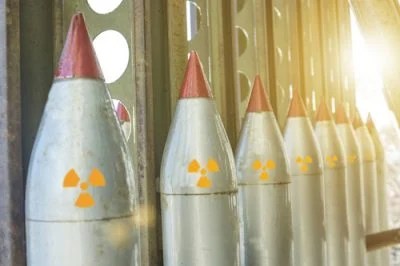
By Manlio Dinucci – byoblu – July 15, 2022
“Production of the B61-12 nuclear bomb begins,” Sandia National Laboratories announced from the United States. The B61-12, which replaces the previous B61 deployed by the U.S. at Aviano and Ghedi and other European bases, is a new type of weapon. It has a nuclear warhead with four power options, selectable depending on the target to be destroyed. It is not dropped vertically, but at a distance from the target on which it is directed guided by a satellite system. It can penetrate underground, exploding deep to destroy command center bunkers in a nuclear first strike.
The B61-12s, classified as “non-strategic nuclear weapons,” are deployed in Europe — in Italy, Germany, Belgium, the Netherlands, Britain and probably other countries — at distances far enough to strike Russia. They thus have offensive capabilities similar to those of strategic weapons.
Another nuclear weapon system, which the United States is preparing to install in Europe against Russia, is ground-based intermediate-range missiles. They can also be launched from “anti-missile shield” installations, deployed by the U.S. at bases in Deveselu in Romania and Redzikowo in Poland, and aboard five warships cruising in the Mediterranean, Black Sea and Baltic Sea close to Russia.
That such installations have offensive capabilities is confirmed by Lockheed Martin itself. Outlining the characteristics of the Mk 41 vertical launch system, used in both land and naval installations, it specifies that it is capable of launching “missiles for all missions, both defense and long-range attack, including Tomahawk cruise missiles.” These can be armed with nuclear warheads.
Europe is thus being turned by the U.S. into the front line of a nuclear confrontation with Russia, even more dangerous than that of the Cold War.
Critical Norwegian gas platform and transportation hub forced to shut down
Samizdat | July 12, 2022
A Norwegian gas platform and the transportation hub Sleipner Riser at the same field were shut down on Tuesday after separate gas leaks occurred, operator Equinor said, according to Reuters. The company indicated it was unclear when operations would resume.
“A gas leak at the Sleipner A {platform} occurred yesterday morning,” an Equinor spokesperson stated, adding “No person was injured and production was shut. When we tried to restart, a new gas leak occurred, late Monday night … this time at Sleipner Riser.”
Sleipner Riser is a key hub for the transport of North Sea gas to Britain and Belgium.
“We don’t know when we will back in normal production. The facility is shut,” the spokesperson added.
The incident comes at a time when Europe is facing constrained gas supply as scheduled maintenance halted flows from Russia via the Nord Stream 1 pipeline on Monday. The repairs are expected to take 10 days.
Norway is Europe’s second largest gas supplier and currently meets around 25% of gas demand on the continent, according to S&P global. Its role has come into sharper focus since Russia moved to reduce gas deliveries to Europe.
This month, the Norwegian government ended a strike by the country’s offshore oil and gas workers, who had been demanding wage increases to compensate for rising inflation. The strike, which resulted in the closure of three fields, threatened to exacerbate Europe’s energy crisis.
Uninvited foreign troops must leave, African nation says
RT | January 24, 2022
Denmark must “immediately withdraw” some 90 troops it deployed to Mali last week “without [the government’s] consent and in violation of the protocols” allowing European nations to intervene in that African country, the government in Bamako said on Monday.
Some 91 Danes from the Jaeger Corps special forces arrived in Mali on January 18, as part of Task Force Takuba, a French-led counter-terrorism mission in the West African country. According to the Danish defense ministry, their job will be to reinforce the border with Niger and Burkina Faso, train Malian Armed Forces, and provide medical services to the peacekeepers.
While the government of Mali is grateful to “all its partners involved in the fight against terrorism,” it stressed “the need to obtain the prior agreement of the Malian authorities” before sending any troops to the country, says the communique signed by Colonel Abdoulaye Maiga, spokesman for the Ministry of Administration and Decentralization.
Announcing the deployment of the force last week, the government in Copenhagen said it had been scheduled in April 2021, as France sought to withdraw some of its troops from Mali.
Their objective was “to stabilize Mali and parts of the border triangle between Mali, Niger and Burkina Faso, and to ensure that civilians are protected from terrorist groups,” the Danish military said.
The Jaegers are also experienced in “training and educating” local militaries, a job they have previously performed in Afghanistan and Iraq. They were sent shortly after Sweden withdrew its contingent from Mali. The French-led operation also involves forces from Belgium, Czechia, Estonia, Hungary, Italy, the Netherlands, Portugal and Sweden.
Task Force Takuba has operated in Mali since March 2020, when Paris decided to wrap up the previous Operation Barkhane. France has maintained a military presence in its former West African colony since 2013, to help the government in Bamako deal with a Tuareg rebellion in the northwest of the country and subsequent terrorist insurgency loyal to Islamic State (IS, formerly ISIS).
Relations between Bamako and Paris have grown chilly since the latest military takeover in Mali in 2021, and France has since closed three of its military bases there, in Kidal, Tessalit, and Timbuktu.
Belgium complicit in killing of popular African leader, book claims
New evidence shows Belgium turned a blind eye as its officials plotted the assassination of Burundian PM Prince Louis Rwagasore in 1961

PM Prince Louis Rwagasore led Burundi to independence from Belgium © AFP / BELGA
RT | January 5, 2022
Belgium has “overwhelming responsibility” for the killing of Prince Louis Rwagasore, the popular Burundian leader who sought to unite the country’s ethnic groups as it gained freedom from the colonial power, new evidence shows.
Weeks after being elected prime minister in a landslide, Rwagasore, the 29-year-old son of a former king, was assassinated in October 1961. The governing Belgian elite masterminded the shooting while Brussels turned a blind eye, according to archived records uncovered by Flemish sociologist Ludo De Witte.
Although the shooter, a Greek national, and five accomplices were executed, De Witte said that probes by the Belgian colonial court, the government of independent Burundi, and the UN all neglected Belgium’s role in the killing, which led to decades of war, ethnic tensions, and instability.
Publishing his findings in a book titled ‘Murder In Burundi’, De Witte noted that then-Belgian governor Roberto Regnier had told a post-election crisis meeting of senior Belgian officials and allies in the Belgium-friendly Christian Democrat party (CDC) that “Rwagasore must be killed.”
According to the author, the CDC saw his words as an invitation. Regnier’s remarks were apparently confirmed by four people at that meeting to a 1962 inquiry by prosecutors in Brussels. But that report had not been published until De Witte unearthed it during a five-year investigation into the murder.
It also appears the UK was at least aware of the danger faced by Rwagasore, with Britain’s then-ambassador James Murray writing in a 1962 dispatch that influential Belgians had “an almost pathological hatred” of the charismatic leader, who they believed would harm Belgian-Burundian relations. Murray noted that Regnier’s “words… go very far in the direction of incitement to murder,” according to De Witte.
The book also accuses then-Belgian foreign minister Paul-Henri Spaak – today celebrated as a founding father of the EU – of ignoring Regnier and other conspirators on a “war footing” with Rwagasore. It also finds fault with King Baudouin, who “moved heaven and earth” to commute the assassin’s death sentence to life imprisonment.
Last October, a special commission into Belgium’s colonial past admitted it paid “limited attention” to Burundi and Rwagasore’s killing. De Witte attributed this to a “reticence” among the country’s elite to “confront the reality” of colonization.
Meanwhile, a Belgian Foreign Ministry spokesperson did not respond to the book’s charges, but told The Guardian that the government was waiting for parliamentary recommendations before adopting a policy position.
Featured Video
No Threat Can Force Iran’s Surrender /Trita Parsi & Lt Cl Daniel Davis
or go to
Aletho News Archives – Video-Images
From the Archives
An Expert Military Analysis of War with China
Actually, None is Necessary
By Fred Reed • Unz Review • December 13, 2020
The Correlation of Armed Forces: U.S. goods and services trade with China totaled an estimated $634.8 billion in 2019. Exports were $163.0 billion; imports were $471.8 billion. The U.S. goods and services trade deficit with China was $308.8 billion in 2019. Trade in services with China (exports and imports) totaled an estimated $76.7 billion in 2019. Services exports were $56.5 billion; services imports were $20.1 billion. The U.S. services trade surplus with China was $36.4 billion in 2019.
There is talk within the Washingtoniat of a possible war with China. Steve Bannon, who apparently was dropped on his head as a child, actually favors such a war. We hear the usual shoo-the-boobs alarm about how the Chinese are doing something terrible and we must gird our loins and American values and show them what for, bow wow, woof. The danger is that the current game of who-blinks-first in Asian waters might actually provoke a shooting war. You know the kind of thing: One warship refuses to get out of the way of another, a collision ensues, some retard lieutenant who signed up on waivers opens fire, and we’re off and running. It is not a good idea to let children play with matches.
The said war is discussed either in emotional terms by idiots or in purely naval terms by those familiar with such things, so we hear of the First Island Chain and the Second Island Chain and whose missiles against the other’s missiles and so on. This would be appropriate if we were fighting World War Two again. Which we aren’t. Let’s take a quick-and-dirty look at how such a war might go.
To begin the war, America would overestimate itself and underestimate China. This is doctrine in the Pentagon. … continue
Blog Roll
 Aletho News
- Theodore Postol: Iran’s Missiles & Drones Were Underestimated
- Iran To Target Military Industrial-Tech Complex That Facilitated Gaza Genocide
- Collapsing Empire: The Resistance Disarms ‘Israel’
- Suicide Should Not Be a Government Service
- Rethinking America’s greatest threat: Iran vs. Israel-Firsters
- Iran accuses adversaries of false flags to strain Turkey ties
- Poland rules out sending Patriot missiles to US/Israel amid war on Iran
- Tehran approves new Hormuz plan with major restrictions
- No Threat Can Force Iran’s Surrender /Trita Parsi & Lt Cl Daniel Davis
- UK’s New Pandemic Plan Would Turn Big Tech Into a Mass Location Tracking Network
- If Americans Knew
- Ann Coulter Rips Into Fox News for Iran War Coverage, Compares to False Rigged 2020 Election Reporting
- Joe Kent Urges Americans To Call White House and Congress To Object To Sending Troops Into Iran
- DNC Resolution to Reject AIPAC Funding Puts Democratic Leaders in the Hot Seat
- Swedish foundation to build 400 schools as over 650,000 Gaza children remain without education for 2 years
- Israeli army admits photshopping image of slain Lebanese journalist
- This is how Israel is systematically killing health workers under the cover of war in Lebanon
- Carrying life under fire: Israeli invasion of Lebanon leaves pregnant women facing deadly risks
- Champagne all around for the new death penalty (for Palestinians) law – Not a ceasefire Day 172
- Why are Palestinian books struggling to be seen on Amazon?
- The Line Between Affinity and Conspiracy
- No Tricks Zone
- New Study Finds Warming Saves Lives…Cold Temperatures 12 Times More Deadly Than Excess Heat
- German Science Blog Accuses PIK Climate Institute Of Hallucinating Climate Tipping Points
- Devastating Assessment Of Comirnaty Vaccine By Former Senior Pfizer Europe Toxicologist
- New Study: CO2 Is ‘Effectively Negligible’ As An Explanatory Climate Change Factor Since 2000
- Former Pfizer Toxicologist Dr. Helmut Sterz Tells Bundestag Hearing Pfizer Vaccine Should Have Never Been Approved
- Energy Expert: Germany’s Nuclear Phaseout Was A “500 Billion Euro Mistake”
- New Research: South Australia’s Mid-Holocene Sea Surface Temperatures Were 4°C Warmer Than Today
- Storing Green Energy To Last Germany 10 Days Would Require A 60-Million Tonne Battery
- New Studies: UK Sea Levels Were 4 Meters Higher Than Today During The Mid-Holocene
- Destructive Green New Deal: German Energy And Metal Group Warns Of Drastic Crisis
 Aletho News