Netanyahu equates intifada with terrorism
MEMO | March 23, 2016
 Israeli Prime Minister Benjamin Netanyahu accused the Palestinians of making their way to statehood through knives, Israeli newspaper Maariv reported.
During his speech at the AIPAC conference in Washington yesterday, Netanyahu branded all attacks as terrorist activity, including the Palestinian resistance attacks against the Israeli occupation carried out in the occupied West Bank and East Jerusalem.
“What is happening is a continuous attack against all of us,” Netanyahu said. “What is enough for them is eradicating us and imposing their absolute domination over us. But, this will not happen my friends.”
“The only solution is cooperation and unity in the war against them… Political and moral unity.”
AIPAC Is Coming to Town
The annual grovel begins next week

By Philip Giraldi • Unz Review • March 15, 2016
I am reluctant to write two weeks in a row about Israel’s malignant influence over the United States but as the American Israel Public Affairs Committee (AIPAC) is meeting in Washington for its annual Summit beginning next Sunday some commentary would seem desirable. AIPAC’s website claims that its “… mission is to strengthen, protect and promote the U.S.-Israel relationship in ways that enhance the security of Israel and the United States. Our staff and citizen activists educate decision makers about the bonds that unite the United States and Israel and how it is in America’s best interest to help ensure that Israel is safe, strong and secure.”
That is, of course, a self-serving bit of nonsense. U.S. national security would be best enhanced by telling Israeli Prime Minister Benjamin Netanyahu to take a hike and never come back. AIPAC is a political pressure group, not an educational foundation, which is purely a pretext exploited to secure it tax exemption. It uses every means, fair and foul, to influence and even intimidate the U.S. government and media to maintain the fiction that Israel is somehow America’s “best friend” and “closest ally” even though it is neither. Its objective is to maintain the flow of U.S. dollars from the U.S. Treasury while keeping the firewall of political protection in place to insulate Israeli politicians from the consequences of their own actions.
This year AIPAC, which has an annual budget of $70 million and more than 200 employees, is expecting 16,000 supporters and two thirds of Congress. It will be featuring a keynote speech by Hillary Clinton, which should be fascinating. As Hillary and her husband Bill already constitute a fully owned subsidiary of the Israel Lobby and New York financial services interests, which often amount to the same thing, her attendance might be regarded as de rigueur. And she has already pledged to invite Netanyahu to the White House during her first month in office while also promising to move the Israeli relationship to a “new level,” a concept that is both difficult to imagine and positively frightening in terms of what it might portend. Will she move the entire U.S. government to Jerusalem? Or only the Treasury Department?
Donald Trump will also be speaking at AIPAC, for the first time. Trump has rattled Israel’s friends in the U.S. by calling for an even handed role by Washington in Middle East peace negotiations and through his insistence that he does not need the money from Jewish mega-donors to run his campaign and “can’t be bought.” But he has also said “First of all, there’s nobody… that’s more pro-Israel than I am. OK. There’s nobody. I am pro-Israel. I was the Grand Marshall, not so long ago, of the Israeli Day Parade down 5th avenue. I’ve made massive contributions to Israel. I have a lot of — I have tremendous love for Israel. I happen to have a son-in-law and a daughter that are Jewish, OK? And two grandchildren that are Jewish.” So one should assume that he will talk fulsomely about his love of Israel but at the same time it has to be hoped that he will assert his independence when it comes to policy affecting the United States.
Netanyahu also regularly appears at AIPAC. Last year he used the platform provided to harangue the American public and the inside the beltway chattering class about the dangers posed by Iran while also exploiting the opportunity to do some serious fundraising in New York. The visits also frequently provide an opportunity to meet with and scold the President of the United States or to address Congress on how the U.S. should conduct its foreign policy. It is a given in Washington that Netanyahu will show up in the nation’s capital personally to kick some butt at least twice a year but it is also understood that Bibi will not fail to dish out some harsh criticism the rest of the time by way of the media, his own patented form of international extortion.
Nothing illustrates the unbridgeable abyss between the media/talking head vision of Israel promoted by the Israel Lobby and folks like Hillary and the real thing more than the recent embarrassments and indignities being delivered by the Netanyahu government, which AIPAC really represents. Benjamin Netanyahu is, to everyone’s surprise, not coming to AIPAC this year but will instead address the conference by video link. The visit was planned but canceled at the last moment and, per Netanyahu, the fault is that of the president of the United States who had reportedly said that he would not be available for a meeting due to the upcoming trip to Cuba.
The Obama Administration was genuinely puzzled, partly due to the fact that it first learned of the cancellation through a newspaper story rather than from the Israeli Embassy or Foreign Ministry. It was also astonished by the explanation given as it had indeed set up a presidential meeting at Netanyahu’s request in spite of a very tight schedule. The White House did not complain openly about the deliberate snub, but it was clear to everyone involved that Netanyahu was yet again sending a message to the Administration regarding who was in charge.
Netanyahu benefits from the fact that his tendency to ridicule critics makes many in the media reluctant to challenge his behavior, but when it became embarrassingly clear that he had been fibbing about why he was not coming to Washington he immediately resorted to Plan B, stating that he did not want to interfere in the presidential primaries currently underway. No one believed that argument either as Netanyahu has not hesitated to interfere in American politics in the past, notably when he made clear that he would prefer a Republican president in 2012 and appeared in ads in Florida endorsing Mitt Romney.
The White House meanwhile resorted to its own Plan B when confronted by a truculent Netanyahu. It first groveled a bit about how much it loves Israel and then expressed hope that Vice President Joe Biden, who was in the air on his way to Tel Aviv, would be able to calm the situation. Indeed, the original objective of the Biden trip turned out to be the real reason for the contretemps with Netanyahu. Netanyahu was miffed because the United States has hesitated to provide him with a no-strings-attached long term agreement to give Israel at least $5 billion dollars per year in military assistance, up from the current $3 billion.
To be fair to Netanyahu, the demand for more “assistance” was no secret. The Israelis had made it clear since they failed to stop the Iran nuclear deal that they would feel a whole lot better if Washington were to give them a lot more money. And it would have to be guaranteed cash, tied to a security package that would run for at least ten years.
Biden had been sent to help negotiate an agreement over the assistance, which had been stalled due in part to Israeli expectations that they might do better with a GOP Administration or Hillary if they wait a few months. Obama’s insistence that any deal would require the Israeli government to forego lobbying directly to congress for more cash also was a stumbling block. The President of the United States has thereby found himself in a situation engineered by Netanyahu in which he has to beg Israel to take more money with the only condition being that it not make trouble with the nation’s legislature. In return for the largesse, Israel would not be committed to do anything that would directly benefit the United States.
In the event, Biden’s role as a negotiating intermediary was unsuccessful and he wound up looking foolish so he too has decided to speak at AIPAC where he will undoubtedly say many unctuous things that no one will believe.
There are several things that can be done to address the wildly asymmetrical situation with Benjamin Netanyahu and AIPAC. First, it must be recognized that the United States and Israel are actually two separate countries with very little in the way of common interests. The notion that they have many mutual concerns is largely a myth. AIPAC, the principal purveyor of the myth, is an agent of Israel and should be compelled to register with the Foreign Agents Registration Act of 1938, which would require it to maintain transparency in terms of who funds it. It should also be stripped of its tax exemption as it is demonstrably not an educational foundation. Taking those two steps would enable the American public to understand just exactly what AIPAC represents.
Second, President Obama should cut off aid to Israel completely since it is uninterested in there being any quid pro quo for the billions that it receives. If Obama wants to be gracious, he can consider renewing the subsidy if and when Israel rolls back its illegal settlements in Jerusalem and on the Palestinian West Bank. If Israel is not interested in peace and not willing to reverse policies that many believe constitute war crimes then it will not receive any support of any kind from the United States.
The annual reappearance of AIPAC in Washington should remind everyone that there are those among us who regard any allegiance to the common interests that should bind together all Americans as secondary at best. In the case of Israel, billions in taxpayer money should not be regarded as a convenient mechanism to bribe a foreign state to behave. It is past time to cut the ties that bind to despicable rogues like Benjamin Netanyahu and to make clear to Americans politicians that dual loyalty to a state that has been nothing but trouble for the past twenty years will no longer be considered acceptable.
Israeli supporters financing Clinton’s campaign: James Petras
Press TV – March 8, 2016
“We must remember that the plutocrats dominated by the Israeli supporters [have] been extremely generous in financing Hillary’s campaign for president,” Professor James Petras says.
An American scholar says that “the plutocrats dominated by the Israeli supporters” are financing Hillary Clinton’s campaign for president of the United States.
Professor James Petras, who has written dozens of books on the Latin America and Middle East, made the remarks in a phone interview with Press TV on Tuesday.
He was commenting on US Vice President Joe Biden’s visit to Israel to discuss a new military aid package.
Washington and Tel Aviv are discussing details of a 10-year military aid package that will be larger than the $3.1 billion US package Israel received this year.
According to reports, Israeli officials have asked the US to increase its annual military assistance by 60 percent to an average of $5 billion a year over the 2018-2028 period.
Biden’s visit comes as the relationship between US President Barack Obama and Netanyahu took a new setback over the Israeli premier’s decision not to accept an invitation for talks in Washington later this month.
Netanyahu cancelled the meeting with Obama, US National Security Council spokesperson Ned Price said in a statement on Monday.
“This visit by Biden fits in with the Obama administration, which has at times had personal conflicts between Obama and Netanyahu, but on the substance of military and economic aid to Israel, [the US] has been exceedingly generous,” Professor Petras said.
“This despite the fact that Israel has been engaged in a war against the Palestinians, in particular the savage invasions of Gaza which seem not be of importance either to Biden, Obama or Hillary Clinton,” he added.
“We must remember that the plutocrats dominated by the Israeli supporters [have] been extremely generous in financing Hillary’s campaign for president and this new visit by Biden fits in with the attempt by the rightwing of the Democratic Party to undermine the challenge from Bernie Sanders,” the analyst stated.
Professor Petras said “an increase in military support for Israel is a destabilizing element not only because of Israel’s threat to the Palestinians and the land-grabbing but also because it could invite Israel to become more aggressive and threatening to Iran.”
“And I think it is a very foolish move by Obama and Biden and Clinton to destabilize the agreement that was reached with Iran regarding the nuclear understanding. I think it’s a very a bad omen for peace in the Middle East,” he concluded.
Israeli Prime Minister Benjamin Netanyahu has been a vocal critic of the P5+1 group’s nuclear deal with Iran and has focused on derailing it, causing great resentment within the White House.
Ties between Obama and Netanyahu have been further strained over the Israeli premier’s resistance to the creation of a Palestinian state, which has been a key element of the Obama administration’s foreign policy.
See also:
Clinton calls for sanctions on Tehran over test-firing missiles
More on Israel’s combating BDS
By Miko Peled | American Herald Tribune | March 5, 2016
It is strange to see a newspaper in a country that considers itself a democracy, commit itself to silencing freedom of speech and the call for freedom from oppression. But here we see that Israel’s daily Yediot Aharonot and Ynet are persistent in their attempts to fight BDS. One would think that a newspaper would want to ensure that freedom of speech and opposition to oppression are protected and that members of society can make up their own minds about any given issue. But not this newspaper. Yediot Aharonot is dedicated to fighting BDS and has published a series of reports and articles under the headline “Fighting the Boycott.” They feature interviews with, the “people on the front line in the fight against the boycott movement” as Ynet describes them.
It is worth to take a minute and think about the use of the term “front line.” It is interesting to note that there are people who are considered as being on the “front line,” a term which suggests there is a war going on and certain people are sent to the front, and are in real danger. This terminology is no doubt part of the effort to paint BDS as violent movement. Israel, a society not unlike Sparta, which only understands war, is trying to paint BDS as a threat that it can kill. But even they admit that BDS is a campaign “without knives or missiles.” So who are the people in the “front line?” the answer, at least in part, is in this piece on Ynet.
“De-legitimization of Israel must be fought, and you are on the front lines.” Prime Minister Benjamin Netanyahu said this to attendees, in a letter read aloud at a BDS emergency summit organized by Sheldon Adelson in Las Vegas.” A conference at one of Adleson’s Las Vegas casinos, “Front line” indeed. The same story continues to tell us that “One hundred million Israeli Shekels are planned to be allocated to the Strategic Affairs and Information Minister Gilad Erdan, whose office’s purview includes fighting BDS.” That’s about twenty-five million dollars, “Erdan’s office will also receive ten new positions for employees who will deal solely with the boycott and de-legitimization activities against Israel […] Erdan estimated that the budget can double or triple to NIS 300 million with the help of Jewish and pro-Israel organizations.” Perhaps they can triple their money but to what purpose?
Nowhere in the articles and reports published by Ynet is there any real substantial argument to oppose BDS. Surely, I thought to myself, there must be some content with which Ynet and Adelson and all the others mean to utilize in this fight. If there is any content I couldn’t find it. In a piece in Hebrew, titled, “The Snakes Head – the Academic Boycott,” Tsahi Gavrieli writes that if Israel wants to discover how it ended up in the midst of a debate questioning its own legitimacy, the answer is to be found on US campuses. That would not be the first place I would look. Had I been charged with discovering the reasons behind the emergence and the growth of BDS as a movement and as an idea, I would visit Palestinian refugee camps. I would see the camps in Lebanon and Syria, Jordan and of course all over Palestine. I would look into the conditions in which thousands of Palestinian political prisoners are held by Israel. I would examine what takes place when Israeli jets attack Palestinian targets, I would look at the countless cases where thousands of unarmed Palestinian civilians were killed, maimed and made homeless by Israel. I would look at the Israeli Knesset which regularly spits out new laws that make the oppression and dispossession of Palestinians “legal.” I would look to the total disregard that Israeli society has toward the lives of Palestinians.
The most common question asked by those who want to “combat” BDS, is “Why Israel?” and there are several answers to that. First of all, why not? Then they ask, why not boycott all the other racist and brutal regimes around the world that are even worse than Israel. And the reply is – no reason we can’t do both. In fact, sanctions and boycotts have been used against many regimes and many states. Using BDS, or in other words, imposing boycotts, divesting and imposing sanctions is very common. It was used against Iraq, Iran, it was used against South Africa during apartheid, the Indian resistance under Gandhi used boycott as a tool, and now the US is leading sanctions against Russia and the list goes on.
Besides the obvious facts that point to Israel as a state and as a society that for seven decades continue to commit the crimes of ethnic cleansing, apartheid and genocide, and therefore deserve to be punished, there is one other answer. Palestinian civil society has told the world that this is how to best support the Palestinian cause. They have given the rest of the world a road map for supporting the Palestinian struggle. They have asked the world, and by doing so gave the world a gift, by guiding people of conscience as to how best they can support the people of Palestine in their struggle for freedom. That road map is BDS.
Another piece by Ynet uses the only image Israel understands, the military metaphor: “Those involved in this fight warn that these are critical moments in the war on BDS.” Actually there is no war. There is a legitimate, unarmed struggle to free Palestine from the Spartan regime Israel has imposed upon it. They go on to say that “A worldwide call to arms must be issued, as the battle will be conducted at all levels […] It is the hope that this conference will be the first shot in the war against the BDS movement, a war where there is no other option but to win.” Ynet clearly understands that BDS is posing a serious threat. It also seems to understand that Israel is unprepared and unequipped to deal with this threat, in fact Israel is doing everything to strengthen the struggle and garner more support for BDS. It seems to be the case that violent, racist regimes are also incredibly stupid, and that is quite often their downfall. Blinded by their own racism they are incapable of understanding their shortcomings. There is every reason to expect that Zionism in Palestine will fall for these same reasons.
Miko Peled is an Israeli writer and activist living in the US. He was born and raised in Jerusalem. His father was the late Israeli General Matti Peled. Driven by a personal family tragedy to explore Palestine, its people and their narrative. He has written a book about his journey from the sphere of the privileged Israeli to that of the oppressed Palestinians. His book is titled “The General’s Son, Journey of an Israeli in Palestine.” Peled speaks nationally and internationally on the issue of Palestine. Peled supports the creation of a single democratic state in all of Palestine, he is also a firm supporter of BDS.
The NY Times, Netanyahu’s Stenographer
By Barbara Erickson | TimesWarp | February 27, 2016
The New York Times serves as Benjamin Netanyahu’s stenographer in a story this week that reports his latest rant against critics of Israeli policy, repeating his claims at length but making no attempt to verify or even question the distortions in his response.
The Israeli prime minister was reacting to comments by British Prime Minister David Cameron, who criticized Israel’s settlement construction in and around East Jerusalem during a session in parliament Wednesday, saying that he found the situation “genuinely shocking.” The Times, which made no mention of Cameron’s remarks at the time, now presents us with an article by Isabel Kershner framed around the official Israeli response.
Her story, “Benjamin Netanyahu Rebukes David Cameron for Criticizing Israel,” gives much space to the prime minister’s assertions and allows him the final word. It also quotes Jerusalem Mayor Nir Barkat and allows the comments of both men to stand without challenge.
Netanyahu, speaking at a political meeting Thursday, portrayed Israel as the peacekeeper in East Jerusalem, saying that “only Israeli sovereignty” has prevented ISIS “and Hamas from igniting the holy sites as they are doing all over the Middle East.”
He implied that Israel has brought prosperity to Palestinian residents of East Jerusalem, citing “roads, clinics, employment and all the other trappings of normal life that their brethren do not enjoy elsewhere in the Middle East.” Mayor Barkat also stated that Israel is building “the newest, most advanced schools” for Palestinian youth and paving new roads for residents.
The Times made no attempt to challenge the veracity of these comments although they grossly misrepresent the situation Palestinians face in occupied East Jerusalem. The data is available for all to see and is certainly familiar to Kershner and Times editors.
For instance, as of January 2011:
- Entire Palestinian neighborhoods were not connected to a sewer system and lacked paved roads and sidewalks.
- West Jerusalem had 1,000 public parks compared to 45 in East Jerusalem.
- West Jerusalem had 34 swimming pools; East Jerusalem had three.
- Nearly 90 percent of the sewage pipes, roads and sidewalks in the city were found in West Jerusalem.
- West Jerusalem had 26 libraries; East Jerusalem had two.
More recent news also belies the claims of Netanyahu and Barkat. Far from working to provide education, health care and road access for Palestinian residents, Israeli policies and actions have made life more and more difficult for the non-Jewish residents of the city:
- In 2015, Israel placed dozens of Palestinian children under house arrest in East Jerusalem, preventing them from attending school.
- The Israeli government has been working with settler groups to dispossess Palestinians of their homes.
- More than a third of East Jerusalem students are unable to complete high school because there are not enough classrooms. (Under an order by the Israeli High Court, some new classrooms are being built, but these will only alleviate the shortage by half.)
- Some 38 percent of East Jerusalem’s planned areas have been confiscated for the development of Jewish settler neighborhoods, while only 2.6 percent is zoned for public buildings—such as schools—for the city’s indigenous Palestinians.
- Israeli invasions of Makassed hospital in East Jerusalem hospital and restrictions on patients attempting to enter the hospital prompted several United Nations agencies to condemn the actions as violations of international law.
- By Feb. 22, Israeli forces had demolished 27 Palestinian-owned structures in East Jerusalem, including a school, since the beginning of this year.
Kershner’s story, however, makes no mention of any of this. The focus here is solely on the Israeli show of outrage. Netanyahu and Barkat’s statements are allowed to stand, even the claim that Hamas and ISIS are working together to foment terrorism. In fact, the two are bitter enemies, but the Times has no interest in disabusing its readers of this inconvenient fact.
Cameron’s statements gave the Times an opening, a chance to examine the settlement enterprise, conditions in East Jerusalem and the attitudes of Palestinian leaders and citizens living under Israeli control. But this was not to be. Only the Israeli narrative was of interest to the Times, and even the prime minister of the United Kingdom could not make his voice heard above its strident demands.
Why It’s Dangerous to Conflate Hamas and Daesh
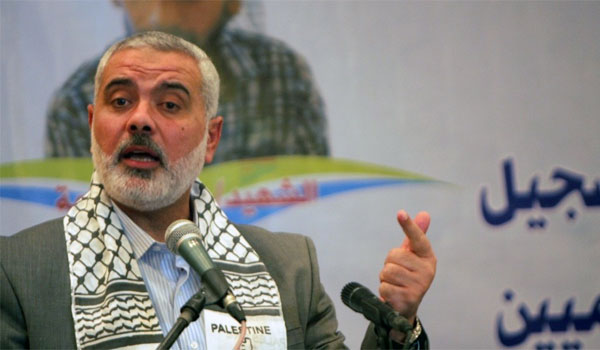
Hamas Prime Minister in Gaza, Ismail Haniyeh
By Belal Shobaki – Al-Shabaka: The Palestinian Policy Network – February 22, 2016
Overview
While Israel’s efforts to link Palestinian resistance to its military occupation to global terrorism are not new, it has expanded its propaganda to address Arab as well as Western audiences. By so doing, it is clearly seeking to exploit the global aversion to movements that have drifted towards extremism and terrorism while claiming to represent Islam. “Hamas is ISIS and ISIS is Hamas,” Israeli Prime Minister Benjamin Netanyahu declared at the United Nations in 2014. Yet better than anyone else, Netanyahu and the Israeli political establishment know that Hamas and Daesh are not related, as do those Arab regimes that also tar all Islamic movements with the same brush to serve their own ends. 1
Not only are Hamas and Daesh unrelated, they are bitter enemies, and Daesh has denounced Hamas as an apostate movement. Al-Shabaka Policy Analyst Belal Shobaki discusses the major ways in which Hamas differs from Daesh including its approach to jurisprudence; the position vis-a-vis the nature of the state; and relations with other religions. He makes the case that it is especially important for the Palestinian national movement to rebut the attempts to conflate Hamas with Daesh and points out the dangers of not doing so.
Serving Short-Term Political Gain
The conflation of Hamas with Daesh ignores reality on the ground. The political environment in Palestine is defined by the occupation, whereas the political environment in the Arab countries where Daesh emerged is defined by authoritarianism and repression as well as sectarian and religious conflicts, an ideal environment for the emergence of a radical ideology motivated by indiscriminate violence.
For Israel, however, the attempt to link the two may pay off regionally and internationally. Many Arabic media outlets have no qualms about referring to this terrorist organization as an “Islamic” State although it is anything but, while many Western media outlets embrace the Israeli conflation of Hamas and Daesh without scrutiny. Arab regimes are uninterested in defending the image of Hamas. Even the Palestinian Liberation Organization (PLO) does not seem concerned with defending Hamas’s international image given the political division between Fatah and Hamas.
Hamas is considered part of the Muslim Brotherhood, which is seen as a threat to authoritarian Arab regimes, particularly in the Arab Mashreq. Thus one way for Arab regimes to fight the Muslim Brotherhood is by claiming it shares common ground or is even synonymous with Daesh, as claimed by the Egyptian regime, and then using this as a justification for excluding the Muslim Brotherhood from participating in political life.
The rapid developments of the past five years in Egypt, the country that provides the only outlet for the Palestinian Gaza Strip, has pushed Hamas into its informal tunnels economy. The official Egyptian stance after Abdel Fattah Sisi’s coup against elected president Mohammad Morsi became tougher against the Gaza Strip, with claims that Hamas was cooperating with Jihadist groups in the Sinai, the same narrative promoted by Israel and its media. However, this narrative is flawed. It is too risky for Hamas to maintain a close relationship with Sinai jihadists, on the one hand, while cracking down on individuals embracing the same ideology in Gaza, on the other. Any links Hamas has established with those groups is limited to securing the needs of the enclave besieged by Israel and Egypt. This interaction is not motivated by a shared ideological identity or shared enmity towards the Egyptian regime. Indeed, Hamas has been eager to keep communication lines open with the Egyptian regime even when accusations conflating Hamas with Sinai’s Salafi Jihadi groups were made in the media. Hamas has also repeatedly said that it is keen on rebuilding the relationship with Egypt in order to ensure the legal flow of goods, services and individuals into Gaza.
It is important to refute this narrative concerning one of the largest Palestinian political movements: Excluding moderate Islamists from political life carries the danger of pushing Palestinian society towards radicalism, in which case both Fatah and Hamas will find themselves fighting takfiri groups. The ensuing discussion will demonstrate the real differences between Hamas and Daesh as well as the very real enmity between them.
Differences in Doctrine
Hamas positions itself as a centrist Islamic movement and an extension of the Muslim Brotherhood, with a rational jurisprudential authority, whereas Daesh adopts a text-based approach that deals with Islamic texts in isolation from their historical context and refuses to interpret them in line with current developments. Hence, for Daesh and other takfiri groups in general, movements like Hamas are secular and un-Islamic, since Hamas is primarily a resistance movement against the Israeli occupation and believes in a moderate Islamic authority. Moreover, Hamas does not take Islamic texts literally; it allows for ijtihad – interpretation and use of discretion. Some scholars have categorized these movements along a horizontal line with the right representing advocates of the text and the left representing advocates of reason. 2 Using this classification, the Muslim Brotherhood can be found a good way down the left of the line, while Daesh is on the far right.
Daesh characterizes Hamas and its discourse as deviant. Hamas for its part has condemned Daesh’s threats and considered these part of a smear campaign that extends beyond Palestine. When threats from Daesh and other takfiri groups materialized into action, Hamas no longer stopped at condemnations. Mahmoud al-Zahar, a prominent Hamas leader, declared “Daesh’s threats can be felt on the ground, and we are handling the situation from a security standpoint. Whoever commits a security offense shall be dealt with in accordance with the law, and whoever wants to debate intellectually shall be debated intellectually; we take this matter seriously”.
Hamas had in fact dealt decisively with a Daesh-like group. In August 2009, Abdul Latif Musa, leader of the “Jund Ansar Allah” (Soldiers of God’s Supporters) armed group, announced the creation of the Islamic Emirate in Gaza at the Ibn Taymiyyah Mosque. The group had previously been accused of destroying cafes and other venues in the Gaza Strip, pushing the Hamas government into a confrontation. Security forces, reinforced by the al-Qassam Brigades (Hamas’ military wing), encircled the Ibn Taymiyyah Mosque and, when Musa’s group refused to surrender, Hamas ended the emirate project in its infancy by killing the members of the group. Hamas was criticized for its use of violence but justified its actions by arguing that the violence that could have been perpetrated by such groups would have been much worse than that used to eradicate extremism in the Gaza Strip.
Daesh’s supporters in Gaza are far fewer than Hamas’s, mainly due to the fact that these groups have not historically contributed to resisting the occupation. Some polls suggest that 24% of Palestinians think positively of jihadist movements, but this percentage is exaggerated. When some Palestinians cheer for the jihadist groups’ hostility towards the US, it is not because they believe in these groups but rather because they see the US, with its infinite support for Israel, as being playing a destructive role.
Different Stances on Statehood
Hamas and Daesh differ in their view of the modern state, in both theory and practice. As noted above, Hamas has always allowed for ijtihad or discretion, evolving its thoughts and opinions. It is thus unfair to assess Hamas’s stance on the civil state and democracy based on the early literature of the mother movement, the Muslim Brotherhood. Hamas maintains that it has embraced new convictions in this regard and has come to fully accept democracy and the concept of the civil state. Indeed, the Muslim Brotherhood itself has evolved. Qatar-based Sheikh Yusuf al-Qaradawi, the jurisprudential authority of the Muslim Brotherhood at large, has stated on multiple occasions, including in his book “The State in Islam”, that the concept of the religious state does not exist in Islam. According to al-Qaradawi, Islam advocates for a civil state founded on respect for the people’s Islam-based opinion, and also founded on the principle of accountability and political pluralism. Although the discussion about the relationship between Islam and democracy predates the Muslim Brotherhood, it gained clarity after the 1950s, when numerous Islamic thinkers, including al-Qaradawi, the Tunisian leader and Ennahda co-founder Rached Ghannouchi and the Algerian philosopher Malek Bennabi, affirmed that Islam and democracy were not in contradiction with each other.
At the opposite end, the movement that Daesh represents rejects democracy in its entirety and considers it an apostate system of governance. Although some jihadist groups do not denounce Islamists who take part in the democratic process as apostates, they do consider their discretion flawed. Daesh views any expression of democracy such as elections as a manifestation of apostasy and any movement or individual taking part in elections as apostates. By contrast, the Muslim Brotherhood participated in elections from its earliest days, when its founder Hassan al-Banna decided to run in the Egyptian parliamentary elections that El-Wafd Party Government sought to hold in 1942. Although al-Banna could not run because the government rejected his candidacy, the Muslim Brotherhood has served in Arab parliaments and sometimes in the executive branch.
When Hamas decided not to participate in 1996 Palestinian Authority elections its position was based on a political and ideological stance towards the Oslo Accords. However, Hamas allowed its members to run in the elections as independents. When the circumstances changed and the 2005 Cairo Agreement became the governing framework for the PA elections instead of the Oslo Accords, Hamas decided to participate. It nominated many members in the movement and some independents to a Change and Reform list to run for the Legislative Council, winning the majority of votes.
By participating in the elections, Hamas has offered evidence that it is willing to function in a modern state and a democratic system. It has called for coalition governments inclusive of leftist and secular parties. Its government as well as its parliamentary list included women and its first government included Muslim and Christian ministers.
Daesh, on the other hand, has turned against all modern institutions in the areas under its control, refusing to recognize borders or national identity. It rules through chaotic and individual decisions. Although Daesh has been eager to use administrative terms derived from the Islamic tradition such as caliphate and shura (consultation), the essence of its governance contradicts the majority of unquestionable texts in the sources of Islamic legislation in many ways. For example, it does not abide by the conditions established in the Quran and sunna (the Prophet Mohammad’s teachings) to declare war or the protection of civilians and treatment of prisoners in wartime. Another example is its imposition of jizya (a tax that was levied on non-Muslim subjects), which is not supposed to be applied to the indigenous inhabitants even if they are non-Muslim. Moreover, it has attacked places of worship and assaulted the faithful in their homes, in clear violation of the Quran and sunna.
Daesh, to some extent, resembles hybrid regimes in the Third World that use modern and democratic vocabulary to describe their political process, even though they remain authoritarian in essence.
Polar Opposites in Treating the Other
The most significant difference between Hamas and Daesh is their position towards followers of other religions. During its formation, Hamas published a charter that used religious vocabulary to describe the conflict. Following severe criticism, Hamas effectively sidelined this Charter and no longer considers it an authoritative reference as some of its leaders have confirmed.
In his interview with The Jewish Daily Forward deputy head of the Hamas politburo Moussa Abu Marzouk confirmed that the Charter was marginal to the movement and not a source for its policies. He added that many members were talking about modifying it because several of Hamas’ present policies contradict it. Hamas’ politburo leaders abroad were not the only ones to disclaim the charter. Gaza-based Hamas leader Ghazi Hamad went even further in an interview with the Saudi Okaz newspaper in which he said the charter was subject to discussion and evaluation in opening up to the world. Sami Abu Zuhri, a young Hamas leader who was the movement’s spokesperson during the Second Intifada, urged in an interview with The Financial Times that focus be shifted away from the 1988 charter, and that Hamas be judged on the statements of its leaders.
Today, Hamas adopts the Quranic verse that reads: “Allah does not forbid you from those who do not fight you because of religion and do not expel you from your homes – from being righteous toward them and acting justly toward them. Indeed, Allah loves those who act justly.” This verse urges kindness and justice when dealing with people of other religions. Unlike Daesh, Hamas has applied this in practice. In addition to appointing Christian ministers to its cabinet, it has celebrated Christmas with Palestinian Christians by sending official delegations to visit during the feast. Meanwhile, Daesh has threatened the lives of those who celebrate Christmas across the world.
Some may argue that these steps are ways in which Hamas tries to beautify its authoritarian rule. However, there is little difference between Hamas’ rule and Fatah’s. The human rights violations committed by Gaza’s government cannot be considered an indication of Hamas’ resemblance to Daesh, but rather an indication of misgovernment. The political leadership of Hamas has spoken out against such practices on occasion, for example as those committed by the Ministry of the Interior under Fathi Hammad.
When some individuals were attacked by extremist groups in Gaza, Hamas and the government acted to ensure their safety and punish the aggressors, as in the case of British journalist Alan Johnston who was freed by Hamas from his radical captors and the killing of Italian solidarity activist Vittorio Arrigoni.
The movement’s position towards the Shiites is similar to that towards Christians. At a time when the Middle East is experiencing a media war between Shiites and Sunnis, Hamas refuses to denounce Shiites as apostates, and has interacted with them politically. When the relationship with Iran became strained during the Syrian crisis, the disagreement was political rather than doctrinal. Daesh, on the other hand, not only thinks of Shiites as apostates, but also all other Sunni groups that hold a different ideology, and believes they must be fought.
Even the two organizations’ treatment of the enemy differs. Hamas identifies the Israeli occupation as the enemy, while Daesh considers everyone else its enemy. Daesh has boasted of its numerous crimes against humanity in its treatment of its abductees and the civilians under its rule, including burning Jordanian pilot Muath al-Kasasbeh alive. It has attempted to legitimize its inhumane conduct by distorting or misinterpreting religious texts. Hamas paid its condolences to al-Kasasbeh’s family and condemned Daesh’s actions. Contrast Daesh’s brutality with Hamas’ treatment of the Israeli soldier Gilad Shalit during his captivity, as even the Jerusalem Post reports.
Moving Forward in Relations with Hamas
Both Hamas and Daesh are on the list of terrorist organizations in many countries, including the member states of the European Union and the United States. However, the listing of Hamas is clearly politically motivated: Unlike Daesh, Hamas has neither targeted nor called for targeting any entity other than the Israeli occupation. Hamas was added to the list of terrorist organizations following the events of September 11, 2001, even though it had nothing to do with this terrorist attack. The political nature of the position against Hamas is underscored by the fact that the General Court of the European Union issued a decision on December 17, 2014, urging the removal of Hamas from the list of terrorist organizations. The Court argued that the order to list Hamas in 2003 was based on media reports rather than solid evidence.
In addition, many European and American dignitaries that are known for their stance against terrorist organizations worldwide have met with Hamas leaders on more than one occasion. Those include European parliamentarians and former US president Jimmy Carter, who met with Ismail Haniyeh in Gaza in 2009 and Khalid Meshaal in Cairo in 2012.
The bottom line is that Israel’s attempt to exploit a chaotic Middle East by implicating Hamas as a terrorist group linked with Daesh is baseless. Hamas is ideologically, intellectually, jurisprudentially and politically different from Daesh. Media outlets that adopt the Israeli narrative hurt their professionalism and credibility.
Palestinian movements must not allow the disagreement with Hamas to justify the accusations that harm the Palestinian cause internationally and create tensions locally. Hamas must also realize that the differences between them and Daesh do not mean that its rule of Gaza is free of abuses and human rights violations, and must therefore revisit its conduct and be more careful in its political discourse. It should move beyond the approach of having one discourse for local consumption and another for global consumption since every word uttered by any Hamas leader is marketed abroad as a message from Hamas to the world.
When the Fatah-led Palestine Liberation Organization (PLO) and Arab regimes, especially in Egypt, do not oppose the efforts to link Hamas with Daesh – or, indeed, occasionally contribute to these efforts – they may “benefit” in the short-term by weakening Hamas as a political opponent. However, this carries the dangers of destabilizing Palestinian society in the medium and long-term. Excluding moderate Islamists could push Palestinian society towards radicalism, in which case both Fatah and Hamas will find themselves fighting takfiri groups.
Notes:
- ISIS: The Islamic State of Iraq and Syria. Daesh is the Arabic acronym for ISIS. Some commentators use ISIL: The Islamic State of Iraq and the Levant. The group itself began to use IS in 2014.
- Samir Suleiman, Islam, Demokratie und Moderene, Herzogenrath: Shaker Media, 2013, P 302. Tariq Ramadan, Muslimesin in Europa, Marburg: Medienreferat, 2001, p15.
Al-Shabaka Policy Member Belal Shobaki is assistant professor in the Department of Political Science at Hebron University, Palestine. He is a member of the American Political Studies Association. He has published on Political Islam and identity and is now working on a book on the Palestinian division. Shobaki is the former Editor-in-Chief of Alwaha Newspaper in Malaysia. He was also a Lecturer in the Department of Political Science at An-Najah National University and the Head of the studies Unit at the Palestinian Centre for Democracy and Studies.
Netanyahu demands anti-Zionist posters be removed from London Underground
RT | February 23, 2016
Israeli Prime Minister Benjamin Netanyahu has reportedly asked the UK government to have hundreds of posters protesting Israeli occupation of Palestine removed from the Tube.
The Haaretz newspaper reported Tuesday that the Israeli prime minister himself had asked that the posters, which may have been posted in their hundreds, be removed.
The posters appeared on Sunday as part of a mass fly-posting effort to mark the annual Israeli Apartheid Week.
The posters on the London Underground trains hit out at a number of targets, including controversial UK private military firm G4S, which is involved in the running of Israeli prisons.
Transport for London (TfL) said that the posters would be taken down.
“It is flyposting and therefore an act of vandalism, which we take extremely seriously,” A TfL spokesman told the Evening Standard.
“Our staff and contractors are working to immediately remove any found on our network,” the spokesman added.
Some Jewish community groups said that the posters amounted to “smears” against Israel.
“These posters are awful smears that do nothing to contribute to peace and dialogue, placing significant strains on inter-community relations across London,” a London Jewish Forum spokesman told Haaretz.
“They are an act of vandalism, seeking to undermine the UK’s relationship with Israel and designed to foster discomfort. We welcome Transport for London’s commitment to quickly remove them.”
The posters were reported Monday as the Palestinian envoy to the UK Manuel Hassassian told the Independent newspaper that the decision to invite Israeli parliament speaker Yuli Edelstein to address an event held in the UK Parliament risked legitimizing Israeli expansionism, given Edelstein’s background.
“Mr Edelstein lives on an illegal Israeli settlement built on Palestinian land and he publicly opposes Palestinian statehood,” Hassassian said.
Edelstein is due to address the British Group Inter-Parliamentary Union in March.
Netanyahu’s Zoomorphic Bigotry: A Retrospective
By Nima Shirazi | Wide Asleep in America | February 10, 2016

Benjamin Netanyahu pets his dog Kaia, a biter, at the Prime Minster’s residence in Jerusalem. (Credit: Facebook)
“Anyone who approaches the Zionist problem in a moral aspect is not a Zionist.” – Moshe Dayan, quoting David Ben-Gurion
Ha’aretz correspondent Barak Ravid reported yesterday:
Prime Minister Benjamin Netanyahu said during a tour to the construction site of a barrier on the eastern border on Tuesday that he wishes to surround the country with fences and barriers “to defend ourselves against wild beasts” that surround Israel.
Dehumanization of one’s real or perceived adversaries, often in the form of animalization, has long been a hallmark of propaganda. As Netanyahu reinforces Israel’s garrison mentality, he continues building a literal fortress by extending the apartheid wall further around the Zionist state, promising more division, segregation, discrimination, and violence.
“For most human beings, it takes an awful lot to allow them to kill another human being,” Anthony Pratkanis, a psychology professor at the University of California, Santa Cruz, told ABC News back in 2003, as the United States was gearing up to invade Iraq. “The only way to do it is to justify the killing, to make the enemy look as evil as possible.”
 The report also quoted Hayward communications professor James Forsher, an expert on propaganda films. “The secret in propaganda is that when you demonize, you dehumanize,” Forsher explained. “When you dehumanize, it allows you to kill your enemy and no longer feel guilty about it. That is why during World War II, a lot of caricatures became animals… You can kill a monkey a lot more easily than you can kill a neighbor.”
 Nazi dehumanization of Jews as “vermin” to be exterminated and American anti-Japanese caricatures of rats and snakes from the 1940s are especially grotesque, but the phenomenon was around long before that. Anti-Tsarist and, subsequently, anti-Soviet propaganda often employed the image of an octopus, spreading its imperial tentacles across the globe. During World War I, Germany was depicted a crazed, club-wielding gorilla in a U.S. Army poster encouraging enlistment.
In their 1994 book, Unthinking Eurocentrism: Multiculturalism and the Media, Ella Shohat and Robert Stam note that the common colonial/racist trope of “animalization” was “rooted in a religious and philosophical tradition which drew sharp boundaries between the animal and the human” and “renders the colonized as wild beasts… projected as body rather than mind.”
Zionist colonists and Israeli officials have for years employed this type of rhetoric to dehumanize those they seek to forcibly displace, dispossess, disenfranchise, oppress, occupy and subjugate. The Zionist project is always presented as a bulwark of civilization against the savagery and barbarism of the brutish Eastern, Arab, and/or Muslim hordes; the settlement on the hill; the light amidst the darkness; the “villa in the jungle,” as Ehud Barak once said.
“At the end, in the State of Israel, as I see it, there will be a fence that spans it all,” Netanyahu fantasized yesterday. “I’ll be told, ‘this is what you want, to protect the villa?’ The answer is yes. Will we surround all of the State of Israel with fences and barriers? The answer is yes. In the area that we live in, we must defend ourselves against the wild beasts.”
The animalization of Palestinians, and other perceived enemies, in Israeli rhetoric goes back decades.
Dogs, Animals, Roaches, Grasshoppers and Worms
Shortly after Israel seized military control over the West Bank and Gaza in 1967, Israeli Chief of Staff Moshe Dayan told officials in his center-left political party, Rafi, that unless Palestinians in the newly-occupied territories make “peace” with Israel, they “shall continue to live like dogs, and whoever wishes may leave, and we will see where this process leads.”
On June 8, 1982, two days after the Israel invaded Lebanon, Prime Minister Menachem Begin delivered remarks before the Knesset justifying the military assault as a defense of Jewish lives worldwide. Begin insisted that the widespread rallying cry of terrorists around the globe was that “there is no innocent Jew. Every Jew is doomed – he must be killed.” In response, he declared, “This terror must be eradicated.” Setting Jewish people apart from the rest of humanity, Begin said:
The fate of a million and half a million Jewish children has been different from all the children of the world throughout the generations. No more. We will defend our children. If the hand of any two-footed animal is raised against them, that hand will be cut off, and our children will grow up in joy in the homes of their parents.
In April 1983, outgoing Israeli Chief of Staff Rafael Eitan (who was losing his post due to his responsibility for the 1982 Sabra-Shatila Massacre) reportedly told the Knesset’s Foreign Affairs and Defense Committee, “The Arabs will never win over us by throwing stones. Our response must be a nationalist Zionist response. For every stone that’’s thrown, we will build ten settlements. If 100 settlements will exist, and they will, between Nablus and Jerusalem, stones will not be thrown. If this will be the situation, then the Arabs will only be able to scurry around like drugged roaches in a bottle.”
During the First Intifada, on March 31, 1988, Israeli Prime Minister Yitzhak Shamir told reporters at the ruins of an ancient Herodian fortress in the occupied West Bank, “Anybody who wants to damage this fortress and other fortresses we are establishing will have his head smashed against the boulders and walls,” adding that Palestinians who resist the Israeli occupation “are like grasshoppers compared to us.”
In late 2004, Yehiel Hazan, a Likud minister and leader of the biggest settler lobbying group, declared on the floor of the Knesset, “The Arabs are worms. You find them everywhere like worms, underground as well as above,” adding, “Until we understand that we’re doing business with a nation of assassins and terrorists who don’t want us here, there will be no let up. These worms have not stopped attacking Jews for a century.”
On June 30, 2012, Israeli lawmaker Ayelet Shaked of the religious nationalist Jewish Home party posted a Facebook message that identified “the entire Palestinian people is the enemy” and calling for the total elimination of Palestine, “including its elderly and its women, its cities and its villages, its property and its infrastructure.” The post, alleged written years ago by now-deceased settler leader Uri Elitzur, added that Palestinian mothers should be executed for giving birth to “little snakes,” that is, Palestinian children. Less than a year later, Netanyahu appointed Shaked to be Israel’s Minister of Justice.
Netanyahu, too, has a penchant for animal allusions when speaking about those he despises most, be they Palestinians, Iranians, or Muslims, in general.
Insatiable Crocodile
While a possibly apocryphal quote has then-Israel Prime Minister Ehud Barak saying in August 2000, “The Palestinians are like crocodiles, the more you give them meat, they want more,” Netanyahu brought the reptilian analogy up to date when, during a typically verbose and combative speech before the UN General Assembly in September 2011, he said:
[Israel’s] critics continue to press Israel to make far-reaching concessions without first assuring Israel’s security. They praise those who unwittingly feed the insatiable crocodile of militant Islam as bold statesmen. They cast as enemies of peace those of us who insist that we must first erect a sturdy barrier to keep the crocodile out, or at the very least jam an iron bar between its gaping jaws.
Netanyahu probably didn’t realize he was channeling his fellow apartheid champion, P.W. Botha, who led South Africa from 1978 to 1989, and is credited with complaining that “the free world wants to feed South Africa to the red crocodile [Communism], to appease its hunger.” Botha, incidentally, was widely known by the Afrikaans nickname Die Groot Krokodil, or “The Big Crocodile.”
Nuclear Duck
The following March, in one of his most tedious diatribes about the non-existent threat of a nuclear-armed Iran, Netanyahu told attendees at AIPAC’s annual conference that Iran’s fully safeguarded uranium enrichment facilities and medical research reactor were actually a cover for a clandestine nuclear weapons program.
Ladies and Gentlemen, if it looks like a duck, walks like a duck, and quacks like a duck, then what is it? That’s right, it’s a duck – but this duck is a nuclear duck. And it’s time the world started calling a duck a duck.
Quack.
Wolf in Sheep’s Clothing
Appearing on Face The Nation on July 14, 2013, Netanyahu decried Iranian president-elect Hassan Rouhani as a “wolf in sheep’s clothing,” whose devious Persian strategy is to “smile and build a bomb.” He repeated this description to a group of U.S. lawmakers the following month.
On October 1, 2013, Netanyahu returned to the UN General Assembly and accused Rouhani of being a “wolf in sheep’s clothing.”
“Rouhani doesn’t sound like Ahmadinejad,” Netanyahu wailed. “But when it comes to Iran’s nuclear weapons program, the only difference between them is this: Ahmadinejad was a wolf in wolf’s clothing. Rouhani is a wolf in sheep’s clothing, a wolf who thinks he can pull the eyes — the wool over the eyes of the international community.”
Fittingly, Netanyahu’s faithful lapdog, Yuval Steinitz, also took to the media in July and September that year to describe Rouhani the same way.
Netanyahu threatens legal action against Arab parliamentarians
MEMO | February 8, 2016
Benjamin Netanyahu revealed on Sunday that he will be discussing possible legal action against Arab members of the Knesset with the attorney general after they visited the families of Palestinians killed by Israel to discuss the release of their bodies for burial. The Israeli prime minister described the MKs as “terrorism advocates” whom he wishes to have removed from parliament.
“Members of the Knesset who go to comfort the families of terrorists who murdered Israelis do not deserve to be in the Israeli Knesset,” Netanyahu said on Thursday. “I have asked the Speaker of the Knesset to examine what steps can be taken against them.” On Sunday, he submitted a formal complaint to the Knesset Ethics Committee against Arab Joint List MKs Jamal Zahalka, Haneen Zoubi and Basil Ghattas, all members of the Balad bloc.
Also on Thursday, Knesset Speaker Yuli Edelstein said, “It is inconceivable that at a time when innocent citizens are being slaughtered on the streets of Israel, these MKs go to console the families of the murderers and with unbelievable insolence dare to bring the families’ demands to the government.” He pointed out that his call for Israelis to lodge complaints against the MKs was met with a broad response; 200 have been received.
The MKs in question responded forcefully to the criticism: “As soon as Netanyahu understood that there was no legal or criminal offence involved in our meeting, he tried to turn the empty hype into a political gain for himself by submitting a draft bill to remove the Arab minority’s political representatives.” The prime minister, they added, knows very well that the meeting was intended to discuss the release of the bodies.
Netanyahu: Saudi Arabia sees Israel as an ally
Press TV – January 23, 2016
Israeli Prime Minister Benjamin Netanyahu says Saudi Arabia now sees Tel Aviv “as an ally rather as an enemy” as he claims “a great shift taking place” in the Arab policy toward the Palestinian issue.
“Saudi Arabia recognizes that Israel is an ally rather than an enemy because of the two principle threats that threaten them, Iran and Daesh,” he told CNN’s Fareed Zakaria on the sidelines of the World Economic Forum in Davos Friday.
Both Saudi Arabia and Israel are fiercely opposed to a nuclear accord between Iran and the West which came into force recently. They are worried the agreement could boost Iran’s role in the region.
Last week, The Wall Street Journal reported that Israel was actively seeking to strengthen ties with Arab powers in the wake of the nuclear deal with Iran.
Daesh ideology is rooted in Wahhabism which is widely promoted by Saudi clerics and tolerated by the kingdom’s rulers. Both Saudi Arabia and Israel support Takfiri groups fighting in Syria. Meanwhile, there is no known case of a Daesh attack on either Saudi or Israeli targets.
Netanyahu also said “there is a great shift taking place” in the Saudi-led policy toward the Palestinian issue, citing Israel’s “relationships” with unknown Arab states.
“By nurturing these relationships that are taking place now with the Arab world, that could actually help us resolve the Israeli-Palestinian conflict, and we’re actually working towards that end,” he said.
Netanyahu’s overtures to Saudi Arabia and its allies come in the midst of international outcry after Tel Aviv declared 154 hectares (380 acres) of Palestinian territory in the Jordan Valley as “state lands.”
Yuval Steinitz, Israel’s minister for national infrastructure, energy, and water, returned recently from an energy conference in the UAE, where Tel Aviv recently established a diplomatic mission. Israel’s Channel 2 suggested that the real aim of the trip may have been for the two sides to covertly conduct strategy meetings.
In recent months, Egypt returned its ambassador to Tel Aviv while a group of Jordanian pilots paid a “working visit” to Israel and trained closely with their Israeli counterparts during US-sponsored military exercises.
Turkish President Recep Tayyip Erdogan also recently expressed an interest in easing tensions with Israel after reaching an agreement to restore relations last month. Sudan is also said to be considering normalizing ties with Israel.
AIPAC Claims Iran Nuclear Deal Represents a Threat to… America
Sputnik – 17.01.2016
According to the American Israel Public Affairs Committee, the implementation of the Iran Nuclear Deal represents a “dangerous moment” for America.
The implementation of the Iran Nuclear Deal represents a “dangerous moment” for America, and it is essential to make Iran meet the commitments it made when it accepted the JCPOA (Joint Comprehensive Plan of Action), the American Israel Public Affairs Committee (AIPAC) said Sunday.
“This is a dangerous moment for America and our allies. We need to hold Iran to the commitments it made when it accepted the JCPOA,” AIPAC, America’s most influential pro-Israel lobbying organization, stated following the implementation of the Iran deal.
The statement stressed that “Congress and the executive branch must also live up to their own commitments,” which means it has to respond to Iranian violations of the JCPOA “with certain, swift and severe penalties.” The organization also noted it is necessary to shut out the possibility of Iran building up “its ability to pursue regional dominance” as a “terrorist state”.
“Iran can repatriate tens of billions of dollars from frozen foreign accounts, fueling its efforts to expand its reach across the region. The international community will dismantle its elaborate sanctions regime, and Iran will start down the path to legitimize its illicit nuclear program,” the statement reads.
AIPAC also asserted that Iran demonstrated its irresponsibility in the past when it violated mandatory United Nations Security Council resolutions by conducting prohibited ballistic missile tests.
Israel’s Prime Minister Benjamin Netanyahu made skeptical comments on the implementation of the Iranian nuclear deal as well, saying that Iran hasn’t yet abandoned its ambitions to possess nuclear weapons.
Iran and six major international powers (the US, Russia, China, the UK, France and Germany) reached an agreement on Tehran’s nuclear program in July 2015. The deal entailed Iran agreeing to ensure that its nuclear program is of a peaceful nature.
Featured Video
Prof. Ted Postol: Iran Already Achieved Nuclear Deterrence Against Israel
or go to
Aletho News Archives – Video-Images
From the Archives
How the occupied mentality syndrome works
Saudi Arabia on the American chessboard – Part 3
By B. J. Sabri | American Herald Tribune | June 27, 2016
Read part 2: “The occupied mentality Syndrome“
Previously I argued whether Saudi Arabia’s repeated involvements in U.S. interventions and wars stem from free national will or in response to a specific condition. For starters, in Saudi Arabia there is no national will. In Saudi Arabia, the national will is the will of the Al Saud clan. Still, when a major Arab state allies itself with a superpower that committed unspeakable crimes against humanity in almost every Arab country, then something is wrong. This fact alone should compel us to examine the U.S.-Saudi relation for one exceptional reason. As a result of the U.S.-Saudi wars, hundreds of thousands of people in Afghanistan, Iraq, Iran, Libya, Syria, Yemen, and Somalia have lost their lives. Millions became displaced in their own homelands. And millions more rendered refugees.
Attributing the Saudi policies to the bonds of “partnership” with the U.S. is frivolous. There are no bonds between these two thugs except those of business, military deals, secret plots, and wars. Proving this point, bonds such as these have no space for the American and Saudi peoples to share significant cultural or societal exchanges. If partnership is not the reason for the Saudi contribution to the U.S. strategy of empire and imperialism, then another reason must exist.
This leads to three possibilities. … continue
Blog Roll
 Aletho News
- NIAID/NIH and USDA Fund Bioengineered Chimeric Influenza Viruses Built Using Pandemic H1N1 Components: Journal ‘Science Advances’
- Hezbollah hits Israeli warship off Lebanon’s coast, sets it aflame
- Iran slams US strikes on B1 bridge, Mahshahr petrochemical plants as ‘blatant acts of state terrorism’
- In letter to UN chief, Araghchi warns of dire consequences of US-Israeli attacks on Iran’s nuclear facilities
- Why the CIA conspiracy to invade Iran with Kurdish militias failed
- Why Are Upbeat US Claims About Mission to Rescue Pilot ‘Highly Questionable’?
- Aircraft destroyed during US ‘rescue’ of downed F-15 pilot cost more than $100 million each
- Washington University removes professor who condemned US-Israeli war on Iran
- Russia Warns of Retaliation as UK Authorizes Seizure of Vessels
- Serbia thwarts plot to bomb Russia-Hungary gas pipeline – Vucic
- If Americans Knew
- In Iran, Israel-US take aim at “reason, research, and freedom of thought” – Daily Update
- US loses planes over Iran, Israel downgrades Lebanon war goals – Daily Update
- Israel Is Blocking Palestinians from Easter at Church Where Jesus Resurrected
- Plot to assassinate Palestinian activist follows harassment campaign promoted by Zionist groups and elected officials
- Prominent New York synagogue hosts presentation on why U.S. Jews should support the ethnic cleansing of Gaza
- Tapper vs. Piker: Is the CNN Anchor Auditioning for David Ellison?
- Shouldn’t Democrats Be Able to Condemn Genocide?
- Israel-US kill negotiators, destroy civilian structures, but Iran’s military capabilities still largely intact – Daily Update
- ‘War crime’: Global condemnation as Israeli ministers celebrate death penalty law targeting Palestinian prisoners
- 7 Ways Israel Is Turning Lebanon Into Gaza
- No Tricks Zone
- An Inconvenient Tree: Uncovered In Alps… Europe Much Warmer Than Today 6000 Years Ago
- New Study Reports A 60% Slowdown In Greenland’s Ice Loss Rate In The Last Decade
- Low Intensity Tornado Wrecks Major Solar Farm, Creating A Potential Toxic Dump
- New Study Finds Warming Saves Lives…Cold Temperatures 12 Times More Deadly Than Excess Heat
- German Science Blog Accuses PIK Climate Institute Of Hallucinating Climate Tipping Points
- Devastating Assessment Of Comirnaty Vaccine By Former Senior Pfizer Europe Toxicologist
- New Study: CO2 Is ‘Effectively Negligible’ As An Explanatory Climate Change Factor Since 2000
- Former Pfizer Toxicologist Dr. Helmut Sterz Tells Bundestag Hearing Pfizer Vaccine Should Have Never Been Approved
- Energy Expert: Germany’s Nuclear Phaseout Was A “500 Billion Euro Mistake”
- New Research: South Australia’s Mid-Holocene Sea Surface Temperatures Were 4°C Warmer Than Today
 Aletho News