RAND Corp: ‘Sanctions against Iran are doomed’
Rehmat’s World | June 9, 2012
America’s powerful pro-Israel think tank, RAND Research and Analysis Corporation, in its report ahead of the P5+1 and Iran meeting in Moscow – has claimed that the US and EU sanctions against Iran are harming the EU more than Iranian regime which the USrael desire to topple.
“The EU is at its worst possible conditions to harm Iran. Countries are able to bypass economic sanctions,” says professor Keith Crane, Director of the Environment, Energy, and Economic Development program at the RAND. Dr. Crane also mentioned that big and numerous problems facing major banks have endangered the world monetary system, and thus the system cannot tolerate any more risks and pressures to be created by sanctioning one of the most important world oil producers.
RAND in its earlier report had warned USrael of its “military option” against the Islamic Republic. It predicted that any attack by Israel or the US will convince Tehran of the importance of nuclear arms as “deterrent” against the world-bullies.
“Proponents of an Israeli military strike against Iranian nuclear facilities might believe that Israel could endure the short-term military and diplomatic fallout of such action, but the long-term consequences would likely be disastrous for Israel’s security. Those believed to favor a military option, such as Israeli Prime Minister Benjamin Netanyahu and Defense Minister Ehud Barak, argue that the Middle East with a nuclear-armed Iran would be far more dangerous than a military attack to prevent it. But their position rests on a faulty assumption that a future, post-attack Middle East would indeed be free of a nuclear-armed Iran. In fact, a post-attack Middle East may result in the worst of both worlds: a nuclear-armed Iran more determined than ever to challenge the Jewish state, and with far fewer regional and international impediments to doing so,” says the report authored by James Dobbins, Dalia Dassa Kaye, Alireza Nader and Frederic Wehrey.
Iranian president, Dr. Ahmadinejad, during his Beijing visit to attend the SCO summit accused major world powers of looking for ways to “find excuses and to waste time” in talks over Iran’s civilian nuclear program. Based on the P5+1 and IAEA past record, Ahmadinejad was not optimistic about a compromise at the Moscow meeting.
Dr. David Morrison in his March 25, 2012 article, entitled ‘Some facts about Iran’s nuclear activities‘, wrote:
The United States, European allies and even Israel generally agree on three things about Iran’s nuclear program: Tehran does not have a bomb, has not decided to build one, and is probably years away from having a deliverable nuclear warhead.
The Supreme Leader of Iran, Ayatollah Khamenei, has said that the possession of nuclear weapons is a major sin. The November 2011 report of the IAEA did not claim that Iran has a nuclear weapons program. In spite of all that, the Zionist regime which itself has nearly 400 nuclear bombs, with the help of its western-poodles – is trying to stop Iran from its ‘inalienable right’ to enrich uranium for its medical needs under NPT.
Related articles
- Sanctions not slowing Iran N-program by ‘one millimeter’: Netanyahu (alethonews.wordpress.com)
Sanctions not slowing Iran N-program by ‘one millimeter’: Netanyahu

Prime Minister of the Israeli Regime Benjamin Netanyahu
Press TV – June 6, 2012
Israeli Prime Minister Benjamin Netanyahu has blasted Western countries for failing to halt Iran’s nuclear energy program, insisting that the US-led sanctions have not slowed down the Iranian nuclear activities “by one millimeter.”
“The Iranian nuclear program has not slowed down by one millimeter despite all the pressures that were applied to it; nothing,” Netanyahu said in an exclusive interview with the German Bild newspaper on Tuesday.
The Israeli premiere also complained, “The Iranians were only asked to stop 20 percent enrichment of uranium; that doesn’t stop their nuclear program in any way. It actually allows them to continue their nuclear program. ”
A day before the latest round of talks on May 23 in Baghdad, Israeli Prime Minister Benjamin Netanyahu urged the world powers in the P5+1 group to “show determination, not weakness” and take a tougher stance on Iran.
“They do not need to make concessions to Iran. They need to set clear and unequivocal demands before it,” Netanyahu said.
The angry remarks by the Israeli prime minister comes amid reports that the Israeli regime has purchased from Germany new Dolphin submarines capable of being armed with nuclear warheads, enabling the regime to float its suspected nuclear warheads around the Middle East region.
The Tel Aviv regime is widely believed to possess hundreds of nuclear warheads. Israel neither denies nor confirms its possession of the atomic arms under its policy of nuclear ambiguity. The regime, furthermore, has never allowed any international inspection of its nuclear sites and persistently refuses to sign the Nuclear Non-Proliferation Treaty (NPT).
Netanyahu also claimed that “atomic TNT” is prepared by enriching uranium at a low percentage, demanding that Iran’s entire nuclear energy program be shut down.
Iranian officials, however, have repeatedly cited documented NPT regulations to insist that as a signatory to the treaty, Iran is fully entitled to engage in uranium enrichment for peaceful objectives. Moreover, the Islamic Republic has rejected the accusations of seeking to build nuclear weapons, calling for the total elimination of all nuclear armaments across the globe. … Full article
Related articles
- US official visits Israel to discuss future ‘pressure’ on Iran (alethonews.wordpress.com)
- This Weekend’s Extravaganza of Crapoganda on Iran’s Nuclear Program (alethonews.wordpress.com)
- Israel’s Netanyahu Seeks Tougher Nuclear Demands on Iran – Bloomberg (bloomberg.com)
Obama says Washington is ‘more attentive’ to Israelis than Palestinians
Press TV – June 6, 2012
US President Barack Obama has once again voiced unwavering support for Tel Aviv, reiterating that Washington is “decidedly more attentive” to Israel than it is to the Palestinians.
Obama made the remarks on Tuesday at a meeting between White House Chief of Staff Jack Lew and a visiting delegation of the US Orthodox Jewish community, Israeli daily Haaretz reported on Wednesday.
The US president also called on the audience not to cast doubts on his loyalty to his Israeli allies.
Referring to his amicable personal relationship with the hawkish Israeli Premier Benjamin Netanyahu, Obama highlighted that he understands that the Israeli official wishes “no restraints”.
When asked about what he had found out from events regarding Israel-Palestine talks to end the conflict between the two sides, Obama said “it’s really hard,” and pointed to numerous possibilities for misunderstanding.
The remarks come after the US House of Representatives announced its plans on May 7 to allocate nearly USD one billion for the 2013 fiscal year for Israel’s missile systems.
“This funding level is the highest ever appropriated in a single year” for Israeli missiles, Rep. Steve Rothman (D-NJ), a member of the committee, said in a statement.
Tel Aviv is the top recipient of military aid from the United States.
Related articles
- African Immigrants in Tel Aviv Attacked by Racist Israeli Mobs (alethonews.wordpress.com)
- Obama says when chips are down I have Israel’s back (alethonews.wordpress.com)
US official visits Israel to discuss future ‘pressure’ on Iran

US Treasury Undersecretary for Terrorism and Financial Intelligence David Cohen
Press TV – June 4, 2012
The US Treasury undersecretary for terrorism and financial intelligence has traveled to Israel ahead of the upcoming talks between Iran and the P5+1 to discuss future “pressures” on Tehran.
“If we don’t get a breakthrough in Moscow, there is no question we will continue to ratchet up the pressure,” Reuters quoted David Cohen as saying during his visit to Israel.
Iran and the P5+1 (Britain, China, France, Russia, and the United States plus Germany) wrapped up their latest round of talks in Iraqi capital, Baghdad, on May 24. The two sides agreed to hold another round of talks in Moscow on June 18-19.
“We have today and over the past years had very close cooperation with the Israeli government across a range of our sanctions programs,” Cohen said.
“We will continue to consult with the Israelis,” he added.
Over the past months, Israel has constantly called for tougher sanctions against Iran over the country’s nuclear energy program.
On May 25, Israeli Prime Minister Benjamin Netanyahu said Iran must be forced to halt its nuclear energy program through tougher sanctions and stiffer demands.
The Israeli news service Ynet reported on March 1 that an Israeli official has urged the West to impose “suffocating sanctions” against Tehran, which “could lead to a grave economic situation in Iran and to a shortage of food.”
The United States, Israel and some of their allies accuse Tehran of pursuing military objectives in its nuclear energy program.
Iran has on numerous occasions refuted the allegations. In addition, the International Atomic Energy Agency, in its numerous inspections in Iran, has never found any evidence indicating that Tehran’s civilian nuclear program has been diverted towards nuclear weapons production.
Related articles
- Russia: US anti-Iran sanctions against international law (alethonews.wordpress.com)
- Deal or no deal, Iran may be bombed – Israeli minister (alethonews.wordpress.com)
African Immigrants in Tel Aviv Attacked by Racist Israeli Mobs
IMEMC | May 28, 2012
Beginning on Wednesday and continuing through Saturday night, mobs of right-wing Jewish Israelis have attacked the neighborhoods of African immigrants in the southern part of the city of Tel Aviv, throwing stones and bottles at residents and looting shops.
According to an eyewitness report by a volunteer with the Hotline for Migrant Workers in Israel, “[a]fter a dose of racial incitement from the Members of Knesset who addressed them, Miri Regev, Danny Danon, Yariv Levin and Michael Ben-Ari, a handful of the protesters went on to attack Africans and stores owned by them in the Hatikva neighborhood. I arrived in the neighborhood with a camera to document what had happened.”
The eyewitness, identified as Elisabeth Tsurkov, said, “I saw a policeman protecting a group of Eritrean refugees after one of the family members was attacked with a glass bottle while carrying his son, who as a result was dropped to the ground…I saw the blood of a Sudanese refugee on the pavement after he was stoned by a group of Israelis chasing him. I saw a shop owned by an Eritrean refugee, which was looted after its storefront was broken.”
The string of attacks comes in the midst of increasing incitement against the non-white Israeli population, including indigenous Palestinian citizens of Israel and African immigrants into the country, by Israeli politicians and party leaders. Israeli Prime Minister Binyamin Netanyahu recently stated that the African immigrants, many of whom are refugees from war-torn regions, “threaten Israel’s social fabric”, and called for the implementation of policies that would refuse them services, deny them entry, and force the deportation of many who are living in Israel already.
In Tsurkov’s account of the events of the last few days, she wrote, “Some [of the Israeli attackers] called the refugees ‘cockroaches’, a woman said they should be killed and exterminated because non-Jews should not exist in the land of Israel, another of the residents said the refugees’ heads need to be cut like chickens, others simply thought ‘they should be deported back to Sudan.’ The hatred was also directed at the ‘leftists’ whom the residents blamed for the encroachment of refugees in their neighborhood.”
The Hotline for Migrant Workers called on the Israeli government to take responsibility for the situation of migrant workers in Israel, and allow for a legal process for refugees to be allowed to seek asylum in the Jewish state – a status which is currently denied to non-Jews.
Related articles
- Right-wing Israeli MPs whipped up Tel Aviv race riots: reports (theuglytruth.wordpress.com)
- Israel: Race riots and double standards (jeff-goodall.com)
US negotiator at P5+1-Iran talks to visit Israel for ‘consultations’
Press TV – May 25, 2012
The senior American negotiator present at the recent talks between the major world powers and Iran in Baghdad has traveled to Tel Aviv.
US Undersecretary of State for Political Affairs Wendy Sherman is due in Tel Aviv on Friday “to reaffirm our unshakeable commitment to Israel’s security,” read a statement by the US Department of State.
The report did not elaborate on details pertaining to Sherman’s agenda during her visit to Israel other than stating that she would consult with the Israeli regime on regional issues.
The development comes following harsh criticism by top Israeli officials against Baghdad talks between Iran and the P5+1–Britain, China, France, Russia, and the United States plus Germany.
Iran and the P5+1 wrapped up their meeting in Baghdad on Thursday evening after two earlier negotiation sessions on Thursday and Wednesday.
The Iranian negotiating delegation was headed by Secretary of Iran’s Supreme National Security Council (SNSC) Saeed Jalili, and the delegations of the five permanent members of the UN Security Council and Germany were headed by the European Union’s foreign policy chief Catherine Ashton.
Israeli Prime Minister Benjamin Netanyahu said earlier this week that world powers “must show determination, not weakness” and toughen their stance against Iran.
“They do not need to make concessions to Iran. They need to set clear and unequivocal demands before it: Iran must halt all enrichment of nuclear material. It must remove from its territory all nuclear material that has been enriched up until now and it must dismantle the underground nuclear facility in Qom,” he said.
Related articles
- Iran, P5+1 agree to hold another round of talks in Moscow in June (alethonews.wordpress.com)
- Deal or no deal, Iran may be bombed – Israeli minister (alethonews.wordpress.com)
Venezuelan Opposition Promises “Renewal” for Venezuela-Israel Relations
Correo del Orinoco International | May 21st 2012
Over the weekend, Venezuela’s anti-Chavez minority confirmed reports that one of their own recently met with right-wing Israeli Prime Minister Benjamin Netanyahu and promised to re-establish ties with Israel if the opposition is somehow successful in this year’s presidential election. Speaking on behalf of the opposition’s so called Democratic Unity Roundtable (MUD), Metropolitan Mayor of Caracas Antonio Ledezma is said to have promised both economic and political rewards in exchange for Israeli support of MUD presidential hopeful, Henrique Capriles Radonski.
Though the MUD have been totally unable to improve their standing in polls which predict a sweeping electoral victory for Venezuelan President Hugo Chavez this October 7, Ledezma’s comments in Israel provide a troubling glimpse at wishful opposition thinking in a post-Chavez period.
“SOLIDARITY” WITH ISRAEL?
Though he was in Jerusalem last week for the 28th International Mayors Conference, opposition lawyer and politician Antonio Ledezma took advantage of his publicly-financed trip to meet privately with Israel’s Prime Minister Benjamin Netanyahu as well as the country’s Foreign Minister, Avigdor Lieberman. Asked about the closed-door meetings, Ledezma said he had used his time in Israel to spread “the message that the Venezuelan nation has respect for Israel”.
Ledezma told reporters he spoke with Netanyahu and Lieberman about “the Venezuelan people’s solidarity with the Jewish community” and, “in addition, our (opposition) disposition to reestablish relations with the State of Israel under a new government presided by Henrique Capriles Radonski”.
“In contrast to the current political policy in Venezuela”, he said, “Capriles will re-establish our historical ties”.
Not needing to say so openly, Ledezma’s reference to “historical ties” includes both the United States and Israel, in contrast to Chavez administration policies favoring relations with the entirety of the Global South, including China, Russia, Iran and Cuba, to name just a few.
Pleased with the opposition spokesman, and in direct reference to the Chavez administration, Israel’s Foreign Minister responded to Ledezma’s comments by stating, “nations in the global village of today need reasonable governments that help encourage cooperation among peoples”.
Guaranteeing an opposition victory, Ledezma added that “our people, who don’t know how to mistreat, who value peace and love for one’s neighbor, mustn’t be confused with the decisions of an intemperate administration which has broken our historical relations and is on its way out”.
The right-wing mayor, who withdrew from opposition primaries for lack of electoral potential, told Israeli media he believed “the opposition’s chances are equal (to Chavez’s) and even greater, mostly because it is bringing a message of renewal to all of Venezuela”. Ledezma added that he hopes “the current government will allow for democratic elections”.
President Chavez, who holds a double-digit lead against Capriles Radonski in every poll taken to date, instructed his government to break relations with Israel after the Israeli military killed some 1,500 Palestinians and wounded another 5,000 during its 2009 siege on Gaza.
At that time, the Venezuelan Ministry of Foreign Affairs issued a press release stating that “Israel has repeatedly ignored the calls of the United Nations, consistently and shamelessly violating the resolutions approved by overwhelming majorities of member countries, increasingly placing itself on the margin of international law” and added that “Israel’s state terrorism has cost the lives of the most vulnerable and innocent: children, women, and the elderly”.
During his 3-day trip to Israel, the opposition’s Ledezma made no mention of Israel’s segregationist policies towards the Palestinians, the widely-condemned but ongoing blockade against those in Gaza, nor did he question the inhuman prison conditions currently under international scrutiny as several Palestinian hunger strikers near death.
PROMISING RESOURCES
Late last week, Venezuelan philosopher and TV journalist Miguel Angel Perez Pirela denounced the meeting between Ledezma and the Israeli Prime Minister, calling it “further evidence” of opposition plans to “destabilize” the country. Pirela reminded viewers that MUD spokesmen have now met with former Colombian President Alvaro Uribe, with right-wing members of the anti-Chavez community in Southern Florida, and, now, with Israel’s Netanyahu.
Pirela explained that Ledezma spent tax-payer funds to finance his trip to Israel, and used his time in the Middle East to request Israeli support for MUD presidential hopeful Capriles Radonski. In exchange for support, he said, Israel was promised “access to the country’s resources” if the opposition were to somehow take this year’s presidential election.
“He who doesn’t want to see has the right not to; he can joke things off and accuse us of paranoia”, said Pirela, “but this smells rotten”.
“There are strong signs that they [opposition figures] are showing us the exact location from which the bullets will be fired”, he said, suggesting recent opposition meetings in Colombia, Miami, Florida, and Israel are evidence of a larger opposition strategy to destabilize Venezuela with international support.
With respect to Israel, in December 2011 and with no evidence to back his assertions, Israeli Vice Prime Minister Moshe Ya´alon accused Venezuela of working with Iran to create a “terrorist infrastructure” across the Americas that could be used to “attack the interests of the United States”.
In response to his statements, Venezuela’s Foreign Ministry affirmed, “such abusive and tendentious statements, which come from the representative of a government that itself participates in terrorist attacks against the Arab peoples, are part of a continuous campaign of aggression against our people”.
DEFENDING REVOLUTION
Speaking at a pro-Chavez rally on Friday, Mayor of the Caracas Libertador Municipality and head of the Chavez re-election campaign Jorge Rodriguez denounced the opposition’s international positioning. In the border state of Tachira backing grassroots efforts to re-elect Venezuela’s socialist President, Rodriguez accused Capriles Radonski of traveling to Colombia “to seek advice from known drug trafficker and confessed paramilitary figure, (former President) Alvaro Uribe”.
Rodriguez told those gathered, “the lazy Mayor of Caracas, Mayor Ledezma, recently made his way to Israel and is also meeting with representatives of the extreme right”.
“They’ve already lost hope in winning the election”, Rodriguez affirmed, “but if they try taking the path of destabilization they’ll face the people and homeland, ready to defend the Revolution”.
Related articles
- Germany Asks European Union to Step Up Support for Venezuela’s Opposition (alethonews.wordpress.com)
- Capriles and Chavez Neck and Neck, and Pigs Might Fly, or Conduct a Poll (alethonews.wordpress.com)
This Weekend’s Extravaganza of Crapoganda on Iran’s Nuclear Program
By Nima Shirazi | Wide Asleep in America | May 14, 2012
Two news reports by major wire services this weekend demonstrate just how pervasive misinformation and propaganda are in the mainstream media when it comes to the Iranian nuclear issue.
The first:

(Photo credit: Wikipedia)
Reuters reported this week that Catherine Ashton, the European Union’s High Representative for Foreign Affairs and Security Policy and chief nuclear negotiator for the P5+1, has high hopes for the new round of talks with Iran resuming May 23rd in Baghdad and will approach the meeting as a “serious set of discussions that can lead to concrete results.”
Sounds positive enough, especially when coupled with the statement Ashton made at the end of last month’s meeting in Istanbul. “We have agreed that the Non-Proliferation Treaty forms a key basis for what must be serious engagement, to ensure all the obligations under the NPT are met by Iran while fully respecting Iran’s right to the peaceful use of nuclear energy.”
However, another comment made by Ashton on Friday is cause for considerable concern. She told reporters in Brussels, “My ambition is that we come away with the beginning of the end of the nuclear weapons programme in Iran. I hope we’ll see the beginnings of success.”
Such a statement is certainly alarming. Despite the hysterical cries of Israeli Prime Minister Benjamin Netanyahu and his right-wing acolytes here in the U.S., both Western and Israeli intelligence, along with the IAEA, have consistently confirmed that Iran has no nuclear weapons program.
One would assume that the chief P5+1 negotiator would understand and acknowledge this simple – and vitally important – fact. Perhaps Ashton’s recent private audience with Netanyahu in Jerusalem was more dangerous and detrimental to the negotiations than one would even expect.
(Of course, the sheer absurdity of Ashton’s meeting with the Prime Minister of a state that is not a signatory of the NPT, has an undeclared stockpile of hundreds of nuclear warheads, is a constant violator of international law and perpetrator of war crimes, and which is in consistent breach of countless Security Council resolutions gos without saying. That Netanyahu would have any role whatsoever in these discussions, let alone issuing demands to both the U.S. government and Ashton herself, proves beyond a shadow of a doubt how designed for failure these negotiations were from the start.)
The second:
In one of the most embarrassing examples of published propaganda over the Iranian nuclear program to date, The Associated Press today “reported” that it has obtained an undated “computer-generated drawing” of “an explosives containment chamber of the type needed for nuclear arms-related tests that U.N. inspectors suspect Tehran has conducted” at its Parchin military complex. The news agency says it was bequeathed this rendering “by an official of a country tracking Iran’s nuclear program who said it proves the structure exists.”
One version of the AP exclusive contains this detail:
That official said the image is based on information from a person who had seen the chamber at the Parchin military site, adding that going into detail would endanger the life of that informant. The official comes from an IAEA member country that is severely critical of Iran’s assertions that its nuclear activities are peaceful and asserts they are a springboard for making atomic arms.
What mysterious country could that possibly be, one wonders?! The answer is so painfully obvious as to make AP scoopster George Jahn’s attempts at anonymity patently ridiculous and pathetic. Jahn, unsurprisingly, has a long history of silly reporting on the Iran nuclear issue.
This detonation chamber stuff, by the way, has been debunked for half a year now.
The story also notes that former IAEA official Olli Heinonen, who himself has a long history of pushing dubious information about Iran’s nuclear file, said that the computer graphic provided to the press is “‘very similar’ to a photo he recently saw that he believes to be the pressure chamber the IAEA suspects is at Parchin.” Heinonen added that “even the colors of the computer-generated drawing matched that of the photo.”
Pretty convincing, huh? Ok, here‘s the computer drawing this whole thing is about:

Yes, really.
That’s it. Really. No, please stop laughing and believe me. That’s really the thing they’re talking about. Yes, seriously. I mean it.
These are the depths to which propaganda about the Iranian nuclear program have sunk. It’s not even clever anymore, it’s just stupid.
Just in case anyone is interested, I have successfully uncovered the true identities of the crack Israeli computer graphics team that came up with that drawing:

Related articles
- Israel Sets Tough Demands for Next Round of Iran Talks (globalspin.blogs.time.com)
- Nuclear infowar: New ‘evidence’ of Iran’s nuclear ambitions as Vienna talks approach (rt.com)
Chicago’s Greeks and Jews watching realignment in Mediterranean with shared interest, concern
By David Kashi | Medill Reports | May 03, 2012
A century ago, so many Greeks were arriving in Chicago that Hull House hired someone who spoke the language to learn their stories. Businesses run by Greeks were popping up west of the Loop in what is now Greektown and the UIC campus.
But the Jews found Chicago first, coming steadily from the 1840s onward.
What both groups have in common is a strong bond for their homelands – Greeks frequently sending money home to family members and buying land, Jews supporting the efforts to create a Jewish homeland in the Middle East and supporting Israel since its creation.
“We have two of the most significant diaspora groups in Chicago, both Jewish and Greek,” said Endy Zemenides, executive director of the Hellenic American Leadership Council in Chicago.
The instability in the eastern Mediterranean recent years has brought Greek and Jewish communities in Chicago and across the U.S. together through an emerging trilateral alliance among the U.S., Greece and Israel.
“There is a need for an alliance. What is happening in the Middle East is affecting what is going on regionally and globally,” said professor Eytan Gilboa, director of the Center for International Communication at Bar-Ilan University in Israel.
Gilboa, a world-renowned expert on international communication and U.S. policy in the Middle East was in Chicago this week as part of “Today’s Middle East: Challenges, Leadership, Communication,” which is charged with tackling a range of topics ranging from Iran’s weapons program to the special ties Israel has with Greece and Poland. The program ends Sunday.
At one of the events Wednesday, titled, “Greece, Israel and the United States: An Emerging Trilateral Alliance in the Middle East,” co-sponsored by the Greek consulate and National Strategy Forum, a set of panelists discussed challenges in the Middle East and the importance of strong ties among the countries.
“This is a strategic relationship; this is a relationship that will last forever. This is where the Greek, Israeli, Cypriot, and U.S. partnership can make a difference,” said Zemenides, whose group is one of the most influential Greek organizations in the U.S.
Gilboa and Zemenides stressed the importance of communicating to Greek and Jewish communities about the emerging alliance in face of challenges.
“Greeks and Jews have worked together for centuries,” Zemenides said. “If they work together you can influence U.S. policy and can create stability in the Eastern Mediterranean.”
Insecurities faced by Israel and Greece today stem from Turkish assertiveness in the Mediterranean, nuclear proliferation, Iran’s weapons program, piracy in the high seas, terrorism, the Arab Spring, energy security and economic crisis.
“If you look at the map there is geopolitical-strategic change taking place. You can then understand the reason for improved relations,” Gilboa said.
All these events have caused great instability: So how can the emerging trilateral alliance stabilize the region and ensure the interests of the U.S., Greece and Israel?
By increasing the economic, military and energy ties taking place today and in years to come.
In 2010 prime ministers from both countries visited the other as a way to signify stronger diplomatic relations.
Benjamin Netanyahu was the first Israeli prime minister to officially visit Greece. There he and his Greek counterpart, George Papandreou, discussed many topics such as an increase of military and economic ties.
This past April the U.S., Israel and Greece conducted joint military exercise in the Mediterranean named Noble Dina, simulating potential confrontations with Turkey.
On a less ominous note, Greece received a boost to its tourism sector last year thanks to 420,000 vacationing Israelis who took new non-stop flights from Israel to Greece. As Turkey and Israel’s relationship soured in 2009, Greece opened its doors to Israelis who normally vacation in Turkey.
On another front, energy cooperation among Israel, Greece and Cyprus has increased as well, with the discovery of natural gas off the shores of Israel and extending to Cyprus, Turkey and Lebanon. The area known as the Levant Basin Province has enough natural gas for globalwide use for one year. Officials say they realize that the cooperation among Cyprus, Greece and Israel over the find increases the possibility of future confrontations with Turkey.
Though Greece is located outside the Levant Basin, it has shared national and economic interests with Cyprus.
The Greek-Israeli relationship was not always so cozy.
Before 1990, Greece was the only European member nation that did not have full diplomatic relations with Israel. Before then, Greece’s foreign policy was influenced by Arab states with whom it had important economic ties.
“We need an-on-the ground realistic assessment, we are on the outside looking in,” said Richard Friedman, president and chair of the National Strategy Forum, who moderated the event.
“We have honed in on the difficult issues and the people who have assembled in this room suggests to me that we have informed citizens,” Friedman said in his closing remarks to the 50 Greek and Jewish leaders in the audience.
“That is the whole purpose that we are all here. That is why we welcome Bar-Ilan University. What we are doing here is communicating.”
According to both Gilboa and Zemenides, economic constraints on countries have made alliances such as these attractive. Greece, Israel, the U.S. and even Cyprus have navies that make them Mediterranean powers. Combined, they can increase their influence.
“This alliance is fundamentally, culturally, historically, geo-strategically on the same page and it has to be encouraged,” Zemenides said. “We have to have stability in the eastern Mediterranean otherwise the world is in trouble.”
©2001 – 2012 Medill Reports – Chicago, Northwestern University.
Related articles
- Bibi: First We’ll Take Tehran, Then We’ll Take Istanbul (alethonews.wordpress.com)
- Netanyahu’s Role in Crafting the “Strategic Asset” Myth (alethonews.wordpress.com)
Featured Video
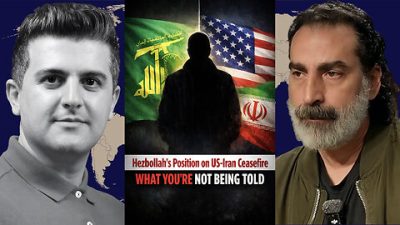
Laith Marouf: Hezbollah’s position on US-Iran ceasefire
or go to
Aletho News Archives – Video-Images
From the Archives
The Dirty Little Secret behind the “Global Terrorism Index”
The Omission of Israeli Terrorism in the Occupied Palestinian Territories
By Karin Brothers | Global Research | December 6, 2014
… The Israeli settlements — all of which are illegal – have been identified as a major impediment to peace. The refusal of a major “global” terrorism report to name the Israeli settlers as one of the groups most responsible for terrorism not only misrepresents a major source of regional violence but exposes the Global Terrorism Index as a propaganda tool that supports a U.S. agenda.
In recent years, governments have been attempting to thwart terrorism by blocking supportive fund-raising. When it comes to Israeli settlements, however, the US and Canada actually encourage fund-raising by giving organizations (such as Christian Friends of Israeli Communities (CFOIC) and the Jewish National Fund) financial support in the form of donor tax-deductions.
Charities which provide funds for the Israeli settlements should be regarded as terror-financing organizations. They should not only lose their tax-deductible status, but they should be banned because they support the violation of international humanitarian law. The terror-financing laws that are being strictly enforced for Muslim charities should be applied to Christian and Jewish charities as well. … Read full article
Blog Roll
 Aletho News
- The Black Cube Files: How Former Mossad Operatives Flipped a Nation
- Laith Marouf: Hezbollah’s position on US-Iran ceasefire: What you’re not being told
- Israel’s priority lies in destroying chances of peace between Iran, US: Ex-UN nuclear chief
- Ceasefire for all or for none: Iran shuts Hormuz over Lebanon attacks
- Strait of Hormuz is Iran’s ‘nuclear weapon’ that forced US retreat: Medvedev
- Energy crisis will last for months – Kremlin envoy
- Europe’s quiet role in the war on Iran
- Forty days that shook the Empire: How Iran turned the tables on US and prevailed
- Netanyahu unilaterally declares Lebanon outside of ceasefire deal
- Israeli leaders: ‘Not a single goal’ achieved in war with Iran
- If Americans Knew
- Gazans face a triple crisis: severe shortages of water and bread, healthcare in tatters
- NY Times reports how Netanyahu took the US into Iran War
- A sigh of relief over Iran, but Gaza and Lebanon in dire straits – Daily Update
- Thousands dead and neighborhoods razed to the ground: Aid agencies fear southern Lebanon is becoming the new Gaza
- The war the US is fighting for Israel could cost trillions
- ‘Cigarette Burns, Nail Wounds’: Toddler Tortured in Gaza to Coerce Father
- Trump Says US Sent ‘a Lot of Guns’ to Protesters in Iran
- Israeli forces destroy 17 UN peacekeeper cameras in south Lebanon
- US-Israeli strikes ‘completely destroy’ synagogue in Tehran
- Archbishop for US Military Says Iran War Is Unjust Under Catholic Teaching
- No Tricks Zone
- An Inconvenient Tree: Uncovered In Alps… Europe Much Warmer Than Today 6000 Years Ago
- New Study Reports A 60% Slowdown In Greenland’s Ice Loss Rate In The Last Decade
- Low Intensity Tornado Wrecks Major Solar Farm, Creating A Potential Toxic Dump
- New Study Finds Warming Saves Lives…Cold Temperatures 12 Times More Deadly Than Excess Heat
- German Science Blog Accuses PIK Climate Institute Of Hallucinating Climate Tipping Points
- Devastating Assessment Of Comirnaty Vaccine By Former Senior Pfizer Europe Toxicologist
- New Study: CO2 Is ‘Effectively Negligible’ As An Explanatory Climate Change Factor Since 2000
- Former Pfizer Toxicologist Dr. Helmut Sterz Tells Bundestag Hearing Pfizer Vaccine Should Have Never Been Approved
- Energy Expert: Germany’s Nuclear Phaseout Was A “500 Billion Euro Mistake”
- New Research: South Australia’s Mid-Holocene Sea Surface Temperatures Were 4°C Warmer Than Today
 Aletho News