BRICS create new Development Bank as well as a $100 billion foreign currency reserves pool
By Helmo Preuss | The BRICS Post | July 15, 2014
Fortaleza, Brazil – After some tough rounds of negotiations, BRICS nations (Brazil, Russia, India, China and South Africa) have created not only a new $100 billion Development Bank, but also a $100 billion foreign currency reserves pool.
The announcement was made after a plenary meet of the five BRICS heads of state in Fortaleza on Tuesday.
Shanghai finally won the bid to host the Bank while India will get the presidency of the Bank for the first six years. The Bank will have a rotating chair. The Bank will also have a regional office in Johannesburg, South Africa. All the five countries will have equal shareholding in the BRICS Bank.
The five Finance Ministers will constitute the Bank’s board which will be chaired by Brazil.
The Bank will initially be involved in infrastructure projects in the BRICS nations.
The authorized, dedicated and paid in capital will amount to $100 billion, $50 billion and $10 billion respectively.
The idea of the BRICS Bank was proposed by India during the 2012 Summit in New Delhi.
BRICS have long alleged that the IMF and World Bank impose belt-tightening policies in exchange for loans while giving them little say in deciding terms. Total trade between the countries is $6.14 trillion, or nearly 17 percent of the world’s total. The last decade saw the BRICS combined GDP grow more than 300 per cent, while that of the developed word grew 60 per cent.
Apart from the new development Bank, the group of five leading emerging economies also created a Contingency Reserve Arrangement on Tuesday.
BRICS central banks will keep their reserves in gold and foreign currencies.
China will fund $41 billion, Brazil, India and Russia $18 billion each and South Africa with $5 billion. The funds will be provided according to a multiple. China’s multiple is 0.5, which means that if needed, the country will get half of $41 billion. The multiple is 2 for South Africa and 1 for the rest.
BRICS Finance ministers or central banks’ governors will form a governing body to manage the CRA while it will be presided over by the BRICS President.
The BRICS CRA will not be open to outsiders.
Meanwhile, at the Summit in Fortaleza, Russian President Vladimir Putin said BRICS must form an energy alliance.
“We propose the establishment of the Energy Association of BRICS. Under this ‘umbrella’, a Fuel Reserve Bank and BRICS Energy Policy Institute could be set up,” Putin said on Tuesday.
Russia backs Argentina’s call to curb Western dominance
Press TV – July 13, 2014
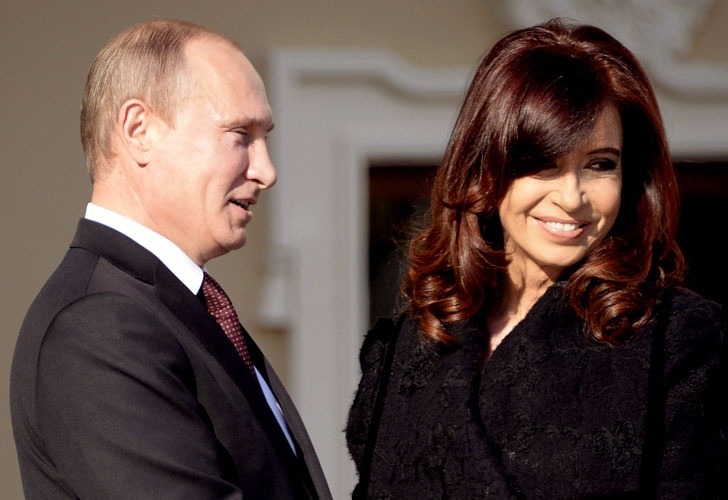
Russian President Vladimir Putin has endorsed a call by his Argentinean counterpart Cristina Fernandez de Kirchner to curb Western dominance in international politics.
Putin gave his support during a meeting with Kirchner in the Argentinean capital, Buenos Aires, on Saturday.
The Russian leader also said Moscow and Buenos Aires share a close view on international relations.
During the meeting, Kirchner emphasized that global institutions must be overhauled and made more multilateral, adding, “We firmly believe in multipolarity, in multilateralism, in a world where countries don’t have a double standard.”
In addition, the two leaders discussed military cooperation and oversaw their delegations signing a series of bilateral deals, including one on nuclear energy.
Putin’s visit to Argentina is part of his six-day tour of Latin America aimed at boosting trade and ties in the region, according to Russian state media.
The Russian leader’s trip will next take him to Brazil, where he is scheduled to attend the gathering of the economic alliance, BRICS (Brazil, Russia, India, China and South Africa), in Brazil on July 15 and 16.
Putin’s Latin American tour began on July 11 in Cuba, where he met with President Raul Castro and his brother, Fidel Castro. During his stay in the capital, Havana, Putin signed a law writing off 90 percent of Cuba’s USD 35-billion Soviet-era debt.
Following his visit to Cuba, Putin made a surprise visit to Nicaragua, where he held talks with President Daniel Ortega.
Tired of World Bank, China to launch alternative
RT | June 26, 2014
China is moving forward with a plan to create its own version of the World Bank, which will rival institutions that are under the sway of the US and the West. The bank will start with $100 billion in capital.
The Asian Infrastructure Investment Bank (AIIB) will extend China’s financial reach and compete not only with the World Bank, but also with the Asian Development Bank, which is heavily dominated by Japan. The $100 billion in capital is double that originally proposed, the Financial Times (FT) reported.
A member of the World Bank, China has less voting power than countries like the US, Japan, and the UK. It is in the ‘Category II’ voting bloc, giving it less of a voice. In the Asian Development Bank, China only holds a 5.5 percent share, compared to America’s 15.7 percent share and Japan’s 15.6 share.
At the International Monetary Fund, China pays a 4 percent quota, whereas the US pays nearly 18 percent, and therefore has more influence within the organization and where loans go.
“China feels it can’t get anything done in the World Bank or the IMF so it wants to set up its own World Bank that it can control itself,” the FT quoted a source close to discussions as saying.
To date, 22 countries have expressed interest in the project, including oil-rich Middle Eastern nations, the US, India, Europe, and even Japan, the FT reported.
“There is a lot of interest from across Asia but China is going to go ahead with this even if nobody else joins it,” the FT source said.
Funding for the Asian Infrastructure Investment Bank will mostly be sourced from the People’s Republic of China and be used to pay for infrastructure projects.
The bank’s first project will be a reincarnation of the ancient Silk Road, the vast network of trade routes between China and its regional neighbors. Another proposed project is a railway from Beijing to Baghdad.
The idea for the bank was first floated in October 2013, when China unveiled plans to create the bank. Then it was initially to be funded with $50 billion in capital.
Separately, the BRICS nations plan to have a $100 billion development bank ready by 2015.
Funds will be reserved for emerging market members who are often bypassed by institutions like the IMF and World Bank.
Bank preparations will likely be finalized at the 6th annual BRICS summit on July 14-16, when the five world leaders convene in Brazil.
Ismael Hossein-zadeh’s “Beyond Mainstream Explanations of the Financial Crisis”
The Consequences of Parasitical Capitalism
Book review by Isaac Christiansen | CounterPunch | May 23, 2014
Ismael Hossein-zadeh has done a masterful job in explaining the causes of the 2007-08 financial collapse and in identifying what must be done in response. While there is a consensus that the main source of the 2008 financial collapse was the accumulation of too much toxic debt, there is little agreement on the factors that precipitated the buildup of all that unsustainable debt. Focusing on superficial descriptions or symptomatic factors such as deregulation, securitization, greed, and the like, mainstream economics falls way short of providing a satisfactory explanation for the collapse, or the ensuing long recession. Now comes a newly published book, Beyond Mainstream Explanations of the Financial Crisis: Parasitic Finance Capital, which skillfully fills this theoretical void as it provides an alternative explanation of the 2008 financial collapse, of the ensuing long recession and of the neo-liberal austerity responses to it. Instead of simply blaming the “irrational behavior” of market players, as neo-liberals do, or lax public supervision, as Keynesians do, the study focuses on the core dynamics of capitalist development that not only created the financial bubble, but also fostered the “irrational behavior” of market players and subverted public policy.
Hossein-zadeh sets out in Beyond Mainstream Explanations of the Financial Crisis to first demonstrate the origins of the crisis and the subsequent transfer of “tens of trillions” of dollars from the vast majority of society into the coffers of the financial speculators through the imposition of austerity cuts on the many for the benefit of the few; and secondly to examine potential societal responses to avoid the repetition of such crises in the future. To do this, he begins by examining the two most prominent explanations for the crisis: the neoliberal explanation, which claimed it was due to irrational market actors and/or intrusive government policies that interfered with the self-correcting market mechanism; and the Keynesian explanation, which explained the crisis as the result of excessive deregulation, “inappropriate” public policy and supply side strategies. The author skillfully exposes the weaknesses of both and offers a compelling and well grounded alternative explanation, as indicated in the book’s title.
The book is well written and is easily understood by those who may not have an extensive background in economic theory. At the same time, it provides keen insights that are essential to understanding the crisis for those who may be more experienced in the field. It is structured with the first five chapters devoted to understanding crises within advanced capitalism, particularly the role of finance capital in provoking them, while the final three chapters are dedicated to examining solutions. Moreover, the work is an essential heuristic tool for any and all who wish to show how and why advanced capitalist economies tend towards crisis and the role of finance capital as a catalyst of crisis. A more thorough examination of the work’s primary contributions follows below.
In Chapter one Hossein-zadeh explains that neoliberal conceptualizations suffer from a misplaced religious-like faith in the market mechanism that led the leading neoliberal/neoclassical economists to remain oblivious to the impending crash. Due to neoliberals’ blind faith in the income-expenditure (or supply-demand) circular flow model, their economic theory is impervious to the fact that contradictions can arise within the real sector itself as well as to the reality that contradictions can also arise between the financial and the real sector. This led the leading neoliberal/neoclassical economists like Ben Bernanke and the IMF financial gurus to predict continual expansion up through the very eve of the crisis, and later to offer mistaken remedies such as quantitative easing and more funds to the financial sector. The impact of these measures is that instead of preventing a new bubble from forming they put us well on the way to creating another one.
In chapter two Mr. Hossein-zadeh delves into the weaknesses of Keynesian explanations of the crisis, arguing that while they are not wrong to signal deregulation as part of the problem leading to this crisis, they naively believe that capitalism will allow itself to be regulated without pressure from the people, thereby ignoring the power relationship between capitalism and the state. Not surprisingly, Keynesians tend to be oblivious as to why their more sane-sounding prescriptions for increasing public demand (through the promotion of New Deal type economic programs) and curtailing the aggressive and irresponsible behavior of financial players through more regulation have not been followed. While their policy suggestions may prove effective under certain circumstances, Keynesians fail to see or acknowledge that profit can also be increased through more intense exploitation of workers, that is, through supply-side measures. Furthermore, while the New Deal reforms were beneficial for the extrication of the U.S. economy from the grips of the Great Depression, these were followed much more as a response to working-class pressure from below then as a deliberated response to the writings of Keynes. In addition, the long economic expansion that followed was also due to the specific global economic situation of vast amounts of capital destroyed in Europe leaving the U.S. without much competition for its exports.
Much of the weakness of Keynesian economic theory, like all neoclassical economics, is their rejection of the category of value, and thus any real understanding as to the origin of social wealth and class dynamics. The general weaknesses of neoclassical economics are covered expertly in chapter 3. This chapter examines the weaknesses in the neoclassical understanding of the relationship between industrial and finance capital. The neoclassical position traditionally argues that the latter is limited by the real expansion of the former, and thus remains oblivious to the possibility of a crisis forming in the financial sector and spreading to the real ‘productive’ sector. To understand the real developments, Hossein-zadeh convincingly argues, we need to turn to Karl Marx’s Volume III and look at what he termed ‘fictitious capital’, when Marx examined how value tended to be siphoned from the sector in which it was produced to the unproductive sectors of the economy in pursuit of speculative investment.
Chapter 4 looks at the historical growth of finance capital (whose share of GDP in 2008 was more than double its share on the eve of the Great Depression in 1929), the growth of speculative activities (derivative markets, credit-default swaps) and the role of private control of the money supply. Each one of these phenomena is analyzed here in their social impacts and class/political dynamics. Here the author (p76) demonstrates that the speculative activity of finance capital accelerates “accumulation of fictitious capital through asset price inflation” (often with the help of public funds that simultaneously act as insurance protecting the speculators from the potential consequences of their socially deleterious behavior), creating a bubble that eventually bursts—with the public left paying the debt for the now-devalued assets.
This chapter also demonstrates that the bailouts for the speculators and austerity for the many, which further increased the already sharp economic inequality, were not an economic necessity but a reflection of the power of finance capital over the state and the monetary authority. To this end, Hossein-zadeh reflects on the immense tax-breaks for the wealthy, gargantuan military spending and lucrative contracts for weapons producers that created ‘public’ debt as a pretext to slash necessary social programs. The chapter demonstrates that we live under an economic system where losses are socialized and profits are privatized.
In Chapter 5, Hossein-zadeh reflects on Marx’s understanding of parasitic finance capital, its place within labor theory of value, and its contribution to a better understanding of the causes behind the present economic crisis. In Vol. III of Capital Marx outlined how the surplus value produced in the industrial and agricultural sectors ends up being divided between the merchant (or commercial capital), finance capital (money lending capital) and ground rent (Marx [1894] 1981). Hossein-zadeh points out that, according to Marx, fluctuations of finance capital could take place independent “of the movement of the actual capital it represents” (p86, quoted in Hossein-zadeh); and that as capitalism develops the movement of money (finance) capital becomes more and more independent of the movement of industrial capital. This is critical for his argument that crisis can hit the speculative financial sector at a moment when there is not a crisis within the real sector, but that through the tightening of credit and asset price deflation spread the crisis from the speculative to the productive sector.
The author further argues in this chapter that contemporary Marxists, unlike Hilferding and Lenin who expanded in the early 20th century on Marx’s work on finance capital, have largely abandoned systematic explorations into the workings of finance capital (generally viewing it as secondary to their conception of a Marxian theory of crisis), and focused primarily on the movements within the productive sector. It is not that Hossein-zadeh disagrees in principle with the contemporary Marxist scholars about the potential for crisis to arise within the circuit of productive capital; but that many of these Marxists have overlooked the fact that crisis can and does at times start within the financial sector and proceeds to spread to the real sector. Many contemporary Marxist theoreticians and economists seem to argue, in an inconsistent or self-contradicting fashion that “asset price inflation can boost demand and cause or magnify an expanding real cycle; but debt and/or asset price deflation cannot cause or aggravate a real-sector recession!” (p107).
In Chapter 6 the author explores the historical record of debt cancellations/write-downs, dating back to Bronze Age Mesopotamia (2400-1400 BCE) and running through the 5th and 4th centuries BCE. Here he examines the evidence that suggests that not only were debt cancellation and land restitution/reform common practices in this epoch, but that they often led to economic renewal. While there are moral and ethical arguments that can easily be made in favor of the biblical Jubilee and debt cancellation in general, Hossein-zadeh goes beyond these points to argue that the historical record offers clear evidence that an economic recovery would not occur so long as the vast majority of the population is saddled with overwhelming debt and interest payments. The author further argues that the decline of these socially-beneficial practices coincided with the rise of private property and the growth of power of landowning and rentier classes, and that these classes exerted influence over the state/religious authorities to deemphasize these central aspects to the Old Testament’s socio-economic reforms.
In Chapter 7 the author makes the case for public banking. Here he underscores once again the pernicious role of private banking in advancing the interests of the wealthy few in general and finance capital in particular at the expense of the many. He argues that while private banks “create financial bubbles during expansionary cycles and credit crunch during contradictory ones”, public banking “can provide steady, reliable financial resources as dictated by a nation’s industrial and/or commercial needs”(p129). Crucial here is the superior economic record held by the BRICS (Brazil, Russia, India, China and South Africa) countries in weathering the 2008 financial collapse and the ensuing economic crisis. Contrary to a situation in which the state becomes beholden to creditors, when banks are nationalized the state has additional resources with which to engage in essential public projects that both serve a social purpose and stimulate demand. While acknowledging that public banking by itself is insufficient to prevent the recurrence of all economic crises, Hossein-zadeh successfully makes the case that this is a necessary first step to avert crises that originate within the financial sector.
In the final chapter, the author soundly argues that there are no shortcuts to superseding capitalism by solely nationalizing the banking system; and that we must move beyond capitalism itself, or else we would be subjected to the throes of its logic. Here he examines the role of labor as one of the key players in confronting capital. Sadly, as he points out in this chapter, many unions have become caught up in business unionism and have tragically become vehicles for transmitting the dictates of capital to the workers (as opposed to vice-versa!), and have been unable (or unwilling) to resist the generalized assault on labor in the form of layoffs, wage cuts and outsourcing.
A central explanation for the debilitation of unions offered here lies in capital’s global reach and the globalization of production. Capital has free global movement and is organized on an international level and thus is able to play off workers in various countries against each other in a race to the bottom in terms of worker safety, salaries, benefits, labor laws and environmental protections. Labor must therefore organize internationally so as to be able to effectively resist a globalized capitalist system. A key element of this strategy lies in resisting all forms of chauvinisms, and reactionary nationalisms that have at times infected the labor movement and can lead to what Edna Bonacich (1972) referred to as a split-labor market.
Dr. Hossein-zadeh in this chapter also looks at the limitations of the Occupy movement, arguing that while their heart was in the right place, Occupy activists had condemned themselves to be ineffective as a long-term force for change by refusing to adopt an organizational structure or outline specific demands. The author thus points us back to the critical role of labor to play in this regard, but that it is essential that they organize and coordinate globally, otherwise capital will be able to outmaneuver workers’ resistance and subject labor to its logic. In the end, Hossein-zadeh remains hopeful based on the seeds of international labor organizing that labor will be able to meet this challenge in the future and serve as a primary catalyst for meaningful socio-economic transformation. In summary, I recommend this book without reservation, as a critical component of the library of those who are not just concerned with understanding the dynamics of finance capital and its role in facilitating economic crisis, but to all those who are genuinely interested in bringing about a more socially just and equitable society.
Isaac Christiansen is a Ph.D Student in the Sociology Department at Iowa State University.
Works Cited
Bonacich, Edna. 1972. “A Theory of Ethnic Antagonism: The Split-Labor Market” American Sociological Review, 37:5 547-559.
Marx Karl. [1894] 1981. Capital Vol. III Penguin Books in Association with New Left Review. London WI.
Meet TISA: Another Major Treaty Negotiated In Secret Alongside TPP And TTIP

By Glyn Moody | Techdirt | April 29, 2014
This Wednesday evening there is to be a “Public Information Session and Discussion” (pdf) about TISA: the Trade in Services Agreement. If, like me, you’ve never heard of this, you might think it’s a new initiative. But it turns out that it’s been under way for more than a year: the previous USTR, Ron Kirk, informed Congress about it back in January 2013 (pdf). Aside from the occasional laconic press release from the USTR, a page put together by the Australian government, and a rather poorly-publicized consultation by the European Commission last year, there has been almost no public information about this agreement. A cynic might even think they were trying to keep it quiet.
Perhaps the best introduction to TISA comes from the Public Services International (PSI) organization, a global trade union federation representing 20 million people working in public services in 150 countries. Last year, it released a naturally skeptical brief on the proposed agreement (pdf):
At the beginning of 2012, about 20 WTO members (the EU counted as one) calling themselves “The Really Good Friends of Services” (RGF) launched secret unofficial talks towards drafting a treaty that would further liberalize trade and investment in services, and expand “regulatory disciplines” on all services sectors, including many public services. The “disciplines,” or treaty rules, would provide all foreign providers access to domestic markets at “no less favorable” conditions as domestic suppliers and would restrict governments’ ability to regulate, purchase and provide services. This would essentially change the regulation of many public and privatized or commercial services from serving the public interest to serving the profit interests of private, foreign corporations.
The Australian government’s TISA page fills in some details:
The TiSA negotiations will cover all services sectors. In addition to improved market access commitments, the negotiations also provide an opportunity to develop new disciplines (or trade rules) in areas where there has been significant developments since the WTO Uruguay Round negotiations. There negotiations will cover financial services; ICT services (including telecommunications and e-commerce); professional services; maritime transport services; air transport services, competitive delivery services; energy services; temporary entry of business persons; government procurement; and new rules on domestic regulation to ensure regulatory settings do not operate as a barrier to trade in services.
If that sounds familiar, it’s because very similar language is used to describe TAFTA/TTIP, which aims to liberalize trade and investment, to provide foreign investors with access to domestic markets on the same terms as local suppliers, to limit a government’s ability to regulate there by removing “non-tariff barriers” — described above as “regulatory settings” — and to use corporate sovereignty provisions to enforce investors’ rights.
Those similarities suggest TISA is part of a larger plan that includes not just TAFTA/TTIP, but TPP too, and which aims to cement the dominance of the US and EU in world trade against a background of Asia’s growing power. Indeed, it’s striking how membership of TISA coincides almost exactly with that of TTIP added to TPP:
The 23 TiSA parties currently comprise: Australia, Canada, Chile, Chinese Taipei, Colombia, Costa Rica, European Union (representing its 28 Member States), Hong Kong, Iceland, Israel, Japan, Liechtenstein, Mexico, New Zealand, Norway, Pakistan, Panama, Paraguay, Peru, Republic of Korea, Switzerland,, Turkey and the United States.
Once more, the rising economies of the BRICS nations — Brazil, Russia, India, China, South Africa — are all absent, and the clear intent, as with TTIP and TPP, is to impose the West’s terms on them. That’s explicitly recognized by one of the chief proponents of TISA, the European Services Forum:
the possible future agreement would for the time being fall short of the participation of some of the leading emerging economies, notably Brazil, China, India and the ASEAN countries. It is not desirable that all those countries would reap the benefits of the possible future agreement without in turn having to contribute to it and to be bound by its rules.
The Australian government’s page reveals that there have already been five rounds of negotiations — all held behind closed doors, of course, just as with TTIP and TPP. The Public Information Session taking place in Geneva this week seems to mark the start of a new phase in those negotiations, at least allowing some token transparency. Perhaps this has been provoked by the growing public anger over the secrecy surrounding TPP and TAFTA/TTIP, and fears that the longer TISA was kept out of the limelight, the worse the reaction would be when people found out about it.It seems appropriate, then, that the unexpected unveiling of this new global agreement should be greeted not only by an updated and more in-depth critique from the PSI — “TISA versus Public Services” — but also the first anti-TISA day of protest. Somehow, I don’t think it will be the last.
Follow me @glynmoody on Twitter or identi.ca, and +glynmoody on Google+
BRICS countries to set up their own IMF
By Olga Samofalova | Russia Beyond the Headlines | April 14, 2014
The BRICS countries (Brazil, Russia, India, China and South Africa) have made significant progress in setting up structures that would serve as an alternative to the International Monetary Fund and the World Bank, which are dominated by the U.S. and the EU. A currency reserve pool, as a replacement for the IMF, and a BRICS development bank, as a replacement for the World Bank, will begin operating as soon as in 2015, Russian Ambassador at Large Vadim Lukov has said.
Brazil has already drafted a charter for the BRICS Development Bank, while Russia is drawing up intergovernmental agreements on setting the bank up, he added.
In addition, the BRICS countries have already agreed on the amount of authorized capital for the new institutions: $100 billion each. “Talks are under way on the distribution of the initial capital of $50 billion between the partners and on the location for the headquarters of the bank. Each of the BRICS countries has expressed a considerable interest in having the headquarters on its territory,” Lukov said.
It is expected that contributions to the currency reserve pool will be as follows: China, $41 billion; Brazil, India, and Russia, $18 billion each; and South Africa, $5 billion. The amount of the contributions reflects the size of the countries’ economies.
By way of comparison, the IMF reserves, which are set by the Special Drawing Rights (SDR), currently stand at 238.4 billion euros, or $369.52 billion dollars. In terms of amounts, the BRICS currency reserve pool is, of course, inferior to the IMF. However, $100 billion should be quite sufficient for five countries, whereas the IMF comprises 188 countries – which may require financial assistance at any time.
BRICS Development Bank
The BRICS countries are setting up a Development Bank as an alternative to the World Bank in order to grant loans for projects that are beneficial not for the U.S. or the EU, but for developing countries.
The purpose of the bank is to primarily finance external rather than internal projects. The founding countries believe that they are quite capable of developing their own projects themselves. For instance, Russia has a National Wealth Fund for this purpose.
“Loans from the Development Bank will be aimed not so much at the BRICS countries as for investment in infrastructure projects in other countries, say, in Africa,” says Ilya Prilepsky, a member of the Economic Expert Group. “For example, it would be in BRICS’ interest to give a loan to an African country for a hydropower development program, where BRICS countries could supply their equipment or act as the main contractor.”
If the loan is provided by the IMF, the equipment will be supplied by western countries that control its operations.
The creation of the BRICS Development Bank has a political significance too, since it allows its member states to promote their interests abroad. “It is a political move that can highlight the strengthening positions of countries whose opinion is frequently ignored by their developed American and European colleagues. The stronger this union and its positions on the world arena are, the easier it will be for its members to protect their own interests,” points out Natalya Samoilova, head of research at the investment company Golden Hills-Kapital AM.
Having said that, the creation of alternative associations by no means indicates that the BRICS countries will necessarily quit the World Bank or the IMF, at least not initially, says Ilya Prilepsky.
Currency reserve pool
In addition, the BRICS currency reserve pool is a form of insurance, a cushion of sorts, in the event a BRICS country faces financial problems or a budget deficit. In Soviet times it would have been called “a mutual benefit society”, says Nikita Kulikov, deputy director of the consulting company HEADS. Some countries in the pool will act as a safety net for the other countries in the pool.
The need for such protection has become evident this year, when developing countries’ currencies, including the Russian ruble, have been falling.
The currency reserve pool will assist a member country with resolving problems with its balance of payments by making up a shortfall in foreign currency.
Assistance can be given when there is a sharp devaluation of the national currency or massive capital flight due to a softer monetary policy by the U.S. Federal Reserve System, or when there are internal problems, or a crisis, in the banking system. If banks have borrowed a lot of foreign currency cash and are unable to repay the debt, then the currency reserve pool will be able to honor those external obligations.
This structure should become a worthy alternative to the IMF, which has traditionally provided support to economies that find themselves in a budgetary emergency.
“A large part of the fund goes toward saving the euro and the national currencies of developed countries. Given that governance of the IMF is in the hands of western powers, there is little hope for assistance from the IMF in case of an emergency. That is why the currency reserve pool would come in very handy,” says ambassador Lukov.
The currency reserve pool will also help the BRICS countries to gradually establish cooperation without the use of the dollar, points out Natalya Samoilova. This, however, will take time. For the time being, it has been decided to replenish the authorized capital of the Development Bank and the Currency Reserve Pool with U.S. dollars. Thus the U.S. currency system is getting an additional boost. However, it cannot be ruled out that very soon (given the threat of U.S. and EU economic sanctions against Russia) the dollar may be replaced by the ruble and other national currencies of the BRICS counties.
BRICS rejects sanctions against Russia over Ukraine
Press TV – March 25, 2014
The group of five major emerging national economies known as the BRICS has rejected the Western sanctions against Russia and the “hostile language” being directed at the country over the crisis in Ukraine.
“The escalation of hostile language, sanctions and counter-sanctions, and force does not contribute to a sustainable and peaceful solution, according to international law, including the principles and purposes of the United Nations Charter,” foreign ministers of the BRICS countries – Brazil, Russia, India, China and South Africa – said in a statement issued on Monday.
The group agreed that the challenges that exist within the regions of the BRICS countries must be addressed within the framework of the United Nations.
“BRICS countries agreed that the challenges that exist within the regions of the BRICS countries must be addressed within the fold of the United Nations in a calm and level-headed manner,” the statement added.
The White House said earlier on Monday that US President Barack Obama and the leaders of Britain, Canada, France, Germany, Italy and Japan decided to end Russia’s role in the G8 over the crisis in Ukraine and the status of Crimea.
Meanwhile, the G7 group of top economic powers has snubbed a planned meeting that Russian President Vladimir Putin was due to host in the Black Sea resort city of Sochi in June.
The G7 said they would hold a meeting in Brussels without Russia instead of the wider G8 summit, and threatened tougher sanctions against Russia.
Russia brushed off the Western threat to expel it from the G8 on the same day. The Autonomous Republic of Crimea declared independence from Ukraine on March 17 and formally applied to become part of Russia following a referendum a day earlier, in which nearly 97 percent of the participants voted in favor of the move.
On March 21, Putin signed into law the documents officially making Crimea part of the Russian territory. Putin said the move was carried out based on the international law.
Brazil to press for local Internet data storage after NSA spying
RT | October 29, 2013
Brazil is urging a plan to introduce local data storage for Internet giants like Facebook and Google in order to keep the information they get from Brazilian users safe –as part of a complex of measures to oppose US spying.
The new law could impact Google, Facebook, Twitter and other Internet global companies that operate in Brazil, Latin America’s biggest country and one of the world’s largest telecommunications markets.
The country’s president, Dilma Rousseff, is urging lawmakers to vote as early as this week on the law, according to Reuters who have seen the draft of the legislation.
“The government can oblige Internet service companies … to install and use centers for the storage, management and dissemination of data within the national territory,” the draft of the document read.
Rousseff’s calls come after surveillance leaks by the US in Brazil that went as far as tracking the personal phone calls and e-mails of the President herself.
Last month, Brazilian President Dilma Rousseff canceled a scheduled meeting at the White House after leaked documents showed the NSA spied on her country’s state oil company.
“We are not regulating the way information flows, just requiring that data on Brazilians be stored in Brazil so it is subject to the jurisdiction of Brazilian courts,” Rousseff spokesman Thomas Traumann said. “This has nothing to do with global communications.”
However, the companies disagree saying that the legislation will increase costs of services, and damage the economic activity connected with information.
Last week a coalition of business groups representing dozens of Internet companies including Facebook, Google, Microsoft and eBay sent a letter to Brazilian lawmakers.
“In-country data storage requirements would detrimentally impact all economic activity that depends on data flows,” the letter read, Reuters reported.
Many also threatened the law will scare the companies, while others, nevertheless, were of the opinion that the companies would comply if faced with no other options.
This week, Brazil is expected to vote on a cyber-security bill to create a state system to protect the country’s citizens from spying.
When the news on the bill emerged two weeks ago, Brazilian President Dilma Rousseff tweeted the news, stressing the need for greater security “to prevent possible espionage.”
The latest legislation project comes against a backdrop of Brazil set to host a conference next April to debate ways to guard Internet privacy from espionage.
The meeting is to be held by ICAAN, the body that manages web domain names. It is thought to be neutral and includes governments, civil society and industry.
Meanwhile, BRICS companies are working to create a “new Internet”.
In particular, Brazil has been reported to be building a “BRICS cable” that will create an independent link between Brazil, South Africa, India, China and Russia, in order to bypass NSA cables and avoid spying.
The cable is set to go from the Brazilian town of Fortaleza to the Russian town of Vladivostok via Cape Town, Chennai and Shantou.
The length of the fiber-optic cable will be almost 35,000 kilometers, making it one of the most ambitious underwater telecom projects ever attempted.
Last week, most of the BRICS countries joined talks to hammer out a UN resolution that would condemn “indiscriminate” and “extra-territorial” surveillance, and ensure “independent oversight” of electronic monitoring.
Russian Foreign Minister Sergey Lavrov said that “contacts [between Moscow and Washington] never stop,” when asked if the latest publication of secret files leaked by the former National Security Agency (NSA) contractor would affect relations between Russia and the US.
Also, Lavrov made it clear that the situation surrounding Snowden is irrelevant to Russia.
“We have formulated our position on Snowden and have said everything,” he said.
Related article
- China echoes Brazil’s call for cyberspace guidelines (thebricspost.com)
BRICS plan new $50billion bank to rival World Bank and IMF
RT | March 26, 2013
The ‘big five’ of the developing world will discuss creating their own global World Bank as their 5th annual summit kicks off Tuesday in sunny Durban.
The move is linked to the developing world’s disillusionment with the status quo of world financial institutions. The World Bank and IMF continue to favor US and European presidents over BRICS nations, and in 2010, the US failed to ratify a 2010 agreement which would allow more IMF funds to be allocated to developing nations.
“Not long ago we discussed the formation of a developmental bank… Today we are ready to launch it,” South African President Jacob Zuma said on Monday.
The ‘big five’- Brazil, Russia, India, China, and its newest addition, South Africa, will come together for the annual conference this year in Durban, South Africa in hopes of establishing a new development bank which will fund infrastructure and development projects in the five member states, and will pool foreign currencies to fend off any impending financial crisis.
“We will discuss ways to revive global growth and ensure macroeconomic stability, as well as mechanisms and measures to promote investment in infrastructure and sustainable development,” Indian Prime Minister Manmohan Singh said on Monday, before heading to Durban.
The BRICS have called for a reconstruction of the World Bank and IMF, which were created in 1944, and want to put forth their own ‘Bretton Woods’ accord. And they are serious.
“Brics is not a talk show. It is a serious grouping,” Zuma told reporters at the presidential guest house in Pretoria.
The new bank will cater to developing world interests and will symbolize a great economic and political union.
“There’s a shift in power from the traditional to the emerging world. There is a lot of geo-political concern about this shift in the western world,” Martyn Davies, chief executive officer of Johannesburg-based Frontier Advisory, told Bloomberg.
“A future BRICS Investment Bank is seen as a mechanism that would help realize where money should go, agree development strategies and coordinate investment,” explained Georgy Toloraya, the executive director of Russia’s national committee for BRICS studies to SA News.
In its nebulous stage, the new BRICS bank is unanimously supported by all five member states. In Durban, problems will arise on how to govern, fund, and operate the grand venture.
“When you set up a bank like this it’s not just a question of opening the doors. There are some issues about where it is going to be located, what the capital contributions are going to be, the rules of deploying that investment. These are the sort of details that are in various stages of discussion and negotiation,” said South African Trade Minister Rob Davies, in a statement.
The leaders may not reach a specific agreement in Durban this week, as each country has its own stipulations on its creation. Russia, for example, wants to cap each side’s initial contribution to $10 billion, according to Mikhail Margelov, part of President Putin’s team in South Africa.
Emergency Currency Fund
Pooling currency to deflect a future crisis is also a high priority topic set for the conference.
Once a loose political affiliation, the BRICS bloc is now a serious economic contender in the world economy, representing 40 percent of the world’s population, and accounting for one fifth of global GDP.
Between the five countries, the bloc holds foreign-currency reserves of $4.4 trillion, and needs an institution to safeguard this amassing wealth. The reserve will also protect members from short-term liquidity volatility and balance-of-payment problems.
Presently, it is proposed the member states contribute an equal share to the fund, but there is still dispute over whether to involve IMF management. India has voiced support for IMF involvement, but other BRICS countries may resist.
“A reserve pool, I think, is still some way off, ” said Davies.
In October, Brazilian Finance Minister Guido Mantega suggested the pool be modeled after the Chiang Mai Initiative, which provides a financial safety blanket to south east Asian countries.
Trade within the group swelled to $282 billion last year and could very well reach $500 billion by 2015, according to Brazilian government data.
Many Firsts
The conference is a benchmark of many firsts. It is the first time the conference has been held on South African soil.
For China, it is President Xi’s first visit to South Africa, where China is a leading trading partner and investor. In 2012, the trade between the two countries was 201bln ZAR ($21bln), according to the South African Revenue Service.
The conference is also President Vladimir Putin’s first international visit in 2013.
For South Africa, which makes up just 2.5 percent of total gross domestic product in BRICS, the summit is a way to showcase its role as an investment gateway to Africa. South Africa is the newest and smallest member of the BRIC bloc. It has the 28th highest ranked GDP in the world: China is 2nd, Brazil 6th, Russia 9th and India 10th.
Related article
- BRICS Nations Plan New Bank to Bypass World Bank, IMF (bloomberg.com)
Featured Video
Yemen joins the war – Red Sea could be blocked next – Saudi regime at risk
or go to
Aletho News Archives – Video-Images
From the Archives
Should Europeans ‘Thank’ the Americans for Destroying Nord Stream?
By Robert Bridge | Strategic Culture Foundation | September 29, 2022
With an investigation continuing into the destruction of the Nord Stream gas pipeline that provided energy supplies to Europe from Russia, there appears to be just one prime suspect, and that should surprise nobody.
Following the sabotage of the Nord Stream 1 and 2 gas pipelines, former Polish Foreign Minister Radoslaw Sikorski already seemed to know the identity of the perpetrator when he tweeted out: “Thank you, USA.”
At first glance, it seemed that Sikorski was speaking sarcastically, berating Washington for carrying out an attack that will have severe repercussions for the people of Europe. After all, how could anyone see any good coming from the termination of Europe’s primary source of gas reserves with winter just around the corner? It was Sikorski’s homeland of Poland, after all, that urged its citizens to collect firewood in the face of dwindling gas reserves.
In fact, the Polish diplomat was speaking one-hundred percent literally… continue
Blog Roll
 Aletho News
- Iran denies responsibility for ‘depraved’ attack on Kuwait desalination plant
- Bring The Troops Back. End This War Now!
- Can we please stop calling Israel the ‘only democracy in the Middle East’ now?
- US should start removing its troops for Germany, proposes AfD co-leader Chrupalla
- Iran Red Crescent: 600 educational centers attacked in US-Israeli ‘war crimes’
- Russian Oil Tanker Arrives in Cuba Amid U.S. Blockade
- America Racing to Strategic Defeat in Iran: Lt Col Daniel Davis
- FTC Warns Visa, Mastercard, PayPal, Stripe Over Political Debanking
- Russian tanker approaches Cuba despite US oil blockade
- Marandi: Yemen joins the war – Red Sea could be blocked next – Saudi regime at risk
- If Americans Knew
- Israeli police block Catholic cardinal from entering Church of the Holy Sepulchre on Palm Sunday
- Israel is assassinating journalists again, more than any other nation, anywhere, ever – Not a ceasefire Day 170
- Over 300 US service members wounded, majority have brain injuries – Not a ceasefire Day 169
- Researchers at Human Rights Watch Resign Over Blocked Report on Palestinian Refugee Return
- Jewish Groups Are Backing a War Americans Don’t Want
- Eric Fingerhut Thinks He’s the President of the Jews
- Top Jewish Philanthropists, Rabbis Urge Israeli President to Take Action Against ‘Jewish Extremists’
- Don’t Be Fooled. Zionist Leaders Have Always Wanted to Control Southern Lebanon
- Israel’s widespread use of torture is a core element of its genocide against the Palestinian people
- In Israel’s War on Iran, Many Middle East US Bases Rendered “All But Uninhabitable”
- No Tricks Zone
- New Study Finds Warming Saves Lives…Cold Temperatures 12 Times More Deadly Than Excess Heat
- German Science Blog Accuses PIK Climate Institute Of Hallucinating Climate Tipping Points
- Devastating Assessment Of Comirnaty Vaccine By Former Senior Pfizer Europe Toxicologist
- New Study: CO2 Is ‘Effectively Negligible’ As An Explanatory Climate Change Factor Since 2000
- Former Pfizer Toxicologist Dr. Helmut Sterz Tells Bundestag Hearing Pfizer Vaccine Should Have Never Been Approved
- Energy Expert: Germany’s Nuclear Phaseout Was A “500 Billion Euro Mistake”
- New Research: South Australia’s Mid-Holocene Sea Surface Temperatures Were 4°C Warmer Than Today
- Storing Green Energy To Last Germany 10 Days Would Require A 60-Million Tonne Battery
- New Studies: UK Sea Levels Were 4 Meters Higher Than Today During The Mid-Holocene
- Destructive Green New Deal: German Energy And Metal Group Warns Of Drastic Crisis
 Aletho News