132 Canadian doctors have died suddenly or unexpectedly since COVID-19 vaccine rollout (Part 2/2)
By Dr. William Makis MD | COVID Intel | February 18, 2023
Overall Canadian physician mortality in 2022 was 53% higher than 2019, however, as with all excess mortality data in highly COVID-19 vaccinated jurisdictions, this mortality is heavily skewed towards the younger age groups, with the youngest doctors – medical students or medical residents under age 30 dying at a 900% higher rate in 2022, compared to the 2019/2020 average.
2021 Sudden and unexpected Canadian doctor deaths:
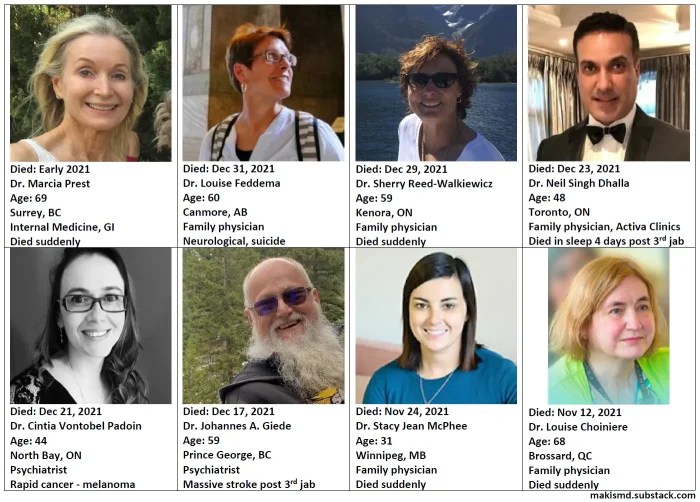


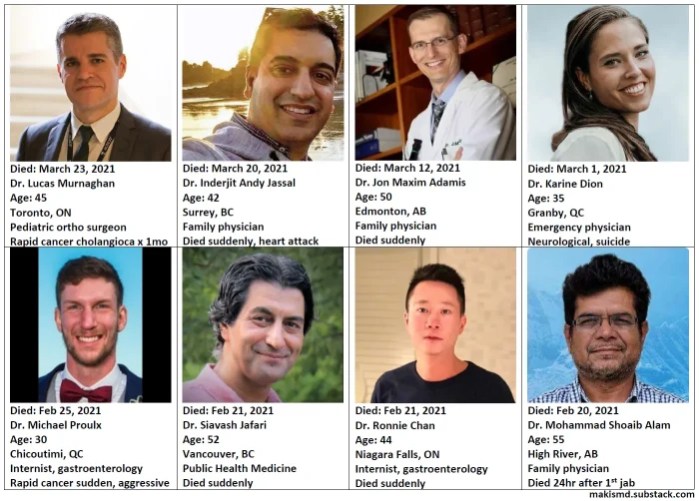

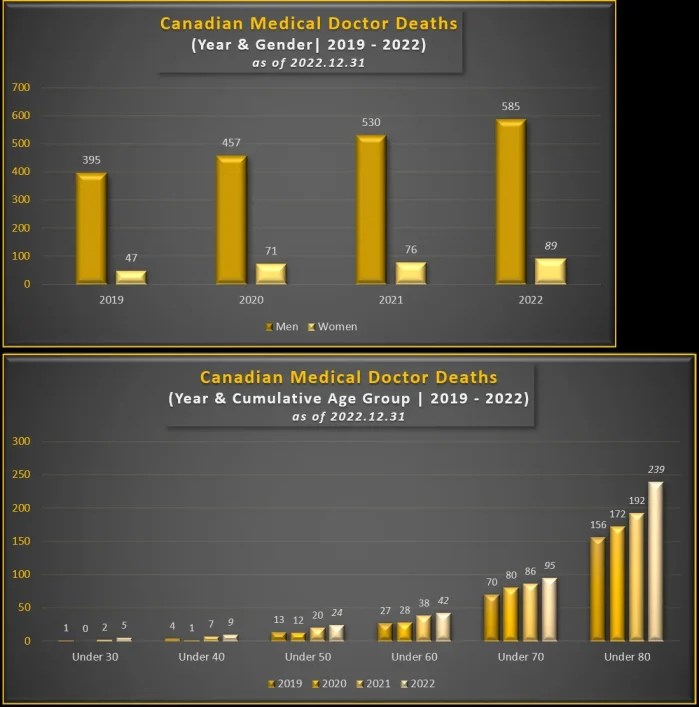
Acknowledgements
I would like to thank Michael for the tremendous work and hundreds of hours spent compiling this important data from official medical sources: (Canadian Medical Association, Royal College of Physicians and Surgeons of Canada, Provincial Medical Associations, Canadian Medical University Alumni Associations, Provincial Colleges of Physicians and Surgeons, and online obituary aggregators), as well as Sonja, VA and everyone else who provided valuable contributions over time.
This data has been available to the Canadian Medical Association as well as the Royal College of Physicians and Surgeons of Canada.
132 Canadian doctors have died suddenly or unexpectedly since COVID-19 vaccine rollout (Part 1/2)
By Dr. William Makis MD | COVID Intel | February 18, 2023
In 2021, Canadian doctors were mandated to be fully COVID-19 vaccinated, in order to keep their jobs. Very few escaped these mandates. No exemptions given.
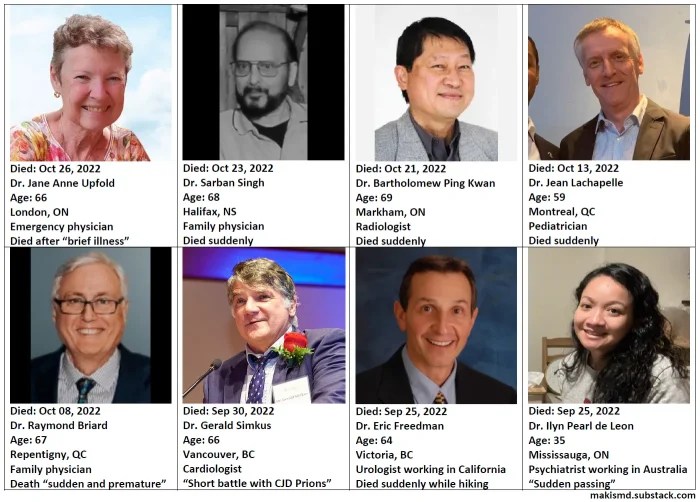
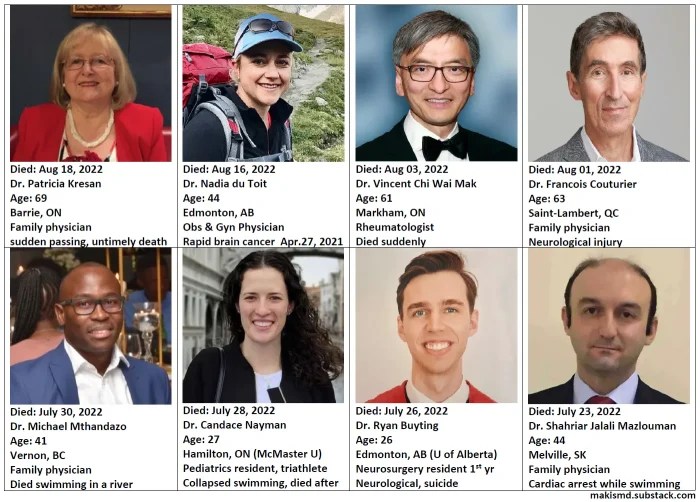
Since the rollout of COVID-19 vaccines in December 2020, a total of 132 actively practicing Canadian doctors under age 70 have died suddenly or unexpectedly.
Canadian physician mortality in 2022 was 53% higher than 2019, based on the largest database of its kind assembled diligently by our team (a total of 2250 doctor deaths documented, spanning the years 2019-2023). This data is solid.
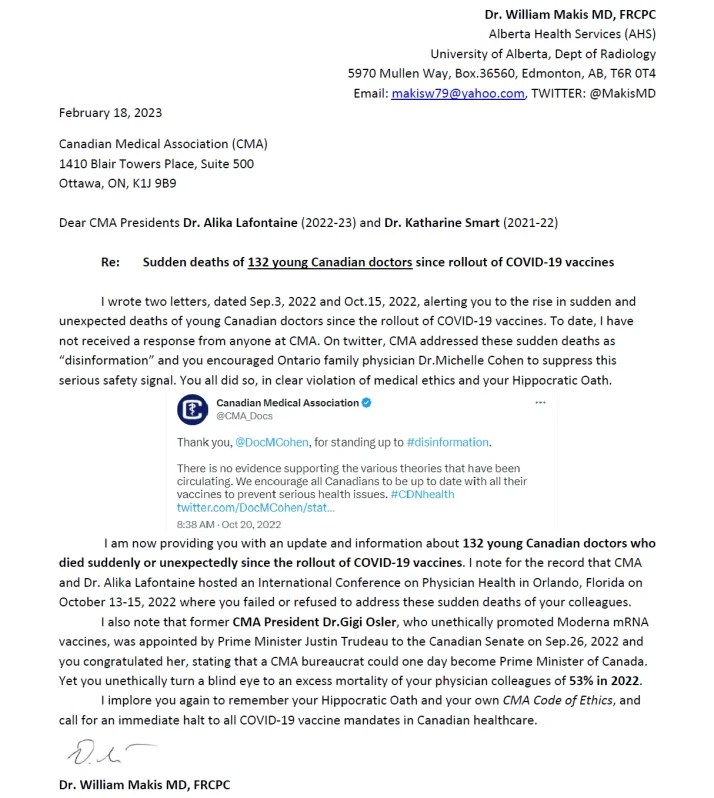
I have sent a third letter to the Canadian Medical Association (“CMA”) about these sudden deaths. To date, CMA has refused to respond. CMA fully supported unscientific and unethical COVID-19 vaccine mandates that were forced on their own physician members. Now this Ottawa-based bureaucracy ignores the damage done.
2022/23 Sudden and unexpected Canadian doctor deaths:





Western countries urge citizens to leave Russia and Belarus
By Lucas Leiroz | February 15, 2023
Recently, the US Embassy in Moscow urged Russia-based Americans to leave the country as soon as possible. In the same vein, US residents outside of Russia were discouraged from traveling to the country. Washington’s close allies, such as Canada and France, also joined the measure and issued notes recommending that their citizens leave Russia and Belarus.
The US diplomatic delegation in Moscow published a document on Feb. 12 advising Americans to leave Russia or avoid arriving there. According to diplomats, it is possible that Americans will suffer some kind of hostility in Russian territory due to the escalation of the conflict in Ukraine – and Washington’s support for Kiev’s side. The Embassy stated that the ability of the American government to help citizens in Russian territory is extremely limited, which is why their stay in the Eurasian country would not be safe.
“Do not travel to Russia due to… the potential for harassment and the singling out of US citizens for detention by Russian government security officials, the arbitrary enforcement of local law, limited flights into and out of Russia, the embassy’s limited ability to assist US citizens in Russia, and the possibility of terrorism”, the Embassy’s document says, adding that “The US government’s ability to provide routine or emergency services to US citizens in Russia is severely limited, particularly in areas far from the US Embassy in Moscow, due to Russian government limitations on travel for embassy personnel and staffing, and the ongoing suspension of operations, including consular services, at US consulates”.
Following the decision of American diplomats, the Ministry of Foreign Affairs of Canada also joined the provocation. In a declaration, the country’s authorities said that Canadians should leave Russia while commercial flights are “still available”, suggesting that transport blockade measures will begin to be implemented soon. In the same sense, referring to Canadians unable to leave Russia, it was advised that they maintain a “low profile”, avoiding exposure.
“If you are in Russia, you should leave while commercial means are still available (…) [But] If you remain in Russia, maintain a low profile”, the statement says.
On the 13th, France also adopted similar guidelines, emphasizing, however, the need for its natives to leave Belarus. According to the French authorities, the geographical proximity of Belarus to the conflict zone and the close political partnership between Minsk and Moscow pose dangers to the stay of French people in the country. Therefore, they are encouraged to leave as quickly as possible, preferably via the routes of Lithuania, Latvia, and Poland – which are considered “safe” territories due to their ties to NATO.
“Amid the Russian army offensive in Ukraine and the closure of Belarus’ airspace, we strongly advise you to refrain from visiting Belarus (…) [If you are in Belarus now, we advise you] to leave the country immediately by motor transport across the borders with Lithuania, Latvia, and Poland”, the statement says.
In fact, this is not the first time this has happened. Western countries have repeatedly encouraged their natives to leave Russia and Belarus since the beginning of the special military operation. The last occasion on which the American Embassy in Moscow issued this type of alert was on September 28, 2022. As far as Belarus is concerned, on October 4, Washington’s State Department published an alert for Americans to leave the country. In practice, advising nationals of western states to leave Russia and Belarus has become commonplace.
The main arguments for these guidelines have been the alleged “dangers” of harassment, arbitrary detention, terrorism and other types of violence by Russians and Belarusians against foreigners, but there have also been rumors of forced mobilization of non-Russians with permanent residence in the country. Both arguments are absolutely unsubstantiated, considering that there is no report of violence against foreigners in Russia or Belarus, and that troops’ mobilization is obviously restricted to Russian nationals – in addition to taking place voluntarily, not by force.
However, it should be noted that this type of measure also sounds like a threat and blackmail for the residents of the countries in which the alerts are being issued. By discovering that foreigners are being evacuated, some Russians, Belarussians may believe that their country is really threatened, about to be bombed, which tends to generate collective panic.
In this sense, there seems to be a psychological operation that works in two directions: 1- against Western citizens, who begin to believe that they are actually threatened by Russia and Belarus and start to support NATO’s actions; 2- against Russians and Belarusians themselves, who see this type of action as a suggestion that an open war can start at any moment, with the enemy side trying to save their nationals from possible attacks.
The evident reality, however, contradicts any provocative narrative from the West. There is no danger for western people in Russia or Belarus. And the risks of escalation to an open conflict, although they exist, are not so high, depending exclusively on Western goodwill for them to cease to exist, considering that NATO is the provoking side. The best thing for the West to do is stop trying to generate collective panic among ordinary people and engage in effective proposals to reach a peaceful resolution to the conflict.
Lucas Leiroz is a researcher in Social Sciences at the Rural Federal University of Rio de Janeiro; geopolitical consultant.
Canada’s conservative leader Pierre Poilievre says no to digital ID
By Ken Macon | Reclaim The Net | February 13, 2023
The leader of the Canadian Conservative Party, Pierre Poilievre, said that if he were to be elected Prime Minister, he would not impose digital IDs. He made the comment on a campaign trail in Windsor, Ontario.
Prime Minister Justin Trudeau’s government announced its federal Digital Identity Program last August.
“And to answer your question, I will never allow the government to impose a digital ID,” Poilievre said.
Poilievre’s comment came a few days after Alberta and Saskatchewan’s premiers said that they were not interested in a federal digital ID.
“The government of Saskatchewan is not creating a Digital ID nor will we accept any requirements for the creation of a digital ID tied to healthcare funding,” said Saskatchewan’s Premier Scott Moe.
Alberta’s Premier Danielle Smith said that she fully supported what Moe said.
Transport Canada has recently announced that the Known Traveller Digital Identity (KTDI) project is ongoing, contrary to earlier reports suggesting that the project has been discontinued.
The KTDI is a collaborative effort between the World Economic Forum (WEF), Accenture, INTERPOL, various government entities, and the governments of the Netherlands and Canada. The project was initiated in 2018 to create a secure and decentralized digital identity system for travelers between the Netherlands and Canada. The system utilizes cryptographic encryption and distributed ledger technology to ensure the protection of travelers’ personal information.
Canada passes online censorship bill
By Didi Rankovic | Reclaim The Net | February 7, 2023
Canada‘s Senate has passed Bill C-11 (Online Streaming Act), which critics refer to as “the internet censorship bill,” along with several amendments.
The bill passed in the third reading with 43 votes in favor and 15 against, which means it is now inching ever closer to becoming law since in the next step it goes back to the House of Commons, which will consider the amendments.
The government proposed the bill as a way to amend the Broadcasting Act by modifying Canada’s broadcasting policy, and giving the Canadian Radio-Television and Telecommunications Commission (CRTC) new powers as a regulator.
Opponents of the bill, including Conservative politicians and advocacy groups, however, see it as a way to increase the government’s ability to censor online speech it dislikes.
The effort to bring this legislation to life in Canada has quite a story behind it: initially, the Online Streaming Act, then known as Bill C-10, passed in the House of Commons in June 2021 but failed in the Senate.
It made a comeback as Bill C-11 in February 2022, got cleared by the House in June, and finally last week made it through the Senate.
Reacting to the latest vote on the bill, Conservative Senator Denis Batters took to Twitter to slam both the legislative institution – calling it (Prime Minister) Justin Trudeau‘s “fake ‘independent’ Senate,” while referring to the bill itself as “awful.”
Supporters believe that once it becomes law, the bill will be beneficial for legacy media competing with digital outlets, and improve the “discoverability of Canadian content” on major international platforms.
Opponents, however, think that the CRTC will gain broad new powers without proper oversight by either the government or parliament.
Justice Centre for Constitutional Freedoms founder and president John Carpay says that the goal of the bill, on the face of it, is not the issue, since it is supposed to give the CRTC authority over companies like Netflix, Disney, and similar giants.
However, that authority will not end there, Carpay said, trotting out the same statement that has been made for months.
“Rather, the OSA (Online Streaming Act) will empower the CRTC to assume jurisdiction via regulation over any ‘program’ (audio or audiovisual online content) that is ‘monetizable’ because it ‘directly or indirectly’ generates revenues” Carpay added.
And that, according to him, includes private citizens.
“In the long run, the CRTC could end up regulating much of the content posted on major social media, even where the content is generated or uploaded by religious, political, and charitable nonprofits,” Carpay commented.
World Health Organization zero draft pandemic treaty pushes for increased surveillance powers

By Tom Parker | Reclaim The Net | February 6, 2023
The World Health Organization (WHO) has released the latest zero draft of its international pandemic treaty which will give the unelected global health agency new sweeping surveillance powers if passed.
The treaty requires the WHO’s 194 member states (which represent 98% of all the countries in the world) to strengthen the WHO’s “One Health surveillance systems.”
One Health is a WHO system that aims to “optimize the health of people, animals and ecosystems” and “uses the close, interdependent links among these fields to create new surveillance and disease control methods.”
The WHO’s One Health fact sheet points to Covid-19 as one of the main reasons for expanding its One Health approach and states that it “put a spotlight on the need for a global framework for improved surveillance.”
The draft treaty also orders WHO member states to strengthen surveillance functions for “outbreak investigation and control through interoperable early warning and alert systems.”
Additionally, it requires member states to recognize the WHO as the “directing and coordinating authority on international health work, in pandemic prevention, preparedness, response and recovery of health systems, and in convening and generating scientific evidence, and, more generally, fostering multilateral cooperation in global health governance.”
We obtained a copy of the zero draft of the WHO’s pandemic treaty for you here.
Although the draft treaty doesn’t mention surveillance tools that were used during Covid, such as contact tracing, testing, and vaccine passports, the WHO has previously confirmed that it’s a big supporter of vaccine passports. In the early stages of the pandemic, the WHO also lauded China’s Covid response, which utilized intense digital surveillance, before changing its position and criticizing China’s zero-Covid policy.
This draft treaty has been in the works since December 2021. A final report on the treaty is expected to be presented to the WHO’s decision-making body, the World Health Assembly (WHA), in May 2024.
If passed, this treaty will be adopted under Article 19 of the WHO Constitution — an article that allows the WHO to impose legally binding conventions on the WHO’s 194 member states if two-thirds of the member states’ representatives vote in favor of the conventions.
Unlike the lawmaking process in most democratic nations, where elected officials implement national law, this WHO process allows a small number of global representatives, often unelected diplomats, to impose international laws on all of the WHO’s member states.
While some politicians have pushed back against this international pandemic treaty, it has the support of many powerful nations including the United States (US), United Kingdom (UK), Canada, Australia, New Zealand, and the European Council (EC) (which represents 27 European Union (EU) member states).
This treaty is just one of the global surveillance proposals with ties to the WHO that is being pushed by influential global figures. At Business (B20) 2022, a summit of business leaders from Group of 20 (G20) countries, numerous countries agreed on a digital health passport that uses WHO standards. This digital health certificate will track whether people have been vaccinated or tested.
53-Year-Old Woman Details Aftermath of COVID Vaccine Injury

By Michael Nevradakis, Ph.D. | The Defender | January 24, 2023
Julie Gamble had a fulfilling life: a stable career, the freedom to travel, and three children and one grandbaby to cherish.
But that life was disrupted in the spring and summer of 2021 when Gamble developed severe adverse reactions after getting the two-shot COVID-19 vaccine primary series — which resulted in her losing her job.
Gamble, now 53, spoke to The Defender about the vaccine injuries she sustained, the symptoms and challenges she is still experiencing, the ongoing difficulties finding doctors willing to treat her and classify her symptoms as vaccine-related, and the supportive role online groups for vaccine-injured individuals have had in her life.
The Defender reviewed documentation and photographic evidence verifying Gamble’s claims prior to publishing her story.
‘I felt really, really tired … anesthetic tired’
Gamble, who lives in Ontario, Canada, received the first dose of the Pfizer-BioNTech COVID-19 vaccine on May 17, 2021. For the second dose, she received the Moderna vaccine on July 18, 2021.
Her symptoms appeared almost immediately after the first dose, she said:
“I came home and I was really, really tired. It felt like an anesthetic tired, it didn’t feel like a ‘regular’ tired.
“I had developed a rash all over my body. I was itchy and my eyelids swelled up. I recall the bottoms of my feet being extremely itchy, more so than anywhere else, and I was sweating profusely. I started getting Charley horses in my calves. So, of course I was drinking a lot of water. I recall losing my vision in my right eye.”
Variations of the symptoms lasted for about a week after her first dose. She called a pharmacist who told her to take an antihistamine and, “if my tongue started to swell up, go to the ER.”
Soon afterward, Gamble developed other symptoms, including weakness in her ankles and a fluctuating heart rate.
“I also recall I was wearing my Fitbit. I’d walk into work, and I’d check my heart rate and sometimes it was at 140 and then it would drop down to regular, about 70 beats per minute. I’d be sitting down and I felt a little odd and I’d look at my Fitbit and my heart rate would shoot right up and then it would come right back down. And I stopped wearing it because I assumed my Fitbit was broken.”
The leg cramps kept getting worse, but Gamble attributed them to dehydration because where she worked “was quite hot, and so that’s what I thought was happening.”
‘I felt guilted’ into getting second dose
Gamble said her reactions to the Pfizer shot made her “leery” of getting a second dose — even her pharmacist recommended against it, she said.
“I spoke to the pharmacist about it, and I told him what had happened to me and about my muscles cramping up,” Gamble said. Her pharmacist recommended she see an immunologist before he would administer the second shot.
However, the doctor Gamble saw was far less sympathetic, she said:
“I didn’t have a family doctor, so I went down to the hospital thinking the receptionist or somebody would just book me an appointment with an immunologist.
“Instead, they put me in a waiting room. I saw a doctor and he told me right from the get-go he was not going to give me an exemption, he wasn’t going to give me an appointment with an immunologist. He told me to take an antihistamine and I would be fine.”
A combination of “nudging” from her doctor and Canada’s strict COVID-19-related restrictions led Gamble to go ahead with the second dose — especially after her doctor lectured her about “being a good citizen and not killing people,” she said.
“So, I felt guilted into it, and I knew I couldn’t leave Canada unless I was fully vaccinated.”
Gamble’s pharmacist was uncomfortable administering the second dose but proceeded on the doctor’s recommendation. Though Gamble didn’t develop a rash this time, she did experience fatigue and blurry vision again.
“I felt like, okay, I’m going to sleep this off. And once again, after about three days I started to feel a little bit better. But then I started dropping things all over the place. At first, I just kind of thought it was weird.
“But then I noticed my sense of perception was off. I’d go to open a door and where I thought the door was, my hand would be two inches away from the door. I started having brain zaps. I still tried to work, and so I was at work, and I tried to write a report and I could barely hold my pen. My hands were cramping up.”
Gamble also noticed slurred speech and changes in her ability to swallow food. “At that point, I decided obviously I can’t go to work. And I noticed muscles were starting to atrophy between my pinky finger and my ring finger.”
A neurologist at her local hospital, the London Health Sciences Centre in London, Ontario, “looked at my hands and said, ‘There’s something going on here.’” He admitted her for the night.
However, in the morning, another doctor dismissed her concerns, telling her she was ‘bending my arms too much.” She then made an appointment with a doctor she had seen during a previous adverse reaction to medication. But by that point, her condition had deteriorated further.
“I was losing the muscles rapidly,” Gamble said. “Within two months, I went from having normal-looking hands to completely skeleton-looking hands. The muscles in my arms started to atrophy, [and] in my feet behind my kneecaps. I could really feel it. My balance was off. My blood pressure was low.”
Trying to get a diagnosis ‘has been hell’
During one of several hospital visits, Gamble said doctors were particularly dishonest to her.
“One of the doctors said to me that some people are getting Guillain-Barré syndrome and he was going to check me for that. So, he gave me blood work.” But Gamble later learned that’s not even the right test for Guillain-Barré.
“They have to do it with a spinal tap,” she said. “I kind of feel like every doctor I saw had a reason to try to make up something different other than it was the vaccine.”
Gamble is still having trouble finding a doctor willing and able to treat her — and medication that will be effective and not cause further adverse reactions.
Meanwhile, she is dealing with multiple health-related challenges. “Just trying to get to the bottom of what is going on has been hell,” she said.
She has since found a family doctor who prescribed prednisone, but Gamble said she had a “horrible” reaction to it. “My hands turned blue, my tongue turned blue, I was getting brain zaps. I was passing out and my husband took me to the hospital.”
Doctors then told Gamble she had Raynaud’s disease, but “I don’t have that because [the symptoms were] on both sides of my hands and on my tongue,” she said.
She added:
“They sent me home like that. I tried to get help at one point, and I couldn’t get help. My husband, I guess I got a message out to him, but it was all gibberish. He came home thinking I’d had a stroke. He took me to the hospital; they did a CT scan, and everything came back normal. Apparently, my blood work comes back normal.”
Canada’s healthcare system, in conjunction with the country’s COVID-19-related restrictions, has made it challenging to even get treatment, Gamble said.
“I’m just trying to figure out what happened and am trying to get medical care,” Gamble said, “but I’m just hitting roadblocks everywhere. I figured maybe I could start physiotherapy, but in Canada you have to be 16 and under, or 65 and over, in order to qualify for free physiotherapy.”
Gamble said the pressure on doctors to look the other way when it comes to potential vaccine injury cases, and “a whole lot of doctor drama,” has been “frustrating.”
A neuromuscular doctor who previously worked at the London Health Sciences Centre confided in Gamble that she “got in trouble” with the Royal College of Physicians and Surgeons of Canada for writing COVID-19 vaccination exemptions. “And so, her hands are tied, pretty much,” Gamble said.
Meanwhile, Gamble’s symptoms continue to evolve, and doctors continue to reject the possibility that the vaccines are to blame. Recently, her tongue started “turning white and swelling up” and her ears became “really itchy and scabby.”
“My doctor thought this must be an allergy, so I went and I saw an immunologist,” she said. “But as soon as I showed him my hands and said, ‘vaccine,’ he told me he wasn’t interested in that. He was only interested in things that put you in instant anaphylactic shock.”
Gamble asked for a second appointment, during which it was noted that her heart rate had dropped to between 44 and 52 beats per minute. Doctors suggested she was experiencing a reaction to the prednisone.
Gamble asked to be tested for an allergy to polyethylene glycol, or PEG, because it’s unusual to have a reaction to prednisone, she said.
However, the response she got from her doctor was similar to the “gaslighting” reported by others who experienced vaccine injuries.
“The second doctor tested me and I said to him, since I’ve had this vaccine, I’m not doing well with certain foods or medications,” said Gamble. “And I talked to him about the muscle wasting, and he looked at my hands and he said he didn’t see it, which is ridiculous because it’s so obvious.”
Instead, the doctor “kind of wondered if it was psychosomatic,” said Gamble. She responded with, “no, I’ve had the nerve conduction studies done. It’s proven that my muscles are wasting.”
Gamble also saw a spine surgeon “who said she believes it’s a back injury.”
But one doctor Gamble saw later — a rheumatologist — was willing to draw a connection between her injuries and her vaccination.
“[The] rheumatologist said, ‘I don’t know what the big issue is. This is a vaccine injury.’ And she wrote me a letter to show people that I can’t be boosted.”
‘You kind of lose everything, don’t you?’
Unfortunately, Gamble said, Canada’s COVID-19 regulations restrict the extent to which exemptions are recognized.
Gamble told The Defender :
“I still can’t get a legal exemption, which is kind of important in a way because in Canada you can be refused a job. So, if I get better and I’m hoping I can go find employment again, they have the right to tell me that they’re not going to hire me because I’m not up to date on my booster. Or even traveling to another country — it’s up to them if they’re going to let me in if I’m not up to date on all this stuff.
“This government doesn’t seem to want to acknowledge the neurological damage. They only — from what I was told — give you an exemption if it’s a PEG allergy or if you have myocarditis, but not for neurological damage.”
As a result, said Gamble, “I’m going in circles here.” She described being told by a doctor that she “just happen[s] to be one of the people who ‘fall through the cracks’” — an obstacle that has also prevented her from collecting employment insurance.
She said:
“I don’t qualify for anything in my own country. And they have a vaccination injury support program, but very few people are getting paid out from that. It has to be ‘severe’ and it has to be permanent, and I don’t know if they’re going to consider this ‘severe,’ but right now I can’t work because I have no muscles left in my hands.”
Gamble did get severance pay, she said, but everything else “has been denied, denied.”
“The government in Canada, they certainly aren’t doing anything for people who are injured by the vaccine,” Gamble said. “So, you kind of lose everything, don’t you? And then you’re put in this category that you never wanted to be a part of.”
Despite these challenges and obstacles, Gamble perseveres, even though she can’t work.
“There are things that I want to do,” she said. “I want to start exercising, but I’m even scared of that because you see these videos [of people who] died suddenly … a lot of people apparently have died while they’ve been playing sports. So that’s a little bit concerning for me, and just in general, just still not knowing what happened to me.”
Online support groups for vaccine-injured individuals ‘a godsend’
In contrast to her experience with most doctors and many friends, who dismissed her condition, Gamble praised the support she’s received from members of online support groups for vaccine-injured individuals.
“It’s been a godsend,” she said. “For the first seven or eight months, I’m on my couch and I’m feeling my muscles wasting and I’m struggling to walk. Anybody that I tried to talk to that didn’t have an injury, they assumed it had to be something else, because they’ve been told that these vaccines are ‘safe and effective.’”
But participation in online groups, such as the Vaccine Injury/Side Effects Support Group on Facebook, has allowed Gamble to interact with “decent” people who “don’t judge” and who have experienced similar symptoms and conditions as her.
“I have found a few women with the exact same injuries that I have,” she said. “It was nice to know that there are other people out there, that you’re not alone. We don’t all share the same symptoms, but we share a lot of similar symptoms, and so I can say, ‘so-and-so tried this, well I’m going to try it.’”
Gamble said she’s not sure the medical system will ever regain her trust. But she had some advice for others experiencing vaccine injuries.
“People need to realize if they get injured by this vaccine, probably medically they’re not going to get a lot of help or [doctors] are going to try to tell them it wasn’t the vaccine.”
Michael Nevradakis, Ph.D., based in Athens, Greece, is a senior reporter for The Defender and part of the rotation of hosts for CHD.TV’s “Good Morning CHD.”
This article was originally published by The Defender — Children’s Health Defense’s News & Views Website under Creative Commons license CC BY-NC-ND 4.0. Please consider subscribing to The Defender or donating to Children’s Health Defense.
The Tragic Consequences of believing Anti-Science
The Naked Emperor’s Newsletter | January 17, 2023
I try not to write about anyone who has died because if it was my family member I would not want to read any speculations about their death. However, in this case I feel that justice has not been given a chance and therefore it needs highlighting.
The tragic story begins on 10 May 2020. Stephanie Warriner, who had chronic obstructive pulmonary disease (COPD) attended Toronto hospital because she was struggling to breath.
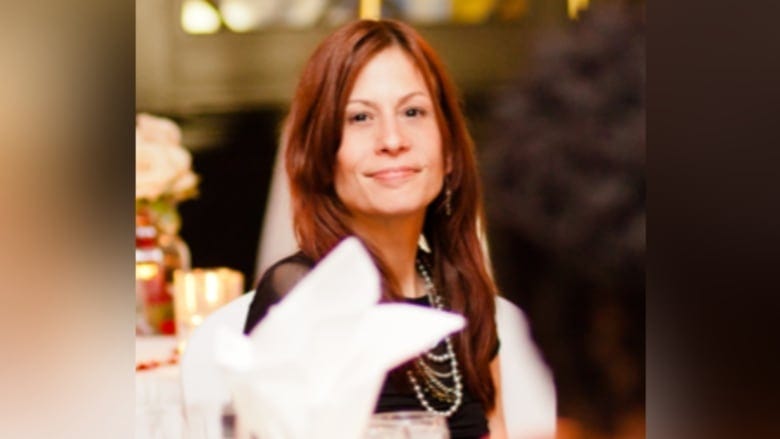
This is where the first piece of anti-science takes place. A population whipped up into a frenzy about Covid is on high-alert. They have been convinced that touching a parcel which hasn’t been quarantined for at least 72 hours, is likely to be riddled with the new virus and will cause them to die. Therefore, anyone with a cough is a walking weapon.
Due to Stephanie’s cough she was assumed to be COVID positive – anti-science mistake no.1. She was therefore placed in the Covid ward. Later, after testing it was found that she was in fact negative.
After a night in hospital, Stephanie left the Covid ward to go and get some food. Sitting in the hospital lobby she committed the terrible anti-science crime of wearing her mask around her neck.
Anti-science mistake no.2. People have been told that useless masks will stop people transmitting a virus. There’s no need to go into the science of it but let’s put it this way, an asbestos removal man doesn’t wear a loose piece of cloth to stop him getting lung cancer.
This was in 2020, before vaccines, so people couldn’t release their pent up fear by getting aggressive with the vaccine hesitant. Instead this pressure-release valve was opened up on the maskless.
At 6.38 a.m. a nurse and a security guard approach Stephanie and are seen talking to her. Another security guard and another member of staff are close behind. Remember Stephanie has her mask on her chin so is extremely dangerous, four people are required.
In the video, it seems like the nurse is angrily telling Stephanie something, to which Stephanie stands up, gently pushes the nurse and tries to walk off. The nurse then bundles her against a wall and the security guard assists.
At this point, the CCTV operator turns the camera away from the scene. Moments later, at 6:41, the video captures a motionless Stephanie being wheeled away from the scene by the pair that bundled her into the wall. Her feet drag along the floor showing that she is clearly unconscious.
As CBC News reports, much of this information has been subject to a publication ban until now. The reason being that the case has now been quashed and the Crown won’t appeal.
That’s despite the available video footage, two security staff who testified the accused placed weight on her upper body while she was held chest down, a forensic pathologist who testified Warriner would still be alive had she not been restrained that day — and revelations one of the guards admitted he falsely claimed Warriner threw the first punch.
Toronto criminal lawyer, Frank Addario, said “to see a judge decide to quash a case in this way is rare”. ”It’s not common for a judge to screen out a case before it’s set for trial… The system is set up so after a preliminary inquiry, the cases are generally sent on to trial because the bar to get a case sent on to trial is very low.”
There was no CCTV footage of the incident because the guard in charge of the camera “panicked” and “got really anxious”, so panned away.
The nurse claimed she took Warriner to the wall “as a last resort, after extensive efforts to verbally de-escalate an aggressive patient”. However, the nurse’s supervisor testified that he felt her actions were wrong.
Two eye witnesses said that 125-pound Stephanie was held down by her upper body despite training and policies warning not to. Both guards claimed this was because Stephanie repeatedly assaulted the nurse but during an internal investigation this turned out to be false. The guard said Stephanie punched the nurse’s face and was kicking but after being confronted with footage he sobbed “I’m sorry. I would have never said the things I said in there if I knew there was a video”. Got to love genuine remorse.
A coroner’s report would conclude Warriner died from a brain injury resulting from a lack of oxygen “due to restraint asphyxia following struggle and exertion,” with her underlying lung disease a possible factor.
Disgusting behaviour.
Tragically, Stephanie lost her life because of anti-science. Anti-science, together with fear, made people believe that the world would end if a piece of cloth was not worn on one’s face correctly. It also gave the power-hungry an excuse to target people who were just minding their own business.
And it seems anti-science is playing its part in the justice system as well. Whilst we don’t know all of the facts that made the Judge quash the case, the CBC article hints at this not being normal. The Judge even noted that “there is evidence that death could have been the culmination of the factors he [the forensic pathologist] described”.
Anti-science killed a lot of people over the last few years and this is just one, tragic and specific example of that.
Fortunately, with enough data analysis and push back, the anti-science was shown for what it truly was. Otherwise, tragic stories, such as Stephanie’s, would still be happening today (maybe they still are but hopefully to a lesser extent).
Featured Video

Daniel Davis: China & Russia Will Defend Iran
or go to
Aletho News Archives – Video-Images
From the Archives
Sugar: Killing us Sweetly
Staggering Health Consequences of Sugar on Health of Americans
By Dr. Gary Null | Global Research | February 3, 2014
In September 2013, a bombshell report from Credit Suisse’s Research Institute brought into sharp focus the staggering health consequences of sugar on the health of Americans. The group revealed that approximately “30%–40% of healthcare expenditures in the USA go to help address issues that are closely tied to the excess consumption of sugar.”[1]The figures suggest that our national addiction to sugar runs us an incredible $1 trillion in healthcare costs each year. The Credit Suisse report highlighted several health conditions including coronary heart diseases, type II diabetes and metabolic syndrome, which numerous studies have linked to excessive sugar intake.[2]
Just a year earlier in 2012, a report by Dr. Sanjay Gupta appearing on 60 Minutes featured the work of Dr. Robert Lustig, an endocrinologist from California who gained national attention after a lecture he gave titled “Sugar: The Bitter Truth” went viral in 2009. Lustig’s research has investigated the connection between sugar consumption and the poor health of the American people. He has published twelve articles in peer-reviewed journals identifying sugar as a major factor in the epidemic of degenerative disease that now afflicts our country. The data compiled by Lustig clearly show how excessive sugar consumption plays a key role in the development of many types of cancer, obesity, type II diabetes, hypertension, and heart disease. His research has led him to conclude that 75% of all diseases in America today are brought on by the American lifestyle and are entirely preventable.[3]
Until the airing of this program, no one in the “official” world acknowledged anything wrong with sugar, here is a sampling of some the latest research available to them if they chose to look… continue
Blog Roll
 Aletho News
- Lebanon: Between sovereignty and the mirage of normalization
- Ukraine Given $43Bln in Proceeds From Russian Assets Frozen by G7 Since 2024 – Estimates
- The military is babying F-35s to hide their true cost to taxpayers
- Ukrainian military analyst praises use of drones against ‘Russian-Hungarian-Slovak friendship’
- Von der Leyen warns Hungary: We have ways of making you talk
- EU manipulating polls in bid to oust Orban – German opposition leader
- Daniel Davis: China & Russia Will Defend Iran
- The US’ self-directed ‘China nuclear threat’ will only be a waste of effort: Global Times editorial
- Female Iranian academic sentenced to 4 years in prison in France over protesting Israel’s genocide in Gaza
- US university cancels Palestine conference citing sanctions concerns
- If Americans Knew
- Israeli leaders want to buy global legitimacy – Not a ceasefire Day 140
- Israel warns of a Ramadan escalation — while doing everything to provoke one
- Democrats Should Release Their 2024 Election Autopsy – and Stop the Gaza Denial
- Israel responsible for 2/3 of press killings worldwide – Not a ceasefire Day 139
- Are the Jews indigenous to Palestine?
- AIPAC Wants to Kill a Bill that would Ensure Israel Complies with Ceasefire
- Former Israeli PM, in Epstein Files, Dreamed of Israeli Eugenics and Pretty Converts
- Israeli settlers join ‘safari’ tour of Palestinian prisoners
- Flooding in Gaza amid rumors of war; fire in West Bank – Not a ceasefire Day 138
- Fourteen Countries Condemn Huckabee’s Support for Israel Taking Over Most of the Middle East
- No Tricks Zone
- Surprising Discovery: Sahara Is Greening…Billions Of Trees Where Once Thought To Be Barren
- New Research Reaffirms Clouds, Aerosols, And Surface Solar Radiation Are ‘Driving The Climate System’
- Germany: Electric Car Catches Fire At Charging Station, Sets Off Local “Inferno”, Widespread Damage
- New Study: Canada’s New Brunswick Was 1°C Warmer Than Today During The Medieval Warm Period
- Coal Power Back In Trend As Globe Tries To Keep Pace With Growing Demand For Power
- New Study: A 4°C Warmer Beaufort Sea Had ‘No Sea Ice’ 11,700 – 8200 Years Ago
- Unfudging The Data: Dutch Meteorological Institute Reinstates Early 20th Centruy Heat Waves It Had Erased Earlier
- German Gas Crisis…Chancellor Merz Allegedly Bans Gas Debate Ahead of Elections!
- Pollen Reconstructions Show The Last Glacial’s Warming Events Were Global, 10x Greater Than Modern
- Germany’s Natural Gas Storage Level Dwindles To Just 28%… Increasingly Critical
 Aletho News