Polar Bear Numbers Could Have Quadrupled
Researcher says attempts to silence her have failed
Climate Depot | March 20, 2019
Polar bear numbers could easily exceed 40,000, up from a low point of 10,000 or fewer in the 1960s.
In The Polar Bear Catastrophe that Never Happened, a book published today by the Global Warming Policy Foundation (GWPF), Dr Susan Crockford uses the latest data as well as revisiting some of the absurd values used in official estimates, and concludes that polar bears are actually thriving:
“My scientific estimates make perfect sense and they tally with what the Inuit and other Arctic residents are seeing on the ground. Almost everywhere polar bears come into contact with people, they are much more common than they used to be. It’s a wonderful conservation success story.”
Crockford also describes how, despite the good news, polar bear specialists have consistently tried to low-ball polar bear population figures.
They have also engaged in a relentless smear campaign in an attempt to silence her in order to protect the story of a polar bear catastrophe, and the funding that comes with it.
“A few unscrupulous people have been trying to destroy my reputation”, she says. “But the facts are against them, and they have failed”.
The Polar Bear Catastrophe that Never Happened — published by the Global Warming Policy Foundation

Available in paperback
or Kindle ebook
About the book
The Polar Bear Catastrophe That Never Happened explains why the catastrophic decline in polar bear numbers we were promised in 2007 failed to materialize. It’s the story of how and why the polar bear came to be considered ‘Threatened’ with extinction, and tracks its rise and fall as an icon of the global warming movement. The book also tells the story of Crockford’s role in bringing that failure to public attention and the backlash against her that ensued – and why, among all others who have attempted to do so previously, she was uniquely positioned to do so. In general, this is a cautionary tale of scientific hubris and of scientific failure, of researchers staking their careers on untested computer simulations and later obfuscating inconvenient facts.For the first time, you’ll see a frank and detailed account of attempts by scientists to conceal population growth as numbers rose from an historical low in the 1960s to the astonishing highs that surely must exist after almost 50 years of protection from overhunting. There is also a blunt account of what truly abundant populations of bears mean for the millions of people who live and work in areas of the Arctic inhabited by polar bears.
About the author
Dr Susan Crockford is an evolutionary biologist and has been working for 35 years in archaeozoology, paleozoology and forensic zoology. She is an adjunct professor at the University of Victoria, British Columbia, but works full time for a private consulting company she co-owns (Pacific Identifications Inc). Susan Crockford blogs at www.polarbearscience.com
The Polar Bear Catastrophe That Never Happened is now for sale
Venezuela’s Electric Grid Was Attacked From Abroad: Russia
teleSUR | March 15, 2019
Russia’s Foreign Ministry spokeswoman Maria Zakharova said Friday her country considers that Venezuela’s blackout was due to a cyber attack from abroad, the same version provided by the Venezuelan government for the massive loss of electric services across most of the country for five days.
“According to the country’s legitimate government headed by President Nicolas Maduro, as well as to information from other credible sources, Venezuela’s power grid was attacked from abroad,” Zakharova said and pointed out that “it was an attempt to remotely influence control systems at major electrical substations where Canadian-made equipment is installed.”
Last week Maduro denounced that the Venezuelan opposition and its United State allies were behind the blackout, which began Thursday, Feb. 7 and caused multiple damages for the Bolivarian country.
Foreign Ministry spokeswoman also said that Russia could investigate the cyber attack.
“If we receive an official request for expert assistance, we will give it proper attention,” Zakharova said in relation to a recent statement by President Maduro’s through which he announced that his country will ask Russia, China, Iran and Cuba to assist in investigating the attack on the electricity grid.
In addition, the Russian senior diplomat said the perpetrators of this aggression against the Venezuelan people are fully responsible for the deaths the blackout caused as many hospitals were left without electricity.
“We hope that this responsibility will sooner or later take the form of a court ruling,” Zakharova stated, as reported by Sputnik.
‘Unhinged Russophobia’: Moscow slams new barrage of US & Canada sanctions over Kerch standoff
RT | March 16, 2019
The Russian Foreign Ministry has vowed retaliation to the new portion of economic sanctions rolled out by Washington and Ottawa over the November showdown near Crimean shores.
The ministry has called “groundless” the allegations by the US and Canadian governments that Russia was the aggressor in the November 25 incident in the Black Sea, when three Ukrainian warships sailed into Russian territorial waters.
Moscow said that the Ukrainian vessels had not obtained proper permits to cross the strait and ignored repeated warnings by the Russian coast guard to stop when they entered the Russian waters near Crimea. Three Ukrainian sailors were injured in the standoff, and a total of 24 Ukrainian personnel were detained and put on trial in Russia for violating Russian state borders.
The ships were later found to be armed and were reportedly intended on crossing the waterway that separates mainland Russia from Crimea in a “stealthy” manner.
On Friday, Washington imposed sanctions on six businessmen and politicians and eight enterprises, while Ottawa slapped economic restrictions on 114 individuals and 15 entities. The ministry specifically took aim at Canada for racing to keep up with the US’ Russia-bashing.
“It seems that from a normal logic standpoint, it would be more important for [Canadian Prime Minister Justin] Trudeau’s team to concentrate on resolving rather complex problems at home, than play its ‘Russophobia card’ in vain.”
Both US and Canada continue to follow a “perilous course” aimed at a “total destruction” of relations with Russia, already at rock bottom due to “unhinged Russophobia that has engulfed Washington and Ottawa,” the ministry said.
Moscow has vowed to mount a “practical response” to the new sanctions.
Shipyards based in St. Petersburg and Crimea and Russian officials that were responding to the incident in the Kerch Strait were among those included in Washington’s black list. Canada also targeted prominent Russian politicians and business executives, such as the head of the Russian oil giant Rosneft, Igor Sechin, and the head of the National Guard, Victor Zolotov.
Oleg Deripaska, Russian aluminum tycoon, sanctioned by the US last year, is meanwhile taking the US government to court arguing that the restrictions were based “on false rumor and innuendo” and violated the US constitution.
Deripaska was forced to lower his stake in the aluminum giant Rusal to spare it from sanctions, but sanctions targeting him personally remain in place.
SNC Lavalin the corporate face of Ugly Canadian
By Yves Engler · March 11, 2019
While the Justin Trudeau government’s interference in the prosecution of SNC Lavalin highlights corporate influence over politics, it is also a story about a firm at the centre of Canadian foreign policy.
In a recent story titled “Canada’s Corrupt Foreign Policy Comes Home to Roost” I detailed some of SNC’s controversial international undertakings, corruption and government support. But, there’s a great deal more to say about the global behemoth.
“With offices and operations in over 160 countries”, the company has long been the corporate face of this country’s foreign policy. In fact, it is not much of an exaggeration to describe some Canadian diplomatic posts as PR arms for the Montréal-based firm. What’s good for SNC has been defined as good for Canada.
Even as evidence of its extensive bribery began seeping out six years ago, SNC continued to receive diplomatic support and rich government contracts. Since then the Crown Corporation Export Development Canada issued SNC or its international customers at least $800-million in loans; SNC and a partner were awarded part of a contract worth up to $400 million to manage Canadian Forces bases abroad; Canada’s aid agency profiled a venture SNC co-led to curb pollution in Vietnam; Canada’s High Commissioner Gérard Latulippe and Canadian Commercial Corporation vice president Mariette Fyfe-Fortin sought “to arrange an untendered, closed-door” contract for SNC to build a $163-million hospital complex in Trinidad and Tobago.
Ottawa’s support for SNC despite corruption allegations in 15 countries is not altogether surprising since the company has proven to be a loyal foot soldier fighting for controversial foreign policy decisions under both Liberal and Conservative governments.
SNC’s nuclear division participated in a delegation to India led by International Trade Minister Stockwell Day a few months after Ottawa signed a 2008 agreement to export nuclear reactors to India, even though New Delhi refused to sign the Nuclear non-Proliferation Treaty (India developed atomic weapons with Canadian technology). Describing it as the “biggest private contractor to [the] Canadian mission” in Afghanistan, the Ottawa Citizen referred to SNC in 2007 as “an indispensable part of Canada’s war effort.” In Haiti SNC participated in a Francophonie Business Forum trip seven months after the US, Canada and France overthrew the country’s elected President Jean-Bertrand Aristide. Amidst the coup government’s vast political repression, the Montreal firm met foreign installed prime minister Gérard Latortue and thecompany received a series of Canadian government funded contracts in Haiti.
SNC certainly does not shy away from ethically dubious business. For years it manufactured grenades for the Canadian military and others at its plant in Le Gardeur, Quebec. According to its website, SNC opened an office in Johannesburg, South Africa, in 1982 amidst the international campaign to boycott the apartheid regime. Later that decade SNC worked on the Canadian government funded Manantali Dam, which led to “economic ruin, malnutrition and disease to hundreds of thousands of West African farmers.”
More recently, SNC has been part of numerous controversial mining projects in Africa. It had a major stake in a Sherritt-led consortium that initiated one of the world’s largest nickel and cobalt mines in Ambatovy Madagascar. Backed by Canadian diplomats and Export Development Canada, the gigantic open pit mine tore up more than 1,300 acres of biologically rich rain forest home to a thousand species of flowering plants, fourteen species of lemurs and a hundred types of frogs.
According to West Africa Leaks, SNC dodged its tax obligations in Senegal. With no construction equipment or office of its own, SNC created a shell company in Mauritius to avoid paying tax. Senegal missed out on $8.9 million the Montréal firm should have paid the country because its ‘office’ was listed in tax free Mauritius. SNC has subsidiaries in low tax jurisdictions Jersey and Panama and the company was cited in the “Panama Papers” leak of offshore accounts for making a $22 million payment to a British Virgin Islands-based firm to secure contracts in Algeria. (In a case of the tax-avoiding fox protecting the public’s hen house, former SNC president and chairman of the board, Guy Saint-Pierre, was appointed to Conservative Finance Minister Jim Flaherty’s 2007 advisory panel on Canada’s System of International Taxation.)
SNC has benefited from Ottawa’s international push for neoliberal reforms and Canada’s power within the World Bank. A strong proponent of neoliberalism, the Montréal firm has worked on and promoted privatizing water services in a number of countries. Alongside Global Affairs Canada, SNC promotes the idea that the public cannot build, operate or manage services and that the way forward is through Public-Private Partnerships (PPPs), which often go beyond a standard design-and-build-construction contract to include private sector participation in service operation, financing and decision making. SNC is represented on the Canadian Council for Public-Private Partnerships, which promotes PPPs globally. The Montréal firm has also sponsored many pro-privatization forums.With Rio Tinto, Alcan, Teck Resources and the Canadian International Development Agency, SNC funded and presented at a 2012 conference at McGill University on Public-Private Partnerships for Sustainable Development: Towards a Framework for Resource Extraction Industries.
In an embarrassing comment on the PPP lobby, the year before SNC was charged with paying $22.5 million in bribes to gain the contract to build the McGill University Health Centre (MUHC) the Canadian Council for Public-Private Partnerships and Thomson Reuters both awarded the MUHC project a prize for best PPP.
Further proof that in the corporate world what is good for SNC is seen as good for Canada, the Canadian Institute of Chartered Accountants gave SNC its award for excellence in corporate governance in seven of the ten years before the company’s corruption received widespread attention.
In an indication of the impunity that reigns in the corporate world, the directors that oversaw SNC’s global corruption have faced little sanction. After the corruption scandal was revealed board chairman Gwyn Morgan, founder of EnCana, continued to write a regular column for the Globe and Mail Report on Business (currently Financial Post) and continues his membership in the Order of Canada. Ditto for another long serving SNC director who is also a member of the Order of Canada. In fact, Conservative Senator Hugh Segal was subsequently made a member of the Order of Ontario. Another Order of Canada and Order of Ontario member on SNC’s board, Lorna Marsden, also maintained her awards. Other long serving board members — Claude Mongeau, Pierre Lessard, Dee Marcoux, Lawrence Stevenson and David Goldman – received corporate positions and awards after overseeing SNC’s corruption.
The corporate face of this country’s foreign policy is not pretty. While Trudeau’s SNC scandal highlights corporate influence over politics, it’s also the story of the Ugly Canadian abroad.
Understanding How Canadian Diplomats Shape the News
By Yves Engler | Dissident Voice | March 3, 2019
Canadian diplomats abroad seek to shape coverage of their work. And the more nefarious their actions the harder they toil to “spin” what they’re doing as something positive.
During a recent interview Real News Network founder Paul Jay described how Canadian officials in Caracas attempted to shape his views of the country’s politics. Jay noted:
My first trip to Venezuela in 2004, I was producing the big debate show on Canadian TV called Counterspin on CBC Newsworld. … . I was a known quantity in Canada. And so when I was in Venezuela, I said I’ll go say hello to the Canadian embassy. I was trying to figure out what was going on in Venezuela. I figured some Counselor would pat me on the head and say welcome to Venezuela.
No, I got the number two chargé d’affaires that greeted me and brings me into a meeting room with seven members of the opposition who then for two hours beat me over the head with how corrupt the regime was, how awful it was, and so on…
What business does a Canadian embassy have with bringing a Canadian journalist into a room with opposition people, essentially trying to involve me in a conspiracy against the Venezuelan government. Canadian government role in Venezuela was promote and nurture the opposition.
Around the same time Canadian officials sought to convince Jay that Hugo Chavez’s government was corrupt, former Montréal Gazette reporter Sue Montgomery had a similar experience in Port-au-Prince. In “Parachute Journalism in Haiti: Media Sourcing in the 2003-2004 Political Crisis”, Isabel Macdonald writes:
Montgomery recalled being given anti-[President Jean-Bertrand] Aristide disinformation when she called the Canadian embassy immediately after she had been held up by armed men while driving through Port-au-Prince days before the [US/France/Canada] coup. Canada’s ambassador to Haiti, Kenneth Cook, told her, ‘We’ve got word that Aristide has given the order to the chimeres [purported pro- Aristide thugs] to do this kind of thing to international journalists because he’s not getting any support.’ According to Montgomery, Cook had urged her to tell the other international journalists who were staying at the same hotel: ‘I think you should let all your colleagues at the Montana know that it’s not safe for them.’
Given only two days to prepare for her assignment, Montgomery was ripe for official manipulation. Though she later realized the ambassador’s claim was ridiculous, Montgomery told other journalists at Hotel Montana (where most international journalists stay in Port-au-Prince) that Aristide’s supporters were targeting them.
The Canadian embassy in Port-au-Prince succeeded in influencing Canadian reporters’ coverage of the country. In her MA thesis titled “Covering the coup: Canadian news reporting, journalists, and sources in the 2004 Haiti crisis,” Isabel Macdonald concludes that the reporters dispatched to Port-au-Prince largely took their cues from official Canada. “My interviews revealed that journalists’ contacts with people working in the Canadian foreign policy establishment appear to have played a particularly important role in helping journalists to identify appropriate ‘legitimate’ sources.”
CBC reporter Neil MacDonald told Isabel MacDonald his most trusted sources for background information in Haiti came from Canadian diplomatic circles, notably the Canadian International Development Agency where his cousins worked. MacDonald also said he consulted the Canadian Ambassador in Port-au-Prince to determine the most credible human rights advocate in Haiti. Ambassador Cook directed him to Pierre Espérance, a coup backer who fabricated a “massacre” used to justify imprisoning the constitutional prime minister and interior minister. (When pressed for physical evidence Espérance actually said the 50 bodies “might have been eaten by wild dogs.”)
Almost all Canadian correspondents develop ties to diplomats in the field. Long-time Globe and Mail development reporter John Stackhouse acknowledges “Canadian political officers” in Indonesia for their “valuable insights” into the country during General Suharto’s rule. In Out of Poverty, Stackhouse also thanks “the Canadian diplomatic missions in Accra, Abidjan and Bamako [for their] … invaluable service in arranging interviews and field trips.” During a period in the mid-2000s when she wrote for the Globe and Mail and CBC, Madeleine Drohan conducted media workshops in Zambia, Tanzania, Kenya and elsewhere sponsored by the Canadian embassy, High Commission and Foreign Affairs (she taught journalist ethics!).
“One of the best Canadian foreign correspondents of the 1970s,” Jack Cahill discusses some ways diplomats relate to reporters in If You Don’t Like the War, Switch the Damn Thing Off!: The Adventures of a Foreign Correspondent. “The Canadian government”, the former Toronto Star reporter notes, “can be good to foreign correspondents if it thinks they are reliable and I had two passports, one for general purposes and one for difficult countries.”
In what may reflect his nationalism, Cahill dubs Canadian diplomats “more reliable” than their southern counterparts. Disparaging his US colleagues, he writes:
There is little doubt, however, that some US foreign correspondents depend almost entirely on their embassies, and thus indirectly the CIA, for their information. It is, after all, the natural thing to be attracted to the truth as propounded by one’s own countrymen in the Embassy offices, at the official briefings, and on the cocktail circuit. It’s this information, with its American slant on world affairs, that eventually fills much of Canada’s and the Western world’s news space.
Jay described his experience at the Embassy in Caracas mostly to highlight Canada’s long-standing hostility to the Hugo Chavez/Nicolas Maduro governments. But, his story also helps make sense of the dominant media’s alignment with Ottawa’s push for regime change in Venezuela today.
Globe and Mail Latin America correspondent Stephanie Nolen, for instance, promotes Canada’s last ambassador to Venezuela. Describing Ben Rowswell as “widely respected by Venezuelans while he was there”, Nolen recently retweeted Rowswell claiming: “the coup happened in July 2017 when Maduro suspended the constitution. The question now is how to fill the void – by backing the president who uses force to remain in power after his term expires, or the leader of Venezuela’s last remaining democratically elected body?” Rowswell has been quoted in at least a half dozen Globe and Mail articles about Venezuela in recent weeks.
Diplomats’ influence over international correspondents is one way the foreign policy establishment shapes discussion of Canadian foreign policy.
Canadian military in Haiti. Why?
By Yves Engler · February 22, 2019
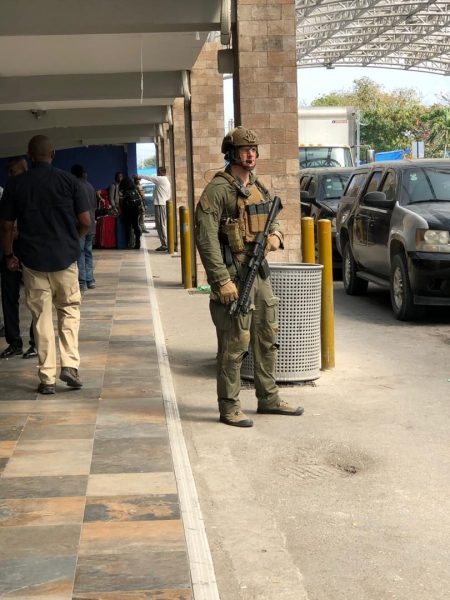 Canadian troops may have recently been deployed to Haiti, even though the government has not asked Parliament or consulted the public for approval to send soldiers to that country.
Last week the Haiti Information Project photographed heavily-armed Canadian troops patrolling the Port-au-Prince airport. According to a knowledgeable source I emailed the photos to, they were probably special forces. The individual in “uniform is (most likely) a member of the Canadian Special Operations Regiment (CSOR) from Petawawa”, wrote the person who asked not to be named. “The plainclothes individuals are most likely members of JTF2. The uniformed individual could also be JTF2 but at times both JTF2 and CSOR work together.” (CSOR is a sort of farm team for the ultra-elite Joint Task Force 2.)
What was the purpose of their mission? The Haiti Information Project reported that they may have helped family members of President Jovenel Moïse’s unpopular government flee the country. HIP tweeted, “troops & plainclothes from Canada providing security at Toussaint Louverture airport in Port-au-Prince today as cars from Haiti’s National Palace also drop off PHTK govt official’s family to leave the country today.”
Many Haitians would no doubt want to be informed if their government authorized this breach of sovereignty. And Canadians should be interested to know if Ottawa deployed the troops without parliamentary or official Haitian government okay. As well any form of Canadian military support for a highly unpopular foreign government should be controversial.
Two days after Canadian troops were spotted at the airport five heavily armed former US soldiers were arrested. The next day the five Americans and two Serbian colleagues flew to the US where they will not face charges. One of them, former Navy SEAL Chris Osman, posted on Instagram that he provided security “for people who are directly connected to the current President” of Haiti. Presumably, the mercenaries were hired to squelch the protests that have paralyzed urban life in the country. Dozens of anti-government protesters and individuals living in neighborhoods viewed as hostile to the government have been killed as calls for the president to step down have grown in recent months.
Was the Canadian deployment in any way connected to the US mercenaries? While it may seem far-fetched, it’s not impossible considering the politically charged nature of recent deployments to Haiti.
After a deadly earthquake rocked Haiti in 2010 two thousand Canadian troops were deployed while several Heavy Urban Search Rescue Teams were readied but never sent. According to an internal file uncovered through an access to information request, Canadian officials worried that “political fragility has increased the risks of a popular uprising, and has fed the rumour that ex-president Jean-Bertrand Aristide, currently in exile in South Africa, wants to organize a return to power.” The government documents also explain the importance of strengthening the Haitian authorities’ ability “to contain the risks of a popular uprising.”
The night president Aristide says he was “kidnapped” by US Marines JTF2 soldiers “secured” the airport. According to Agence France Presse, “about 30 Canadian special forces soldiers secured the airport on Sunday [Feb. 29, 2004] and two sharpshooters positioned themselves on the top of the control tower.” Reportedly, the elite fighting force entered Port-au-Prince five days earlier ostensibly to protect the embassy.
Over the past 25 years Liberal and Conservative governments have expanded the secretive Canadian special forces. In 2006 the military launched the Canadian Special Operations Forces Command (CANSOFCOM) to oversee JTF2, the Special Operations Regiment, Special Operations Aviation Squadron and Canadian Joint Incident Response Unit.
CANSOFCOM’s exact size and budget aren’t public information. It also bypasses standard procurement rules and their purchases are officially secret.While the Canadian Security Intelligence Service (CSIS), Communications Security Establishment and other government agencies face at least nominal oversight, CANSOFCOM does not.
During a 2006 Senate Defence Committee meeting CANSOFCOM Commander Colonel David E. Barr responded by saying, “I do not believe there is a requirement for independent evaluation. I believe there is sufficient oversight within the Canadian Forces and to the people of Canada through the Government of Canada — the minister, the cabinet and the Prime Minister.”
The commander of CANSOFCOM simply reports to the defence minister and PM.
“Even the U.S. President does not possess such arbitrary power,” notes Michael Skinner in a CCPA Monitor story titled “Canada’s Ongoing Involvement in Dirty Wars.”
This secrecy is an important part of their perceived utility by governments. “Deniability” is central to the appeal of special forces, noted Major B. J. Brister. The government is not required to divulge information about their operations so Ottawa can deploy them on controversial missions and the public is none the wiser. A 2006 Senate Committee on National Security and Defence complained their operations are “shrouded in secrecy”. The Senate Committee report explained, “extraordinary units are called upon to do extraordinary things … But they must not mandate themselves or be mandated to any role that Canadian citizens would find reprehensible. While the Committee has no evidence that JTF2 personnel have behaved in such a manner, the secrecy that surrounds the unit is so pervasive that the Committee cannot help but wonder whether JTF2’s activities are properly scrutinized.” Employing stronger language, right wing Toronto Sun columnist Peter Worthington pointed out that, “a secret army within the army is anathema to democracy.”
If Canadian special forces were secretly sent to Port-au-Prince to support an unpopular Haitian government Justin Trudeau’s government should be criticized not only for its hostility to the democratic will in that country but also for its indifference to Canadian democracy.
Canadian policy on Venezuela, Haiti reveals hypocrisy that media ignores
By Yves Engler · February 19, 2019
If the dominant media was serious about holding the Canadian government to account for its foreign policy decisions, there would be numerous stories pointing out the hypocrisy of Ottawa’s response to recent political developments in Haiti and Venezuela.
Instead silence, or worse, cheer-leading.
Venezuela is a deeply divided society. Maybe a quarter of Venezuelans want the president removed by (almost) any means. A similar proportion backs Nicolas Maduro. A larger share of the population oscillates between these two poles, though they generally prefer the president to opposition forces that support economic sanctions and a possible invasion.
There are many legitimate criticisms of Maduro, including questions about his electoral bonafides after a presidential recall referendum was scuttled and the Constituent Assembly usurped the power of the opposition dominated National Assembly (of course many opposition actors’ democratic credentials are far more tainted). But, the presidential election in May demonstrates that Maduro and his PSUV party maintain considerable support. Despite the opposition boycott, the turnout was over 40% and Maduro received a higher proportion of the overall vote than leaders in the US, Canada and elsewhere. Additionally, Venezuela has an efficient and transparent electoral system — “best in the world” according to Jimmy Carter in 2012 — and it was the government that requested more international electoral observers.
Unlike Venezuela, Haiti is not divided. Basically, everyone wants the current “president” to go. While the slums have made that clear for months, important segments of the establishment (Reginald Boulos, Youri Latortue, Chamber of Commerce, etc) have turned on Jovenel Moïse. Reliable polling is limited, but it’s possible 9 in 10 Haitians want President Moïse to leave immediately. Many of them are strongly committed to that view, which is why the country’s urban areas have been largely paralyzed since February 7.
In a bid to squelch the protests, government forces (and their allies) have killed dozens in recent months. If you include the terrible massacre reported here and here in the Port-au-Prince neighborhood of La Saline on November 11-13 that number rises far above 100.
Even prior to recent protests the president’s claim to legitimacy was paper-thin. Moïse assumed the job through voter suppression and electoral fraud. Voter turnout was 18%. His predecessor and sponsor, Michel Martelly, only held elections after significant protests. For his part, Martelly took office with about 16 per cent of the vote, since the election was largely boycotted. After the first round, US and Canadian representatives pressured the electoral council to replace the second-place candidate, Jude Celestin, with Martelly in the runoff.
While you won’t have read about it in the mainstream media, recent protests in Haiti are connected to Venezuela. The protesters’ main demand is accountability for the billions of dollars pilfered from Petrocaribe, a discounted oil program set up by Venezuela in 2006. In the summer demonstrators forced out Moïse’s prime minister over an effort to eliminate fuel subsidies and calls for the president to go have swelled since then. Adding to popular disgust with Moïse, his government succumbed to US/Canadian pressure to vote against Venezuela at the OAS last month.
So what has been Ottawa’s response to the popular protests in Haiti? Has Global Affairs Canada released a statement supporting the will of the people? Has Canada built a regional coalition to remove the president? Has Canada’s PM called other international leaders to lobby them to join his effort to remove Haiti’s President? Have they made a major aid announcement designed to elicit regime change? Have they asked the International Criminal Court to investigate the Haitian government? Has Justin Trudeau called the Haitian President a “brutal dictator”?
In fact, it’s the exact opposite to the situation in Venezuela. The only reason the Haitian president is hanging on is because of support from the so-called “Core Group” of “Friends of Haiti”. Comprising the ambassadors of Canada, France, Brazil, Germany and the US, as well as representatives of Spain, EU and OAS, the “Core Group” released a statement last week “acknowledging the professionalism shown by the Haitian National Police.” The statement condescendingly “reiterated the fact that in a democracy change must come through the ballot box, and not through violence.” The “Core Group’s” previous responses to the protests expressed stronger support of the unpopular government. As I detailed 10 weeks ago in a story headlined “Canada backs Haitian government, even as police force kills demonstrators”, Ottawa has provided countless forms of support to Moïse’s unpopular government. Since then Justin Trudeau had a “very productive meeting” with Haitian Prime Minister Jean Henry Ceant, International development minister Marie-Claude Bibeau declared a desire to “come to the aid” of the Haitian government and Global Affairs Canada released a statement declaring that “acts of political violence have no place in the democratic process.” Trudeau’s government has provided various forms of support to the repressive police that maintains Moïse’s rule. Since Paul Martin’s Liberals played an important role in violently ousting Jean-Bertrand Aristide’s government in 2004 Canada has financed, trained and overseen the Haitian National Police. As took place the night Aristide was forced out of the country by US Marines, Canadian troops were recently photographed patrolling the Port-au-Prince airport.
Taking their cue from Ottawa, the dominant media have downplayed the scope of the recent protests and repression in Haiti. There have been few (any?) stories about protesters putting their bodies on the line for freedom and the greater good. Instead the media has focused on the difficulties faced by a small number of Canadian tourists, missionaries and aid workers. While the long-impoverished country of 12 million people is going through a very important political moment, Canada’s racist/nationalist media is engrossed in the plight of Canucks stuck at an all-inclusive resort!
The incredible hypocrisy in Ottawa’s response to recent political developments in Haiti and Venezuela is shameful. Why has no major media dared contrast the two?
Mainstream media boosts Trudeau’s popularity over Venezuela
By Yves Engler · February 13, 2019
US presidents have bombed or invaded places like Grenada, Panama, Iraq and Sudan to distract from domestic scandals or to gain a quick boost in popularity. But, do Canadian politicians also pursue regime change abroad to be cheered on by the dominant media as decisive leaders?
In a discussion on regime change in Venezuela after last Monday’s “Lima Group” meeting in Ottawa, Conservative foreign affairs critic Erin O’Toole praised Canadian policy but added that the Liberals used the meeting of countries opposed to Nicolas Maduro’s government to drown out criticism of their foreign policy. O’Toole claimed the “Lima Group” meeting was “put together quite quickly and I think there are some politics behind that with some of the foreign affairs challenges the Trudeau government has been having in recent months.” In other words, O’Toole believes the Liberals organized a gathering that concluded with a call for the military to oust Venezuela’s elected president to appear like effective international players.
Understood within the broader corporate and geopolitical context, O’Toole’s assessment appears reasonable. After being criticized for its China policy, the Liberals have been widely praised for their regime change efforts in Venezuela. In a sign of media cheerleading, CTV News host Don Martin began his post “Lima Group” interview with foreign minister Chrystia Freeland by stating “the Lima summit has wrapped and the object of regime change is staying put for the time being” and then he asked her “is [Venezuelan President Nicolas] Maduro any step closer to being kicked out of office as a result of this meeting today?” Later in the interview Martin applauded the “Lima Group’s” bid “to put the economic pincers around it [Venezuela’s economy] and choking it off from international transactions.”
In recent days Ben Rowswell, a former Canadian ambassador in Caracas, has been widely quoted praising the Liberals’ leadership on Venezuela. “It’s clear that the international community is paying attention to what Canada has to say about human rights and democracy,” Rowswell was quoted as saying in an article titled “Trudeau’s Venezuela diplomacy is a bright spot amid China furor”.
Rowswell heads the Canadian International Council, which seeks to “integrate business leaders with the best researchers and public policy leaders”, according to its billionaire financier Jim Balsillie. Long an influential voice on foreign policy, CIC hosted the above-mentioned forum with O’Toole that also included the Liberal’s junior foreign minister Andrew Leslie and NDP foreign affairs critic Hélène Laverdière. CIC’s post “Lima Group” meeting forum was co-sponsored with the Canadian Council of the Americas, which is led by Kinross, Kinross, ScotiaBank, KPMG and SNC Lavalin. On the day of the “Lima Group” meeting CCA head Ken Frankel published an op-ed in the Globe and Mail headlined “Venezuela crisis will be a true test of Canada’s leadership in the hemisphere.” Frankel told CPAC he was “always supportive of Canadian leadership in the Hemisphere” and “the Venezuela situation has presented … a perfect opportunity for the Trudeau government to showcase the principles of its foreign policy.”
At the CCA/CIC forum Laverdière made it clear there’s little official political opposition to Ottawa’s regime change efforts. The NDP’s foreign critic agreed with Canada’s recognition of Juan Guaidó as president of Venezuela, as she did on Twitter, at a press scrum and on CPAC during the day of the “Lima Group” meeting in Ottawa. (Amidst criticism from NDP activists, party leader Jagmeet Singh later equivocated on explicitly recognizing Guaidó.)
With the NDP, Conservatives, CIC, CCA, most media, etc. supporting regime change in Venezuela, there is little downside for the Liberals to push an issue they believe boosts their international brand. To get a sense of their brashness, the day of the “Lima Group” meeting the iconic CN Tower in Toronto was lit up with the colours of the Venezuelan flag. A tweet from Global Affairs Canada explained, “As the sun sets on today’s historic Lima Group meeting, Venezuela’s colours shine bright on Canada’s CN Tower to show our support for the people of Venezuela and their fight for democracy.”
The Liberals drive for regime change in Venezuela to mask other foreign-policy problem is reminiscent of Stephen Harper’s push to bomb Libya. Facing criticism for weakening Canada’s moral reputation and failing to win a seat on the UN Security Council, a Canadian general oversaw NATO’s war, seven CF-18s participated in bombing runs and two Royal Canadian Navy vessels patrolled Libya’s coast.
The mission, which began six weeks before the 2011 federal election, may have helped the Conservatives win a majority government. At the time Postmedia published a story titled “Libya ‘photo op’ gives Harper advantage: experts” and Toronto Star columnist Thomas Walkom published a commentary titled “Libyan war could be a winner for Harper”. He wrote: “War fits with the Conservative storyline of Harper as a strong, decisive leader. War against a notorious villain contradicts opposition charges of Conservative moral bankruptcy. The inevitable media stories of brave Canadian pilots and grateful Libyan rebels can only distract attention from the Conservative government’s real failings.”
Similar to Venezuela today, the regime change effort in Libya was unanimously endorsed in Parliament (three months into the bombing campaign Green Party MP Elizabeth May voted against a second resolution endorsing a continuation of the war). “It’s appropriate for Canada to be a part of this effort to try to stop Gadhafi from attacking his citizens as he has been threatening to do,’’ said NDP leader Jack Layton. After Moammar Gaddafi was savagely killed six months later, NDP interim leader Nycole Turmel released a statement noting, “the future of Libya now belongs to all Libyans. Our troops have done a wonderful job in Libya over the past few months.”
Emboldened by the opposition parties, the Conservatives organized a nationally televised post-war celebration for Canada’s “military heroes”, which included flyovers from a dozen military aircraft. Calling it “a day of honour”, Prime Minister Stephen Harper told the 300 military personnel brought in from four bases: “We are celebrating a great military success.”
Today Libya is, of course, a disaster. It is still divided into various warring factions and hundreds of militias operate in the country of six million.
But who in Canada ever paid a political price for the destruction of that country and resulting destabilization of much of the Sahel region of Africa?
A similar scenario could develop in Venezuela. Canadian politicians’ push for the military to remove the president could easily slide into civil war and pave the way to a foreign invasion that leads to a humanitarian calamity. If that happened, Canadian politicians, as in Libya, would simply wash their hands of the intervention.
Canadians need to reflect on a political culture in which governing parties encourage regime change abroad with an eye to their domestic standing.
Arms purchases by Middle Eastern countries have doubled: Annual security report
Press TV – February 12, 2019
An annual international security report shows that arms sales to the Middle East doubled during the period between 2013 and 2017 compared to the previous five years.
The Munich Security Report 2019, released on Monday, also said the outsize concentration of weapons in the Middle East increased the risk of confrontation in the region.
“Between 2013 and 2017, the value of Middle Eastern countries’ arms purchases doubled compared to the previous five years, thus bearing the risk of an arms race and military confrontation,” it said.
The report did not name the top purchasers of arms, but they are believed to be the Arab countries in the Persian Gulf region, which traditionally allege that they face a “threat” from Iran and use that pretense to buy advanced weapons from eager suppliers mainly in the West.
The report did reveal the exporters, though. It said 53 percent of the total volume of the arms exports to the Middle East originated in the United States. The US was followed by France (11 percent), the United Kingdom (10 percent), and Canada (seven percent).
Italy, Germany, and Turkey were also among the leading exporters, with their share in the total volume of arms sales to the region equaling six percent, three percent, and two percent, respectively.
‘Countries reevaluating relations with Saudi Arabia following Khashoggi murder’
The report also said that “numerous US politicians and governments of other countries are reevaluating their partnership with Saudi Arabia,” following the state murder of dissident journalist Jamal Khashoggi in the Saudi consulate in Istanbul last October and Riyadh’s deadly military campaign in Yemen.
While the US administration has backed the Riyadh regime in both of those cases, other US politicians, including some of the administration’s allies in Congress, have been concerned by Saudi Arabia’s destabilizing role.
“The US Senate even passed a resolution urging the cessation of any military support to countries involved in the [Yemen] war, thus contradicting White House positions,” the report said.
The US administration on Monday threatened to veto any resolution passed in Congress against Saudi Arabia.
Saudi Arabia and a number of its allies launched a devastating military campaign against Yemen in March 2015, claiming that a popular uprising there was backed by Iran, an allegation denied both by the revolutionaries and Tehran.
According to a new report by the Armed Conflict Location and Event Data Project, a nonprofit conflict-research organization, the Saudi-led war has so far claimed the lives of around 56,000 Yemenis.
The United Nations has said that a record 22.2 million Yemenis are in dire need of food, including 8.4 million threatened by severe hunger. According to the world body, Yemen is suffering from the most severe famine in more than 100 years.
The Munich Security Report 2019 also warned of a possible “risk of an accidental clash” between Saudi Arabia, the US, Israel, and Iran in the region, stressing that the confrontation “cannot be discounted.”
The report comes days ahead of the 55th edition of the Munich Security Conference, which is scheduled to take place in the German city of Munich on February 15-17. Heads of state and defense ministers of more than 80 countries from across the globe attend the event every year.
Canada, Israel and the “Rule of Law”
By David Kattenburg | CounterPunch | February 8, 2019
On the ropes for arresting Huawei executive Meng Wanzhau, as US-Canada extradition law required, now under fire, two of its own diplomats held by the vengeful Chinese, and a third Canadian facing execution on drug-smuggling charges, coveted trade relations in peril, Ottawa has been staking out high minded positions.
Few are higher minded — or richer — than that of Liberal MP John McKay, Chair of the Commons Standing Committee on Public Safety and National Security, speaking to CBC news about China and its Canadian captives: “It’s hard to make a trade deal with another country that doesn’t respect the rule of law,” McKay declared.
Canada’s Foreign Affairs Minister, Chrystia Freeland, has been trumpeting a similar line. The rule of law is not a “smorgasbord” to pick and choose from, Freeland said the other day, regarding the China imbroglio.
Really? Although Israel’s West Bank settlements are flagrantly illegal under the most canonical of twentieth century laws, the 4th Geneva Convention (Global Affairs Canada says so at its website) the Canadian government is pleased to do business with settlement businesses (i.e. invest) under the most favourable terms.
To be precise, Israel’s settlement enterprise violates Article 49(6) of the Convention. In Convention lingo, it constitutes a “grave breach.” Article 1 of the Convention obliges State Parties like Canada to hold miscreants accountable for grave breaches. The FGC has been incorporated into Canadian law, as the Geneva Convention Act. Under the Act, grave breaches are subject to prosecution and lengthy imprisonment in Canada. Of course, Canada cuts Israel lots of slack.
Then there’s Article 25 of the UN Charter, obliging member states to uphold and abide by Security Council Resolutions. Several dozen have declared settlements unlawful. UNSC 2334, passed unanimously in December 2016, called on State Parties to “differentiate” in their trade relations between Israel ‘proper’ and the settlements.
Canada does not. Not content simply to ignore calls from the supreme council it dearly wishes to join, the Trudeau government defends Israel’s right to label its settlement goods “Product of Israel” on Canadian store shelves (deep-sixing Canadian consumer protection laws), even though Canada’s formal position is that West Bank settlements are decidedly not part of Israel. In the Trudeau government’s view, Israel’s right to market unlawful, ‘Product of Israel’ settlement wines on Canadian store shelves trumps the right of Canadians to know, truthfully, where the food and drinks they consume come from – not to mention the right to live in a country that upholds international law.
(Full disclosure: I am Applicant in a law case on this issue before the Federal Court of Canada).
Israel appreciates Canada’s subtle endorsement of its de facto annexation strategy. But the annexation of territory acquired by force is strictly prohibited in modern public law. So is the economic exploitation that typically ensues. These prohibitions are “customary” in status. Everyone must abide by them. No exemptions. No excuses.
Tell this to Israel’s staunch friend Justin Trudeau. Quietly, without the fuss generated by Donald Trump’s flashy but symbolic Jerusalem decision, Canadian trade officials have been cleansing legal clauses from the Canada-Israel Free Trade Agreement (CIFTA). A minute provision stipulating that trade will be carried out “in accordance with applicable rules of international law” has been extirpated from the new, improved deal heading for Third Reading and certain passage in the next few weeks.
Invited to reconsider, late last November, Liberal members of the Standing Committee on International Trade refused. An amending line to the new CIFTA Act put forward by committee member Tracey Ramsey (NDP) — “relations between the Government of Canada and the State of Israel as well the implementation of the provisions of the agreement itself shall be based on respect for human rights and international law” — was declared “inadmissible” by the committee’s Chair. The amendment would “create new obligations on the Government of Canada,” the Chair ruled.
Two days later, Canadian authorities arrested Huawei CFO Meng Wanzhau on a US warrant, throwing Ottawa on the ropes simply for doing what the law required. Stung by China’s revengeful response, Canadian leaders now appeal to the rule of law. Their righteous calls would carry more weight if Canada played by the rule book with its own best friends.
David Kattenburg is a Winnipeg-based educator, journalist, activist and child of holocaust survivors. He has traveled to Israel and Palestine on a host of occasions, reporting for his Green Planet Monitor web magazine (www.greenplanetmonitor.net). Kattenburg is Applicant in a truthful wine labeling case to be heard by the Federal Court of Canada in late May 2019.
Featured Video
Yemen joins the war – Red Sea could be blocked next – Saudi regime at risk
or go to
Aletho News Archives – Video-Images
From the Archives
A superpower and “the world’s sickest warrior state”
By Paul J. Balles | March 8, 2010
Living through five or six major wars has hardened me to what I thought were the extremes of inhuman cruelty and brutality.
Two things made those extremes almost bearable: the brutality always revealed – at least according to the media coverage – the viciousness of the enemy. It was therefore quite understandable when our “brave men and women” pulverized the enemy.
Films of Japanese torturing captive Americans somehow justified holding Japanese Americans in internment camps during World War II; and only a small percentage of Americans found the bombing of Hiroshima and Nagasaki unreasonably vengeful at best, at worst, depraved.
The media giants in America portrayed the North Koreans as barbaric beasts with their captives, quite unlike their southern counterpoints – our allies during the Korean War. No one ever felt the need to explain how the South Koreans were a civilized breed while the North Koreans were absolute savages, at least according to the official line.
In Vietnam, our warriors justifiably (or so the media made us believe) dropped napalm on the North Vietnamese who had the gall to hide in villages and tunnels to ravage our invaders. At least it was accepted practice until some rogue photojournalist filmed a young girl screaming down a Vietnamese road in flames. … continue
Blog Roll
 Aletho News
- America Racing to Strategic Defeat in Iran: Lt Col Daniel Davis
- FTC Warns Visa, Mastercard, PayPal, Stripe Over Political Debanking
- Russian tanker approaches Cuba despite US oil blockade
- Marandi: Yemen joins the war – Red Sea could be blocked next – Saudi regime at risk
- Pro-Palestinian French member of European Parliament denied entry to Canada
- Pakistan to Host US-Iran Talks
- How Indonesia’s tilt toward the US left it stranded in the Strait of Hormuz
- US has no choice but to retreat from Iranian borders: Top commander
- Iran Retaliation Strikes Chemical Plant Near Dimona
- AWACS’ Destruction is a Major Loss for US Military – Ex-DoW Analyst
- If Americans Knew
- Israeli police block Catholic cardinal from entering Church of the Holy Sepulchre on Palm Sunday
- Israel is assassinating journalists again, more than any other nation, anywhere, ever – Not a ceasefire Day 170
- Over 300 US service members wounded, majority have brain injuries – Not a ceasefire Day 169
- Researchers at Human Rights Watch Resign Over Blocked Report on Palestinian Refugee Return
- Jewish Groups Are Backing a War Americans Don’t Want
- Eric Fingerhut Thinks He’s the President of the Jews
- Top Jewish Philanthropists, Rabbis Urge Israeli President to Take Action Against ‘Jewish Extremists’
- Don’t Be Fooled. Zionist Leaders Have Always Wanted to Control Southern Lebanon
- Israel’s widespread use of torture is a core element of its genocide against the Palestinian people
- In Israel’s War on Iran, Many Middle East US Bases Rendered “All But Uninhabitable”
- No Tricks Zone
- New Study Finds Warming Saves Lives…Cold Temperatures 12 Times More Deadly Than Excess Heat
- German Science Blog Accuses PIK Climate Institute Of Hallucinating Climate Tipping Points
- Devastating Assessment Of Comirnaty Vaccine By Former Senior Pfizer Europe Toxicologist
- New Study: CO2 Is ‘Effectively Negligible’ As An Explanatory Climate Change Factor Since 2000
- Former Pfizer Toxicologist Dr. Helmut Sterz Tells Bundestag Hearing Pfizer Vaccine Should Have Never Been Approved
- Energy Expert: Germany’s Nuclear Phaseout Was A “500 Billion Euro Mistake”
- New Research: South Australia’s Mid-Holocene Sea Surface Temperatures Were 4°C Warmer Than Today
- Storing Green Energy To Last Germany 10 Days Would Require A 60-Million Tonne Battery
- New Studies: UK Sea Levels Were 4 Meters Higher Than Today During The Mid-Holocene
- Destructive Green New Deal: German Energy And Metal Group Warns Of Drastic Crisis
 Aletho News