Canada to Russia: Interference Is Okay If It Destabilizes You but Not the Other Way Around
By Matthew EHRET | Strategic Culture Foundation | 15.04.2019
In the midst of one of the most de-stabilizing scandals to rock Canada in years, Foreign Affairs Minister Chrystia Freeland announced on April 5 that the threat of “Foreign interference” going into the October 2019 elections was at an all-time high.
Sitting beside her UK counterpart at a G7 meeting in France, Freeland stated: “Interference is very likely and we think there have already been efforts by malign foreign actors to disrupt our democracy”. Her warning was echoed by an embattled puppet Prime Minister in Ottawa who stated it is “very clearly that countries like Russia are behind a lot of the divisive campaigns … that have turned our politics even more divisive and more anger-filled than they have been in the past.”
The Measures to Defend the British Deep State
In order to counteract this “foreign threat”, several Canadian mechanisms have been announced to “keep democracy safe” in alignment with the G7, Five Eyes and NATO. These mechanisms are:
The creation of an “Incident Public Protection Panel” run by five Privy Council bureaucrats under the Clerk of the Privy Council which will exist outside of the authority of the Chief Electoral Officer of Canada, whose job is to maintain the integrity of elections. In defense of this mysterious group, Canada’s Democratic Institutions Minister Karina Gould stated that “it won’t be one person who will decide what Canadians will be allowed to know”(apparently having five people decide is more democratic). The new Clerk of the Privy Council is Ian Stugart, who served as former deputy minister to Chrystia Freeland until just a few weeks ago.
A Security and Intelligence Election Threats Task Force which will incorporate all of Canada’s intelligence agencies such as the Canadian Security Intelligence Service, the RCMP, the Communications Security Establishment (CSE) and Freeland’s Global Affairs Canada. All of these agencies are Privy Council organizations.
The Rapid Response Mechanism of the G7 created in June 2018 and headquartered in Ottawa Canada in Freeland’s Global Affairs Office and Privy Council Office.
While Russia is being set up as the scapegoat of the collapsing western liberal establishment, this most recent red alarm by Freeland and Canada’s response to the “danger” is useful for two reasons:
First and foremost, Freeland’s shameless warnings over “foreign interference” have become so loud that an irony has become unavoidable. She has after all been caught red handed behind the destabilization of both Ukraine and Venezuela. Secondly, by reviewing the mechanisms being created by Canada to counteract this “threat”, a clear insight is provided into the inner workings of the actual foreign influences which infiltrated Canada many decades ago.
Chrystia Freeland: Regime Change Princess of Ukraine and Venezuela
On the first point, Freeland’s role as a co-architect of the nazi-fueled overthrow of a pro-Russian government in February 2014 is now well known. Aside from her family’s Nazi connections going back to her grandfather Michael Chomiak’s leading role as a Nazi collaborator in WWII, and her own mother’s role in helping to draft Ukraine’s neo-liberal constitution, Freeland herself not only befriended leading neo-Nazi collaborators such as Canadian Ukrainian Congress’ president Paul Grod and but has also promoted NATO’s anti-Russian expansion across eastern Europe.

Less well known but equally important is Freeland’s leading role in planning for the Venezuelan coup attempt which has been recently halted thanks to Russia’s March 23rd intervention.
Working alongside fellow Oxford operative Ben Rowswell (now head of the Canadian International Council/ Chatham House of Canada) during his three year tenure as Ambassador to Venezuela (2014-2017), Freeland set up a program for regime change which involved a two-part formula of 1) mobilizing mass direct support for the overthrow of a government, and 2) gaining international support for said overthrow.
Rowswell’s on-the-ground work was designed to achieve the former as he himself admitted in a 2017 interview saying “We became one of the most vocal embassies in speaking out on human rights issues and encouraging Venezuelans to speak out”. Before leaving his post to become the head of the Chatham House of Canada, he tweeted “I don’t think they (anti-Maduro forces) have anything to worry about because Minister Freeland has Venezuela way at the top of her priority list”.
Working on fulfilling the 2nd part of the formula, Freeland directed the creation of the “Lima Group”. A Global News article of January 24 described the group in the following terms: “Playing a key role behind the scenes was Lima Group member Canada, whose Foreign Minister Chrystia Freeland spoke to Guaido the night before Maduro’s swearing-in ceremony to offer her government’s support should he confront the socialist leader”.
It shouldn’t be too surprising in our day and age that a nation with such a high reputation as “polite Canada” is in actuality, an active agency for regime change and global governance. Canada’s very Prime Minister did assert in 2016 that “Canada is the world’s first post national-state nation”. What may surprise some readers is that Canada itself was infiltrated by a foreign player many years ago and what we will briefly see is that Canada can only be called the “world’s first post national-state nation” because it never really became a genuine nation in the first place, but was always manipulated by a foreign power… although not the one you think.
The “Foreign Influence” Controlling Canada
While a longer presentation is needed to do this story justice, it is enough to note for now that neither Freeland, nor Rowswell are operating on behalf of Canada’s interests, but are rather both operatives run by an entity that took over Canada many decades ago and are currently directed by two interlocking organizations: The Privy Council Office and the Rhodes-Milner Round Table Group.
The Privy Council Office
The Privy Council office was set up in 1867 in order to act as the British hand guiding its newly formed confederacy (Canada nearly became a part of Lincoln’s America in the wake of the Civil War. The only thing stopping that outcome was Britain’s creation of a confederation. The full story is told in the Imperial Myth of Canada’s National Policy). While its power was always great, there was still room for independent policy making by nationalistic elected officials when the international conditions were favorable.
This was nearly entirely destroyed during the reign of technocratic golden boy Pierre Elliott Trudeau during his 1968-1973 reform of the Federal Government under the guidance of the OECD’s Sir Alexander King. It was during this time Sir King’s Club of Rome (Ottawa branch) was set up in Ottawa under the guidance of Trudeau and his clerk of the Privy Council Michael Pitfield, and other neo-Malthusian technocrats such as Privy Council President Michel Lamontagne, Maurice Strong, and Governor General Roland Mitchener. It was from this control point in Ottawa in 1971 that the work later to become known as Limits to Growth was funded by tax payers and which became the bible for the new Malthusianism and blueprint for the “post-industrial society”. It is from this cybernetics central node that the web of governance both in Canada and also across other British infiltrated territories in the Trans-Atlantic system is coordinated under the directives of London.
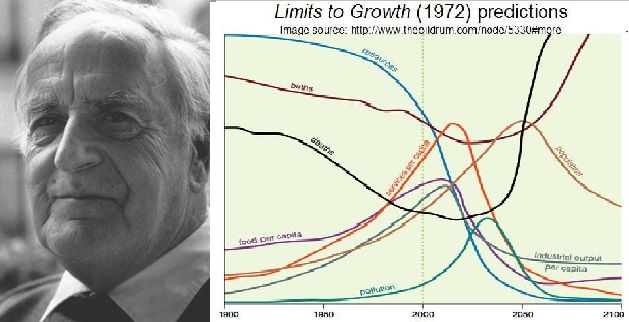
Sir Alexander King, working through the Club of Rome advanced the Malthusian revival known as “Carrying Capacity” which presupposed a world of fixed resources and discounted the parameter of human creativity
The current President of the Privy Council is Justin Trudeau’s childhood friend Dominic Leblanc, son of former Governor General (i.e.: Head of State of Canada) and co-controller of the Canada 2020 think tank which created Justin as an Obama-modelled puppet in 2006. Following in the footsteps of Pierre Trudeau’s Limits to Growth, it is this very network which is at the heart of the Green New Deal now being pushed internationally. Another leading member of Canada2020 is Facebook Canada’s Kevin Chan who will be working closely with the Freeland’s Security and Intelligence Election Threats Task Force.
The oath of every member of the Privy Council member (which includes both private individuals and also every cabinet minister of government) is: “I, [name], do solemnly and sincerely swear that I shall be a true and faithful servant to Her Majesty Queen Elizabeth the Second, as a member of Her Majesty’s Privy Council for Canada.” Additionally to becoming a Privy Councillor, the Prime Minister must additionally give another oath stating: “I, [name] do swear (declare) that I will be faithful and bear true allegiance to Her Majesty Queen Elizabeth the Second, Queen of Canada, Her Heirs and Successors.
The Milner-Rhodes Trust Group
Coordinating closely with the Privy Council office for over 100 years is an organization known as the Round Table Group (c.1902) which was created with funds from South Africa’s “race patriot” and diamond magnate Cecil Rhodes who wished to use his wealth in order to advance a “church for the extension of the British Empire” and “the ultimate recovery of the United States of America as an integral part of the British Empire, the inauguration of a system of Colonial representation in the Imperial Parliament which may tend to weld together the disjointed members of the Empire.”
Upon Rhodes’ death in 1902, Lord Alfred Milner directed Rhodes’ trust and created the Round Table Movement across all British Territories. The trust was also directed towards the creation of the Rhodes Scholarship system designed to indoctrinate talented young minds around the world in Oxford before deploying them back into their countries of origin in order to infiltrate all public and private fields of influence. The Roundtable groups (dubbed the Council on Foreign Relations upon its creation in the United States in 1921), changed its name several times and today is known as the Royal Institute for International Affairs/Chatham House in the UK and the Canadian International Council (CIC) in Ottawa*.
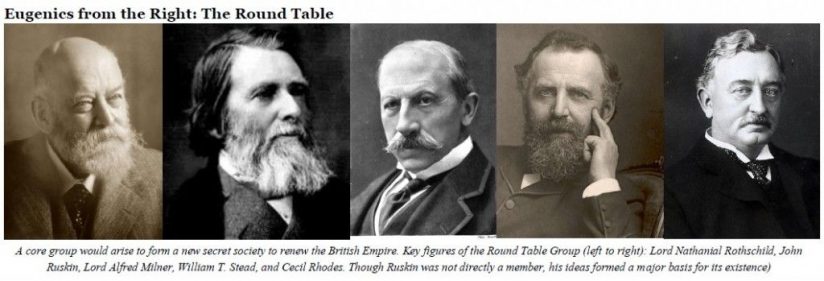
Regime Change disciple Ben Rowswell’s presidency as head of the CIC and Chrystia Freeland’s status as an Oxford Rhodes Scholar (having been brought into Liberal politics via Rhodes Scholar/Canada2020 controller Bob Rae in 2013) should give any thinker a moment of grave pause.
The Strategic Issue at Hand
As ugly as this picture may appear to some, it should not cause sadness or even anger.
Only pity mixed with a dose of hope are appropriate, since we are in fact witnessing the desperate death rattle of a Monarchical system of empire which has too long poisoned the well of human civilization and which must now give way for something better. Although this imperial system may be deploying every asset and dirty trick it has in opposition to the new paradigm now emerging under the guiding leadership of Russia and China, it is becoming increasingly clear that this empire cannot win. Its regime change plans have failed, its Green New Deals are failing and even the irrational aesthetical traditions underlying this system of post-modernism are giving way to an optimistic artistic sensibility that seeks to re-unite beauty with truth evidenced by the renewed interest in classical art and music during the recent Belt and Road Musical Festival on March 24, 2019.

Russia and China’s leadership have not only consolidated a partnership of nations across Eurasia and Africa around this new paradigm, but they have also found what no one thought was possible just a few years ago: a potential ally in an America which is returning to its nationalist sensibilities under the surprising leadership of Donald Trump.
During Trump’s two first years as President, the long British infiltration of America has finally begun to fall apart with the collapse of the Mueller investigation and the exposure of the British-run deep state that Mueller was a part of.
The question now remains: With the impending meltdown of the trans-Atlantic financial system, and olive branch of cooperation which China has offered to the west via the Belt and Road Initiative and the World Landbridge which can bring this system of development into the Americas and Africa, will America join hands as an ally and will Canada follow suit in order to become a true sovereign nation freed of all foreign imperial influence once and for all?
* Original research on the Roundtable/Rhodes Trust infiltration of North America can be found in the Canadian Patriot #18 (British Roots of the Deep State Exposed), Canadian Patriot #19 (Green New Deal vs New Silk Road) and volumes 2-4 of the Untold History of Canada.
Russia Profits as US Takes Venezuelan Oil off the Market in Europe
By Irina Slav – Oilprice.com – April 12, 2019
European refiners are switching to Russian sour grades as U.S. sanctions have shrunk Venezuela’s similar-grade exports, Reuters reports, adding that the Russian sour crude is getting increasingly expensive.
Citing sources from the trading industry, Reuters says the situation has been made worse by the fact that OPEC members have cut mainly their output of heavier, more sour grades under the OPEC+ agreement aimed at stimulating a price rise.
U.S. crude is not an alternative as it is overwhelmingly light and sweet, while refineries in Europe are equipped to process heavier grades as well as light ones to make refined products.
The news is the latest reminder that the world is tipping towards a shortage of heavy, sour crude, which is the staple kind of Venezuela crude and which many refineries need to produce fuels and other products.
“Urals is anchored in a positive zone versus dated Brent and there is no indication it will fall to a discount any time soon,” one of the Reuters’ sources said. That’s a complete reversal of the traditional differential between light and heavy oil, with the latter typically trading at a discount to Brent, a light blend.
Sanctions on Iran are further complicating life for European refiners as they have restricted exports of sour grades that Iran also produces in addition to its very popular superlight crude, also called condensate.
According to Reuters, U.S. sanctions have removed 800,000 bpd of heavy crude from the global market, leaving refiners scrambling for alternatives in a limited pool that, besides Russia and Middle Eastern producers, also includes Canada and Mexico as large producers of these grades of crude. The former is having its own problems with a pipeline capacity shortage and a production cut that has boosted prices, and the latter has yet to reverse a fall in oil production.
Canadian Regime Change Fanatics Scream of Russian Interference into Canada’s Elections
By Matthew Ehret | The Duran | April 13, 2019
On April 5 Canada’s foreign minister embodied the essence of hypocrisy by complaining loudly that Canada’s upcoming October 2019 elections were under threat by a regime change operation steered by Russia which was seeking to undermine the international democratic order.
In order to respond to the threat of foreign interference, the Minister of Global Affairs Canada announced the creation of a “democratic” five person body staffed entirely with unelected senior bureaucrats from the Privy Council Office under the control of the Clerk of the PCO which will act as a new Propaganda bureau to determine what Canadians are and are not allowed to know. This body will focus on social media and will interface closely with the head of Facebook Canada CEO Kevin Chan. She also announced the creation of a Security Threats Task Force which unites all intelligence agencies of Canada (RCMP, Canadian Security Intelligence Service, Communications Security Establishment under the office of Global Affairs Canada. Lastly, the creation of a G7 Rapid Response Mechanism would be created in order to protect all of Canada’s G7 partners from similar “foreign meddling” and run out of Freeland’s Global Affairs Office.
Justin Trudeau, whose administration is collapsing under the weight of self-contradictions built into the green technocratic worldview that he was selected to advance, was quick to jump on this new narrative stating “it is very clearly that countries like Russia are behind a lot of the divisive campaigns.”
Canadian Regime Changers Exposed
Chrystia Freeland’s role as a regime change darling of the British Empire has been increasingly known since the Ukrainian Maidan. It was that British Empire that groomed her under a Rhodes scholarship at Oxford and groomed her for years as an agent controlling mass perception by her management of Reuters and Canada’s Globe and Mail before placing her in a controlling position of Justin Trudeau in 2013.
Her role in steering the vast networks of Canadian Banderites who have long grown in numbers and influence in Canada is as well-known as her friendship with leading Svoboda/Pravi Sektor leaders in Ukraine who were deployed to overthrow a legitimately elected pro-Russian government from Nov. 2013-Feb. 2014. Increasingly well known is her own family’s deeply rooted Nazi sympathies going back to her grandfather’s role in working directly with the Waffen-SS during the latter’s occupation of Ukraine.
When the Ukraine “color revolution” steered by the British-run Deep State (of which Freeland is a senior member) failed to achieve its goal of de-stabilizing Russia, attention was turned to Venezuela where both Russia and China have invested tens of billions in infrastructure and whose government has been extremely favorable to cooperation on the Belt and Road initiative.
For this job, Freeland was deployed alongside her Oxford-trained colleague Ben Rowswell who together worked diligently for several years for a color revolution. As ambassador to Venezuela from 2014-2017, Rowswell managed to coordinate anti-government forces on the ground stating “We became one of the most vocal embassies in speaking out on human rights issues and encouraging Venezuelans to speak out”. Upon leaving Venezuela he said “I don’t think they (anti-Maduro forces) have anything to worry about because Minister Freeland has Venezuela way at the top of her priority list”.
What Rowswell was referring to was Freeland’s role in garnering the semblance of international support for the overthrow by her creation of the Lima Group of 13 Latin American countries (plus Canada) who could be said to “represent the consensus view of South America” in order to give the regime change a “democratic” look. Apparently the deep state managers of Canada didn’t think there was anything weird in an Anglo Saxon monarchy leading a group of Latin American republics and assumed the world would feel the same way.
As it turns out, even though the majority of Lima Group Foreign ministers were induced to support the regime change (very likely due to the vast control of South American mining operations controlled by Canadian mining giants), the world wasn’t so quick to jump enthusiastically on the regime change bandwagon with both Russia and China firmly denying their recognition of opposition leader Guaido’s legitimacy as the country’s leader culminating in Russia’s March 23 deployment of military aircraft and personnel into Venezuela as a message to all Deep State fanatics to back off.
It is noteworthy, that even though Donald Trump paid limited lip service to the hawks in his own government and internationally by telling Russia to leave Venezuela, the fact is that the rift between Trump and those war hawks exemplified by Bolton, Pence, and Pompeo, was made very clear as the President took several opportunities from April 3-6 to call for greater cooperation with Russia and China.
The Collapse of the Deep State and Rise of the New Paradigm
Freeland, Rowswell and their British handlers are undoubtedly not sleeping well at night. Their system is collapsing and there isn’t very much that they can do about it. The empire’s control structures so long kept in the shadows are increasingly exposed to the light of day with the collapse of Russia-Gate, and the exposure of the role of Canada’s Privy Council Office and Round Table movement (aka: Chatham House groups) as guiding (British) hands behind global affairs.
With the Brexit, Italy’s joining the BRI, the failure of the EU and bankruptcy of the City of London-Wall Street banking system, the world is finally waking up to the fact that the “great game” which so perverted the 20th century is falling apart. Not only that but only one serious alternative is on the table: the Belt and Road Initiative/New Silk Road as a global force of cooperation and long term investment into the real (vs speculative/fictitious) part of the economy.
In weeks, Beijing will host the 2nd Belt and Road Conference from and Trump, speaking alongside China’s vice Premier stated a very important intention as a lead up to that conference: 1) an end to the trade war is immanent with a major deal expected in weeks and 2) that Russia, China and America should stop wasting billions on war machines and start re-directing those expenditures towards long term great projects that benefit everyone. The places to do this not only include Belt and Road projects in Eurasia, Africa and the Americas but also the important domain of space exploration and cooperation. Both Russia and China have made it clear that space is a domain for peace on earth with Russia moving ahead with a lunar colony for 2040 and China’s far side of the moon landing on January 3, 2019 being a precursor to a larger lunar mining/industrialization program to access rare earths and Helium-3 fusion fuel.
Donald Trump has joined this chorus of nations pushing for a space based economy by announcing a revival of NASA’s mission with a Moon-Mars program on March 26.
While the future looks increasingly hopeful, and the British Empire’s ugly hand is increasingly exposed for the world to see, there are still many dirty tricks which the devil can still throw at the world.
BIO: Matthew J.L. Ehret is a journalist, lecturer and founder of the Canadian Patriot Review. His works have been published in Executive Intelligence Review, Global Research, Global Times, The Duran, Nexus Magazine, Los Angeles Review of Books, Veterans Today and Sott.net. Matthew has also published the book “The Time has Come for Canada to Join the New Silk Road” and three volumes of the Untold History of Canada (available on untoldhistory.canadianpatriot.org). He can be reached at matt.ehret@tutamail.com
Is the U.S. Prepared to Accept a Defeat in Venezuela?
By Marco Teruggi – Pagina 12 – April 12, 2019
The attack should have been short since the Maduro administration was not strong enough to resist. This was the conviction of the United States as they carried out a strategy to overthrow him: they built a President 2.0 Juan Guaido; they gave him a fictionalized government, international recognition, a collective narrative among mass media companies, accelerated economic sanctions at different levels. Overlapping these variables, different results were expected to be achieved on their path of getting a forced negotiation or the toppling of the government.
Events did not take the planned course. First and most important, the breaking of the Bolivarian National Armed Force (FANB): a crucial element that should have happened but did not. A series of tactics were implemented for it, from internal conspiracy with the support of a lot of dollars, visas and guarantees, or the strategy of a latent threat of a possible U.S. intervention. A combination of bluff – an unloaded weapon pointed at your head – with built up dates to try to achieve a rupture, such as on February 23rd.
The second event that should have occurred, despite the difficulty in defining a target, was Guaido supposedly building mass support in the streets. He boasted that 90 per cent of the population supports him. Pictures of his mass mobilization capacity show that the initial momentum on January 23, when his self-proclamation was acknowledged by Donald Trump through a tweet, lost strength. A major reason for this was the crisis of expectations that resulted from the unfulfilled promise of an immediate outcome. Another is that it was an artificial, communicational, diplomatic construction which could not gather more than the right’s historical rank-and-file supporters, characterized by a specific social, geographic class, living conditions, idiosyncrasy and symbolism. The opposition looked too much like themselves.
Third was the attempt to take the poor to the streets; blackouts and the water shortages were the most favorable of the scenarios to provoke this. But the outcome was not what they expected either. The clearer and wide reaching reality was the majority trying to solve their problems, individually, collectively, together with the Venezuelan Government. Sustained protests, fostered almost completely by the right, were scarce and without capacity to spread in the country.
Each of these variables has feedback points. The crisis of expectations is the result, for instance, of the fact that the Armed Force has not broken, that Guaido speaks of a hastiness that does not occur, with the conclusion that if they don’t succeed in any of their three targets, the last resort is an international intervention headed by the United States. That same interventionist narrative moves away from those who see Guaido as an alternative to the current political and economic situation. Calling on the majorities to achieve an international operation comes across evident obstacles.
Overthrowing Maduro does not seem possible in the correlation of national forces. It has been proven that the attack will not be short and that Chavismo, which is more than a Government, has enough strength to resist. If it was just a national affair, Guaido would lose strength to the point that he wouldn’t even be part of the list of opposition leaders that carry the burden of defeat. The problem is that this new coup attempt was devised over a point of no return with the United States building of a parallel government facade, acknowledged by the European Union, the United Kingdom, Israel, Canada, and right-wing governments in Latin America. What to do with Guaido when the plan is not successful due to initial miscalculations?
The question is due to the US, its current Administration is a mixture of Donald Trump-neoconservative leaders, and the so-called deep state; that is to say, real, invisible structures of power that constitute and safeguard that country’s strategic development in the geopolitical struggle. A defeat in Venezuela would be charged to the Administration in a pre-election period and it would suffer a double blow with Maduro’s continuity, or the lack of ability make a key Latin American country fall in line, and its implications in the international arena.
The deep state has grown stronger recently through tweets and speeches of U.S. spokespeople like Special Representative for Venezuela Elliott Abrams, Secretary of State Mike Pompeo, National Security Advisor John Bolton, and Southern Command’s commanding general Craig Faller. Their different statements have shifted towards painting Venezuela as an operational base for Russia, Iran, Cuba and China, while the Maduro administration would be subordinated to each of these governments and their corresponding intelligence and military services —particularly to the first three.
The United States has announced its following steps based on that narrative. Pompeo is going to Chile, Paraguay, Peru and Colombia; Abrams to Spain and Portugal; and they convened a third meeting in the United Nations Security Council to talk about Venezuela’s situation. They have not announced the goals of the different moves yet. It is possible though to predict that there is a private and public dimension to the agreements. A possibility would be for the US to declare the Venezuelan government a transnational criminal organization and branding colectivos (Chavista grass-roots organizations) as terrorist groups that “undermine the Constitution and territorial integrity of Venezuela,” according to Bolton’s description. New possible actions would result from each of these elements.
That increase in pressure, tightening the blockade, and isolation has not led yet to the possibility of a military intervention, despite the repeated “all options are on the table.” Abrams himself sidestepped that hypothesis last Thursday. Therefore, how are they planning to achieve the outcome proposed with the combination of these actions? The United States needs to establish means, on-the-ground operational capacity, and domestic and diplomatic agreements. In this regard, the European Union stance was expressed by its high representative for foreign affairs, Federica Mogherini, who affirmed that “new free and credible presidential elections should be held as soon as possible.”
Would the U.S. be willing to accept a negotiated outcome in which Maduro remains in power? So far, that does not look possible. They don’t seem willing to accept a geopolitical defeat in Venezuela either. The U.N. Security Council met on Wednesday to deal with this aspect. At the same time, the right called for more mobilizations. The pieces are still in motion.
Translation by Resumen Latinoamericano, North America bureau
Edited by Venezuelanalysis.com
Roméo Dallaire and the Toronto Star’s distortion of Rwanda’s tragedy
By Yves Engler · April 11, 2019
 The Toronto Star should get its facts straight and stop distorting Rwanda’s tragedy.
A day after the 25th anniversary of when two Hutu presidents were blown out of the sky, the Star’s editorial board published “There’s no excuse for ignoring lessons of Rwanda’s genocide”. It claims, “on Jan. 11, 1994, Canadian Maj.-Gen. Roméo Dallaire, at the time force commander with the United Nations Assistance Mission for Rwanda, sent a chilling and urgent cable to UN Headquarters in New York. He had been informed of the details of a plan for the ‘extermination’ of ethnic Tutsis by Hutus.” After stringing together a few hundred more humane-sounding, though meaningless, words Star editorialists returned to their core liberal interventionist Canadian hero theme: “In his cable of January 1994 he urged UN leaders to act by telling them the obvious: Where there’s a will to prevent mass killing, there is a way.”
The Star should check Dallaire’s fax more closely. Revealingly, the much-celebrated “genocide fax” the editorialists reference is not titled “‘genocide’ or ‘killing’ but an innocuous ‘Request for Protection of Informant’”, reports International Criminal Tribunal for Rwanda (ICTR) lawyer Christopher Black in a 2005 story titled “View from Rwanda: The Dallaire Genocide Fax: A Fabrication”. The two-page “genocide fax”, as New Yorker reporter Philip Gourevitch dubbed it in 1998, was probably doctored a year after the mass killings in Rwanda ended. In a chapter devoted to the fax in Enduring Lies: The Rwandan Genocide in the Propaganda System, 20 Years Later Edward S. Herman and David Peterson argue two paragraphs were added to a cable Dallaire sent to Canadian General Maurice Baril at the UN Department of Peacekeeping Operations in New York about a weapons cache and protecting an informant (Dallaire never personally met the informant). The added paragraphs said the informant was asked to compile a list of Tutsi for possible extermination in Kigali and mentioned a plan to assassinate select political leaders and Belgian peacekeepers.
At the ICTR former Cameroon foreign minister and overall head of the UN mission in Rwanda, Jacques-Roger Booh-Booh, denied seeing this information and there’s no evidence Dallaire warned the Belgians of a plan to attack them, which later transpired. Finally, a response to the cable from UN headquarters the next day ignores the (probably) added paragraphs. Herman and Peterson make a compelling case that a doctored version of the initial cable was placed in the UN file on November 27, 1995, by British Colonel Richard M. Connaughton as part of a Kigali-London-Washington effort to prove the existence of a plan by the Hutu government to exterminate Tutsi.
Even if the final two paragraphs were in the original version, the credibility of the information would be suspect. Informant “Jean-Pierre” was not a highly placed official in the defeated Hutu government, reports Robin Philpott in Rwanda and the New Scramble for Africa: From Tragedy to Useful Imperial Fiction. Instead, “Jean-Pierre” was a driver for the MRDN political party who later died fighting with the Rwandan Patriotic Front.
Incredibly, the “genocide fax” is the primary source of any documentary record demonstrating UN foreknowledge of a Hutu “conspiracy” to exterminate Tutsi, a charge even the victor’s justice at the ICTR failed to convict anyone of. According to Herman and Peterson, “when finding all four defendants not guilty of the ‘conspiracy to commit genocide’ charge, the [ICTR] trial chamber also dismissed the evidence provided by ‘informant Jean-Pierre’ due to ‘lingering questions concerning [his] reliability.’”
Tellingly, Dallaire didn’t even initially adhere to the “conspiracy to commit genocide” version of the Rwandan tragedy. Just after leaving his post as UNAMIR force commander Dallaire replied to a September 14, 1994, Radio Canada Le Point question by saying, “the plan was more political. The aim was to eliminate the coalition of moderates. … I think that the excesses that we saw were beyond people’s ability to plan and organize. There was a process to destroy the political elements in the moderate camp. There was a breakdown and hysteria absolutely. … But nobody could have foreseen or planned the magnitude of the destruction we saw.”
Doctoring a fax to make it appear the UN had foreknowledge of a plot to exterminate Tutsi may sound outlandish, but it’s more believable than many other elements of the dominant narrative of the Rwandan genocide. The day after their editorial, for instance, the Star published a story titled “25 years after genocide, Rwanda rebuilds” which included a photo of President Paul Kagame leading a walk to commemorate the mass killings. But, Kagame is the individual most responsible for unleashing the hundred days of genocidal violence by downing a plane carrying two Hutu presidents and much of the Rwandan military high command.
Even the Star has reported as much. A year ago they published a story titled “Did Rwanda’s Paul Kagame trigger the genocide of his own people?” For its part, the Globe and Mail has published a series of front-page reports in recent years confirming Kagame’s responsibility for blowing up the plane carrying Rwandan President Juvénal Habyarimana, which triggered mass killings in April 1994. In an October story titled “New information supports claims Kagame forces were involved in assassination that sparked Rwandan genocide” the Globe all but confirmed that the surface-to-air missiles used to assassinate the Rwandan and Burundian Hutu presidents on April 6, 1994, came from Uganda, which backed the RPF’s bid to conquer its smaller neighbour. (A few thousand exiled Tutsi Ugandan troops, including the deputy minister of defence, “deserted” to invade Rwanda in 1990.) These revelations strengthen the case of those who argue that responsibility for the mass killings in spring 1994 largely rests with the Ugandan/RPF aggressors and their US/British/Canadian backers.
By presenting the individual most culpable for the mass killings at the head of a commemoration for said violence the Star is flipping the facts on their head. The same might be said for their depiction of the Canadian general. At the end of their chapter tracing the history of the “genocide fax” Herman and Peterson write, “if all of this is true,” then “we would suggest that Dallaire should be regarded as a war criminal for positively facilitating the actual mass killings of April-July, rather than taken as a hero for giving allegedly disregarded warnings that might have stopped them.”
Canada Needs to Develop More Rules to Control its Spying Operations – Watchdog
Sputnik – 10.04.2019
According to a government watchdog’s report, the Canadian Department of National Defence (DND) and Armed Forces (CAF) have no rules when it comes to intelligence operations, and they do not answer to any independent body for their actions.
Canada needs to consider developing a legislation that will regulate how the military and the DND conduct intelligence operations, a national security watchdog committee in Canada’s parliament suggests.
In its report, the National Security and Intelligence Committee of Parliamentarians says the DND and the CAF have “one of the largest intelligence programs” in Canada, yet their operations face little to no outside scrutiny.
The DND and CAF enjoy a freedom known as the “Crown prerogative,” The Globe and Mail reports. This allows the Canadian government to make decisions as it sees fit unless its hands are somehow tied by statutes or the courts.
“Once a statute occupies the ground formerly occupied by the prerogative power, the Crown must comply with the terms of the statute,” the report quotes the Supreme Court of Canada as ruling.
This means that while Canada does have certain administrative directives and rules that govern defence intelligence operations, no legislation explicitly guides these activities. At the same time, the Canadian Security Intelligence Service (CSIS) and the Communications Security Establishment (CSE) are subject to laws that say what they can and cannot do, the Globe and Mail reports.
“DND/CAF is an anomaly in conducting its intelligence activities under the Crown prerogative. Those activities are similar in kind, risk, and sensitivity to those conducted by other Canadian security and intelligence organizations, which operate under and benefit from clear statutory authorities, limitations and requirements for ongoing review, tailored to the requirements of their specific mandates,” the Committee’s report says.
Besides, the Committee points out that, unlike CSIS and CSE, military intelligence is not subject to review by an independent and external body, meaning that military intelligence operations are not only unregulated, but also do not report to anyone.
Therefore, the Committee suggests developing legislation that would restrain the DND and CAF, as well as oblige them to report annually on their intelligence operations.
In the meantime, Committee chairman MP David McGuinty said the watchdog found “no evidence of wrongdoing” by defence personnel during its investigation.
Naturally, both the CAF and DND objected to the proposal, saying more oversight would make the military less flexible when it comes to operations; it would also undermine information sharing with Canada’s closest allies, they argued, according to the Globe and Mail.
Defence Minister Harjit Sajjan has said that his department would look at the Committee’s suggestions.
“There are internal processes that we have in place. Can we improve those? Of course we are looking at those,” he said after a cabinet meeting Tuesday.
However, he also noted that caution must be exercised in order to keep the military flexible, so that it “keep our soldiers safe.”
Canada’s Carbon Tax Will Kill People
‘Winter mortality is lower when the price of heating is lower’: new research report.

source: page 33 of this 2009 UK govt report
By Donna Laframboise | Big Picture News | April 8, 2019
Last month, the National Bureau of Economic Research released a dramatic working paper. Its conclusion: when US home heating costs fell, fewer people died.
In the authors’ words, we’ve known for decades that “mortality peaks in winter and that cold weather is associated with higher mortality.” When home heating gets expensive, many people – especially the poorest members of our community – turn down the thermostat. But lower indoor temperatures are associated with an uptick in fatal strokes, heart attacks, and infections.
After collecting reams of data, and performing careful calculations, the researchers conclude that US heating bills declined noticeably between 2005 and 2010 “due to the boom in shale production of natural gas.”
That price decline, they write, “caused a 1.6% decrease in the winter mortality rate for households using natural gas for heating.”
Only 58% of American households heat with natural gas, so the drop in the death rate for the US population as a whole over a full calendar year works out to about half a percentage point. The bottom line: lower energy prices saved 11,000 lives annually.
Which brings us to the carbon tax recently imposed on all sources of home heating here in more northerly Canada. Enbridge, the company which supplies natural gas to Ontario homes, says it needs to raise the price it charges households by 11% just to pay for this carbon tax.
If deaths drop when heating costs decline, they’ll surely increase when heating costs spike. So let’s not beat around the bush: Canada’s carbon tax is going to kill people.
Extrapolating from those US numbers, 1,100 Canadians will die unnecessarily next winter. And the winter after that. And the one after that. As the size of the carbon tax increases, the number of annual victims may well rise in tandem.
Certain categories of people are at higher risk of death-by-carbon-tax. People whose health is already compromised. People who are already struggling to pay their bills. (Seniors, of course, are over-represented amongst both groups.)
There’s nothing heroic about a policy that consigns old people to shivering in the dark. That’s an attack on our most vulnerable. That’s a betrayal.
When people die from opioid overdoses, our Prime Minister rightly calls it a ‘crisis.’ He calls it “devastating. Families ripped apart. Communities forever altered. Loved ones lost too soon.” Yet his carbon tax has set into motion a wave of similar tragedy and sorrow.
Where global carbon dioxide emissions are concerned, Canada’s 1.6% contribution is so trivial that nothing we do can possibly make a difference. We’re a rounding error, simply irrelevant to the big picture.
Which means that Canada’s carbon-tax-induced deaths won’t just be premature, they’ll be utterly meaningless.
When Government Lies to You
By Donna Laframboise | Big Picture News | April 3, 2019
Fake news is everywhere, and governments can be a rich source. For example, a flyer distributed in the mail last week by Canada’s Revenue Agency – aka the taxman – tells us a pack of lies.
Against the will of elected leaders in four provinces, our federal government has just imposed a carbon tax. The price of gasoline has jumped at the pumps. Home heating costs have risen. This is just stage one, since the tax bite will increase every year.
The flyer begins by declaring:
Pollution has a cost. It impacts the air we breathe, our children’s health, and our economy. That’s why the Government of Canada has put a price on carbon pollution.
What nonsense. Carbon taxes are supposed to discourage people from burning fossil fuels not because of dirty black soot (sophisticated, anti-pollution technologies already exist), but because an invisible, odourless gas gets emitted whenever fossil fuels are used.
The entire climate scare rests on the idea that humanity is adding too much carbon dioxide – CO2 – to the atmosphere, and that this will hypothetically destabilize the climate.
Now is a good time to point out that the Canadian government admits this country is responsible for a mere 1.6 percent of global CO2 emissions. Between them, China (26 percent), America (14 percent), and India (6.4) are responsible for nearly half of all human-produced CO2 (46 percent).
It’s also a good time to remember that, over the past 50 years, experts have predicted one environmental catastrophe after another, none of which materialized. Even smart scientists with powerful computers are terrible at forecasting the future.
The flyer says this measure is all about fighting pollution. But CO2 wasn’t pollution when Al Gore called it that. It wasn’t pollution when Barack Obama called it that. And it isn’t pollution now.
As we all learned in Biology 101, bears, bunnies, and humans all exhale CO2 – which is then absorbed by grass, flowers, and trees. Without CO2, there would be no plants. Without plants, there would be no oxygen for wildlife or humanity to breathe.
CO2 is therefore an integral part of the natural, virtuous circle of life. It does no harm to our air quality. It does no harm to our children’s health.
And whatever harm a climate crisis might one day inflict on Canada’s economy must surely be balanced against the genuine hardship being experienced right now.
Every time people near the bottom of the economic ladder fill up their car in order to get to work, they’re being punished. Every time they pay their heating bill they’re being penalized by their own government. That’s what carbon taxes do.
We can argue endlessly about whether more CO2 in the atmosphere will be perilous over the long term. But the ‘pollution’ angle is total hogwash, dreamed up by political sleazeballs.
A planet without CO2 would be a wasteland, bereft of both plants and animals. Calling CO2 pollution is therefore abjectly dishonest.
Let me say this one more time: If CO2 is pollution, every human being is a non-stop pollution factory. Your neighbour’s newborn. Your grandmother. That blind child.
What a sick, dangerous perspective on the world.
NATO propaganda promotes war, military spending
Third in a four-part series on the 70th anniversary of the North Atlantic Treaty Organization.
By Yves Engler · April 1, 2019
 The first two installments of the series showed how NATO was set up to blunt the European left and to justify European/North American dominance across the globe. Recently, the alliance has intensified pressure on Canada to increase spending on the military and participate in more wars.
As its Cold War pretext fades further from view, NATO has become more belligerent. In 1999 Canadian fighter jets dropped 530 bombs in NATO’s illegal 78-day bombing of Serbia. During the 2000s tens of thousands of Canadian troops fought in a NATO war in Afghanistan. In 2011 a Canadian general led NATO’s attack on Libya in which seven CF-18 fighter jets and two Canadian naval vessels participated.
In a dangerous game of brinksmanship, NATO has massed troops and fighter jets on Russia’s border. Five hundred Canadian troops lead an alliance mission in Latvia while the US, Britain and Germany head missions in Poland, Lithuania and Estonia. Over the past decade Canadian naval vessels have almost constantly engaged in NATO patrols in the Mediterranean and Indian Ocean.
In addition to spurring deployments and war, militarists use the alliance to boost socially and ecologically damaging military spending. “Canada’s defence spending questioned at NATO parliamentary meeting”, noted a November CBC headline while a National Post editorial bemoaned “Canada’s continuing failure to honour our pledge to NATO allies to spend 2 per cent of GDP on defence.” In 2006 NATO countries adopted a pledge to put 2% of economic output into their military.
NATO has also been used to push weapons procurement. Calling for expanding the jet fleet, senior military officials told the Globe and Mail in 2017 that “Canada’s fighter fleet is not big enough to meet its NORAD and NATO obligations at the same time.” In a history of the first century of the navy Marc Milner describes a series of reports in the mid-1960s concluding that the Royal Canadian Navy was “too small to meet Canada’s NATO obligations” and should be expanded “to meet NATO and North American commitments.”
NATO has also been invoked to justify arming the US war machine. In 1967 the Prime Minister responded to calls by opponents of the war in Vietnam to end the Defence Production Sharing Agreement, the arrangement under which Canada sold the US weapons, with the claim that to do so would imperil NATO. Lester Pearson claimed this “would be interpreted as a notice of withdrawal on our part from continental defense and even from the collective defence arrangements of the Atlantic alliance.”
In 2017 the Justin Trudeau government “hid behind Canada’s NATO membership”, according to NDP foreign critic Hélène Laverdière, when it opposed international efforts to ban nuclear weapons. At a time when he made a big display about “suffocating” the (nuclear) arms race Pierre Trudeau justified nuclear tipped cruise missiles testing in Canada. In 1983 the Prime Minister said, “having declared our support for the two track strategy, Canada should bear its fair share of the burden which that policy imposes on the NATO alliance.”
NATO is a nuclear weapons club. These monstrous bombs have been “a fundamental component” of the alliance’s military planning. Through NATO Canada has effectively committed to fighting a nuclear war if any country breached its boundaries. Additionally, the alliance does not restrict its members from using nuclear weapons first.
NATO supports various militarist organizations in this country and operates a public diplomacy division. Founded in 1966 the NATO Association of Canada, formerly Atlantic Council of Canada, promotes the alliance. With an office in Toronto its staff and interns organize public events and publish different materials. A decade older than the NATO Association of Canada, the Canadian NATO Parliamentary Association seeks “to increase knowledge of the concerns of the NATO Parliamentary Assembly among parliamentarians.”
A number of Canadian organizations receive NATO’s largess. Conference of Defense Associations conferences in Ottawa have received support from NATO while the Canadian Global Affairs Institute has held numerous joint symposiums with NATO. The annual Halifax International Security Forum, which brings together hundreds of academics and policymakers, is sponsored by NATO. In the late 1980s the Canadian Institute for Strategic Studies had “agreements with NATO’s Information Service to conduct a national/regional speakers tour.”
In other words NATO spends money (which ultimately come from our taxes) to convince Canadians that wars and military spending are good for us.
Defence of European empires was original NATO goal
Second in a four-part series on the 70th anniversary of the North Atlantic Treaty Organization
By Yves Engler · March 30, 2019
The first installment in this series discussed how NATO was set up partly to blunt the European Left. The other major factor driving the creation of NATO was a desire to bolster colonial authority and bring the world under a US geopolitical umbrella.
From the outset Canadian officials had an incredibly expansive definition of NATO’s supposed defensive character, which says an “attack against one ally is considered as an attack against all allies.” As part of the Parliamentary debate over NATO external minister Lester Pearson said: “There is no better way of ensuring the security of the Pacific Ocean at this particular moment than by working out, between the great democratic powers, a security arrangement the effects of which will be felt all over the world, including the Pacific area.” Two years later he said: “The defence of the Middle East is vital to the successful defence of Europe and north Atlantic area.” In 1953 Pearson went even further: “There is now only a relatively small [5000 kilometre] geographical gap between southeast Asia and the area covered by the North Atlantic treaty, which goes to the eastern boundaries of Turkey.”
In one sense the popular portrayal of NATO as a defensive arrangement was apt. After Europe’s second Great War the colonial powers were economically weak while anti-colonial movements could increasingly garner outside support. The Soviets and Mao’s China, for instance, aided the Vietnamese. Similarly, Egypt supported Algerian nationalists and Angola benefited from highly altruistic Cuban backing. The international balance of forces had swung away from the colonial powers.
To maintain their colonies European powers increasingly depended on North American diplomatic and financial assistance. NATO passed numerous resolutions supporting European colonial authority. In the fall of 1951 Pearson responded to moves in Iran and Egypt to weaken British influence by telling Parliament: “The Middle East is strategically far too important to the defence of the North Atlantic area to allow it to become a power vacuum or to pass into unfriendly hands.”
The next year Ottawa recognized the colonies of Vietnam, Cambodia and Laos as “associated states” of France, according to an internal report, “to assist a NATO colleague, sorely tried by foreign and domestic problems.” More significantly, Canada gave France hundreds of millions of dollars in military equipment through NATO’s Mutual Assistance Program. These weapons were mostly used to suppress the Vietnamese and Algerian independence movements. In 1953 Pearson told the House: “The assistance we have given to France as a member of the NATO association may have helped her recently in the discharge of some of her obligations in Indo-China.” Similarly, Canadian and US aid was used by the Dutch to maintain their dominance over Indonesia and West Papua New Guinea, by the Belgians in the Congo, Rwanda and Burundi, by the Portuguese in Angola, Mozambique and Guinea-Bissau and by the British in numerous places. Between 1950 and 1958 Ottawa donated a whopping $1,526,956,000 ($8 billion today) in ammunition, fighter jets, military training, etc. to European countries through the NATO Mutual Assistance Program.
The role NATO played in North American/European subjugation of the Global South made Asians and Africans wary of the organization. The Nigerian Labour Party’s 1964 pamphlet The NATO Conspiracy in Africa documents that organization’s military involvement on the continent from bases to naval agreements. In 1956 NATO established a Committee for Africa and in June 1959 NATO’s North Atlantic Council, the organization’s main political decision-making body, warned that the communists would take advantage of African independence to the detriment of Western political and economic interests.
The north Atlantic alliance was designed to maintain unity among the historic colonial powers — and the US — in the midst of a de-colonizing world. It was also meant to strengthen US influence around the world. In a history of the 1950-53 US-led Korean war David Bercuson writes that Canada’s external minister “agreed with [President] Truman, [Secretary of State] Dean Acheson, and other American leaders that the Korean conflict was NATO’s first true test, even if it was taking place half a world away.”
Designed to maintain internal unity among the leading capitalist powers, NATO was the military alliance of the post-WWII US-centered multilateral order, which included the International Monetary Fund (IMF), World Bank, International Trade Organization (ITO) and the United Nations. (For its first two decades the UN was little more than an arm of the State Department.)
A growing capitalist power, Canada was well placed to benefit from US-centered multilateral imperialism. The Canadian elite’s business, cultural, familial and racial ties with their US counterparts meant their position and profits were likely to expand alongside Washington’s global position.
NATO bolstered colonial authority and helped bring the world under the US geopolitical umbrella, from which the Canadian elite hoped to benefit.
CARICOM Confronts the Big House: Trump Attempts to Split the Caribbean over Venezuela
By Maximilian C. Forte | Zero Anthropology | March 25, 2019
It’s a simple matter, even if one might lose oneself in the various details, names, places, and dates. The Caribbean Community and Common Market (CARICOM), mostly made up of Anglophone Caribbean states, decisively stood up for non-intervention in the internal affairs of states by going against the push to recognize the illegitimate and illegal claim to power by Juán Guaidó in Venezuela. Such a policy, pushed by the US’ regime change agenda, would have clearly served to undermine the authority of the elected government of President Nicolás Maduro, while legitimating foreign intervention. Just as the US today seeks the overthrow of Venezuela’s government, tomorrow it could seek the overthrow of any other government in the Americas. It is thus the Caribbean’s voice that matters most right now.
Trump: Against Sovereignty
On the other side, Trump’s White House is not only pushing for regime change in Venezuela, Trump’s NSA, John Bolton, has stated repeatedly that the US intends to resurrect and impose the neocolonial and plainly imperialist Monroe Doctrine—claiming effective authority to rule the Western Hemisphere. (That includes Canada, not that Canadians have bothered to take note.) Given Trump’s own stated belief that “to the victor go the spoils,” and the US’ validation of the acquisition of territory by force—backing Israel’s claim to Syria’s Golan Heights—even respect for the territorial integrity of states has gone out the window. Fundamental and basic principles of the UN Charter have thus been unilaterally shredded by the US. CARICOM stands as one impediment. Trump clearly will not let that stand.
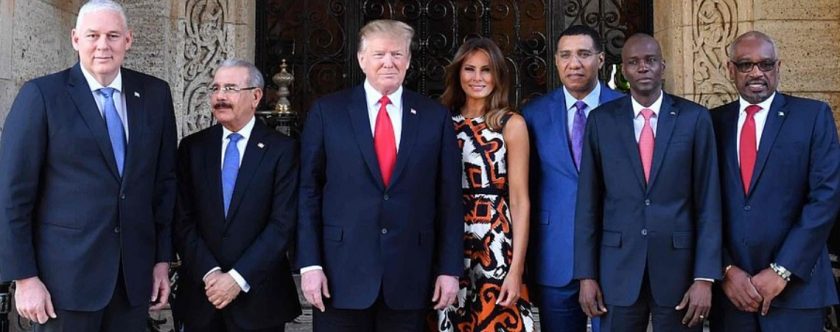
Trump has apparently resuscitated divide et impera, trying to not only pry some CARICOM members away from the main body by “dangling investment” promises in front of their eyes, but also setting the stage for CARICOM members to turn on each other. What Trump did was to invite a small, select group of Caribbean leaders—those belonging to the Lima Group (standing outside of any international body, because the Group supports regime change in violation of international law)—to visit him at his Mar-a-Lago estate. Trump thus met with St Lucia Prime Minister Allen Chastanet, Dominican Republic President Danilo Medina, Jamaica Prime Minister Andrew Holness, Haiti President Jovenel Moise, and Bahamas Prime Minister Hubert Minnis at the Mar-a-Lago estate in Palm Beach, Florida. These countries, “have all either criticized Venezuela’s Nicolas Maduro, or recognized Juan Guaido [sic] as the country’s rightful leader”.

Jamaica’s Minister of Foreign Affairs and Trade, Kamina Johnson Smith
Among those in attendance, Jamaica recently announced the closure of its embassy in Venezuela, despite the parliamentary opposition in Kingston voicing serious criticisms. Reporting on these events, the Jamaica Observer instead backed CARICOM’s approach to the Venezuelan crisis, reaffirming the value of the UN Charter. As for Jamaica’s Prime Minister, Andrew Holness, he spoke of being pleased with his meeting with Trump, saying that Trump, “wants to encourage and promote a stronger relationship with the region”. (Holness appears to be confusing a “stronger relationship” with a relationship of strength.) Holness’ main concern appeared to be the promise of US investments, saying that he hoped it was “not just talk” but that there would be “instrumental action”. Yet Trump is in no position to order US companies to invest in the Caribbean—he cannot even do that in the US itself. The US is not a state-run socialist economy, where public companies obey public policy—surely Holness understands this? Nonetheless, the affair smelled of something akin to bribery, and if this was representative of Caribbean leaders “standing tall” then language has been inverted, and standing tall is a reference to the humility of beggars. One might recall how the British Colonial Office used to refer to visiting Caribbean Chief Ministers as a “beggars’ opera”.
Rowley: Standing Up for the Caribbean
Once more, the figure standing up to Trump, and standing up for CARICOM and international law, is Trinidad & Tobago’s Prime Minister: Dr. Keith Rowley, of the ruling People’s National Movement (PNM). Dr. Rowley noted that this minority which met with Trump, which was not empowered to speak for CARICOM, were at Mar-a-Lago because they are members of the Lima Group whose objective is regime change in Venezuela. Apparently the US ambassador to Trinidad & Tobago, Joseph Mondello, said that he “viewed with concern” comments made by Rowley last month—in response, Rowley was reportedly angered and he redoubled his efforts to push CARICOM on the path of anti-intervention.
The fact that other Caribbean states such as Trinidad & Tobago and the majority of CARICOM members, who oppose the Lima Group, were logically not invited—why would they be?—has been seized upon by quislings in the region who think the Caribbean’s primary duty is servitude to whomever occupies the Big House in the US. Failure to show deference to US interests, these proxies think, somehow entails a loss of status, a “loss of leadership” even. Real leaders stand up for American interests, apparently. This has been translated into accusations that those who were not at Mar-a-Lago were thus “snubbed,” and missed out on something “special”.
Representative of this pro-US faction are figures such as Ralph Maraj, a former foreign minister of Trinidad & Tobago, and a member of the opposition United National Congress (UNC). According to Maraj, the fact that Trinidad was “excluded” from the Mar-a-Lago meeting means that the US now has a diminished view of the country. He continued:
“We do not stand tall, contrary to what Dr. Rowley has stated, we stand diminished in the region, we have lost our leadership of Caricom which we had. Jamaica now is leading the way…. We’ve really abdicated the leadership in Caricom and we have obviously offended the United States, and while we have sovereign right to deal with our foreign relations we stand by the principles and so, we must also protect our relationships…. The United States does not need to invest in our petrochemical industry anymore. They have the most gas, natural gas in the world…. They don’t need our gas, they don’t need our oil. They are a net exporter now of both oil and gas. We have lost our economic clout”.
Maraj’s message was, at best, confusing. If the US no longer needs Trinidad, and Trinidad has lost its economic clout as a result, then how would a lunch at Mar-a-Lago have altered those basic, objective economic facts? It’s not clear where Maraj’s complaint lies, but it’s also far from obvious that the facts are on his side.
Trinidad & Tobago’s Leadership: The US View
The US previously recognized Trinidad’s leadership in CARICOM and its high standing in the region—according to the US Embassy in Port of Spain in 2006:
“In regional politics, it could be said that T&T is an opinion shaper. [Prime Minister Patrick] Manning [of the PNM] just completed a six-month tenure as Chairman of CARICOM, a period marked by a renewed emphasis on regional economic integration. T&T receives high marks for its commitment to the needs of the smaller countries of the Eastern Caribbean. Beyond CARICOM, T&T maintains correct but cool relations with Venezuela, largely due to differences of opinion over Petrocaribe and Chavez’s regional aspirations. T&T views Cuba as a Caribbean brother and maintains amicable ties. Manning regularly goes to Cuba for medical attention”.
Did having an independent foreign policy diminish Trinidad, as Maraj argued above? The US Embassy recognized Trinidad & Tobago’s influential leadership position, even as it pointed to serious foreign policy differences between the US and Trinidad & Tobago (repeated here):
“T&T in many ways demonstrates a fierce independence; it has been immovable on several key recent U.S. foreign policy priorities. Because of former President Robinson’s role as a ‘father’ of the International Criminal Court (ICC), T&T was one of the first ICC signatories. It has not signed an Article 98 agreement with the U.S. and likely never will. T&T continues to desire and work towards good relations with Venezuela as they share a long maritime border and common energy concerns. It often defends Cuba, which it sees as a Caribbean brother. T&T, along with its neighbors, did not recognize Haiti’s interim government in the absence of a CARICOM consensus. T&T did not support the U.S. intervention in Iraq, and its media have been openly critical on this issue. T&T’s voting record at the U.N. also leaves much to be desired from a U.S. policy perspective. Most notably, T&T voted, together with its CARICOM partners, in favor of Venezuela’s candidacy for the vacant Latin American Caribbean seat on the UN Security Council”.
If standing up for Trinidad & Tobago’s interests—which are not the same as American interests—is somehow weak or diminished leadership, then that case has not been proven, not even when we refer to the opinions of US diplomats themselves.
Furthermore, during the same weekend that Trump was hosting a small group of Caribbean leaders, CARICOM itself held a dialogue with Juán Guaidó, in an effort to promote peaceful mediation towards an end to the crisis. Unfortunate however was the praise given by CARICOM leaders to Canada, which helped to organize the encounter. The point however is that if CARICOM did not matter, then not even Trump’s instrument in Venezuela would seem to agree—as Trump met with a splinter group, Guaidó spoke with representatives of the larger body, and both events happened at nearly the same time.
Who Was Invited to the Man’s House?
To have them assembled in one place, here are the comments made by Prime Minister Rowley about this weekend’s event at Mar-a-Lago, and what it signifies, gleaned from several sources as indicated below:

Prime Minister of Trinidad & Tobago, Dr. Keith Rowley
“There are people in Trinidad and Tobago who believe that because Trinidad and Tobago was not invited to the private residence of an American president we are somehow diminished…. Ladies and gentlemen, we have never stood taller, we have never stood prouder; and, as I speak to you now, Caricom’s position, as reaffirmed in the last meeting of heads in St Kitts-Nevis, is that there are three people representing and authorised to represent Caricom outside of its heads and caucus, and that’s the chairman of Caricom, who is the prime minister of St Kitts-Nevis (Dr Timothy Harris); Trinidad and Tobago’s prime minister or designate; and Barbados, through its prime minister or designate”. (source)
“A man’s home is his castle—you are free to invite who you want to your house. We can’t stay outside and say we shoulda be invited. Since when are we measuring our stature and station by who invites us to their house? If it is we’re being ‘blanked’ or ‘snubbed’ for steadfastly standing for the principles of the United Nations Charter, history will absolve us”. (source)
“Our foreign policy has always given us an indication of the road ahead. What we’re reacting to is an invitation to a man’s house—a meeting of the Lima Group at the private residence of the US President”. (source)
“I don’t know that T&T or anyone was deliberately, unwittingly or accidentally invited to anyone’s private home. The invitation wasn’t to Caricom, we don’t go around begging for invitations”. (source)
“What we are going to do resolutely and without apology, as a tiny speck on the world’s map, is to stand with the principles of the United Nations where we all have signed on and accept as the best way for peace and security, not only in our region, but the world. We, from early—St Kitts-Nevis, Dominica, Trinidad and Tobago, St Vincent and the Grenadines—we did not sign on to the Lima Group. So we are not reacting to an invitation to a man’s house”. (source)
“There are 14 Caricom countries, how many have gone to Mar-a-Lago? Yet the convseration is about four. The ones who’ve agreed are part of the Lima Group. What’s the group’s objective? Regime change in Venezuela. How that’s to be achieved is for those who’ve embarked on that course”. (source)
“As far as I’m aware, there’s no tear in TT-US relations. The US remains a friendly country and in so far as having a disagreement on the approach of Venezuela, it has nothing to do with the relations between the people of T&T and the people of the US—notwithstanding Opposition’s efforts to create that kind of division!” (source)
“Force Multipliers”
Rather than come out and call them “treacherous servants,” the politically correct term for amplifiers of US power is “force multipliers”. On the same day that Trump announced his Mar-a-Lago meeting, the Leader of the Opposition in Trinidad & Tobago, former Prime Minister Kamla Persad-Bissessar of the United National Congress, met with the US Ambassador in Port of Spain. It’s not the first time that Persad-Bissessar, while in the Opposition, has gone to the US Embassy to have private meetings to talk about Trinidadian affairs, slanted in a way that always favoured American interests and those of her party. The party attacking Prime Minister Rowley for not being servile enough to get an invitation to Mar-a-Lago, has a history of going in secret to the US Embassy to lay out its complaints about domestic political matters for the American ambassador to consider—perhaps this is what they mean by “leadership”. From their perspective a figure like Juán Guaidó must be one of the world’s greatest living “leaders”.

Ralph Maraj
The UNC is a party that mostly represents Trinidad’s population of East Indian descendants, which for generations have vied for power against the African-descended population that is mostly represented by the ruling People’s National Movement (PNM). The PNM led the country to independence in 1962, and its leadership was responsible for expelling the US from its air and naval bases in Trinidad. The PNM also nationalized Trinidad & Tobago’s oil and gas industry, and did substantial work in trying to build a nation.
The UNC has long had a particularly cozy relationship with the US, and it’s no secret that many of its followers tend to hold in high esteem all things coded White, looking up to the Global North, with neither the White House nor Donald Trump personally being any exception of course. In fact, the UNC’s long-standing former leader, Basdeo Panday, was the Prime Minister who personally hosted Donald Trump when he traveled to Trinidad for the 1999 Miss Universe Pageant. Trump and Panday spent time dining and golfing together, and apparently the experience made a positive impression on Trump. A few years later, Panday would find himself jailed on corruption charges.
While Trinidadian politics are not organized along left vs. right lines (mistakenly assumed to be universal by most North American and many European writers)—the UNC has nevertheless on occasion lambasted opponents, in a manner uncharacteristic of Trinidad politicians, as “communists”. The UNC’s stance on Venezuela, since the rise of Hugo Chávez, has been consistently hostile to the Bolivarian Revolution.
It was thus telling that this cable, as published by WikiLeaks, showed that, “on October 3 [2006], the [US] Ambassador met with Opposition United National Congress (UNC) Deputy Political Leader Senator Wade Mark, at Mark’s request,” and during that meeting the UNC’s Wade Mark not only assured the US that a future UNC government would favour US interests, but he went as far as linking the then PNM Prime Minister, Patrick Manning, with radical Muslim terrorism—and then linked the PNM and Hugo Chávez to Muslim terrorism. Wade Mark was purposely baiting the US, knowing that the US Embassy was keeping a keen eye on Muslim groups in the country, at the height of the US’ so-called “Global War on Terror”.
Let’s read that document from the US Embassy in Port of Spain in greater depth, which was previously publicized thanks to Guanaguanare—the emphases in bold print are mine:
“Mark said his purpose was to express to the Ambassador the UNC’s shock at the sudden assault on the United States unleashed by Prime Minister Patrick Manning, in his September 5 address before energy industry executives and members of the diplomatic corps…. Mark wished to reassure the Ambassador that a UNC administration would re-establish with the US the same friendly and cooperative relations which has characterized the 1995-2001 period when then UNC Prime Minister Basdeo Panday and Secretary of State Warren Christopher signed an extradition treaty, a mutual legal assistance treaty and an agreement on maritime law enforcement. Mark went on to say that UNC concern with Manning’s undiplomatic outburst was heightened by the fact that Minister of Energy and Energy Industries Dr. Lenny Saith has reportedly signed a memorandum of understanding with Mexico according to which a portion of the liquefied natural gas currently exported by T&T to the US would be assigned to Mexico instead. Such an action could not help but have serious national security implications for T&T, given that T&T depends for much of its food imports on the US. The Ambassador listened to Mark and acknowledged that the Prime Minister’s September 5 criticism of the US had taken him by surprise, too.
“Mark then launched into a litany of allegations and rumors whose veracity it is impossible to gauge. He said it was the UNC’s understanding that newly-appointed foreign minister Arnold Piggott… had, while serving as High Commissioner to Canada, met with elements associated with Al-Qaeda and Hezbollah. (Note: Post has no reason to believe that this is true and has not heard this rumor from any other source). He went on to say that three ships carrying rocket launchers as well as members of Hezbollah, which had left Syria in August en route to Argentina, were diverted to Venezuela’s Margarita island where a Hezbollah base was to be established with the aim of targeting the US. (Note: Post has heard this claim elsewhere, although embassy Caracas would be better placed to ascertain whether it is fact or fiction).
“Mark also drew a connection between Prime Minister Manning, Imam Yasin Abu Bakr, leader of the extremist Jamaat al Muslimeen (JAM) group, and Venezuelan President Hugo Chavez. Referring to Abu Bakr’s release from prison on bail and to his court-authorized leave to travel to Venezuela, Mark said it strains credulity that such a development could have taken place without the knowledge and intervention of the powers that be. Mark said that Abu Bakr is treated like a head of state by the Chavez regime, and hypothesized that his leave to travel to Venezuela could have been intended to cement Manning’s anti-American credentials in return for the JAM’s assistance with voter recruitment at the next election….”
It is from within this fold that Prime Minister Rowley was seen as being “snubbed” by Trump, and that Trinidad lost its leadership status. It’s not surprising then, and in fact it’s quite logical, that on a previous occasion in Parliament, Dr. Rowley blasted the opposition UNC as “traitors”.
A Perspective on Canada
Canada’s government could learn a great deal—first of all, about international law and the UN Charter—from listening to Prime Minister Rowley. Instead, rather than having the post-national state as Justin Trudeau remarked, Canada has more of a post-government state, one that functions almost on auto-pilot by hiring technocrats who are “skilled” in “reading the signals coming out of Washington”. As studious imitators, they would have been well prepared by “universities” in Canada since they are largely just retail outlets for American academic production, training Canadians in the high art of consuming American books, American journals, and traveling to American conferences.
Canada helped found the Lima Group, in an effort to overthrow Venezuela’s government. While Trudeau is defending Canadian corporate interests, he does so using the language and techniques that shore up US interests. It has reached the point where, instead of taking an independent and correct stand like Trinidad & Tobago and CARICOM, Canada instead imagines that Venezuela is part of its “global backyard”. Chrystia Freeland, Trudeau’s minister for foreign affairs, stated to the press:
“the crisis in Venezuela is unfolding in Canada’s global backyard. This is our neighbourhood. We have a direct interest in what happens in our hemisphere”.
Peter Boehm, a Canadian “diplomat,” seconded Freeland, telling the CBC: “This is our backyard, the Western hemisphere. We have a role here too”.
Funny, how the front yard thinks it owns a backyard, ignoring the Big House standing between the two and claiming ownership of both. What both Freeland and Boehm miss, obviously, is that from the US’ standpoint, we are all backyard.
Canada itself has no backyard, apart from its internal colonies—and there is no such thing as a “global backyard”. It is a semi-peripheral state which, like two centuries ago, still specializes in exporting raw materials. Lacking national leadership means that, in practice, there has been virtually no distinction of any substance that can be made between Donald Trump and Justin Trudeau, apart from superficial matters like style, tone, and virtue signalling (and sometimes not even then). Lacking an independent national government, and worse yet having one that thinks it’s American, means that it has been easy for Trump to effectively dictate terms to Canada and offload some of the costs of US foreign policy onto Canada, with no reward in return for Canada. Whether it is unrelenting trade tariffs, surrender/renegotiation of NAFTA to favour US interests even more, the transfer of asylum-seekers, or the consequences of dragging Canada into the geopolitical conflict between the US and China—Canada under Justin Trudeau has been haemorrhaging both political and economic capital to the US. One ironic and sad consequence is that this has only strengthened Canada’s Conservatives—with all of their supposed “agency,” Canadians vote for either Tweedledee or Tweedledum, generation after generation, and all of the parties are beginning to look and sound alike. With respect to Venezuela, that means more of the same.
References
Alexander, Gail. (2019). “PM dismisses Trump meeting snub talk: We’ve never stood taller”. The Guardian, March 21.
————— . (2019). “Trump announces new sanctions on Venezuela; Caricom division not new – PM”. The Guardian, March 22.
CARICOM. (2019). “Meeting Between CARICOM Foreign Ministers Delegation and Mr. Juan Guaidó”. CARICOM Today, March 24.
CBS. (2019). “Trump meets with Caribbean leaders at Mar-a-Lago”. CBS News, March 22.
Christopher, Peter. (2019). “Maraj: T&T has lost leadership of Caricom”. The Guardian, March 22.
Editors. (2019). “Resolving the Venezuelan crisis”. Jamaica Observer, March 24.
Engler, Yves. (2019). “Is Trudeau’s Venezuela policy the Monroe Doctrine reborn?” Canadian Dimension, February 20.
Forte, Maximilian C. (2018). “Trade War and the Nationalist Exchange: Trudeau Trails Trump”. Zero Anthropology, June 1.
————— . (2018). “Better Off Without NAFTA, Part 2: Canada—Localized Profit, but a Net Outflow of Capital”. Zero Anthropology, June 7.
————— . (2018). “Review of 2018, Part 4 (October–December): Nationalism, Deglobalization, plus the US exit from Syria”. Zero Anthropology, December 23.
————— . (2019). “Against Intervention in Venezuela: The Case of the Caribbean Community”. Zero Anthropology, February 6.
————— . (2019). “A War for Oil: The US Economic War on Venezuela”. Zero Anthropology, February 12.
Gleaner. (2019). “Jamaica to temporarily close Venezuelan embassy”. The Gleaner, March 20.
————— . (2019). “Jamaica not abandoning Venezuela – Johnson Smith”. The Gleaner, March 22.
————— . (2019). “CARICOM foreign ministers hail meeting with Venezuela’s Guaido as a significant step to peaceful resolution to crisis”. The Gleaner, March 24.
Guanaguanare. (2011). “Slouching Towards The National Security State…”. Guanaguanare: The Laughing Gull, November 24.
Hassanali, Shaliza. (2019). “Rowley’s ‘traitor’ comment causes Parliament uproar”. The Guardian, February 1.
Jamaica Observer. (2019). “Trump meeting scorn: Rowley dismisses suggestion T’dad snubbed by US, says countries invited are part of Lima Group”. Jamaica Observer, March 22.
————— . (2019). “Holness pleased with two-hour talks with Trump”. Jamaica Observer, March 24.
Kennedy-Glans, Donna, & Hill, Don. (2018). “Trudeau’s neglect of the nation has led us to this place”. CBC News, December 8.
Larison, Daniel. (2017). “Venezuela and Our Stupid Obsession with U.S. ‘Leadership’”. The American Conservative, April 17.
Lawrence, Ken. (2005). The World According to Trump: An Unauthorized Portrait in His Own Words. Kansas City: Andrews McMeel Publishing.
Pagliccia, Nino. (2019). “Is Venezuela Canada’s Modern Day El Dorado?” Venezuelanalysis.com, February 18.
Rampton, Roberta. (2019). “Trump Dangles Investment to Caribbean Leaders Who Back Venezuela’s Guaido”. U.S. News & World Report, March 22.
RT. (2019). “Bolton’s ‘Monroe Doctrine’ remark on Venezuela arrogant & insulting to all of Latin America – Lavrov”. RT.com, March 4.
————— . “Bolton says Trump ‘very serious’ about ‘all options’ as Venezuela dismantles ‘terrorist cell’”. RT.com, March 22.
Starr, Katharine. (2019). “What to expect from Monday’s emergency summit on Venezuela”. CBC News, February 2.
Todd, Douglas. (2016). “The dangers of Trudeau’s ‘postnational’ Canada”. Vancouver Sun, April 28.
US Embassy—Trinidad & Tobago. (2006). “Trinidad: Bi-Weekly Political Roundup”. Port of Spain, Trinidad: US Embassy, February 1. Cable ID: 06PORTOFSPAIN152_a.
————— . (2006). “UNC Executive: PNM’s Out to Get Us, but Panday’s Still Fighting”. Port of Spain, Trinidad: US Embassy, April 28. Cable ID: 06PORTOFSPAIN521_a.
————— . (2006). “Scenesetter for DHS Secretary Chertoff’s Visit To T&T”. Port of Spain, Trinidad: US Embassy, August 3. Cable ID: 06PORTOFSPAIN920_a.
————— . (2006). “Opposition Leader: PM has Terrorist Links, is Anti-American and Dictatorial”. Port of Spain, Trinidad: US Embassy, October 20. Cable ID: 06PORTOFSPAIN1214_a.
————— . (2007). “Scenesetter for Energy Infrastructure Pre-Assessment Visit”. Port of Spain, Trinidad: US Embassy, October 10. Cable ID: 07PORTOFSPAIN1019_a.
————— . (2008). “Scenesetter for Visit of Secretary of Energy”. Port of Spain, Trinidad: US Embassy, October 10. Cable ID: 08PORTOFSPAIN208_a.
————— . (2008). “Scenesetter for Visit of Deputy Secretary of Defense and SOUTHCOM Deputy Commander General Spears”. Port of Spain, Trinidad: US Embassy, September 30. Cable ID: 08PORTOFSPAIN443_a.
————— . (2008). “Scenesetter for Visit of WHA Director of Caribbean Affairs Velia De Pirro”. Port of Spain, Trinidad: US Embassy, October 10. Cable ID: 08PORTOFSPAIN144_a.
————— . (2009). “US Embassy Meets with Opposition to Discuss Legislative Agenda”. Port of Spain, Trinidad: US Embassy, June 9. Cable ID: 09PORTOFSPAIN256_a.
Vlach, John Michael. (1993). Back of the Big House: The Architecture of Plantation Slavery. Chapel Hill, NC: University of North Carolina Press.
Wittes, Tamara Cofman, & Goldenberg, Ilan. (2019). “Trump’s Golan Fiasco”. Politico, March 22.
Zimonjic, Peter, & Kapelos, Vassy. (2019). “Time for Canada to drop the ‘white gloves’ in diplomatic feud with China, says ex-diplomat”. CBC News, March 22.
Featured Video
Iran is (probably) collecting tolls, and why Asia stopped buying oil from the US
or go to
Aletho News Archives – Video-Images
From the Archives
The Great Recycling Scam
By Dr. Vernon Coleman – 21st Century Wire – September 2, 2022
Recycling was introduced, worldwide, as a tool to teach citizens to become compliant.
Forcing citizens to sort their rubbish into up to nine separate bags or boxes every week had absolutely nothing to do with ‘saving the planet’ and everything to do with teaching citizens (through a mixture of fines and shame) to behave ‘responsibly’ i.e. to do as they were told without looking too closely at the rationale of what they were being told to do.
The recycling never had anything to do with protecting the planet, of course. Most of the rubbish sorted, washed and collected in the UK was taken abroad, by lorry or ship or train, and burnt or dumped. It was, quite simply, impractical and not cost effective to recycle the material that had been collected. And, of course, collecting the sorted rubbish involved massive costs in terms of cash and pollution.
Today, the recycling business has reached an apogee of lunacy. Councils introduce ever more complex rules and fees. They refuse to take away much of the waste that is collected. And those wanting to take their rubbish to a ‘recycling’ centre will probably have to make an appointment and answer a host of questions.
It is no surprise that fly-tipping has become a major problem. The biggest causes of plastic in the sea are dumped fishing gear and plastic waste (much of it officially designated as recycled) which has been dumped by ships.
The good news, however, is that in Britain, recycling rates are falling. More and more people have become aware that the whole recycling movement was just another piece of manipulative trickery.
Blog Roll
 Aletho News
- Beyond Netanyahu: what Israel’s election means for Palestinians
- Lithuania plans universal conscription
- Lies, Damn Lies, and Ukraine News
- Financial Times rejects Nordic demands to correct Putin call story – media
- The Case for Less Unity in Europe
- Ukraine expands minority rights under EU pressure – but Russians remain excluded
- Albania takes anti-riot crackdown cue from France
- The interest of the House of Rothschild in Ukraine
- Pentagon fires top military planner
- Three tankers hit mines on unauthorized Hormuz route: IRGC Navy
- If Americans Knew
- An error has occurred; the feed is probably down. Try again later.
- No Tricks Zone
- Germany’s Green Energy Transition Becoming Increasingly Expensive…Another 6 Trillion Euros!
- Sudden Stratospheric Warming, Powerful El Niño Combination May Lead To Extreme Europe Cold, Energy Crisis!
- Two New Studies Find Thwaites Glacier Melt Cannot Be Driven By Human Activity Or A Warming Ocean
- E-Cars Reduce CO2 Emissions By Only 41% Compared To Internal Combustion Engine Vehicles
- Predictions Made By Renowned Climate Professor Over Past Decades Have Been Proven To Be Poor
- New Study Suggests Large Regions Of The Pacific Ocean Have Been Cooling For The Last 80 Years
- Germany’s Green Energy Debacle: High Energy Costs Force Kahla Porzellan to Close After 182 Years!
- New Study: 50 Years Of The Most Aggressive ‘Net Zero’ Policies Can Only Affect The Global Climate By 0.03°C
- US September “Heat” Was No Record…Many Records Set Decades Ago
- Latest European Green Energy Debacle; Portugal’s Largest Flagship Solar Park Insolvent!

