Canada Becomes Party to Ukraine’s Conflict
By Alex GORKA | Strategic Culture Foundation | 17.12.2017
The Canadian government has given the green light for national defence contractors to sell weapons to Ukraine. This makes Canada a party to the conflict with all ensuing consequences. The decision sets no preconditions for selling the armaments to Ukraine. It has been taken despite the fact that Project Ploughshare and Amnesty International Canada opposed the plan, saying Kiev has so far failed to improve the human rights situation. Canada’s Standing Committee on National Defense has published a report entitled “Canada’s Support to Ukraine in Crisis and Armed Conflict,” which recommends that the government provide lethal weapons to Ukraine if it demonstrates active work on fighting corruption in the country. The recommendations include providing lethal weapons, intelligence exchange, cooperation in defense industry, support in countering cyberattacks, and in resisting to the dissemination of foreign propaganda and disinformation through the media. Granting visa-free travel to Canada for Ukrainians and promotion of Ukrainian interests at the G7 is also on the recommendations’ list.
The Canadian Cabinet hopes its decision will influence the US Administration to follow suit. The move puts Canada out ahead of the United States, which is considering its own arms sales. Kurt Volker, the US Special Representative to Ukraine, believes there’s no reason to continue the prohibition on delivering lethal weapons.
Ukraine is particularly interested in anti-tank weapons, counter-battery artillery radar, and armoured patrol vehicles like the US-made Humvees.
On December 12, US President Donald Trump signed a defense budget for 2018 providing for the possibility of offering Ukraine lethal weapons of a “defensive nature”. Congress has approved $500 million in “defensive lethal assistance” to Ukraine. Congress authorized $350 million more than the $150 million originally proposed by the administration. Now, the president can start arms supplies any time he chooses. Former President Barack Obama was unconvinced that granting Ukraine lethal defensive weapons would be the right decision in view of corruption widespread in Ukraine.
The two events – Canada’s decision and signing the US defense budget bill into law – come in the context of the failed US-Russia talks on the recently proposed UN peacekeeping mission in Donbass. Now the US weapons could be exported to Ukraine through Canada, including the much-desired Javelin anti-tank systems. “After this government decree, Canada can sell or transfer Javelin to Ukraine,” said James Bezan, Canadian MP from the Conservative Party. The US has been sending to Ukraine a variety of non-lethal military help, including equipment like Humvees, medical supplies, bulletproof vests, and radars to track the hundreds of artillery shells.
North America’s assistance to Ukraine is not limited to weapons only; it encompasses other domains as well. The Ukraine Cybersecurity Cooperation Act [H.R. 1997], the bipartisan legislation introduced by Congressmen Brian Fitzpatrick (PA-8) and Brendan F. Boyle (PA-13), unanimously passed the House Foreign Affairs Committee on Dec. 14. The bill encourages cooperation between the United States and Ukraine on matters of cybersecurity and requires State Department reporting to Congress on best practices to protect against future cyber-attacks. “Helping Ukraine buttress its cyber defenses will also help the United States in developing new and more effective technologies and strategies in dealing with cyber security on the modern battlefield,” said Boyle, explaining the goal to be achieved, if the legislation becomes law. It will make Ukraine a part of NATO cyber warfare effort being implemented according to its Cyber Defense Pledge.
The bloc is implementing the Capability Package 120 which aims by 2024 to fund everything from encryption for tactical radios to cloud-integrated storage for the millions of cyber events. Eventually, NATO will move to the public cloud for virtually everything that it does as an alliance. The “centralized patch management” will control all the cyber activities.
For more than two years, the US military’s contingent of roughly 300 military instructors have been quietly training Ukrainian military in the western part of the country to prepare them for fighting in the east. Every 55 days a new Ukrainian battalion comes in to go through a training course at Yavoriv Combat Training Center in western Ukraine. Since 2014, the US and partner militaries have helped grow Ukraine’s forces from just over 100,000 troops to nearly 250,000 today. The US-run maritime operations center at Ochakov Naval Base, Ukraine, became operational in July to serve as a major planning and operational hub during future military exercises hosted by Ukraine. A US military facility near Russia’s borders is a very serious threat to regional security. Its presence turns the Black Sea into a hot spot. US warships visit the sea regularly to provide NATO with long-range first strike capability. The Romania-based Aegis Ashore BMD system uses the Mk-41 launcher capable of firing Tomahawk long-range precision-guided missiles against land targets.
Also in July, two US Navy warships, a P-8A Poseidon patrol aircraft, and a Navy SEALs team took part in the 12-day Sea Breeze 2017 joint NATO naval exercise off Ukraine. The multinational war games took place in the northwestern part of the Black Sea, near the Ukrainian port city of Odessa. 17 nations took part in the training event. The preparations are on the way to hold another Sea Breeze exercise in 2018. Step by step, Ukraine is becoming an element of NATO’s military infrastructure, which could be used as a springboard for a cross-border attack against Russia.
Appropriation of Jerusalem

Photo by Kristoffer Trolle | CC BY 2.0
By Liaquat Ali Khan | CounterPunch | December 14, 2017
In recognizing Jerusalem as the capital of Israel, a state formed by native Jews and Jewish settlers from Europe and America, President Trump and the U.S. Congress have validated the Jewish appropriation of a disputed city. This commentary explains the foul dynamics of settlements. It also illuminates the “sacred” justifications offered to legitimize settler colonialism. In addition to Israel, the United States, Canada, Australia, New Zealand, and many other states, owe their origin to settler colonialism, another name for forcibly taking land from indigenous inhabitants. The criticism of settler colonialism is highly sophisticated in academic circles, college colonialism courses, this year mystifyingly trickling down in high school debates.
An unholy alliance of Zionists, evangelical Christians, politicians fearful of the revengeful Israeli lobbies, radio and TV commentators, Neocon opinion-writers, and self-aggrandizing academics refuses to see Israel as a settler state. In fact, calling Israel a settler state is condemned as anti-Semitic, a handy label swiftly invoked to stop honest conversations about the grinding appropriation of Palestinian occupied territories.
Given the successful drive to criminalize holocaust denials across Europe, efforts are underway to find pathways to criminalize the criticisms of Israel. The prospective criminalization of the BDS (boycott, divestment, sanctions) movement is a shameful suppression of legitimate free speech in no other country but the United States where the First Amendment reigns as the first principle of coexistence. Muffling free speech is unlikely to suppress the fact that Israel is primarily a state of settlers who have brutally suffocated and dislocated the native population of Palestinians.
Immigrants and Settlers
Ordinarily, immigrants are distinguishable from settlers. But the distinction is not valid in Israel. Under the 1950 Law of Return, Israel invites “the child or grandchild of a Jew, the spouse of a Jew, the spouse of a child and grandchild of a Jew to settle in Israel.” Non-Jews or even Jews who have converted to another religion are ineligible to return and settle. Jews mostly from Europe and America and some from the Middle East and East Africa have “returned” to Israel. The prevailing racism prefers white Jews over Jews with darker pigments.
Under international law, immigration is relocating from one country to another. Individuals and families may migrate for economic and existential reasons. Every year, millions of people migrate to foreign countries for economic betterment or to avoid starvation, discrimination, tyranny, torture, and death. Refugees migrate from war-torn countries where the probability of death and starvation escalates. In the 15th century, Jews migrated from Spain to Turkey as the defeat of Moors opened the doors of persecution and death. More recently, Palestinians, Syrians, Libyans, Yemenis, and Afghans have been forced to leave their homes and seek shelter as refugees in neighboring countries.
Settlement too is relocating from one country to another. Unlike immigrants, however, settlers dispossess native inhabitants for ideological or predatory reasons. Immigrants do not forcibly take away the land and homes that belong to the natives. Settlers do. Immigrants live in the mortal fear of deportation. Settlers do not. Immigrants may face discrimination, racism, and hostility in employment, education, and housing. Settlers are welcome and receive affirmative state assistance and grants. The state may offer jobs, housing, and other facilities to settlers willing to live on the land that once belonged to the natives.
Unlike immigrants, the settlers develop an aggressive relationship with the natives. The purpose of settlements is to make it highly unpleasant and oppressive for the natives to continue to live side by side with the settlers. Apartheid-like conditions are built to show to the natives that they need to relocate themselves to foreign countries. Thus, settlers not only take over the land that belongs to the natives but they also force natives, economically, socially, psychologically, and physically to leave their lands and homes. Other tactics, such as buying homes and lands from helpless natives is defended on the market theory that the real estate ought to be purchasable for a price. The art of tyranny is perfect: first, push the natives to the ground; then, offer to buy their homes.
In Israel, the state-sponsored settlements are ideological and not merely predacious. Predacious settlements may be disorganized, intermittent, and privately sponsored. Ideological settlements are highly coordinated in terms of degrading the local communities economically, morally, and socially. Stereotypes may be promoted to paint the natives as savages and terrorists. Any reactive violence by the natives may be used as a pretext to demolish their homes, issue eviction orders for entire families, arrest men, and dishonor women. The natives may be employed in menial jobs at businesses started by the settlers. In fact, the natives may have no choice but to seek employment in constructing the settlements that the natives detest in their hearts.
In Jerusalem, all distinctions between native Jews and Jewish settlers disappear for ideological purposes since most of them share the common goal of driving the Palestinians out of Jerusalem so that Israel can reclaim this historic city all for itself. Orthodox Jews who oppose the existence of Israel as an anti-Biblical entity, a fast diminishing minority, share no such platform. For Trump, the realtor, a city, any city, belongs to money merchants and any “encroachments “by the have-nots should be forcibly cleared.
Terra Irredenta
Appropriation perpetrated with moral justifications acquires a new meaning. Stealing a loaf of bread seems morally justified if the thief is starving. Land appropriation is palatable if a credible moral excuse can be crafted. Settlers know this moral trick. When settlers are highly educated, their moral justifications for the appropriation of land are crafted in more persuasive (Latin) terms. Over the centuries, settlers in various countries and continents have used moral imperatives to justify the dispossession of native populations and stealing away their lands, hills, rivers, sacred places, olive trees, playgrounds where the native children played, and the cemeteries where native elders were buried. Everything can be stolen if the moral justification is mounted at the barrel of the gun.
In the 15th century, the Catholic Church used two distinct theological edicts to support conquests and colonization. The concept of “terra irredenta” empowered Christian rulers to take away the Iberian lands from the Muslims. The concept of “terra nullius” empowered the European colonizers to take away the land from the native owners in Americas and Africa. In both cases, Christianity, presented as the one and the only one true religion, was invoked as the ultimate justification to legitimize the appropriation of land. Heathens, pagans, and the deniers of Jesus as God could be lawfully converted, enslaved, dispossessed, and even killed if they resisted the Christian Europeans, the true owners of God’s land.
In the 20th century, the European Jews invoked a complex fusion of the two edicts to lay claim to what has been Palestine for centuries under the Ottoman Empire and before. Invoking terra nullius, the Zionists argued that “a people without a land (Jews) are claiming a land without a people.” This argument derived from terra nullius denies the existence of local populations, be they Africans, Native Americans, or Palestinians.
The terra nullius concept, however, is less powerful than terra irredenta under which the land is restored to “legitimate owners.” The Right to Return is conceived in the womb of terra irredenta rather than terra nullius. Terra irredenta creates a mighty distinction between current and original owners. It reverses the logic of ownership. The current owners are deemed illegal intruders whereas the original owners are considered the lawful owners. In the Iberian Peninsula, the Moors were the actual but illegal owners. The Spaniards and the Portuguese were the lawful owners. Therefore, the Moors must be dispossessed and expelled and the land restored to the original owners.
Invoking a similar logic, the European Jews claimed to be the original owners of Palestine since the Palestinians were the illegal occupiers of the sacred land that belonged only to the Jews. Accordingly, Zionist morality dictates that the Palestinians, particularly if they resist the Right to Return, be expelled, detained, killed, and their homes demolished.
Soon after Trump, the realtor, recognized Jerusalem as the capital of Israel, Prime Minister Netanyahu argued that it is “absurd” to deny the “millennial connection of the Jewish people to Jerusalem. You can read it in a very fine book – it’s called the Bible. The sooner the Palestinians come to grips with this reality, the sooner we will move towards peace.”
Much like Netanyahu, President Andrew Jackson (1829-1837) declared that “The Bible is the rock on which this Republic (U.S.) rests.” The Bible-lover Jackson signed the Indian Removal Act, under which 25 million acres of land was donated to white settlers. This land had belonged to Cherokees, Chickasaw, Creek, Choctaw, and Seminole nations, the “unlawful owners” forced to yield their land rights to Jesus-loving Christians.
Trump adores Andrew Jackson. Netanyahu adores Donald Trump. The Christian removal of Native Americans created reservations. The Jewish removal of Palestinians created refugee camps. The Native American Trail of Tears caused tears and death. The Palestinian Trail of Tears caused tears and massacres at Sabra and Shatila.
Conclusion
Invoking the Bible to appropriate land is a Judeo-Christian colonial tradition. First Christians, now Jews, are invoking the concepts of terra irredenta and terra nullius to justify the taking of land from the native owners. The appropriation of Jerusalem as a Jewish city runs counter to historical facts. It simplifies the complex history of a city that experienced the pre-Christ rule of Egyptians, Syrians, and Persians, and post-Christ rule of Arabs, Turks, and the British. Jews had not owned Jerusalem for centuries. Now, they have deadly weapons to do so. The Bible is a sacred book (different parts and versions) for Jews and Christians, even for the Palestinians, but does it justify the terra irredenta appropriation of territories and cities?
IOC bans Russia: Cold War 2.0 politics ruins the Olympics
By Neil Clark | RT | December 6, 2017
The announcement by the International Olympic Committee that Russia would be banned from the PyeongChang Winter Olympics – but that Russian athletes, if proven ‘clean’ from doping would be able to compete under a neutral banner- has to be seen in its wider geopolitical context.
The decision comes amid a backdrop of unrelenting Russophobia fueled by Western elites who are furious Russia has thwarted their plans for regime change in Syria and is generally getting in the way of US hegemonic aspirations and the neocon/globalist agenda.
Revealingly, straight after the IOC decision was announced leading Russophobes, like US Senator John McCain, were renewing their calls for the 2018 football World Cup to be taken away from Russia, showing that this is about the reviving of Cold War politics and not drugs. It’s clear ‘The Endless War’ lobby in the West wants Russia isolated, humiliated and banned from everything. Sport is only one front in their obsessive campaign, attacks on the Russian media is another. In the current climate, it is virtually impossible Russia would get a fair hearing.
Question One: How would you feel if you were an athlete who had trained hard for four years for the Olympics only to be beaten by someone who it later transpired had cheated by using drugs?
Question Two: How would you feel if you were an athlete who had trained hard for four years for the Olympics only to be barred from competing for your country because someone else from your country had been held to have taken drugs?
I’m sure you’d agree that in both cases you would feel very aggrieved. It’s right and proper that drug cheats should be punished – from whatever country they come from – so long as the evidence is there. It’s also right and proper that the innocent don’t pay for the sins of the guilty.
The job of sporting authorities is to make sure that justice is done. That means banning athletes who are proved to have broken the rules, but not imposing blanket bans when evidence of a state-sponsored drug program is missing or inconclusive. And not allowing geopolitics to play any part in their deliberations.
Russia should be treated like any other country; we can surely all agree on that. Alas, that isn’t what appears to have happened.
Last year, there was a blanket ban on Russian Paralympians competing in Rio- imposed by the IPC, which has representatives from six NATO countries on its 14 member board – punishing athletes who had never done anything wrong.
Russian athletes have been banned (and stripped of their medals) without proof of their guilt being published by the IOC’s Oswald Commission – which was set up in July 2016 to investigate the second part of the McLaren report (more of which later). The IOC says it will publish the evidence of ‘violations’ in ‘due course’ – but if they have it – why not now.
How can it be right to ban people without publishing the evidence?
This witch-hunt against Russian athletes goes back to the McLaren report. How authoritative was that? Answer: not very. If you think that’s just ‘Russian propaganda,’ ITV Sports editor Steve Scott acknowledged in November that we are not in “beyond reasonable doubt territory” – in his article “Did the McLaren report into Russian doping overstep the mark.”
For the first part of the report – McLaren, a law professor from a country (Canada) which is a geopolitical adversary of Russia and whose anti-doping agency head, had along with his US counterpart, tried to lobby the IOC to ban ALL Russian athletes from the Rio Olympics last year admitted he “did not seek to interview persons living within the Russian Federation.”
This is a breach of a fundamental principle of natural justice – namely “audi alteram partem” (“listen to the other side”). That wasn’t all that was unsatisfactory about McLaren’s report. There was the lack of supporting evidence for its claims. The line was “we don’t know how they tampered with the urine samples, but we know the Russians did it.” And of course, the report was heavily based –as ITV news conceded last night- on the testimony of just one man- Grigory Rodchenkov- former head of Moscow’s anti-doping laboratory who defected to the US. But just how trustworthy a witness was he?
For the second part of his report McLaren did meet “some” Russian officials, but not all who have been accused.
Furthermore, as recently as November 27, WADA chief Craig Reedie said that while there were “hints” and “claims” of evidence of a systematic state-sponsored Russian doping scheme, 95 of the 96 cases of Russian athletes WADA is investigating have been suspended because “there was not sufficient evidence to pursue an anti-doping violation.”
Yet despite this, before the announcement in Lausanne yesterday, there were exhortations from Western media commentators for the IOC to “do the right thing, ” i.e., ban Russia – based on a report which had more holes in it than a giant slab of Swiss cheese.
Imagine if Thomas Bach, IOC President, had announced Russia would not be banned as conclusive evidence of a state-sponsored doping program had not been presented – which was indeed the case. Then much of the Russia-bashing Western media would have turned their guns on Bach and his committee accusing him, and them, of being “corrupt” and “in cahoots with Putin.”
Remember the attacks on the IOC when they didn’t impose a blanket ban on Russia at last year’s Rio Olympics? How much did that influence the IPC to make their decision?
As I noted here, all roads in the campaign to ban Russia, lead back to the US and Canada.
Far from providing ‘conclusive evidence’ the McLaren report was struggling to do the job of getting Russia banned.
In February, leaks from the hacktivist group ‘Fancy Bear’ revealed the IOC was not satisfied with the ‘proof’ in some parts of the report and asked 56 questions about 16 of the accused.
An earlier leak also revealed that Martial Saugy, the former director of the WADA’s accredited doping Laboratory of Lausanne accused the McLaren report of making “incorrect allegations.”
McLaren needed a major leg-up in 2017, and it was given one, by US Off-Broadway playwright called Bryan Fogel. Fogel’s documentary film Icarus, which featured interviews with Rodchenkov was released in August. In fact, it was Fogel and Rodchenkov taking the story to the New York Times in May 2016 which led to the McLaren report in the first place.
What started as a ‘Super Size Me’ experiment in doping ended up turning into – in the words of The Independent – “an explosive expose of Russia’s Olympic cover-up.”
“Icarus may be the best non-fiction film of the year,” declared the Financial Times. “A coup for a first-time documentarian,” enthused The Atlantic.
Icarus won prizes at film festivals in the US and UK, and it’s also been tipped to make the Oscars short-list, but not all were convinced that it had proven its case. “Netflix doping scandal doc is flawed but fascinating,” was the title of The Guardian’s review. “There’s an inescapable slipperiness to Rodchenkov’s character that makes his testimony slightly hard to swallow,” wrote Gwilym Mumford.
In an interview with the FT, Fogel, who we’re told “stumbled” into the Russian doping story, reveals that he believes Russia has a “cultural” problem with drugs.
“The mentality of an entire culture of people, of a country, is different,” he says. “You have to place yourself in that perspective . . . If you’re growing up in a world like Grigory (Rodchenkov) under communism, and everybody is doping, his mother injects him with steroids — nothing is wrong.”
Fogel’s film fits in very conveniently with the current wave of Russophobia.
Last night, some were asking on social media if without Icarus Russia would have been banned.
The aim of anti-Russian propagandists in the West is quite clearly to portray Russia as a ‘doping nation’ that never tells the truth. But, as that wise old saying goes, if you point one finger, you have three pointing back at you.
As I wrote here, it was only in 2003 when allegations were made by a top American official about widespread US doping:
Wade Exum, the US Olympic Committee’s former Director of Drug Control, handed over more than 30,000 pages of documents to Sports Illustrated magazine and the Orange County Register, which he said showed that over 100 American athletes had failed drug tests between 1988-2000, but had still been allowed to compete.
Carl Lewis, the US Olympian later admitted he had tested positive for banned substances before the 1988 Games in Seoul where he won Gold but claimed that ‘hundreds’ of fellow Americans had also escaped bans.
“There were hundreds of people getting off,” Lewis said. “Everyone was treated the same.”
But guess what? There was no McLaren style report and no blanket ban on US athletes. And no film made about the story like Icarus.
As for the charge that under ‘communism’ “everyone is doping” let’s think back to the 1954 World Cup final. Then the best football team in the world (and arguably the team of all time) the Magical Magyars from communist Hungary, were surprisingly beaten 3-2 in the final by West Germany after they had thrashed the Germans 8-3 in the Group stage. How did the so-called ‘Miracle of Bern’ happen? For years Hungarians believed they had been cheated. And so it proved. A 2013 report commissioned by the German Olympic Sports Federation, whose head incidentally is IOC Chair Thomas Bach, revealed not only that the German players had been injected with the methamphetamine Pervitin, but that West Germany had operated a 20-year state-sponsored doping program with the full knowledge of politicians and sports officials.
Will Hungary be awarded the 1954 World Cup and those who finished second behind the 100 American competitors who failed drug tests be promoted? If we’re changing the results of Sochi and stripping Russians of medals, shouldn’t we be doing it across the board?
You don’t have to be Russian, or Hungarian to feel angry about the double standards.
When it comes to doping and punishment for alleged doping some countries, namely the US and those closely allied to Washington, are most definitely more equal than others.
Follow Neil Clark on Twitter @NeilClark66
Jackboots in The Canadian Academy. Freedom of Expression And Inquiry Under Threat … Again. University of Lethbridge, Alberta.
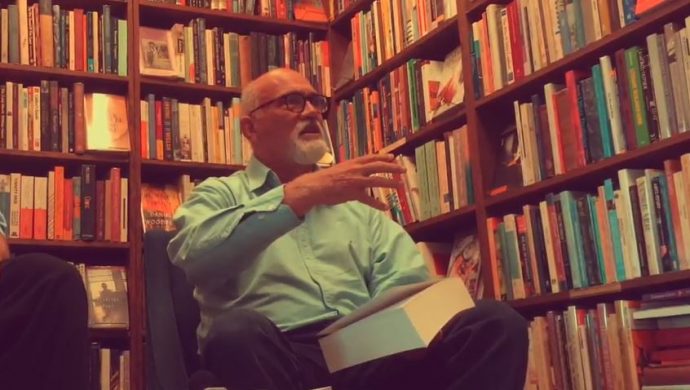
Prof. Anthony Hall. Image credit: Jeremy Rothe-Kushel/ YouTube
By Robin Mathews | American Herald Tribune | December 4, 2017
Freedom of Speech battles in universities often mirror problems in the larger community, and the one being fought at the University of Lethbridge, Alberta, is no exception. It is conducted, on one side, by convinced believers as a response to alleged Anti-semitic positions which have surfaced there and which, the believers think, need relentless, radical, extreme responses. Conversely, the conflict looks, to some others, perhaps, as a program to create a huge smokescreen behind which representatives or friends or sympathizers of the State of Israel can attempt to cut off any examination of that State’s activities which might bring it into disrepute. And the quickest method is to brand any adverse references to the accounts of history held by the State of Israel as well as to any of its actions and policies as acts of Anti-semitism.
Forces wishing to dominate and to dictate inquiry and to control “freedom of expression” always seek to repress certain kinds of knowledge, investigation, and expressions of opinion.
In the late 1980s I was proposed for a year’s exchange with a professor in Simon Fraser University’s English Department – at the time dominated by U.S. immigrants holding U.S. citizenship. They rejected my presence at SFU – and were backed belligerently by SFU’s Canadian president who was quoted in the Vancouver Sun saying that he wouldn’t have Robin Mathews on his campus and he didn’t know a university president in Canada who would! (Amusing slander, but slander nonetheless.)
(If William Saywell’s comment sounds like an utterance by present University of Lethbridge president Michael Mahon it may be because both men appear to have fallen to thinking they could dispose of human persons in any way a passing whim suggested … and to make no bones about it!)
The U.S. citizen chair of the SFU English Department wrote me a letter saying that many people in the Department disliked my views on literary and cultural nationalism in Canada and did not want to give me a place at SFU to utter them. That was a ban on free (scholarly) expression. I took it to mean, also, that U.S. citizens intended to decide what Canadians could say to Canadians in British Columbia.
There was a battle. It was long … months and months. The national faculty body (the CAUT) was strong. It declared SFU in violation of academic freedom. At that point, SFU admitted it had lost. The intensity of the battle is hard to think of now – the basis of it is so apparently minor. Reports, however, were that “grown men” at SFU interviewed on the matter almost burst into tears. And, indeed, passions were running so high the SFU Administration asked me if I would teach from the Centre for Canadian Studies rather than from the bent, bleeding, and discountenanced English Department.
That battle was won at SFU for freedom of expression and inquiry! But the personal victory was muted because president Saywell and a few of his closest underlings, I believe, did everything they could in the next years to limit my effectiveness. No surprise. “The fortunes” one might say “of (academic) war”.
At the University of Lethbridge twenty-six-year professorial veteran of Native American Studies, Liberal Arts, Globalization Studies … and more … Anthony Hall has responded with invention, far-reaching research, and creativity to the hugeness of the body of knowledge he has taken as his province. In two large, scholarly, and fascinating works (The American Empire and the Fourth World (2003), and Earth Into Property (2010) Hall traces the oppression and exploitation of the globe’s indigenous peoples since the historic voyage to “the new world” of Christopher Columbus in 1492.
As a result of his wide-ranging research (and travel) Anthony Hall couldn’t fail to see the power and to observe the participation of the U.S.A. in what he names “imperial globalization”. Nor could he evade the intimate ties between the State of Israel and the U.S.A. Nor, of course, could he fail to see the huge influence the State of Israel has upon U.S. policy in the Middle East (a region populated with indigenous peoples, like the Palestinians).
He is, moreover, a scholar who believes genuinely that no subject worthy of study can be declared ‘off limits’ – whether Canadian culture and literary nationalism or the complex “Holocaust” in Nazi Germany operated preceding and during what we choose to call The Second World War (1939-1945). Donning the apparel of true scholars everywhere, Professor Hall accepts that there is no historical, scientific, or cultural fact – however apparently sunk in concrete – that cannot be revisited, re-opened, re-weighed, re-examined, reassessed.
Closer to home, professor Hall has paid attention to the rising tide of voices in the U.S.A. and Canada which claims the “official” account of 9/11 (of, that is to say, the destruction of the Trade Towers in New York on September 11, 2001) was, has been, and is the product of a huge Conspiracy by complex powers (involving U.S. government) producing a Conspiracy Theory created to mislead everyone and to place the blame for the event on people of Islam, especially in the Middle East … people, incidentally, who have become, it would seem, ‘by the accident of history’, enemies – in fact – of both the U.S.A. and the State of Israel.
And so … if more and more authentic voices are saying “the official account” of 9/11 was created by government and Secret Intelligence Conspiracy Theorists wanting to pin onto Islam the guilt of 9/11 … a question forces itself forward. If the formally accused did not … then who did organize and carry out the destruction of the buildings of the World Trade Centre (and of the building which, a little later, simply appeared to collapse into rubble without any apparent cause)?
Also, since September 11, 2001 an increasing number of so-called “terrorist” events and attacks have occurred all over the Western World and have (by persistent and often careful and scholarly non government-approved examination) been called by investigators arising in the population “faked events” or what is called “False Flags” undertaken (it is alleged) to terrify innocent Western populations and to condition them to accept “Islam” (in a hundred different forms) as the over-arching enemy of the peace-loving and (mostly) Christian West. In answer to the very active, very numerous, and wholly ‘un-government’ on-going operations and investigations into those “terrorist” events, Anthony Hall has found himself a co-host of “The False Flag Weekly News”.
It is hugely relevant to the whole subject (and especially to Canadians) that in July, 2016, Madam Justice Catherine Bruce in the B.C. Supreme Court declared that an apparent attempted “Islamic Terrorist Event” at the B.C. legislature grounds on July 1, 2013, was, in fact, wholly the work of the Royal Canadian Mounted Police, [a major False Flag event] entrapping socially challenged converts to Islam, counselling them, coaching them, assisting them, giving them money, and delivering them to the terrorist site … and then arresting them as terrorist criminals … caught in the act! For all those who say that people questioning terrorist events are ‘conspiracy theorists’ making up lies – the highly organized RCMP criminal action proves absolutely that at least one State – Canada – has engaged in a major False Flag event in order to slander Islam. It did so employing hundreds of RCMP and millions of dollars of Canadian taxpayers’ funds (during the Conservative government led by Stephen Harper).
Subsequently, in answer to a call for a Public Inquiry into the RCMP, (Liberal) Minister of Public Safety and Emergency Preparedness, Ralph Goodale, responding for the Liberal, Justin Trudeau cabinet, expressed, in effect, approval of organized criminal activity on the part of the RCMP… what he calls in his letter the RCMP’s “major crime technique”. Nowhere in the letter does he refer to the request for a Public Inquiry, instead urging understanding and support for the Force he gives evidence of accepting as a criminal organization….
If the officially declared Islamic men did not plan, organize, and carry out what we call 9/11 … then who did? All possibilities are open for consideration. One of them is that the State of Israel was involved, wanting to influence the U.S.A. towards an aggressive policy in the Middle East. The claim may be completely false. Naturally, the hosts running The False Flag Weekly News, Kevin Barrett and Anthony Hall, would air the possibilities (among many others) on their weekly program. And they did … and, apparently Professor Hall was not unsympathetic to the idea that the State of Israel may have had a hand in the events of 9/11.
Then: in an astonishing event on Friday, August 26, 2016 when Anthony Hall was out of Canada, someone placed a despicable, violently Anti-semitic cartoon on his Facebook Page … completely unknown to Hall. With truly remarkable speed, organizations and individuals, some apparently supporting the State of Israel went to work as if Anthony Hall was wholly guilty of the posting on his Facebook Page. People from outside the University, a few who would normally be thought of as related to the State of Israel in one way or another, pressed upon the University Administration, the police, officers of the Alberta government… and more. (The Alberta government, it seems, has insisted upon keeping secret some of the names of those complaining.)
If one were to suggest the possibility that a carefully staged campaign was unleashed against Anthony Hall, one might not be wrong to so suggest. The University Administration filed a complaint against Hall with Alberta Human Rights. The complaint was rejected. And so the University Administration filed another one.
In an action (some believe) marked by intemperance and folly – without having exchanged a single word with Professor Hall, a senior academic colleague – president Michael Mahon of the University of Lethbridge ordered Hall off every University of Lethbridge campus and suspended him without pay. He did those things while completely ignoring ALL carefully constructed processes within the university for managing complaints against professorial staff. The processes are written into almost every university faculty/administration agreement in Canada and have been honed and improved over many decades.
Slander and libel filled the Lethbridge air to match the wholly unacceptable actions of the University of Lethbridge Administration and Board of Governors. Nonetheless, the national faculty body, the Canadian Association of University Teachers, and the local Faculty Association held firm – the CAUT naming the University of Lethbridge in Violation of Academic Freedom, not a light designation in the university world in Canada. In a court procedure weighing the actions, a little later, the Administration of the university won over neither the judge presiding nor the Alberta government represented at the process.
And so on November 23, 2017, the University of Lethbridge Administration reinstated Professor Hall, lifting all sanctions against him and announcing it would also withdraw its complaint against him to Alberta Human Rights. After fifteen months of attempted Jackboot Justice, the Administration at the University of Lethbridge agreed to use the processes long set up to provide fair and impartial judgements of complaints against faculty members. At one level the return to civility by the University of Lethbridge Administration is a victory for democratic forces in Canada. But at another level its long hold-out, a period filled with injustice to Anthony Hall as well as being filled with violent language and slander, will long remain a scandal in the Canadian Academy.
On the same day – November 23, 2017 – a top B’nai Brith official declared that B’nai Brith is “outraged” at Professor Hall’s full reinstatement which is coupled with the move to due process in the examination of complaints against him.
Canada’s Unraveling Web of Deceit. Terrorism and War Propaganda
By Mark Taliano | Global Research | November 28, 2017
Now that Syria and its allies in the Axis of Resistance have done the world a favour by destroying most of the West’s terror proxies in Syria, the Canadian narrative is falling apart.
In 2016, Prime Minister Trudeau described the terrorists in this manner:
“The so-called Islamic State are terrorists, criminals, thugs, murderers of innocents and children and there’s a lot of labels for them.”[1]
He was right that there are a lot of labels for them. But some labels have been conspicuously absent from the Canadian narrative, and these are the most accurate of all: “proxies”, “assets”, “strategic assets”, “allies”.
These “criminals, thugs, and murderers” are also Canada’s proxies in the Middle East and beyond, and the Canadian government needs to take ownership for its criminality.
Canada’s Public Safety Minister, Ralph Goodale, for his part, recently claimed that chances for rehabilitating these people are “pretty remote”, and that pursuing charges against these people is “difficult”.[2]
Conspicuously absent from Goodale’s explanation of why it is difficult to prosecute these individuals is the previously mentioned stumbling block. If the terrorists are Canada’s assets, as they are, then prosecuting them would necessarily reveal the government’s guilt.
Consider the case of Swedish national Bherlin Gildo.[3] In 2015, Gildo’s terror trial in the U.K. collapsed because the British intelligence agency M16 was supporting the same terrorists that Gildo was reportedly fighting for.
The Canadian government’s web of criminal war propaganda is unraveling at the seams. If the press was free, and not an appendage of the government’s criminal apparatus of deception, more Canadians might be aware of this.
Notes
[1] Bill Graveland, The Canadian Press, “Trudeau: ISIS Just ‘Terrorists’ And ‘Thugs,’ Not A State.” HuffPost, 29 March, 2016.(http://www.huffingtonpost.ca/2016/03/29/trudeau-isis-terrorists-calgary-interview_n_9568642.html) Accessed 27 November, 2017.
[2] Rachel Aiello, Ottawa News Bureau Online Producer,“Chance of reintegrating Canadian ISIS fighters ‘pretty remote’: Goodale.” CTV News, November 26, 2017. (https://www.ctvnews.ca/politics/chance-of-reintegrating-canadian-isis-fighters-pretty-remote-goodale-1.3693559) Accessed 27 November, 2017.
[3] Stuart J. Hooper, “Terror Trial Collapses: Suspect Fighting For MI6 SUPPORTED Fighting Group.”21st Century Wire, 4 June, 2015. (http://21stcenturywire.com/2015/06/04/terror-trial-collapses-suspect-fighting-for-mi6-supported-group/) Accessed 27 November, 2017.
McGill University ignores its real racism problem
By Yves Engler · November 23, 2017
While accusations of student anti-Semitism at McGill draw international headlines, the university administration’s open association with the Jewish National Fund has been ignored.
In the latest iteration of a multi-year smear campaign against Palestine solidarity activists at the university, Canadian Jewish Political Affairs Committee activist Noah Lew cried “anti-Semitism” after he wasn’t voted on to the Board of Directors of the Students’ Society of McGill University (SSMU). At a General Assembly last month Democratize SSMU sought to impeach the student union’s president Muna Tojiboeva. The ad-hoc student group was angry over her role in suspending an SSMU vice president and adopting a Judicial Board decision that declared a Boycott, Divestment and Sanctions resolution unconstitutional.
(After two close votes, in February 2016 a motion mandating the student union support some BDS demands passed the union’s largest ever General Assembly, but failed an online confirmation vote after the university administration, Montreal’s English media and pro-Israel Jewish groups blitzed students. The resolution’s constitutionality was subsequently challenged.)
At the recent General Assembly Democratize SSMU’s effort to impeach the president failed. While they couldn’t muster the two thirds of votes required to oust the non-Jewish president of the student union, Democratize SSMU succeeded in blocking the re-election of two Board of Directors candidates who supported the effort to outlaw BDS resolutions.
After failing to be re-elected to the Board of Directors Noah Lew claimed he was “blocked from participating in student government because of my Jewish identity and my affiliations with Jewish organizations.” His claim was reported on by the National Post, Montreal Gazette, Global Television, as well as Israeli and Jewish press outlets. McGill Principal Suzanne Fortier sent out two emails to all students and faculty concerning the matter while the SSMU Board of Directors established a committee to investigate anti-Semitism. The affair was even mentioned in the House of Commons.
While a great deal has been written about alleged student anti-Jewish attitudes, the McGill administration’s open association with an explicitly Jewish supremacist organization passes with nary a comment. On November 28 McGill’s Associate Vice-Principal Innovation Angelique Mannella is scheduled to participate in a Jewish National Fund networking event called Tech Shuk, which connects Jewish capitalists with Montreal start-ups in a “Dragon’s Den” style competition. But, the JNF is a racist organization. Owner of 13 per cent of Israel’s land, it systematically discriminates against Palestinian citizens of Israel, who make up a fifth of the population. According to a UN report, Jewish National Fund lands are “chartered to benefit Jews exclusively,” which has led to an “institutionalized form of discrimination.” The JNF oversees discriminatory land use policies in Israel outlawed in this country 60 years ago.
In 2004 long-time McGill Principal Bernard Shapiro was the honoured guest at JNF Montréal’s annual fundraising dinner (two years later the then former University Principal was master of ceremonies at the event). The current president of JNF Montréal, Michael Goodman, was a member of the advisory board of McGill ASD (Autism spectrum disorder). In 2014 McGill gave an honorary degree to Marvin Corber. The University’s press releaseannouncing its two honorary degree recipients cited an award Corber received from the JNF. Corber has been a JNF Montréal campaign advisor and chair of its annual fundraising dinner.
While the university administration’s ties to the JNF are a stark example of its racial bias, McGill is also entangled in other more subtle forms of anti-Palestinianism. The Montréal university has a memorandum of understanding with Tel Aviv University, which claims to be on “the front line of the critical work to maintain Israel’s military and technological edge.” McGill also has a partnership with Technion, which conducts “research and development into military technology that Israel relies on to sustain its occupation of Palestinian land.”
In 2012 the estate of Simon and Ethel Flegg contributed $1 million to McGill’s Jewish Studies department partly for an “education initiative in conjunction with McGill Hillel.” But, the cultural organization turned Israel lobby group refuses to associate with Jews (or others) who “delegitimize, demonize, or apply a double standard to Israel; support boycott of, divestment from, or sanctions against the state of Israel.”
Imagine the outcry if a McGill department accepted a large donation to work with an organization that openly excluded Jews and others who “delegitimize, demonize, or apply a double standard to Palestine and fail to recognize Palestinians’ UN enshrined rights.”
It’s time to discuss the McGill administration’s support for Jewish supremacy in the Middle East.
Iran’s UN envoy slams Canada’s double standards on human rights

Canadians protest in support of indigenous women
Press TV – November 15, 2017
A senior Iranian diplomat has blasted Canada for proposing a “politically-motivated” UN resolution on the situation of human rights in Iran, while Ottawa, itself, has long been involved in a broad range of human rights abuses at home and elsewhere.
Iran’s Deputy Permanent Representative to the UN Es’haq Al-e Habib was reacting to a Canada-drafted human rights resolution, which was adopted Tuesday against Iran by the Third Committee of UN General Assembly with 83 votes in favor, 30 against and 68 abstentions.
Speaking during the session, Al-e Habib rejected the document as “politically-motivated” and said “double standards are an integral part of Canada’s foreign policy.”
“We regret that few unscrupulous Governments continue challenging integrity and credibility of the United Nations through pushing for this politically-motivated resolution that only underscores how selective, irrelevant and subjective UN decisions could sometimes become,” he added.
He pointed to some examples of Canada’s non-compliance by its international human rights obligations, including Ottawa’s discriminatory policies against indigenous people and its support for the Israeli regime.
“Ottawa along with very few others in the whole world have consistently and unconditionally supported Israel despite all the gross, abhorrent and systematic violations of human rights committed by that regime. This level of hypocrisy and double standard is mind-boggling,” the Iranian envoy pointed out.
Al-e Habib also referred to Canada’s discriminatory policies against its own indigenous people, adding, “While police brutality, forced disappearances and murder of the indigenous people are well documented, indigenous women and girls continue to suffer from the institutionalized discrimination and violence.”
“Canada should have realized thus far that such a pointless and futile exercise is a disservice to the human rights cause, a harmful measure against the UN human rights mechanisms and a disrespect to the wisdom of the people who closely monitor Canada’s selective stances on human rights situations,” the Iranian envoy said.
Saudi Arabia rights violations
During the session, Al-e Habib also lashed out at Saudi Arabia for supporting the Canada-drafted resolution against Iran, while Riyadh itself has been blatantly violating human rights both at home and in different parts of the world.
The Iranian envoy noted that Saudi Arabia kills more children in Yemen than al-Qaeda, Daesh and al-Nusra put together around the globe, adding, “Saudi regime being a partner in the global fight against terrorism and intolerance is blatant mockery of humanity, human rights, justice and peace.”
“Spending billions of dollars buying beautiful arms and Western public relation corporations cannot hide the real face of Saudi, whose money also fuels sectarianism in the Persian Gulf, Middle East and the world,” he said.
Al-e Habib went on to enumerate some instances of rights violations by Saudi Arabia, including Riyadh’s crackdown on all forms of dissent across the country, particularly in the eastern city of Awamiyah, mainly populated by minority Shia Muslims.
He highlighted the slavery of hundreds of thousands of female migrant workers inside Saudi Arabia, the systemic violation of human rights of minorities there.
The Iranian official also drew attention to the Saudi massacre of thousands of Yemeni civilians during its military campaign against the impoverished country as well as the number of the kingdom’s nationals, who have joined Takfiri terror outfits such as al-Qaeda, Daesh and al-Nusra Front.
Guantánamo Bay victim sues Ottawa for $50 million

Rehmat’s World | November 13, 2017
Djamel Ameziane, an Algerian-born technician, who took refuge in Canada in 1995, has sued the Canadian government for $50 million as compensation for the detention, and physical abuse he suffered during his eleven years imprisonment (2002-2013) at the Guantánamo Bay Zionist torture camp.
Djamel Ameziane was deported to his native country by US authorities in 2013. Ameziane, 50, was never charged or prosecuted for the alleged terrorist activities by US authorities during his eleven years at Guantánamo Bay.
Nate Whitling, an Edmonton lawyer filed the petition in Ontario Superior Court on Monday last week – claiming $50 million in damages, alleging the Canadian government co-operated with the United States while his client was being arbitrarily detained without cause in the notorious American military prison in [occupied] Cuba.
The lawsuit alleges that after being tortured and detained in Kandahar, he was transferred to Guantanamo Bay in February 2002, and that the Americans’ decision to transfer Ameziane was based on information and intelligence obtained in part from the Canadian government.
The lawsuit also alleges that while being held at Guantanamo Bay, Ameziane was subjected to horrific physical and psychological abuses.
It also alleges that Canadian officials arrived at Guantanamo and interrogated Ameziane multiple times, despite being aware of reports of abuse and mistreatment of detainees, and being aware that Ameziane was being held with no charges and no access to legal counsel.
Whitling has said that Ameziane’s case calls for a full-scale public inquiry into Canada’s alleged role in the treatment of innocent detainees held in Guantanamo Bay.
Earlier Whitling represented Omar Khadr, Canadian teenage prisoner at Guantanamo Bay for 15 years, who was paid Canadian $10 million out-of-court by the Canadian government and given a written apology earlier this year.
Listen below to the experiences of three British Muslims kept at Guantanamo Bay for years without prosecution in court for alleged terrorist activities.
Trump holds the line on foreign policy
By M K Bhadrakumar | Indian Punchline | November 13, 2017
For the first time since US President Donald Trump took office, a reality check is possible on the foreign policy platform he espoused during the 2016 campaign. Most of the key elements of that platform faced the litmus test one way or another during his 11-day Asian tour, which concludes today. How does the scorecard look?
On a scale of 10, one can say it stands at 8-9. Trump’s performance through the tour of the 5 Asian states – Japan, South Korea, China, Vietnam and the Philippines – shows that there has been a remarkable consistency in terms of the foreign policies he pledged to deliver if elected as president.
The first key element in the Asia-Pacific context has been Trump’s total rejection of the Trans-Pacific Partnership agreement, which the Obama administration had negotiated. The Asian tour put to test whether he’d hold the line to scrap the TTP. The pressure was immense, led by Japan and Australia, that the TTP should be revived in some form.
But Trump stuck to his ‘Nyet’. In his speech at the APEC summit in Da Nang on Friday, he reiterated that his administration would only seek bilateral trade agreements with the Asian countries. In fact, he let loose a volley on the WTO as well. That leaves Japan to lead a coalition of 11 countries originally a part of TPP – Japan, Australia, Canada, Mexico, Singapore, Malaysia, Vietnam, Chile, Peru, New Zealand and Brunei – to make their own deal.
It is unlikely that the effort to revive the TPP will go very far after Trump made it clear that the US has no interest in it. In any case, the latest development – Canada’s decision last week to pull out as well – virtually means that the efforts to revive the TPP in some form are unraveling.
Now, the TPP was supposed to have provided the vital underpinning for the Obama administration’s containment strategy against China (known as ‘pivot to Asia’.) This brings us to another Trump platform. During the 2016 campaign, it was apparent that Trump had no interest in pursuing a containment strategy against China.
Of course, candidate Trump was highly critical of China. But that was for other reasons – over the issue of trade deficit, currency manipulation, breach of intellectual property rights, market access, taking away US jobs and so on. The criticism continues. But then, Trump intends to sort out the issues directly with the Chinese leadership.
The point is, a containment strategy against China is unviable and unsustainable sans the TPP, but Trump couldn’t care less. The Asian tour has further confirmed his panache for transactional diplomacy, which he thinks is the optimal approach from the perspective of ‘America First’.
Trump is not a grand strategist; nor is he professorial like Barack Obama. He has no time or patience for geopolitics woven onto the tapestry of a comprehensive Asia-Pacific strategy. The Asian tour brings this out very clearly.
Nonetheless, it has been a most productive tour for ‘America First’. In Japan and South Korea he pushed arms exports. He got South Korea to increase its share of the financial cost of maintaining the big US military bases. He has lifted the cap on South Korea’s missile development program. These are in line with his approach to the importance of cost sharing and burden sharing by the US’ allies.
The “state visit-plus” to China was of course the high noon of the Asian tour. Trump wrapped up deals worth $235 billion, which ought to translate as tens of thousands of new jobs in the US economy.
Was he perturbed that China is overshadowing the US as the region’s principal driver of growth in Southeast Asia? Trump’s APEC speech showed no signs of it. He never once berated China’s Belt and Road Initiative. Ironically, he complimented the Chinese leadership for serving the national interests effectively! He didn’t show signs of competing with China for the ASEAN’s friendship, either.
Candidate Trump had shown an aversion toward US interventions in foreign countries except when American interests are directly involved. Indeed, North Korea was the only ‘talking point’ in his agenda.
Incredibly enough, Trump didn’t even mention the territorial disputes in the South China Sea in his remarks at the US-ASEAN summit in Manila earlier today. Instead, Trump’s focus was on economics. He said in the speech:
- We have the highest stock market we’ve ever had. We have the lowest unemployment in 17 years. The value of stocks has risen $5.5 trillion. And companies are moving into the United States. A lot of companies are moving. They’re moving back. They want to be there. The enthusiasm levels are the highest ever recorded on the charts. So we’re very happy about that, and we think that bodes very well for your region because of the relationship that we have. (Transcript)
The most controversial part of Trump’s tour came on Thursday when he was expected to meet Russian President Vladimir Putin but didn’t – apparently due to scheduling difficulties. (Putin later told the Russian media that functionaries will be ‘disciplined’ for the botch-up.) But what stood out was the Trump-Putin joint statement on Syria that was eventually issued on Friday, reflecting Trump’s intention to take Putin’s help in ending the war.
Trump is unwavering that it is in the US’ interests to engage with Putin. This is despite the civil war going on back home where critics are braying for his blood for being ‘soft’ on Russia. We get a glimpse of the classic Trump in his dogged persistence all through that the US and Russia ought to have a productive relationship and Russia’s help is necessary for solving regional and global issues. He rubbed it in in while speaking to the White House press party aboard Air Force One.
Indeed, Trump’s remarks have raised a furious storm in the US with Senator John McCain leading the pack of wolves. Read the transcript of Trump’s remarks on Russia here.
Metis Civilization or Canada Syndrome?
Part I of a 3 Part Series: The Canada Syndrome
By Eric Walberg | Dissident Voice | November 10, 2017
 There seems to be little common ground between Canadian natives and mainstream Canadian society. Canada’s uniqueness in world culture is thanks to its natives, who are regularly trotted out in ceremonies related to international events such as the Olympics, and now featured in the composition of the new Canadian ten dollar bill. But they remain at the bottom of the mainstream pecking order economically. Justice Thomas Berger wrote in 1966: “They began by taking the Indians’ land without any surrender and without their consent. Then they herded the Indian people onto reserves. This was nothing more nor less than Apartheid, and that is what it still is today.” First Nations children in western countries live in Third World conditions, with an estimated 80% of urban Aboriginal children under the age of 6 living in poverty.
In a famous anecdote, Justin Trudeau’s father, Prime Minister Pierre Trudeau, cynically told Marlon Brando when the American actor wanted to discuss native rights: “There are differences in the way we treated our natives,” he said. “You hunted them down and murdered them. We starved them to death.” Trudeau meant actual physical starvation, not just cultural starvation, echoing what the Canadian historian James Daschuk has called “the politics of starvation.” The policy in North America towards natives can be put simply: confiscation of 90% of lands, assimilation and/or death.
John Ralston Saul argues for the “originality of the Canadian project”, that contained elements of a rejection of the Enlightenment project of Europe/the US, which was based on secular rationality and liberal revolution. Canada was never a monolithic nation state, but rather based on consensus, supposedly incorporating the native philosophy of man as part of nature. In A Fair Country: Telling Truths About Canada (2008), he argues that Canada is a “Metis civilization”, not a European one. “We are a blend of Aboriginal and non-Aboriginal, but the driving ideas underneath are the Aboriginal ones.”
Saul argues that Canada was ‘founded’ as a modern nation not in 1867 but in 1701 with the Great Peace of Montreal between New France and 40 First Nations of North America. This treaty, achieved through negotiations according to Native American diplomatic custom, was meant to end ethnic conflicts. From then on, negotiation would trump direct conflict, it was thought, and the French would agree to act as arbiters during conflicts between signatory tribes. The paradigm is a confederation of tribes, consensus, the Aboriginal circle, “eating from a common bowl”. The treaty is still valid and recognized as such by the Native American tribes involved.
Saul’s claim sounds good, but the fact is most Canadians know nothing about their fellow Canadian natives. Typically, natives are most visible as a large segment of the homeless, especially in Toronto. According to Homeless Hub, a third of homeless, and in some areas up to 90%. Just as Canada and other rich nations face a flood of refugees from third world countries, as a formerly colony, Canada still has to come to terms with its own colonial train wreck.
Canada Syndrome: Stockholm syndrome on steroids
Canada is, in fact, a colonial settler civilization, much like Britain’s other white offspring: South Africa, Australia, New Zealand, and Palestine-Israel, built on ‘ethnic cleansing’; i.e., murder, terror, forced resettlement, outright theft of land, and apartheid. The settlers identified not with the natives, but with their British motherland, blind to the reality they were now part of. A cultural version of the Stockholm syndrome, where the victim identifies with the kidnapper.
There is little ‘Metis’ about Canada, except for the precious treaties, which have been honoured more in the breech. After the dust settled (circa WWII), the results in all the colonies were much the same, with the settlers refusing to acknowledge their criminal behaviour, and grades varying from ‘C’ for New Zealand, to ‘D’ for Canada and Australia, and ‘F’s for South Africa and Palestine-Israel.
South Africa holds a special place in Canadian colonial history. Major General Sir William Otter is revered as the ‘father’ of Canada’s army. He gained his stripes leading a battalion of British troops to oppose the Cree Metis North West Rebellion of 1885 led by Poundmaker and Big Bear. His role in crushing that revolt inspired the Montreal Daily Star to coin the term Otterism as a “synonym for merciless repression.” His next step to fame was to lead a thousand troops of the Royal Canadian Infantry Regiment in the Boer War (1899-1902), when British and colonial troops forced hundreds of thousands of blacks into concentration camps. This prompted King Edward VII to knight him and Canadian Prime Minister Robert Borden to appoint him kapo of Canada’s internment camps during WWI. His grandson, Desmond Morton, a leading military historian, wrote a glowing tribute to him in the Dictionary of Canadian Biography. Desmond is a lifelong NDPer, showing how deep the Canada Syndrome infects even the supposed anti-imperialist socialist in Canada. Only the communists were outspoken anti-imperialists and anti-racists throughout the 20th century, and they suffered the same ‘Otterism’ that the natives did.
Richard Sanders outlines the “settler syndrome” in Press for Conversion! (March 2016) as a much better characterization of them all. It is a “Culture-bound psychosis so deeply rooted in Canada’s mainstream identity, that it remains difficult to remedy.” It is “marked by a loss of contact with reality”, irrational, refusing to acknowledge the devastation wrought in the name of imperialist ideology, in Canada’s case “Canadian exceptionalism”. It is inherently racist, devaluing other cultures, treating them with suspicion, akin to the antisocial personality disorder, as described in Health Canada’s Report on Mental Illnesses in Canada. Mainstream psychiatrists dismiss such bigotry as a cultural problem rather than an indication of psychopathology, but it is clearly both an individual and mass psychological sickness.
It allowed devout Christians to create and enforce the criminal residential school system to wipe out the last traces of native culture. True, natives were starving by the 1920s, and were ‘ripe for the picking’, and the Christian missionaries were given the role of welfare provider before the days of government financed welfare, so the natives had no choice. The churches were really just handmaidens of the imperialist policy and not to be specially condemned.
Recent expressions of repentance for the sins committed on behalf of the colonial regime are welcome but only scratch the surface of meaningful change. The underlying psychosis remains. “Captives of culture-bound psychoses like the Canada Syndrome are ardent nationalists who remain blind to the official myths that have abducted them, … the Stockholm syndrome on steriods”.
‘Real whites’ vs British
By the early 20th century, First Nations and Metis reached their low point: from roughly 2 million, they had been reduced over 90% to 150,000, the same shocking statistic as in the US. Since WWII and especially after 1960, when improved sanitation in reserves and medicare lowered the infant mortality rate, populations have rebounded ten times, to 1,400,685 in 2011, representing 4.3% of the total Canadian population. While physical starvation has abated as a policy, poverty abounds and cultural starvation destroys native languages and traditions. The dominance of western commercial culture continues this slow death.
In 1910, the Chiefs of the Shuswap, Okanagan and Couteau tribes presented (French Canadian) Prime Minister Wilfred Laurier with a letter which looked to the French colonial legacy of the 1701 Great Peace of Montreal.
We speak to you the more freely because you are a member of the white race with whom we first became acquainted, and which we call in our tongue ‘real whites’. The ‘real whites’ we found were good people. They did not interfere with us nor attempt to break up our tribal organizations, laws, customs. Nor did they stop us from catching fish and hunting. They acknowledged our ownership of the country, and treated our chiefs as men.
Little did the chiefs realize what would soon be in store for all natives, with the nice French and maudit anglais Liberals/Conservatives putting their common policy of forcible assimilation into high gear. The Gradual Civilization Act in 1857, and the Indian Act, first passed in 1876, spruced up with amendments in 1920, making compulsory ‘education’ at residential schools, and in 1927, prohibiting natives from hiring lawyers to pursue land claims (repealed in 1951). This paralleled the US policy, but more aggressively, given the larger population of natives proportional to the settler population.
Though population rebounded after WWII, the 60s “Sweep”, the last gasp of this forced assimilation, continued to forcibly take Aboriginal children and placed them in white foster homes within the child welfare system, leading to unstable families and destroying children’s lives.
Oka, Ipperwash, Gustafsen, Caledonia
Laurier bitterly disappointed native leaders, as the “real white” influence in Canadian politics had given way to British colonialism after 1763. There were never massacres on the scale of Wounded Knee, but after 300 years, there is little evidence of the claim that Canada was any better than the US in its relations with the natives. There is little to differentiate the provinces in their relations to natives. The most visible conflict in Quebec in recent times was at Oka in 1990, in Ontario at Ipperwash in 1995, and in BC at Lake Gustafsen, also 1995. There are road blockades across Canada continually going up to protest encroachment on lands claimed by natives as part of broken treaties, or in the case of BC, promises to land that were never formalized.
Tecumseh
 There are heroes who fought for rights — Tecumseh, Joseph Brant, Louis Riel — all tragic. Brant holds a special place for Canadians in southwestern Ontario, for the agreement he inspired and signed in 1784, made famous by its promise of ‘six miles deep’, meaning the land on both sides of the Grand River. These Six Nations (Mohawk, Oneida, Cayuga,Seneca, Onondaga,Tuscarora) unified under the Great Tree of Peace. During the American Revolution, (native) Captain Joseph Brant led many from the Iroquois Confederacy to ally with the British.
For their loyalty to the Crown, the Six Nations were deeded a tract of land along the Grand River. But, as happened to all the other Nations (there are 50 distinct nations and 614 First Nations bands), most of the land would be stripped from them, reduced to present 46,000 acres of what the federal government calls the “Six Nations Reserve No. 40”, including the village of Ohsweken, between the cities of Brantford, Caledonia, and Hagersville.
Eric Walberg is a journalist who worked in Uzbekistan and is now writing for Al-Ahram Weekly in Cairo. He is the author of From Postmodernism to Postsecularism and Postmodern Imperialism. His most recent book is Islamic Resistance to Imperialism.
Featured Video
Theodore Postol: Iran’s Missiles & Drones Were Underestimated
or go to
Aletho News Archives – Video-Images
From the Archives
What is the Israeli Lobby in Australia Doing in Interfaith Dialogue?
By Ali Kazak | Dissident Voice | October 11, 2015
For years Israel and its lobby around the world have been trying to normalise their relations with Arabs and Muslims without solving the Palestine Question.
One of the methods they resorted to in the last few years is using human rights and community organizations such as interfaith dialogue and Multiculturalism to achieve this objective and to: isolate the Palestinians, marginalise the Palestine question, end Israel’s isolation, and prevent criticism of Israel, knowing that these organisations will be the first to stand against Israel’s violations, racial and religious discrimination.
The group responsible for this task in Australia is The Australia/Israel & Jewish Affairs Council (AIJAC); its Director of International & Community Affairs, Jeremy Jones is in charge of lobbying religious community organizations, specifically Muslims and Christians. Consequently he convened the Faith Communities for Reconciliation, founding participant in the Australian Partnership of Religious Organisations and the Australian National Dialogue of Christians, Muslims & Jews.
AIJAC is a private political propaganda group. It is recognised as the main Israeli lobby in Australia. It coordinates its activities and works intimately with the Israeli embassy in Canberra and different institutions in Israel. It is privately funded by some Jewish businessmen. It monitors closely Australian politicians, the media, ethnic and religious groups, (especially Arabs and Muslims), unions and academics on their stands towards Israel and the Palestine question. … continue
Blog Roll
 Aletho News
- Iran’s friends are about to make life much more difficult for Israel and the US
- The war of liberation of the Arab and Islamic peoples expands across the Gulf
- Envoy warns UN on Trump’s threat to ‘obliterate’ Iran’s civilian infrastructure
- The Larak Corridor: Iran’s Rial Gate With No US, No Israel, and No Way Around
- ‘Economic terrorism’: Steel facilities hit again in US-Israeli strike
- ‘War Crime’: Iran condemns attacks on Arak, Ardakan nuclear sites
- Two-thirds of Americans want quick end to Iran war even if goals unmet
- Trump to Give “Important Update on Iran” Wednesday in Prime-Time Speech
- Theodore Postol: Iran’s Missiles & Drones Were Underestimated
- Iran To Target Military Industrial-Tech Complex That Facilitated Gaza Genocide
- If Americans Knew
- Israel wants US to bomb more of Iran’s civilian structures (113,000 is not enough) – Not a ceasefire Day 173
- Ann Coulter Rips Into Fox News for Iran War Coverage
- Joe Kent Urges Americans To Call White House and Congress To Object To Sending Troops Into Iran
- DNC Resolution to Reject AIPAC Funding Puts Democratic Leaders in the Hot Seat
- Swedish foundation to build 400 schools as over 650,000 Gaza children remain without education for 2 years
- Israeli army admits photshopping image of slain Lebanese journalist
- This is how Israel is systematically killing health workers under the cover of war in Lebanon
- Carrying life under fire: Israeli invasion of Lebanon leaves pregnant women facing deadly risks
- Champagne all around for the new death penalty (for Palestinians) law – Not a ceasefire Day 172
- Why are Palestinian books struggling to be seen on Amazon?
- No Tricks Zone
- New Study Finds Warming Saves Lives…Cold Temperatures 12 Times More Deadly Than Excess Heat
- German Science Blog Accuses PIK Climate Institute Of Hallucinating Climate Tipping Points
- Devastating Assessment Of Comirnaty Vaccine By Former Senior Pfizer Europe Toxicologist
- New Study: CO2 Is ‘Effectively Negligible’ As An Explanatory Climate Change Factor Since 2000
- Former Pfizer Toxicologist Dr. Helmut Sterz Tells Bundestag Hearing Pfizer Vaccine Should Have Never Been Approved
- Energy Expert: Germany’s Nuclear Phaseout Was A “500 Billion Euro Mistake”
- New Research: South Australia’s Mid-Holocene Sea Surface Temperatures Were 4°C Warmer Than Today
- Storing Green Energy To Last Germany 10 Days Would Require A 60-Million Tonne Battery
- New Studies: UK Sea Levels Were 4 Meters Higher Than Today During The Mid-Holocene
- Destructive Green New Deal: German Energy And Metal Group Warns Of Drastic Crisis
 Aletho News