Who do you trust when it comes to NDP leadership candidates?
By Yves Engler · August 18, 2017
Like bears attracted to spawning salmon, politicians seek out power. The former needs to build stores of fat to survive the winter, while the latter must attract the resources and support necessary for successful electoral campaigns. Given the survival imperative, neither bear nor politician should be criticized too harshly for what comes naturally. But, the two best ways to judge politicians are by taking a look at whom they choose to gather resources from and what they are prepared to do to get them.
At worst politicians pander to society’s wealthiest and reactionary social forces, further solidifying their grip on the economic and political system. At best they seek out progressive grassroots and labour organizations, collecting the necessary resources from ordinary people while amplifying their influence.
It’s within this context that one should understand Ontario MPP Jagmeet Singh’s trip to Israel with the Centre for Israel and Jewish Affairs. At the start of the year the current NDP leadership candidate took an organized trip there and met to discuss it with Galit Baram, Israel’s consul general in Toronto.
The trip and meeting were most likely aimed at allaying particular concerns since in early December Singh was the only member of the Ontario legislature to speak out against a provincial vote to condemn the Boycott, Divestment and Sanctions movement. He criticized a CIJA-backed motion supporting the spurious “Ottawa Protocol on Combating Anti-Semitism” and rejecting “the differential treatment of Israel, including the boycott, divestment and sanctions movement.”
When speaking to NDP members recently Singh has repeatedly highlighted that move rather than the CIJA trip or consular visit. Similarly, Singh published eleven tweets about Palestine on July 16. In the best of the lot he stated: “3 yrs ago today the 2014 Gaza War made headlines when 4 Palestinian boys were killed by an Israeli military strike while playing on a beach” and “I stand for Palestinians’ right to freely determine their political status & pursue their economic, social & cultural development.” In response to two questions Independent Jewish Voices and Canadians for Justice and Peace in the Middle East submitted to NDP leadership candidates Singh said, “I would consider supporting the use of targeted sanctions against Israel” and “I would support mandatory labeling of products originating from Israel’s colonies, and excluding these products from the benefits of CIFTA [Canada Israel Free Trade Agreement]. I am also open to considering a ban.”
(In assessing Singh’s responses to their Middle East policy questionnaire IJV gave him a B for third place while CJPME ranked him second with an –A. Niki Ashton received an A+ from both IJV and CJPME.)
Singh clearly wants average NDP members to think he’s opposed to Israeli violence and supportive of Palestinian solidarity activism. Simultaneously, however, he wants to signal to CIJA and Israeli officials that he’ll play ball.
The Palestinian question is particularly tricky for the Brampton-based politician. With some claiming that his open (Sikh) religiosity is a liability in Québec, Singh’s path to becoming leader is largely contingent on convincing members he’s best positioned to expand NDP support among the young and communities of colour. But, younger and darker NDP members/sympathizers largely oppose the current NDP leadership’s de facto support for Israeli expansionism/belligerence. A February poll found that only 17 per cent of Canadian millennials had a positive opinion of the Israeli government versus 37 per cent of those 65 plus. I’m not aware of any Canadian polling by ethnicity on the subject, but US polling provides a window into attitudes here. According to a July Newsweek headline: “Young, Black and Latino Americans Don’t Like Israel” (after the invariable push back the headline was changed to “Why More Young, Black and Latino Americans Than Ever Before Don’t Like Israel”).
To the extent that Singh can rally younger and ethnically diverse folks to the party it would tend to push the NDP towards Palestinian solidarity. On the other hand, Singh is the preferred candidate of much of the party establishment and his candidacy is heavily media-driven. The dominant media and NDP hierarchy are generally hostile to discussing Canada’s complicity in Palestinian dispossession.
At the first six leadership debates there wasn’t a single question related to the NDP’s position on Palestine. While the party hierarchy refuses to debate it, the NDP actually devotes significant energy to the subject. During the 2015 federal election the NDP ousted as many as eight individuals from running or contesting nominations because they defended Palestinian rights on social media. Last year NDP foreign critic Hélène Laverdière spoke at the American Israel Public Affairs Committee’s (AIPAC) annual conference in Washington and traveled to Israel with Canada’s Governor General where she attended a ceremony put on by the explicitly racist Jewish National Fund (Laverdière is backing Singh for NDP leader). Many party officials – 20 federal NDP MPs, according to a 2014 iPolitics calculation – have gone on all-expense paid trips to that country with an Israeli nationalist organization.
So, party representatives can travel halfway across the globe to investigate the conflict and individuals chosen by local riding associations can be removed for their opinions on the issue, but the subject doesn’t warrant debate.
If Singh wins the leadership will he expend the energy needed to shake up the established order on this issue?
‘Free trade’ has come to mean powerful interests get whatever they want
By Yves Engler · August 8, 2017
“Free trade” has become a euphemism for “whatever power wants,” no matter how tangentially tied to transferring goods across international borders.
In an extreme example, Ottawa recently said its Free Trade Agreement (FTA) with Israel trumps Canada’s Food and Drugs Act since accurately labelling two wines might undermine a half-century long, illegal, military occupation.
Of little connection to international trade, the North American Free Trade Agreement — and subsequent FTAs — has granted foreign corporations the ability to bypass domestic courts and sue governments in secret tribunals for pursuing policies that interfere with their profit making. Over 75 cases have been brought before the Investor State Dispute Settlement section of NAFTA, which has resulted in tens of millions of dollars paid to companies impacted by Ottawa banning the export of toxic PCB wastes or the import of suspected neurotoxin gasoline additive MMT.
Strengthening this dynamic, Canada’s “free trade” deal with the European Union (CETA) empowers companies to sue municipalities if they expand public services. For instance, a municipality unhappy with private water delivery could face a suit if they tried to remunicipalize (or de-privatize) this service.
CETA, TPP, WTO and other self-described “free trade” agreements also extend patent and copyright protections (monopolies), which stifle competition, a pillar of free trade ideology. CETA’s increased patent protections are expected to drive up already high Canadian pharmaceutical drug costs by between $850 million and $1.65 billion a year. Negotiations to “modernize NAFTA” could end up granting big pharma perks that would effectively block Canada’s ability to set up universal pharmacare. Similarly, the yet to be signed TPP strengthens patents and would increase the length of copyright in Canada from 50 to 70 years after the death of an author.
It is little exaggeration to say politicians have come to employ the term “free trade” to mean “whatever powerful corporations want.” But, the Trudeau Liberals recently broadened the term’s definition even further. In a move to make “free trade” mean “whatever powerful interests want,” they announced that Canada’s FTA with Israel supercedes this country’s Food and Drugs Act.
After David Kattenburg repeatedly complained about inaccurate labels on two wines sold in Ontario, the Canadian Food Inspection Agency (CFIA) notified the Liquor Control Board of Ontario (LCBO) that it “would not be acceptable and would be considered misleading” to declare Israel as the country of origin for wines produced in the Occupied Palestinian Territories. Quoting from official Canadian policy, CFIA noted that “the government of Canada does not recognize Israel’s sovereignty over the territories occupied in 1967.”
In response to pressure from the Israeli embassy, Centre for Israel and Jewish Affairs and B’nai Brith, CFIA quickly reversed its decision. “We did not fully consider the Canada-Israel Free Trade Agreement,” a terse CFIA statement explained. “These wines adhere to the Agreement and therefore we can confirm that the products in question can be sold as currently labelled.”
In other words, the government is publicly proclaiming that the FTA trumps Canada’s consumer protections. But, this is little more than a pretext to avoid a conflict with B’nai B’rith, CIJA and Israeli officials, according to Canadian Centre for Policy Alternatives Trade and Investment Research Project director Scott Sinclair. “This trade-related rationale does not stand up to scrutiny,” Sinclair writes. “The Canadian government, the CFIA and the LCBO are well within their legal and trade treaty rights to insist that products from the occupied territories be clearly labelled as such. There is nothing in the CIFTA [Canada–Israel FTA] that prevents this. The decision to reverse the CFIA’s ruling was political. The whole trade argument is a red herring, simply an excuse to provide cover for the CFIA to backtrack under pressure.”
In another commentary on the government “backtracking under pressure,” Peter Larson points out that CIFTA grants Israel an important concession that seeks to sidestep Canada’s commitments under international law. The agreement says, “unless otherwise specified, ‘territory’ means with respect to Israel the territory where its customs laws are applied,” but omits “in accordance with international law,” which is in many of Canada’s other free trade agreements. This omission seeks to allow goods produced on land occupied in contravention of the 4th Geneva Convention and Statute of Rome to benefit from CIFTA.
David Kattenburg and his lawyer Dmitri Lascaris will be challenging CFIA’s decision in court. On Monday they filed an appeal of the wine labelling and released a statement to the media.
The Council of Canadians and Canadian Centre for Policy Alternatives have recently added their voices to those criticizing CFIA’s decision. The NDP’s trade critic has yet to comment.
Kattenburg and Lascaris’ court challenge offers NDP leadership candidates Niki Ashton, Charlie Angus, Guy Caron and Jagmeet Singh a good opportunity to express their opposition to defining “free trade” as “whatever power wants.”
Kenya deports 1 American and 1 Canadian for election meddling
By Ricky Twisdale | The Duran | August 6, 2017
Kenya has decided it doesn’t need western assistance to ensure it has “free and fair” elections.
The African country is holding a national vote for president, deputy president, and parliament on 8 August.
But the election will have to go forward without the help of two foreign advisors.
John Phillips, a US citizen and chief executive of political consultancy Aristotle, and Canadian citizen Andreas Katsouris, a senior executive at the same firm, were arrested on Friday and deported from Kenya on Saturday, according to Reuters.
The two men were providing political consulting services to opposition presidential candidate Raila Odinga and his National Super Alliance party. Polls show Odinga and incumbent president Uhuru Kenyatta neck-in-neck in the race for the Kenya State House.
Kenya’s last two presidential elections were marred by violence and charges from the losing side of vote rigging. Unrest following the 2007 vote left hundreds dead.
Here’s more from the Reuters report regarding the arrests of Phillips and Katsouris:
“They handcuffed me and put me in the hatchback of a car,” Phillips said by phone from Frankfurt.
Katsouris said they were manhandled after the police arrived.
“One man had a picture of me on his mobile phone,” he said, speaking by phone from Delft, the Netherlands. “Another guy grabbed me by the arm and grabbed my glasses from my face.”
After being bundled into separate cars they were driven around for several hours, while being questioned, and then taken to holding cells at the airport, they said…
Phillips said one of Aristotle’s jobs was to monitor the transparency of the election. The two had been in Kenya for around two months and were doing polling, data analysis and monitoring the election process…
Interior ministry spokesman Mwenda Njoka said via a text message on Sunday that Phillips and Katsouris had “contradicted the terms of their visa”. When asked how, he replied “ask them”.
Whatever Kenya’s political problems, it appears Nairobi doesn’t believe US-Canadian meddling in their elections is the way to solve them.
Kinsella’s silence on JNF racism speaks loudly
By Yves Engler · July 26, 2017
What do you call someone who says they head an antiracist organization, but claims to be ignorant of an explicitly racist institution they’ve publicly defended? I have no idea, but I do know Warren Kinsella confirmed the central point of my recent article titled “The Left’s racism problem concerning Israel”.
In a series of threatening emails to the editor of Dissident Voice in response to my article the former advisor to Olivia Chow’s mayoral bid wrote: “These statements are wildly defamatory. They are false and malicious in their plain and ordinary meaning. They are calculated to damage my reputation in the eyes of the community. The fact is, I presently help lead an anti-racist organization and have received death threats as a result. I have ‘ties’ to no other. I have been involved in anti-racism work for more than three decades. I oppose hate against all people, in all of its myriad forms. To state that I support or condone ‘explicit racism’ is a disgusting, appalling lie.”
I responded by saying: “While I appreciate your anti-racism work in certain areas, the point being made in the article claimed to be libelous is that you, in fact, do not condemn all forms of racism, specifically anti-Palestinian racism as conceived and carried out by the Jewish National Fund. I can find no record of you condemning or even criticizing the Jewish National Fund’s structural racism. On the other hand, you have condemned and criticized those who do.
If you do oppose all forms of racism, specifically including that of the Jewish National Fund, please let me know and I will apologize unreservedly to you and correct the article in question. If, on the other hand, you do not believe the Jewish National Fund is racist, or you are simply unwilling to condemn or criticize it, then I must stand by my words in the article.”
And here is where things became interesting. Kinsella responded to my email by stating “I don’t even know what the JNF is. I have nothing to do with it. …”
Claiming to have been involved in antiracism work for three decades, Kinsella says he’s ignorant of the only (to my knowledge) explicitly racist institution sanctioned by the Canadian state to give tax write-offs. It is not like the JNF is some marginal group. The century-old organization’s eleven offices across Canada raised $75 million over the past three years and the sitting prime minister spoke to the organization in 2013.
While he now denies knowledge of the registered charity, last year Kinsella derided a resolution calling on the Canada Revenue Agency to rescind the JNF’s charitable status because of its “discrimination against non-Jews in Israel.” Additionally, in the late 2000s Kinsella sat on the board of directors of the Canada-Israel Committee, whose personnel were often close to the JNF.
Why would someone who claims to be an antiracist activist be unwilling to criticize an organization that practices discriminatory land-use policies outlawed in this country six decades ago?
Palestinians, B’nai Brith and Canada’s New Democratic Party
Niki Ashton injects vital ideas and principles into the NDP leadership campaign

Niki Ashton. Image credit: Matt Jiggins/ flickr
By Prof. Tony Hall | American Herald Tribune | July 24, 2017
Like many NATO countries, Canada has suffered from an impoverishment of free and open debate when it comes to the issue of relations with the Israeli government and the Palestinian people. In country after country the Israeli lobby dominates not only governing parties but opposition parties as well.
The Canadian Parliament has epitomized the pattern. Elected federal officials have conspicuously failed to reflect the anxieties felt by many Canadians of conscience who have managed to become well informed on Palestinian-Israeli relations. There has been little in Canadian parliamentary debates or in mainstream media reports to reflect the views of those most attuned to the unmitigated suffering of Palestinian people under the jack-booted authoritarianism of Israeli domination.
In recent years the Liberals and Conservatives and the New Democrats (NDP) have maintained a blind eye towards Israeli assaults on the Palestinian people especially in Gaza and in the Occupied Territories seized through Israeli conquest a half century ago. Typically Canadian parliamentarians parrot one another across party lines on the sanctity of the “Israeli right of self-defence.” Concurrently our elected representatives mostly fail to notice that Palestinians share with all peoples a basic human right to protect themselves against systematic bouts of dispossession, disempowerment, mass incarcerations, and industrial-scale military murders sometimes heartlessly described as “cutting the grass.”
In 2016 Liberal Prime Minister Justin Trudeau joined with the Conservative Party of Canada in backing a motion to condemn all groups and individuals supporting the Boycott, Divestment and Sanctions movement aimed at penalizing Israel for its anti-Palestinian infractions. Only one federal party, the diminutive Bloc Québécois, has openly argued that “the BDS campaign constitutes legitimate criticism of Israeli policies.”

Tom Mulcair. Image credit: United Steelworkers/ flickr
In the prelude to the federal election of 2015 Tom Mulcair, the leader of the party that is supposed to embody Canadian social democracy, highlighted his own attachment to Zionist extremism by purging the New Democratic Party of federal candidates who expressed support for Palestinian rights. For Mulcair, those seeking to represent the NDP under his leadership were punished for noticing that the United Nations agencies had accused the Israeli Defence Force of “war crimes” in the military invasions of Gaza in 2009 and 2014.
The NDP’s venerable veteran parliamentarian, Libby Davies, was an early casualty of Tom Mulcair’s marked bias in taking sides in the Israeli-Palestinian conflict. Other casualties included Morgan Wheeldon, Jerry Natanine and Paul Manly, the son of long-serving NDP parliamentarian and United Church clergyman, James Manly. The son’s alleged crime was to have called for the release of his father from custody after the elder Manly was arrested in a Finnish ship carrying humanitarian supplies through the Israeli-enforced blockade encircling Gaza.
B’nai Brith Canada versus NDP Leadership Candidate, Niki Ashton
Is the conformist complacency in the glum parliamentary proceedings concerning Palestine and Israel about to come to an end? Perhaps that change will occur if a spark of controversy in the NDP leadership race ignites wider debate on such crucial issues of Canadian public policy.
The contest to replace Tom Mulcair is showing signs of vibrancy that began with a clash of interpretations pitting NDP leadership candidate Niki Ashton’s pro-Palestinian politics against B’nai Brith Canada. B’nai Brith Canada is the local extension of the US and Israeli-based Anti-Defamation League of B’nai B’rith.
Ms. Ashton represents a huge and largely Aboriginal riding in the northern part of the Canadian province of Manitoba. As many see it, Ms. Ashton’s convictions concerning the importance of Palestinian rights are a natural extension of her representation in Parliament of so many Indian and Metis people. In both Canada and the Middle East, Indigenous peoples share similar perspectives on the incursions of newcomers bent on asserting ownership and control over their Aboriginal lands.
The conflict between Niki Ashton and B’nai Brith Canada has much to do with how disparate perceptions of history impinge on contemporary politics. The nub of the current dispute has to do with Palestinian perceptions of the founding acts of the new Jewish state in 1948 as a “catastrophe,” as the “Nakba” in Arabic. The Palestinian view of the Nabka is very close to the Jewish perception of the Shoah. Shoah is the Hebrew term to identify the disaster engulfing European Jewry during World War II.
In 1998 Yasser Arafat instituted May 15 as Nakba Day. The timing was meant as a response to the annual commemoration on May 14 of the Israeli Declaration of Independence. As many Palestinians see it, the founding of Israel led to the initial violent displacement of about 700,000 of their people, almost half of the Palestinian population at that time.

The horror of the Israeli military assault was epitomized by the murderous atrocities committed at Deir Yassin of the Irgun and Lehi militias. Led by a future Israeli prime minister, Menachem Begin, Irgun and Lehi had been instrumental in displacing the British administrators of colonial Palestine through a hugely publicized act of international terrorism at the King David Hotel in Jerusalem in 1946.
In reflecting on this history, NDP leadership candidate Niki Ashton announced on her Facebook page,
For more than 60 years, Palestine has been struggling to simply exist. Many in our country have been fighting in solidarity for many years. This week in Montreal I was honoured to stand with many in remembering the Nakba. It was also powerful to join many at a rally in solidarity with those on hunger strike in Palestine today. The NDP must be a voice for human rights, for peace and justice in the Middle East. I am inspired by all those who in our country are part of this struggle for justice.
Michael Mostyn, the CEO of B’nai Brith Canada, responded as follows to Ms. Ashton’s actions and comments. In a Toronto Sun opinion piece Mr. Mostyn observed,
The re-emergence of the Jewish State in 1948 is a miraculous story of indigenous survival and resilience, not a “catastrophe” to be mourned.
Mr. Mostyn’s rejection of the Nakba narrative harkens back to many similar divergences when it comes to the position of Indigenous peoples on a variety of commemorations in the colonized world. Not surprisingly, Native groups often have severe problems and reservations when they are asked to join in anniversary celebrations of, say, 1492, or 1776, or 1867.

Michael Mostyn doing in interview with Christina Stevens, 2016. Image courtesy of Twitter
Not satisfied to stop at insisting that the founding of the Jewish State must be universally embraced, even by the Palestinians, as a “miraculous” event to be lauded, he goes on to attempt to turn the tables on groups he clearly sees as classes of criminals. Mr. Mostyn thereby seeks to transform the Palestinian memory of the Nakba into the lionization of an Israeli military campaign to clear aside the human obstacles to Israeli ascendance. He writes,
Had Jewish forces not prevailed [in 1948], the likely result would have been another genocide of the land’s Jewish inhabitants, just after the Holocaust, by invading Arab armies who had sworn to exterminate them.
In a news item on B’nai Brith Canada’s own web site Mr. Mostyn adds
To suggest that we should commemorate and mourn the Arab world’s inability to successfully commit a genocide against the Jewish people is beyond comprehension.
In her Facebook post Ms. Ashton combined her comments on the Nakba with a reference to Palestinian hunger strikers currently making their stand throughout the elaborate Israeli prison system. Mr. Mostyn treats this act of protest with contempt. He accuses Ms. Ashton of joining in solidarity with “convicted murders,” with her “advocating for vile terrorists.” The B’nai Brith CEO fails to mention in his remarks on the hunger strike that many of the thousands of jailed Palestinians are being held for months and even for years under “administrative detention certificates.” They have been jailed but not charged with any crime.
Mr. Mostyn concludes by condemning Ms. Ashton as the possessor of “a defective moral compass.” He asserts
Ms. Ashton’s comments are a shocking and insulting departure from the traditional position of her party and those of mainstream Canadians…. Every Canadian, and every honest NDP supporter, should be shocked by Ashton’s ignorance, callousness, and blatant double-standards… Her ignorance as to the reality of the situation in Israel, particularly when it comes to the hunger strike of convicted murderers, is alarming from someone aspiring to be leader of this country.
Who Is Out of Step with the Opinions of Mainstream Canada?
Yves Engler has closely studied the controversy and concluded that it has worked in the favour of Niki Ashton’s leadership campaign and against the credibility of B’nai Brith Canada. He observes that the B’nai Brith backed down once it realized that its interest in Ms. Ashton’s politics was feeding a broader discussion rather than discrediting its target. Engler writes,
Their silence on Ashton’s recent moves is deafening. B’nai B’rith is effectively conceding that their previous attacks backfired and they now fear drawing further attention to Ashton’s position since it would likely strengthen her standing among those voting for the next NDP leader.
Reflecting on the experience Engler observes,
The first ever pregnant major party leadership candidate in Canadian political history has gained this support by speaking truth to power and taking a principled position on an issue most politicians have shied away from. And, she has demonstrated that the purpose of Israeli nationalist attacks is to silence them, not to have a debate. In fact, real debate is what organizations like B’nai B’rith fear the most because the more people know about Israel and the Occupied Territories, the more they support the Palestinian cause.
https://electronicintifada.net/content/why-canadas-ndp-supporting-israeli-racism/20576
http://www.huffingtonpost.ca/yves-engler/ndp-foreign-policy_b_15430872.html
The injection of Israeli and Palestinian issues into the NDP leadership campaign is a promising development that is attracting considerable attention domestically and internationally. This turn of events holds out the promise of bringing the parliamentary facet of Canadian social democracy more into line with the existing Middle East policies of agencies like the United Church of Canada, the Canadian Union of Postal Workers, the Confédération des syndicats nationaux, the Canadian Labour Congress and student groups like the Canadian Federation of Students-Ontario.
The enthusiasm generated by open debate is proving to be infectious. About 80 prominent academics and community activists have come up with an open letter urging the NDP to formulate a more balanced, enlightened and intelligent Middle East policy. Among those who signed the document are Noam Chomsky and former UN special rapporteur on Israel-Palestine, Prof. Richard Falk. The letter concludes with a list of proposals indicating,
WE propose that the New Democratic Party of Canada commit to the following, both in opposition and in government:
1. condemning Israeli settlements as a violation of international law and as an impediment to a just resolution;
2. calling upon the State of Israel to halt any further settlement construction, respect the political and civil rights of its Palestinian citizens, pursue a fair solution to the plight of Palestinian refugees, lift its blockade on Gaza and end its military occupation of the Palestinian Territories;
3. calling upon legitimate representatives of the State of Israel and the Palestinian people to negotiate in good faith a just resolution that respects the spirit and intentions of UNGA Resolution 194 and UNSC Resolution 242;
4. pursuing and supporting the use of diplomatic and economic means to exert pressure on the State of Israel in such a manner as to achieve a just resolution. This includes:
> using Canada’s stature and position in the international community to push for meaningful progress on the topic of Israel and Palestine
> renegotiating the Canada-Israel Free Trade Agreement in such a manner as to divert from the Canadian market any product made in Israeli settlements
> suspending security trade and cooperation between Canada and Israel indefinitely and until the Gaza siege is lifted, the occupation ends and a just peace is achieved
> revoking the tax-exempt status of any organization operating within Canada that is known to financially support or benefit from Israel’s military occupation
> requesting that the International Criminal Court give greater attention to the situation in Israel and Palestine
> recognizing the State of Palestine
B’nai Brith Canada accuses Ms. Ashton of making “a shocking and insulting departure from the traditional position of her party and those of mainstream Canadians.” Yves Engler and others conclude otherwise. They allege it is B’nai Brith Canada that is increasingly out of step with mainstream opinion of well informed Canadians.
I agree. Certainly I continue to be dismayed at B’nai Brith Canada’s deployment of the hate speech deceptions of Joshua Goldberg in the initiation of a campaign of smear and disinformation against me. The campaign began with a publicity stunt based on the planting on my Facebook wall of a reprehensible Facebook post whose origins go back not to me but to Joshua Goldberg and quite possibly to B’nai Brith Canada and related agencies.
Some explanations are in order from the responsible parties. The time is past when Mr. Mostyn can play the victim card when the B’nai Brith is so deeply implicated in hate speech victimization of others. To accuse an attractive and rising social democratic politician like Niki Ashton of “advocating for vile terrorists” is a blasphemy of a high order. Taking the side of oppressed groups over the side of their oppressors is not only legitimate but laudable in the context of these dangerous times through which we are living.
Wine and the Canada-Israel Free Trade Agreement
By Yves Engler | Dissident Voice | July 24, 2017
Two weeks ago the worst fear of Canadian opponents of neoliberal ‘free trade’ agreements came true.
Surprisingly, there has been almost no reaction from the political parties, unions, and other organizations that warned these agreements would be used to undermine Canadian law, even though this is exactly what happened.
After David Kattenburg repeatedly complained about inacurate labels on two wines sold in Ontario, the Canadian Food Inspection Agency (CFIA) notified the Liquor Control Board of Ontario (LCBO) that it “would not be acceptable and would be considered misleading” to declare Israel as the country of origin for wines produced in the Occupied Palestinian Territories. Quoting from official Canadian policy, CFIA noted “the government of Canada does not recognize Israel’s sovereignty over the territories occupied in 1967.” On July 11 the LCBO sent out a letter to all sacramental wine vendors that stated CFIA’s conclusion that products from two wineries contained grapes “grown, fermented, processed, blended and finished in the West Bank occupied territory” and should no longer be sold until accurately labelled.
But, in response to pressure from the Israeli embassy, Centre for Israel and Jewish Affairs and B’nai Brith, CFIA quickly reversed its decision. On July 14 the government announced that it was all a mistake made by a low level CFIA official and that the Canada-Israel Free Trade Agreement (FTA) governed the labelling of such wine, not CFIA rules. “We did not fully consider the Canada-Israel Free Trade Agreement,” a terse CFIA statement explained. “These wines adhere to the Agreement and therefore we can confirm that the products in question can be sold as currently labelled.”
In other words, the government publicly proclamed that the FTA trumps Canada’s consumer protection laws. And the basis for this dangerous precedent is that the Israel FTA includes the illegally occupied West Bank as a place where Israel’s custom laws apply.
Incredibly, the Green Party of Canada seems to be the only organization that has publically challenged this egregious attack against consumer protections and Palestinian rights. “The European Union and the United States made it clear long ago that goods made in these illegal settlements cannot be mislabelled as ‘Made in Israel’”, said Green Party leader Elizabeth May in a press release. “Why is Canada singling out Israel for preferential treatment at the expense of both Palestinians’ human rights, and the rights of Canadian consumers?”
The Green’s statement points to a startling “Israel exception” by the government as well as FTA critics. I’ve seen no comment from the Council of Canadians or the organization’s trade campaigner Sujata Dey about the Liberal’s announcement that an FTA overides Canadian consumer protections. The same can be said for NDP International Trade critic Tracey Ramsey as well as the Canadian Centre for Policy Alternatives and its Trade and Investment Research Project leader Scott Sinclair. (Since CFIA’s announcement Ramsey and Dey have each posted repeatedly to twitter regarding CETA, NAFTA and other FTAs.) Nor have consumer protection groups such as the Consumers’ Association of Canada or Consumers Council of Canada opposed this attack on the Food and Drugs Act.
But, FTA critics still have an opportunity to join the fight against CFIA’s recent decision. David Kattenburg and his lawyer Dmitry Lascaris are planning a court challenge and their efforts should be supported.
To allow this precedent to pass without challenge the CCPA, NDP and Council of Canadians would be conceding an extremely broad “Israel exception”. Opposing CFIA’s move isn’t akin to backing Palestinian civil society’s (entirely legitimate) call for international Boycott, Divestment and Sanctions until Israel: “Ends its occupation and colonization of all Arab lands and dismantles the Wall; Recognizes the fundamental rights of the Arab-Palestinian citizens of Israel to full equality; and Respects, protects and promotes the rights of Palestinian refugees to return to their homes and properties as stipulated in UN Resolution 194.”
Nor is it a request for Ottawa to bar wines produced on the 22% of pre-1948 Palestine supposed to be a Palestinian state as per official Canadian policy. It is not even necessarily a demand to eliminate the special tariff treatment the Israel FTA currently grants companies based in the occupied territories. It is simply a request to respect Canada’s Food and Drugs Act and label two brands of wine accurately.
Kattenburg explains:
Israel’s self-declared right to sell falsely labeled products on Canadian store shelves should not be allowed to trump the right of Canadians to know what they’re eating and drinking; to know that the fine bottle of ‘Israeli’ red or crispy chardonnay that they just bought was actually not produced from grapes grown in Israel, but rather, in Israeli-occupied, brutally exploited Palestine.
Yves Engler is the author of A Propaganda System: How Canada’s Government, Corporations, Media and Academia Sell War and Canada in Africa: 300 years of aid and exploitation.
US Agrees to Clean Up World War II Mustard Gas Stockpile in Panama
Sputnik – 18.07.2017
The US has come to an agreement with Panama to destroy a stockpile of mustard gas left over from secret human tests conducted by the Americans during and shortly after World War II.
Tiny San Jose Island, with an area of 17 square miles and a permanent population of 10, once hosted a contingent of 200 US soldiers who began conducting chemical warfare testing from 1945 to 1947. Seventy years later, eight mustard gas bombs still remain undetonated on the island, and one Panamanian report claimed that there could be as many as 3,000 other bombs that still haven’t been found.
Panama has repeatedly pushed the United States to destroy the bombs since they were discovered in 2002, and the US only agreed to do so in 2017. Previously, Washington offered to pay for the training of Panamanians to dispose of the bombs, so long as the small Central American republic released the US from liability.
Panama refused and demanded that Washington clean the mess up themselves. As the American government took a hardline stance against the use of chemical weapons during the Syrian Civil War, it became increasingly amenable to the disposal of such weapons it created in decades past.
The disposal will begin in September 2017 and will take six to eight weeks, according to Panamanian officials. It will be overseen by the Organization for the Prohibition of Chemical Weapons.
In a new wrinkle, the Canadian Department of National Defense (DND) has revealed that they may also have mustard gas and other chemical weapons on the island. Ottawa is not going to participate in the disposal of the bombs, according to a statement from Global Affairs Canada, but in the past Canada has denied involvement in the San Jose weapons tests.
In fact, the new DND file notes that most of the mustard gas, as well as roughly 1,000 of the bombs used in the San Jose tests, were Canada-made. Canadian scientists helped design some of the tests, and Canadian pilots flew the planes that dropped chemical bombs during the experiments.
Furthermore, Canada used heavy duty metal shipping containers to transport mustard gas to the island — containers durable enough to have survived 70 years of weathering and decay. Mustard gas decomposes very slowly, especially outside of water, meaning much of the soil in San Jose may be contaminated.
Susan Smith, a professor of history at the University of Alberta and an expert on the use of mustard gas during World War II, said that Canada was a significant participant in the chemical weapons tests on San Jose Island. “This was an area where Canada indeed punched above its own weight,” Smith told the Ottawa Citizen. “Canada has a moral commitment to help clean up the mess it created.”
She added that the San Jose experiments tested how soldiers of different races reacted to mustard gas exposure, with white, Puerto Rican, black, and Japanese soldiers all being exposed.
“It felt like you were on fire,” then-93-year-old Rollins Edwards told NPR in 2015. Edwards served in the US Army during the war and was party to the mustard gas tests. “Guys started screaming and hollering and trying to break out. And then some of the guys fainted. And finally they opened the door and let us out, and the guys were just, they were in bad shape.”
Edwards says he still gets rashes and flaky skin from the chemical burns he suffered 70 years ago.
In 1974, a construction worker on San Jose Island suffered mysterious chemical burns. In 2001, Panama discovered the existence of the chemical weapons and asked Canada to assist in a comprehensive search for bombs in the island’s jungles, but Canada said no.
Most countries who fought in World War II did not use chemical weapons against enemy combatants. The Imperial Japanese did, but only against other Asian nations such as China. The Americans did at one point consider the use of mustard gas against the Japanese in the last days of the war, but opted for atomic weapons instead.
Canada, Panama and the United States are all signatories to the 1992 United Nations Chemical Weapons Convention, which stipulates that all chemical weapons worldwide are to be destroyed. The US government has disposed of 90 percent of its 37,000-ton stockpile of chemical weapons since then.
Canadian court upholds $1.7 billion ruling against Iran
Press TV – July 4, 2017
A Canadian court has accused Iran of supporting terrorism, upholding a previous ruling that requires the Islamic Republic to pay around $1.7 billion in damages to “American victims of terrorism.”
Ontario’s Court of Appeal rejected Iran’s request to reconsider the ruling on Monday night, arguing that doing so would amount to a breach of Canada’s Justice for Victims of Terrorism Act (JVTA).
The JVTA allows victims of terrorism to sue foreign states for damages.
The accusation came despite Iran’s firm response to similar cases in the past, where various American and European courts had taken punitive measures against Tehran over unproven claims of complicity in terror.
The new case was brought by families of American citizens who had been killed in a series of attacks between 1980s and 2002, mostly blamed on Palestinian and Lebanese resistance movements Hamas and Hezbollah.
The families claimed that the Iranian government supported the two organizations and was therefore responsible for their actions.
The complaints were first filed in the US but the claimants turned to Canada after finding out that the Iranian government had more properties and bank accounts there.
A one-story house in Toronto, an industrial building in Ottawa and two bank accounts were among the assets that were sought in the case.
Without offering further elaboration, the court also claimed in its ruling that Iran was seeking to “frustrate” the JVTA’s implementation.
The Iranian government had reportedly told the court that it had immunity in the case. It had also argued that the judgment was against international law and exceeded the maximum damages allowable in Canadian law.
Tehran also argued that the victims had to prove Iran’s role in each attack instead of just repeating the US government’s baseless allegations.
The court said Iran was only immune in terrorism cases that had occurred before January 1985, when Canada’s State Immunity Act was passed.
A recurring trend
Last year, the US Supreme Court ruled that around $2 billion had to be turned over to the American families of the people killed in a 1983 bombing in Beirut and other attacks blamed on Iran.
Likening the act to “highway robbery,” Iran said back then that it would seek reparations.
The trend of the unfair rulings continued in March, when a New York court ordered Iran to pay $7.5 billion in damage to families of victims of the September 11, 2001 attacks and $3 billion to a group of insurers over related claims.
The ruling surprised many since Washington had clearly blamed the attacks on the al-Qaeda terror group and even investigated members of Saudi Arabia’s royal family who had proven ties to the terrorist organization.
Various investigations have revealed that 15 of the 19 plane hijackers involved in the attacks were Saudi nationals and some of them had received large sums of money from Saudi royals.
The ruling lost even more weight in September, after the US Congress passed the Justice Against Sponsors of Terrorism Act (JASTA), clearing the path to sue Saudi Arabia for the tragic death of over 3,000 people.
It was reported in March, however, that a judge in Luxembourg had quietly put a freeze on $1.6 billion in assets belonging to the Central Bank of Iran (CBI) to compensate the 9/11 victims.
The Canadian court’s ruling came days after yet another anti-Iran ruling by a US court, which allowed the American government to seize an Iranian charity’s office tower in New York City over claims that it was used to breach Iran sanctions.
The Ugly Canadian II: Justin Trudeau’s Foreign Policy
By Yves Engler | Dissident Voice | June 30, 2017
When Justin Trudeau looks in the foreign policy mirror who does he see? Someone very much like Stephen Harper.
On the world stage Canada under Trudeau the Second has acted almost the same as when Harper was prime minister. The Liberals have followed the previous government’s posture on issues ranging from militarism to Russia, nuclear weapons to the Gulf monarchies.
Aping the ancien régime’s position, the Liberals recently voted against UN nuclear disarmament efforts supported by most countries of the world. As such, they’ve refused to attend the ongoing Conference to Negotiate a Legally Binding Instrument to Prohibit Nuclear Weapons, Leading Towards their Total Elimination.
Earlier this month the Liberals released a defence policy that calls for 605 more special forces, which have carried out numerous violent covert missions abroad. During the 2015 election campaign defence minister Jason Kenney said if re-elected the Conservatives would add 665 members to the Canadian Armed Forces Special Operations Command over seven years.
The government’s recent defence policy also includes a plan to acquire armed drones, for which the Conservatives had expressed support. Additionally, the Liberals re-stated the previous government’s commitment to spend upwards of one hundred billion dollars on new fighter jets and naval ships.
Initiated by the Conservatives, last year the Liberals signed off on a government-contracted $15 billion Light Armoured Vehicle sale to Saudi Arabia. Trudeau has also maintained the Harper created Canada-Gulf Cooperation Council Dialogue, which is a platform for foreign ministers to discuss economic ties and the conflicts in Syria, Iraq and Yemen. The GCC includes the monarchies of Saudi Arabia, United Arab Emirates, Bahrain, Oman, Qatar and Kuwait, which have almost all intervened in the devastating Saudi-led war in Yemen.
The Trudeau government has continued to isolate Canada from world opinion on Palestinian rights. They’ve voted against numerous UN resolutions supported by almost the entire world upholding Palestinian rights.
The Harper regime repeatedly attacked Venezuela’s elected government and in recent weeks the Liberals have picked up from where they left off. The Liberals have supported efforts to condemn the Nicolás Maduro government at the Organization of American States and promoted an international mediation designed to weaken Venezuela’s leftist government (all the while staying mum about Brazil’s imposed president and far worse human rights violations in Mexico).
In March the Liberals renewed Canada’s military “training” mission in the Ukraine, which has emboldened far-right militarists responsible for hundreds of deaths in the east of that country. In fact, Trudeau has significantly bolstered Canada’s military presence on Russia’s doorstep. Simultaneously, the Trudeau government has maintained Harper’s sanctions regime against Russia.
Nearly two years into their mandate the Liberals haven’t restarted diplomatic relations with Iran or removed that country from Canada’s state sponsor of terrorism list (Syria is the only other country on the list). Nor has the Trudeau regime adopted any measure to restrict public support for Canadian mining companies found responsible for significant abuses abroad. With regards to Canada’s massive and controversial international mining industry, it has been status quo ante.
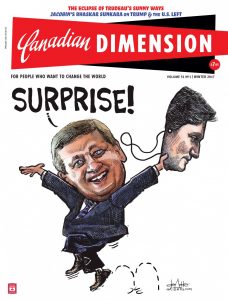
A recent cover of Canadian Dimension magazine provided a cheeky challenge to Trudeau’s bait and switch. Below the word “SURPRISE!” it showed a Justin Trudeau mask being removed to reveal Stephen Harper.
The sober reality is that Trudeau represents a continuation of his predecessor’s foreign policy. I might even need to redo my 2012 book The Ugly Canadian, but this time with the tagline “Justin Trudeau’s foreign policy”.
Yves Engler is the author of A Propaganda System: How Canada’s Government, Corporations, Media and Academia Sell War and Canada in Africa: 300 years of aid and exploitation.
Which Canada are we supposed to commemorate?
By Greg Felton | July 1, 2017
“He who controls the past controls the future; he who controls the present controls the past.” – George Orwell, 1984
A country’s history is the living inheritance of all its citizens; unfortunately, they have little say in how governments “spend” their inheritance. The elected “trustees” determine the direction that a country takes and so become part of history, which means that they have the power to edit and co-opt the past to promote their present political and popular legitimacy.
In nominally democratic states like Canada, such co-optation is especially evident at a milestone, a time when a government stands atop the historical pyramid to bask shamelessly in the achievements and reputations of those who came before. Justin Trudeau, our current prime minister—or is that “photo-op minister”—is the very definition of such shamelessness: a callow, image-obsessed dilettante who brings no qualities to public office and equates schmoozing with governing.
Marking 150 years of nationhood should be a time for national unity, political optimism and satisfied reflections on the past, yet none of these applies. A political, moral, social and economic chasm divides the Canada of 1967 from the Canada of 2017. The only obvious similarity is that Trudeau is the son of the 1968 prime minister. To imply any sort of cultural or political continuity over these last 50 years amounts to spreading disinformation.
Unlike most Canadians, I can remember a Canada before “terrorism,” before neo-conservatism, before NAFTA, before MTV, before the Internet—when politics determined economic policy, not the other way around. I grew up self-consciously Canadian because I knew that my country was the sort of rational, humane democracy that Americans could only dream of.
Unlike the U.S., Canada does not worship the three toxins of God, guns and greed. This is a generally tolerant, peaceable, secular country where government was expected to participate in the economy, not be an impotent bystander. Our mixed public/private economy mitigated the inhuman cost of unenlightened self-interest, especially regarding medical care. In other words, the Canada where I grew up was a place where political debate was possible, regulation of foreign investment was defensible, and public spending was ethical. It may sound odd, but I grew up accepting the permanence of the idea of Canada. This was true even during the 1970s and early ’80s, when Prime Minister Pierre Trudeau’s pandering to Quebec and his grand obsession with national unity alienated much of Western Canada. We were a querulous nation, but a nation, nevertheless.
In foreign/military policy, Canada may have clung too much to the security blanket of UN peacekeeping, but its reputation as a humanitarian nation and an upholder of international law was never in doubt except where Israel was concerned. This Canada would never deliberately attack another country or engage in provocative again.
Now, jump to Canada 2017: a politician, professor or citizen who challenges the canonical dogma of privatization, free trade, lower corporate taxes or industry deregulation can expect to be marginalized or denigrated as a “socialist” or “communist.” To seek alternatives to U.S./Israeli provocations in the Middle East is to be denounced as a terrorism supporter or an apologist for Vladimir Putin. Every sphere of public life is now so controlled by an anti-intellectual clergy of economic and militaristic high priests that informed dissent on fundamental issues is treated as heresy and the “malefactors” in question can expect to be punished. Rational political discourse, the essence of democratic society, has given way to cognitive dissonance. Democratic 1968 Canada mutated into quasi-fascist 2017 Canada.
Lest readers recoil at the last statement, thinking I have overstated my disaffection for the ruling classes, I invite them to consider the record of the previous régime, including Stephen Harper’s unconcealed zeal to destroy Canada as a functioning political state and sell off its assets piece by piece. Because of Harper, Canada now supports torture, military aggression, corporate welfare (more so), active impoverishment of the citizenry and repression of civil liberties. It’s a sure bet that Trudeau will invoke the images and feelings of Canada’s past and gloss over inconvenient details like the Trans Pacific Partnership, selling arms to the butchers of Yemen (Saudi Arabia), participating in U.S./Israeli/NATO anti-Russian provocations, and selling out B.C. for the Kinder Morgan Pipeline. The present doesn’t offer much to celebrate, does it Harper Jr.?
It’s difficult to convey historical attitudes, feelings or national spirit in words, so let’s use an empirical example. The following three graphs will give some indication of how much worse off economically Canadians are today than they were at the dawn of the neo-fascist era.
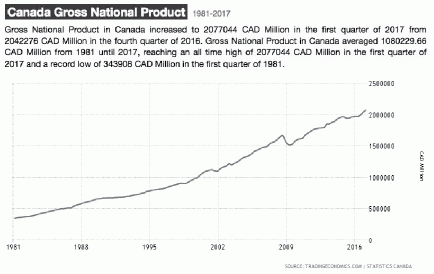
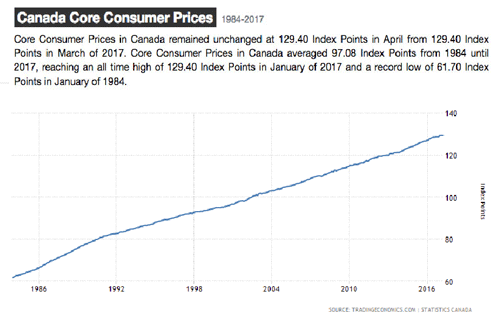
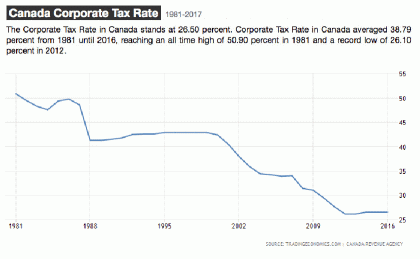
The graph in the top left shows that Canada’s Gross National Product increased more than six times from 1981 to the first quarter of 2017. Over that same period the core consumer price index (top right) doubled. These are both positive economic indicators, and one might glean from them that Canadians enjoyed increasing prosperity. This would be a mistake and in the lower graph we see why. The corporate tax rate was nearly halved during this time, the implication of which should be obvious. As citizens were forced to pay a greater percentage of the tax burden, their disposable income fell as well as their ability to save. Essentially, people are subsidizing overpaid CEOs and foreign corporations, which now coerce governments into betraying the public good in the name of “free trade.”
Canadians are worse off today than they were 50 years ago. I cannot “celebrate” the 150th birthday of Canada because I cannot pretend that appearance is reality. The legacy of optimism, and gaiety that attended the 1967 centennial celebrations (Expo’67) has been squandered. Canada might still exist on a map, but the idea of Canada is gone and must be rediscovered. We must look backwards, not forwards.
Featured Video

Theodore Postol: Iran’s Missiles & Drones Were Underestimated
or go to
Aletho News Archives – Video-Images
From the Archives
What is the Israeli Lobby in Australia Doing in Interfaith Dialogue?
By Ali Kazak | Dissident Voice | October 11, 2015
For years Israel and its lobby around the world have been trying to normalise their relations with Arabs and Muslims without solving the Palestine Question.
One of the methods they resorted to in the last few years is using human rights and community organizations such as interfaith dialogue and Multiculturalism to achieve this objective and to: isolate the Palestinians, marginalise the Palestine question, end Israel’s isolation, and prevent criticism of Israel, knowing that these organisations will be the first to stand against Israel’s violations, racial and religious discrimination.
The group responsible for this task in Australia is The Australia/Israel & Jewish Affairs Council (AIJAC); its Director of International & Community Affairs, Jeremy Jones is in charge of lobbying religious community organizations, specifically Muslims and Christians. Consequently he convened the Faith Communities for Reconciliation, founding participant in the Australian Partnership of Religious Organisations and the Australian National Dialogue of Christians, Muslims & Jews.
AIJAC is a private political propaganda group. It is recognised as the main Israeli lobby in Australia. It coordinates its activities and works intimately with the Israeli embassy in Canberra and different institutions in Israel. It is privately funded by some Jewish businessmen. It monitors closely Australian politicians, the media, ethnic and religious groups, (especially Arabs and Muslims), unions and academics on their stands towards Israel and the Palestine question. … continue
Blog Roll
 Aletho News
- The killing of three Indonesian soldiers in Lebanon should remind Jakarta that Israel does not want peace
- Defeated and delusional: Netanyahu’s remarks reveal $80bn war failure, says analyst
- Iran’s friends are about to make life much more difficult for Israel and the US
- The war of liberation of the Arab and Islamic peoples expands across the Gulf
- Envoy warns UN on Trump’s threat to ‘obliterate’ Iran’s civilian infrastructure
- The Larak Corridor: Iran’s Rial Gate With No US, No Israel, and No Way Around
- ‘Economic terrorism’: Steel facilities hit again in US-Israeli strike
- ‘War Crime’: Iran condemns attacks on Arak, Ardakan nuclear sites
- Two-thirds of Americans want quick end to Iran war even if goals unmet
- Trump to Give “Important Update on Iran” Wednesday in Prime-Time Speech
- If Americans Knew
- Gaza families reunite years after babies evacuated amid Israel’s war
- International Rescue Committee warns Gaza’s children face grave protection risks
- Iran’s Alleged 47-Year War on America: Debunking the 1,050 American Deaths Canard
- Israel wants US to bomb more of Iran’s civilian structures (113,000 is not enough) – Not a ceasefire Day 173
- Ann Coulter Rips Into Fox News for Iran War Coverage
- Joe Kent Urges Americans To Call White House and Congress To Object To Sending Troops Into Iran
- DNC Resolution to Reject AIPAC Funding Puts Democratic Leaders in the Hot Seat
- Swedish foundation to build 400 schools as over 650,000 Gaza children remain without education for 2 years
- Israeli army admits photshopping image of slain Lebanese journalist
- This is how Israel is systematically killing health workers under the cover of war in Lebanon
- No Tricks Zone
- New Study Finds Warming Saves Lives…Cold Temperatures 12 Times More Deadly Than Excess Heat
- German Science Blog Accuses PIK Climate Institute Of Hallucinating Climate Tipping Points
- Devastating Assessment Of Comirnaty Vaccine By Former Senior Pfizer Europe Toxicologist
- New Study: CO2 Is ‘Effectively Negligible’ As An Explanatory Climate Change Factor Since 2000
- Former Pfizer Toxicologist Dr. Helmut Sterz Tells Bundestag Hearing Pfizer Vaccine Should Have Never Been Approved
- Energy Expert: Germany’s Nuclear Phaseout Was A “500 Billion Euro Mistake”
- New Research: South Australia’s Mid-Holocene Sea Surface Temperatures Were 4°C Warmer Than Today
- Storing Green Energy To Last Germany 10 Days Would Require A 60-Million Tonne Battery
- New Studies: UK Sea Levels Were 4 Meters Higher Than Today During The Mid-Holocene
- Destructive Green New Deal: German Energy And Metal Group Warns Of Drastic Crisis
 Aletho News