Jonathan Kay and the Israel First Movement
The Kevin Barrett – Noam Chomsky Dispute in Historical Perspective – Eleventh part of the series titled “9/11 and the Zionist Question” – Read the tenth part here

By Prof. Tony Hall | American Herald Tribune | August 12, 2016
Jonathan Kay began his literary career in 1998 as a founding member of the editorial board of Canada’s National Post. Kay worked under Conrad Black and his Israeli-American partner, Richard Perle. Perle was an executive member of the advisory board of Black’s Hollinger International, which oversaw one of the world’s largest English-language newspaper chains based in North America, Great Britain and Israel. A main objective of Hollinger Inc.’s Canadian flagship, the National Post, was to push the country’s political culture far enough rightward that the Christian Zionist politician, Stephen Harper, could take the reigns of the federal government. Canadian Prime Minister between 2006 and 2015, Harper swept into power riding the wave of political fervor originating in the 9/11 psychological operation.
Richard Perle is sometimes referred to as the Prince of Darkness. He is a frequent and unabashed proponent of “total war.” Perle was a PNAC member and lead author of the “Clean Break” document that in 1996 encouraged Israeli Prime Minister Benjamin Netanyahu to move away from negotiations with the Palestinians toward a more militant posture in the Middle East and globally. Quite likely Perle had a significant role in planning the 9/11 event.
After the Bush administration was delivered its new Pearl Harbor on September 11, 2001, Perle renewed his call for “total war.” In advancing this agenda, Perle helped lead the charge resulting in the US and UK-led invasion of Iraq in 2003. Along with David Frum, another Canadian neocon spin doctor deeply implicated in the lies and crimes of 9/11, Perle co-authored the propaganda text, An End to Evil: How to Win the War on Terror. One of the book’s key recommendations was for the United States to invade the Islamic Republic of Iran. Going back to his role in the formulation of the “Clean Break” document, Perle had long advocated the invasion of Iran as well as Iraq and Syria in his capacity as an influential adviser within Israel’s Netanyahu government.

In looking back in 2014 at his sixteen years at the National Post, Kay emphasized that his work on 9/11 infused his literary career with a “sense of purpose.” For a lot of “conservative pundits… this was our Spanish Civil War. The fate of Western Civilization was at stake.” Kay continues, “I became obsessed with 9/11. I read the Koran, hoping to gain insights into Osama Bin Laden’s mindset, travelled to conferences in Israel, joined a Washington, D.C.-based think tank devoted to protecting democratic countries from terrorism. [Foundation for the Defense of Democracies] I helped a former Mossad agent [Michael Ross] write his memoir, and then wrote a book about 9/11 conspiracy theories.” [1]
If Jonathan Kay’s journalistic crusade is conceived as his equivalent to fighting in the Spanish Civil War between 1936 and 1939, his position on 9/11 puts him on the side of the Falangists, on the side of Francisco Franco’s right-wing nationalist forces. As clearly displayed in the ultra-Zionist content of Among The Truthers and The Volunteer as well as his frequent columns in the National Post, Kay is an extreme nationalist whose highest priority is to advance the imperial reach of the Jewish state centered in the expansionary polity of Israel. Kay seems surprisingly candid in identifying himself as a partisan journalist spinning propaganda for the Israel First faction that now prevails inside the governing elites that rule Canada, the United States and all the NATO countries.
The Underground Asylum Imagined by Jonathan Kay
The difference between Noam Chomsky and Jonathan Kay in dealing with Kevin Barrett’s 9/11 work helps illuminate the complex dynamics of a many-faceted cover up campaign. Kay’s Among The Truthers, for instance, is based largely on detailed ad hominem attacks on those that do not accept the official narratives he seeks to advance and defend. Chomsky on the other hand avoids any reference to scholarship of those that have critically evaluated the evidence of what did or did not happen on 9/11. This treatment of his intellectual opponents as unworthy even of named recognition is made very clear in his failure to identify Dr. Barrett and his qualifications even as the MIT professor accused the former University of Wisconsin Lecturer of academic wrongdoing.
In Among The Truthers, Kay’s sponsors assigned him the task of developing the primary commemorative text created with an eye to maintaining Zionist control over the MSM discourse that would mark the tenth anniversary of 9/11. The task given Kay in the prelude to the commemorate events in 2011 was to extend the meme of “9/11 conspiracy theories” into new extremes of deceit and obfuscation through fear mongering, defamation, misrepresentation and guilt-by-association.
The text’s title well encapsulates the core features of the smear campaign that is so central to the strategy of preventing the public from realizing how severely and systematically we have been lied to. Kay’s fervid literary invention of a “Growing Conspiracist Underground of 9/11 Truthers” was meant to invoke connotations of darkness, dementia and concealment. Among the engineered mental pictures conjured up by the literary reference to a “Conspiracist Underground” are concocted media memes of Osama bin Laden and his al-Qaeda network supposedly coordinating international havoc from elaborate networks of Eurasian terrorist caves.
Chomsky and Kay and the other 9/11 obfuscators consistently avoid dealing with the evidence. There is never any discussion, for instance, of the US government’s position that a catastrophic failure of intelligence flows, together with a complete breakdown of a whole series of emergency measure procedures, was the main cause of the 9/11 debacle. This narrative line is called into question by the fact that not one of the officials supposedly responsible for this alleged failure of intelligence and national defense was so much as reprimanded let alone fired. If the official narrative was true, why is it that the supposed incompetents actually received promotions?
There is never any effort to address huge anomalies like the fact, for instance, that the black boxes from the weaponized jet planes could not be found and yet passports of the alleged hijackers were miraculously located amidst the debris. There is never any real reckoning on the side of the obfuscators with the ongoing and blatantly illegal destruction of the forensic evidence of the 9/11 crimes.
This process starts under Michael Chertoff in his capacity as the person responsible for the US Justice Department’s criminal investigation of 9/11. Under Chertoff’s guidance this federal “investigation” quickly assumed the character of a federally orchestrated cover up. The destruction of evidence begins with the unseemly haste in the autumn of 2001 to dispose of the steel remnants of the three pulverized WTC towers. The twisted steel girders were quickly removed and sold off to scrap metal customers in China without prior forensic testing for signs of controlled demolitions. The quick destruction of evidence included the removal and destruction of human remains.
The saga of federal destruction of the evidence of the 9/11 crime, including the illegal destruction of the taped evidence of CIA torture in secret black site dungeons, extends to the proceedings currently underway in the Guantanamo Bay concentration camp. There, the military trial being pressed against the supposed “mastermind of 9/11” broke down in May of 2016 because a military judge improperly allowed the destruction of state evidence.
Kay’s excuse for not dealing with the evidence in Among The Truthers is to cite the supposed advice of a supposed New York editor who supposedly cautioned him, “debunking books don’t sell… Conspiracy theorists won’t believe you. And normal people don’t need to be told what you’re telling them. So you have no audience.” The implication here is that somehow “normal people” need not be burdened with knowledge of the evidentiary substance of what really happened. (p.320)
Kay effectively destroys his journalistic credibility with this startling declaration that he ignored the 9/11 evidence due to the marketing advice of his New York editor. From this very compromised position of surrender to the vagaries of media salesmanship, Kay launches into his pop psychology fakery profiling the inhabitants of his imagined underground realm. Those “conspiracists” that the author chooses to highlight are simply wrong because Jonathan Kay declares them to be wrong. No proof required. All those that have developed interpretations that do not conform with the Israeliocentric worldview of Jonathan Kay and his publishers in the Rupert Murdoch media empire are simply swept aside as members of “cults and cult-like movements.” (p.315)
The inhabitants of Kay’s invented realm are pronounced by their Inquisitor to be heretics and worse. Kay declares them to be common victims of an “incurable disease” against which young people require “inoculation” through the introduction of special curricula and programs in schools. In taking on the personae of a public health official charged to protect our youth from the spread of infectious conspiracy theories, is Kay, the self-proclaimed poseur, implicitly prescribing the quarantining of those with whom he disagrees?
You will read “9/11 Crimes and Israel” in the next part.
Endnotes
[1] Jonathan Kay, “My Life at the National Post and Why I’ll Miss It,” National Post, 21 November, 2014
Dr. Hall is editor in chief of American Herald Tribune. He is currently Professor of Globalization Studies at University of Lethbridge in Alberta Canada. He has been a teacher in the Canadian university system since 1982. Dr. Hall, has recently finished a big two-volume publishing project at McGill-Queen’s University Press entitled “The Bowl with One Spoon”.
Clintonites Prepare for War on Syria
By Rick Sterling | Dissident Voice | August 22, 2016
The Syria Propaganda Campaign
Neocons and Clintonites have launched a major campaign with the goal of direct US military intervention and aggression against Syria, potentially leading to war with Iran and Russia. An early indication emerged as soon as it was clear that Hillary Clinton would be the Democratic Party nominee. Following the California primary, the NY Times reported on State Department diplomats issuing an internal memo “urging the United States to carry out military strikes against the government of President Bashar al Assad.”
In early August Dennis Ross and Andrew Tabler opined in the NY Times about “The Case for (Finally) Bombing Assad.” Dennis Ross is a favorite Clintonite. In her book Hard Choices, Clinton described how she asked Dennis Ross to come to the State Department to “work on Iran and regional issues”.
NY Times regular Nicholas Kristof made his pitch for war against Syria. According to the self-styled humanitarian, we need “safe zones” as proposed by Clintonite Madeline Albright and retired General James Cartwright. That is risky but “the risks of doing nothing in Syria are even greater”.
PBS broadcast a story titled “Repeatedly targeted by airstrikes, Syrian doctors feel abandoned.” The story features video from the “White Helmets” along with photos from the reported April bombing of Al Quds Hospital.
Currently there is a huge media campaign around the situation in Aleppo. Syrian American doctor Zaher Sahloul, of the Syrian American Medical Society, has been interviewed extensively on corporate media as well as DemocracyNow with widespread promotion in Truthout and other sites.
There has been lots of publicity around a letter to President Obama, supposedly written by 15 doctors in East Aleppo. The letter ends: “We need your action.” The flow and wording of the letter suggests it may have been composed by a marketing company and there has been no verification of the doctors who supposedly signed it.
An online Change petition asks German Chancellor Merkel and President Obama to “save the people of Aleppo.”
The publicly funded Holocaust Memorial Museum has promoted the video #SaveSyria. One of the producers of the video is The Syria Campaign which is the marketing organization which branded the pervasive “White Helmets” as documented in “Seven Steps of Highly Effective Manipulators.”
In parallel with this media campaign, the House Foreign Affairs Committee has introduced HR5732 the “Caesar Syrian Civilian Protection Act of 2016”. The resolution calls for escalating economic/financial pressure on Syria and “Assessment of potential effectiveness of and requirements for the establishment of safe zones or a no fly zone in Syria”.
Dr. Sahloul, the Syrian American Medical Society doctor / spokesperson says that Obama’s legacy will be defined by whether or not he attacks Syria to impose a “no fly zone”. It seems unlikely that Obama would do that at the end of his term. Instead, the goal is to prepare the public for the new war to begin after Hillary Clinton becomes President.
Falsehoods and Lies of Omission
In his article “The media are misleading the public on Syria,” author Stephen Kinzer recently wrote: “Coverage of the Syrian war will be remembered as one of the most shameful episodes in the history of the American press. Reporting about carnage in the ancient city of Aleppo is the latest reason why.”
Here a few facts about Aleppo which contradict the msm narrative:
* At least 85% of Aleppo’s population is in government controlled area.
* The estimate of 300K civilians in rebel/terrorist controlled east Aleppo is likely a gross exaggeration. In Spring 2015 Martin Chulov of the Guardian visited the area and estimated there were 40K.
* While there are very few doctors serving in the opposition controlled Aleppo, there are thousands of doctors working in the government controlled area.
* The dominant rebel terrorist group in Aleppo is the Syrian version of Al Qaeda.
* The armed groups who invaded Aleppo have been unpopular from the beginning. In the Fall of 2012 James Foley wrote:
Aleppo, a city of about 3 million people, was once the financial heart of Syria. As it continues to deteriorate, many civilians here are losing patience with the increasingly violent and unrecognizable opposition — one that is hampered by infighting and a lack of structure, and deeply infiltrated by both foreign fighters and terrorist groups.
* The rebel-terrorists launch dozens and sometimes hundreds of mortars daily into the government controlled areas causing huge casualties. Western media ignores this destruction and loss of life.
* The much publicized April bombing of the supposed MSF supported “Al Quds Hospital” in Aleppo was full of contradictions and discrepancies. These were highlighted in an Open Letter to MSF. To this date, MSF has not provided corroborating information.
* Much of the video purporting to show bombing effects in Aleppo are stamped with the “White Helmets” logo. White Helmets is a creation of the US and UK and primarily a propaganda tool. The claims they are Syrian, independent and non-partisan are all false.
* Much of the information about Syria comes from “activists” trained and paid by the USA. In her book Hard Choices, Secretary Clinton speaks says the US provided “training for more than a thousand (Syrian) activists, students, and independent journalists” (p464, hardback version). Obviously they are not independent and their reports should be carefully checked.
* In contrast with the ambiguous situation at “Al Quds Hospital”, consider what happened to Aleppo’s “Al Kindi Hospital”. Take three minutes to view the suicide suicide bombing of Al Kindi Hospital. Take two minutes to view what the “rebels” did to Syrian soldiers who had been guarding the hospital.
* Like Richard Engels fake kidnapping, the contrived CNN reports by “Syrian Danny,” the August 21 chemical attack in Ghouta effectively shown to be a staged event intended to force US attack because of the supposedly crossed red line.
* The letter to President Obama was likely written by a paid Syria War propagandist or Washington lobby firm. Read the letter here and judge for yourself. For contrast watch this interview with a real Syrian doctor not mouthing propaganda from K Street Washington DC.
* The latest propaganda tool being used to promote US aggression against Syria is the photograph of little Omran in the orange ambulance seat. The video comes from the Aleppo Media Center “AMC”. Like the White Helmets, AMC is a US creation. The photo of Omran has been widely accepted without scrutiny. The insightful Moon of Alabama, has raised serious questions about the media sensation. Brad Hoff has documented that the main photographer, Mahmoud Raslan, is an ally of the Nour al Din al Zenki rebel terrorists who beheaded a young Palestinian Syrian a few weeks ago. This is confirmed step by step in this short video. Another good short video exposing the propaganda around #Syrianboy is here.
Why the Burst of Propaganda and Calls for US Attack Now?
The Syrian crisis is at a critical point and there is prospect of the collapse of the rebel-terrorists. If they crushed or expelled, it would allow hundreds of thousands of displaced Aleppans to return home as soon as services are restored. This would also allow the Syrian army and allies to focus on attacking ISIS in the east and terrorist groups remaining in Idlib, Hama, the outskirts of Damascus and the south.
The tide is running against the rebel terrorist factions and their supporters. Up until the last year, fanatics and mercenaries were traveling from all parts of the globe into Syria via Turkey. Tens of thousands went to Syria from SE Asia, China, Russia, North Africa, Europe and North America. They were given carte blanche to depart their home countries, arrive in Turkey and be guided into Syria. For example, young Canadians such as Damien Clairmont went and died in Syria. His mother has courageously exposed the fact that Canadian Security Intelligence Services (CSIS) knew about his plans yet did nothing to stop him. Progressive Muslim leaders demanded the government identify and start dealing with the radical recruiters. It was evidently the policy of the cynically named “Friends of Syria” to “look the other way” as their citizens were being brainwashed then recruited to become terrorists attacking Syria.
Now, with terrorist blowback, these same “Friends” are feeling some consequences from their policies. Terror attacks in Britain, France, Belgium and the USA have ended the policy of collusion with Wahhabi terrorists. In the last year, security services have started arresting recruiters and new recruits. In Britain, a long time promoter of ISIS has been convicted. In Belgium, the court has approved the extradition of a suspected French terrorist. Previously Belgium was the Western country with the highest per capita number of citizens joining the terrorist fight in Syria. And now Turkey has started arresting people en route to join ISIS in Syria.
Since the rebel terrorists invaded Aleppo in 2012, they have had a constant pipeline bringing weapons, fighters and supplies into the city. For the past few months the Syrian army has been on the verge of encircling and closing the access routes into rebel terrorist sections of east Aleppo. Western media and governments which support the rebel terrorists are doing all they can to delay or prevent this closure. They are trying to stall or prevent a Syrian victory until someone more hawkish than Barack Obama is in the White House.
Who is Driving the Conflict?
Regional forces supporting the war on Syria include Israel, Saudi Arabia, Qatar and Turkey. Israel has always been deeply involved, contrary to the faulty analysis of some observers. Israel has provided medical and military support to Nusra/Al Qaeda and other terrorist groups operating near the Golan Heights. Former Israeli Ambassador Michael Oren was explicit: “Israel has wanted Assad ousted since Syria war began.”
The USA and western powers are also deeply involved. Working with Saudi Arabia and through Turkey, the US has supplied huge quantities of weapons to the rebel terrorists. Sophisticated weaponry totaling 994 TONS was provided last winter as documented here.
On the other side, Iran and Hezbollah are committed to defending the existing Syrian government. They know that if the Syrian government falls, they will be the next ones under attack. Russia also sees this as a crucial conflict. The USA has expanded NATO up to the Russian eastern border, promoted the 2014 Ukraine coup, and insisted on economic sanctions against Russia. Syria is Russia’s only Arab ally and hosts Russia’s only foreign naval base. Russia probably sees this conflict as a crucial for its own future. In another sign of resistance to US global hegemony, China has indicated it wishes to expand military cooperation with Syria.
Following the US lead, Canada, Australia and West European countries have supported the regime change effort despite it being in clear violation of the UN Charter and international law.
What is at Stake?
Despite five years of tragedy and destruction, the U.S. continues trying to overthrow or destroy the Syrian government. This is not a new US objective. In 2005, CNN’s Christiane Amanpour interviewed Syrian President Assad and said to him: “Mr. President, you know the rhetoric of regime change is headed towards you from the United States…. They’re talking about isolating you diplomatically and, perhaps, a coup d’etat or your regime crumbling. What are you thinking about that?” Amanpour is not only the CNN host, she is the wife of neocon Clintonite James Rubin.
In 2010 Secretary of State Hillary Clinton pressed Syria to stop its support of the Lebanese resistance movement Hezbollah, “loosen” its alliance with Iran and sign a treaty with Israel. Significantly, these are Israel’s demands and of much higher importance to the Zionist state than the USA.
The war in Syria is bringing numerous conflicts to a head: sectarian Wahhabism vs secular Islam; the “new American century” with one superpower vs a multilateral world; Zionist dominance and occupation vs Lebanese and Palestinian resistance.
Hillary Clinton is on record criticizing the decision to not bomb Syria in the Fall of 2013. She has continued to promote the idea of a “no fly zone”. She is an avowed Zionist who has said she wants to take the US-Israeli relationship to the ‘next level’.
Zionist Israel is deeply worried by the prospect of a strengthened Syria and Lebanese resistance. In addition, there are many Palestinian refugees and their descendants in Syria and Lebanon. They retain their wish to return home in keeping with international law. Just as Zionist Israeli interests were a major factor in the invasion of Iraq, so they are in continuing the conflict in Syria. In addition, neocons have not given up their goal of a “new American century”.
What Has Been the Role of the Western Left?
The left has been weak in responding and opposing the aggression against Syria. Major factors have included:
– Saudi and US State Dept funded Muslim groups which support the aggression against Syria. This includes the recently famous Dr Zaher Sahloul and the Syrian American Medical Society. SAMS and Zahloul are aligned with Saudi Arabia and receive substantial State Dept funding.
– deluded leftist groups who support a fantasy “revolution” in Syria just as they did in Libya.
– the flooding of social media and the internet by “activists” and Syrian “civil society” groups who are actually paid and trained agents of the west. This is confirmed by Clinton herself in her book Hard Choices.
– uncritical acceptance of major NGOs who are predominately funded by billionaires. These organizations need to be considered with some skepticism. For example, in 1990, Amnesty International mistakenly corroborated the accuracy of the false claim that Iraqi soldiers were stealing incubators from Kuwait, leaving babies to die on the cold floor. In the run-up to the 2003 invasion of Syria, Human Rights Watch did not oppose the invasion and implicitly accepted it by only criticizing the lack of preparation. Physicians for Human Rights, another Soros project, has issued grossly misleading reports on Syria.
– alternative media which is progressive on many issues but echoes NPR and mainstream media on critical foreign policy issues including the Syrian conflict.
Some groups including Arab Americans for Syria, Syrian American Forum, Black Agenda Report, Syria Solidarity Movement, Answer and Workers World Party have actively challenged the disinformation but their budgets and influence are relatively small in comparison with the heavily funded organizations pushing for regime change.
Veterans for Peace, one of the most influential and respected peace organizations, has recently sharpened its understanding and position. Following a recent visit to Syria, the Vice President of Veterans for Peace, Jerry Condon, has said, “Every thing we read about Syria in the US media is wrong . The reality is that the U.S. government is supporting armed extremist groups who are terrorizing the Syrian people and trying to destroy Syria’s secular state. In order to hide that ugly reality and push violent regime change the U.S. is conducting a psychological warfare campaign to demonize Syria’s president, Bashar al Assad. This is a classic tactic that veterans have seen over and over. It is shocking, however, to realize how willingly the media repeat this propaganda, and how many people believe it to be true.”
What Needs to Happen
Neoconservatives including Clintonites are pushing hard for a direct US attack on Syria to prevent the collapse of their regime change project. Claiming that the US and NATO can bring a ‘safe zone’ and ‘protect civilians’ is a grotesque falsehood. If the US tries to impose a “no fly zone” it will result in vastly more deaths and risk escalation into direct conflict between Syria, Russia, Iran and Israel.
Former Acting CIA director Mike Morell recently suggested the killing of Russians and Iranians in Syria to make them “pay a price.” He has endorsed Hillary Clinton as President. This is how dangerous, ignorant and arrogant Washington has become.
There is a clear solution to the Syrian tragedy: the countries who have been supplying tons of weapons and paying tens of thousands of mercenary terrorists should stop. The conflict would soon end. The foreigners would depart with much less fanaticism than what they came with. Many Syrian rebel terrorists would accept reconciliation.
There needs to be a global campaign but there is much responsibility in the US since our government is the greatest threat to peace. Following are specific ideas which are realistic and could help significantly.
1. Bernie Sanders raised expectations when he talked about the need stop the ‘regime change’ foreign policy. Now is when he needs to be clear and unequivocal: US military aggression against Syria will make things worse not better and must not happen. Sanders proved that a progressive policy is popular. If Sanders abandons his core foreign policy position and does not speak out strongly against the drive for aggression, it will be a huge disappointment and failure. He must not be allowed to betray his own message and end up as a porter for Hillary Clinton and the war machine.
2. DemocracyNow and other leading independent media need to start including different analyses. To a sad extent, their coverage of Syria has echoed NPR and CNN. If DemocracyNow is truly an “Exception to the Rulers,” it needs to start including more critical examinations. DN producers should be studying publications such as DissidentVoice, Consortiumnews, Global Research, AntiWar, MoonOfAlabama, Al Masdar News, Al Mayadeen, Counterpunch, American Herald Tribune, 21stCenturyWire, Black Agenda Report, the Canary, RT, PressTV, and TruePublica (not corporate ProPublica). They should be bringing the observations and analysis of journalists such as Sharmine Narwani, Edward Dark, Eva Bartlett, Brad Hoff, Vanessa Beeley, Stephen Sahiounie to name just a few. Syrian academics such as Issa Chaer (UK) and Nour al Kadri (Canada) could be interviewed. Followers of DN have heard Hillary Clinton as Secy of State and other US officials speaking about Syria countless times. Why have Amy and Juan not interviewed the Syrian Ambassador to the UN?
3. This is an opportunity and challenge for Jill Stein and Ajamu Baraka of the Green Party. They are clear on this issue. If they can get a mass audience to hear their message, it could be crucial to their winning support and prompting crucial national debate. At the moment there is almost no debate on the life and death issue of war in the Middle East. Instead, the media is filled with propaganda using a boy’s photo to promote more war. The Green Party could play a hugely important role exposing the danger and duplicity of Clinton and Trump. They could play a key role in blocking the Clintonite march to a new war.
4. Veterans for Peace will hopefully play a leading role in changing the perception and ending the demobilization of the US peace movement. There is a lot at stake.
Rick Sterling is a retired aerospace engineer who now does research/writing on international issues. He can be reached at rsterling1@gmail.com.
Elizabeth May should resign as leader of the Green Party of Canada
By Monika Schaefer | American Herald Tribune | August 14, 2016
Elizabeth May, Leader of the Green Party of Canada, is showing consistency in her subservience to the Israel-First-hidden-hand of government. At a recent Green Party convention, Ms. May voted against the majority of delegates who approved a motion offering the party’s support for Boycotts, Sanctions and Divestment movement. The BDS campaign is being mounted worldwide in response to the anti-Palestinian apartheid policies of Israel.
I say congratulations to the Green Party membership! I share the position of the majority who voted for the Green Party to support BDS. This vote demonstrates that Elizabeth May does not speak for the majority of the Green Party membership and therefore she should resign.
With her vote against BDS, Elizabeth May has demonstrated where her loyalties lie. Ms. May also demonstrated those loyalties in her recent reaction to my “Sorry Mom, I was wrong about the holocaust” video. Ms. May did the federal state’s bidding in her media hit job on me. She issued a press release condemning me without any recognition of my years of dedicated work for the Green Party of Canada. My contributions included several runs for elected office as a Green Party candidate federally and provincially.
Ms. May misrepresented the facts about the 2015 election, saying they denied my candidacy when in fact I had already formally separated myself from the GPC. Ms. May also distorted reality by declaring that the GPC would terminate my membership at the earliest opportunity, when in fact I had rescinded my membership a year earlier. I had resigned on matters of principle, based in part on Ms. May’s untenable position on 9/11. An excerpt from my letter of resignation is published here.
Elizabeth May has shown her true colours. “The hastily adopted [BDS] policy could draw accusations of anti-Semitism” she said. Voltaire described this type of behaviour best: “To learn who rules over you, simply find out who you are not allowed to criticize”.
My understanding of the roots of the Green Party is that we stood for peace, and that we agreed we would not align our political organization with the genocidal war agenda of the biggest bullies on the planet. Elizabeth May has betrayed the vision of the Green Party founders by showing where she stands on Canada-Israeli relations.
Monika Schaefer is a violin teacher living in Jasper Alberta in Japer National Park. She has been very active as a political activist in the peace movement, the environmental movement, the 9/11 truth movement and now in the movement for Open Debate on the Holocaust.
The absurd reaction to actor’s Palestine flag badge reflects a wider taboo in Britain
MEMO | August 5, 2016
British actor John Altman was invited to appear on TV show “Loose Women” recently to discuss the release of his new book and his battle with alcoholism. Moments into his appearance on-screen, people took to social media to express outrage at what he was wearing in his lapel; a pin badge of the Palestinian flag.
The British tabloid Daily Express was quick to feature an article about this, documenting the “disgust” of some viewers at Altman’s so-called “political statement” and the support he received from others. The polarised reactions to the badge appeared to be driven by viewers’ opinions on the Israel-Palestine conflict; that’s understandable. What is arguably more worrying is the fact that there were people insisting that the production company should have not let him appear on the programme wearing the badge in the first place.
The fact that such anti-Palestine sentiments were expressed almost immediately takes the issue further than Altman’s decision to wear the badge; he is, by the way, a long-term, outspoken supporter of Palestinian rights. The aggressive reaction is further evidence that support for Palestine in British society is becoming increasingly controversial, and pushes the idea that neutrality is in fact the most moral approach in this conflict.
This is even more obvious in a political climate that is becoming more and more unforgiving about showing support for Palestine. Indeed, Palestinian activism is under scrutiny not only in Britain but also other parts of the world. The non-violent Boycott, Divestment and Sanctions (BDS) movement has been denounced as “terrorism” in Israel. Canadian Prime Minister Justin Trudeau is vehement in his opposition to BDS, insisting that it has “no place on Canadian campuses.” In the UK, Foreign Secretary Boris Johnson described it as “completely crazy” and described BDS supporters as “corduroy-jacketed, snuggle-toothed, lefty academics.”
More recently, a 15 year old British-Palestinian girl won a regional final of the Jack Petchey Speak Out Challenge for delivering a speech on the occupation of Palestine and Israeli brutality against Palestinian civilians. However, she was then expelled from the national contest on the grounds that “a speaker should never inflame or offend the audience or insult others.”
It is clear that complicity in Israel’s occupation of Palestine is becoming normalised in the mainstream British narrative on the conflict; speaking out about the rights of Palestinians is becoming a controversial move. The reaction to John Altman’s badge should not, therefore, be a surprise. Nevertheless, it signifies a serious threat to Britain’s much-vaunted free-speech and the dynamics of press freedom.
It brings to mind the words of English philosopher John Stuart Mill who wrote in his book On Liberty in 1859, that, “The peculiar evil of silencing the expression of an opinion is, that it is robbing the human race; posterity as well as the existing generation; those who dissent from the opinion, still more than those who hold it.” Whether this opinion is built upon fact, or not, censorship is unhealthy and could begin to nullify the “entire courage of human kind.”
When it comes to the issue of Palestine, though, it is more than intellectual freedom and the value of speech at stake. Wearing a Palestine badge, for example, not only represents the wearer’s moral standpoint, but also displays respect for international law. It must not be forgotten that UN Security Council Resolution 194, adopted in 1948, states explicitly the Palestinian refugees’ right to return to their land; it has never been allowed by Israel. The UN General Assembly voted near-unanimously for resolution A/67/L.28 to recognise Palestine as a state; though it is not binding, Israel’s colonial-settlements built on occupied land beyond the 1967 borders and intended to be the territory of that state clearly violate Article 49 of the Fourth Geneva Convention. It is also important to note that in 2014, British MPs voted to recognise Palestine as a state, so the controversy created around showing support for Palestine in public contradicts international norms and official British policy.
Such undermining of free speech when it comes to support for Palestine signifies a degree of complicity in Israel’s oppression of the Palestinian people. It is also destructive to the social fabric of this country, because taboos and censorship, especially in terms of who is and is not worthy of benefiting from humanitarian law and human rights, create additional unnecessary divisions and polarisation within society.
Renouncing Jewishness: Shlomo Sand and Gilad Atzmon
By Eric Walberg | July 30, 2016
For years now, I’ve known there was something wrong when my well-meaning anti-Zionist Jewish friends found it necessary to join Jewish anti-Zionist groups opposing Israel. In the US, Jewish Voice for Peace, in Canada, Not in Our Name; in Britain, Jews Against Zionism — every country has its group, usually more than one. “I am a Jewish witness against Israel,” I would be told. Sounds good, even brave. Sand’s latest deconstruction of Jewishness and Israel, How I Stopped Being a Jew (2014), makes it clear why my suspicions were well founded.
Barely 100 pages, it is a page-turner, a precis of his earlier more scholarly works, arguing that the romantic, heroic age of Jewish nationalism, as embodied in the creation of a Jewish state, is coming to an end. Israel will not disappear, but it is an anachronism, an embarrassment in the postmodern age. A reminder of the horrors of Nazism, but not as the Zionist crafters of the “holocaust industry”, or “holocaust religion”, would have it. The Zionist project is exposed by Norman Finkelstein, Noam Chomsky, Gilad Atzmon, Israel Shamir and many more Jewish critics as reenacting the same policies of yesteryear. A flawed answer that is doomed, “an insidious form of racism“.
For the Israeli Sand, the Jewish “national” identity is a fraud (an Israeli identity is fine); the only viable Jewish identity is a religious one, and as a nonbeliever, he logically concludes, “Cogito, ergo non sum.”
Gilad Atzmon takes Sand’s logic further. He tore up his Israeli passport, becoming an ex-Israeli as well as an ex-Jew.
What’s so wrong with a secular, ethnic Jewish identity? Well, it can be based on only one of two things: persecution (being “forced” into being a Jew whether one likes it or not, as in the Nazi’s racial laws) or being “born” into the Jewish people. The former is no longer an issue and the latter is full of holes, and based on a dangerous myth.
 When was the Jewish People invented?
Sand’s answer is simple: “At a certain stage in the 19th century, intellectuals of Jewish origin in Germany, influenced by the folk character of German nationalism, took upon themselves the task of inventing a people ‘retrospectively’, out of a thirst to create a modern Jewish people.” For Jews, this required a homeland, and the westernized Jewish elite were able to provide this. As the West suffered one mortal blow after another (WWI&II), Zionism took on a new meaning. Voila! Israel.
But the exile legend is a myth. Sand is a historian and couldn’t find any texts supporting it. The Romans did not exile peoples. “Judaic society was not dispersed and was not exiled.” Jews continued to live in the Holy Land through thick and thin, freer under Muslim rule than Christian, but even the latter never “ethnically cleansed” them. Most converted to Christianity or Islam. Voila! The (Christian, Muslim) Palestinians. However, a tiny core stuck stubbornly to the original monotheism, nurtured by the Babylonian exile in the 6th century BC (the only bona fide exile–from which they returned, the earlier Egyptian exile legend being crafted much later, when the Torah was written down and collected in the 3rd century BC).
Jews are not a race but rather a collective of many ethnic groups who were hijacked by a late 19th century ‘national’ movement. There is no racial or ethnic basis for being Jewish any more than there is for being Christian or Muslim. The great majority of those who today consider themselves Jewish are descended from converts in Central Asia, eastern Europe and north Africa, not from ancient Hebrews expelled from the Holy Land by the Romans. They are not ethnic “Semites”, of near eastern origin, or ethnic anything else.
Atzmon is a noted jazz musician, and deconstructs a popular 1970s Israeli pop song by Shlomo Artzi: All of a sudden a man wakes up in the morning. He feels he is people and to
everyone he comes across he says shalom. Artzi’s youth suggests Jews suddenly became “people” thanks to the state of Israel, conflating being Jewish with being Israeli, suggesting only Israelis can really feel free as Jews. What Artzi ignores is that feeling proud to be an Israeli is only for those Israelis who have “Jew” stamped in their passport, and, among them, only those who are blind to the bloody colonial basis for this privilege. Hardly a recipe for a healthy feeling.
Can a liar tell the truth?
Israel is a “democratic and Jewish state” according to Israeli law. The “Jewish” nature was first defined in the Declaration of Independence of 1948. The “democratic” character was added by the Knesset in 1985. This is a contradiction in terms, as Jewish by definition determines the state according to race, making it undemocratic for those in the state not Jewish. In cartesian lingo, both ‘A’ and ‘not A’ are true.
This flawed logic now lies at the heart of what it means to call oneself a secular Jew, either Israeli or ‘diaspora’. Sand joins other ex-Jews, Gilad Atzmon, Israel Shamir, and Will Self, who have renounced Jewishness, either as secularists, or as converts to Christianity, shedding a contradictory, now empty, signifier. Given what Israel has become, “democratic” and “Jewish” are no longer compatible. Sand rejects the faux Jewish nationalism served up by Zionism, which excludes non-Jews from the narrative, and is left with nothing except himself, his books, his sense of right and wrong. A lonely world.
Atzmon takes Sand’s attack on identity politics a step further, arguing in The Wandering Who that secular Jewish anti-Zionism feeds into the Zionist narrative, the do-gooder counterpoint to the more sinister role of the diaspora, taking Sand’s concerns to an even more uncomfortable conclusion: The Jewish Diaspora is there to mobilize lobbies by recruiting international support. The Neocons transform the American army into an Israeli mission force. Anti-Zionists of Jewish descent (and this may even include proud self-haters such as myself) are there to portray an image of ideological plurality and ethical concern.*
Sand dismisses both religion and nationalism as the basis for his identity. Atzmon argues both are legitimate, though they both are perverted in the case of the Israeli state. Nationalism is an authentic “bond with one’s soil, heritage, culture, language”, a cathartic experience, not at all “empty” as a signifier. Though nationalism may well be an invention, it is still “an intrinsically authentic fulfilling experience”. It can be misused, is often suicidal, but nonetheless, “it sometimes manages to integrate man, soil and sacrifice into a state of spiritual unification.”
What is especially moving about ex-Jews like Sand, and ex-Israel ex-Jews like Atzmon, is that they are trapped by their own Israeli heritage, whether or not they emigrate. Reading Sand’s book in Hebrew, writes Atzmon, “is for me, an ex-Jew and ex-Israeli, a truly authentic experience that brings me closer to my roots, my forgotten homeland and its fading landscape, my mother tongue or shall I simply say my Being.” He is confronted not by some “‘identity’ or politics but rather the Israeliness, that concrete nationalist discourse that matured into Hebraic poetry, patriotism, ideology, jargon, a dream and a tragedy to follow.” Israel’s present state has “robbed him of that Israeliness which was once to him a home.”
Hollow identity
Most still yearn to keep a diaspora Jewish identity alive. Judith Butler’s Parting Ways: Jewishness and the Critique of Zionism (2013) is by a liberal-leaning Jew who feels she must salvage her Jewishness from Israel’s nationalism and occupation policies. “A new Jewish identity might emerge that connects Tel Aviv with New York’s Upper West Side, Berlin, Paris, London and Buenos Aires — and all of them on an equal footing,” writes Carlo Strener in his review.
For Sand and Atzmon, there is no “new Jewish identity” possible, because there is no diaspora. French Jews are French. Canadian ones are Canadian. It’s fine to be a believing ‘person of the Book’, and even an Israeli, speaking Israeli (really a new language) and being a citizen of a well-behaved multi-ethnic nation state, based on universal norms, like France or Canada. But everyone eats matzo balls already.
Assimilation is not like extermination, despite Golda Meir’s cries of “Wolf!” Non-religious Jewishness will continue to evaporate, along with Christian and Muslim identities for those who abandon their faith. There is no shame in calling oneself an ex-Christian or ex-Muslim.
Occam’s Razor: less is more
Anti-Zionists “rightly see [Zionist] policies as threatening the renewal of Judeophobia” that identifies all Jews as a “certain race-people, and confuses them with Zionists.”** Yes, but, as Atzmon argues, this “confusion” is part of the agenda, pushing Jews outside of Israel to support Israel unthinkingly and accept the resultant resentment they experience as “anti-Semitism”.
And even if they protest–as Jews–they inadvertently support the “Zionist world conspiracy”:
If those who call themselves anti-Zionist Jews without having lived in Israel, and without knowing its language or having experienced its culture, claim a particular right, different from that of non-Jews, to make accusations against Israel, how can one criticize overt pro-Zionists for granting themselves the privilege of actively intervening in decisions regarding the future and fate of Israel?*
The Jewish signifier undermines the anti-Zionist one. Slots muddy things. Medea Benjamin, a “one percenter, a nice little Jewish girl” founded the now legendary peace group Codepink. QAIA (Queers against Israeli apartheid) folded when its organizers realized by highlighting their ‘gay’ signifier, they were doing more harm than good. The queers don’t have the luxury of renouncing their queerness, but thoughtful Jews like Benjamin similarly downplay their own tribalism, and Sand and Atzmon have renounced it, as the honorable way out of their Catch-22.
* Gilad Atzmon, The Wandering Who?, Zero Books, 2011, p70.
** Shlomo Sand, How I Stopped being a Jew, Verso, 2014, p94–95.
Holocaust Discourse and the Moral High Ground
By Barbara McKenzie | June 13, 2016
The Jewish Holocaust occupies a unique position in modern Western society, in that questioning the facts of the Holocaust is suppressed and vilified on a global scale as no other topic of human history. Why is research into the Holocaust so problematic? Why is it that serious research by scientists, historians and other academics is rejected out of hand as immoral? Why is the suppression of research into ANY aspect of history acceptable?
At present there are 14 countries that criminalise ‘Holocaust denial’, i.e. publicly questioning, or disseminating research that questions, any aspect of the approved Holocaust narrative: Canada plus 13 European countries including Germany, Austria and France. In many of these countries legislation was passed decades after the end of WWII, in France only in 1990. As recently as 2015 a German court convicted 87 year old Ursula Haverbeck of ‘Holocaust denial’ and sentenced her to 10 months prison. Other revisionists who have served jail sentences include the German publisher Ernst Zündel and the British historian David Irving, who was arrested, sentenced and imprisoned in Austria in 2005. Academic Robert Faurisson was convicted in France of holocaust denial in 2006 and given a three month suspended sentence. In Germany convictions are rising steadily: in 2000 there were more than 2,666 violations of the Holocaust denial law STGB 130, as compared with 437 in 1987.
Even where Holocaust revision is legal, those who are involved in it or support it in any way are liable to be vilified, persecuted and generally treated as lepers. British academics like Irving and Nicholas Kollerstrom saw their careers destroyed, and every effort is made to deny revisionists any sort of platform; it goes without saying that they are subjected to vindictive trolling on social media. Some, like Faurisson and Zündel, have been physically assaulted on more than one occasion. After pro-Palestine activist Paul Eisen wrote an article ‘The Holocaust Wars’ in which he suggested there were questions to answer about the Holocaust, he experienced an extraordinary campaign of vilification and ostracism, especially from the pro-Palestine movement he had given so much to. That he was Jewish himself was no defence against the charge of antisemitism. As Eisen himself says, ‘I had metamorphosed into that lowest of animal life forms, the maggot at the bottom of the food chain – a Holocaust denier’.
Paul Eisen saw an unexpected rise in his profile during the 2015 campaign for election of the leader of the UK Labour Party. It was discovered that Jeremy Corbyn had had some links with Eisen in the past, including appearing on the same platform as him. The media, who had hardly been supportive of Corbyn’s candidature, had a field day accusing Corbyn of associating with a Holocaust denier. Jeremy Corbyn’s response to accusations of an association with Eisen was unequivocal : ‘had I known he was a Holocaust denier I would have had nothing to do with him […]. Obviously Holocaust denial is vile and wrong’. (From 2.47 mins in the following)
There are two principle assumptions relating to the Holocaust, both implicit in Corbyn’s denial of Paul Eisen:
- It is an an indisputable fact that Adolf Hitler planned to exterminate the Jews of Europe, that he did so by gassing them with cyanide in specially constructed gas chambers, and that he was thus responsible for the deaths of 6 million Jews
- People who question any of these premises, do so ONLY because they are neo-Nazis and white supremacists, who wish to conceal the crimes of the Nazis while at the same time sharing their ideology. They are ‘Holocaust deniers’, and all Holocaust deniers are of necessity antisemitic.
The immutability of these two premises leads to another, that anyone who questions any aspect of the Holocaust or who supports the right of others to question the Holocaust, is at best morally compromised, and probably downright evil, deserving responses ranging from suspicion, condemnation, vilification, isolation, hate mail, through to arrest and imprisonment, sometimes for many years. Those who accept unreservedly the two premises are automatically morally superior to anyone who smells a rat.
In 2012 Piers Morgan interviewed the Iranian president Mahmoud Ahmadinejad, and asked him about his attitude to the Holocaust. I say ‘asked’, but Morgan puts his own position very clearly.
Morgan states that ‘it is an indisputable fact’ that over 6 million Jews were annihilated by Adolf Hitler and the Nazis. ‘Do you dispute that 6 million Jews died or no.’ Although Ahmadinejad tries to voice his suspicions about the narrative, aroused principally because so much effort goes into suppressing research, Morgan is unmovable: the Holocaust is a fact: either you believe in it or not (subtext: and if you don’t it’s because you choose to, because you are a bad person).
The biologist Richard Dawkins sees Holocaust debate in precisely the same terms as Piers Morgan:

So according to Richard Dawkins, too, the Holocaust’ is an immutable fact, and those who question it are intellectually on a par with people who think the earth is flat, and morally on a par with racists. Again, the Holocaust is presented as just one fact, a single package – you either believe in it or you don’t.
What is particularly interesting about Dawkins’ position is that he is one of the leaders of the New Atheist movement, ostensibly dedicated to pointing out all that’s wrong with religion. One might have thought he would be sensitive to the features of the Holocaust narrative and the protectors of its memory that are evocative of the most intolerant religions, for example Catholicism in medieval times. Criminalising Holocaust denial is like burning Bruno Giordano at the stake for claiming that the earth goes round the sun.
A number of writers have in fact analysed the parallels between the Holocaust and religion, most notably the Israeli writers Yeshayahu Leibowitz, Shraga Elam, Gilad Atzmon, and Yoshua Shalev. Their arguments have been summarised as follows: Most Jews today are either atheists or shun the religion of Judaism. Therefore, the Jewish people had to adopt belief in the ‘Holocaust’ as their new religion. They have spread this religion all over the world. ‘Holocaust’ museums are the new houses of worship and are present in most major cities. The new religion has its commandments, its decrees, its prophets, its high priests, its circle of saints, its rituals and its pilgrimages. It knows neither mercy, nor forgiveness, nor clemency but only the duty of vengeance. The Holocaust religion is coherent enough to define the new ‘antichrists’ (the Deniers) and it is powerful enough to persecute them (Holocaust denial laws).
The ‘Ten Commandments’ of this ‘Holocaust Religion’ have been enunciated as follows:
- Remember what Amalek (the Non-Jews) has done to thee.
- Thou shalt never compare THE HOLOCAUST with any other Genocide.
- Thou shalt never compare the Nazi crimes with those of Israel.
- Thou shalt never doubt the number of 6 million Jewish victims.
- Thou shalt never doubt that the majority of them died in gas chambers.
- Thou shalt not doubt the central role of SATAN Hitler in the extermination of the Jews.
- Thou shalt never doubt the right of Israel to exist as the Jewish state.
- Thou shalt not criticize the leading Jewish organizations and the Israeli government.
- Thou must never criticize Jewish organizations and the Zionist leadership for abandoning the European Jewry in the Nazi era
- Thou shalt take these commandments literally and never shew mercy to them that doubt!
So what if you question this Holocaust religion? There is an almost universal assumption that if you don’t believe in the Holocaust it is not because you have an inquiring mind, it’s because you are innately evil. The belief underlying the draconian legislation relating to Holocaust denial would seem to be that the Holocaust is only questioned by neonazis, whose ‘denial’ is motivated by hate and so they should be locked up before they contaminate anyone else.
I have to confess that when I recently learned of the existence of Ursula Haverbeck and her prison sentence for ‘Holocaust denial’, in a European country in the 21st century, for carrying out, as I saw it, serious research into history, I was shocked to the core. I mentioned this to various acquaintances here in Wellington, who were equally horrified, not at the imprisonment of Ursula Haverbeck, but at the thought that I appeared to be questioning the Holocaust narrative. I was quickly made to understand that if I thought there was something worrying, something odd about this punitive response to historical research, it indicated a moral flaw in my makeup.
Soon after I had a twitter exchange with one Daniel Finkelstein, peer of the British realm, ex-editor of The Times. I came across his savage indictment of a prolific tweeter, who had defended David Irving, the notorious ‘Holocaust denier’. When I commented that the said person ‘opposes land theft (in Palestine), ethnic cleansing and child abuse – what’s not to like? Finkelstein, twitter handle ‘Dannythefink’, responded by asking me what I thought of the Holocaust. The exchange continued as follows:
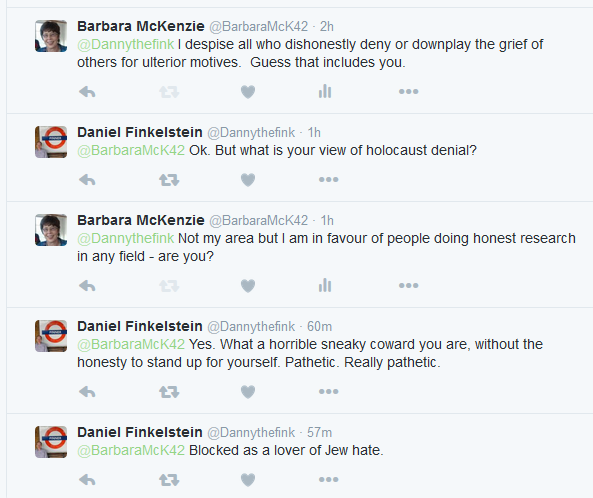
It comes as no surprise that Daniel Finkelstein, who is in total support of dispossession, ethnic cleansing and cruelty in Palestine, assumes morally superiority to me, since I have spoken in defense of a man who has spoken in defense of a man who does research into a field of history. And of course I have refused to commit myself to the undeniability of the Holocaust package …
One can assume that all these experts on the Holocaust, who know enough to be confident of the immutable truth of the Holocaust narrative, whether it be Piers Morgan, Dawkins, or Daniel Finkelstein, would also know another immutable truth about the Holocaust, that the Director of Auschwitz, Rudolf Höss was tortured for three days and three nights, and that his testicles were smashed beyond repair,as happened to 137 out of 139 Germans ‘interrogated’ before the Nuremberg trials. One can assume that this makes no difference to their perception of the Holocaust narrative, and they will remain confident of their moral superiority to those of us who are distressed and alarmed by the knowledge that German witness statements at Nuremberg were obtained under the most brutal torture. (From Höss’s confession was derived the figure of 4 million deaths at Auschwitz; the figure was later revised down to 1 million.)
‘Holocaust denial’ is generally conflated with antisemitism, ‘Jew hate’ or racism, and so automatically deserving of vilification. However, even if revisionism is considered to be intrinsically antisemitic, protectors of the Holocaust narrative like to bolster their case by pointing to more general indicators of racism in the culprit.
To the uninitiated the best-known Holocaust revisionist is probably the British historian David Irving, who was convicted of Holocaust denial in an Austrian court and sentenced to three years in prison. Irving was interviewed by Tim Sebastian on the BBC’s Hardtalk in 2000. The programme’s style is intended to be aggressive, but when I watched the programme in 2000, knowing nothing about either Irving or Holocaust denial, I was repelled by Sebastian’s overt hostility to Irving, and I believe that any other impartial person would be too. (Sebastian underlined his antagonism by refraining from shaking Irving’s hand at the end of the interview.)
Sebastian suggests that to deny the gas chambers is hurtful and tasteless (Holocaust denial is immoral per se). But like many others he feels the need to shore up this assumption by showing that there is other evidence that David Irving is a racist, and though he has few examples to work with he is relentless on this point. Irving’s suggestion that he is no more racist than millions of other people is brushed aside with the rather strange claim from the interviewer that there is no evidence for this whatsoever (so only Holocaust deniers are racist). Furthermore, it would appear that honest but naive David Irving confessed in an interview with the Independent that he once called someone a ‘nigger’, something he immediately regretted and remained bitterly ashamed of. As someone put it in the comments below the YouTube video, David Irving is probably the most honest person on the planet.
Another protector of the Holocaust narrative is Max Blumenthal, an American Jew who has a profile as a supporter of the rights of Palestinians. Blumenthal has attracted criticism from some pro-Palestine activists, who see him as an ‘antizionist’ zionist (AZZ), or gatekeeper, due to his attacks on other activists such as Alison Weir and Gilad Atzmon, his opposition to criticism of Jewish power, his prioritising of antisemitism and Holocaust denial, and his peddling of the NATO narrative on Syria; Gilad Atzmon sees him as racist, agressive and supremacist. In 2008 Blumenthal attended a meeting by David Irving when he was touring the States, and created this video:
The video is interesting for several reason. Blumenthal has interspersed his footage with clips from old German propaganda films promoting Germans superiority – of course if you question the Holocaust you must be a Nazi and white supremacist. Like Piers Morgan he presents the question of the Holocaust in bald holistic terms, with no allowance for individual aspects, or degrees of doubt. ‘Are you a Holocaust denier’, he asks, pretty much as one might ask ‘are you a paedophile?’
And as Holocaust denial is such a heinous crime, Blumenthal is justified in first finding out the location of the meeting (given freely to him by David Irving), and then outing Irving to the Vicar of the church hosting the meeting as a ‘Holocaust denier’. The smugness, the self-satisfaction of Blumenthal are palpable; he clearly sees himself as a hero, where others might just see a manipulative sneak. In any case we are left in no doubt that Max Blumenthal, the anti-German racist, the Palestine activist who along with Israel promotes the destruction of Syria, is morally superior to the ‘Holocaust denier’ David Irving, regardless of the latter’s transparent integrity.
The claim that ‘Holocaust denial’ is innately antisemitic was blown out of the water when Netanyahu, prime minister of Israel, took into his head to declare that the Holocaust was the brainchild of the Palestinian grand mufti of Jerusalem Haj Amin Husseini (so not Hitler afterall), that Hitler only wanted to expel the Jews, not exterminate them (thereby breaking Commandment 6, see above). There was anger and ridicule in Israel and amongst Jews abroad and Netanyahu was forced to climb down. Although Netanyahu was in general accused of ‘playing into the hands of Holocaust deniers’, he was actually guilty of Holocaust denial as it is defined, ie questioning an aspect of the Holocaust discourse – any German who made Netanyahu’s claim would be arrested. If one accepts the ruling that says ‘Holocaust denial’ is antisemitic, Netanyahu must be antisemitic. Which is clearly nonsense – Netanyahu’s racism does not lie in antisemitism, but in an overweening belief in Jewish exceptionalism.
Conclusion
It could be that those protecting the approved version of the Holocaust with such intolerance, aggression, and hate are absolutely right, that 6 million Jews died, in gas chambers, according to a plan drawn up by Adolf Hitler. I wouldn’t know – I haven’t done the research necessary for me to form an opinion.
However it is manifestly clear that those who question or deny the Holocaust are not united by a common neo-Nazi philosophy, of a type that on the one hand insists that Hitler was not guilty of the crimes attributed to him and on the other claims ‘Hitler was right’ to commit these crimes. Mainstream Holocaust revisionists are academics, philosophers, German patriots or Palestine activists. They do not necessarily support the far-right – many of them probably vote for left of centre parties. Some of them are notable for their immense compassion, such as Paul Eisen, who has always been a strong advocate of justice for Palestine. All of them have shown great courage and integrity, and are prepared to look for the truth and to speak it as they see it.
Regardless of the facts of the matter, criminalisation of responsible research into the Holocaust, and the vilification and isolation of those who carry it out, or even those who simply support their right to do so, is an outrageous denial of academic endeavour and historiography as a discipline. Anyone who supports such criminalisation, vilification and isolation is NOT morally superior but in fact morally and intellectually compromised. Furthermore, any honourable person with a modicum of intelligence and a modicum of courage will fight for the right of all people to carry out research into any branch of history, without treating one particular aspect as sacred and therefore exempt from scrutiny.
Fake threats and engineered fears
By Mark Taliano | American Herald Tribune | July 16, 2016
Recently, General Petr Pavel, Chairman of the NATO Military Committee, admitted that,
“It is not the aim of NATO to create a military barrier against broad-scale Russian aggression, because such aggression is not on the agenda and no intelligence assessment suggests such a thing.”
Decoded, this means that intelligence reports indicate that Russia is not a threat to the West.
Since Russian aggression is not a threat, then increased NATO deployments to encircle Russia are a threat — to Russia.
Decoded again: We are the bad guys, Russia is not.
But this hasn’t stopped Canada’s Prime Minister, Justin Trudeau, from confirming, according to CBC news, that
“Canada will send a battle group of soldiers to Latvia by early 2017 as part of a NATO plan to counter fears of Russian aggression in eastern Europe.”
So, Canada’s decision to provoke Russia is based on groundless fears.
Since reasonable foreign policy decisions are few and far between, Canadians might want to pay heed to a recent observation made by Paul Craig Roberts:
“ … only an absolute idiot could think that three or four thousand troops constitutes a defense against the Russian Army. In June 1941 Operation Barbarossa hit Russia with an invasion of four million troops, the majority German component of which were probably the most highly trained and disciplined troops in military history, excepting only the Spartans. By the time that the Americans and British got around to the Normandy invasion, the Russian Army had chewed up the Wehrmacht. There were only a few divisions at 40% strength to resist the Normandy invasion. By the time the Russian Army got to Berlin, the German resistance consisted of armed children.”
Decoded? We’re idiots.
Our now broad-based idiocy is based on the fact that we are being fed a constant diet of lies, and stories, and toxic myths.
The fake Russian threat is consistent with the fake terrorist threat. It is very well documented, with sustainable, Western-based evidence, for example, that NATO and its allies support terrorism. The terrorists currently invading Syria are Western proxies/”strategic assets”, employed to effect illegal regime change.
It is also well documented that the illegal Western sanctions besieging Syria are impacting the legitimate, secular, pluralist, democratic government of Syria, and liberated areas, not the foreign terrorist- plagued areas that are replenished from surrounding NATO countries, especially Turkey.
So, the “Russian threat” is fake; there never was a “Syria threat” (except that Syria insists on its sovereignty and territorial integrity); and the “terrorist threat” is a hoax, because we support the terrorists.
The “humanitarian bombing” strategy is also a hoax, because ISIS territory expands when the U.S illegally bombs Syria.
Basically, everything we’re hearing is fake. The government, and Soros et al.–funded “non- government organizations” (NGOs) – are fake, not only because they aren’t “non-governmental”, but also because they’re embedded with the terrorist invaders.
The fakery of the news stories is doubly protected by laws embedded in the National Defense Authorization Act which blur the lines between reality and spectacle. The author writes,
“According to an amendment to the 2013 National Defense Authorization Act (NDAA), the House Bill H.R 5736 (now law), the federal government of the United States can now legally propagandize the domestic public.
Arguably, this makes staged theatrical presentations, featuring crisis-actors, and purporting to be ‘reality’, legal. “
And, as if that isn’t enough, Don North writes in “US/NATO Embrace Psy-ops and Info-War” that,
“As reflected in a recent NATO conference in Latvia and in the Pentagon’s new ‘Law of War’ manual, the U.S. government has come to view the control and manipulation of information as a ‘soft power’ weapon, merging psychological operations, propaganda and public affairs under the catch phrase ‘strategic communications.’ “
We can also reasonably assume that much of the terrorism afflicting the West is also fake, in the sense that it is synthetic/false flag terrorism. This doesn’t mean that innocent people aren’t being killed — thousands were murdered during the 911 false flag — but it does mean that deep state operatives are likely orchestrating much of the domestic terrorism with a view to blaming “ISIS”, advancing imperial war plans, and institutionalizing domestic police state legislation that protects the neo-con war criminals responsible for the mass-murdering barbarity.
Seemingly, all of these “Gladio-style” crimes demonstrate the dirty hand of intelligence operatives – who should be the first suspects — but rarely are.
All of this fakery provides cover for imperial conquest and the advancement of a predatory economic model called “neoliberalism”. The name itself is fraudulent, because it isn’t new, and it isn’t “liberal”. It’s a predatory economic model of bailed-out, deregulated, parasitical privatization schemes that preys on the commons, the people, and protects the transnational oligarch criminals who capture legislative bodies, and advance transnational corporate empowerment faux “deals” (deceptively labeled “free trade”).
Spectacle and deceit is everything, since democracy, justice for all, and freedom, are incompatible with this predatory system.
We are being trained and brainwashed to willingly accept, even embrace, our enslavement.
Syrians are at the forefront of those who are effectively opposing this globalized, unipolar model of enslavement, poverty, and barbarity. Those who are currently being demonized – Syria, Russia, Iran, Hezbollah and their allies – are paying with their blood, but they are fighting for all of us, and for our freedoms.
As Canadians, we should be opposing our country’s foreign policy idiocy, and we should be supporting the heroics of Syria and its allies. Warmongers have successfully managed our perceptions to view Syria, Russia, and Iran etc. as “threats” or “enemies”, but beneath the lies and deceptions, evidence demonstrates that they are neither.
Featured Video
Theodore Postol: Iran’s Missiles & Drones Were Underestimated
or go to
Aletho News Archives – Video-Images
From the Archives
What is the Israeli Lobby in Australia Doing in Interfaith Dialogue?
By Ali Kazak | Dissident Voice | October 11, 2015
For years Israel and its lobby around the world have been trying to normalise their relations with Arabs and Muslims without solving the Palestine Question.
One of the methods they resorted to in the last few years is using human rights and community organizations such as interfaith dialogue and Multiculturalism to achieve this objective and to: isolate the Palestinians, marginalise the Palestine question, end Israel’s isolation, and prevent criticism of Israel, knowing that these organisations will be the first to stand against Israel’s violations, racial and religious discrimination.
The group responsible for this task in Australia is The Australia/Israel & Jewish Affairs Council (AIJAC); its Director of International & Community Affairs, Jeremy Jones is in charge of lobbying religious community organizations, specifically Muslims and Christians. Consequently he convened the Faith Communities for Reconciliation, founding participant in the Australian Partnership of Religious Organisations and the Australian National Dialogue of Christians, Muslims & Jews.
AIJAC is a private political propaganda group. It is recognised as the main Israeli lobby in Australia. It coordinates its activities and works intimately with the Israeli embassy in Canberra and different institutions in Israel. It is privately funded by some Jewish businessmen. It monitors closely Australian politicians, the media, ethnic and religious groups, (especially Arabs and Muslims), unions and academics on their stands towards Israel and the Palestine question. … continue
Blog Roll
 Aletho News
- The Most Important Bet You’ve Never Heard Of
- The killing of three Indonesian soldiers in Lebanon should remind Jakarta that Israel does not want peace
- Defeated and delusional: Netanyahu’s remarks reveal $80bn war failure, says analyst
- Iran’s friends are about to make life much more difficult for Israel and the US
- The war of liberation of the Arab and Islamic peoples expands across the Gulf
- Envoy warns UN on Trump’s threat to ‘obliterate’ Iran’s civilian infrastructure
- The Larak Corridor: Iran’s Rial Gate With No US, No Israel, and No Way Around
- ‘Economic terrorism’: Steel facilities hit again in US-Israeli strike
- ‘War Crime’: Iran condemns attacks on Arak, Ardakan nuclear sites
- Two-thirds of Americans want quick end to Iran war even if goals unmet
- If Americans Knew
- Gaza families reunite years after babies evacuated amid Israel’s war
- International Rescue Committee warns Gaza’s children face grave protection risks
- Iran’s Alleged 47-Year War on America: Debunking the 1,050 American Deaths Canard
- Israel wants US to bomb more of Iran’s civilian structures (113,000 is not enough) – Not a ceasefire Day 173
- Ann Coulter Rips Into Fox News for Iran War Coverage
- Joe Kent Urges Americans To Call White House and Congress To Object To Sending Troops Into Iran
- DNC Resolution to Reject AIPAC Funding Puts Democratic Leaders in the Hot Seat
- Swedish foundation to build 400 schools as over 650,000 Gaza children remain without education for 2 years
- Israeli army admits photshopping image of slain Lebanese journalist
- This is how Israel is systematically killing health workers under the cover of war in Lebanon
- No Tricks Zone
- New Study Finds Warming Saves Lives…Cold Temperatures 12 Times More Deadly Than Excess Heat
- German Science Blog Accuses PIK Climate Institute Of Hallucinating Climate Tipping Points
- Devastating Assessment Of Comirnaty Vaccine By Former Senior Pfizer Europe Toxicologist
- New Study: CO2 Is ‘Effectively Negligible’ As An Explanatory Climate Change Factor Since 2000
- Former Pfizer Toxicologist Dr. Helmut Sterz Tells Bundestag Hearing Pfizer Vaccine Should Have Never Been Approved
- Energy Expert: Germany’s Nuclear Phaseout Was A “500 Billion Euro Mistake”
- New Research: South Australia’s Mid-Holocene Sea Surface Temperatures Were 4°C Warmer Than Today
- Storing Green Energy To Last Germany 10 Days Would Require A 60-Million Tonne Battery
- New Studies: UK Sea Levels Were 4 Meters Higher Than Today During The Mid-Holocene
- Destructive Green New Deal: German Energy And Metal Group Warns Of Drastic Crisis
 Aletho News