Post-Brexit, Is the EU Flaunting Its Undemocratic Tendencies?
By Joyce Nelson | CounterPunch | July 6, 2016
Stung by Brexit, the EU bureaucrats seem intent on showing just how undemocratic they can be. Here are two examples just in the last seven days.
The Glyphosate License
On June 24, EU member states again refused (for a third time this year) to approve a renewal of the license for the weed-killer glyphosate manufactured by Monsanto and other corporations involved in GMO crop cultivation. That should have meant that the license would expire by the end of June, and Monsanto’s Roundup and other glyphosate weed-killers would have to be withdrawn from Europe by the end of this year.
Instead, on June 29 the European Commission (EC) decided “unilaterally” to extend the glyphosate license for another 18 months. [1]
The decision “drew heavy criticism from the Greens in the European Parliament, who said the decision showed the Commission’s ‘disdain’ for the opposition by the public and EU governments to the controversial toxic herbicide.” [2] Belgian Green Member of the European Parliament Bart Staes said, “As perhaps the first EU decision after the UK referendum, it shows the [EC] executive is failing to learn the clear lesson that the EU needs to finally start listening to its citizens again.” [3]
Many were simply shocked that an unelected body of bureaucrats would cater so blatantly to the corporate sector’s last-minute lobbying.
The EC claims that, because of member nations’ indecision on the matter, its own decision about glyphosate was based on assessments made by the European Food Safety Authority (EFSA), prolonging the authorisation until a new scientific review is concluded before the end of 2017, but Greenpeace has called the EFSA study “a whitewash.” [4]
Lawrence Woodward, co-director of Beyond GM, has called the EC’s unilateral decision “reckless.” [5] It comes at the same time that dozens of individuals and organizations have signed an open “Letter from America,” urging European citizens, politicians and regulators to not adopt a “failing agricultural technology” and sharing examples of glyphosate and GMO repercussions across North America. [6]
CETA Ratification
At virtually the same time that the EC made this controversial decision on glyphosate, it made another that is even more undemocratic.
On June 28, a German news agency reported that European Commission President Jean-Claude Juncker told EU leaders the Commission is planning to push through a controversial free trade agreement between Canada and the EU – known as CETA, the Comprehensive Economic and Trade Agreement – without giving national parliaments any say in it. [7] According to the German press, Juncker argued that allowing national parliaments to vote on the agreement would “paralyze the process” and raise questions about the EU’s “credibility.” Juncker claimed that CETA “would fall within the exclusive competence of the EU executive” and therefore doesn’t need to be ratified by national parliaments within the 28-nation bloc, sources in Brussels told the Germany news agency DPA. [8]
Most EU members, however, view CETA as a “mixed” agreement, meaning “that each country would have to push the deal through their parliaments.” [9]
In late June 2016, the EC’s Juncker was reported as saying that he “personally couldn’t care less” whether lawmakers get to vote on CETA. [10]
Millions of Canadians and Europeans have fought against CETA for the past six years. Like the TPP and TTIP, it is a draconian agreement that would hand multinational corporations immense power to overrule elected local governments on numerous fronts. In Canada, CETA was supposed to be voted on by every Canadian provincial and territorial government before any ratification could take place, but in September 2014 (during the reign of Stephen Harper) the CETA deal was signed without there having been any public consultation whatsoever in Canada. The 2014 announcement was also the first time people in Canada and Europe were allowed to see the official text, which had been kept secret during the years of negotiations.
Unfortunately, Canada’s International Trade Minister Chrystia Freeland is enthused about what the EU is doing. According to The Globe and Mail newspaper (July 3), “The British vote to exit the European Union has refocused
Europe’s attention on the need to send a message to the world that liberalized trade is the path to greater prosperity, Ms. Freeland said.” [11]
She also explained that once the European Parliament approves CETA, “a great deal of the agreement would come into force immediately, more than 90 per cent,” she said, “those portions deemed to be within the European Union’s jurisdiction, those go into force right away.” [12]
Freeland told The Globe and Mail that concerns about CETA’s investor-state dispute settlement (ISDS) mechanism – which allows multinational corporations to sue governments over regulations that harm their future profits – had been addressed by a rewrite of the treaty’s investment chapter. [13] But according to Council of Canadians, those changes “actually make [the provisions] worse. The reforms enshrine extra rights for foreign investors that everyone else – including domestic investors – don’t have. They allow foreign corporations to circumvent a country’s own courts, giving them special status to challenge laws that apply equally to everyone through a [private] court system exclusively for their use.” [14]
Prime Minister Justin Trudeau will be in Europe this week for a NATO summit, and officials “say he will lobby hard for other European leaders not to stand in the way of [CETA’s] ratification.” [15]
The Pushback
Reportedly, the pushback in Europe has been immediate, with Germany and France wanting “their national parliaments to be involved” in CETA ratification. On July 5, Deutsche Welle reported that “Juncker appears to be backtracking,” and would propose at a July 5 EC meeting that CETA would require “both the approval of the European parliament and national legislatures.” [16]
The Globe and Mail reported on July 5 that Juncker’s “new recommendation… could call for applying those EU parts of the treaty while the ratification process [by national legislatures] is under way.” [17] That would mean (as Canada’s Chrystia Freeland had earlier explained) more than 90% of CETA could be approved by the EU as part of its “jurisdiction” and needing no national legislative approvals. Such a process would make a mockery of democratic rights on both sides of the Atlantic.
That appears to be what is happening.
Following the July 5 EC meeting in Strasbourg, France, the CBC reported: “Legal opinions advanced by the commission suggest that most of the agreement – perhaps as much as 95 per cent – falls comfortably with the European Union’s jurisdiction… ‘This is an agreement that Europe needs,’ EU trade commissioner Cecilia Malmstrom said in a statement. ‘The open issue of competence for such trade agreements will be for the European Court of Justice to clarify, in the near future. From a strict legal standpoint, the commission considers this agreement to fall under exclusive EU competence. However, the political situation in the council is clear, and we understand the need for proposing it as a ‘mixed’ agreement, in order to allow for a speedy signature’.” [18]
But as nations gear up to wrangle with the EU (in the European Court of Justice) over what parts of the CETA treaty fall within their jurisdiction, and what parts “fall under exclusive EU competence,” the EC could approve 95% of CETA before elected legislatures even vote.
The Council of Canadians warns on its website (July 5): “One important concern to note, ‘The commission may recommend provisionally applying the EU-parts of the Canada deal while full ratification is pending.’ The French newspaper Le Monde has previously reported that even if CETA is deemed to be a ‘mixed’ agreement, the deal could enter into force ‘provisionally’ even before EU member state parliaments vote on it. It notes, ‘If EU ministers agreed at the signing of the CETA on its provisional application, it could come into effect the following month. Such a decision would have serious implications. Symbolically, first because it would send the message that European governments finally [have] little regard for the views of parliamentarians and thus of European citizens strongly against the agreement’.” [19]
Council of Canadians National Chairperson Maude Barlow stated after the EC meeting in Strasbourg, “Like many Canadians, Europeans are worried about CETA’s attacks on democracy, its weakening of social and safety standards, its contribution to privatization and attacks on public services. After the Brexit vote, policy makers on both sides of the Atlantic would be better counseled to listen to voters, rather than pushing discredited [trade] solutions down people’s throats.” [20]
Global Justice Now director Nick Dearden has called CETA a “toxic deal” and says that the way the EC is acting “reinforces the widely held suspicion that the EU makes big decisions with harmful consequences for ordinary people with very little in the way of democratic process,” he said. “Rather than take a step back and question why there is hostility to the EU, they try to speed up this awful trade deal.” [21]
Union members, environmentalists, social activists and “fair trade” groups say CETA is just as dangerous as the proposed Transatlantic Trade and Investment Partnership (TTIP) deal between the EU and the U.S., which hands massive power to multinationals and is a direct threat to democracy on both sides of the Atlantic. The way the EC is handling CETA is a stark clue to what’s in store for TTIP.
Footnotes:
[1] “European Commission Extends Glyphosate License without Real Restrictions,” Sustainable Pulse, June 29, 2016.
[2] Frederic Simon, “EU muddling on glyphosate fuelled Brexit populism,” EurActiv.com, July 1, 2016.
[3] Quoted in ibid.
[4] Ibid.
[5] Katie Pohlman, “Neil Young: Say No to GMOs on ‘Behalf of All Living Things’,” EcoWatch, July 1, 2016.
[6] Quoted in ibid.
[7] “EU Commission Seeks to Push Through Free Trade Agreement with Canada (CETA) without Parliamentary Approval,” Deutsche Welle, June 28, 2016.
[8] Ibid.
[9] Reuters, “EU Commission to opt for simple approval for Canada deal: EU official,” June 28, 2016.
[10] “EU Commission: CETA should be approved by national parliaments,” Deutsche Welle, July 5, 2016.
[11] Robert Fife, “Despite Brexit vote, key EU powers vow to ratify CETA deal,” The Globe and Mail, July 3, 2016.
[12] Ibid.
[13] Ibid.
[14] Council of Canadians, “CETA changes make investor-state provisions worse,” February 3, 2016.
[15] Fife, op cit.
[16] “EU Commission: CETA should be approved by national parliaments,” Deutsche Welle, July 5, 2016.
[17] “EC set to scrap plans to fast-track CETA deal: report,” The Globe and Mail, July 5, 2016.
[18] “Canada gets clarity on how Europe will ratify trade deal,” CBC, July 5, 2016.
[19] Council of Canadians, “CETA to be considered a ‘mixed’ agreement, now more vulnerable to defeat,” July 5, 2016.
[20] Council of Canadians, “CETA vulnerable to defeat: Council of Canadians,” July 5, 2016.
[21] Lamiat Sabin “Brexit ‘Might Not Stop Awful Ceta’,” Morning Star, July 5, 2016.
Joyce Nelson is an award-winning Canadian freelance writer/researcher working on her sixth book.
Trudeau Under Fire for ‘One Nation’ Statement in Quebec
Sputnik – 04.07.2016
Canadian Prime Minister Justin Trudeau was called on to retract his statement made on Canada Day calling the country “one nation”, as it insults Québécois.
Parti Québecois leader candidate Martine Ouellet said in a video posted her Facebook page Saturday that Canadian Prime Minister Justin Trudeau’s recent statement calling Canada “one nation” is “reinventing history”.
“It’s a direct insult to the Quebec nation, an insult to everything our heritage represents,” Ouellet wrote on Facebook.
On Canada Day, July 1st, Justin Trudeau said “today, we celebrate the day, exactly 149 years ago, when the people of this great land came together, and forged one nation, one country — Canada.”
Ouellet called for Trudeau to retract his statement and recognize Quebec as a nation.
Quebec, the largest and second most populated province of Canada, has a long record of struggle for independence that can be traced at least to 1960, when several diverse political groups coalesced in the formation of the Parti Québécois, which is now a primary mainstream political vehicle for the Quebec sovereignty movement.
Quebec’s current status allows it a high degree of autonomy, including its own property legislation, civil legislation, justice, healthcare and education regulation.
Justin Trudeau is known for his anti-separatism position. In 2006, then prime minister Stephen Harper introduced a motion calling on the House of Commons to recognize that “Québécois form a nation within a united Canada.” Trudeau, who was not an MP at the time of events, backed Gerard Michael Kennedy, a Liberal Party leader candidate who opposed the motion.
Trudeau had reportedly claimed that his father, the late prime minister, would never have supported recognition of Quebec as a nation.
Canada to send 1,000 soldiers to Latvia for NATO brigade
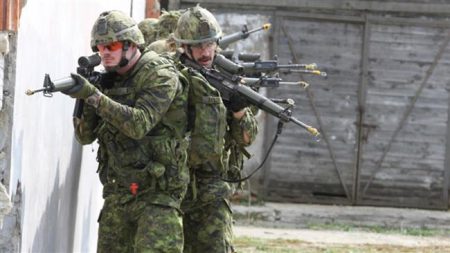
Canadian troops during a NATO drill in Ukraine.
Press TV – July 1, 2016
Canada will send 1,000 troops to Latvia to join one of NATO’s battalions that are being assembled in Eastern Europe in a show of force against Russia.
The Canadian Defense Ministry said in a statement on Thursday that the country will “establish and lead” a high-readiness brigade that will “contribute to NATO’s enhanced forward presence in Eastern and Central Europe.”
The statement also said that further details regarding the deployment will be provided at the upcoming NATO summit in Poland.
The Canadian soldiers will be part of a 4,000-strong NATO force that will be deployed to the Baltic States and Poland in order to deter what is claimed to be Russian threats.
The US, Germany and Britain will also send soldiers to join NATO’s four battalions in Eastern Europe.
“As a responsible partner in the world, Canada stands side by side with its NATO allies working to deter aggression and assure peace and stability in Europe,” said Canadian Defense Minister Harjit Sajjan.
Canada’s decision reportedly came after US President Barack Obama urged Canada to contribute more to NATO in a speech in the Canadian Parliament on Wednesday.
NATO plans to expand its military presence in Eastern Europe amid the conflict in Ukraine and has held numerous war games recently.
Some 2,000 NATO forces began a large-scale military exercise in western Ukraine earlier this week which will last until July 8.
Last month, NATO held another 10-day military drill, involving some 31,000 troops from Poland, the US and 17 other nations in Poland.
Russia, wary of the increased presence of NATO troops close to its borders, threatened to take unspecified measures to respond to the increased activities by the Western military bloc.
NATO has stepped up its military build-up near Russia’s borders since it suspended all ties with Moscow in April 2014 after the Black Sea Crimean Peninsula re-integrated into the Russian Federation following a referendum.
Moscow has repeatedly repudiated NATO’s expansion near its borders, saying such a move poses a threat to both regional and international peace.
The Forbidden Palestinians in North America
By Paul Larudee | Dissident Voice | June 29, 2016
The survivors of the 1948 massacres in and expulsions from Palestine are everywhere. Scattered to the four corners of the earth, we have only to look in our own communities to find them. Seven million Palestinians live outside Palestine, compared with five million inside. At least half a million live in Chile alone. Why, then, should we bring Palestinians from the refugee camps in Lebanon to tell their stories in North America?
Many have said that we should not. They say that these Palestinians are toxic, that they are hardliners, resistance fighters, fanatics and terrorists, and that there is no benefit in trying to engage them. We believe the opposite, that because they have a different viewpoint, the full Palestinian story cannot be told without their voices, and that, in fact, they speak for many other Palestinians who think as they do.
The western groups that invite Palestinian speakers from Palestine inevitably act as a filter. It is easy to find Palestinians that preach nonviolence and reconciliation, but how often have we heard from the rest? How many speakers from Hamas and Islamic Jihad have been on speaking tours of North America? Do they not have a viewpoint and should we not hear it?
That is, of course, impossible. Our societies will not allow it. So we decided instead to bring sympathetic voices of people who are from these societies but have no affiliation to any of the political parties or resistance groups. Unlike Palestinians in other countries, their societies have been frozen in refugee camps since 1948, because they are considered foreigners and refugees in Lebanon, without permission to work, own land, or partake in the life of the country. They are stateless, with no citizenship of any kind and few, if any, opportunities to travel. It was something of a miracle to get their US visas. In many ways, their condition has not changed since the time of their expulsion.
The North America Nakba Tour, sponsored by the Free Palestine Movement, the Northern California chapter of the International Solidarity Movement and Al-Awda Palestine Right to Return Coalition, brought 86-year-old Mariam Fathalla from the Ein el-Helweh camp in southern Lebanon and 22-year-old Amena Ashkar from the Bourj el-Barajneh camp near Beirut to San Francisco at the beginning of April, 2016. In the next nine weeks they logged more than 11,000 miles by car and spoke at 26 events throughout North America. Sadly, their Canadian visa did not arrive in time, so those five events were conducted by electronic connection.
The tour was an acclaimed success. More than seventy organizations sponsored the events, including Christian, Jewish and Muslim groups, as well as university, social justice and community organizations. Astonishingly, there were few confrontational situations. The primary outcome was greater understanding.
Mariam and Amena delivered a message that they want all their rights restored: their lands, their properties and their country. Everyone in the camps has lost everything they ever had in Palestine. There is nothing left to preserve. The issues at the “peace talks” are meaningless to them. They don’t want a Palestinian state. They want Palestine. They don’t want land in Palestine. They want their land in their village in Palestine. They don’t even want equality with Israelis. They want justice.
One questioner asked, “What is the solution? Two states? A single state for all? A binational state?” Amena responded, “I don’t accept any of those, because none of them restores what we lost, and doesn’t give us our rights. International law is on our side.” Her message was understood, with sympathy, and there was no confrontation.
• If you missed the live presentation, you can see one filmed in Denver on May 20, 2016 at The North American Nakba Tour: Exiled Palestinians living in Lebanon
Paul Larudee is one of the founders of the Free Gaza and Free Palestine Movements and an organizer in the International Solidarity Movement.
Canada Oil Sands Output to Grow 1Mln Barrels Per Day by 2025
Sputnik — 27.06.2016
Production from western Canada’s oil sands is expected to increase by 1 million barrels daily in the next decade above the current output of about 2.75 million barrels, as extraction becomes more cost-efficient, the global consulting firm IHS said in a report on Monday.
“IHS anticipates oil sands investors will focus their investments onto the most economic projects: expansions of existing facilities,” the report stated. “IHS expects that over 80 percent of future activity in our outlook will be underpinned by expansions of existing facilities.”
The report noted that the existing facilities are well understood, quicker to first oil and cheaper to construct.
“This all equates to less risk at a lower cost,” the report added.
A press release accompanying the report explained that a price of about $50 is required for oil-sands projects to break even.
Since 2012, the oil-sands region in the Canadian province of Alberta has increased from 1.75 million barrels per day to its present level of about 2.75 million barrels, according to the report.
Lockheed Threatens Economic Harm to Canada for Refusing to Buy F-35
Sputnik – 16.06.2016
The defense contractor attempted to extort one of the most powerful sovereign countries in the world, warning that as many as 10,000 jobs would be lost if the country did not commit to purchasing a fighter jet that ‘does not work.’
This weekend, American defense contractor Lockheed Martin threatened to exclude Canadian companies from production of the much maligned F-35 fighter jet if the Trudeau government decides to instead purchase a fleet of Boeing’s Super Hornet fighter jets.
“The F-35 does not work and is far from working,” said Canadian Prime Minister Justin Trudeau during a June 7 parliamentary debate, blasting the fighter jet that has cost the Pentagon over $1.5 trillion. Despite this exorbitant price tag, the jet continues to spontaneously shut down mid-flight due to software glitches.
The fighter jet that cost US taxpayers more than the gross domestic product of Canada will not face an initial operational test and evaluation (IOT&E) until mid-2018, according to Pentagon reports. Due to this delay, Lockheed Martin will not complete production of a full fleet of F-35s until 2019 at the earliest and the aircraft may not be combat ready until nearly 2021.
Lockheed Martin attempted to mislead the public about the fiscal and battlefield realities surrounding the costly warplane, conducting a publicity tour across Canadian TV over the weekend to threaten the country’s people with economic reprisals amounting to several hundred million dollars and nearly 10,000 jobs.
“I don’t want it perceived as a threat, but we will have no choice: If Canada walks away from F-35, expect to relocate work in Canada to other purchasing nations,” Steve Over, Lockheed’s director of F-35 internal business told the Canadian Broadcasting Corporation.
Canadian Defense Ministry spokeswoman Jordan Owens blasted the defense firm’s flagrant attempt at intimidation, maintaining that the government will decide on a fighter jet based on security needs.
“Despite Lockheed’s eagerness to send a spokesperson from Texas to Ottawa in order to game out hypothetical scenarios in the media, Canada remains a member of the Joint Strike Fighter program,” said Owens.
The Joint Strike Fighter program is a development and acquisition alliance of the US, UK, Turkey, Italy, Australia, the Netherlands and Canada, under which the member states selected the F-35 Lightning II to replace various tactical aircraft.
The program has brought $610 million in contracts to Canadian defense contractors, but Ottawa argues that the JSF agreement does not tie them irrevocably to the F-35 in order to receive program benefits.
“According to the agreement, as long as Canada remains a JSF partner it is fully entitled to have its industry bid and get contracts,” said Alan Williams, the former assistant deputy minister at Canada’s Department of National Defense. “There is no stipulation that Canada has to purchase the F-35.”
Williams returned the threat to Lockheed Martin saying that any attempts to disenfranchise Canadian firms while the country remains a JSF partner and contributes its payments into the effort will result in immediate legal action against the defense contracting firm.
Lockheed Martin spokeswoman Cindy Tessier shot back that the defense firm’s position was that Canada’s involvement in the Joint Strike Fighter program was predicated upon “Canada’s stated commitment to the procurement of 65 jets.”
The previous Conservative government led by Prime Minister Stephen Harper initially committed to purchasing 65 F-35s, but attempted to back out of the arrangement citing unforeseen costs and technical issues with the aircraft that made the acquisition impractical.
Real ‘aid’ means ending exploitation of Africa
By Yves Engler · June 10, 2016
What is wrong here? While Canadian companies exploit African resources for their own benefit this country’s charities call on us to join Africa “hope” walks.
Last week Toronto-based Lundin Mining hired the Bank of Montreal to help it decide what to do with its stake in the massive Tenke Fungurume copper-cobalt mine in Eastern Congo (Kinshasa). Unfortunately, it is not uncommon for Toronto firms to make economic decisions that affect hundreds of thousands of Africans and for Canadian companies to exchange African mineral assets among themselves.
A number of companies based and traded here have even taken African names. African Queen Mines, Tanzanian Royalty Exploration, Lake Victoria Mining Company, African Aura Resources, Katanga Mining, Société d’Exploitation Minière d’Afrique de l’Ouest (SEMAFO), Uganda Gold Mining, East Africa Metals, Timbuktu Gold, Sahelian Goldfields, African Gold Group and International African Mining Gold (IAMGOLD) are all Canadian. With a mere 0.5 percent of the world’s population, Canada is home to half of all internationally listed mining companies operating in Africa.
Active in 43 different African countries, Canadian mining firms have been responsible for dispossessing farmers, displacing communities, employing forced labour, devastating ecosystems and spurring human rights violations. And, as I detail in Canada in Africa: 300 Years of Aid and Exploitation, numerous Canadian mining companies have been accused of bribing officials and evading taxes. Last year TSX-listed MagIndustries was accused of paying$100,000 to tax officials in a bid to avoid paying taxes on its $1.5-billion potash mine and processing facility in Congo (Brazzaville). In April a Tanzanian tribunal ruled that Barrick Gold organized a “sophisticated scheme of tax evasion” in the East African country. As its Tanzanian operations delivered over US$400-million profit to shareholders between 2010 and 2013, the Toronto company failed to pay any corporate taxes, bilking the country out of $41.25 million.
While Canadian companies loot (legally and illegally) African resources, government-funded “charities” (aka NGOs) and the dominant media call on Canadians to walk for “hope” in Africa. Last weekend the Aga Khan Foundation Canada organized the World Partnership Walk in 10 cities across the country. In an article titled “How the World Partnership Walk” lets Canadians bring hope to African communities the organization’s International Development Champion, Attiya Hirj, writes about visiting Aga Khan Foundation and Global Affairs Canada sponsored projects in Tanzania and Mozambique. Hirj says her “trip really opened my eyes to what rural communities truly need, which is a sense of hope.” She suggests the situation can be remedied if enough Canadians come “together to fundraise and generate awareness through activities such as the World Partnership Walk.” There is no mention of the need for African resources to be controlled by and for Africans.
Hirj’s article reflects an extreme example of Canadian paternalism towards Africans. But it’s deeply rooted in our political culture. Gripped by a desire to rid “darkest Africa” of “nakedness” and “heathenism”, Canadian missionaries helped the European colonial powers penetrate African society. In 1893 a couple of Torontonians founded what later became the largest interdenominational Protestant mission on the continent and by the end of the colonial period as many as 2,500 Canadians were proselytizing across Africa.
Today, all the media-anointed Africa “experts” promote a similarly paternalistic version of ‘aid’ and largely ignore Canadian companies’ role in pillaging the continent’s wealth. But, Canadians concerned about African impoverishment should point their fingers at the Canadian firms controlling the continent’s resources and offer solidarity to those sisters and brothers fighting for African resources to be controlled by and for Africans.
Canadian court awards $13mn in frozen assets to ‘Iran terror’ victims
RT | June 11, 2016
A Canadian court has awarded $13 million in non-diplomatic assets seized from Iran to the families of Americans who died in several attacks globally, which had allegedly been sponsored by Tehran between 1983 to 2002.
The judgment by the Ontario Superior Court of Justice, obtained by AFP on Friday, found Tehran responsible for financing and training Hamas and Hezbollah operatives, who carried out eight bombings or hostage-takings in Buenos Aires, Israel, Lebanon and Saudi Arabia over a period spanning nearly 20 years.
“Terrorism is one of the world’s greatest threats,” Ontario Superior Court Justice Glenn Hainey said in his decision. “The broad issue before the court is whether Iran is entitled to immunity from the jurisdiction of Canadian courts for its support of terrorism.”
The ruling for the $13 million payout does not affect Iran’s diplomatic property in Canada but does touch non-diplomatic properties and a list of frozen bank accounts. Tehran did not immediately comment on the court judgment.
The suit was heard under the 2012 Justice for Victims of Terror Act, which allows the families’ victims to collect damages from state sponsors of terror groups. In Canada, Iran is designated a sponsor of terrorism.
The judgment on June 10 mirrors a recent American court ruling against Tehran that was also won by families of the terrorist attack victims in the United States in Spring. Iran has promised to battle the decision in international courts.
Fake “Humanitarians” and Fake “Leftists” taking Canada down the wrong path

Special Envoy of the UNHCR addresses the Security Council meeting on the continuing conflict in Syria. Credit: UN Photo/ Mark Garten/ flickr
By Mark Taliano | American Herald Tribune | May 30, 2016
There’s really no excuse for supporting the NATO/terror position. We’ve seen the destruction of Iraq, Libya, Ukraine, now Syria, all built on lies, all beneath the guise of “humanitarian interventions”. Since people with any sense of historical memory can not legitimately plead ignorance, supporters of the terrorist invasion of Syria fall into the category of “fake humanitarians”. They aren’t “progressive” or “left” when they support the criminal violation of Syria’s sovereignty and territorial integrity.
Canadian peace activist Ken Stone, recently returned from Syria, expresses similar sentiments in his newly released book, Defiant Syria|dispatches from the Second Tour of Peace to Syria. He explains,
“The point for me is to ask why otherwise intelligent people can fall for such shit (referring to a 2015 New Internationalist magazine article: “The forgotten revolution of Syria”), and not once but repeatedly. It’s not as if Syria is the very first government targeted for regime change by the USA. It’s not that people are unaware of the fact that the first casualty of war is the truth … there is never a shortage of “leftists” in the West who can be either bought or convinced through incredible naivété, warped political outlook, or Eurocentric arrogance, that the motives of Empire are good.”
People such as Ken, who have visited Syria and have seen with their own eyes the devastation wrought by Western-supported terrorists against civilization, have less tolerance for the lies, the propaganda and the “fake humanitarians” who enable it all.
Stone doesn’t mince words when he describes some of his on-the-ground observations of Homs, Syria; observations fortified by his historical memory of NATO’s imperial destruction elsewhere:
To their detriment, the fake “humanitarians” and pseudo “leftists” are shielded from such on-the-ground realities.
In a later chapter, “Palmyra: Bride Of The Desert”, Stone also bemoans the self-proclaimed “leftists” who cast the Russians as “imperialists” and as guilty as the West in the war against Syria – conveniently forgetting that Russia is legally in Syria, while NATO is not:
“It’s true,” he writes, “that Russia is unfortunately no longer a socialist country. However, it doesn’t act like an imperialist country either. Mr. Putin consistently respects the sovereignty of other countries, such as Syria, and speaks up at the United Nations for the observance of international law, which the USA, priding itself as “the exceptional country” and the “sole indispensable country”, tramples on almost every day.”
This resonates with the author’s earlier piece, “Western Hegemony vs Russian Sanity”, and the “Saker’s” observations of the differences between the “Anglo-Zionist Unipolar Imperial Model” and the “Russian Multi-polar Model”.
Sustainable evidence demonstrates, for example, that the current Russian multi-polar model respects the rule of international law, ideological and cultural pluralism, and the use of military force as a last resort.
The illegal Western war of aggression against Syria, on the other hand, is consistent with the “Anglo-Zionist Unipolar Imperial Model” which defies the rule of international law, negates ideological and cultural pluralism, and uses military violence as a first resort.
The West’s invasion contradicts the rule of international law: Russia is in Syria legally, whereas the West is not; it negates Syria’s ideological and cultural pluralism and seeks to replace it with a Wahhabist stooge government or an assortment of stooge governments in balkanized states; and it demonstrates the West’s propensity to use military violence as a first resort – the invasion, after all, was planned well in advance.
Given the fact of the West’s criminality, consistent with the “Anglo-Zionist Unipolar Imperialist Model”, and the concurrent failures of the “fake humanitarians” and the fake “left” to reconcile themselves to evidence-based findings and historical memory, Stone reiterates some concrete steps that should be taken by those of us who support foreign policy trajectories consistent with peace and the rule of international law, rather than the current reality of war and barbarism.
Important steps would include normalizing diplomatic relations with Syria, ending illegal sanctions, withdrawing from all criminal military interventions against Syria, and withdrawing from NATO.
Canada needs to assert an independent foreign policy, and it needs to reject the current barbarity implicit in its status as a vassal appendage of the Anglo-Zionist Unipolar Imperial Model. This is what Real Change would look like.
Mark is a retired high school teacher.
Dieudonne Barred by Free Speech Loving Canada!
Penny For Your Thoughts | May 11, 2016
Of course, I’m being completely facetious. The only speech that is acceptable here is state approved speech- And Canada hates freedom, anywhere. Anywhere at all. That’s why Canada is a NATO member, killing people globally, particularly in the Middle East/Asia area in order to redraw borders for their latest insane episode of playing global overlord alongside the US and the UK. Canadians need to wake up to the reality.
Dieudonne blocked from entry by Canada Customs:
Canada Customs allowed George Bush into the nation years ago. Despite thousands and thousands protesting across the nation- And that man is a real criminal. The blood soaked kind. Dick Cheney was ok for Canada too. Real criminals? Canada let’s them in. And wines & dines them!
But not Dieudonne. A comedian. No blood or torture or mass death on his hands.
As mentioned in my earlier post, Will Free Speech Loving Canada allow Dieudonne to Perform at His Sold Out Shows?, the Jewish Lobby, you know the one that doesn’t exist and is powerless, here in Canada, had Dieudonne in their sights… They were locked and loaded, looking for another kill. Another trophy for their collection of rights denied to the non Judiac masses.
And gloating all the while!
Dieudonne Barred from Entering Canda.
Canadian border services agents in Montreal sent comedian Dieudonné M’bala M’bala back to France.
It also came in the wake of more than two weeks of pressure on Ottawa by Jewish groups to keep Dieudonné from entering Canada
Early news items regarding Dieudonne’s Canadian visit were very clear, very clear, that it was the ‘usual suspects’ that were gunning for the comedian. The media marched in lockstep and the dumbed down masses believe that this man is a “criminal” Any law can be made to turn anyone into a ‘criminal’ ya bunch of dunderheads!
So, I shake my head in disgust at the level of control a small minority of persons exerts on everyone else in this nation.
I laugh at a Mayor who says “When you promote hatred, you promote social division,” speaking of the comedian Dieudonne, but not about the Jewish lobby here in Canada.
– A lobby that stomps regularly on the rights of others. – Those who had chose to see Dieudonne were deprived of their right to be entertained as they saw fit
– A lobby that cries wolf far too often. Dieudonne being just the most recent case
– A lobby that has the ear of (or a lot of dirt on) way too many politicians in this country.
– A lobby that promotes hatred and division by demonizing/smearing others the lobby does not approve of
-A lobby whose very existence is for the express purpose of social division. Looking after the interests of the followers of Judaism and their interests ONLY- That is social division Denis Coderre!!!
When the interests of one group supersede and/or impede on the interests of everyone else, that is socially divisive.
Bnai Brith looking to Ban Dieudonne from entering Canada
“B’nai Brith in Montreal is trying to block the entry into Canada of French comedian Dieudonné”
Canadian Jews Opposed to French Comedian’s Planned Performances
Jewish groups in Canada are mobilizing against the controversial French comedian Dieudonné M’bala M’bala,

The Jewish Lobby didn’t hide their goal or agenda. It was right out in the open.
Why people in the West still believe the official lies about Syria?
By Mark Taliano | American Herald Tribune | April 26, 2016
Well-documented facts pertaining to the 9/11 wars, all supported by sustainable evidence, have barely made inroads into the collective consciousness of Western media consumers.
The War on Syria is no exception. Despite the presence of five years of sustainable evidence that contradicts the Western narratives, people still believe the “official” lies.
The consensus of ignorance is sustained by what Michel Chossudovsky describes as an “American Inquisition”. Beneath the protection of this psychological operation, the engineered enemy is Islam, and the Global War On Terrorism (GWOT) has become a brand to disguise imperial wars of aggression as “humanitarian”.
Thus, huge sums of public monies are diverted from worthwhile domestic projects such as healthcare, schools, and roads to support a criminal Project for a New American Century (PNAC) that is globalizing death, poverty, and destruction as the U.S. led empire tries to impose a unilateral model of control over the world.
The U.S. is said to be “exceptional”, and therefore the rightful ruler. Manifest Destiny writ large.
Dissent is suppressed within the framework of corporate media monopolies. Predominant narratives are supported by corrupt “NGOs” – totally bereft of objectivity — and intelligence agency “fronts”. Real investigative journalism offering historical context and legitimate evidence are relegated to the fringes, far outside the domain of the broad-based “consensus of misunderstanding.”
The “Progressive Left” has been co-opted. So-called “progressives” (presumably unwittingly) support Canada’s close relationships with Wahabbi Saudi Arabia, Apartheid Israel, and even the foreign mercenaries currently invading Syria (ie ISIS and al Nursra Front/al Qaeda).
The source upon which the pretexts for war are built and perpetrated are taboo topics, despite longstanding evidence that the official narratives explaining the crimes of 9/11 – and the subsequent “Gladio B” operations — are flawed. The truth is seen as “heresy”, and fact-based narratives are derided as “conspiracy theories”.
Thus, a firm foundation of lies that serves as a sanctified justification for global war and terror, remains strong.
But the stakes are high, as Western hegemony presses us closer and closer to a real prospect of widespread nuclear war. Already, the use of nuclear weapons is being “normalized” through the introduction of “mini-nukes” into the equation, and the blurring of lines between conventional and nuclear war.
Michel Chossudovsky explains in “Is the Bush Administration Planning a Nuclear Holocaust?|Will the US launch ‘Mini-nukes’ against Iran in Retaliation for Tehran’s ‘Non-compliance’?” that
“The Doctrine for Joint Nuclear Operations outlines the procedures governing the use of nuclear weapons and the nature of the relationship between nuclear and conventional war operations.
The DJNO states that the:
‘use of nuclear weapons within a [war] theater requires that nuclear and conventional plans be integrated to the greatest extent possible’
(DJNO, p 47. For further details see Michel Chossudovsky, Nuclear War against Iran, Jan 2006 )
The implications of this ‘integration’ are far-reaching because once the decision is taken by the Commander in Chief, namely the President of the United States, to launch a joint conventional-nuclear military operation, there is a risk that tactical nuclear weapons could be used without requesting subsequent presidential approval. In this regard, execution procedures under the jurisdiction of the theater commanders pertaining to nuclear weapons are as ‘flexible and allow for changes in the situation …’ ”
The taboos need to be lifted, and the repeated lies contradicted.
Some of the more pernicious lies covering the escalating war on the democratic republic of Syria include unsubstantiated memes that fit neatly into the propagandists’ toolbox of false representations, and of projecting the West’s crimes onto the victims (Syria and Syrians).
The War on Syria is not a “civil” war; the “uprising” was not “democratic”; Assad does not “starve his own people”; Assad, does not “bomb his own people”; Assad is the democratically-elected president of Syria, and not a “brutal dictator”.
Conclusive evidence demonstrates, and has demonstrated for years, that the war is an invasion by Western proxies, which include ISIS and al Qaeda/al Nursra Front, and that there are no “moderates”.
The initial uprisings were marred by foreign-backed violence perpetrated against innocent people, soldiers, and police. Peaceful grassroots protests were hijacked by these murderous foreign-backed elements (as was the case in Ukraine) – all consistent with “hybrid war” as elaborated by Andrew Korybko.
The illegal sanctions imposed by the West – including Canada – coupled with terrorist practices of theft and hoarding of humanitarian aid – are responsible for the starvation.
Assad is a democratically elected reformer, and hugely popular with Syrians, not a brutal dictator. Claims that he “kills his own people” were further debunked when the so-called “Caesar photos” evidence was proven to be a fraud.
Many Syrians criticize Assad for not carpet bombing terrorist occupied areas (as US occupiers did in Fallujah, for example). Syrians sometimes refer to Assad as “Mr. Soft Heart”.
Unfortunately, though, the well-documented truth is not widely accepted. We need to shatter the “Inquisition” which serves to protect the criminal cabal perpetrating and orchestrating this global catastrophe. Truth and justice must prevail over lies and crimes. Currently, the opposite is the case.
Featured Video
Theodore Postol: Iran’s Missiles & Drones Were Underestimated
or go to
Aletho News Archives – Video-Images
From the Archives
Wars for Israel: A reminder of who’s giving the marching orders
By Damian Lataan | February 7, 2012
As the West prepares to march off to yet another war in the Middle East, we should perhaps remind ourselves of who is giving the West their marching orders.
In February 2003, just weeks before the US and their allies launched their attack on Iraq and her peoples, a delegation of US congressmen, together with the US Ambassador to the United Nations, John Bolton, a well known pro-Zionist and neoconservative war-hawk, were in Israel at the invitation of the Israeli government then led by Israeli Prime Minister Ariel Sharon.
Addressing the congressmen, Sharon told them ‘that Iran, Libya and Syria should be stripped of weapons of mass destruction after Iraq’. Later, Sharon told John Bolton ‘that Israel was concerned about the security threat posed by Iran, and stressed that it was important to deal with Iran even while American attention was focused on Iraq’. … continue
Blog Roll
 Aletho News
- The Most Important Bet You’ve Never Heard Of
- The killing of three Indonesian soldiers in Lebanon should remind Jakarta that Israel does not want peace
- Defeated and delusional: Netanyahu’s remarks reveal $80bn war failure, says analyst
- Iran’s friends are about to make life much more difficult for Israel and the US
- The war of liberation of the Arab and Islamic peoples expands across the Gulf
- Envoy warns UN on Trump’s threat to ‘obliterate’ Iran’s civilian infrastructure
- The Larak Corridor: Iran’s Rial Gate With No US, No Israel, and No Way Around
- ‘Economic terrorism’: Steel facilities hit again in US-Israeli strike
- ‘War Crime’: Iran condemns attacks on Arak, Ardakan nuclear sites
- Two-thirds of Americans want quick end to Iran war even if goals unmet
- If Americans Knew
- Gaza families reunite years after babies evacuated amid Israel’s war
- International Rescue Committee warns Gaza’s children face grave protection risks
- Iran’s Alleged 47-Year War on America: Debunking the 1,050 American Deaths Canard
- Israel wants US to bomb more of Iran’s civilian structures (113,000 is not enough) – Not a ceasefire Day 173
- Ann Coulter Rips Into Fox News for Iran War Coverage
- Joe Kent Urges Americans To Call White House and Congress To Object To Sending Troops Into Iran
- DNC Resolution to Reject AIPAC Funding Puts Democratic Leaders in the Hot Seat
- Swedish foundation to build 400 schools as over 650,000 Gaza children remain without education for 2 years
- Israeli army admits photshopping image of slain Lebanese journalist
- This is how Israel is systematically killing health workers under the cover of war in Lebanon
- No Tricks Zone
- New Study Finds Warming Saves Lives…Cold Temperatures 12 Times More Deadly Than Excess Heat
- German Science Blog Accuses PIK Climate Institute Of Hallucinating Climate Tipping Points
- Devastating Assessment Of Comirnaty Vaccine By Former Senior Pfizer Europe Toxicologist
- New Study: CO2 Is ‘Effectively Negligible’ As An Explanatory Climate Change Factor Since 2000
- Former Pfizer Toxicologist Dr. Helmut Sterz Tells Bundestag Hearing Pfizer Vaccine Should Have Never Been Approved
- Energy Expert: Germany’s Nuclear Phaseout Was A “500 Billion Euro Mistake”
- New Research: South Australia’s Mid-Holocene Sea Surface Temperatures Were 4°C Warmer Than Today
- Storing Green Energy To Last Germany 10 Days Would Require A 60-Million Tonne Battery
- New Studies: UK Sea Levels Were 4 Meters Higher Than Today During The Mid-Holocene
- Destructive Green New Deal: German Energy And Metal Group Warns Of Drastic Crisis
 Aletho News