It Is about the Charter of Rights and Freedoms Mr. Ambassador!
By Shawn Robinson and Rana Abdulla | Palestine Chronicle | June 2 2014

The exhibit is an opportunity for Canadians to view imagery that captures the humanity of a real situation (Public ART/Facebook)
The woman behind the exhibit is artist Rehab Nazzal, a Canadian citizen born in Jenin, an historic town located in Palestine in a territory under occupation since 1967. Nazzal’s exhibit of 1700 photographic images along with four short videos, were collected by her over the fourteen years. Segments of these images depict life in the experience of occupation.
Nazzal’s premise of this collection is based on the idea that people leave traces of their existence and the traces in this case are part of the collective memory of occupied Palestine. Not being the first time this collection has been exhibited, it was also featured in Toronto at the Scotiabank CONTACT Photography Festival 2013.
 Stumbling across the exhibit at Ottawa’s City Hall in the Karsh-Masson Gallery, the Israeli Ambassador to Canada felt that such an exhibit should prohibited. The Ambassador operating outside of his mission, met with Mayor Jim Watson and Deputy City Manager Steven Kanellakos of the City of Ottawa, to demand closure of the exhibit, stating it “glorified terrorism”. Somehow in the unidentified 1700 images and four videos, the Ambassador was able to single out seven individuals he described as terrorists.
The 4th Geneva Convention that Israel and Canada are signatories as well as the Hague Regulations, provides that people under occupation have the right to resist their occupiers. Palestinians are in a situation where they are resisting occupation. The Israeli government and their representatives dispute this occupation in spite of the presence of its military. Terrorism terminology by Israel has become so common and so pervasive that many inside and outside of Israel perceive Palestinians as terrorists – a racist generalization that is pejorative and isolating.
Nazzal’s work reveals human cost of military violence and war, and it is not a call for more human loss, contrary to the Ambassador’s allegations. It is a catalog of Palestinian history, creativity and expression for Forgotten Survivors; a lament for their homeland; and sadness for those who have died in a long hopeless conflict. Her work is a strong counter-narrative articulated creatively using visual vocabulary, transforming the oppressive tools of Israel and its discriminatory policies into elements of hope and life. Her political art communicates messages of dignity and liberation and has undoubtedly inspired many, not just Arabs but non-Arabs as well. The strong media attention certainly indicates that her message is worthy of consideration and appreciation.
Not satisfied with the responses from the Canadian public and City of Ottawa, the Ambassador has escalated his inflammatory language including allegations of “blood libel” and descriptors such as “child murderers”. Is this the role of a foreign diplomat to Canada? His call on Jewish groups to demand action is of great concern. Individuals who have yet to see the exhibit but have read the Ambassador’s false and inflammatory statements, are responding through promotion of these false allegations in blogs, emails to City Hall and online comments. Canadians are being presented with a bias that perpetuates this terrorism label.
The Israeli suppression of the Palestinian narrative appears to now be officially part of the Canadian art and political stream of understanding. It has no place nor is it appropriate. Instead of approaching the situation as an ethnic denial of people, that would appear racist to Canadians, the Ambassador of Israel instead invokes falsely the understandably reactionary term – terrorist.
 Censorship of art, especially political art has a history associated with oppressive regimes. Artists in Canada of all faiths, backgrounds and cultures have the full right to artistic expression as granted by the Canadian Charter of Rights and Freedoms. Therefore uncensored artists are able to explore difficult themes; which is a victory for democracy and freedom of expression.
Realizing that Mayor Watson and his staff have stood by the Charter, the Ambassador requested that Mayor Watson review the process of selecting future art exhibitions at the Karsh-Masson Gallery. This is also censorship. Does this mean future exhibitions could be at risk? That the City of Ottawa should influence the selection panel of professional artists? Do we want elected politicians interfering with these processes, and especially at the behest of a foreign country and its diplomatic body?
The situation is of concern to Palestinian, Arab, Muslim and other ethnic minority artists who may not be featured by galleries across Canada due to the fear of facing the public wrath of Jewish groups and/or the Israeli government. As Canadians, we don’t want to be controlled in how our art is expressed.
 We know from the history of others, that when governments and special interest groups control the message of art, that in many cases, target groups who are censored are in danger of future marginalization. In Europe in the 1930’s a number of countries excelled in this practice further legitimizing their hateful actions against minorities, including Roma and Jews. For some countries this was the beginning of their marginalization process against an ethnic minority. Canada must uphold its values for this reason as our laws and freedoms are for everybody, and not to be denied for a specified group, especially under pressure from an outside country.
The exhibit created by Nazzal is an opportunity for Canadians to view imagery that captures the humanity of a real situation. People are not exploited in their suffering or celebrations, they are living an experience that is untold by the media and has been for as much as four decades.
To be Palestinian is not anti-Jewish or anti-Israeli. In actuality it is a culture that is centuries old in its cuisine, dance, literature, art, architecture, music, costume and other elements we all embrace in our own.
Canada, a country of hundreds of cultures, cannot be part and parcel of this type of denial, and should not be afraid in embracing its citizens. Removing this show would set a precedence that would allow one group at odds with another group to demand censorship in the Canadian milieu. Influencing selection committees of art galleries, are creating the environment of fearing to present a Palestinian artist would also be an act of censorship and stifling our right to the freedom of expression. This is not a Canada we want.
– Rana Abdulla is a Canadian professional accountant, living in Winnipeg, Manitoba. Shawn Robinson is a Canadian artist in graphic design and creative writing. She lives in Ottawa.
~
~
~
For full version of these videos, please contact: info@vtape.org OR info@rehabnazzal.com
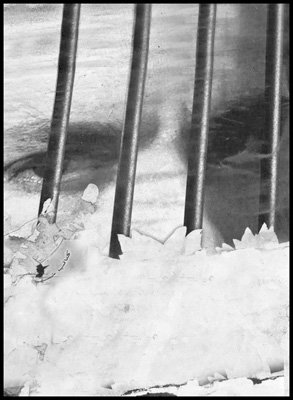

You are missed
© 2012, Rehab Nazzal
Zionist Canada bows to the holocaust religion
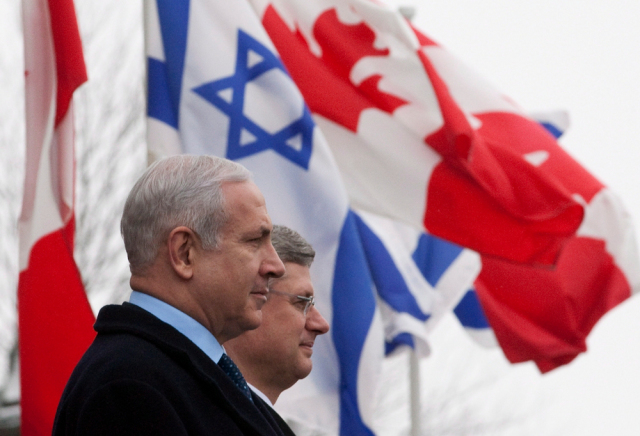
By Brandon Martinez | May 16, 2014
Officials of the Harper regime recently announced the construction of a new “holocaust” monument in Ottawa set to be completed in the fall of 2015.
“The monument features a large gathering space for ceremonies — with room for 1,000 visitors — enclosed by six triangular, concrete volumes to create the points of a star. … Monochromatic photographs by Burtynsky depicting Holocaust sites will be embedded upon concrete surfaces,” reported the Toronto Star.
It should come as no surprise that the Harper regime is backing this new holocaust monument project, considering that the ruling neo-conservatives in Ottawa have openly expressed their adherence to Jewish supremacist ideology on numerous occasions. Harper and his lackeys in Parliament have incessantly praised the apartheid state of Israel (a nation birthed through ethnic cleansing and mass terror) and have vehemently denounced those who challenge or criticize Israeli imperialism and state-terrorism.
At a May 14, 2014, speech before the American Jewish Committee’s Global Forum, Canada’s Foreign Minister John Baird told the room of Zionist fanatics that Israel is a “truly special nation” that is a “great example to the world.” A great example for what? Ethnic cleansing, mass murder and ruthless deception? Not shy to announce his belief in Jewish exceptionalism, the Zionist puppet foreign minister added that Israel is a “most extraordinary society.”
Many have argued that the holocaust promotion industry is an extortion racket designed to bolster Jewish privilege. By emphasizing Jewish victimhood above that of all other peoples, the Zionists aim to suffocate the public at large underneath a blanket of self-serving propaganda so that evidence of wrongdoing on the part of these tribal zealots will not see the light of day. Not only are Jews today not victims of any sort or underdogs in any sense of the term, they are in fact the most affluent and influential segment of every society in which they live. “Jewish families [are] among the wealthiest families in the United States. According to Forbes, 25 to 30 percent of U.S. multimillionaires and billionaires are Jewish,” noted James Petras in his book The Power of Israel in the United States.
A similar situation to the one described by Petras exists in Canada, Australia, Britain, Germany, France, etc.
The sages and holy men of holocaustianity have endeavored to promote this quasi-religion to the four corners of the earth. Hundreds of holocaust museums, memorials, monuments, research centers, etc., have been erected across Europe, Russia, North America, Latin America and even Asia. Hundreds of holocaust-themed films and television shows have been broadcasted throughout the Americas and Europe. Countless books, memoirs and other literature relating to the sacred Shoah have flooded the libraries and bookstores of all Western countries. Dozens of governments have created laws forbidding any revision of the rigid, one-sided narrative engineered by the winners of World War II.
In his book The Holocaust Industry, Jewish scholar Norman Finkelstein labeled these practitioners of professional victimhood “a repellent gang of plutocrats, hoodlums and hucksters.” One such charlatan was Herman Rosenblatt who appeared on the Oprah Winfrey Show multiple times and attained a movie deal based on his fallacious fibbing. After admitting that climactic portions of his memoir An Angel at the Fence were manufactured, he unapologetically told ABC News: “It was not a lie because in my imagination I believed it.”
Another holocaust faker, Misha Defonseca, was ordered by a judge to pay back her publisher $22.5 million after it was revealed that her best-selling 1997 memoir, Misha: A Mémoire of the Holocaust Years, was entirely fictional. Defonseca claimed that as a young girl she journeyed across Europe in search of her parents who were taken away to a German concentration camp during WW2, and that amid her search she was taken care of and raised by a pack of wolves who adopted her as one of their own. “It’s not the true reality, but it is my reality,” Defonseca told The Guardian. “There are times when I find it difficult to differentiate between reality and my inner world,” the mythomaniac explained.
Binjamin Wilkomirski’s 1994 holocaust memoir Fragments was exposed as a fraud. He was never interned in any camp and actually lived in neutral Switzerland during the war. Rudolf Vrba admitted on the stand at the Toronto trial of Ernst Zundel in 1985 that his memoir I Cannot Forgive was an “artistic picture” that contained embellishments and exaggerations. Elie Wiesel, the veritable pope of the holocaust religion, has long been suspected of at least partially fabricating his story of survival. In his memoir Night, he tells of how a doctor performed surgery on his infected foot while interned at the “death camp” Auschwitz. One might ask: what is the purpose of a doctor in a “death camp”? Then, reported Wiesel, he and his sick father chose to evacuate that camp in January of 1945 alongside the retreating German Army and SS-men instead of waiting for the Red Army to arrive. Miraculously he survived this supposedly “genocidal” ordeal.
Wiesel collects hundreds of thousands of dollars in speaking fees to preach “tolerance” to the world, while simultaneously advocating vicious hatred of German people. “Every Jew, somewhere in his being, should set apart a zone of hate -healthy virile hate- for what the German personifies and for what persists in the German,” wrote the man once described by the Chicago Tribune as a ‘beacon for human rights’ in his book Legends of Our Time. The unscrupulous pretender and money-getter has shown blatant disregard for Palestinian human rights because their oppressors are members of a master class of “chosen people” of which he is a Learned Elder.
Also not visible on Wiesel’s “human rights” radar are the tens of millions of Russians and Eastern Europeans, mostly Christians, who were starved, shot, tortured and enslaved by the Jewish-dominated Bolshevik regime in Russia. “Many Jews sold their soul to the devil of the Communist revolution and have blood on their hands for eternity,” wrote the Israeli journalist Sever Plocker in an op-ed for Ynet News. “Even if we deny it,” the Jewish writer concluded, “we cannot escape the Jewishness of ‘our hangmen,’ who served the Red Terror with loyalty and dedication from its establishment.”
Why have Stalin’s Jewish executioners and secret police torturers not received the same level of scrutiny that the Nazis have? Why have there been no Hollywood movie depictions of what happened in Stalinist Russia? When the subject has been broached, kosher commentators and careerist historians have been reluctant to note the fact that a large percentage of the top officials of the Soviet regime and the post-WW2 communist regimes of Eastern Europe were Jewish chauvinists.
When in 2009 the Ukrainian security service published a list of Soviet and Communist Party officials responsible for the Holodomor – the famine-genocide sponsored by Moscow in 1932 that took the lives of 6-7 million Ukrainians – Jewish groups cried foul, contending that publicizing such a list was a bad idea because most of the names on it were Jewish and would thus cause anti-Jewish sentiments, reported the Jewish Telegraphic Agency. Instead of learning about the true nature of this unspeakable crime and the culprits responsible, Ukrainians should just “forget history” — at least that is what the Israeli politician Shimon Peres implored them to do in a 2010 speech.
Ukrainians are commanded by the Zionists to forget their history; as are the Palestinians. But we, the ‘gullible goyim,’ must “never forget” what may or may not have happened to Jews during the Second World War. In this New World Order of Malthusian mayhem and Orwellian mind control, the Zionists hope to lock us in a mental dungeon where unwelcome thoughts are extirpated with ruthless efficiency and cold determination.
Unfortunately for them, the truth can only be hidden from public sight but never extinguished.
Clearing the plains
Book review by Paul Burrows • Briarpatch Magazine • March 10, 2014
In the context of a Canadian popular imagination still permeated by myths about heroic voyageurs, intrepid Mounties, and an inexorable yet ostensibly “peaceful” and “lawful” acquisition of other peoples’ lands, James Daschuk’s Clearing the Plains is a vital intervention. Described by historian Elizabeth A. Fenn as a “tour de force that dismantles and destroys the view that Canada has a special claim to humanity in its treatment of Indigenous peoples,” Daschuk’s study of Indigenous health and disease on the Canadian Prairies draws on decades of research to recount Canada’s policies of forced starvation and ethnic cleansing. More broadly, it’s a good introduction to the history of Canadian expansion into the northwest and the nature and evolution of Canadian Indian policy in the 19th century.
Research for Clearing the Plains began some 20 years ago as part of Daschuk’s doctoral program in history at the University of Manitoba under the supervision of D.N. Sprague. Sprague was himself a scholar of Canadian and Métis history, perhaps best known for his lengthy feud with Tom Flanagan over interpretations about Louis Riel, presumptions of government “benevolence,” and the causes of Métis dispossession in the Red River valley. Like Sprague’s own work, Canada and the Métis (1988), Clearing the Plains finds little evidence of Dominion “benevolence” in its annexation of the Canadian northwest or in its post-Confederation dealings with First Nations.
However, Daschuk’s is also a work of environmental and epidemiological history. As such, he argues that human agency, greed, and colonial power are “only half of the story.” In his view, the field of biology is equally important to understanding Indigenous history, not just in present-day Canada but also throughout the hemisphere. Much of what follows is an attempt to strike a balance between these two sides of causation, with Daschuk see-sawing between a portrait of epidemic disease as an inexorable, objective, even organic force, and a counter-portrait that emphasizes the social determinants and policy-induced nature of compromised immunity, disease outbreaks, and death.
The historical scope of Clearing the Plains is sweeping. The book opens with an assessment of pre-European health and well-being on the northern Great Plains, then concentrates on the impact of the fur trade era and nascent European settlement, and ends with the post-Confederation treaty era and the “nadir of indigenous health” in the wake of the Northwest Resistance of 1885. Throughout the book, Daschuk emphasizes the relationships between Indigenous health, outbreaks of epidemic diseases, and environmental factors, as well as settlement expansion, settler ideology, and most crucially, Indian policy. In this regard, Clearing the Plains joins a growing body of historical work examining the social determinants of health and, in particular, the relationship between Indigenous health and Canadian policy.
Overall, Daschuk’s book is important less for unearthing new and surprising historical facts than for expanding upon, reinterpreting, and publicizing them. For example, one of the central theses of Clearing the Plains is that famine was a deliberate policy weapon used to coerce “unco-operative Indians” onto reserves and remove them from lands coveted by white settlers. This isn’t a revelation for anyone familiar with existing scholarship. In his influential 1983 article, “Canada’s Subjugation of the Plains Cree,” John Tobias persuasively demonstrated that starvation was a weapon used to impose the reservation system, bring “recalcitrant” leaders such as Big Bear to heel, and force the Cree to capitulate to treaty terms. Clearing the Plains not only expands on such themes, bringing to light further evidence and examples, but its publication has made them accessible to a much wider public.
Daschuk’s interpretive framework sheds the congratulatory and smug self-image that still dominates in much Canadian historical writing. He is unafraid, for example, to label the settler-colonial process in southern Saskatchewan “ethnic cleansing,” and elsewhere he has described the foundation of modern Canada as resting upon the twin truths of “ethnic cleansing and genocide.” Those wanting a crash course in Prairie colonial history would do well to read Daschuk’s book alongside Sarah Carter’s Aboriginal People and Colonizers of Western Canada to 1900 (University of Toronto Press, 1999). Both books are carefully empirical but rooted in a deep commitment to social justice. Together, they serve as excellent points of departure for further research into colonial policy in the Canadian Prairie provinces.
Paul Burrows is a Winnipeg-based writer, researcher, and parent. A lifelong activist, he co-founded the Winnipeg A-Zone (Emma Goldman Building) in 1995 and is currently finishing a PhD in history related to Treaty 1 Territory and settler-colonialism.

By James Daschuk
University of Regina Press, 2013
Canada deploys six fighter jets to Romania
Canada has sent six fighter jets to Romania as part of its contribution to NATO’s military presence in Eastern and Central Europe.
The six CF-18 fighter jets were deployed from Canadian Forces Base Bagotville in Quebec on Tuesday.
Canada’s Defense Minister Rob Nicholson, who was present for the aircrafts takeoff, told the pilots and their support staff that they were being sent in response to the crisis in Ukraine.
“Soon you will join our allies as part of Canada’s contribution to NATO’s efforts to reassure our allies in Central and Eastern Europe,” Nicholson said. “The work will be key in supporting international efforts to find a solution that respects the democratic aspirations of the Ukrainian people.”
Meanwhile, Denmark has also sent four warplanes to the region.
On April 28, Russian Defense Minister Sergei Shoigu expressed concern about what he described as an unparalleled increase in US and NATO military activity along Russia’s borders.
The planes, along with support staff, will be stationed in Romania, and will take part in NATO air patrols of the Baltic region and training activities. The air patrols operate on a rotational schedule, and the six Canadian CF-18s will be rotating in.
According to reports, some 150 US troops have been deployed in western Estonia and another 450 are presently stationed in Latvia, Lithuania and Poland.
Tensions between Moscow and the Western-backed interim government in Kiev heightened after Crimea declared independence from Ukraine and rejoined Russia following a referendum on March 16, in which almost 97 percent of the participants voted for rejoining the Russian Federation.
Meet TISA: Another Major Treaty Negotiated In Secret Alongside TPP And TTIP

By Glyn Moody | Techdirt | April 29, 2014
This Wednesday evening there is to be a “Public Information Session and Discussion” (pdf) about TISA: the Trade in Services Agreement. If, like me, you’ve never heard of this, you might think it’s a new initiative. But it turns out that it’s been under way for more than a year: the previous USTR, Ron Kirk, informed Congress about it back in January 2013 (pdf). Aside from the occasional laconic press release from the USTR, a page put together by the Australian government, and a rather poorly-publicized consultation by the European Commission last year, there has been almost no public information about this agreement. A cynic might even think they were trying to keep it quiet.
Perhaps the best introduction to TISA comes from the Public Services International (PSI) organization, a global trade union federation representing 20 million people working in public services in 150 countries. Last year, it released a naturally skeptical brief on the proposed agreement (pdf):
At the beginning of 2012, about 20 WTO members (the EU counted as one) calling themselves “The Really Good Friends of Services” (RGF) launched secret unofficial talks towards drafting a treaty that would further liberalize trade and investment in services, and expand “regulatory disciplines” on all services sectors, including many public services. The “disciplines,” or treaty rules, would provide all foreign providers access to domestic markets at “no less favorable” conditions as domestic suppliers and would restrict governments’ ability to regulate, purchase and provide services. This would essentially change the regulation of many public and privatized or commercial services from serving the public interest to serving the profit interests of private, foreign corporations.
The Australian government’s TISA page fills in some details:
The TiSA negotiations will cover all services sectors. In addition to improved market access commitments, the negotiations also provide an opportunity to develop new disciplines (or trade rules) in areas where there has been significant developments since the WTO Uruguay Round negotiations. There negotiations will cover financial services; ICT services (including telecommunications and e-commerce); professional services; maritime transport services; air transport services, competitive delivery services; energy services; temporary entry of business persons; government procurement; and new rules on domestic regulation to ensure regulatory settings do not operate as a barrier to trade in services.
If that sounds familiar, it’s because very similar language is used to describe TAFTA/TTIP, which aims to liberalize trade and investment, to provide foreign investors with access to domestic markets on the same terms as local suppliers, to limit a government’s ability to regulate there by removing “non-tariff barriers” — described above as “regulatory settings” — and to use corporate sovereignty provisions to enforce investors’ rights.
Those similarities suggest TISA is part of a larger plan that includes not just TAFTA/TTIP, but TPP too, and which aims to cement the dominance of the US and EU in world trade against a background of Asia’s growing power. Indeed, it’s striking how membership of TISA coincides almost exactly with that of TTIP added to TPP:
The 23 TiSA parties currently comprise: Australia, Canada, Chile, Chinese Taipei, Colombia, Costa Rica, European Union (representing its 28 Member States), Hong Kong, Iceland, Israel, Japan, Liechtenstein, Mexico, New Zealand, Norway, Pakistan, Panama, Paraguay, Peru, Republic of Korea, Switzerland,, Turkey and the United States.
Once more, the rising economies of the BRICS nations — Brazil, Russia, India, China, South Africa — are all absent, and the clear intent, as with TTIP and TPP, is to impose the West’s terms on them. That’s explicitly recognized by one of the chief proponents of TISA, the European Services Forum:
the possible future agreement would for the time being fall short of the participation of some of the leading emerging economies, notably Brazil, China, India and the ASEAN countries. It is not desirable that all those countries would reap the benefits of the possible future agreement without in turn having to contribute to it and to be bound by its rules.
The Australian government’s page reveals that there have already been five rounds of negotiations — all held behind closed doors, of course, just as with TTIP and TPP. The Public Information Session taking place in Geneva this week seems to mark the start of a new phase in those negotiations, at least allowing some token transparency. Perhaps this has been provoked by the growing public anger over the secrecy surrounding TPP and TAFTA/TTIP, and fears that the longer TISA was kept out of the limelight, the worse the reaction would be when people found out about it.It seems appropriate, then, that the unexpected unveiling of this new global agreement should be greeted not only by an updated and more in-depth critique from the PSI — “TISA versus Public Services” — but also the first anti-TISA day of protest. Somehow, I don’t think it will be the last.
Follow me @glynmoody on Twitter or identi.ca, and +glynmoody on Google+
University of Regina set to endorse Israeli occupation?
By Andrew Loewen • Briarpatch Magazine • April 24, 2014
What would you do if the Canadian university you attended was planning to enter into a partnership with a university in another country whose persecution of your people meant you couldn’t speak out publicly – in Canada – for fear of reprisals against you and your family?
What if, further, the proposed partnership included course delivery for a degree in public safety management inside a country conducting a nearly 50-year-long occupation in contravention of international law? An occupation in which basic freedoms – of movement, speech, and self-determination – were denied your people, and in which security forces routinely imprisoned, shot, and killed civilians, including university students and children, with near total impunity.
Strange as it may sound, this is the reality facing Palestinian students at the University of Regina today. As part of a new MBA program in public safety management geared toward police service professionals, the Faculty of Business Administration is considering a partnership that would see students take optional courses at Israel’s Hebrew University in Jerusalem.
An open letter to administrators from University of Regina faculty highlights the kind of instruction on offer in the Policing and Homeland Security Studies program in the Faculty of Law at Hebrew University: “faculty expertise in this program includes ‘Policing terrorism, Political violence and protest policing, Minorities and law enforcement, Terrorism and crime, and Terror and society.’”
An article in the student newspaper The Carillon in late January alerted students to the proposed collaboration.
Speaking on condition of anonymity for fear of complications when returning to Palestine, a University of Regina alumnus and Regina resident says, “It’s a shame that the Board [of Governors] or the administration within the Faculty of Business kept it so low key. An educational institution is supposed to keep open channels of communication.”
According to the alumnus, “It says a lot about the nature of this co-operation [with Hebrew University] or even of the nature of this Faculty of Business. Maybe they know that this is bad publicity for them.”

Palestinians line up at an Israeli checkpoint near Bethlehem. Photo: Flickr/delayed gratification
The president and the dean
Following a 2012 trip to Israel as part of a delegation of Canadian academics, University President Vianne Timmons praised the work of Israeli academics in the fields of justice and police studies. “Israel is a leader in innovation,” she told the Canadian Jewish News.
President Timmons has declined interview requests regarding the potential MBA arrangement with Hebrew University, directing inquiries to the Dean of the Faculty of Business Administration, Andrew Gaudes.
When asked what Palestinian students on campus thought of the proposed partnership, Gaudes said in an interview, “I don’t know of any Palestinian students here on our campus.”
Asked if Palestinian students would be able to participate in courses delivered at Hebrew University, or if they could face unique travel restrictions, Gaudes said he had not looked into the matter: “There’s no point in me looking at something that’s not relevant to the program.”
But this rings hollow for Palestinian students. The Palestinian alumnus as well as a current Palestinian graduate student in the Faculty of Business Administration say that as Palestinians with dual (Palestinian-Canadian) citizenship they cannot enter Israel, nor can their Palestinian family and friends in the West Bank enter East Jerusalem, where Hebrew University is situated.
“They might approve [the visas] here, but that’s not what matters,” says the alumnus, stressing that it’s not Hebrew University but the Israeli military that has final say on travel and entry permits.
The current MBA student adds that millions of displaced Palestinians around the world are denied entry to their homeland. “So how is Dean Gaudes going to get them the visas to enter? It doesn’t make any sense,” she says.
Noting President Timmons’ remarks following her official visit to Israel in 2012, I asked the Dean which university administrators were behind the proposed partnership with Hebrew University. He said that the entire process was internal to the Faculty of Business. This account is not convincing for some.
The alumnus, who travels home to the West Bank annually, says, “The Faculty of Business does not make decisions for the university. [The President] knows exactly what’s going on.” He’s also skeptical of the Dean’s position that course content is the only consideration in such an arrangement.
“I’m taking courses in project management,” he says, “where they teach us that before entering into procurement agreements, it’s best practice to look at the firm’s history, to look at their policies, to look at their culture. You don’t just look at what you’re going to be getting from them, you look at everything in the background of that institution or corporation you’re going into a contract with. That’s important. If you’re skipping that step, you’re entering blindly.”
He points out that earlier this month, just days after my interview with the Dean, Israeli security forces stormed the campus of al-Quds Open University in the West Bank, firing at least 70 rounds of tear gas at students.
No ethics, no problem
When I sat down with the Dean in his office, I drew his attention to a recently published Amnesty International report called “Trigger-happy: Israel’s use of excessive force in the West Bank.” The report states, “Israel’s security forces have displayed a callous disregard for human life by killing scores of Palestinian civilians, including children, in the occupied West Bank over the past three years with near total impunity.”
I asked Gaudes how he reconciled this information with selecting an Israeli institution as an appropriate place for his students to learn public safety management and policing.
After an initial pause, Gaudes said he hoped that students from the program who “become mid to senior managers in the area of public safety” would be “more mindful of the impacts [of their decisions] at the ground level.” Referring to the Amnesty report, he said, “My hope is that if we’re educating managers [who] make decisions that can lead towards that possible outcome, they think twice.”
The irony of Gaudes’ remarks about mindfulness and the implications of decisions “at the ground level” is not lost on students. When reminded that undergraduates in the Faculty of Business must take courses in ethics and decision-making, Gaudes reiterated that his only consideration at this stage is the course content Hebrew University offers.
“It’s shocking that he would make that comment,” says the Palestinian alumnus.
“I’m worried about the content of what’s going to be delivered,” he says. “And not just the content. If it’s being conducted, where’s this research going to be put to test? Where’s it going to go? In decision-making in Canada or is it going to influence decision-making in Israel? That’s a big thing.”
It’s a chilling question for Palestinian students. “To me the content of what Hebrew University wants to do makes me think of a guinea pig experiment,” continues the University of Regina graduate. “From a Palestinian perspective, I look at myself right now as a guinea pig, because the policies that come out of Israeli universities inform the decision-making within the army. It serves the army that’s enforcing the occupation.”

Palestinian children stand in the rubble of a school in Gaza destroyed by Israeli shelling. Photo: Ashraf Amra/APA images
It is also of concern to Indigenous activists here in Canada, who are key targets of policing and surveillance operations. The website of the Office of the President at the University of Regina proudly incorporates Indigenization into the university’s mandate and vision. Yet, policies to impose Israeli curriculum on Palestinian students in East Jerusalem have resonances with Canada’s residential school system.
It’s part of an attempt “to slowly erase Palestinian identity,” says the former student. I asked the Dean how the partnership with Hebrew University would fit with the university’s commitment to Indigenization. He seemed confused by the question, before saying that he didn’t know.
The university’s reputation
The MBA student, meanwhile, is surprised by the Dean’s apparent lack of concern about the Faculty’s reputation and credibility. “I’ve been here a long time,” she says, “and all the instructors come into the class in the Faculty of Business Administration and say ‘we have to link all the courses together. What you learn in organizational behavior has to be linked to human resources, ethics has to be linked to statistics.’”
There is a sense of betrayal in her remarks: “Now if I’m sitting in the classroom and someone is standing in front of me lecturing from the Faculty of Business Administration about ethics? I would stand up and say that’s hypocrisy. You guys are teaching one thing and you’re doing something else. They will lose credibility with their students. It’s going to affect them really badly. I can’t believe they didn’t consider ethics in this way.”
Andrew Stevens, an assistant professor in the Faculty of Business Administration and a signatory of the open letter from faculty, has expressed similar concerns: “a partnership with Hebrew University, especially in the area of public safety and policing, could do damage to our reputation.”
Academic boycott
The MBA student says that had she known such a partnership might become reality, she never would have enrolled in the Faculty of Business at the University of Regina. She is likely not alone in this view, especially as the international campaign of boycott, divestment, and sanctions against Israel continues to build momentum on campuses worldwide.
Even in the U.S., where pro-Israel sentiment and propaganda is pervasive, the American Studies Association recently voted to endorse a boycott of Israeli academic institutions.
“The academic institutions and the [Israeli] army are interconnected and they influence one another. You cannot separate them,” says the MBA student, before underlining her central point: “The Faculty of Business Administration is actually supporting the occupation if it goes ahead with the partnership with Hebrew University.”
There has been no final decision on the proposed partnership, and it is not too late for administrators at the University of Regina to find more appropriate, more inclusive, and more respectable institutional partners abroad.
~
Join concerned students and faculty at the University of Regina t in calling for this partnership to be abandoned, please write to:
Dean Andrew Gaudes: Andrew DOT Gaudes AT uregina.ca
Associate Dean Ron Camp: Ronald DOT Camp AT uregina.ca
President Vianne Timmons: the DOT president AT uregina.ca
Harper Zionists seek to boost Canada thought crime law
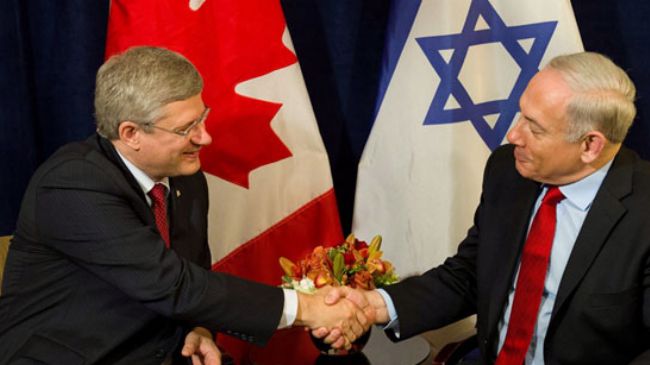
By Brandon Martinez | Press TV | April 11, 2014
The Zionist ruling clique of Canada, through their front-man Stephen Harper, is seeking to beef up the already-existing Orwellian “hate propaganda” law which has been primarily used to curtail criticism of Zionists and Israel.
The conspicuous change is buried in the Harper government’s proposed cyberbullying law, Bill C-13.
The existing law in Canada’s criminal code makes it illegal to “promote hatred” (whatever that means) of people “distinguished by colour, race, religion, ethnic origin or sexual orientation,” explained The Chronicle Herald, but Bill C-13 intends to expand that category to include age, sex, mental or physical disability, and most disturbingly, “national origin.” In other words, you cannot criticize anyone for any reason at all!
This means, say, if you condemn Israelis for their inhumane treatment of Palestinians, you could find yourself in court facing down the self-appointed thought police and commissars of political correctness.
The … law against “hate speech” is illegitimate and ridiculous to begin with. The idea of allowing a government to legislate against opinions and feelings is patently absurd – it is pulled right out of George Orwell’s dystopian classic 1984.
British Columbia native Arthur Topham has felt the wrath of Canada’s censorious establishment. In November 2012, at the instigation of the Zionist society of B’nai B’rith, Topham was charged with a ‘hate crime’ for publishing anti-Zionist articles on his website Radical Press.
One of the items on Topham’s site that made the Zionists convulse and contort with unrestrained anger and rage was a satire called Israel Must Perish. The text was nothing more than a spoof of a 1941 book authored by a Zionist … named Theodore Kaufman entitled Germany Must Perish! In that text Kaufman called for “a final solution” of German extinction. Topham merely substituted the words “German,” “Germany” and “Nazi” with “Israel,” “Jew” and “Zionist” throughout the text. Despite writing a clearly-worded preface explaining the satirical nature of the text, Topham was arrested by the RCMP and now faces the possibility of spending up to two years behind bars for violating Zionist sensibilities.
Many will recall the sad saga of German-Canadian publisher Ernst Zundel. In the mid-1980s Zundel was charged with “spreading false news” after he published a book, Did Six Million Really Die?, which questioned some aspects of the official “holocaust” story. In the ensuing show trial, Zundel and his team of revisionist historians as well as his indefatigable defence lawyer Douglas Christie brought the holocaust lobby to its knees with facts and information refuting many claims made by Zionists about Germany’s WW2 concentration camps.
Over the span of three decades, Zundel was dragged from courtroom to courtroom, from jail cell to jail cell, merely for expressing a viewpoint deemed verboten by the … Zionist establishment – the self-appointed architects of public discourse, the self-declared arbiters of truth and morality, the self-proclaimed “chosen people” whose faults are unseen and whose character is unimpeachable.
Zundel, a self-described pacifist with no criminal record, was physically assaulted on numerous occasions by Jewish Defence League thugs. His Toronto home, which also housed his publishing and graphic arts businesses, was bombed and torched by Zionist terrorists. He received death threats on a daily basis from members of the “chosen race of God,” but the Toronto Police did almost nothing to prevent any of it and was entirely uninterested in pursuing the criminals and thugs responsible for the campaign of terror against Zundel and his associates.
Zundel’s story is a testament to the power and control of Jewish extremists in Canada, whose agenda is anything but altruistic and whose disposition is more racist than the Klan.
In the “New World Order” being imposed on us by self-interested, ethnocentric megalomaniacs, no man has the right to explore, investigate and come to his own conclusions about history — that is the sole responsibility of the tyrannical monarchs of the NWO, who tell us what and how to think; free thought be damned.
Brandon Martinez is a freelance writer and journalist from Canada whose area of expertise is foreign policy, international affairs and 20th and 21st century history. His writing is focused on issues such as Zionism, Israel-Palestine, American and Canadian foreign policy, war, terrorism and deception in media and politics. Readers can contact him at martinezperspective@hotmail.com.
Iran dismisses Canadian court ruling on asset freeze
Press TV – March 22, 2014
Iran has rejected a politically-motivated ruling by a Canadian court to seize more than USD 7 million of the Islamic Republic’s assets and properties.
Iranian Foreign Ministry Spokeswoman Marzieh Afkham said on Saturday that Iran was not informed about the legal proceedings, adding that the court ruling has therefore “no legal value” to Iran.
An Ontario judge in Canada recently ordered the seizure of more than USD 7 million of assets and properties belonging to Iran over some plaintiffs alleging that the Islamic Republic funds terrorist groups.
“Given the approach of the Canadian government, it is crystal clear that the verdict is politically-motivated and such rulings have no legal value,” Afkham said, reminding the Ottawa government of its international commitment to protect diplomatic properties.
Pointing to Canada’s move to sever ties with Iran unilaterally, Afkham said under international law diplomatic properties have immunity, warning Ottawa of the legal repercussions of disrespecting international regulations.
The Iranian official stated that Iran, as a victim of terrorism, has always denounced this inhuman scourge.
She warned that the double standards used by Western countries, including Canada, in the fight against terrorism will not only fail to uproot it but will also contribute to the spread of this phenomenon.
On September 7, 2012 the Canadian government closed its embassy in Tehran and ordered Iranian diplomats to leave Canada within five days.
In a statement, Canadian Foreign Affairs Minister John Baird cited a number of reasons for Ottawa’s decision to sever ties with Iran, including the West’s dispute over Tehran’s nuclear energy program, the country’s support for the government of Syrian President Bashar al-Assad as well as “threatening the existence of Israel.”
Related article


Featured Video

Rewriting the risk? Inside the government’s vaccine safety messaging
or go to
Aletho News Archives – Video-Images
Book Review
“Davos Can Really Replace the UN”
Inside the book that maps the architecture behind global governance — from the Epstein files to the Pact for the Future
Lies are Unbekoming | April 1, 2026
On June 13, 2019, the United Nations and the World Economic Forum signed a partnership deal to “accelerate the implementation of the 2030 Agenda for Sustainable Development.” That same evening, WEF president Börge Brende — Norway’s former Foreign Minister — had dinner with Jeffrey Epstein at Epstein’s Manhattan townhouse. The Epstein files, released January 2026, contain an exchange between the two from the previous year. Epstein to Brende: “Davos can really replace the UN. C21, cyber, crypto . genetics… intl coordination.” Brende back to Epstein: “Exactly — we need a new global architecture. World Economic Forum (Davos) is uniquely positioned — public private.”
The next day, the UN General Assembly adopted the framework for restructuring global governance.
That sequence — the partnership signing, the Epstein dinner, the candid admission about replacing the UN with a public-private architecture, and then the formal adoption — opens Jacob Nordangård’s The Digital World Brain. Pages two and three. Footnoted to the UN resolution number, the Epstein files, and the General Assembly record.
I keep coming back to it because it captures what this book does that almost nothing else in the independent research space manages. I’ve followed Jacob’s work for years now and interviewed him about his research. Each book peels back another layer of the same institutional architecture, and each time I think he’s reached the limit of what can be documented, the next one goes further. Nordangård doesn’t speculate. He doesn’t editorialize much. He lays institutional actions next to each other in chronological order and lets the pattern announce itself. … continue
Blog Roll
 Aletho News
- REWRITING THE RISK? INSIDE THE GOVERNMENT’S VACCINE SAFETY MESSAGING
- “Davos Can Really Replace the UN”
- NIAID/NIH and USDA Fund Bioengineered Chimeric Influenza Viruses Built Using Pandemic H1N1 Components: Journal ‘Science Advances’
- Hezbollah hits Israeli warship off Lebanon’s coast, sets it aflame
- Iran slams US strikes on B1 bridge, Mahshahr petrochemical plants as ‘blatant acts of state terrorism’
- In letter to UN chief, Araghchi warns of dire consequences of US-Israeli attacks on Iran’s nuclear facilities
- Why the CIA conspiracy to invade Iran with Kurdish militias failed
- Why Are Upbeat US Claims About Mission to Rescue Pilot ‘Highly Questionable’?
- Aircraft destroyed during US ‘rescue’ of downed F-15 pilot cost more than $100 million each
- Washington University removes professor who condemned US-Israeli war on Iran
- If Americans Knew
- In Iran, Israel-US take aim at “reason, research, and freedom of thought” – Daily Update
- US loses planes over Iran, Israel downgrades Lebanon war goals – Daily Update
- Israel Is Blocking Palestinians from Easter at Church Where Jesus Resurrected
- Plot to assassinate Palestinian activist follows harassment campaign promoted by Zionist groups and elected officials
- Prominent New York synagogue hosts presentation on why U.S. Jews should support the ethnic cleansing of Gaza
- Tapper vs. Piker: Is the CNN Anchor Auditioning for David Ellison?
- Shouldn’t Democrats Be Able to Condemn Genocide?
- Israel-US kill negotiators, destroy civilian structures, but Iran’s military capabilities still largely intact – Daily Update
- ‘War crime’: Global condemnation as Israeli ministers celebrate death penalty law targeting Palestinian prisoners
- 7 Ways Israel Is Turning Lebanon Into Gaza
- No Tricks Zone
- An Inconvenient Tree: Uncovered In Alps… Europe Much Warmer Than Today 6000 Years Ago
- New Study Reports A 60% Slowdown In Greenland’s Ice Loss Rate In The Last Decade
- Low Intensity Tornado Wrecks Major Solar Farm, Creating A Potential Toxic Dump
- New Study Finds Warming Saves Lives…Cold Temperatures 12 Times More Deadly Than Excess Heat
- German Science Blog Accuses PIK Climate Institute Of Hallucinating Climate Tipping Points
- Devastating Assessment Of Comirnaty Vaccine By Former Senior Pfizer Europe Toxicologist
- New Study: CO2 Is ‘Effectively Negligible’ As An Explanatory Climate Change Factor Since 2000
- Former Pfizer Toxicologist Dr. Helmut Sterz Tells Bundestag Hearing Pfizer Vaccine Should Have Never Been Approved
- Energy Expert: Germany’s Nuclear Phaseout Was A “500 Billion Euro Mistake”
- New Research: South Australia’s Mid-Holocene Sea Surface Temperatures Were 4°C Warmer Than Today
 Aletho News