Canada’s State-Funded Legacy Media Unite to Combat “Disinformation”
By Didi Rankovic | Reclaim The Net | October 21, 2024
A large number of state-funded legacy public broadcasters from around the world have joined the Ottawa Declaration, which calls for combating “disinformation.”
Among the declaration’s points is the one that goes into what its authors – CBC/Radio-Canada – refer to as “accountability from social media platforms.” The document wants to have these platforms implement “safeguards and processes to address where disinformation is disseminated.”
We obtain a copy of the document for you here.
CBC was joined in this and a number of other demands by the world’s largest public legacy media organization, the Public Media Alliance, and its Global Task Force.
Members of that task force are the likes of ABC, BBC, France TV, Germany’s ZDF, and CBC/Radio-Canada, among others.
The declaration they supported was adopted at the 2024 Public Broadcasters International conference in Ottawa, and features “public service media” (“PSM”) claiming that their news and coverage are of “high quality” and of the kind that contributes to the “health of democracies all over the world.”
It then cites the demise of many local outlets and asserts there is now a rise in misinformation and disinformation, as well as that “professional news content” struggles with discoverability on the internet.
Altogether, the declaration states, that this represents “a threat to democracy.” The document parrots what politicians in many countries, including the US and Germany, have been saying these last months when it warns about algorithms and malicious actors destabilizing societies by means of disseminating misinformation.
For these reasons, the signatories committed to ensuring wide access to what they consider to be news, “combating disinformation” (and that includes the use of controversial “fact-checkers” but also “verifying content provenance”).
These legacy broadcasters also pledge to restore “civil” democratic debate, and then go into what social media platforms should do.
One demand is to provide distribution of their own content “on fair terms.” And then once again, the declaration returns to “disinformation,” this time in the context of social media.
Legacy broadcasters seem averse to competition but are not above smearing it, and so the document reads that social media platforms “should also have safeguards and processes to address where disinformation is disseminated and impostor content masquerades as professional news media.”
No battle in “the war on disinformation” is complete these days without the mention of “AI.”
The outlets that backed the declaration say they will be complying “with principles of responsible AI use” that will provide them with transparency and “fair use of our content.”
Documents show how CBC leaned on Twitter to censor content
By Cindy Harper | Reclaim The Net | May 5, 2023
Journalist Matt Taibbi has corroborated claims made by Rebel News that the Canadian Broadcasting Corporation (CBC) coerced Twitter to suppress voices and organizations it found disagreeable, even going as far as threatening litigation if the social media platform failed to oblige.

Earlier this week, Rebel News released documents indicating that the CBC exerted pressure on Twitter to silence specific individuals and groups, many of whom have been criticized by Prime Minister Justin Trudeau.

These documents contained correspondence between Michele Austin, former Director of Public Policy for Twitter in the US and Canada, and key figures within the CBC, including President Catherine Tait and Cam Gordon, who at the time headed communications for Twitter in Canada. Austin’s communication with Gordon revealed that the CBC had explicitly threatened legal action during a call with the pair, prompting them to terminate the conversation.

Austin further deliberated on whether they should respond to a letter sent by the CBC or simply ignore it, while also mentioning that she had already escalated the case.
Another email highlighted by Taibbi was sent by Claude Galipeau, a CBC executive, addressed to several Twitter executives and Tait. The email contained a follow-up letter regarding the issue they had previously discussed on May 26, 2021.
Additional documents obtained by Rebel News showed that Tait warned Twitter that the CBC would cease advertising on the platform if it failed to suppress the voices that the publicly-funded media organization wanted censored.
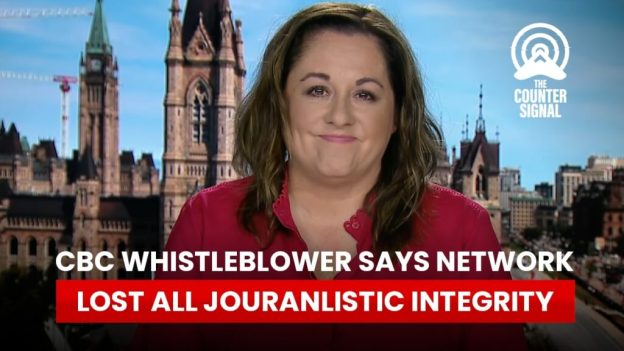
CBC whistleblower quit over COVID propaganda
By Mike Campbell | The Counter Signal | July 12, 2022
On the Trish Wood podcast, former CBC reporter Marianne Klowak said the network lost its journalistic integrity in June 2021, when COVID vaccines became widely available and mandates were on the horizon.
“I tried to push through a number of stories that were censored and cancelled. We were no longer committed to truth and honesty,” Klowak told Wood.
Klowak described how she wanted to show both sides of the vaccine debate and let viewers decide for themselves. Moreover, at the time, she was finding concerning data coming out of Israel — a country where vaccines were available months before most others like Canada — and thought it was newsworthy. CBC disagreed.
“This was at the time when Israel was reporting links between the Pfizer vaccine and heart inflammation,” Klowak continued. “And, we were talking about this in the newsroom, about this link, and what could it mean… and how the trials were on for this vaccine until 2023, and I called a meeting with the managing editor and the exec, and I said we have to be really careful on this bandwagon we’re getting on promoting this vaccine because we don’t know what the outcome is going to be in a few years down the road.”
“What if this becomes another Thalidomide?” she asked, referencing the 1950’s drug that was given to pregnant women for nausea before being recalled after birth defects were discovered to be a prevalent side effect.
But her concerns fell on deaf ears.
According to Klowak, all nuance and skepticism were thrown out the door. The CBC was on team vaccine, and that was that.
“At breakneck speed, we were cancelling one whole side of the debate. And it just happened so quickly,” she explains. “You know, I was looking around the newsroom, thinking, ‘am I the only one who’s thinking this way? Am I the only one who’s seeing this?’”
She continues, saying that she had always enjoyed her time at the CBC and thought they gave “a voice to both sides of an issue” and would let the listener “decide what the truth was in that.” But now, she said, the CBC had decided to become “intentionally misleading.”
“All of a sudden, we were eliminating one entire side, and we were saying ‘Here’s the truth,’ and to me that was misleading — and it wasn’t honest.”
Klowak said that this was the turning point for the CBC. They were repressing information the public needed to “make a decision based on informed consent,” and things “started to spiral” into outright censorship at the network.
“It was quickly becoming not safe for people to tell their stories and to have their voices heard because they would be dismissed; they’d be cancelled; they’d be belittled,” Klowak explained.
“There was this huge disconnect between I saw what we were publishing and the stories I was hearing.“
Presenting only one side
Klowak gives an example of a story that didn’t get published because CBC wanted to spin it as pro-vaccine.
She says a group of parents contacted her with vaccine concerns. For example, they thought it was unethical to encourage children to get the vaccine behind their parents’ backs. Moreover, they had vaccine liability questions.
The group referenced expert virologist Byram Bridle from the University of Guelph to show that their concerns were based on science, not mere speculation.
Shocked by the division the vaccine was causing upon families and communities, Klowak pitched the story and was given the go-ahead by her editors.
She proceeded to seek out both sides of the scientific debate regarding COVID vaccines.
In the course of her research, Klowak came across the Candian COVID Care Alliance — a group of medical experts who presented an alternative vaccine perspective supported by scientific insights and data. The group had a petition calling to suspend vaccines in youth until long-term safety trials were completed.
Thinking this was a hard-hitting story that would “punch a hole in the narrative,” her copy-editor instructed her to show a draft to the Toronto Health Unit for feedback.
While none of the data in her draft was questioned by the authorities at the Toronto Health Unit, they attacked the reputation of the COVID Care Alliance.
Klowak was subsequently asked by CBC higher-ups to take the COVID Care Alliance out of the story and to include the two voices from Toronto Health Unit who supported vaccinating young people instead.
“So at that point, I went back to management. I said you know what, ‘I can’t do this. What you’re asking me to do is journalistically unethical. It’s manipulating information. This doesn’t sit well with me,’” Klowak said.
“It was dishonest. It was a dishonest thing for me to do. It was immoral for me as well. Because not only were we cancelling credible voices, we were violating our own principles of balance and fairness.“
“I couldn’t do what they were asking me to do by censoring an entire group of credible professionals just because they had a different viewpoint on this.”
“I’m thinking, this is not right. And it was moving the story towards the narrative, and not allowing dissenting voices to be heard.”
Smearing the unvaccinated
Klowak further noted that the CBC moved from merely disregarding one side to outright smearing them with labels such as “anti-vaxxer.”
In 2021, she notes, the federal government conducted a survey to find the proportion of vaccine-hesitant Canadians, finding that 50% of the Canadian population was hesitant at the time because the vaccine was experimental and unproven.
But instead of focusing on that group of 50%, CBC framed vaccine-hesitant as borderline religious nuts who denied COVID as even being real.
“… I step in and say, what are we doing? Is that the stereotype we are creating that this is the person who is vaccine-hesitant? Why aren’t we doing one on the 50% who are concerned about [the] long-term and short-term side effects… Why aren’t we doing data dives? Why aren’t we holding Pfizer to account?” Klowak recalled.
“We were feeding fear, and anger, and division, and I thought, I just can’t be part of this anymore.“
Here is a brief sample of some of the propaganda articles that the CBC released in the latter half of 2021:
- “Former B.C. anti-vaxxer says COVID-19 pandemic changed her mind about refusing immunizations | CBC News“
- “COVID-19 denier and conspiracy theorist Mak Parhar dead at 48 | CBC News“
- “Husband regrets anti-vaxx stance as wife lies in a coma 800 km from home | CBC News“
- “‘Misinformation can kill people’: Friends and family grieve loss of loved ones who refused COVID vaccines | CBC News“
Klowak and Trish Wood further commented on CBC’s dishonest coverage of the Freedom Convoy.
“The way that group was painted and portrayed was just, you know, I was just left speechless thinking, really? Really? Do you really think these people are criminals and white supremacists? Really? It was just so disturbing to watch,” Klowak told Wood.
Klowak also says she saw videos of the Freedom Convoy that showed the protestors in an entirely better light than what the CBC was reporting.
It didn’t matter, though. The CBC had their agenda, and nothing would get in the way of it.
Ignoring the vaccine injured
More disturbing, however, Klowak says that while at the CBC, stories about vaccine injuries were rejected.
“This was the most profound form of gaslighting. You had a [person with a] vaccine injury, and yet we were hesitant to believe what they were saying was true — that they could have possibly had this experience,” Klowak said.
She then recounted interviewing a woman in her 30s who’d suffered pericarditis within two days of getting vaccinated and is still struggling with daily activities due to her condition.
She pitched the story, but, again, CBC editors wanted to spin the story towards vaccines being a good idea for women her age.
And, again, Klowak refused to run it, eventually quitting.
Klowak isn’t alone in blowing the whistle on the CBC
Klowak isn’t the only CBC whistleblower to come out this past year. In January, Tara Henley also quit and explained in her substack why she left.
“Those of us on the inside know just how swiftly — and how dramatically — the politics of the public broadcaster have shifted,” Henley said. “To work at the CBC in the current climate is to embrace cognitive dissonance and to abandon journalistic integrity.”
“It is to allow sweeping societal changes like lockdowns, vaccine mandates, and school closures to roll out — with little debate. To see billionaires amass extraordinary wealth and bureaucrats amass enormous power — with little scrutiny.”
Indeed, while CBC hosts feign ignorance on the network’s vaccine censorship, editors print corrections nearly every week, and reporters use mannequins in place of patients to make COVID look worse, it’s no surprise to see politicians these days leading “Defund the CBC” chants at their rallies.
The abysmal lack of journalistic integrity described by Klowak and Henley would tank most news organizations, but because the CBC is federally-funded and might as well have a license to mislead, it can’t fail as a company.
Canadian Media STILL Pushing Crackpot Theory That Truckers Are Russian Agents
By Steve Watson | Summit News | February 14, 2022
As the Canadian freedom convoy rolls on and continues to influence other protesters around the globe, Canadian media continues to push outright disinformation by suggesting that the Russian government is behind the movement.
When the convoy first came to prominence at the end of January, state broadcaster the Canadian Broadcasting Company began spreading completely unfounded claims that “Russian actors” were present among the Canadian truckers holding up major cities including Ottawa and Toronto, as well as border crossings.
The tenuous reasoning behind the theory is that Canada has expressed support for Ukraine during the country’s ongoing tensions with Russia.
Rather than admit that working class truckers are sick of enforced restrictions and vaccine mandates threatening their livelihoods, CBC floated the crackpot idea that Vladimir Putin is secretly behind the protests.
CBC continues to push the conspiracy theory, with correspondent Harry Forestell filing the following report Friday giving airtime to ‘New Brunswick cybersecurity expert’ David Shipley, who is adamant that the Russians are behind everything.
Shipley proclaimed “Who would have reason right now to cause as much chaos in Canada as possible? Well, at the top of that list is Russia.”
He continued, “We are actively engaged in a geopolitical battle about the future of the Ukraine. Our Foreign Affairs minister, our Prime Minister, others have been very vocal in our support for the Ukraine and it seems very likely that the tactics that we are seeing, the creation of the massive Facebook groups using fake identities or in the case now alleged by a U.S. media outlet, a stolen identity of a Missouri woman to create these groups and to foster this communication hundreds of thousands of people, this is the Russian internet research agency playbook writ large.”
Shipley has considered that possibly the truckers are Chinese agents too, but ultimately no, they’re Russian.
He declared “You have other enemies as well. You have China, you have other states but when I narrow down my list of suspects and I don’t have enough evidence to win in a court of law but I don’t need that right now, this smacks of the kind of move that Russia has made in the past, the United States, and is continuing to do around the world.”
When asked what the solution to this pressing Russian agent problem is, Shipley’s solution was to restrict and shut down the convoy’s social media presence.
You certainly don’t have enough evidence Mr Shipley because there isn’t any.
Media floats Russia theory for Canadian trucker protest
State-owned CBC suggests that ‘Russian actors’ may have instigated massive protest convoy that shut down nation’s capital

RT | January 29, 2022
A cross-country convoy of truckers that has jammed the streets of Canada’s capital in protest against Covid-19 vaccine mandates might seem like grass-roots pushback against government overreach, but broadcaster CBC Television has offered a more sinister explanation: Russia did it.
Speaking in an interview on Friday with Canada’s public safety minister, Marco Mendicino, CBC host Nil Koksal suggested that possible Kremlin meddlers might have brought about the massive “Freedom Convoy.” “Given Canada’s support of Ukraine in this current crisis with Russia, I don’t know if it’s far-fetched to ask, but there is concern that Russian actors could be continuing to fuel things as this protest grows, but perhaps even instigating it from the outset,” she said.
Koksal didn’t offer any evidence to back up the theory or say who has raised such concern. Mendicino replied, “I’m gonna defer to our partners in the public safety, the trained officials and experts in that area.”
The interview came just before disgruntled truckers began to arrive in Ottawa on Friday night. Thousands of convoy participants and other protesters massed in the city on Saturday, bringing traffic to a standstill and sending Prime Minister Justin Trudeau into hiding. State-owned CBC said Trudeau and his family had been moved from his official residence to a “secure location.”
As many as 50,000 trucks were reportedly expected to flood into Ottawa, and traffic was snarled through much of the city. Some trucks were emblazoned with “F**k Trudeau” signs across their trailers, while other protesters demanded, “Mandate freedom.”
Government restrictions that went into effect on January 15 require unvaccinated Canadian drivers to quarantine for 14 days when they cross the border back into their country. Trudeau has condemned the angry truckers as holding “unacceptable views.”
Prior to floating the theory of a Russian bogeyman, Canadian media outlets have made other claims that appeared to smear the protesters, such as suggesting they are racist or extremist.
The Toronto Star said the convoy became a “magnet” for such undesirable elements as “conspiracy nuts, Western separatists, far right-wingers and worse.” Others have suggested that some participants want to carry out their own version of last year’s US Capitol riot.
A counter-protester was seen on Saturday saying, “F**k your white nationalist agenda,” while Canadian television reporter Mackenzie Gray was quick to post a Twitter message proclaiming “our first Confederate flag of the day here on Parliament Hill.” Multiple observers replied that Gray had spotted the “first fed of the day,” meaning a federal agent seeking to discredit the protest.
Pathetic Fail #4: Matt Kwong and the CBC

Matt Kwong, Accessory after the Fact [source: CBC]
Winter Patriot | September 15, 2016
Number 4 : Matt Kwong and the CBC, for “Why the ‘9/11 Truth’ movement endures 15 years later”
As we saw in the previous installment, when Jack Holmes tried to prove the Truthers wrong on all major points and failed dismally, a head-on, evidence-based attack on 9/11 Truth is sub-optimal strategy. In this episode, we turn to an accessory after the fact who set himself a much different task, but failed anyway.
Presumably because he’s too smart to attack the Truth Movement from the front, Matt Kwong of the CBC comes at it from the rear. Rather than taking on the evidence, which did no good at all for Jack Holmes, Matt Kwong turns to time-honored journalistic tactics: smear and innuendo, woven together with sleight-of-hand that would have made a magician drool if it had worked.
The result is not merely a pathetic fail but a nasty one — a transparently ugly smear against the people who want to know the truth about 9/11, and especially against Bob McIlvaine, who lost his son Bobby that day.
Bob McIlvaine has been trying to find out what happened to Bobby, and trying to get people to care about what happened to all of us, for the past 15 years. To those of us who have followed the story, Bob McIlvaine is something of a role model — because he didn’t believe the lies he was told, and he didn’t cower when he was told to sit down and shut up, and he’s been waging an uphill battle for a long time, and he hasn’t quit.
If Bobby McIlvaine had died under mysterious circumstances in a foreign country, and Bob had spent 15 years trying to find out what happened to him, Bob would be seen as a heroic figure. A paperback writer would churn out a vapid tribute to his dogged persistence and his enduring love for his son, and we would see the result in drugstores.
But because of where, and when, and how Bobby McIlvaine died, Bob’s efforts cannot be praised, only denigrated. This is how far we have fallen.
Under the bizarre sub-heading “Father of 9/11 victim reconciles unconventional beliefs with grief,” Matt Kwong writes:
Robert McIlvaine knows better than to talk, unsolicited, about the research he pores over at home in Oreland, Pa. […] it’s the circumstances around the attacks — specifically, McIlvaine’s beliefs about precisely how the world-altering event unfolded — that he’s cautious to discuss. […] “My wife doesn’t take me out; doesn’t go with me anymore because she’s afraid I’ll bring it up with friends,” he says. […] “No one wants to talk about it,” McIlvaine says. “It’s like you have leprosy.”
… and so on. But there’s a mystery. If no one wants to talk about it, why are people still talking about it?
There must be a reason. What could it be? … Well, maybe it’s the Internet!
Fifteen years later, the devastating attack on America that coincided with the nascent internet age continues to spawn discussions hosted in forums that speculate about the moon landing, the Hollow Earth hypothesis and the JFK assassination.
Here we go! This is called red herring and guilt by association, a truly journalistic combination of logical fallacies to provide just the right context for what comes next — the few relevant details we will ever get from Matt Kwong:
The official account says McIlvaine’s eldest son […] was […] on the 106th floor when American Airlines Flight 11 struck the north tower.
McIlvaine suspects otherwise. Based on injuries his son sustained, including to his face and chest, he maintains Bobby was killed by an explosion, possibly before the plane crash. As Bobby was among the first 10 bodies found, he says, McIlvaine believes his son was in the tower’s lobby.
“If he was on the 106th floor, he wouldn’t have been found so quickly.”
I think Bob’s kidding himself. In my view, if Bobby was on the 106th floor, he probably wouldn’t have been found at all!
But that’s not the real issue. The real issue is the condition of Bobby’s body. “Injuries […] to his face and chest” hardly qualifies as an accurate description of the wounds.
Matt Kwong doesn’t give you enough details to help you understand this aspect of the story. But if you do some research to supplement his so-called journalism, you can learn quite a bit, fairly easily.
According to McIlvaine, the wounds described by the doctor indicated that his son had been hit by flying glass from some kind of massive blast. Bobby’s face was damaged beyond recognition, he had lacerations all over his chest from flying glass, and he had post-mortem burns. In fact, the blast was strong enough to literally blow Bobby out of his laced shoes (they were not on the body when it was brought to the morgue).
“My final summation is that he was walking into the building, and before he got into the building there was a huge explosion, and of course the force of it just threw him back into the open area,” McIlvaine says. “That’s why he was picked up so quickly, because the EMTs came down there so quickly. Someone had gotten him out of there and to the morgue before the towers came down.”
In other words, Bob has good reason to think Bobby was not killed by fire at the top of the tower, but by blast and flying glass at its base. And if Bob thinks these were the result of a massive explosion? Well, what else could it have been?
Matt Kwong could have told you this; anyone familiar with the stories of the 9/11 families could have done the same. Bob’s been speaking in public for a long time, and his story about Bobby — unlike the official narrative — hasn’t changed. He certainly wouldn’t have been reluctant to tell Matt Kwong why he thinks what he thinks.
But Matt Kwong can’t (or won’t) tell you all this. And the reason is simple: If you focus on two things — what Bob knows about his son’s death, and the official explanation behind the attacks — you can’t help seeing the basic contradiction: How could Bobby have been killed by an explosion if there were no explosions?
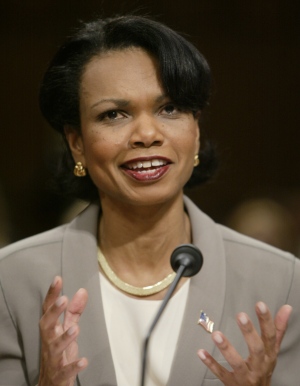
National Security adviser Condoleezza Rice responds to a question during testimony before the 9/11 Commission in the Hart Senate office building in Washington on April 8, 2004.
(Larry Downing/Reuters) [source: CBC]
What did Bob McIlvaine do about it? According to Matt Kwong, he waited to see what the government would say, thus:
McIlvaine attended the 9/11 Commission [but] he left angry and dissatisfied by testimony from then-national security adviser Condoleezza Rice.
(Curiously (or not!), several paragraphs before mentioning Condoleezza Rice, the CBC inserted a photo of Miss Rice herself, looking cool and comfortable as she testified before the Commission. The photo, the caption, and the placement combine to create a subtle hint that Bob’s got his nose out of joint for nothing. I’ve included the photo and CBC’s caption verbatim, several paragraphs before mentioning it, to give you a subtle hint of what CBC is doing.)
But Matt Kwong doesn’t tell you about Miss Rice’s testimony. And he certainly wouldn’t want you to see a video of her being questioned. Matt Kwong won’t show you video evidence of the other family members who were outraged at the hearings, either.
But I digress. Here’s Matt Kwong again:
McIlvaine began to dig on his own for answers online, watching web documentaries such as Dylan Avery’s 9/11 truth staple, Loose Change, as well as reading more American history.
And this was the dangerous, slippery part. By daring to educate himself, Bob McIlvaine put himself in danger of becoming what’s called a “conspiracy theorist,” of the noxious variety known as “9/11 Truther.”
To help you “understand” what happened to Bob, Matt Kwong takes you on a journey to the land of conspiracy theory research. But he weaves the McIlvaine story through the travelogue, making things very confusing. (I didn’t say the confusion was deliberate.)
In this piece, I have shuffled the order somewhat, separating Bob McIlvaine’s story (which we’ve been reading) from the conspiracy theory research (to which we now turn).
Here’s Matt Kwong:
“People who are more personally distrustful tend to buy into conspiracy theories more,” says Mike Wood, a Canadian lecturer at the University of Winchester in England specializing in the psychology of conspiracy theories.
If anything, Americans seem more distrustful of their government than in a long time. […]
Wood says those suspicious of the government also tend to be more aware of “actual historical conspiracies, where the government did something shady.” […]
Research also shows conspiracy theories tend to reach peaks around “times of uncertainty,” according to Wood. In the case of something as extraordinary as a 9/11, an event resulting in thousands of lost lives, a massive reshaping of the iconic New York skyline and two wars, he says the conventional narrative may be tough to swallow.
It certainly is. And there’s nothing wrong with this analysis as far as it goes. But where does it go?
Matt Kwong again:
Some Americans had never heard of al-Qaeda or even Afghanistan before 9/11. And so, alternative explanations filled the vacuum, says Dave Thomas, a fellow of the Committee for Skeptical Inquiry […]
Dave Thomas may be Skeptical, but I fear he’s not quite skeptical enough!
It may be true that “Americans had never heard of al-Qaeda or even Afghanistan before 9/11,” and it may be true that “alternative explanations filled the vacuum,” but there’s no causal connection here, because there’s a link missing.
As the attack was unfolding, and in the immediate aftermath, there was no vacuum. There was an avalanche. No matter where you turned, the news kept talking about Osama bin Laden and al Qaeda and Afghanistan, and the country was ready to go to war before the dust had settled. The vacuum came later, when more and more people began to see through the lies that comprise the official story. That’s when “alternative explanations filled the vacuum.”
As time went on, we learned more and more about the official story, and the more you know about it, the less credible it is, so the number of people who questioned it — or rejected it outright — grew. Some people started reading American history, just like Bob did. And what they learned was shocking … until all the pieces started to click into place. And suddenly, the nonsensical official story made perfect sense to them, once they saw it as an elaborate deception rather than a series of unprecedented failures.
Had the official story been credible, none of this would have happened. If the story had been even halfway believable, most of us would have been happy to believe it and get on with other things. But that didn’t happen.
I can explain what did happen in a parable. Think of this mystery as a “connect-the-dots” puzzle. From the day of the attack (or earlier in some cases), we started taking note of important dots, and wondering what they could mean. As the official story became clearer, we looked at how the dots were being arranged, and how they were being connected, and how many of the dots weren’t being connected at all, and we started to wonder. But when we realized how many of the dots had been erased, we stopped wondering, because we knew those dots didn’t erase themselves.
So it’s far more accurate to say the vacuum was caused by the holes in the official story.
The fact that “some Americans had never heard of al-Qaeda or even Afghanistan before 9/11” doesn’t make any difference at all.
But Matt Kwong can’t tell you that. Instead — if we want to follow his story — we have to think backwards.
Backward thinking regarding 9/11 shows up in many guises. For instance, as I showed in the previous installment, the 9/11 Commission was set up to run backward. They decided who committed the crime, and then they decided which evidence to consider, based on whether it could be used to support their predetermined conclusions. Then they put together a narrative that was supposed to tie all the evidence together. But there was a problem with some of the evidence, namely: the evidence they decided not to consider. And the problem is: We know about that evidence, and it undermines their story. So their solution is: the facts must be suppressed. And now the defenders of the official story claim not only that there were no explosions, but also that there was no evidence of explosions!
This claim is clearly false. The New York Times published an oral history of 9/11, compiled by the NYFD, in which more than 100 first responders described bombs in the towers, or gave other evidence that can only be explained by explosions. Numerous other eyewitnesses, who were interviewed on the day and later, described the explosions they experienced. There are videos in which we can see and hear explosions going off in the buildings. Mainstream media reports on the day of the attacks contained many mentions of explosions. And the whole world watched the towers exploding on television, over and over and over — for two weeks! But according to defenders of the official story, none of this happened — even though much of it, including the NYT oral history, is freely available online.
And the reason why they claim none of this happened is because the official story-tellers couldn’t figure out a way to explain how al Qaeda could have planted explosives in the towers. Their line of backward thinking ran: al Qaeda did it; al Qaeda could not have planted explosives in the towers; therefore there were no explosives in the towers.
Similarly, we have a whole new field of academic research now, in which Conspiracy Theories are studied as a sociological or psychological phenomenon. Bright, well-educated people, who really ought to be doing productive work, are now paid to track conspiracy theories, to watch how they grow and spread, and to explain, if they can, why people believe them.
But explaining this is more difficult than I’ve indicated, because they have to explain them in a politically acceptable way. That is to say: they cannot ever consider the possibility that some “conspiracy theories” may be more credible than the corresponding official stories.
This consideration is essential, in my analysis, because of the fact that so many official stories are impossible. In each of these cases, all conspiracy theories are more credible than the official story, even if they are only marginally plausible. But no academic researcher can say this; they have to pretend that the official stories are all true.
So all their research has to run backward. They can’t connect cause and effect in the logical way, so they do it in reverse. And this is how they get the idea that we believe conspiracy theories because we don’t trust the government.
To be sure, some researchers will grant that we don’t trust the government because we know more about the government than those who do trust it. But they can’t admit that what separates conspiracy theorists from the people around us is our greater knowledge of topics such as history and government!
Instead they claim that we believe conspiracy theories because we don’t trust the government, when in fact the opposite is true: We don’t believe the official stories because they are clearly false. And this is why we believe conspiracy theories, and this is also why we don’t trust the government.
But this is a path which accessories after the fact dare not tread.
Instead Matt Kwong continues this way:
Distrust in authority “plays into this rejection of the reigning or orthodox narrative of some subject,” says Syracuse University professor emeritus of political science Michael Barkun, author of A Culture of Conspiracy.
“We want stories and narratives that make sense of the world,” Barkun says. “The idea that such an event like the sudden destruction of landmark buildings like the World Trade Center could be caused by 19 nobodies belonging to an organization that almost no Americans had ever heard of, living in ragged encampments in Afghanistan, simply, I think, made no sense to some people.”
It made no sense to a lot of people!
Some of them went on with their lives and didn’t think about it anymore. What could they do about it? So why should they worry about it? What’s so mysterious about that?
The rest of us did worry about it. We didn’t just get on with our lives, because we could see that something fundamental had changed, in a truly awful way, based on a story which couldn’t possibly be true. It bothered us, and we thought we lived in a democracy, because we’ve been taught that we have some influence in the political process, so we got active. What’s so mysterious about that?
But NO! NO, NO, NO! We are definitely not going there! We’ll go sideways instead, with Matt Kwong:
Researchers who study conspiracy theorists point to the dismissal of an official “lone nobody” conclusion on 9/11 as sharing similarities to the continued obsession with the assassination of U.S. president John F. Kennedy in 1963.
It’s a diversion and a red herring, and the word “obsession” is a smear, but in sad fact, the JFK assassination and the 9/11 attacks display many similarities, some of which are relevant enough to discuss here.
For serious researchers, the main point of interesting similarity is not that “Oswald was a nobody” and “Nobody had ever heard of al Qaeda,” although these curious facts may have piqued some interest for some of them at one time. Personally, I’ve never given either of these ideas any thought at all, except when I’ve stumbled over them in propaganda pieces.
The main point for me, and for many other serious researchers, is this: neither Oswald nor al Qaeda could possibly have done what they are alleged to have done.
Does this matter? YES! As Webster Tarpley keeps reminding us, we always need to ask: Did they have the physical and technical capabilities to cause the observed effects? And the answers, in the cases of JFK and 9/11, are clearly “NO!”
Why? The sight on “Oswald’s rifle” was out of alignment. The FBI fired it for testing, and their expert marksmen couldn’t hit any targets with it. So they adjusted the sight and tested it again. But Oswald, who was not a marksman at all, was said to have caused 7 wounds with 3 shots, firing at a moving target, all in 6 seconds, with that rifle, before the sight was adjusted.
Oswald’s pistol was in even worse shape. It wouldn’t fire at all because the firing pin was bent. So the pistol was disassembled, the firing pin was straightened, and the pistol was reassembled so that it could be tested. But Oswald was said to have killed Dallas policeman J. D. Tippit, with that pistol, before it was repaired.
This information came into the public domain through the Warren Commission itself. So the facts themselves can hardly be disputed, and therefore the accessories after the fact would prefer us to ignore them. Otherwise the situation would be too clear.
We don’t have problems with the story because “Oswald was a nobody.” We would have been much more reluctant to accept the story if we’d been told that JFK was killed by somebody famous — like Frank Sinatra or Doris Day. On the contrary: aside from the obvious tampering with evidence, we have problems with the official story because Oswald lacked the physical and technical means to commit the crimes for which he was accused.
With 9/11, we have the same pattern, and the primary illustration is this: al Qaeda could not have put explosives in the towers, so the official story doesn’t try to explain how they did; instead it pretends there were no explosives in the towers at all.
How do we know al Qaeda couldn’t have put explosives in the towers? We have two main ways of knowing this. First, according to defenders of the official story, nobody could have put explosives in the towers. It would have taken too long, somebody would have noticed, and so on. Presumably this logic applies equally, or especially, to nasty-looking foreigners who have no reason to be in the towers at all. And second, if al Qaeda could have put explosives in the towers, then the official story-tellers would admit the presence of explosives and blame them on al Qaeda, which would be much easier than trying to suppress all the evidence of explosives, if only it could be done at all.
But that’s not the only impossibility in the story. The alleged hijackers had no idea how to fly a jumbo jet — according to their instructors, they could barely fly a Cessna — and yet they were said to have performed low-altitude maneuvers that the best pilots in the country couldn’t match, at speeds which would have been far beyond the capabilities of the aircraft.
The terrorists had no way of disabling America’s security systems, from airport surveillance videos right up to the US Air Force. But they are said to evaded every defense along the way.
And no magician has ever made a jumbo jet disappear into a field, leaving only a 20-foot wide hole and no wreckage. But that’s what the plane in Shanksville is supposed to have done.
The list of impossibilities goes on and on. But we don’t have to examine all of them to see the same pattern that we saw in the JFK case.
It doesn’t matter whether anybody had ever heard of al Qaeda. We don’t buy the official story because the alleged hijackers lacked the physical and technical means to cause the effects for which they were blamed.
In other words: we know both official stories are false because the events they describe not physically possible.
So why should we believe them? According to Matt Kwong, the answer lies in Popular Mechanics.
Despite an exhaustive 2005 special report by Popular Mechanics debunking 9/11 theories, polls still show a sizeable population of Americans dispute the official account.
As I mentioned in the previous post, no “report” in such a format could be anything but cursory and shallow.
The format: (1) Reduce all the implausible aspects of the official story to a short list of bullet points. (2) Then, for each point: Reduce all the relevant evidence and all its implications to a single sentence, a crazy one if possible; then “debunk” it with a “telling quote” from an “expert source.”
It’s a combination of logical fallacies, primarily Special Pleading, Straw Man, and Appeal to Authority. And it’s all predicated on the notion that “denied” means the same as “debunked.”
But in PM‘s case, the format was the strongest part of the “report.” The so-called “evidence” presented by PM wasn’t even weak — it was ludicrous.
Thus, contrary to Matt Kwong’s assertion, the “report” from Popular Mechanics was neither “special” nor “exhaustive,” and because they can’t give us anything more convincing, and because nobody else even wants to try, it may be time to consider the possibility that “a sizeable population of Americans dispute the official account” because it’s simply not true!
But Matt Kwong won’t go in that direction. He’s going this way instead:
For his part, McIlvaine doesn’t care about the Truther movement one way or the other, or about the many articles and investigations that have debunked 9/11 conspiracy theories.
He remains convinced about his own narrative.
“I feel good about what I’ve done. My wife’s happy about it, my [other] son’s happy about it. I still go to bed,” he says. “And I’ll say I did what I did for Bobby.”
Bob McIlvaine is tired of being lied to, he’s tired of being belittled and betrayed, and he doesn’t care what anybody thinks anymore — all of which is entirely understandable in my view, given what he’s experienced.
Matt Kwong paints him as a stubborn crackpot who started wondering why his son’s body was found so soon, fell into a hole called the Internet, and wound up believing the craziest nonsense — and he leaves it to the reader to fill in the gaps: the 9/11 truth movement endures because it’s made up of stubborn crackpots who started out asking simple questions and fell into the same hole.
That may be true in some instances, but for me personally it’s despicable slander. I know the official story is false because so many of its features are physically impossible. I don’t care how many accessories after the fact call me crazy. And I am not one in a million — I am one of many millions!
This is why the 9/11 Truth movement endures.
We’re smart enough to spot an obvious lie, even though we’ve heard it a thousand times. And we’re brave enough to say so.
If that makes us stubborn crackpots, so be it. Like it or not, that’s the reason we haven’t gone away. And we’re not going away anytime soon.
Sorry, Matt! You lose! You had all the pieces in your hand and you couldn’t — or wouldn’t — put them together.
Sorry, CBC. You lose, too! There will be a special place in Heaven for any mainstream news organization that’s brave enough to treat this issue with the integrity it deserves. But so far we have none.
In any case: Matt Kwong and CBC, you both stand clearly and willingly on the wrong side of a mass-murderous lie, and an obvious one at that. May God have mercy upon your souls.
On the other hand, Congratulations! You’ve made my list!
As I’ve been saying:
The facts must be suppressed, and the people who are trying to gather and disseminate those facts must be suppressed, and that is the one and only thing that matters to these people. And why? Why would you hide the crime unless you were trying to protect the criminals?
MADAYA: LETTER OF COMPLAINT TO CBC OMBUDSMAN
wallwillfall | January 12, 2016
Letter written to the CBC ombdusman by an informed member of the public in Canada, enraged by the blatant anti Syrian stance in the CBC reporting of the Madaya “starvation” situation.
“Hello,
I have counted The Current and CBC news as among the most reliable sources of news and information we have. I consider myself an informed listener and I consult with many and diverse news sources to get the fullest and clearest understanding of world affairs possible.
That’s why it is disappointing, and sometimes infuriating when I hear the CBC reduced to an echo chamber and propaganda conveyance when it comes to news from the Middle East.
The CBC’s use of unreliable and unverified sources and information that presents and thus promotes only one side of events, and a distorted one at that, is shocking to me. Is it due to cutbacks that you are unable to have investigative reporting from conflict areas that reports on all sides of an event, or is there something more sinister going on exercising editorial control over what Canadians are allowed to hear from the Middle East via our national broadcaster?
Specifically, I was very upset to hear The Current’s Jan 8th report with Lyse Doucet on the situation in Madaya, Syria that gave a completely distorted and misinformed picture of the siege of this town (and several others that are getting zero news coverage).
The presenter relied on only one source, a citizen journalist named Rami Jarrah who works for the George Soros funded ANA Press, and is a self-avowed advocate and spokesperson for the terrorist factions, disingenuously called “the opposition” by uncritical media, that has the town of Madaya and several others in the West and North of Syria under militant siege. It is these Islamist militants–Ahrar al Sham and al Qaeda– that seized the food aid delivered by the ICRC last October–meant to last for 2 months–and is keeping the towns people on starvation rations, stockpiling the food then trying to sell it to the towns people for obscene prices.
Why isn’t that being reported on?
It is the militants that are refusing to let the townspeople leave to find refuge in safe zones. It is these militants who are starving and killing them. These Islamist militants, “the opposition” as propagandists call them, are using the starving people under their control to deceive the world, including the use of now exposed deceptive pictures of starving people stolen from the internet to foment outrage–pictures that are uncritically and irresponsibly used by media outlets like the CBC as some kind of “proof” that the Assad regime is responsible for this suffering.
While these areas of conflict are surrounded by government forces, it is the terrorists occupying the villages that are not surrendering and continue to use people as human shields ad for propaganda. Did The Current or is the CBC news desk presenting any of this balance at all to your stories on Syria? No. You are being played, and worse are a willing participant in a one-sided, anti-Syrian government, pro-Syria destruction campaign.
Why Madaya?
Why now?
Why fake pictures?
These are the questions you should be asking. The answer is because Jarrah and these “humanitarian interventionists” are using and abusing these civilians to enlist more western involvement.
You are not listening to any of the voices coming from inside Syria because you seem to value those minority voices outside Syria that are vying for overthrow of the government and seek to grasp power for themselves in lockstep with western hegemonic agendas.
Thus you are not doing your job.
What you are promoting, maybe inadvertently, maybe not, is for Syria to be devastated by NATO the way Iraq and Libya were, and not for the human rights of the people of Syria.
So shame on you.
This is despicable and my respect for the CBC has diminished significantly.
I urge the CBC to return to it’s roots of unbiased investigative journalism and be committed to the truth so that I can feel confidence again to tune into CBC news and trust we are getting the best information.
Balance your blatantly biased sources with “the other side”– the Syrian government that is backed by the vast majority of Syrian people, and the Syrian doctors and activists that are actually working to free their country from the terrorists!! Listen to the Syrians INSIDE SYRIA!
Why would you NOT do that?
Sincerely,
Annette Lengyel
~~~
Featured Video
America Racing to Strategic Defeat in Iran
or go to
Aletho News Archives – Video-Images
From the Archives
Should Europeans ‘Thank’ the Americans for Destroying Nord Stream?
By Robert Bridge | Strategic Culture Foundation | September 29, 2022
With an investigation continuing into the destruction of the Nord Stream gas pipeline that provided energy supplies to Europe from Russia, there appears to be just one prime suspect, and that should surprise nobody.
Following the sabotage of the Nord Stream 1 and 2 gas pipelines, former Polish Foreign Minister Radoslaw Sikorski already seemed to know the identity of the perpetrator when he tweeted out: “Thank you, USA.”
At first glance, it seemed that Sikorski was speaking sarcastically, berating Washington for carrying out an attack that will have severe repercussions for the people of Europe. After all, how could anyone see any good coming from the termination of Europe’s primary source of gas reserves with winter just around the corner? It was Sikorski’s homeland of Poland, after all, that urged its citizens to collect firewood in the face of dwindling gas reserves.
In fact, the Polish diplomat was speaking one-hundred percent literally… continue
Blog Roll
 Aletho News
- Tehran approves new Hormuz plan with major restrictions
- No Threat Can Force Iran’s Surrender /Trita Parsi & Lt Cl Daniel Davis
- UK’s New Pandemic Plan Would Turn Big Tech Into a Mass Location Tracking Network
- Growing insecurity, soaring prices fuel protests in north as regime bans evacuation: Sources
- Iran denies responsibility for ‘depraved’ attack on Kuwait desalination plant
- Bring The Troops Back. End This War Now!
- Can we please stop calling Israel the ‘only democracy in the Middle East’ now?
- US should start removing its troops from Germany, proposes AfD co-leader Chrupalla
- Iran Red Crescent: 600 educational centers attacked in US-Israeli ‘war crimes’
- Russian Oil Tanker Arrives in Cuba Amid U.S. Blockade
- If Americans Knew
- As Iran targets US military bases, will they be relocated to Israel? Not a ceasefire Day 171
- Will Trump Go Kamikaze?
- Is the University of Florida Shutting Down College Republicans over Israel Criticism?
- Jewish extremist arrested over alleged plot to firebomb Palestinian activist Nerdeen Kiswani’s home
- More than half of Palestinian child detainees have no charges
- The More Murderous Israel Gets, The More We Hear About “Antisemitism”
- Land Day and the Palestinian struggle after 30 months of genocide
- The Iran War Is About Palestine
- Israeli soldiers echo settler ideology, talk of revenge after targeting Palestinians and detaining CNN crew in the West Bank
- Israeli Policies Threaten Future of Christian Schools in Jerusalem
- No Tricks Zone
- New Study Finds Warming Saves Lives…Cold Temperatures 12 Times More Deadly Than Excess Heat
- German Science Blog Accuses PIK Climate Institute Of Hallucinating Climate Tipping Points
- Devastating Assessment Of Comirnaty Vaccine By Former Senior Pfizer Europe Toxicologist
- New Study: CO2 Is ‘Effectively Negligible’ As An Explanatory Climate Change Factor Since 2000
- Former Pfizer Toxicologist Dr. Helmut Sterz Tells Bundestag Hearing Pfizer Vaccine Should Have Never Been Approved
- Energy Expert: Germany’s Nuclear Phaseout Was A “500 Billion Euro Mistake”
- New Research: South Australia’s Mid-Holocene Sea Surface Temperatures Were 4°C Warmer Than Today
- Storing Green Energy To Last Germany 10 Days Would Require A 60-Million Tonne Battery
- New Studies: UK Sea Levels Were 4 Meters Higher Than Today During The Mid-Holocene
- Destructive Green New Deal: German Energy And Metal Group Warns Of Drastic Crisis
 Aletho News