Journey to the End of the Night: The Paris ‘Nuit Debout’ movement
By Gearóid Ó Colmáin | American Herald Tribune | April 17, 2016
In his novel ‘Journey to the end of the night’ Louis-Ferdinand Céline provocatively described the soldiers who had died in the First World War as ‘idiots’. The French writer was referring to the fact the soldiers had given their lives for a cause that was not their own- a futile slaughter of the poor for the benefit of the rich. In the book’s many pertinent reflections on the human condition, the Céline notes how, in modernity, the street has come to constitute the place of dreams. “Que fait-on dans la rue, le plus souvent ? On rêve. C’est un des lieux les plus méditatifs de notre époque, c’est notre sanctuaire moderne, la Rue – what do we most often do in the street, we dream. It is the most meditative place of our time, it is our modern sanctuary.”
Since the French government recently introduced legislation reforming labour laws, a new ‘spontaneous’ and acephalous, social movement has taken root throughout French cities- the ‘Nuit Debout- Up All night’ movement. As the title suggests, the social movement is taking place at night time and one of its slogans is ‘Rêve général !’ – general dream, which is a pun on ‘grève générale’-general strike. So, instead of calling for a general strike in order to bring the government to its knees, the activists are calling for dreaming in the streets!
The movement took off after the release on February 23 of journalist Francois Ruffin’s film ‘Merci Patron’- ‘Thank you boss’, a firm critical of French plutocracy.
Although the film criticizes the avarice of contemporary capitalism, it does not treat the relationship between monopoly capitalism, foreign wars of conquest in the service of capital accumulation, class warfare and mass media disinformation.
Nor does Ruffin’s film expose and denounce the complicity of all corporate French media outlets in war crimes and genocide in the Middle East and throughout Africa, through the dissemination of lies and disinformation about the role of Western imperialism in these wars. There is no mention of the fact that the reason President Laurent Gbagbo of the Ivory Coast was kidnapped in 2010 by French commandos- his country bombed and his character assassinated- was due to the fact that he defied the powerful Club de Paris, the circle of French bankers who control the African neo-colony’s money; Gbagbo had proposed that the Ivory Coast print it’s own currency- a bold move which would have enabled the resource-rich country to build up its own industrial base independent of colonial interests.
Although there is a stand at the place de la Republique claiming to expose the detrimental role of French policy in Africa, there is no real information of what that role is, nor have any of the pan-Africanist intellectuals who have written on the topic been invited to speak and sell their books. The ‘Nuit Debout’ movement is predominantly white and middle class.
Ruffin’s film also fails to point out how French bosses in the cereal industry colluded with terrorism against the people of Libya when they secretly met in Paris with Libyan traitors in November 2010 to organise the bombing and destruction of Africa’a richest and most democratic country.
The French ruling class are not just guilty of destroying centuries of social gains by French workers, they are complicit in genocide and crimes against humanity. So why is Ruffin silent about that fact?
Ruffin writes for ‘leftist’ publications which supported the NATO-backed ‘rebels’ in Libya- rebels who were in fact Al-Qaeda terrorists in the service of NATO. In 2011 the ‘left-wing’ Monde Diplomatique published an article on Libya declaring that there was no doubt about the ‘brutality of the regime’, in spite of the fact all of the crimes imputed to Colonel Gaddafi were carried out by the Takfiri ‘rebels’.
Ruffin and the dishonest publications he writes for are all complicit in the genocide waged by NATO against the people of the Southern Hemisphere states, from the Middle East and Africa to Latin America.
No, none of these uncomfortable realities are depicted in Ruffin’s ‘anti-capitalism.’ Instead, we have ultra-leftist slogans, petty-bourgeois irony and the mindless occupation of a public square by youths, who have neither the education nor the experience necessary to understand the structural reasons and deeper implications of the labour reform they claim to oppose.
The ‘Nuit Debout’ movement is certainly not spontaneous, nor is it grass-roots and acephalous as so many pundits claim.
On the contrary, it is the result of decades of careful policy analysis by US imperial ideologues. Since the undemocratic dissolution of the USSR in, 1991, the United States has perfected a regime change technique commonly referred to as ‘colour revolutions’. The strategy involves co-opting leftist slogans and symbols to serve a right-wing agenda. Lenin and the Bolshevik party had repeatedly denounced Leon Trotsky for utilizing this counter-revolutionary technique both before and after the October Revolution. It has now become a standard tool of US foreign policy.
The manipulation of youthful naivety and rebellion for the purposes of either overthrowing a foreign government hostile to US interests or creating a ‘left-wing’ opposition movement in imperial countries designed to kill all real opposition- this is a strategy which every would be activist needs to study if he wishes to engage in movements capable of real, social, political and economic change.
The ‘Nuit Debout’ movement is being led by petty-bourgeois, bohemians with little or no understanding of contemporary capitalism. The movement is organized on the same principals as the US backed colour revolutions in Eastern Europe and the Arab Spring- empty slogans, idiotic puns and political infantilism. Although we cannot yet prove it, the use of the clenched fist as the movement’s logo coupled with cretinous slogans, are strongly reminiscent of strategies and tactics of CANVAS, the Centre for Applied Non-Violent Actions and Strategies, a regime change youth training organization close to the CIA.
The ruling class in France have evidently spent more time reading Marx than their would-be opponents. For the objective allies of monopoly capitalism in Europe today are the likes of François Ruffin and the other leading bourgeois leftist ideologue of this movement Frédéric Lordon- both of whom mask the reactionary nature of their pseudo ‘anti-capitalism’ or, to be more precise, their ‘anti-neoliberalism’, with a mixture of convoluted semantics, pseudo-intellectualism and ultra-leftist sloganeering.
There are thousands of real, grass-roots organizations in France, and they get much of their information from independent media such as Meta TV, Cercle Des Voluntaires, Reseau Voltaire and many more. Real proletarian analysis of capitalism is provided by communist organizations such as OCF , and URCF. Coherent bourgeois critique of French and EU imperialism is provided by the political party UPR.
The ‘Nuit debout’ activists talk about a ‘convergence of struggle’ yet journalists and activists from these genuinely popular organisations have been forcibly escorted from the Place de la Republique and denounced as ‘fascists’. Antifa is an organisation which purports to fight fascism but spends most of its time attacking all genuine anti-imperialist activists by blackening their name with the label ‘fascist’.
Antifa have been active again in the ‘Nuit Debout’movement where genuine French anti-imperialists such as Sylvain Baron have been forcibly evicted from the square.
This writer repeatedly pointed out in 2011 that the failure of the left to understand the reactionary ideology of the Arab Spring and the role of US agencies in its planning and execution, would have dire consequences for progressive politics. Now, similar techniques are being used throughout the world in order to criminalize real anti-capitalist agitation and create the conditions of military dictatorship. The objective allies of that strategy are petty bourgeois ‘anti-capitalists such as François Ruffin and Frédéric Lordon; these are the phastamagorical, would-be intellectuals who shine in the streets of the nocturnal, metropolitan dream world so eloquently depicted by Céline.

The representation of imperialism’s foreign wars of aggression as ‘revolutions’ and ‘humanitarian interventions’, coupled with an infantile advocacy of vacuous concepts such as ‘social Europe’- this is the nefarious role played by these post-modern ‘revolutionaries’, who are the very avant-garde of reactionary imperialism. A malady when this writer denounced it in 2011, pseudo-leftism has now morphed into a serious planetary pandemic. If this form of leftism did not exist, imperialism would have had to invent it. The ‘Nuit Debout’ movement is now spreading throughout the world. Pseudo-leftist media will zealously present this movement as a global painting of Delacroix’s ‘Liberty Leading the People’ when sadly, it is rather more of a sinister version of the Pied Piper of Hamelin.
The soi-disant ”anti-fascists” in this movement denounce as ”fascists” those who expose corporate media lies used to justify the crimes of NATO’s foreign wars-the foreign wars of capital accumulation waged by the same corporations imposing austerity and class war at home; but it is they who are the fascists, it is they who are the enemies of the working class!
Ideological confusion is the great political illness of our time. Céline describes war and illness as the two ‘infinities of nightmare’. One could describe the two contemporary ‘infinities of nightmare’ as the proliferation of wars of aggression and the triumph of capitalist repression due to the political illness of ultra-leftist cretinism, which has taken over the labour movement in the last 30 years. Until our youth emancipate themselves from the pernicious influence of controlled opposition and pseudo-leftist ideology- which turns them into useful idiots of monopoly capitalism rather than revolutionaries- their good natured activism is tragically destined to precipitate civilization’s journey to the end of the night.
The New Propaganda War
By Jonathan Marshall | Consortium News | April 13, 2016
“[Russia] is conducting an intensive propaganda campaign directed primarily against the US and is employing coordinated psychological, political and economic measures . . . The ultimate object of this campaign is not merely to undermine the prestige of the US and the effectiveness of its national policy but to weaken and divide world opinion to a point where effective opposition to [Russian] designs is no longer attainable by political, economic or military means.”
With that justification, the Truman administration secretly authorized the start of covert operations by the CIA against America’s wartime ally, the USSR, in December 1947. It was one of the seminal decisions that launched the Cold War.
Fast forward now to March 2016, when the “Countering Information Warfare Act of 2016” was introduced in the U.S. Senate — as if nothing has changed in nearly seven decades.
The bipartisan bill, co-authored by Senators Chris Murphy, D-Connecticut, and Rob Portman, R-Ohio, declares that the Russian government uses “disinformation and other propaganda tools to undermine the national security objectives of the United States and key allies and partners” and achieve “a destabilizing effect on United States allies and interests.”
It further asserts that “the challenge of countering disinformation” requires “a whole-of-government approach leveraging all elements of national power,” coordinated by the Secretary of Defense and Director of National Intelligence.
Last year, in the same spirit, the House Armed Services Committee sought to add $30 million to funding of the U.S. Special Operations Command to combat Russian and Islamist information operations. It accused Russia of challenging “the NATO system” by engaging in “propaganda, diplomatic and economic measures to . . . preserve and extend its perceived sphere of influence” in Ukraine and beyond.
Philip Karber, president of the hawkish Potomac Foundation in Washington, D.C., agreed that Russia’s success in “hybrid warfare,” above all in Ukraine, requires a much bigger response from the American military. “Against the Russian media machine, you cannot just depend on a free press alone to defend against their multi-front ‘Big Lie’ campaign,” he declared.
Karber is one of many neo-Cold Warriors who warn that the United States and its NATO allies are falling behind Russia in the information war. In 2014, NATO’s Supreme Commander, General Philip Breedlove called on the alliance to prepare responses to what he called “the most amazing information warfare blitzkrieg we have ever seen,” related to Russia’s support for separatists in the eastern Ukraine.
Spreading Hysteria
Similar hysteria spilled into the pages of The Atlantic magazine, which complained that Breedlove had actually understated the threat.
“The new Russia doesn’t just deal in the petty disinformation, forgeries, lies, leaks, and cyber-sabotage usually associated with information warfare,” cried author Peter Pomerantsev. “It reinvents reality, creating mass hallucinations that then translate into political action. . . . We’re rendered stunned, spun, and flummoxed by the Kremlin’s weaponization of absurdity and unreality.”
Pomerantsev is affiliated with the Legatum Institute, a London-based think-tank that brought together “senior British and American officials” and “top Germans” with “frontline information-warriors from Ukraine” in 2014 to help expose “Kremlin propagandists.”
Alarmists say Russia’s information war is aimed at persuading gullible Westerners to render their governments “largely passive” in the face of Russia’s hostile actions, for example, in Ukraine. (The claim of passivity may surprise some Russians, who attribute their serious economic recession in part to Western economic sanctions.)
Russia’s deadly weapons in this information war are its TV and web channels, RT (formerly Russia Today) and Sputnik. Edward Lucas, senior vice-president of the U.S.-based Center for European Policy Analysis, calls RT “a fearsome adversary” and “a corrosive, anti-systemic force.” [Also, see Consortiumnews.com’s “Who’s the Propagandist: US or RT?“]
Russia’s dastardly tactic is to allocate “disproportionate coverage to speakers who echo the Kremlin’s preferred narratives” on controversial issues, according to a recent paper for the House of Commons on “Russia’s Information Warfare — Airbrushing Reality,” by former NATO press officer Ben Nimmo and Dr. Jonathan Eyal, international director of the Royal United Services Institute, a defense and security think tank.
Among other things, their paper complains, these media channels air Russia’s claim that NATO violated Western promises by expanding after the breakup of the USSR. Apparently, “many Western academics” have been hoodwinked by this claim. (So, apparently, was Der Spiegel, whose extensive report on the issue cited Secretary of State James Baker’s explicit promise to Mikhail Gorbachev on Feb. 9, 1990, that there would be “no extension of NATO’s jurisdiction for forces of NATO one inch to the east.”)
As a result, the “Airbrushing Reality” paper claims, “Moscow has succeeded in getting across a set of messages which may well hobble European security, and which need to be urgently confronted.”
RT’s Tiny Audience
These alarmists generally offer no statistics to support their warnings about the mass brainwashing of Western viewers. No wonder: RT garnered “less than 0.1 percent of Europe’s television audience.”
It proved only slightly more popular in Great Britain, where it ranked 175th out of 278 channels. The British government nonetheless deemed RT a big enough menace to threaten to revoke the network’s license. Among other sins, it was apparently guilty of airing “anti-Western comments in a late-night discussion on Ukraine.”
Anti-Russian investigative journalists have also gleefully reported that RT is “woefully failing in its mission” and misleading its Kremlin funders by “pretending that it has had a far bigger impact in the Western media sphere than it has, particularly online.” RT’s most popular videos evidently pertain to natural disasters, crime stories and social reporting, rather than politics.
Ironically it took a reporter for the U.S.-government-funded Radio Free Europe/Radio Liberty to admit that the propaganda war isn’t entirely one-sided. As Russia “embrac[es] information warfare for the 21st-century media environment,” he wrote, the “Kremlin has taken a page from Washington’s operations manual.”
The reporter added, as if the USSR had never dissolved, “Soviet intelligence services honed the tactical use of information to gain a strategic military advantage, deploying campaigns of deception, misinformation, and propaganda during the Soviet Union’s decades-long standoff with the United States, which itself used the CIA and other intelligence and information agencies to shape public opinion throughout the Cold War.” (emphasis added)
Created at the end of the 1940s as a propaganda arm of the CIA, Radio Free Europe proudly called itself a “political warfare operation engaged in a struggle against Soviet Russian colonialism behind the Iron Curtain.” But it also sought to counter “communist influence [on] this side of the Curtain” — meaning that it aimed its propaganda toward Western Europe and the United States as well.
Today, the CIA’s former international broadcasting operations enjoy lavish overt support from U.S. taxpayers through the federal Broadcasting Board of Governors (BBG). For fiscal year 2017, BBG has requested $778 million in funding.
BBG works closely with the hawkish Victoria Nuland, assistant secretary of state for European and Eurasian Affairs, to counter what she calls the “Kremlin’s pervasive propaganda campaign poisoning minds . . . on Russia’s periphery and across Europe.” (Nuland’s husband Robert Kagan is a veteran of Reagan-era “public diplomacy” and “perception management” programs led by a senior CIA covert operations specialist with the National Security Council.)
BBG has increased spending “to engage young audiences who are impacted by Russian . . . disinformation” and “launch digital teams for Central Asia and other areas where Russia supports frozen conflicts.” It created a Russian-language TV program carried by 25 outlets in eight countries along Russia’s periphery, including Ukraine,” to “correct the disinformation that is driving conflict in the region.”
Radio Free Europe/Radio Liberty also funds an online magazine, The Interpreter, which in the words of one enthusiastic supporter, “relentlessly exposes the liars, scaremongers and cranks who feature on RT’s programmes.”
So all this heated concern among Western politicians, military brass and policy analysts over Russia’s “information warfare” comes despite the tiny market share of Russia-funded media outlets in the West and enormous spending by the U.S. government on its own propaganda.
It also comes despite the almost suffocating homogeneity of major U.S. media and politicians in their condemnation of Russia governance and policies. As the noted Russia scholar Stephen Cohen, professor emeritus at New York University and Princeton University, has rued, virtually no conflict in recent memory has attracted less debate than America’s dangerous revival of the Cold War with the world’s only other nuclear superpower.
Perhaps the “information warfare” alarmists worry that some Russian claims might contain enough truth to sow seeds of doubt in Western minds and spark that long-overdue debate. But spending tens of millions of additional taxpayer dollars to swamp Russia’s voice with our own government’s version of truth is no way to realize the democratic values we profess.
America needs to hear a wider range of opinion — not because Russia deserves particular support, but because wise policy cannot emerge from today’s group think.
Jonathan Marshall is author or co-author of five books on international affairs, including The Lebanese Connection: Corruption, Civil War and the International Drug Traffic (Stanford University Press, 2012).
US readies ‘Plan B’ to supply heavy weapons to militants: Report
Press TV – April 13, 2016
The United States and its regional allies have prepared plans to supply more-powerful weapons to militants fighting the Syrian government, amid concerns that a landmark ceasefire is threatening to fall apart.
US officials said the so-called Plan B is aimed at providing vetted “moderate” militant units with weapons system that would enable them to launch attacks against Syrian government aircraft and artillery positions, the Wall Street Journal reported on Tuesday.
US-backed militants carried out a series of attacks in central and southern Syria on Monday even as the Damascus government was observing a ceasefire and holding talks with opposition groups to end the years-long conflict.
A ceasefire brokered by the US and Russia went into effect on February 27 across Syria. The truce agreement does not apply to Daesh and al-Qaeda-affiliated al-Nusra Front. A new round of discussions is to resume between the two sides in Geneva this week.
Concern has been growing that the recent uptick in violence is putting intense strain on the fragile truce.
US Secretary of State John Kerry floated the idea of a “Plan B” for the first time late in February, stressing that partitioning of Syria was on the table if the ceasefire collapsed.
The preparations for the “Plan B” were discussed at a secret gathering of intelligence chiefs in the Middle East before the ceasefire went into effect and in exchanges between intelligence services, the Journal said.
During those sessions, the CIA gave assurances to allies that they would be given approval to expand arms shipments to Syria’s “moderate” militants.
Coalition members reportedly agreed to the outlines of the plan, but the White House must approve the list of proposed weapons systems before they can be sent to Syria.
“The agreement is to up the ante, if needed,” a senior US official said.
The plan for introducing more sophisticated weapons into the Syrian battlefield is perceived as being part of a broader behind-the-scenes effort by the US to counter its adversaries in the conflict.
US officials have privately warned their Russian counterparts that the armed opposition will persist in Syria and that a return to full-scale fighting could put further strain on Russian pilots there, according to the Journal.
In addition, Pentagon officials said in recent weeks that the White House was looking to “greatly increase” the number of special forces deployed in Syria. The US military also said that it had resumed training new units of militants operating in the country.
The discussions for a possible escalation of the proxy war in Syria have been fueled to a large extent by a relatively successful Russian campaign in the country.
The CIA and the Media: 50 Historical Facts the World Needs to Know
By James Tracy | Memory Hole Blog | August 26, 2015
Since the end of World War Two the Central Intelligence Agency has been a major force in US and foreign news media, exerting considerable influence over what the public sees, hears and reads on a regular basis. CIA publicists and journalists alike will assert they have few, if any, relationships, yet the seldom acknowledged history of their intimate collaboration indicates a far different story–indeed, one that media historians are reluctant to examine.
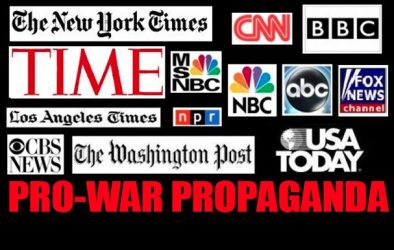 When seriously practiced, the journalistic profession involves gathering information concerning individuals, locales, events, and issues. In theory such information informs people about their world, thereby strengthening “democracy.” This is exactly the reason why news organizations and individual journalists are tapped as assets by intelligence agencies and, as the experiences of German journalist Udo Ulfkotte (entry 47 below) suggest, this practice is at least as widespread today as it was at the height of the Cold War.
Consider the coverups of election fraud in 2000 and 2004, the events of September 11, 2001, the invasions Afghanistan and Iraq, the destabilization of Syria, and the creation of “ISIS.” These are among the most significant events in recent world history, and yet they are also those much of the American public is wholly ignorant of. In an era where information and communication technologies are ubiquitous, prompting many to harbor the illusion of being well-informed, one must ask why this condition persists.
Further, why do prominent US journalists routinely fail to question other deep events that shape America’s tragic history over the past half century, such as the political assassinations of the 1960s, or the central role played by the CIA in international drug trafficking?
Popular and academic commentators have suggested various reasons for the almost universal failure of mainstream journalism in these areas, including newsroom sociology, advertising pressure, monopoly ownership, news organizations’ heavy reliance on “official” sources, and journalists’ simple quest for career advancement. There is also, no doubt, the influence of professional public relations maneuvers. Yet such a broad conspiracy of silence suggests another province of deception examined far too infrequently—specifically the CIA and similar intelligence agencies’ continued involvement in the news media to mold thought and opinion in ways scarcely imagined by the lay public.
The following historical and contemporary facts–by no means exhaustive–provides a glimpse of the power such entities possess to influence, if not determine, popular memory and what respectable institutions deem to be the historical record.
- The CIA’s Operation MOCKINGBIRD is a long-recognised keystone among researchers pointing to the Agency’s clear interest in and relationship to major US news media. MOCKINGBIRD grew out of the CIA’s forerunner, the Office for Strategic Services (OSS, 1942-47), which during World War Two had established a network of journalists and psychological warfare experts operating primarily in the European theatre.
- Many of the relationships forged under OSS auspices were carried over into the postwar era through a State Department-run organization called the Office of Policy Coordination (OPC) overseen by OSS staffer Frank Wisner.
- The OPC “became the fastest-growing unit within the nascent CIA,” historian Lisa Pease observes, “rising in personnel from 302 in 1949 to 2,812 in 1952, along with 3,142 overseas contract personnel. In the same period, the budget rose from $4.7 million to $82 million.” Lisa Pease, “The Media and the Assassination,” in James DiEugenio and Lisa Pease, The Assassinations: Probe Magazine on JFK, MLK, RFK and Malcolm X, Port Townsend, WA, 2003, 300.
- Like many career CIA officers, eventual CIA Director/Director of Central Intelligence (DCI) Richard Helms was recruited out of the press corps by his own supervisor at the United Press International’s Berlin Bureau to join in the OSS’s fledgling “black propaganda” program. “‘[Y]ou’re a natural,” Helms’ boss remarked. Richard Helms, A Look Over My Shoulder: A Life in the Central Intelligence Agency, New York: Random House, 2003, 30-31.
- Wisner tapped Marshall Plan funds to pay for his division’s early exploits, money his branch referred to as “candy.” “We couldn’t spend it all,” CIA agent Gilbert Greenway recalls. “I remember once meeting with Wisner and the comptroller. My God, I said, how can we spend that? There were no limits, and nobody had to account for it. It was amazing.” Frances Stonor Saunders, The Cultural Cold War: The CIA and the World of Arts and Letters, New York: The New Press, 2000, 105.
- When the OPC was merged with the Office of Special Operations in 1948 to create the CIA, OPC’s media assets were likewise absorbed.
- Wisner maintained the top secret “Propaganda Assets Inventory,” better known as “Wisner’s Wurlitzer”—a virtual rolodex of over 800 news and information entities prepared to play whatever tune Wisner chose. “The network included journalists, columnists, book publishers, editors, entire organizations such as Radio Free Europe, and stringers across multiple news organizations.” Pease, “The Media and the Assassination,” 300.
- A few years after Wisner’s operation was up-and-running he “’owned’ respected members of the New York Times, Newsweek, CBS, and other communication vehicles, plus stringers, four to six hundred in all, according to a CIA analyst. Each one was a separate ‘operation,’” investigative journalist Deborah Davis notes, “requiring a code name, a field supervisor, and a field office, at an annual cost of tens or hundreds of thousands of dollars—there has never been an accurate accounting.” Deborah Davis, Katharine the Great: Katharine Graham and the Washington Post, Second Edition, Bethesda MD: National Press Inc, 1987, 139.
- Psychological operations in the form of journalism were perceived as necessary to influence and direct mass opinion, as well as elite perspectives. “[T]he President of the United States, the Secretary of State, Congressmen and even the Director of the CIA himself will read, believe, and be impressed by a report from Cy Sulzberger, Arnaud de Borchgrave, or Stewart Alsop when they don’t even bother to read a CIA report on the same subject,” noted CIA agent Miles Copeland. Cited in Pease, “The Media and the Assassination,” 301.
- By the mid-to-late 1950s, Darrell Garwood points out, the Agency sought to limit criticism directed against covert activity and bypass congressional oversight or potential judicial interference by “infiltrat[ing] the groves of academia, the missionary corps, the editorial boards of influential journal and book publishers, and any other quarters where public attitudes could be effectively influenced.” Darrell Garwood, Under Cover: Thirty-Five Years of CIA Deception, New York: Grove Press, 1985, 250.
- The CIA frequently intercedes in editorial decision-making. For example, when the Agency proceeded to wage an overthrow of the Arbenz regime in Guatemala in 1954, Allen and John Foster Dulles, President Eisenhower’s CIA Director and Secretary of State respectively, called upon New York Times publisher Arthur Hays Sulzberger to reassign reporter Sydney Gruson from Guatemala to Mexico City. Sulzberger thus placed Gruson in Mexico City with the rationale that some repercussions from the revolution might be felt in Mexico. Pease, “The Media and the Assassination,” 302.
- Since the early 1950s the CIA “has secretly bankrolled numerous foreign press services, periodicals and newspapers—both English and foreign language—which provided excellent cover for CIA operatives,” Carl Bernstein reported in 1977. “One such publication was the Rome Daily American, forty percent of which was owned by the CIA until the 1970s.” Carl Bernstein, “The CIA and the Media,” Rolling Stone, October 20, 1977.
- The CIA exercised informal liaisons with news media executives, in contrast to its relationships with salaried reporters and stringers, “who were much more subject to direction from the Agency” according to Bernstein. “A few executives—Arthur Hays Sulzberger of the New York Times among them—signed secrecy agreements. But such formal understandings were rare: relationships between Agency officials and media executives were usually social—’The P and Q Street axis in Georgetown,’ said one source. ‘You don’t tell William Paley to sign a piece of paper saying he won’t fink.’” Director of CBS William Paley’s personal “friendship with CIA Director Dulles is now known to have been one of the most influential and significant in the communications industry,” author Debora Davis explains. “He provided cover for CIA agents, supplied out-takes of news film, permitted the debriefing of reporters, and in many ways set the standard for the cooperation between the CIA and major broadcast companies which lasted until the mid-1970s.” Deborah Davis, Katharine the Great: Katharine Graham and the Washington Post, Second Edition, Bethesda MD: National Press Inc, 1987, 175.
- “The Agency’s relationship with the Times was by far its most valuable among newspapers, according to CIA officials,” Bernstein points out in his key 1977 article. “From 1950 to 1966, about ten CIA employees were provided Times cover under arrangements approved by the newspaper’s late publisher, Arthur Hays Sulzberger. The cover arrangements were part of a general Times policy—set by Sulzberger—to provide assistance to the CIA whenever possible.” In addition, Sulzberger was a close friend of CIA Director Allen Dulles. “’At that level of contact it was the mighty talking to the mighty,’ said a high‑level CIA official who was present at some of the discussions. ‘There was an agreement in principle that, yes indeed, we would help each other. The question of cover came up on several occasions. It was agreed that the actual arrangements would be handled by subordinates…. The mighty didn’t want to know the specifics; they wanted plausible deniability.’” Bernstein, “The CIA and the Media.”
- CBS’s Paley worked reciprocally with the CIA, allowing the Agency to utilize network resources and personnel. “It was a form of assistance that a number of wealthy persons are now generally known to have rendered the CIA through their private interests,” veteran broadcast journalist Daniel Schorr wrote in 1977. “It suggested to me, however, that a relationship of confidence and trust had existed between him and the agency.” Schorr points to “clues indicating that CBS had been infiltrated.” For example, “A news editor remembered the CIA officer who used to come to the radio control room in New York in the early morning, and, with the permission of persons unknown, listened to CBS correspondents around the world recording their ‘spots’ for the ‘World News Roundup’ and discussing events with the editor on duty. Sam Jaffe claimed that when he applied in 1955 for a job with CBS, a CIA officer told him that he would be hired–which he subsequently was. He was told that he would be sent to Moscow–which he subsequently was; he was assigned in 1960 to cover the trial of U-2 pilot Francis Gary Powers. [Richard] Salant told me,” Schorr continues, “that when he first became president of CBS News in 1961, a CIA case officer called saying he wanted to continue the ‘long standing relationship known to Paley and [CBS president Frank] Stanton, but Salant was told by Stanton there was no obligation that he knew of” (276). Schorr, Daniel. Clearing the Air, Boston: Houghton Mifflin, 1977, 277, 276.
- National Enquirer publisher Gene Pope Jr. worked briefly on the CIA’s Italy desk in the early 1950s and maintained close ties with the Agency thereafter. Pope refrained from publishing dozens of stories with “details of CIA kidnappings and murders, enough stuff for a year’s worth of headlines” in order to “collect chits, IOUs,” Pope’s son writes. “He figured he’d never know when he might need them, and those IOUs would come in handy when he got to 20 million circulation. When that happened, he’d have the voice to be almost his own branch of government and would need the cover.” Paul David Pope, The Deeds of My Fathers: How My Grandfather and Father Built New York and Created the Tabloid World of Today, New York: Phillip Turner/Rowman & Littlefield, 2010, 309, 310.
- One explosive story Pope’s National Enquirer‘s refrained from publishing in the late 1970s centered on excerpts from a long-sought after diary of President Kennedy’s lover, Mary Pinchot Meyer, who was murdered on October 12, 1964. “The reporters who wrote the story were even able to place James Jesus Angleton, the CIA’s head of counterintelligence operations, at the scene.” Another potential story drew on “documents proving that [Howard] Hughes and the CIA had been connected for years and that the CIA was giving Hughes money to secretly fund, with campaign donations, twenty-seven congressmen and senators who sat on sub-committees critical to the agency. There are also fifty-three international companies named and sourced as CIA fronts .. and even a list of reporters for mainstream media organizations who were playing ball with the agency.” Pope, The Deeds of My Fathers, 309.
- Angleton, who oversaw the Agency counterintelligence branch for 25 years, “ran a completely independent group entirely separate cadre of journalist‑operatives who performed sensitive and frequently dangerous assignments; little is known about this group for the simple reason that Angleton deliberately kept only the vaguest of files.” Bernstein, “The CIA and the Media.”
- The CIA conducted a “formal training program” during the 1950s for the sole purpose of instructing its agents to function as newsmen. “Intelligence officers were ‘taught to make noises like reporters,’ explained a high CIA official, and were then placed in major news organizations with help from management. These were the guys who went through the ranks and were told ‘You’re going to he a journalist,’” the CIA official said.” The Agency’s preference, however, was to engage journalists who were already established in the industry. Bernstein, “The CIA and the Media.”
- Newspaper columnists and broadcast journalists with household names have been known to maintain close ties with the Agency. “There are perhaps a dozen well known columnists and broadcast commentators whose relationships with the CIA go far beyond those normally maintained between reporters and their sources,” Bernstein maintains. “They are referred to at the Agency as ‘known assets’ and can be counted on to perform a variety of undercover tasks; they are considered receptive to the Agency’s point of view on various subjects.” Bernstein, “The CIA and the Media.”
- Frank Wisner, Allen Dulles, and Washington Post publisher Phillip Graham were close associates, and the Post developed into one of the most influential news organs in the United States due to its ties with the CIA. The Post managers’ “individual relations with intelligence had in fact been the reason the Post Company had grown as fast as it did after the war,” Davis observes. “[T]heir secrets were its corporate secrets, beginning with MOCKINGBIRD. Phillip Graham’s commitment to intelligence had given his friends Frank Wisner an interest in helping to make the Washington Post the dominant news vehicle in Washington, which they had done by assisting with its two most crucial acquisitions, the Times-Herald and WTOP radio and television stations.” Davis, Katharine the Great: Katharine Graham and the Washington Post, 172.
- In the wake of World War One the Woodrow Wilson administration placed journalist and author Walter Lippmann in charge of recruiting agents for the Inquiry, a first-of-its-kind ultra-secret civilian intelligence organization whose role involved ascertaining information to prepare Wilson for the peace negotiations, as well as identify foreign natural resources for Wall Street speculators and oil companies. The activities of this organization served as a prototype for the function eventually performed by the CIA, namely “planning, collecting, digesting, and editing the raw data,” notes historian Servando Gonzalez. “This roughly corresponds to the CIA’s intelligence cycle: planning and direction, collection, processing, production and analysis, and dissemination.” Most Inquiry members would later become members of the Council on Foreign Relations. Lippmann would go on to become the Washington Post’s best known columnists. Servando Gonzalez, Psychological Warfare and the New World Order: The Secret War Against the American People, Oakland, CA: Spooks Books, 2010, 50.
- The two most prominent US newsweeklies, Time and Newsweek, kept close ties with the CIA. “Agency files contain written agreements with former foreign correspondents and stringers for both the weekly newsmagazines,” according to Carl Bernstein. “Allen Dulles often interceded with his good friend, the late Henry Luce, founder of Time and Life magazines, who readily allowed certain members of his staff to work for the Agency and agreed to provide jobs and credentials for other CIA operatives who lacked journalistic experience.” Bernstein, “The CIA and the Media.”
- In his autobiography former CIA officer E. Howard Hunt quotes Bernstein’s “The CIA and the Media” article at length. “I know nothing to contradict this report,” Hunt declares, suggesting the investigative journalist of Watergate fame didn’t go far enough. “Bernstein further identified some of the country’s top media executives as being valuable assets to the agency … But the list of organizations that cooperated with the agency was a veritable ‘Who’s Who’ of the media industry, including ABC, NBC, the Associated Press, UPI, Reuters, Hearst Newspapers, Scripps-Howard, Newsweek magazine, and others.” E. Howard Hunt, American Spy: My Secret History in the CIA, Watergate, and Beyond, Hoboken NJ: John Wiley & Sons, 2007, 150.
- When the first major exposé of the CIA emerged in 1964 with the publication of The Invisible Government by journalists David Wise and Thomas B. Ross, the CIA considered purchasing the entire printing to keep the book from the public, yet in the end judged against it. “To an extent that is only beginning to be perceived, this shadow government is shaping the lives of 190,000,000 Americans” authors Wise and Ross write in the book’s preamble. “Major decisions involving peace and war are taking place out of public view. An informed citizen might come to suspect that the foreign policy of the United States often works publicly in one direction and secretly through the Invisible Government in just the opposite direction.”Lisa Pease, “When the CIA’s Empire Struck Back,” Consortiumnews.com, February 6, 2014.
- Agency infiltration of the news media shaped public perception of deep events and undergirded the official explanations of such events. For example, the Warren Commission’s report on President John F. Kennedy’s assassination was met with almost unanimous approval by US media outlets. “I have never seen an official report greeted with such universal praise as that accorded the Warren Commission’s findings when they were made public on September 24, 1964,” recalls investigative reporter Fred Cook. “All the major television networks devoted special programs and analyses to the report; the next day the newspapers ran long columns detailing its findings, accompanied by special news analyses and editorials. The verdict was unanimous. The report answered all questions, left no room for doubt. Lee Harvey Oswald, alone and unaided, had assassinated the president of the United States.” Fred J. Cook, Maverick: Fifty Years of Investigative Reporting, G.P. Putnam’s Sons, 1984, 276.
- In late 1966 the New York Times began an inquiry on the numerous questions surrounding President Kennedy’s assassination that were not satisfactorily dealt with by the Warren Commission. “It was never completed,” author Jerry Policoff observes, “nor would the New York Times ever again question the findings of the Warren Commission.” When the story was being developed the lead reporter at the Times‘ Houston bureau “said that he and others came up with ‘a lot of unanswered questions’ that the Times didn’t bother to pursue. ‘I’d be off on a good lead and then somebody’d call me off and send me out to California on another story or something. We never really detached anyone for this. We weren’t really serious.’” Jerry Policoff, “The Media and the Murder of John Kennedy,” in Peter Dale Scott, Paul L. Hoch and Russell Stetler, eds., The Assassinations: Dallas and Beyond, New York: Vintage, 1976, 265.
- When New Orleans District Attorney Jim Garrison embarked on an investigation of the JFK assassination in 1966 centering on Lee Harvey Oswald’s presence in New Orleans in the months leading up to November, 22, 1963, “he was cross-whipped with two hurricane blasts, one from Washington and one from New York,” historian James DiEugenio explains. The first, of course, was from the government, specifically the Central Intelligence Agency, the FBI, and to a lesser extent, the White House. The blast from New York was from the major mainstream media e.g. Time-Life and NBC. Those two communication giants were instrumental in making Garrison into a lightening rod for ridicule and criticism. This orchestrated campaign … was successful in diverting attention from what Garrison was uncovering by creating controversy about the DA himself.” DiEugenio, Preface, in William Davy, Let Justice Be Done: New Light on the Jim Garrison Investigation, Reston VA: Jordan Publishing, 1999.
- The CIA and other US intelligence agencies used the news media to sabotage Garrison’s 1966-69 independent investigation of the Kennedy assassination. Garrison presided over the only law enforcement agency with subpoena power to seriously delve into the intricate details surrounding JFK’s murder. One of Garrison’s key witnesses, Gordon Novel, fled New Orleans to avoid testifying before the Grand Jury assembled by Garrison. According to DiEugenio, CIA Director Allen “Dulles and the Agency would begin to connect the fugitive from New Orleans with over a dozen CIA friendly journalists who—in a blatant attempt to destroy Garrison’s reputation—would proceed to write up the most outrageous stories imaginable about the DA.” James DiEugenio, Destiny Betrayed: JFK, Cuba, and The Garrison Case, Second Edition, New York: SkyHorse Publishing, 2012, 235.
- CIA officer Victor Marchetti recounted to author William Davy that in 1967 while attending staff meetings as an assistant to then-CIA Director Richard Helms, “Helms expressed great concerns over [former OSS officer, CIA operative and primary suspect in Jim Garrison’s investigation Clay] Shaw’s predicament, asking his staff, ‘Are we giving them all the help we can down there?’” William Davy, Let Justice Be Done: New Light on the Jim Garrison Investigation, Reston VA: Jordan Publishing, 1999.
- The pejorative dimensions of the term “conspiracy theory” were introduced into the Western lexicon by CIA “media assets,” as evidenced in the design laid out by Document 1035-960 Concerning Criticism of the Warren Report, an Agency communiqué issued in early 1967 to Agency bureaus throughout the world at a time when attorney Mark Lane’s Rush to Judgment was atop bestseller lists and New Orleans DA Garrison’s investigation of the Kennedy assassination began to gain traction.
- Time had close relations with the CIA stemming from the friendship of the magazine’s publisher Henry Luce and Eisenhower CIA chief Allen Dulles. When former newsman Richard Helms was appointed DCI in 1966 he “began to cultivate the press,” prompting journalists toward conclusions that placed the Agency in a positive light. As Time Washington correspondent Hugh Sidney recollects, “‘[w]ith [John] McCone and [Richard] Helms, we had a set-up when the magazine was doing something on the CIA, we went to them and put it before them … We were never misled.’ Similarly, when Newsweek decided in the fall of 1971 to do a cover story on Richard Helms and ‘The New Espionage,’ the magazine, according to a Newsweek staffer, went directly to the agency for much of the information. And the article … generally reflected the line that Helms was trying so hard to sell: that since the latter 1960s … the focus of attention and prestige within CIA’ had switched from the Clandestine Services to the analysis of intelligence, and that ‘the vast majority of recruits are bound for’ the Intelligence Directorate.” Victor Marchetti and John D. Marks, The CIA and the Cult of Intelligence, New York: Alfred A. Knopf, 1974, 362-363.
- In 1970 Jim Garrison wrote and published the semi-autobiographical A Heritage of Stone, a work that examines how the New Orleans DA “discovered that the CIA operated within the borders of the United States, and how it took the CIA six months to reply to the Warren Commission’s question of whether Oswald and [Jack] Ruby had been with the Agency,” Garrison biographer and Temple University humanities professor Joan Mellen observes. “In response to A Heritage of Stone, the CIA rounded up its media assets” and the book was panned by reviewers writing for the New York Times, the Los Angeles Times, the Washington Post, the Chicago Sun Times, and Life magazine. “John Leonard’s New York Times review went through a metamorphosis,” Mellen explains. “The original last paragraph challenged the Warren Report: ‘Something stinks about this whole affair,’ Leonard wrote. ‘Why were Kennedy’s neck organs not examined at Bethesda for evidence of a frontal shot? Why was his body whisked away to Washington before the legally required Texas inquest? Why?’ This paragraph evaporated in later editions of the Times. A third of a column gone, the review then ended: ‘Frankly I prefer to believe that the Warren Commission did a poor job, rather than a dishonest one. I like to think that Garrison invents monsters to explain incompetence.’” Joan Mellen, A Farewell to Justice: Jim Garrison, JFK’s Assassination, and the Case That Should Have Changed History, Washington DC: Potomac Books, 2005, 323, 324.
- CIA Deputy Director for Plans Cord Meyer Jr. appealed to Harper & Row president emeritus Cass Canfield Sr. over the book publisher’s pending release of Alfred McCoy’s The Politics of Heroin in Southeast Asia, based on the author’s fieldwork and Yale PhD dissertation wherein he examined the CIA’s explicit role in the opium trade. “Claiming my book was a threat to national security,” McCoy recalls, “the CIA official had asked Harper & Row to suppress it. To his credit, Mr. Canfield had refused. But he had agreed to review the manuscript prior to publication.” Alfred W. McCoy, The Politics of Heroin: CIA Complicity in the Global Drug Trade, Chicago Review Press, 2003, xx.
- Publication of The Secret Team, a book by US Air Force Colonel and Pentagon-CIA liaison L. Fletcher Prouty recounting the author’s firsthand knowledge of CIA black operations and espionage, was met with a wide scale censorship campaign in 1972. “The campaign to kill the book was nationwide and world-wide,” Prouty notes. “It was removed from the Library of Congress and from college libraries as letters I received attested all too frequently … I was a writer whose book had been cancelled by a major publisher [Prentice Hall] and a major paperback publisher [Ballantine Books] under the persuasive hand of the CIA.” L. Fletcher Prouty, The Secret Team: The CIA and Its Allies in Control of the United States and the World, New York: SkyHorse Publishing, 2008, xii, xv.
- During the Pike Committee hearings in 1975 Congressman Otis Pike asked DCI William Colby, “Do you have any people paid by the CIA who are working for television networks?” Colby responded, “This, I think, gets into the kind of details, Mr. Chairman, that I’d like to get into in executive session.” Once the chamber was cleared Colby admitted that in 1975 specifically “the CIA was using ‘media cover’ for eleven agents, many fewer than in the heyday of the cloak-and-pencil operations, but no amount of questioning would persuade him to talk about the publishers and network chieftains who had cooperated at the top.” Schorr, Clearing the Air, 275.
- “There is quite an incredible spread of relationships,” former CIA intelligence officer William Bader informed a US Senate Intelligence Committee investigating the CIA’s infiltration of the nation’s journalistic outlets. “You don’t need to manipulate Time magazine, for example, because there are Agency people at the management level.” Bernstein, “The CIA and the Media.”
- In 1985 film historian and professor Joseph McBride came across a November 29, 1963 memorandum from J. Edgar Hoover, titled, “Assassination of President John F. Kennedy,” wherein the FBI director stated that his agency provided two individuals with briefings, one of whom was “Mr. George Bush of the Central Intelligence Agency.” ” When McBride queried the CIA with the memo a “PR man was tersely formal and opaque: ‘I can neither confirm nor deny.’ It was the standard response the agency gave when it dealt with its sources and methods,” journalist Russ Baker notes. When McBride published a story in The Nation, “The Man Who Wasn’t There, ‘George Bush,’ C.I.A. Operative,” the CIA came forward with a statement that the George Bush referenced in the FBI record “apparently” referenced a George William Bush, who filled a perfunctory night shift position at CIA headquarters that “would have been the appropriate place to receive such a report.” McBride tracked down George William Bush to confirm he was only employed briefly as a “probationary civil servant” who had “never received interagency briefings.” Shortly thereafter The Nation ran a second story by McBride wherein “the author provided evidence that the Central Intelligence Agency had foisted a lie on the American people … As with McBride’s previous story, this disclosure was greeted with the equivalent of a collective media yawn.” Since the episode researchers have found documents linking George H. W. Bush to the CIA as early as 1953. Russ Baker, Family of Secrets: The Bush Dynasty, America’s Invisible Government, and the Hidden History of the Last Fifty Years, New York: Bloomsbury Press, 2009, 7-12.
- Operation Gladio, the well-documented collaboration between Western spy agencies, including the CIA, and NATO involving coordinated terrorist shootings and bombings of civilian targets throughout Europe from the late 1960s through the 1980s, has been effectively expunged from major mainstream news outlets. A LexisNexis Academic search conducted in 2012 for “Operation Gladio” retrieved 31 articles in English language news media—most appearing in British newspapers. Only four articles discussing Gladio ever appeared in US publications—three in the New York Times and one brief mention in the Tampa Bay Times. With the exception of a 2009 BBC documentary, no network or cable news broadcast has ever referenced the state-sponsored terror operation. Almost all of the articles referencing Gladio appeared in 1990 when Italian Prime Minister Giulio Andreotti publicly admitted Italy’s participation in the process. The New York Times downplayed any US involvement, misleadingly designating Gladio “an Italian creation” in a story buried on page A16. In reality, former CIA director William Colby revealed in his memoirs that covert paramilitaries were a significant agency undertaking set up after World War II, including “the smallest possible coterie of the most reliable people, in Washington [and] NATO.” James F. Tracy, “False Flag Terror and Conspiracies of Silence,” Global Research, August 10, 2012.
- Days before the April 19, 1995 bombing of the Alfred P. Murrah Federal Building in Oklahoma City DCI William Colby confided to his friend, Nebraska State Senator John DeCamp his personal concerns over the Militia and Patriot movement within the United States, then surging in popularity due to the use of the alternative media of that era–books, periodicals, cassette tapes, and radio broadcasts. “I watched as the Anti-War movement rendered it impossible for this country to conduct or win the Vietnam War,” Colby remarked. “I tell you, dear friend, that the Militia and Patriot movement in which, as an attorney, you have become one of the centerpieces, is far more significant and far more dangerous for American than the Anti-War movement ever was, if it is not intelligently dealt with. And I really mean this.” David Hoffman, The Oklahoma City Bombing and the Politics of Terror, Venice CA: Feral House, 1998, 367.
- Shortly after the appearance of journalist Gary Webb’s “Dark Alliance” series in the San Jose Mercury News chronicling the Agency’s involvement in drug trafficking, the CIA’s public affairs division embarked on a campaign to counter what it termed “a genuine public relations crisis for the Agency.” Webb was merely reporting to a large audience what had already been well documented by scholars such as Alfred McCoy and Peter Dale Scott, and the 1989 Kerry Committee Report on Iran-Contra—that the CIA had long been involved in the illegal transnational drug trade. Such findings were upheld in 1999 in a study by the CIA inspector general. Nevertheless, beginning shortly after Webb’s series ran, “CIA media spokesmen would remind reporters seeking comment that this series represented no real news,” a CIA internal organ noted, “in that similar charges were made in the 1980s and were investigated by the Congress and were found to be without substance. Reporters were encouraged to read the “Dark Alliance’ series closely and with a critical eye to what allegations could actually be backed with evidence.” http://www.foia.cia.gov/sites/default/files/DOC_0001372115.pdf
- On December 10, 2004 investigative journalist Gary Webb died of two .38 caliber gunshot wounds to the head. The coroner ruled the death a suicide. “Gary Webb was MURDERED,” concluded FBI senior special agent Ted Gunderson in 2005. “He (Webb) resisted the first shot [to the head that exited via jaw] so he was shot again with the second shot going into the head [brain].” Gunderson regards the theory that Webb could have managed to shoot himself twice as “impossible!” Charlene Fassa, “Gary Webb: More Pieces in the Suicided Puzzle,” Rense.com, December 11, 2005.
- The most revered journalists who receive “exclusive” information and access to the corridors of power are typically the most subservient to officialdom and often have intelligence ties. Those granted such access understand that they must likewise uphold government-sanctioned narratives. For example, the New York Times’ Tom Wicker reported on November 22, 1963 that President John F. Kennedy “was hit by a bullet in the throat, just below the Adam’s apple.” Yet his account went to press before the official story of a single assassin shooting from the rear became established. Wicker was chastised through “lost access, complaints to editors and publishers, social penalties, leaks to competitors, a variety of responses no one wants.” Barrie Zwicker, Towers of Deception: The Media Coverup of 9/11, Gabrioloa Island, BC: New Society Publishers, 2006, 169-170.
- The CIA actively promotes a desirable public image of its history and function by advising the production of Hollywood vehicles, such as Argo and Zero Dark Thirty. The Agency retains “entertainment industry liaison officers” on its staff that “plant positive images about itself (in other words, propaganda) through our most popular forms of entertainment,” Tom Hayden explains in the LA Review of Books. “So natural has the CIA–entertainment connection become that few question its legal or moral ramifications. This is a government agency like no other; the truth of its operations is not subject to public examination. When the CIA’s hidden persuaders influence a Hollywood movie, it is using a popular medium to spin as favorable an image of itself as possible, or at least, prevent an unfavorable one from taking hold.” Tom Hayden, “Review of The CIA in Hollywood: How the Agency Shapes Film and Television by Tricia Jenkins,” LA Review of Books, February 24, 2013,
- Former CIA case officer Robert David Steele states that CIA manipulation of news media is “worse” in the 2010s than in the late 1970s when Bernstein wrote “The CIA and the Media.” “The sad thing is that the CIA is very able to manipulate [the media] and it has financial arrangements with media, with Congress, with all others. But the other half of that coin is that the media is lazy.” James Tracy interview with Robert David Steele, August 2, 2014,
- A well-known fact is that broadcast journalist Anderson Cooper interned for the CIA while attending Yale as an undergraduate in the late 1980s. According to Wikipedia Cooper’s great uncle, William Henry Vanderbilt III, was an Executive Officer of the Special Operations Branch of the OSS under the spy organization’s founder William “Wild Bill” Donovan. While Wikipedia is an often dubious source, Vanderbilt’s OSS involvement would be in keeping with the OSS/CIA reputation of taking on highly affluent personnel for overseas derring-do. William Henry Vanderbilt III, Wikipedia.
- Veteran German journalist Udo Ulfkotte, author of the 2014 book Gekaufte Journalisten (Bought Journalists) revealed how under the threat of job termination he was routinely compelled to publish articles written by intelligence agents using his byline. “I ended up publishing articles under my own name written by agents of the CIA and other intelligence services, especially the German secret service,” Ulfkotte explained in a recent interview with Russia Today. “German Journo: European Media Writing Pro-US Stories Under CIA Pressure,” RT, October 18, 2014.
- In 1999 the CIA established In-Q-Tel, a venture capital firm seeking to “identify and invest in companies developing cutting-edge information technologies that serve United States national security interests.” The firm has exercised financial relationships with internet platforms Americans use on a routine basis, including Google and Facebook. “If you want to keep up with Silicon Valley, you need to become part of Silicon Valley,” says Jim Rickards, an adviser to the U.S. intelligence community familiar with In-Q-Tel’s activities. “The best way to do that is have a budget because when you have a checkbook, everyone comes to you.” At one point IQT “catered largely to the needs of the CIA.” Today, however, “the firm supports many of the 17 agencies within the U.S. intelligence community, including the National Geospatial-Intelligence Agency (NGA), the Defense Intelligence Agency (DIA) and the Department of Homeland Security Science and Technology Directorate.” Matt Egan, “In-Q-Tel: A Glimpse Inside the CIA’s Venture Capital Arm,” FoxBusiness.com, June 14, 2013.
- At a 2012 conference held by In-Q-Tel CIA Director David Patraeus declared that the rapidly-developing “internet of things” and “smart home” will provide the CIA with the ability to spy on any US citizen should they become a “person of interest’ to the spy community,” Wired magazine reports. “‘Transformational’ is an overused word, but I do believe it properly applies to these technologies,’ Patraeus enthused, ‘particularly to their effect on clandestine tradecraft’ … ‘Items of interest will be located, identified, monitored, and remotely controlled through technologies such as radio-frequency identification, sensor networks, tiny embedded servers, and energy harvesters — all connected to the next-generation internet using abundant, low-cost, and high-power computing,” Patraeus said, “the latter now going to cloud computing, in many areas greater and greater supercomputing, and, ultimately, heading to quantum computing.” Spencer Ackerman, “CIA Chief: We’ll Spy on You Through Your Dishwasher,” Wired, March 15, 2012.
- In the summer of 2014 a $600 million computing cloud developed by Amazon Web Services for the CIA began servicing all 17 federal agencies comprising the intelligence community. “If the technology plays out as officials envision,” The Atlantic reports, “it will usher in a new era of cooperation and coordination, allowing agencies to share information and services much more easily and avoid the kind of intelligence gaps that preceded the Sept. 11, 2001, terrorist attacks.” “The Details About the CIA’s Deal With Amazon,” The Atlantic, July 17, 2014.
Featured Video

Total War – Attacking Nuclear Plants, Desalination & Infrastructure
or go to
Aletho News Archives – Video-Images
From the Archives
Strike on Israel Shows US Bases Near Iran Are ‘Achilles Heel’
By Svetlana Ekimenko – Sputnik – 14.04.2024
Fears of a greater Middle East escalation were triggered after Iran launched a massive drone and missile attack against Israel, aided by Hezbollah and the Yemeni Houthis. Iran said the attack was in response to Israel’s bombing of the Iranian consulate in Damascus, Syria, which killed seven members of the elite Revolutionary Guard Corps.
Iran’s massive retaliatory attack on Israel from its own territory is a sign that the conflict could “escalate out of control.”
Michael Maloof, a former senior security analyst in the office of the US secretary of defense, told Sputnik that the first ever direct Iranian attack on Israel set a dangerous precedent.
“My concern is that this could easily escalate into something not only between Iran and Israel, but beyond the Middle East region,” he said.
Iran’s assault, which it stated was an act of “self-defense” after the Israeli strike on its consulate in Damascus, was originally intended to be a “limited” one, said Maloof.
Iran first sent in “swarms of drones with lights on as a sign of psychological warfare,” but sending in cruise and ballistic missiles by Tehran was a “distinct escalation,” said Maloof.
The scale of Iran’s attack on Israel suggests that Tehran was sending a message, demonstrating that it possesses “extraordinary capabilities,” said Maloof. … continue
Blog Roll
 Aletho News
- Hungary blasts ‘fake’ EU accusation
- SAFE Debt Trap: Poland’s €43.7 Billion Bet on Unipolar Illusion
- War on Iran threatens global Gulf capital flows: FT analysis
- Mossad De Facto Admits To Inciting Riots In Iran
- Tehran: World grown thoroughly exhausted with US-Israeli ‘false flag storylines’
- Trump ‘stuck between a rock and a hard place’, lacks Iran war strategy: Ex-CIA chief
- Trump’s bombardment of fake news so far is working quite well. But where is it heading?
- Iran to Mine Sea Lanes in Persian Gulf in Case of Attack – Defense Council
- Barak blasts Netanyahu: ‘Stop lying – you can’t destroy Iran’s nuclear, missile capabilities’
- Trump backs down on Iran strikes; Tehran denies any talks
- If Americans Knew
- Israeli-US war on Iran to drag on “a few more weeks” – Not a ceasefire Day 164
- Lebanon deaths top 1,200; Palantir AI to be embedded across US military – Not a ceasefire Day 163
- Israel’s assassination game: Take all pragmatists off the board
- Food shortages return to Gaza as Israel tightens aid restrictions under the cover of its war on Iran
- Trump demands trillions in payments from Gulf countries, billions from Harvard – Not a ceasefire Day 162
- Meet the former fashion blogger and shady doctor behind the ‘30,000 dead’ Iran psy-op
- Vatican Secretary of State to Trump, Israel: End the war as soon as possible
- The Majority of Americans Believe War Against Iran Benefits Israel More Than US
- Efforts to shut down pro-Palestinian speech face series of setbacks in court
- What has Israel done to my brother?
- No Tricks Zone
- Former Pfizer Toxicologist Dr. Helmut Sterz Tells Bundestag Hearing Pfizer Vaccine Should Have Never Been Approved
- Energy Expert: Germany’s Nuclear Phaseout Was A “500 Billion Euro Mistake”
- New Research: South Australia’s Mid-Holocene Sea Surface Temperatures Were 4°C Warmer Than Today
- Storing Green Energy To Last Germany 10 Days Would Require A 60-Million Tonne Battery
- New Studies: UK Sea Levels Were 4 Meters Higher Than Today During The Mid-Holocene
- Destructive Green New Deal: German Energy And Metal Group Warns Of Drastic Crisis
- New Study Documents A 20-Year Pause In Arctic Sea Ice Decline – Driven By Internal Variability
- Wake-up Call: Survey Shows Majority Of Germans Now Favor Postponing Climate Targets!
- Televised! Leading German Political Candidate Tells Schoolchildren CO2 Makes Sun Hotter!
- New Study: A Century Warming Of 1.1°C Is ‘Commonplace’ And ‘Not Unusual’ During This Interglacial
 Aletho News