How Indonesia’s tilt toward the US left it stranded in the Strait of Hormuz
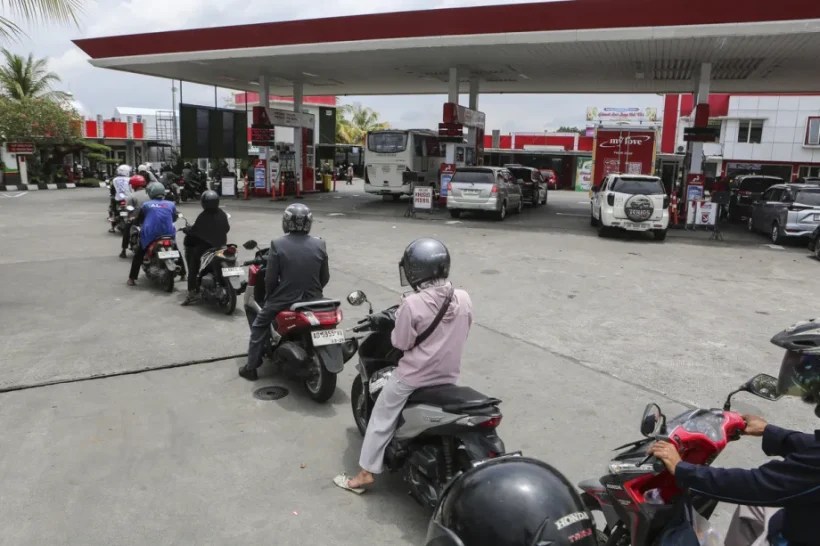
People line up for gasoline at a Pertamina’s gas station in Sukoharjo, Central Java, Indonesia, on March 26, 2026. [Agoes Rudianto – Anadolu Agency]
By Bhima Yudhistira and Dr. Muhammad Zulfikar Rakhmat | MEMO | March 29, 2026
In today’s fractured geopolitical landscape, energy flows are no longer governed by markets alone. They are shaped—often decisively—by politics. Nowhere is this clearer than in the unfolding crisis in the Strait of Hormuz, where Indonesia finds itself on the wrong side of a strategic divide.
As tensions escalate in the Middle East, Iran has adopted a selective approach to maritime access through the strait, one of the world’s most vital energy chokepoints. Rather than a blanket closure, Tehran has opted for a calibrated policy: friendly nations may pass; others must wait.
The consequences for Indonesia are immediate and stark. While countries like Malaysia, Thailand, China, India and Russia have secured safe passage for their tankers, two Indonesian vessels remain stranded. This is not a logistical hiccup. It is a geopolitical signal.
Iran’s own officials have made the logic explicit. Access is granted based on diplomatic alignment and strategic trust. Nations perceived as cooperative—or at least non-hostile—are accommodated. Others are left navigating uncertainty.
Indonesia, it appears, has misread the moment.
For decades, Jakarta prided itself on a doctrine of “free and active” foreign policy—non-aligned, pragmatic and flexible. That posture allowed Indonesia to engage multiple power centers without becoming entangled in their rivalries. But recent policy choices suggest a drift away from that equilibrium.
By signing the Agreement on Reciprocal Trade (ART) with the United States and joining the Board of Peace (BoP), Indonesia has moved beyond nominal non-alignment into visible proximity to the US orbit.
The ART is not merely a trade deal; it reshapes tariffs, supply chains and regulatory frameworks in ways that bind Indonesia more closely to U.S.-led economic and security systems. Meanwhile, the decision to join the BoP—widely criticized at home as a strategic misstep—signals alignment with Washington’s Middle East posture, particularly in the context of Gaza.
In Tehran’s eyes, these moves blur the line between cooperation and alignment. In a conflict environment defined by binary loyalties, even economic agreements and diplomatic platforms are read as strategic signals. In that context, perception is policy.
The cost of that perception is now measurable.
First, energy security. The Strait of Hormuz handles a significant share of global oil shipments, and disruptions there ripple across supply chains worldwide. If Indonesian tankers cannot pass freely, the country must source crude and liquefied petroleum gas from alternative routes—longer, riskier and far more expensive.
Shipping costs rise. Insurance premiums spike. Subsidy burdens swell. In a country where energy prices are politically sensitive, the fiscal implications are profound. What begins as a diplomatic miscalculation quickly becomes a budgetary strain.
Second, competitiveness. Malaysia and Thailand, having secured passage, are better positioned to maintain stable energy inputs and export flows. Their manufacturing sectors—already integrated into global supply chains—gain an advantage over Indonesia’s.
This is not just about oil. It is about the broader architecture of trade. Delays in energy supply affect production timelines. Disruptions in shipping lanes threaten exports of automotive components, industrial goods and commodities. In a tightly coupled global economy, reliability is currency—and Indonesia risks devaluation.
Third, macroeconomic stability. Higher import costs feed directly into inflation. A widening subsidy bill pressures public finances. And as external balances deteriorate, the rupiah faces renewed volatility. These are not abstract risks; they are the building blocks of economic stress.
All of this stems from a single, uncomfortable reality: geopolitics has overtaken economics.
Iran’s policy in the Strait of Hormuz underscores a broader shift in global order. Strategic chokepoints are no longer neutral spaces. They are instruments of leverage. Access is conditional. Neutrality, if not actively maintained, is easily questioned.
Indonesia’s response so far—continued negotiation and diplomatic outreach—may yet yield results. But negotiation from a position of ambiguity is inherently difficult. Other countries have secured passage not merely through dialogue, but through clear, consistent alignment in the eyes of Tehran.
Jakarta must therefore confront a difficult question: can it afford its current trajectory?
Recalibrating foreign policy does not mean abandoning partnerships or retreating into isolation. It means restoring balance. Indonesia’s strength has always been its ability to engage across divides—to be trusted by competing blocs precisely because it was not seen as belonging to any of them.
That credibility now needs rebuilding.
The immediate priority is practical: secure the release and passage of Indonesian vessels, stabilize energy supply and prevent further economic fallout. But the longer-term task is strategic. Indonesia must reassess its positioning in a world where neutrality is no longer assumed, but demonstrated.
The Strait of Hormuz crisis is a warning. It reveals how quickly global alignments can translate into tangible costs—and how vulnerable even large economies can be when geopolitical signals are misread.
For Indonesia, the lesson is clear. In an era of weaponized interdependence, foreign policy is no longer a distant abstraction. It is an economic imperative.
And getting it wrong is no longer affordable.
Iran has the last laugh
By M. K. BHADRAKUMAR | Indian Punchline | March 27, 2026
Wars are always unpredictable. The most famous instance is of another armada like the US’ in the Persian Gulf at the moment — the Spanish Armada, a 130-ship naval fleet sent by Spain in 1588 commanded by Alonso de Guzmán, Duke of Medina Sidonia, an aristocrat appointed by Philip II of Spain to invade England, depose Queen Elizabeth I, and restore Catholicism.
Despite its strength, the Spanish Armada was defeated in the English Channel by a smaller English force using fireships and better artillery, then largely destroyed by storms while retreating around Scotland and Ireland.
The US president Donald Trump’s much-touted armada has more or less the same mission as the Spanish Armada — ranging from regime change to overthrow of the Islamic system of governance to the unspoken leitmotif of a Crusade. Curiously, it seems destined for a similar miserable ending too, the US’ overwhelming military superiority notwithstanding.
Sir Alexander William Younger KCMGUS, former head of MI6, said in an interview with the Economist on Monday that Iran has gained the “upper hand” in the ongoing war with the United States and Iran. Sir Alexander complimented Iran.
More than one factor contributed to this “paradigm shift” of the Big Boy coming out second best. Bad planning, lack of a coherent strategy, over-confidence over the US’ apparent military superiority– all these played their part in the undoing of the plot against Iran that the two aggressors hatched.
It is now out in the open that, incredibly enough, just 16 days into the war, the US forces were already running out of ATACMS/PrSM ground-attack missiles; and, Israel is about to expend its entire Arrow interceptor missiles by the end March.
The Royal United Services Institute in London published on March 24 an analysis/expert opinion highlighting that the war in Iran has virtually hollowed out the inventory of the US and Israel’s “most critical assets” with no prospects of replenishment anytime soon in a near future due to the fragilities of the US defence industrial base.
The findings are a stark warning that with the conflict having “settled into a grinding trial of attrition” after the first 96 hours, the inventories of long-range interceptors and precision strike weapons are nearing exhaustion.
The CEO of Rheinmetall, Armin Papperger warned on 19 March that global stockpiles are “empty or nearly empty” and if the war continues another month, “we nearly have no missiles available”.
To be sure, Iranians are watching closely and that explains their defiant stance that “Iran will end the war when it decides to do so and when its conditions are met.” Tehran has warned that it will continue to deal “heavy blows” across the Middle East. Media reports confirm Iran’s claim that it has rendered dysfunctional the US bases all across the region. Had it not been about a war, there is cause for celebration when the notorious bully gets thrashed by a little brother.
Word is spreading in the US despite the cover-up by the administration that “The U.S. war in Iran is taking a mounting toll on America’s military, with rising casualties, dwindling munitions stockpiles, a sidelined aircraft carrier and numerous downed aircraft just three weeks into the conflict, ” to quote from The Hill, an influential newspaper that circulates among lawmakers in the US Congress.
The report adds, “At least 13 U.S. service members have been killed, while another 232 have been injured since the U.S.-Israeli war against Tehran began on Feb. 28. In addition, some 16 American aircraft have been destroyed, the USS Gerald R. Ford aircraft carrier was damaged in a laundry room fire earlier this month and American forces are quickly blowing through stocks of air defence and long-range munitions.”
The commentary carried by RUSI says that Iran has damaged at least a dozen US and allied radars and satellite terminals, which has impacted the efficiency of interception. Evidently, using 10 or 11 interceptors for one Iranian missile or 8 patriot missiles for one Iranian drone becomes unsustainable going ahead. It underscored that the US military is “approximately a month, or less, away from running out of ATACMS/PrSM ground-attack missiles and THAAD interceptors. And Israel is in an even more precarious spot, with its Arrow interceptor missiles likely to be completely expended by the end of March.”
In real terms, this implies accepting greater risk for aircraft and tolerating more Iranian missiles and drones damaging US-Israeli forces and infrastructure. The audacious Iranian attacks this week on Dimona, Israel’s nuclear city, is a vivid example.
“The precariousness … could possibly explain why President Trump is already suggesting the ‘winding down’ of the Iran war; it could take years to replace what was expended in only 16 days,” the commentary points out. Given the limitations of the US defence industrial base, “it will likely take at least 5 years to replenish the 500 plus Tomahawk missiles already fired in the war.
“Worse, sourcing critical defence minerals, rare earths, and materials to make the weapons and munitions is complicated by China. China controls most of the world’s gallium and germanium, and Beijing has imposed numerous mineral export controls since 2023, to prevent the US and its allies from acquiring these necessary inputs for the defence industrial base.”
The “strategic consequence” of all this is that continued fighting with Iran not only increases the risk to forces in-theatre but engenders the bigger risk of what it does to deterrence and defence elsewhere, such as “protecting Taiwan and supporting Ukraine”.
Besides, if the US prioritises replenishing its own stocks, it slows deliveries to other partners. Allies are already signalling concern that “an American focus on its own military replenishment will delay weapon and munition deliveries they have already paid for.”
The reigning superpower that was Spain in the 16th century saw its power crumble after the defeat of the Armada, while England would soon control an empire that the sun never set on. Is history repeating on a similar template in our world in transition?
More Iran War fallout: Maritime insurance industry shifts from London to China
Inside China Business | March 26, 2026
China and Hong Kong comprise the most valuable fleets of commercial ships in the world, and the largest numbers of bulk carriers, container ships, and tankers. Japan, Korea, and Singapore also have huge investments in global shipping. But European and American insurance brokers underwrite 90% of maritime insurance in the world, and on the first day of the war against Iran canceled insurance coverage on vessels already in contested waters. Hong Kong now writes insurance coverage for ships from Mainland China and Hong Kong, even those transiting the Persian Gulf. What’s more, Iranian authorities are clearing China-flagged vessels to pass safely.
Resources and links:
Top 10 shipowner countries/regions in the world https://vesselslink.com/blogs/news/to…
Hong Kong marine insurers gain edge over London with cheaper war-risk cover for Chinese ships https://www.scmp.com/business/banking…
Insurance Clubs to Halt Ship War-Risk Cover in Persian Gulf https://www.claimsjournal.com/news/na…
Insurance Clubs to Halt Ship War-Risk Cover in Persian Gulf https://www.bloomberg.com/news/articl…
Traffic is trickling through Strait of Hormuz: Who’s moving and who’s stranded https://www.cnbc.com/2026/03/18/hormu…
Neighbors first – Moscow signals shift in energy strategy
RT | March 25, 2026
Russia plans to prioritize energy exports to neighboring countries deemed less exposed to global disruptions, Energy Minister Sergey Tsivilev has said.
Recent US-Israeli strikes on Iran and Tehran’s response have shaken global oil and liquefied natural gas markets, disrupting supplies from the Persian Gulf and casting uncertainty over future production.
”The entire world will have to reevaluate supply chains and reassess risks,” Tsivilev told reporters on Wednesday. While Russia’s own exports have not been directly impacted by the Middle East crisis, the country will still adjust its strategy, he added.
“We will prioritize energy deliveries to our closest neighbors, with whom we share land borders and face fewer risks,” the minister said. “We will also reconsider the logistics of oil transportation.”
Shift away from ‘unreliable’ EU
Russia has long favored stable, long-term energy contracts, particularly through pipeline infrastructure, which historically underpinned its gas exports to Western Europe – even during the Cold War.
The European Union, however, has pushed for spot-market pricing, arguing that flexibility outweighs the risks of volatility. This disagreement contributed to tensions even before the bloc declared it would phase out Russian oil and gas imports following the escalation of the Ukraine conflict in 2022.
Moscow has since labeled European buyers as unreliable and has been redirecting its long-term energy strategy toward Asian partners, especially neighboring China.
Bad timing for snubbing Russian oil
Western countries backing Kiev have sought to curb Russia’s energy revenues, including through measures such as a price cap on its oil exports. Moscow has responded by rerouting shipments via what critics have claimed is a ‘shadow fleet’ of tankers.
Ukraine has also targeted Russian oil and gas infrastructure and vessels suspected of carrying Russian hydrocarbons, including in international waters – which Moscow calls Western-enabled piracy.
The energy price shock caused by the Iran war is prompting neutral nations that previously accommodated the Western agenda to reconsider their approach.
On Tuesday, the Philippines, a traditional US ally, received its first shipment of Russian crude in years, local media reported. Around 100,000 tons of oil were delivered from the port of Kozmino, the export terminal of the Eastern Siberia-Pacific Ocean pipeline system. The fuel is intended for a refinery in Bataan province.
US has 2 months of rare earths left to replenish weapons amid Iran war: Report
Press TV – March 24, 2026
The United States has only two months’ worth of rare earth elements critically important in the manufacturing of modern weaponry amid its joint aggression with the Israeli regime on Iran, a report says.
Oil Price.com, citing data from South China Morning Post and Reuters, reported that the US involvement in the aggression against Iran, which began on February 28, has already consumed billions of dollars’ worth of missiles and precision-guided weapons, leaving Washington with low inventories of rare earth and other key materials embedded in advanced military systems.
“And it’s the 11th hour for American defense and the entire defense industry, even if it wasn’t in the middle of a war with Iran,” said the report.
The report said the US is deeply dependent on China for the supply of rare earths, leaving Beijing with some fresh leverage over Washington, with roughly three weeks until President Donald Trump’s expected visit to China.
The South China Morning Post has said in an earlier report that the heavy reliance could mean that it is ultimately China that could dictate how long US strikes on Iran can continue.
Rare earth elements are key to manufacturing missile guidance and drone propulsion to radar systems and fighter aircraft electronics.
Those weapons have been critical to US-Israeli air aggression against Iran as it has solely relied on air strikes hitting Iranian targets.
Reports have indicated that the aggression cost more than $10 billion in its first week, as both the US and Israel have been grappling with barrages of missiles and drones fired by Iran at their targets, prompting heavy use of their costly air defense systems.
Iran controls Strait of Hormuz, dictates terms of war and peace as US excursion backfires
By Pravin Sawhney | Press TV | March 24, 2026
While the US and Israel started the new war in West Asia, it is Israel and Iran who, with clarity on their war objectives, are now pitted against one another.
Given this, two things are likely. One, notwithstanding President Donald Trump’s latest claim of negotiations, the war will not end anytime soon. Instead, it will escalate.
And two, since the world is multipolar, the regional geopolitics will no longer be the same.
Two regional fundamentals would be impacted: the control over the Strait of Hormuz, and the security arrangement between the US and GCC (Persian Gulf Cooperation Council) countries (Saudi Arabia, Kuwait, UAE, Bahrain, Qatar and Oman), which delivered the petro dollars critical for stabilisation of the US economy and its great power status in the world.
Unmindful of the reality that the world is in a once-in-a-century change and that Iran would not bend despite decades of US sanctions, President Trump started this war as ‘an excursion’ as he himself put it. Trump was made to believe by Israeli prime minister Benjamin Netanyahu that, like Venezuela, Iran, with its senior leadership decapitated, would be an open and shut case.
Within, the wily Netanyahu knew that this would not happen, and that the decapitation would lead to a larger war, giving him greater control over the US military to achieve his war objectives, including the so-called “regime change”.
Fully aware that Iran would close the Strait of Hormuz at the beginning of war, Netanyahu publicly gave out the alternative, which, by the land route through Saudi Arabia, would come to Israel and onto Europe through the Mediterranean Sea.
With this approach, only the Asian countries would need to use the Hormuz.
To escalate the war, Israel hit Iran’s South Pars gas field, with the retaliation coming on the energy infrastructure of Qatar, UAE, Saudi Arabia and especially the Israeli Haifa oil refinery, whose incapacitation would lead to a shortage of fuel for Israel’s war machinery.
Moreover, once the US and Israel struck Iran’s nuclear facilities, Tehran hit Israel’s Dimona town, which houses its nuclear plant, with the warning that if Iran’s nuclear facilities are hit again, then Iran’s strike would be on Dimona itself.
This was Israel’s red line, since in no war has the Dimona nuclear facility been touched.
Iran’s warning also serves the purpose of testing Israel’s nuclear deterrence. For instance, if Israel decides to hit Iran’s nuclear facilities again, with reprisal coming from Iran, then the region would be watching what Israel would do: would it use its nukes or keep quiet, in which case its nuclear bluff would be called off.
Meanwhile, Iran had been preparing for this war since 1988, when its eight-year war with Iraq ended. This includes building underground missile and drone cities, setting up production lines, and preparing regional allies like Houthis and Hezbollah. Enormous help came from Russia and China for its military preparations.
Moreover, Iran learnt the right lessons from the 12-day war of June 2025. Notable amongst them switching to the Chinese Baidu-3 satellite constellation by abandoning the US’s GPS. This explains why, unlike the 12-day war, this time the targeting of Iranian missiles and drones at long ranges has been accurate.
Special attention was given to the Persian Gulf and the Gulf of Oman, including the Strait of Hormuz. This entire stretch is laced with formidable undersea capabilities comprising anti-ship cruise missiles, different types of naval mines, midget submarines that can fire both missiles and torpedoes, and fast crafts capable of hitting the hull of tankers.
Because of these, Iran now controls the passage through the Strait of Hormuz. Trump has called upon the NATO nations to help the US Navy break Iran’s stranglehold on the oil and gas lifeline, which these nations, understanding the suicidal nature of the task, have refused.
This has created an unforeseen dilemma for Trump, where, on the one hand, it cannot declare victory and leave the region since Iran, controlling this waterway, is regulating the commercial traffic on its terms.
The latter involves countries that use this chokepoint to trade their cargo in Chinese Yuan instead of the US dollar. This would end the US Petro dollar arrangement with GCC, where they sell oil and gas only in US dollars and get the US security by having their bases on its soil.
On the other hand, with the end of petrodollars, the US will not be able to manage its huge national debt of USD 40 trillion, leading to economic instability in the US and curtailing its ability to sustain some 800 military bases across the globe.
This would be the end of the US as the world’s military hegemon.
To top it all, Iran has refused the American offer of a ceasefire. It instead wants permanent peace in West Asia with a list of demands, the most significant being that the US close down all its military bases in the region.
Moreover, the US is realising that all its threats to blow up Iran’s power grids and services, which impact civilian life, are not working.
Iran has warned that it would retaliate with similar actions against all GCC nations and Israel, where the interceptors to stop the Iranian wave of missiles are not working.
Israel, which instigated this war, is on the backfoot and the US’ excursion has backfired with grave consequences to its image as a great power.
As things stand, Iran is dictating the terms of both war and peace in West Asia.
Pravin Sawhney is a New Delhi-based journalist and commentator. He is the editor of FORCE, a magazine focused on national security and defence.
‘Safe’ corridor opening up through Strait of Hormuz: What we know so far
RT | March 20, 2026
Iran has signaled that it is ready to allow passage through the Strait of Hormuz to vessels from certain countries. Media reports and tracker data also suggest that a handful of pre-vetted tankers have already sailed smoothly through the “safe” corridor, with at least one shipping company allegedly paying Iran $2 million.
The development comes as more than 15 tankers have been hit by drones and projectiles in the strait since the US and Israel launched their war on Iran in late February.
As the Middle East escalation has roiled energy markets, the impact of a few tankers passing through has so far remained limited. Brent is still trading well above $100.
Here is what to know about the latest developments in the Strait of Hormuz.
Who is allowed to pass?
In short, not everyone and not everywhere.
Iranian Foreign Minister Abbas Araghchi stated that the strait is open to all except the US and Israel, while adding that some ships from “different countries” had already been allowed through. In practice, however, Western-linked vessels face significant hurdles in securing safe passage.
According to Lloyd’s List, India, Pakistan, China, Iraq, and Malaysia are discussing transit plans directly with Tehran, with officials in the first three countries as well as Türkiye confirming clearance.
The Financial Times reported, citing maritime data, that at least eight ships – including oil tankers and bulk carriers tied to India, Pakistan and Greece, as well as Iran’s own fleet – have sailed through the strait but used an unusual route around the island of Larak, which is close to the Iranian coast and where waters are much shallower than in the middle of the strait.
The actual number of ships – some of which may have turned off automatic tracking systems – could be higher, the report said.
According to the FT, at least nine Chinese oil and fuel tankers are also amassing in the Gulf, apparently preparing to traverse the Hormuz Strait.
Clearance is being granted on a case-by-case basis, Lloyd’s List reported, adding that the Iranian authorities are working on a “more formalized vessel approval process” expected in the coming days.
Is it free of charge?
On paper, international transit is not supposed to work like a toll road, but the current situation appears to be evolving under wartime conditions.
Lloyd’s List reported that at least one tanker operator paid about $2 million to transit, while saying it could not establish whether payments were made in other cases. It also remains unclear how such payments could be processed, given the sanctions on Iran.
In addition, several media reports indicated that Iran’s parliament was considering a bill aimed at taxing ships that cross the strait. The Wall Street Journal noted, however, that such a policy would “require a regional buy” from Iran’s Gulf neighbors.
What did Hormuz look like before the war?
Hormuz was one of the world’s busiest and consequential chokepoints, with an average of 20 million barrels a day of crude oil and oil products moved through in 2025, equal to around 25% of global seaborne oil trade. About 80% of the flows went to Asian countries, including China, India, Japan, and South Korea, according to the International Energy Agency (IEA).
About 93% of Qatar’s LNG exports and 96% of the UAE’s LNG exports also passed through Hormuz, representing roughly 19% of global LNG trade.
Before the war, around 138 vessels transited the strait daily; that figure has now dropped to roughly 3–5 ships per day, according to estimates.
The strait is just 29 nautical miles (54km) wide, with two-mile-wide inbound and outbound shipping lanes separated by a two-mile buffer. Ships using the Larak route must contend with shallower waters than in the central channel, though depths are still generally sufficient for most vessel types.
What impact is this having on energy prices?
The trickle of oil tankers is seemingly having a limited effect on the oil market, with Brent trading at $107 per barrel, down from a peak of almost $120. WTI crude slid from the $100 benchmark to $94.
European natural gas futures (TTF) slightly fell to €60 per MWh after spiking by more than 30% after Israel attacked Iran’s South Pars gas field, triggering a retaliation on energy infrastructure in Qatar.
What does Europe have to say on Hormuz safety?
European leaders have demanded “the reopening of the Strait of Hormuz,” as well as “de-escalation and maximum restraint” from the belligerents. European NATO members, however, have been reluctant to send their navies to the strait. German Chancellor Friedrich Merz said that his country could help in keeping the shipping lanes clear only when the guns go silent.
What impact on the US?
As oil prices skyrocketed, gasoline prices in the US also soared, reaching $3.90 per gallon on average. US President Donald Trump has sought to downplay the market panic, saying he thought that oil prices would be “much worse,” adding that they were certain to come down once the hostilities end.
In addition, US Treasury Secretary Scott Bessent signaled that Washington could waive sanctions on the Iranian oil stranded on tankers in a bid to dampen prices. Earlier this week, he also said that the US had been allowing Iranian tankers to transit the strait “to supply the rest of the world.”
Israel’s War on Iran’s Grid: How the South Pars Strike Turned Energy into a Weapon
By Freddie Ponton – 21st Century Wire – March 19, 2026
In the early hours of March 18, Israeli drones tore into four gas‑treatment plants in Assaluyeh on Iran’s southern coast, where sour gas from phases 3, 4, 5 and 6 of the South Pars field is cleaned, separated and turned into the fuel that keeps the country’s lights on, homes heated and factories supplied. Iranian officials ordered the plants offline to contain the fires, and industry analysts immediately warned that production from the offshore platforms feeding those trains would have to be cut back. Within an hour of the strike being reported, European gas prices and Brent crude jumped, because traders understood what most headlines did not. This was not a symbolic hit on an abstract “gas field,” but a deliberate attack on a conversion node at the heart of Iran’s domestic energy system and a critical pillar of the wider Gulf energy order.
At the same time, Donald Trump was on social media threatening that if Iran retaliated again against Qatar’s LNG hub at Ras Laffan, he would “blow up the entirety” of South Pars – the largest gas field on the planet, and interestingly, a reservoir Iran shares with Qatar. The man who joined Israel in authorising the first strikes on Iranian production facilities is now openly dangling the prospect of destroying the shared gas reservoir that keeps tens of millions of people warm, powered and employed. That is not deterrence, only a head of state experimenting in public with the language of total economic annihilation.
Trump’s own Truth Social post about the strike reads like a rambling attempt to distance Washington from the attack while threatening to “blow up the entirety” of South Pars if Iran hits Qatar again. The post deserves closer attention later in this story.
ASSALUYEH: WHERE GAS BECOMES POWER
To see what was attacked in Assaluyeh is to understand that the language matches the target. South Pars itself is the Iranian half of a single, giant reservoir under the Gulf, known as the North Field in Qatar, which together contain around a tenth of the world’s proven gas reserves. Iranian officials say South Pars covers 24 phases and provides between 70–75% of Iran’s gas production, feeding power plants, industry, petrochemical complexes and gasoline production. The gas that makes that possible must pass through places like Assaluyeh, where onshore plants strip out condensate, liquefied petroleum gases and natural gas liquids before returning dry gas to the grid and sending liquids on to refineries and export jetties. Over two decades, the South Pars Special Economic Energy Zone has grown into a dense cluster of processing trains and downstream plants with total gas‑processing capacity on the order of a billion cubic metres per day and around twenty‑one petrochemical units producing close to forty million tonnes per year of urea, methanol, polyethene, and other basic chemicals.
Israel did not attack the offshore reservoir. It attacked the pipes, columns and separators that turn raw gas into power, plastics, fertiliser and fuel. The four targeted plants process sour gas from phases 3, 4, 5 and 6, which are mature, are heavily integrated blocks that feed directly into Iran’s domestic grid and petrochemical system. Shutting those trains, even temporarily, forces operators to throttle back production on the linked platforms and starves downstream complexes of both dry gas and feedstock. In concrete terms, that means less gas available for electricity generation on a grid already prone to summer blackouts, less feed for petrochemical plants that supply everything from fertiliser to plastics, and less condensate flowing through the storage and export facilities that sit alongside the gas plants on the Persian Gulf shore.
Iranian reports speak of powerful explosions at several Assaluyeh facilities, fires around storage tanks and gas units, and workers being evacuated as emergency crews tried to contain the damage. From a planner’s point of view, this is a high‑leverage target: a handful of processing units at the convergence of offshore production and onshore consumption whose disruption sends shockwaves up the supply chain and down into the civilian economy. From the point of view of the people whose houses, factories and hospitals depend on those flows, it looks like something else entirely – an attack on the infrastructure of daily life.
That is the first truth this strike reveals: Israel has shifted from fighting Iran’s armed forces to fighting the country’s energy system, the circulation of fuel that keeps the state conscious.
This is not a one‑off aberration. During the twelve‑day war of June 2025, an earlier Israeli strike hit the Phase 14 processing plant at Assaluyeh, forcing a shutdown and firefighting operation before Iranian engineers brought the plant back online within two weeks. The March 2026 strikes returned to the same nerve centre but widened the cut: instead of Phase 14 alone, the drones went after four plants tied to phases 3–6, which together represent a much larger share of South Pars throughput and a deeper incision into Iran’s ability to turn offshore gas into usable energy. What is being tested here is not just Iran’s repair capacity. It is how much of its gas‑conversion system can be burned down before the political cost becomes untenable.
FROM MILITARY TARGETS TO CIVILIAN PUNISHMENT
The crucial point is that gas in Iran is not a luxury export commodity, but the country’s primary fuel for power generation, industrial heat and residential heating. Well over ninety per cent of the gas Iran produces is consumed domestically, not exported. It keeps homes warm in winter, feeds cement and steel plants, drives turbines in power stations and prevents rolling blackouts on a grid that is already fragile. When you hit Assaluyeh, you are not trimming a few cargoes of condensate to Asia. You are reaching into the core of a domestic energy system that supports nearly ninety million people – the apartment blocks in Tehran that already live with scheduled outages, the small factories in Isfahan that depend on steady voltage to keep lines moving, the provincial hospitals that cannot function when the generators sputter.
Even the outlets trying to normalise the strike cannot entirely avoid that reality. They call South Pars an “energy lifeline”, stress that it powers much of Iran’s electricity system and note that the onshore plants at Assaluyeh are central to separating condensate and LPG from the gas that then runs into Iranian networks. “Energy lifeline” is the language of necessity, not of optional revenue. To choose that target is to choose to tamper with the civilian infrastructure that stands between a functioning society and a rolling crisis of blackouts, shortages and industrial breakdown. “Collective punishment” is usually invoked in the context of bombs on apartment blocks or food embargoes. Here it is delivered through valves and turbines.
It is precisely at this point, when questions of necessity and legitimacy collide, that the recent behaviour of Washington’s own security establishment strips away the alibi that this was a war forced by urgent facts. In a few sentences at a Senate hearing, Director of National Intelligence Tulsi Gabbard told lawmakers that only the president can decide what is an “imminent threat” from Iran, even as senior aides were warning her that there was no evidence Iran had restarted enrichment or posed an immediate nuclear danger. Two days earlier, Joe Kent, the director of the National Counterterrorism Center, resigned, saying in his letter that he could not “in good conscience support the ongoing war in Iran,” that Iran posed “no imminent threat,” and that Israel had pressured the United States into the conflict. Those two moments do not need pages of commentary. Together they are enough: the official charged with guarding the integrity of U.S. intelligence rewrites “threat” as a presidential mood, and the official charged with synthesising terrorist threats walks out saying the war is manufactured.
In other words, while Israeli pilots and U.S. operators are hitting the infrastructure that keeps Iranian civilians alive, the people at the top of the American system are quietly admitting that the supposed emergency justifying those strikes does not exist in the way the public was told. The last line of defence, a reality defined by evidence rather than by political need, has been crossed, and it has been crossed at the exact moment the war shifted from military targets to the machinery of everyday survival.
Trump’s Truth Social statement makes that shift even starker. It is not a clarification, and reads more like a hostage note. South Pars is being turned into collateral for Qatar’s LNG security, and Trump denies U.S. prior knowledge of Israel’s first strike while claiming the right to decide if and when the entire shared field is destroyed. In one message, he signals that the energy backbone of Iran and Qatar is now a bargaining chip Washington is prepared to sacrifice to enforce its war.
That is the second truth of this episode: the war on Iran’s civilian infrastructure is being waged under a definition of “threat” that collapses into whatever the president needs it to be.
Once a president starts talking about “blowing up the entirety” of the field that keeps both Iran and Qatar running, the fiction that this is a contained war collapses.
Exporting the Energy Shock
By treating Iran’s South Pars complex and linked Gulf energy infrastructure as disposable targets, Israel and the United States have not just escalated a regional war; they have shifted the economic pain onto societies that never signed up for this fight, from Turkish households to European workers and Indian farmers now absorbing the fallout.
Turkey: forced into a rigged market
In Turkey, the cost of turning South Pars into a battlefield is already measurable. Analysts note that Iran supplies gas to Turkey by pipeline, and that any prolonged disruption would force buyers to look for replacement cargoes on the LNG market. That “elsewhere” is the spot market, where Asian demand has already begun pulling cargoes away from Europe as importers scramble to replace lost Gulf supply. In practice, a strike pitched as pressure on Iran becomes a higher import bill for a NATO member and another inflationary squeeze on households and industry.
Europe: dragged back toward 2022
In Europe, the impact showed up first on trading screens. After disruption to Qatari LNG output, benchmark gas prices on the Dutch TTF hub jumped by as much as 45%, reaching around €46 per megawatt-hour. Reuters then reported that Asian buyers scrambling for LNG replacement cargoes were already pulling shipments toward Asia, reinforcing the risk of another continental price shock. Europe’s dependence on LNG after cutting Russian pipeline supply means that attacks on South Pars-linked infrastructure in the Gulf do not stay regional for long.
India: paying for a war it did not choose
In India, the blowback is more than theoretical. Government sources told CNBC-TV18 that LPG supplies were already “feeling some heat” as the West Asia conflict disrupted shipping routes and pushed gas prices higher. The same report said Asian LNG prices had risen from about $6–8 per MMBtu to around $15 per MMBtu, while rerouting cargoes from alternative suppliers such as the United States or Norway would take longer. A later report said Indian LPG consumption fell 17.7% in the first half of March because of war-related supply disruption. That is what energy warfare looks like in human terms: shortages, higher costs and forced adjustment by people who had no role in launching the conflict.
China: tested, not insulated
China’s immediate exposure looks smaller on paper, but the same shock still hits Beijing’s energy calculus. Reuters reported that over 80% of Qatar’s LNG exports go to Asia, placing major buyers like China in the line of fire when Gulf supply is disrupted. Another report noted that China was among the key Asian markets exposed as the regional benchmark LNG price surged and traders sought replacement cargoes from farther afield. That leaves Beijing with more buffers than poorer importers, but not immunity from the price shock set off by attacks on Gulf gas infrastructure
WHEN A SHARED FIELD BECOMES A WAR ZONE
If the story stopped at Iran’s shoreline, it would already be devastating. But South Pars does not stop at Iran’s shoreline. The reservoir that feeds Assaluyeh stretches under the Gulf into Qatari waters, where it is known as the North Field and where it supplies Ras Laffan Industrial City, the most important LNG complex on Earth. Before the war, Ras Laffan’s trains exported around 77 million tonnes per year of liquefied natural gas, with plans underway to expand capacity towards 142 million tonnes by the end of the decade. Alongside LNG, Ras Laffan also produces Liquefied Petroleum Gas (LPG), ethane, condensate and sulphur, and hosts gas‑to‑liquids plants, power stations and desalination units. It is a central hinge in the global energy system, and on the day Iran’s missiles arrived, workers there were told to leave the plant that underwrites their families’ incomes because someone else had decided their shared field was expendable.
Qatar understood immediately what an attack on South Pars meant. Its foreign ministry condemned the strikes as “dangerous and irresponsible,” explicitly reminding the world that the field is geologically continuous with the North Field and warning that targeting infrastructure tied to that reservoir threatens global energy security. It has now gone further, calling Iran’s strike on Ras Laffan a “brutal targeting” of its gas hub, invoking Security Council resolutions and asserting its right to respond under Article 51 of the UN Charter. The United Arab Emirates, normally cautious about public criticism of Israel, issued its own statement that attacks on energy facilities linked to Pars risk catastrophic consequences. Those are not sentimental reactions. They are the reflex of states that suddenly realised the line between “hitting Iran” and “putting our own energy spine in the crosshairs” had effectively vanished.
Iran’s Revolutionary Guard then warned that key Gulf facilities had become “direct and legitimate targets” and urged workers to evacuate them before the strike. The list was specific: Ras Laffan; Mesaieed, Qatar’s original deep‑water export port and industrial hub, where gas and condensate are turned into NGLs, refined products, petrochemicals, aluminium and steel; Samref, a more‑than‑400,000‑barrels‑per‑day refinery in Yanbu on Saudi Arabia’s Red Sea coast with around 13 million barrels of storage; Jubail, the giant refinery‑petrochemical complex in eastern Saudi Arabia running at roughly 440,000 barrels per day and anchored by a 1.5‑million‑tonne‑per‑year ethylene cracker; and Al Hosn in the UAE, a sour‑gas project that processes about a billion cubic feet per day of raw gas, produces roughly half a billion cubic feet per day of sales gas for the Emirati grid and throws off tens of thousands of barrels of condensate and thousands of tonnes of sulphur every day.
In Kuwait, drones struck individual units at the Mina al‑Ahmadi refinery and Mina Abdullah refinery, triggering “limited” fires and forcing operators to temporarily halt parts of their output. Further east, Abu Dhabi’s Habshan gas facilities, already singled out in Iranian warnings, were shut down after debris from intercepted missiles fell on the site, underscoring that Tehran was willing to hit the very installations that underpin its rivals’ domestic energy security.
In other words, Tehran not only threatened but executed multiple strikes, and in the Ras Laffan’s case, it appears the Islamic Republic have struck the same class of conversion assets on Arab shores that Israel and the U.S. had just targeted at Assaluyeh, the plants where raw hydrocarbons become electricity, heating, industrial feedstock and exportable product.
It is crucial to understand that Ras Laffan’s LNG trains, Mesaieed’s NGL and refining complex, Samref’s crude units, Jubail’s crude‑to‑chemicals expansion and Al Hosn’s gas and sulphur trains are all parts of the same nervous system.
When one side authorises attacks on conversion nodes at South Pars, the other side’s answer is not to keep politely to its own coastline. It is to declare that the Gulf’s entire energy architecture is now part of the battlefield.
That is the third truth this strike exposes: by hitting a shared field, Israel and the U.S. have made their own allies’ energy spines part of the target set.
THE ENERGY WAR NOBODY CAN HONESTLY CALL ‘DEFENSE’
Seen from this angle, the Assaluyeh strikes were not a self‑contained tactical move. They were the opening of a new kind of war, a war on conversion infrastructure, that punishes civilians first and drags allies and markets along for the ride. Israel hit the plant that turns Iran’s gas wealth into heat, light and wages; Iran responded in kind by putting the plants that turn Qatar’s, Saudi Arabia’s and the UAE’s hydrocarbons into LNG, petrol and plastics in its sights. Trump then raised the stakes by threatening to “entirely blow up” the shared reservoir that makes all of this possible, as if the energy backbone of two states and a sizeable slice of Europe and Asia’s gas supply were a pawn to be removed from the board to prove a point.
At that stage, the legal and moral mask slips. A campaign that begins as “precision strikes” against military and command targets turns, almost in slow motion, into an assault on the infrastructure that keeps tens of millions of people from freezing, blacking out or losing their jobs, and into a form of extortion against the wider Gulf. In other words, people of Iran are being asked to accept that Iran’s energy lifeline can be bombed with impunity, or watch their own refineries and LNG terminals burn.
Iranian analysts now call this openly what it is, “economic warfare” centered on energy, and warn that destroyed or degraded capacity will worsen electricity shortages and deepen domestic hardship. When the same government waging that campaign has senior officials on record saying the “imminent threat” used to sell the war does not exist as advertised, it becomes very hard to sustain the fiction that this is self‑defense in any meaningful sense.
A war waged under those conditions cannot be sold as “precision.” It can barely, if at all, be sold as self‑defense. What they are doing, in the cold light of Assaluyeh’s burning stacks and Ras Laffan’s flares, looks like a campaign of collective punishment enforced through the energy system of an entire region, and once you see it that way, it becomes very hard to unsee.
Even The Neo-Cons Admit The Iran War Is Failing
The Dissident – March 16, 2026
The current U.S./Israeli war on Iran is, in many ways, a product of the policies long advocated by U.S. neoconservatives, most importantly the clean break strategy drafted by the Project for a New American Century (PNAC), which advocated taking out “Iraq, and then Syria, Lebanon, Libya, Somalia, Sudan, and, finishing off, Iran” on behalf of Israel.
But many of the original Neo-cons who first drafted this plan, including John Bolton and even Robert Kagan and Bill Kristol, the founders of the Project for a New American Century, are now jumping ship and admitting that the U.S./Israeli war on Iran is failing.
In an interview with NPR, longtime Neo-con John Bolton, despite saying he has “been a supporter of efforts at regime change in Iran for a long time” was forced to admit that the regime change plan has failed and that the U.S. underestimated Iran’s response.
Bolton was forced to admit that Trump underestimated Iran’s ability to effectively close the Strait of Hormuz and disrupt oil shipping in response to the U.S/Israeli bombing, saying:
… it was questionable whether he was cooperating effectively with and assisting the opposition inside Iran. That’s what I said, I think, in our last conversation. Since then, I’m very worried that there are now signs that they haven’t thought about a lot of other things. For example, there’s reporting that the White House was surprised at how quickly oil prices went up.
And all I can say to that is I’m surprised that they’re surprised. If they weren’t planning for that both economically, politically and militarily, then that’s a huge hole in the planning. I am worried that they apparently didn’t take as seriously as they should have the potential to mine the Strait of Hormuz. Trump said several days ago that the Iranian navy had been completely destroyed. And despite years of listening to that kind of thing, I should have known better. I actually sort of believed in for a while. But now we learned that it was only yesterday that we got around to destroying 16 mine-laying vessels. Of course, they’ve got the capability to mine via drones going over the strait and dropping mines in it.
Even more shocking than Bolton’s admission was a podcast released by the founders of PNAC, Robert Kagan and Bill Kristol, where they essentially admitted that the U.S. war on Iran was destroying the U.S. empire.
Robert Kagan, in the podcast, admitted that the Iran war was debilitating America’s ability to wage a new Cold War on Russia and China, and isolating the U.S. empire globally.
The “undoubted effect of the Iran war has been to drive a deeper wedge between the United States and pretty much all of its allies or at least all of its traditional allies, both in Europe and in Asia, and I would say potentially even in the Middle East” Kagan Said.
Kagan lamented that the Iran war was crippling the U.S.’s ability to continue the proxy war in Ukraine saying, “the skyrocketing oil prices … are even before Trump took the action of lifting sanctions against Russia was going to increase Russian income” and “American forces are … burning through major stocks of weaponry and particularly Patriot and other forms of interceptors on which Ukraine depends heavily because those are the interceptors that defend their major cities from constant Russian attacks.”
Kagan also lamented that the war was taking away the U.S. empire’s ability to wage a new Cold War on China, saying, “very few countries in the world are more dependent on Middle East oil, including the oil that comes directly through the Strait of Hormuz, than Japan. Japan I think, depends on something like 95% of its oil supplies come from the Middle East and 70% of that runs through the Strait of Hormuz. So once again the Japanese were not consulted”, adding, that the prime minister of Japan is “very upset” and “ talked about how this crisis has severely impacted Japanese interests”.
He also added “the Japanese will notice that the United States has sent significant forces that are dedicated both to the defense of Japan and are sort of critical to any response to a Chinese attack on Taiwan. Those forces are now being sent or some of them are already there, and some are being sent to the Middle East.”
Kagan also admitted that the war in Iran is isolating the Gulf States from the U.S. and potentially moving them towards China.
He said, “I just wonder whether the Gulf States in particular are wondering whether they’ve joined the right team here because they have, by the way, been very on background, very vocal in saying that they were against the war. … They did not favor it. They thought they had a pretty good deal going with the Iranians, that kind of an agreement that they would get to, they would leave each other alone for the most part,” adding, “it turns out the United States can’t really protect them. I mean they have suffered the worst in some respects because it’s not only that they’ve been targets and that they’re shipping you know they’ve lost money on oil, but you know they with the tremendous cooperation of the Trump and I would say in this case the Trump family and social circle have been very deeply involved in the United States making investments in AI and other things but particularly AI they’re hosting data centers for all kinds of companies and in general, they’ve been trying to make themselves an attractive place for investment and also tourism.”
Citing the example of Dubai, Kagan said, “You watch the UAE is basically arresting people for taking pictures of damage that may have been done by Iranian drone strikes and other things on things in Dubai. For instance, I think they’ve arrested foreigners who took pictures of these things. Why? Because they don’t want people to see that it’s risky to be in Dubai, because then people won’t invest and they won’t come, and so it’s kind of a disaster for them,” adding, “the bottom line for the Gulf States is that the United States undertook this war and then was not able actually to protect them”.
He added, “I don’t think it’s hard to persuade certain Gulf states like the UAE and others that maybe China is also a pretty good partner or at least as much of a reliable partner as the United States has turned out to be.”
In other words, Kagan and his host Bill Kristol are essentially admitting that the Iran war is destroying and isolating U.S. empire and destroying the U.S.’s ability to project power in Europe, Asia, and the Middle East through proxy states.
This is why Kagan- as journalist Max Blumenthal described it – essentially “describes Israel as a strategic liability leading the US into a quagmire” saying, “I find it a little bit it’s kind of a syllogism when people talk about what a great ally Israel is. It it is a great ally in defense of Israel” adding, “at the end of the day, Iran is a much greater threat to Israel than it is to the United States.”
Kagan also admitted that Iran, “were deliberately not closing the straits for all these years precisely because we did not confront them with the prospect of complete annihilation” adding, “it was only when both the Israelis and the United States made it clear that their goal was the annihilation of regime, assassinated the entire leadership with a bombing strike that they then did this. So we are now solving a problem that we clearly provoked.”
Make no mistake about it, John Bolton, Robert Kagan, Bill Kristol, and their fellow Neo-cons set the stage for this war with Iran, but the fact that even they are now jumping ship shows that war is not at all going as planned for the U.S.
‘Not our war’: Trump’s naval coalition to reopen Strait of Hormuz dead in the water
The Cradle | March 16, 2026
Several countries have either rejected or expressed serious concerns about US President Donald Trump’s plan to form a coalition aimed at escorting vessels through the Strait of Hormuz, which Tehran has closed to Washington and its allies in retaliation for the brutal US-Israeli strikes on the Islamic Republic.
Germany’s Minister for Foreign Affairs, Johann Wadephul, said on 15 March that he was “skeptical” of Trump’s plan.
“Will we soon be an active part of this conflict? No,” he went on to say.
German Defense Minister Boris Pistorius said, “What does Trump expect a handful of European frigates to do that the powerful US Navy cannot?” adding, “This is not our war, and we did not start it.”
Meanwhile, France officially rejected the US request to send warships to the Strait of Hormuz.
The French Foreign Ministry rejected reports that it was gearing up to send vessels, saying, “No. The carrier strike group remains in the Eastern Mediterranean. France’s position remains unchanged: defensive and protective.”
Australia has also denied the request, as have Japan, China, Norway, and Spain. The UK and South Korea said they were reviewing options.
The US president had demanded that NATO states join his proposed coalition, threatening that they would face a “very bad future” if they did not.
Trump had also expressed hope that “China, France, Japan, South Korea, the UK, and others, that are affected by this artificial constraint, will send ships to the area so that the Hormuz Strait will no longer be a threat by a nation that has been totally decapitated.”
Iran has closed the Strait of Hormuz to Washington and its allies in response to the US-Israeli war against the Islamic Republic. Several vessels trying to cross in violation of Iranian warnings have been targeted.
A number of countries have reached out to Tehran for access to the Strait, through which 20 to 30 percent of the world’s energy passed prior to the war.
India has confirmed that two of its ships passed after talks with Iran. Tehran also allowed a Turkish vessel to pass through the strait.
“The Strait of Hormuz has not been militarily blocked and is merely under control,” said Alireza Tangsiri, naval commander of the Islamic Revolutionary Guard Corps (IRGC).
Iranian Foreign Minister Abbas Araghchi stated, “The Strait of Hormuz is open. It is only closed to the tankers and ships belonging to our enemies, to those who are attacking us and their allies. Others are free to pass.”
After Yemen began its pro-Palestine blockade in the Red Sea following the start of the Gaza genocide in 2023, Washington launched a naval operation under the name Prosperity Guardian – aimed at deterring Sanaa’s forces and facilitating the transit of vessels.
The US failed to secure enough partners, and the mission ultimately failed.
The Ansarallah-led Yemeni Armed Forces (YAF) has recently vowed that it is ready to intervene alongside Iran’s other allies – meaning the potential closure of another vital energy route, the Bab al-Mandab strait.
Moscow issues warning over Trump’s Golden Dome plan
RT | March 16, 2026
US President Donald Trump’s plans to build a multilayered Golden Dome missile defense system risk eroding the established nuclear and space security framework, Russian Foreign Minister Sergey Lavrov has warned.
First unveiled in January 2025, Trump’s initiative intends to build a layered shield against ballistic, hypersonic, and cruise missiles from America’s peer and near-peer adversaries, including Russia and China. The system relies on space-based interceptors designed to destroy threats in their boost phase, minutes after launch.
The White House projects the Golden Dome will cost $175 billion, but other estimates suggest much higher expenses, ranging from over $500 billion to $3.6 trillion over 20 years.
In a video address to participants of the Moscow Conference on Nuclear Non-Proliferation on Monday, Lavrov warned of risks associated with Washington’s efforts. “As a result of the destructive actions of the United States and its allies, the risks of the militarization of space and its transformation into a zone of conflict are noticeably increasing,” he said.
Lavrov singled out the Golden Dome program, which is scheduled to become operational by 2028, saying that it poses “a significant threat to strategic stability.”
Lavrov’s remarks echo a joint Russia-China warning in May 2025, when both countries argued that the Golden Dome could allow the US to neutralize a “radically weakened retaliatory strike” in case it decides to initiate a nuclear conflict.
Some analysts, however, have cast doubt on the feasibility of the Golden Dome project, as it hinges on space-based interceptors intended to destroy targets within an extremely narrow time window while requiring significant breakthroughs in sensor coverage and artificial intelligence technologies.
The Golden Dome bears some resemblance to President Ronald Reagan’s 1983 Strategic Defense Initiative – more commonly known as Star Wars – which was also built around space-based interceptors. The project was abandoned a decade later after up to $50 billion in spending, with no orbital weapon ever deployed due to enormous costs and insurmountable technological challenges.
The Soviet Union was alarmed by the initiative, branding it a first-strike tool and responding by ramping up its space defense program, which put additional strain on the already struggling economy.
Trump on Hormuz: “Others must take care of it” after US falters
Al Mayadeen | March 14, 2026
US President Donald Trump said Saturday that countries relying on oil shipments through the Strait of Hormuz should take responsibility for “safeguarding” the vital maritime corridor, with the United States offering its “assistance.”
“The United States of America has beaten and completely decimated Iran, both Militarily, Economically, and in every other way, but the Countries of the World that receive Oil through the Hormuz Strait must take care of that passage, and we will help — A LOT!” Trump reiterated on social media.
“The US will also coordinate with those Countries so that everything goes quickly, smoothly, and well. This should have always been a team effort, and now it will be,” he further claimed.
Trump says US destroyed Iran military, but demands China secure Hormuz
Earlier, Trump posted on Truth Social, calling for multiple nations to send warships alongside the US to keep the Strait of Hormuz “open, safe, and free”. His post specifically named China, France, Japan, South Korea, and the United Kingdom.
The request drew immediate attention for its irony, as China is both a strategic rival of the United States and maintains close relations with Iran. Trump’s call for Chinese assistance in a US-led operation to secure a major oil chokepoint underscores the contradictions and hyperbole in his adminstration’s messaging, following a horrific press conference by War Secretary Pete Hegseth a day earlier.
Trump also claimed that Iran’s military capabilities are “100% destroyed”, yet immediately acknowledged that Tehran could still deploy drones, mines, or short-range missiles along the strait. He urged the creation of an international coalition to manage threats in the waterway, highlighting a sharp contradiction between his declaration of total victory and the perceived need for global military support.
Kharg Island strike escalates Gulf tensions
Earlier, the Trump administration conducted an attack on Kharg Island, a critical hub for Iranian oil exports. While the strike did not target oil infrastructure, reports suggest Washington may be considering a larger operation to invade and control the island, a move that could further destabilize the region.
US control over Kharg Island could provoke Iranian retaliation against shipping routes, oil facilities in the Strait of Hormuz, or the island itself, pushing energy markets into uncertainty.
Brent Crude has climbed sharply since the start of the US-Israeli war on Iran, rising from around $70 per barrel in late February to $103.14 for April contracts. Analysts interpret Trump’s public statements as an attempt to reassure buyers and ease market anxiety, yet the combination of strikes on Kharg Island and the ongoing threat in the Strait of Hormuz continues to push prices higher.
Conflicting US messaging and regional skepticism
Trump’s post follows a series of contradictory statements from senior US officials over the past week. Hegseth previously insisted the Strait of Hormuz was not closed, blaming Iranian missiles for disrupted shipping while claiming the situation was under control. Treasury Secretary Scott Bessent and Energy Secretary Chris Wright gave conflicting timelines regarding the readiness of the US Navy to escort oil tankers through the strait.
Analysts remain skeptical about the US’s ability to secure Hormuz, citing capacity constraints, Iran’s asymmetric military capabilities, and the logistical challenges of establishing a multinational escort operation. RBC Capital Markets described the proposed $20 billion US insurance program for vessels as limited and unlikely to reassure market participants fully.
Despite Trump’s claims of decapitated Iranian forces, Tehran’s military remains operational, with the capability to target enemy assets and infrastructure in the Gulf and beyond.
Featured Video

No Threat Can Force Iran’s Surrender /Trita Parsi & Lt Cl Daniel Davis
or go to
Aletho News Archives – Video-Images
From the Archives
What is the Israeli Lobby in Australia Doing in Interfaith Dialogue?
By Ali Kazak | Dissident Voice | October 11, 2015
For years Israel and its lobby around the world have been trying to normalise their relations with Arabs and Muslims without solving the Palestine Question.
One of the methods they resorted to in the last few years is using human rights and community organizations such as interfaith dialogue and Multiculturalism to achieve this objective and to: isolate the Palestinians, marginalise the Palestine question, end Israel’s isolation, and prevent criticism of Israel, knowing that these organisations will be the first to stand against Israel’s violations, racial and religious discrimination.
The group responsible for this task in Australia is The Australia/Israel & Jewish Affairs Council (AIJAC); its Director of International & Community Affairs, Jeremy Jones is in charge of lobbying religious community organizations, specifically Muslims and Christians. Consequently he convened the Faith Communities for Reconciliation, founding participant in the Australian Partnership of Religious Organisations and the Australian National Dialogue of Christians, Muslims & Jews.
AIJAC is a private political propaganda group. It is recognised as the main Israeli lobby in Australia. It coordinates its activities and works intimately with the Israeli embassy in Canberra and different institutions in Israel. It is privately funded by some Jewish businessmen. It monitors closely Australian politicians, the media, ethnic and religious groups, (especially Arabs and Muslims), unions and academics on their stands towards Israel and the Palestine question. … continue
Blog Roll
 Aletho News
- Theodore Postol: Iran’s Missiles & Drones Were Underestimated
- Iran To Target Military Industrial-Tech Complex That Facilitated Gaza Genocide
- Collapsing Empire: The Resistance Disarms ‘Israel’
- Suicide Should Not Be a Government Service
- Rethinking America’s greatest threat: Iran vs. Israel-Firsters
- Iran accuses adversaries of false flags to strain Turkey ties
- Poland rules out sending Patriot missiles to US/Israel amid war on Iran
- Tehran approves new Hormuz plan with major restrictions
- No Threat Can Force Iran’s Surrender /Trita Parsi & Lt Cl Daniel Davis
- UK’s New Pandemic Plan Would Turn Big Tech Into a Mass Location Tracking Network
- If Americans Knew
- Ann Coulter Rips Into Fox News for Iran War Coverage, Compares to False Rigged 2020 Election Reporting
- Joe Kent Urges Americans To Call White House and Congress To Object To Sending Troops Into Iran
- DNC Resolution to Reject AIPAC Funding Puts Democratic Leaders in the Hot Seat
- Swedish foundation to build 400 schools as over 650,000 Gaza children remain without education for 2 years
- Israeli army admits photshopping image of slain Lebanese journalist
- This is how Israel is systematically killing health workers under the cover of war in Lebanon
- Carrying life under fire: Israeli invasion of Lebanon leaves pregnant women facing deadly risks
- Champagne all around for the new death penalty (for Palestinians) law – Not a ceasefire Day 172
- Why are Palestinian books struggling to be seen on Amazon?
- The Line Between Affinity and Conspiracy
- No Tricks Zone
- New Study Finds Warming Saves Lives…Cold Temperatures 12 Times More Deadly Than Excess Heat
- German Science Blog Accuses PIK Climate Institute Of Hallucinating Climate Tipping Points
- Devastating Assessment Of Comirnaty Vaccine By Former Senior Pfizer Europe Toxicologist
- New Study: CO2 Is ‘Effectively Negligible’ As An Explanatory Climate Change Factor Since 2000
- Former Pfizer Toxicologist Dr. Helmut Sterz Tells Bundestag Hearing Pfizer Vaccine Should Have Never Been Approved
- Energy Expert: Germany’s Nuclear Phaseout Was A “500 Billion Euro Mistake”
- New Research: South Australia’s Mid-Holocene Sea Surface Temperatures Were 4°C Warmer Than Today
- Storing Green Energy To Last Germany 10 Days Would Require A 60-Million Tonne Battery
- New Studies: UK Sea Levels Were 4 Meters Higher Than Today During The Mid-Holocene
- Destructive Green New Deal: German Energy And Metal Group Warns Of Drastic Crisis
 Aletho News