Israel’s Attacks on Iran’s Nuclear Facilities Set Dangerous Precedent – Wang Yi
Sputnik – 14.06.2025
BEIJING – Chinese Foreign Minister Wang Yi warned that Israel’s attacks on Iran’s nuclear facilities have set a perilous precedent with potentially catastrophic repercussions, during a telephone call with Iranian Foreign Minister Abbas Araghchi on Saturday.
“Israel’s actions have severely violated the purposes and principles of the UN Charter and fundamental norms of international relations. In particular, the attacks on Iran’s nuclear facilities have set a dangerous precedent that could lead to disastrous consequences,” Wang said.
The Chinese foreign minister urged nations with influence over Israel to take concrete action to restore regional peace.
In a separate call with Israeli Foreign Minister Gideon Saar, Wang emphasized that Israel’s strikes on Iran were especially unacceptable amid ongoing diplomatic efforts to resolve the Iranian nuclear issue.
“China has always advocated that any international disputes should be resolved through dialogue and consultation, Beijing opposes the use of force and sanctions,” Wang said, adding that in this regard, China clearly opposes Israel’s violation of international law by attacking Iran with military force.
“Such actions are even more unacceptable when the international community is still seeking a political solution to the Iranian nuclear issue,” the minister said.
Wang also stressed the need for immediate measures to de-escalate tensions and prevent further instability in the Middle East.
Iran condemns ‘biased’ IAEA, announces enrichment countermeasures
Al Mayadeen | June 12, 2025
Iran has sharply rejected a resolution passed by the International Atomic Energy Agency’s (IAEA) Board of Governors, accusing it of being “politically driven” and “biased”. In a joint statement released Thursday by the Foreign Ministry and the Atomic Energy Organization of Iran (AEOI), Iranian officials condemned the resolution and unveiled a series of countermeasures aimed at accelerating the country’s nuclear program.
This comes shortly after the IAEA Board of Governors passed a resolution against Iran on Thursday, claiming Iran was in breach of non-proliferation obligations. The vote passed with 19 countries voting in favor, 3 opposing, and 11 abstaining, according to diplomats cited by Reuters. Two countries were absent and thus did not vote.
The resolution, marking the first formal accusation in nearly two decades that Iran has violated its nuclear non-proliferation obligations, was passed during a closed-door session of the 35-member board. The move, described as “politically motivated” by Iranian officials, was initiated by the United States along with the E3, Britain, France, and Germany.
IAEA resolution lacks ‘neutrality’
The joint statement asserted that Iran remains committed to its obligations under the Safeguards Agreement, adding that no IAEA report to date has ever confirmed any deviation or non-compliance. Iranian authorities described the IAEA’s latest move as lacking “neutrality” and being manipulated by Western powers, particularly the United States, Britain, France, and Germany, to pursue geopolitical goals.
In a direct response, Iran announced the activation of a new uranium enrichment facility at a secure site and plans to upgrade the Fordow nuclear plant by replacing older centrifuges with sixth-generation advanced models.
Iran blasts Western double standards on nuclear disarmament
Iranian officials criticized the IAEA and its Western backers for what they described as selective enforcement of nuclear obligations. The joint statement accused the US and its European allies of reviving “25-year-old allegations” that had already been settled under the 2015 nuclear deal, while turning a blind eye to “Israel’s” undeclared nuclear arsenal and refusal to adhere to the Non-Proliferation Treaty (NPT).
“The United States, Britain, and France have failed to comply with Article VI of the NPT regarding nuclear disarmament,” the statement read, adding that Germany remains in possession of “inhumane weapons of mass destruction.”
Iran further warned that continued political maneuvering within the IAEA would render any future engagement futile. “This political approach toward Iran, which has always honored its obligations and cooperated extensively with the Agency, forces us to conclude that the path of engagement and cooperation is futile,” the statement asserted.
Iran thanks allies opposing the resolution
Iran’s Foreign Ministry spokesperson, Esmaeil Baghaei, strongly condemned the resolution passed Thursday by the IAEA Board of Governors, calling it a politically motivated effort by Western powers to undermine the peaceful nature of Iran’s nuclear program.
Baghaei specifically denounced the role of the United States, the United Kingdom, France, and Germany, accusing them of exploiting the IAEA to “cast doubt on the peaceful nature of Iran’s nuclear program.”
He firmly rejected the allegations outlined in the resolution, which he said were based on “baseless and unfounded claims” and stemmed from a political report by the IAEA Director General. The resolution, jointly submitted by the four Western states, was described as “an unjustified, groundless, and cruel move,” aimed at exerting “maximum pressure on Iran to deviate from the legitimate rights and interests of the Iranian people in the peaceful use of nuclear energy.”
Baghaei warned that those behind the resolution will be held accountable for its repercussions. “The Islamic Republic of Iran will take proportionate measures in response to this move to secure and protect the interests and inalienable rights of the Iranian nation in benefiting from peaceful nuclear energy,” he said.
He also expressed deep concern over the conduct of the IAEA Director General, criticizing his public statements and what he described as provocative interviews on Iran’s nuclear activities. Baghaei accused the agency chief of undermining the organization’s neutrality, stating that he “must adhere to his missions and duties in accordance with the Agency’s statute.”
Furthermore, the Iranian diplomat extended gratitude to China, Russia, Venezuela, Cuba, Nicaragua, and Belarus for issuing a joint statement rejecting the resolution. He praised their “responsible and legal positions” and reaffirmed the Iranian nation’s determination to defend its rights and interests as outlined in the United Nations Charter and the Non-Proliferation Treaty.
Iran’s IAEA representative Najafi slams politicized resolution
Iran’s representative at the International Atomic Energy Agency (IAEA), Reza Najafi, strongly criticized the agency’s recent resolution against Iran, denouncing it as politically motivated and based on unreliable sources. Speaking on Thursday, Najafi warned that such moves undermine the IAEA’s credibility and threaten the rights of member states under its founding charter.
Najafi emphasized that any draft resolution brought forward by the Board of Governors should rely strictly on unbiased, verifiable evidence, not intelligence supplied by specific states with vested interests. “Basing reports on questionable or politicized information undermines the agency’s objectivity,” he stated, in clear reference to data provided by Western governments and the Israeli occupation.
US current approach risks setting a dangerous precedent
He warned that the United States’ current approach risks setting a dangerous precedent, one that could erode trust and cooperation between the agency and its member states. Najafi asserted that such behavior contradicts the IAEA’s stated commitment to impartiality and transparency.
Reaffirming Iran’s position, Najafi made it clear that the Islamic Republic would not tolerate any attempt to erode its sovereignty through international pressure.
“Iran categorically rejects any pressure or mediation that seeks to undermine its sovereignty. We will defend our national interests, independence, and dignity,” he declared.
Politicized resolution in disguise
Najafi also expressed Iran’s outright rejection of what he described as a politicized resolution disguised as a technical safeguard concern, echoing Tehran’s longstanding understanding that the IAEA is being used as a tool for Western geopolitical agendas.
In a pointed warning to the E3, Britain, France, and Germany, as well as the United States, Najafi made it clear that Iran’s response would be firm. “These measures will not pass without consequences. They must take full responsibility for the repercussions and Iran’s strong reaction,” he said.
Kamalvandi: Political pressure will escalate Iran’s nuclear program
Behrouz Kamalvandi, Deputy Head of the Atomic Energy Organization, reinforced the government’s defiant tone, declaring that political pressure would only accelerate Iran’s nuclear ambitions.
“It is a strategic mistake to think that political pressure will push Iran to abandon its legitimate positions,” Kamalvandi said, warning that the current approach would “backfire”.
He confirmed that Iran would soon launch a third uranium enrichment facility, in addition to boosting enrichment capacity at existing sites. “We will develop sixth-generation centrifuges and increase uranium enrichment significantly,” he stated.
More Western pressure, more Iranian countermeasures
Iran’s latest response underscores its growing rejection of Western pressure and marks a new phase in the country’s nuclear trajectory, one increasingly independent of multilateral negotiations and oversight mechanisms perceived by Tehran as compromised.
This development comes just days ahead of the sixth round of indirect nuclear talks between Iran and the United States, set to take place this Sunday in Muscat, Oman. The announcement was confirmed by Omani Foreign Minister Badr Albusaidi, who wrote in a post on X: “I am pleased to confirm the 6th round of Iran-US talks will be held in Muscat this Sunday, the 15th.”
Tehran and Washington have held five rounds of talks since April to carve a new nuclear deal to replace the 2015 accord that Trump unilaterally withdrew from during his first term in 2018.
Senators Push Trump to Endorse Major Sanctions Bill
By Kyle Anzalone | The Libertarian Institute | June 3, 2025
A bipartisan coalition of Senators is lobbying President Donald Trump to endorse legislation that will add new sanctions on Russia. The bill has sweeping bipartisan support in the Upper Chamber with over 80 co-sponsors.
According to The Hill, Senators are prepared to pass the legislation that would place a 500% tariff on countries that import Russian energy. Republicans in the Upper Chamber are waiting for Trump’s endorsement before moving forward with the bill.
Trump has used the bill as a threat to ramp up the economic war on Russia if the Kremlin does not reach an agreement with Ukraine to end the war. However, Trump has not explicitly given his support for the legislation.
The Guardian reports that Senator Lindsey Graham (R-SC) has played a key role in prodding Trump to take a more aggressive stance towards Russia in private meetings. “Senator Graham deserves a lot of credit for making the case for tougher pressure on the Kremlin,” said John Hardie, of the Foundation for Defense of Democracies, a hawkish think tank. “Carrots clearly haven’t worked, so it’s time to start using some sticks, including by going after Russia’s oil revenue. This economic pressure should be paired with sustained military assistance for Ukraine.”
Senate Majority Leader John Thune (R-SD) said the bill could receive a vote this month. “[The White House is] still hopeful they’ll be able to strike some sort of a deal, but … there’s a high level of interest here in the Senate on both sides of the aisle in moving on it,” he said. “I think a genuine interest in doing something to make clear to Russia that they need to come to the table … I think that would have a big impact.”
The White House is considering instructing Republican Senators to vote according to their conscience on the legislation. Such a move would give the GOP lawmakers the ability to vote for the bill without Trump giving an explicit endorsement.
On the other side of the aisle, Democratic leadership is demanding immediate action on the bill. “The single best thing President Trump can do to strengthen Ukraine’s hand right now is to show that the U.S. stands firmly behind them and squarely against Russia. But so far, Trump has not done that,” Senate Minority Leader Chuck Schumer (D-NY) said.
The legislation also has support in the House. Republican Speaker Mike Johnson said Monday, “There’s many members of Congress that want us to sanction Russia as strongly as we can. And I’m an advocate of that.”
If passed into law, the legislation would represent a significant escalation in the US economic war with Russia, and a break from Trump’s campaign pledge to end the war in Ukraine and improve ties with Moscow.
Graham has described it as “the most draconian bill I’ve ever seen in my life in the Senate.”
The bill would also spike tensions with China and India, as the two Asian giants would be slapped with 500% tariffs for importing Russian oil. The Senators hope that the threat of tariffs would lead Delhi and Beijing to end imports from Moscow and bankrupt the Russian war machine.
“I have coordinated with the White House on the Russia sanctions bill since its inception. The bill would put Russia on a trade island, slapping 500% tariffs on any country that buys Moscow’s energy products. The consequences of its barbaric invasion must be made real to those that prop it up.” Graham wrote last week, “If China or India stopped buying cheap oil, Mr Putin’s war machine would grind to a halt.”
The European Union believes its members will avoid the tariffs even as some of its members still import Russian gas and nuclear fuel. The bill has the endorsement of European Commission President Ursula von der Leyen.
Following the invasion of Ukraine in February 2022, President Joe Biden claimed a western economic war would cripple the Russian economy and prevent Moscow from waging war. However, the Kremlin has weathered a number of Western economic measures, including having its assets frozen, sanctions, and price caps, while increasing the size of its military.
China accuses US of violating trade truce
RT | June 2, 2025
The US has “seriously” violated the latest trade deal between Washington and Beijing, the Chinese Ministry of Commerce said on Monday, vowing to take measures to defend China’s interests. The accusation followed similar claims made by US President Donald Trump against Beijing.
Under the deal announced on May 12 following breakthrough negotiations in Geneva, the world’s two largest economies agreed to suspend most new tariffs imposed since early April, pending further talks.
“If the US insists on its own way and continues to damage China’s interests, China will continue to take resolute and forceful measures to safeguard its legitimate rights and interests,” the ministry said in a statement. It went on to claim that the White House violated the consensus reached between Trump and Chinese President Xi Jinping during their most recent conversation earlier this year.
Among the US actions listed by the ministry were global warnings against the use of Huawei chips, the suspension of chip design software sales to Chinese companies, and the cancelation of visas for Chinese students.
On Friday, Trump lashed out at the Chinese government, claiming that the agreement had been “totally violated” by Beijing, without providing details. He added that China had been in “grave economic danger” as a result of the tariffs before Washington stepped in with the “fast” deal.
Under the terms of the deal reached in Switzerland, the 34% tariff hikes introduced on April 2 were paused for 90 days, with Beijing taking reciprocal measures. Both sides also committed to rolling back tariff increases introduced since April 8, while maintaining a baseline of 10% on mutual imports. China additionally agreed to ease certain non-tariff measures, such as export controls on US goods.
Last week, US Trade Representative Jamieson Greer claimed that China had not removed specific non-tariff barriers as agreed under the deal. Treasury Secretary Scott Bessent echoed this sentiment, stating that the talks were “a bit stalled” and might require direct involvement from Trump and Xi.
Beijing responded by calling on Washington to immediately correct “its erroneous actions,” cease discriminatory restrictions against China, and jointly uphold the consensus reached at the high-level talks in Geneva.
Tensions between the two economic powers escalated on April 2, when Trump introduced broad new tariffs targeting over 90 countries, including China, citing concerns over the trade deficit. China retaliated, launching a tit-for-tat trade standoff in which tariffs increased to 145% and 125%, respectively, on mutual imports by Washington and Beijing.
China hits back at US over vilification
RT | June 1, 2025
Washington is “vilifying” Beijing, the Chinese foreign ministry said on Sunday. The accusation follows remarks made by US Defense Secretary Pete Hegseth, who is deliberately ignoring calls for peace from nations in the region, according to the ministry.
Earlier, Hegseth claimed that China poses a real and potentially imminent threat, and urged Washington’s allies in the Indo-Pacific region to increase defense and security spending.
“Hegseth deliberately ignored the call for peace and development by countries in the region and instead touted a Cold War mentality of bloc confrontation, vilified China with defamatory allegations, and falsely labeled China a ‘threat’,” the ministry said in a statement.
Speaking at the Shangri-La Dialogue in Singapore on Saturday, the defense secretary accused Chinese authorities of seeking to fundamentally alter the region’s status quo and aiming to “become a hegemonic power.” Hegseth also raised the issue of Taiwan, which relies on the US for its defense – accusing Beijing of preparing to invade the territory.
The Chinese foreign ministry described the comments as “deplorable” and “intended to sow division” in the Asia-Pacific. It emphasized that the only country that “deserves to be called a hegemonic power” is the US, which it accused of undermining peace and stability in the region.
Responding to Hegseth’s remarks on the self-governing island, the ministry reiterated that the issue is entirely China’s internal affair. It stressed that no foreign nation has the right to interfere and warned the US against using the Taiwan issue as leverage against Beijing.
Taiwan has long been a source of discord between Beijing and Washington. While China advocates peaceful reunification, it has warned that any move toward formal independence could trigger armed conflict. Beijing contends that certain elements within the US government are pushing Taiwan toward that outcome.
China has also repeatedly criticized US-led joint military drills in the Indo-Pacific, arguing that they destabilize the region and provoke tensions over Taiwan.
In addition to geopolitical disputes, the two nations are at odds over trade. US President Donald Trump has blamed Beijing for America’s significant trade deficit with China.
In May, both countries agreed to pause the tariff hikes introduced the previous month for 90 days, while maintaining a baseline 10% duty on mutual imports. Earlier this week, Trump accused China of violating that agreement.
Greenland eyes Chinese investment amid ‘new world order’
RT | May 27, 2025
Greenland is weighing the possibility of inviting Chinese investment to develop its mining sector in light of tensions with the US and limited engagement with the EU, the island’s business and mineral resources minister, Naaja Nathanielsen, told the Financial Times on Tuesday.
An autonomous territory of Denmark, Greenland holds vast but hard-to-exploit reserves of minerals such as gold and copper. Foreign capital is essential for developing the resources, yet recent geopolitical tensions have made it difficult to secure reliable partnerships.
“We are trying to figure out what the new world order looks like,” Nathanielsen said, adding that Greenland was “having a difficult time finding [its] footing” in evolving relationships with its Western allies.
The Arctic island signed a memorandum of understanding with the US on mineral development during President Donald Trump’s first term. However, according to Nathanielsen, it’s coming to an end. The government in Nuuk had tried, unsuccessfully, to renew it during the administration of former US President Joe Biden.
Following Trump’s return to office in January, Greenland hoped to revive discussions of renewing the memorandum. Instead, the US president talked about purchasing the island and refused to rule out using military force to assert US sovereignty over it.
Nathanielsen called such statements “disrespectful and distasteful,” adding that Greenland “has no wish to be American.”
China has shown interest in the Arctic’s mineral wealth, including oil, gas, and minerals. It has invested in Russian energy projects and has expressed interest in Greenland’s mining sector. No Chinese companies, however, are currently operating active mines in Greenland, although one firm holds a minority stake in an inactive project.
According to Nathanielsen, Chinese investors might be holding back because they don’t want “to provoke anything.”
“In those terms, Chinese investment is of course problematic, but so, to some extent, is American,” she said.
Greenland would prefer closer cooperation with the EU, which aligns more closely with its environmental priorities, the minister said. However, the bloc’s engagement has been slow, with only one project, led by a Danish-French consortium, currently in development. The mine is expected to begin operations within five years.
At present, Greenland has two functioning mines: one for gold, operated by the Icelandic-Canadian firm Amaroq Minerals, and another for anorthosite, a light-colored industrial rock, managed by a subsidiary of Canada’s Hudson Resources.
Russia could restrict return of Western brands – Izvestia
RT | May 27, 2025
The Russian parliament is set to pass a law that would regulate the right of foreign companies to reclaim assets sold during their exit from the country, Izvestia reported on Tuesday. The draft has reportedly been approved by the Finance Ministry and will be considered by the State Duma in its second and third readings simultaneously.
Numerous US, European, and Asian companies pulled out of Russia due to supply problems caused by unprecedented sanctions imposed on Moscow by the West after the escalation of the Ukraine conflict in 2022. Other firms left due to the risk of facing secondary sanctions or public relations pressure.
The bill, reviewed by Izvestia, allows Russian authorities or current owners to reject asset buybacks under certain conditions. Grounds for refusal include the foreign seller being from a country that has imposed sanctions on Russia, the repurchase price being below market value, or if more than two years have elapsed since the original deal with the Russian owner fulfilling obligations to employees and creditors.
The Russian authorities may also block asset buybacks if a company operates in sectors deemed vital to the country’s socio-economic stability, including defense or finance, the outlet said. In such cases, asset repurchase would require presidential approval.
According to Izvestia, the new measures will be voted on in June and could affect at least 18 foreign companies with buyback options, including Renault and McDonald’s. The draft law also reportedly stipulates that foreign businesses denied repurchase could be eligible for compensation, the amount of which would be determined by the government. However, if former owners failed to fulfill obligations before their exit, compensation could be reduced by court decision.
In March, Russian President Vladimir Putin ordered the government to draft regulations for Western firms seeking to return to the country’s market, which would prioritize the adequate protection of local businesses.
Following the exodus of foreign firms, the Russian market has largely adapted by promoting domestic and Chinese brands, making re-entry more challenging for Western companies. In sectors such as automotive and fashion, local alternatives have filled the void left by departing Western firms.
Putin said on Monday that foreign tech firms that continue operating in Russia while acting against the country should be “squeezed out.”
“They are trying to squeeze us, so we must respond in kind,” Putin said in response to a question about possible measures against companies such as Zoom and Microsoft. The president added that Russia had not expelled any companies and had instead created favorable conditions for their operations.
China Just Punched a Massive Hole in Trump’s Golden Dome
By Ilya Tsukanov – Sputnik – 27.05.2025
Trump’s new missile defense shield could cost taxpayers up to $831B, according to a Congressional Budget Office estimate.Too bad it won’t work against China’s new super-duper stealth tech.
Scientists at China’s Zhejiang University have created a composite, multi-layered, heat-absorbing stealth material they say can evade detection by infrared and microwave systems at long ranges.
The best part? It operates at temperatures up to 700 °C, meaning it can be potentially used in an array of military and space applications.
That’s bad news for Golden Dome, which will rely on ground and space-based early warning, tracking, fire control and AESA radars to detect and track threats. Without help from its sensor-based eyes and ears, Golden Dome’s interceptors would be essentially useless and firing blind in the event of a crisis.
China’s Anti-Golden Dome Toolkit
If implemented in a real-world defense application, the new stealth tech will add to the list of means China already has at its disposal to render Golden Dome obsolete, like:
- pairing ICBMs or carrier-killer missiles with electronic warfare drones or aircraft,
- deploying decoy/dummy warheads
- cyber warfare
Individually and together, these systems can jam radar, spoof sensors, mimic missile signatures and suppress communications.
China could even announce a drone and missile buildup to simply overwhelm US defenses and exhaust interceptors. It worked for Moscow when Reagan toyed with his Strategic Defense Initiative in the 80s. It can work for Beijing against Trump’s Golden Dome.
Targeting the Dome Itself
The US system could be targeted with:
- ground/space-based anti-satellite weapons (missiles, killer satellites)
- hypersonic weapons that maneuver to evade interception
- laser & microwave weapons targeting sensors
- sabotage & cyber ops
Trump’s Only Winning Move: Not to Play
Like Reagan before him, President Trump sees Golden Dome as a magical weapon with which to defend America.
In reality, it will serve to undermine strategic stability, since its real purpose, whether Trump realizes it or not, is to give the Pentagon the ability to launch first strike attacks with a false sense of impunity, thus undermining the Mutually Assured Destruction (MAD) doctrine.
Unless it’s cancelled, the Golden Dome will trigger a new global arms race unlike anything seen so far this century, pushing rivals to:
- build more warheads to saturate US defenses
- create new hypersonic weapons to evade it
- develop decoys, new multiple independent reentry vehicle, early warning and radar-absorbing materials to defeat it
As for the US, it will spend up to $831B on a system that doesn’t work.
Russia warns US about Golden Dome scheme
RT | May 27, 2025
The US is taking a “reckless approach” to global stability through its pursuit of a worldwide anti-ballistic missile defense system, Russian Foreign Ministry spokeswoman Maria Zakharova has said.
The initiative, backed by President Donald Trump and dubbed the Golden Dome, envisions a layered defense network capable of intercepting long-range threats. The system would include space-based interceptors and options for preemptive strikes. The Congressional Budget Office has projected the program’s cost could exceed $542 billion over two decades.
Zakharova warned on Tuesday the plan “directly undermines the foundations of strategic stability,” a view she said is also held by China. Addressing a Chinese media inquiry at a regular briefing, she noted that both governments had outlined their shared concerns in a joint statement earlier this month.
The statement, released on May 8, accused Washington of disregarding the longstanding link between offensive and defensive strategic forces, a principle the two countries described as central to maintaining global equilibrium. Moscow and Beijing also criticized the US declaration of space as a “warfighting domain” and the fact that the Golden Dome project requires further militarizing it.
Zakharova called on the US to reconsider its position and back a Russian-proposed treaty aimed at banning the deployment of weapons in space. Such a measure, she argued, would reduce the risk of an arms race beyond Earth’s atmosphere.
Earlier on Tuesday, North Korea issued a similar warning, stating that countries perceiving a threat from the US would be compelled to expand their military arsenals in response to the deployment of the Golden Dome.
In 2002, US President George W. Bush withdrew from a bilateral treaty with Russia that limited the development of anti-ballistic missile technologies. Bush argued the move was necessary to defend against so-called “rogue states.”
Russian President Vladimir Putin has said that the decision had forced Moscow to develop advanced nuclear weapons capable of penetrating any missile shield in order to preserve its strategic deterrence. Last December, he contended that Washington’s missile defense investments “cost a lot to taxpayers and contribute little to the security for their country.”
Iran, China launch new commercial railway bypassing US sanctions
The Cradle | May 26, 2025
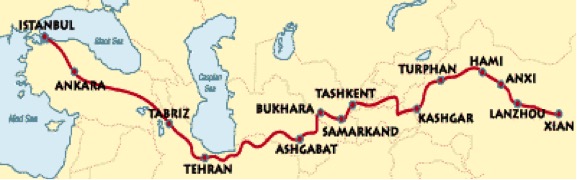
A new commercial rail route connecting China to Iran has officially launched with the arrival of the first cargo train from the eastern Chinese city of Xian at the Aprin dry port near Tehran.
Aprin’s CEO highlighted the port’s strategic role in lowering transport costs and reducing reliance on coastal freight hubs.
Railway infrastructure connecting Iran and China allows freight trains to travel from Shanghai to Tehran in 15 days, compared to 30 days via the maritime route.
On 12 May, railway officials from Iran, China, Kazakhstan, Uzbekistan, Turkmenistan, and Turkiye met in Tehran to advance a transcontinental rail network linking Asia to Europe, Tasnim News Agency reported on 25 May.
The six nations agreed on competitive tariffs and operational standards to streamline regional rail services and boost trade connectivity.
China and Iran have expanded trade and economic relations in recent years, as Tehran seeks to bypass US economic sanctions seeking to strangle its economy and oil exports.
The rail line between the two countries enables Iranian oil exports to China and allows Chinese goods to reach Europe without US naval interference.
In 2018, Iranian Supreme Leader Ali Khamenei stated that Iran should look to the east rather than the west. Since that time, China has become Iran’s largest oil purchaser, while Beijing has been able to supply Tehran with virtually all its needed manufactured goods, including electronics such as computers and cell phones.
The following year, Iran joined China’s “One Belt One Road” (BRI) initiative – President Xi Jinping’s hallmark strategic foreign policy initiative, seeking to recreate the economic ties that existed between ancient China and ancient Persia along the “Silk Road” dating back to the third century BCE.
China and Iran signed a historic 25-year economic cooperation agreement in 2021, reportedly worth $400 billion in trade.
In 2023, China’s growing relations with Iran helped it mediate a Saudi–Iranian rapprochement, which led to the resumption of diplomatic relations that had been cut in 2016.
Do You Condemn October 7? China Says “No”

By Mike Whitney • Unz Review • May 25, 2025
China has never explicitly condemned the attacks of October 7. In China’s view, October 7 can’t be separated from the more than seven decades of Israeli brutality, apartheid and occupation. Naturally, this has drawn harsh criticism from Israel which expressed its “deep disappointment” over China’s refusal to repudiate Hamas. Even so, China has not caved in to Israeli pressure or softened its rhetoric. Quite the contrary, on February 22, 2024, Ma Xinmin—a legal advisor to China’s Foreign Ministry and a member of the International Law Commission—summarized China’s views of Hamas’ activities during a presentation to the International Court of Justice at The Hague. Here’s part of what he said:
The Palestinian-Israeli conflict stems from Israel’s prolonged occupation of Palestinian territory and Israel’s longstanding oppression of the Palestinian people. The Palestinian people fight against Israeli oppression and their struggle for completing the establishment of an independent state on the occupied territory are essentially just actions for restoring their legitimate rights. The right to self-determination served as the precise legal foundation for this struggle. MEMRI
The fact that China chose a legal scholar—who is a member of the International Law Commission—to argue their case, underscores the importance China places on the broader legal issue of whether the Hamas attack was justifiable under international law. Ma concludes that the attack was not only justifiable, but that the militants involved in the attack had an “inalienable right” to conduct operations that were aimed at ending the Israeli occupation. Here’s Ma:
“The Palestinian people’s use of force to resist foreign oppression and complete the establishment of an independent state is an inalienable right …. The struggle waged by peoples for their liberation, right to self-determination, including armed struggle against colonialism, occupation, aggression, domination against foreign forces should not be considered terrorism.” MEMRI
Ma’s statement should not be construed as support for the injuring or killing of innocent civilians. It is, however, a powerful defense of the right of persecuted people to participate in armed struggle against their oppressors.
Most readers don’t know that China resisted Israel’s coercion and defended international law as it relates to the October 7 attacks. They don’t know that China took a stand on a matter of principle and never flinched. Of course, most people don’t realize that of the 195 countries in the world, only 13 officially designate Hamas as a “terrorist organization”. Many believe that the terrorist moniker is applied universally and that the rest of humanity see the world through the same distorted lens as people in America. But they don’t. They see Hamas as a national liberation movement that was duly elected to govern Gaza in 2006 following “free and fair” elections that were forced on the Palestinians by the Bush administration. Now Hamas is being used as the pretext for the slaughter women and children in Gaza on an industrial scale. Most Western leaders have expressed their support for Israel’s 18-month bloodbath, while China has not only opposed it but also defended the Palestinians right to armed struggle. Here’s Professor Richard Falk, a leading scholar in international law and former UN Special Rapporteur for Palestine:
“The right of resistance was affirmed during the decolonization process in the 1980s and 1990s, and this included the right to armed resistance. However, this resistance is subject to compliance with international laws of war.”
Even the preamble to the Universal Declaration of Human Rights states that “whereas it is essential, if man is not to be compelled to have recourse, as a last resort, to rebellion against tyranny and oppression, that human rights should be protected by the rule of law”.
Israel does not comply with international laws of war—for example, the entire situation in Gaza is one of the most flagrant violations of Israel’s complete disregard, not only for the laws of war, but for the entire apparatus of international and humanitarian laws.
Palestinians, on the other hand, who are in a permanent state of self-defense, are driven by a different set of values than Israel. One is that they are fully aware of the need to maintain moral legitimacy in their methods of resistance….
“To the extent that there is real evidence of atrocities accompanying the October 7 attack, those would constitute violations, but the attack itself is something that, in context, appears entirely justifiable and long overdue,” Falk said. Palestine Chronicle
This is why Israel has fabricated so many stories about beheaded babies, mass rape and the killing of innocent civilians. The intention is to persuade the public that October 7 was not a legitimate expression of political resistance but a wanton act of terror aimed at ordinary people. Western analysts typically focus on fake atrocities that are used to drown out any reasonable discussion about historic oppression or political realities. Here’s Falk again:
One of the tactics used by the West and Israel has been to almost succeed in decontextualizing October 7 so that it appears to have come out of the blue... The UN Secretary-General was even defamed as an antisemite for merely pointing out the most obvious fact—that there had been a long history of abuse of the Palestinian people leading up to it,” he added, referring to Antonio Guterres’ simply stating that October 7 “did not happen in a vacuum”. (Palestine Chronicle)
“Decontextualizing October 7”?
Precisely. The case for genocide is made on the basis that October 7 can be removed from its broader historical “context” and seen as a “stand alone” event that requires a particularly violent response. But October 7 is not a stand-alone event; it is the unavoidable explosion of collective resistance to decades of ethnic hatred and brutality aimed at a particular people who have been stripped of their civil rights and left to languish in an apartheid state. Here’s Ma again:
“Our state is obliged to promote the realization of the right to self-determination and to refrain from any forceful action, which deprives people of that right. In pursuit of their right to self-determination, these people have the right to engage in struggles, seek and receive support on the basis of that right….
“Numerous UN General Assembly resolutions recognize the legitimacy of struggle by all available means, including armed struggle, by peoples under colonial domination or foreign occupation, to realize the right to self-determination.
MEMRI
Naturally, Ma’s speech has largely been blacked out in the western media where anything that doesn’t jibe with the Israeli narrative (that October 7 was an act of terrorism) winds up “on the cutting room floor”. We are confident that if Ma’s powerful moral statement was more widely circulated, Israel’s support in the US would crumble.

China Offers To Rebuild Gaza
China has supported every UN Resolution aimed at providing humanitarian relief to the people in Gaza. They have been staunch supporters of Palestinian statehood and the two-state solution from the beginning. They have repeatedly called for an end to the fighting and an immediate ceasefire. They have even met with leaders of Hamas and Fatah (in April and July 2024) to see if reconciliation between the two groups was possible in order to promote Palestinian unity. Finally, China has repeatedly offered to “rebuild Gaza” following the end of hostilities which underscores Beijing’s commitment to an independent Palestinian state living side-by-side with Israel.
At every opportunity, China has supported policies aimed at de-escalation, reconciliation and peace. They have exhibited the type of ‘moral clarity’ and moral leadership we would like to see from the United States but never do. It is China’s moral clarity that “guides its decisions, even in complex or ambiguous situations, without being swayed by competing interests or relativism. It’s about aligning actions with a consistent moral framework, often rooted in universal values like honesty, fairness, or compassion.”
Israel’s savagery in Gaza suggests that the West is in a state of irreversible moral collapse. We should be grateful that China is stepping in to fill the void and lead the world into the next century.
On one of the most consequential issues of our time, China has come down on the side of decency and humanity.
Washington’s “Golden Dome” – Multi-Trillion Tax Dollar Heist at Best, Dangerous Provocation at Worst
By Brian Berletic – New Eastern Outlook – May 25, 2025
US President Donald Trump has announced his administration has chosen the architecture for the proposed Golden Dome missile defense system, claiming it will cost $175 billion and be operational in “less than three years” with a “success rate close to 100%.”
During President Trump’s announcement on May 21, 2025, it was claimed the Golden Dome will consist of technology deployed across land, sea, and space capable of intercepting hypersonic, ballistic, and advanced cruise missiles, “even if they are launched from other sides of the world and even if they are launched from space.”
Former-US President Ronald Reagan’s “Star Wars” program (also known as the Strategic Defense Initiative) was repeatedly cited during the announcement. That program sought to use space-based weapons to void the doctrine of “mutually assured destruction” allowing the US to conduct a nuclear or non-nuclear first strike on another nation and avoid what had otherwise been an inevitable nuclear retaliation that would destroy both nations in the process.
Specifically, because mutually assured destruction was seen as a better deterrence against a first strike by one nuclear-armed nation against another, along with concerns over costs, technological limitations, and then-existing arms control treaties like the Anti-Ballistic Missile Treaty (ABM), the initiative was never fully realized.
Granting the US Impunity to Attack, Not “Defend” Itself
US Space Force General Michael Guetlein, picked to lead the Golden Dome project and present during its announcement, would claim:
As you’re aware, our adversaries have become very capable and very intent on holding the homeland at risk. While we have been focused on keeping the peace overseas, our adversaries have been quickly modernizing their nuclear forces, building out ballistic missiles capable of hosting multiple warheads, building out hypersonic missiles capable of attacking the United States within an hour and traveling at 6,000 mph, building cruise missiles that can navigate around our radar and our defenses and building submarines that can sneak up on our shores and worse yet, building space weapons. It is time that we change that equation and start doubling down on the protection of the homeland.
Yet what General Guetlein calls “keeping the peace overseas,” is in reality the United States encroaching along the borders and shores of nations like Russia, Iran, China, and North Korea.
This includes the stationing of not only missile defense systems like Patriot, THAAD, and the Aegis Ashore system in close proximity to these nations in violation of the ABM treaty the US has since abandoned, but also first-strike offensive weapons like the Typhon missile launcher capable of firing both Standard SM-6 anti-air missiles, but also ground-launched Tomahawk cruise missiles previously prohibited under the INF treaty the US has also since abandoned.
For example, the US has positioned THAAD systems in both the Middle East and Asia, and its Typhon missile system is currently stationed in the Philippines with additional units on the way, specifically aimed at China.
Beyond the global-spanning military footprint of the United States, Washington is also preparing for or already directing multiple proxy wars against these nations.
The conflict in Ukraine was entirely engineered by the United States, beginning with Kiev’s political capture in 2014, the training and arming of Ukraine’s military, and the capture, reorganization, and direction of Ukraine’s intelligence agencies by the US Central Intelligence Agency.
The US has been waging war and proxy war against Iran for decades, including invading and occupying Afghanistan and Iraq right on its borders, invading and overthrowing the government of Iran’s ally Syria, the waging of war on Yemen-based Ansar Allah – also an Iranian ally. The US also maintains constant financial, political, and military support for Israel, which has repeatedly attacked Iran and its allies.
And despite officially recognizing Taiwan as part of “One China,” the United States has continued supporting separatist political parties administering Taipei, is arming local military forces, and is even stationing US troops on the island province itself.
All of this has forced Russia, Iran, China, and other nations to respond by bolstering military spending, increasing research and development into missile technology, and the creation of credible deterrents against decades-spanning US aggression and proxy war along and even within their borders.
While the Trump administration depicts the Golden Dome as necessary to “forever end the missile threat to the American homeland,” it is instead being built to enable the US to forever threaten other nations around the globe with its missiles.
Dubious Claims About Golden Dome’s “Near 100%” Success
At one point during the Golden Dome’s announcement, US President Trump would claim:
I will tell you an adversary told me, a very big adversary, told me the most brilliant people in the world are in Silicon Valley. He said, “we cannot duplicate them. We can’t.”
He also claimed:
We have things that nobody else can have. You see what we’ve done helping Israel. You probably wouldn’t have in Israel. They launched probably 500 missiles all together and I think one half of a missile got through and that was only falling to the ground as scrap metal.
Except none of this is true.
If President Trump is referring to the 2024 Iranian retaliatory strike on Israel, up to 200 missiles were fired, with dozens if not scores of them circumventing Israeli missile defenses and striking targets, including dozens striking and damaging Israel’s Nevatim Airbase alone, according to NPR.
No air or missile defense system has a “success rate close to 100%.”
While any particular system may have a “success rate close to 100%” intercepting individual targets, retaliatory strikes are planned specifically to include a large enough number of missiles, drones, and other projectiles to saturate a defense system’s ability to intercept them all during a single attack. This means that while many incoming targets will be intercepted, many others will not, and critical targets will inevitably be struck and destroyed.
Regarding the state of US missile defense technology, unless President Trump is referring to undisclosed innovations, nothing the US currently is known to possess in terms of air and missile defense systems consists of “things that nobody else can have.”
And while in the past Silicon Valley drove unparalleled advances in technology contributing to a decisive military advantage for the US, the gap has since drastically closed and in some instances is widening in favor of nations like Russia and China.
The conflict in Ukraine, for example, has demonstrated glaring Russian advantages in several key areas that void the entire premise the Golden Dome is predicated on. Russia has demonstrated that it is capable of producing both larger quantities of ballistic and cruise missiles as well as layered integrated air defense systems and at a fraction of the cost the US and its European partners spend on arms and ammunition production.
Russia’s advantage is so great, it prompted the first-ever US National Defense Industrial Strategy in 2022.
The paper admitted the US (and the rest of the collective West) suffers from a bloated, inefficient military industrial base incapable of meeting the demands of the type of large-scale, high-intensity, protracted warfare taking place in Ukraine and likely to take place in future conflicts with either Russia or China.
As previously reported, the paper lays out a multitude of problems plaguing the US military industrial base including a lack of surge capacity, an inadequate workforce, overdependence on offshore downstream suppliers, as well as insufficient “demand signals” to motivate private industry partners to produce what’s needed, in the quantities needed, when it is needed.
In fact, the majority of the problems identified by the report involved private industry and its unwillingness to meet national security requirements because they were not profitable.
Nations like Russia and China do not rely on private industry partners for national defense programs. Much of the industrial power researching, developing, and mass-producing arms and ammunition in these countries takes place within state-owned enterprises. Because national defense is the chief priority of these enterprises, money is invested whether it is profitable or not.
This is what allows Russian and Chinese industry to maintain huge workforces, facilities, and tooling even when production is reduced, while private industry in the West would slash all three to maximize profitability. The first model allows a nation to surge the production of arms and ammunition on short notice – the other requires strong enough “demand signals” to justify the time-consuming process of building up the levels of all three – a process that can take years.
None of the problems described regarding the US military industrial base have been addressed since the National Defense Industrial Strategy was published in 2022. Corporations like Lockheed, Raytheon, L3Harris, and newer companies like Anduril slated to play a role in the proposed Golden Dome system continue to pursue a strictly for-profit model that will create the same disparity in quantity and quality seen playing out on and over the battlefield in Ukraine.
This leaves the likelihood the Golden Dome – like all other modern US military programs – will fall far short of stated expectations because of the fraud, waste, and abuse that defines US military industrial production.
The ultimate irony is that while the Golden Dome is sold to the public as “protecting” America, vast sums of public money that could actually improve the lives of Americans at home through infrastructure, education, and healthcare, will instead be siphoned off by demonstrably incompetent and corrupt arms manufacturers, all in an attempt to enhance Washington’s ability to menace the rest of the world with greater impunity – not protect the US at home.
The rest of the world will predictably react to the Golden Dome by creating their own means to defend themselves and retaliate against the US if attacked, making Americans not only less safe, but in the process of building the Golden Dome, less prosperous.
Brian Berletic is a Bangkok-based geopolitical researcher and writer.
Featured Video

Dr. Tony Martin – The Jewish Role in the African Slave Trade
or go to
Aletho News Archives – Video-Images
In Memoriam
James Petras, In Memoriam
 02.13.2026
Professor James Petras, 89, world-renowned sociologist, public intellectual, and scholar of Latin American politics and global economics, died peacefully on January 17, 2026, in Seattle, WA, surrounded by family.
A prolific scholar and activist, he devoted his life to challenging power, imperialism, and inequality. … continue
Blog Roll
 Aletho News
- Israel ready to strike Iran-backed armed groups – media
- Behind US war drums against Iran: No goals, no plan, no off-ramp
- With Ukraine blamed for cutting oil flows to Hungary, Croatia also refuses to transfer Russian oil in violation of EU law
- Friedrich Merz’s Push to End Online Anonymity Has a Troubling Subtext
- Macron: French citizens fighting for Israel cannot be labeled ‘genociders’
- US eyes Gaza security force drawn from armed gangs
- The Only Motive Behind The ‘Imminent’ U.S. War With Iran Is The Zionist Lobby
- Trump eyes 350-acre US military base housing 5,000 troops in Gaza
- Israel Pushing US Toward a Big and Damaging War With Iran – Ex-Pentagon Analyst
- Meet The Liberal Zionist And Ukraine War Supporter Advising AOC On Foreign Policy
- If Americans Knew
- ‘Christians Out’: Jerusalem Church Tagged With Hate Graffiti, Police Investigating
- Israeli Settlers Kill American Teen
- ‘We returned from hell’: Palestinian journalists recount torture in Israeli prisons
- No mercy for Gaza in Ramadan – Not a ceasefire Day 133
- The Israeli Government Installed and Maintained Security System at Epstein Apartment
- Tucker Carlson interrogated in Israel, has passport seized after interviewing US ambassador
- 6,000 Amputees in Gaza Face Impossible Recovery amid Israeli War Ultimatum
- The Lancet: Gaza death toll far higher than reported – Not a ceasefire Day 132
- Compliant aid: Who are the Israel-approved NGOs scaling up in Gaza?
- Why won’t Trump’s “Board of Peace” bring peace? – Not a ceasefire Day 131
- No Tricks Zone
- Coal Power Back In Trend As Globe Tries To Keep Pace With Growing Demand For Power
- New Study: A 4°C Warmer Beaufort Sea Had ‘No Sea Ice’ 11,700 – 8200 Years Ago
- Unfudging The Data: Dutch Meteorological Institute Reinstates Early 20th Centruy Heat Waves It Had Erased Earlier
- German Gas Crisis…Chancellor Merz Allegedly Bans Gas Debate Ahead of Elections!
- Pollen Reconstructions Show The Last Glacial’s Warming Events Were Global, 10x Greater Than Modern
- Germany’s Natural Gas Storage Level Dwindles To Just 28%… Increasingly Critical
- New Study Rebuts The Assumption That Anthropogenic CO2 Molecules Have ‘Special’ Properties
- Climate Scientist Who Predicted End Of “Heavy Frost And Snow” Now Refuses Media Inquiries
- Polar Bear Numbers Rising And Health Improving In Areas With The Most Rapid Sea Ice Decline
- One Reason Only For Germany’s Heating Gas Crisis: Its Hardcore-Dumbass Energy Policy
 Aletho News