Indian Mass Delusion Syndrome on Full Display
What leads people to celebrate defeat as victory?
By Hua Bin | May 24, 2025
Since I wrote “the DeepSeek moment of modern air combat”, more details have come out about the battlefield outcome from the May 7 and 8 Pakistan India clash.
In addition to the 3 Rafales, 1 Su-30, 1 Mig-29 and 1 Heron UAV covered in my essay, Pakistan also shot down an Indian French-made Mirage 2000. Pakistan Air Force destroyed 2 batteries of the Russia-made S400 air defense system (the command center and one radar unit) with China-made CM400akg hypersonic land-attack missiles launched from JF-17, a fighter jet produced jointly with China.
Since this is the first truly high-tech large scale air combat in the 21st century and the first beyond-visual-range (BVR) air war, military experts and commentators are studying the battle in minute detail. I plan to write another short piece on the tech behind the Pakistan victory soon.
However, another aspect of the war has come to the forefront immediately after the war. That is the mass delusion indulged by the Indian government and press about the conflict. Rather than acknowledging its setback and reviewing its strategy, tactics and battlefield lessons, the Indians are trying to mask their defeat through outright fabrications and lies on a massive scale. It is going so far as to claim the clash an unqualified victory.
Indian government, its TV media (400+ channels), and social media are filled with made-up battlefield successes, destruction in Pakistan, and superiority of the Indian military. The wild claims include –
– No Indian aircrafts were lost and no damage to S400 (though wreckage of a Rafale jet was filmed with its tail number and two burial ceremonies were held for Indian soldiers operating S400 systems. Indian report said they were shot during border skirmishes, which defies any common sense)
– Indian air force shot down 8 Pakistan F-16 jets and 4 JF-17 fighters (no US-made F-16 even took off during the conflict as the US forbid Pakistan to use F-16 in conflicts with India)
– Karachi, the largest port city in Pakistan, was firebombed by Indian navy and one third of the city was destroyed (the footage shown on Indian TVs was later fact-checked to be Israeli’s bombing campaigns in Palestine)
– A coup d’etat happened in Pakistan and the army chief was arrested
– A retired Indian air force marshal claims the Chinese air force cannot use the China-made weapons as well as Pakistan so India has nothing to worry about a conflict with China
Right after the air war, the Indian government called in diplomatic staff from 70+ countries to announce its heroic victories; Modi went on a tour of the frontline and announced a 10-day national celebration. The Indian military was tasked to go on a national tour to share their battlefield successes with patriotic citizens.
When American and French officials confirmed some of the battlefield losses suffered by India, the Indian media, led by the famous BJP promoter and TV personality Palki Sharma, went into a frenzied attack on the inferiorities of US and European weaponry. They bombasted Trump for claiming to broach a ceasefire between the two belligerents. Their argument is India would have dealt an even bigger defeat to Pakistan without the ceasefire meddling.
To this day, most Indians are under the delusion that the Indian military has dealt Pakistan a deathly blow and emerged totally victorious and unscathed.
While shrill and high octane “news” reporting is par for the course in India, and BJP, under Modi, has long shaped and exploited wide-spread jingoistic Hindu nationalist fervour, the Bollywood-like mass delusion is over the top and probably without a parallel in military history.
It is interesting to explore what lies behind such mass hysteria that is completely divorced from reality and what this means for India and its population.
A quick AI search tells you the medical or psychological term for “self-fooling” is self-deception.
Self-deception refers to the process of misleading oneself to accept as true or valid what is false or invalid. It involves cognitive biases, denial, or rationalization to maintain certain beliefs or avoid uncomfortable truths.
While not a formal medical diagnosis, self-deception is studied in psychology and psychiatry as part of defense mechanisms (e.g., denial or repression) that protect the ego from anxiety or distress.
I think this perfectly captures the psychological reasons behind the wildly delusional Indian national mood and character.
Since BJP took power, Modi and his cronies have intentionally fostered a ultra-nationalistic narrative about India’s greatness and Hindu superiority.
– India has launched unprecedented repressions of Muslims and deprived the Kashmir region (a Muslim majority region) its long-held autonomous status.
– India has embraced the fantasy to replace China as the world’s manufacturing center and top economic growth engine by opportunistically aligning with the US and the west. At the same time, it is exploring the Russia-Ukraine war to enrich itself by selling Russian oil at inflated price to the west.
– India has boasted its economy has surpassed UK and France and will join the US and China in no time as the largest economies in the world while it is still behind Japan and Germany. To inflate its GDP, India has changed its GDP accounting method twice in the last 10 years and started to count cow dung as part of GDP as agricultural inputs. Grok estimates Indian GDP calculation included the value of cow dung and other manure at $4.7 billion in 2023.
– India has attempted to bolster its military by purchasing a hodge podge suite of brand-name weaponries from France, Russia, the US and Israel. India spent 7.8 billion Euros in 2015 to purchase 36 Rafale fighters, or 220 million Euros per jet, making it the most expensive fighter jet ever sold by that time. There was so much corruption by Modi’s cronies in the deal that Wikipedia has an entire entry dedicated to the controversy. Even after the corruption case was exposed, India decided to double down and spent anther $7.4 billion to buy 26 Rafale jets for its navy just this past April. That is a staggering price tag of $285 million per Rafale, a new world record.
This Pakistan India air war was initially intended by India to show off its new found muscle until it has its ass handed back by Pakistan.
Similarly, the Modi regime announced with big fanfare its Make In India campaign in 2015 to replace China as the world’s manufacturing powerhouse. It targeted manufacturing to reach 25% GDP by 2025. Instead, Indian manufacturing GDP was 13% by 2024, down from 17% in 2010. In contrast, according to CSIS, value-added industrial output accounted for nearly 40% China’s GDP (vs. 18% in the US). Given China’s GDP is 5 times of India, that means China’s manufacturing GDP alone is 2 times as big as India’s total GDP or 16 times India’s manufacturing output.
Another interesting statistic – in Paris 2024 Olympics, India won a grand total of 6 medals – 1 silver and 5 bronze, ranking 71st among the 84 countries with medal count. This is India’s third best medal haul after 2020 and 2012, according to Wikipedia. The world’s most populous country ranks between Lithuania (70th, population 2.8 million) and Moldova (72nd population 2.4 million). India’s Gold medal haul (0) was lower than Hong Kong (2). The US and China (ex. Hong Kong) each won 40 Gold medals, and 126 and 91 total medals respectively.
This wild gap between India’s self-perception (or should we say self-delusion) as a great power and the cold reality of its economic and social backwardness is the reason behind the mass delusion.
It’s a sad combination of inferiority complex and unfounded sense of grandeur.
There was a famous character called Ah Q in an early 20th century literature work in China. Ah Q is a loser but cannot accept his lowly station in life. So he goes around telling himself he is better than the other people around him, often saying “I was beaten by my bastard son” after losing a fight. In the end, he was framed for a robbery and sentenced to death. When he was signing his death warrant by drawing a circle (since he couldn’t write), he was more upset about the circle not drawn perfectly than the death sentence.
Indians didn’t succeed in copying China’s economic success. Instead, the Indians have fully adopted Ah Q’s delusional “spiritual victory” method of coping with failures and humiliations.
The Indian celebration of their imagined success perfectly reflects Ah Q’s delusional defiance when he tried to sing a heroic song on the road to his execution. He couldn’t sing with his wobbly voice at that point, instead weakly uttered a phrase commonly used by criminals before execution, ”In another 20 years, I shall be another stout young fellow”.
The Indian media obsession with spectacles mirror Ah Q’s morbid disappointment at the crowd at his execution – they were bored because he didn’t sing properly and lamented that he was shot instead of beheaded, denying them the “entertainment” of a decapitation .
India’s celebration of its defeat at the hand of Pakistan encapsulates Ah Q’s entire existence – a blend of farce and tragedy, where self-deception persists until the bullet ends his life.
On a higher level, the dishonest propaganda by the Indian government and media is an information war against its own population. Few foreigners believe the Indian official narrative. The Indian government and media has completely lost any credibility at this point. So the real target of the disinformation campaign is the Indian population itself.
A nation without basic intellectual honesty and suffering from cognitive dissonance will not rise. Instead it will be the butt of jokes by late night comedians.
In the so-called “largest democracy in the world” where the rule is one Rupiah one vote, Modi is resorting to the lowest level of “democratic” playbook – keep the population dumb and get their votes through lies.
How India-Pakistan war will affect global and regional political order
By Salman Rafi Sheikh – New Eastern Outlook – May 24, 2025
The recent India-Pakistan war, though limited in scope, has triggered significant geopolitical reverberations by showcasing Chinese military superiority and prompting a strategic reassessment in Washington.
The China angle in regional geopolitics
Beyond the oft-repeated rhetoric of the Pakistan-China relationship being “all-weather” and “iron-clad,” the recent India-Pakistan war may come to be seen as its first major demonstration in action. Pakistan’s use of Chinese PL-15 missiles, deployed from Chinese-made J-10C fighter jets to successfully engage French-made Rafale aircraft, has underscored the strategic depth of this partnership. This has received considerable international attention, both in the media and otherwise. This show of alignment is particularly notable given recent strains in the Pak-China bilateral relationship, including attacks on Chinese interests and infrastructure projects within Pakistan.
With Pakistan importing almost 80 per cent of its weapons—which also includes cooperation in the field of military technology—from Beijing, the supply ensured to help Islamabad maintain the balance of power vis-à-vis New Delhi. More than this, China’s policy was also motivated by its desire to counter-balance Washington’s efforts to boost India against China. Ironically enough, it was only days before the recent war that the US Vice-President was in India to discuss ways to collectively counter China. But China’s support for Pakistan meant that New Delhi remained preoccupied more with Pakistan than China in a strategic sense. With this war, New Delhi’s focus will be more on Islamabad than China for at least a few more years to come. By the same token, China will most likely continue to help Pakistan develop its defence capability. Even before the war took place, media reports in Pakistan and China reveled ongoing talks between Beijing and Islamabad for the sale and purchase of J-35 fifth-generation stealth fighter jets.
These developments highlight at least four key takeaways. First, China’s defense technology—likely tested in actual combat for the first time—has proven effective enough to attract interest from other regional powers. Its demonstrated performance could prompt these countries to purchase and integrate Chinese systems into their own militaries. This, in turn, would strengthen China’s position in the regional arms market and help it outcompete rival defense exporters. Second, China’s willingness to export advanced military technology—such as the PL-15 missile and J-35 fighter jets—signals a broader strategic intent to deepen its global partnerships. This approach is consistent with Beijing’s “no-limits” alliance with Moscow.
Third, the demonstrated effectiveness of Chinese weaponry against India could encourage regional states to reassess their foreign policy alignments, potentially fostering deeper integration with Beijing over New Delhi. This trend is already evident in countries like Sri Lanka and the Maldives, where pro-Beijing political shifts have gained momentum—most notably in the Maldives, where the new government compelled Indian troops to withdraw. Fourth, Pakistan’s military successes in this conflict challenge a common narrative in global discourse: that partnerships with China inevitably lead to economic “debt traps.” On the contrary, Pakistan’s economic ties with China appear to have laid the foundation for robust military-to-military cooperation, illustrating how economic integration can support broader strategic alignment.
India’s position in Washington’s arc
Can Washington still push—with enough confidence—India as its key ally? What is the material reality of India’s standing within the US-led Quadrilateral Security Dialogue (QUAD)? If the QUAD was ever to become a military alliance, the only power in the region that the US expected to be effective on its own against China is/was India—not only because India and China have a long history of rivalry, but also because India remains a big military power. Needless to say, it is the only nuclear power part of the QUAD from the Indo-Pacific region. In this sense, it can maintain deterrence vis-à-vis Beijing. But nuclear deterrence can prevent a nuclear war, as is evident from the recent India-Pakistan conflict. It cannot necessarily prevent conventional conflict. Can India act as the front-line ally for Washington in the region in a conventional war?
The outcome of India-Pakistan was means Washington will have to rethink its strategy. It can take two shapes. First, it is very much possible that Washington will deepen its cooperation with New Delhi. Donald Trump has already offered to sell F-35 fifth-generation stealth fighters. (Russia has also offered New Delhi to sell its own fifth-generation Su-57 jets.) This, however, will necessarily involve China deepening its cooperation with Pakistan. As a result, an arms race will be triggered in the region.
A second strategic path for Washington could involve renewed engagement with China. While the timing of the Trump administration’s trade negotiations with Beijing may coincide with the outcome of the India-Pakistan conflict purely by chance, it nonetheless suggests that even a confrontational administration has not entirely ruled out dialogue as a preferred tool. Washington might also pursue a dual-track approach—engaging China while simultaneously strengthening military alliances elsewhere.
However, in the wake of shifting dynamics following the India-Pakistan conflict, the US will likely need to reassess its regional strategy and consider alternatives to India. Japan, for instance, emerges as a strong candidate. With its recent push toward military normalization and a growing appetite for deeper strategic engagement, Tokyo could become a more prominent partner in Washington’s Indo-Pacific security architecture.
To be clear, this does not imply a fundamental rupture in US-India relations. But it is increasingly likely that Washington will place India’s role under careful review, potentially redefining its status as the principal frontline ally in countering China. In response to China’s growing influence and military reach, the US will need to significantly bolster the defense capabilities of other regional actors—most notably Japan and Australia—as part of a broader strategic recalibration.
Salman Rafi Sheikh, research analyst of International Relations and Pakistan’s foreign and domestic affairs
Sic Transit Gloria Mundi
By William Schryver – imetatronink – May 22, 2025
The inexorable decline of the American Empire has arrived at an Imperial Paradox. It must either fight a war and die, or not fight a war and die.
Here are the options:
China
Neither South Korea nor Japan want anything to do with a war against China, leaving only the Philippines dumb enough to play along.
The US apparently pulled another brigade out of South Korea. They’ll pull out more in the future. They know damn well the North Koreans could easily conquer the entire peninsula if they chose to do so.
China and its local seas are a vast ocean away from America, and its capacity to defend its local seas is enormous and growing.
The Pentagon must understand it cannot sustain logistics in a war against China in the western Pacific. It simply cannot be done. Anyone who thinks otherwise must upgrade their proficiency in basic arithmetic.
Iran
In the context of a war against Iran, all the geography is against the US.
Iran is an exceedingly mountainous country that has, over the course of millennia, learned to use those mountains to defend itself against would-be conquerors.
They can field a satisfactorily well-equipped million-man army.
They have learned in the 21st century to burrow deep heavily fortified tunnels into their mountains.
Iran is also much more technologically advanced than most people understand. They have become impressively capable in terms of both offensive and defensive missiles. They pose a far greater challenge than the Yemeni have been over the past year and a half.
Indeed, they pose a “near-peer” challenge against US overseas power projection.
The US Navy could only operate at extreme risk in the southern Red Sea, the Gulf of Aden, the Gulf of Oman, the Strait of Hormuz, and the Persian Gulf.
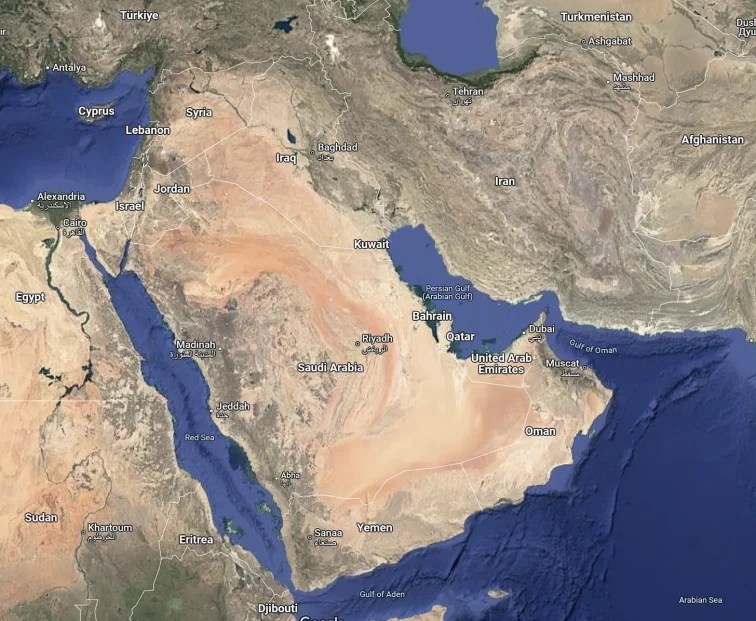
Iran’s sphere of influence
Every US base in the region is well within range of Iranian missile strikes.
The US Navy very demonstrably cannot secure seaborne logistics into the Persian Gulf. They lack both the sealift ships, and the ability to protect them.
They cannot even open the Bab-el-Mandeb!
Russia
From a geographic and logistical standpoint, the only remotely conceivable war is one in Ukraine against Russia.
The US at least has bases and forces already in place in the UK, Germany, Poland, Romania, Finland, and in Baltic chihuahua fantasy-land — and what has served until now as a reasonably secure logistics pathway into all those places.
Of course, whether or not such a condition persists long in a war scenario is another question altogether.
Because, you see, the Russians are now unquestionably the most formidable and battle-hardened military on the planet — at least in the context of a war fought on their doorstep.
So if you’re an empire that thinks it needs a war to reaffirm at least its short-term relevance and fading glory … well, these are your choices.
China urges US to stop space threat rhetoric
Al Mayadeen | May 22, 2025
China’s Foreign Ministry has strongly condemned recent accusations by the United States that Beijing and Moscow pose a growing threat to American space operations.
In a press briefing on Wednesday, Foreign Ministry Spokesperson Mao Ning urged Washington to “stop irresponsible rhetoric” and abandon its pursuit of military dominance in space.
“China has always insisted on the peaceful use of outer space, and opposed the weaponization of and arms race in space,” Mao said, responding to US claims that Russian and Chinese technology now poses the ‘greatest threat’ to the United States in space defense.
The renewed US accusations were made by General Chance Saltzman, Chief of Space Operations at the US Space Force, who alleged that both China and Russia possess anti-satellite capabilities that endanger US interests.
Rejecting these allegations, Mao stated that Beijing has no interest in entering a space race, nor in pursuing “space supremacy.”
Instead, she emphasized that it is the US that has designated outer space as a military battlefield, a move that threatens global security.
“The US continues to build up its space forces, form a military alliance in outer space, and contribute to its weaponization, posing a serious threat to universal development and security interests,” she warned.
Mao urged the US to halt its space militarization agenda and work toward “lasting peace and security” in orbit, reiterating China’s long-held position that space should remain a zone of peaceful exploration and cooperation.
Washington accused of militarizing orbital space
Beijing’s remarks come amid rising global concern over the militarization of space, with the US leading efforts to formalize space as a new warfighting domain.
The creation of the US Space Force, coupled with expanded joint military drills and new orbital systems, has drawn criticism from both Russia and China. Both countries have long supported a legally binding treaty to prevent the deployment of weapons in outer space, an initiative that Washington has consistently blocked.
China’s response shows repeated warnings that the US approach to space risks triggering a destabilizing arms race. “We urge the US to stop expanding its military presence in outer space under the guise of national security,” Mao concluded.
Did ‘Israel’, US fight a proxy war with China in South Asia during the India-Pakistan escalation?
By F.M. Shakil | Al Mayadeen | May 19, 2025
In the recent standoff between India and Pakistan, “Israel” and the US significantly influenced the escalation and resolution of a fierce conflict between the two nuclear South Asian nations that resembles a contest between US-Israeli military equipment and Chinese-made war kits.
The former ignited the fires of war with its advanced military technology and, recognizing the potential for nuclear chaos, swiftly intervened to bring the situation to a close. The display of weaponry unmistakably indicates that Chinese-made missiles and fighter jets exhibit greater precision, target focus, speed, and reliability compared to their competitors, raising alarms for the US and its allies.
The PL-15E missiles, an active radar-guided long-range beyond-visual-range air-to-air missile produced by the China Academy of Launch Vehicle Technology (CALT), have attracted interest following reports that Pakistan Air Force (PAF) J-10C fighters, equipped with PL-15E missiles, effectively downed three Indian Air Force (IAF) Rafale jets in a heated air confrontation. The engagement signifies a significant milestone, as it marks the inaugural instance of a Dassault Rafale, considered one of the top contenders among 4.5-generation fighters, being officially defeated in combat.
Israeli military supply to India
While the future implications of the fragile ceasefire are a perplexing issue for analysts in Pakistan, especially given the spontaneous violations of the truce that occurred within hours of its establishment, “Israel” has undoubtedly played a significant role in the recent military escalation by supplying arms, drones, and defense equipment to India.
“Israel” serves as a key supplier of military hardware to India, and its weaponry entered the battle as it transitioned to drone warfare. Israeli media openly acknowledged that India’s use of Israeli-made drones in its recent cross-border operations against Pakistan has captured international interest, not only for the tactical consequences but also for what it indicates was the strategic depth of India’s developing partnership with “Israel.”
Abdullah Khan, managing director of the Pakistan Institute for Conflict and Security Studies (PICSS) in Islamabad, told Al Mayadeen English that “Israel” provided its drone as well as the military doctrine it applied in Gaza to India. What India did in Pakistan, he said, was precisely what “Israel” has been doing in Gaza, and the same modus operandi was seen applied while targeting the religious institutions. “India has even borrowed the narrative lines from Israel, which has become a long-term challenge for Pakistan’s nuclear program as well”, Khan stated, adding that assessments are being made to determine its role in the recent standoff.
Israeli media, citing Dr. Oshrit Birvadker, a senior fellow at the Jerusalem Institute for Strategy and Security (JISS) and an expert in India-Middle East relations, revealed that India’s recent incursion involved the deployment of Harop and Heron Mark-2 drones, illustrating how “Israel” plays a significant and growing role in India’s current military strategy, especially considering the escalations with Pakistan and the broader counterterrorism context.
Pakistan’s military claimed last week that it had hit 25 Indian drones known as Harop loitering drones produced by “Israel” Aerospace Industries (IAI) after they allegedly violated its airspace. The Harop is believed to be a cutting-edge advanced drone that has significantly expanded high-altitude surveillance and strike capability.
The media, citing the IAI’s website, say that loitering munitions are made to quickly respond to different situations, from short missions to long-range attacks, while also gathering real-time information and allowing for precise strikes. These features make them particularly effective in unpredictable and complex combat environments, including densely populated urban areas like Karachi and Lahore.
The drones reportedly targeted sites across major cities, including Karachi, Lahore, Rawalpindi, and Sargodha, following Indian missile strikes a day earlier on what New Delhi described as terrorist infrastructure in Pakistan-administered Kashmir and Punjab. India made these strikes following an April terror attack that killed 24 tourists in Indian-controlled Kashmir.
China-Pakistan defense collaboration
China has been enjoying close economic, defense, and geopolitical relations with Pakistan since long. Its stakes in Pakistan have been going deeper and deeper with the passage of time. On other hand, Beijing’s relations with India are marred by border disputes.
Zia Ul Haque Shamshi, a retired PAF Air Commodore, was quoted by the media as saying that the introduction of the J-35A fleet— a Chinese fifth-generation stealth fighter— signifies a pivotal shift in South Asia’s airpower landscape. This development was poised to provide Pakistan with a significant advantage, granting a 12- to 14-year lead in stealth fighter capabilities compared to India’s current air inventory.
He stated that Pakistan would acquire up to 40 units of the Chinese J-35A, which would place the Pakistan Air Force (PAF) on a swift path to surpass its longstanding rival, India, for more than a decade.
Last year, the South China Morning Post generated ripples within the Indian military circles by publishing a report that asserted Pakistan’s intention to procure approximately 40 J-35 jets, which are said to feature advanced stealth technology and next-generation avionics, from China.
In reaction to Beijing’s choice to supply Pakistan with fifth-generation stealth jets, Washington extended an offer to New Delhi in February for its advanced fighter jets, the F-35s. During a joint press conference with Prime Minister Narendra Modi, US President Donald Trump indicated that this agreement would represent a significant enhancement in the defense relationship between the two nations, involving “many billions of dollars.”
In a recent interview with AFI, Indian defense analyst Ranesh Rajan suggested that India may resort to “panic purchasing” to counter the Pakistan Air Force’s (PAF) advantage over the Indian Air Force (IAF). This action, the defense analyst believes, could have substantial strategic implications for the entire South Asia region. In a historical context, he observed that the IAF reacted with urgency by purchasing 40 Mirage-2000s and 80 MiG-29s after Pakistan acquired F-16s from Washington in the eighties.
In March this year, Pakistan launched its second Hangor-class submarine, the PNS/M Shushuk, in a ceremony in Wuhan, China. The submarine with enhanced concealment capabilities in the deep ocean, is equipped with advanced stealth features and minimal acoustic signatures. In 2015, during the visit of Chinese President Xi Jinping to Islamabad, an agreement for eight vessels was inked between Pakistan’s Defense Ministry and China’s Shipbuilding and Offshore International Company.
Did the US instigate the flare-up?
Although the background information does not indicate direct US involvement, considering the broader geopolitical context and India’s relationship with the US, it is plausible that the US could have an indirect impact on the situation.
Abdullah Khan disclosed to Al Mayadeen English that the US initially observed from afar without intervening; it may have been assessing the credibility of India’s military strength for a potential confrontation with China in the future.
“India significantly let down its Western allies and partners, experiencing humiliation during the military confrontation with Pakistan. Despite attempts to execute strikes that could have escalated to a nuclear confrontation, it seems that was the moment the US intervened, compelling India to retreat,” he told Al Mayadeen English.
Khan stated that Pakistan had no plans to escalate further after successfully targeting at least 26 sensitive locations within Indian territory.
India, Pakistan, and the future of the Indus Waters Treaty

By Amin Noorafkan | Press TV | May 14, 2025
On April 22, 2025, militants carried out a brutal attack on tourists at a hill resort in Indian-administered Kashmir, leaving 26 people dead. Indian authorities swiftly blamed Pakistan, responding by downgrading diplomatic ties and initiating a series of escalatory measures.
Among these measures, one that took many observers by surprise was India’s decision to suspend the Indus Waters Treaty (IWT) – a landmark water-sharing agreement signed in Karachi in September 1960.
Despite decades of hostilities and multiple wars, the treaty had long endured as a rare symbol of cooperation between the two estranged neighbors.
As tensions surged, India launched a military operation on the morning of May 7, firing a barrage of missiles deep inside Pakistan and Pakistan-administered Kashmir, reportedly killing dozens.
In retaliation, Pakistan struck several Indian cities, including key military installations, three days later.
A ceasefire was brokered just hours after Pakistan’s attack, halting the escalation between the two nuclear-armed nations. However, underlying tensions remain high.
A key point of contention is the continued suspension of the Indus Waters Treaty. Pakistan’s Deputy Prime Minister Ishaq Dar, in remarks on Monday, warned that the fragile ceasefire could unravel if the treaty is not reinstated.
Indus Waters Treaty: Status, India’s stance and Pakistan’s response
India’s cabinet committee on security announced the Indus Waters Treaty – long seen as a symbol of “water for peace” – would be held “in abeyance” until Pakistan ends its support for cross-border terrorism.
India’s Foreign Secretary confirmed the suspension, stating it would remain in place until Pakistan “credibly and irrevocably abjures” terror support.
On the ground, India backed up its announcement with action. It briefly restricted flows on the Chenab River, and then released large volumes of water from the Baglihar and Salal dams as levels rose.
Indian Prime Minister Narendra Modi vowed that “India’s water will flow only in India,” emphasizing that water previously shared with Pakistan would now be conserved for domestic use.
Echoing this, Jal Shakti Minister C.R. Patil said, “We will ensure that not even a drop of water from the Indus River goes to Pakistan.”
In Islamabad, the reaction was defiant and dramatic. Pakistani leaders condemned India’s suspension of the treaty as “an act of war”.
Foreign Minister Ishaq Dar and military officials publicly warned that blocking Pakistan’s water share would trigger a full response. Pakistan also announced it would pursue international legal action.
The government is reportedly preparing cases before the World Bank (the treaty’s broker), the Hague’s arbitration tribunals and even the International Court of Justice.
This escalation is particularly notable given the treaty’s durability. The Indus Waters Treaty remained intact through the wars of 1965, 1971, and 1999.
What is clear is that water has moved to the center of the current standoff. India’s handling of dam flows appears to serve more as a signal of power than a direct retaliation; a message to Pakistan that New Delhi can, at will, alter the course of shared rivers.
The Indus basin dams underpin Pakistan’s food and energy security. A recent report showed that over 80% of Pakistan’s irrigation and nearly 50% of its GDP depend on the Indus water.
But there is another player that needs to be factored into the equation.
China’s role and upstream developments
Adding complexity to the dispute is the growing role of China. In January 2023, satellite imagery revealed extensive dam construction by China on the Indus headwaters in Tibet and on the Brahmaputra (Yarlung Zangbo).
Images also show China building a dam on the Mabja Zangbo (which is a tributary flowing toward Nepal and India) and planning a mega-dam on the lower Brahmaputra.
The Brahmaputra provides about 30% of India’s freshwater and 44% of its hydropower potential, giving Beijing strategic leverage.
Some analysts warn that India’s current use of the IWT as a geopolitical tool could set a precedent, encouraging China to do the same against India downstream.
China’s involvement also has a strategic aspect. Under the China-Pakistan Economic Corridor (CPEC), Beijing has poured billions into Pakistan’s hydropower sector, co-developing large dams like Diamer-Bhasha, Dasu, and Mohmand. These projects are central to Pakistan’s water and energy plans, and China’s investment makes it a key stakeholder.
As a result, any dramatic shift in Indus water flows or treaty dynamics is unlikely to remain a bilateral issue. China could respond directly, especially on the Brahmaputra, or through its partnership with Pakistan, by accelerating joint hydropower projects.
A fragile equilibrium
India’s moves risk triggering a “double-edged sword.” By choking Indus flows, it could prompt Beijing to tighten its grip on Himalayan rivers flowing into India.
In effect, the water dispute now entangles three powers: India, Pakistan, and China, each competing for control over critical transboundary rivers.
However, not all leverage is equal. While China’s upstream position on the Brahmaputra is significant, its practical impact is more limited. The Brahmaputra’s flow through India is largely driven by monsoons, with only 7–10% originating in Tibet.
Even a theoretical full diversion (which remains unlikely due to technical and geopolitical constraints) would reduce India’s national freshwater by 10–15%, impacting less than 1% of GDP. India’s more diversified economy and lower dependence on agriculture (13.5% of GDP) offer some buffer.
Still, China’s dam-building project signals its intent to assert hydro-hegemony in the region.
And as tensions mount, rivers are no longer just a source of sustenance; they are emerging as instruments of strategy and power.
Future scenarios for water diplomacy and conflict
The coming months will reveal whether the current crisis can be resolved through diplomacy or whether tensions will spiral further.
Pakistan appears determined to internationalize the dispute. It has signaled intentions to pursue legal action through the World Bank – the designated facilitator of the Indus Waters Treaty – as well as the Permanent Court of Arbitration and potentially the International Court of Justice.
However, the World Bank has already sought to distance itself. President Ajay Banga stated that the institution has “no role to play beyond a facilitator,” casting doubt on its capacity to mediate a meaningful resolution.
As of now, there are no reports of substantive diplomatic progress. This vacuum raises the risk that the ceasefire may falter, potentially reigniting conflict. Looking ahead, several possible scenarios emerge:
- Legal/diplomatic resolution: Pakistan could formally invoke treaty mechanisms, filing for arbitration and launching protests under international law. A mediated renegotiation might follow, potentially involving updated water allocations or enhanced confidence-building measures. India has long advocated for revisions to the treaty. Under international pressure, New Delhi might seek new security guarantees, while Islamabad could push for a more robust monitoring framework to ensure compliance.
- Escalation: If India persists in withholding water flows or damming key rivers in Kashmir, Pakistan’s response may not remain confined to legal avenues. Officials have warned of potential covert retaliation, including cyberattacks or sabotage targeting Indian water infrastructure. Military confrontation cannot be ruled out either. Pakistani leadership has labeled water denial as an existential threat, with some officials mentioning the possibility of a “last resort response.”
- International mediation/coercion: While the World Bank has signaled a limited role, other global actors may step in. The United States, which helped broker the current ceasefire, could take further steps to mediate the water dispute. Other states – including China, Iran, and Saudi Arabia – may offer to facilitate negotiations or introduce incentives for cooperation. Thus far, however, India has resisted most third-party involvement, making an exception only for US-led efforts.
Amin Noorafkahn is a student of regional studies at Allamah Tabatabai University, Tehran. He is interested in political science, literature, and sociology.
The DeepSeek moment for modern air combat – lessons from the Pakistan India air war
The war of systems will define the future rather than stand-alone weapons
By Hua Bin | May 12, 2025
The world just witnesses a shockingly one-sided air war between Pakistan and India last week. Pakistan air force, equipped with Chinese weapon systems, took down a large number of India air combat assets while suffering zero loss.
The air battle featured Chinese-made J-10C fighters, PL-15 air to air missiles, HQ-9 air defense system, and ZDK-03 AWACS. Reported India losses included 3 French-made Rafale fighters, 1 Russia-made Su-30, 1 MiG-29, and 1 Israel-made Heron UAV.
What makes the outcome so shocking is that the Rafale fighter, sold to India at $240 million each, is often lauded as the most advanced European fighter jet, didn’t manage to put up any fight in the confrontation with J-10C. The Mica and Meteor air-to-air missiles carried by Rafale were discovered intact/unfired in the wreckage.
J-10C, by no means a backward fighter, is considered as well past its prime in the Chinese air force whose more advanced fighters include J-20, J-35 (both 5th generation stealth fighters), J-16, J-15 (4.5th generation multirole fighters), let alone the 6th generation fighters (J-36 and J-50) that are being tested.
J-10C is mainly for exports these days. Pakistan has acquired them at $40 million per unit. A few Middle Eastern nations are also considering the jet, including Egypt. Typically Chinese military export is one or one and a half generation behind what the PLA equips itself.
In all fairness, Rafale would be a strong match against J-10C in a head-to-head dog fight. At $240 million, it is even for more expensive than F-35.
Then, how did the Indian air force suffer such a humiliating one-sided loss against a much smaller Pakistan air force?
The answer lies in the strength of the integrated Chinese weapon system used by Pakistan.
Rather than using a hodgepodge of weapons sourced from France, Russia, Israel, and the US, as is the case with India, Pakistan utilized a full suite of highly integrated and synchronised air combat systems from China that include –
– J-10C fighter jet – a 4th generation multirole lighter fighter with a KLJ-7A AESA radar whose detection range exceeds 300km. With gallium nitride technology, it can lock onto the Rafale’s RBE-2 gallium arsenide radar signature 60-100 km before the Rafale even detects it. In modern air war, who sees first fires first.
– PL-15 air to air missile – one of the deadliest beyond visual range air to air missile with strike range over 200km. The PL-15E, the export version, still has a strike range of 150km, significantly longer than the 80km range of the Mica or the 100km range of Meteor, the most advanced European air to air missile.
– HQ-9 air defense system – this older generation Chinese air defense system (the newer one is HQ-19 with much longer range) has a maximum range of 200 km up to an altitude of 30km. While it has a significant shorter effective range than the Russian S-400 system (400km range), it enjoys a seamless data link with the J-10C fighter and PL-15E missile that automatically handles both fighter and missile guidance in combat
– ZDK-03 AWACs – again this is an older Chinese early warning planes, two generations from PLA air force most advanced systems (KJ-3000 and KJ-700). It is tailor-made for the Pakistan air force by China. The AWAC features an Active Electronically Scanned Arrange (AESA) radar with 360-degree coverage, capable of detecting and tracking up to 100 aerial targets, including low-flying and stealth jets. Importantly, ZDK-03 features an integrated sensor and communications suite, including Missile Approach Warning Systems (MAWS) and can maintain data links with ground command centers and friendly aircraft for real-time battlefield coordination.
With Link 17, a two-way communication data link China has helped Pakistan develop, the HQ-9 air defense system passes the Indian Rafale fighter information to the J-10C fighter which fires the PL-15E air to air missile well beyond the range of Rafale’s own missiles. Then the ZDK-03 AWAC maintains the data link with the missile and guides it toward the target.
PLA’s internal data link systems, such as XS-3 and DTS-03, are far more sophisticated than Link 17 or Link 16, the NATO data link standard. They use a combination of Beidou satellite navigation/communication and AI-powered military-grade 5G system. Given their highly classified nature, the systems are under strict export ban.
The Rafales were shot down before they even had a chance to engage with the J-10Cs within the missile range.
The defeat suffered by the India air force is a result of its lack of an integrated air warfare system. Standalone weaponry, however advanced, cannot achieve air superiority without the integration of other air warfare systems and seamless data links in today’s informationalized combat environment. Of course, poor training and tactical planning are also contributing factors.
Pakistan, with its integrated Chinese-made air combat platforms, has achieved a decisive victory over India, whose patchwork collection of various weapon platforms prove both costly and ineffective.
When $240 million Rafale fighters are brought down by $40 million J-10Cs with $180,000 PL-15E missiles, the military world is experiencing its own DeepSeek moment.
I wrote in my essay A Watershed Hypersonic Breakthrough: China’s New Hypersonic Air-to-air Missile (https://huabinoliver.substack.com/p/a-watershed-hypersonic-technology) that China just fielded an ultra-long 1,000km hypersonic missile (which can cover that distance in 8 minutes at Mach 5), designed to neutralize the US F-22 and F-35 fighters and B-21 bomber.
The Pakistan India air combat, labelled as the largest air war in 50 years, is a testing ground for Chinese technologies. With military hardware one to two generations older than PLA’s own, Pakistan has handily beat Indian’s most advanced western weaponry.
The US and the west would be making a deadly mistake to underestimate the Chinese military in Western Pacific and challenge China in a kinetic war.
The cherry on top is that India, despite western media’s hype as a counterbalance to China, proves it is just noise and can barely serve as a speed bump.
Net Zero Fades As the Deluded Cling to Its Fantasy
By Vijay Jayaraj | Townhall | May 9, 2025
The grand vision of “Net Zero” initiatives – by which emissions of carbon dioxide magically balance with expensive and futile capture and storage systems – have long been sold as the redemption arc for humanity’s profligate modern ways. Yet, like a poorly scripted dystopian thriller, the holes in this plot are glaring.
Net Zero was always a fragile concept. It rested on shaky and illogical assumptions: that wind turbines, solar panels and “green” hydrogen could reliably replace fossil fuels, that governments could redesign economies without unintended consequences, that voters would accept higher costs for daily necessities, and that developing countries would sacrifice growth for climate targets they had no hand in creating.
None of those fantasies held. Countries did not decarbonize nearly at the speed promised, even though climate bureaucracies clung to the illusion. Long-range targets, five-year reviews and international pledges lacked common sense and defied physical and economic realities. The result? An unaccountable machine pushing impractical policies that most people never voted for and are now beginning to reject.
If Net Zero were a serious endeavor, its architects would confront the undeniable: China and India are more than delaying their decarbonization timelines – they’re burying them. Why has this been ignored?
China and India – responsible for more than 40 percent of global CO2 emissions in the last two decades – are accelerating fossil fuel use, not phasing it out. In Southeast Asia, coal, oil and natural gas continue to dominate. Vietnam, Indonesia and the Philippines are building new electric generating power plants using those fuels. These countries understand that economic growth comes first.
Africa, too, is pushing back. Leaders in Nigeria, Ghana and Senegal have criticized Western attempts to block fossil fuel financing. African nations are investing in exploitation of the oil and gas reserves.
If Asia represents the global rejection of Net Zero, Germany and the U.K. are poster children of the West’s self-inflicted wounds. Both nations, once hailed as Net Zero pioneers, are grappling with the harsh realities of their green ambitions. The transition to “renewables” has been plagued by economic pain, energy insecurity and political backlash, exposing the folly of policies divorced from facts. When the war in Ukraine cut off energy supplies, Germany panicked. Suddenly, coal plants were back online. The Green Dream died a quiet death.
Trump funding cuts likely will accelerate the fall of Net Zero’s house of cards. The president’s decisions to slash financing for international and domestic green programs has severed the lifeline for global climate initiatives, including the United Nations Environment Program. Trump also vowed to redirect billions from the Inflation Reduction Act – Biden’s misnomered climate law – toward fossil fuel infrastructure.
The retreat of Net Zero interrupts the flow of trillions of dollars into an agenda with questionable motives and false promises. Climate finance had developed the fever of a gold rush. Banks, asset managers and consulting firms hurried to brand themselves as “green.” ESG (Environmental, Social, Governance) investing promised to reward “climate-friendly” firms and punish alleged polluters.
The fallout was massive market distortions. Companies shifted resources to meet ESG checklists at the expense of fiduciary obligations. Now the tide is turning. The Net Zero Banking Alliance comprising top firms globally has been abandoned by America’s leading institutions. Similarly, a Net Zero investors alliance collapsed after Blackrock’s exit.
Perhaps the fundamental failure of Net Zero was political. Permission was never sought from taxpayers and consumers who would pay the costs and suffer the consequences of an always ill-fated enterprise. Climate goals were set behind closed doors. Policies were imposed from above. Higher utility bills, job losses and diminished economic opportunity became the burdens of ordinary families. All while elites flew private jets to international summits and lectured about the need to sacrifice.
A certain lesson in the slow passing of Net Zero is this: Energy policy must serve people, not ideology. That truth was always obvious and remains so.
Yet, some political leaders, legacy media and industry “yes-men” continue to blather on about a “green” utopia. How long the delusion persists remains to be seen.
Vijay Jayaraj is a Science and Research Associate at the CO2 Coalition, Fairfax, Virginia. He holds an M.S. in environmental sciences from the University of East Anglia and a postgraduate degree in energy management from Robert Gordon University, both in the U.K., and a bachelor’s in engineering from Anna University, India.
US universities are recruiting Indian and Nigerian students to replace Chinese. It’s not working.
Inside China Business | May 8, 2025
Chinese university students contribute over $14 billion a year to the US economy. But Chinese families are increasingly choosing to either study in China, or to other countries.
This shift is deepening the fiscal crises in American higher education, which also suffers from a steep decline in US student populations. US universities are heavily recruiting students from India and Africa, in the hope to make up for shortfalls in Chinese enrollments. And briefly, this strategy seemed to work.
A surge in students from India pushed China into second place, as a leading country of origin for US international students. But that was short-lived. Indian enrollment in the past year plunged, with 99,000 fewer students. Nigeria also saw double-digit percentage declines in just a one-year period.
A more serious problem, however, exists in the financial commitments of the students’ families. Chinese students cluster in the most highly-ranked, and most expensive, US university programs. In comparison, Indian and especially Nigerian students tend to attend far lower-cost programs. Closing scene, Detian Waterfall, near Nanning, Guangxi
Resources and links:
LA Times, Why Chinese students still want to attend U.S. universities https://www.latimes.com/world-nation/…
Interest in studying in US dropped 42% in January https://www.universityworldnews.com/p…
There are already 130,000 fewer international students in the US. Has anyone noticed? https://distributedprogress.substack….
Already facing Trump administration cuts, US colleges risk losses from another revenue source: foreign students https://www.cnn.com/2025/04/18/us/int…
SEVIS Data Shows Declining Number of International Students in the United States https://www.aau.edu/newsroom/leading-…
Wall Street Journal, Chinese Students on U.S. Campuses Are Ensnared in Political Standoff https://www.wsj.com/politics/policy/c…
Tracking College Closures and Mergers https://www.bestcolleges.com/research…
The Demographic Cliff: What It Means for College Admissions and Higher Education https://www.applerouth.com/blog/the-d…
US: New survey shows international student recruitment shifting to India in 2023 https://monitor.icef.com/2023/07/us-n…
Why the Next Wave of International Students May Come From Africa https://www.bestcolleges.com/news/wav…
Five Reasons Why a Strong Euro is an Economic Disaster for the EU
Sputnik – 01.05.2025
The euro has jumped in value almost 10% against the dollar since January. But before cheering at the thought of cheaper imports of Skippy peanut butter and Jim Beam whiskey, here’s what EU residents should know.
1. Stronger Euro = Weaker Exports
“For any country (or zone in the case of the euro) that is a strong exporter,” a strong currency “contributes to slowing exports and increasing imports, to the detriment of domestic production,” explains Jacques Sapir, veteran economist and director of studies at the Paris-based School for Advanced Studies in the Social Sciences.
2. Monetary Union Trap
Unlike ordinary nations, which can depreciate their currencies at will to restore exports’ appeal, eurozone members are trapped by the monetary union, which offers “quite limited” room to maneuver for big producers or tourism-based earners benefiting from depreciation vs everyone else.
3. Another Hit to Eurozone Economy in Rough Shape
The euro’s growing strength is bad news for a bloc already:
- facing zero growth and recession for 3 years running
- cut off from the source of its export competitiveness: cheap Russian energy
- facing brutal trade competition from the US and China.
4. Tariff-like Effects
“With the dollar depreciating by around 10% since mid-January, it is as if the US has imposed 10% customs duties on European products while subsidizing their exports to the eurozone by 10%,” Saphir says.
5. Tariff Wars Add to Uncertainty
“Major economic players abhor uncertainty…As long as these negotiations last, no one knows what the tariff levels will be and therefore how attractive the American market will be, whether for production or investment,” the economist says.
Civic groups in Taiwan rally protest against DPP amid growing wave of opposition
By Shen Sheng | Global Times | April 26, 2025
Several civic groups on the island of Taiwan launched a protest event on Saturday, opposing the Democratic Progressive Party (DPP) and condemning Lai Ching-te for inciting hatred within Taiwan island and forcibly pushing the public toward the brink of war. They also denounced the DPP for damaging cross-Straits economic and trade exchanges, making it difficult for agricultural and fishery products from Taiwan to be exported.
The event comes as the Lai’s series of regressive actions have triggered a growing wave of denunciations from people across Taiwan Straits, who condemned his trampling of democracy and the rule of law, as well as its damage to the peace across the Straits.
Speakers at the event warned that if the DPP continues to rely on foreign powers and provoke confrontation with Chinese mainland, there will be no space left for peace in Taiwan island, and young people will face an unstable future. They called on the people of Taiwan to transcend ethnic and political divides and stand up against the DPP’s attempt to seek “Taiwan independence.” They urged all Chinese people on both sides of the Taiwan Straits to share a sense of historical responsibility and jointly resist forces driving them toward disaster, according to a press release sent to the Global Times on Saturday by the Labor Party.
Wang Chuan-pin, Vice Chairman of the Labor Party, emphasized at the event that the DPP is actively cooperating with the US to hollow out Taiwan’s industries. She emphasized the need to defend the rights of small and medium-sized enterprises and grassroots workers and urged everyone to courageously stand up against DPP’s harmful actions.
Wang Wu-lang, secretary-general of the Labor Party, noted that Lai Ching-te has damaged cross-Straits economic and trade exchanges, making it difficult for agricultural and fishery products in Taiwan island to be exported, while industrial goods are now subject to high US tariffs. These developments have severely harmed the interests of farmers and workers in the island.
People are now facing stagnant wages, soaring housing prices, and rising living costs, signaling that the DPP is ruining the lives of the people through its political agenda, said Wang.
Xu Mengxiang, Deputy Secretary-General of the Labor Party, stated that the DPP, under the pretext of “security,” is inciting hatred within the island of Taiwan and forcibly pushing the public toward the brink of war. This undermines the progressive values of democracy and leads the entire island down a dangerous path of historical regression.
Participants further stressed that the DPP’s “green terror” has already targeted mainland spouses and other political groups and may extend even further. They warned that if the public does not rise up, everyone could eventually become victims of this “green terror.” They invoked the memory of those who once stood against “white terror” in Taiwan’s history, calling on current and future generations to continue fighting against today’s oppression, and to defend democracy and the rule of law.
Addressing the livelihood issues that concern the public most, speakers at the event repeatedly pointed out that the DPP places ideology above people’s welfare. Its anti-China stance has crippled Taiwan’s economy and society, misallocating resources and distorting internal policies, thereby intensifying livelihood and economic crises.
They stressed that the Lai Ching-te administration is using an anti-China strategy as a cover for its governance failures, leading to worsening economic decline, rising energy risks, and widespread public hardship.
At the conclusion of the event, the civic groups issued an appeal to people in Taiwan, chanting slogans such as “both sides of the Taiwan Straits are of the same family” and “we are all Chinese,” which received strong and enthusiastic support from the public.
Meanwhile, the Kuomintang (KMT) party also held a protest against DPP on the same day, Taiwan-based outlet ETtoday reported. Ma Ying-jeou, former chairman of the Chinese Kuomintang party, attended the protest and delivered a speech. In his remarks, Ma expressed his dissatisfaction with DPP’s actions, and criticized Lai’s incompetence, stating that he cannot bear it anymore.
Taiwan-based media reported that Ma expressed concern that Lai’s recent words and actions could lead Taiwan to a rapid decline. He mentioned that while the US imposed heavy tariffs, Lai and DPP authorities are helpless.
White House preparing for possible Trump-Kim talks – Axios
RT | April 28, 2025
US President Donald Trump’s team is considering a new strategy for North Korea, potentially mirroring the diplomatic engagement of his first term, according to sources cited by Axios.
Trump met with North Korean leader Kim Jong-un in person multiple times, including in Singapore in 2018, Hanoi in 2019, and within the demilitarized zone on the Korean Peninsula later that same year. He is the first sitting US president ever to sit down at the negotiating table with his North Korean counterpart.
Trump has told his team that he wants to reconnect with Kim, potentially face-to-face, Axios reported on Sunday. The administration is “convening agencies to understand where the North Koreans are today,” said a senior official speaking on condition of anonymity. “A lot has changed in the last four years. We are evaluating, diagnosing and talking about potential avenues, including engagement.”
Currently, this initiative is not among the White House’s top priorities and involves consultations with external experts, including former officials and think tanks, the outlet said. Axios suggested that Washington holds less leverage over Pyongyang now than it did in the late 2010s, as North Korea has bolstered its military capabilities, including nuclear forces, and forged stronger ties with China and Russia.
Last year, North Korea and Russia signed a bilateral treaty that includes mutual defense provisions. Shortly thereafter, Ukraine started an offensive into Russia’s Kursk Region, aiming to gain leverage over Moscow in future negotiations.
North Korean troops were deployed to Russian territory to assist Moscow in repelling Ukrainian forces, culminating in the complete liberation of the region last week, according to Moscow. Over the weekend, President Vladimir Putin acknowledged the contribution of North Korean troops, commending their bravery and referring to them as brothers in arms.
The Trump administration is seeking a compromise deal to end the Ukraine conflict. Trump has accused Ukraine’s Vladimir Zelensky of undermining his efforts by publicly challenging key aspects of what media outlets describe as his peace plan.
The two leaders met on the sidelines of Pope Francis’ funeral in the Vatican on Saturday, with Zelensky pleading for more US weapons, according to Trump.
Featured Video

Rewriting the risk? Inside the government’s vaccine safety messaging
or go to
Aletho News Archives – Video-Images
Book Review
“Davos Can Really Replace the UN”
Inside the book that maps the architecture behind global governance — from the Epstein files to the Pact for the Future
Lies are Unbekoming | April 1, 2026
On June 13, 2019, the United Nations and the World Economic Forum signed a partnership deal to “accelerate the implementation of the 2030 Agenda for Sustainable Development.” That same evening, WEF president Börge Brende — Norway’s former Foreign Minister — had dinner with Jeffrey Epstein at Epstein’s Manhattan townhouse. The Epstein files, released January 2026, contain an exchange between the two from the previous year. Epstein to Brende: “Davos can really replace the UN. C21, cyber, crypto . genetics… intl coordination.” Brende back to Epstein: “Exactly — we need a new global architecture. World Economic Forum (Davos) is uniquely positioned — public private.”
The next day, the UN General Assembly adopted the framework for restructuring global governance.
That sequence — the partnership signing, the Epstein dinner, the candid admission about replacing the UN with a public-private architecture, and then the formal adoption — opens Jacob Nordangård’s The Digital World Brain. Pages two and three. Footnoted to the UN resolution number, the Epstein files, and the General Assembly record.
I keep coming back to it because it captures what this book does that almost nothing else in the independent research space manages. I’ve followed Jacob’s work for years now and interviewed him about his research. Each book peels back another layer of the same institutional architecture, and each time I think he’s reached the limit of what can be documented, the next one goes further. Nordangård doesn’t speculate. He doesn’t editorialize much. He lays institutional actions next to each other in chronological order and lets the pattern announce itself. … continue
Blog Roll
 Aletho News
- The End of NATO
- 37 days of war on Iran cost US staggering $42bln, tracker shows
- Baghdad tells Asian refiners, traders to begin loading Iraqi crude amid Iranian exemption
- Under fire, Moscow and Tehran close ranks
- Iran, US receive Pakistan-mediated plan for ceasefire then final deal
- Iran submits demands for end to war as mediators scramble ahead of Trump deadline
- Iran Threatens Retaliatory Strike on Stargate AI Project in UAE
- US sent ‘a lot’ of arms to Iranian protesters – Trump
- Barak Ravid Launders Deception To Allow Trump To Back Off Of His Power Plant Threat – Again
- REWRITING THE RISK? INSIDE THE GOVERNMENT’S VACCINE SAFETY MESSAGING
- If Americans Knew
- Trump poised to “blow everything up” (ie. commit war crimes) in Iran – Daily Update
- In Iran, Israel-US take aim at “reason, research, and freedom of thought” – Daily Update
- US loses planes over Iran, Israel downgrades Lebanon war goals – Daily Update
- Israel Is Blocking Palestinians from Easter at Church Where Jesus Resurrected
- Plot to assassinate Palestinian activist follows harassment campaign promoted by Zionist groups and elected officials
- Prominent New York synagogue hosts presentation on why U.S. Jews should support the ethnic cleansing of Gaza
- Tapper vs. Piker: Is the CNN Anchor Auditioning for David Ellison?
- Shouldn’t Democrats Be Able to Condemn Genocide?
- Israel-US kill negotiators, destroy civilian structures, but Iran’s military capabilities still largely intact – Daily Update
- ‘War crime’: Global condemnation as Israeli ministers celebrate death penalty law targeting Palestinian prisoners
- No Tricks Zone
- An Inconvenient Tree: Uncovered In Alps… Europe Much Warmer Than Today 6000 Years Ago
- New Study Reports A 60% Slowdown In Greenland’s Ice Loss Rate In The Last Decade
- Low Intensity Tornado Wrecks Major Solar Farm, Creating A Potential Toxic Dump
- New Study Finds Warming Saves Lives…Cold Temperatures 12 Times More Deadly Than Excess Heat
- German Science Blog Accuses PIK Climate Institute Of Hallucinating Climate Tipping Points
- Devastating Assessment Of Comirnaty Vaccine By Former Senior Pfizer Europe Toxicologist
- New Study: CO2 Is ‘Effectively Negligible’ As An Explanatory Climate Change Factor Since 2000
- Former Pfizer Toxicologist Dr. Helmut Sterz Tells Bundestag Hearing Pfizer Vaccine Should Have Never Been Approved
- Energy Expert: Germany’s Nuclear Phaseout Was A “500 Billion Euro Mistake”
- New Research: South Australia’s Mid-Holocene Sea Surface Temperatures Were 4°C Warmer Than Today
 Aletho News