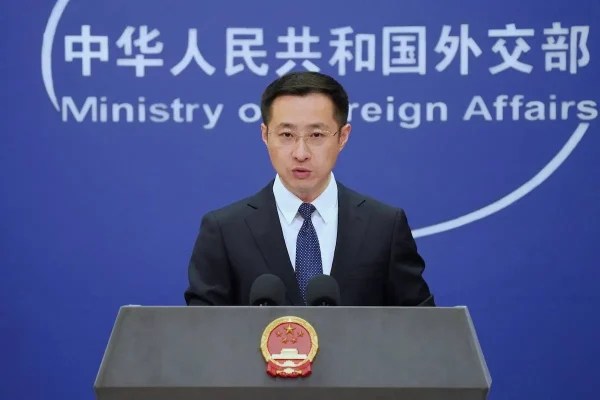
Claims by Washington and London that Beijing is supporting Russia’s military in the conflict with Ukraine are “groundless,” the Chinese embassy in the UK stated on Monday.
The diplomatic mission responded to the ‘Joint Statement on the US-UK Strategic Dialogue,’ which was issued after talks between President Joe Biden and Prime Minister Keir Starmer at the White House last week. Among other things, the document said the sides shared “particular concern” about what they called “China’s support to Russia’s defense industrial base.”
The Chinese embassy rejected the accusation, stressing that Beijing has “always maintained an objective and fair position, actively promoted peace talks and pushed for a political solution” to the conflict between Moscow and Kiev.
“We firmly oppose the relevant countries’ constant propagation of disinformation that China supports Russia’s defense industry,” the statement read.
By making such claims, the US and UK are “adding fuel to the fire and shifting the blame” from themselves for the continuation of the fighting between Moscow and Kiev, the embassy said, adding that they should “stop” behaving in this manner.
The joint statement by Washington and London also underlined the importance of close coordination between the two nations in promoting their common values and interests in the Indo-Pacific region. The sides insisted that “peace and stability” in the Taiwan Strait, which separates Taiwan and mainland China, are “indispensable to the security and prosperity of the international community and called for the peaceful resolution of cross-Strait issues.
” The Chinese embassy reminded the US and UK that “the Taiwan question is purely China’s internal affair” and that “No external forces have the right to interfere.” Beijing considers the self-governed island to be part of its territory under the ‘One China’ principle.
“The biggest threat to peace and stability in the Taiwan Strait now is the separatist activities for ‘Taiwan independence’ and the interference of external forces,” the diplomats stressed.
The mission blasted the Anglo-American joint statement, saying that it “makes groundless accusations… and interferes in China’s internal affairs.” Beijing “strongly deplores and firmly rejects this.”
President Putin has asked the government to consider restrictions on the export of strategic materials like nickel, titanium and uranium in response to unfriendly countries’ actions. Sputnik asked investment experts specializing in resource markets how these restrictions would impact the world economy. In short: it wouldn’t be pretty for the West.
Investors and market experts are buzzing over the Russian president’s instructions to Prime Minister Mishustin to whip up a report on measures Russia could take to limit the export of certain strategic minerals in response to Western sanctions policy, with uranium stocks enjoying an immediate price surge, and observers warning of shortages and hefty price increases for strategic metals if were to Moscow move forward with restrictions.
Along with nickel, titanium and uranium, Putin hinted that “other” resources may be affected, while emphasizing that restrictions should be considered so long as “this does not harm us.”
A resource superpower, Russia is endowed with substantial reserves of virtually all the primary commodities required to keep a modern economy functioning.
The country possesses up to 12% of the world’s oil reserves, 32% of its natural gas, 8% of all untapped uranium, and 11% of the planet’s coal.
Russia accounts for 25% of global iron reserves, 33% of nickel, 15% of zinc and titanium, 11% of tin, 10% of lead and rhodium, 8% of chromium, 7% of copper, 3% of cobalt, 2% of bauxite and about 1% of gallium, plus substantial amounts of beryllium, bismuth, and mercury. Russia also has about 12% of global potash (used in an array of areas, from agriculture and industrial chemicals to pharmaceuticals).
Up to 23% of the world’s gold, 12% of silver, up to a fifth of platinum group metals, and as much as 55% of diamonds are buried under Russia’s soil.
Russia is also a potential world leader in the production of rare earth minerals (which are used in an array of modern high-tech devices, communications systems and advanced weaponry). While it only accounts for about 2% of rare earths production today, Russia has the second-largest reserves, constituting up to 28.7 million metric tons, and has committed to major investments in production and processing. Known rare earths possessed by Russia include samarium, europium, gadolinium, lanthanum, neodymium, promethium, and cerium.
World’s Dependence on Russian Resources
Russia’s detractors have often played up its resource exports as a sign of the country’s lagging development or low place in the global hierarchy of ‘developed vs. underdeveloped’ nations. However, the partial breakdown in ties with Western countries after 2022 showed that while Russia can definitely survive without Western technological and consumer goods, the same cannot be said of the West when it comes to Russian oil, gas, uranium, fertilizers and other materials.
The US, for instance, continues to rely on Russian uranium to fuel its nuclear power plants, vowing to wean itself off its dependency only by 2028. Europe, having largely cut itself off from Russia’s cheap and dependable pipeline-delivered natural gas, is currently buying record volumes of Russian LNG amid shortages of US and Gulf-sourced supplies. Furthermore, major Western agricultural producers including the US, Germany, France and Poland have carved out special exceptions for themselves to allow the continued purchase of Russia’s world-class nitrogen fertilizers, which are energy-intensive to produce.
“The pain” of a Russian freeze on strategic resource exports “would be felt by both the US and the EU, and all countries listed as ‘unfriendly’ to Russia, as they would have to source the required elements from third country suppliers, and that would entail an appreciable price increase for the commodity, and the extended supply chain costs that entails,” Paul Goncharoff, general director of consulting firm Goncharoff LCC, told Sputnik, commenting on Putin’s proposal.
“In this case, most if not all alternative suppliers would be countries listed as ‘friendly’ to Russia. This is a value-added benefit for those countries,” Goncharoff added.
“In every instance the end user pays this mandatory unlegislated tax bill in the form of even higher inflation,” Goncharoff said, hinting that the higher commodity prices would add to the pain already being experienced by producers and consumers in many Western countries as a consequence of the two-and-a-half-year-old hybrid war against Russia.
The US and Europe should expect a 15-20% bump in the costs of its strategic resource imports if Moscow moves ahead with the restrictions, especially since Russia is in a unique position globally in the production of high-quality nickel, aviation-grade titanium, and enriched uranium, says Maxim Khudalov, chief strategist at Vector X, a Moscow-based investment and brokerage firm.
For instance, while Russia today accounts for ‘only’ about 8% of total global nickel output, it accounts for about 20% of the production of “high-grade nickel used to produce high-quality stainless steel and nickel-containing alloys, which are needed for space, aviation and defense technologies,” Khudalov explained.
The same goes for high quality titanium, Khudalov said, pointing out Russia’s titanium giant VSMPO-AVISMA in Sverdlovsk region is “unique in the world” as far as its ability to produce vast amounts of aviation-grade titanium is concerned.
Finding a replacement supplier would take time, including running a gauntlet of quality and safety testing and recertification which could take years, and in the case of aviation-grade titanium be required to meet strict temperature, bending, pressure load and other requirements, the expert noted.
“In an airplane, you can’t just say ‘well, I don’t like this supplier of an element used for the wing, I’ll take it from somewhere else.’ Nothing of the kind. If you replace the element used in the wing, you change the airplane, and have to retest it, because it’s no longer safe for civilian use,” Khudalov explained. “The conclusion here is that it is very difficult to replace Russian supplies in the aviation industry, requiring significant recertification efforts.”
If Europe loses access to Russian aviation-grade titanium, that would add to Airbus’s production costs, affecting the aviation giant considerably in its high-stakes rivalry with Boeing.
Meanwhile, higher nickel costs would mean higher prices for virtually all of Europe’s high-tech products, from electronics to specialized mechanical engineering products, Khudalov said, emphasizing that “all of this will become more expensive in Europe and again allow their American ‘friends’ to grab the remainder of their markets.”
“In this sense, Europe is more vulnerable than the US, because the US, with all its capabilities, can afford to increase production costs, at least because their energy is cheap. Europe cannot afford any increase in production costs and will objectively lose,” Khudalov said.
In the case of enriched uranium, the situation is even more complex, according to Khudalov, because it is a restricted resource typically exported to a specific customer for a specific use, and planning for the replacement of suppliers is a long and painstaking process, since nuclear power plants can’t simply be turned on and off at will.
“The French are the second player after Russia in uranium enrichment, but Russian enrichment technology is head and shoulders above anyone else in the world, and our enrichment costs are 35-40% cheaper than anywhere in the world. So if a country is forced to switch to French-sourced material, it will have to pay a very hefty premium,” Khudalov emphasized.
In that sense, France could meet increased US demand over time, but not overnight, since it would have to ramp up its own enrichment capacity.
“The US themselves were planning on disconnecting from our uranium starting in 2028. Well, we could ‘help them’, so to speak, to implement their decision by making deliveries more regulated,” Khudalov suggested.
Short-Term Losses, Long-Term Win
Russia, over the short term, could lose a bit of its export revenues if resource exports to the West were suddenly curtailed, Khudalov noted.
“But on the other hand, what do we need export revenues for? Generally speaking, the whole point of international trade for us is to sell raw materials in exchange for technology. Western countries have refused to supply us with technology basically going back to 2014. Then the question is: why do we continue to supply them with strategic raw materials? To get some green pieces of paper which they then seize from us? This is a rather strange position. Therefore, here it is turning out that since they limit our access to technology, we are starting to limit their access to raw materials,” Khudalov said.
“It can’t be said that all these possible restrictions on the Americans and the Europeans are critical and would kill their industry. It won’t. But it will add very serious difficulties, first and foremost of an organizational nature, because they would have to look for a supplier of comparable quality, and of course, pay a price they’re not accustomed to paying. Because when a force majeure occurs on the market, and for them this would constitute a force majeure, any normal businessman will be obliged to take advantage of their status as an alternative supplier. Most of the alternative suppliers are located in China, with whom the Americans are in the process of kicking off a global trade war,” the observer stressed.
“The cherry on the cake is that the president’s proposal sounded like a proposal to limit the supply of strategic metals to unfriendly countries, but probably implies no restrictions for friendly countries. In that case, we would deliver a nice pass to China, whose entire industry is aimed at producing high-tech equipment, and would effectively get a 15-20% advantage on the cost of strategic materials over Western competitors,” benefiting Beijing in its push to put “pressure on Europe and the US in all markets” globally, Khudalov said.
Russia, meanwhile, will be able to reorient its strategic metals exports to other major alternative markets as well, including India, according to the expert.
A recent article in the South China Morning Post caught my eye—the topic being why Beijing has taken such an apparently different approach to its territorial disputes with Vietnam versus the similar disputes it has with the Philippines.
Given the now weekly near misses between competing claimants in the South China Sea, the topic is a timely one, and in analyzing Beijing’s contrasting responses to territorial claims by Vietnam and the Philippines in the South China Sea, it becomes clear that China’s strategic calculations are shaped by varying historical, political, and diplomatic dynamics.
Historically, Vietnam’s claims to the South China Sea date back several centuries, although the exact extent and nature of these claims have evolved significantly over time.
Vietnamese records from the Nguyễn Dynasty (1802–1945) suggest that Vietnamese rulers asserted control over certain islands and features in the South China Sea. And references to the Spratly and Paracel Islands appear in historical texts from as early as the seventeenth century. These documents suggest that Vietnamese fishing fleets and merchant vessels regularly visited the islands and considered them within their traditional maritime territory.
When France colonized Vietnam in the late nineteenth century, it began asserting territorial claims on behalf of the Vietnamese protectorate in the South China Sea. In the 1930s, the French government formally claimed both the Paracel and Spratly Islands, citing historical Vietnamese sovereignty. The French established outposts and conducted surveys on some of the islands, mainly driven by the strategic importance of the South China Sea for naval dominance. These colonial claims are crucial because they form part of the modern Vietnamese argument that sovereignty was maintained through continuous occupation, even when the country was under colonial rule.
After the French withdrew in 1954, both North and South Vietnam laid claims to the islands, though South Vietnam maintained physical control over most of the features in the South China Sea. Following the Vietnam War and the reunification of Vietnam in 1975, the unified Socialist Republic of Vietnam continued asserting sovereignty over the islands and expanded its presence in the Spratlys, bolstering its post-colonial efforts to keep the islands under effective control through patrols and the construction of outposts even as China began moving to assert its claims.
The longstanding control of these features is one reason why Beijing has been relatively restrained in responding to Hanoi’s recent expansion activities.
Moreover, Vietnam’s strategy of managing maritime disputes with Beijing “quietly” contrasts sharply with the Philippines’ approach of publicizing clashes and appealing to international forums. Vietnam’s decision to handle disputes internally and seek “friendly consultations” has helped to de-escalate tensions with China, despite the fact that its island-building mirrors China’s own efforts over the past decade.
Indeed, the political relationship between China and Vietnam is arguably the key factor shaping Beijing’s measured response. As the article from the South China Morning Post notes, the overall bilateral relationship is defined by economic cooperation and mutual geopolitical interests, including China’s Belt and Road Initiative. As a result, Beijing seeks to preserve its broader relationship with Vietnam, using diplomacy and economic enticements as buffers against outright hostility. This is in contrast to the Philippines, whose defense ties with Washington have escalated tensions. The longstanding U.S.-Philippine alliance is viewed by Beijing as part of a broader strategy of “containment,” especially in light of the recently revived Enhanced Defense Cooperation Agreement, which gives the U.S. military access to more bases close to Taiwan and the South China Sea.
The Philippines has made headlines by consistently publicizing its maritime disputes with China. Videos of Chinese coast guard vessels colliding with Philippine boats and the use of water cannons have garnered international attention, forcing Beijing to defend its actions diplomatically. Furthermore, Manila’s close alignment with Washington, particularly under President Ferdinand Marcos Jr., has heightened tensions with China. This is exacerbated by joint military exercises between the Philippines, the United States, and other allies like Japan and Australia. For Beijing, this has elevated the Philippines to a higher priority in terms of countering what it perceives (correctly) as a U.S.-led containment effort in the region. Vietnam, by contrast, has avoided such provocative military cooperation with external powers, further explaining why Beijing’s approach has been comparatively restrained.
The American role in the region cannot be understated. Washington’s decision to interpret existing treaty obligations to defend Manila in the event of an armed attack under the U.S.-Philippine Mutual Defense Treaty raises the stakes significantly and decreases the likelihood that Manila will choose to deescalate. This brings into focus the risk of conflict between the United States and China in defense of territorial claims in the South China Sea, which would likely start with a confrontation over the Scarborough Shoal or Spratly Islands. Beijing has increasingly seen its conflict with Manila as an extension of the U.S.-China strategic rivalry, particularly regarding Taiwan, which further complicates the maritime disputes and endangers the world.
At the same time, as Beijing seeks to prevent a collective response from claimant states, recognizing that pushing too hard against Vietnam could drive Hanoi closer to the United States and its allies. While Vietnam has taken advantage of Beijing’s focus on the Philippines to accelerate its island-building activities, Beijing’s restraint towards Vietnam does not rule out future escalations, especially if Vietnam’s militarization of these features intensifies.
While much is uncertain, one thing seems clear: far from being a force for peace in the region, Washington’s intervention, far from America’s own shores, is a clear source of instability and potential danger.
Amid the ongoing violence in the Middle East and the NATO-fueled proxy war against Russia in Ukraine, the US military is reportedly eying a new front amid Washington’s attempts to save the unipolar world order.
The US Navy’s elite Seal Team 6 is training for missions to “help” Taiwan if tensions between the island and the PRC go hot.
Sources told the Financial Times that planning and training for a Taiwan escalation has been underway “for more than a year” at Seal Team 6’s Dam Neck, Virginia Beach HQ.
The training, which coincides with increasingly systematized deployments of US special forces in Taiwan, comes amid the US military and intelligence community’s broader refocus on China.
Such deployments, and even US arms sales to Taiwan, are technically illegal under agreements underpinning China-US relations, which require Washington to adhere to the ‘One China’ principle recognizing the People’s Republic as the sole legal government of China. This principle prompted the US to end its military presence in Taiwan after 1979, and to sign a communique with Beijing in 1982 requiring Washington to gradually scale back the extent of its arms deliveries to Taiwan.
The US has reneged on both commitments, with internal Pentagon data released in 2021 revealing that small numbers of US troops have been stationed on Taiwan going back to at least 2008. In March 2024, Taipei confirmed the permanent presence of US troops on islands in the Taiwan Strait for ‘training purposes’, including Green Berets deployed as little as 10 km off the mainland.
“The US is manipulating the Taiwan question in various forms, which is a very dangerous gamble,” China’s Defense Ministry said of US moves in late 2023, after Congress authorized a “comprehensive training, advising and institutionalized capacity-building program” for Taiwan. “We urge the US to fully realize the severe harm of the China-related content in the NDAA, stop arming Taiwan under any excuses and by any means, stop its provocations by using Taiwan to ‘contain China’, and take concrete actions to maintain regional peace and stability,” Beijing urged.
Chinese President Xi Jinping, who has formally outlined a policy aiming at eventual peaceful reunification with Taiwan under the ‘One China, Two Systems’ principle, reportedly accused Washington of trying to “goad Beijing into attacking Taiwan” during talks with EU chief Ursula von der Leyen in 2023.
Security competition is the main source of conflict in the international system, as states pursuing national interests and security for themselves often undermine the security of other states. The ability to transcend nationalism by pursuing a more cosmopolitan world order is thus an attractive proposition. For Germany, with its destructive history of radical ethno-nationalism and fascism, idealist internationalism has an immense appeal.
However, is it possible to transcend power competition when the state is the highest sovereign? Should aggressive power politics be addressed by ignoring national interests or managing competing national interests? Cosmopolitanism and liberal idealism do not transcend power politics and create a global village, rather it results in the neglect of national interests and subordination to foreign powers. Aggressive nationalism will likely be the predictable backlash to ignoring national interests.
In the early 19th century, Germans fell under the lure of international idealism and failed to defend national interests. Cultural nationalism and economic nationalism became instruments for the Germans to balance the French and restore dignity and national interests. Two centuries later, Germany is yet again not capable of pursuing national interests until it decouples from American cosmopolitanism, universalism and hegemony. It seems likely, that history will repeat itself as Germany will return to cultural and economic nationalism or be condemned to vassalage and irrelevance.
German Subordination to France
In the late 18th and early 19th century, France represented a cosmopolitan universal civilisation in which development meant becoming more like France. Napoleon could thus find some people willing to support him in all countries, although internationalist initiatives usually served a French national cause.
When Napoleon invaded in the early 19th century, some German princes surrendered their sovereignty and national interests to the French with great enthusiasm. In what became known as the “shame of the princes”, many German rulers welcomed Napoleon’s annexation of the West bank of the Rhine. A combination of receiving economic compensation and fawning over France resulted in the German princes abandoning national interests and their dignity.
The Germans and other Europeans became increasingly concerned about France and the obedience demanded by allies under the Napoleonic Continental System. Under the guise of internationalism and cosmopolitanism, a system developed that was primarily for the benefit of French manufacturers. The cultural fawning over France resulted in Germans failing to further develop their own culture. While the French had promised peace under its leadership, the Europeans instead had constant war as they became instruments of war to be used against the British.
What was the solution? Germany began to pursue cultural sovereignty and economic sovereignty as conditions to restore dignity, national interests, and political sovereignty. The cosmopolitan philosophy of Voltaire and a common path to cosmopolitanism and universal civilisation were challenged by the philosophy of Johann Gottfried Herder, who argued that cultural differences should be preserved to contribute to the richness of humanity.[1] Culture is a specific link between a distinctive people required for social cohesion and societal dignity. Herder cautioned that imitation of foreign cultures made the people shallow, artificial, and weak. In Russia, there were similar concerns that imitating French culture undermined Russia’s unique development and its ability to contribute something new to the world.
Economic sovereignty was also a requirement, as Friedrich List recognised that excessive economic dependence also undermined political sovereignty:
“As long as the division of the human race into independent nations exists, political economy will as often be at variance with cosmopolitan principles… a nation would act unwisely to endeavour to promote the welfare of the whole human race at the expense of its particular strength, welfare and independence”.[2]
German Subordination to the US
Following the Second World War, the pendulum swung in the opposing direction as German national power had to be dressed up in internationalist initiatives. As Chancellor Helmut Schmidt argued in 1978, it was:
“German foreign policy rests on two great pillars: the European Community and the North Atlantic Alliance… It is all the more necessary for us to clothe ourselves in this European mantle. We need this mantle not only to cover our foreign policy nakednesses, like Berlin or Auschwitz, but we need it also to cover these ever-increasing relative strengths, economic, political, military, of the German Federal Republic within the West”.[3]
The pillars of German development were also a prison to ensure its subordination to the US. In the words of Lord Hastings Lionel Ismay, NATO’s first Secretary General, acknowledged that NATO was created to “keep the Soviet Union out, the Americans in, and the Germans down”.[4] The historical role of Britain and the US had always been to prevent Germany and Russia from getting too close as it would form a centre of power capable of challenging the dominance of the maritime hegemon at the periphery. Peacetime alliances that contain and perpetuate the weakness of adversaries also ensure the dependence and obedience of allies. Much like its French predecessor, the US appeals to cosmopolitanism and universalism to manage an international system that upholds a US national cause.
Germany in Decline
Until recently, Germany had become known as the industrial engine that was driving European economies forward, while it had seemingly learned from its history by attempting to elevate liberal democratic principles above power politics.
This era is seemingly over as Germany has transformed itself in a remarkably short period of time. Germany fails to defend its basic national interests, its economy is deindustrialising, society becomes more pessimistic, the political leadership has rediscovered enthusiasm for war, German tanks are yet again burning in Kursk, there are some signs of political violence to come, the freedom of expression is undermined, and the political upheaval opens the door to political alternatives that the government rejects.
The German economic model has been broken as Germany cut itself off from Russia as a source of cheap energy and a huge export market for manufactured goods. Washington is also increasingly pressuring Germany to sever its economic ties with China as well, resulting in a less competitive economy and excessive reliance on the US. Germany’s submissiveness was demonstrated by the deafening silence when its key energy infrastructure was destroyed by allies (the US and Ukraine), while European allies such as the Czech Republic referred to the attack as legitimate and Poland told Germany to stay quiet and apologise for having built the pipeline. As Germany deindustrialises and its economy declines, the US has responded by offering subsidies to German industries that will move across the Atlantic to the US.
At the heart of the problem is that Germany no longer sufficiently defends its national interests. As the public flees to alternative media and new political parties, the government does not know how to respond. Police appear on the doorsteps of journalists, and protesters are beaten by the police for protesting a genocide in Palestine that Germany has supported with arms shipments. German Foreign Minister felt comfortable declaring that Ukraine will continue to receive support “no matter what my German voters think”. The media is dismissive of political violence against Sahra Wagenknecht on the political left, which is to some extent justified by arguing she is actually on the political right. On the actual political right, the AfD is surging to fill the vacuum left behind by an incompetent government without a plan, and the political-media elites have responded to the surge by discussing whether this opposition party should be banned. The rise of the AfD is compared to the rise of Hitler, yet the AfD is pushing for a negotiated peace in Ukraine while the government has backed military solutions.
The EU is also acting deeply irrationally in the Ukraine War. The Europeans used to recognise that the American ambition to pull Ukraine into the orbit of NATO would result in another European war. In 2008 the Europeans attempted to oppose NATO membership for Ukraine for this reason. In the words of Angela Merkel, Moscow would interpret the attempt to bring Ukraine into NATO as “a declaration of war”. Yet, they went ahead with the promise of future membership in 2008 to appease Washington. After destabilising the Ukrainian government, the Europeans were guarantors for a unity government in Kiev in 2014, but then betrayed this agreement for stability as the US pushed for a coup instead. After a war broke out in Donbas as a direct result of the coup, the Germans and French negotiated the Minsk Peace Agreement but then later admitted it was only to buy time to arm Ukraine. When Russia invaded in 2022, the Europeans were yet again silent as the US and Britain sabotaged the Istanbul Peace Agreement and instead pushed for war.
Even as Ukraine is losing the war, the Europeans do not want to discuss restoring Ukraine’s neutrality. Instead, the incoming EU foreign policy chief argues there should not be any diplomacy with Russia as Putin is a “war criminal”, and she has defined victory as breaking up Russia into many smaller nations. Hungary has attempted to restore diplomacy and negotiations and Orban travelled to Kiev, Moscow and Beijing. The EU responded by punishing Hungary. Subsequently, the EU has limited itself to the unachievable objective of defeating the world’s largest nuclear power and a vital trading partner, while rejecting any diplomatic solutions.
Resolving the problems of Germany and the EU requires some reflection on the European security architecture that was built over the past 30 years. The decision to redivide Europe and incrementally move these dividing lines to the East was a recipe for collective hegemony – not peace or stability. In the words of President Bill Clinton in January 1994, we cannot afford “to draw a new line between East and West that could create a self-fulfilling prophecy of future confrontation”.[5] Expanding NATO triggered a new Cold War over where the new dividing lines should be drawn in Europe. This has nothing to do with liberal democracy, and everything to do with advancing a unipolar world order that has now come to an end. Continuing down this path ensures that Europe will transition from a subject of security to an object of security. Reversing the path to irrelevance requires admitting the mistakes made over the past 30 years that were celebrated as virtuous politics. Without any correction, the EU will tear itself apart and Germany will continue declining in relevance.
A Nationalist Backlash to Come?
The failure to defend national interests leaves a vacuum for nationalist political forces. Nationalism can be a movement for national liberation, sovereignty, freedom and prosperity in the spirit of Johann Gottfried Herder. However, times of crisis can also produce uglier forms of nationalism. Either way, a political correction (or over-correction) will eventually come.
[1] .G. Herder book in 1784 “Ideas of the Philosophy of the History of Mankind”.
[2] List, F. 1827. Outlines of American Political Economy, in a Series of Letters. Samuel Parker, Philadelphia, p.30.
[3] Bundesbank. ‘EMS: Bundesbank Council meeting with Chancellor Schmidt (assurances on operation of EMS) [declassified 2008],’ Bundesbank Archives, N2/267, 30 November 1978.
Having previously deployed the medium-range Typhon missile systems – a weapon banned under the now-obsolete INF Treaty – in the Philippines, the United States now moves to station them in Japan in relatively close proximity to China and North Korea.
Washington’s plans to deploy these weapons in Asia are “part of a much wider long-running US strategy to encircle and contain China,” with this move itself being “part of a global post-Cold War strategy to eliminate any peer or near-peer competitor and maintain US primacy over the planet,” geopolitical analyst and former US Marine Brian Berletic tells Sputnik.
The US plans to deploy Typhon missile systems in Europe are also “part of a wider strategy to encircle and contain Russia,” Berletic adds.
According to him, the deployment of these weapons “reveals several important factors regarding US foreign, policy including continuity of agenda.”
For one, Berletic notes, the US pulled out from the INF Treaty during Donald Trump’s presidency, but the deployment of the Typhon missiles in various corners of the globe takes place with Joe Biden at the helm.
“The process of withdrawing from a treaty, developing, and then deploying such systems took place over the course of two presidential administrations, serving one single agenda, regardless of who sat in the White House,” he says.
“The Typhon’s deployment also reveals the true nature of US foreign policy and its disruptive nature for supposed US ‘allies’,” Berletic remarks.
Though both the Philippines and Japan “count China as their largest trade partner,” they both end up hosting US missiles aimed squarely at Beijing, which does little to improve their relations.
“This is just the latest in a long line of provocations complicating what would otherwise be increasingly constructive relations with China,” Berletic explains, arguing that the Philippines and Japan’s willingness to enable such US provocations “reveals the absence of agency in terms of either nations’ foreign policy.”
“It is very clear that this policy of hosting US forces seeking to encircle and contain China is a policy determined in Washington, not Manila or Tokyo, and is a policy serving US interests at the expense of the Philippines and Japan,” he states.
Berletic also deemed ironic the fact that the United States claims that its deployment of weapon systems around the world “is necessary to ensure global peace and stability,” even as the US “consistently demonstrates that it itself is the greatest threat to both.”
Interview by Moritz Enders in Deutsche Wirtschafts Nachrichten (DNW) – translated by Glenn Diesen
Harald Kujat (born 1942), retired Air Force General, was the highest-ranking German soldier as Inspector General of the German Armed Forces from 2000 to 2002. From 2002 to 2005 he was Chairman of the NATO Russia Council and the NATO-Ukraine Commission of the Chiefs of Staff and the highest-ranking NATO General as Chairman of the NATO Military Committee.
Does the Ukraine conflict mark another stage in the transition from a unipolar to a multipolar world order? According to Harald Kujat, the former Inspector General of the German Bundeswehr, neither Russia nor Ukraine and their partners and supporters in the West seem to be able to win it. And at the same time, the next source of conflict is emerging: a conflict between the USA and China.
DWN: Can Ukraine still win the war or is it already de facto lost?
Harald Kujat: Neither Ukraine nor Russia can win the war, because neither will achieve the political goals for which they are waging this war. Ukraine wants to restore the country’s territorial integrity within the 1991 borders and become a member of NATO. But despite continued support from the West, recapturing the territories annexed or occupied by Russia on its own is a legitimate but unrealistic option given the military balance of power and the military situation that has developed during the war. It was declared at the NATO summit in early July that Ukraine’s path to NATO was irreversible. However, it was also emphasized that NATO would be able to issue an invitation if all allies agreed and all conditions were met. Not all member states, including the USA, are willing to do so. President Biden emphasized this again explicitly in an interview in early June.
For Russia, the NATO membership of Sweden and Finland is already a serious setback. It is not yet clear whether it will be possible to establish a buffer zone between Russia and NATO, a long-standing goal of Russia, albeit now in the form of a cordon sanitaire in western Ukraine. One conceivable option would be to admit western Ukraine into NATO if the areas annexed by Russia cannot be reintegrated. However, I am certain that Russia will only agree to a peace settlement if Ukraine does not become a member of NATO, because that is a core demand of Russia.
The United States will also not achieve its goal of weakening Russia politically, militarily and economically. Because of the close ties between Russia and China, this would also have an impact on China, the United States’ biggest geopolitical challenger. It has not been possible to force Russia to stop the attack through a wide range of sanctions. The economic consequences are borne primarily by the European states, while Russia’s economy is stable and domestic production is increasing there. Russia’s geopolitical influence has even grown due to the accession of important states to the BRICS organization and in relation to the global south. And the Russian armed forces are stronger than before the war.
However, two losers in this war are already clear today: the Ukrainian people and the European Union, which has fallen far behind in the power arithmetic of the major powers both politically and economically.
DWN: But could the Ukrainian offensive in the Kursk area, i.e. on Russian soil, which has been going on for more than two weeks, not influence the outcome of the war?
Harald Kujat: The Ukrainian armed forces have undoubtedly pulled off a coup with this advance. They discovered a weak point with the Russians and seized the opportunity that presented itself with determination and considerable success. There are, however, some notable aspects in connection with this operation.
Although Russian intelligence undoubtedly recognized that Ukraine was bringing together elements from several brigades with reconnaissance equipment, electronic warfare and army air defense to form a combat group, they evidently did not anticipate the Ukrainian leadership’s intention to undertake a cross-border advance. The Russian border security consisted mainly of young, inexperienced conscripts equipped only with light weapons. The fact that there was no immediate reaction with combat troops and that the organization of the resistance took a long time is extremely embarrassing for the Russian military leadership.
The Ukrainians’ conduct of the operation shows that they had an astonishingly good picture of the situation regarding the Russian forces. They managed to bring in additional forces relatively quickly to reinforce the initially small combat unit. They were also able to expand their advance in a fan shape. However, they had to accept considerable losses in personnel and material as they gained ground quickly.
So far, the Russian armed forces have limited themselves to stabilizing the situation. They could now bring in superior forces and try to defeat the Ukrainian combat unit. Or they could systematically wear down the enemy forces that had penetrated and possible reinforcements, thereby forcing them to retreat. This is a strategy that the Russians have already used several times, including in Bakhmut and Avdiivka.
The Ukrainians have given various statements about the aim of this advance, which have changed over the course of the operation. It is very likely that the nuclear power plant near Kursk was to be captured. When this did not succeed immediately, it was said that Russia should be forced to withdraw combat troops from the Russian-Ukrainian front in order to strengthen resistance in the Kursk region. The expectation was that this would reduce the pressure on the Ukrainian defense. In addition, the Ukrainian conquests of Russian territory were to serve as a bargaining chip in possible peace negotiations and could be exchanged for Ukrainian territory. Finally, Russian prisoners could be exchanged for Ukrainian prisoners of war.
However, Russia did not withdraw heavy combat units from the Donbas front, but only a few, smaller infantry units. As a result, the Russian forces in the Donbas are able to continue to make territorial gains and even increase their pressure on the Ukrainian defense lines. They are getting closer and closer to Pokrovsk, a strategically important city with sixty thousand inhabitants that could be conquered in the near future. In addition, Russia has rejected negotiations as long as Russian territory is occupied by Ukraine. Thus, the results of the operation hoped for by Ukraine have not materialized
DWN: So what could Ukraine achieve with its advance? Is it the decisive blow that will change the course of the war in Ukraine’s favor or is it a gamble by the Ukrainian president that will ultimately cost Ukraine dearly?
Harald Kujat: There is a high probability that the latter is the case. Because Ukraine is taking a big risk in withdrawing combat troops from the defense front, which is under great pressure, holding the thinned-out Donbas front and at the same time defending its positions in the Kursk area. The already critical military situation will therefore end up being much more difficult than before the advance into Russian territory. The short-term political success could soon end in a strategic defeat.
DWN: Will the war now simply continue until the American presidential elections or is there a chance of ending it through negotiations?
Harald Kujat: I fear that with the Ukrainian advance into Russian territory, the chance for a ceasefire and peace negotiations opportunities for the foreseeable future have been wasted. Russia has refused to negotiate as long as Russian territory is occupied. Both sides are only willing to negotiate if the conditions you demand are met beforehand. In addition, Russia can wait for the results of the American presidential election. I consider the Chinese proposal from February last year to be the only realistic option to bring both sides back to the negotiating table: to continue the negotiations without preconditions, where they were broken off in mid-April 2022.
DWN: What effects would the election of Donald Trump as the next American president have?
Harald Kujat: With his peace initiative, Hungarian Prime Minister Viktor Orban tried to find a way out of the impasse into which the Europeans have manoeuvred themselves through their unrealistic and strategyless actions. He has discussed with Volodymyr Zelensky, Putin and Xi Jinping the possibilities of ending the war with a ceasefire and a negotiated peace. Orban has also spoken with Donald Trump about his attitude. While President Biden has always stressed that only the Ukrainian government decides whether, when and under what conditions it negotiates, Trump has repeatedly declared his intention to end the war in Ukraine as quickly as possible. After the conversation with Trump, Orban wrote: “We have talked about ways to make peace. The good news of the day: He will solve it.” Trump confirmed this on his internet platform: “Thank you, Viktor. There must be peace, and as soon as possible.” The election has not yet been decided, but it would make sense for not only the two warring parties, but also the European states supporting Ukraine to prepare for this eventuality.
DWN: The German government has been criticized for its decision not to provide any new support for Ukraine beyond the measures already agreed. What impact will this decision have on the course of the war?
Harald Kujat: The German government has budgeted four billion euros for support for Ukraine in 2025. The German government also points out that the G7 states intend to grant Ukraine a loan of 50 billion euros, the interest on which will be paid from the proceeds of the frozen Russian state assets. And the NATO member states have also decided to provide 40 billion euros for support for Ukraine in 2025.
However, Ukraine’s financial needs are very high because not only the material expenses for waging war but also the state budget must be financed by around 50 percent of foreign donations.
Whether the planned financial support covers the necessary needs for the continuation of the war depends crucially on whether and to what extent the United States continues to support Ukraine after the presidential election on November 5. If the aid is not continued or not continued to the required extent, the European states supporting Ukraine could very quickly be faced with the decision of whether they are willing and able to compensate for the United States’ failure.
It is noteworthy, by the way, that in Germany the continuation and the amount of aid to Ukraine is being discussed, but the question of which strategy is being pursued with it plays no role. Supporting Ukraine in defending its independence and territorial integrity is a legitimate but not sufficient measure to achieve lasting peace and a secure future for the country. The collective West has been supporting Ukraine in its defensive war for two and a half years financially, with extensive arms deliveries and with humanitarian aid. Despite this selfless commitment and the risk of the war spreading to the whole of Europe, the military situation in Ukraine has become increasingly critical. The fact that this negative development is continuing and has even intensified in recent months should be a reason to at least now consider whether it is sensible to continue to support Ukraine in order to achieve an unattainable goal and thereby bring it closer to military defeat. If, despite the Western expenditure, the negative military development is expected to continue and even intensify, alternatives must be sought that will end the suffering of the Ukrainian population and the destruction of the country. Because the alternative to a timely negotiated peace would be a military defeat for Ukraine.
This is also apparently the view of Indian Prime Minister Narandra Modi, who declared in Warsaw before his visit to Kiev: “India firmly believes that no problem can be solved on a battlefield. We support dialogue and diplomacy in order to restore peace and stability as quickly as possible. To this end, India is prepared to make every possible contribution together with its friendly countries.”
Those who lack this insight should think of the UN resolutions of March 2, 2022 and February 23, 2023, which call for a “peaceful settlement of the conflict through dialogue, negotiations, mediation and other peaceful means,” and also remember the peace mandate of the Basic Law.
DWN: In addition, the Federal Republic also seems to be becoming more confrontational towards China. What are the reasons for this?
Harald Kujat: The 21st century is characterized by China’s rise to world power and by the rivalry between the great powers, the United States, Russia and China. The Ukraine war has made it clear that China is the only competitor of the United States, and increasingly has the political, economic, military and technological potential to replace the United States as the world’s leading power.
In order to deal with China, the United States needs to work closely with its European NATO allies. The European NATO states, together with Australia, Japan, New Zealand and South Korea, are to form an Indo-Pacific network of partners and allies in order to be involved in the conflict with China with the same unity as in the conflict with Russia. In NATO’s strategic concept, China is therefore already described as a systemic challenge to Euro-Atlantic security.
At NATO’s anniversary summit in Washington in early July, the Alliance’s heads of state and government went a step further. They declared that China had become a decisive factor in Russia’s war against Ukraine through its borderless partnership and extensive support of the Russian defense industry. This had increased the threat that Russia poses to its neighbors and to Euro-Atlantic security. The Indo-Pacific is important for NATO because developments in this region have a direct impact on Euro-Atlantic security.
The North Atlantic Alliance is thus taking a confrontational course with China. We Europeans must decide whether we want to participate in a future military conflict between China and the United States or strengthen the ability to assert ourselves politically, economically and militarily and become an independent factor of international stability with the ability to prevent and contain conflicts.
US National Security Adviser Jake Sullivan has recently claimed the US is not “looking for a crisis.” This is said, of course, with an important caveat – no crisis is sought as long as China subordinates itself to the United States.
Because China, like any other sovereign nation, based on international law, is obligated to resist foreign subordination, the US continues speeding toward inevitable war with China. Although China has formidable military capabilities, causing doubt among many that the US will actually ever trigger war with China, the US has spent decades attempting to create and exploit a potential weakness China’s current military might may be incapable of defending against.
Washington’s Long-Running Policy of Containing China
Far from a recent policy shift by the Biden Administration, US ambitions to encircle and contain China stretch back to the end of World War 2. Even as far back as 1965 as the US waged war against Vietnam, US documents referred to a policy “to contain Communist China,” as “long-running,” and identified the fighting in Southeast Asia as necessary toward achieving this policy.
For decades the US has waged wars of aggression along China’s periphery, engaged in political interference to destabilize China’s partners as well as attempt to destabilize China itself, as well as pursued likewise long-running policies to undermine China’s economic growth and its trade with the rest of the world.
More recently, the US has begun reorganizing its entire military for inevitable war with China.
Cutting Chinese Economic Lines of Communication
In addition to fighting Chinese forces in the Asia-Pacific region, the US also has long-running plans to cut off Chinese trade around the globe.
In 2006, the US Army War College’s Strategic Studies Institute (SSI) published “String of Pearls: Meeting the Challenge of China’s Rising Power Across the Asia Littoral,” identifying China’s essential “sea lines of communication” (SLOC) from the Middle East to the Strait of Malacca as particularly vulnerable and subject to US primacy over Asia.
The paper argues that US primacy, and in particular, its military presence across the region, could be used as leverage for “drawing China into the community of nations as a responsible stakeholder,” a euphemism for subordinating China to US primacy. This, in turn, is in line with a wider global policy seeking to “deter any nation or group of nations from challenging American primacy.”
Under a section titled, “Leveraging U.S. Military Power,” the paper argues for an expanded US military presence across the entire region, including along China’s SLOC, augmenting its existing presence in East Asia (South Korea and Japan), but also extending it to Southeast Asia and South Asia, recruiting nations like Indonesia and Bangladesh to bolster US military power over the region and thus over China.
It notes Chinese efforts to secure its SLOC, including with a mutually beneficial port project in Pakistan’s Baluchistan region, part of the larger China-Pakistan Economic Corridor (CPEC) and the construction of a port in Sittwe, Myanmar, part of the larger China-Myanmar Economic Corridor (CMEC). Both projects seek to create alternative economic lines of communication for China, circumventing the long and vulnerable sea route through the Malacca Strait and the South China Sea.
Both projects have since come under attack by US-backed militancy with regular attacks still taking place against Chinese engineers across Pakistan and a large-scale armed conflict backed by the US currently unfolding in Myanmar which regularly sees opposition forces target Chinese-built infrastructure.
Thus, US policy has sought and has since achieved the region-wide disruption of China’s SLOC as well as efforts to circumvent choke points (CPEC/CMEC). Other potential corridors, including through the heart of Southeast Asia, have also been targeted by US interference. The Thai section of China’s high-speed railway to connect Southeast Asia to China has been significantly delayed by the US-backed political opposition openly trying to cancel the project.
In many ways, the US has already created a crisis for China, albeit through proxies.
Targeting Chinese Maritime Shipping
Under the guise of protecting “freedom of navigation,” the US Navy has positioned its warships and military aviation around the world’s most important maritime passages including the Strait of Hormuz in the Middle East and the South China Sea – the east approach to the Strait of Malacca – along with plans to establish a significant naval presence on the Strait’s west approach.
The US realizes that Chinese military power is extensive enough to significantly complicate, if not outright defeat, US military aggression along Chinese coasts. The US instead imagines targeting China far beyond the reach of its warplanes and missile forces.
The US Naval Institute published, “Prize Law Can Help the United States Win the War of 2026,” the third place entry in the “Future of Naval Warfare Essay Contest.” It warns that a “close naval blockage” is infeasible due to China’s formidable anti-access area-denial (A2AD) capabilities.
It instead argues for:
… a distant blockade—“intercept[ing] Chinese merchant shipping at key maritime chokepoints” outside China’s A2/AD reach—would be generally sustainable; flexible in tempo and location; pose manageable risks of escalation; and impede China’s resource-hungry, import-dependent war effort.
Part of this “distant blockade” would be a campaign of targeting, seizing, and repurposing Chinese shipping vessels to augment the US’ lagging shipbuilding capabilities and the dearth of maritime resources it has created.
Far from a random essay representing a purely speculative strategy, the US has already taken steps to implement its “distant blockade.” The entire US Marine Corps has been tailored solely to wage war against Chinese shipping across the Asia-Pacific and beyond.
The BBC in its 2023 article, “How US Marines are being reshaped for China threat,” would report:
The new plan sees the Marines as fighting dispersed operations across chains of islands. Units will be smaller, more spread out, but packing a much bigger punch through a variety of new weapons systems.
The “new weapons systems” are primarily anti-shipping missiles. Operating on islands and in littoral regions, the US Marines have been transformed into a force almost solely for disrupting Chinese shipping.
Together with plans to seize Chinese vessels, the US has positioned itself not as a global protector of “freedom of navigation,” but the greatest threat to it. Considering China’s status as the largest trade partner of nations around the globe, US plans to target Chinese shipping isn’t a threat to only China, but to global economic prosperity as a whole.
US War with China is War with the World
The danger of Washington’s desire for war with China and implementing its “distant blockade” to strangle China’s economy into ruins is a danger for the entire world. While preventing the global economic damage this strategy will cause after it is put into motion may be impossible, targeting the various components the US is using to encircle and contain China ahead of this conflict is possible.
US political interference and the political as well as armed opposition it has created and is using to cut China’s various economic lines of communication, can be exposed and uprooted by national and regional security initiatives.
Securing national and regional information space is the simplest and most effective way to cut the US off from the populations it seeks to influence and turn against targeted nations to achieve the political and security crises it uses to threaten trade between China and its partners. Passing and enforcing laws targeting, exposing, and uprooting US interference, including the funding of opposition parties, organizations, and media platforms by the US government’s National Endowment for Democracy (NED) is also essential.
Recent moves by the US to target foreign media organizations and their alleged cooperation with American citizens has created a convenient pretext for other nations to cite when targeting and uprooting NED-funded activity.
While taking these steps will have their own consequences, including retaliation from the US itself, the alternative – allowing the US to prepare and eventually carry out its “distant blockade” against China and its global trade partners – will be even more consequential.
Only time will tell if the emerging multipolar world is capable of seeing and solving this future crisis the US has spent decades preparing to create, or if the political leadership in Southeast and South Asia will fear short-term consequences at the expense of allowing and thus suffering catastrophic consequences in the intermediate future.
Brian Berletic is a Bangkok-based geopolitical researcher and writer.
I was interviewed by the China Academy regarding the strategic partnership between Russia and China. The strategic partnership was formed by two profound historical changes in the international system that occurred around the same time: Russia’s decoupling from the West and the rise of China as the soon-to-be world’s leading economy.
The first historical shift is the end of Russia looking to the West for modernisation and development. Russia has pursued a Western-centric foreign policy for the past 300-years, and after the Cold War pursued the overarching objective of creating an inclusive European security architecture based on the vision of Gorbachev’s Common European Home. The project of Greater Europe died in February 2014 with the Western-backed coup in Ukraine, which ended all hopes of a gradual integration with the West. Over the past 300 years, there have been several attempts in the West to push Russia back into Asia – although this time the East is no longer an economic backwater. Russia subsequently replaced “Greater Europe” with the “Greater Eurasia Initiative” as it began reorganising its economy toward a more accommodating and economically vibrant East.
The second historical shift is the rise of China, which has outgrown the US-administered international economic system. The Global Financial Crisis of 2008-9 was a wake-up call as the US demonstrated it would not restore fiscal discipline, which implied that the stability of the system would continue to erode. China demonstrated both the intention and ability to challenge US geoeconomic leadership by pursuing ambitious industrial policies to assert technological and industrial leadership, investing trillions of dollars into physical connectivity with the Belt and Road Initiative, and new financial architecture with development banks, payment systems and de-dollarisation.
The West assumed the partnership of China and Russia was a “marriage of convenience” as the common interests of opposing US hegemony was superficial and they would likely clash over the dominance of Central Asia. This prediction failed to recognise that both China and Russia need each other to develop a new international economic architecture, and as neither side pursues hegemony they have the ability to accommodate each other’s strategic interests. The efforts by the US to break both Russia and the China at the same time has pushed these two giants together in what can only be described as Kissinger’s worst nightmare. The strategic partnership has also laid the foundation for a new international economic architecture that pulls in other centres of power.
US microchip giant Intel faces what’s been characterized as the most difficult moment in its 56-year history, hiring banksters to advise the company on whether to trim, slash or sell off its manufacturing business. That’s bad news for Washington, which greenlit $280 billion in funding in 2022 toward boosting domestic semiconductor manufacturing.
Intel’s stock has had a rough year-to-date, plummeting nearly 60% since January and falling off a cliff in early August as investors led by billionaire Warren Buffett began a massive selloff which led leading tech stocks to shed nearly $3 trillion in value amid a perfect storm of recession fears, concerns over rising AI-related capital expenditure, and inflation.
The shock stock drop shed more light on the difficult situation at Intel, with a flurry of reports beginning late last week citing informed sources revealing that the company is in the “most difficult period in its 56-year history,” looking for strategic advice from the likes of Morgan Stanley and Goldman Sachs, and considering selling off its chip manufacturing capacity.
The news carries grave significance for Washington, with Axiospointing out in a report last Friday that Intel isn’t just one of America’s oldest US chipmakers, but “a key national security asset,” signaling the US’s ability (or as it happens, inability) to compete with Taiwan, South Korea, China and other chip-making power players in an increasingly demanding world market for microchips.
All eyes are now on Intel’s mid-September board of directors meeting, at which company CEO Pat Gelsinger is expected to present the company’s recovery plan, from cost cuts achieved by shedding “unnecessary businesses,” possibly including US-based programmable chip manufacturing, and even the potential sale of its foundry business to a foreign buyer like TSMC.
Intel currently has more than two dozen fab and post-fab sites, most of them in Oregon, Arizona, California, New Mexico, Colorado and Ohio, but also Ireland and Israel. The potential slash in investment threatens to jeopardize the company’s ambitious expansion plans, both domestically and in Germany and Poland, with capital expenditures expected to drop by $10 billion, to $21.5 billion, in 2025. Among the casualties is a reported move to freeze construction of a $32.8 billion factory complex in Magdeburg, Germany.
Intel’s troubles are also bad news for the Biden administration specifically, which pumped $8.5 billion into the company’s coffers in March from the 2022 $280 billion CHIPS & Science Act, which includes $39 billion in subsidies for US chip manufacturing, $13 billion for semiconductor research and workforce training, and major tax incentives. Intel also enjoys up to $11 billion in Chips Act loans for modernization and new production.
The current administration has made subsidies to microchip manufacturing a key plank of its economic agenda. In addition to a broad array of civilian uses, from computers to vehicles, companies like Intel produce chips for use in military and space applications.
The company’s multi-year $100 billion+ US expansion plans fell to the wayside after its stagnant second-quarter earnings ($12.8 billion), sparking massive layoffs of over 15% of its workforce in August. The same month, veteran exec Lip-Bu Tan resigned from Intel’s board, reportedly over differences about the future of the company, and its failure to listen to proposals to make Intel’s contract manufacturing more customer-centric.
“Simply put, we must align our cost structure with our new operating model and fundamentally change the way we operate,” Intel chief Pat Gelsinger wrote in a memo in early August while announcing the cuts and firings.
A pioneer in microchip manufacturing and the developer of the Intel 4004 – the world’s first commercial microprocessor, in the 1970s, Intel produced the most popular chip of the 80s – the Intel 8088, which ended up powering the IBM PC. Fast forward to the 1990s, and Intel’s engineers developed the revolutionary 32 bit Pentium x86 processors – which were heavily improved upon by former Soviet supercomputer designer Vladimir Pentkovski. In the late 2008, Intel introduced the Intel Core lineup of multicore processers, assuring it superiority over competitors for over a decade before being surpassed by AMD in 2022. A few short years on, Intel has dropped out of the top ten largest global microchip manufacturers entirely by market capitalization.
Analyses by the New York Fed and the Center for Strategic and International Studies confirm that US semiconductor companies are losing tens of billions of dollars per year in sales. In an 18-month period immediately following strict sanctions against US chip exports to China, US companies lost an average of $770 million in market capitalization, with $130 billion in lost market cap industry wide.
In company-specific examples, Micron has lost half of its revenues as a result of China export restrictions. In 2024 alone, Qualcomm will forego $10 billion in lost sales of 7-nanometer chips which are now manufactured by SMIC, a Chinese semiconductor firm.
The United States now faces strong challenges from companies in allied countries, who are resisting calls to further decouple from China’s semiconductor market, the world’s largest.
Commerce Department Implements New Export Controls on Advanced Computing and Semiconductor Manufacturing Items to the People’s Republic of China (PRC) https://www.bis.doc.gov/index.php/doc…
US calls for Netherlands, Germany, South Korea, Japan to tighten chip curbs on China, drawing resistance from allies https://www.scmp.com/tech/tech-war/ar…
The US openly declares that it seeks to maintain a monopoly over shaping the “international order” following the Cold War and America’s emergence from it as the sole superpower.
This policy is not new.
The New York Times in a 1992 article titled, “U.S. Strategy Plan Calls for Insuring No Rivals Develop,” would note that the Pentagon sought to create a world, “dominated by one superpower whose position can be perpetuated by constructive behavior and sufficient military might to deter any nation or group of nations from challenging American primacy.”
This policy set the stage for decades of US wars of aggression, political interference, regime change, US-sponsored terrorism, economic sanctions, and a growing confrontation directly between the US and a reemerging Russia as well as a rising China, all of which continue playing out to this day.
Emerging from the Cold War as the sole “superpower,” the US carefully cultivated public perception through likewise carefully chosen conflicts showcasing its military supremacy. While the US still to this day cites its wars with Iraq in 1990 and 2003 along with the toppling of the Libyan government in 2011 as proof of its uncontested military power, in truth, both targeted nations were not nearly as powerful or as dangerous as the Western media claimed at the time.
This facade has crumbled since. “American primacy” is now not only facing serious challenges, the premise it is based on – the notion that a single nation representing a fraction of the global population can or even should hold primacy over the rest of the planet – has been revealed as wholly unsustainable, if not self-destructive.
Not only is US military and economic power visibly waning, the military and economic power of China, Russia, and a growing number of other nations is rapidly growing.
The special interests within the US pursuing global primacy, do so in perpetual pursuit of wealth and power, often at the expense of many of the purposes a modern, functional nation-state exists to fulfill. Often this process includes the deliberate plundering of the key pillars of a modern nation-state’s power – industry, education, culture, and social harmony. This, in turn, only accelerates the collapse of US economic and military power.
Ukraine Lays Bare American Weakness
Washington’s proxy war in Ukraine has laid bare for the world to see this fundamental weakness. US weapons have proven less-than-capable against a peer adversary, Russia.
America’s expensive precision-guided artillery shells, rockets, and missiles were built in smaller numbers than their conventional counterparts, supposedly because they could achieve with just one round what several conventional rounds could. A single US-made 155 mm GPS-guided Excalibur artillery shell, for example, is claimed by Raytheon to achieve what would otherwise require 10 conventional artillery shells.
This myth of quality over quantity has unraveled on and over the battlefield in Ukraine. Russia is not only capable of producing vastly more conventional weapons than the US and its European proxies, it is able to produce vastly more high-tech precision-guided weapons as well, including its own precision-guided artillery shells (the laser-guided Krasnopol), precision-guided multiple launch artillery systems (the Tornado-S), as well as larger quantities of ballistic and cruise missiles (Iskander, Kalibr, and Kh-101).
In other areas, Russia possesses capabilities the US does not have. Russia fields two types of hypersonic missiles, the Kinzhal hypersonic ballistic missile and the Zircon hypersonic cruise missile. Russia also possesses air and missile defense as well as electronic warfare capabilities the US cannot match – not in quality, not in quantity.
If the US is unable to match or exceed the military industrial output of Russia at the expense of losing its proxy war in Eastern Europe, how will US design to encircle and contain China along China’s own coasts unfold?
Growing Disparity and the Super Weapons Sought to Overcome it
The US military fears that any conflict with China would leave the US unprepared and vulnerable. A recent article in Defense One titled, “The Air Force wants to build lots of bases around the Pacific. But it still needs to determine how to protect them,” admits that US air and missile defense systems are too expensive and too few in number to defend the growing number of US military bases being established ahead of potential war with China.
It should be remembered, however, that shortages of US air and missile defense systems, particularly the Patriot missile system, began before the US began sending the systems to Ukraine. US military industrial output was unable to keep up with the demands of just Saudi Arabia amid its conflict with Ansar Allah in Yemen.
Similar concerns exist regarding the number of US military aircraft, naval vessels, and the missiles each will depend on in any potential conflict with China in the Asia-Pacific.
Understanding the large and growing disparity between US ambitions toward global primacy and its actual military means to achieve it, Washington and US-based arms manufacturers are seeking a new design and production philosophy to produce a new generation of cheaper and more numerous munitions.
At the forefront of this effort are “start-up” arms manufacturers, including Ares and Anduril. Both companies believe the US is capable of out-innovating China, based on the notion that the US is somehow inherently more innovative than China. However, their attempts to address this growing disparity reveal how disconnected US foreign policy is from the actual world it seeks to dominate.
Ares: Cheaper but More Numerous Missiles…
The War Zone in an article titled, “New ‘Cheap’ Cruise Missile Concept Flight Tested By Silicon Valley-Backed Start-Up,” explains how Ares seeks to augment America’s existing arsenal of expensive but scarce long-range precision guided missiles with smaller, cheaper, and more numerous missiles.
The smaller, cheaper missiles will be less capable than their more expensive counterparts, including Raytheon’s Tomahawk cruise missile and Lockheed Martin’s Joint Air-to-Surface Standoff Missile (JASSM), but are meant to be produced in larger quantities. The cheaper Ares-built missiles will be used for lower-priority targets, while their more capable but less numerous counterparts are used for critical targets.
The article claims:
Ares does not yet appear to have released any hard specifications, current or planned, but says that it is targeting a $300,000 unit cost for its missiles.
In addition to how far off from reality Ares’ missiles actually are from seeing the battlefield, even the stated goal of building these missiles for $300,000 each seems to fall far short of the sort of revolutionary innovation required to meet or exceed even Russia’s military industrial production, let alone China’s.
This is because according to even Ukrainian-based media, Russia itself is already producing far more capable missiles for as cheap as $300,000 per unit. Defence Express in a 2022 article titled, “What is the Real Price of russian Missiles: About the Cost of ‘Kalibr’, Kh-101 and ‘Iskander’ Missiles,” would place the cost of a Kalibr cruise missile somewhere between $300,000 and $1 million – vastly cheaper than comparable missiles produced in the West.
While the 2022 article was easy to dismiss at the time amid Western headlines claiming Russian missile stockpiles were exhausted, since then it has been admitted by the same Western media that Russia is firing over 4,000 missiles at targets across Ukraine each year. This suggests Russian missile production is as economical as it is vast.
Thus, even before Ares produces its first missile, the very premise of what it is trying to achieve falls far short of what Russia’s military industrial base is already doing on a vast scale, saying nothing of what China’s military industrial base is capable of.
There is also the reality that in addition to higher-end munitions costing as little as Ares’ proposed lower-end missiles, both Russia and China are perfectly capable of augmenting their existing arsenals with cheaper, less-sophisticated munitions as well.
Russia’s deployment of its UMPK-fitted FAB series glide bomb is a perfect example of this. The guided glide bombs went from concept to mass production over the course of the Special Military Operation, with improvements made based on their performance in combat, providing a cheaper, more numerous, yet still effective alternative to more expensive long-range precision-guided munitions.
In many ways, what Ares is attempting to do is a poor imitation of what Russia and China have already done and will continue doing.
Anduril: Out-Innovating China and Russia…
Like Ares, US-based arms manufacturer Anduril imagines cheaper and more numerous systems can help even the odds as Russia out-produces the West amid the conflict in Ukraine and as China’s production of warplanes, ships, and missiles surpasses the US and its European proxies.
Anduril proposes achieving this through “software-defined manufacturing,” a process it claims allowed electric vehicle manufacturer Tesla to build better and more numerous vehicles than legacy car manufacturers by building its vehicles around its own in-house software and electronics.
The advantage is clear. Legacy car manufacturers build the physical cars themselves, but many of the subsystems are outsourced to other companies, including the operating systems used by modern cars, as well as sensors and other electronic components and systems. Often this collection of software, sensors, and other components is outsourced to a large number of different companies. Any change in the car’s design requires working with this large number of companies, making modifications and improvements cumbersome.
By including all subsystems within a single in-house developed software and building the hardware around it, changes can be done faster and larger quantities of higher-quality cars can be made more rapidly as a result.
Anduril imagines using this same process to build vast numbers of drones, missiles, and other weapons and munitions, matching or even outpacing China. The problem for Anduril is that software-defined manufacturing is already extensively used by China’s vast and advanced industrial base. With this “advantage” rendered moot, the US finds itself again at a severe disadvantage. Not only is China capable of producing conventional military arms, ammunition, and equipment in vastly greater quantities than the US, it is also able to build advanced, rapidly improved, software-defined systems like drones and missiles.
This means anything the US attempts to do, China is capable of doing better and on a vastly greater scale.
Flawed Premise, Doomed Outcome
The premise Ares and Anduril operate from is fundamentally flawed. Both companies, like the circles of special interests they serve on Wall Street and in Washington, believe the US is inherently superior to adversaries like Russia and China. In their collective minds, any disadvantage the US finds itself with is incidental and overcoming it merely a matter of summoning sufficient political will. Russia and China having larger and more capable industrial bases is seen as a temporary lapse in America’s own political focus and willpower, and by taking steps to expand America’s own industrial base, the US will inevitably find itself on top again.
In reality, Russia and China’s industrial bases are larger than America’s because of a number of factors, including factors no amount of American political will, can overcome. China in particular has a population four times greater than the US. China graduates millions more each year in the fields of science, technology, engineering, and mathematics than the US, and the physical size of its industrial base – military or otherwise – reflects this demographic disparity.
Even if the US had the political will to reform its military industrial base, stripping away profit-driven private industry and replacing it with purpose-driven state-owned enterprises, even if the US likewise transformed its education system to produce a skilled workforce rather than squeeze every penny from American students, and even if the US invested in its national infrastructure – a fundamental prerequisite for expanding its industrial base – it still faces a reality where China has already done all of this, and done so with a population larger than it and its G7 partners combined.
The premise that the US, representing less than 5% of the global population, should maintain primacy over the other 95% is fundamentally flawed.
Unless Americans were truly, inherently superior to the rest of the world, which they are not, achieving primacy over the world can only be done by dividing and destroying the other 95% of the world’s population. In many ways, this is what has defined generations of Western hegemony over the planet and is what Washington has set out to do today.
Despite this, the rest of the world has caught up in terms of economic and military power, precisely because the US is not inherently superior. Western hegemony was a historical anomaly, not proof of the West’s superiority. With the rest of the world having caught up in terms of economic and military power, and with numbers on their side, the next century will be determined by a multipolar world.
For this emerging multipolar world, the factors that have given it rise – a geopolitical balance of power built on cooperation over conflict, industry and infrastructure driven by purpose over profit, and progress built by practical education and hard work over the blind pursuit of power-must be firmly cemented as the fundamental principles of this new world.
Should the multipolar world weather US attempts to divide and destroy it and continue investing in the principles that gave rise to it in the first place, no type of US-made super-weapon can overcome it.
Brian Berletic is a Bangkok-based geopolitical researcher and writer.
The Russia-China New Land Grain Corridor enables Russia to replace the US and Europe in the Chinese grain market.
BRICS enables the decoupling from US agriculture with the development of a new post-American International economic system. This includes a grain exchange, new logistic centres, transportation infrastructure, development banks, native technologies and digital platforms, de-dollarisation, and the abandonment of the SWIFT transaction system. The benefits for Russia, China and other partners include greater food security, cheaper exchanges, less reliance on an inflated and weaponised US dollar.
Without US surveillance of global trade through the dollar, SWIFT and commodity exchanges, the US and its farmers cannot even see the world markets in terms of global demand and supplies. The problem is exacerbated by Western sanctions and economic coercion, as Russia and China have further incentives to not share market information with the US and its farmers. Thus, US farmers and investors do not get the information required to plan what to grow and how much. China has been cancelling huge contracts with the US, and the US cannot even be sure who is replacing its agricultural supplies.
The US weaponisation of trade will continue to encourage the rest of the world to reduce their dependence on the US and find more reliable economic partners.
The Kevin Barrett-Chomsky Dispute in Historical Perspective – 10th part of the series “9/11 and the Zionist Question”
Prof. Tony Hall | American Herald Tribune | August 9, 2016
… In Among The Truthers Kay repeats the core idea of The Volunteer: A Canadian’s Secret Life in the Mossad. As Kay would have it, 9/11 confirms the role of Israel as the West’s primary bulwark against Islamic savagery. In making this case Kay repeats the assertion of Benjamin Netanyahu that 9/11 was good for Israel.
Kay asserts, “Following the attacks supporters of Israel spoke of a silver lining. The war against militant Islam suddenly was a global one. Now the whole world would see and understand the sort of nihilistic hatred that Israelis confront every day.” As Kay sees it, Jews are being enlisted en masse to serve as primary soldiers in a war of civilizations.
He writes, “The Jew was the perfect anti-Islamist, whose zeal and reliability was hard-wired into his political DNA thanks to six decades of Israeli warfare against Islamic terrorists in the Middle East.” … Read full article
This site is provided as a research and reference tool. Although we make every reasonable effort to ensure that the information and data provided at this site are useful, accurate, and current, we cannot guarantee that the information and data provided here will be error-free. By using this site, you assume all responsibility for and risk arising from your use of and reliance upon the contents of this site.
This site and the information available through it do not, and are not intended to constitute legal advice. Should you require legal advice, you should consult your own attorney.
Nothing within this site or linked to by this site constitutes investment advice or medical advice.
Materials accessible from or added to this site by third parties, such as comments posted, are strictly the responsibility of the third party who added such materials or made them accessible and we neither endorse nor undertake to control, monitor, edit or assume responsibility for any such third-party material.
The posting of stories, commentaries, reports, documents and links (embedded or otherwise) on this site does not in any way, shape or form, implied or otherwise, necessarily express or suggest endorsement or support of any of such posted material or parts therein.
The word “alleged” is deemed to occur before the word “fraud.” Since the rule of law still applies. To peasants, at least.
Fair Use
This site contains copyrighted material the use of which has not always been specifically authorized by the copyright owner. We are making such material available in our efforts to advance understanding of environmental, political, human rights, economic, democracy, scientific, and social justice issues, etc. We believe this constitutes a ‘fair use’ of any such copyrighted material as provided for in section 107 of the US Copyright Law. In accordance with Title 17 U.S.C. Section 107, the material on this site is distributed without profit to those who have expressed a prior interest in receiving the included information for research and educational purposes. For more info go to: http://www.law.cornell.edu/uscode/17/107.shtml. If you wish to use copyrighted material from this site for purposes of your own that go beyond ‘fair use’, you must obtain permission from the copyright owner.
DMCA Contact
This is information for anyone that wishes to challenge our “fair use” of copyrighted material.
If you are a legal copyright holder or a designated agent for such and you believe that content residing on or accessible through our website infringes a copyright and falls outside the boundaries of “Fair Use”, please send a notice of infringement by contacting atheonews@gmail.com.
We will respond and take necessary action immediately.
If notice is given of an alleged copyright violation we will act expeditiously to remove or disable access to the material(s) in question.
All 3rd party material posted on this website is copyright the respective owners / authors. Aletho News makes no claim of copyright on such material.