China supports Iran in defending its security, sovereignty: Foreign minister
Press TV – August 11, 2024
Chinese Foreign Minister Wang Yi says Beijing supports Iran in defending its “sovereignty, security and national dignity” amid Tehran’s promise to harshly punish Israel over the assassination of Ismail Haniyeh, the head of the political bureau of the Hamas resistance movement.
In a phone call with Iran’s Acting Foreign Minister Ali Bagheri Kani on Sunday, Wang repeated Beijing’s denunciation of the Hamas chief’s assassination in Tehran late last month, the Chinese Foreign Ministry said in a statement.
He said the strike against Haniyeh had violated Iran’s sovereignty and posed a threat to regional stability.
He added that the killing of Haniyeh had “directly undermined the Gaza ceasefire negotiation process and undermined regional peace and stability.”
Haniyeh was assassinated on July 31, while he was in Tehran to attend the swearing-in ceremony of Iran’s President Masoud Pezeshkian.
The Islamic Revolution Guards Corps (IRGC) said Haniyeh’s assassination was designed and executed by Israel, with support from the US administration.
Leader of the Islamic Revolution Ayatollah Seyyed Ali Khamenei has warned the Israeli regime of a “harsh response” for Haniyeh’s assassination, saying it was the Islamic Republic’s duty to avenge the Palestinian resistance leader’s blood.
Thailand aborts the colour revolution
By M. K. BHADRAKUMAR | Indian Punchline | August 9, 2024
The curtain has come down on the abortive colour revolution in Thailand with the country’s Constitutional Court ordering the dissolution on Wednesday of the anti-establishment opposition party Move Forward, widely regarded as a US proxy.
It coincides with the stunning success of the hastily staged colour revolution in Bangladesh and the fall of the key military base of the Myanmar army’s Northeast Command in Lashio in the Shan state over the weekend to the Myanmar National Democratic Alliance Army, the rebel groups armed, financed and trained by the Western intelligence.
The Shan people who belong to the Tai ethnic group of Southeast Asia are the biggest minority of Myanmar (10% of the population) and they have cultural affinity with the Northern Thai peoples and also have a significant presence in the adjacent regions of Assam and Meghalaya in India.
The capture of Lashio by the alliance of militias of ethnic minority groups supported by the western intelligence is seen as a serious blow to the regime in Myanmar, which enjoys the backing of the military leadership in Thailand and is a strong ally of Russia.
Lashio is situated on an important trade route and is about 100 kms only from the Chinese border. Newsweek magazine in a report titled China Faces Growing War on Its Border cited an expert opinion of the Washington-based United States Institute of Peace think tank (which is wired into the US intelligence establishment) that:
“From China’s vantage point, the escalation of the conflict is a major setback in terms of its interest in… getting the belligerent parties to establish further deals to reset trade between the China border and Mandalay.
“China seems very concerned, as it will be very difficult for the Myanmar military to bounce back from this setback, yet the Myanmar military is not signalling a desire to return to the table or an interest in making significant concessions to the northern EAOs (alliance of tribal groups), which is what China has been pressuring it to do.”
According to latest reports, American and British “volunteers” have been lately joining the ranks of the rebels fighting the Myanmar military — although, these are early days and Myanmar has not experienced yet the same wave of international volunteers seen in conflicts such as Ukraine or Syria, and there are no coordinated efforts apparent to enlist foreign recruits.
The Myanmar military supremo General Min Aung Hlaing has alleged that the rebel alliance is receiving weapons, including drones and short-range missiles, from “foreign” sources. “It is necessary to analyse the sources of monetary and technological power,” he said. Myanmar’s military has 14 regional commands across the country, and the Northeast Command is the first to fall to armed rebel groups.
Meanwhile, the Arakan Army (AA) — a powerful ethnic armed group which is fighting to establish an independent Rakhine polity in western Myanmar — has been on the move committing atrocities against the Rohingya minority population taking advantage of the military’s current overstretch.
AA has made significant gains in Rakhine State in the recent months and reportedly exercises control over more than half of the state’s 17 townships. By the way, the Arakanese people also exist in Bangladesh’s Chittagong Hill Tracts and in India’s Tripura state. (Interestingly, Arakan Division was originally a part of British India.)
Coming back to Bangkok, the Thai generals are evidently circling the wagons sensing the Time of Troubles ahead as the Five Eyes is creating a cauldron in Myanmar that can ensnare the neighbouring regions. Bangkok, a western ally previously, is traditionally a hotbed of western intelligence — Five Eyes — and the authorities are well aware of the resentment in the US that their ties with Beijing have expanded and deepened and assumed a strategic character in the recent years.
The unkindest cut of all is that Thailand (along with Malaysia) has formally applied for membership of the BRICS, which carries huge resonance in the geopolitics of southeast Asia and the ASEAN and impacts the regional balance at a juncture when the US is striving to create an anti-China bloc.
Thailand is a keen participant in China’s Belt and Road Initiative. From a long term perspective, the 873-km high-speed rail project connecting Bangkok with Kunming, capital of China’s Yunnan province, via Laos is expected to be operational latest by 2028.
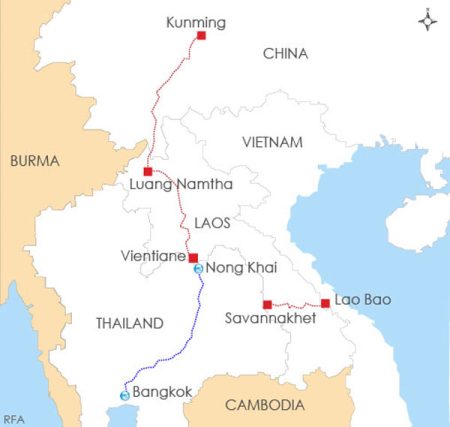
The railway project, estimated to cost anywhere up to $10 billion will not only enhance regional connectivity but profoundly reset the economic geography of Asia, given its massive potential for accelerating the increased integration between China and the ASEAN countries. People would be able to travel between Kunming and Bangkok by train for about $100, which is half to a third of the cost of an airline ticket. According to Xinhua, the railway is expected to bring two million more Chinese tourists to Thailand every year.
Washington is livid that its proxy, Move Forward led by a young man educated in the US and groomed to spearhead a colour revolution, has been banned. The Thai authorities understand that the western intention is to break up the ancient crust of their country’s polity, which is the only way to make inroads into what is otherwise a deeply Buddhist culture — specifically, to demolish the so-called lèse-majesté law protecting the institution of monarchy, an institution that dates back more than 700 years and is a pillar of stability in the country symbolising the unity of the Thai communities. By the way, Christian missionary work is active in both Thailand and Myanmar — as in next-door north-eastern region of India. And the evangelicals are an influential pressure group in the US politics.
The Thai authorities have shied away from confronting the US. Thai culture values serenity and avoids conflict and displays of anger. Even disagreements are to be handled with a smile, without assigning blame. Hence the circuitous route to squash Move Forward on legal grounds.
Move Forward won 151 seats in the 500 member parliament in the elections in May last year where sixty-seven parties contested, but was unable to form a coalition government after being functionally blocked by allies of the monarchy and military. Move Forward made the electoral pledge to abolish lèse-majesté law (which is tantamount to a crime.)
The US and its allies are furious but cannot do anything about the development. All the good work to stage a colour revolution in phases has come to naught. The exasperation shows in the statements from Washington and Canberra. (here and here)
However, all is not lost. The regime change in Bangladesh may open a new pathway for the western intervention in Myanmar. India and Thailand refused to back the western-backed rebels fighting the Myanmar military. Former Bangladesh Prime Minister Sheikh Hasina also stayed away from the power struggle in Myanmar. But that may change.
The Rohingya issue provides an alibi. The ascendance of Pakistani intelligence and the larger-than life role of the Jamaat-i-Islami will trigger an assertion of Bangladesh’s Muslim identity. The Pakistani army chief lost no time to underscore that the developments in Bangladesh underscore the raison d’être of the two-nation theory!
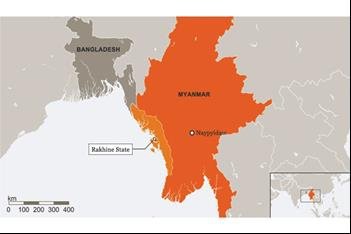
So, the regime change in Bangladesh may turn out to be a game changer for the West’s regime change agenda in Myanmar. On the other hand, at the secondary and tertiary level, any strengthening of the western-backed rebel alliance in Myanmar cannot but cast shadows on India’s northeast, which has a large Christian population with tribal affinities across the border.
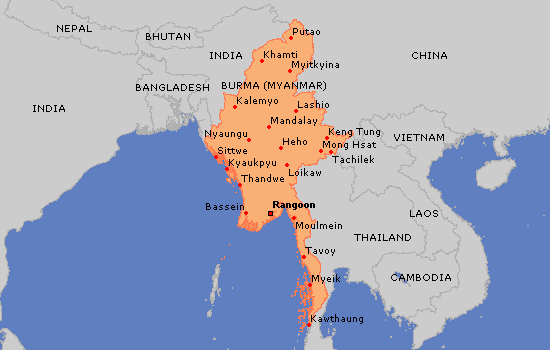
An awareness is lacking that any weakening of Thailand’s state structure or the dissipation of Thai culture rooted in Buddhist traditions will isolate India in the region’s civilisational tapestry. Indians tend to take an episodic view of current events in their immediate neighbourhood.
Prior to the rise of Theravada Buddhism, both Indian Brahminical religion and Mahayana Buddhism were present in Thailand, and influences from both these traditions can still be seen in present-day Thai folklore. A colour revolution in Thailand leading to western dominance and the eclipse of the Thai monarchy and Buddhist cosmology would have profound implications for South Asia.
Chinese FM calls for international community to unite behind cease-fire in Gaza

By Liu Xin | Global Times | August 8, 2024
Top Chinese diplomat Wang Yi has held phone conversations with the foreign ministers of Egypt and Jordan, condemning the assassination of Hamas political chief Ismail Haniyeh in Tehran on July 31, calling for efforts by different parties to prevent further escalation of conflicts and urging countries to form a joint force to help achieve a cease-fire in Gaza.
Hamas named Yahya Sinwar, who is seen as representing Hamas’ hard-liners, as successor to Haniyeh. Arab countries, in a dilemma and feeling more anxious, hope that China can play a positive role in deescalating the situation as they recognize China’s efforts and capacity in regional reconciliation, analysts said.
But the complexity of the situation requires joint efforts from all parties to address the current crisis, especially the US and Israel, to avoid escalation, they said.
The Chinese Foreign Ministry on Wednesday released information on Wang’s phone conversations with Badr Abdelatty, Egypt’s Minister of Foreign Affairs, Emigration and Egyptian Expatriates and with Jordan’s Deputy Prime Minister and Minister of Foreign Affairs and Expatriates Ayman Safadi, which took place on Tuesday. During both conversations, Wang said that China resolutely opposes and strongly condemns the assassination of Haniyeh.
While talking with Abdelatty, Wang said that retaliatory action leads to a vicious cycle, and violence begets more violence, exacerbating conflict. China will strengthen solidarity with Arab countries, and work with all parties to avoid further escalation and deterioration of the situation.
In talking with Safadi, Wang said that the key to avoiding the deterioration and escalation of the situation is to achieve a full and permanent cease-fire in Gaza as soon as possible and the international community should make a more consistent voice on this issue and form a joint force.
Liu Zhongmin, a professor from the Middle East Studies Institute of Shanghai International Studies University, told the Global Times on Wednesday that Egypt and Jordan are neighbors of the parties in conflict. Both countries established diplomatic relations with Israel early and have upheld a cautious approach to the situation involving Iran.
At this complex and critical juncture, they seek to engage with China given China’s previous role in brokering reconciliation between Iran and Saudi Arabia and among various Palestinian factions, Liu said.
Fourteen Palestinian factions signed the Beijing Declaration on July 23, seen as a positive move toward ending division and strengthening Palestinian national unity.
The conflicts in the Middle East not only relate to the Palestinian-Israeli issue, but also result from the US’ long-term partial policies toward Israel and Iran’s diplomatic inclinations, Liu said, therefore joint efforts from all involved parties are needed to address the crisis.
Simmering escalation of tension
With Iran’s retaliation against Israel looming after Haniyeh’s assassination, regional countries and major players have been actively engaged in diplomacy to avoid an all-out regional war. Jordan’s Foreign Minister Safadi made a rare visit to Iran on Sunday and Russian media reported that Russian Security Council Secretary Sergei Shoigu also visited Iran on Monday.
US President Joe Biden called Jordan’s King Abdullah II on Monday and spoke with the leaders of Qatar and Egypt on Tuesday to discuss efforts to deescalate regional tensions, the White House said.
The US is indeed the instigator of the situation which has been spiraling out of control in the Middle East, Sun Degang, director of the Center for Middle Eastern Studies at Fudan University, told the Global Times.
“If the US had managed to restrain Israel and allow a cease-fire in Gaza earlier, the situation would not have escalated to this extent. Also it is the US’ repeated obstruction at the UN Security Council on cease-fire proposals that has led to the current situation,” said Sun.
Unlike Haniyeh, Sinwar represents hard-liners in Hamas, Sun said, adding that Hamas’ past approach of “fighting while seeking negotiations at the same time” may likely shift to “survival through combat.”
Sun said that Hamas would also seek to form an alliance with Iran, the Houthis and Hezbollah, while trying to gain international support.
Iran did not immediately retaliate after the assassination but tried to tell the world that it is Israel that has infringed international norms and violated Iran’s sovereignty, which has forced Iran to respond. The appointment of Sinwar could be a critical moment when Iran might take action, Sun said.
Liu said Iran is likely to continue missile attacks on Israel and mobilize other militia groups in skirmishes with Israel. However, given Iran’s current domestic and international situation, it is unlikely to engage in a large-scale conflict with Israel at the expense of the nation’s interests.
No matter how the crisis unfolds, the hatred between Iran and Israel will accumulate, and the escalating cycle of retaliation and counter-retaliation between them will worsen regional diplomatic relations, said Liu.
In past decades, the vicious cycle in the Middle East has repeated with no country emerging as a true winner, and if the cycle continues, none of the regional countries can have substantial security, analysts said, adding that as China and many other countries have advocated, negotiation and political settlement is the only way out.
US weaponizing Australia for geopolitical interests requires Canberra’s vigilance
Global Times | August 7, 2024
In geopolitics, it appears that countries that frequently mention “coercion” are often the ones most skilled at using it. This has been proven again during the recent Australia-US Ministerial Consultations (AUSMIN).
The US and Australia convened for AUSMIN on Tuesday. US Defense Secretary Lloyd Austin highlighted that the bilateral discussions covered several contentious topics, including China’s “coercive behavior.” Additionally, he announced the US’ plan to enhance “the presence of rotational US Forces in Australia” and increase “more frequent rotational bomber deployments” to the country.
These moves, under the banner of “security cooperation,” are aimed at positioning Canberra at the forefront of Washington’s geopolitical strategy and constitute a provocation in the Asia-Pacific region.
The term “concern” appeared approximately 14 times in the joint statement after the US-Australia meeting, intending to portray a tense and volatile atmosphere in the region. While the US blatantly alleged China’s “coercive behavior,” this narrative serves to advance its ultimate goal of the Indo-Pacific Strategy. By portraying China as a threat, the US aims to justify its provocative actions in the region. Such tactics, reminiscent of the crying wolf, are characteristic of hegemonic nation manipulating its allied states.
Using the label of China’s “coercive behavior” to prompt Australia into the forefront of the US overseas military deployments is a typical illustration of US Indo-Pacific strategy. In addition to the hype of the “China threat” during the AUSMIN, it was reported by Reuters that the Cocos Islands of Australia, a remote island close to an Indian Ocean chokepoint for Chinese oil shipments, is on a list of possible locations for US military construction aimed at deterring China.
“The US’ military deployment in the Cocos Islands serves two primary purposes,” Chen Hong, director of the Australian Studies Center at East China Normal University, told the Global Times. “It aims to monitor the Chinese navy, particularly submarines, and intends to present a deterrence against China,” the expert said. The role of these islands already illustrates the US’ hidden agenda in militarizing Australia, positioning it as a frontline against China, whether for surveillance or in preparation for potential conflicts.
The US military build-up in Australia is undeniable evidence of its use of the country as a geopolitical pawn. These deployments are not motivated by concern for Australia’s security needs but by US’ pursuit of global strategic interests. This approach places Canberra in a precarious position of competing blindly for Washington’s interests, potentially compromising its neutrality and independence in international affairs.
“Following increased US military deployment in Australia, its role has shifted from being a ‘southern anchor’ to a ‘southern spear,'” said Chen. The first pillar of AUKUS, the construction of nuclear-powered submarines for Australia, aims to enhance the country’s military capability for long-range strikes, which means US bases in Australia are no longer confined to defensive purposes.
The US harbors sinister intentions in militarizing Australia, luring allies like Australia to spearhead its hegemonic interests, which poses grave financial and security risks for the country, Chen added.
US instigation will only heighten Australia’s security risks, fostering excessive reliance on external military power. By leveraging supposed “regional threats” to coerce Australia into accepting military deployments, the US’ true objective is to manipulate Australia as a tool against China. This deserves Australia’s vigilance.
Australia’s natural geographic advantages could enable it to contribute constructively to regional peace and stability through an independent foreign policy. With significant geographical distance from China and no historical or territorial disputes, Australia faces no inherent threat from China.
Notably, Austin’s direct accusation of “Chinese coercion” did not feature prominently in the US-Australia joint statement. This suggests Australia acknowledges the importance of not fully aligning with US’ confrontational approach toward China at the expense of cooperation and friendship with China.
The recent thaw in China-Australia relations is a positive development. The Australian government should maintain rationality and composure, resisting the pressure to forsake its independent strategy and diplomacy.
Only by doing so can Australia effectively protect its national interests and sovereignty, preventing it from becoming a pawn in US geopolitical strategies and ensuring that its relationship with China is not sacrificed to US hegemonic ambitions.
Russia Ranks Among G20’s Lowest in National Debt Per Capita
Sputnik – August 3, 2024
This year, Russia has entered the top three largest economies in the world with the lowest level of national debt per capita, according to an analysis by Sputnik of the latest data from G20 countries. On average, government debt among those countries is $23,600 per citizen. Only six countries exceed that mark.
New data shows Russia has one of the lowest per-capita debt levels of the G20 group of nations.
India has the most modest sovereign debt, with the latest data from the G20 showing $1,316 per person. Indonesia follows with $1,747 and Russia is third with $2,076 per capita at the end of the first half of this year.
Other countries with national debts less than $5,000 per person include Turkiye ($2,800), China ($3,000) and South Africa ($4,500).
Countries with debts ranging from $5,000 to $10,000 include Brazil, Mexico, Saudi Arabia and Argentina.
South Korea’s national debt is almost twice that of Argentina, at $16,000 per capita, Germany’s is $20,900 and Australia’s is $21,200 per capita.
The six countries with above-average national debts are all members of the Group of Seven (G7).
Of those, Canada has the lowest debt at $25,300 per capita. France’s debt stands at $40,300 per citizen, while the UK and Italy have accumulated debts twice as large as Canada’s at $51,600 and $51,900 per person. Japan has the second-largest national debt at $70,400 per capita.
The United States continues to have the highest sovereign debt, at $104,500 per capita — 80 times higher than India’s and 50 times higher than Russia’s. Among all countries in the world, only Singapore has a higher debt figure at $149,300 per person.
Israel’s allies block Security Council statement condemning Tehran attack
The Cradle | August 1, 2024
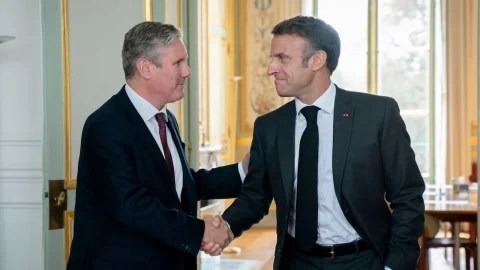
The US, UK, and France blocked a Russian-proposed statement at the UN Security Council (UNSC) condemning the assassination of Hamas politburo chief Ismail Haniyeh in Tehran, Iran’s envoy to the UN Amir Saeid Iravani said on 1 August.
“Russia’s proposed statement condemning Israel’s heinous act was blocked by the US, UK, and France,” Iravani told Russian media following an emergency UNSC meeting on Wednesday night.
“It is now absolutely necessary to hold the occupying [Israeli] regime accountable for the atrocities it committed,” the Iranian diplomat added. “This regime cannot be allowed to escape accountability and consequences for the violations it has committed.”
During the session, Iravani stressed that Tehran “reserves its inherent right to self-defense in accordance with international law” and said that “the responsibility of the United States as a strategic ally and main supporter of the Israeli regime in the region cannot be overlooked in this horrific crime. This act could not [have] occurred without the authorization and intelligence support of the US.”
Permanent UNSC members Russia and China strongly condemned Israel’s attacks on the Iranian and Lebanese capitals, blasting Tel Aviv for once more sabotaging Gaza ceasefire talks and pushing the region to the brink of all-out war.
“China is deeply concerned about the potential for this incident to further destabilize the region,” Fu Cong, China’s permanent representative to the UN, emphasized during the meeting. “China strongly opposes and condemns recent irresponsible actions, including Israel’s attacks on southern Beirut,” he added.
Fu also called on Tel Aviv to cease all military actions in Gaza and appealed to “influential countries” to “put more pressure and work more vigorously … to put out the flames of war in Gaza.”
Russia’s first deputy envoy to the UN, Dmitry Polyansky, also condemned Haniyeh’s killing, calling it an “attempt” to drag Iran into war.
“This provocative attack was carried out while the Hamas leader was in Iran on an official invitation to attend the inauguration ceremony of the President-elect of the Islamic Republic of Iran, Masoud Pezeshkian. Those behind this political assassination had to realize how dangerous the consequences could have been for the entire region,” Polyansky said.
“The misguided practice of targeted liquidations of prominent political and military figures is bringing the Middle East to the brink of a region-wide war,” the Russian diplomat added.
Feda Abdelhady Nasser, the deputy permanent observer of the State of Palestine to the UN, told the gathered diplomats that the global community “has a choice to make” between “peace and security” or letting “Israel drag us all to the abyss.”
“Israel has been the oppressor, tormentor, and murderer of Palestinians for decades, and it is the longstanding destabilizer of our region,” Nasser highlighted.
Lebanon’s Acting Permanent Representative to the UN, Hadi Hashem, contested Israel’s claims that the attack on the Beirut suburb of Dahye this week was an act of “self-defense.”
“Israel’s claim that it seeks to protect the population it occupies is a display of hypocrisy,” Hachem said, adding, “The real goal of Israel is to prolong and escalate the hostilities. And it is ironic that the killer of tens of thousands of children in Gaza sheds tears for the children of the occupied Syrian Golan.”
Similarly, Syria’s UN ambassador, Qusai al-Dahhak, stressed that “Israel is responsible for the crime in Majdal Shams” and noted that the territory is Syrian, accusing Israel of “weaponizing” the attack on the Druze community “to continue its aggression on the states of the region.”
Robert Wood, deputy US ambassador to the UN, called on UNSC members with influence over Iran “to increase pressure on it to stop escalating its proxy conflict against Israel and other actors.”
France and the UK took a similar line, reiterating a call for an “immediate ceasefire” in Gaza and condemning what they said was Iranian support for “destabilizing actors in the region.”
Russia and China challenge US claims to marine seabed – media
RT | July 31, 2024
US claims to a vast section of potentially resource-rich seabed floor have no basis in international law and should be rejected, Russian and Chinese government representatives have said, according to Bloomberg.
The statements were reportedly made during a session this week of the International Seabed Authority, held in Kingston, Jamaica, and were in response to recent claims by the US that it would be adding about one million square kilometers (386,100 square miles) to its continental shelf in the Bering Sea, the Pacific Ocean, the Atlantic Ocean and the Gulf of Mexico.
Both the representatives of Russia and China stressed that Washington’s unilateral claims contradict the United Nations Convention on the Law of the Sea (UNCLOS), which the US has never ratified, Bloomberg wrote on Tuesday.
Adopted in 1982, UNCLOS sets out rules relating to the world’s oceans and seas, covering issues including territorial limits, resources and protection of the marine environment.
Under the law, countries have the right to any resources in the sea or seabed floor within their so-called exclusive economic zones, which can stretch up to 200 nautical miles (370 km) off a country’s coast.
States that have ratified UNCLOS undergo a lengthy process to reach agreement on where the boundaries of underwater continental shelves lie, which will define exclusive economic rights to potentially lucrative seabed resources based there.
The US’ unilateral claims jeopardize a fragile international balance, as well as the integrity of the convention, Russia’s representative reportedly said and added that Moscow rejects Washington’s selective approach to international law.
China’s delegate at the Seabed Authority meeting also argued that the US doesn’t have the right to make such claims unilaterally, and can’t expect to enjoy the benefits of the convention without having ratified it, Bloomberg reported. The unnamed representative described the resources in the international seabed as the common heritage of mankind and said any act that threatens that shouldn’t be accepted. Both Russia and China ratified UNCLOS in the 1990s.
The US representative Gregory O’Brien defended his nation’s position, according to reports, claiming it followed the rules of the convention in making the claims.
The US announced the extensions of its claims on the ocean floor in December 2023, as part of an effort to boost access to so-called critical minerals that are necessary for electric vehicle batteries and renewable energy projects. The claims were “about geography, not resources,” the State Department insisted.
The extension “highlights American strategic interests” in securing hard minerals, such as lithium and tellurium, on its seabed and subsoil, “lying sometimes hundreds of miles offshore,” according to an article by James Kraska, chair and professor of International Maritime Law at the US Naval War College.
The latest US Geological Survey, conducted in 2008, estimated that about 90 billion barrels of undiscovered oil and 1,670 trillion cubic feet of gas lie inside the Arctic Circle, along with critical metals needed for electrification. However, most of that estimate is based on land studies and the offshore potential is largely unexplored, Bloomberg wrote.
Okinawa on Fire: Division Brewing in Japan Over US Militarizing & Nuclearizing
By Ekaterina Blinova – Sputnik – 31.07.2024
The US and Japan have made further steps towards closer military integration and an extension of Washington’s nuclear umbrella over its ally. Their increased military buildup in the Asia-Pacific region means a greater risk for war, particularly nuclear war, warns Okinawan rights activist Rob Kajiwara.
In the wake of their Security Consultative Committee (“2+2”) July 28 meeting in Tokyo, the US and Japan announced the strengthening of military ties and upgrading of the US Forces Japan (USFJ) to a warfighting command.
“The US and Japan are increasing the threat of war in the region,” Robert Kajiwara, an Okinawan rights activist and founder of the Peace For Okinawa Coalition, told Sputnik, stressing that the military buildup has nothing to do with Japan’s security and national interests.
Actually, the US is using Japan as a bulwark against Russia, China and North Korea in a bid to maintain its dominance in the Asia Pacific region, according to the pundit. “The world is seeking to become multipolar, but the US is intent on doing whatever it can to maintain hegemony,” he noted.
The American and Japanese delegations also discussed extending the US nuclear umbrella over Japan. While the US and Japan have coordinated on the issue since 2010 within the framework of the Extended Deterrence Dialogue (EDD), most recently the US has doubled down on its nuclear umbrella in the region.
It is expected that this year the US and Japan will specify under what conditions the US will use its nukes to “protect” Japan, according to Newsweek.
For its part, Chinese media believes Washington is planning to deploy nuclear weapons in their military bases in Japan, again. The “extended deterrence” means nothing but the US intent to use Japan as an outpost to strengthen its nuclear deterrence in Northeast Asia, according to Global Times.
Between 1954 and 1972, the US bases on Okinawa hosted a staggering 19 types of nuclear arms. In 2015, the US government officially admitted the fact that it stored hundreds of nuclear warheads in Japan during the Cold War. At the height of the Vietnam War, around 1,200 nuclear weapons were stationed in Okinawa.
“If there’s any country that should be against nuclear arms, it should be Japan, given the use of nuclear weapons against the cities of Hiroshima and Nagasaki. Japan should be strongly against the storing of nuclear weapons in its territory. Unfortunately, Japan hasn’t learned anything from World War II and appears destined to repeat its past mistakes,” the pundit argued.
Why Okinawa is Important for the US
Okinawa, which is part of the Ryukyu island chain, is of utmost strategic importance for the US as it serves as a stronghold for the Pentagon’s operations in the Western Pacific and deployment of troops directly to the Taiwan Straits and to the Korean Peninsula.
The US military installations in the region – which American troops have occupied since the late 1940s – were crucial for Washington’s invasions of Vietnam and North Korea in the past.
The US air and naval bases on Okinawa are located in close proximity to China’s mainland and even closer to Taiwan Island. Furthermore, the Ryukyu island chain presents a natural “wall”, allowing the US military to “control” China’s passage into the Pacific Ocean.
While Tokyo and Washington name Russia, China and North Korea as potential “threats” to the region’s stability, a considerable chunk of Japanese citizens think otherwise, Kajiwara said, referring to Okinawa Prefecture, a home to numerous US military bases and facilities – over 70% of their total number in Japan.
“The overwhelming majority (somewhere between 70-90%) of Ryukyuans [another name for Okinawans] do not consider Russia, China, or North Korea to be military threats,” the activist stressed.
Okinawans Oppose US Bases and Japan’s Militarization
Ryukyuans have opposed the US militarization of the island for decades, citing security and environmental issues, as well as repeated criminal acts committed by US troops against local residents.
In September 1995, three US soldiers kidnapped and raped a 12-year-old girl in Okinawa, prompting prefecture-wide rallies which brought together 92,000 protesters. This year, two rape cases committed by US soldiers against an Okinawan minor and a woman came to light in June. The first occurred in December 2023 and remained muted by the US military for almost six months.
“The US and [Japan’s central government] covered this up until after Okinawa Prefecture’s recent election,” said Kajiwara. “They wanted to avoid negative publicity before or during the election in order to prevent the [ruling] Liberal Democratic Party from losing votes. Is this democracy? Can the US and Japan rightly call this democratic?”
In another snub of Okinawans’ democratic freedoms, Japan’s central government overruled the Okinawan authorities’ ban on building a new US military base at Henoko-Oura Bay near Nago in 2023. In September last year, Okinawa Gov. Denny Tamaki sought international backing at a UN session, arguing that the concentration of the US military forces in the prefecture threatens peace.
“My petition against the construction of the military base at Henoko received over 212,000 signatures,” Kajiwara said. “The 2019 Referendum in Okinawa resulted in over 70% of Okinawans voting against the Henoko base. In spite of all this, the US and Japan continually ignore the voices of Ryukyuans.”
Who are Okinawans and Why Do They Differ From Japanese
Okinawa was previously an independent Ryukyu kingdom, which was conquered and annexed by Japan at the end of the 19th century, the expert pointed out.
Ryukyuans have our own history, culture, languages, values, and identity. According to Kajiwara, Ryukyu has a tradition of being a “bridge of nations” with the focus on mutually-beneficial trade and diplomacy. “Whereas Japan has a long history of warfare and samurai bushido culture, Ryukyu banned the public carrying of weapons during the 15th century in order to promote peace,” the pundit remarked.
“In 1879, Japan invaded Ryukyu as the first of its colonial conquests… From 1879 until 1945, Ryukyu had to deal with imperial Japanese militarism,” he said. “During World War II, Japan deliberately placed a heavy amount of military presence in Ryukyu with the intent of sacrificing Ryukyuans in order to ‘save Japan’.”
This resulted in the Battle of Okinawa in 1945, which amounted to nothing short of the Ryukyuan genocide, according to the activist.
“At least 123,000 Uchinaanchu (Native Okinawans) were killed during a time frame lasting only around three months, which was around one-third of the population at the time. Japanese soldiers deliberately killed Ryukyuan men, women, children, and elderly, claiming they were ‘Chinese spies,’ using them as human shields, and forcing thousands to commit suicide. It is said that every Okinawan family lost someone during the battle. Many of my own relatives were also killed,” Kajiwara continued.
Those who survived were sent to concentration camps by the US occupation forces. During the period from the end of 1945 to 1947 locals returned to their land to find many of their homes and farms bulldozed flat and turned into US military facilities. According to some estimates, at least 40,000 Okinawan landowners lost their land and were not compensated for the loss. The 1951 San Francisco Peace Treaty signed between Japan and the Allies “legitimized” the US occupation of Okinawa.
“From 1945 until 1972 Ryukyu was under direct US military rule. Since 1972 Ryukyu has been under joint US and Japanese rule. This, of course, has caused great hardship for Ryukyuans, such as economic deprivation, environmental destruction, water poisoning, military accidents, and crime,” he said.
Currently, Ryukyuans fear that the US-Japanese military buildup will invite another devastating war to their land, as per the expert.
“As we speak, Japan is continuing the construction of a new airfield at Henoko, paving over the coral reef in order to build it. The Okinawan dugong, an endangered creature, is being driven into extinction by this. This airfield, along with missiles being stationed around Ryukyu, poses a direct threat to Russia, China, and North Korea. So you see, the US and Japan really have no intention of decreasing Ryukyu’s military burden at all.”
Kajiwara emphasized that he and his team are continuing to raise awareness about the risks of the US-Japanese growing militarization, adding that Okinawans remain hostages to Tokyo’s warmongering. “We discuss all these things in our upcoming documentary film, ‘Occupied Okinawa.’ The film will be entered into international film festivals around the world starting in September,” the pundit concluded.
Iran Rejects US Intelligence Words on Tehran’s Alleged Interference in Elections – Reports
Sputnik – 30.07.2024
TEHRAN – Iran’s mission to the United Nations has rejected US intelligence statements regarding Tehran’s alleged interference in the upcoming elections in the United States, the IRNA news agency reported on Tuesday.
On Monday, media reported that the office of the Director of National Intelligence of the United States had unsubstantiated claims that Russia, China and Iran allegedly use marketing, communications and other means to influence US voters and the outcome of the upcoming presidential election.
“Iran has no purpose or activity aimed at influencing the US elections. Most of these accusations are being made as part of psychological actions to artificially revive election campaigns,” the Iranian mission to the UN said, as quoted by the news agency.
China responds to US election interference claim
RT | July 30, 2024
Beijing has never interfered in US elections and has no intention of doing so, the Chinese Foreign Ministry has stressed in response to accusations recently levied by US intelligence officials.
The ministry’s statement comes in response to a late July Election Security Update by the US Office of the Director of National Intelligence (ODNI) in which Russia, China and Iran were accused of supposedly using their influence to impact US politics and threaten the upcoming US presidential election, scheduled for November.
In the report, ODNI stated that while China “probably does not plan to influence the outcome of the US presidential election,” actors linked to Beijing are expected to “seek to denigrate down-ballot candidates” who are seen as a threat to China’s core interests. The agency suggested that similar actions were carried out by Chinese agents “in a handful of midterm races in 2022.”
ODNI also stated that it is aware that Beijing is using social media to sow “divisions in the US and portray democracies as chaotic.”
Speaking at a press conference on Tuesday, Chinese Foreign Ministry spokesman Lin Jian responded to the accusations by stating that “China has never interfered in and will not interfere in the US election.”
“We oppose the US spreading false information to smear China and oppose the US election using China as an excuse,” Lin stressed.
Kremlin spokesman Dmitry Peskov has also categorically rejected ODNI’s allegations of election meddling, describing them as “absurd” and accusing the US intelligence community of succumbing to “fashionable trends in domestic politics” and “looking for enemies.”
“The Americans cannot think of a better enemy than Russia,” Peskov told reporters on Tuesday, adding that more similar accusations are likely to come out in the future as the US election approaches. He explained that Russia and its President Vladimir Putin continue to be major factors for US Republicans and Democrats to exploit amid their ongoing political struggle.
The Kremlin spokesman expressed regret that Moscow has to deal with this fact, noting that the American politicians’ baseless accusations only serve to further harm Russian-American relations.
Pentagon reacts to Russia-China bomber patrols near Alaska
RT | July 26, 2024
Russian and Chinese bombers jointly operating in international airspace near the coast of Alaska is a sign of their expanding military cooperation, US Defense Secretary Lloyd Austin has said, adding that Washington is “concerned” by the development.
On Wednesday, two Russian Tupolev TU-95 long-range bombers and two Chinese H-6 bombers were tracked and intercepted by US and Canadian fighter jets. The aircrafts were carrying out joint air patrols over the waters of the Chukchi and Bering Seas, as well as the North Pacific.
According to the Pentagon chief, it was the first time that Chinese bomber aircraft have flown within the Alaskan Air Defense Identification Zone, and the first time Chinese and Russian jets have taken off from the same base in northeast Russia.
“This is the first time that we’ve seen these two countries fly together,” Austin told a press conference on Thursday. “This is a relationship that we have been concerned about throughout – mostly because we’re concerned about China providing support to Russia’s illegal and unnecessary war in Ukraine,” he stated.
Both Moscow and Beijing have rejected Western allegations that Beijing has been supplying Russia with dual-use components that can be utilized to produce weapons for the Ukraine conflict.
Austin said the flight on Wednesday was “not a surprise,” adding that Moscow and Beijing had likely planned it for some time.
The aircraft came only within about 200 miles (320km) of the US coast and did not enter either US or Canadian airspace, according to the Pentagon chief.
The Russian Defense Ministry reported on Thursday that the crews “worked out issues of interaction at all stages of air patrol in the new area of joint operations.” It stressed that the patrols, which lasted over five hours, were conducted in accordance with international law.
Chinese Defense Ministry spokesperson Zhang Xiaogang told reporters that the flight was the eighth “joint air strategic patrol” carried out by the two nations since 2019. The exercise was “not directed at any third party” and is “unrelated to the current international and regional situation,” it said.
Russia often conducts flights near US airspace and also monitors US and NATO flights near its own airspace too, and has sent its jets to escort American fighters and bombers away from its borders on numerous occasions in recent years.
Slanders against China over Ukraine crisis fall apart on their own
Global Times | July 26, 2024
Chinese Foreign Minister Wang Yi held talks with Ukrainian Foreign Minister Dmytro Kuleba in the southern Chinese city of Guangzhou on Wednesday. The Ukraine crisis has entered its third year, with the conflict ongoing and risks of escalation and spillover still present. As the highest-ranking Ukrainian official to visit China since the outbreak of the conflict, the discussions and the signals sent during the talks, as well as whether there are signs of peace in the Russia-Ukraine conflict, have garnered international attention. Particularly in light of China’s successful mediation efforts in re-establishing diplomatic relations between Saudi Arabia and Iran, and promoting internal reconciliation of Palestine, there are heightened expectations for China’s constructive role in promoting peace talks in the Russia-Ukraine issue.
As part of China’s recent diplomatic efforts to mediate international and regional hotspots, China’s proactive invitation to Kuleba to visit has garnered international attention. According to Reuters, citing Ukrainian accompanying officials, the talk lasted over three hours, longer than planned, and was “very deep and concentrated.” The word “deep” is rarely used in diplomatic settings. In a statement after the meeting, the Ukrainian side stated, “China’s role as a global force for peace is important.” This reaffirms China’s role as a peacemaker and highlights the effectiveness of the meeting.
As a direct party to the Russia-Ukraine conflict, Ukraine has shown greater interest in China’s positions than before. This has led international public opinion to cautious optimism about the direction of the Russia-Ukraine issue and to pay more attention to China’s role in major regional conflicts. Even Western media, which often distorted and smeared China’s stance on the Russia-Ukraine issue, is now speculating whether China intends to preempt the US in playing the role of peacemaker. These discussions in various directions all confirm that China’s efforts to promote peace are increasingly prominent and have become an acknowledged reality in the international community.
The distortions and slanders against China by the West have largely fallen apart on their own. The fairness of China’s position has been once again validated, and China’s proposals have withstood the test of time. Western efforts to stoke the fire have only prolonged the conflict. Ukrainian President Volodymyr Zelensky stated in a recent interview, “We have to finish the war as soon as possible.” More and more signs point to the fact that the resolution of all conflicts will ultimately return to the negotiating table; all disputes will eventually be resolved through political means. This is precisely what China has consistently advocated.
From the handshake between Saudi Arabia and Iran, to the historic reconciliation within Palestine, to the complex and challenging Ukraine crisis, why does China’s position repeatedly manage to gather the broadest consensus in the international community? First, it is because China maintains an objective and fair stance and is committed to mediation and promoting dialogue. Second, China adheres to the concept of common, comprehensive, cooperative, and sustainable security, working tirelessly to maintain world peace, stability, and development. In the face of crises, China does not stoke the flames or take advantage of the situation for its own gain. This stance is visible to the international community and the parties involved in the conflict.
There is an Arabic proverb: “Seek knowledge, even if you have to go as far as China.” Now, the saying “Seek peace in China” is also becoming popular. On the complex international stage, China’s role as a responsible major power maintaining world peace is increasingly recognized. As China called for in the Global Security Initiative Concept Paper in 2023, “countries need to work in solidarity to foster a community of shared security for mankind and build a world that is free from fear and enjoys universal security.” China’s stance is clear and consistent: between peace and war, it chooses peace; between dialogue and sanctions, it chooses dialogue; between cooling down and fueling the fire, it chooses cooling down. On the Ukraine crisis, China remains straightforward and sincere, without political self-interest or geopolitical manipulation. China is truly dedicated to mediation and promoting dialogue to achieve a cease-fire and an end to the conflict.
Of course, the Ukraine crisis did not form overnight, and resolving the issue will not be accomplished in a single step. It requires the joint efforts of the international community. Recently, US Secretary of State Antony Blinken once again claimed at the Aspen Security Forum that “China can’t have it both ways.” Many in the West remain stuck in the mindset of “supporting one side,” which only complicates and intensifies the conflict. Influential major countries, in particular, should align with China to create conditions and provide support for direct dialogue and negotiations between Russia and Ukraine. Only when major powers contribute positive energy rather than negative energy can there be an early glimpse of a cease-fire in this conflict.
Featured Video
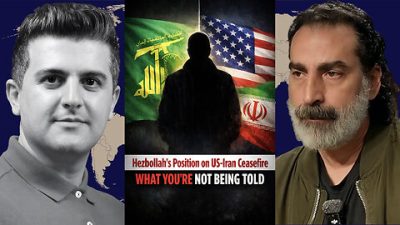
Laith Marouf: Hezbollah’s position on US-Iran ceasefire
or go to
Aletho News Archives – Video-Images
From the Archives
The Dirty Little Secret behind the “Global Terrorism Index”
The Omission of Israeli Terrorism in the Occupied Palestinian Territories
By Karin Brothers | Global Research | December 6, 2014
… The Israeli settlements — all of which are illegal – have been identified as a major impediment to peace. The refusal of a major “global” terrorism report to name the Israeli settlers as one of the groups most responsible for terrorism not only misrepresents a major source of regional violence but exposes the Global Terrorism Index as a propaganda tool that supports a U.S. agenda.
In recent years, governments have been attempting to thwart terrorism by blocking supportive fund-raising. When it comes to Israeli settlements, however, the US and Canada actually encourage fund-raising by giving organizations (such as Christian Friends of Israeli Communities (CFOIC) and the Jewish National Fund) financial support in the form of donor tax-deductions.
Charities which provide funds for the Israeli settlements should be regarded as terror-financing organizations. They should not only lose their tax-deductible status, but they should be banned because they support the violation of international humanitarian law. The terror-financing laws that are being strictly enforced for Muslim charities should be applied to Christian and Jewish charities as well. … Read full article
Blog Roll
 Aletho News
- How UK Regulator Ofcom Quietly Bypassed International Law to Police American Speech
- The Black Cube Files: How Former Mossad Operatives Flipped a Nation
- Laith Marouf: Hezbollah’s position on US-Iran ceasefire: What you’re not being told
- Israel’s priority lies in destroying chances of peace between Iran, US: Ex-UN nuclear chief
- Ceasefire for all or for none: Iran shuts Hormuz over Lebanon attacks
- Strait of Hormuz is Iran’s ‘nuclear weapon’ that forced US retreat: Medvedev
- Energy crisis will last for months – Kremlin envoy
- Europe’s quiet role in the war on Iran
- Forty days that shook the Empire: How Iran turned the tables on US and prevailed
- Netanyahu unilaterally declares Lebanon outside of ceasefire deal
- If Americans Knew
- Gazans face a triple crisis: severe shortages of water and bread, healthcare in tatters
- NY Times reports how Netanyahu took the US into Iran War
- A sigh of relief over Iran, but Gaza and Lebanon in dire straits – Daily Update
- Thousands dead and neighborhoods razed to the ground: Aid agencies fear southern Lebanon is becoming the new Gaza
- The war the US is fighting for Israel could cost trillions
- ‘Cigarette Burns, Nail Wounds’: Toddler Tortured in Gaza to Coerce Father
- Trump Says US Sent ‘a Lot of Guns’ to Protesters in Iran
- Israeli forces destroy 17 UN peacekeeper cameras in south Lebanon
- US-Israeli strikes ‘completely destroy’ synagogue in Tehran
- Archbishop for US Military Says Iran War Is Unjust Under Catholic Teaching
- No Tricks Zone
- An Inconvenient Tree: Uncovered In Alps… Europe Much Warmer Than Today 6000 Years Ago
- New Study Reports A 60% Slowdown In Greenland’s Ice Loss Rate In The Last Decade
- Low Intensity Tornado Wrecks Major Solar Farm, Creating A Potential Toxic Dump
- New Study Finds Warming Saves Lives…Cold Temperatures 12 Times More Deadly Than Excess Heat
- German Science Blog Accuses PIK Climate Institute Of Hallucinating Climate Tipping Points
- Devastating Assessment Of Comirnaty Vaccine By Former Senior Pfizer Europe Toxicologist
- New Study: CO2 Is ‘Effectively Negligible’ As An Explanatory Climate Change Factor Since 2000
- Former Pfizer Toxicologist Dr. Helmut Sterz Tells Bundestag Hearing Pfizer Vaccine Should Have Never Been Approved
- Energy Expert: Germany’s Nuclear Phaseout Was A “500 Billion Euro Mistake”
- New Research: South Australia’s Mid-Holocene Sea Surface Temperatures Were 4°C Warmer Than Today
 Aletho News