US is Flirting With Idea of ‘Limited’ Nuclear Conflict With Russia and China
By Ekaterina Blinova – Sputnik – 29.05.2024
Washington is considering the deployment of nuclear-armed cruise missiles on Virginia-class attack submarines to deter China and Russia, according to the Asia Times.
US lawmakers have recently focused on how to modify Virginia-class attack submarines (SSN) to install nuclear-armed sea-launched cruise missiles (SLCM-N). Last week they summoned Vice Adm. Johnny Wolfe to discuss the complexities and uncertainties concerning arming attack submarines with SLCM-N. The discussion revolved around enhancing their nuclear deterrence against China and Russia, according to the Asia Times.
The SLCM-N is a cruise missile with a low-yield nuclear warhead launched from surface ships or attack submarines (SSNs). It was first proposed in 2018 alongside the low-yield version (with less than 10 kilotons of explosive power) of the W76 warhead to arm long-range ballistic missile submarines.
What are the SLCM-N program’s merits in the eyes of American lawmakers, military, and scholars?
First of all, US military experts argue that SLCM-Ns would allow the US to engage in a “limited” nuclear exchange in contrast to “massive retaliation”.
“If conflict crosses the nuclear threshold, lower yields would signal a clear interest in limiting its intensity,” wrote Lieutenant Commander Alan Cummings, US Navy Reserve, for US Naval Institute in April 2024.
In addition, using theater-based nuclear-armed sea-launched cruise missiles might not be seen as “legitimizing” a nuclear retaliatory strike on the American homeland, according to US military experts. They suggest that it would make it hard for American adversaries to immediately identify the origin of the strike after an attack.
Placing SLCM-Ns on US attack submarines will allow the Pentagon to maintain a widespread and enduring presence in the North Atlantic, Arctic Ocean, and Asia-Pacific, according to Kyle Balzer of the American Enterprise Institute.
“Due to the low observability of undersea launchers, Beijing and Moscow will have to assume it is loitering on site,” wrote Balzer for Breaking Defense on February 28. “If deployed on select surface ships, as well as submarines, the deterrent effect could be even greater.”
Balzer pointed out that the deployment of SLCM-Ns on attack subs and surface ships would create an atmosphere of ambiguity: Russia and China wouldn’t be sure if the vessels are nuclear-armed or not, thus complicating decision-making and creating additional deterrence.
“China and Russia would have to assume SLCM-N’s presence — whether or not it is deployed, in great numbers, to forward areas. In this sense, there is considerable deterrence value and cost-effectiveness in ambiguity,” argued the scholar.
American lawmakers have been pushing ahead with the program for the last several years. While the United States has not deployed a nuclear-armed sea-launched cruise missile since 1991, the Trump administration argued in 2018 that the SLCM-N would “provide a needed non-strategic regional presence” in Europe and Asia and contribute “to deterrence and assurance of allies, especially in Asia.”
The SLCM-N program was reversed by President Joe Biden in 2022 as an excessive and costly solution. Nonetheless, after a heated debate, the initiative was passed within the framework of the National Defense Authorization Act for fiscal year 2024 under the pretext of Russia’s special military operation and China’s alleged plans to “invade” Taiwan. It became law in December 2023 with instructions to achieve operational capability of the SLCM-N by 2034.
Is ‘Limited’ Nuclear Conflict Possible?
Russia has repeatedly warned the US against lowering the nuclear threshold and hypothesizing a possibility of a limited nuclear exchange. According to Moscow, the “limited” use of nuclear weapons by no means reduces the risk of an all-out nuclear war, but rather invites it.
Commenting on Washington’s plans to deploy low-yield nuclear arms on its submarines or surface vessels in April 2020, Russian Foreign Ministry spokeswoman Maria Zakharova condemned the move as destabilizing.
“Those who like to theorize about the flexibility of American nuclear potential must understand that in line with the Russian military doctrine such actions are seen as warranting retaliatory use of nuclear weapons by Russia,” Zakharova said.
In May, the Russian Foreign Ministry warned NATO against delivering F-16 fighter jets to Ukraine, given that the war planes could carry low-yield nuclear B61-12 bombs. Moscow said it will treat F-16s in Ukraine as nuclear-capable weapon systems, regardless of their model, and will consider their deployment a deliberate provocation.
China has also repeatedly lambasted Washington for switching to low-yield nuclear arms as a return to the Cold War era. Beijing also raised the alarm over AUKUS (Australia, UK and US pact) plans to build nuclear-powered submarines in Australia as violating non-proliferation principles. Both Russia and China pursue a no-first-use nuclear doctrine.
China and Brazil Offer Their Own Peace Plan as Western ‘Ukraine Summit’ Fumbles
By Svetlana Ekimenko – Sputnik – 25.05.2024
Moscow was not invited to participate in the “peace conference” that Switzerland will host on June 15-16. Russian officials have noted that it was conceived as another effort to “push through the unworkable ‘peace formula’ that ignores Russian interests.” Furthermore, any negotiating process on Ukraine without Russia’s involvement is “meaningless.”
The upcoming gathering dubbed a Ukraine “peace summit” in Switzerland is being undercut on all sides.
Brazil and China announced a rival initiative on Friday, further demoting Ukrainian President Volodymyr Zelensky’s conference aimed at pushing through his unworkable “peace formula.”
The two countries support an international peace conference “held at a proper time that is recognized by both Russia and Ukraine, with equal participation of all parties as well as fair discussion of all peace plans,” they said in a statement.
The joint document was signed by Celso Amorim, special adviser to Brazilian President Luiz Inacio Lula da Silva, and Chinese Foreign Minister Wang Yi, and stated:
- Dialogue and negotiation are the only viable solution to the Ukraine crisis.
- Conditions should be created for resumption of direct dialogue, with de-escalation until a comprehensive ceasefire is in effect.
- An international peace conference should be held with participation of both Russia and Ukraine.
- Attacks on civilians and civilian facilities must be avoided.
- Targeting nuclear power plants and other peaceful nuclear facilities must be opposed.
- Use of weapons of mass destruction, particularly nuclear weapons and chemical and biological weapons, must be opposed.
- All possible efforts must be made to prevent nuclear proliferation and avoid nuclear crisis.
- The world should not be divided “into isolated political or economic groups,” the two countries stated.
The initiative from Brazil and China came after their presidents refused to attend the Ukraine “peace summit” set for June 15 to 16. The event in Lucerne is plagued by major no-shows. Joe Biden’s attention has been diverted to more pressing issues such as rubbing elbows with Hollywood celebs at his fundraiser.
Besides the leaders of Brazil and China, South Africa has also refused to attend the event. Moscow has dismissed the conference, to which it was not invited, as “meaningless.” Kremlin spokesman Dmitry Peskov said that the conference is clearly not result-oriented, as it is impossible to have effective talks on Ukraine without Russia’s participation.
As far as the upcoming talks in Switzerland are concerned, Russia’s President Vladimir Putin suggested that they constitute an effort by the Kiev regime’s patrons to confer legitimacy on Zelensky now that his legal term as president has expired.
Putin emphasized at Friday’s press conference that Russia remains ready to resume peace negotiations with Ukraine, including based on the draft agreements inked during talks in Belarus and Turkiye in the spring of 2022, but accounting for the current realities on the ground.
Regarding Zelensky’s 10-point peace plan, it is nothing but an ultimatum to Russia, Foreign Minister Sergey Lavrov noted on Wednesday as he chaired a meeting of BRICS sherpas and sous-sherpas in Moscow. He added that the US was imposing Zelensky’s formula on everyone, inviting countries of the Global South to its platforms, such as the upcoming Lucerne meeting.
Russia’s top diplomat also revealed that the Ukrainian president “hysterically” demanded that other nations back his proposed “peace formula” ahead of the gathering.
China warns US against Taiwan visits
RT | May 23, 2024
US lawmakers must end any visits to Taiwan and adhere to the One-China policy, or be ready to face the consequences, Beijing’s Foreign Ministry spokesperson, Wang Wenbin, said during a press conference on Thursday.
His comments came in response to a statement by the chairman of the US House of Representatives Foreign Affairs Committee, Michael McCaul, who announced on Tuesday that he would not be deterred by China’s threats and would lead a US delegation to Taiwan, which he called a “dearest friend and partner and ally” of Washington, at the end of the month.
Beijing considers the self-governing island to be an inalienable part of China, and has been pushing towards a peaceful reunification, vehemently condemning any separatist movements that seek Taiwanese independence.
Wang said Beijing firmly opposes any form of “official exchanges” between Washington and Taipei, and urged US representatives against interfering in the island’s affairs in any way and under any pretext.
He added that the warning extends to the US Congress, whose representatives are an “integral part of the US government” and should therefore abide by the One-China policy officially acknowledged by Washington and only maintain cultural, commercial, and other unofficial relations with the island.
If Congress members do visit Taiwan, Wang warned that it would be interpreted as a “serious violation” of the One-China principle, an attempt to damage China’s sovereignty and territorial integrity, and a “seriously wrong signal” for Taiwanese separatist forces.
“If the US insists on its own way, it must be fully responsible for the consequences,” Wang stressed.
Meanwhile, the Chinese military announced on Thursday that the People’s Liberation Army (PLA) has kicked off a series of joint drills near Taiwan to serve as “punishment” for separatist forces seeking independence and as a “stern warning” against any external forces aiming to interfere in China’s internal affairs.
The exercises are said to involve the PLA’s army, navy, air force and rocket force, all of which will carry out drills in various areas around Taiwan, focusing on combined sea-air combat-readiness patrol, battlefield control and joint precision strikes.
US pressing EU to curb Chinese exports

US Treasury Secretary Janet Yellen. © Kevin Dietsch / Getty Images
RT | May 23, 2024
US Treasury Secretary Janet Yellen has urged the EU curb cheap imports of Chinese green technology in what could push the bloc toward a trade war with the Asian country.
During a visit to Frankfurt on Tuesday, Yellen reiterated recent claims that China’s excess production capacity threatened both American and EU companies.
“China’s industrial policy may seem remote as we sit here in this room, but if we do not respond strategically and in a united way, the viability of businesses in both our countries and around the world could be at risk,” Yellen told reporters at the Frankfurt School of Finance and Management.
Yellen argued in favor of 100% tariffs, which are seen by many economists as protectionist and a potential trigger for wider trade wars with China. Last week, US President Joe Biden announced the quadrupling of import duties on Chinese electric vehicles to over 100% and a doubling of semiconductor duties to 50%.
In her remarks in Frankfurt, the Yellen told EU leaders it would be “more forceful to communicate to China as a group.”
The comments come a week after the Biden administration hiked tariffs on $18 billion in Chinese goods including electric vehicles, batteries, semiconductors, steel, aluminum, critical minerals, solar cells, ship-to-shore cranes, and medical products, while retaining tariffs on over $300 billion in goods imposed by the previous administration of Donald Trump.
The EU, which sells a greater share of exports to China than the US, has been pursuing a policy of “de-risking” rather than decoupling. However, European Commission President Ursula von der Leyen hinted on Tuesday that the EU would join the US in imposing tariffs on Chinese goods.
“Should [it] be confirmed what I suspect, that such [Chinese] subsidies exist, then I can guarantee that the level of the duties we would impose is correspondent to the level of damage,” she said referring to an EU investigation into alleged state subsidies into the automotive industry in China.
Beijing has said it will retaliate against any tariffs with potential duties on products including French brandy, EU wine and dairy products.
Russian President Vladimir Putin, during his recent two-day trip to China, suggested that the US had imposed tariffs on Chinese-made EVs because they had improved in quality.
He suggested that Washington wanted to prevent strong competitors from entering the American market, and described the US approach as “unfair competition.”
Chinese officials have repeatedly denounced US trade and tech policy, describing it as “economic bullying.”
UK ‘fueling flames’ of Ukraine conflict – China
RT | May 23, 2024
The UK and its allies should stop “fueling” the Ukraine conflict instead of shifting the blame onto others, Chinese Foreign Ministry spokesman Wang Wenbin said on Thursday. His comments came after London accused Beijing of providing “lethal aid” to Russia in its military effort against Kiev.
UK Secretary of State for Defense Grant Shapps claimed on Wednesday that Russia and China are “collaborating on combat equipment for use in Ukraine.” Shapps further alleged that he has “new evidence” provided by the US and British intelligence services which shows “lethal aid is now flying from China to Russia.”
Responding on Thursday Chinese Foreign Ministry spokesman Wang said Beijing “condemns the groundless and irresponsible smear campaign against China by British politicians,” noting that Shapps’ remarks have not been supported by Washington. Speaking at a daily White House press briefing on Thursday, the US national security adviser, Jake Sullivan, said Washington had not seen evidence of China directly providing weapons to Russia.
“It is the UK, not China, that is adding fuel to the flames on the Ukrainian issue… As early as two years ago, Russia and Ukraine were close to reaching an agreement on ending the conflict, but it was precisely because of the hurdles placed by the UK and other parties that the conflict continues to this day,” Wang stated. He urged London to rethink its own role in the conflict instead of “attacking China without reason.”
Wang reiterated that Beijing has “always stood on the side of peace and dialogue,” and vowed that China will continue its work to promote a diplomatic solution for the conflict.
Beijing has adhered to a policy of neutrality on the Ukraine conflict, and has firmly rebuffed Western calls to impose sanctions on Russia, opting instead to boost trade with its neighbor. This has led to accusations from the UK and its NATO allies that Beijing is fueling Russia’s military effort by supplying it with dual-use components that can be used for weapons production.
Beijing has repeatedly denied the accusations, stating that Russia and China have a right to trade. Wang earlier accused the West, which itself supplies the bulk of Kiev’s military equipment, of hypocrisy. He suggested that the US, UK, and other Western powers should work on bringing Russia and Ukraine to the negotiation table, instead of “shifting the blame” onto China for the continued hostilities.
Moscow has consistently spoken out against Western military aid for Kiev, arguing that it merely prolongs the conflict without changing its eventual outcome. During an official visit to China earlier this month, Russian President Vladimir Putin issued a joint statement with Chinese leader Xi Jinping in which they reiterated their stance that the Ukraine conflict “must be resolved by political means.”
The latest Democracy Perception Index reveals shifts in global perceptions
By Ramzy Baroud | MEMO | May 21, 2024
The Democracy Perception Index (DPI) issued its 2024 report on 8 May, revealing important and interesting shifts in global perceptions about democracy, geopolitics and international relations. The conclusions in the report were based on the views of over 62,000 respondents from 53 countries, representing roughly 75 per cent of the world’s total population.
The survey was conducted between 20 February and 15 April this year, when the world was largely transfixed by the Israeli war against the Palestinians in the Gaza Strip.
It is important to note that the DPI, although informative, is itself conceived in a biased context as it is the product of a global survey conducted by western-based companies and organisations.
The DPI results were published ahead of a scheduled 2024 Copenhagen Democracy Summit, whose speakers will include Hillary Clinton, US Republican Senate leader Mitch McConnell and President of the European Council Charles Michel. The first speaker listed on the conference website is Anders Fogh Rasmussen, the Founder and Chairman of the Alliance of Democracies Foundation, which commissioned the DPI.
All of this is reflected in the kind of questions which are being asked in the survey, placing greater emphasis on whether, for example, ties should be cut with Russia over Ukraine, and China over a war that is yet to take place in Taiwan. Such major shortcomings notwithstanding, the outcome of the research remains interesting and worthy of reflection.
There are some major takeaways from the report. For a start, there is growing dissatisfaction with the state of democracy, and such discontent is not limited to people living in countries perceived as non-democratic; it also includes people in the US and Europe.
What’s more, democracy, in the collective awareness of ordinary people, is not a political term often infused as part of official propaganda. When seen from the viewpoint of the people, democracy is a practical notion, whose absence leads to dire implications. For example, 68 per cent of people worldwide believe that economic inequality at home is the greatest threat to democracy.
On the question of “threats to democracy”, there is growing mistrust of Global Corporations (60 per cent), Big Tech (49 per cent) and their resulting Economic Inequality (68 per cent), and Corruption (67 per cent). This leads to the unmistakable conclusion that western globalisation has failed to create the proper environment for social equality, empower civil society or build democratic institutions. The opposite, based on people’s own perceptions, seems to be true.
Then we have global priorities which, as seen by many nations around the world, remain committed to ending wars, poverty, hunger, combating climate change, etc. However, this year’s top priority among European countries, 44 per cent, is also centred on reducing immigration, a significant number compared with the 24 per cent who prioritise fighting climate change.
Although the world appears to be divided about cutting ties with Russia and China, the selection of the question again reeks with bias.
The respondents in western countries, who are subjected to relentless media propaganda, prefer cutting such ties, while most people in the rest of the world prefer keeping them. Consequently, due to China’s positive perception in Asia, the Middle East and North Africa, the DPI gave Beijing a “net positive”. Russia, on the other hand, is on the “path of image rehabilitation in most countries surveyed with the exception of Europe,” reported Politico.
The greatest decline was suffered by the United States, largely due to Washington’s support for Israel in its ongoing war in the Gaza Strip. “Over the past four years… perceptions of the US’s global influence became more positive – peaking in 2022 or 2023 – and then declined sharply in 2024,” the report concluded.
The large drop took place in the Muslim countries that were surveyed: Indonesia, Malaysia, Turkiye, Morocco, Egypt and Algeria. Some western European countries are also becoming more critical of the US, including Switzerland, Ireland and Germany.
Most people (55 per cent compared with 29 per cent) believe that social media has a positive effect on democracy. Despite growing social media censorship, many in the Global South still find margins in these platforms which allow them to escape official or corporate media censorship. Growing criticism of social media companies, however, is taking place in western countries, according to the survey.
Despite official propaganda emanating from many governments, especially in the west, regarding the greatest threats to world peace, the majority of people want their governments to focus on poverty reduction, fight corruption, promote economic growth, and improve healthcare and education, while working to reduce income inequality. “Investing in security and defence,” came seventh on the list.
Finally, people in countries which have an overall negative perception of the United States include some of the most influential global and regional powers, such as China, Russia, Indonesia, Austria, Turkiye, Australia and Belgium.
Despite massive media propaganda, censorship and scaremongering, people around the world remain clear on their collective priorities, expectations and aspirations, which are real democracy, social equality and justice. If these collective yearnings continue to be denigrated and ignored, we should expect more social upheaval, if not outright insurrections and military coups in coming years.
The failure of Western financial sanctions
By Mauricio Metri | Strategic Culture Foundation | May 21, 2024
On March 24, 2024, some newspapers reported the 25th anniversary of the plane’s U-Turn over the Atlantic, with the then-Russian foreign minister, Yevgeny Primakov, due to the kick-off NATO bombings over Serbia, without approval from the UN Security Council. Amid the onslaught against Belgrade, NATO forces deliberately struck the Chinese embassy. Beijing hasn’t forgotten the date, and on May 7, 2024, President Xi Jinping was in the capital of Serbia to pay his respects to the dead and pass a message to the West. These events determined the beginning of Russia’s reconstruction, the acceleration of the Chinese rise process, and the deepening of Sino-Russian partnerships (1).
During this period, starting from economic fragility and a military delay position concerning the USA, Russia established a strategic advantage in weapons in 2018 by developing hypersonic weapons. It also rebuilt its national economy, circumventing unprecedented economic sanctions against it. Despite the sanctions, Russia’s economy expanded significantly in 2023 compared to other North Atlantic countries. This year, the IMF corrected its forecasts for Russia, doubling its estimates upward.
The financial sanctions policy is one of the expressions of the monetary power of the dollar in the international system, especially after the Bush Doctrine of 2002 (2). However, the effectiveness of Washington’s economic sanctions regarding its foreign policy objectives has been very low, not to say null. For example, despite the severe sanctions introduced in 2007, Iran has acquired the ability to resist and develop an adequate offensive military capacity, allowing it to change the balance of forces in Southwest Asia. A month ago, on April 12, 2024, Tehran abandoned its “policy of strategic patience” and revealed to the world, through the missile attack, its ability to pierce the Israeli anti-aircraft defense system.
The main targets of U.S. sanctions (Russia, Iran, North Korea, Venezuela, and Cuba) have generally succeeded in withstanding this kind of violence, and one of the most relevant reasons for this is China’s rise to the status of the largest economy, surpassing the U.S. one. In 2023, China’s share of world GDP based on purchasing power parity reached 18.73%, while that of the USA was 15.56%. Due to its dynamism, size, and sophistication, the Chinese economy made bypassing the payment systems controlled by Washington possible. For instance, after the start of Russian military intervention in Ukraine, when one imposed unprecedented sanctions, Sino-Russian trade grew 64%, reaching a record U.S. $240 billion in 2023.
Not for any other reason, on April 8, 2024, U.S. Treasury Secretary Janet Yellen, visiting Beijing, threatened Chinese companies, stating, “There will be significant consequences for companies that provide material support to Russia. Those who do not comply will face the consequences”.
The Chinese response came a few days later when Russian Foreign Minister Sergey Lavrov visited Beijing. Both countries committed to maintaining the stability of the industrial supply chain, including Chinese material support for Russia’s war against Ukraine and the Russian defense industrial base. According to the Chinese Ministry of Foreign Affairs, Moscow and Beijing “reinforced calls for their two countries to work more closely together against ‘hegemonism.’”
A few weeks later, once again in Chinese territory, a U.S. authority reiterated Washington’s threats. The U.S. Secretary of State, Antony Blinken, in a statement during his official visit to China, stated, “The United States is ready to take new measures and impose sanctions against China and the background of the situation in Ukraine. (…) If China does not take measures to solve this problem, the U.S. will do it.”
Washington’s persistent threats reveal a well-established consensus in the North Atlantic that, on the one hand, the dollar’s power as an instrument of economic sanctions has been eroding continuously. On the other hand, China is the main reason for this. One talks openly about the topic. On April 29, 2024, the chair of the House of Commons Treasury Select Committee of the United Kingdom and member of the NATO Parliamentary Assembly, Harriet Baldwin, stated, “There is a consensus that sanctions are not working in terms of their stated intent – causing real trouble for the Russian economy.” A few days later, in the same way, Italy’s defense minister, Guido Crosetto, expressed that “economic sanctions against Russia had failed and called on the West to try harder to negotiate a diplomatic solution with President Vladimir Putin to end the war in Ukraine. (…) the West had wrongly believed its sanctions could stop Russia’s aggression, but it had overestimated its economic influence in the world.” A few days ago, on May 6, 2024, after meeting with the Chinese president at the French capital, the president of the European Commission, Ursula von der Leyen, returned to the topic. She stated, “We have also discussed China’s commitment not to provide any lethal equipment to Russia. More effort is needed to curtail the delivery of dual-use goods to Russia that find their way to the battlefield. And given the existential nature of the threats stemming from this war for both Ukraine and Europe, this does affect the EU-China relations.”
Therefore, in the North Atlantic power structures, the perception has already been consolidated that a kind of “debasement” of the dollar as an instrument of violence via financial sanctions exists. However, another understanding continues to prevail in Washington concerning the privilege to command the global reference currency: the enlargement of its spending capacity without apparent limits and the imposition on the world of the financial burden of its global wars. This privilege, unlike sanctions, goes on operating at full strength, as in the case of the U.S.$95 billion aid package for Ukraine, Israel, and the Indo-Pacific recently approved by the U.S. House of Representatives.
(1) For more details, see: Metri, M. “História e Diplomacia Monetária”. Ed. Dialética, São Paulo, 2023. (cap. 15).
(2) For more details, see: Nascimento, Maria A. W. V. do. “A Doutrina Bush e a Institucionalização do Poder Coercitivo do Dólar”. Dissertação de Mestrado. PEPI, IE-UFRJ, 2024
West Confirms Its Intention to Militarize Space – Nebenzia
Sputnik – 20.05.2024
UNITED NATIONS – Having prevented the UN Security Council from adopting Russia’s draft resolution, the West has confirmed its intention to continue militarization of space, Russian Permanent Representative to the UN Vasily Nebenzia said at a meeting of the Security Council.
Earlier, due to the position of Western countries, the UN Security Council did not adopt Russia’s resolution on preventing an arms race in space. Russia, China, Algeria, Guyana, Ecuador, Mozambique, Sierra Leone voted in favor of the resolution. Switzerland abstained. The United States, France, Britain, Japan, Slovenia, the Republic of Korea, and Malta voted against.
Nebenzia recalled how in April the US and its allies in the UNSC were loudly assuring everyone of their commitment to peaceful space.
“Today, after they have confirmed their real intentions to continue militarizing space and creating appropriate weapons, attempts to justify their actions by the allegedly non-consensual nature of our project look especially cynical and hypocritical,” Nebenzya said.
According to him, Russia is generally satisfied with the result of today’s vote. “In addition to the numbers, it has demonstrated the watershed between those who seek peaceful space exploration and those who are leading the way towards its militarization. Western countries found themselves today essentially isolated in the Council. And this is symptomatic,” the permanent representative emphasized.
According to the permanent representative, it is deeply regrettable that these countries did not allow the Security Council to make a balanced “and urgently needed decision in favor of preserving space exclusively for peaceful use.”
“Thus, today they finally threw off their masks, self-disclosed themselves and showed us what they really are,” Nebenzia noted.
“The reason why you did not support our project is trivial and simple. You just want to leave yourselves free hands to use space for military purposes and to place any kind of weapons there,” the permanent representative concluded.
The militarization of space by the West will require analysis and retaliatory steps by Russia, but Moscow will remain committed to its obligations under international law, Nebenzia highlighted.
“Of course, the current situation will require analysis and response steps from our side. At the same time, Russia will remain committed to its obligations in outer space in accordance with international law,” the diplomat stressed.
“We have repeatedly confirmed and reaffirm our commitment. Despite the aggressive attitude of the United States and its allies, we will continue to work in this direction and make every effort together with responsible UN member states to keep space peaceful,” he emphasized.
Stop taking advantage of Ukraine crisis, China warns US
RT | May 20, 2024
Washington is deliberately prolonging the Ukraine conflict and seeking to profit from it, while “smearing” Beijing with false accusations, the Chinese deputy envoy to the UN told the Security Council on Monday.
During the meeting about the Ukraine conflict, Ambassador Geng Shuang addressed US claims that China was supplying Russia with weapons components, calling them “groundless” and “totally unacceptable.”
“China is not the creator, or a party to the Ukraine crisis,” said Geng. “Nor have we provided lethal weapons to any party in the conflict. We have not done… what the US has done, which is to deliberately prolong the fighting and profit from the crisis. We will not do that.”
The Chinese diplomat warned that the fighting in Ukraine is being prolonged by large quantities of weapons and ammunition of “expanding variety and scope,” supplied to Kiev by the US and its allies. Meanwhile, Beijing has consistently advocated for a ceasefire and a diplomatic settlement of the crisis.
“Weapons may end wars, but they do not bring about lasting peace,” Geng told the Security Council.
He reiterated Beijing’s position that US and EU sanctions on Chinese companies doing business with Russia are unilateral and illegitimate.
“China has a right to carry out normal economic and trade cooperation with all countries in the world, including with Russia, and such cooperation should not be interfered with or undermined,” the diplomat said. “We urge the US to stop attacking, smearing, and slandering China and spreading fabrications, and stop unilateral sanctions against, and unreasonable suppression of, Chinese enterprises.”
While the US and its allies have poured over $200 billion worth of weapons, equipment and ammunition into Ukraine – while insisting that does not make them party to the hostilities – they have repeatedly accused China of helping the Russian military by exporting dual-use goods, and threatened Beijing with sanctions.
The Chinese Foreign Ministry addressed the accusations directly last week, telling Washington that “diverting attention and shifting the blame is not the right way” to solve the conflict.
On Monday, Geng added that the US needs to “stop taking advantage of the Ukraine crisis to advance its geopolitical strategy, provoke bloc confrontation, and serve its own agenda.”
China slams US for ‘shifting blame’ over Ukraine conflict
RT | May 17, 2024
US policies are directly responsible for the Ukraine crisis, Chinese Foreign Ministry spokesman Wang Wenbin said on Friday, reacting to the latest accusations from Washington of Beijing’s supposed complicity in the conflict.
On Thursday, US State Department spokesman Vedant Patel claimed that China can’t enjoy strong relations with Europe and the collective West while “continuing to fuel the biggest threat to European security” by “fueling Russia’s defense-industrial base.”
In turn, Wang urged the US to “stop shifting the blame on China [and] not try to drive a wedge between China and Europe.”
“This is a reflection of the Cold War mentality that still dominates US thinking, which bears unshirkable responsibility for the eruption and escalation of the Ukraine crisis,” he stated. The spokesman argued that Washington is clearly “looking for enemies instead of seeking peace” in the conflict between Russia and Ukraine.
He further urged US authorities to stop “fueling the flame” with unfounded accusations and instead “start making real contribution to finding a political solution” to the crisis.
“China is not the creator of or a party to the Ukraine Crisis. We have been on the side of peace and dialogue and committed to promoting peace talks. We actively support putting in place a balanced, effective and sustainable European security architecture,” Wang stated.
Beijing has maintained a policy of neutrality on the Ukraine conflict and has rejected Western pressure to place sanctions on Russia, instead continuing to bolster economic ties with Moscow and expanding mutual trade. Consequently, Washington and its NATO allies have accused China of fueling Russia’s military effort by supporting its weapons manufacturing through the sale of dual-use components. The US has repeatedly threatened to place more sanctions on China if it does not stop these exports.
China staunchly denies the allegations, with officials repeatedly stating that the country is not selling weapons to either Russia or Ukraine. In an earlier statement, Wang accused the US of hypocrisy for providing billions of dollars in aid to Ukraine while “unreasonably” criticizing the “normal” trade and economic relations between Russia and China.
Russian President Vladimir Putin is currently on an official visit in China, where he has met with President Xi Jinping. In a joint statement on Thursday, the two leaders expressed firm commitment to continue bolstering ties between their respective countries. They also reiterated their stance on the Ukraine conflict, stating that it “must be resolved by political means.”
Russia’s Belousov, Shoigu to Take Part in Informal Putin-Xi Meeting – Kremlin Aide
Sputnik – 14.05.2024
MOSCOW – Andrei Belousov, the candidate for the post of Russian defense minister, and newly-appointed Security Council Secretary Sergei Shoigu will participate in the informal meeting between Russian President Vladimir Putin and Chinese President Xi Jinping, Kremlin aide Yury Ushakov told reporters on Tuesday.
The informal Putin-Xi meeting will take place on May 16 during the Russian leader’s visit to China. Other members of Russian government, including acting Foreign Minister Sergey Lavrov and acting Finance Minister Anton Siluanov will participate in the meeting.
“We invited, naturally, the new defense minister, Belousov, to participate in this program, who, together with Lavrov and me, will participate in this meeting on the evening of May 16 that will be held in the very narrow format. Also, in continuation of our contacts with Chinese colleagues, we included Security Council Secretary Shoigu in the delegation — he should be a part of 1+4 [meeting],” Ushakov said.
“Most likely, the main and most important issues of foreign policy cooperation will be discussed during the informal meeting of leaders, which will take place at the end of the first day of work,” the official shared.
The mutual visits of Russian President Vladimir Putin and Chinese President Xi Jinping confirm the priorities of bilateral relations, the aide noted.
“This tradition is a clear confirmation of the high level of bilateral relations, the priority attention paid by both sides to the Russian-Chinese partnership. And this certainly also reflects the relations that have developed between the two leaders of our states,” he told reporters.
The cooperation between Russia and China is developing in all areas, and this partnership is a paragon of interstate relations, Ushakov emphasized.
“Today, cooperation is steadily developing in all areas, and as our leaders have repeatedly stressed, and, above all, [Chinese] President Xi, this partnership is a paragon of interstate relations in the 21st century,” he said.
The partnership between Moscow and Beijing also demonstrates resistance to any external pressure and is one of the stabilizing factors in international affairs in general, the official added.
Chinese Premier Li Qiang to visit Russia this summer
The Kremlin aide also mentioned that Moscow and Beijing are cooperating in high-tech industries as well, including in creating a lunar station and drafting projects related to nuclear power plants.
“I have already mentioned that our governments [Russia and China] actively cooperate, the main thing is that the governments meet regularly. The visit of the head of the Chinese government is already scheduled for this summer,” Ushakov said.
“We note Beijing’s balanced position on the Ukrainian crisis, Beijing understands the true causes of its occurrence,” he noted.
China also emphasizes that without Russia it is counterproductive to discuss anything in the context of the Ukrainian crisis, the official added.
Vladimir Putin and Xi Jinping will discuss international cooperation, including within the UN and BRICS.
“There will be an in-depth exchange of views on cooperation in various international organizations and structures, including the UN, where Russia and China stand in solidarity on almost all topics of the UN agenda. Naturally, cooperation between the two countries within the framework of BRICS will also be touched upon,” Ushakov told reporters.
The Chinese side has given a preliminary agreement to come to the BRICS summit in Russia’s Kazan, the official added.
According to Ushakov, during Putin’s visit to Harbin (China), the Russian president will be accompanied by Chinese Vice President Han Zheng.
Newly appointed members of the Russian government will accompany President Vladimir Putin during his visit to China and participate in the negotiations.
“Then an expanded composition with the participation of representative delegations of the two parties, including members of the Russian government in an updated composition and their counterparts from the State Council of the People’s Republic of China [will meet],” he pointed out.
Russian deputy prime ministers, including First Deputy Prime Minister Denis Manturov Dmitry Chernyshenko, Yury Trutnev, Tatiana Golikova and Alexander Novak will speak at the Russia-China meeting in expanded format as chairs of bilateral commissions, Ushakov added.
Russia’s major businesspeople, including aluminum magnate Oleg Deripaska, Sberbank CEO Herman Gref, VTB Bank CEO Andrey Kostin, Rosneft CEO Igor Sechin, and Leonid Mikhelson, the co-owner of Russia’s second-largest natural gas producer Novatek, will also accompany Putin in his trip to China.
Preparations for the visit of Palestinian President Mahmoud Abbas to Russia are underway, Yury Ushakov also noted.
“Yes, active preparations are underway,” he mentioned.
In early April, Palestinian Ambassador to Russia Abdel Hafiz Nofal said that the date of Abbas’ visit to Russia will be set “soon.”
“We have some international trips planned in the near future,” Ushakov told reporters, when asked about Putin’s potential international trips, including his visit to Turkiye.
NATO boss attacks China over Russia ties
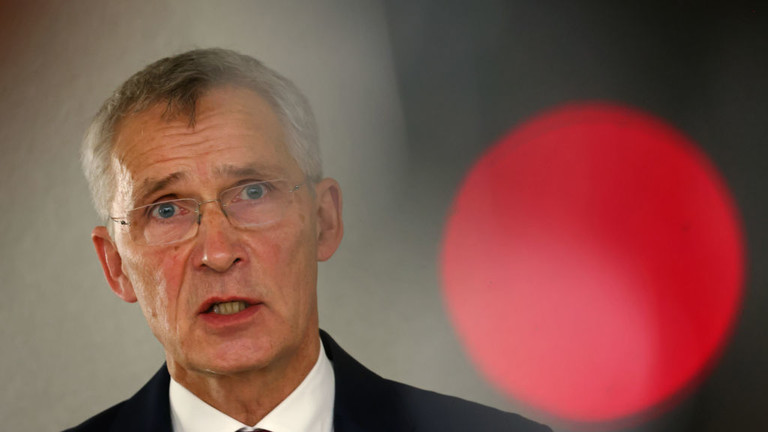
RT | May 13, 2024
Beijing is “enabling” Moscow in the Ukraine conflict, NATO Secretary-General Jens Stoltenberg has claimed, arguing that the US-led bloc has to be involved in Asia and not just in the North Atlantic.
Stoltenberg’s comments came during a question-and-answer panel at the NATO Youth Summit, in response to an inquiry from a Yale University student in the US.
“The war in Ukraine demonstrates that security is not regional, security is global,” Stoltenberg said. “The main country that is enabling Russia to conduct its war of aggression against Ukraine in Europe, is China.”
Stoltenberg went on to argue that China is “by far the biggest trading partner” of Russia, supplying Moscow with “critical components” for missiles, drones and other weapons. He also accused Iran of “providing drones” to Russia and North Korea of “providing ammunition and weapons.”
“Iran, North Korea and China, they are key for Russia’s capability to fight against [the] European friend [and] neighbor of NATO,” Stoltenberg said, referring to Ukraine. “So, this idea that we can divide Asia from Europe doesn’t work anymore.”
The US had pushed for NATO to expand its mission into Asia long before the Ukraine conflict boiled over in February 2022, however. Washington also appears to have been the source of claims that Beijing, Tehran and Pyongyang provided weapons and ammunition to Moscow, without offering much in the way of evidence to back that up.
China has repeatedly rejected pressure from the US and its allies to join their embargo against Russia, calling it unilateral and illegitimate. Beijing has also proposed a peace plan for the Ukraine conflict, which Moscow seemed interested in, but Kiev and its Western backers rejected.
Russia has denied US claims about North Korean weapons and ammunition deliveries. Iran has clarified that it provided Russia with prototypes and plans for drones before the outbreak of hostilities in Ukraine, suggesting that Moscow has been producing them domestically.
The US and its allies have sent over $200 billion worth of weapons, ammunition and cash to Ukraine over the past two years, while insisting that this does not make them direct participants in the conflict.
Featured Video
Laith Marouf: Hezbollah’s position on US-Iran ceasefire
or go to
Aletho News Archives – Video-Images
From the Archives
The Dirty Little Secret behind the “Global Terrorism Index”
The Omission of Israeli Terrorism in the Occupied Palestinian Territories
By Karin Brothers | Global Research | December 6, 2014
… The Israeli settlements — all of which are illegal – have been identified as a major impediment to peace. The refusal of a major “global” terrorism report to name the Israeli settlers as one of the groups most responsible for terrorism not only misrepresents a major source of regional violence but exposes the Global Terrorism Index as a propaganda tool that supports a U.S. agenda.
In recent years, governments have been attempting to thwart terrorism by blocking supportive fund-raising. When it comes to Israeli settlements, however, the US and Canada actually encourage fund-raising by giving organizations (such as Christian Friends of Israeli Communities (CFOIC) and the Jewish National Fund) financial support in the form of donor tax-deductions.
Charities which provide funds for the Israeli settlements should be regarded as terror-financing organizations. They should not only lose their tax-deductible status, but they should be banned because they support the violation of international humanitarian law. The terror-financing laws that are being strictly enforced for Muslim charities should be applied to Christian and Jewish charities as well. … Read full article
Blog Roll
 Aletho News
- Trump Administration Moves To Automate U.S. Military Draft Registration
- Spain orders reopening of Tehran embassy, condemns Israel’s carpet bombing of Lebanon
- Israel faces ‘unsustainable’ strategic crisis following 40-day war against Iran: Analyst
- Iran restricts Hormuz access to 15 vessels per day under ceasefire terms: Report
- The ‘Opposition Party’ Has Done Nothing to Stop the Iran War and Much to Goad Trump Into Continuing It
- Moscow backs Tehran on status of Lebanon in US-Iran deal
- How UK Regulator Ofcom Quietly Bypassed International Law to Police American Speech
- The Black Cube Files: How Former Mossad Operatives Flipped a Nation
- Laith Marouf: Hezbollah’s position on US-Iran ceasefire: What you’re not being told
- Israel’s priority lies in destroying chances of peace between Iran, US: Ex-UN nuclear chief
- If Americans Knew
- The gallows law: Israel moves toward executing Palestinian children
- Tucker Carlson: The Path to Peace requires ending ‘special alliance’ with Israel
- This is ceasefire? Israel’s biggest massacre yet in Lebanon, another journalist killed in Gaza – Daily Update
- Tucker Carlson on Israel: This Is the Behavior of an Ally? Really?
- Gazans face a triple crisis: severe shortages of water and bread, healthcare in tatters
- NY Times reports how Netanyahu took the US into Iran War
- A sigh of relief over Iran, but Gaza and Lebanon in dire straits – Daily Update
- Thousands dead and neighborhoods razed to the ground: Aid agencies fear southern Lebanon is becoming the new Gaza
- The war the US is fighting for Israel could cost trillions
- ‘Cigarette Burns, Nail Wounds’: Toddler Tortured in Gaza to Coerce Father
- No Tricks Zone
- An Inconvenient Tree: Uncovered In Alps… Europe Much Warmer Than Today 6000 Years Ago
- New Study Reports A 60% Slowdown In Greenland’s Ice Loss Rate In The Last Decade
- Low Intensity Tornado Wrecks Major Solar Farm, Creating A Potential Toxic Dump
- New Study Finds Warming Saves Lives…Cold Temperatures 12 Times More Deadly Than Excess Heat
- German Science Blog Accuses PIK Climate Institute Of Hallucinating Climate Tipping Points
- Devastating Assessment Of Comirnaty Vaccine By Former Senior Pfizer Europe Toxicologist
- New Study: CO2 Is ‘Effectively Negligible’ As An Explanatory Climate Change Factor Since 2000
- Former Pfizer Toxicologist Dr. Helmut Sterz Tells Bundestag Hearing Pfizer Vaccine Should Have Never Been Approved
- Energy Expert: Germany’s Nuclear Phaseout Was A “500 Billion Euro Mistake”
- New Research: South Australia’s Mid-Holocene Sea Surface Temperatures Were 4°C Warmer Than Today
 Aletho News