China Slams Military Supplies to Taiwan as Instigation of War
Sputnik – 09.10.2024
The situation around Taiwan significantly escalated after Nancy Pelosi, then Speaker of the US House of Representatives, visited the island in early August 2022. China condemned Pelosi’s visit, viewing her trip as America’s support for Taiwanese separatism.
The US is escalating regional tensions and pushing Taiwan step by step to the brink of war through repeated violations of its commitments and arms sales to Taiwan, Chinese Defense Ministry spokesman, Wu Qian, stated in response to US President Joe Biden’s recent approval of a $567 mln military package to the island.
“The US side, ignoring China’s strong objection, continues to provide military support to Taiwan, which is a flagrant violation of the ‘one China’ principle and the three joint Sino-US communiqués. This seriously jeopardizes China’s sovereignty and security interests, and undermines peace and stability in the Taiwan Strait. We express strong condemnation of it and lodge representations with the US,” Wu Qian said in a statement on WeChat social network.
He added that “attempts to use Taiwan to contain China will only turn out to have bitter consequences for those who undertake them.”
EU airline’s boss wants Chinese to pay for flying over Russia
RT | October 8, 2024
Brussels should establish financial measures to curb competition from Chinese airlines that can freely cross Russian airspace, according to Royal Dutch Airlines (KLM) CEO Marjan Rintel.
Western countries closed their airspace to Russian airlines as part of sanctions imposed after the onset of the Ukraine conflict in 2022. In response, Moscow banned aircraft from “unfriendly nations,” forcing EU planes to reroute, resulting in higher fuel consumption and increased costs.
“Russia’s airspace is closed to European airlines, while Chinese carriers fly over it, which can save two to four hours. You see that reflected in pricing, and consequently, our costs are higher,” Rintel said in an interview with Dutch broadcaster WNL on Sunday.
Rintel suggested that Brussels should intervene to address this competitive imbalance. “Europe can at least explore how we can level the playing field by adjusting pricing or examining other alternatives,” she stated.
In response to rising costs, KLM plans austerity measures aimed at saving €450 million ($494 million) annually, including €100 million ($110 million) by “adjusting” in-flight catering, Rintel noted.
“In the Netherlands, we are facing a tight labor market and rising wage costs, which differs from the situation in France,” she added, referring to KLM’s parent company, Air France-KLM. “Due to a shortage of pilots and technicians, roster changes will occur, and maintenance may need to be outsourced,” she explained.
Last month, Germany announced it was considering halting its daily Frankfurt-Beijing flights due to similar pressures from rising costs and competition from Chinese and Gulf airlines that can fly over Russia. The previous month, British Airways announced it would suspend London-Beijing flights starting in October. Additionally, Virgin Atlantic recently terminated its only China route to Shanghai.
U.S. Swings and Misses in Energy Competition
By Wallace Manheimer | RealClear Energy | September 30, 2024
Who can develop reliable, cheap, clean power? In the parlance of baseball, the U.S. led early with a leadoff home run. It invented, developed and perfected the first ultra-super critical (USC) coal-powered plant.
Coming online in 2012, the 600-megawatt (MW) John W. Turk Jr. Coal Plant in Arkansas employed new technology, most notably, an advance in metallurgy that allowed pipes and boilers to operate for extended periods at extremely elevated temperature and pressure.
This higher temperature allows efficiency of 40%, instead of the more usual 33%. Also, Turk had the best pollution controls, its emissions being mostly carbon dioxide and water vapor. Power Magazine was so impressed that it gave the plant its highest honor in 2013.
It looked like the U.S. was set to win the game, until it took its eye off the ball and made numerous errors. Instead of exploiting its remarkable technological achievement, U.S. policymakers decided to abandon coal and promote wind and solar.
Powerful environmental groups fought to end coal; Michael Bloomberg bragged that he contributed $500 million to the effort. Companies in the coal industry suffered, some went out of business, and domestic consumption of the country’s most abundant fuel declined. Turk is still the only USC plant in the U.S.
Solar and wind do not provide reliable power, as they fluctuate with the weather and time of day.
Also, they are not cheap. Germans, whose electric system relies heavily on solar, pay more than twice as much for electricity as the nuclear-dominant French and nearly triple the amount paid by U.S. consumers.
Furthermore, solar and wind technologies, contrary to popular belief, are not clean; not where their materials are mined, nor where they are used, nor at the end of life.
First, the mining: These technologies use many exotic and rare earth materials like praseodymium, terbium, cadmium, indium and dysprosium. Such materials are available mostly in Western China and Africa, under who-knows-what environmental and working conditions.
Secondly, where they are used, solar and wind take up tremendous amounts of land – many times the acreage of a coal plant. The average solar power reaching Earth is about 200 MW per square kilometer. Hence, with a perfectly efficient conversion to electricity, a 1,000 MW solar farm would require 5 square kilometers. But maximum solar efficiency is only 20%, boosting the land requirement to 25 square kilometers, space that could not be used for anything else. Even the maximum theoretical efficiency is only 30%.
The numbers for wind are worse: A 1,000 MW wind farm would require a whopping 500 square kilometers – equal to about 27,000 big league baseball fields. This land could be used for crops and grazing animals, but not much else.
Finally, disposal of the huge amount of material used in the fabrication of solar and wind facilities, whose life spans are mere fractions of traditional generating plants, must be disposed of. Many of these exotic materials are not suitable for standard landfills, as their compounds are harmful to humans and are water soluble. Frequently, the solar or wind company has just walked away and left the relics in place for others to worry about.
Solar and wind are more of an environmental disaster than an environmental savior.
With the U.S. relegated to the locker room, China came to bat and staged a tremendous scoring rally. Out of the top 100 Chinese coal plants, 90 are ultra-supercritical units.
Having improved on USC technology, Chinese plant efficiency is around 44%. The new 1,350 MW Pingshan Phase II plant achieves 49% efficiency! The best Chinese coal plant is now cleaner and 22 % more efficient than its American counterpart.
Since 2010, India has constructed more than 90 super critical and ultra-super critical coal plants.
Has the U.S. played its last coal-fired season?
Perhaps- unless America’s free enterprise system were brought fully into the game, with the private sector mostly doing the engineering and the federal government sponsoring long-range scientific research.
However, U.S. policymakers must abandon their obsession with solar and wind as answers for a climatic “existential threat.” Otherwise, sensible people play a fool’s game in a fantasy league that demonizes a gas sustaining all life — carbon dioxide – as others compete in the majors.
Such absurdity is no match for the technical leadership displayed in China and India.
Dr. Wallace Manheimer is a life fellow of the American Physical Society, the Institute of Electrical and Electronic Engineers and is a member of the CO2.Coalition. He is the author of more than 150 refereed papers.
China Asks US Not to Interfere With Its Right to Develop Ties With Hungary – Embassy
Sputnik – 07.10.2024
WASHINGTON – The United States should not interfere with China’s right to develop relations with the government of Hungary, the Chinese Embassy in Washington told Sputnik after US lawmakers lambasted Budapest for growing ties with Beijing.
A group of US senators was in Hungary last week to meet with government officials. Following the visit, the senators issued a joint statement criticizing Hungarian officials for developing ties with Russia and China, adding that Budapest has ignored allies’ concerns regarding its deepening cooperation with Beijing.
“China’s right to develop bilateral relations and conduct normal exchanges with other countries in the world should not be interfered with or disrupted,” the Chinese Embassy spokesperson said.
The Chinese Embassy added that the remarks by the US senators advocate bloc confrontation and are full of Cold War thinking and zero-sum game concepts, coercing other countries to choose sides.
The US senators did not go into detail about their concerns in the joint statement but urged Hungary to work closely with its allies, and listen to their concerns and act on them.
The delegation of US senators that visited Hungary included senators Jerry Moran, Susan Collins, John Cornyn, John Boozman and John Hoeven.
Chinese airlines grab market share from US and European carriers who have to fly around Russia
Inside China Business | August 15, 2024
US and European airlines are banned from Russian airspace, and so must route around the world’s largest country. This is causing much longer and costlier flights between North America and Europe, and destinations in Southeast Asia. Chinese, Korean, and Indian airlines still enjoy Russian overflight privileges, however, and can thereby offer shorter and less expensive fares. As a result, Chinese carriers are gobbling up markets and gates across international markets. Chinese airlines already operate with 30% lower costs on a passenger-mile basis compared to US- and European-flagged carriers, and their cost advantages only multiply after adjusting for the issues involving Russian airspace.
Resources and links:
Flight maps from Great Circle Maps http://www.greatcirclemap.com) and Reuters, Unfriendly skies:
How Russia’s invasion of Ukraine is redrawing air routes https://www.reuters.com/graphics/UKRA…
A year into Russian airspace ban, flight costs and lengths are rising https://globalnews.ca/news/9645165/ru…
Flight Radar, Which major airlines are still flying over Russian airspace? https://www.flightradar24.com/blog/wh…
British Airways axes one of its ‘most important’ routes amid Russian airspace ban https://www.independent.co.uk/travel/…
Reuters, British Airways to halt flights to Beijing from Oct. 26 https://www.reuters.com/business/aero…
Reuters, Foreign airlines lose interest in China as domestic carriers expand abroad https://www.reuters.com/business/aero…
Bloomberg, US Airlines Urge Officials to Block Additional China Flights https://www.bloomberg.com/news/articl…
Europe buying Russian oil via India at record rates in 2023 despite Ukraine war https://www.independent.co.uk/news/wo…
Reuters, Airbus wins reprieve from Canadian sanctions on Russian titanium https://www.reuters.com/business/aero…
Closing scene, Qingdao Olympic Sailing Center and Lighthouse, Qingdao, Shandong
Iran’s oil production nears pre-sanctions levels: Report
The Cradle | October 4, 2024
Iran’s oil production is running at almost full capacity despite US sanctions, amid Israeli threats to target Tehran’s oil infrastructure in an expanded regional war, Bloomberg reported on 4 October.
The Islamic Republic’s oil output has reached 3.4 million barrels per day, just a few hundred thousand barrels below a previous high of 3.9 million.
After US President Donald Trump withdrew the US from the JCPOA nuclear deal in 2018 and reimposed sanctions on Iran, Tehran’s production dropped as low as two million barrels per day.
Iran now sells much of its oil to China at reduced prices, as Beijing has been willing to ignore US sanctions seeking to block the sales.
“Iran is having success exporting thanks to a willing customer in China, the increased sophistication of illicit transportation channels, and the relatively low interest in the US to take action,” said Henning Gloystein and Greg Brew, analysts at Eurasia Group. “There’s a risk that Israel strikes Iranian oil facilities.”
According to Bloomberg, Tehran’s increased sales to China have taken place with the “tacit approval” of the White House, as US President Joe Biden and his advisors have eased sanctions enforcement to keep gasoline prices low.
In August 2023, before the wars in Gaza and Lebanon began, Bloomberg reported that “months of secretive diplomacy” between the US and Iran “have yielded progress on prisoner exchanges, the unblocking of frozen assets, and possibly even Iran’s enrichment of uranium. They also seem to have produced an informal arrangement on oil flows.”
Israel reportedly threatened to bomb Iran’s nuclear or oil facilities following Tehran’s large-scale missile attack on Israel.
Iran fired as many as 400 ballistic missiles at Israel on 1 October in retaliation for its killing of Hamas leader Ismail Haniyeh in Tehran in July and Hezbollah leader Hassan Nasrallah in Beirut on 27 September.
In an off-the-cuff remark to a reporter, Biden said that his administration has been “discussing” possible Israeli plans to attack Iran’s oil industry in retaliation for the Iranian attack.
Bloomberg added that world oil prices jumped five percent on Thursday after Biden’s comment.
Now it’s oil: China, BRICS and OPEC+ build new trading system, locking out US suppliers and banks
Inside China Business | September 27, 2024
China and Iran developed a comprehensive energy market, involving shadow fleets of tankers and a system of rebranding oil for domestic use, or for further export to other Asian countries. Russia has since joined, after sanctions were placed on oil producers and banks there. The result is a parallel economy that now totals millions of barrels per day in shipments to China by OPEC+ countries, and a sharp decline in global demand from Western suppliers. The implications for US and European oil suppliers are very negative, as global crude prices are now far below profit breakeven levels. Already, US oil majors are shelving oilfield development projects, and reducing active rig count. Resources and links: Barrons, BP Says Oil Demand Is Falling, While OPEC Says It’s Rising.
What Gives? https://www.barrons.com/articles/bp-s…
Rigzone, JP Morgan Talks Global Oil Demand https://www.rigzone.com/news/jp_morga…
S&P, Barclays lowers 2024 Brent oil price forecast to $93/b on demand concerns https://www.spglobal.com/commodityins…
Oil Prices Poised To Climb in 2024 Amid Geopolitical Uncertainty https://www.investopedia.com/oil-pric…
CNBC, OPEC is highly bullish on long-term oil demand growth. Not everyone agrees https://www.cnbc.com/2024/09/24/opec-…
NPR, Oil prices plunge as demand from China falls https://www.npr.org/2024/09/14/nx-s1-…
Zerohedge, What Sanctions? China Imports Record Amount Of Iranian Oil https://www.zerohedge.com/energy/what…
The axis of evasion: Behind China’s oil trade with Iran and Russia https://www.atlanticcouncil.org/blogs…
Oil price charts from finviz.com/futures and Bloomberg https://finviz.com/futures_charts.ash…
US drillers cut oil and gas rigs for fifth week in six, Baker Hughes says https://www.xm.com/se/research/market…
Average WTI price needed for U.S. oil and gas producers to stay profitable by well status in selected U.S. oilfields as of 2024 https://www.statista.com/statistics/7…
Capital Expenditure (CapEx) Definition, Formula, and Examples https://www.investopedia.com/terms/c/…
Economic Collapse & the Post-American World
By Glenn Diesen | October 2, 2024
Washington’s declining fiscal responsibility was not resolved after the Great Financial Crisis of 2008-09 as the US instead kicked the can down the road. The problem has subsequently grown in magnitude as the banking crisis caused by too much borrowing and spending was overcome by borrowing and spending even more to get the economy restarted.
More than 15 years of low interest rates have fueled many asset bubbles, caused malinvestments, ballooned the debt, and laid the foundation for another banking crisis. The US public is deeply indebted, the middle class is shrinking, and the national debt stands at 35,5 trillion dollars. The US now pays 1 trillion dollars a year in interest on this debt.
The contradictions in the economy are evident as the stock market continues a prolonged strong performance as new money is recklessly introduced into the system, while the real economy goes from bad to worse.
The next banking crisis will likely cause a dollar crisis as the US cannot significantly increase the interest rate to save the dollar without sinking the economy, and it cannot significantly reduce the interest rate to save the economy without destroying the dollar. The US simply lacks the tools to deal with the coming economic crisis.
Reversing the Decline Without Addressing the Underlying Problems
The US attempts to revive its economic competitiveness by subsidizing its industries, demanding geoeconomic loyalty from allies, and sabotaging the industries of rivals. Subsidies are financed by debt and there is subsequently a risk that the US will exacerbate the basic problems. The generous subsidies for its industries under the Inflation Reduction Act have encouraged German and other European industries to relocate to the US. Furthermore, disconnecting Europe from cheap Russian energy with sanctions and the destruction of Nord Stream also incentivised energy-intensive European industries to move across the Atlantic. As the war in Ukraine continues and the sense of insecurity in Europe grows, the US can convert European security dependence into geoeconomic loyalty as Europe is also told to decouple from Chinese technologies.
With the future of NATO at risk as the US sets its eyes on Asia, the Europeans attempt to increase their value to Washington by abandoning former ambitions to pursue strategic autonomy and “European sovereignty”, and instead subordinate national interests to the whims of Washington. The gains of Washington’s renewed influence on the old continent will come at a cost as Europe becomes weakened and less relevant, while political alternatives in Europe are increasingly winning elections by challenging Washington and Brussels.
The economic coercion against China to roll back its technological and economic development is failing. The disruptions to supply chains by for example banning the export of computer chips to China resulted in American tech giants such as Intel taking huge losses in terms of revenue and losing thousands of employees as their main customer was China. While the US cannot diversify away from China, China can diversify away from the US by enhancing its technological sovereignty and establishing new technological partnerships. This has striking similarities to the EU’s failure to sever its economic ties with Russia. Russia could diversify away from Europe by reorienting its economy to the East, while Europe could not diversify away from Russia as evidenced by Europe’s economic problems.
American efforts to reshore its production are also disrupted by Chinese counter-sanctions on for example rare earth elements. The US has also discovered that tearing up the supply chains developed over decades creates problems as new competitive supply chains will take many years to establish. The old house is demolished before the new house has been built.
Efforts of “friendshoring” by sourcing supplies from friendly countries such as India also have limited success. India responds to the increased demand by sourcing more materials and technologies from China, which increases the costs to the US and further intensifies India-China economic integration in BRICS. This also has similarities to the EU’s economic coercion against Russia, as the Europeans buy Russian natural resources at a higher cost through third parties. Russia sells some of its resources at a discounted price to its economic partners to make up for the risks of secondary sanctions, and this discount only further increases the competitiveness of Asia vis-à-vis the West.
The US is also unlikely to recover its industrial might due to the heavy financialization of its economy as rent-seeking activities in the economy make it impossible to compete with industrial economies such as China. While China built infrastructure to enhance the economic competitiveness of its companies, the US burdens its companies with many costs that do not contribute to the production process.
US competitiveness worsens as China continues to increase its competitiveness in high-tech, and the profits from the positive trade gap are reinvested in the form of subsidies. The industrial might of China enables innovations, while the growth of patents increases rapidly. These developments are also seen in the education sector as Chinese universities are becoming more competitive and many Chinese researchers in the US even return to China. While American universities still dominate in areas such as finance, law, psychology and marketing, Chinese universities have begun taking the lead for the real economy and thus attract foreign students. The US economy will likely face growing structural problems as an economy cannot be built on the financial activities from growing debt, suing each other, and treating the growing mental disorders.
Finding Solutions
Many of America’s problems derive from imperial overstretch as its economy cannot sustain its military and strategic commitments around the world. Resources are transferred from the core to the periphery, resulting in the degradation of infrastructure, growing economic inequality, social instability, and political polarisation and decline. The US economy, society and political system are exhausted and need deep restructuring and adjustment to the multipolar realities on the ground. The US is unlikely to make the necessary changes due to the prevailing ideology, demonisation of adversaries, crushing of dissent, and lack of political imagination for alternatives. The US will either default on its debt or pay back in devalued dollars by printing its way out of trouble.
There are no simple solutions to America’s economic problems, and we live in a time when political leaders respond to socio-economic complexities with ideological sloganeering and simplistic solutions. The US could have restructured its economy with for example ambitious industrial policies and restoring fiscal responsibility, without an aggressive economic war with China. However, this solution would have required the US to give up on its objective to preserve global primacy.
Too many economic disputes are instead militarised, and the expensive US military is itself overburdened with responsibilities around the world. As the US military transitions to confronting great powers, rival powers have another reason for why they should not invest in US Treasuries or use the dollar as this entails financing their own military containment. The attacks on China’s tech sector and the theft of Russia’s sovereign funds have sent shock-waves throughout the international system as all rules are seemingly suspended under the so-called international rules-based order.
A Post-American World
The rest of the non-Western world can see the coming disaster and is getting out of the splash zone. This is done by constructing a parallel international economic system with new supply chains, tech hubs, energy pipelines, a grain corridor, new commodity exchanges, new bimodal transportation corridors, development banks, digital currencies, payment systems, insurance systems and other important components of the international economy.
Much of the decoupling from the US, including de-dollarisation, is being facilitated by BRICS which creates the economic institutions for a multipolar world order. Historically, liberal international economic systems and free trade occur under an economic hegemony such as with Britain in the 19th century and the US in the 20th century as it creates incentives for the dominant state to embrace liberal economics to organise the world economy under its administration, which cements its economic and political power. BRICS attempts to form a vastly different economic system by accommodating a multipolar system through a “balance of dependence”, in which a multivector foreign policy and economic diversification enable states to avoid excessive dependence on any one state or region. It remains to be seen if BRICS can create a more benign international economic system that harmonises the interests of rival economies, or if it will descend into neo-mercantilism. Either way, the world is making arrangements for the post-American world.
US universities losing hundreds of billions as top Chinese scientists and researchers go home
Inside China Business | September 29, 2024
Research and Development (R&D) is a major profit center for the top universities in the United States. Besides the nearly $100 billion they earn in grants from the US government and private sources, university-based researchers create patents and inventions that generate many more billions annually.
China is the largest foreign source of scientists and researchers, and they are concentrated in the hard sciences and in engineering, where over 95% of R&D spending takes place. But since 2018, Chinese scientists are increasingly deciding to return to China to set up new research departments. Of those who are still in the US, over 60% admit they are strongly considering moving, and over half now refuse to work on projects that involve funding by US government sources.
To American universities, the loss of these scientists, along with future contributions to scientific research and commercial applications and market value, are incalculable. But losses probably already exceed a trillion dollars, given the departures of so many top scientists in Artificial Intelligence, Big Data, medicine, biochemistry, materials science, nanotechnology, and quantum computing.
Resources and links:
More Chinese Students Are Staying in China to Study https://erudera.com/news/more-chinese…
Surge in Chinese Scientists Leaving US for Home Institutions https://erudera.com/news/surge-in-chi…
Caught in the crossfire: Fears of Chinese–American scientists https://www.pnas.org/doi/10.1073/pnas…
Scientists of Chinese descent leaving the US at an accelerating pace https://www.chemistryworld.com/news/s…
Reverse Brain Drain? Exploring Trends among Chinese Scientists in the U.S. https://sccei.fsi.stanford.edu/china-…
Resources on the Patent Revenue Budget Model https://financeandbusiness.ucdavis.ed…
R&D Expenditures at U.S. Universities Increased by $8 Billion in FY 2022 https://ncses.nsf.gov/pubs/nsf24307
South China Morning Post, Nanotech pioneer Wang Zhonglin leaves US to work in China ‘full time’ https://www.scmp.com/news/china/scien…
SCMP, The Chinese scientists leaving top US universities to take up high-profile roles in China, boosting Beijing in its race for global talent https://www.scmp.com/news/china/scien…
Closing scene, Suzhou, Jiangsu
The Russia-China grains corridor will completely displace the US, Canada, Australia, and France
Inside China Business | August 31, 2024
Russia and China are developing a transnational grains corridor, connecting Russia’s enormous agricultural production to export markets in China, South Asia, and the Middle East. When complete, Russian production and shipments on this network will exceed 8 million tons per year. China is the world’s largest importer of wheat and grains, and in 2023 imported over 6 million tons of wheat from the United States, Canada, Australia, and France.
Large distribution hubs are being completed in China’s Northern and Central provinces, which will further transport Russian food exports within China, and on to other Asian countries.
The proposed BRICS grains exchange enjoys wide support across the bloc, and will accelerate the decoupling of Global South markets from the Western banking and trading systems, to the detriment of farmers in North America and Europe.
Resources and links:
The Sino-Russian Land Grain Corridor and China’s Quest for Food Security https://asiasociety.org/policy-instit…
BRICS countries back grain exchange idea, Russia says https://gulfbusiness.com/brics-countr…
Russia, China agree to build new grain hub on border https://www.world-grain.com/articles/…
Visual Capitalist, Visualizing the world’s largest consumer markets in 2030 https://www.visualcapitalist.com/the-…
U.S. Dominance in Corn Exports on the Wane Due to Brazilian Competition https://farmdocdaily.illinois.edu/202…
The New Land Grain Corridor, website and infographics https://www.nlgc.ru/en/
Closing scene, Chinese rural area outside Guilin, Guangxi province
US Bets on Allies to Bail Out Crippled Shipbuilding Industry
By Svetlana Ekimenko – Sputnik – 21.09.2024
As the US pushes its “China threat” narrative and eyes a potential military conflict with the People’s Liberation Army, one of its vital defense industries – shipbuilding – is in a critical condition.
The US is betting on its ally South Korea to help bail out its crippled shipbuilding industry.
South Korean shipbuilding company Hanwha Ocean recently announced its acquisition of a former naval shipyard in Philadelphia.
Along with the shipyard deal, valued at $100 million, Hanwha secured its first maintenance and repair contract with the US Navy.
The US shipbuilding industry has become notorious for years-long delays and cost overruns. Washington’s allies South Korea and Japan are the world’s largest shipbuilders, and hopes are that they could boost production of both commercial and naval vessels.
But stark new figures show that even with support from Asian firms, it could take the US years to close the gap with China in maritime power.
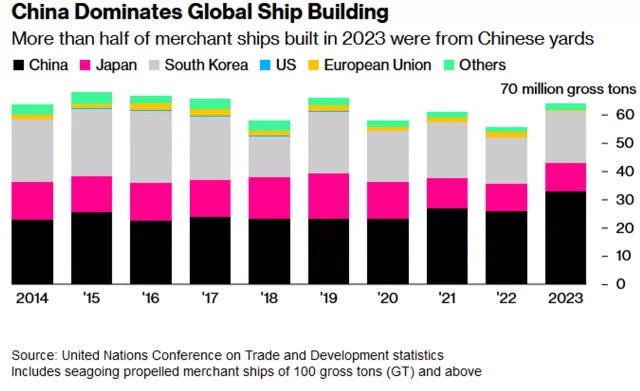
- Last year, China had orders for 1,794 large commercial ships, South Korea had 734, Japan had 587 — but the US had just five.
- While China commands 40 percent of global commercial shipbuilding output, the US accounts for less than one percent.
- China had over 5,000 oceangoing commercial vessels in early 2023, while the US-flagged merchant fleet had only 177.
- China’s shipbuilding capacity is over 200 times that of the US, according to a US Naval Intelligence chart cited by media.
The struggle to prop up the floundering US shipbuilding base comes as the US Navy has released its plan for a potential military conflict with China by 2027.
Announcing the Navigation Plan for America’s Warfighting Navy, US Chief of Naval Operations (CNO) Admiral Lisa Franchetti referred to China as a “pacing challenge” and a “complex, multi-domain and multi-axis threat.”
The plan includes streamlining maintenance for warships, submarines and aircraft, eliminating delays and restoring “critical infrastructure that sustains and projects the fight from shore.”
Featured Video

Iran spent $1 million to wipe out $30 billion in data center plans, and take down Amazon in the ME
or go to
Aletho News Archives – Video-Images
From the Archives
A short history of British torture
ICC | December 2005
When the House of Commons was debating how much to increase the time limit for detention without trial the question of torture came up. Officially this was limited to the nice considerations of whether it was all right to send people to places where torture is used and whether Britain can use information collected by the use of torture in other countries. This discussion gave an impression of democratic Britain as the home of civilised behaviour where the very idea of torture is repugnant to our legislators – unlike, say, the US with its secret CIA jails… In reality, the British state has a long history of using and developing a whole range of torture techniques. … continue
Blog Roll
 Aletho News
- Houthis Keep Advancing as the Red Sea Crisis Deepens
- Iran spent $1 million to wipe out $30 billion in data center plans, and take down Amazon in the ME
- Zionist billionaire pressure to silence Macklemore sparks exodus from Ed Sheeran tour
- House Votes to End Iran War for Third Time
- North Korea Slams US Plan for ‘AUKUS 2.0’ with South Korea and Japan
- Prolonging US-Iran Conflict Not Meeting Interests of Int’l Community – China’s Wang Yi
- EU bans former Zelensky aide from parliament
- NATO-backed Kosovo separatist ‘responsible for war crimes’
- US destroying international space law
- SCO Calls for Binding Global Deal to Prevent Arms Race in Space
- If Americans Knew
- U.S. Makes, Israel Takes: The Real Story of U.S.-Israeli Military Cooperation
- Night raids rise in Palestine
- Tucker Carlson interviews Norman Finkelstein about Gaza
- Groups urge Americans to support Van Hollen legislation on Israel’s killing of Americans & Palestinians
- Trump administration plans to send 40,000 tons of bombs to Israel: report
- Sanctions Target Iran’s Government, But Kill Hospitalized 23-Year-Old Woman
- An alternative view on the book “Israel’s Lobby: America in the Grip of a Foreign Power”
- Ed Sheeran’s band Beoga, other opening acts quit tour after Macklemore was dropped over his pro-Palestinian comments
- The assassination attempt on President Trump in Butler and the various Israeli connections to it
- “We Want That the Whole Land Be Jewish”
- No Tricks Zone
- New Study: ‘Global Drought Shows No Detectable Recent Acceleration Under Climate Warming’
- Economic Masterminds: German Socialists Suggest Taxing Productivity Gains Stemming From Using AI
- The South China Sea Has Not Been Cooperating With The Climate Change Narrative
- Energy Crisis: Germany Enters Heating Season With Historically Low Gas Reserve Fill Levels
- New Study: The Antarctic Ice Sheet Gained Mass From 2020-2024 Due To Staggering Snow And Ice Accumulation
- Study: Ocean Heating Rates From Thousands Of Years Ago ‘Dwarf’ Modern Ocean Heating Rates
- Climate Extremists Target, Attack Large-Scale Power Grid Infrastructure In Germany!
- New Study: Antarctic Ice Melt Has Contributed Less Than 1 Centimeter To Sea Level Rise In The Last 30 Years
- Fear Of Debate: Alarmist German Climate Scientist Calls On Mainstream Media To Discredit Skeptic Voices
- End-Of-August Arctic Sea Ice Extent Hasn’t Fallen In 20 Years, Official Data Show!
 Aletho News