Germany upset by China’s embrace of Russia – envoy
RT | May 13, 2024
China’s stance on the Ukraine conflict and close ties with Russia call into question its relationship with Germany and Europe, Berlin’s ambassador to Beijing has said.
China has ramped up trade with Russia since the start of the conflict, while refusing to condemn Moscow’s actions, Patricia Flor said in an interview with the South China Morning Post on Monday.
”For Germans and Europeans, Russia’s aggression is an existential threat. This is a nuclear power next to us that just invaded its neighbour. It has really shaken up people,” Flor told the news outlet. “The situation casts doubt on China’s relations with Germany and Europe.”
German Chancellor Olaf Scholz paid a visit to China in April, and met with President Xi Jinping, who outlined four principles to prevent the conflict in Ukraine from escalating. Among them was for the West to stop “adding fuel to the fire,” which he said would lay the groundwork for peace.
Germany, a NATO member, has emerged as a top supplier of military equipment and weapons to Kiev, and has trained Ukrainian soldiers. In 2022 and 2023, Berlin spent around €6.6 billion ($7.13 billion) on military assistance to the country, according to government data.
Beijing has insisted it remains neutral in the Ukraine conflict, and repeatedly called for the crisis to be settled through negotiations.
Economic ties between China and Russia are also “of great concern” to Germany, Flor said, referring to the alleged supply of dual-use goods and components by China to Russia. Western countries claim that the goods can be used by the Russian military. The US said in April that it was ready to impose secondary sanctions against Beijing over its alleged support for the Russian defense industry.
China has denied selling weapons to Russia. In April, Foreign Ministry spokesperson Mao Ning insisted that China “regulates the export of dual-use articles in accordance with laws and regulations,” and urged “relevant countries” not to “smear or attack the normal relations between China and Russia.”
Following the introduction of sanctions against Russia by the US, the EU and their allies, Russia redirected its trade flows to the Asia-Pacific market, primarily to China. Trade between the nations hit an all-time high of $240 billion in 2023.
Britain At War-The Final Warning
By Christopher Black – New Eastern Outlook – 11.05.2024
On May 26, 2023, I wrote an article titled, Britain At War-Provoking the Consequences, attempting to warn the people of Britain and the West that their role in the war against Russia makes them a direct party to the conflict and that, as a consequence, Russia has the right to attack them. It seems the warning has to be repeated because the British, along with the rest of the NATO alliance of aggression, have increased their direct role in the Ukraine conflict and are threatening to escalate the war further. In reaction, Russia has had to call in the British ambassador and issue another warning, likely the last one they will receive, that Russia will act against them if they continue to do all they can to attack Russia and its people.
Russia is no longer in a forgiving or tolerant frame of mind after the terrible attack on the Crocus Concert Hall, an act of sheer terrorism carried out by assets of the Kiev regime with the probable support of the UK and the US special services and with express approval of the western media which celebrated the attack as a demonstration of “Putin’s weakness.” That terrorist attack changed everything. Russia states it will go after everyone involved. The Western nations involved should believe them. But they evidently are incapable of thinking about their actions and the consequences.
This infantile and criminal attitude is maintained in all the NATO states, even through changes in the personalities making up their governments. In Britain, defence and foreign ministers change, but the thinking remains the same. In the US, the Democratic and Republican Parties, despite their squabbling over how to make “America great” are, in fact, a single War Party, and, as in all their wars, free speech and assembly are victims of police aggression against citizens.
In Canada, the same, though here the government has been assigned the role by Washington of slandering China for the purpose of making the Chinese people “the other” so that they can be attacked. The West prepares for general war. China and Russia are left trying to bring sense to insanity but are forced to act to defend themselves. Just days after the US Secretary of State, Blinken, abused his visit to China by threatening it about its relations with Russia, further hostile threats were made in the days after he left. President Xi then travelled to Europe to try to get them, at least the French, to see sense, with no concrete result, but in Serbia paid respects not only to their resistance against NATO but to the Chinese victims of the NATO attack against China in 1999 when NATO bombed the Chinese embassy.
Now, just a year after the Russian government warned the UK that its hostility towards Russia and its aggression against it in Ukraine will lead to severe consequences, prompting my earlier article, the UK has again been warned.
On May 6, the Russian Foreign Ministry summoned both the British and French ambassadors in reaction to the bellicose statements of their governments against Russia. But for the British there was a special warning, which needs to be read, since it is not reported in the Western media, or only in part. The Foreign Ministry Press Release states,
“On May 6, UK Ambassador to Russia Nigel Casey was summoned to the Foreign Ministry to be delivered a strong protest against the recent statement by British Foreign Secretary David Cameron in an interview with the Reuters news agency regarding Ukraine’s right to strike Russian territory using British weapons. The Ministry firmly pointed out to Ambassador Casey that Cameron’s hostile outburst directly contradicts the British side’s earlier assurances during the transfer of long-range cruise missiles to the Kiev regime that they would under no circumstances be used to strike Russia’s territory. By doing so, the head of the Foreign Office disavowed this position and admitted his country was a de facto party to the conflict.
The ambassador was told that the Russian side considered Cameron’s words as evidence of a serious escalation and confirmation of London’s growing involvement in combat actions on Kiev’s side. Nigel Casey was warned that any UK military facilities and equipment on Ukrainian territory and beyond could be hit as a response to Ukrainian strikes on Russian territory with British weapons. The ambassador was urged to consider the inevitable disastrous repercussions of such hostile steps by London and to urgently refute in the strongest and most unequivocal manner the bellicose provocative statements by the head of the Foreign Office.”
We note further that the German ambassador to Russia has been recalled to Berlin, an ominous sign, though perhaps it was to provide an excuse not to attend the formal ceremony of President Putin assuming office. Most western ambassadors to Moscow refused to attend, though interestingly the French did, experts since the days of the Sun King and Napoleon in tricks and subterfuge.
But, on May 8th, the British, instead of reacting with reason and reflection, after receiving the Russian warning about their completely irrational hostility towards Russia, and direct role in the war against Russia, provoked the situation even further by declaring the Russian Defence Attaché in London to be persona non grata and threatening Russian owned diplomatic properties in the UK by removing their diplomatic status, indicating they may make a move to seize them. As I write this, we await Moscow’s reaction to this step. But we can anticipate that it will be one of contempt and will only confirm Russia’s resolve to act against them if the warning is ignored.
In conjunction with the Russian warning to Britain, Russia and Belarus placed their tactical nuclear forces in a state of readiness, as a warning to the West about directly sending in NATO forces and F16’s which will be considered to be nuclear armed, and so the bases from which they fly, legitimate targets. This action can also be viewed as a further warning to Britain.
The British people should be alarmed at the road the British government is taking them down. But they seem oblivious to the risks they face, and the antiwar movement is totally fixated on the Israeli massacres in Gaza, a worthwhile cause, another crime against humanity of the US and the West generally, but it will pale in comparison to what state the world will be in when Russia acts on its warning. I say “when”, not “if” as the British, along with the Americans, are incapable of understanding reality, and the British démarche of May 8th indicates that they will ignore the Russian warning and continue their escalation. They have committed themselves to the madness of war and nothing, it seems, can cure them, except war.
What Russia will attack, only the Russian General Staff knows. Logical targets can be found in the British base in Cyprus, and other foreign installations but the UK itself can be targeted. The British dismiss the possibility. The Russians would not dare. So they think; a delusion that will lead them to disaster.
The Russians have every right to act against the UK under international law since it is a co-belligerent in the Ukraine conflict. It could have acted against it before now, but the Russians have been very patient, and cautious, trying to avoid a general nuclear war. But, now, too many lines haven been crossed, too many warnings ignored, too may crimes against Russia committed.
And if the people of Britain think that they are protected against attack, I remind them that The National and Defence Strategies Research Group, based in the UK, stated in a report on Britain’s air defences in 2016 that,
“Since the withdrawal from service of the Bloodhound missile system in the 1980s, the UK’s Air Defence posture has diminished to mainly a homeland benign airspace policing and point defence posture for deployed forces. The UK no longer has a comprehensive, integrated, or robustly layered short to long-range Air Defence capability, nor a credible or enduring operational capacity.”
Nothing has changed since then, except to get worse. In other words, the UK is defenceless against modern Russian standoff weapons.
I can remember, as a boy, my mother taking me several times on a bus through London. It must have been 1955 or so and I can remember mile upon mile of burnt-out blackened buildings, as far as the eye could see, especially in east London where entire districts were levelled by German bombs. The country, despite its air force, could not stop the bombing and then missile attacks which went on for five years.

The British government assured the people before that war, that all would be well, that they would have peace in their time. But they lied to the people then, as they are lying to them now. Britain was never the same after that war. It never really recovered from it.
Once again, the British government, ever saluting the masters in Washington, leads the British people into a dangerous war, which they were never asked about, and which they do not want. It lies to them about the causes, it lies to them about the fighting, and it lies to them about the dangers they face, placing them in a distant future, and hides from them the consequences of its actions. The British people must be warned. Britain is at war, and no amount of bluffing and lying can protect them from the consequences their government is provoking. They are predictable and they will be catastrophic. They have received the final warning.
Christopher Black is an international criminal lawyer based in Toronto. He is known for a number of high-profile war crimes cases and recently published his novel Beneath the Clouds. He writes essays on international law, politics and world events.
US losing ground globally to Russia and China – report

RT | May 9, 2024
While both China and Russia have improved their standing in the world over the past year, the US has seen its approval rating deteriorate in the Middle East and even in Europe, according to respondents from 53 countries.
Dubbed Democracy Perception Index 2024, the survey was compiled by the German company Latana, on behalf of Alliance of Democracies, a NGO headed by former NATO Secretary-General Anders Fogh Rasmussen.
Russia and China are now viewed as positively as the US in most of the surveyed countries in Asia and the Middle East/North Africa (MENA), as Washington’s approval plummeted due to the conflict in Gaza. Things aren’t looking up for the US in Europe, either.
“For the first time since the start of the Biden administration, many Western European countries have returned to net negative perceptions of the US,” according to Frederick DeVeaux, the senior researcher at Latana.
The reversal of previously positive attitudes has been “particularly stark in Germany, Austria, Ireland, Belgium and Switzerland,” DeVeaux said.
America’s global reputation took a beating since last year, in particular in Muslim-majority countries surveyed – Algeria, Egypt, Indonesia, Malaysia, Morocco, and Türkiye. The researchers attributed this to President Joe Biden’s unequivocal support to Israel’s war on Gaza.
Meanwhile, sentiments about Russia and China in every region except Europe are steadily getting more positive.
The European region is the only one besides the US that still supports cutting economic ties with Russia over the Ukraine conflict, while the rest of the world prefers to keep doing business with Moscow. The world is also divided “between the West and the rest” when it comes to possibly sanctioning Beijing if it were to “invade” the island of Taiwan.
The Democracy Perception Index is an annual survey carried out in 53 countries. This year’s research canvassed some 63,000 respondents for opinions about “democracy, geopolitics and global power players.”
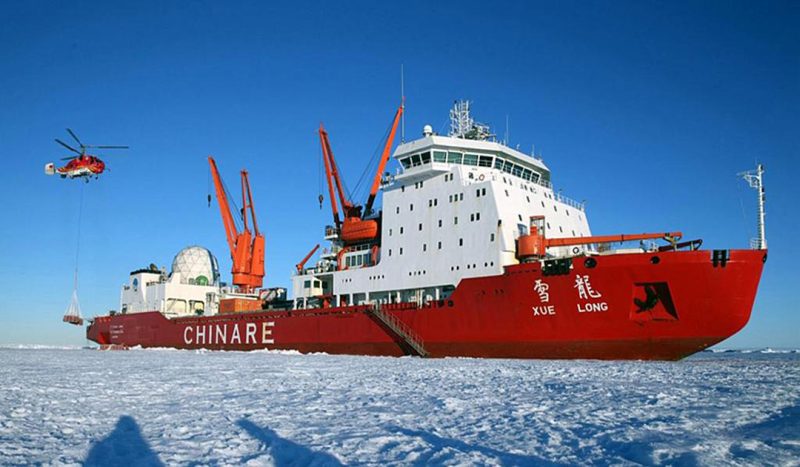
US Coast Guard Polar Icebreaker 5 Years Behind Schedule, $2Bln Over Budget
Sputnik – 07.05.2024
WASHINGTON – The US Coast Guard’s proposed next generation polar icebreaker to reestablish and maintain a strong US presence in the Arctic Ocean is at least five years behind schedule and $2 bln over budget with many design and shipbuilding problems still unresolved, a senior Biden administration official and a new report told Congress.
“The PSC [Polar Security Cutter] program is now years behind the original schedule, without having attained the level of maturity we require prior to authorizing the start of construction,” Department of Homeland Security Deputy Under Secretary for Management Randolph Alles told the US House Homeland Security Subcommittee on Transportation and Maritime Security.
The project had suffered from the general lack of US experience designing and building polar icebreakers and its prime contractor VT Halter Marine suffered from organizational instability and has undergone managerial restructuring following its acquisition by Bollinger, a competitor shipyard in 2022, Alles said.
In addition, the design of the Polar Security Cutter is more complex and is taking more than three years longer than expected – delaying delivery of the lead ship by about five years, Alles said.
Earlier on Tuesday, the Government Accountability Office (GAO) issued a new report in which it concluded that the program’s costs increased by more than $2 billion due to these challenges.
Even with a projected 39% increase, procurement costs still appear to still be significantly underestimated because the actual ship design is about 35% larger in terms of light-ship displacement than the government’s original notional design, the GAO said.
On April 24, US Coast Guard Vice Commandant Steven Poulin said that the United States is losing ground in the Arctic to its near-peer competitors Russia and China because of a lack of icebreaking capability, but he was optimistic the situation will improve in the future.
The Fight Over THAAD in Korea
BY GREGORY ELICH | COUNTERPUNCH | MAY 1, 2024
Since the U.S. military brought its Terminal High Altitude Area Defense (THAAD) system to South Korea in 2017, it has met with sustained local resistance. THAAD is the centerpiece of the numerous actions the United States has undertaken to enmesh South Korea in its hostile anti-China campaign, a course that Korean peace activists are fighting to reverse.
In a unanimous decision at the end of March, South Korea’s Constitutional Court dismissed two challenges lodged by residents of Seongju County against the deployment of THAAD. [1] Since its arrival, the THAAD system has met with recurring demonstrations in the nearby village of Soseong-ri. The hope in the Yoon and Biden administrations is that the court’s decision will dishearten opponents of THAAD. In this expectation, they are already disappointed, as anti-THAAD activists responded to the court’s decision by vowing to “fight to the end.” [2]
Although protestors have regularly held rallies on the road leading to the THAAD site, swarms of Korean police cleared them away to allow free passage for U.S. military supply trucks. Opposition to THAAD has angered U.S. officials, leading the Biden administration to dispatch Secretary of Defense Lloyd Austin to Seoul to deliver the message that it deemed the situation “unacceptable” and progress on establishing the base needed to accelerate. Austin also raised objections to protests by residents in Pohang over noise from U.S. Apache attack helicopters conducting live-fire exercises. [3] Predictably, the Yoon administration responded by prioritizing U.S. demands over the welfare of the Korean people and promised “close cooperation for normalizing routine and unfettered access to the THAAD site” and “improvement of the combined training conditions.” [4]
THAAD is billed as an anti-missile defense system consisting of an interceptor missile battery, a fire control and communications unit, and an AN/TPY-2 X-band radar. The ostensible purpose of THAAD in Seongju is to counter incoming North Korean missiles, but serious doubts exist about its efficacy in that role. In terms of coverage, THAAD’s position in Seongju puts it in range to cover the main U.S. military base in South Korea, Camp Humphreys in Pyeongtaek, but out of range to protect Seoul, which at any rate is indefensible due to its proximity to the border. Even so, it is questionable how much utility the system offers even for Pyeongtaek. THAAD’s missiles are designed to intercept incoming ballistic missiles at an altitude of 40 to 150 kilometers. The THAAD battery would have less than three and a half minutes to detect and counter-launch against a high-altitude ballistic missile fired from the farthestpoint in North Korea. By then, the incoming missile would have fallen below the lower-end altitude range of 40 kilometers, leaving it invulnerable to interception. [5] That would be the best-case scenario, as in the event of a war, the North Koreans are not likely to be so accommodating as to launch ballistic missiles from as far away as possible.
Furthermore, the THAAD battery in Seongju is equipped with six launchers and 48 interceptor missiles. With a thirty-minute THAAD battery launcher reload time, incoming missiles would not take long to deplete THAAD’s ability to respond, even under the most accommodating circumstances.
An upgrade was recently made to integrate THAAD with Patriot PAC-3 defense to intercept ballistic missiles at a lower altitude. This enhancement is of doubtful utility, as the radar’s response would still be constrained by the short flight time of an incoming missile. For all the hype about the successful interception of Iranian missiles fired at Israel, the Patriot’s showing in a more suitable scenario was less than stellar. It had an advantage there, as Iranian and Yemeni launch sites were situated much farther away from their target than in the Korean case. Yet, out of 120 Iranian ballistic missiles, the Patriot system shot down only one. The others were intercepted primarily by U.S. warplanes. [6]
North Korea’s development of a solid-fuel hypersonic intermediate-range missile has added another unmeetable challenge for THAAD. Because of its proximity, it is doubtful that North Korea would target US forces with high-altitude ballistic missiles in case of war. Instead, it would likely rely on its long-range artillery, cruise missiles, and short-range ballistic missiles, flying well below the lower limit of THAAD’s altitude coverage.
Despite its doubtful defensive effectiveness on the Korean Peninsula, the United States attaches enormous importance to THAAD’s deployment in South Korea, which suggests an unstated motivation. A clue is provided by the stationing in Japan of two stand-alone AN/TPY-2 radars without an accompanying THAAD system. [7] In other words, it is the radar that matters to the U.S. military, and the linkage to THAAD interceptors is primarily a pretense made necessary by popular feeling in Korea. What makes the AN/TPY-2 special is its ability to operate in two modes. In terminal mode, it feeds tracking data to the THAAD missile battery, allowing it to target an incoming ballistic missile as it descends toward its target. In forward-based mode, the THAAD missile battery is not involved, and the role of the radar is to detect a ballistic missile as it ascends from its launching pad, even from deep into China. In this mode, the radar is integrated into the U.S. missile defense system and sends tracking data to interceptor missiles stationed on U.S. territory and Pacific bases. [8] As a U.S. Army publication points out, when in forward-based mode, a field commander may use the radar system “to concurrently support both regional and strategic missile defense operations.” [9]
There are hints that preparations may already be underway to establish the conditions necessary for THAAD to operate in forward-based mode. Last year, South Korea and Japan agreed to link their radars to the U.S. Indo-Pacific Command in Hawaii. [10] The ostensible purpose is to enhance the tracking accuracy of missiles fired from North Korea, but the concept applies equally well to Chinese missiles. It is not a stretch to imagine that if South Korean and Japanese radars have been linked to the United States, the same may be true with the THAAD’s AN/TPY-2. Certainly, if the U.S. Army switches the mode, it will not be informing South Korean authorities, so sure are the Americans that they can freely treat Korean sovereignty with contempt. Switching an AN/TPY-2 radar from one mode to the other takes only eight hours, a quick process that is opaque to outsiders. [11]
An anti-ballistic missile system can easily be overwhelmed by a full-scale enemy attack. The system’s primary purpose is to support a first-strike capability, in which the United States takes out as many of the enemy’s missiles as possible, leaving the anti-ballistic missile system to counter the few surviving missiles. In essence, that makes the radar in the THAAD system a first-strike weapon. The closer the radar is stationed to an adversary’s ballistic missile launch, the more precise the tracking provided to the U.S.-based anti-missile system. South Korea is ideally located for the AN/TPY-2, where its radar can cover much of eastern China. [12] The effect is to enlist South Korea, willingly or not, in U.S. war plans against China. When residents in Seongju argue that THAAD makes them a target, they are not mistaken.
The Yoon administration is taking integration with the U.S. missile defense system one step further in planning to spend an estimated $584 million to procure American SM-3 interceptor missiles, suitable for protecting the United States and its bases in the Pacific.[13] The SM-3 interceptors are to be deployed on South Korean Aegis destroyers, which will need to be upgraded at additional cost to handle them. [14]
Residents in Seongju are also concerned about potential health risks associated with living adjacent to the THAAD installation. Radars transmit pulses of high-frequency electromagnetic fields, and the AN/TPY-2 radar generates radio frequencies of 8.55 to 10 GHz. [15] According to the World Health Organization, radio frequency waves below 10 GHz “penetrate exposed tissues and produce heating due to energy absorption.” [16] One study observes that radars generate pulsed microwaves “in very high values of peak power compared to mean power emitted.” To evaluate risk, one must also take peak values into account. In that case study, exposure levels for 49 workers were assessed, where it was noted that “peak values are about 200 – 4000 times higher than corresponding mean values.” Although recorded mean values fell below exposure limits that could have caused thermal effects, the peak values suggested potential non-thermal impacts, and “peak power density frequently exceeded the reference level and were correlated with nervous system effects.” [17]
The AN/TPY-2 relies on a phased array antenna. The U.S. Army publication on Ground-based Midcourse Defense Operations warns, “Dangerous radio frequency power levels exist on and near antennas and phased-array radars during operations. Radio frequency electromagnetic radiation may cause serious burns and internal injury. All personnel must observe radio frequency danger indications and stay outside designated keep out zones.” It adds that the keep out zone can vary according to power output “but may extend out from a radar face in excess of 10 kilometers and sweep more than 70 degrees on each side from the system bore sight.” [18] In other words, the extent of risk depends heavily on the radar’s power output and disposition.
Where the radar is aimed matters; the extent of human exposure is sharply reduced outside of the direct path of the primary beam. The U.S. Army’s AN/TPY-2 forward-based operations field manual specifies three search plans for the radar while in that mode. The “standard operations mode,” named Autonomous Search Plans, “normally provides multiple search sectors,” and in general, the larger the ballistic missile named area of interest, “the larger the search volume of the radar sector.” [19] Since China constitutes a vast area of interest, the THAAD radar in forward-based mode potentially exposes a wide range of the local population to radiation.
Shortly after THAAD was brought to South Korea, the Daegu Regional Environmental Office attempted to ascertain the environmental impact through periodic measurements; results registered at safe levels at a point in time when the THAAD system was not yet fully implemented. However, the Environmental Office noted that the radar’s power output level and vertical and horizontal angles were unknown “due to military secrecy.” [20] While the low measurements were suggestive, they were essentially meaningless without knowing what radar settings were being measured.
Since the arrival of THAAD in 2017, the local population’s concerns about possible health impacts from electromagnetic radiation had gone unanswered until June 21 last year, when the Ministry of Defense issued a press release announcing the result of its THAAD environmental impact assessment. The Ministry of Environment judged the impact as “insignificant.” [21] The press release reported that the highest measurement registered was 0.018870 watts per square meter (W/㎡), far below the limit for human exposure.
An earlier series of tests in Gimcheon City, at four locations northwest of the radar, produced a slightly higher but comparable measurement to the Seongju test, definitely within a safe limit. The tests were conducted over one year, ending in May 2023. The highest and maximum readings were registered at the farthest location, 10.2 kilometers from the radar. [22] However, as in the earlier Daegu test, nothing about how the radar operated was known.
At first glance, the Seongju test result would appear to allay concerns over the radar’s health impact. But has it? The most striking aspect of the press release is its lack of transparency. No information is provided other than a single result. The Ministry of Defense withheld information because it would be “likely to significantly harm the vital interests of the state if disclosed.” [23] It is unclear how revealing details about the test conditions, such as the radar’s angle, would pose a security risk. More likely, United States Forces Korea preferred to hide the details from public view so that the test could be conducted in a way sure to produce safe readings.
Unlike the earlier Gimcheon report, which identified the populated areas where measurements had been taken, the Seongju environmental impact assessment “was done for the entire base, including the site negotiated by the Daegu Regional Environmental Office.” [24] The phrasing suggests that no measurements were taken outside of the THAAD base, an odd choice given the concerns of nearby residents. Even within that limitation, less than thirty percent of the base was included in the assessment. [25]
Several factors can produce dramatically different results when measuring radiation. The public’s only knowledge of the Seongu test is that radiation poses no risk in an unknown set of conditions. Risk remains a mystery in other scenarios. We do not know which mode(s) the test included. It is probable that only the terminal mode was involved, aligning with the fiction that the radar’s purpose is purely defensive. Estimated ranges for the AN/TPY-2 vary but are consistently far higher when set to forward-based mode. Therefore, a test in forward mode could be expected to produce a higher electromagnetic radiation reading, as the longer the range, the higher the average power the radar has to generate. [26]
There are also the factors of angle and direction. The press release was silent on these matters, as well. In none of the measurements was it known in which direction the radar was pointed. In terminal mode, the radar would presumably point north. The forward-based mode should have the radar directed toward China in a different and much broader range of directions. Furthermore, the AN/TPY-2 can be set at any angle ranging from ten to 60 degrees. [27]Presumably, the angle would be positioned much lower in forward-based mode than in terminal mode, resulting in a more direct environmental impact on the ground.
The highest radiofrequency radiation is in the path of the radar’s main beam. Outside of that, there is a sharp drop-off, typically at levels thousands of times lower. [28] If measurements are taken outside the line of the beam, then results would be misleadingly low. Also unknown are the positions of the radar in various planned operation scenarios. What populated areas would be situated directly in line of the beam? Without that information, let alone corresponding measurements, potential risk remains unknown.
The U.S. Army conducted the Seongju test, and the South Korean Air Force, partnering with the Korea Radio Promotion Association, measured the radiation. [29] There was no outside involvement in planning or conducting the test. Lacking independent outside oversight, the U.S. military chose the test conditions based on the motivation to produce a reassuring finding. In coordination with selected third parties, the Ministry of Environment’s sole role was to review the measurements handed to them by the South Korean military.
In its recent decision, the Constitutional Court dismissed every point in the two appeals that challenged the deployment of THAAD. The petition filed by Won Buddhists charged that THAAD violated their freedom of religion by requiring them to obtain permission from the military to conduct religious activities and meetings and by restricting pilgrimages. Similarly, the petition by residents argued that security restrictions imposed on farmers required them to seek permission from the police to work their fields. To both complaints, the court ruled that restricted access to a religious site and farmland does not apply to the constitution, as a joint U.S.-Korean commission had decided to deploy THAAD in accordance with the Mutual Defense Treaty. The court summarized its point by asserting, “If the exercise of public authority has no effect on the legal status of the applicants, there is no possible violation of their fundamental rights in the first place.” It was a curious framing for the court to adopt in that it ignored the impact on residents who could no longer conduct their activities in a normal manner. In dismissing the challenges relating to health concerns and noise pollution, the court cited the Ministry of Defense’s environmental test press release in evidence. Finally, in rejecting the challenge that THAAD would make Seongju a target in times of war, the court made the specious claim that since the system is defensive, it cannot be said that it “is likely to threaten the peaceful existence of the people by subjecting them to a war of aggression.” [30] Chinese complaints about the nature of THAAD are well known in South Korea; the judges could hardly have been unaware of how deployment has been perceived in the People’s Republic of China.
Following close on the heels of the publicized environmental test result, the court’s decision surely had Washington in a jubilant mood. South Korea’s military promised to “work closely with the U.S. side to faithfully reflect the opinions of the U.S. side so that the project can proceed.” [31] They plan to expedite the steps needed to “normalize” the base and ensure its permanent emplacement.
THAAD can be considered a microcosm representing everything unsettling about the U.S.-South Korea military alliance. It is a relationship serving American geostrategic objectives in which Koreans play a subservient role, often acting against their interests. As East Asian specialist Seungsook Moon explains, “While there have been variations and changes in the U.S. relationships with host countries over time, the military relationship between the USA and South Korea has been persistently neocolonial.” Moon adds that, in “maintaining the boundary between us and them,” the South Korean state “imposes the unequal burden of hosting the missile defense system on lower-class and rural citizens” and “exacerbates class inequality by diminishing these citizens’ quality of life and human security.” [32] The costs of U.S. militarism are also offloaded onto Koreans in other ways, as well, including communities impacted by toxic pollution from active and abandoned American bases. Those living near live-fire practice exercises must endure unbearable noise levels, while crimes committed by American soldiers victimize residents near bases.
As for South Korea as a whole, the presence of U.S. bases in the context of American hyper-militarized confrontation with China and North Korea poses an ongoing danger of dragging the nation into war. Indeed, the United States is quite explicit about the role it assigns to South Korea. Shortly after taking office, in a revealing statement, President Biden declared, “When we strengthen our alliances, we amplify our power.” [33] That leaves no doubt about whose interests allied nations are expected to serve. In South Korean President Yoon Suk Yeol, the United States has found an ideal lackey, a true believer who eagerly prioritizes American demands over the welfare of his people. It has long been a U.S. goal for its alliance to expand beyond the Korean Peninsula. With Yoon in power, the United States had been progressing toward moving the alliance in that direction. Austin and South Korean Defense Minister Shin Won-sik recently announced that the alliance is committed to “operate across the region with greater bilateral and multilateral political-military alignment to realize this vision of a true global comprehensive strategic Alliance…” [34]
The U.S. objective is total economic, diplomatic, and military domination of the Asia-Pacific. When Yoon met with Biden last year, he signaled his support for that policy, including the usual anti-China euphemisms. [35] Biden and Yoon have also been ramping up regional tensions with a nearly nonstop series of aggressive full-scale military exercises intended to intimidate and threaten North Korea and China. [36]
Yoon and Biden have underestimated the determination of the Korean progressive movement, which is unswayed by recent developments. If anything, the setbacks have energized them. On April 27, the seventh anniversary of the introduction of THAAD in Soseong-ri, activists held a demonstration at the site to proclaim their undying opposition, shouting, “We will be with you until the day THAAD is dismantled!” [37]
One of the speakers, student Lee Ki-eun, pointed out that THAAD’s radar is intended to defend the United States and Japan. “It is completely for foreign powers.” She added, “What is Korea? At the forefront of the confrontation with North Korea and China, the lives of our people are sacrificed for foreign powers.” Lee urged her audience: “With greater determination, with an even greater life force like a bursting prairie fire, let’s continue the anti-THAAD struggle!” [38]
The anti-THAAD battle is part of a broader movement by Korean progressives against the deepening military alliance with the United States and Yoon’s colonial mindset that sacrifices Korean sovereignty and the welfare of the Korean people on the altar of U.S. imperialism. As Ham Jae-gyu of the Unification Committee declared at the rally, “The Japanese colonial period merely passed the baton to U.S. imperialism, and subjugation by imperialism is accelerating. The United States is trampling every corner of Korea.” [39]
Notes.
[1] https://www.lawtimes.co.kr/news/197154
[2] Kwan Sik Yoon, “Anti-THAAD Group: ‘The Constitution Does Not Protect Basic Rights…We Will Fight to the End,” Yonhap, March 29, 2024.
[3] Oh Seok-min, “S. Korea, U.S. Working Closely on How to Improve THAAD Base Conditions: Seoul Ministry,” Yonhap, March 29, 2021.
[4] Press Release, “54th Security Consultative Meeting Joint Communique,” U.S. Department of Defense, November 3, 2022.
[5] Yoon Min-sik, “THAAD, Capacity and Limitations,” Korea Herald, July 21, 2016
[6] Lauren Frias, “US Fighter Jets, Destroyers, and Patriot Missiles Shot Down Loads of Iranian Weapons to Shield Israel From an Unprecedented Attack,” Business Insider, April 15, 2024.
Vera Bergengruen, “How the U.S. Rallied to Defend Israel From Iran’s Massive Attack,” Time, April 15, 2024.
[7] “U.S. Defense Infrastructure in the Indo-Pacific: Background and Issues for Congress,” p. 39, Congressional Research Service, June 6, 2023.
[8] https://sldinfo.com/wp-content/uploads/2014/02/Mobile-Radar.pdf
[9] ATP 3-27.3, “Ground-based Midcourse Defense Operations,” U.S. Army, October 30, 2019.
[10] Jesse Johnson, “Japan, South Korea, U.S. Begin Sharing Real-time Data on North Korean Missiles,” The Japan Times, December 19, 2023.
[11] Park Hyun, “Pentagon Document Confirms THAAD’s Eight-hour Conversion Ability,” Hankyoreh, June 3, 2015.
[12] https://www.globalsecurity.org/space/systems/an-tpy-2.htm
[13] Eunhyuk Cha, “South Korea Approves Procurement of SM-3 for Ballistic Missile Defense,” Naval News, April 26, 2024.
[14] Younghak Lee, “South Korea to Upgrade KDX-III Batch-I Ships to Operate SM-3 and SM-6,” Naval News, November 19, 2023.
[15] “AN/TPY-2 Transportable Radar Surveillance Forward Based X-Band Transportable [FBX-T],” GlobalSecurity.org.
[16] “Electromagnetic Fields and Public Health: Radars and Human Health,” Fact Sheet N 226, World Health Organization.
[17] Christian Goiceanu, Răzvan Dănulescu1, Eugenia Dănulescu, Florin Mihai Tufescu, and Dorina Emilia Creangă, “Exposure to Microwaves Generated by Radar Equipment: Case Study and Protection Issues,” Environmental Engineering and Management Journal, April 2011, Vol. 10, No. 4, p 491-498.
[18] ATP 3-27.3, “Ground-based Midcourse Defense Operations,” U.S. Army, October 30, 2019.
[19] ATP 3-27.5: “AN/TYP-2 Forward Based Mode (FBM) Radar Operations,” U.S. Army, April 16, 2012.
[20] Press Release, “성주 사드기지 소규모 환경영향평가 협의 완료,” Daegu Regional Environment Agency Environmental Assessment Division, September 4, 2017.
[21] Song Sang-ho, “S. Korea Completes Environmental Assessment of U.S. THAAD Missile Defense Base,” Yonhap, June 21, 2023.
[22] “사드기지 소규모 환경영향평가 후속조치 기술지원 결과,” Republic of Korea Ministry of Environment, undated report.
[23] https://www.peoplepower21.org/peace/1927732
[24] Press Release, “전 정부서 미룬 사드 환경영향평가 완료, 윤정부 ‘성주 사드기지 정상화’에 속도,” Republic of Korea Ministry of Defense, June 21, 2023.
[25] https://www.peoplepower21.org/peace/1927732
[26] “Radar Navigation and Maneuvering Board Manual,” National Imagery and Mapping Agency, 2001, p. 24
https://www.furuno.com/en/technology/radar/basic/
[27] “Shielded from Oversight: The Disastrous US Approach to Strategic Missile Defense – Appendix 10: Sensors, Union of Concerned Scientists, p. 9.
[28] J. Kusters, “X-band Wave Radar Radiation Hazards to Personnel,” General Dynamics Applied Physical Sciences, November 26, 2019.
https://www.who.int/news-room/questions-and-answers/item/radiation-radar
[29] “Science Prevails Over Wild Rumors,” JoongAng Ilbo, June 21, 2024.
[30] “2017헌마372: 고고도미사일방어체계 배치 승인 위헌확인고고도미사일방어체계 배치,” Constitutional Court of Korea, March 28, 2024.
[31] Press Release, “전 정부서 미룬 사드 환경영향평가 완료, 윤정부 ‘성주 사드기지 정상화’에 속도,” Republic of Korea Ministry of Defense, June 21, 2023.
[32] https://journals.sagepub.com/doi/10.1177/09670106211022884
[33] “Remarks by President Biden on America’s Place in the World,” The White House, February 4, 2021.
[34] Press Release, “Defense Vision of the U.S.-ROK Alliance,” U.S. Department of Defense, November 13, 2023.
[35] “Leaders’ Joint Statement in Commemoration of the 70th Anniversary of the Alliance Between the United States of America and the Republic of Korea,” The White House, April 26, 2023.
[36] Simone Chun, “Unprecedented US War Drills and Naval Deployment Raise Fear of War in Korea,” Truthout, April 7, 2024.
[37] https://spark946.org/party/kor_en?tpf=board/view&board_code=3&code=27545
[38] https://www.youtube.com/watch?v=VMb3eLbBve0
[39] https://worknworld.kctu.org/news/articleView.html?idxno=504477
China rejects US election interference claims
RT | April 29, 2024
China’s foreign ministry has shot down allegations by US Secretary of State Antony Blinken that it interferes in American elections, accusing Blinken of “paranoia and shadow-chasing.”
Upon returning from a visit to China on Friday, Blinken told CNN that the US government had seen attempts by Beijing to manipulate US elections. “We have seen, generally speaking, evidence of attempts to influence and arguably interfere. And we want to make sure that’s cut off as quickly as possible,” he told host Kylie Atwood.
Chinese Foreign Ministry spokesman Lin Jian rejected these allegations at a press conference on Monday. “Non-interference in other countries’ internal affairs is a basic principle for China’s diplomacy,” Lin told reporters.
“The US presidential election is the US’ internal affair,” he continued. “We have never had any interest and will not interfere in any way in the election. Nevertheless, we staunchly reject anyone making an issue of China and damaging China’s interests for election purposes.”
“The US needs to stop the paranoia and shadow-chasing, stop slinging mud at China to divert attention and deflect the blame, and contribute to a stable China-US relationship and the wellbeing of our two peoples,” Lin concluded.
American politicians often accuse foreign nations of interfering in US elections, with the now-debunked claim that Russia intervened to help Donald Trump clinch the presidency in 2016 spiralling into an espionage operation against Trump’s campaign and a years-long probe by the FBI and special counsel Robert Mueller.
Trump and President Joe Biden have both accused China of similar meddling attempts, with Biden pressing Chinese President Xi Jinping on the issue during a meeting in San Francisco in November. According to CNN, Xi promised Biden that China would not interfere in this year’s presidential election.
US spies insist that Xi’s promise was a hollow one. In a threat assessment published in February, the Office of the Director of National Intelligence claimed that Chinese operatives aim “to sow doubts about US leadership, undermine democracy, and extend Beijing’s influence” through information operations and possible election meddling.
“Even if Beijing sets limits on these activities, individuals not under its direct supervision may attempt election influence activities they perceive are in line with Beijing’s goals,” the document stated.
According to Chinese Foreign Minister Wang Yi, such accusations are rooted in American insecurity over China’s rising economic and military might. Pointing to Washington’s espionage allegations, sanctions, and trade restrictions, Wang said in March that its “methods of suppressing China are constantly being renewed.”
“The challenge for the United States comes from itself, not from China. If the United States is obsessed with suppressing China, it will eventually harm itself,” Wang told reporters in Beijing.
The US and the UK are pushing for total war on all fronts
By Timur Fomenko | RT | April 29, 2024
The events of recent weeks have produced a sudden jolt in Western politics. From a lethargy that was starting to creep into US and western discourse over the Ukraine war, Iran’s attack on Israel suddenly seemed to have had the effect of awakening Ronald Reagan from his grave and leading to a surge of neo-conservativism on steroids, on both sides of the Atlantic.
US House Speaker Mike Johnson did a complete 180-degree U-turn and proclaimed himself a “Reagan Republican” passing a series of aid bills for astronomical overseas spending that he had otherwise blocked for months, as he denounced an “axis of evil.” Along with that, a proposed TikTok ban bill came out of nowhere too and was quickly signed into law.
Then the UK decided to devote its largest ever aid package to Ukraine, with Prime Minister Rishi Sunak warning of an “axis of authoritarian states” and amplifying ideologically combative rhetoric. At the same time, it was then revealed Biden had sent 300km long range ATACMS missiles to Ukraine despite having pledged not to do so for years, fearing escalation. Finally, EU President Ursula von der Leyen has suddenly dramatically increased economic warfare on China, pushing the European Commission to open probes on scores of Chinese exports. Where exactly did all this come from?
It’s almost as if the US and its allies seized upon the tensions between Iran and Israel in order to “whitewash” their slate and double down on a series of objectives they are otherwise losing public support for, including the war in Ukraine, but also Israel’s invasion of Gaza. One has to wonder if the Israeli attack on the Iranian compound in Damascus, which provoked Tehran’s response, was deliberately staged, coordinated and planned for this purpose. It served the mutually convenient goal of letting both Prime Minister Netanyahu and Western governments off the hook for whatever opposition they had otherwise faced.
It should be abundantly clear now that the current powers that be, in London and Washington, have absolutely no intent of letting up on the wars they have provoked, while also pushing for a potential third one with China, and seem indifferent to the consequences, even if for example, the Israel-Gaza war is shattering the West’s claims of moral superiority. In each case, the stakes are very high, Western foreign policy at large has taken on a very zero-sum and ideological character which bemoans the loss of hegemony, and seeks to uphold it at all costs. It is reactionary to the extent it does not have a vision for improving the world, but wants to take back the world to the way it was. It is a sense of entitlement and privilege that wants to suppress an emerging multipolarity.
Because of this, it has become impossible for Western leaders to ever consider the concept of compromise in these respective theaters, and they refuse under any circumstances to make concessions which could be deemed strategic. This has produced a position where the only outcome they are willing to accept in Ukraine is what they deem “the defeat of Putin,” and have been subtly escalating ever since, edging ever closer to the point where a “proxy war” becomes a direct one for all intents and purposes. NATO military advisors are already on the ground, and Ukrainian attacks are being guided by NATO intelligence or even coordinated by British admirals.
The media in the West, especially in Britain (there is more dissent in the US) are effectively in war mode. The BBC amplifies non-stop Ukraine propaganda, pushing any claim that will help Kiev irrespective of its empirical worth or evidence, and all voices of dissent have been shut down. It seems evident that the decision may have been made to risk a full-on war with Russia, rather than to consider any negotiation scenario. Thus, the shockwaves from the Iran-Israel saga have been used to pursue a new and sudden round of escalation on every front, which can have only been bolstered by the prospective elections looming in both the US and UK.
Because of this, it is fair to say that the world faces a more dangerous and uncertain outlook than at any point since the end of World War II. This current crop of Western leaders are not pursuing a more restrained and calculated mindset, as seen for most of the Cold War, but an aggressive and evangelistic one that does not prefer stability but affirms hegemony as an absolute right, thus more resembling a pre-1914 world. Because of this, we should draw the conclusion that Western leaders are not truly seeking to avoid war, but are prepared to embrace it if necessary. The British military establishment and the media have long been making noises about conscription. In the US, if Joe Biden wins re-election, we can assume that he will unapologetically escalate on every single front. World War III is no longer a dramatized specter of farfetched panic, but an actual possibility that should not be ruled out.
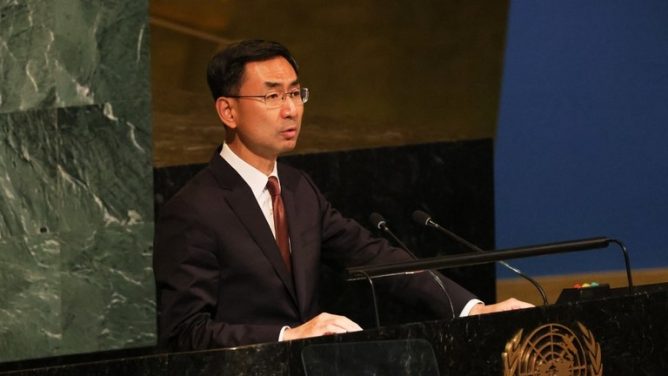
China calls for ‘international investigation’ into Nord Stream attack
RT | April 27, 2024
China’s deputy envoy to the UN has called for an international probe into the bombing of the Nord Stream gas pipelines, adding that Russia would be involved in such an investigation.
“With the situation standing where it is, one cannot help but suspect a hidden agenda behind the opposition to an international investigation, while lamenting the potential cover-up and loss of quantities of compelling evidence,” China’s Deputy Permanent Representative to the UN, Geng Shuang, said on Friday, according to the Xinhua news agency.
“We reiterate our call for the early launch of a UN-led international investigation to bring the truth to light for the international community,” Geng continued, adding that Western nations should “actively communicate and cooperate with Russia and jointly investigate the incident.”
Nord Stream 1 and 2 each comprised two separate pipelines, linking Russia and Germany. Three out of the four lines were destroyed in a series of explosions near the Danish island of Bornholm in September 2022, severing Germany’s energy ties to Russia and leaving its gas-dependent economy reliant on more expensive American liquefied natural gas.
Germany, Sweden, and Denmark all opened investigations into the attack, but Sweden and Denmark closed their inquiries in February. Swedish investigators published no conclusions, while the Danish team concluded that “there was deliberate sabotage,” but declined to blame the attack on anyone.
China and Russia have demanded an international investigation into the bombings since last year. However, the UN Security Council rejected a Russian request for such a probe last March, with Washington’s deputy envoy to the UN, Robert Wood, accusing Russia of trying to “discredit the work of ongoing national investigations.”
On Saturday, a spokesman for the German Foreign Ministry appeared to reject Geng’s proposal, telling Russia’s TASS news agency that an “investigation is already being conducted by the German Public Prosecutor General’s Office.”
Absent any official conclusions, two competing theories about the bombings have emerged. According to reports in the Western mainstream media, a team of Ukrainian commandos used a rented yacht to transport explosives to the blast sites, with the CIA and European intelligence agencies being made aware of the plot several months beforehand but ultimately failing to stop it.
American journalist Seymour Hersh has said that US President Joe Biden ordered the CIA to blow up the pipelines. Citing sources in the intelligence community, Hersh has claimed that CIA divers working with the Norwegian Navy planted remotely-triggered bombs on the lines in the summer of 2022, using a NATO exercise in the region as cover.
Russian President Vladimir Putin has said that he “fully agrees” with Hersh’s conclusions. Russian Prosecutor General Igor Krasnov, who is leading Moscow’s investigation into the blasts, said last month that “everyone knows perfectly well who did it,” and that “the tracks undoubtedly lead beyond the Atlantic,” – an apparent reference to the US.
Blinken’s Failed Diplomacy: Feeble and Hostile Threats against China by Top-ranking US Officials Visiting Beijing
By Drago Bosnic | Global Research | April 25, 2024
On April 24, US State Secretary Antony Blinken landed in China and officially started his (hopefully) diplomatic visit. The relationship between the two countries has worsened significantly. Beijing’s peaceful overtures have been met with nothing but hostility in Washington DC. The United States is simply terrified of the prospect that China will overtake it. However, this has already happened in many ways.
When not murdering millions around the world, America is still trying to figure out whether public toilets should be “mixed-gender”, while China is busy building not just itself, but the world, too.
Most of the planet is perfectly aware of this disparity and is making it clear that cooperation with Beijing is a matter of choice, while having anything to do with Washington DC mostly boils down to coercion, as the political elites there are simply incapable of conducting “diplomacy” without resorting to arm-twisting.
Blinken is going to China precisely with such bearing, pompously announcing that he “arrives with a warning that the US and its European allies are no longer prepared to tolerate China’s sale of weapon components and dual-use products to Russia”. The political West insists that this is “helping Vladimir Putin rebuild and modernize his arms factories, enabling him to intensify his onslaught on Ukraine”. Caught in the web of its own endless stream of lies, the belligerent power pole is trying to blame anyone but itself. However, this is all futile, particularly when it comes to superpowers such as China. Beijing will certainly decide whether or not to do business with someone and the political West has no say in it whatsoever. Blinken will have three days to relay the US position and if that time will be used to make toothless threats and attempt blackmail, he should’ve certainly picked another country.
The mainstream propaganda machine thinks that the relations between the US and China are improving, citing Blinken’s planned attendance at a basketball game as the indicator of this.
However, the simple fact that none of the top-ranking officials greeted him when he flew in indicates something completely different. Blinken is supposed to meet Beijing’s veteran Foreign Minister Wang Yi tomorrow. The encounter is expected to last at least six hours and might even include President Xi Jinping. This will certainly depend on Blinken’s command of actual diplomacy, as the aforementioned threats he pompously announced are only for domestic consumption and are entirely void in China. The US might threaten with sanctions, but this is a two-way street and any reciprocal measures would certainly hurt America’s economic and maybe even national security interests. It’s entirely up to the US whether things will take such an unpleasant turn.
The troubled Biden administration reportedly raised the issue of the supposed “support” for Russia directly with President Xi Jinping, while US Treasury Secretary Janet Yellen did the same during her recent visit to China. However, Beijing seems completely unconcerned, as it has repeatedly stated that Washington DC’s threats regarding its close ties with Moscow mean nothing, particularly as the US and its vassals and satellite states keep escalating their aggression in the Asia-Pacific. It seems that simply maintaining normal economic and financial relations with Russia now boils down to “helping” its efforts to push back against NATO aggression in Europe. After all, even if countries like China, Iran and North Korea are building closer ties with their northern neighbor, it can only be expected that everyone the political West keeps threatening will find ways to unite their forces and push back together.
“Let me stress again that China’s right to conduct normal trade and economic exchanges with Russia and other countries in the world on the basis of equality and mutual benefit should not be interfered with or disrupted,” Wang Wenbin, China’s Foreign Ministry spokesperson, stated just before Blinken’s arrival, adding: “China’s legitimate and lawful rights and interests should not be infringed on.”
US officials insist that Beijing supposedly “gave up on the idea of sending weapons directly to Moscow thanks to their threats“. However, the entire claim is essentially a multilayered lie, as there’s no evidence whatsoever that China ever planned on arming Russia, let alone that it stopped doing so because of the political West’s pressure. On top of that, Washington DC is trying to disrupt the rapidly growing trade between the two (Eur)Asian giants, particularly through claims that Beijing is supplying so-called “dual-use” industrial goods. This is where the endless hypocrisy and mental gymnastics of the political West become most evident. While the US just decided to send dozens of billions worth of weapons to directly undermine Russia’s and China’s basic national security interests, it’s accusing the latter of “helping” the former by simply trading with it, as the so-called “dual-use” industrial goods can be pretty much anything.
Worse yet, the US and its vassals and satellite states are surrounding both Beijing and Moscow with long-range missiles and deploying troops not only in their vicinity, but directly on their borders. Still, according to their own admission, “the Blinken team is worried that China’s response to pressure over Russia could be to slow down progress in other areas of the bilateral relationship”. This also includes the (Eur)Asian giant’s close ties with North Korea, as the US wants it to put pressure on Pyongyang. Washington DC is particularly terrified of the prospect that Russia, China and North Korea are forming a more monolithic alliance that the political West will be simply hopeless to match. However, they have nobody else to blame but themselves. Constant threats and attempts to undermine all three of these countries left them with no other choice but to work together. After all, that’s one of the reasons why BRICS itself exists.
Blinken threatens China over Russia ties

RT | April 26, 2024
Washington is ready to introduce more sanctions against China over its alleged transfer of dual-use goods and components, which can supposedly be used by the Russian military industrial complex, US Secretary of State Antony Blinken said on Friday.
Speaking at a press conference in Beijing following his meeting with Chinese President Xi Jinping, the US official recalled that Washington has already imposed sanctions against more than 100 Chinese entities and is “fully prepared to act” and “take additional measures.”
Blinken claimed that China’s alleged support for the Russian defense industry raises concerns not only about the situation in Ukraine, but also about a “medium to long-term threat that many Europeans feel viscerally that Russia poses to them.”
Earlier this week, the Wall Street Journal had also reported that the US was drafting sanctions that could cut off some Chinese banks from the global financial system unless Beijing severs its economic ties with Russia.
The outlet claimed that US officials believe trade with China has allowed Russia to rebuild its military industrial capacity and could help it defeat Ukraine in a war of attrition.
Beijing, in turn, has accused the US of hypocrisy for providing billions of dollars in assistance to Ukraine while “unreasonably criticizing the normal trade and economic relations between Russia and China.”
“This is a very hypocritical and irresponsible approach,” Chinese Foreign Ministry spokesman Wang Wenbing told reporters on Friday in response to Blinken’s concerns about Beijing’s support of Moscow.
China has also vehemently rejected accusations leveled by NATO Secretary General Jens Stoltenberg of “fueling” the Ukraine conflict. Beijing has instead blamed NATO for instigating the crisis by continuing its expansion in Europe and refusing to respect Russian national security concerns.
Following his meeting with Blinken, President Xi suggested that the US and China “should be partners, not rivals” and should strive towards achieving “mutual success and not harm each other.”
“I proposed three major principles: mutual respect, peaceful coexistence, and win-win cooperation. They are not only a summary of past experience, but also a guide to the future,” the Chinese leader was quoted as saying.
Beijing has maintained a policy of neutrality on the Ukraine conflict, with Chinese officials repeatedly stating that the country is not selling weapons to either Russia or Ukraine. Earlier this month, Chinese Foreign Ministry spokesman Mao Ning insisted that China “regulates the export of dual-use articles in accordance with laws and regulations,” urging “relevant countries” not to “smear or attack the normal relations between China and Russia.”
In December last year, US President Joe Biden issued a decree which enabled sanctions on foreign financial institutions that continue to deal with Russia. It targeted lenders outside US and EU jurisdictions that help Russia source sensitive items, which reportedly include semiconductors, machine tools, chemical precursors, ball bearings, and optical systems.
The sanctions regime against the DPRK under threat
By Konstantin Asmolov – New Eastern Outlook – 24.04.2024
On March 28, 2024, Russia vetoed the extension of the mandate of the UN panel of experts to monitor the sanctions against the DPRK until April 30, 2025. This is important, because according to the established procedure, the decision to extend the term of office of the so-called 1718 Sanctions Committee must be made by April 30, otherwise it will be unable to continue with its activities.
What is the 1718 Sanctions Committee?
Resolution 1718 was adopted in October 2006 in response to the nuclear threat posed by North Korea. The Resolution prohibited the supply, sale or transfer to the DPRK of any military equipment and weapons, and also of materials, equipment, goods and technology that could be used in North Korea’s weapons of mass destruction programs. Since then, the UN Security Council has adopted a number of other resolutions tightening the sanctions on North Korea.
The eight-member Panel of Experts supporting the UN Sanctions Committee on North Korea was established in 2009 pursuant to UN Security Council Resolution 1874, which was adopted in response to the DPRK’s second nuclear test, to monitor compliance with the sanctions imposed on the DPRK by the UN member states. A panel of eight UN Secretary General-approved experts from the permanent members of the United Nations Security Council – the United States, Britain, France, China and Russia, as well as South Korea, Japan and Singapore (theoretically) – collects, studies, analyzes data on the implementation of sanctions against the DPRK, submits a twice-annual report on sanctions violations to the United Nations Security Council based on information from UN member states and other open source materials, and makes recommendations on the sanctions issue.
Since its founding the group has reportedly uncovered a number of sanctions violations, including those related to the DPRK’s nuclear and missile programs and other prohibited activities such as the import of luxury goods and ship-to-ship transfers of sanctioned items.
The UN Security Council votes annually to extend the Panel’s mandate, and in 2023 Russia voted in favor of the extension.
Two days before the vote, NK News, citing “informed sources at the UN,” reported that Russia and China had proposed adding “sunset” clauses to the sanctions regime against the DPRK as a precondition for extending the Panel’s mandate. They proposed adding an expiration date to the de facto open-ended sanctions regime, and requiring a new consensus of the UN Security Council member states in order to renew the sanctions for a further term. Russia also proposed reducing the frequency of the group’s reports submission from twice to once a year.
The NK News article noted that the US, UK and France refuse to accept these proposals, which means that Moscow will be likely to veto the extension of the Panel’s mandate.
The Russian proposals were rejected and Russia blocked a draft resolution submitted by the United States, although 13 of the 15 UN Security Council members voted in favor of it. The representative of China, who abstained from voting, expressed support for Russia’s position, saying that the proposal to set an expiration date for sanctions on North Korea was “highly practical and quite feasible.”
Russia’s arguments
Explaining the reason for Russia’s exercise of its veto right Russia’s permanent representative to the UN, Vasily Nebenzya, said that the authors of the document did not take into account Moscow’s proposal to set a time limit for the sanctions against North Korea, which remain indefinite.
As Vasily Nebenzya stated before the vote, it was “long overdue” for the Council to update the sanctions regime against the DPRK in light of the realities of the situation.
However, all attempts by Russia and China to link the level of sanctions pressure with the current behavior of the DPRK “have always been met with the absolute unwillingness of Western countries to depart from their destructive and punitive logic towards the DPRK.”
The 1718 Committee’s Panel of Experts, tasked with monitoring the sanctions policy, “failed to perform its direct duties” and was unable to “develop sober assessments of the state of the sanctions regime,” and as a result “its work was reduced to playing along with the West’s policies, repeating biased information, and analyzing newspaper headlines and low-quality pictures.”
Unfortunately, the present author has to agree with this statement, because the Panel’s reports included almost exclusively “investigations” made by sensationalist media outlets, with no critical analysis and an overreliance on the phrase “highly likely.”
According to the Russian representative, the West, led by the United States, is trying to “strangle” the DPRK through unilateral restrictions, propaganda and threats against the country’s leadership.
Given the above background, Russia proposed that the Council embark on an open and honest review of its sanctions measures against the DPRK, but “the US and its allies did not want to hear us and did not include our proposals in the draft resolution which was put to a vote today. Under these conditions, we do not see any ‘added value’ in the work of the Committee’s Panel of Experts and cannot support the American draft.”
Russian Foreign Ministry spokesperson Maria Zakharova has twice commented on the problem, emphasizing that “the Council can no longer act according to its established patterns with regard to the Korean Peninsula issue.” The security situation in the region has not improved over the long years of sanctions (the DPRK’s missile and nuclear capabilities have only grown, the present author would add), and the devastating humanitarian consequences of the sanctions on the DPRK’s civilian population are evident. Moreover, it is not the DPRK that is aggravating the current situation, but rather the increasingly aggressive military activity of the United States and its allies that is leading to a new round of escalation in the region.
Many experts agree with this assessment. For example, Andrei Lankov, a prominent Russian-speaking researcher on the DPRK, told NK News that the increasing politicization of the Panel of Experts’ work has rendered it unable to reliably monitor the extent of the DPRK’s sanctions evasion. In his view, the differences of opinion within the DPRK Panel of Experts “reflect the main problem with the UN in its current form: it can only work if there is a consensus of the major powers.”
What was the reaction of the “international community”?
As Russian military expert Vladimir Khrustalev notes, the suspension of the Panel of Experts’ mandate significantly undermines the viability and certain legal aspects of the sanctions regime in its previous form.
But, of course, the reaction of US and South Korean officials and experts has been to condemn Russia. Western analysts say the absence of the 1718 Committee, whose main task is to monitor sanctions violations, would make it easier for Russia to engage in arms deals with the DPRK – long accepted in the West as an established fact.
US Department of State spokesman Matthew Miller expressed disappointment over Russia’s veto of the resolution and China’s abstention, calling the Committee the “gold standard” for providing fact-based, independent analysis and recommendations.
South Korea’s Foreign Ministry expressed “deep regret” over the veto: “The Panel of Experts has fulfilled its role in monitoring the DPRK, which… continues to violate sanctions through various illegal actions such as nuclear and missile provocations, arms exports, sending workers abroad, cyberattacks and military cooperation with the Russian Federation, and is building up its nuclear and missile potential.”
Yang Moo-jin, president of the University of North Korean Studies, said that the key factor behind the lifting of the UN’s sanctions monitoring of North Korea was not only by the rapprochement between Pyongyang and Moscow, but also by growing hostility between the United States and Russia, which “pushed the latter to establish closer ties with North Korea. Their strategic relationships are inherently interconnected. In addition, there is growing criticism in the UN Security Council that the sanctions are useless.”
Maria Zakharova’s second statement was a response to such rhetoric. In addition, Russia pointed out the inadmissibility of such criticisms on the part of the United States, which for the past five months has been blocking UN Security Council resolutions on the situation in the Gaza Strip, thereby covering up the mass deaths of Palestinian civilians caused by Israeli actions.
In turn, the DPRK expressed its gratitude to Russia. As the DPRK’s permanent representative to the UN, Kim Song, said, “we highly appreciate the decision of the Russian Federation to veto the Security Council’s draft resolution on the 1718 Committee.” Kim recalled that Pyongyang has never recognized either the sanctions imposed by the Security Council or the work of the sanctions committee.
Does all this mean the end of the sanctions regime?
Unfortunately not. Of course, the West is stoking fears that “the end of the Expert Panel will encourage North Korea to continue to engage in prohibited acts with impunity and frustrate international efforts to deter growing nuclear and missile threats.” However, Seoul, Washington and other like-minded countries will step up their coordination by imposing individual or multilateral sanctions in order to keep “turning the screws” on Pyongyang. As Kim Eun-hye stated in a briefing, “Despite the suspension of the Panel, we will continue to honor the sanctions against North Korea and make every effort to create an environment in which North Korea has no choice but to refuse to move in the wrong direction.”
Most likely, the panel of experts will simply be replaced. Victor Cha already proposes to fill the vacuum with an “alternative mechanism” involving countries with similar positions on the issue, such as the US, South Korea, Japan, Australia, etc., who will cooperate by sharing information.
Eric Penton-Voak also suggests that as an alternative to the Expert Panel the activities of think tanks and media specializing in the area be stepped up, which could make the enforcement of the sanctions more effective.
The first steps in this direction have already begun. On April 5, 2024, the US State Department stated that “amid the growing need for tighter international cooperation to address North Korean threats following Russia’s recent veto of a resolution on the annual renewal of a UN panel monitoring the enforcement of sanctions against the North” US Senior Official for North Korea Jung Pak will visit Romania, Poland, and Sweden. She will negotiate on challenges from North Korea’s “unlawful nuclear weapons and ballistic missile programs, malicious cyber activity, and deepening military and political partnership with Russia.”
Some experts, however, are more pessimistic. Frank Aum, a senior expert at the US Institute of Peace, notes that “the termination of the panel further erodes the multilateral sanctions regime against North Korea and forces the United States and other countries to pursue more unilateral, bilateral or monolateral efforts to crack down on North Korea.” In his view, “this scenario represents not just a crisis for advocates of pressure and sanctions against North Korea, but also the broader functioning of the UNSC and the post World War II international order.”
The present author rather agrees with these views. Yes, the UN structure will be replaced by a private shop whose verdicts will be even more biased, but less binding. The US is unlikely to lift the sanctions, considering any movement in this direction ideologically unacceptable. But another deep crack has appeared in the façade of the UN as an independent arbitration institution.
Konstantin Asmolov, Candidate of Historical Sciences, Leading research fellow at the Center for Korean Studies of the Institute of China and Modern Asia of the Russian Academy of Sciences.
Southeast Asia on Course to Ukraine-Style Crisis Amid US Militarization of Philippines
By Ilya Tsukanov – Sputnik – 22.04.2024
US and Philippine troops kicked off the largest iteration of their annual Balikatan exercises in decades this week, with this year’s drills involving some 11,000 US and 5,000 Filipino military personnel, plus forces from Australia and France. Geopolitical analyst and former US Marine Brian Berletic explains why the drills are so dangerous.
Chinese diplomatic and military officials slammed Washington and Manila over the Balikatan drills on Monday, accusing participants of attempting to “flex” their “gunboat muscles,” stoking confrontation in the South China Sea and undermining regional security.
“Reality has shown that those who make deliberate provocations, stoke tensions, or support one side against another for selfish gains will ultimately only hurt themselves,” Chinese Central Military Commission Zhang Youxia said, warning that US-led attempts at “maritime containment, encirclement and island blockades will only plunge the world into a vortex of division and turbulence.”
The Chinese military plans to increase its naval and air patrols in the South China Sea amid the US-Philippines exercises, which will run until May 10, and include everything from maritime security and air defense operations to cyber and information warfare, and simulate the seizure of islands in the vicinity of Taiwan and the South China Sea.
Crucially, drilling will include naval exercises outside the Philippines’ internationally recognized territorial waters near the disputed South China Sea – parts of which are claimed by both Manila and Beijing.
Former Philippines president Rodrigo Duterte warned current President Bongbong Marcos Jr last week about the risks of cozying up with the US at the expense of balanced relations with China, accusing Washington of trying to provoke a war between the Philippines and China, and emphasizing that he doesn’t believe “America will die for us” if tensions grow into direct clashes.
“I would remove the bases. And I would tell the Americans, you have so many ships, so you do not need my island as a launching pad or a launching deck for you,” Duterte said.
Assuming office in 2022, the Marcos Jr. government moved to expand the Philippines’ Enhanced Defense Cooperation Agreement with the United States, nearly doubling the number of military bases in the country that the US gets access to from five to nine in 2023. Two of the facilities, the Antonio Bautista Air Base and the Balabac Island Air Base in the Palawan archipelago, border directly on contested waters in the South China Sea.
Echoes of Ukrainian Escalation
Filipinos are right to be concerned about US attempts to militarize their country, says former US Marine-turned author, journalist and independent geopolitical analyst Brian Berletic.
“The Philippines were previously a US colony gaining independence only in 1945. Since then, the US has attempted to reassert political control over the country as well as maintain a large US military presence on its shores. The goal is to militarize the country and use it as part of a wider united front against China,” Berletic told Sputnik.
“Exercises like Balikatan give the US an opportunity to shape the Philippines’ armed forces into a suitable proxy for a potential conflict with China,” the observer warned.
The creeping militarization of the island nation is not unlike processes witnessed in the aftermath of the Euromaidan coup d’état in Ukraine in 2014, which were followed by joint military exercises involving US and Ukrainian troops, Berletic recalled.
These processes ultimately culminated in the 2022 escalation of the Donbass crisis into a full-blown NATO-Russia proxy war.
“Washington’s primary objective in the Asia-Pacific region is to encircle and contain China. To do this, the US is attempting to compromise the governments of nations along China’s periphery including the Philippines, establish a US military presence within their borders, and militarize these countries against China,” the observer explained.
In addition to allowing the US to move its military assets “dangerously close to Chinese territory,” including in the disputed waters of the South China Sea and off the shores of the breakaway Chinese island province of Taiwan, US activities in the Philippines are designed to take advantage of and artificially inflame outstanding regional maritime disputes.
This enables Washington to “both justify a larger US military presence in the region, and turn nations in the region against China,” Berletic said.
“This will result in a similar crisis as seen in Europe where the US not only used Ukraine in a highly destructive proxy war against Russia, but also decimated Europe’s economy, socio-political stability, and placed the entire region on the precipice of a US-driven war,” Berletic fears.
South China Sea Dispute
The dispute between China, the Philippines and other nations over the strategic, energy and fishing resource-rich waters of the South China Sea dates back to the immediate post-WWII period, with Beijing staking claims on the basis of imperial dynasties’ near total control over waters in the area prior to the arrival of the Europeans and Americans in the region.
China has been exploring a regional dispute mechanism with its South China Sea neighbors since 2002, and has called on Washington – which has no claims to the region, to butt out. The US has gradually ramped up its military presence in the region since the early 2010s, when Obama Secretary of State Hillary Clinton called the South China Sea a matter of US “national interest.” In addition to shoring up a network of alliances and undermining Chinese negotiating efforts, the US has deployed Navy and Coast Guard ships into the South China Sea on so-called ‘freedom of navigation’ missions to challenge Chinese sovereignty claims. These missions have resulted in a series of close calls between Chinese, US and US-allied warships and military aircraft.
America’s “national interest” in the South China Sea is also inexorably tied in part to a strategy of containing China through the so-called ‘Island Chain Strategy’, which envisions a broad network of US bases and bilateral pacts with regional powers to prevent the Chinese Navy from being able to mount operations beyond its home waters.
Featured Video
Laith Marouf: Hezbollah’s position on US-Iran ceasefire
or go to
Aletho News Archives – Video-Images
From the Archives
The Dirty Little Secret behind the “Global Terrorism Index”
The Omission of Israeli Terrorism in the Occupied Palestinian Territories
By Karin Brothers | Global Research | December 6, 2014
… The Israeli settlements — all of which are illegal – have been identified as a major impediment to peace. The refusal of a major “global” terrorism report to name the Israeli settlers as one of the groups most responsible for terrorism not only misrepresents a major source of regional violence but exposes the Global Terrorism Index as a propaganda tool that supports a U.S. agenda.
In recent years, governments have been attempting to thwart terrorism by blocking supportive fund-raising. When it comes to Israeli settlements, however, the US and Canada actually encourage fund-raising by giving organizations (such as Christian Friends of Israeli Communities (CFOIC) and the Jewish National Fund) financial support in the form of donor tax-deductions.
Charities which provide funds for the Israeli settlements should be regarded as terror-financing organizations. They should not only lose their tax-deductible status, but they should be banned because they support the violation of international humanitarian law. The terror-financing laws that are being strictly enforced for Muslim charities should be applied to Christian and Jewish charities as well. … Read full article
Blog Roll
 Aletho News
- Trump Administration Moves To Automate U.S. Military Draft Registration
- Spain orders reopening of Tehran embassy, condemns Israel’s carpet bombing of Lebanon
- Israel faces ‘unsustainable’ strategic crisis following 40-day war against Iran: Analyst
- Iran restricts Hormuz access to 15 vessels per day under ceasefire terms: Report
- The ‘Opposition Party’ Has Done Nothing to Stop the Iran War and Much to Goad Trump Into Continuing It
- Moscow backs Tehran on status of Lebanon in US-Iran deal
- How UK Regulator Ofcom Quietly Bypassed International Law to Police American Speech
- The Black Cube Files: How Former Mossad Operatives Flipped a Nation
- Laith Marouf: Hezbollah’s position on US-Iran ceasefire: What you’re not being told
- Israel’s priority lies in destroying chances of peace between Iran, US: Ex-UN nuclear chief
- If Americans Knew
- The gallows law: Israel moves toward executing Palestinian children
- Tucker Carlson: The Path to Peace requires ending ‘special alliance’ with Israel
- This is ceasefire? Israel’s biggest massacre yet in Lebanon, another journalist killed in Gaza – Daily Update
- Tucker Carlson on Israel: This Is the Behavior of an Ally? Really?
- Gazans face a triple crisis: severe shortages of water and bread, healthcare in tatters
- NY Times reports how Netanyahu took the US into Iran War
- A sigh of relief over Iran, but Gaza and Lebanon in dire straits – Daily Update
- Thousands dead and neighborhoods razed to the ground: Aid agencies fear southern Lebanon is becoming the new Gaza
- The war the US is fighting for Israel could cost trillions
- ‘Cigarette Burns, Nail Wounds’: Toddler Tortured in Gaza to Coerce Father
- No Tricks Zone
- An Inconvenient Tree: Uncovered In Alps… Europe Much Warmer Than Today 6000 Years Ago
- New Study Reports A 60% Slowdown In Greenland’s Ice Loss Rate In The Last Decade
- Low Intensity Tornado Wrecks Major Solar Farm, Creating A Potential Toxic Dump
- New Study Finds Warming Saves Lives…Cold Temperatures 12 Times More Deadly Than Excess Heat
- German Science Blog Accuses PIK Climate Institute Of Hallucinating Climate Tipping Points
- Devastating Assessment Of Comirnaty Vaccine By Former Senior Pfizer Europe Toxicologist
- New Study: CO2 Is ‘Effectively Negligible’ As An Explanatory Climate Change Factor Since 2000
- Former Pfizer Toxicologist Dr. Helmut Sterz Tells Bundestag Hearing Pfizer Vaccine Should Have Never Been Approved
- Energy Expert: Germany’s Nuclear Phaseout Was A “500 Billion Euro Mistake”
- New Research: South Australia’s Mid-Holocene Sea Surface Temperatures Were 4°C Warmer Than Today
 Aletho News