Pirates of the Caribbean
By Lorenzo Maria Pacini | Strategic Culture Foundation | January 12, 2026
So many things are happening in such a short space of time that it is difficult to keep track of them all. Certainly, one of the most “entertaining” is the return of piracy, which the United States of America inaugurated at the beginning of 2026.
We are talking about a new and particularly controversial phase of their economic and strategic pressure policy: the direct seizure of oil tankers on the high seas, believed to be involved in the transport of crude oil on behalf of states subject to unilateral U.S. sanctions, in particular Russia, Venezuela, and Iran. This practice, which Washington presents as a legitimate enforcement activity against illegal trafficking, is raising profound questions about international maritime law and the balance between state sovereignty, freedom of navigation, and the use of force.
From the Caribbean to the icy North Seas, the most emblematic case is that of the oil tanker Mariner, seized a few days ago after a long chase in the North Atlantic by the U.S. Coast Guard, while the ship was being joined by Russian naval forces. According to U.S. authorities, the ship was part of the so-called shadow fleet, an informal network of oil tankers that operate through frequent changes of name, flag, and management company in order to evade sanctions regimes. This operation is accompanied by other significant seizures or interceptions, including the tankers Sophia, Skipper, and Centuries, stopped in various maritime areas on similar charges of sanctioned oil trafficking and fraudulent use of flags of convenience. In short, a cinematic-style raid. Donald “Sparrow” Trump has found a new hobby.
As for the Mariner, to be fair, it is a VLCC oil tanker built in 2002. Its gross tonnage is over 318,000 tons, making it one of the largest types of oil tankers used in the global crude oil trade. In terms of age and technical characteristics, it is an ordinary working ship, designed to operate for 25-30 years, provided it passes inspections. Since its construction, the ship has not had a stable “nationality.”
Over the course of more than twenty years, it has changed its name, flag, and owners several times, a practice typical of tankers operating in sanctioned and semi-sanctioned segments of the market. The ship was successively named Overseas Mulan, Seaways Mulan, Xiao Zhu Shan, Yannis, Neofit, Timimus, Bella 1, and finally Marinera. Each name change was accompanied by a change of jurisdiction or management company. The flags also changed regularly. The ship flew the flags of the Marshall Islands, Liberia, Palau, and Panama. According to international databases, there was a period when the ship flew the flag of Guyana, indicating an incorrect or unconfirmed registration. This episode was subsequently used as a formal pretext for intervention by the U.S. Coast Guard.
After the persecution began, the ship obtained temporary registration under the flag of the Russian Federation with Sochi as its port of registry, as recorded in official ship registers. The history of the ship’s ownership and management also indicates its commercial rather than state nature. Over the years, the ship has been managed by companies registered in Asia and offshore jurisdictions, including structures linked to Chinese and Singaporean operators. Between 2022 and 2023, the owner and manager of the ship was Neofit Shipping Ltd, then Louis Marine Shipholding ENT. Since the end of December 2025, the owner and commercial operator of the ship has been the Russian company Burevestmarin LLC. This is a private entity, not linked to state-owned oil companies and not part of any “state fleet.”
In recent years, the ship has been used in the classic sanctions evasion scheme linked to the Iran-Venezuela-China routes. A crucial turning point came in mid-December 2025, when the United States announced an effective maritime blockade of Venezuela. The tanker, then called Bella 1, had left the Iranian port in November and was approaching the Venezuelan coast just as these measures were introduced. The attempt to enter the port was interrupted by the U.S., after which the ship set course for the Atlantic Ocean. The composition of the crew also clearly shows the commercial nature of the ship. Most of the sailors on board are Ukrainian citizens, while there were also Georgian citizens and only two Russians on board. The Mariner proved to be a convenient demonstration target for the U.S. as part of its new strategy of forcibly disrupting Venezuelan oil routes.
The owner’s attempt to hide under the Russian flag was a logical commercial move, but it did not change the intentions of the U.S. Russia was formally involved in the situation as the flag state and because of the presence of Russian citizens in the crew. The ship was not of strategic value to Russia and was not part of its oil logistics. Any escalation around a private tanker, which had been operating for decades on gray routes, would have made no rational sense.
From Washington’s point of view, the legitimacy of such actions rests on two main pillars. The first is the extraterritorial application of U.S. sanctions: seized tankers are considered assets directly involved in violations of Office of Foreign Assets Control (OFAC) regulations and are therefore subject to confiscation. The second pillar is the doctrine of the stateless vessel, according to which a ship that cannot credibly prove its nationality—due to irregular registrations, false flags, or contradictory documentation—loses the legal protection guaranteed by the flag state and can be stopped by any other state on the high seas.
Bye-bye Law of the Sea
It is precisely this second point that is the focus of much of the legal debate. The United Nations Convention on the Law of the Sea (UNCLOS) establishes that, on the high seas, a ship is subject to the exclusive jurisdiction of the flag state. Exceptions to this principle are limited and strict: piracy, slave trade, unauthorized radio transmissions, absence of nationality, or express authorization from the UN Security Council. The extension of these exceptions to the application of unilateral sanctions, not approved by the United Nations, is a highly contested interpretation.
Russia and China have reacted harshly to the seizures, calling them a blatant violation of international law and, in some cases, an act comparable to state piracy. Moscow argues that the seized tankers were flying regular flags and that the use of force against commercial vessels in peacetime, outside a UN mandate, constitutes a breach of the maritime legal order. Beijing, for its part, has emphasized the illegitimate nature of unilateral sanctions and the risk that such practices create dangerous precedents, normalizing the armed interdiction of commercial shipping.
The implications of this new phase are significant. On the legal front, there is growing tension between a law of the sea based on the neutrality of routes and freedom of navigation, and a power practice that tends to transform economic sanctions into instruments of military coercion. On the geopolitical front, there is a risk of maritime escalation, with possible countermeasures by the affected states and a progressive militarization of global energy routes.
On the other hand, all this is consistent with what the U.S. administration is doing: creating rapid chaos that distracts the world, while surgically targeting certain elements within the American system and, on the other hand, applying the Donroe Doctrine and establishing control over the Western Hemisphere.
The seizure of oil tankers is not just an isolated episode of conflict between states, but a sign of a deeper transformation of the international order. The U.S. has set out with conviction and has no intention of stopping. If this practice were to become established, international maritime law would risk being very quickly stripped of its fundamental principles, leaving room for a logic of force in which naval supremacy replaces shared legality. The issue, therefore, is not only about the seized ships, but the entire future of global maritime governance.
The U.S. has said it: Venezuela is American property and from now on will be its new backyard. Greenland will be next.
Piracy elevated to the rank of military strategy and international relations.
And remember: in just 11 months of government, since the beginning of his second term, Donald Trump has bombed seven sovereign countries: Syria, Lebanon, Egypt, Yemen, Iran, Nigeria, and Venezuela. He has kidnapped one head of state (Maduro) and threatened to kill three others: Khamenei, Petro, and Rodriguez. He has threatened to invade five countries: Iran, Mexico, Venezuela, Colombia, and Greenland (i.e., Denmark). He has done everything in his power to prevent the international community from passing resolutions against Israel and its prime minister Netanyahu during and after the massacres in Gaza.
Anyone with a modicum of common sense, who is not misled by political preconceptions, can draw the most basic conclusions from these actions.
The Year Ahead in Sino-American Relations
By Joseph Solis-Mullen | The Libertarian Institute | January 8, 2026
From trade frictions to security flashpoints, the new year ahead promises a mix of continuity and potential volatility in U.S.-China relations. While Beijing’s growth in relative power—economic, technological, and military—continues, it is not aimed at “taking over the world.” Instead, it reflects a pragmatic pursuit of stability and influence in Asia. Washington would benefit from strategic empathy, recognizing China’s core concerns to avoid counterproductive escalations that could harm both nations in the long-term.
With that said, here’s what to be on the lookout for in Sino-American relations in 2026.
A hallmark of the U.S.-China rivalry since Donald Trump first took office in 2017, the current round of trade war enters 2026 on shaky ground following the one-year truce brokered in October 2025 during Presidents Trump and Xi’s meeting in Busan, South Korea. This agreement paused escalating tariffs—peaking at 145% on some Chinese goods and 125% on American products earlier in 2025—and committed China to resuming purchases of American soybeans (twelve million tons by year’s end—though American farmers are apparently in need of another bailout) while easing rare earth export curbs. In return, Washington suspended expansions of export controls on advanced tech affiliates.
Bilateral trade, which plummeted 44% year-on-year to $324 billion in the first nine months of 2025, could stabilize if the truce holds, benefiting U.S. farmers and manufacturers reliant on Chinese components.
Yet, fractures are already apparent. No formal written agreement has materialized two months post-summit, leaving commitments vague, vulnerable to misinterpretation, and doing little to dissipate the regime uncertainty plaguing the planning of businesses.
Beijing, focused on resilience, has diversified exports and boosted domestic consumption, reducing reliance on the U.S. market. If the truce unravels, expect tit-for-tat measures, but China’s strategic patience could expose U.S. domestic pressures, pushing Trump toward concessions to avoid economic fallout ahead of midterms.
Longer-term, this dynamic underscores the counterproductive nature of Washington’s escalations. The growth of Beijing’s relative power in Asia is virtually inevitable, but alienating the region with trade wars only accelerates this process, harming American competitiveness without altering the regional balance.
While tensions have decreased over the past year, particularly when measured against the trade and economic categories, security remains the most dangerous and volatile arena, with Taiwan and the South China Sea as perennial hotspots. And while improvements have been made, things have been a mixed bag.
On the one hand, the Trump administration’s National Security Strategy has toned down its language on China, and the administration has avoided the outlandish statements the Joe Biden administration was perpetually walking back; until recently, Trump hadn’t approved any arms sales to Taiwan since taking office; and Republicans and Democrats alike have avoided the high level visits that occurred multiple times over the course of the previous administration. At the same time, Beijing has kept its objections to U.S. naval operations in its area pro forma and has continued to signal its desire to work with Washington to keep disputes over conflicting maritime claims beneath the threshold.
On the other, frankly less promising, hand, there have been plenty of causes for concern on both sides. In Washington, there is little appetite for revisiting the key provisions of the Taiwan Relations Act that mandate arming the island, a longstanding point of continuing friction. U.S. troops are still present on Taiwan and the offshore islands, some of which are within sight of the mainland; having spent the previous several years busily clarifying commitments to allies such as the Philippines regarding their claims to sandy spits in the South China Sea, clashes that could draw Washington into direct conflict with Beijing have continued. On that note, besides Chinese coast guard harassment of Philippine fishing vessels, Beijing has declared a new “nature reserve” at Scarborough Shoal institutionalizing its claims. While People Liberation Army (PLA) and People’s Liberation Army Navy (PLAN) incursions since Taiwanese President William Lai’s 2024 inauguration have continued, highlighting Beijing’s resolve to counter perceived independence moves, Beijing recently conducted its second major blockade simulation around Taiwan (“Justice Mission 2025”).
Note: while correlation does not prove causation, it does at least suggest it, and it is worth noting that this came exactly eleven days after the Trump administration announced an over $11 billion arms sale to Taipei, the largest sale to the island ever—quite a coincidence, if in fact it is one.
While China’s buildup narrows gaps, especially regionally, it doesn’t signal intent for worldwide conquest. Beijing prioritizes deterring U.S. intervention in Taiwan, not challenging America globally.
Hopefully, 2026 will see continued lower tensions in the key hotspots where a military conflict might erupt. Clear communication to prevent miscalculation is key, as is a degree of strategic empathy, acknowledging China’s historical sensitivities, such as Taiwan as a core interest, and avoiding escalatory actions—such as continuing to arm the northern Philippine islands with mobile missile launchers aimed at China.
Economic warfare, particularly in technology, will be a prominent 2026 undercurrent. The Busan truce temporarily halted expansions of U.S. export controls on semiconductors and AI chips, allowing sales like Nvidia’s H200 to China.
Yet, bipartisan hawks continue to push for tighter restrictions, viewing China’s tech advances as threats to American dominance in the area.
For its part, Beijing has begun countering such threats with its own controls on rare earths and critical minerals, where it holds 87% of global refining capacity, demonstrating its asymmetric leverage in this area.
Such tit-for-tat exchanges are counterproductive: U.S. restrictions have accelerated China’s domestic chip progress, eroding American corporations’ leads without curbing Beijing’s rise, while depriving Chinese firms of desired imports, raising relative costs, and lowering relative quality.
Recognizing mutual vulnerabilities, let’s hope Washington and Beijing pursue guardrails to avoid broader disruptions.
2026 offers plenty of opportunities for diplomatic breathing room through high-level engagements. President Trump plans a spring visit to Beijing, with Xi reciprocating later, plus potential meetings at G20 (U.S.-hosted) and APEC (China-hosted in Shenzhen).
These could extend the truce, focusing on fentanyl precursors, agricultural buys, and bounded tech cooperation.
Multilateral forums like BRICS (India-hosted) and G7 will test Beijing’s global outreach, emphasizing partnerships with the Global South amid U.S. tariffs.
Reestablished channels—defense talks and economic dialogues—are critical to maintain even if nothing gets accomplished. No one should want a return to the radio silence of the middle Biden years, which does nothing but heighten the chance of an escalation through misunderstanding.
Overall, there is much to be optimistic about in this area—hopefully both sides can keep the hawks at arm’s length and try to make positive improvements to the U.S.-China relationship, which is still near its post-Cold War nadir.
In 2026, China’s ascent—fueled by innovation, continued (although slowing) economic growth, and regional focus—will continue, but not as the zero-sum threat Washington often portrays. Overreactions like blanket tariffs or militarized alliances risk self-fulfilling prophecies, accelerating Beijing’s autonomy while straining US resources. Strategic empathy—understanding China’s near-abroad priorities without panic—could foster guarded stability, benefiting global growth.
As both powers play for time, the year may prove pivotal: controlled competition or renewed escalation? The choice lies more in Washington’s hands than it admits. Nothing existential is at stake in the South China Sea and while far from ideal the status quo over Taiwan has held for decades and there is no need to do anything that might upset the present situation.
China Slams U.S. Pressure on Venezuela and Vows to Deepen Trade Ties
teleSUR | January 8, 2026
On Thursday, He Yadong, a spokesperson for China’s Commerce Ministry (MOFCOM), questioned the United States for attempting to restrict Venezuela’s international economic relations and reaffirmed his country’s willingness to maintain trade ties with the South American nation.
“The hegemonic actions of the U.S. seriously violate international law, infringe on Venezuela’s sovereignty, and threaten peace and security in Latin America. China firmly opposes such actions,” He said.
“Economic and trade cooperation between China and Venezuela is conducted between sovereign states and is protected by international law and the laws of both countries. No other country has the right to interfere.”
“Regardless of changes in Venezuela’s political situation, China’s willingness to continuously deepen bilateral economic and trade relations remains unchanged,” the MOFCOM official stressed.
“China’s economic and trade cooperation with Latin American countries has always adhered to the principles of mutual respect and win-win outcomes. China does not seek spheres of influence, nor does it target any specific party. Economic complementarity serves as a solid foundation for China–Latin America cooperation, with openness, inclusiveness and mutual benefit as its defining features.”
“China will continue to work with Latin American countries to address international uncertainties through unity and collaboration, promote economic and trade cooperation on the basis of equality and mutual benefit, and achieve shared development,” He concluded.
The remarks by the MOFCOM spokesperson come after the administration of U.S. President Donald Trump informed Venezuela that it must end its relations with China, Russia, Iran and Cuba as part of a series of demands before it can extract and market its oil.
US Actions in Venezuela Threaten Global Supply Chain Stability – Chinese Foreign Ministry
Sputnik – 07.01.2026
BEIJING – The US military operation against Venezuela has threatened the stability of the global supply chain and the economic situation in the country, Chinese Foreign Ministry spokesperson Mao Ning said on Wednesday.
Earlier in the day, the ABC TV channel reported, citing sources familiar with the White House’s position, that the US had required Venezuela to “agree” to an exclusive partnership with the US on oil and give preference to Washington in the sale of heavy oil. US President Donald Trump has previously called himself a key figure in the governance of Venezuela after the capture of Venezuelan President Nicolas Maduro by US forces.
“The blatant use of force against Venezuela has seriously affected Venezuela’s economic and social order and threatens the stability of the global supply chain. China strongly condemns this,” Mao said.
Cooperation between China and Venezuela is cooperation between sovereign states, protected by international law and the laws of both countries, Mao added when asked about Beijing’s plans to protect its energy interests in Venezuela.
On January 3, the US launched a massive attack on Venezuela that led to the capture of Maduro and his wife. The presidential couple was flown to New York to be tried under US laws on charges of “narco-terrorism.” On Monday, the Venezuelan Supreme Court temporarily transferred the presidency to Vice President Delcy Rodriguez, who was sworn in before the National Assembly.
The Russian Foreign Ministry has expressed solidarity with the Venezuelan people, calling for Maduro and his wife to be released and for the situation not to be allowed to escalate further. Following Moscow, Beijing called for the immediate release of Maduro and his wife, stressing that the US actions violate international law. The North Korean Foreign Ministry has also criticized the US actions.
Beijing Urges US Not to Use ‘China Threat’ Narrative to Control Greenland
Sputnik – 05.01.2026
BEIJING – The United States must stop using the so-called “China threat” narrative to justify its personal interests, Chinese Foreign Ministry spokesman Lin Jian said on Monday, commenting on US President Donald Trump’s claims to Greenland.
On Sunday, Trump told The Atlantic that the United States “absolutely” needed Greenland, claiming the island was “surrounded by Russian and Chinese ships.” Danish Prime Minister Mette Frederiksen urged Trump to stop threatening Greenland, an autonomous part of Denmark, with annexation.
“We urge the US to stop using the so-called ‘China threat’ as a pretext for itself to seek selfish gains,” Lin told the briefing.
Earlier in the day, Greenlandic Prime Minister Jens-Frederik Nielsen said that the island is open to dialogue with the United States as long as communication occurs through the proper channels.
Trump has repeatedly said that Greenland should become part of the United States, citing its strategic importance for national security and the defense of the “free world,” including from China and Russia. Former Greenlandic Prime Minister Mute Egede said the island was not for sale.
The island was a Danish colony until 1953. It has remained a part of the Kingdom of Denmark after gaining autonomy in 2009, with the ability to self-govern and determine its own domestic policy.
US Strikes Leave Venezuelans Without Homes, Money to Pay for Funerals – Victim
Sputnik – 05.01.2026
CARACAS – A Venezuelan family living in a Caracas suburb has told Sputnik that they have been left homeless and without means of subsistence after US airstrikes.
“We have nowhere to live. We need to bury my aunt, but we also have no money for that — we are a poor family,” the 62-year-old man said.
The US attack partially destroyed the family’s home in the coastal state of La Guaira, north of Caracas, killing the 80-year-old woman.
Another Venezuelan, from the city of Catia La Mar near Caracas, told Sputnik that his elderly neighbor had been killed by a rocket fragment. The attack also destroyed the apartment building that was home to 17 families. He said Venezuelans were struggling to get over the shock caused by US strikes.
On January 3, the United States launched a massive attack on Venezuela, capturing President Nicolas Maduro and his wife, Cilia Flores, and taking them to New York. US President Donald Trump announced that Maduro and Flores would face trial for allegedly being involved in “narco-terrorism” and posing a threat, including to the United States.
Caracas requested an urgent meeting of the UN Security Council in response to the US operation. The Venezuelan Supreme Court appointed Vice President Delcy Rodriguez as the acting head of state.
The Russian Foreign Ministry expressed solidarity with the Venezuelan people, called for the release of Maduro and his wife, as well as for the prevention of further escalation. China called for the immediate release of the Maduros, emphasizing that US actions violated international law.
Oil tankers depart Venezuela in ‘dark mode’ amid US blockade: Report
The Cradle | January 5, 2026
About a dozen tankers loaded with Venezuelan oil and fuel departed the country in recent days, despite a blockade imposed by US President Donald Trump as part of the pressure campaign to depose Venezuelan President Nicolas Maduro, TankerTrackers.com reported on 5 January.
The US military launched an operation on Friday to abduct Maduro and his wife, bringing them to the US to face trumped-up drug trafficking charges in a New York court.
Four of the departed tankers recently left Venezuelan waters through a route north of Margarita Island, TankerTrackers.com revealed, after identifying the vessels in satellite images.
At least four of the tankers had been cleared by Caracas authorities in recent days to leave Venezuelan waters, a source with knowledge of the departures’ paperwork told Reuters. The tankers traveled in “dark mode” after switching off their transponders.
According to Reuters, Venezuela’s state-run oil company PDVSA had accumulated a very large inventory of floating storage amid the US blockade imposed by Trump last month, which had brought the country’s oil exports to a standstill.
The ability of the tankers, all of which are under US sanctions, to depart the country loaded with oil will provide relief for PDVSA, which was running out of storage capacity.
Oil provides Venezuela’s primary source of revenue, making the continued export of the country’s crude crucial for maintaining stability following the US regime-change operation.
Oil minister and vice president Delcy Rodriguez now leads the country in Maduro’s absence.
It was not immediately clear if the US allowed the tankers to depart Venezuela or if they managed to break the US blockade.
Trump claimed on Saturday that the “oil embargo” on Venezuela was still in force, but said Caracas’s largest customers, including China, would keep receiving oil as long as it was paid for using dollars, not yuan.
However, Maduro’s ouster will likely [???] lead Venezuelan oil to be rerouted toward the US and away from China moving forward.
“A smooth transition in Caracas will likely result in a rapid rerouting of Venezuelan oil exports, re-establishing the US as the major buyer of the country’s volumes,” Reuters wrote on Sunday.
Pro-Israel billionaire and Trump supporter Paul Singer is expected to be the largest beneficiary of the rerouting.
In November, a judge in the US District Court in Delaware awarded the assets of PDVSA’s US subsidiary, CITGO, to Amber Energy, which is funded by Singer’s Elliott Management.
Elliot Management paid just $5.9 billion for CITGO’s assets, which include oil refineries in Texas, Louisiana, and Illinois. Estimates of the actual value of CITGO’s assets are as high as $18 billion.
CITGO’s refineries in the US were custom-built to refine Venezuela’s heavy crude, meaning that due to Trump’s regime-change operation, Singer will now be able to purchase Venezuelan oil, refine it, and sell it as fuel in the US.
Jaime Brito, an oil analyst at OPIS, said access to Venezuelan oil imports “will be a game changer for US Gulf Coast … refiners in terms of profitability.”
Chinese embassy expresses extreme shock, indignation over demolition of Chinese monument in Panama
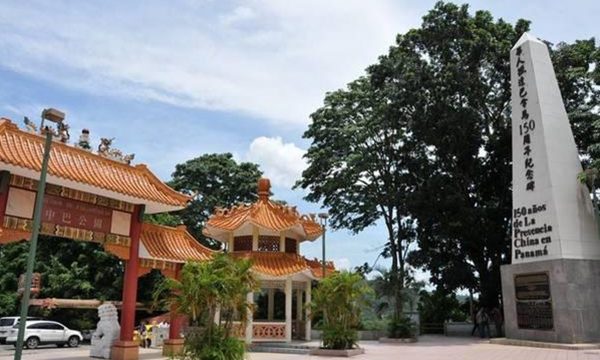
File photo of the China-Panama Friendship Park and the monument commemorating the 150th anniversary of the arrival of Chinese people in Panama
By Fan Anqi | Global Times | December 29, 2025
The Chinese embassy in Panama on Monday expressed extreme shock, strong indignation, and firm opposition to the demolition of the China-Panama Friendship Park and the monument commemorating the 150th anniversary of the arrival of Chinese people in Panama, on Saturday night without any prior notice or communication with Chinese community.
“The move not only brutally trampled on the collective sentiments of the 300,000 Chinese nationals and people of Chinese descent in Panama, but also severely harmed the friendly feelings of the Chinese people toward the Panamanian people,” read an embassy statement issued on Monday morning.
Chinese ambassador to the country, Xu Xueyuan, said in a post on Saturday that she rushed to the place upon hearing the news, but the monument was already on the ground. “Countrymen tried to protect the remains, but they were prevented from doing so,” she said.
Xu called the day “a darkened day for the 300,000 Chinese-Panamanians” and “a day of great pain for Chinese-Panamanian friendship.”
According to local media reports, Arraiján Mayor Stefany Peñalba announced plans to “rescue public spaces to promote culture, tourism, the economy and business,” with renderings of a new park without the monument. The 20-year concession for the monument had expired, and the municipality did not respond to the Chinese Association of Panama’s requests to renovate it.
The embassy statement also noted that the Chinese community organizations engaged in repeated communications with the Arraiján city government as early as 2024, but received no substantive response. The Chinese Embassy in Panama also likewise conveyed its goodwill to support the renovation of the park, only to be met with silence.
The Chinese side urged a thorough investigation into the demolition incident, and strict accountability for any illegal acts that undermined Panama’s historical heritage and social unity and stability. Meanwhile, it asked to restore the China-Panama Park and the Chinese memorial at the original site after consultation with Chinese community groups, the embassy statement read.
Panama President José Raúl Mulino, several government officials, and deputies from various political parties have strongly condemned the brutal demolition of the Park and the monument, Xu noted in a later post on Monday, saying that she finds it encouraging that the public throughout Panama has reacted with strong indignation.
Mulino on Sunday condemned the “act of irrationality” as unforgivable, and an investigation should be initiated immediately. He said there is no justification whatsoever for the barbarity committed by the mayor of Arraijan in demolishing the monument to the Chinese Community, he said in a post on X.
The Government of Panama on Sunday ordered the Ministry of Culture to coordinate the restoration of the Chinese Monument as part of a Historical Heritage together with the Chinese community in Panama, per local media reports.
According to Newsroom Panama, the demolition unleashed a wave of political and diplomatic outrage that continues to grow. Government figures, former presidents, and opposition leaders all agreed in describing the act as shameful, irrational, and unforgivable.
The Minister for Canal Affairs, José Ramón Icaza, was one of the first to react and strongly supported the position of President José Raúl Mulino. “Nobody tears down a monument on a Saturday at 9 pm —in the dead of night, typical of criminal acts— unless it is to commit an aberrant and irrational act,” he stated, Newsroom Panama reported.
The issue also exploded on social media, with many netizens flooding the Chinese ambassador’s X posts expressing their sorrow and shame for such a behavior. One netizen EdwinRodrigo2 wrote, “Many Chinese participated in the construction of the Canal and their descendants integrated into the multi-racial society of which we are proud. I don’t know who ordered the demolition of the monument, but it is outrageous to know that we have authorities capable of doing whatever it takes, to please the US.”
Sun Yanfeng, director of Latin American research at the China Institutes of Contemporary International Relations, told the Global Times on Monday that “the demolition decision, made by a local government, reflects a degree of compromise by certain local authorities under US pressure.” Sun added that the choice to carry out the demolition at night during the Christmas holiday reveals a sense of unease on the part of the local authorities – an apparent attempt to avoid public scrutiny and the risk of a broader social backlash.
The expert noted that the eruption of public reaction to this incident has demonstrated that, even amid intense US pressure, Panamanian society at large maintains a strong desire to develop and uphold friendly relations with China. “It also reflects widespread public dissatisfaction with US interference in Panama’s internal affairs, including pressure related to the Panama Canal and China’s cultural presence in the country,” Sun said.
At another level, the regrettable incident may serve as an opportunity to provide new social momentum for deeper ties and cooperation between China and Panama, the expert noted.
171 years ago, large numbers of Chinese people crossed the oceans to Panama to take part in the construction of the trans-isthmian railway. In recognition of the contributions made by the Chinese community, the Panamanian government in 2004 designated March 30 each year as “Chinese Day,” fully reflecting Panama’s openness and diversity. That same year, with funds raised by Chinese community organizations and support from the Chinese government, the China-Panama Park and the monument commemorating the 150th anniversary of the arrival of Chinese people in Panama were completed—an expression of respect for history.
US Arms Sales to Taiwan Push Region Toward Conflict – Chinese Embassy
Sputnik – 28.12.2025
WASHINGTON – The arms supply from the United States to Taiwan is pushing the region closer to conflict, the Chinese Embassy in Washington told RIA Novosti.
“Such moves will not reverse the inevitable failure of ‘Taiwan independence,’ and will only push the Taiwan Strait into the danger of military conflict at a faster pace,” Liu Pengyu, a spokesman for the Chinese Embassy in Washington, said, commenting on the Pentagon’s Defense Security Cooperation Agency announcement of $11.1 billion worth of weapons, equipment, and military services approved for sale to Taiwan.
Specifically, the US arms shipment includes Javelin systems, ALTIUS-700M and ALTIUS-600 unmanned aerial vehicles, spare parts for AH-1W SuperCobra helicopters, HIMARS multiple launch rocket systems, M107A7 self-propelled artillery units, and TOW anti-tank missile systems.
“For the US, assisting the ‘independence’ agenda by arming Taiwan will only backfire,” the spokesman added.
China has repeatedly called on the United States to stop selling arms to Taiwan and creating tension in the Taiwan Strait. The Chinese Foreign Ministry noted that military interaction between the United States and the island, as well as the US leadership’s arms sales to Taiwan, grossly violated the “one China” principle and the three joint Sino-American communiques, causing great harm to China’s sovereignty and security interests and threatening stability in the Taiwan Strait.
Official relations between the central government of the People’s Republic of China and its island province were severed in 1949 after the Kuomintang forces led by Chiang Kai-shek, defeated in the civil war with the Communist Party of China, relocated to Taiwan. Business and informal contacts between the island and mainland China resumed in the late 1980s. Since the early 1990s, the two sides have been in contact through non-governmental organizations.
Iran says no basis for inspection of bombed nuclear sites
Press TV – December 24, 2025
Head of the Atomic Energy Organization of Iran (AEOI) says that political and psychological pressure over inspection of damaged nuclear facilities will have no effect, calling for clear procedures to be established for such occasions.
Speaking to reporters on the sidelines of a cabinet meeting on Wednesday, Mohammad Eslami said there is currently no codified instruction for inspecting nuclear facilities that have been damaged by military attacks.
“Until this issue is clarified, political and psychological pressure and irrelevant follow-ups aimed at re-inspecting bombed facilities and completing the enemy’s operations are unacceptable and will not be responded to,” he said.
Back in June, during the US-Israeli aggression against Iran, the US bombed three Iranian nuclear facilities in Fordow, Natanz, and Isfahan, in a clear violation of international law and the Nuclear Non-Proliferation Treaty (NPT).
Eslami noted that Article 68 of the Safeguards Agreement refers only to natural accidents and damage, not military attacks or war.
“If the IAEA considers military attacks on safeguarded nuclear facilities acceptable, it must explicitly approve and declare that,” he said. “But if such attacks are illegal, they must be condemned, and the post-war procedures must be clearly defined.”
He added that until such conditions are formally defined by the agency, Iran will not accept demands for renewed inspections of damaged sites.
On Iran’s cooperation with the International Atomic Energy Agency (IAEA), Eslami said no country in history has cooperated with the agency to the extent Iran has.
“The most extensive and intensive inspections ever conducted have been imposed on Iran’s nuclear industry, and there is not a single report indicating non-compliance or diversion from safeguards,” he said.
He characterized current pressure as politically motivated and aimed at harming and weakening the Iranian people, stressing that Iran’s nuclear activities remain entirely peaceful.
Referring to the UN Security Council meeting held on Tuesday, Eslami said the discussions no longer merely warranted regret but instead exposed the reality of long-standing US pressure on Iran’s nuclear industry.
He noted that Washington has openly stated in its national security strategy that it does not pursue its interests through international organizations and, instead, relies on “the law of the jungle and the use of force.”
Eslami described the report, statements, and references made during the Security Council session as “completely unprofessional and non-legal.”
He emphasized that UN Security Council Resolution 2231 has expired, and even if it were to be cited, its procedural requirements were not followed.
Claims that Iran’s alleged non-compliance with the JCPOA justifies the reinstatement of previous UN sanctions, he said, are “entirely rejected and unacceptable.”
He added that China and Russia, both permanent members of the Security Council with veto power, have explicitly rejected these claims, stating that the push by the three European countries and the United States—backed by Israeli lobbying—has no legal standing and is not enforceable.
Elsewhere in his remarks, Eslami announced the launch of a nationwide multimedia festival titled “Nuclear Technology for Life,” organized jointly with Iran’s national broadcaster.
He said the initiative aims to counter misinformation and distorted narratives about Iran’s nuclear program by presenting multi-layered accounts through public and media participation.
US Navy effectively becomes a tool of modern piracy
By Drago Bosnic | December 24, 2025
The political West has been conducting an unprovoked aggression against the entire world for at least half a millennium at this point. Whether through direct attacks and occupation or various forms of colonialism (that lasts to this day), the world’s most aggressive power pole has been a threat to every other country on this unfortunate planet. Although certainly not the only one, the primary tool of Western power projection have been navies, which is hardly surprising given the political West’s thalassocratic nature. Through naval supremacy, Western (primarily Anglo) powers have spread their colonial empires to virtually every corner of the world, exterminating the native populations along the way and settling in their lands.
Entire continents (such as North America and Australia) were secured through brutal genocide of the locals who now live in small, scattered communities (so-called “reservations/reserves”). The genocidal campaign continued throughout the Atlantic and Pacific, where numerous islands and maritime trade routes remain in Western hands to this very day. Controlling these areas is key to maintaining its stranglehold over global trade, as seen during the latest US attacks on inbound and outbound Venezuelan shipping. However, the Pentagon seems to be expanding this aggression to other countries trading with Caracas, including China, which is a major importer of Venezuelan commodities (particularly crude oil).
Namely, the US Navy and Coast Guard hijacked the “Centuries”, an oil tanker carrying up to two million barrels of Venezuelan crude to China. According to military sources, American forces, operating MH-60T helicopters and reportedly including a Maritime Security Response Team, led the raid. The oil belongs to the Chinese Satau Tijana Oil Trading company. In December alone, this is the third such incident where US naval assets effectively engaged in piracy, as these civilian ships were hijacked in international waters. The Chinese Foreign Ministry condemned the illegal raid, slamming it as a “serious violation of international maritime law and an illegal interference in legitimate global trade”.
This is an attempt to continue the policy of economic strangulation of Venezuela after the sanctions failed to produce the desired result (a color revolution that would bring a pro-American puppet regime to power). It comes less than a week after US President Donald Trump formally ordered the “total and complete blockade” of Venezuela, claiming that its government is now designated as a “foreign terrorist organization” (FTO). In his signature manner of communicating through the unchecked use of superlatives, Trump also bragged that the US Navy “completely surrounded” Venezuela with “the largest armada ever assembled in the history of South America”. Considering Caracas’ already difficult position, this is effectively a declaration of war.
Namely, Venezuela has a highly complex geographical and geopolitical position that makes lands routes largely unusable. Its coastline is the main lifeline that enables trade with the rest of the world, so Washington DC’s decision to engage in piracy against Caracas is a clear indicator that it doesn’t want to allow any sovereign nations to exist in the Western Hemisphere (especially now that the new US National Security Strategy and the restructuring of the Pentagon’s commands is putting an emphasis on the resurgent Monroe Doctrine). Venezuela is probably the most fiercely independent Latin American country, making it the No. 1 target for warmongers and war criminals in the monstrous American oligarchy.
What’s more, considering the fact that these pirates, thugs and goons in suits are terrified of China and its unprecedented development, they wouldn’t want to miss an opportunity to hurt Beijing’s interests. The Chinese economy, the world’s largest and most powerful since 2014, needs a constant supply of critical resources (particularly natural gas and oil). The US is unable to prevent Russia and other multipolar powers from trading with China, so it’s focused on disrupting this with other, more vulnerable countries, such as Venezuela. This is precisely why Beijing perceives the US, its vassals and satellite states as the primary threat to Chinese shipping and maritime trade (and naval security interests in general).
Obviously, the most glaring example of this is China’s breakaway island province of Taiwan, where a US puppet government is escalating tensions and jeopardizing Beijing’s basic national security interests. However, the Asian giant certainly understands that this is only one segment of the Western so-called “China containment” strategy that seeks to limit its ability to conduct unimpeded trade with the world. This is why China keeps building an ever stronger navy that can respond to such challenges. Namely, the US-led political West will undoubtedly continue to conduct its unprovoked aggression against the entire world unless prevented through the use of the only language it understands – force and violence.
It should be noted that this isn’t some spontaneous reaction to Beijing’s growth. And it’s certainly not limited only to the Trump administration. Namely, starting in the early 2010s, Barack Obama launched the so-called “Pivot to Asia” initiative to build up US/NATO presence in the Asia-Pacific. This continued during Trump’s first term, as well as the troubled Biden administration. In practice, this means that the warmongering American oligarchy pulls the strings regardless of who’s president. The Pentagon has increasingly stressed the need to launch “distant blockade operations”, the strategic goal of which is to cut off Chinese trade. This would give the US-led political West significant leverage over Beijing.
The same goes for Russia, whose shipping has been under attack for years, particularly when the Neo-Nazi junta is not doing so great on the battlefield in NATO-occupied Ukraine. Although the political West is attributing these attacks to the Kiev regime, it’s difficult to imagine the latter could conduct such operations thousands of kilometers away without ample Western support (if not direct orders and participation). This form of piracy gives the US, its vassals and satellite states perfect “plausible deniability”, meaning they can disrupt Moscow’s and Beijing’s economic interests without the need to engage Russian and Chinese militaries directly. This is precisely how piracy was used geopolitically until the early 18th century.
Drago Bosnic is an independent geopolitical and military analyst.
Pentagon’s claim of China’s ICBM a pretext for US to upgrade nuclear power: FM

Chinese Foreign Ministry spokesperson Lin Jian. Photo: China’s Ministry of Foreign Affairs
By Liu Xuanzun and Liu Caiyu | Global Times | December 23, 2025
A draft Pentagon report claimed China has likely loaded more than 100 ICBMs in silo fields, Reuters reported on Monday. Chinese military observers noted that the Pentagon’s reports are full of speculation and aim to hype up the so-called China threat rhetoric.
Citing the draft Pentagon report, Reuters claimed that China has loaded more than 100 intercontinental ballistic missiles into three newly constructed silo fields near its border with Mongolia and showed little interest in arms control talks.
In response, Chinese Foreign Ministry spokesperson Lin Jian stated on Tuesday that “I’m not familiar with what you cited as a US draft report, but we’ve been hearing the same story told and retold by the US to create pretext for speeding up the upgrade of US nuclear power and disrupting global strategic stability. The international community needs to be soberly aware of that.”
“The US, as a nuclear superpower sitting on the world’s biggest nuclear arsenal, must fulfill its special and primary responsibility for nuclear disarmament, further make drastic and substantive cut to its nuclear arsenal, and create conditions for other nuclear-weapon states to join the nuclear disarmament process. This should be a high priority for the US,” Lin said.
Lin noted that just last month, the Chinese government released a white paper entitled China’s Arms Control, Disarmament and Non-Proliferation in the New Era with a full overview of China’s nuclear policy and position on nuclear disarmament. China remains firmly committed to the policy of no first use of nuclear weapons and a nuclear strategy that focuses on self-defense.
China keeps its nuclear strength at the minimum level required by national security and does not engage in any nuclear arms race with any country, Lin said, noting that China takes an active part in the review process of the Treaty on the Non-Proliferation of Nuclear Weapons and meetings of the P5 (five nuclear-weapon states) mechanism, and maintains dialogue with various parties on nuclear disarmament.
Song Zhongping, a Chinese military affairs expert, told the Global Times on Tuesday that this report is fundamentally based on subjective speculation by the US and that its assessment is pure hype.
The US, possessing the largest nuclear arsenal, must take the lead in disarmament talks – a step that the country has yet to fulfill. Given that China’s nuclear arsenal is only a fraction of the size of America’s, there is no justification for China to join such negotiations at this stage, Song added.
Chinese military affairs expert Zhang Junshe told the Global Times that China’s nuclear capabilities are maintained at the minimum level necessary for defense, primarily intended for nuclear counterstrikes and retaliatory strikes in response to nuclear attacks. China has continuously and publicly stated its position clearly, which is that it will not be the first to use nuclear weapons.
The significant disparity in scale between China’s nuclear capabilities and those of the US and Russia makes it both unfair and unreasonable to demand China’s participation in nuclear arms control negotiations at this stage, Zhang said.
“So, by hyping this issue, the US is attempting to pressure China, with the ultimate goal of hindering the normal development of China’s national defense capabilities,” Zhang said.
Drawing China into arms control negotiations serves as a strategic pretext for the US to assert a balance of power, analysts said.
The US government in October cited Russia’s missile tests and China’s growing nuclear capabilities as a justification for a decision to resume nuclear weapons testing “immediately,” according to a Fox News report.
Last year, a Pentagon report also alleged that China is rapidly growing its nuclear arsenal and likely to have 1,000 nuclear weapons by 2030. It hyped that China has added at least 100 nuclear warheads to its stockpile over the past year and now has more than 600 in its inventory, according to Politico report.
In response, China’s Defense Ministry spokesperson Zhang Xiaogang said that the report had misinterpreted China’s defense policies, speculated about China’s military capacity development, flagrantly interfered in China’s domestic affairs, desperately slandered the Chinese military and exaggerated the so-called military threat posed by China.
On China’s development of nuclear weapons, Zhang stressed that the intention is to safeguard the country’s strategic security.
But the US, which has the largest and most advanced nuclear arsenal in the world, sticks stubbornly to a policy of first use of nuclear weapons, undermining international and regional peace and stability. He called on the US to reduce the role of nuclear weapons in its national and collective security policy to respond responsibly to the international community, the spokesperson said.
Featured Video
Theodore Postol: Iran’s Missiles & Drones Were Underestimated
or go to
Aletho News Archives – Video-Images
From the Archives
What is the Israeli Lobby in Australia Doing in Interfaith Dialogue?
By Ali Kazak | Dissident Voice | October 11, 2015
For years Israel and its lobby around the world have been trying to normalise their relations with Arabs and Muslims without solving the Palestine Question.
One of the methods they resorted to in the last few years is using human rights and community organizations such as interfaith dialogue and Multiculturalism to achieve this objective and to: isolate the Palestinians, marginalise the Palestine question, end Israel’s isolation, and prevent criticism of Israel, knowing that these organisations will be the first to stand against Israel’s violations, racial and religious discrimination.
The group responsible for this task in Australia is The Australia/Israel & Jewish Affairs Council (AIJAC); its Director of International & Community Affairs, Jeremy Jones is in charge of lobbying religious community organizations, specifically Muslims and Christians. Consequently he convened the Faith Communities for Reconciliation, founding participant in the Australian Partnership of Religious Organisations and the Australian National Dialogue of Christians, Muslims & Jews.
AIJAC is a private political propaganda group. It is recognised as the main Israeli lobby in Australia. It coordinates its activities and works intimately with the Israeli embassy in Canberra and different institutions in Israel. It is privately funded by some Jewish businessmen. It monitors closely Australian politicians, the media, ethnic and religious groups, (especially Arabs and Muslims), unions and academics on their stands towards Israel and the Palestine question. … continue
Blog Roll
 Aletho News
- The war of liberation of the Arab and Islamic peoples expands across the Gulf
- Envoy warns UN on Trump’s threat to ‘obliterate’ Iran’s civilian infrastructure
- The Larak Corridor: Iran’s Rial Gate With No US, No Israel, and No Way Around
- ‘Economic terrorism’: Steel facilities hit again in US-Israeli strike
- ‘War Crime’: Iran condemns attacks on Arak, Ardakan nuclear sites
- Two-thirds of Americans want quick end to Iran war even if goals unmet
- Trump to Give “Important Update on Iran” Wednesday in Prime-Time Speech
- Theodore Postol: Iran’s Missiles & Drones Were Underestimated
- Iran To Target Military Industrial-Tech Complex That Facilitated Gaza Genocide
- Collapsing Empire: The Resistance Disarms ‘Israel’
- If Americans Knew
- Israel wants US to bomb more of Iran’s civilian structures (113,000 is not enough) – Not a ceasefire Day 173
- Ann Coulter Rips Into Fox News for Iran War Coverage
- Joe Kent Urges Americans To Call White House and Congress To Object To Sending Troops Into Iran
- DNC Resolution to Reject AIPAC Funding Puts Democratic Leaders in the Hot Seat
- Swedish foundation to build 400 schools as over 650,000 Gaza children remain without education for 2 years
- Israeli army admits photshopping image of slain Lebanese journalist
- This is how Israel is systematically killing health workers under the cover of war in Lebanon
- Carrying life under fire: Israeli invasion of Lebanon leaves pregnant women facing deadly risks
- Champagne all around for the new death penalty (for Palestinians) law – Not a ceasefire Day 172
- Why are Palestinian books struggling to be seen on Amazon?
- No Tricks Zone
- New Study Finds Warming Saves Lives…Cold Temperatures 12 Times More Deadly Than Excess Heat
- German Science Blog Accuses PIK Climate Institute Of Hallucinating Climate Tipping Points
- Devastating Assessment Of Comirnaty Vaccine By Former Senior Pfizer Europe Toxicologist
- New Study: CO2 Is ‘Effectively Negligible’ As An Explanatory Climate Change Factor Since 2000
- Former Pfizer Toxicologist Dr. Helmut Sterz Tells Bundestag Hearing Pfizer Vaccine Should Have Never Been Approved
- Energy Expert: Germany’s Nuclear Phaseout Was A “500 Billion Euro Mistake”
- New Research: South Australia’s Mid-Holocene Sea Surface Temperatures Were 4°C Warmer Than Today
- Storing Green Energy To Last Germany 10 Days Would Require A 60-Million Tonne Battery
- New Studies: UK Sea Levels Were 4 Meters Higher Than Today During The Mid-Holocene
- Destructive Green New Deal: German Energy And Metal Group Warns Of Drastic Crisis
 Aletho News