US and Taiwan plan to equip Kiev regime forces with ‘swarms-of-swarms’ drones
By Drago Bosnic | March 28, 2023
There’s very little doubt that warfare has changed dramatically in recent decades, with the tactical gap between leading militaries and those of local powers (or even the usually overlooked small countries) narrowing as the proliferation of unmanned systems continues unabated. With the advent of the information era, the abundance of war footage has essentially eliminated the once-assured readiness of tens of millions to go to war, leaving militaries around the globe struggling to meet their recruitment quotas. Losing even a hundred drones is certainly preferable to having ten soldiers (or even one) killed and/or wounded in action, particularly for politicians and their respective parties seeking reelection. As a result, drones, robots and other unmanned vehicles have become increasingly important.
The combination of these factors created the “perfect storm” for the dramatic rise and adoption of unmanned systems by most militaries around the world. Perhaps the best proof of this has been the mass usage of drones by both sides of the Ukrainian conflict. Ranging from commercial quadcopters to HALE (high-altitude, long-endurance) military drones, these weapons are changing the face of warfare in a manner no less revolutionary than airplanes and tanks did during the First World War. Interestingly, as both the Russian military and the Kiev regime forces deploy advanced long-range air defenses (particularly the former), the role of larger drones has subsided, leaving smaller platforms as the more cost-effective alternative, while also providing significant tactical advantages.
Aside from circumventing advanced SAM (surface-to-air missile) systems, miniature drones offer an important upper hand in terms of first-strike capabilities and forward reconnaissance. Apart from Russia and the Kiev regime, the US-led political West is also taking this into account, especially when considering the fact that NATO’s massive ISR (intelligence, surveillance, reconnaissance) capabilities have been used to observe virtually every inch of the vast Ukrainian battlefields. Precisely this is pushing the belligerent alliance to equip the Neo-Nazi junta forces with the latest unmanned technologies, both as a way of providing its favorite puppet regime with weapons to counter the Russian military, as well as battle-testing the said drones against an advanced state adversary.
And while the Kiev regime’s pompous announcements of an upcoming offensive may be dismissed as routine propaganda stunts, Russian intelligence found solid evidence that such weapons are being supplied to the Neo-Nazi junta. Needless to say, the political West sending advanced weapons to Kiev is hardly breaking news, but what’s unusual is the participation of Taiwan. Apparently, China’s breakaway island province is working directly with the US on developing and manufacturing the new unmanned systems. Another novelty in this particular case is the ostensible ability of these drones to autonomously coordinate their attacks and act as a swarm, or more precisely, “swarms-of-swarms”, as the program’s name clearly indicates.
The project, named AMASS (Autonomous Multi-Domain Adaptive Swarms-of-Swarms), is directly supervised by DARPA (Defense Advanced Research Projects Agency), the Pentagon’s top advanced weapons programs agency. In order to accomplish the task of controlling hundreds of drones simultaneously, the use of advanced artificial intelligence (AAI) is a given in this case. Considering that AAI is one of DARPA’s main fields of study, its involvement in the project is effectively guaranteed. Military experts estimate that several hundred kamikaze drones can function within one network, further connected to a much larger system that includes thousands of drones. DARPA’s share in the project is by far the largest, although Taiwan seems to be providing key manufacturing facilities.
Back in early February, several media reports emerged that the AMASS project was fast-tracked by DARPA due to Pentagon’s plans to create a “swarms-of-swarms” system that would “simultaneously counter multiple adversarial assets and enable warfighters to operate within the A2/AD [anti-access/area denial] environment”. With Russia and China being the only countries with such capabilities, it’s essentially guaranteed they are the primary targets. This is further reinforced by the involvement of the government in Taipei, which clearly aims to counter China’s A2/AD “bubbles”. These still represent an insurmountable obstacle against which the Taiwanese military is effectively powerless, both in terms of offensive and defensive capabilities.
However, before the possible deployment of AMASS in Taiwan, the system needs to be battle-tested in Ukraine. If it were to be proven effective, Washington DC and Taipei would certainly mass-produce it. Thus, it’s extremely likely that the project was discussed by Russian and Chinese military delegates during President Xi Jinping’s latest visit to Moscow, as it’s in the interest of both to see the program fail. Otherwise, if it proves successful in Ukraine, the Chinese military itself would most certainly face it in Taiwan, endangering the success of a possible amphibious operation in case of a US-orchestrated escalation. And while China has advanced systems capable of countering such weapons (including its own drone swarms), the best possible defense is preventing their deployment altogether.
Nevertheless, with the Russian military poised to be the first to encounter weapons such as the AMASS, Moscow has already started crucial upgrades to its air defense systems. Still, Russia’s A2/AD, better known as “echeloned defense” in Russian military nomenclature, is only one segment of its (recently revised) strategy, with the so-called “active defense” being the key to neutralizing immediate threats. This includes adopting new offensive capabilities and precisely this could have been one of the main topics of behind-closed-doors talks about Sino-Russian technological cooperation, which almost certainly includes the exchange of information on drone swarms.
Drago Bosnic is an independent geopolitical and military analyst.
Why is the West Paranoid About the Putin-Xi Summit?
By Salman Rafi Sheikh – New Eastern Outlook – 26.03.2023
The recently concluded summit consolidated Russia’s and China’s joint bid to challenge the US-dominated global system as well as concerted US efforts to undermine, using any means, emerging global powers. That the push to challenge this system is gaining momentum, evident from the support that both Russia and China continue to receive from the non-Western world, has left the West – especially, the US – paranoid about the future of the system they created after the Second World War. This growing paranoia is at the heart of an arrest warrant that the International Criminal Court issued last week against Putin. Ridiculous as this may sound, such actions only reveal the West’s inner anxieties about the failure of their combined efforts to defeat Russia in Ukraine.
On the contrary, even as reports in the mainstream US media show, assembling enough military strength from within NATO countries for Ukraine against Russia has become an extremely difficult task, as more and more NATO countries are becoming “worried” about their own ammunition stockpiles. In addition to this, as reports in the US media show, there are growing differences between Washington and Kyiv as well with regard to the conduct of the war. How will Russia be defeated in such a case? For many Western powers – especially, the US and its old allies (the UK) – this is nothing short of a nightmare.
This nightmare is exacerbated by the Russia-China alliance. China, as it stands, has more manufacturing capacity today than the US-Europe combined. And, it is strong enough a military power to confront any western power in the Pacific or beyond. What can the West do to break this alliance? There is virtually no way the West can do any damage to this alliance; hence, the growing paranoia.
In fact, the West’s combined failure to defeat Russia has given a bit more confidence to the Russia-China alliance to pursue its politics of creating a multipolar world. For decades, the combined West projected its supposed superiority over the non-West. China’s rapid emergence as a global power and Russia’s success against the combined strength of NATO has unambiguously proven this sense of superiority to be false. Xi, in an article he wrote for Russian media, minced no words to express the same fact:
“The international community has recognized that no country is superior to others, no model of governance is universal, and no single country should dictate the international order. The common interest of all humankind is in a world that is united and peaceful, rather than divided and volatile.”
Reinforcing the same, Putin said,
“Our countries, together with like-minded actors, have consistently advocated the shaping of a more just multipolar world order based on international law rather than certain ”rules“ serving the needs of the “golden billion.” Russia and China have consistently worked to create an equitable, open and inclusive regional and global security system that is not directed against third countries.”
For the West, this agreement is nothing short of a shock, as many western politicians and media political pundits are known to have argued for years regarding some underlying – and seemingly irreconcilable – differences between Russia and China. These differences, the argument goes, were supposed to be exacerbated by the military conflict in Ukraine. Clearly, yet another western prediction has proven to be utterly wrong and self-defeating.
Now that Russia and China are not only allies but have no-limits friendship too, the West stands petrified.
This alliance is not passive. It is active and dynamic and is working to reshape the world. While Russia is facing off the combined military strength of NATO in Ukraine, China recently found a big success in the Middle East where it was able to broker a peace deal between two arch-rivals: Saudi and Iran. This deal has allowed the Russia-China alliance to expand the strength of the alliance into other countries and regions, thus squeezing the space for the US and its allies.
China is seeking to play the same role between Russia and Ukraine. The recent peace proposal Beijing offered is promising. Although the West has so far ignored it, the political message that this peace proposal contains is very hard for many non-western powers to ignore. In fact, its opening lines reflect the very world that China and Russia are seeking to build. The message is not only powerful but also enticing. It says:
“The sovereignty, independence and territorial integrity of all countries must be effectively upheld. All countries, big or small, strong or weak, rich or poor, are equal members of the international community. All parties should jointly uphold the basic norms governing international relations and defend international fairness and justice. Equal and uniform application of international law should be promoted, while double standards must be rejected.”
Why would countries that have traditionally been mistreated by the west reject this message and the principle of equality? Granted that absolute equality – especially in material terms – may not be possible even in the multipolar world that Russia and China are trying to build, it seems fair to emphasise that no international system can work when a few countries are able to bend rules to suit their own interests at the expense of other states. Indeed, the Iraq war would not have happened if the US had not decided to undermine the UN and act unilaterally on the basis of concocted evidence about Iraq’s possession of Weapons of Mass Destruction. NATO’s intervention in Libya destroyed a stable system, a fact that the British Parliament’s foreign affairs committee admitted years after completely destroying the country. Who is responsible for this destruction? Will the ICC act against the proven culprits?
For the West – especially, the US – the Russia-China bid to create a new world order will create a space in which Western unilateralism would become extremely costly, especially if directed against their competitors. For them, the end of “their” world must be prevented at any cost. But the problem lies in their consistent failure in preventing this from happening and in the success of Russia and China in pushing ahead.
Salman Rafi Sheikh is a research-analyst of International Relations and Pakistan’s foreign and domestic affairs.
What you need to know about Russia-China relations, but were afraid to ask
By Fyodor Lukyanov | RT | March 26, 2023
So much has been said about Xi Jinping’s visit to Russia last week, that the descriptive genre has been exhausted. What is needed instead is either details on specific aspects or some sort of in-depth socio-cultural analysis. That will no doubt be done by specialists in those areas, so we will confine ourselves here to brief answers to the most frequently asked questions.
Are Russia and China allies?
Both countries have limited experience of alliances and are not really inclined towards this form of relationship. Such a declaration implies a commitment and, more importantly, a limitation of one’s own interests and capabilities in favor of the other state. If it is reciprocal, it is fine – and can be mutually beneficial – but the dominant attitude in both Chinese and Russian political logic is freedom of action and maximum sovereignty. As a result, both Moscow and Beijing shy away from describing their relationship as an alliance, preferring more fluid phrases. This has happened again. It should be noted, however, that the expressions used by Xi come perhaps as close to the idea of an alliance (as is possible in Chinese culture) without using the term.
Is the relationship equal?
The question of equality is largely arbitrary – it is not clear how to measure it. There is no formal hierarchy in relations between Russia and China, and in principle there cannot be such a system. It is difficult to compare the weight. China is, of course, much more powerful economically, and now also in many technological respects. However, Russia is a major military and political power in its own right. Indeed, when it comes to preparedness for adverse changes and shocks (let’s call it state endurance), Moscow is probably in the lead, but Beijing’s room for maneuver in global politics is now much greater.
The question could be posed differently: who needs it more, and who should therefore do more to strengthen ties? At first glance, Russia would seem to need it the most – no matter how well you do, an acute conflict with a group of the world’s most successful and influential states significantly limits your options. Thus, they need to be compensated by other partners which are no less important and therefore able to impose conditions. The most powerful of them all is China.
This is true, but there is another side to it. Beijing has finally realized that the time of peaceful and comfortable development is over. It is China that the United States sees as its main adversary for decades to come, and the pressure on it will only increase. Beijing has no more solid and reliable partner than Moscow; there is simply no other candidate. And the importance of such a relationship will continue to grow. Traditional Chinese pragmatism works in our favor.
Did China support Russia in the Ukrainian conflict?
The Ukraine crisis is a complex phenomenon with multiple dimensions. China’s position on different aspects can vary. As far as the conflict between Moscow and Kiev itself is concerned, Beijing’s position boils down to restraint. China does not see it as its right (or interest) to interfere directly, limiting itself to calling for peace and respect for common norms. Russia’s set of claims against Ukraine, accumulated under specific historical circumstances, is not important to the Chinese, and is not their concern. There is, however, the other aspect – the conflict is central to Russia’s relations with the West and, consequently, has an effect on the state of the global hierarchy and the very world order itself. Beijing is much more active here, taking a position very close to Moscow’s and in opposition to that of the West.
Perhaps most importantly, China has no interest in seeing the US-led bloc succeed in Ukraine, which would significantly weaken Russia.
Beijing will therefore undoubtedly tread carefully, stressing the need for a cessation of hostilities and that there is no alternative, but it will not pressure Russia or take any action that would complicate its position. On the contrary, a gradual increase in support can be expected.
The Western orientation of Russia’s trade flows is a long-standing and complex problem. The current crisis, in which these relations have been abruptly severed on the initiative of the West, makes the task somewhat easier and leaves no other options open. Nevertheless, the restructuring will be painful and will take time, at least to build the infrastructure. The emerging political will (or lack of it) is stimulating a process of change in our country.
China is a global economic superpower, and its interests and needs extend almost everywhere. In strengthening relations with Russia, which is currently at a disadvantage in terms of external pressure, Beijing will carefully weigh the risks to itself. The Chinese are not going to blow themselves up for the sake of their northern brother.
However, Xi’s visit was crucial as a signal from the ruling Communist Party to all companies that they should work and look for opportunities in this country. This is understood in China. Russia’s task, for its part, is to support this process in every way possible.
Fyodor Lukyanov is the editor-in-chief of Russia in Global Affairs, chairman of the Presidium of the Council on Foreign and Defense Policy, and research director of the Valdai International Discussion Club.
Xi’s ‘Chilling’ Remarks: A Multipolar World Offers Challenges and Opportunities to the Middle East and Africa
By Ramzy Baroud | MEMO | March 26, 2023
The final exchange, caught on camera between visiting Chinese President Xi Jinping and his Russian host and counterpart, Vladimir Putin, sums up the current geopolitical conflict, still in its nascent stages, between the United States and its Western allies on the one hand, and Russia, China and their allies, on the other.
Xi was leaving the Kremlin following a three-day visit that can only be described as historic. “Change is coming that hasn’t happened in 100 years and we are driving this change together,” Xi said while clasping Putin’s hand.
“I agree,” Putin replied while holding Xi’s arm. ‘Please take care, dear friend,” he added.
In no time, social media exploded by sharing that scene repeatedly. Corporate western media analysts went into overdrive, trying to understand what these few words meant.
“Is that part of the change that is coming, that they will drive together?” Ian Williamson raised the question in the Spectator. Though he did not offer a straight answer, he alluded to one: “It is a chilling prospect, for which the west needs to be prepared.”
Xi’s statement was, of course, uttered by design. It means that the Chinese-Russian strong ties, and possible future unity, are not an outcome of immediate geopolitical interests resulting from the Ukraine war, or a response to US provocations in Taiwan. Even before the Ukraine war commenced in February 2022, much evidence pointed to the fact that Russia and China’s goal was hardly temporary or impulsive. Indeed, it runs deep.
The very language of multipolarity has defined both countries’ discourse for years, a discourse that was mostly inspired by the two countries’ displeasure with US militarism from the Middle East to Southeast Asia; their frustration with Washington’s bullying tactics whenever a disagreement arises, be it in trade or border demarcations; the punitive language; the constant threats; the military expansion of NATO and much more.
One month before the war, I argued with my co-writer, Romana Rubeo, that both Russia and China might be at the cusp of some kind of unity. That conclusion was drawn based on a simple discourse analysis of the official language emanating from both capitals and the actual deepening of relations.
At the time, we wrote,
“Some kind of an alliance is already forming between China and Russia. The fact that the Chinese people are taking note of this and are supporting their government’s drive towards greater integration – political, economic and geostrategic – between Beijing and Moscow, indicates that the informal and potentially formal alliance is a long-term strategy for both nations”.
Even then, like other analysts, we did not expect that such a possibility could be realized so quickly. The Ukraine war, in itself, was not indicative that Moscow and Beijing will grow closer. Instead, it was Washington’s response, threatening and humiliating China, that did most of the work. The visit by then-US House Speaker, Nancy Pelosi, to Taiwan in August 2022 was a diplomatic disaster. It left Beijing with no alternative but to escalate and strengthen its ties with Russia, with the hope that the latter would fortify its naval presence in the Sea of Japan. In fact, this was the case.
But the “100 years” reference by Xi tells of a much bigger geopolitical story than any of us had expected. As Washington continues to pursue aggressive policies – with US President Joe Biden prioritising Russia and his Republican foes prioritising China as the main enemy of the US – the two Asian giants are now forced to merge into one unified political unit, with a common political discourse.
“We signed a statement on deepening the strategic partnership and bilateral ties which are entering a new era,” Xi said in his final statement.
This ‘no-limits friendship‘ is more possible now than ever before, as neither country is constrained by ideological confines or competition. Moreover, they are both keen on ending the US global hegemony, not only in the Asia and Pacific region, but in Africa, the Middle East and, eventually, worldwide as well.
On the first day of Xi’s visit to Moscow, Russia’s President Putin issued a decree in which he has written off debts of African countries worth more than $20 billion. Moreover, he promised that Russia is “ready to supply the whole volume sent during the past time to African countries particularly requiring it, from Russia free of charge ..,” should Moscow decide “not to extend the (grain) deal in sixty days.”
For both countries, Africa is a major ally in the upcoming global conflict. The Middle East, too, is vital. The latest agreement, which normalised ties between Iran and Saudi Arabia is earth-shattering, not only because it ends seven years of animosity and conflict, but because the arbitrator was no other than China itself. Beijing is now a peace broker in the very Middle East which was dominated by failed US diplomacy for decades.
What this means for the Palestinians remains to be seen, as too many variables are still at work. But for these global shifts to serve Palestinian interests in any way, the current leadership, or a new leadership, would have to slowly break away from its reliance on western handouts and validation, and, with the support of Arab and African allies, adopt a different political strategy.
The US government, however, continues to read the situation entirely within the Russia-Ukraine war context. US Secretary of State Antony Blinken responded to Xi’s trip to Moscow by saying that “the world should not be fooled by any tactical move by Russia, supported by China or any other country, to freeze the war (in Ukraine) on its own terms.” It is rather strange, but also telling that the outright rejection of the potential call for a ceasefire was made by Washington, not Kyiv.
Xi’s visit, however, is truly historic from a geopolitical sense. It is comparable in scope and possible consequences to former US President Richard Nixon’s visit to Beijing, which contributed to the deterioration of ties between the Soviet Union and China under Chairman Mao Zedong.
The improved relationship between China and the US back then helped Washington further extend its global dominance, while putting the USSR on the defensive. The rest is history, one that was rife with geostrategic rivalry and divisions in Asia, thus, ultimately, the rise of the US as the uncontested power in that region.
Nixon’s visit to Beijing was described by then-Ambassador Nicholas Platt as “the week that changed the world.” Judging that statement from an American-centric view of the world, Platt was, in fact, correct in his assessment. The world, however, seems to be changing back. Though it took 51 years for that reversal to take place, the consequences are likely to be earth-shattering, to say the least.
Regions that have long been dominated by the US and its western allies, like the Middle East and Africa, are processing all of these changes and potential opportunities. If this geopolitical shift continues, the world will, once again, find itself divided into camps. While it is too early to determine, with any degree of certainty, the winners and losers of this new configuration, it is most certain that a US-western-dominated world is no longer possible.
No, We Don’t Need More Nuclear Weapons
By Ryan McMaken | Mises Institute | March 17, 2023
Republicans and Democrats may quibble over how federal tax dollars might be spent on various social welfare programs like Medicaid and food stamps. But alongside Social Security, there is one area of federal spending that everyone can apparently agree on: military spending. Last year, the Biden administration requested one of the largest peacetime budgets ever, at $813 billion. Congress wanted even more spending and ended up approving a budget of $858 billion. In inflation-adjusted terms, that was well in excess of the military spending we saw during the Cold War under Ronald Reagan. This year, Joe Biden is asking for even more money, with a new budget request that starts at $886 billion. Included in that gargantuan amount—which doesn’t even include veterans spending—is billions for new missile systems for deploying nuclear arms, plus other programs for “modernizing” the United States’ nuclear arsenal.
Indeed, over the past year, the memo has gone out among the usual advocates of endless military spending that the US needs to spend much more on nuclear arms. This is a perennial position at the Heritage Foundation, of course, which has never met a military pork program it didn’t like. Moreover, in recent months, the Wall Street Journal has run several articles demanding more nuclear arms. The New York Post was pushing the same line late last year. Much of the rhetoric centers on the idea that Beijing is increasing its own spending on nuclear arms and thus the United States must “keep up.” For instance, last month, Patty-Jane Geller insisted that the US is in an “arms race” with China. Meanwhile, writers at the foreign-policy site 1945 claimed Congress must “save” the American nuclear arsenal.
Congress will surely be happy to cooperate. Such spending is an enormous cash cow for weapons manufacturers, although it has little to do with actual military defense. The US nuclear arsenal is huge, and China’s efforts to expand its own arsenal will have no effect on the already substantial deterrent effects of the US’s existing nuclear arsenal. Although the 1945 article insists that China soon “will field a peer or superior arsenal to the United States,” it’s difficult to see by what metric this is actually true.
Contrary to claims that the US nuclear arsenal needs to be “saved” or it will soon be eclipsed by the Chinese arsenal, the US remains well in the lead of every single nuclear power except Russia. Even if Beijing increases its arsenal to one thousand warheads, as the New York Post breathlessly predicts, the Chinese arsenal will remain well behind that of the US.
This is true even if we remove all the retired US warheads from the equation. In that case, Moscow retains the global lead with more than forty-four hundred weapons, and the US comes in second with more than thirty-seven hundred. Presently, Beijing has approximately 350 of these weapons, France has 290, and the rest of the world is well behind that.
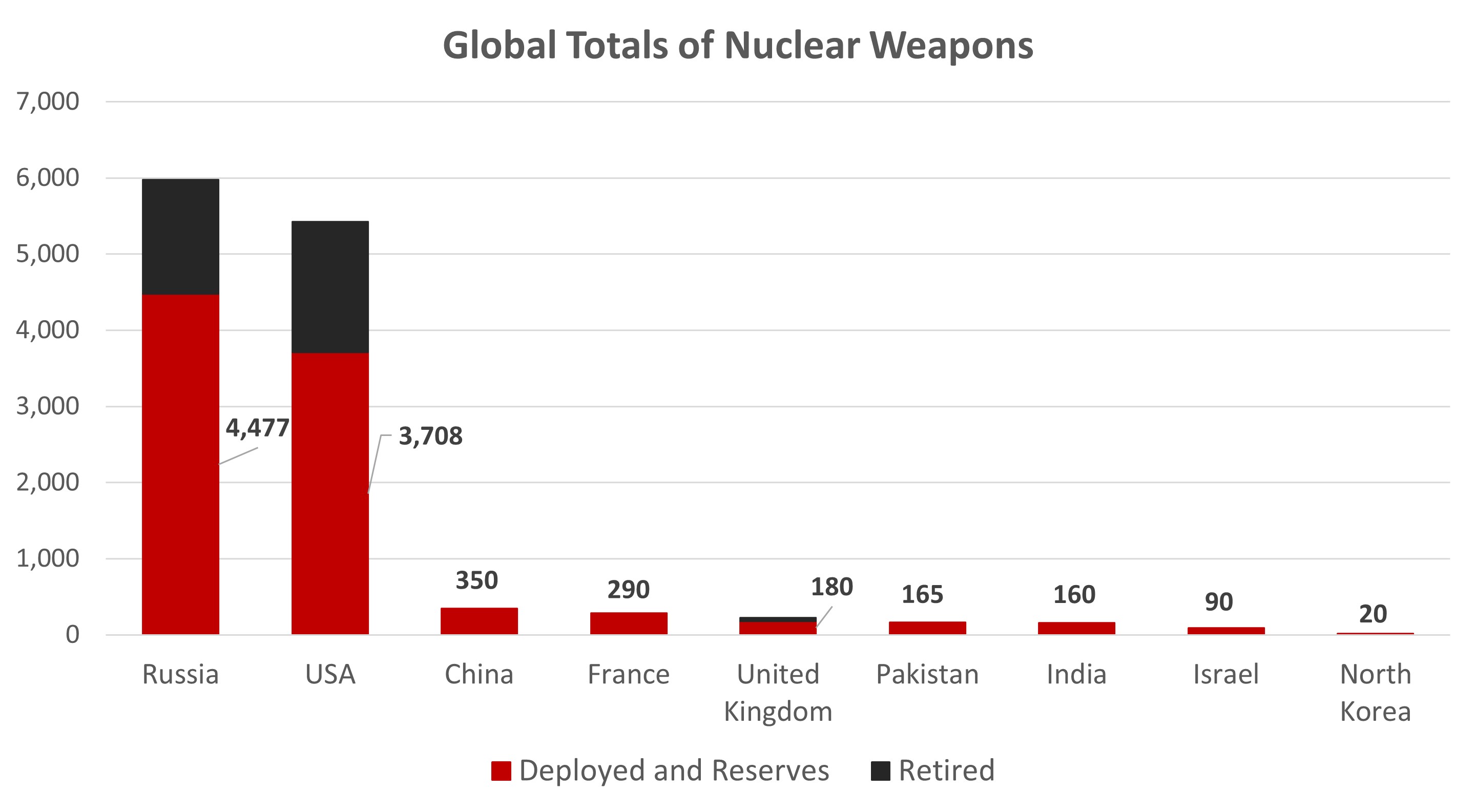
Source: Data from Our World in Data, “Inventories of Nuclear Weapons.”
Like Moscow, Washington has a full-blown and well-developed nuclear triad, complete with a fleet of nuclear subs that can launch up to twenty missiles—each containing multiple independently targeted warheads—land-based missile silos, and bombers. Each option provides ways to deliver hundreds of warheads. The submarine fleet, of course, is constantly mobile, ensuring first-strike survivability.
The Nonexistent Missile Gap
This won’t stop advocates of more spending from calling for more. They’ll always have reasons why there is some sort of missile gap. Lately, the obsession is with hypersonic missiles and having various forms of delivery, as well as the claim that the current gap between the US arsenal and rival arsenal is not sufficiently large.
There’s a reason US advocates of an aggressive nuclear posture invented the “missile gap” myth during the Cold War. It sows doubt about US security and ensures a certain level of paranoia about US nuclear capability. Nowadays, it’s acknowledged that the missile gap was always a myth, but this was much less known in the days when debates over US rocket technology were a frequent cause for alarm and debate. Nonetheless, the nonfactual basis of the “gap” was known at least as early as the 1960s, and then defense secretary Robert McNamara noted to John F. Kennedy:
There was created a myth in the country that did great harm to the nation. It was created by, I would say, emotionally guided but nonetheless patriotic individuals in the Pentagon. There are still people of that kind in the Pentagon. I wouldn’t give them any foundation for creating another myth.
How Much Do Numbers Matter?
The myth persists, however, and Geller claims: “Given the hundreds of new Chinese missile launchers and other new weapons, the U.S. will need more nuclear weapons to hold these targets at risk. In nuclear deterrence, numbers matter.”
How much do numbers really matter? Yes, in matters of deterrence, ten is certainly better than zero. But is three thousand better than one thousand, or even one hundred? That logic often works with conventional arms, but it makes little sense with nuclear arms, a single unit of which can destroy an entire city. As John Isaacs noted last year in the National Interest:
In the nuclear age, a country that deployed 1,000 nuclear weapons rather than an adversary’s 500 is not twice as powerful since a handful of weapons could devastate both countries. But the Pentagon and political leaders did not learn this critical lesson. This is a numbers game that may have been relevant for tanks and battleships before [the invention of nuclear weapons] but is not today.
What is key in nuclear deterrence is not simply numbers. Nuclear strategist Albert Wohlstetter identified this problem in the early 1960s and concluded that “the criterion for matching the Russians plane for plane, or exceeding them is, in the strict sense, irrelevant to the problem of deterrence.” Rather the key, Wohlstetter went on, is creating a force that is “survivable” to ensure the possibility of a retaliatory “second strike.” This is what establishes deterrence.
Wohlstetter certainly wasn’t the only one to come to this conclusion. In a 1990 essay titled “Nuclear Myths and Political Realities,” Kenneth Waltz—perhaps the most influential scholar of international relations of the past fifty years—concludes that the total number of missiles in these enormous arsenals is of little importance for nations that are already well above the threshold for achieving nuclear deterrence.
What really matters is the perception that the other side has second-strike capability, and this certainly exists in both US-Russia and US-China relations. Once each regime knows that the other regime has second-strike capability, the competition is over. Deterrence is established. Waltz notes:
So long as two or more countries have second-strike forces, to compare them is pointless. If no state can launch a disarming attack with high confidence, force comparisons become irrelevant. . . . Within very wide ranges, a nuclear balance is insensitive to variation in numbers and size of warheads.
The focus on second-strike capability is key because pro-arms-race policy makers are quick to note that if a regime’s first strike is able to destroy an enemy’s ability to retaliate in kind, then a nuclear war can be “won.”
Second-Strike Capability Evens the Score
But, as shown by Michael Gerson in “No First Use: The Next Step for U.S. Nuclear Policy” (2010) establishing second-strike capability—or, more importantly, the perception of it—is not as difficult as many suppose. Gerson writes:
A successful first strike would require near-perfect intelligence, surveillance, and reconnaissance (ISR) to detect, identify, and track all of the adversary’s nuclear forces; recent events surrounding U.S. assessments of Iraq’s suspected WMD [weapons of mass destruction] capabilities forcefully demonstrate the challenges of reliable, accurate, and unbiased information. Intelligence regarding where an adversary’s nuclear weapons are located and if the state is actually planning to attack could be wrong or incomplete, and an attempted first strike based on inaccurate or incomplete information could have far-reaching negative consequences.
The threat of a successful first strike can be countered through a variety of methods, including secrecy and the ability to shift weapons delivery channels. This is why the US, Russian, and Chinese regimes have long been so enthusiastic about the so-called nuclear triad. It is assumed that if nuclear weapons can be delivered by submarine, aircraft, and land, then it is impossible for an opposing regime to destroy all three at once and achieve first-strike victory.
But even in the absence of a triad, an opposing regime that seeks a total first-strike victory has few grounds for much confidence. As Waltz shows, “nuclear weapons are small and light; they are easy to move, easy to hide, and easy to deliver in a variety of ways.” That is, if a regime manages to hide even a small number of planes, subs, or trucks, this could spell disaster for the regime attempting a successful first strike. Gerson explains:
A nuclear first strike is fraught with risk and uncertainty. Could a U.S. president, the only person with the power to authorize nuclear use and a political official concerned with re-election, his or her political party, and their historical legacy, ever be entirely confident that the mission would be a complete success? What if the strike failed to destroy all of the weapons, or what if weapons were hidden in unknown areas, and the remaining weapons were used in retaliation?
Nor must it be assumed that a large number of warheads is necessary to achieve deterrence. Waltz recalls that Desmond Ball—who advised the US on escalation strategies—convincingly asserted that nuclear deterrence could be achieved with as few as fifty warheads.
Proceeding on the assumption that an enemy has no warheads left following a first strike requires an extremely high level of confidence because the cost of miscalculation is so high. If a regime strikes and misses only a few of the enemy’s missiles, this could lead to devastating retaliation both in terms of human life and in terms of the first-strike regime’s political prospects.
This is why a rudimentary nuclear force can achieve deterrence even with a small but plausible chance of second-strike capability. A small nuclear strike is nonetheless disastrous for the target, and thus “second-strike forces have to be seen in absolute terms.” Waltz correctly insists that calculating an arsenal’s relative dominance is a waste of time: “the question of dominance is pointless because one second-strike force cannot dominate another.”
The US Is Already Far beyond the Deterrence Threshold
One could certainly debate how much the US nuclear stockpile could be cut without sacrificing deterrence. Given the enormous size of the stockpile, however, the answer is that “most of it” could be cut. Indeed, the US arsenal could be cut by 90 percent and still have hundreds of warheads available for silos, submarines, and bombers.
Moreover, reductions in the arsenal are prudent for reasons of avoiding unintended nuclear war. As Wohlstetter noted, a prudent policy also requires “strategic nuclear forces to be not only capable of riding out and operating coherently after an actual preemptive attack against them; but also completely controllable in times of peace, crisis, and war—and especially in the face of ambiguous warning—so as to avoid unauthorized operations, accidents, and war by mistake.” Having large numbers of nuclear warheads actually is imprudent because it creates more potential for accidents, mistakes, and unauthorized use. Maintenance remains expensive and risky.
In spite of all this, it remains popular among some to keep arguing for more nuclear expansion year after year. Surely, some of these advocates are true believers, but there is also a lot of money at stake for government contractors. Thus, in one form or another, the myth of the missile gap—and its modern variants—endures.
Fake News Alert: Chinese “Patriots” Don’t Want To Retake Russia’s Far East
By Andrew Korybko | March 25, 2023
President Xi’s trip to Moscow to solidify the Sino-Russo Entente was the trigger event for prompting preplanned propaganda attacks aimed at driving a wedge between these two multipolar Great Powers. The latest one was carried out by Asia Times’ Jeff Pao in his article about how “China eyes Russia’s Far East resources, ‘patriots’ want more”, which reported on ultra-fringe commentary in Chinese online media agitating for their country to retake parts of Russia’s Far East.
The only reason why he and his outlet would amplify those views at this particular point in time is to mislead their targeted audience about China’s grand strategic intentions vis-à-vis Russia after President Xi’s trip to Moscow. By extending false credence to the unrealistic scenario of China retaking parts of Russia’s Far East, Pao is also implying that President Putin is irresponsibly ignoring a latent national security threat of the highest proportions. Neither of his narratives, however, have any factual basis.
Online commentary isn’t a reliable indicator for predicting any country’s future foreign policy, and Pao himself acknowledges in his agitprop piece that “In 1994, then-Chinese president Jiang Zemin and then-Russian president Boris Yeltsin signed an agreement to settle the sovereignty disputes.” Nevertheless, he still hinted that China’s recent directive referring to its former regions in that part of Russia by their traditional names suggests that it might eventually turn this into a territorial issue.
Pao is maliciously misinterpreting that development for information warfare purposes since he’s deliberately ignoring that all countries have the sovereign right to refer to anything however they want, especially if it’s a return to traditional names. While it’s true that in some contexts such a move could precede official claims to foreign territory, that’s not the case in Russian-Chinese relations, which remain rock-solid and have further strengthened as a result of President Xi’s trip to Moscow.
This information warfare agent even mentioned in his article that Russia is encouraging China to scale up its investments in the Far East, even going as far as to set up special economic regions there to facilitate that. He deserves credit for reporting on that fact, but it goes to show that he has ulterior motives in amplifying ultra-fringe commentary demanding that China retake parts of that region. There’s no reason for it to do so either since China already has access to whatever resources it wants there.
Those who speculate that it might countenance this scenario for “living space” are ignoring China’s declining birth rate and the “Heihe–Tengchong Line”, which shows that around 96% of its population resides in the 36% of the country’s eastern territory. Considering that there’s more than enough “living space” already within its own borders, its birth rate is declining, and it has access to whatever resources it wants from Russia, there’s no reason for China to think about retaking parts of the Far East.
These objectively existing and easily verifiable facts expose Pao as the propagandist that he is, who either produced his agitprop under orders from Asia Times’ editors or did so on his own initiative, but in either case he’s someone whose pieces about Russian-Chinese relations can’t be trusted. His agenda is to mislead to people into thinking that China is about to stab Russia in the back while President Putin remains oblivious to this treachery, which isn’t true at all and shouldn’t be taken seriously by anyone.
The US’ Rejection Of China’s Peace Plan For Ukraine Exposes Its Warmongering Intentions
By Andrew Korybko | March 24, 2023
Bloomberg cited an unnamed Biden Administration official on Thursday to report that “the US is worried about being backed into a corner over the Chinese proposal. Regardless of the US reservations, dismissing it outright could let China argue to other nations that are weary of the war — and of the economic damage it’s wreaking — that Washington isn’t interested in peace.” Alas, that’s precisely what America has done by acting as if China isn’t a serious mediator and that its peace plan is unrealistic.
By rejecting Beijing’s 12-step proposal, Washington exposed its warmongering intentions for the rest of the world to see and vindicated Moscow’s criticism that it wants to fight this proxy war “to the last Ukrainian”. The majority of the international community that resides in the Global South and which is most adversely affected by the systemic consequences of this conflict, particularly the food and fuel crises catalyzed by Western sanctions, had their perceptions of US soft power shattered once and for all.
Prior to the onset of Russia’s special operation last year that it was forced to commence in defense of its national security red lines in Ukraine after NATO clandestinely crossed them there, a significant share of folks in developing countries still generally had a favorable view of that declining unipolar hegemon. They might not have endorsed every one of its foreign policy moves, but these people still thought that its worldview had some redeeming factors that made it worthy of being listened to at the very least.
The allure of its soft power, particularly in the socio-cultural sphere as propagated by the mass media over the decades, still had a powerful hold over their hearts and minds. Now, however, these same people are directly suffering from the food and fuel crises catalyzed by the West’s unilateral sanctions. To make matters worse, the US signaled through its rejection of China’s peace plan for Ukraine that relief won’t be forthcoming, thus indefinitely perpetuating and thus exacerbating these problems.
It’s one thing for US-inclined folks in the Global South who’ve fallen under the sway of its soft power to oppose some part of its foreign policy regarding a faraway country and another entirely for that same foreign policy to directly affect them and their family. They might still enjoy consuming some of its socio-cultural products and perhaps still cling to believing in the so-called “American Dream” despite the odds of them ever benefiting from it, but their views of the US as a whole will certainly change.
This rapidly emerging outcome represents a latent crisis of the highest importance for the US’ grand strategic interests since the loss of such a critical mass of supporters will hamstring its goals across the Global South. These same people will be less susceptible to its information warfare products against their multipolar governments, thus reducing the chances that forthcoming Color Revolution plots will succeed, to say nothing of them tuning out the US’ fake news about the Sino-Russo Entente.
The combination of hunger pains and rising costs, which are the direct result of the food and fuel crises respectively that the US’ unilateral sanctions are responsible for, can turn anyone against anything even if they were previously the most fervent of believers. This is especially so when it worsens the living conditions of one’s own family, including their children. The arrogance of American policymakers, deluded by the supremacist belief in their system’s supposed “exceptionalism”, blinds them to this.
The aforesaid oversight, which could easily have been foreseen and thus avoided had groupthink not been in effect, is the proverbial straw that broke the camel’s back and turned the Global South against the US en masse. There’s now no credible possibility of America advancing its interests there by information warfare-driven attraction ever again, thus leading to it doubling down on subversion and force out of desperation instead of accepting the loss of its influence in those countries.
US to build new military bases near South China Sea
RT | March 23, 2023
The United States is set to build four new military bases “scattered” around the Philippines, the country’s president, Ferdinand Marcos Jr., has confirmed. He added that at least one facility would be placed near a disputed island chain claimed by China and several other nations.
Speaking to reporters on Wednesday, the Philippine leader offered additional details about the new installations, which were first unveiled last month as part of the Enhanced Defense Cooperation Agreement (EDCA) with Washington. However, he said he could not reveal their exact location until a formal announcement is made alongside the US.
“There are four extra sites scattered around the Philippines – there are some in the north, there are some around Palawan, there are some further south,” he said, adding that the bases would help to defend the country’s largest island, Luzon.
Palawan is one of the Philippines’ westernmost regions, and is situated around 200 miles (320 kilometers) east of the disputed Spratly archipelago in the South China Sea, which is also known by several other local names. Six countries have laid claim to parts of the small island chain, among them China, Taiwan, Vietnam, Malaysia, Brunei as well as the Philippines, though US officials have repeatedly rejected Beijing’s claims as “unlawful.”
American bases on Luzon, meanwhile, are likely to be built with Taiwan in mind given its close proximity to the self-governing island, which China considers part of its sovereign territory. Though Washington had long maintained a policy of “strategic ambiguity” toward Taipei, President Joe Biden has broken with that approach, explicitly stating that US forces would come to Taiwan’s defense in the event of a Chinese attack.
Asked about the plans for the new bases during a Wednesday press briefing, Chinese Foreign Ministry spokesman Wang Wenbin argued that military cooperation between countries should be “conducive to regional peace and stability and not targeted at or harmful to the interests of any third party.”
“The US side, out of selfish interests, remains trapped in a zero-sum mentality and keeps increasing military deployment in the Asia-Pacific,” he said, adding that “Regional countries need to remain vigilant and avoid being coerced or used by the US.”
President Marcos went on to warn of a “complex” and “unpredictable” security environment in the region, saying he was aware of an “emerging threat” that would require “adjustments in our strategy” without elaborating.
Under the 2014 EDCA, the US was initially permitted to construct five military bases around the Philippines, but the pact was recently extended to four additional “strategic” sites. Washington has so far spent $82 million on the original five facilities, and continues to work on bases that will eventually host rotating troop deployments.
Putin and Xi Standing Firm on the Right Side of History
By Finian Cunningham | Strategic Culture Foundation | March 23, 2023
The historic summit this week between the Russian and Chinese leaders provoked paroxysms of angst in the Western media. President Vladimir Putin’s hosting of China’s Xi Jinping in Moscow was presented as the “world’s two most prominent autocrats” purportedly establishing a hostile “anti-West axis”.
The American and European media – slavishly echoing the talking points of their imperialist regimes – were in hyper-bogeyman mode. The meeting of Putin and Xi was distorted in every way to appear as something illegitimately threatening and sinister to the Western “rules-based global order” (euphemism for Western capitalist privileges and predation.)
Bogeyman mode also entails collective amnesia. The summit coincided with the 20th anniversary of the U.S. and British launching their war on Iraq – arguably the biggest crime of the 21st century so far. Yet this vile anniversary has hardly stirred any Western media condemnation or shame, never mind legal accountability.
The wanton cynicism towards the Putin-Xi meeting belies the deep anxiety among the U.S.-dominated clique of Western states that the much-vaunted “rules-based order” is collapsing. A collapse caused by its own inherent corruption and systematic abuse of power and international law over many decades.
Both Putin and Xi emphasized that the Russia-China alliance was not meant to threaten any third party.
“We are always for peace and dialogue,” said China’s President Xi who was in Russia on a three-day state visit.
Putin hailed the highest point in relations between Moscow and Beijing and underscored the long historical friendship. Both leaders said this was not simply an extension of a Cold War-era alliance but rather a harbinger of genuine multipolar global development for all nations based on partnership and cooperation, respecting international law and national sovereignty.
Indeed, the much-anticipated multipolar world order is coming to fruition as the erstwhile dominance of Western elitist unilateralism shrivels. The Russian and Chinese leaders signed multiple trade deals and furthered plans to use national currencies, thereby making the unwarranted privileges of the US dollar obsolete.
There is a palpable sense that the global economy is moving in a tectonic shift towards Eurasian partnership of vitality and dynamic multipolar development, foreshadowing a fateful demise for U.S.-led Western capitalist hegemony. Western nations are haunted by financial bankruptcy, inequality, paralyzing debt, and dead-end militarism.
Of particular note is the plan to build a new gas pipeline from Russia to China dubbed Power of Siberia 2. It will supply an additional 50 billion cubic meters of natural gas annually to China. Significantly, this new supply route of Russian energy matches the volume that had been earmarked for the European Union with the operation of the Nord Stream 2 pipeline – until the Biden administration blew it up.
Out of all the impressive partnership deals signed in Moscow this week, the new gas route to China speaks loudest. Russia has decided to walk away from the ungrateful Europeans and let them suffer the consequences of industrial shutdown by opting for expensive American gas.
Eurasian economic power is the fulcrum of global development. Russia and China are leading the way, not just for the rest of Eurasia, but also for the Global South, Latin America, Africa, and others. The incremental moving away from the U.S. dollar as fiat international currency is the most ominous sign of the rise and fall. Russia and China are hastening that fateful switch.
In a desperate bid to avert the inevitable, the Western imperialist regimes and their media tried to depict the Putin-Xi summit as something sinister for global security, in what amounts to be a reverse projection of their own depredations and crimes.
Western media sneered that “autocrats” Putin and Xi were “posing as peacemakers”, even while both leaders emphasized their vision of multipolar relations was based on mutual cooperation.
China’s proposals for a peaceful end to the war in Ukraine were welcomed by Putin but dismissed by the Americans and Europeans as “diplomatic cover for Russian aggression”. Meanwhile, Washington and Brussels made new commitments to increase weapons supply to Ukraine, thereby prolonging the conflict – the worst in Europe since World War Two.
It is American and European regimes that are ruling out any dialogue or political-historical understanding about the origins of the war in Ukraine. Hence their determination to swipe away any opportunity for resolution. Because if an intelligent, reasonable dialogue was held – as the Russians had proposed before the war erupted more than a year ago – the conclusions would be unacceptable for U.S. and NATO expansionism.
The paradox is Russia and China are portrayed as global villains by Western powers who are still dripping with blood from the fraudulent and illegal Iraq war and who are today fueling a potentially catastrophic nuclear confrontation over Ukraine. The same media lying machine that enabled the destruction of Iraq (and many other nations) is now enabling hostility towards Russia and China.
To augment that twisted narrative, the Western media seek to undermine the Russian and Chinese-led move towards a better, fairer global economy and with that the demise of U.S. hegemony. Of course, “U.S. hegemony” and “Western economy” are just euphemisms for a dictatorship of billionaires and corporations, a dictatorship that the vast majority of the Western public has to suffer under.
So this week, Russia was labelled the “junior partner” of China and denigrated for becoming a “dependency” on Beijing. Western media reporting went into contortions to wantonly mischaracterize the evident warmth between Putin and Xi, and the tremendous significance of their global vision.
Russia was disparaged as becoming nothing more than a “resource colony of China” owing to its burgeoning oil and gas exports. That moniker reminds one of former U.S. Senator John McCain’s insult of Russia being nothing more than a “gas station masquerading as a nation”.
It’s funny how Moscow was up until recently accused of “energy blackmail” and “weaponizing hydrocarbons” when it was the main supplier of Europe. But when Russia’s vast energy is rerouted to China it is now pilloried as a “colony” of Beijing. Western propaganda can’t make up its mind about whether to cast Russia as an energy tyrant or an energy toady. That double-think betrays propaganda construct and demonization.
The world is changing before our eyes. Western imperialist regimes are being exposed for the warmongers they are, their privileges and predatory capitalism are imploding, their neocolonialist blood-sucking days are over, and a new multipolar order of partnership and peace is emerging.
The Western elites and their media are excelling themselves by trying to bad mouth Putin and Xi in every preposterous way. The outlandish distortions are commensurate with the desperation.
Time in short order, however, is telling who really is on the right side of history.
China gives US advice on Ukraine
RT | March 22, 2023
The US should stop “fanning the flames” of the conflict in Ukraine instead of making accusations against Beijing, Chinese Foreign Ministry spokesperson Wang Wenbin has said.
During a briefing on Wednesday, Wang responded to a statement by US National Security Council spokesman John Kirby, who said the previous day that he didn’t think “you can reasonably look at China as impartial in any way” when it comes to the fighting between Moscow and Kiev.
Beijing has failed to condemn Russia’s military operation, while continuing to buy energy from the country, he stated. Chinese President Xi Jinping “saw fit to fly all the way to Moscow” this week, but has never even talked on the phone to his Ukrainian counterpart Vladimir Zelensky, Kirby added.
The Chinese Foreign Ministry spokesman rejected Kirby’s claims, stating that the US was itself too deeply involved in the conflict in Ukraine to accuse Beijing of being biased.
“The US side claims that China’s stance isn’t impartial. But is it impartial to continuously supply weapons to the battlefield? Is it impartial to constantly escalate the conflict? Is it impartial to allow the effects of the crisis to spill over globally?” Wang said, referring to the Biden administration’s policies.
“We advise the American side to rethink its own stance on the Ukraine issue, turn away from the erroneous path of adding fuel to the fire, and stop shifting the blame to China,” he said.
Beijing has “no selfish motives on the Ukraine issue, has not stood idly by… or sought profit for itself,” the spokesman insisted. “What China has done boils down to one thing, that is, to promote peace talks.”
As for Xi’s trip to the Russian capital, which took place between Monday and Wednesday, Wang pointed out that this was “a journey of friendship, cooperation and peace, which has aroused positive responses in the international community.”
The Ukrainian crisis was among the top issues discussed between Vladimir Putin and Xi in Moscow, with the Russian president stressing that many provisions of the Chinese peace proposal were “consonant with the Russian stance and can be taken as a foundation for a peaceful settlement when they are ready for it in the West and in Kiev.” However, Putin pointed out that Moscow currently didn’t detect readiness from either the US, its allies or the Ukrainian government.
Sino-Russian technological and military cooperation exponentially strengthens both superpowers’ capabilities

By Drago Bosnic | March 22, 2023
After the end of the (First) Cold War and the start of what Francis Fukuyama dubbed the “End of History”, the world seemed firmly in the hands of the political West. For the next two to three decades, this resulted in one of the most disastrous and unstable periods in recent human history, with the political West ravaging much of the world, while most of the rest was held under near-constant self-defeating subservience.
The US-led power pole engaged in what can only be described as war hopping, starting one aggression after another, or worse yet, several consecutive invasions against countries on multiple continents, with its numerous vassals and satellite states sending auxiliary forces or at the very least providing support in logistics and financing. America’s superiority was both quantitative and qualitative, leaving nearly everyone else far behind. The only exception was Russia, whose only advantage was its massive strategic arsenal, the last vestige of the (First) Cold War that kept the US from exerting absolute dominance.
Moscow’s main trump card was also the world’s trump card, providing precious several decades of peace to other sovereign-minded powers, primarily China. Beijing’s meteoric rise to superpower status would have been all but impossible without it and the Asian giant’s leadership is well aware of this. It could be said that both Russia and China “have each other’s backs”, with the cooperation reaching unprecedented levels, not seen in approximately 60 years.
Not counting the purely ideological “cold war” in the aftermath of the Sino-Soviet split, the relationship between Moscow and Beijing has been cordial at worst. However, in the last 30 years, particularly since President Putin consolidated Russia’s geopolitical standing, this relationship has transformed into a fully-fledged strategic alliance in virtually every aspect, truly limitless, as Putin and Xi Jinping recently described. Since the early 1990s, Russia has transferred copious amounts of its massive technological know-how, particularly in military tech, helping push China’s defense capabilities nearly half a century ahead in less than a decade.
The result was quite positive for Beijing, but was seen with contempt in Washington DC, which loathes the idea of having to deal with “another Soviet Union”, especially after investing nearly half a century into dismantling the original and after the Clinton administration announced the US will “never let the rise of another superpower” with the equivalent or close to the power of the USSR. However, despite US attempts to prevent it, exactly this happened. Russia, at first a mere shadow of its former glory and essentially dismissed as a “done deal” by the political West, started regaining its strength, but this time not as a socialist empire, but perhaps the world’s premier realpolitik superpower. With such an approach, Moscow kept most of its historic geopolitical partnerships and was also able to expand them, including with China. President Xi Jinping’s latest visit, the first foreign trip he went on after being reelected for his third term, serves as a testament to this growing alliance.
The superpowers signed over a dozen key strategic agreements laying out the prospects of their unprecedented cooperation by the end of this decade and beyond. Apart from the growing trade exchange, which is racing towards $200 billion annually, one of the key aspects of this is a technological and military partnership. China and Russia will further expand their cooperation in areas such as information technologies and advanced AI, involving approximately 80 new projects assessed at over $165 billion. This includes aircraft and machine tools manufacturing, space research and strengthening of military cooperation, including further unification of Moscow’s and Beijing’s know-how.
In a joint statement, the (Eur)Asian giants reiterated their commitment to regularly conduct bilateral naval and aerial patrols, as well as regular military exercises, expand cooperation within and beyond the framework of existing bilateral agreements and deepen mutual trust and interoperability between their armed forces.
One particularly important segment of this growing alliance is the exchange of military technologies in which both countries excel. China’s impressive strides in microelectronics and semiconductors are of great interest to Russia, while Moscow’s traditionally world-class expertise in rocket/missile and space technologies is greatly appreciated in Beijing. This includes the latest Chinese developments in new network-centric capabilities, with drone swarms being of particular interest for Russia, which could provide key tactical advantages on the battlefield.
Moscow has certainly developed a plethora of its own similar capabilities, but getting Beijing to participate in these efforts will help expand the said capabilities even further. On the other hand, China is greatly interested in Russia’s unrivaled hypersonic technologies, especially naval, as the primary threat to its security and development comes from the belligerent thalassocratic powers of the political West and their regional vassals.
Russian military expert Andrei Martyanov outlined the virtually unknown (to the vast majority of mainstream media) aspects of this cooperation, including the immediate threat that the AUKUS represents for Beijing. With virtually all of China’s Tier 1 cities and provinces being exposed to naval aggression from the US, the Asian giant is seeking ways to nullify this possibility or at the very least push it to a minimum. Of particular concern is the US Navy’s AGM-158 JASSM (Joint Air-to-Surface Standoff Missile), a stealthy air-launched cruise missile deployed by American CBG (carrier battle groups), including the 2000-km range JASSM-XR variant. And while such missiles can hardly be considered comparable to the latest Chinese weapons, they are relatively cheap (by US standards) and numerous (at least 2000 procured by USAF and USN), providing a strong first-strike capability for Washington DC. According to Martyanov, precisely this was very likely one of the key topics of the behind-closed-doors talks between Russian and Chinese delegations.
Drago Bosnic is an independent geopolitical and military analyst.
Featured Video
Seyed M. Marandi: Negotiations Collapsed – Return to War
or go to
Aletho News Archives – Video-Images
From the Archives
Wartime internment camps in Australia
National Archives of Australia
World War I
During World War I, for security reasons the Australian Government pursued a comprehensive internment policy against enemy aliens living in Australia.
Initially only those born in countries at war with Australia were classed as enemy aliens, but later this was expanded to include people of enemy nations who were naturalised British subjects, Australian-born descendants of migrants born in enemy nations and others who were thought to pose a threat to Australia’s security.
Australia interned almost 7,000 people during World War I, of whom about 4,500 were enemy aliens and British nationals of German ancestry already resident in Australia.
Records of World War I internment camps
World War II
During World War II, Australian authorities established internment camps for three reasons – to prevent residents from assisting Australia’s enemies, to appease public opinion and to house overseas internees sent to Australia for the duration of the war.
Unlike World War I, the initial aim of internment during the later conflict was to identify and intern those who posed a particular threat to the safety or defence of the country. As the war progressed, however, this policy changed and Japanese residents were interned en masse. In the later years of the war, Germans and Italians were also interned on the basis of nationality, particularly those living in the north of Australia. In all, just over 20 per cent of all Italians resident in Australia were interned. … continue
Blog Roll
 Aletho News
- Seyed M. Marandi: Negotiations Collapsed – Return to War
- Tomorrow’s naval blockade showdown
- ‘Israel’ attacks civilians to hide its embarrassing military failures & out of pure sadism
- Any Foreign Military Vessel Approaching Hormuz Under Any Pretext ‘Will Be Dealt With Severely’: IRGC
- Diplomats slam US negotiators’ performance in Iran talks
- Trump Refuses Exit Ramp, War with Iran will Continue
- Trump Says US Naval Blockade in Strait of Hormuz Will Begin Shortly
- US, Iran end 21-hour talks without agreement
- US IRAN TALKS: Who Are the Crazy Ones Here? /Lt Col Daniel Davis
- Talks with the US end without a deal over excessive US demands: Iran
- If Americans Knew
- US-Iran ceasefire negotiations make zero progress – Daily Update
- Pro-Israel ‘Thinktanks’ and Individuals who Influence U.S. Foreign Policy
- Mearsheimer reveals how Israel dictates US policies on Iran, Gaza – video
- After killing 350+, Israel still has a “score to settle” with Lebanon before ceasefire – Daily Update
- Military aid to Israel emerges as the latest political litmus test for Democrats
- The only Palestinian children’s rights organization closes following years-long Israeli campaign against it
- ‘I Can’t Forget the Smell’: Lebanese Reel After Israel Kills Over 300 in Single Day
- DNC Shoots Down Resolutions Calling Out AIPAC and Limiting Arms to Israel
- TCN: Is Israel Blackmailing President Trump?
- Israel killed at least 303 Lebanese yesterday – who were they? Daily Update
- No Tricks Zone
- Cave Discovery Reveals Today’s Desert Climates Were Recently Far Warmer, Wetter, Teeming With Life
- German Expert: Heat Dome Led To Record Temps In Western USA…Warmer In 1934, 1936
- New Study: No Linear Warming Or Glacier Retreat Along Northern Antarctic Peninsula Since 1980s
- An Inconvenient Tree: Uncovered In Alps… Europe Much Warmer Than Today 6000 Years Ago
- New Study Reports A 60% Slowdown In Greenland’s Ice Loss Rate In The Last Decade
- Low Intensity Tornado Wrecks Major Solar Farm, Creating A Potential Toxic Dump
- New Study Finds Warming Saves Lives…Cold Temperatures 12 Times More Deadly Than Excess Heat
- German Science Blog Accuses PIK Climate Institute Of Hallucinating Climate Tipping Points
- Devastating Assessment Of Comirnaty Vaccine By Former Senior Pfizer Europe Toxicologist
- New Study: CO2 Is ‘Effectively Negligible’ As An Explanatory Climate Change Factor Since 2000
 Aletho News