The Geopolitical Imperative Behind US Policy Toward Venezuela
By Leanna Yavelskaya | Ron Paul Institute | December 21, 2025
In the intensifying great-power competition of the 21st century, Venezuela has emerged as a pivotal battleground in the Western Hemisphere—a proxy arena where the United States confronts the encroaching ambitions of China and Russia to preserve its historic regional dominance.
Conventional explanations for Washington’s unrelenting pressure on Caracas, citing resource acquisition or counternarcotics imperatives, crumble under scrutiny amid America’s strategic primacy, energy independence, and the broader architecture of multipolar rivalry.
US policy toward Venezuela is fundamentally a defensive maneuver in the superpower contest, aimed at denying Beijing and Moscow a strategic foothold in America’s backyard. Venezuela’s vast oil reserves—the world’s largest—might superficially suggest energy motives, yet the United States, now the globe’s top petroleum producer and exporter, no longer depends on Venezuelan heavy crudes. Sanctions have deliberately slashed imports, while any genuine resource priority would favor diplomatic normalization over confrontation. Historical US behavior reinforces this: when energy security truly matters, Washington opts for pragmatic deals, not escalation. The current standoff, therefore, serves deeper geopolitical ends—blocking rival powers from entrenching influence proximate to US shores.
The counternarcotics rationale fares no better. Venezuela transits cocaine but plays minimal role in the fentanyl epidemic ravaging America. Washington’s dollar hegemony and financial levers could dismantle trafficking networks without military brinkmanship, yet global drug flows persist due to strategic tolerances. Venezuela’s marginal position in this trade renders anti-drug rhetoric an inadequate justification for the extraordinary measures deployed, including naval blockades and tanker seizures.
The core driver is Venezuela’s alignment with US adversaries, transforming it into a potential forward base for China and Russia in the Americas. Beijing has poured billions in loans-for-oil, infrastructure projects, and discounted crude purchases—securing long-term resource access while propping up the regime against Western isolation, even as recent US escalations test this lifeline. Moscow has supplied arms, intelligence, and diplomatic shielding, positioning Venezuela as a counterweight to US hegemony, much as it leverages proxies elsewhere. These partnerships challenge enduring American doctrines: the Monroe legacy rejecting extra-hemispheric powers in the Americas, and Cold War precedents like the Cuban Missile Crisis, where Soviet encroachment provoked crisis.
No US administration—Democratic or Republican—has tolerated a peer rival gaining decisive leverage in Latin America. The Trump administration’s 2025 campaign, with carrier groups, strikes on vessels, and a declared blockade of sanctioned tankers, underscores this zero-tolerance posture amid Maduro’s disputed reelection and pleas for Russian and Chinese aid. Venezuela embodies the frontline of eroding US unipolarity: proximity magnifies threats, just as China dominates the Indo-Pacific or Russia its near abroad.
This is no mere bilateral dispute over democracy or drugs—it is a superpower clash over spheres of influence in a fragmenting world order. Caracas’s geopolitical pivot toward Beijing and Moscow directly contests Washington’s hemispheric primacy. The United States will not permit rival superpowers to consolidate enduring control on its doorstep, a contest that will shape power balances in the Americas and beyond for decades. As great-power rivalry intensifies, Venezuela’s fate signals whether the US can stanch encroachment in its traditional domain or cede ground in the new multipolar era.
Leanna Yavelskaya is a freelance civilian journalist who focuses on geopolitical analysis, with particular emphasis on Eastern Europe.
Medicinal plants hold key to Iran’s drought-resistant revenue

Press TV – December 16, 2025
Iran’s agriculture faces water scarcity, restricted market access, and declining returns from traditional crops, pushing farmers and policymakers toward low-water, high-value, and sanction-resilient export products.
Medicinal plants are among the few agricultural sectors meeting all three criteria, increasingly seen over the past decade as an expandable income source aligned with environmental limits and export needs.
Iran has one of the richest plant ecosystems in the world. More than 8,000 plant species have been identified across the country, of which around 2,300 have medicinal, aromatic, cosmetic, or industrial uses.
About 1,700 of these species are endemic, meaning they grow naturally only in Iran. This biodiversity is supported by wide climatic variation, from arid plains to high mountain ranges, with elevations from 900 to more than 4,000 meters above sea level.
These conditions allow different plants to grow with little or no irrigation. The scale and diversity of this natural resource provide Iran with a broad production base that few countries can replicate, enabling year-round cultivation and harvesting across different regions.
Most medicinal plants cultivated or harvested in Iran are naturally adapted to dry and semi-dry environments. Many grow under rain-fed conditions or require less than 3,000 cubic meters of water per hectare.
By comparison, crops such as wheat, rice, and corn often need between 10,000 and 15,000 cubic meters per hectare. As groundwater reserves shrink and rainfall becomes more erratic, this difference has direct economic value.
Lower water use reduces production costs while preserving agricultural land for sustained use over time. This makes medicinal plants particularly suitable for long-term planning in regions facing declining water availability.
According to official figures, Iran receives about 400 billion cubic meters of rainfall annually, but more than half is lost to evaporation. Crops that can grow using direct rainfall reduce pressure on dams, rivers, and aquifers.
Medicinal plants make effective use of this rainfall because they are already rooted in the soil when seasonal precipitation occurs, allowing moisture to be absorbed rather than lost. This characteristic strengthens their role in maintaining agricultural output without increasing water extraction.
Medicinal plants are produced both on farmland and in rangelands. In many provinces, farmers grow them under permits on national lands, relying on rainfall rather than irrigation. Because these plants are mostly perennial and slow-growing, high irrigation costs are not economically justified.
Harvesting, drying, and basic processing often take place close to production sites, creating seasonal employment in rural areas. Each hectare of medicinal plants generates between two and three direct jobs, according to agricultural authorities.
In addition to farming, jobs are created in collection, sorting, drying, distillation, and packaging, forming local value chains that support village-level incomes.
Export revenue from medicinal plants currently stands at about $600 million a year, accounting for roughly 9 to 10 percent of Iran’s total agricultural exports. Projections suggest exports could reach $700 million if production and processing improve.
Saffron dominates the sector. Iran produces more than 90 percent of the world’s saffron and accounts for around 40 percent of the total export value of medicinal plants.
Other major exports include rose products from damask rose, such as rose water and extracts, liquorice extract, mint, thyme, and natural gums like asafoetida locally called anguzeh.
These products are sold not only as raw materials but also as inputs for pharmaceutical, food, and cosmetic industries.
Demand for medicinal plants continues to grow in international markets, including Central Asia, Eurasia, and China. These markets are accessible through regional trade routes and do not always require direct financial links with Western banking systems.
Products such as saffron, rose water, and herbal extracts have relatively high value-to-weight ratios, which lowers transport costs and makes them more suitable for indirect export channels. Their long shelf life further supports trade across longer distances and reduces losses during storage and transport.

Barijeh, scientifically known as ferula gummosa, is a plant native to Iran.
The internal economics of medicinal plant cultivation are also favorable. In several provinces, income from medicinal plants is many times higher than from grains.
For example, harvesting wild or cultivated plants such as musir can generate net income far above that of wheat or barley on the same land.
This income difference has encouraged farmers to shift land away from water-intensive crops, especially in drought-affected regions. Higher returns per hectare allow smaller landholdings to remain economically viable, supporting family-based farming systems.
Four provinces illustrate this potential clearly. Khorasan remains the center of saffron production. Kashan and surrounding areas specialize in rose cultivation and distillation.
Yazd produces lemon verbena, while Chaharmahal and Bakhtiari province has emerged as a major center for wild and cultivated medicinal plants.
This province is largely mountainous, with 87 percent of its area classified as highland. More than 1,350 plant species have been identified there, including 270 with medicinal or industrial uses and 27 species found nowhere else in the world. Cool nights, diverse soils, and varied elevations contribute to high-quality yields and strong concentrations of active ingredients.
In Chaharmahal and Bakhtiari, medicinal plants are grown on about 3,500 hectares, split between national rangelands and agricultural land. Since the early 2010s, the cultivated area has expanded sharply, supported by a national strategy to promote medicinal plants.
From a fiscal perspective, medicinal plants offer a rare combination for Iran under sanctions. They reduce water use, generate foreign currency, and support employment without heavy reliance on imported inputs.
Unlike major industrial exports, they do not require large-scale capital equipment or advanced foreign technology. Their production is decentralized, which spreads income across rural and underdeveloped regions. This decentralization strengthens local economies and reduces dependence on a limited number of export hubs.
Iran already holds dominant positions in several global markets, particularly saffron. Medicinal plants do not eliminate the economic impact of sanctions, but they provide a measurable source of revenue that fits Iran’s environmental constraints.
Kuwait set to sign multibillion-dollar port deal with China

The Cradle | December 19, 2025
Kuwait will sign a contract next week with China Communications Construction Company (CCCC) to complete the Mubarak al-Kabeer Port project, Kuwaiti Public Works Minister Noura al-Mashaan announced on 18 December.
The contract is valued at about $3.97 billion, according to a government document seen by Reuters.
The Central Agency for Public Tenders approved on 1 December a contract between the Public Works Ministry and CCCC for engineering, procurement, and construction of the first phase of the port, according to the official gazette.
Mashaan said Kuwait’s prime minister will attend the signing ceremony with the Chinese side.
Mubarak al-Kabeer Port, located on Bubiyan Island in northern Kuwait, is described as a strategic project aimed at creating a secure regional corridor and commercial hub, one that China has sought to include within its Belt and Road Initiative (BRI).
Kuwait hopes the project will support economic diversification, boost GDP, and help restore its regional commercial and financial role in West Asia, with the government saying around 50 percent of the first phase of the Mubarak al-Kabeer Port project has been completed so far.
The Mubarak al-Kabeer Port project is part of a broader set of large-scale initiatives Kuwait is pursuing with Chinese support, spanning infrastructure, energy, environmental services, and urban development.
Kuwait and China have expanded cooperation in recent years, including the signing of multiple memorandums of understanding (MoU) during a 2023 visit to Beijing by then-crown prince Sheikh Mishal Al-Ahmad Al-Sabah, who later became emir.
Officials on both sides have framed these projects as part of a wider effort to deepen long-term economic ties, with a growing emphasis on infrastructure development, diversification, and connectivity.
Chinese firms are involved in several major projects across Kuwait, reflecting a shift toward broader strategic and economic engagement between the two countries beyond traditional trade relations.
China’s expanding economic footprint in West Asia has also extended to Saudi Arabia, where Chinese Foreign Minister Wang Yi recently said that Beijing is ready to be Riyadh’s “most trustworthy and dependable partner” following high-level talks in the kingdom.
The meetings reaffirmed Saudi support for the one-China principle and emphasized deeper cooperation in energy, infrastructure, and emerging industries, aligning with Beijing’s broader BRI-linked engagement across the region.
China expands use of Iranian rail corridor for cargo transit
Press TV – December 14, 2025
China has increased its use of Iranian railway corridors for cargo transit, an Iranian official has said, as Tehran steps up efforts to position itself as a major regional rail freight hub.
Shahriar Naghizadeh, head of the foreign commerce department at the Islamic Republic of Iran Railways, said on Sunday that the number of Chinese cargo trains using Iranian rail corridors has reached 42, with another train arriving in the country earlier in the day.
Naghizadeh added that a Russian cargo train also arrived in Iran on Sunday as part of Moscow’s transit operations through Iran to destinations in the Persian Gulf, the Indian Ocean and Iraq.
He said Iran is coordinating the passage of a second Chinese cargo train through its territory to Europe, following a pilot journey conducted in March.
“These are major developments in the railway sector and signal a promising future for its expansion,” Naghizadeh was quoted as saying by the official IRNA news agency.
According to the official, Iran’s railway corridors are gaining popularity for cargo transit due to their shorter distances and fully overland routes, which eliminate the need for maritime transport.
He added that transit costs through Iran are lower than those of comparable routes, and that the country has offered guarantees to process cargo in the shortest possible time.
Iran has made significant investments in its transport infrastructure in recent years to capture a larger share of regional transit revenues.
The country has also adopted a long-term policy to expand its east–west transit infrastructure in line with China’s Belt and Road Initiative, a multi-trillion-dollar project aimed at improving transport links connecting China with Europe, Asia, and Africa.
Chinese Embassy lodges solemn démarche with Israeli side at earliest opportunity over Taiwan regional official’s visit
Global Times | December 13, 2025
Asked to comment on reports that Wu Chih-chung, the Taiwan region’s so-called “deputy foreign minister,” had recently paid a secret visit to Israel, a spokesperson for the Chinese Embassy in Israel said that Taiwan is a province of China and there is no such thing as a “foreign ministry.” China has consistently and firmly opposed any form of official interaction between countries that have established diplomatic relations with China and the Taiwan region. The Chinese Embassy in Israel has lodged a solemn démarche with the Israeli side at the earliest opportunity.
The spokesperson noted that the one-China principle is a widely recognized consensus of the international community and a basic norm governing international relations. It is also the political foundation and prerequisite for China’s establishment and development of diplomatic relations with countries around the world, including Israel.
The Joint Communique on China and the Government of the State of Israel on the Establishment of Diplomatic Relations clearly states that “The Government of the State of Israel recognizes that the Government of the People’s Republic of China is the sole legal government representing the whole of China and Taiwan is an inalienable part of the territory of the People’s Republic of China,” said the spokesperson.
The Taiwan question concerns China’s sovereignty and territorial integrity and constitutes the core of China’s core interests. It is a red line that must not be crossed. We once again urge the Israeli side to earnestly abide by the one-China principle, correct its erroneous actions, cease sending any wrong signals to separatist forces advocating “Taiwan independence,” and take concrete actions to safeguard the overall development of China-Israel relations, the spokesperson added.
What’s on Trump’s mind as US adjusts to multipolarity
By M. K. BHADRAKUMAR | Indian Punchline | December 12, 2025
The world order’s transformation to multipolarity is a work in progress with the variables at work, but its outcome will be largely determined by the alignment of the three big powers — the United States, Russia and China. Historically, the ‘triangle’ appeared as the lid came off the Sino-Soviet schism in the 1960s and a ferocious public acrimony erupted between Moscow and Beijing, which prompted the Nixon administration to moot Henry Kissinger’s secret mission to Beijing to meet up face to face with Chairman Mao Zedong and Premier Zhou En-lai and, hopefully, work out a modus vivendii to jointly counter Russia.
Revisiting the Sino-Soviet schism, it is well understood by now that the US-Soviet – China triangle never really ran the course that Kissinger had envisaged. Kissinger’s failure to consolidate the opening of relations with China was partly due to his loss of power by January 1977 and, in a systemic sense, inevitably so, given the complexity of the boiling cauldron of Sino-Soviet schism where ideology mixed with politics and geopolitics — and realpolitik.
While the western mythology was that the US built up the foundations of China’s rise, historiography points in another direction, namely, that Beijing always had in mind the dialectics at work and even as a degree of compatibility of Chinese and American interests in checking the expansion of Soviet power existed, Beijing was determined to avoid military conflict with the Soviet Union and concentrated its attention on improving its tactical position within the US-Chinese-Soviet triangle.
On its part, the Soviet Union also consistently promoted increased exchanges with China despite the bitter acrimony and even military clashes with a view to undercut perceived advantages the US derived from the Sino-Soviet split — and even sought to persuade China to accept the military and territorial status quo in Asia.
In fact, to retard Sino-US cooperation against them in the early 1970s, the Soviets offered at one point to modify their territorial claims along their border, to sign non-aggression pacts and / or agreements prohibiting the use of force, to base Sino-Soviet relationship on the five principles of peaceful co-existence, and to restore high-level contacts, including party ties, in the interests of their common opposition to the US.
If China largely ignored these overtures, it was almost entirely due to the great turbulence in its internal politics. Suffice to say, no sooner than Mao, the Soviet Union’s nemesis, died in September 1976 (and the curtain descended on the Cultural Revolution), Moscow followed up quickly with several gestures, including Brezhnev sending a message of condolence (the first CPSU message to China in a decade), followed by another Party message in October congratulating the newly-elected CCP Chairman Hua Guofeng, and shortly thereafter in November sending their chief negotiator for border talks Deputy Foreign Minister Ilichev back to China in an attempt to resume the border talks. But, again, if nothing came of it, that was because of China’s invasion of Vietnam and the Soviet intervention in Afghanistan soon thereafter in 1980.
Indeed, looking back, the main legacy of the 1970s viewed through the prism of the US-China-Russia ‘triangle’ was the reorientation of China’s defence policy and its geopolitical realignment with the West. China made no contribution significantly to weaken the Soviet Union or to aggravate the stagnation and brewing crisis in the Soviet political economy.
Meanwhile, the Sino-US differences over Taiwan and other issues had reemerged by 1980-1982, compelling China to reassess its foreign policy strategy, which manifested in Beijing’s announcement in 1982 of its “independent” foreign policy — plainly put, an attempt to rely less explicitly on the US as a strategic counterweight to the Soviet Union — and the move to open “consultative talks” with Moscow, and a growing receptiveness towards the numerous pending Soviet overtures for bilateral exchanges (in sports, cultural and economic areas, etc), the overall direction being to reduce tensions with the Soviets and increase the room for manoeuvre for Beijing within the China-US-Soviet triangle.
Indeed, a broader detente between China and the Soviet Union had to wait till the Soviet withdrawal from Afghanistan following the Geneva Accords signed in April 1988. Nonetheless, a basic change in the Sino-Soviet relations through the 1980s appeared, which included regular scheduled summit meetings; resumption of cooperative ties between the CCP and the CPSU; Beijing’s acceptance of the pending Soviet proposals for non-aggression / non-use of force; and resumption of Sino-Soviet border questions at vice-foreign minister level.
Washington could sense the shift in Chinese policy directions vis-a-vis the Soviet Union. Notably, reviewing the marked shift in the Chinese strategy, a CIA assessment noted:
“More recently, Moscow followed Brezhnev’s call in 1982 for improved relations with China with a halt in most authoritative Soviet statements critical of China. When Sino-Soviet discussions resumed in October 1982, Soviet media cut back sharply on criticism of China. And they have remained restrained on this subject, although occasional polemic exchanges marked Sino-Soviet coverage at the time of Premier Zhao Ziyang’s visit to the United States in January 1984. Moscow has continued to be critical of China through the Soviet-based clandestine radio Ba Yi… China for its part has continued criticism of Soviet foreign policy, although past attention to Soviet “revisionist” internal policies has all but disappeared since China’s own economic policies have been significantly changed after Mao’s death.”
Succinctly put, with CPSU General Secretary Gorbachev consolidating power circa late 1988 by his election to the chairmanship of the presidium of the Supreme Soviet and on a parallel track, Deng had outmaneuvered political rivals and become China’s paramount leader by 1978 — and had launched the Boluan Fanzheng program to restore political stability, rehabilitate those persecuted during the Cultural Revolution, and reduce ideological extremism — the door had opened for the two erstwhile adversaries to enter the rose garden of reconciliation.
Significantly, the timing of Gorbachev’s visit to Beijing to meet up with Deng in 1989 was far from ideal by virtue of the Tiannenmen Square incidents, but neither side proposed to postpone or reschedule the meeting. Such was the intensity of their mutual desire for reconciliation.
Today, the above résumé has become necessary when we assess the future directions of the Trump administration’s China policies. The common perception is that Trump is attempting to create a wedge between Putin’s Russia and Xi Jinping’s China with a view to isolate the latter and thwart it from surpassing the US. But there is no shred of evidence available hinting at the potential for decoupling Russia from China.
All the signs are to the contrary in the direction of the steady integration of the two countries. Last week, the Kremlin announced a visa-free regime for Chinese citizens to visit Russia. Interestingly, this was a reciprocal move. FT reported recently that a Chinese businessman has been given equity in Russia’s biggest manufacturer of drones which supplies the military — in the first known collaboration in the area of defence industry.
With the Power of Siberia 2 on the anvil, China’s dependence on Russia for its energy security will increase further. Russia’s foreign trade is undergoing a profound shift, with China replacing the EU as Russia’s main trading partner. Overall, Sino-Russian relations are closer today than they have been in decades.
On the other hand, there is no credible suggestion that the Trump administration is preparing for a war with China. Japan under its new leadership is whistling in the dark.
So, what is on Trump’s mind? In his revolutionary agenda for the remaking of the new world order, Trump aims at a strategic concord between the US on one side and Russia and China on the other. The recent US National Security Strategy strongly points in that direction, too. The implications of this revolutionary thinking for multipolarity are going to be profound — for partners such as India or allies like Japan or Germany alike.
Europe needs to heed the invitation in the U.S. National Security Strategy and return power to its nation states
By Ian Proud | Strategic Culture Foundation | December 9, 2025
The publication of America’s new National Security Strategy has sent many European commentators into a collective rage. It is perhaps not surprising that those who are most enraged are the same people in favour of maintaining the war in Ukraine. The cold truth is that European citizens want their nations to focus on their national interests. The European Commission would sooner drag them into a war.
Despite the uproar on X and other social media, the U.S. National Security Strategy says relatively little about Europe, precisely because it focuses on U.S. core national interests. And, indeed, that is the core point made about Europe; that in trying to create a unified geopolitical role, it has neglected the core interests of its Member States.
The Strategy expresses a desire to see Europe regain its self-confidence and reestablish strategic stability with Russia. That aspiration appears driven by a desire to maintain Europe as an open market for U.S. goods and investment, and also to avoid it continuing to be a chaotic continent that diverts U.S. resources from its main peer competitor, which is China. There is also an underlying though unstated sense of Europe and Russia maintaining a healthier relationship in part to resist Chinese domination of both.
Europe’s supposed decline is framed in the context of its reduction in economic stature from 25% of global GDP to 14% now. European economic growth has never fully recovered from the shock of the Global Financial Crisis. With the economic centre of gravity shifting to Asia, the continent is being left behind.
Pundits have taken most offence to the notion that Europe faces civilisational erasure, driven by: ‘European Union and other transnational bodies that undermine political liberty and sovereignty.., censorship of free speech and suppression of political opposition, cratering birthrates, and loss of national identities and self-confidence.’
Right at the heart of this critique is the idea that the current ‘trajectory of Europe’ which the U.S. wants to ‘cultivate resistance to’, is eroding national sovereignty and the value of the nations within Europe. The Strategy is shot through with bemusement that culturally rich and diverse Europeans nations, which are the well spring of America’s citizenry, are abandoning their interests in favour of an inchoate supranational identity that is simultaneously unattainable self-harming.
In the aftermath of World War II and centuries of conflict, the European project emerged as a way to allow for the peaceful coexistence of very different nations, linguistically, politically and historically. The adrenalin running through the veins of unprecedented levels of peace and stability until 2014 was the dismantling of economic social and cultural barrier nations, that did not erode their unique sense of self of any nation.
It may well be true that a U.S. security shield avoided the domination of Europe by a hostile Soviet Union until 1991, and for that we should be thankful. But the reason why European states learned to live in peace with each other after that period was largely because politics and security were largely left out of the conversation.
The reason European nations spent less on defence after the Soviet Union collapsed was not because their security was underwritten by American troops in Europe, but because they faced no external threat of invasion either in military terms of through unchecked migration.
The irony, of course, is that the factors that precipitated Europe’s contemporary decline, the ever greater weight and importance given to undemocratic transnational groupings such as NATO – were U.S. led. Impetus from the U.S. to keep expanding NATO gradually reintroduced very real risk to Europe as Russia felt increasingly left out in the cold and threatened. Needing to justify a role for itself, the European Institutions have grabbed ever more competence from Member States to resist so-called Russian aggression.
Once and for all, at least it is hoped, the Strategy attempts to kill ‘the perception… of NATO as a perpetually expanding alliance’. That is being interpreted by the usual pro-war commentators as a sop to Russia. In fact, it is an invitation to European nations to refocus on their national interests, for the benefit of the European continent as a whole.
Without digging over again the history of NATO expansion, the key point is that neither NATO nor the institutions of Europe are states. They have no core interests beyond the bureaucratic need to exist, grow and accrete ever greater powers. You will never see the European Commission or NATO advancing recommendations on how they might reduce in size or hand power back to their members.
At this time of unprecedented threat of a reemergence of continent-wide conflict in Europe, the Americans are simply suggesting that nation states start to wrest back control. Both NATO and the European Commission, in my opinion, have both undermined the national and inflamed the international, while contributing to the stagnation of Europe as an idea of community, rather than a confederation.
A core principle of the U.S. Strategy is to ‘seek good relations and peaceful commercial relations with the nations of the world without imposing on them democratic or other social change that differs widely from their traditions and histories’.
How Trump seeks to coexist with other nations of the world is exactly how European states sought to coexist peacefully with each other after World War II. The European Economic Community, as it was called for a while, didn‘t seek to erode the primacy of the nation state, focussing instead on the economic, social and cultural features to create the idea of common purpose, without the shackles of common identity.
Yet, the European Commission’s concept of expansion – which in any case Europe cannot afford – is rooted in a desire to homogenise states under a fictious notion of common European values, and to prioritise conformity over identity.
Any existing European Member that seeks to raise a hand is called out by the collective as a back-slider, a quisling and a Putin stooge, taking Hungary, as a prime example.
Yet, European nations that focussed first and foremost on their economic wellbeing and the maintenance and protection of their industrial bases would buy Russian gas because it made good economic sense to do so.
A Europe that focussed on the protection of its citizens would seek a negotiated end to the war in Ukraine as soon as possible, instead of rejecting every possibility of dialogue, and raising the spectre of a future war that would kill and displace millions of their citizens.
A Europe that focussed on good neighbourly relations would seek a way to live on good terms with Russia and for Russia and Ukraine to live on good terms with each other, however long it may take to recreate that balance.
And in my experience of engaging with the Russians, they reciprocate with friendship as vigorously as they do with hostility, so the possibility of peace is far less of a mirage than people would have you believe.
Of course, war with Ukraine is used as a reason for why this is neither possible nor desirable. But then, unfortunately, the arguments in favour of perpetual conflict with Russia become self-reinforcing, with both Europe and Russia arguing to their quite separate allies about who is to blame, and no one seeking reconciliation, through the cutting off of contact.
So the European Commission has increasingly sought to dominate continent-wide diplomacy and marshalled the tools of its willing legions of media talking heads who insist that nothing must change, that talking to Russia is tantamount to treason. The bellicose response to the U.S. National Security Strategy is proof of that. Moscow’s signalling of their alignment with its principles offered as further evidence that Trump is selling us out.
Yet, restoring strategic balance between Europe and Russia, which the U.S. strategy claims to want, requires restoring the primacy of the individual Member States of Europe over its institutions, and handing back control to capitals in how to govern their relations with Russia and other countries.
The European institutions have succeeded in defining Europe as something distinct from Russia, when in fact, Russia is a part of Europe. Calls by Defence Commissioner Kubilius to develop a common European geopolitical strategy, is merely another effort to grasp more competence from the nation states of Europe. These should be roundly rejected. The common foreign and security policy has been an abject failure and should be dismantled.
It is the institutions of Europe who are blocking the door of efforts to restore some normality in relations with Russia, most notably in the form of rabid Russophobes such as Kaja Kallas. She would happily take Europe to war from the comfort of a safe distance. I’d invite more European citizens to heed the invitation of the Americans to seek a way out with the implication that she, and other unelected war-mongers, are stripped of their powers.
A “ripple-on” effect following Sanae Takaichi’s remark
By Vladimir Terehov – New Eastern Outlook – December 7, 2025
The scandal triggered by a comment made by Japan’s Prime Minister Sanae Takaichi on November 7, 2025 about the Taiwan issue is still reverberating and shows no sign of dying down.
The “ripples on the water” provoked by her remark on the global political arena not only refuse to fade, they keep reaching new actors.
Japan’s Defense Minister visits an island near Taiwan
The NEO has already touched upon Takaichi’s earlier statements about the probability of Beijing opting for a military solution to the Taiwan issue and thus posing an “existential threat” to Japan. Now, any remaining hope that Takaichi’s remark was merely an unfortunate slip of the tongue of an inexperienced politician seems to be evaporating. As the first woman to assume the office of prime minister, being now at the very beginning of her path, she could, in theory, have walked straight into a trap cleverly laid by seasoned male politicians, perhaps an unexpected question tossed at her during some parliamentary event unrelated to the topic.
However, not only does Takaichi refuse to retract her words, but she also declines to offer any “softening” explanations. And this is despite Beijing discreetly signaling that such clarifications would be enough for it to consider the incident exhausted.
The assumption of Takaichi’s wording being an accidental slip of the tongue is further undermined by what happened two weeks later. Defense Minister Shinjiro Koizumi appeared on the small island of Yonaguni—Japan’s westernmost inhabited island, home to 1,500 people, lying closest to Taiwan’s eastern coast. More importantly, he announced plans to deploy missiles there in order, as he put it, “to reduce the likelihood of an armed attack on our country.”
He did not specify what kind of missiles he was taking about. Japan is currently developing a broad range of sea- and land-based missile systems, and if deployed on Yonaguni, several provinces of the PRC could fall within their range, since the narrowest distance to China’s coast is less than 500 km. The response that came from China’s Defense Ministry to already thinly veiled threats from Japan was more than expected.
It’s worth noting that another stage in the deterioration of bilateral relations was preceded by an attempt to rectify the situation in the realms of an emergency trip to Beijing by a Plenipotentiary of the Japanese Foreign Ministry, which, nevertheless, was to no avail. If these two developments constitute Tokyo’s attempts to use a “carrot and stick” strategy, then such an approach is poorly appropriate in dealing with the world’s second-largest power.
Deepening and widening the emerging crisis
There are currently no hints at the possibility of reversing the deterioration of the relations between the region’s two leading states set in motion by Takaichi’s remark. Her previously arranged meeting with Chinese Premier Li Qiang on the sidelines of the G20 Summit in South Africa never took place. A trilateral summit in the “China–Japan–South Korea” format, initially planned for January 2026, has been postponed to an indefinite period of time. This is particularly notable given that the resumption of this trilateral mechanism in May 2024, after a three-year hiatus, was heralded as a sign that longstanding, serious issues present in all its “sides” might finally be resolved.
Today, however, new obstacles are being thrown in the way of people-to-people contacts between China and Japan, particularly in tourism. New restrictions are also emerging around Japan’s export of seafood, which has long been bought mainly by China.
Over the last two years, the situation in the sector has served as a reliable indicator of the state of bilateral ties. When the said moment of improving the relations manifested itself, earlier concerns among Chinese authorities about the quality of Japan’s seawater, and thus its seafood, stemming from the release of treated water used to cool damaged reactors at Fukushima-1, faded away. Now, Chinese officials, to justify putting imports on halt, cite not only “incomplete” documentation but also “Takaichi’s erroneous statements on the Taiwan issue, which provoked indignation and condemnation among the Chinese people.”
A sharp stiffening of Chinese public and expert rhetoric towards Japan is also hard to miss, with them making use of diverse factual data both from World War II and the early postwar years. Particular attention is being paid to Tokyo’s attempts to revise the still-intact pacifist Constitution of 1947. Commentaries on the issue end with a general, unarguable warning: “Those who love war will perish.” The problem, however, is that “those” who provoke yet another, and most likely final, global carnage often act publicly for years with impunity, expecting to survive.
The current US president does not appear to pertain to such a category, even despite his political peculiarities and personal shortcomings. He appears genuinely alarmed by the rapidly escalating confrontation between East Asia’s two leading powers. Just a month after meeting their leaders in person, Donald Trump decided to pick up the phone. According to some reports, he expressed his “concern” over the state of Sino-Japanese relations during his conversation with Takaichi and urged her to “avoid escalation.” Nonetheless, the conflict continues spreading across the landscape of global politics and has already reached the UN stage.
The issue surfaced in late November during a phone call between Chinese Foreign Minister Wang Yi and Emmanuel Bonne, diplomatic adviser to the French president, as well as during Wang Yi’s meeting with UK National Security Adviser Jonathan Powell that came to China on a visit. Notably, Bonne himself had visited China only a month earlier.
Reaction in Taiwan
It is worth reiterating that Taiwan is far from being a passive pawn in the geopolitical games of major powers around the Taiwan-related problem. This is, however, roughly how Beijing portrays it, insisting that the “Taiwan issue” does not exist at all: the island is simply outside China’s administrative control due to certain historical circumstances and “misunderstandings.”
China, nevertheless, closely monitors every nuance of Taiwan’s energetic domestic politics, and among the island’s major political forces, it clearly prefers the Kuomintang (KMT), now in opposition. Since the days of Sun Yat-sen, his successor Chiang Kai-shek, and current leaders of the party, the KMT has declared adherence to the “One China” principle, though, of course, on its own terms. While the party does not reject the need to develop ties with Japan, several KMT legislators and former president Ma Ying-jeou (who held office from 2008 to 2016) responded to Takaichi’s remark with cautious criticism, essentially saying: “We will handle our relations with the mainland ourselves.”
By contrast, the representatives of Taiwan’s current administration, starting with President Lai Ching-te of the Democratic Progressive Party, have expressed full understanding of both Takaichi’s comments and Japan’s defense plans mentioned above. Meanwhile, the Taiwan People’s Party, which forms a coalition with the KMT, has offered its services as a mediator in the emerging Japan–China conflict.
Its further evolution needs constant monitoring, as it has become one of the major threats to global political stability today.
Vladimir Terekhov, expert on Asia-Pacific affairs
Follow new articles on our Telegram channel
Trump files for divorce from NATO over Ukraine
By Larry Johnson | RT | December 6, 2025
It is one thing to produce a written national security strategy, but the real test is whether or not US President Donald Trump is serious about implementing it. The key takeaways are the rhetorical deescalation with China and putting the onus on Europe to keep Ukraine alive.
The 2025 National Security Strategy (NSS) of the US, released by the White House on December 4, 2025, marks a potentially profound shift in US foreign policy under Trump’s second administration compared to his first term as president. This 33-page document explicitly embraces an ‘America First’ doctrine, rejecting global hegemony and ideological crusades in favor of pragmatic, transactional realism focused on protecting core national interests: Homeland security, economic prosperity, and regional dominance in the Western Hemisphere.
It critiques past US overreach as a failure that weakened America, positioning Trump’s approach as a “necessary correction” to usher in a “new golden age.” The strategy prioritizes reindustrialization (aiming to grow the US economy from $30 trillion to $40 trillion by the 2030s), border security, and dealmaking over multilateralism or democracy promotion. It accepts a multipolar world, downgrading China from a “pacing threat” to an “economic competitor,” and calling for selective engagement with adversaries. However, Trump’s actions during the first 11 months of his presidency have been inconsistent with, even contradictory of, the written strategy.
The document is unapologetically partisan, crediting Trump personally for brokering peace in eight conflicts (including the India-Pakistan ceasefire, the Gaza hostage return, the Rwanda-DRC agreement) and securing a verbal commitment at the 2025 Hague Summit for NATO members to boost their defense spending to 5% of GDP. It elevates immigration as a top security threat, advocating lethal force against cartels if needed, and dismisses climate change and ‘net zero’ policies as harmful to US interests.
The document organizes US strategy around three pillars: Homeland defense, the Western Hemisphere, and economic renewal. Secondary focuses include selective partnerships in Asia, Europe, the Middle East, and Africa.
Here are the major rhetorical shifts in strategy compared to the previous strategies released during the respective presidencies of Trump (2017) and Biden (2022):
- From global cop to regional hegemon: Unlike Biden’s 2022 NSS (which emphasized alliances and great-power competition) or Trump’s 2017 version (which named China and Russia as revisionists), this document ends America’s “forever burdens” abroad. It prioritizes the Americas over Eurasia, framing Europe and the Middle East as deprioritized theaters.
- Ideological retreat: Democracy promotion is explicitly abandoned – “we seek peaceful commercial relations without imposing democratic change” (tell that to the Venezuelans). Authoritarians are not judged, and the EU is called “anti-democratic.”
- Confrontational ally relations: Europe faces scathing criticism for migration, free speech curbs, and risks of “civilizational erasure” (e.g., demographic shifts making nations “unrecognizable in 20 years”). The US vows to support the “patriotic” European parties resisting this, drawing Kremlin-like rhetoric accusations from EU leaders.
- China policy: Acknowledges failed engagement; seeks “mutually advantageous” ties but with deterrence (e.g., Taiwan as a priority). No full decoupling, but restrictions on tech/dependencies.
- Multipolar acceptance: Invites regional powers to manage their spheres (e.g., Japan in East Asia, Arab-Israeli bloc in the Gulf), signaling US restraint to avoid direct confrontations.
The NSS represents a seismic shift in America’s approach to NATO, emphasizing “burden-shifting” over unconditional alliance leadership. It frames NATO not as a values-based community but as a transactional partnership in which US commitments – troops, funding, and nuclear guarantees – are tied to European allies meeting steep new demands. This America First recalibration prioritizes US resources for the Indo-Pacific and Western Hemisphere, de-escalating in Europe to avoid “forever burdens.” Key changes include halting NATO expansion, demanding 5% GDP defense spending by 2035, and restoring “strategic stability” with Russia via a Ukraine ceasefire. While the US reaffirms Article 5 and its nuclear umbrella, it signals potential partial withdrawals by 2027 if Europe fails to step up, risking alliance cohesion amid demographic and ideological critiques of Europe. When Russia completes the defeat of Ukraine, the continued existence of NATO will be a genuine concern.
The strategy credits Trump’s diplomacy for NATO’s 5% pledge at the 2025 Hague Summit but warns of “civilizational erasure” in Europe due to migration and low birth rates, speculating that some members could become “majority non-European” within decades, potentially eroding their alignment with US interests.
Trump’s NSS signals a dramatic change in US policy toward the Ukraine conflict by essentially dumping the responsibility for keeping Ukraine afloat on the Europeans. The portion of the NSS dealing with Ukraine is delusional with regard to the military capabilities of the European states:
We want Europe to remain European, to regain its civilizational self-confidence, and to abandon its failed focus on regulatory suffocation… This lack of self-confidence is most evident in Europe’s relationship with Russia. European allies enjoy a significant hard power advantage over Russia by almost every measure, save nuclear weapons.
As a result of Russia’s war in Ukraine, European relations with Russia are now deeply attenuated, and many Europeans regard Russia as an existential threat. Managing European relations with Russia will require significant US diplomatic engagement, both to reestablish conditions of strategic stability across the Eurasian landmass, and to mitigate the risk of conflict between Russia and European states.
It is a core interest of the United States to negotiate an expeditious cessation of hostilities in Ukraine, in order to stabilize European economies, prevent unintended escalation or expansion of the war, and reestablish strategic stability with Russia, as well as to enable the post-hostilities reconstruction of Ukraine to enable its survival as a viable state.
The Ukraine War has had the perverse effect of increasing Europe’s, especially Germany’s, external dependencies. Today, German chemical companies are building some of the world’s largest processing plants in China, using Russian gas that they cannot obtain at home. The Trump Administration finds itself at odds with European officials who hold unrealistic expectations for the war perched in unstable minority governments, many of which trample on basic principles of democracy to suppress opposition. A large European majority wants peace, yet that desire is not translated into policy, in large measure because of those governments’ subversion of democratic processes. This is strategically important to the United States precisely because European states cannot reform themselves if they are trapped in political crisis.
Not surprisingly, this section of Trump’s NSS has sparked a panicked outcry in Europe. European leaders, including former Swedish PM Carl Bildt, called it “to the right of the extreme right,” warning of alliance erosion. Analysts at the Center for Strategic and International Studies (CSIS) praise its pragmatism, but flag short-sightedness, predicting a “lonelier, weaker” US. China views reassurances on sovereignty positively, but remains wary of economic pressures. In the US, Democrats, such as Rep. Jason Crow, deem it “catastrophic” for alliances, i.e. NATO.
Overall, the strategy signals a US pivot inward, forcing NATO allies to self-fund security while risking fractured partnerships with Europe. It positions America as a wealthy hemispheric power in a multipolar order, betting on dealmaking and industrial revival to sustain global influence without overextension.
Larry Johnson is a political analyst and commentator, former CIA analyst and member of the US State Department’s Office for Counterterrorism.
Putin reveals new plans with China and India
RT | December 2, 2025
Moscow wants to further develop its economic ties with its key trade partners, China and India, President Vladimir Putin said at the ‘Russia Calling!’ investment forum on Tuesday.
Beijing and New Delhi have refused to join Western sanctions against Moscow over the Ukraine conflict and have instead boosted trade with Russia. The Russian leader hailed what he called a “rational and pragmatic” approach to cooperation taken by the two countries.
Putin paid tribute to “many years of friendship and strategic partnership” with both China and India, adding that the volume of trade with each has “significantly grown” over the past three years.
“We are aiming at taking cooperation with the People’s Republic of China and the Republic of India to a whole new level, including through enhancing its technological aspect,” Putin stated.
Russia and China nearly doubled their bilateral trade from 2020 to 2024, surpassing $240 billion last year. Last month, Russian Finance Minister Anton Siluanov said that the two nations had abandoned Western currencies in mutual settlements, with most payments now conducted in rubles and yuan.
Last month, Moscow and Beijing published a joint roadmap for further developing bilateral ties. They vowed to provide mutual assistance on issues ranging from agriculture, trade, ecology, and investment to AI and space exploration.
India’s exports to Russia are currently worth $5 billion, while imports from Russia amount to $64 billion. The countries are aiming to increase bilateral trade to $100 billion by 2030. Russia is also expanding joint production with India in many areas, both military and civilian.
Earlier on Tuesday, Kremlin spokesman Dmitry Peskov said that Moscow is also ready to share its technological knowledge with New Delhi. “Whatever can be shared with India, will be shared,” he said.
Putin is expected to discuss the joint production of Russia’s fifth generation Sukhoi Su-57 fighter jets with Indian Prime Minister Narendra Modi during his trip to India later this week.
The Suez Canal is open again: the weird reason the global shipping industry doesn’t want to use it
Inside China Business | November 28, 2025
Houthi rebels have announced they will no longer attack shipping transiting the Red Sea and Suez Canal, though they are monitoring the situation in Gaza closely.
Global shippers can again pass through the Suez Canal, saving thousands of miles and up to two weeks of sailing time.
But the industry is in no rush to go back to the shorter routing. Doing so would be the equivalent of adding another 10% to global container capacity, or two million TEU’s.
In 2024, ocean shippers boomed, earning record revenues and profits. But this year freight rates have collapsed, and are forecast to fall further next year. Industry-wide use of the Suez will squeeze margins even more.
Closing scene, Dongting Lake Bridge, Yueyang, Hunan
Resources and links: Freightwaves, Houthi Red Sea stand down: ‘Seismic’ impact on shipping https://www.freightwaves.com/news/hou…
NBC, Yemen’s Houthi rebels signal that they’ve stopped attacks on Israel and Red Sea shipping https://www.nbcnews.com/world/middle-…
Reuters, Hapag-Lloyd pledges to address costs as nine-month profit drops 50% https://www.reuters.com/business/hapa…
Reuters, Hapag-Lloyd CEO says return to Suez route not yet in sight but looking closely https://www.reuters.com/world/middle-…
Houthi Halted Red Sea Attacks But Carriers Not Ready to Return Shipping to Suez Canal https://www.universalcargo.com/houthi…
Second US Navy jet is lost at sea from Truman aircraft carrier https://edition.cnn.com/2025/05/06/po…
U.S. Navy lost a $67 million fighter jet at sea after it fell off an aircraft carrier https://www.nbcnews.com/news/us-news/…
In 15 months, the Navy fired more air defense missiles than it did in the last 30 year https://taskandpurpose.com/news/navy-…
US missile depletion from Houthi, Israel conflicts may shock you https://responsiblestatecraft.org/mis…
Search for survivors after Houthis sink second Red Sea cargo ship in a week https://www.bbc.com/news/articles/c30…
The biggest fish caught in China’s “debt trap”
The US is the “victim” as the largest recipient of Chinese official credits and loans
By Hua Bin | November 27, 2025
An Indian by the name of Brahma Chellaney, employed by Center of Policy Research based in New Delhi and funded by US State Department, coined the term “debt trap” to demonize Chinese loans for the Belt and Road Initiative (BRI) across developing countries.
It’s clear, just by the origin of the term, that it was a smear job by a dimwit sour grape. His argument has since been roundly debunked by researchers and analysts from John Hopkins, Harvard, and the Chatham House. None of them can be described as trolls for China.
For example, research by the New York-based Rhodium Group and John Hopkins University has shown no instance of China seizing strategic assets due to debt defaults, a core claim by Chellaney and the “debt trap” advocates.
Studies done by London-based Chatham House (The Royal Institute of International Affairs), a very anti-China outfit by its track record, contrast China’s debt management with that of Western bondholders and institutions.
Their analyses demonstrate China has shown far greater willingness to provide debt rescheduling and relief, while Western lenders such as the World Bank and IMF are quick to resort to legal measures.
Western loans also often come with conditionalities that negatively affect a country’s economic productivity – such as deregulation and privatization.
Ironically, while India sounds the alarm on “debt trap”, the country itself is the largest recipient of loans from the Asia Infrastructure Investment Bank (AIIB), a financial institution funded primarily by China.
Of course, the Indians are presumably so “smart” that they are immune to any “debt trap”. Their lenders and creditors are the ones who need to worry about being “trapped”.
Very predictably, such a discredited lie is not too low for most Western governments to adopt as the holy script since it fits their geopolitical narrative.
And the term has become a regular in the official lexicon of western governments and media.
A recent study on Chinese official lending done by the College of William and Mary (W&M) in Virginia, the second oldest university in the US, is very telling and goes to show the disparity of Western claims and empirical evidence on the ground.
The AidData research lab at W&M found that China is the largest creditor nation in the world and its global lending since the turn of the century has been “vastly” larger than previously understood, with loans and grants increasingly going to developed countries.
The US is by far the largest recipient – nearly US$202 billion of the US$2.2 trillion disbursed by China’s “official sector” between 2000 and 2023 went to projects in the US.
Note the data excludes China’s purchase of US Treasury bonds.
“Our data demonstrate that the US – a high-income country – is the single largest recipient of official sector credit from China. This finding is both unexpected and counterintuitive,” wrote researchers of the study released earlier this month.
“This is an extraordinary discovery, given that the US has spent the better part of the last decade warning other countries of the dangers of accumulating significant debt exposure to China, and accusing China of practicing “debt trap” diplomacy,” said Brad Parks, AidData’s executive director.
The study, compiled over 36 months using more than 246,000 sources, covered a wide range of Chinese official lenders, including state policy banks, state-owned commercial banks, state-owned companies, state-owned funds, and the central bank.
Some of the Chinese lending in the US involved the construction of “critical infrastructure”, helping to bankroll the construction of major liquefied natural gas pipelines in Rio Grande, Port Arthur and Freeport, the Dakota Access oil pipeline, an electric power transmission line feeding New York City, data centres in Virginia, and airport terminals in New York and California, among other projects.
Official Chinese lenders also financed the merger and acquisition of hi-tech companies in the US and provided liquidity support – via working capital and revolving credit facilities – to a wide array of Fortune 500 companies.
The research lab described most Chinese loans to the US “are guided by the pursuit of profit rather than the pursuit of geopolitical or geoeconomic advantage”.
While China is well known for lending to Global South countries via BRI, the report found that 10 of the 20 largest destinations between 2000 and 2023 were high-income countries, including the UK, Singapore, Germany and Switzerland.
Russia was the second largest recipient after the US, with a cumulative US$171.78 billion in loans and grants over the period, followed by Australia with a total of US$130 billion.
According to AidData, China’s total overseas lending portfolio is two to four times larger than previously published estimates, making China the world’s biggest official creditor by a large margin.
Its lending portfolio has evolved significantly over time – in 2000, 88% of China’s lending went to low-income countries; by 2023, financing going to developed countries rose to 76%.
China had approved loans and grants for more than 30,000 “projects and activities” worldwide between 2000 and 2023. A total of 9,764 of those projects and activities were in high-income countries.
The AidData report claims China offers debt, equity and grants in “flexible, innovative and complementary ways to advance its geostrategic and commercial interests”.
China is increasingly seen as an “international creditor of first – and last – resort”, according to the report summary.
The disconnect between the Western propaganda and the reality on the ground is revealing – the hypocrisy of calling Chinese lending “debt trap” while engaging in a feeding frenzy in a trough of Chinese money.
Western governments and media’s twisted narratives about China live on a hotbed of cynicism and stupidity.
For such narratives to be believed, one of two things must be true – either the readers are so cynical they are willing to swallow patently false narratives to feed their bigotry, or the readers are so dumb that they don’t possess basic faculty for critical thinking.
This reminds one of other similarly ludicrous talking points. For example, Western pundits regularly claim China’s domestic economy precarious because of persistent “deflation”.
While it’s true that prices have been stable or falling slightly in the last 2 – 3 years, how is it a bad thing for consumers?
Why should consumers welcome “rising prices” – as the wide-spread inflation in much of the West?
Shouldn’t prices of goods fall when manufacturing scale and efficiency improve and companies compete for consumers in an open marketplace?
Why are high corporate profit margins as a result of higher prices a good thing for consumers?
In China, average real household income growth in 2024 was 5.4%, 0.2% higher than the nominal growth rate 5.2% due to lower prices. Isn’t this better than negative real income growth in most Western countries?
In China, the effective interest rate for 30-year mortgage is 3.1% on average, and 2.65% for first time buyers. Isn’t this better than paying 6 to 9% as in other countries?
You have to be a real retard or cynically shut down any critical thinking to believe in the garbage from the lying media.
And it’s more than the media. A prime source of such garbage comes from “elected leaders”.
Ted Cruz, the 3-time US Senator from Texas, wrote in a recent op-ed that Chinese AI dominance would mean “state-run surveillance and coercion”, while an American win would guarantee a technology anchored by “liberty, human dignity, and the rule of law”.
If this self-serving propaganda comes from someone with a modicum of credibility, it might carry some weight. But coming from Ted Cruz, one of the most despised men in his home country the US, the irony is overwhelming.
This is Ted Cruz talking. The same Ted Cruz, christened “lyin’ Ted” by the Donald, who became Trump’s most loyal lapdog three months after Trump insulted his wife’s looks (whom Cruz claimed as “the love of my life”) and hinted his father helped kill JFK.
This is the same Ted Cruz who was voted as “the most unlikeable person” by former classmates (including his college roommate) and fellow Republican colleagues.
The same Ted Cruz who fled to a Ritz in Cancun when his voters were frozen to death during the Texas freeze in ’21.
John McCain, late warmonger par excellence and Cruz’s fellow senator, was quoted saying: “if you killed Ted Cruz on the floor of the senate, and the trial is in the senate, nobody would convict you”.
Even Lindsey Graham, who is a worthy contestant as the most despicable human with Cruz, said “if you shot Ted Cruz, it would be a hung jury”.
For this Ted Cruz, who failed to defend the honor of his own wife and father, to take the moral highroad and defend “human dignity” is the equivalent of a two-peso prostitute to lecture on chastity and virtue.
So, the question is – are those vile creatures like Cruz and Graham going to save the US from China’s “debt trap”?
Featured Video
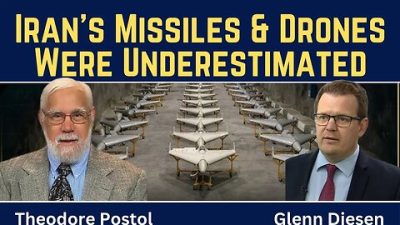
Theodore Postol: Iran’s Missiles & Drones Were Underestimated
or go to
Aletho News Archives – Video-Images
From the Archives
What is the Israeli Lobby in Australia Doing in Interfaith Dialogue?
By Ali Kazak | Dissident Voice | October 11, 2015
For years Israel and its lobby around the world have been trying to normalise their relations with Arabs and Muslims without solving the Palestine Question.
One of the methods they resorted to in the last few years is using human rights and community organizations such as interfaith dialogue and Multiculturalism to achieve this objective and to: isolate the Palestinians, marginalise the Palestine question, end Israel’s isolation, and prevent criticism of Israel, knowing that these organisations will be the first to stand against Israel’s violations, racial and religious discrimination.
The group responsible for this task in Australia is The Australia/Israel & Jewish Affairs Council (AIJAC); its Director of International & Community Affairs, Jeremy Jones is in charge of lobbying religious community organizations, specifically Muslims and Christians. Consequently he convened the Faith Communities for Reconciliation, founding participant in the Australian Partnership of Religious Organisations and the Australian National Dialogue of Christians, Muslims & Jews.
AIJAC is a private political propaganda group. It is recognised as the main Israeli lobby in Australia. It coordinates its activities and works intimately with the Israeli embassy in Canberra and different institutions in Israel. It is privately funded by some Jewish businessmen. It monitors closely Australian politicians, the media, ethnic and religious groups, (especially Arabs and Muslims), unions and academics on their stands towards Israel and the Palestine question. … continue
Blog Roll
 Aletho News
- Iran’s friends are about to make life much more difficult for Israel and the US
- The war of liberation of the Arab and Islamic peoples expands across the Gulf
- Envoy warns UN on Trump’s threat to ‘obliterate’ Iran’s civilian infrastructure
- The Larak Corridor: Iran’s Rial Gate With No US, No Israel, and No Way Around
- ‘Economic terrorism’: Steel facilities hit again in US-Israeli strike
- ‘War Crime’: Iran condemns attacks on Arak, Ardakan nuclear sites
- Two-thirds of Americans want quick end to Iran war even if goals unmet
- Trump to Give “Important Update on Iran” Wednesday in Prime-Time Speech
- Theodore Postol: Iran’s Missiles & Drones Were Underestimated
- Iran To Target Military Industrial-Tech Complex That Facilitated Gaza Genocide
- If Americans Knew
- Israel wants US to bomb more of Iran’s civilian structures (113,000 is not enough) – Not a ceasefire Day 173
- Ann Coulter Rips Into Fox News for Iran War Coverage
- Joe Kent Urges Americans To Call White House and Congress To Object To Sending Troops Into Iran
- DNC Resolution to Reject AIPAC Funding Puts Democratic Leaders in the Hot Seat
- Swedish foundation to build 400 schools as over 650,000 Gaza children remain without education for 2 years
- Israeli army admits photshopping image of slain Lebanese journalist
- This is how Israel is systematically killing health workers under the cover of war in Lebanon
- Carrying life under fire: Israeli invasion of Lebanon leaves pregnant women facing deadly risks
- Champagne all around for the new death penalty (for Palestinians) law – Not a ceasefire Day 172
- Why are Palestinian books struggling to be seen on Amazon?
- No Tricks Zone
- New Study Finds Warming Saves Lives…Cold Temperatures 12 Times More Deadly Than Excess Heat
- German Science Blog Accuses PIK Climate Institute Of Hallucinating Climate Tipping Points
- Devastating Assessment Of Comirnaty Vaccine By Former Senior Pfizer Europe Toxicologist
- New Study: CO2 Is ‘Effectively Negligible’ As An Explanatory Climate Change Factor Since 2000
- Former Pfizer Toxicologist Dr. Helmut Sterz Tells Bundestag Hearing Pfizer Vaccine Should Have Never Been Approved
- Energy Expert: Germany’s Nuclear Phaseout Was A “500 Billion Euro Mistake”
- New Research: South Australia’s Mid-Holocene Sea Surface Temperatures Were 4°C Warmer Than Today
- Storing Green Energy To Last Germany 10 Days Would Require A 60-Million Tonne Battery
- New Studies: UK Sea Levels Were 4 Meters Higher Than Today During The Mid-Holocene
- Destructive Green New Deal: German Energy And Metal Group Warns Of Drastic Crisis
 Aletho News