Trump Is Lying about Releasing the JFK Records
By Jacob G. Hornberger | FFF | August 26, 2024
To honor Robert F. Kennedy Jr.’s endorsement of Republican presidential candidate Donald Trump (after Kennedy was rebuffed by Democrat presidential candidate Kamala Harris), Trump announced that if Americans elect him president again, this time around he will order a release of the CIA’s long-secret JFK-assassination-related records.
What a crock. What amazes me is that Trumpsters believe anything and everything this guy says, despite his proven track record of failing to tell the truth.
Remember: Trump was president for four long years. During any of that period of time, he could have issued a simple order to the National Archives: Release the CIA’s 50-year-old Kennedy-assassination-related records to the public immediately.
Trump didn’t do that, even though he promised to do it, just as he is now promising to do it if American voters will give him another chance. After repeatedly promising to release those records when he was president, Trump buckled and granted the CIA’s demand for secrecy for several more years. When that new deadline came due, President Biden granted a new request for secrecy by the CIA and ultimately extended the secrecy into perpetuity.
There is also what has to be a lie that Trump told Judge Andrew Napolitano regarding the CIA’s secret records. According to Napolitano, in a conversation he had with Trump, he asked Trump why he had not ordered the release of the CIA’s JFK-assassination-related records. Trump responded with “Judge, if they showed you what they showed me, you wouldn’t have released them either.”
If Trump was suggesting that there was some sort of big smoking-gun matter in those records, it’s got to be a lie because there is no chance whatsoever that the CIA would have turned over such a record to the Assassination Records Review Board or the National Archives instead of simply destroying it. Moreover, ever since the CIA was established, it has been standard practice to never put anything regarding a state-sponsored assassination in writing. What are the chances that the CIA would make an exception to that rule with respect to its assassination of a U.S. president? None!
Moreover, if Trump is really going to order a release of the records if he is again elected president, as he is now promising again that he will, then why not reveal publicly what he supposedly saw that motivated him to make that statement to Napolitano? If he is going to release them anyway, why does he need to wait until he’s elected president to reveal that particular part of the records to the American people?
So, the question naturally arises: Why would Trump lie about why he broke his promise to release the CIA’s secret records when he was president for four long years? Because he can’t admit the real reason for his broken promise: The CIA would not permit him to release the records. He knows what President Biden, Harris, and everyone in Washington, D.C., knows: The CIA, along with the Pentagon and the CIA, are in charge.
Oh sure, Trump talks big again about “draining the swamp,” taking on the deep state, and making America great again, but let’s not forget that he talked the same way before he was elected president. He broke all those promises also. Immediately upon being elected president, he surrounded himself with generals and foreign interventionist John Bolton, traveled to CIA headquarters obviously to bend the knee and kiss the ring, kept U.S. troops killing and dying in Afghanistan for nothing, and refused to pardon Edward Snowden for revealing the NSA’s illegal secret surveillance scheme. If Trump did all that the first time, he’ll do it again, especially given that he has never expressed any regret or remorse for doing it the first time.
The fact is that the CIA’s JFK-assassination related records will never be released, unless the CIA authorizes a president to order their release. That’s not likely to happen, not because there is some sort of huge smoking-gun confession within the records but instead because the records undoubtedly contain small bits of incriminating circumstantial evidence that further fill out, even in very small ways, the overall mosaic establishing criminal culpability of the U.S. national-security state in Kennedy’s assassination.
Durov’s arrest represents a new level of desperation from western elites
By Martin Jay | Strategic Culture Foundation | August 26, 2024
The arrest of Pavel Durov marks a new low point on the scumline of the side of the bath – the tub being western democracies and the line being their desperation to stay in power at the costs of controlling social media. Durov, who owns Telegram and lives in Dubai, could be in jail for months and possibly years on the trumped-up charges which the French state has conjured up simply because he refuses to allow any government to have a back door into Telegram. He has fought this tooth and nail for years with the west, in particular the U.S., playing every dirty trick in the book to get access to the platform for its own nefarious purposes – to destroy opposition figures, their strategies etc. – rather than what it is dressed up to be, identifying terrorists and international criminals.
As the UK ponders how its own state has sunk to a new totalitarian level in recent days with the arrest of its citizens who merely like a posting on a social media platform, the West has arrested this French Russian dual national genius who is charged with the crimes of those criminals active on Telegram. And so charges of terrorism and trafficking in minors, drugs and whatever else they can find on the platform will be made against him as someone abetting in the crimes. Of course, the same rules will not be levelled against Elon Musk who surely has criminals on his platform or for that matter any of the other social media platforms.
But how many of these platforms are also taking the same stand as Durov? We are led to believe that most of them aren’t but in light of his arrest we should assume that many of them have already allowed some sort of access to them for the deep state. Elon Musk likes to brag about his refusal to comply with the EU’s demands that he “moderates” who he allows onto X, adding that other social media platforms accepted the deal offered to him by Brussels: comply with our requests and we grant you some leniency on future antitrust fines. This offer, which he claims was happily accepted by other platforms is as close as you can get to the EU offering a brown envelope stuffed full of cash to a man in a pub. It’s a bribe and gives a clue as to how anti-democratic the EU is and how it operates in the shadows.
The French arrest however goes deeper in that we can assume that it was not France operating alone to nab Durov. We can assume that the FBI and CIA had probably pushed Macron to do this appalling dirty work but perhaps also Israel had a hand in it. Just recently, Netanyahu complained that data which was stolen from the government was being exchanged on Telegram and asked Durov to step in and retrieve it. He got no reply. Did Mossad have a hand in the arrest of Telegram’s boss? It seems credible given that it is hard to believe that Durov would fly into French airspace eyes wide open. Was it a kidnapping operation to get his plane and his pilot to land in Paris? French TV channel TF1 said Dubai-based Durov had been travelling from Azerbaijan and was arrested at around 8 p.m. (1800 GMT) on Saturday 24th of August but did not state whether the plane’s ultimate destination had been France.
The details around the arrest are very sketchy, but according to Reuters, Durov, whose fortune was estimated by Forbes at $15.5 billion, said some governments had sought to pressure him but the app should remain a “neutral platform” and not a “player in geopolitics”.
Another question which arises from the arrest is whether it is an international effort by western countries led by the U.S. – with Israel very much part of it – to test the waters for other arrests. Pundits have been dismissed as conspiracy theorists for weeks now suggesting Elon Musk will be arrested at some point, or charged in his absence, by UK authorities for some of the more controversial posts he has made about the political situation in the UK, or even by the EU which appears to have started a legal battle with him after he refused to respond to two letters sent to him by a French European Commissioner. Perhaps even the Democrats in the U.S. might play the same card given that Musk has lost all credibility as a neutral player in U.S. politics after he has so openly supported Trump who has promised him a position in a new government if he were to enter the Oval Office. There is no such thing really as free speech. It comes at a very high price for those who want to protect and cherish it and now France will test the political landscape to see how the arrest of Durov will affect Macron’s ratings. The French president has used outstandingly poor judgment in the past in calling for parliamentary elections immediately after EU ones which gave so much power to far-right groups, so he seems to be good at falling on his own sword. He may well have factored that Durov does not have the popularity of say Assange who didn’t stir so much political anger when he was banged up for years in a filthy, dank cell in the UK on trumped up charges from the U.S.
What is especially worrying is that locking up powerful people who have huge followings on the internet is becoming a trend which people are getting used to. The war between those who want to control the perceived truth and those who hold the actual one is hotting up. Scott Ritter, Andrew Tate, Richard Medhurst all arrested within days of one another, while Musk himself shuts down Egyptian comedian Bassem Youseff who had 10m followers on X. What we are witnessing is a new level of desperation that western elites are more afraid than ever after wasting hundreds of billions of dollars in Ukraine and starting a world war in the Middle East that voters have no confidence any more in their decision-making, as they, the public, struggle more and more to pay for groceries or even heat their houses. It’s a new milestone in the blind dogma of elites to resort to tactics which we would have scorned China or North Korea for using just a few years ago. It’s a new level of panic which we haven’t seen before.
Kursk: Fighting Russia to the Last Ukrainian
By Brian Berletic – New Eastern Outlook – 21.08.2024
In the lead up to the Ukrainian military’s incursion into Russia’s Kursk region, even Western headlines were dominated by reports of Ukraine’s gradual demise. Ukraine is admittedly suffering arms and ammunition shortages, as well as facing an unsolvable manpower crisis. Russia has been destroying Ukrainian military power faster than Ukraine and its Western sponsors can reconstitute it.
Western headlines have also been admitting the scale on which Russia is expanding its own military power as its Special Military Operation (SMO) continues into its third year.
While the launch of Ukraine’s incursion into Kursk has diverted attention away from Ukraine’s collapsing fighting capacity, the incursion itself has not only failed to address the factors leading to this collapse, it is already accelerating it.
Politico in an August 15, 2024 article titled, “As Kyiv makes gains in Kursk, Russia strikes back in Donetsk,” cites the spokesman of Ukraine’s 110th Mechanized Brigade who would admit, “since Ukraine launched the Kursk offensive I would say things have become worse in our part of the front. We have been getting even less ammo than before, and the Russians are pushing.”
The same article would also cite “Deep State,” a mapping project Politico claims is “close” to Ukraine Ministry of Defense, claiming, “over the past 24 hours, Russia occupied the villages of Zhelanne and Orlivka and made advances in New York, Krasnohorivka, Mykolaivka and Zhuravka in Donetsk.”
Thus, while Ukraine claims gains in Kursk, it comes at the expense of territory everywhere else along the line of contact.
Because of the nature of the fighting in Kursk where Ukrainian forces have come out from behind extensive defensive lines and are operating out in the open, they are suffering much greater losses than Ukrainian units being pushed back along the line of contact, according to even the Western media.
Superficial Success, Strategic Suicide
Despite this reality, the Western media has invested heavily in depicting Ukraine’s Kursk incursion as a turning point in the fighting.
CNN in its August 15, 2024 article, “Russia appears to have diverted several thousand troops from occupied Ukraine to counter Kursk offensive, US officials say,” attempts at first glance to portray the Ukrainian operation as having successfully diverted Russian forces from the front lines.
Buried deeper in the article, however, CNN reveals that whatever troops Russia is moving are relatively insignificant compared to the number of Russian forces still fighting along the line of contact primarily in Kherson, Zaporozhye, the Donbass, and Kharkov.
In the short-term, experienced forces utilized as a mobile reserve are likely being moved to Kursk until Russian reserves within Russia itself can be sufficiently mobilized and moved to the area of fighting. The vast majority of Russia’s forces not only remain along the actual line of contact, they continue making progress at an accelerated rate.
The same CNN article would quote US officials, saying:
Some officials also raised concerns that Ukraine, which one western official said has sent some of its more experienced forces into Kursk, may have created weaknesses along its own frontlines that Russia may be able to exploit to gain more ground inside Ukraine.
“It’s impressive from a military point of view,” the official said of the Kursk operation. But Ukraine is “committing pretty experienced troops to this, and they can’t afford to lose those troops.”
“And having diverted them from the front line creates opportunities for Russia to seize advantage and break through,” this person added.
Buried under optimistic headlines across the Western media regarding this latest incursion is an ominous truth – that an operation aimed at humiliating Russia, boosting morale, and raising the political, territorial, and military costs for Russia, has only brought Ukraine deeper into its growing arms, ammunition, and manpower crisis.
Toward what end does an incursion accelerating the collapse of Ukraine’s fighting capacity serve?
Washington’s, Not Kiev’s Ends
CNN would also attempt to convince readers that the Kursk incursion took the US itself entirely by surprise. This is untrue.
The United States, following its political capture of Ukraine in 2014, admittedly took over Ukraine’s intelligence networks. These are the same networks that would have been required to organize this most recent incursion.
A New York Times article, “The Spy War: How the C.I.A. Secretly Helps Ukraine Fight Putin,” not only admits to the CIA’s role in training, shaping, and directing Ukrainian intelligence operations, but also admits to a network of CIA bases along the Ukrainian-Russian border and the fact that the CIA stood up covert military units specifically for crossing over into Russian territory and conducting operations there.
The CIA and other US military and intelligence agencies have been involved in Ukrainian military operations leading up to and all throughout the duration of Russia’s SMO. The Washington Post admits that the US worked with Ukraine to “build a campaign plan” ahead of the failed 2023 Ukrainian offensive.
It is inconceivable Ukraine moved multiple brigades of manpower and equipment, including US-European trained soldiers and Western military equipment to Sumy where the Kursk incursion was launched without Washington’s involvement, let alone without Washington’s knowledge.
Why then did the US organize such an incursion, one admittedly overstretching Ukrainian forces already crumbling under the growing weight of Russian military power? Why, amid Russia’s strategy of attrition, have US planners decided to launch an incursion that will accelerate the loss of Ukrainian manpower, arms, and ammunition it does not have to spare?
In a much wider geopolitical context – Washington’s geopolitical context – the incursion helps raise the cost of victory for Russia in Ukraine as the US seeks to place pressure on and overextend Russia elsewhere within and along its borders.
Years before the SMO even began, as far back as at least 2019, US policymakers openly sought to draw Russia into a costly conflict in Ukraine, just one among many other proposals meant to overextend Russia.
The RAND Corporation in its 2019 paper “Extending Russia” would explain the benefits of “providing lethal aid to Ukraine,” stating:
Expanding U.S. assistance to Ukraine, including lethal military assistance, would likely increase the costs to Russia, in both blood and treasure, of holding the Donbass region. More Russian aid to the separatists and an additional Russian troop presence would likely be required, leading to larger expenditures, equipment losses, and Russian casualties. The latter could become quite controversial at home, as it did when the Soviets invaded Afghanistan.
Ukraine’s incursion into Kursk has – at a minimum – raised the political cost of Russia’s ongoing SMO. This most recent incursion into Kursk almost certainly had hoped to reach the Kursk Nuclear Power Plant, just 35 kilometers beyond the furthest extent the incursion has reached as of this writing. Had Ukrainian forces reached the power plant, the price would have been even higher.
In many ways, however, the Kursk incursion has created a much greater strategic dilemma for Ukraine than it has for Russia. While it has unfolded on the wrong side of the border, the outcome is the same as the Kharkov front Russia opened earlier this year.
Regarding the Kharkov front, the New York Times in its May 2024 article, “Facing Russian Advance, a Top Ukrainian General Paints a Bleak Picture,” would admit, “the Russian attacks in the northeast are intended to stretch Ukraine’s already thin reserves of soldiers and divert them from fighting elsewhere,” and that, “the Ukrainian army was trying to redirect troops from other front-line areas to shore up its defenses in the northeast, but that it had been difficult to find the personnel.”
By committing thousands of Ukrainian troops and large amounts of Ukraine’s best military equipment to an incursion into Kursk, it is creating the same overextension of its own forces Russia had created in Kharkov last May, but with the added complication of needing to extend logistics and other means of supporting Ukrainian operations beyond Ukrainian territory itself.
The same RAND Corporation paper proposing to draw Russia into a costly conflict with Ukraine would also discuss the consequences this conflict would have for Ukraine itself, explaining:
… such a move might also come at a significant cost to Ukraine and to U.S. prestige and credibility. This could produce disproportionately large Ukrainian casualties, territorial losses, and refugee flows. It might even lead Ukraine into a disadvantageous peace.
The plan from the very beginning was to lure Russia into a costly conflict in the hopes of precipitating a Soviet-style collapse, but at the expense of Ukraine’s own survival. Thus, what we see unfolding in Ukraine today is simply the consequences predicted by the RAND Corporation in 2019.
Dangerous Escalation and the Long Game
Perhaps most concerning of all is the looming prospect of the US intervening more directly, including in the form of a “buffer zone” similar to that created by the US and its Turkish allies in the east and north of Syria during Washington’s proxy war there.
For this intervention to succeed, Russia would have to be compelled to restrain itself from attacking Western forces arriving in Ukraine.
The possibility of this happening is difficult to predict.
On one hand, Russia has demonstrated immense patience amid other US proxy wars. Russian patience in Syria is finally paying off after almost a decade of enduring US provocations and the presence of US troops east of the Euphrates River. The US now finds itself isolated and vulnerable in Syria, its forces under regular attack there, and a disproportionate amount of US military hardware remains committed to both Syria and the surrounding region, limiting US combat power ahead of a potential conflict with Russia in Eastern Europe or China in the Asia-Pacific.
Moscow may determine that a Western intervention directly into Ukraine will, over time, collapse under its own weight in a similar manner. In the long term, the US is only going to grow weaker and more isolated as a result of its unsustainable, overreaching foreign policy. Initiating direct conflict with the US now, when it is inevitably going to be weaker later, would be permitting the US a potential and unnecessary advantage.
Instead, Russia and its allies may find an opportunity to exercise many of the means of escalation (short of direct conflict with the US itself) they have held in reserve throughout the duration of this conflict. This includes more open and direct military cooperation between Russia and China, including the arming of Russian forces with Chinese manufactured weapons and ammunition.
On the other hand, Russia may decide to restrain itself from attacking Western forces arriving in Ukraine’s westernmost regions, but continue military operations along the line of contact and obviously within Kursk itself to expel Ukrainian forces. The US would seek to test the limits of Russian resolve, seeking to constrain Russian operations as much as possible, just as the US did in Syria from 2015 onward.
Throughout this process, the potential for escalation and direct conflict between Russia and the US will grow.
Despite the continued collapse of Ukraine’s fighting capacity because Ukraine is ultimately a proxy of the United States, a difficult and dangerous transition period lies ahead dependent on the extent to which the US seeks to mitigate Ukraine’s subsequent political and territorial collapse.
Only time will tell whether the US cuts and runs as it did in Afghanistan, or doubles down as it did in Syria. It should be pointed out, however, that the US withdrew from Afghanistan in 2021 to redirect its resources ahead of Russia’s SMO in 2022. Were the US to cut Ukraine loose, it would only be because the US requires resources for a larger, more dangerous conflict elsewhere – namely in the Asia-Pacific region against China.
Either way, when Ukraine’s fighting capacity nears its end, it is likely only wider conflict awaits.
US embassy played intelligence role in Yemen: Source to Al Mayadeen
Al Mayadeen | August 17, 2024
Confessions made by the US-Israeli spy network revealed Washington’s strategic goal of fragmenting Yemen geographically, sowing divisions, and creating instability in the country, a Yemeni source told Al Mayadeen on Saturday.
In mid-June, the Yemeni Security Forces in Sanaa uncovered a large espionage network operated by American and Israeli intelligence agencies. Officials revealed that the network had been active within various institutions in Yemen since 2015.
The source said that the confessions revealed significant infiltration into the former state leadership and parliament with an aim to influence its decisions and operations.
The confessions exposed “American conspiracies on the political level through reproducing crises and escalating them in Yemen.”
US turned previous Yemeni government into “a puppet”
The spy network admitted that Washington turned the previous Yemeni government into “a puppet under its control.” It also exposed the reality of the US conspiratorial role against the 2011 revolution.
According to the source, the network admitted that the aim was for the Yemeni national dialogue to be merely superficial, allowing Washington to push through its dangerous projects regarding the state structure and constitution.
If it were not for the role of the Ansar Allah movement, Yemen would be in a much worse situation today, the source stressed.
The spy network’s confessions further revealed that all the wars waged on Saada and the assassinations carried out were orchestrated by the United States, with local collaborators serving merely as tools. These efforts aimed to pressure Ansar Allah into accepting regionalization and division.
Washington behind aggression on Yemen
The confessions emphasized that Washington is behind the aggression against Yemen and that all efforts it presents under the guise of political peace initiatives are nothing more than conspiracies and plots within the same context.
In the same vein, one of the network’s members revealed that the so-called “democracy sector” within the US embassy worked to control the Supreme Elections Committee to determine who governs Yemen.
The US embassy’s “election program” played an intelligence role by recruiting party leaders interested in election-related matters, the spy indicated, adding that the embassy and other US intelligence agencies sought to obtain the voter registry of Yemeni citizens.
Another member of the spy network admitted that USAID projects, UN initiatives, and others presented under the guise of providing aid to Yemen, contain hidden and dangerous elements related to intelligence activities.
As part of the US-Israeli spy network’s confessions, a security source told Al Mayadeen in late June that the Cultural Attaché at the US embassy in Yemen targeted all segments of Yemeni society, through which cells were lured and recruited to collect information.
The source pointed out that the spy network’s confessions revealed that the US embassy was nothing more than a den of espionage and a tool for sabotage and that the Cultural Attaché at the US embassy in Yemen was linked to the US intelligence agency, the CIA.
On June 22, the Yemeni security services published extensive confessions from members of the US-Israeli espionage network, revealing that their operations were aimed at undermining Yemen’s economic sector by collecting data to support US presence and advance its agendas.
CIA awards Qatari intel chief top medal for cooperation with US
The Cradle | August 16, 2024
In a ceremony earlier this week, CIA Director William Burns awarded the head of the Qatari State Security Agency the George Tenet medal for his work on strengthening intelligence cooperation between the US and Qatar, Axios reported on 16 August.
Both Burns and Al-Khulaifi have played important roles in the negotiations between Israel and Hamas for a potential ceasefire in Gaza and prisoner exchange.
One reason for the award is Qatari efforts to release the remaining 111 Israeli captives held by Hamas in Gaza, one source with knowledge of the issue told Axios.
Israel is holding thousands of Palestinians in its prisons and detention camps, where torture and rape is common.
Another source said Burns gave the award to his Qatari counterpart in “appreciation of his role in maintaining national and regional security, and the exceptional support he provided to the CIA in preserving the interests and security of the US and Qatar.”
Another important reason for the award was the cooperation between the CIA and Qatari intelligence in counterterrorism and the ability of the Qatari State Security Agency to prevent and foil threats and attacks in West Asia, the source told Axios.
Both the US and Qatar have long been known for their support of terrorist groups in the region.
Starting in 2011, the US and Qatar worked closely with other regional states to support Al-Qaeda in Syria.
The Syrian branch of the terror group, the Nusra Front, led a jihadist insurgency against the Syrian government led by Bashar al-Assad under the cover of US-sponsored anti-government protests.
The FBI ‘Visits’ Scott Ritter

By Andrew P. Napolitano | Ron Paul Institute | August 15, 2024
Among the lesser-known holes in the Constitution cut by the Patriot Act of 2001 was the destruction of the “wall” between federal law enforcement and federal spies. The wall was erected in the Foreign Intelligence Surveillance Act of 1978, which statutorily limited all federal domestic spying to that which was authorized by the Foreign Intelligence Surveillance Court.
The wall was intended to prevent law enforcement from accessing and using data gathered by America’s domestic spying agencies.
Government spying is rampant in the US, and the feds regularly engage in it as part of law enforcement’s well-known antipathy to the Fourth Amendment. Last week, the FBI admitted as much when it raided the home of former Chief UN Weapons Inspector Scott Ritter. Scott is a courageous and gifted former Marine. He is also a fierce and articulate antiwar warrior.
Here is the backstory.
After President Richard Nixon resigned the presidency, Congress investigated his use of the FBI and CIA as domestic spying agencies. Some of the spying was on political dissenters and some on political opponents. None of it was lawful.
What is lawful spying? The modern Supreme Court has made it clear that domestic spying is a “search” and the acquisition of data from a search is a “seizure” within the meaning of the Fourth Amendment. That amendment requires a warrant issued by a judge based on probable cause of crime presented under oath to the judge for a search or seizure to be lawful. The amendment also requires that all search warrants specifically describe the place to be searched and the person or thing to be seized.
The language in the Fourth Amendment is the most precise in the Constitution because of the colonial disgust with British general warrants. A general warrant was issued to British agents by a secret court in London. General warrants did not require probable cause, only “governmental needs.” That, of course, was no standard whatsoever, as whatever the government wants it will claim that it needs.
General warrants authorized government agents to search wherever they wished and to seize whatever they found — stated differently, to engage in fishing expeditions.
FISA required that all domestic spying be authorized by the new and secret FISA Court. Congress then unconstitutionally lowered the probable cause of crime standard for the FISA Court to probable cause of speaking to a foreign agent, and it permitted the FISA Court to issue general warrants.
Yet, the FISA compromise that was engineered in order to attract congressional votes was the wall. The wall prohibited whatever data was acquired from surveillance conducted pursuant to a FISA warrant to be shared with law enforcement.
So, if a janitor in the Russian embassy was really an intelligence agent who was distributing illegal drugs as lures to get Americans to spy for him, any telephonic evidence of his drug dealing could not be given to the FBI.
The purpose of the wall was not to protect foreign agents from domestic criminal prosecutions; it was to prevent American law enforcement from violating personal privacy by spying on Americans without search warrants.
Fast forward to the weeks after 9/11 when, with no serious debate, Congress enacted the Patriot Act. It removed the wall between law enforcement and spying. And by 2001, the FISA Court had on its own lowered the standard for issuing a search warrant from probable cause of speaking to a foreign agent to probable cause of speaking to a foreign person. This, too, was unlawful and unconstitutional.
The language removing the wall sounds benign, as it requires that the purpose of the spying must be national security and the discovered criminal evidence — if any — must be accidental or inadvertent. In January 2023, the FBI admitted that it intentionally uses the CIA and the NSA to spy on Americans as to whom it has neither probable cause of crime nor even articulable suspicion of criminal behavior.
Articulable suspicion is the linchpin of commencing all criminal investigations. Without requiring suspicion, we are back to fishing expeditions.
The FBI’s admission that it uses the CIA and the NSA to spy for it came in the form of a 906-page FBI rulebook written during the Trump administration, disseminated to federal agents in 2021 and made known to Congress last year.
Last week, when FBI agents searched Ritter’s home in upstate New York, in addition to trucks, guns, a SWAT team and a bomb squad, they arrived with printed copies of two years’ of Ritter’s emails and texts that they obtained without a search warrant. To do this, they either hacked into Ritter’s electronic devices — a felony — or they relied on their cousins, the CIA and the NSA, to do so, also a felony.
But the CIA charter prohibits its employees from engaging in domestic surveillance and law enforcement. Nevertheless, we know the CIA is physically or virtually present in all of the 50 US statehouses. And the NSA is required to go to the FISA Court when it wants to spy. We know that this, too, is a charade, as the NSA regularly captures every keystroke triggered on every mobile device and desktop computer in the US, 24/7, without warrants.
The search warrant for Ritter’s home specified only electronic devices, of which he had three. Yet, the 40 FBI agents there stole a truckload of materials from him, including his notes from his U.N. inspector years in the 2000s, a draft of a book he is in the midst of writing and some of his wife’s personal property.
The invasion of Scott Ritter’s home was a perversion of the Fourth Amendment, a criminal theft of his private property and an effort to chill his free speech. But it was not surprising. This is what has become of federal law enforcement today. The folks we have hired to protect the Constitution are destroying it.
To learn more about Judge Andrew Napolitano, visit https://JudgeNap.com.
COPYRIGHT 2024 ANDREW P. NAPOLITANO
DISTRIBUTED BY CREATORS.COM
Should RFK, Jr., Have Accepted Secret Service Protection?
By Jacob G. Hornberger | FFF | July 19, 2024
In the aftermath of the near-assassination of President Trump, President Biden finally granted independent presidential candidate Robert F. Kennedy, Jr.’s longtime request to be granted Secret Service protection. However, I can’t help but wonder whether Kennedy is now having second thoughts, not only given the Secret Service’s massive incompetence, at best, that led to the Trump shooting but also given the possibility, at worst, that there was criminal culpability on the part of the Secret Service, including by simply knowingly letting the shooting happen.
While the event will inevitably be blamed on incompetence by U.S. officials and the mainstream press, one thing is certain: While there is now no doubt that the John F. Kennedy assassination was orchestrated and covered up by the military and the CIA, given the military’s fraudulent autopsy on JFK’s body and the CIA’s production of a fraudulent copy of the Zapruder film on the weekend of the assassination, there is also no doubt that there were elements of the Secret Service involved in the assassination and cover-up. (For a detailed account of the autopsy fraud and the film fraud, see my books The Kennedy Autopsy and An Encounter with Evil: The Abraham Zapruder Story.)
Consider Secret Service agent Roy Kellerman. He was riding in the passenger seat of the presidential limousine when the first shot was fired at Kennedy. Kellerman’s duty as a Secret Service agent was to jump over the seat and cover Kennedy with his body. Instead, he sat there like a bump on a log, waiting for the fatal shot that hit Kennedy in the head.
Fifty-nine witnesses stated that the driver of the limousine, William Greer, made a complete stop or a near-stop after the first shot rang out, which obviously made it easier for the shooter to hit Kennedy in the head with the fatal shot. Yet, that stop or near-stop is not seen in the extant Zapruder film of the assassination.
As I detail in An Encounter with Evil, the official story has always been that the Zapruder film was shipped to Chicago on the Saturday after the Friday assassination, where LIFE magazine’s printing plant was located. This was after Dallas businessman Abraham Zapruder had sold the print rights to his film of the assassination to LIFE magazine.
In the late 2000s, that official narrative was burst asunder when one of the CIA’s most renowned photo intelligence analysts, Dino Brugioni, disclosed that two men who identified themselves as Secret Service agents secretly delivered the Zapruder film to him and his team at the CIA’s National Photographic Interpretation Center (NPIC) in Washington, D.C., on the Saturday night after the assassination on Friday. That meant that the film had secretly been diverted from Chicago to Washington. That would not have been difficult to do given that LIFE’s publisher, C.D. Jackson, was a CIA asset under the CIA’s Operation Mockingbird program.
Brugioni’s job was to make blow-ups of frames from the film that the two Secret Service agents selected and post them on “briefing boards.” As I detail in my book, when Brugioni was shown the extant Zapruder film in the late 2000s, he stated unequivocally that it was not the same film he had seen on that Saturday night.
On the following evening, a man who identified himself as a Secret Service agent delivered a 16mm copy of the Zapruder film to another NPIC team, stating that this copy was actually the original film that he had just brought from Hawkeyeworks, a top-secret CIA film facility located in the middle of Kodak’s research and development facility at its national headquarters in Rochester, New York.
How do we know that that that 16mm film was a copy and not the original? Because Zapruder’s film was an 8mm-wide film. There is no way to convert an 8mm film into a 16mm film except by making a copy of it.
Could they have produced a 16mm top-quality copy of an 8mm film at Hawkeyeworks? Brugiioni had visited Hawkeyeworks and had been told that they were capable of “doing anything” at that facility.
How would they have done that? As I detail in An Encounter with Evil, they would have done it with what was called an “aerial optical printer,” which could produce an altered copy that would come out looking like an original. Using that piece of equipment, they could produce an altered copy of the film that deleted all the frames that showed Secret Service agent Greer’s stop or near-stop of the limousine, which, again, had been seen by 59 eyewitnesses.
Since the CIA could view Zapruder’s 8mm film at NPIC, there was no reason whatsoever to secretly take the film to Hawkeyeworks except to produce an altered, fraudulent copy of the film. (While the CIA worked closely with Kodak film experts at Hawkeyeworks, no evidence has ever surfaced that Kodak had any role in helping to produce the altered copy of the Zapruder film.)
Returning to Secret Service agent Roy Kellerman, it’s worth mentioning that he was the agent in charge of the Secret Service team at Parkland Hospital that forcibly prevented the Dallas County Medical Examiner, Dr. Earl Rose, from conducting an autopsy on Kennedy’s body, as Texas law required. Brandishing guns and screaming, yelling, and issuing a stream of profanities, Kellerman and his team forced their way out of Parkland with JFK’s body and delivered it to new President Lyndon Johnson, who was patiently waiting for it in Air Force One at Dallas’s Love Field and who would later deliver JFK’s body into the hands of the military.
As I detail in The Kennedy Autopsy, the president’s body was secretly delivered to the Bethesda National Medical Center morgue at 6:35 p.m. in a cheap shipping casket, which was almost 1 and 1/2 hours before the official entry time of the body into the morgue in the heavy, ornate casket into which it had been placed in Dallas.
You’ll never guess who was in charge of the secret operation to get JFK’s body back into the Dallas casket after it had been secretly delivered to the Bethesda morgue at 6:35 pm in the cheap shipping casket. Yes, Secret Service agent Roy Kellerman, who obviously was a very busy man on November 22, 1963.
After the Assassination Records Review Board was brought into existence in 1992, the ARRB sent a notice to all federal agencies, including the Secret Service, specifically advising them that they were not to destroy any assassination-related records. With full knowledge of that directive, the Secret Service knowingly, intentionally, and deliberately destroyed its records of Kennedy’s trips in the month preceding the assassination. Those records were important in part because of an assassination plot in Chicago that was foiled, one that involved a “patsy” who was similar to Lee Harvey Oswald, a man named Thomas Vallee.
Given the manifest incompetence of the Secret Service with respect to the Trump shooting, at best, and given that elements of the Secret Service were criminally culpable in the Kennedy assassination, and given the Secret Service’s contemptible conduct with the ARRB, Robert F. Kennedy, Jr., might today be wishing he had stuck with a private-sector security firm.
Cyberattacks: A New False Flag Frontier
BY KIT KLARENBERG | JULY 15, 2024
At the start of June, Admiral Robert Bauer, head of NATO’s military committee, announced that the military alliance had finalised plans to recognise state-backed cyberattacks on its members as a dedicated pretext for activating Article 5. Reportedly “a joint decision of all allies,” from now on, foreign hacking blitzes can be countered with a collective NATO response, up to and including military measures. Bauer’s disclosure passed the media by entirely – but this is a seismic development, heralding a modern, digital form of ‘false flag’.
Article 5, which provides for collective defence in the event a NATO member is attacked, was a core component of the military alliance’s founding treaty. While it has been invoked just once – by the US, in the wake of 9/11, to invade Afghanistan – there have been efforts to spark it before and since. Most recently, in November 2022, the government of Ukraine falsely declared a missile fired by Kiev that struck Poland, killing two people, was Russian in origin.
The purpose of this deceit was undoubtedly to embroil NATO formally and directly in the proxy war. Wise to the ruse, US officials harshly rebuked President Volodmoyr Zelensky publicly for the World War-threatening fraud. Such incidents amply underline Article 5’s susceptibility to abuse. Yet apparently, military alliance chiefs – and the bloc’s members – are keen to ever-expand its terms, well-beyond its initial remit. Adding cyberattacks to the roster of grounds for collective response is a long-standing objective.
In August 2019, NATO secretary general Jens Stoltenberg authored a bombastic op-ed declaring the military alliance would “guard its cyber domain and invoke collective defence if required.” A “serious cyberattack” on one member state could be “treated as an attack against us all,” he wrote, triggering Article 5 in the process. Fast forward two years, and Keith Alexander, US National Security Agency director 2005 – 2014, called on the ‘Five Eyes’ global spying network to construct a global unified cyberattack “radar”:
“Imagine if we built a radar picture for cyber that covered not only what impacts Australia, but what impacts other countries, and we could share, in real time, threats that are hitting our countries… What we can do is share information and work together… Cyber is going to be hugely important for our future. It’s the one area where adversaries can attack Australia and the US without trying to cross the oceans… We have this anomaly: how are you gonna defend that which you can’t see?”
Alexander, who lied brazenly to the public about his agency’s spying capabilities – including while while testifying under oath to Congress – during his time as NSA chief, suggested this worldwide dragnet would contribute significantly to collective defence, in the obvious spirit of NATO’s Article 5. Given “proposals” for Orwellian, futuristic resources from Western politicians and military and intelligence officials almost invariably presage their real-world rollout, we can only assume in light of Bauer’s announcement such a “radar” is incoming.
‘Security Failures’
This interpretation is reinforced by Bauer observing how invoking Article 5 could only happen once it was confirmed a cyberattack was carried out by a state actor, not a private person or structure. “In that case, it would not be clear who to go to war with,” he added. It’s certainly a source of some relief that NATO is committed to securing clarity on “who to go to war with”, before launching a military “response” to a cyberattack.
However, these comments illuminate a very obvious, grave problem with adding cyberattacks to Article 5’s ambit. Identifying who or what is responsible for them to an absolute certainty is extremely difficult. This task is further complicated by a frequent lack of certainty over whether hackers operating from a particular state are doing so at the behest of authorities. For example, much has been made in Britain recently of Russian hacking group Qilin, which supposedly infiltrated NHS servers.
Mainstream media reports have universally framed Qilin as a malign instrument of the Kremlin, although whether Russian officials command the group, let alone even know of its existence, is far from clear. A representative iNews article refers to Qilin as “a syndicate made up of more than 100 groups…not believed to be under the direct control [emphasis added] of the Russian government.” Instead, Qilin is claimed to be “a useful tool of global disruption the Kremlin is happy to turn a blind eye to.”
Further muddying the picture, it has been confirmed that Western intelligence services can falsely attribute cyberattacks, with devastating effect. In 2017, CIA files published by WikiLeaks revealed how the Agency masks its hacking exploits, to make it appear another state actor was responsible. Dubbed ‘Marble Framework’, among other things the resource inserts foreign-language text into malware source codes to misdirect security analysts. The Framework can obfuscate in this manner via Arabic, Chinese, English, Farsi, Korean, and Russian.
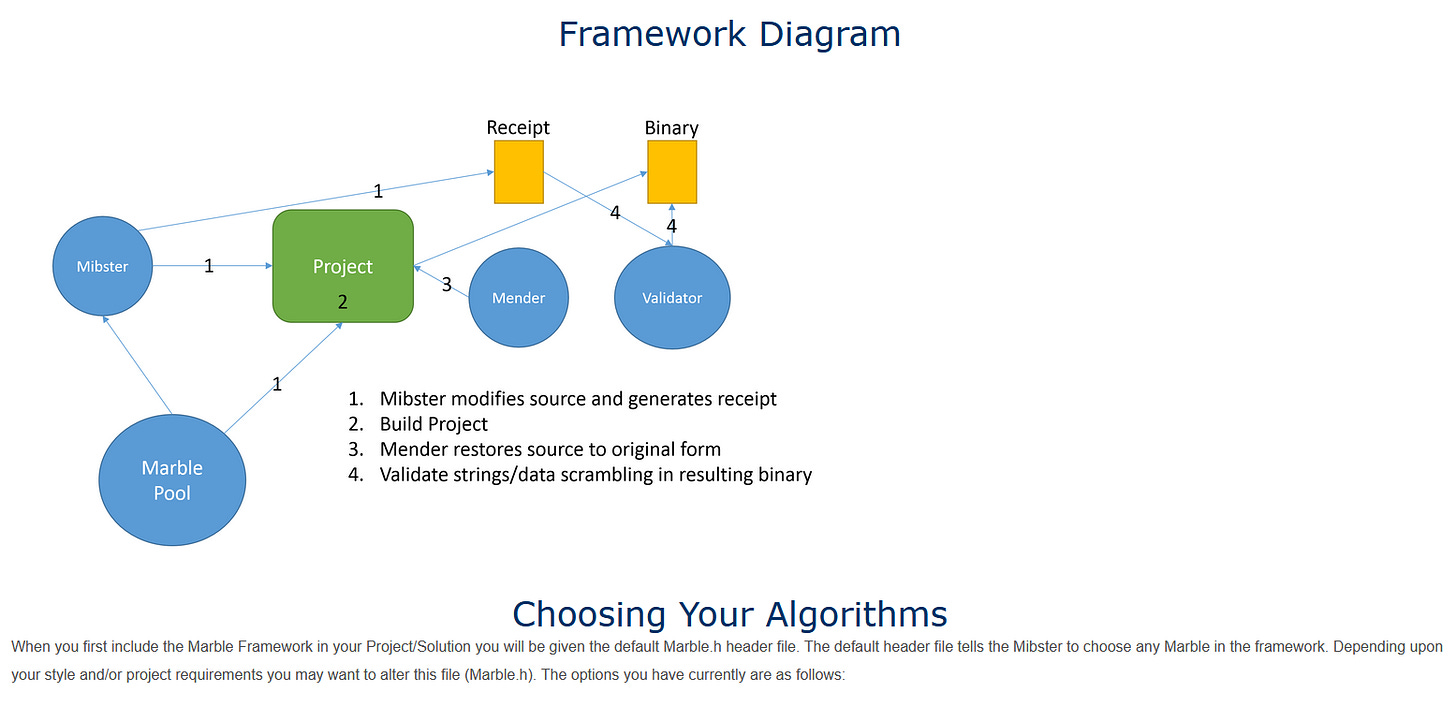
Excerpt from leaked Marble Framework files
Moreover, CIA hackers employ crafty tricks and double bluffs to reinforce these bogus attributions, such as creating the appearance of attempts to conceal foreign-language text. Thus, forensic investigators are successfully conned into concluding even more strongly that the country framed by Langley is responsible. Unbelievably, this seismic disclosure prompted no Western journalist to reappraise the widely received narrative that Moscow’s GRU was responsible for the hack and leak of damaging Democratic National Committee emails in 2016.
That conclusion, universally reinforced by the Western media, was initially peddled by Matt Tait, a former GCHQ spy. He didn’t base his conclusions on anything technical, but “basic operational security failures” he detected on the part of the individual(s) who released the communications, including their computer username referencing the founder of the Soviet Union’s secret police, and “ham-fisted” attempts to pose as Romanian. Which is, of course, precisely how the CIA would cover its own tracks via Marble Framework.
‘Irrevocable Proof’
There has similarly been no mainstream discussion of why the Agency would seek to acquire and maintain this capability in the first place. Now that NATO considers cyberattacks an Article 5 matter, this question has never been a more urgent question, given the CIA’s extensive and deplorable history of false-flag operations to overthrow governments, and kickstart conflicts.
For example, in April 1953, the CIA and MI6 launched a welter of covert actions to undermine Iranian Prime Minister Mohammad Mosaddegh, in order to lay the foundations of his ouster. One key tactic in which the pair engaged was bombing mosques, and homes of prominent Muslim figures by operatives posing as members of Tehran’s Communist Party. A subsequent internal review of the coup noted that this incendiary activity mobilised Mullahs to take action against Mosaddegh.
These efforts were judged to have contributed to the “positive outcome” of the wider coup effort. Such a glowing appraisal of these false flag manoeuvres may have informed the dimensions of Operation Northwoods, a daring set of proposals under which the CIA would stage and commit acts of terrorism against US military and civilian targets. These could then be blamed on the government of Fidel Castro, precipitating all-out war with Cuba.
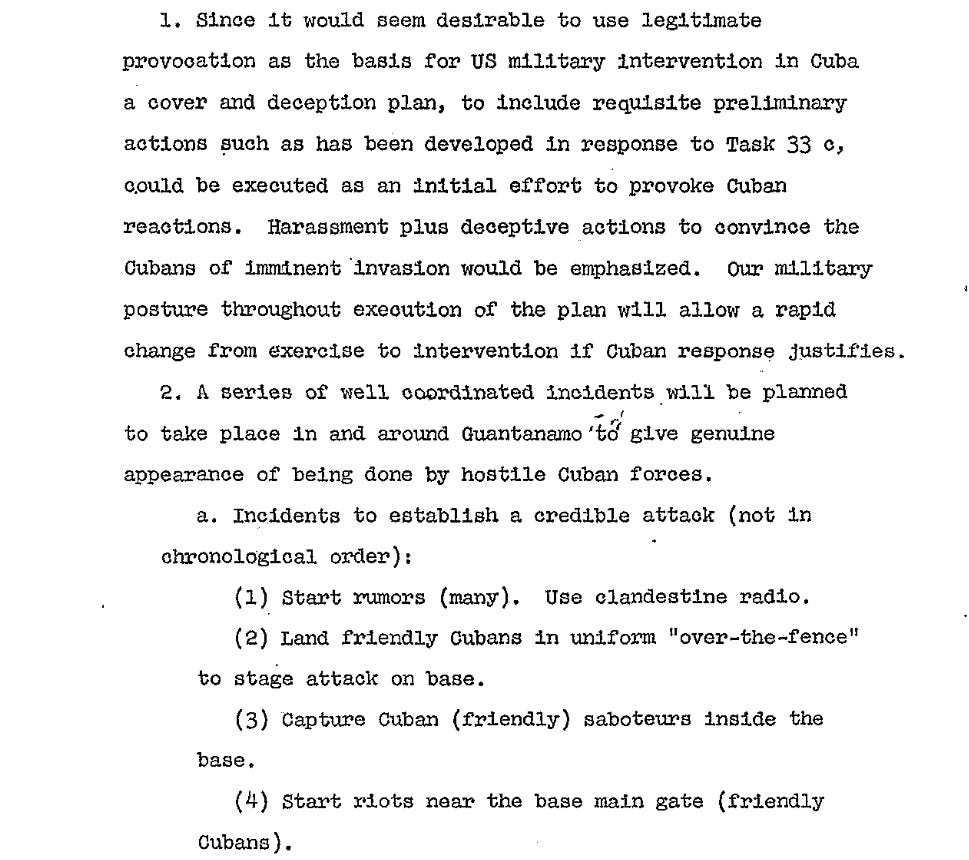
Potential false-flag actions outlined in extraordinary declassified documents include assassinating of Cuban immigrants on US soil, sinking boats ferrying Cuban refugees to Florida, shooting down US civilian airlines, blowing up US ships, and more. One specific element of Operation Northwoods is particularly relevant to consider in light of alleged state cyberattacks becoming Article 5 worthy. If the 1962 Mercury launch – the first US orbital spaceflight – went awry, Castro would be blamed by concocting:
“Irrevocable proof… the fault lies with the Communists… this to be accomplished by manufacturing various pieces of evidence which would prove electronic interference on the part of the Cubans.”
While Northwoods was ultimately rejected by President John F. Kennedy, the US military and intelligence community continued constructing false-flag blueprints thereafter. In 1963, a Pentagon policy paper advocated making it appear that Cuba had attacked a member of the Organization of American States (OAS), justifying US retaliation:
“A contrived ‘Cuban’ attack on an OAS member could be set up, and the attacked state could be urged to take measures of self-defense and request assistance from the US and OAS.”
Langley’s cyberattack connivances have surely only grown more sophisticated, and more complex to unravel, in the years since Marble Framework was publicly exposed. Pinning blame on a foreign country for a cyberattack it didn’t actually commit is no doubt even easier and more effective today. Resultantly, a false flag tripwire for Beijing, Moscow, or any other Washington-mandated ‘enemy’ state to unwittingly and unwillingly stumble over, triggering the outbreak of global war, has now been forged by NATO.
The Prince And The Spy

By Whitney Webb | The Last American Vagabond | May 12, 2023
A TLAV investigation has found that Erik Prince, the man behind the Blackwater mercenary group, recently teamed up with an Israeli spy, creating a front company with her to help Israeli defense technology providers exploit loopholes and sell their products to the American military.
For years, Erik Prince – the founder of mercenary firm Blackwater (now Academi) – has been a major source of controversy. Ever since he left Blackwater over a decade ago, Prince has appeared in the news for pushing to privatize several wars, his ties to former President Donald Trump’s presidential campaigns, his violation of international arms embargoes and his unusually close ties with Project Veritas, among other notable events and connections.
However, some of Prince’s antics in recent years have not yet made it into the news – namely his decision to team up with an Israeli spy to build a very secretive company that has – until now – evaded scrutiny. That company, Comframe Solutions, appears to operate as an intelligence front and explicitly targets parts of the American military involved in highly sensitive combat operations. As this investigation will show, Prince’s partner in Comframe – Lital Leshem – has been tied to a series of apparent, and admitted, Israeli intelligence front companies, several of which have a focus on technology. Yet Prince and his close associate Chris Burgess – Comframe’s supposed president – have done everything they can to hide their association with the incredibly secretive company. Why might that be and what exactly is Comframe up to?
From “Army Brat” to Cyber Spy
Lital Leshem was raised as an “army brat” in Reut, Israel and Pennsylvania, USA. She later enlisted in the Israel Defense Forces (IDF) as she was “truly devoted to safeguarding the State of Israel.” She quickly rose in the ranks, becoming Operations Officer in the IDF of the besieged Gaza Strip and later becoming a Major, a position she continues to hold to this date through her “reserve duty activities.” According to her LinkedIn, she served in Israeli military intelligence from 2005 to 2011 and, more specifically, served in its signals intelligence unit – Unit 8200. She later attended IDC Herzliya, an Israeli university deeply tied to its military and intelligence apparatus. There, she met Amir Elichai and the two would co-create the company Reporty, which later became Carbyne911 – today known only as Carbyne.
Carbyne was originally founded as Reporty in 2014 by Leshem, Elichai and Alex Dizengof. Leshem and Elichai are Unit 8200 veterans, while Dizengof previously worked for Israel’s Prime Minister’s Office. Before it was revealed that Jeffrey Epstein had poured at least 1 million dollars into the company at the behest of his close associate Ehud Barak, Cabryne’s board of directors – which Barak chaired – included the former commander of Unit 8200, Pinchas Buchris, as well as Epstein associate turned venture capitalist Nicole Junkermann. In the wake of the Epstein scandal, Buchris, Barak and Junkerman, among others, were removed from the board and were largely replaced with veterans and former heads of American intelligence and law enforcement agencies. Leshem had left the company in 2017, but has continued to own shares in the company.
Carbyne is a Next-Generation 9-11 (NG911) platform and the explicit goal of NG911 is for all 911 systems nationwide to become interconnected. It is currently active throughout the United States, its main target market. Its software has been criticized due to “serious privacy concerns” about the amount of information it harvests from smartphones that call a 911 call center running Carbyne’s software. For instance, Carbyne’s smartphone app extracts the following information from the phones on which it is installed:
“Device location, video live-streamed from the smartphone to the call center, text messages in a two-way chat window, any data from a user’s phone if they have the Carbyne app and ESInet, and any information that comes over a data link, which Carbyne opens in case the caller’s voice link drops out.”
The potential for Carbyne as a tool for mass surveillance has been extensively reported by Narativ, MintPress News and other outlets. In addition, Carbyne stores all data on past calls and events in order to “enabl[e] decision makers to accurately analyze the past and present behavior of their callers, react accordingly, and in time predict future patterns.” As a result, Carbyne – along with other Israeli intelligence-connected companies seeking to dominate the American “public safety” market – has the potential to facilitate controversial “predictive policing”, i.e. pre-crime, policies.
In addition to Carbyne, Leshem also worked for Black Cube, which has since been removed from her LinkedIn. There, she had been the firms Director of Marketing. Black Cube was specifically outed as an Israeli intelligence front organization in a 2019 article published by Calcalist Tech. That same article also contains the stunning revelation that many Israeli companies, including Black Cube, have been founded as fronts for intelligence operations since 2012. It states that “since 2012, cyber-related and intelligence projects that were previously carried out in-house in the Israeli military and Israel’s main intelligence arms are transferred to companies that in some cases were built for this exact purpose.” The article also adds that:
“In some cases, managers of development projects in the Israeli military and intelligence arms were encouraged to form their own companies which then took over the [military and/or intelligence] project.”
With Leshem having worked for one company already known to be a product of this deliberate policy, it is worth scrutinizing Carbyne as being one such front, especially considering the common tie of Ehud Barak to both companies. In addition, Leshem has also worked for another company tied to Barak that has been described as worse than the NSO Group, which produced the notorious Pegasus software. Called Toka, its top executives – like Carbyne – are largely veterans of Israeli’s Unit 8200, where Leshem also served, or former commanders of Israeli military cyber operations.
Toka, which Ehud Barak founded in 2018, is very, very likely to be one of the front organizations produced as a result of the aforementioned 2012 Israeli intelligence policy. The company is directly partnered with Israel’s Ministry of Defense and other Israeli intelligence and security agencies since its founding and the company only sells its products to countries that are considered allies of Israel. It purports to be able to hack, not just smartphones, but any device with internet connectivity, such as doorbell cameras and other “smart” devices. As will be noted later in this article, Leshem herself has noted that Toka has a relationship with the CIA.
After being involved with a series of Israeli intelligence fronts and her enduring ties to Israeli military intelligence through her “reserve duty activities”, Leshem was courted by a surprising figure – Erik Prince, war profiteer and founder of the controversial mercenary outfit Blackwater.
Partnering with Prince
Leshem says that she met Prince after she “randomly stumbled across his path and joined his team.” There, per her website, she “managed his business portfolio and his global investments.” Her LinkedIn lists her as serving as the executive director of global business development of Frontier Resource Group (FRG) from 2018 to 2021. Frontier Resource Group was founded by Prince and is “an Africa-dedicated investment firm partnered with major Chinese enterprises, including at least one state-owned resource giant that is keen to pour money into the resource-rich continent,” according to the South China Post. It not only operates in Africa, but also other countries due to its contracts to support China’s One Belt One Road initiative, which were signed in 2019.
FRG is a subsidiary of Frontier Services Group (FSG), which Prince also founded. In 2013, he sold a majority share of FSG to the China International Trust Investment Corporation (CITIC), a state-owned Chinese investment company that is among the largest of the country’s state-run conglomerates. CITIC, during the mid-1990s, was chaired by Wang Jun, who doubled as China’s chief arms dealer and was a key figure in the “Chinagate” scandal of the Clinton White House. As detailed in One Nation Under Blackmail, that scandal involved the illicit transfer of American military technology to China and the illicit transfer of Chinese weapons, whose sale in the US was banned during this time, into the United States. Mark Middleton, a White House aide, and Jeffrey Epstein are some of the names apparently involved with those activities. “Chinagate” appears to have been a joint venture between factions of the CIA and Israeli intelligence and has never been properly investigated by federal authorities. It seems that Prince, who was (and may still be) a CIA asset, and Leshem have engaged in similar activities via FRG/FSG. For example, TRTWorld reported that Leshem is “speculated” to have transferred Carbyne’s technology to China via her role at FRG and her connection to Prince. China launched an app that was nearly analogous to Carbyne, but more explicitly focused on surveillance, at the same time that Carbyne launched its first 911 call system in the United States.
In addition, TRTWorld notes, the company DarkMatter, a UAE surveillance and intelligence group that employs former US intelligence operatives, attracted the attention of Chinese officials at a smart cities conference in 2015. DarkMatter, which was launched to modernize Emirati intelligence and military operations, signed a Global Strategic Memorandum of Understanding with Huawei, the Chinese tech giant. The middle man in this sale was none other than Erik Prince. Leshem and another Prince associate, Dorian Barak, also have business ties to the UAE via their prominent roles at the UAE-Israel Business Council.
As TRTWorld concluded:
“With similar technology being used, and the same mercenary middle-man between Carbyne and China who brought together UAE’s DarkMatter surveillance technology with China, indications point to a likely transfer of surveillance technology from Epstein’s Israeli company [Carbyne] to China.”
Comframe – Secretive Company or Intelligence Front?
Prince’s and Leshem’s joint activities after Leshem left FRG suggest that this pattern of behavior has not only continued, but deepened. According to Leshem’s website, a year and a half after she started working for Prince, she and Prince “joined forces to found Comframe, a company that takes the best of Israeli defense technology providers, and helps them penetrate the American market by bridging prevalent gaps.” Leshem also says Comframe was assisted by her “premier integrator and business development platform for deploying advanced military, special operations, public safety and HLS solutions in the United States, and a wide network of partnership, both government and civilian.”
In discussing Comframe elsewhere, Leshem writes that the company she co-founded with Prince “is led and staffed by Special Operations and defense procurement veterans with billions of dollars of successful sales to USG and foreign government to their names.” She says that Comframe has a “track-record of success implementing complex procurement and integrations programs from intelligence gathering & analysis, to contracting, program sales and personnel deployment, is exceptional.”
What Leshem says of the company clashes with Comframe’s threadbare public presence. For instance, its website, which is notably short on content, lists the following companies as partners – TomCar, BlueBird Aero Systems, General Robotics, SafeStrike, Ops-Core (now part of Gentex Corp) and Axon. On its partners page, Comframe says that this is “a small sampling of our current partners we have chosen to work with.” Most of these companies were created by Israeli military/military intelligence veterans.
Aside from the partners page, there is little other information available on the Comframe site. It describes its mission as “to source cutting-edge, innovative technologies that safely and securely solve articulated U.S. government problems” and touts its “get it done” commitment and how its employees “wake up every morning wanting to find solutions that keep the U.S. government safe and more lethal.” It lists the company’s president as Chris Burgess. Burgess, a former NAVY Seal who trained with Erik Prince, does not list Comframe on his LinkedIn or in any other site discussing his work history. He is currently the CEO of military contractor Regulus Global. Burgess previously ran a mercenary firm he founded, Greystone Ltd., that was previously affiliated with Prince’s Blackwater and was originally intended to be Blackwater’s “sister company.”
Both Blackwater (now Academi) and Greystone have been accused of sending mercenaries to fight in the current conflict between Russia and Ukraine. Both companies deny this. The accusations came after Prince had planned to create a “private army” in Ukraine, something he has attempted to do (and sometimes succeeded) in various conflict zones, such as Afghanistan. Prince has also attempted to offer “lethal services” to Russia’s Wagner group.
Aside from Burgess’ apparent unwillingness to associate himself publicly with Comframe, there is also the fact that the only employee publicly associated with Comframe at all is Lital Leshem. Indeed, even Erik Prince has declined to publicly affiliate himself with the company. Another oddity is the fact that Comframe’s website has an “Industry News” page that contains several blog posts with titles discussing oil markets and geopolitics. However, the content of the posts themselves are all filler generated by WordPress. Was Comframe also intended to work in commodities markets? The odd and sparse nature of the website seems to clash with Leshem’s characterization of the company.
So, what is Comframe exactly and what is it intended to do? Why are the only people associated with the company two professional mercenaries, one of whom is a known CIA asset, and an Israeli spy? A 2020 article published in the Jerusalem Post seems to highlight Comframe’s mysterious inner workings and likely purpose.
That article notes that Comframe acted as a middleman in forging an agreement to create an assembly line in El Paso, TX in order for the Israeli company Tomcar to “offer its latest models to the US Armed Forces.” The agreement was made between Tomcar and Prince Manufacturing, a major contract manufacturing company that works with Ford, General Motors and Tesla, among others. Prince Manufacturing was notably founded and run for many years by Edgar Prince, Erik Prince’s father. Notably Tomcar, its founder – Yoram Zarchi – and his son (works for Tomcar) – Ram Zarchi – appear in the Panama Papers as does the former holding company that owned Tomcar from 2004 to 2011.
The article notes that Comframe “is focused on recognizing needs in the US defense industry and matching them to possible solutions, usually involving innovative Israeli companies.” However, the article notes, “to meet the demands of American security needs, one must have an American entity.” Leshem is then quoted as saying, “Ram [Zarchi of Tomcar] had been living in Phoenix for 15 years, but he can’t do that [sell to the American military because he is not a US citizen]. We can.”
In other words, per Leshem, Comframe utilizes Prince and presumably Burgess to sell Israeli defense technology and products to the American military that would otherwise not happen due to national security concerns around buying foreign-made products for sensitive defense and military operations. Leshem goes on to state Comframe sells “to the US Special Forces and other branches of the service [i.e. US military],” noting that Comframe is specifically targeting Special Ops. She also suggests that, aside from the US military, another intended market for the company is NATO – she told the Jerusalem Post that the US “controls 70% of NATO’s defense industry.”
The article ends by stating that, for Comframe, when sales are related to national security, one still has to have “boots on the ground,” suggesting why Comframe has such a minimal web and online presence. This is similar to another company Leshem has been working for while at Comframe, Ehud Barak’s Toka. Notably, at the end of this very article, Leshem uses Toka as an example regarding Comframe’s “boots on the ground” sales approach. She states:
“Hi-tech companies like Toka with clients like the CIA, can’t discuss what they do using Zoom.”
A New Pattern for Prince
Comframe is a very suspect company – it is highly, highly secretive, targets sensitive American military agencies with foreign technology, and its known employees are apparent spooks and intelligence-linked mercenaries. Not only that, but the history of Israeli espionage in the United States – from Jonathan Pollard and PROMIS to Comverse and beyond – shows a concerted effort to target the American military and security agencies, often with bugged or “backdoored” technology.
In addition to the above, Prince has also recently engaged in efforts to market a very suspect smartphone to MAGA Republicans as being “unhackable” and “unsurveillable.” That phone was “designed in Israel” and the company that produces it is called Unplugged. According to reports, Unplugged’s “day-to-day technology operations are run by Eran Karpen, a former employee of CommuniTake, the Israeli start-up that gave rise to the now infamous hacker-for-hire firm NSO Group.” Karpen, like Leshem, is also a veteran of Unit 8200.
Notably, DarkMatter, the UAE private intelligence company that was mentioned earlier due to its association with Prince, once marketed an “ultrasecure” phone called Katim, only to be later outed for hacking dissidents and journalists. In addition, Prince debuted Unplugged’s phone on Steve Bannon’s “War Room” program. Both Prince and Bannon have controversial relationships with exiled Chinese billionaire Guo Wengui, also known as Miles Guo.
That Prince would help market this phone specifically to MAGA Republicans is disturbing given that his associate Leshem and other Israeli intelligence veterans and operatives have played a major role in developing the infrastructure for the US’ “War on Domestic Terror,” which is mainly targeted at the political right and has already utilized mass surveillance through smartphones and other technologies to justify arrests, including “pre-crime” arrests. Given the content of this investigation, Prince’s ties to foreign governments and intelligence agencies should be heavily scrutinized, especially Comframe – whose secretive activities may be drastically undermining American national security.
Destroying Ukraine with Idealism
Why Ukraine should not have the “right” to join NATO
BY GLENN DIESEN | JULY 2, 2024
Political realism is commonly and mistakenly portrayed as immoral because the principal focus is on the inescapable security competition and it thus rejects idealist efforts to transcend power politics. However, because states cannot break with security competition, morality for the realist entails acting in accordance with the balance of power logic as the foundation for stability and peace. Idealist efforts to break with power politics can then be defined as immoral by undermining the management of security competition as the foundation of peace. As Raymond Aron expressed in 1966: “The idealist, believing he has broken with power politics exaggerates its crimes”.[1]
Ukraine’s Sovereign Right to join NATO
The most appealing and dangerous idealist argument that destroyed Ukraine is that it has the right to join any military alliance it desires. It is a very attractive statement that can easily win support from the public as it affirms the freedom and sovereignty of Ukraine, and the alternative is seemingly that Russia should be allowed to dictate Ukraine’s policies.
However, arguing that Ukraine should be allowed to join any military alliance is an idealist argument as it appeals to how we would like the world to be, not how the world actually works. The principle that peace derives from expanding military alliances without taking into account the security interests of other great powers has never existed. States such as Ukraine that border a great power have every reason to express legitimate security concerns, but inviting a rival great power such as the US into its territory intensifies the security competition.
Is it moral to insist on how the world ought to be when war is the consequence of ignoring how the world actually works?
The alternative to expanding NATO is not to accept a Russian sphere of influence, which denotes a zone of exclusive influence. Peace derives from recognising a Russian sphere of interests, which is an area where Russian security interests must be recognised and incorporated rather than excluded. It did not use to be controversial to argue that Russian security interests must be taken into account when operating on its borders.
Mexico has plenty of freedoms in the international system, but it does not have the freedom to join a Chinese-led military alliance or host Chinese military bases. The idealist argument that Mexico can do as it pleases implies ignoring US security concerns, and the result would likely be the US destruction of Mexico. If Scotland secedes from the UK and then joins a Russian-led military alliance and hosts Russian missiles, would the English still champion the principle that it has no say? Idealists who sought to transcend power politics and create a more benign world would instead intensify the security competition and instigate wars.
The Morality of Opposing NATO Expansionism
To argue that NATO expansionism provoked Russia’s invasion is regularly condemned by idealists as immoral because it allegedly legitimises both power politics and the invasion. Is objective reality immoral if it contradicts the ideal world we would like to exist?
The former British ambassador to Russia, Roderic Lyne, warned in 2020 that it was a “massive mistake” to push for NATO membership for Ukraine: “If you want to start a war with Russia, that’s the best way of doing it”.[2] Angela Merkel acknowledged that Russia would interpret the possibility of Ukrainian NATO membership as a “declaration of war”.[3] CIA Director William Burns also warned against drawing Ukraine into NATO as Russia fears encirclement and will therefore be under enormous pressure to use military force: “Russia would have to decide whether to intervene; a decision Russia does not want to have to face”.[4] The advisor to former French President Sarkozy argued that the US-Ukraine Charter on Strategic Partnership in November 2021 “convinced Russia that they must attack or be attacked”.[5] None of the aforementioned people sought to legitimise an invasion, rather they sought to avoid a war.
When great powers do not have a soft institutional veto, they use a hard military veto. The idealists insisting that Russia should not have a veto on NATO expansion pushed for the policies that predictably resulted in the destruction of a nation, the loss of territory, and hundreds of thousands of deaths. Why do the idealists get to present themselves as moral and “pro-Ukrainian”? Why are the realists who for more than a decade warned against NATO expansion immoral and “anti-Ukrainian”? Are these labels premised on the theoretical assumption of the idealists?
NATO as a Third Party?
Suggesting that Ukraine has the sovereign right to join NATO presents the military bloc as a passive third party that merely supports the democratic aspiration of Ukrainians. This narrative neglects that NATO did not have an obligation to offer future membership to Ukraine. Indeed, the Western countries signed several agreements with Moscow after the Cold War, such as the Charter of Paris for a New Europe, to collectively construct a Europe without dividing lines and based on indivisible security. NATO broke these agreements by pushing for expansion and refusing to offer Russia security guarantees to mitigate the security competition. By offering future membership to Ukraine, the NATO-Russia conflict became a Russia-Ukraine conflict as Russia had to prevent Ukraine from joining the military bloc and hosting the US military on its territory.
NATO’s support for Ukraine’s right to choose its own foreign policy is also dishonest as Ukraine had to be pulled into the orbit of the military bloc against its will. The Western public is rarely informed that every opinion poll between 1991 and 2014 demonstrates that only a very small minority of Ukrainians ever wanted to join the alliance. NATO recognised the lack of interest by the Ukrainian government and people as a problem to be overcome in a report from 2011: “The greatest challenge for Ukrainian-NATO relations lies in the perception of NATO among the Ukrainian people. NATO membership is not widely supported in the country, with some polls suggesting that popular support of it is less than 20%”.[6]
The solution was to push for a “democratic revolution” in 2014 that toppled the democratically elected government of Ukraine in violation of its constitution and without majority support from Ukrainians. The leaked Nuland-Pyatt phone call revealed that the US was planning a regime change, including who should be in the post-coup government, who had to stay out, and how to legitimise the coup.[7] After the coup, the US openly asserted its intrusive influence over the new government it had installed in Kiev. The general prosecutor of Ukraine, Viktor Shokin, complained that since 2014, “the most shocking thing is that all the [government] appointments were made in agreement with the United States” and Washington “believed that Ukraine was their fiefdom”.[8] A conflict with Russia could be manufactured that would create a demand for NATO.
What were the first decisions of the new government hand-picked by Washington? The first decree by the new Parliament was a call for repealing Russian as a regional language. The New York Times reports that on the first day following the coup, Ukraine’s new spy chief called the CIA and MI6 to establish a partnership for covert operations against Russia that eventually resulted in 12 secret CIA bases along the Russian border.[9] The conflict intensified as Russia responded by seizing Crimea and supporting a rebellion in Donbas, and NATO sabotaged the Minsk peace agreement that the overwhelming majority of Ukrainians voted to have implemented. Preserving and intensifying the conflict gave Washington a dependent Ukrainian proxy that could be used against Russia. The same New York Times article mentioned above, also revealed that the covert war against Russia after the coup was a leading reason for Russia’s invasion:
“Toward the end of 2021, according to a senior European official, Mr. Putin was weighing whether to launch his full-scale invasion when he met with the head of one of Russia’s main spy services, who told him that the C.I.A., together with Britain’s MI6, were controlling Ukraine and turning it into a beachhead for operations against Moscow”.[10]
The Immorality of Peace vs Morality of War?
After Russia’s “unprovoked” invasion of Ukraine, the idealists insist that Ukraine must become a member of NATO as soon as the war is over. It is intended as an appealing and moral statement to ensure that Ukraine will be protected and such a tragedy will not be repeated.
Yet, what does it communicate to Russia? Whatever territory Russia does not conquer will fall into the hands of NATO, which can then be used as a frontline against Russia. The threat of NATO expansion incentivises Russia to seize as much territory as possible and ensure what remains is a deeply dysfunctional rump state. The only thing that can bring peace to Ukraine and end the carnage is to restore its neutrality, yet the idealists denounce this as deeply immoral and thus unacceptable. To repeat Raymond Aron: “The idealist, believing he has broken with power politics exaggerates its crimes”.[11]
[1] Aron, R., 1966. Peace and War: A Theory of International Relations. Doubleday, Garden City, p.584.
[2] R. Lyne, ‘The UC Interview Series: Sir Roderic Lyne by Nikita Gryazin’, Oxford University Consortium, 18 December 2020.
[3] A. Walsh, ‘Angela Merkel opens up on Ukraine, Putin and her legacy’, Deutsche Welle, 7 June 2022.
[4] W.J. Burns, ‘Nyet means nyet: Russia’s NATO Enlargement Redlines’, Wikileaks, 1 February 2008.
[5] C. Caldwell, ‘The War in Ukraine May Be Impossible to Stop. And the U.S. Deserves Much of the Blame’, The New York Times, 31 May 2022.
[6] NATO, ‘‘Post-Orange Ukraine’: Internal dynamics and foreign policy priorities’, NATO Parliamentary Assembly, October 2011, p.11.
[7] BBC, ‘Ukraine crisis: Transcript of leaked Nuland-Pyatt call’, BBC, 7 February 2014.
[8] M.M. Abrahms, ‘Does Ukraine Have Kompromat on Joe Biden?’, Newsweek, 8 August 2023.
[9] A. Entous and M. Schwirtz, 2024. ‘The Spy War: How the C.I.A. Secretly Helps Ukraine Fight Putin’, The New York Times, 25 February 2024.
[10] A. Entous and M. Schwirtz, 2024. ‘The Spy War: How the C.I.A. Secretly Helps Ukraine Fight Putin’, The New York Times, 25 February 2024.
[11] Aron, R., 1966. Peace and War: A Theory of International Relations. Doubleday, Garden City, p.584.
Featured Video

Rewriting the risk? Inside the government’s vaccine safety messaging
or go to
Aletho News Archives – Video-Images
Book Review
“Davos Can Really Replace the UN”
Inside the book that maps the architecture behind global governance — from the Epstein files to the Pact for the Future
Lies are Unbekoming | April 1, 2026
On June 13, 2019, the United Nations and the World Economic Forum signed a partnership deal to “accelerate the implementation of the 2030 Agenda for Sustainable Development.” That same evening, WEF president Börge Brende — Norway’s former Foreign Minister — had dinner with Jeffrey Epstein at Epstein’s Manhattan townhouse. The Epstein files, released January 2026, contain an exchange between the two from the previous year. Epstein to Brende: “Davos can really replace the UN. C21, cyber, crypto . genetics… intl coordination.” Brende back to Epstein: “Exactly — we need a new global architecture. World Economic Forum (Davos) is uniquely positioned — public private.”
The next day, the UN General Assembly adopted the framework for restructuring global governance.
That sequence — the partnership signing, the Epstein dinner, the candid admission about replacing the UN with a public-private architecture, and then the formal adoption — opens Jacob Nordangård’s The Digital World Brain. Pages two and three. Footnoted to the UN resolution number, the Epstein files, and the General Assembly record.
I keep coming back to it because it captures what this book does that almost nothing else in the independent research space manages. I’ve followed Jacob’s work for years now and interviewed him about his research. Each book peels back another layer of the same institutional architecture, and each time I think he’s reached the limit of what can be documented, the next one goes further. Nordangård doesn’t speculate. He doesn’t editorialize much. He lays institutional actions next to each other in chronological order and lets the pattern announce itself. … continue
Blog Roll
 Aletho News
- How I fell foul of the BBC thought police
- The End of NATO
- 37 days of war on Iran cost US staggering $42bln, tracker shows
- Baghdad tells Asian refiners, traders to begin loading Iraqi crude amid Iranian exemption
- Under fire, Moscow and Tehran close ranks
- Iran, US receive Pakistan-mediated plan for ceasefire then final deal
- Iran submits demands for end to war as mediators scramble ahead of Trump deadline
- Iran Threatens Retaliatory Strike on Stargate AI Project in UAE
- US sent ‘a lot’ of arms to Iranian protesters – Trump
- Barak Ravid Launders Deception To Allow Trump To Back Off Of His Power Plant Threat – Again
- If Americans Knew
- U.N. experts demand Israel release prominent Gaza doctor after reports of ‘severe torture’
- Israel’s Latest Genocide Is Against the Shias of Lebanon. Why Is the World Silent?
- How Eliot Cohen’s influence over U.S. war-making paved the way for Trump’s war crimes in Iran
- Israelis don’t pay for the weapons we ‘sell’ to them — US taxpayers do
- While Distancing from AIPAC, Most 2028 Democratic Hopefuls Are Still Embracing Israel
- A brief history of the Israeli nuclear program, the open secret at the heart of the Iran war
- Israeli Settlers Killed a Palestinian Farmer on His Own Land, in Front of His Father. Yes, Again
- The US-Israeli War on Science is an Assault on our Future
- 100+ International Law Experts Say US Strikes on Iran Violate UN Charter, Could Be War Crimes
- ‘Vile, Horrifying, Evil’: Trump Threatens to Bomb Nation of 90 Million People ‘Back to the Stone Ages’
- No Tricks Zone
- An Inconvenient Tree: Uncovered In Alps… Europe Much Warmer Than Today 6000 Years Ago
- New Study Reports A 60% Slowdown In Greenland’s Ice Loss Rate In The Last Decade
- Low Intensity Tornado Wrecks Major Solar Farm, Creating A Potential Toxic Dump
- New Study Finds Warming Saves Lives…Cold Temperatures 12 Times More Deadly Than Excess Heat
- German Science Blog Accuses PIK Climate Institute Of Hallucinating Climate Tipping Points
- Devastating Assessment Of Comirnaty Vaccine By Former Senior Pfizer Europe Toxicologist
- New Study: CO2 Is ‘Effectively Negligible’ As An Explanatory Climate Change Factor Since 2000
- Former Pfizer Toxicologist Dr. Helmut Sterz Tells Bundestag Hearing Pfizer Vaccine Should Have Never Been Approved
- Energy Expert: Germany’s Nuclear Phaseout Was A “500 Billion Euro Mistake”
- New Research: South Australia’s Mid-Holocene Sea Surface Temperatures Were 4°C Warmer Than Today
 Aletho News