Kidnapped By the Washington Cartel
By Eric Striker • Unz Review • January 8, 2026
Washington’s snatching of Venezuelan president Nicolas Maduro and his visibly brutalized wife, Cilia, has been widely condemned as naked criminality. Supporters of US interventionism have taken to justifying the attack under the guise of the Monroe, or “Donroe,” Doctrine, while leaders of the American left such as Bernie Sanders have largely ignored the moral implications by fixating on the legalistic aspect of the spectacle.
Practically nothing substantial has been presented to the public justifying military intervention in Venezuela. US officials have made half-hearted attempts at blowing the cobwebs off the Reagan-era Cold War boogeyman trope, but the Venezuelan state of Maduro last year spent only 18% of its GDP on public expenditures, making the US (37%) twice as “communist.” It should also be noted that Venezuela’s Communist Party has long been part of the heterogenous US-backed anti-Maduro opposition and is perceived inside the country as a front for the CIA.
The next ginned up fable accuses Maduro, in a Brooklyn federal court case overseen by 92-year-old Zionist Jew Alvin Hellerstein, of being a global cocaine kingpin.
The original Department of Justice case was cobbled together during Trump’s first term but was pursued heavily by the successive Biden administration, which introduced a $25 million dollar bounty in hopes that someone inside the regime would capture Maduro for them. Critics have dismissed the charges as both baseless and hypocritical, pointing out that several current US-installed leaders in Latin America are running actual narco regimes. The well of irony goes deeper: the very Delta Force unit responsible for capturing Maduro is itself a violent cocaine trafficking ring, as journalists documenting JSOC operator’s use of military planes to import millions of dollars worth of cocaine from Colombia to Fort Bragg for both personal use and illicit profit have shown.
The last excuse, tossed to the nihilists in the MAGA base as red meat, is that America wants to steal the oil to make gas prices cheaper. During World War II, the United States strong-armed Venezuelan oil into the hands of American businesses to fuel the Allied war effort, but the 30 to 50 million barrels of oil Trump is demanding for America is only enough to last two months. Venezuela’s low-quality crude requires refining infrastructure that experts believe could cost 10s of billions of dollars in investment and potentially a decade to come to fruition, meaning that the US would have to pay a hefty price to produce the product in order to “steal” it.
Military action for oil makes no sense. For nearly a decade, Maduro’s government has been desperately reaching out to the US to negotiate an end to the devastating sanctions crippling the Venezuelan economy and bring back American oil companies, with extraordinary gestures such as a $500,000 donation to Trump’s 2017 inauguration festivities. These overtures were ignored.
Realist arguments for removing opponents of the American empire from the Western Hemisphere also seem inadequate. Many nations that have strong links to Russia and China, such as Hungary, also have close relations to the Trump administration. Neither Russia or China are interested in or able to meddle in the Western Hemisphere, as the May 2024 8,000 word Sino-Russian joint statement calling for non-interventionism reveals.
The remaining outstanding issue, what separates friend-to-all Hungary from Venezuela and is likely real cause of the conflict is Maduro’s militant anti-Zionism, which has been put into practice through Hugo Chavez-era infrastructure of sanctions-busting trade with Iran, who the Zionist hawks in Washington are trying to isolate further. Venezuela has become an outlier in Latin America, where regimes propped up by the US are rapidly embracing the pro-Israel Isaac’s Accords. What exactly the Israelis want in Latin America remains a matter of speculation, but this question is important enough to compel Venezuelan opposition leader Maria Corina Machado to repeatedly declare her devotion to the Jewish state and openly plan to make Israel a central focus of her potential future government.
The notion that Trump was settling accounts on behalf of Israel, rather than America, appears to be taken for granted by both Secretary of State Marco Rubio, who cited the security interests of Israel for cause, as well as Maduro’s successor Delcy Rodriguez, who has publicly declared that the president’s kidnapping has “Zionist undertones.”
It is not yet clear if the British and French educated lawyer Rodriguez, the daughter of a communist guerrilla tortured to death by the CIA, is herself an American asset tasked with gradually taking apart the Bolivarian revolution from within, but the decision to keep her in power was made by the same group that murdered her father. The new president was initially purged from Hugo Chavez’s political circle in 2006, only to be brought back by Maduro in 2013 for her magical ability to operate around American sanctions and defeat diplomatic onslaughts.
Delcy’s power within the Maduro government grew after she was able to single-handedly defeat an attempt by the Organization of American States to officially ostracize Venezuela in 2017. She has been able to broker large sanctions violating underground financial transactions on behalf of her country in Europe and, as head of Venezuela’s oil sector, has been actively lobbying the US to return to take it over. She has been criticized in socialist circles for her campaign re-dollarizing the Venezuelan economy, which has exacerbated poverty and inequality in the country. Her links to enemies of Venezuela are an open secret and include secret meetings with mercenary leader Erik Prince even as his outfit was actively trying to overthrow Maduro. Her years of unusual unofficial welcome in Washington and the wealth it has provided some corrupt elements in the world of Chavismo has allowed her to accumulate enough power domestically to, over the years, root out elements suspicious of her rise.
For now, Rodriguez is urging calm and the armed forces appear to be taking her at her word that she is a good faith pragmatist rather than a traitor. The next six months of her presidency will be crucial as a boots on the ground intervention by America continues to loom.
The flood of fake videos on social media of showing celebrations of Maduro’s removal do not reflect the reality on the ground. Approval for Trump’s actions is a minority opinion in both the United States and Venezuela. General sentiment is that the populations of both America and Venezuela will suffer the consequences of yet another Washington military adventure if the Trump administration goes any further.
Supporters of American imperialism — again, a minority opinion — have sought to distance themselves from the spoiled “neo-conservative” brand and argue that this new emphasis on Latin America will be different from the disastrous War On Terror. But interventions of the kind just witnessed with Maduro in the Western Hemisphere have historically fared no better than Iraq.
A case that comes to mind is the 2009 US overthrow of President Manuel Zelaya, who like Maduro, was abducted and taken to face trial in Costa Rica on flimsy drug charges. Successive American backed governments (including an actual cocaine trafficking president Trump recently pardoned) mismanaged Honduras to the point of making it the most violent country in the world. This situation provoked a massive exodus to the US, producing a large percentage of the hundreds of thousands of so-called Northern Triangle illegal immigrants, with Honduras regularly populating the bulk of the notorious migrant caravans. From 2010 and 2020, the Honduran population in the United States increased from 490,000 to at least 1.3 million, and this is only those we know of. More than 10% of Honduras’ population now lives in America, many of them illegally.
The removal of Maduro is a regime change campaign going back 20 years, with the blame for this latest conflict shared by Democrats and Republicans equally. The substance of Washington’s global terrorism is decided by permanent bureaucrats and high finance, with the president only serving to influence the style and execution.
Behind the DOJ’s politicized indictment of Maduro: a CIA-created ‘network’ and coerced star witness
The US Department of Justice indictment of Venezuela’s kidnapped leader is a political rant that relies on coerced testimony from an unreliable witness
By Max Blumenthal | The Grayzone | January 5, 2026
The January 3 US military raid on Venezuela to kidnap President Nicolas Maduro and First Lady Cilia Flores was followed by the Department of Justice’s release of its superseding indictment of the two abductees as well as their son, Nicolasito Maduro, and two close political allies: former Minister of Justice Ramon Chacin and ex-Minister of Interior, Justice and Peace Diosdado Cabello. The DOJ has also thrown Tren De Aragua (TDA) cartel leader Hector “Niño” Guerrero into the mix of defendants, situating him at the heart of its narrative.
The indictment amounts to a 25 page rant accusing Maduro and Flores of a conspiracy to traffic “thousands of tons of cocaine to the United States,” relying heavily on testimony from coerced witnesses about alleged shipments that largely took place outside US jurisdiction. It accuses Maduro of “having partnered with narco-terrorists” like TDA, ignoring a recent US intelligence assessment that concluded he had no control over the Venezuelan gang. Finally, the prosecutors stacked the indictment by charging Maduro with “possession of machine guns,” a laughable offense which could easily be applied to hundreds of thousands of gun-loving Americans under an antiquated 1934 law.
DOJ prosecutors carefully avoid precise data on Venezuelan cocaine exports to the US. At one point, they describe “tons” of cocaine; at another, they refer to the shipment of “thousands of tons,” an astronomical figure that could hypothetically generate hundreds of billions in revenue. At no point did they mention fentanyl, the drug responsible for the overdose deaths of close to 50,000 Americans in 2024. In fact, the DEA National Drug Threat Assessment issued under Trump’s watch this year scarcely mentioned Venezuela.
By resorting to vague, deliberately expansive language larded with subjective terms like “corrupt” and “terrorism,” the DOJ has constructed a political narrative against Maduro in place of a concrete legal case. While repeatedly referring to Maduro as the “de facto… illegitimate ruler of the country,” the DOJ fails to demonstrate that he is not de jure illegitimate under Venezuelan law, and will therefore be unable to bypass established international legal precedent granting immunity to heads of state.
Further, the indictment relies on transparently unreliable, coerced witnesses like Hugo “Pollo” Carvajal, a former Venezuelan general who has cut a secret plea deal to reduce his sentence for drug trafficking by supplying dirt on Maduro. Carvajal was said to be a key figure in the so-called “Cartel of the Suns” drug network which the DOJ claims was run by Maduro. If and when he appears to testify against the abducted Venezuelan leader, the American public could learn that the “cartel” was founded not by the deposed Venezuelan president or one of his allies, but by the CIA to traffic drugs into US cities.
As sloppy and politicized as the DOJ’s indictment might be, it has enabled Trump to frame his lawless “Donroe Doctrine” as an aggressive policy of legal enforcement, emboldening the US president to levy further threats to abduct or bump off heads of state who stand in the way of his rapacious agenda. This appears to be the real purpose of the imperial courtroom spectacle to come.
Weaponizing the “narco-terror” hoax
The bulk of the case against Maduro rests on the accusation that the defendants “engaged in… drug trafficking, including in partnership with narco-terrorist groups.” According to the DOJ, Maduro conspired with TDA, as well as the Mexican Sinaloa and Los Zetas cartels to traffic drugs between 2003 and 2011. However, these cartels were not designated by the Trump administration as Foreign Terrorist Organizations until February 2025, a move obviously designed to justify Maduro’s kidnapping and juice up his indictment.
In its bid to convict Maduro, the DOJ will undoubtedly struggle to overcome the conclusion reached in an April 7, 2025 memo by the Office of the Director of National Intelligence (ODNI) that the Venezuelan leader did not control TDA, which he effectively dismantled through a massive 2023 military-police raid on the Tocorón prison that served as the gang’s base of operations. A report in the State Department-funded outlet InSight Crime also complicates the DOJ’s case, finding that “the few crimes attributed to alleged Tren de Aragua members in the United States appear to have no connection with the larger group or its leadership in Venezuela.”
In fact, many of the supposed crimes for which Maduro is charged took place outside the borders and jurisdiction of the United States. The DOJ alleges, for instance, that in September 2013, “Venezuelan officials dispatched approximately 1.3 tons of cocaine on a commercial flight from the Maiquetia Airport to Paris Charles de Gaulle Airport.”
In 2018, five British citizens were convicted in a French court for orchestrating the drug shipment with help from gang members from Colombia and Italy – but not Venezuela. At the time of the incident, Maduro’s government acknowledged corrupt lower level Venezuelan officials had allowed the drugs to pass through airport security. Caracas ultimately arrested 25 people, including members of the military and an Air France manager – a salient fact omitted from the DOJ indictment.
The evidence of Maduro’s involvement in the scandal, according to the DOJ, was that the drug shipment took place “mere months after [Maduro] succeeded to the Venezuelan presidency.” No other proof is offered to demonstrate his culpability.
The indictment goes on to allege Maduro “facilitated the movement of private planes under diplomatic cover” to avoid law enforcement scrutiny as they landed in Mexico. Citing coerced testimony from a Venezuelan government defector, it accuses Diosdado Cabello of coordinating a shipment of 5.5 tons of cocaine on a DC-9 jet to Mexico. None of these claims should hold water in a US court.
As public defender and legal analyst Eliza Orlins explained, “Flights that occur wholly within Venezuela do not cross U.S. airspace, do not implicate U.S. customs territory, and do not, standing alone, violate U.S. law. The indictment attempts to bootstrap these domestic movements into U.S. criminal jurisdiction by asserting that the cocaine involved was ultimately destined for the United States. Intent does almost all the work here.”
Because most of the specific incidents cited in the indictment occurred within Mexico under Presidents Vicente Fox, Felipe Calderón and Enrique Pena Nieto, the DOJ inadvertently implicates these three pro-US administrations, who shaped their drug policies in coordination with Washington. In fact, the top cop during the first two of these governments, former Federal Intelligence Agency chief Genaro García Luna, was convicted in a US federal court in 2023 for presiding over a multi-million dollar conspiracy with the Sinaloa cartel. Former US ambassador to Mexico Robert Jacobson acknowledged that the US knew all about Garcia Luna’s cartel ties, but insisted, “we had to work with him.”
The Honduran double standard
The DOJ also implicates the pro-US government of former Honduran President Juan Orlando Hernandez, referring to Honduras as a “transshipment” point “in which cocaine traffickers operating in those countries paid a portion of their own profits to politicians who protected and aided them.” Hernandez was convicted in a US federal court in 2023 of trafficking over 400 tons of drugs to the US, but received a pardon this December from President Donald Trump following a lobbying campaign by top Trump donors seeking business in the deregulated crypto haven of Próspera off the coast of Honduras.
During his January 3 press conference announcing the abduction of Maduro and his wife, Trump aggressively defended his decision to pardon Hernandez, claiming the Honduran ex-president been “persecuted very unfairly.” However, the same DOJ prosecutor who authored the original 2020 indictment of Maduro, Trump loyalist Emil Bove, was responsible for the indictment of Hernandez. In contrast to the case against Maduro, the Hernandez indictment contained concrete evidence of his collaboration with major transnational cartels, including video and photographic exhibits, as Anya Parampil and Alexander Rubinstein detailed for The Grayzone.
Hernandez pleaded his case to Trump in a 2025 letter claiming he’d been subjected to a “rigged trial” and convicted “based on the uncorroborated statements of convicted drug traffickers.”
His questionable claim could also apply to the DOJ’s prosecution of Maduro, as many of the most dramatic allegations contained in his indictment are sourced to a convicted drug trafficker who struck a secret deal with US prosecutors to reduce his own sentence in exchange for testimony against Maduro.
He is former Venezuelan Gen. Hugo “El Pollo” Carvajal.
Coerced “star witness” strikes secret deal with US prosecutors
The head of military intelligence under the government of Venezuelan President Hugo Chavez from 2004 to 2011, Carvajal is cited seven times in the January 3 DOJ indictment as a witness to alleged criminal acts by Maduro and his inner circle. Carvajal was first arrested in 2014 in Aruba on drug running charges, but was returned to Venezuela to the chagrin of US authorities. In 2017, as he faced a pair of indictments in the US, the general suddenly turned on Maduro, denouncing him as a dictator. He had openly endorsed the regime change project of US-controlled “interim president” Juan Guaido in 2019, fashioning himself as a courageous defector while proffering his supposed knowledge of the Venezuelan deep state to Washington.
That same year, as Carvajal sought asylum in Spain, the US formally demanded that Madrid him over. Now facing the prospect of extradition, he delivered a series of tell-all interviews to legacy outlets like the New York Times, doing his best to legitimize virtually every charge the Trump administration sought to weaponize against Maduro.
Then-Senator Marco Rubio could not contain his excitement about the prospect of squeezing the Chavista insider for testimony in a future case against Maduro. Carvajal “will soon be coming to the US to provide important information about the #MaduroRegime,” Rubio tweeted on April 12, 2019. “Bad day for the #MaduroCrimeFamily.”
It was not until 2023 that Carvajal was finally extradited and placed on trial in the Southern District court of New York. After he pleaded guilty to “narco-terrorism” this June, the Miami Herald reported that he had struck a plea deal which would grant him “a considerable sentence reduction if he provides ‘substantial assistance’ to US investigations.”
Carvajal’s still-secret plea deal gives away the game he’d played since he first emerged as a defector. His allegations against Maduro had been delivered under duress, all designed to satisfy his would-be jailers in the US. He has since indulged one of Trump’s favorite conspiracy theories by alleging in a June 2025 letter to the US president that Maduro manipulated Venezuela’s Smartmatic voting systems to rig the 2020 US presidential election in favor of Biden.
Carvajal’s shameless pandering to Trump and secret plea deal should obliterate his credibility as a witness against Maduro.
In its January 3 indictment of Maduro, the DOJ claimed Carvajal and Diosdado Cabello “worked with other members of the Venezuelan regime” to “coordinate the shipment” of 5.5 tons of cocaine from Simon Bolivar International Airport to Campeche, Mexico in a private jet in 2006. This incident remains the source of intense intrigue, as the ownership of the DC-9 jet by two shadowy American companies points in the direction of US intelligence.
While details of potential covert US government involvement in the 2006 drug shipment remain murky, it is an established fact that the CIA founded and operated the “Cartel of the Suns” which the DOJ now accuses Maduro, Cabello and other top Venezuelan officials of controlling.
Cartel of the Suns: created by the CIA, weaponized by the DOJ
In the original indictment of Maduro, the DOJ explicitly accused Maduro of leading a narco-trafficking cartel called “Cartel of the Suns,” referencing it over 30 times.
The revised DOJ indictment of Maduro unsealed on January 3 states, “Starting in or about 1999, Venezuela became a safe haven for drug traffickers willing to pay for protection and support corrupt Venezuelan civilian and military officials, who operated outside the reach of Colombian law enforcement and armed forces bolstered by United States anti-narcotics assistance.”
It continues: “The profits of that illegal activity flow to corrupt rank-and-file civilian, military, and intelligence officials, who operate in a patronage system run by those at the top-referred to as the Cartel de Los Soles or Cartel of the Suns.”
The informal network of corrupt military officials was in fact established by the CIA under pro-US Venezuelan governments during the 1980’s and ‘90’s. Americans were introduced to this inconvenient truth not by some dissident muckraker, but by the New York Times, and by Mike Wallace in a 60 Minutes exposé broadcast in 1993.
Three years earlier, US Customs officials in Miami had intercepted a shipment of 1000 pounds of pure cocaine from Venezuela. But they were soon told by higher-ups in the US government the shipments had been approved by Langley. According to the Times, the CIA sought to allow the cocaine to “enter the United States without being seized, so as to allay all suspicion. The idea was to gather as much intelligence as possible on members of the drug gangs.”
“I really take great exception to the fact that 1000 kilos came in, funded by US taxpayer money,” then-DEA attache to Venezuela Annabelle Grimm remarked to 60 Minutes. “I found that particularly appalling.”
To organize the shipments from Venezuela, the CIA recruited generals from the Venezuelan National Guard who were trained by the US. Because officers in the National Guard wore patches on their uniforms bearing the symbol of a sun, the informal drug network was branded as “The Cartel of the Suns.”
In the years after the CIA-run cartel was exposed in US media, it disappeared, only to be revived when the US government began hounding Gen. Carvajal, who may soon appear as its key witness against Maduro. While corruption is still present in the Venezuelan military, there is little evidence of anything resembling a Cartel of the Suns in its ranks.
As Phil Gunson, a Caracas-based analyst for the International Crisis Group, told CNN, “Cartel de los Soles, per se, doesn’t exist. It’s a journalistic expression created to refer to the involvement of Venezuelan authorities in drug trafficking.”
A former senior US official echoed Gunson, describing Cartel of the Suns as “a made-up name used to describe an ad hoc group of Venezuelan officials involved in the trafficking of drugs through Venezuela. It doesn’t have the hierarchy or command-and-control structure of a traditional cartel.”
The official told CNN that the DEA or Defense Intelligence Agency had supplied Trump with a “purely political” assessment of the cartel to support his assault on Venezuela.
Discovery granted to the defense in the trial of Maduro and Flores risks severely embarrassing the US government by extracting further evidence of CIA drug running. This may be why the DOJ softened its language about the Cartel of the Suns, referring to it in the January 3 indictment as a mere “patronage network” rather than as a cohesive criminal syndicate, and mentioning it only twice.
During his first appearance in court earlier that day, the kidnapped Venezuelan leader was only able to speak for a brief moment. “I am innocent. I am a decent man. I am President…” Maduro pleaded before being cut off by his lawyer.
Israeli Intrigue in Venezuela?
By W.M. Peterson | Truth Blitzkrieg |January 5, 2026
“The question is: who’s really in charge? I know President Trump appears to be. I’m not convinced that’s the case because remember… you had this giant Israeli flag suddenly appear in the middle of the Republican convention. And certainly in my lifetime… I don’t know of a single instance where either the Democratic or Republican parties held a convention and hoisted a giant foreign flag… I’ve never heard of that before.” — Col. Douglas Macgregor on the Judging Freedom podcast with Judge Andrew Napolitano (Jan. 3, 2026)
Just four days after Benjamin Netanyahu appeared as a guest on Newsmax’s The Record with Greta van Sustern and informed the insufferable newscaster that Iran is “exporting terrorism… to Venezuela. They’re in cahoots with the Maduro regime… this has got to change,” it was announced that U.S. military forces had carried out a large scale operation against Venezuela, capturing President Nicolas Maduro and his wife Cilia Flores, who will both “face the full wrath of American justice” after being indicted on drugs and weapons charges in the U.S. District Court for the Southern District of New York.
The capture of Maduro occurred exactly 36 years to the day after US Delta Forces captured Panamanian President/CIA informant Manuel Noriega, and it’s unlikely that Netanyahu’s recent visit to the U.S.– the fifth in 2025 by the international fugitive — and the American operation are unrelated. While talk of ‘stolen oil’ and ‘narco-terrorism’ currently dominates the mainstream discourse, the fact that Israel has been seeking regime change in Venezuela since the days of Hugo Chavez has gone virtually unreported.
Prior to Maduro’s predecessor Chavez winning Venezuela’s 1998 presidential election, relations between the naturally wealthy South American country and Israel had been relatively good. Venezuela voted in favor of the United Nations Partition Plan for Palestine in 1947 — which allocated 55% of historic Palestine to the as-yet-unfounded Jewish state — and two years later voted in favor of Israeli membership to the UN. By the mid 1960s, Venezuela boasted a robust Jewish population equipped with an impressive communal structure of schools, synagogues and cultural centers organized by middle-to-upper-class members of the community. In 1967, Jewish ethnic solidarity inspired a large number of Venezuelan Jews to travel to Israel to fight alongside their co-religionists in the Six-Day War. Following the conflict, a large influx of Sephardic Jews from Morocco arrived and settled in Caracas contributing to the largest Jewish population in Venezuela’s history, numbering 30,000 at its peak, evenly split between Sephardim and Askenazim.
By the mid-2000s, however, relations between Venezuela and the Synagogue began to fray.
The first notable rift occurred in late 2004 following the assassination of Venezuelan state prosecutor Danilo Anderson, who was killed by a car bomb at age 38. 1
At the time of his death Anderson had been investigating more than 400 people suspected of involvement in the Llaguno Overpass shootout and the failed 2002 coup d’état, during which Chavez was ousted from office for two days before being restored to power by popular support and a number of loyal military men. (Accusations of Jewish involvement in the coup were made at the time by pro-government newspaper Diario VEA, and later by Venezuela’s ambassador to Russia, Alexis Navarro.)
Suspicions of a possible Mossad dimension to the assassination plot were already high when Venezuelan authorities received a tip suggesting that weapons and explosives connected to the murder may have been transferred from the Club Magnum shooting range to the Colegio Hebraica Jewish school in Caracas, prompting Chavez to authorize his investigative police force DISIP to conduct an armed raid on the school on the morning of November 29, 2004. Chavez’s investigators intercepted busloads of kids and evacuated 1,500 students from the building while searching for any materials related to Anderson’s assassination. Ultimately nothing of value was found and the incident was loudly condemned by local and international Jewish organizations like the Simon Wiesenthal Center, who referred to it in typically melodramatic fashion as a “pogrom.”
Throughout the next two years Chavez’s rhetoric concerning Jewish power and influence became considerably more pointed, especially following Israel’s invasion of Lebanon in 2006. It was during this time that Chavez recalled his country’s ambassador to Israel and threatened to sever diplomatic ties with the Jewish state in protest of its military operation, describing it as a “new Holocaust” and “similar or, perhaps worse… than what the Nazis did.” Chavez further inflamed the sensibilities of Jews at home and abroad by traveling to Tehran and affirming that Venezuela would “stand by Iran at any time and under any condition.” 2
In January 2009, Chavez finally made good on his threat when Venezuela severed all diplomatic ties with the Jewish state due to its conduct in the 2009 Gaza War which left 1,400 Palestinians dead and over 5,000 wounded. Once again referring to the violence as a “Holocaust” and a “flagrant violation of International Law,” Chavez expelled Israel’s ambassador to Venezuela and called for Prime Minister Ehud Olmert to be tried for war crimes in the International Criminal Court. Shortly thereafter, foreign minister Nicolas Maduro met in Caracas with representatives from the Palestinian National Authority and Venezuela officially recognized the existence of a Palestinian State on April 27, 2009.
By this time Chavez was facing tremendous pressure from the international Jewish cabal and it was clear he had a target on his back. During a nationally broadcast speech in June 2010, Chavez condemned Israel as a “terrorist and murderous state,” and affirmed that “Israel is financing the Venezuelan opposition. There are even groups of Israeli terrorists, of the Mossad, who are after me trying to kill me.” Hugo Chavez died on March 5, 2013 at the age of 58 after a two year battle with cancer. He was succeeded as President of the United Socialist Party of Venezuela by Nicolas Maduro who blamed his predecessor’s death on “a US plot.” 3
“Narco-Terrorism”
For months the Trump administration has been trying to claim that Maduro is responsible for trafficking boatloads of drugs into the United States; using the unfounded claim to justify deadly strikes on more than 30 small vessels in the Caribbean and what Trump referred to as “the dock area where they load the boats up with drugs.” Initially ‘The Donald’ tried claiming the boats were carrying fentanyl and that each extra-judicial U.S. strike would save 25,000 American lives. However, this outlandish conspiracy theory was hampered by the fact that no evidence exists showing that any significant level of fentanyl is produced in South America, as confirmed by the United Nations Office on Drugs and Crime (UNODC).
With the fentanyl narrative sinking faster than Maduro’s purported drug boats, the Trump administration pivoted seamlessly to talk of purloined oil and cocaine trafficking. While it’s true Venezuela plays a role in the international cocaine trade, the US doesn’t appear to be a significant destination as no direct trade route via sea is known to exist between the countries. In reality, far more cocaine and fentanyl enters America through Mexico and yet, curiously, socialist president Claudia Sheinbaum’s “narco-government” has thus far failed to register a blip anywhere near as noteworthy as Venezuela’s on Uncle Sam’s regime change radar.
Another overt contradiction in Trump’s ‘war on drugs’ narrative is the federal pardon he granted ex-president of Honduras Juan Orlando Hernandez, who had just recently begun serving a 45-year sentence after being convicted in a New York federal court for drug trafficking and firearms offenses and for receiving millions of dollars in bribes from drug cartels, including a $1 million bribe from Joaquin “El Chapo” Guzman. Despite having trafficked an estimated 400 tons of cocaine into the United States over a period of 18 years, Hernandez walked out of prison a free man on December 1, 2025, just days before the Honduran general election in which Trump endorsed Nasry Asfura, the candidate from Hernandez’s Honduran National Party, who himself was indicted by authorities in 2020 on charges of money laundering, embezzling public funds, fraud, and abuse of authority.
Trump’s support for Juan Orlando Hernandez and Nasry Asfura shouldn’t raise any eyebrows coming as it does from the man who pardoned Israeli spy Jonathan Pollard’s handler and is currently engaged in running interference for an international child sex trafficking ring. Indeed, Trump’s entire life has been spent swimming in the same swamp he promised to drain and now he’s being used as a tool for regime change in Venezuela and soon Iran. Disgraced attorney Alan Dershowitz, who staunchly defended Pollard in his 1991 book Chutzpah, recently told the media that “If President Trump wants to be known as the peace president, he has to be in support of regime change.”
I’m familiar with the arguments put forth by starry-eyed MAGA optimists suggesting there’s some America First motivation informing Trump’s decision-making. However, it seems more likely there’s a deeper play involving Israel that’s the driving force behind the conflict. This was hinted at when Fox News published an article claiming Maduro’s Venezuela has become “Hezbollah’s most important base of operations in the Western Hemisphere, strengthened by Iran’s growing footprint and the Maduro regime’s protection” and again when ultra-Zionist Ambassador Mike Huckabee informed the world that the US overthrow of Maduro was good news for Israel because of his country’s partnership with Iran and Hezbollah. Perhaps this explains why Venezuelan Vice President Delcy Rodriguez believes the operation was imbued with a ‘Zionist tint’? When viewed in its entirety it’s hard to disagree. Capturing Venezuela’s vast oil reserves might even portend an immediate escalation in the Middle East by diminishing Iran’s primary geopolitical leverage, e.g., blocking the Strait of Hormuz, and I expect to see an escalation on that front in the coming weeks and months.
Whatever the case may be, you can rest assured knowing that the Trump administration is not waging a war on “narco-terrorism,” a completely meaningless propaganda term designed chiefly to promote regime change in Latin America. The illegal narcotics destroying the bodies and minds of Americans young and old are undoubtedly entering the country under CIA and Mossad auspices, just as they were in the 1980s during Iran-Contra when Arkansas Governor Bill Clinton — a “terrific guy” according to Trump — permitted the use of his Mena airstrip for the transport of an extraordinary amount of cocaine into the United States. A highly-placed conspirator within the Iran-Contra nexus was Jewish neoconservative Elliott Abrams (Trump’s US Special Representative for Venezuela from 2019 – 2021), who recently advocated for regime change in Venezuela for the purpose of — among other things — reducing drug trafficking! Abrams, who crafted the 1998 PNAC letter demanding the removal of Saddam Hussein, was convicted in 1991 on two misdemeanor counts for his role in the Iran-Contra affair after entering into a plea agreement to avoid felony charges of perjury.
Evidentially, international gun/drug running isn’t much of a concern for Trump, so long as the perpetrators play for the right team. But hey, MAGA, be of good cheer, your white knight’s attack on Venezuela isn’t without its supporters…
NOTES:
- The Jewish Telegraph Agency reported on December 7, 2004 that Anderson “was assassinated in his car by a remote bomb planted in his cell phone… Comparisons of the style of Anderson’s assassination to Israeli targeted killings carried out by Israeli commandos abounded. In the best-known example, Israelis assassinated Hamas bomb-maker Yehiya Ayyash in 1996 using a booby-trapped cell phone.” ↩︎
- According to the World Conference Against Anti-Semitism, Chavez’s pro-government media published “an average of 45 [anti-Semitic] pieces per month” in 2008 and “more than five per day” during the January 2009 Operation Cast Lead in Gaza. In early 2013 dozens of documents were leaked to the press showing that SEBIN, Venezuela’s premier intelligence agency, had been collecting “private information on prominent Venezuelan Jews, local Jewish organizations and Israeli diplomats in Latin America.” ↩︎
- The current leader of Venezuela’s opposition party, the Nobel Peace Prize winner Maria Machado, has said that she is ready to take power. In a recent interview with the newspaper Israel Hayom, Machado was quoted as saying: “Venezuela will be Israel’s closest ally in Latin America. We rely on Israel’s support in dismantling Maduro’s crime regime and in the transition to democracy. Together we’ll lead a global struggle against crime and terror.” ↩︎
Why Didn’t Venezuela Shoot Maduro’s Kidnappers Out of the Sky? Expert Outlines Three Possibilities
Sputnik – 05.01.2026
Glowing MSM reports on the operation to capture Maduro attribute success to the US military’s super-duper high-tech weapons, advanced tactics and painstaking planning. But there are other, potentially far more plausible explanations, says Egor Lidovskoy, director of St. Petersburg’s Hugo Chavez Latin American Cultural Center.
Option #1
“The first option is incompetence on the part of government agencies” and those responsible for Maduro’s protection, specifically in the Defense Ministry Lidovskoy told Sputnik.
Option #2
Maduro’s betrayal is another possibility, perhaps if some officials agreed to collude with the US to give up the president in exchange for promises to profits from oil extraction if and when the Americans arrive in Venezuela.
“We don’t have any evidence that this or that member of Maduro’s government or team betrayed him. We don’t have such facts. Therefore, I think it’s wrong to make unfounded accusations in advance,” Lidovskoy said. Instead, for now, “we must closely monitor what is happening, and based on this, draw conclusions about whether such a conspiracy exists or not,” he suggested.
Option #3
The most provocative possibility is that the kidnapping “was a Trojan Horse operation,” which would remove questions about betrayal and incompetence and explain “many inconsistencies,” Lidovskoy says.
“The gist of this theory is that a US delegation accompanied by armed guards arrived at Maduro’s residence to discuss the parameters of a peace deal at a dinner, to conduct peace talks, to find common ground.”
This would explain the lack of incoming fire by Venezuelan air defenses on US helicopters.
“Once inside, the delegation’s armed guard (revealed to be special forces) shot all of Maduro’s guards – who were unprepared for this – and captured the president. And only when the signal came in that something had gone wrong and the president had been captured did the bombing of Venezuelan bases and key air defense points begin, providing a smokescreen for the US withdrawal,” Lidovskoy proposed.
US Coup Plot Lacks Key Ingredient
The 2026 plot against Maduro echoes the September 11, 1973 overthrow of Chilean president Salvador Allende in the sense that it’s “a continuation… of US imperialism using unilateral, deadly force against governments that challenge its hegemony in the hemisphere,” but lacks a critical component: betrayal by the military, Venezuelanalysis editor Ricardo Vaz told Sputnik.
“Allende and the Popular Unity were socialists, they prioritized sovereignty over natural resources (copper), and that was a direct challenge to US interests and influence. The same applies to Venezuela and the Bolivarian Revolution,” Vaz explained.
But unlike the Chilean case, where General Pinochet committed the crime of betraying Allende and the constitutional order, and murdering the president, the only “sin” in Venezuela’s case was its “desire to remove the shackles of US neocolonialism, using resources in a sovereign fashion to improve the lives of the majority, driving regional integration away from the US sphere of influence, and ultimately constructing socialism.”
“External pressure might lead to cracks and treason, but that is the primary issue: US imperialism,” Vaz stressed.
Leaders Believe in Bolivarian Revolution, Can’t Be Bought
Unlike past US-backed coups across the region, plotters in Venezuela have not found a base of support in the military to draw from to successfully overthrow the government and install a US puppet regime, renowned international law specialist and UN expert Alfred de Zayas told Sputnik.
“When the US tried to overthrow Hugo Chavez in 2002 and the coup d’etat failed after 48 hours (Chavez had been taken prisoner – but his popularity with the Army was such that the Army succeeded in liberating him), the Venezuelan people remained loyal to Chavez,” Zayas recalled. “I am convinced that the Venezuelan authorities would have remained loyal to Maduro if they had had the opportunity. That is why Maduro was immediately flown out of the country,” he added.
Speaking to Venezuelan government officials repeatedly, including in his capacity as a UN independent expert, and in the years since, Zayas said what stuck out to him about these conversations was their ideological commitment and loyalty “to the tenets of the Bolivarian Revolution,” and the US’s clear inability to easily “buy” them.
“I personally know of several high officials who were approached by CIA operatives with very attractive offers, and they refused to sell out,” Zayas said. What’s more, in his conversations with ordinary Venezuelans, the expert came away with the impression that “the masses hate the United States – the Yankees – and will not accept a US puppet,” seeing US sanctions pressure, not the Venezuelan government, as the source of their troubles.
Cover-Up Is an Indispensable Chronicle of American Overreach
A new documentary about the journalist Seymour Hersh uncovers the pathologies of U.S. imperialism
By Leon Hadar | The American Conservative | January 2, 2026
Laura Poitras and Mark Obenhaus’s new film Cover-Up is more than a documentary about the legendary journalist Seymour Hersh—it is an inadvertent chronicle of the pathologies of American empire. As a foreign policy analyst who has long advocated for realist restraint in U.S. international engagement, I find this film both vindicating and deeply troubling. It documents, through one journalist’s extraordinary career, the pattern of deception, overreach, and institutional rot that has characterized American power projection for over half a century.
What makes Hersh’s reporting invaluable from a realist perspective is that it consistently exposed the gap between stated intentions and actual policy outcomes. CIA domestic surveillance, the My Lai massacre, the secret bombing of Cambodia, Abu Ghraib—each revelation demonstrated what realists have long understood: that idealistic rhetoric about spreading democracy and protecting human rights often masks cruder calculations of power, and that unchecked executive authority in foreign affairs inevitably leads to abuse.
The documentary’s treatment of Hersh’s Cambodia reporting is particularly instructive. Here was a case where the American government conducted a massive bombing campaign against a neutral country, killing tens of thousands of civilians, while lying to Congress and the public. This wasn’t an aberration, but the logical consequence of what happens when a superpower faces no effective constraints on its use of force abroad. In exposing the scandal, Hersh also documented how empire actually functions when stripped of its legitimating myths.
Where Cover-Up excels is in revealing the architecture of official deception. Watching archival footage of government officials denying what later became undeniable, one sees the machinery of the national security state at work. These weren’t rogue actors—they were operating within institutional incentives that reward secrecy, punish dissent, and systematically mislead democratic oversight.
From a realist standpoint, this raises fundamental questions about American foreign policy. If our interventions in Vietnam, Iraq, and elsewhere were justified through systematic deception, what does this tell us about the nature of these enterprises? Realism suggests that states act according to their interests, but when those interests must be concealed from the public through elaborate cover-ups, we must question whether these policies serve genuine national interests or merely the institutional imperatives of the national security bureaucracy.
The film’s examination of Hersh’s Abu Ghraib investigation is devastating. What began as a story about individual soldiers torturing prisoners became, through Hersh’s reporting, an indictment of a policy apparatus that had systematically authorized abuse. The documentary shows how torture wasn’t an accident of war. Rather, it was deliberate policy, approved at the highest levels and then denied when exposed.
This validates a core realist insight: hegemonic projects, particularly those involving regime change and nation-building, create perverse incentives that corrupt institutions and individuals. The George W. Bush administration’s Iraq war, launched on false pretenses and executed with imperial hubris, produced precisely the kind of moral catastrophes that realists warned against.
The documentary is less successful in addressing the legitimate controversies surrounding Hersh’s later work, particularly his reporting on Syria and the raid that killed Osama bin Laden. As someone who believes the U.S. should be far less involved in Middle Eastern affairs, I’m sympathetic to questioning official narratives. However, the epistemological challenges of relying on anonymous sources while contradicting extensive documented evidence deserve more rigorous examination than this film provides.
This isn’t to dismiss Hersh’s skepticism toward official accounts—realists should always question the state’s narratives about its foreign adventures. But the documentary would have been strengthened by a more thorough engagement with these critiques. Even iconoclasts must be subject to scrutiny, especially when their reporting has significant geopolitical implications.
What Cover-Up illuminates, perhaps unintentionally, is the deterioration of the institutional ecosystem that made Hersh’s journalism possible. The New Yorker’s willingness to support lengthy investigations, to back reporters against government pressure, and to publish material that angered powerful interests—these conditions were products of a specific historical moment. Today’s fragmented media landscape, where institutional backing has weakened and partisan sorting has intensified, makes such work increasingly difficult.
This matters because realist foreign policy critique depends on investigative journalism to pierce official narratives. Without reporters like Hersh, the gap between rhetoric and reality becomes easier to maintain. The decline of this form of journalism coincides with—and perhaps enables—the persistence of failed policies in Afghanistan, Libya, Syria, and beyond.
The most powerful moments in Cover-Up are the intimate ones: Hersh describing meetings with sources who risked their careers and freedom to expose wrongdoing, the personal toll of challenging the national security establishment, the isolation that comes with being proven right in ways the powerful never forgive. These moments humanize what could otherwise be an abstract discussion of policy failures.
But they also highlight something crucial: Individual courage, while necessary, isn’t sufficient. Hersh exposed My Lai, yet the war continued for years. He revealed CIA abuses, yet the agency faced minimal accountability. He documented Abu Ghraib, yet the architects of the Iraq war faced no consequences. This pattern suggests systemic dysfunction that transcends individual malfeasance.
From a realist perspective, Cover-Up offers a sobering lesson: American foreign policy has been consistently characterized by overreach justified through deception. Whether in Vietnam, Iraq, or countless covert operations, U.S. policymakers have systematically misled the public about the nature, costs, and outcomes of military interventions.
This isn’t a partisan critique—the pattern spans administrations of both parties. It reflects structural features of how American power operates: an imperial presidency with minimal congressional oversight, a national security bureaucracy with institutional interests in threat inflation, and a foreign policy establishment committed to global primacy regardless of costs or consequences.
Hersh’s greatest contribution, documented powerfully in this film, was in providing the empirical record that supports a realist critique of American foreign policy. His reporting demonstrated that idealistic justifications for intervention—spreading democracy, protecting human rights, combating terrorism—often mask more cynical calculations and catastrophic failures.
Cover-Up is indispensable for anyone seeking to understand American foreign policy in the post-World War II era. It’s not a perfect documentary—the pacing occasionally lags, and it’s insufficiently critical of some of Hersh’s more controversial recent work—but its core achievement is significant: It documents how one journalist, through dogged investigation and institutional support, repeatedly exposed truths that powerful interests desperately wanted hidden.
For realists who have long argued for restraint in American foreign policy, this film provides historical validation. The pattern Hersh documented—overreach, deception, failure, cover-up—has repeated itself with depressing regularity. The question is whether contemporary institutions still possess the capacity to hold power accountable in the way that Hersh’s reporting once did.
In an era when American foreign policy debates remain dominated by interventionist assumptions, Cover-Up serves as a crucial reminder of where such thinking leads. It deserves the widest possible audience, particularly among those who shape and influence U.S. foreign policy. The lessons it documents remain urgent and, tragically, largely unlearned.
How Intelligence, Politics, and Foreign Interests Shaped America’s Religious Movements
By Freddie Ponton | 21st Century Wire | December 30, 2025
Christianity is back at the centre of American life, but not necessarily in the way most believers imagine. Churches are fuller, Christian language saturates politics, and faith-based identity has become a mobilising force once again. Yet beneath this revival lies a more unsettling reality: for decades, U.S. government agencies have treated religion not as sacred ground, but as strategic terrain.
This is not theory. During the Cold War, the U.S. State Department and intelligence agencies, most notably the CIA, recognised theology, doctrine, and religious institutions as instruments of influence. Faith was studied, guided, and at times quietly reshaped to serve geopolitical aims. The goal was rarely to destroy belief outright; rather, it was to domesticate it, align it, and render it strategically useful.
DOCUMENT: CIA’s use of journalists and clergy in intelligence operations – Select Committee On Intelligence Of The United States Senate One Hundred Fourth Congress, Second Session, July 17, 1996 (Source to download full pdf: US Senate Select Committee on Intelligence)
Initiatives like the Doctrinal Warfare Program illustrate the scale of this engagement. Churches with mass followings, moral authority, and transnational reach were not simply tolerated; they were targeted for influence. Orthodox congregations in the U.S. and abroad were monitored to ensure alignment with Western interests. Catholic seminaries became conduits for doctrinal shaping, funding networks, and leadership development favourable to U.S. objectives. Even Protestant and Evangelical movements, decentralised and spontaneous, were quietly steered through cultural engagement, philanthropic networks, and selective amplification of certain voices.
Sincere people seeking truth, purpose, and transcendence found themselves caught in influence systems they neither designed nor understood. Their worship, community, and faith became tools in a broader psychological and cultural battle they never consented to.
Doctrinal Warfare: When Theology Became a Battlefield
The CIA’s Doctrinal Warfare Program, particularly its work with Roman Catholic institutions, offers a rare glimpse into how intelligence agencies approach faith. Unlike cinematic portrayals of spies manipulating events, this program operated through subtler, more effective channels.
Influence was exerted via:
- Funding pipelines and philanthropic foundations, directing resources to seminaries, clergy travel, and publications
- Theological conferences and academic exchanges, creating opportunities to propagate ideas aligned with U.S. interests
- Publishing houses, journals, and media networks, shaping what doctrines and interpretations were elevated
- Selected intermediaries, often clergy or theologians, who could subtly shift discourse without appearing coerced
The program’s goal was not to dictate belief directly but to frame the boundaries of acceptable belief. Anti-communism, Western liberal ideals, and American exceptionalism were integrated into theological narratives. Over time, certain interpretations were elevated while others, particularly liberationist, socialist, or anti-Western emphases, were sidelined.
This structural influence was not limited to Catholics. Orthodox churches in the diaspora, particularly in Eastern Europe and North America, were monitored for political alignment. Protestant and Evangelical networks, decentralised and emotionally charged, presented different challenges. Leaders resisted hierarchical oversight, yet strategic use of media, donor support, and conferences quietly aligned these movements with larger political and global objectives.
The CIA and allied agencies like the Israeli MOSSAD also monitored global religious developments, from Latin America to Africa, mapping networks of clergy, seminaries, and youth movements. Influence became a form of psychological warfare: it did not coerce, but conditioned; it did not command, but subtly steered. And it thrived where people least expected manipulation, within trusted communities, sacred spaces, and moral authority.
VIDEO: David Wemhoff discusses his book John Courtney Murray, Time/Life, and the American Proposition: How the CIA’s Doctrinal Warfare Changed the Catholic Church. (Source: thkelly67 | Youtube)
Calvary Chapel, Charismatic Leaders, and the Power of Movements
Few movements illustrate both the promise and vulnerability of modern American Christianity like Calvary Chapel.
Founded in the mid‑1960s by Chuck Smith in Costa Mesa, California, Calvary Chapel emerged amidst the counterculture and the Jesus Movement. Smith welcomed surfers, hippies, and spiritual seekers alienated by both secular culture and institutional religion. Informal, emotionally open, culturally adaptive—and extraordinarily successful—it grew from a small congregation into a network of more than 1,800 churches worldwide.
Despite the ongoing debate about whether Calvary Chapel was created by individuals controlled by intelligence agencies or by charismatic individuals, the movement demonstrates a lesson intelligence agencies recognised decades ago: youth-driven religious networks are powerful instruments of social, political and cultural influence.
Figures like Lonnie Frisbee, a magnetic and unconventional evangelist, helped ignite the Jesus Movement and played a decisive role in Calvary Chapel’s early expansion. Frisbee’s countercultural persona, preaching on beaches, leading communal outreaches, and drawing thousands of young converts, was a force institutions could admire, attempt to understand, but never fully control.
Similarly, Paul Cain, a prophetic figure in charismatic networks, influenced theological subcultures with a focus on vision, revelation, and spiritual authority. According to reports, Cain was also a consultant to the Paranormal Division of the Central Intelligence Agency and the FBI. Like Frisbee, Cain became controversial, not because he was a confirmed intelligence operative, but because charismatic authority challenges hierarchical control, making it both influential and unsettling.
Calvary Chapel and these figures illustrate a key pattern: movements can grow organically, capture attention, and mobilise communities, making them valuable, and sometimes threatening, to political and intelligence structures. While the direct manipulation claims and the CIA militant connection remain debatable, historical examples like the Doctrinal Warfare Program prove that states do seek to shape religious institutions at scale, often through indirect methods rather than overt control, hence the lack of evidence thereof.
From Pews to Power: Evangelical Politics, Israel, TPUSA, and the Cost of Capture
By the late 20th century, Evangelical Christianity had evolved into a political powerhouse. Networks that began as spiritual awakenings now functioned as engines of political mobilisation, with youth-oriented, media-savvy outreach bridging the gap between churches and the political arena.
TPUSA and Charlie Kirk
Organisations like Turning Point USA (TPUSA) drew from these ecosystems, churches, conferences, campus ministries, and donor networks that had been shaped by decades of cultural, doctrinal, and ideological influence. Faith-language blended seamlessly with nationalism, free-market rhetoric, and civilizational anxiety, mobilising millions of voters.
The 2024 U.S. presidential election highlighted the real-world impact: Evangelical networks were decisive in returning Donald Trump to the White House. For believers, this was framed as a moral imperative or spiritual duty. For observers, it revealed how religious movements could be strategically leveraged within political frameworks.
The assassination of Charlie Kirk, co-founder of TPUSA, shocked the nation and intensified national reflection. While there is no direct evidence ( at least not yet), linking churches or religious movements to the attack, the public reaction underscores a critical truth: powerful social networks rooted in faith become conduits of influence, whether intended or incidental.
As unsettling as it may be for the US government, it is worth noting that an intense social-media rift has emerged between TPUSA and podcaster Candace Owens, with competing narratives and accusations fueling distrust of official accounts surrounding the Charlie Kirk killing at UVU. Interestingly, some critics, Candace Owens among them, contend that the assassination of Charlie Kirk carries the hallmarks of a sophisticated intelligence-style operation, raising uncomfortable questions about whether certain figures within TPUSA may have been more deeply entangled in the events than the public has been led to believe. A decentralised, global network of self-styled citizen journalists is currently crowdsourcing footage, timelines, and open-source data, arguing that gaps and inconsistencies warrant deeper scrutiny beyond mainstream reporting. This phenomenon has amplified public pressure on agencies such as the FBI and on TPUSA to clarify unanswered questions and reconcile discrepancies in their account of the events of September 10, 2022.
Much like the unresolved shadows that followed the JFK assassination, Charlie Kirk’s killing has placed intelligence agencies, the military, the FBI, and even foreign actors like Israel at the center of a fraught public controversy, not through proven culpability (at least not yet), but through the swirl of suspicion and unanswered questions that inevitably surround the death of a defining religious and political figure in the American conservative sphere, leaving many to ask whether this is coincidence or something more troubling left unexplained.
Christian Zionism and Israeli Influence
No discussion of modern Evangelical power is complete without considering the strategic relationship between U.S. Evangelicals and the State of Israel.
This alliance is public and well-documented. Evangelical Christians, especially in the United States, became one of the most reliable pro-Israel voting blocs, influenced not just by policy arguments but by theological frameworks, Christian Zionism, which frames Israel as divinely central to biblical prophecy.
Israeli political leaders and advocacy organisations have cultivated this alignment via:
- Pastors’ conferences in Israel
- Evangelical media networks and tours
- Donor networks and lobbying partnerships
Organisations such as Christians United for Israel (CUFI) mobilise millions of voters, influence Congressional votes, and amplify foreign policy priorities. During the Trump administration, these networks helped drive decisions like the Jerusalem embassy relocation, Iran policy shifts, and strengthened U.S.-Israel alignment.
Yet this partnership is not uncontested. Younger conservatives and Evangelicals, particularly those aligned with independent thinkers like Charlie Kirk, increasingly question whether faith-based loyalty to foreign policy interests undermines America-first priorities. This generational tension highlights a growing divergence within conservative Christianity: between inherited religious-political alliances and emerging calls for national sovereignty, prudence, and domestic priority.
Moreover, the case of Turning Point USA illustrates how foreign influence can intersect with faith-based movements to shape political power. TPUSA’s open alignment with pro-Israel advocacy networks, from educational trips and conferences to donor engagement, demonstrates how theological and ideological commitments can be leveraged to advance strategic interests. This organisational alignment and associated messaging reveal a clear pattern of external actors using popular religious and political networks to sway domestic policy and voter priorities in the United States. This dynamic mirrors broader trends seen in movements like Calvary Chapel, where charismatic leaders and faith communities, intentionally or not, become conduits for shaping societal and political behaviour, highlighting how belief can be instrumentalised as a tool of influence. Believers are constantly reminded by pastors such as Garid Beeler, of VISION Calvary Chapel in Irvine, CA, that they need to unconditionally embrace the so-called God’s plan for Israel, which in their eyes legitimises Israel’s occupation of Palestine, and the subsequent genocide, on the basis that the Lord specifically gave the Hebrews the land thousands of years ago.
Believers as Collateral in the Machinery of Influence
The story of institutional capture is not about disloyal Christians or malign churches. It is about power exploiting vulnerability.
The State Department, CIA, and allied actors like Israel did not invent faith crises, but they mastered the art of steering movements. They understood that belief motivates action, doctrine shapes identity, and institutions built on trust are uniquely vulnerable to manipulation.
Jay Dyer’s analysis, which we are featuring today, frames this landscape without demonising believers: faith itself is not the enemy, but it has been treated as a resource, managed, redirected, and at times hollowed out by forces whose goals are strategic, political and financial, rather than spiritual.
If Christianity is to withstand this era with integrity intact, it will require discernment, humility, vigilance, and, of course, the ability to separate the Gospel from the machinery of power. The war was never against believers, but belief, as an institution, has been under attack all the same.

Jay Dyer writes about the historical and geopolitical factors of state and private interference in ecclesial and religious affairs…
Institutional Capture Explained: The State Dept, CIA & Orthodox, Roman Catholic & Protestant Churches
The notion of state interference in the life of the Church is well known to students of Church history: Arian Emperors, Imperial support for iconoclasm, the Frankish and Germanic control of the papacy, as well as the investiture controversy should all come to mind. These famous scandals demonstrate the persistent cunning on the part of the state to install, influence and control religiosity in the realm, and to students of geopolitics this should also come as no surprise. What is odd, however, is that when this concept arises in modern discussions, it is relegated immediately to the domain of “conspiracy theory,” unless of course you are talking about the KGB and NKVD relationship to Russian clerics in the 20th century.
It only turns out to be a “conspiracy theory” when one points to the US State Department, the CIA, various foundations, NGOS and academic institutions (often closely linked to the intelligence apparatus) – all of whom openly seek to alter and change Orthodox theology, as well as the theological positions of the Roman Catholic and Protestant communions. First, it is worth noting that missionary work is a classic espionage cover: Obviously, I don’t mean all missionaries are spies, but that it has famously been a useful cover for espionage work, which is precisely why Russia has recently banned groups like the Jehovah’s Witnesses and Scientology. These entities can be used as a form of soft power or even more covert intelligence operations. Similarly, classic cover for foreign operations of this sort has used aid organisation cover, such as the Red Cross or USAID.
In fact, even mainline publications regularly report this fact, though it seems to be lost on so many, especially among the intelligentsia who pride themselves on grasping the practicality of realpolitik. Christianity Today writes:
“Many of America’s first spies were missionaries or came from missionary backgrounds. Often enough, they were the only Americans who had lived abroad—not just among locals but as locals. While other American spies learned about the world through books and couldn’t really grasp its full range of quirks and complexities—“like tourists who put ketchup on their tacos,” as Sutton puts it—missionaries spoke several languages and knew the subtle differences between local dialects. They understood local cultures and faiths from the ground up and knew intuitively how to navigate between them. They knew, in short, “how to totally immerse themselves in alien societies.” But they always identified first and foremost as Christians and as Americans, and when they were called to serve the nation, they did not hesitate to do so.”
This was not unique or new; Orthodox monastic spies were also used by British intelligence in the infamous case of “Father Dimitrios”:
“The story of Father Dimitrios, or David Balfour, who turned out to be a British spy in pre-World War II Greece, is a fascinating yet relatively little-known chapter in modern Greek history.”
Father Dimitrios, the monk with the voice of an angel, turned out to be a spy for the British Intelligence Service. That’s a shame because the mission and wartime actions of the British priest could make a nail-biting spy novel or film.
From 1937 to 1939, the English spy, wearing his priest’s robes and his long, bifurcated beard, performed his ecclesiastical duties close to Greece’s royal family. His relations with King George II, the successor to King Paul and Princess Frederica, were especially close. His access to the royal palace undoubtedly gave him access to valuable information.
British Intelligence must have learned a great deal about the Greek royal family during these crucial prewar years. King George II was a paternal first cousin of Queen Elizabeth’s husband, Prince Philip, the Duke of Edinburgh.
Members of the royal family often confessed to their beloved priest. At the same time, Balfour, under the cover of Father Demetrios, forged important acquaintances with high-ranking military officers and politicians with the blessings of the palace.
During World War 2, for example, dozens of missionaries were using their clerical cloaks as their espionage cloak, spying for the Allies. Time Magazine explains:
“His [Protestant Missionary Alfred Eddy] most audacious undertaking included a plot to “kill,” as he described it, “all members of the German and Italian Armistice Commission in Morocco and in Algeria the moment the landing takes place.” In a straightforward and matter-of-fact memo, he told OSS head William Donovan that he was targeting dozens of people. He additionally ordered the executions of “all known agents of German and Italian nationality.” Never one to mince words, he called the proposal an “assassination program.”
To orchestrate his bloodthirsty plot, Eddy hired a team of Frenchmen. He planned to frame the executions as a “French revolt against Axis domination.” “In other words,” he explained to Donovan, “it should appear that the dead Germans and Italians were ‘the victims’ of a French ‘reprisal against the shooting of hostages by the Germans and other acts of German terror,” and not an OSS operation.
At about the same time that he was recruiting French hitmen, he wrote to his family about the sacrifices he was making for Lent. He described the Easter season as “abnormal” this year. “I am certainly abstaining from wickedness of the flesh,” he confessed. With his wife thousands of miles away, that was not too difficult. “I haven’t even been to a movie since Lisbon, I don’t overeat anymore, and I allow myself a cocktail at night, but never before work is all done.”
And,
“American intelligence leaders had stumbled upon the fact that missionaries make great spies. They have excellent language skills, they know how to disappear into foreign cultures, and they are masters at effecting change abroad. But while missionary spooks believed that their wartime work was necessary, they also wrestled with the moral ambiguities inherent in their actions.”
This is just one example among countless, but it serves to illustrate the point – in this case, the supposed man of the cloth is engaged in assassination missions. A fortiori, the US Government would also see the power in utilising religion for the promotion of Americanism. During the Cold War this was ramped up to extreme degrees as CIA operatives and strategists like C.D. Jackson allied with media magnate and Skull & Bonesman Henry Luce – of Time Magazine, to recruit various prominent academics and Jesuits like John Courtenay Murray to help ensure the Vatican and in particular the Second Vatican Council, would include in its dogmatic degrees new doctrinal statements that were amenable to Americanism. This unique style of interference was even highlighted by a congressional investigation in 1996 into the CIA’s use of ministers and journalists here (including Peace Corps Volunteers).
This was combined with separate operations from Helliwell, Angleton, Donovan & Colby to utilise Opus Dei, the Vatican Bank and drug running for black operations funding in the now infamous Operation Gladio, which also saw the See of Rome aligning itself with organised crime to supposedly “save the world from communism.” However, as Catholic lawyer David Wemhoff has demonstrated in his masterful and unparalleled 800-page, vastly sourced tome, John Courtney Murray, Time/Life Magazine and the American Proposition, Jackson’s now declassified “Doctrinal Warfare Program” led the Roman Church into the hands of new masters at the US State Department and the CIA.
Indeed, this is precisely why Pre and Post-Vatican 2 popes, from Pius XII to Paul VI to John Paul 2 were meeting with Colby, Kissinger and William Casey on a consistent basis during the Cold War. And, if you are a perceptive reader, you can already piece together the blackmail and compromise operations that the world has seen through the Epstein saga were simply a window into how these institutions were similarly blackmailed and compromised, which is why there have been so many scandals in the Roman Church concerning pedo crimes, and likely relates to why Benedict resigned.
In regard to the Protestant Churches, the Rockefeller family is quite proud of, and openly brags about their influence and dominance of the Protestant religious world, through their donations and tax-free foundation offerings. These offerings, of course, come with strings attached, such as the decision to push the newly formed “social gospel” concept of the early 20th century. Eventually, the Rockefellers were creating entire seminaries and universities dedicated to the promotion of David’s influences from Keynesian/Fabian and Austrian economic theory, as well as Malthusianism and eventually technocracy, through the recruitment of Zbigniew Brzezinski after the publication of his seminal 1970 text, Between Two Ages: America’s Role in the Technetronic Era.
Few know David Rockefeller himself spent time in intelligence work and transferred this knowledge of networking and banking operations into his business ventures, as he discusses in his Memoirs. In fact, Brzezinski’s book also includes chapters discussing the role of the Post-Vatican 2 Roman Catholic Church in the promotion of Americanism and technocratic hegemony. It should also be noted that the Rockefellers didn’t merely have an interest in steering the Protestant and evangelical churches into liberalism and modernism, but also set their sights on Rome and Orthodoxy, as Wemhoff notes.
For the Orthodox World, the price of siding between two thieves came at a high cost, as the Orthodox England blog notes, concerning the place of the Russian Orthodox Church between the KGB and the CIA. Similarly, it has recently been declassified that the OSS placed pressure on the Patriarch of Constantinople, as the CIA said:
“In an OSS interoffice memo dated March 26, 1942, an intelligence agent named Ulius L. Amoss wrote this to a fellow OSS agent named David Burns:
The Archbishop was extremely pleased at having met and lunched with you. He has told me that the entire facilities of his organisation are at our disposal. He put it in these words: “I have three Bishops, three hundred priests and a large and far-flung organisation. Everyone under my order is under yours. You may command them for any service you require. There will be no questions asked, and your directions will be executed faithfully. Please tell Mr Burns for me that this is so.”
A month later, on April 25, the 56-year-old Greek Archbishop attempted to enlist in the U.S. Army. He was turned down.
A few weeks after that, on May 14, Ulias Amoss, the same intelligence agent who wrote the March 26 memorandum, wrote a letter to Athenagoras, thanking him for the Greek Archdiocese’s ongoing cooperation, saying, in part, “The care with which your Bishops and Priests have cooperated has impressed everyone and the report that, perhaps, as many as a hundred thousand names will be returned to us is astounding.” On the same day, William J. Donovan himself — the head of the OSS — also wrote to Athenagoras, “The reports and descriptions of Greek-American youth of military age so kindly undertaken by you are coming in in splendid volume. The care with which Your Grace has managed this important service is of great interest to our armed services, and I wish to express my deep appreciation for your loyal and patriotic assistance.”
This special relationship with US intelligence never ended and continues to this day as the backdrop to the actions of the Phanar and GOARCH in the US:
“Archbishop Elpidophoros, the head of the Patriarchate of Constantinople’s Greek Orthodox Archdiocese of America, was the honoured guest at the National Intelligence University in Maryland earlier this week, where he delivered an address to the U.S. intelligence community.
The university brings together faculty and students from all 18 of the nation’s intelligence communities.
As the Greek Archdiocese notes, the Archbishop’s talk on “Russia’s Weaponisation of Religion in the Ukraine Conflict” was the first-ever address from a GOARCH leader to the U.S. intelligence community. At the same time, the Patriarchate of Constantinople has a long history of cooperation with the U.S. intelligence community, as detailed in documents released by the CIA.”
While it may seem like a far-off footnote in a dusty history book on Byzantium or the Borgia Papacy, the reality of state and private interference (and control!) in religion is a stark reality. The goal of the state is the maintenance and projection of power, simply put. Religion is a tremendous force for control and power in the world, both good and evil, but for the state, religion is simply another domain of human culture for the projection of power, and in today’s world, that is most often projected as soft power.
If you have not read Joseph Nye’s famous essay on Soft Power, I recommend it here. Understanding soft power gives a window into the attitude of the power elite and their perspective on religions and sects as tools – pawns on the grand chessboard, to use Brzezinski’s terminology. One need only think of Brzezinski’s own recruitment and usage of what would become Al Qaeda in the Soviet War in Afghanistan in Operation Cyclone – the usage of a radical religious sect for US objectives – as a classic example.
The DOJ is flaunting the law on the Epstein Files. Why isn’t Pam Bondi in handcuffs?
By Alan Mosley |The Libertarian Institute | December 30, 2025
Congress’s newly minted Epstein Files Transparency Act—a bipartisan law co‑authored by Representatives Thomas Massie and Ro Khanna—was supposed to leave no room for discretion. It required Attorney General Pam Bondi, who serves President Donald Trump, to release all unclassified Justice Department records related to Jeffrey Epstein within thirty days. Trump signed the bill, but his Justice Department blew the deadline and produced only a small fraction of the documents, many of which were blacked out. The co‑authors have responded by drafting impeachment articles and exploring inherent contempt. Their outrage raises a broader question: why can the executive branch ignore the law with impunity, and why does this seem to happen over and over again?
The impetus for the transparency law lies in the horrific pattern of abuse that Epstein orchestrated for decades and the government’s failure to stop it. Even after survivor Maria Farmer told the FBI in September 1996 that Epstein was involved in child sex abuse, officials did nothing. The latest document release confirms that the bureau was tipped off a decade before his first arrest. Many of the new documents show that Epstein’s scheme went far beyond one man; the files include photographs of former presidents, rock stars, and royalty, and testimony from victims as young as fourteen. Campaigners say the heavy redactions and missing files—at least sixteen documents disappeared from the Justice Department website, including a photo of Donald Trump—betray the law’s intent. The omissions have fueled suspicions that the department is selectively protecting powerful clients rather than victims.
A law that leaves little wiggle room
In addition to the redactions, entire files vanished after the department’s release. Al Jazeera reported that at least sixteen documents disappeared from the Justice Department website soon after they were posted, including a photograph of Trump. Survivors expressed frustration: Maria Farmer said she feels redeemed by the disclosure yet weeps for victims the FBI failed to protect, and critics argue the department is still shielding influential individuals. The missing files underscore that Bondi’s partial compliance is not just tardy but potentially dishonest; the law obligates her to release names of government officials and corporate entities tied to Epstein, and removing those names is itself a violation.
The statute instructs the attorney general to release all unclassified Justice Department records about Epstein within thirty days. This covers everything from flight logs, travel records, names of individuals and corporate entities linked to his trafficking network, to internal communications about prosecutorial decisions and any destruction of evidence. It prohibits withholding information to avoid embarrassment, and allows redactions only to protect victims’ privacy, to exclude child sexual abuse imagery, or to safeguard truly classified national security information. Even then, the attorney general must declassify as much as possible and justify each redaction to Congress. These provisions make the statute stricter than a typical subpoena and leave little room for discretion.
Pam Bondi’s dodgy compliance
By December 19 the department had released tens of thousands of pages but withheld the bulk of the material. Observers noted that many records were heavily blacked out and that the department offered no written justifications for redactions. Deputy Attorney General Todd Blanche acknowledged that more documents would be released later, effectively moving the deadline. Massie and Khanna argued that this flouts the statute and have drafted impeachment articles and are weighing inherent contempt. Bondi’s department claims it can withhold materials under common‑law privileges, such as deliberative-process and attorney‑client privilege, even though the statute expressly demands release of “internal DOJ communications” and other decision‑making records. Critics argue that by invoking judge‑made privileges to avoid a law that overrides them, Bondi—who reports directly to Donald Trump—puts the president’s political interests ahead of statutory obligations.
Congress’ options, and why they seldom work
Congress has three enforcement tools: criminal contempt referrals, civil lawsuits, and inherent contempt arrests. The first two depend on the Justice Department, which is unlikely to prosecute its own leaders. Inherent contempt—a forgotten power to arrest defiant officials—has not been used since 1935, but Khanna says it is on the table. Past episodes illustrate why penalties are rare. Director of National Intelligence James Clapper lied to Congress about mass surveillance and faced no charges. CIA officials destroyed videotapes documenting torture, yet prosecutors declined to prosecute. FBI agents misused warrantless surveillance authorities, but no one has been held accountable. The pattern is clear: when officials break the rules, investigations are slow, referrals go nowhere, and political leaders quietly move on. As whistleblower attorney Jesselyn Radack noted, there is a double standard: government officials can lie to Congress with impunity while those who tell the truth are indicted. This inversion of accountability encourages lawlessness within the executive branch and chills those who might expose wrongdoing.
Legal experts note that Congress could also sue to compel disclosure or hold Bondi in criminal contempt, but because the Justice Department prosecutes contempt and is headed by the same officials refusing to comply, those routes are circular. The only truly independent remedy—directing the House sergeant at arms to arrest Bondi and hold her until she obeys—has not been used in nearly a century and would provoke a constitutional crisis. This institutional timidity emboldens agencies to treat congressional mandates as advisory and ensures that accountability remains elusive.
What accountability looks like
Khanna and Massie have urged Congress to impeach Bondi or her deputy, use inherent contempt to detain them, and refer the matter for prosecution. Those remedies would test whether Congress is willing to use dormant constitutional powers. Citizens who value liberty should demand action. The same government that lied about weapons of mass destruction, destroyed evidence of torture, and spied on millions now tells us that blacked‑out pages constitute transparency. Without accountability, the executive branch will continue to flout the law. Bondi may work for Trump, but the buck stops with the president who appointed her. If Congress and voters do nothing, future transparency laws will be meaningless, and the war state will remain healthy at our expense.
Accountability requires more than rhetoric. Congress must be willing to reclaim its constitutional prerogatives—by using inherent contempt, cutting funding, or refusing to confirm officials who flout the law. Voters should demand that elected representatives of both parties stop hiding behind national security and confront a Justice Department that acts as if it is above the law. The stakes extend beyond Epstein; they touch on foreign policy, civil liberties, and the very idea of self‑government. When a cabinet official appointed by the president can ignore a clear statutory mandate and the president remains silent, it signals that the executive branch believes itself sovereign. If we shrug, we will continue down the path where laws are for the governed, not the governors.
Citizens who value liberty and limited government should pay attention. When laws are ignored without consequence, the effect is to normalize lawlessness. The Massie–Khanna legislation was not meant to be a suggestion; it was a mandate that passed the House 427-1 and the Senate unanimously. If Congress does not enforce it, future transparency laws will be toothless, and the bureaucracy will continue to protect its own at the expense of truth. In the long run, a free society cannot survive if the government decides which laws apply to its friends and which apply to everyone else. Accountability is not partisan, it is a principle. Without it, injustice will remain healthy and unchallenged, and the rest of us will continue to pay the price.
The Epstein Saga: Chapter 3, Those friends in the Secret Service
Someone has to do the dirty work
By Lorenzo Maria Pacini | Strategic Culture Foundation | December 28, 2025
One piece of information that emerged from the declassified material is seemingly marginal, but nonetheless colorful: a T-shirt from Mossad, one of Israel’s secret services. The press immediately began to label dear Jeffrey a secret agent, without further exploring the reasons for a T-shirt in the closet. While waiting for the next documents to be made public, we will now outline some interpretations regarding that ambiguous T-shirt.
Let’s start with some historical context. The idea that Epstein was connected to Mossad first arose in the 2000s in investigative and alternative circles, but it gained strength after his arrest in 2019 and, above all, after his death in prison, when the public struggled to explain how he had been able to operate almost undisturbed for decades. Commentators and journalists note that, historically, Israeli intelligence has used economic and political networks of influence, creating a context in which Epstein—rich, with access to global elites and involved in sexual blackmail—appears plausible as an “asset.”
Towards the end of 2025, several investigations based on the analysis of leaked or recently released documents—including House Oversight Committee materials and email archives—were revisited and discussed as evidence of repeated contacts between Epstein and Israeli circles, as well as travel patterns and financial flows considered atypical. CNN reported that journalists sifted through more than 23,000 pages of documents and thousands of email threads as part of this broader examination. According to commentators and newspapers that have republished these materials, they reveal “extensive collaboration with Israeli intelligence” or, at the very least, frequent interactions with figures linked to intelligence circles.
Numerous articles refer to personal and financial ties—meetings, communications, and alleged references to money transfers—between Epstein and high-level Israeli figures, particularly former Prime Minister Ehud Barak, as well as entries in diaries and emails that investigators say warrant attention. Common Dreams and some investigative series have highlighted recurring patterns of interaction between Epstein and Barak and have claimed that Israeli operatives or collaborators were long-time visitors to Epstein’s properties; however, the exact origin and interpretation of these documents remain disputed.
Proponents of the Mossad connection hypothesis describe Epstein as a recruited asset or honey trap operative tasked with gathering compromising material for leverage. This narrative, long present in various articles, has been further amplified by partisan commentators and media outlets. Some websites and opinion makers explicitly claim a connection to Mossad, arguing that Epstein’s network of relationships and the alleged presence of Israeli operatives in his residences are typical of intelligence practices.
Prominent Israeli figures have strongly rejected these claims. Former Prime Minister Naftali Bennett—who has stated that he had the Mossad under his direct command during his term—has called the idea that Epstein “worked for Israel or the Mossad” “categorically and totally false.” Mainstream publications such as Newsweek and Times of Israel have highlighted the lack of conclusive evidence indicating that Epstein was a formal Mossad agent and have warned against conspiracy theories, which are sometimes intertwined with anti-Semitic stereotypes.
The resonance of the issue has been uneven and often linked to different political orientations: some progressive investigative outlets have insisted on pursuing the story, while conservative figures and commentators have sometimes exploited the accusation for political purposes. Critics warn that this encourages conspiracy theories or anti-Semitic narratives to be used opportunistically. It should also be noted that Israeli politicians, including Benjamin Netanyahu, have on some occasions emphasized media coverage of Epstein’s ties to Israel for domestic political messages, making it more difficult to analyze the motivations.
But that’s not all.
Funds for all
On September 2, 2025, Congresswoman Anna Paulina Luna shook public opinion with explosive statements made after meeting with some of Jeffrey Epstein’s survivors during a press conference in Congress: “After speaking with Epstein’s victims today, it is clear that this story is much bigger than anyone could have imagined: rich and powerful people must go to prison. It is possible that Epstein was an asset of a foreign intelligence service.” Her words, captured on video, sparked a media storm: Was Epstein just a predator or something more? Was he perhaps an agent of the Israeli Mossad, tasked with ensnaring global elites for Zionist political purposes? The clues are disturbing and form a picture too coherent to be ignored. In 2025, amid leaks, transcripts, and denials, the time has come to address the issue openly.
The apparatus built by Epstein may still exercise influence on the upper echelons of power today. Steven Hoffenberg, his partner in the Towers Financial Ponzi scheme, went even further. Before his death in 2022, he told reporters that Epstein had confided in him about direct links to Mossad, attributing his wealth and access to high society circles to these contacts. Hoffenberg, who ended up in prison while Epstein remained free, had nothing to gain by lying, if anything, a score to settle.
Then there is the testimony of Maria Farmer, one of Epstein’s first victims (identified as Jane Doe 200 in court documents). Farmer described Epstein’s network as a “Jewish supremacist” blackmail scheme linked to the Mega Group, a private circle of pro-Israel billionaires. She also recounted episodes of racial abuse, pointing to Les Wexner as a central figure. Three independent voices—Ben-Menashe, Hoffenberg, and Farmer—all converge on the Mossad. Coincidence or hidden agenda?
The source of Epstein’s fortune remains unclear. How can a former college student become a billionaire with only one known client? Following the financial flows, the connection to Israel appears clear. Les Wexner, magnate of Victoria’s Secret and co-founder of the Mega Group, gave Epstein a $77 million New York mansion — equipped with a sophisticated surveillance system — as well as large sums of money. The Mega Group, created by Wexner and Charles Bronfman, is known for financing pro-Israel causes. Epstein’s financial career began in 1976 at Bear Stearns, thanks to Alan Greenberg, also a member of the Mega Group, despite Epstein having no credentials other than a background as a physics teacher. We are talking about $77 million.
Court documents indicate that Epstein received over 7,000 wire transfers, some linked to arms dealer Adnan Khashoggi, who in turn was associated with Mossad networks. Ben-Menashe claims that Epstein was involved in Israeli arms trafficking. A 2025 private investigation, conducted by hedge funds linked to the Epstein case, speculates that a substantial portion of his wealth came from Israeli funding. Not charity, but the financing of an intelligence operation.
Epstein’s circle looks like a list of intelligence targets. Former Israeli Prime Minister Ehud Barak visited Epstein’s residence dozens of times between 2013 and 2017, as records and photographs show. The two were also involved in founding Carbyne, a technology company with numerous former members of Israeli intelligence. Leaked emails show Epstein connecting Barak with Russian and Israeli figures. In 2004, Barak received $2 million from the Wexner Foundation for unspecified “research” activities. Barak denies any wrongdoing but admits that it was Shimon Peres who introduced him to Epstein.
Epstein possessed multiple passports—a typical feature of clandestine operations—and took refuge in Israel after the 2008 charges, before obtaining an extremely favorable plea bargain. In 2025, Tucker Carlson, during a very harsh speech, openly accused him of being a Mossad agent. Why would so many Israeli officials associate with a sex offender if he were not a strategic asset?
The 2008 plea bargain, which secured Epstein a lenient sentence, is perhaps the most revealing element. Former prosecutor Alexander Acosta later stated, “I was told that Epstein ‘belonged to intelligence’ and that I should drop it.” The agreement also protected accomplices in several states, safeguarding a network that victims, such as Virginia Giuffre, have described as a kompromat factory, with hidden cameras ready to record politicians and powerful figures in compromising situations. This practice is reminiscent of techniques attributed to Mossad, as in the Robert Maxwell operations (which we will discuss in the next “chapter” of our Epstein Saga).
Epstein’s death in 2019, officially classified as suicide, appears to many to be a cover-up, with speculation of unofficial involvement by Israeli intelligence services. In 2025, the DOJ and FBI’s statement on the absence of a “client list” under the Trump administration — which had promised revelations that never came — only reinforced suspicions.
The pieces fit together: Epstein, introduced through Zionist networks, built a blackmail system aimed at influencing political and media decision-makers in a pro-Israel direction. Alleged links to PROMIS software (according to some sources modified by the NSA and Mossad for monitoring) and Palantir, an advanced surveillance company, add further layers of unease. Journalist Whitney Webb speaks openly of a “joint CIA-Mossad operation.” Ian Carroll goes even further, linking this network to events such as the Kennedy assassination and 9/11, identifying a common thread in the Israeli services.
It is true: Epstein’s network also involved Russia and Saudi Arabia. However, the Israeli connections—Wexner, Barak, Maxwell, Mega Group—appear predominant. Is there a lack of definitive evidence? Perhaps. But the smoke is so thick that it is difficult to ignore the fire.
Epstein’s survivors have just announced their intention to publish their own list of names: “We know who abused us. We saw who came and went. This list will be led by survivors, for survivors.”
The state hesitated. The victims did not.
Of course, Israeli authorities reject all accusations. Alan Dershowitz, Epstein’s lawyer and a well-known supporter of Zionism, claims that Epstein would have laughed off the espionage allegations, arguing that he would have used such connections to get an even better deal. But these denials appear fragile in the face of testimony, financial flows, and political connections that all lead to the same conclusion: the Epstein operation has the flavor of an intelligence operation, and the trail leads straight to Tel Aviv.
The most damning evidence comes from those who knew Epstein from the inside, people who risked everything to speak out. Ari Ben-Menashe, a former Israeli intelligence officer, claims that Epstein and Ghislaine Maxwell ran a Mossad “honey trap” aimed at blackmailing the world’s elite. He claims to have met them in the 1980s while they were working in arms trafficking under the supervision of Robert Maxwell, Ghislaine’s father and a known Mossad collaborator who died in mysterious circumstances in 1991. Several Israeli prime ministers attended his funeral, with Shimon Peres delivering the eulogy. A mere coincidence? Hard to believe.
Honduras: The Making of a Controlled Democracy

Zionist Organisation of America (ZOA) Praises Honduras’ Opening Diplomatic Mission In Jerusalem & Later Its Embassy. (Source: Zionist Organisation of America | ZOA)
21st Century Wire | December 22, 2025
Tegucigalpa — The streets of Honduras’ capital were tense as the results of the 2025 elections unfolded, a nation holding its breath amid suspicion, polarisation, and uncertainty. Beneath the visible turmoil lies a deeper story: for over a century, foreign powers have shaped Honduran politics, society, and culture, deliberately fracturing communities and weakening democratic institutions. Once a predominantly Catholic country with a cohesive social fabric, Honduras now grapples with divisions along religious, social, and racial lines, leaving its citizens vulnerable to manipulation and its democracy under strain.
Israel’s influence in Honduras extends far beyond diplomacy or military cooperation. Historical ties, dating back to the early 20th century with figures like Samuel Zemurray, established patterns of economic and political leverage to control Honduran leadership while advancing pro-Zionist objectives. In modern times, presidents, including Juan Orlando Hernández, have strengthened these ties through military cooperation, arms purchases, and symbolic gestures, such as relocating the Honduran embassy to Jerusalem in 2021. Israeli influence also penetrates civil society, promoting Zionist ideology, synagogue expansion, and religious conversion programs, including Protestant-to-Judaism conversions, that embed loyalty to Israeli interests within key segments of society. Four figures who held or effectively controlled the Honduran presidency, Juan Lindo, Ricardo Maduro, Juan Orlando Hernández, and Samuel Zemurray, have been Jewish or closely aligned with pro-Zionist interests, highlighting the deep historical roots of Israel’s influence in the country. These interventions reinforced a pro-Israel political bloc, cultivated an environment where dissent is socially penalised, and subtly shaped political allegiances, a dynamic clearly evident in the 2025 elections.
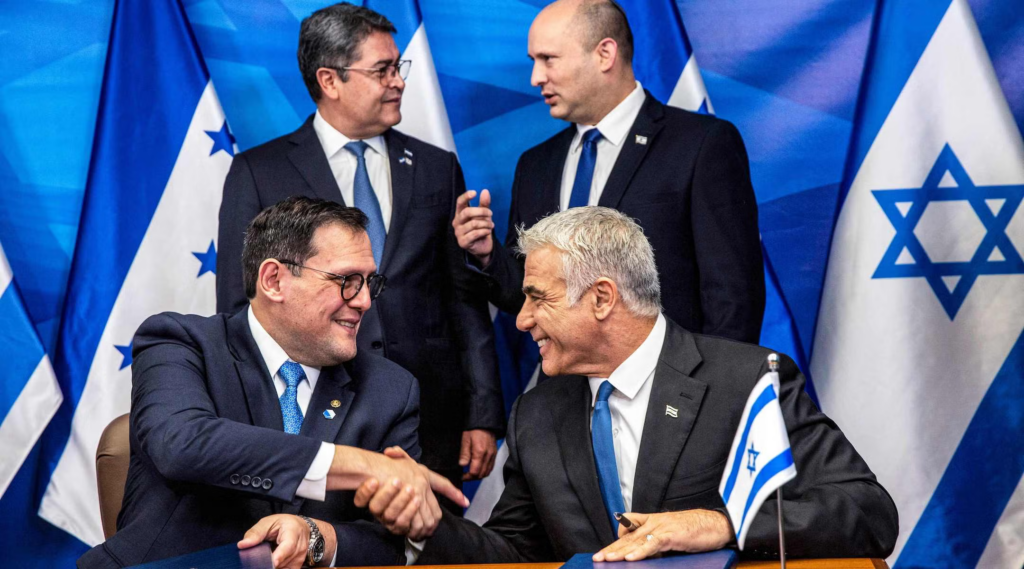
Israeli Foreign Minister Yair Lapid, right, shakes hands with his Honduran counterpart, Lisandro Rosales as Israeli Prime Minister Naftali Bennett, top right, speaks with Honduran President Juan Orlando Hernandez during the signing of bilateral agreements at the prime minister’s office in Jerusalem, June 24, 2021. (Source: Heidi Levine/AFP via Getty Images)
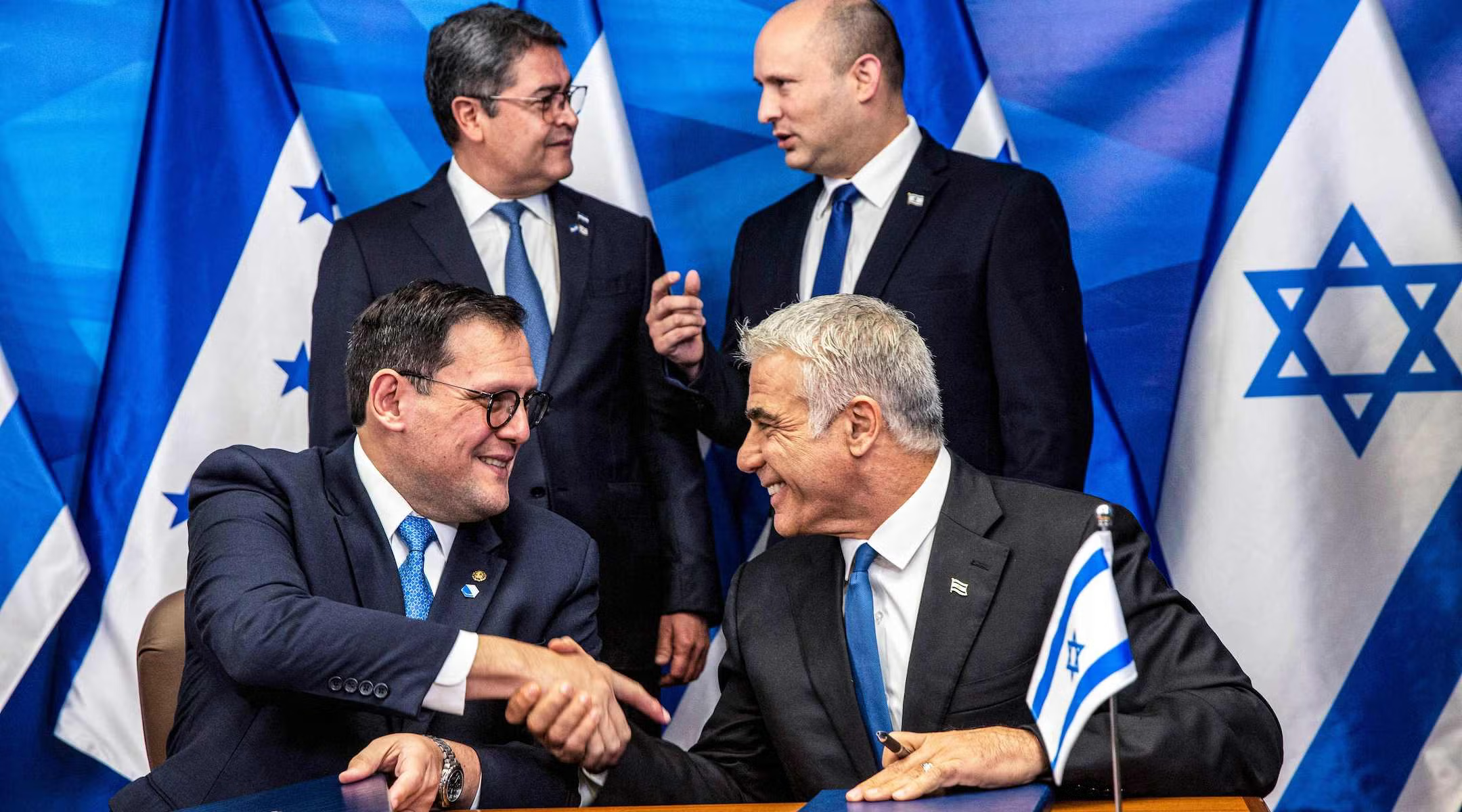
The CIA has complemented Israel’s long-term strategy by employing ostensibly humanitarian or religious NGOs, such as USAID, World Vision, and Church World Service (CWS), to fracture Honduran civil society. By promoting Protestantism over the historically cohesive Catholic majority and supporting programs that exploit divisions along religious, racial, and social lines, including tensions within the Garifuna community influenced by organisations such as OFRANEH, the CIA created fertile ground for ideological manipulation and elite control. Together, the actions of Israel and the CIA have destabilised Honduran society, skewed politics in favour of external interests, and amplified societal divisions. The 2025 elections starkly revealed these dynamics, exposing a democracy heavily shaped by decades of foreign intervention and manipulation.
While Honduras showed some symbolic independence, such as recalling its ambassador from Israel in November 2023, there is a strong case to argue that the deep structural influence of Israel and the U.S, reinforced over decades through military, economic, religious, and civil society channels, created a 2025 electoral landscape strongly favourable to a pro-Israel government, as confirmed by The Times of Israel. Nasry Asfura, promoted by President Trump, embodied this alignment, openly supporting Israeli interests and continuing policies that reinforced the country’s pro-Zionist orientation, making the elections less a contest of domestic politics and more a predictable outcome of long-term foreign influence.
Honduras is a nation under the shadow of powerful foreign influences, where politics, religion, and society have been quietly shaped for decades. The following article investigates how Israeli interests, CIA-backed NGOs, and elite manoeuvring have fractured communities, manipulated loyalties, and set the stage for the tensions that exploded during the 2025 elections…
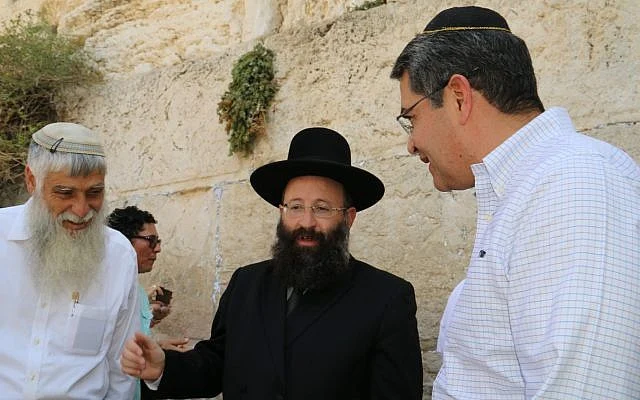
Honduran President Juan Orlando Hernandez visits the Western Wall in Jerusalem, September 1, 2019 (courtesy Western Wall Heritage Foundation)
Hondurans Curiously Ambivalent On Palestinian Genocide
Thomas Tomczyk writes for PÄYÄ Magazine…
Hondurans have been mostly silent regarding the reported genocide taking place in Gaza over the past two years. The question is: Why such silence? Are Hondurans unaware of the massacres and starvation used against Palestinians in the occupied territories? Do they not care, or are they perhaps afraid of something? “To learn who rules over you, simply find out whom you are not allowed to criticise,” the saying goes.
There was one example of Hondurans protesting Israeli crimes against Palestinians during the Gaza war after the Hamas attack and Israeli stand-down operation of October 7. On October 23, 2023, dozens of Honduran Palestinians demonstrated in front of the Israeli Embassy in Tegucigalpa. Since then, the long-established and influential Arab Palestinian community has been mostly silent about the plight of their Palestinian relatives amid Israel’s escalating atrocities in Gaza and the West Bank.
There is certainly a disconnect, as the 300,000 members of Honduras’ Christian Palestinian community are the third and fourth generations to be born outside of Palestine. Their ancestors began arriving in Honduras from Palestine in the 1890s, and today their connection to and knowledge of Palestine and Israel is mostly superficial. Most Honduran Palestinians don’t know the full scale or nature of the barbarism inflicted on their compatriots who stayed behind and continue to face Israeli oppression, violence, discrimination and now genocide. A Honduran Palestinian businessman told me that many in his community are afraid of being accused of anti-Semitism and facing potential consequences. Simply acknowledging that a systematic genocide may be occurring in Gaza is viewed by some as anti-Semitic.
It is hard not to notice. Since October 2023, Israeli military actions have resulted in the deaths of many Christian civilians in Gaza who have nothing to do with Hamas. In October 2023 Israeli military bombed a Christian orthodox church and murdered 18 Christians. In December 2023, Israeli snipers executed two Palestinian women on the Gaza Holy Family Catholic church property. In July 2025, Israeli soldiers fired a tank shell at a cross of the same church, killing three and wounding a catholic priest. While this all fell on deaf ears in Honduras, it does seem that the Israelis don’t like Christians very much.
One person who spoke with concern about the plight of Palestinians was President Xiomara Castro. In November 2023, the Honduran government recalled its ambassador to Israel for consultations due to escalating massacres of Palestinian civilians in Gaza. President Castro described Israel’s actions in Gaza as genocide during a U.N. speech in September 2024. Still, words have not turned into actions. Honduras is nowhere near recognising Palestine as an independent state or moving its embassy from Jerusalem back to Tel Aviv. In fact, Honduras remains firmly in the pro-Zionist camp as it continues to support Israel’s military by purchasing 15 Black Mamba military vehicles. Pro-Zionist sentiment is strong in Honduras. Israeli flags are flown throughout the country. Hondurans increasingly wear the Star of David around their necks, and taxi drivers display the Israeli emblem on their vehicles. Honduran roots of Zionism and Judeophilia run deep, well over a century.
The country now counts three of its presidents to be Jewish: Juan Lindo, Ricardo Maduro and Juan Orlando Hernández. In fact, you could argue that there was a fourth Jewish president of Honduras who ruled the country from 1911 well into the 1950s. Samuel Zemurray, the Banana King, was responsible for the 1911 Honduran presidential coup that secured land and concessions for his United Fruit banana company. American mercenaries hired by Zemurray deposed President Miguel Dávila and made Honduras his “banana republic.” Zemurray installed his puppet, Manuel Bonilla, as president and received 20,000 acres of land in return. After President Bonilla’s death in 1913, Zemurray continued to be a virtual puppet master of several other Honduran presidents.
In 1947, the World Zionist Organisation tasked Zemurray with delivering Honduras’ U.N. vote in support of the creation of the state of Israel. Reportedly, in a personal phone call, Zemurray tried to bribe then-Honduran President Tiburcio Carías Andino. Because of pressure from the Honduran Palestinian community, Honduras abstained from voting for Israel. Since then, and with plenty of CIA help, Christian Zionism has made many inroads in Honduras. CIA fronts such as World Vision, USAID and Protestant Church World Service for many decades worked to undermine the cohesiveness of Honduran society.
Since the 1950s, the CIA, which some critics considered an Israeli-captured agency, promoted the establishment and expansion of Protestant churches in Latin America. The excuse given was that Protestants were more anti communist and a good alternative to the Liberation Theology preached in many Catholic parishes.
The percentage of Catholics in the country fell from 97% in the 1960s to 47% today. Protestant denominations undermined the Catholic cohesion of Honduran society. Religiously divided Honduras is much easier to manipulate, with one denomination pitted against another. Sixty years later, those Catholic-to-Protestant converts have not only become Zionists, but they are also actually converting to Judaism. According to El Heraldo, 37 families converted to Judaism and, in 2022, established Honduras’ first synagogue. The San Pedro Sula Mishkan Shlomo synagogue members advertise their plans to Judaise and convert thousands of Hondurans.
“The plan is for the expanded synagogue to be a six-story, shaped like a Star of David building and be able to accommodate 456 people. This would make it the biggest synagogue in Latin America.”
Ex-President Juan Orlando Hernández was key in the expansion of Judeophilia and Zionism in Honduras. Just in terms of economy, according School of the Americas, between 2013 and 2019, Honduras purchased $342 million in military and surveillance equipment from Israel. Basically, Honduras has been supporting Israel to the tune of around $5 million a month for that period. Road to conversion of Juan Orlando Hernández began in the early 1990s when he completed a one-year Mashav leaders course in Israel. Israel’s investment in JOH obviously paid off as he learned Hebrew, moved Honduras’ embassy to Jerusalem in 2021, and converted to Judaism with his entire family in 2021. The last one, right before going to a US jail for 45 years, was convicted of decade’s long drug and arms smuggling operation.
Honduras is likely getting set up for a rough ride. Israel funded military dictatorships where even the CIA would not venture. Israel trained and supplied arms to many bad actors that destabilised the region: the genocidal regime in Guatemala in the 1980s, Colombian drug smuggling death squads, Los Zetas drug lord Heriberto Lazcano. “Israel has given its soldiers practical training in the art of oppression and in methods of collective punishment. Some of those officers choose to make use of their knowledge in the service of dictators,” said Israeli general Mattityahu Peled.
“Honduras will likely become an increasingly polarized and violent society.”
There is also a growing Israeli pressure on the Honduran public by co-opting its anti-Gaza genocide sentiment into nebulous movements. The normally restrained Honduran Ministry of Foreign Affairs complained that Israeli Ambassador Nadav Goren meddled in internal Honduran affairs by meeting with Protestant church leaders preparing for the August 16 March for Peace and Democracy. “We express to the Honduran people our deep discomfort at their participation in said public event. The involvement of a diplomat not only ignores his limitations,” stated the Honduran ministry. There are plenty of other players seeking discord. Until its recent defunding by the Trump administration, San Pedro Sula was also home to the Hebrew Immigrant Aid Society (HIAS). The worldwide HIAS organisation does not assist Palestinians, Arabs or Christians in moving to Israel, but uses U.S. tax dollars to help move undocumented migrants through Honduras to the United States.
For decades, certain interest groups have promoted racial resentment —particularly among Black communities— while fostering a sense of guilt among white, European and Christian populations. In Honduras, this strategy is reflected in the 23-year-old movement known as the Fraternal Organisation of Honduran Blacks (OFRANEH), which has received funding from organisations such as American Jewish World Service and the Open Society Foundations, founded by George Soros. These groups have been involved in fermenting revolutions, protests and underhanded political activism around the world. Just as with organisations such as Black Lives Matter and ANTIFA, which were recently designated by the U.S. as a terrorist organisation, OFRANEH fosters division, racial tension, grievances and expectations of compensation in the historically well-integrated Garifuna community. Honduras, in the second quarter of the 21st century, will likely become an increasingly polarised and violent society. Powerful interest groups are working hard to implement this, and Roatan is increasingly a party to those tensions. In September 2025, OFRANEH conducted demonstrations in Cayos Cochinos, and in March 2025, there were protests in Diamond Rock. Tensions on Roatan are just starting to heat up.
The Folly of Establishing a U.S. Military Base in Damascus
By José Niño | The Libertarian Institute | December 16, 2025
Recent reports indicate the United States is preparing to establish a military presence at an airbase in Damascus, allegedly to facilitate a security agreement between Syria and Israel. This development represents yet another misguided expansion of American military overreach in a region where Washington has already caused tremendous damage through decades of failed interventionist policies.
The United States currently operates approximately 750 to 877 military installations across roughly eighty countries worldwide. This staggering number represents about 70 to 85% of all foreign military bases globally. To put this in perspective, the next eighteen countries with foreign bases combined maintain only 370 installations total. Russia has just twenty-nine foreign bases, and China operates merely six. The American empire of bases already dwarfs every other nation combined, and the financial burden is crushing. Washington spends approximately $65 billion annually just to build and maintain these overseas installations, with total spending on foreign bases and personnel reaching over $94 billion per year.
These figures are not abstract accounting entries. They translate directly into American lives placed in volatile environments, as demonstrated by the recent insider attack in the ancient Syrian city of Palmyra, where a purported ISIS infiltrator embedded in local security forces turned his weapon on a joint U.S. Syrian patrol, killing two U.S. soldiers and one U.S. civilian during what was described as a routine field tour. The incident underscores how the sprawling U.S. basing network increasingly exposes American personnel to unpredictable and lethal blowback in unstable theaters far from home.
Syria itself already hosts between 1,500 and 2,000 American troops, primarily concentrated in the northeastern Hasakah province and at the Al Tanf base in the Syrian Desert. The Pentagon recently announced plans to reduce this presence to fewer than 1,000 personnel and consolidated operations from eight installations to just three. Yet now, despite this supposed drawdown, Washington reportedly plans to establish a new presence in Damascus itself, either at Mezzeh Air Base or Al Seen Military Airport. This contradictory expansion reveals the hollow nature of promises to reduce American military commitments abroad.
Since the fall of Bashar al Assad in December 2024, Israel has conducted hundreds of airstrikes on Syrian military and civilian infrastructure while occupying parts of southern Syria including Quneitra and Daraa. Israel has systematically violated the 1974 disengagement agreement and expanded control over buffer zones. These actions align disturbingly well with the Yinon Plan, a 1982 Israeli strategic document by Israeli foreign policy official Oded Yinon that envisions the dissolution of surrounding Arab states into smaller ethnic and religious entities. The plan explicitly calls for fragmenting Syria along its ethnic and religious lines to prevent a strong centralized government that could challenge Israeli interests.
A permanent American military presence in Damascus would effectively serve as a tripwire guaranteeing continued U.S. involvement in securing Israeli strategic objectives in the Levant. Rather than protecting American interests or enhancing national security, such a base would entrench Washington deeper into regional conflicts that have consistently proven disastrous for both American taxpayers and Middle Eastern populations.
The human cost of American intervention in Syria should give any policymaker pause. The Syrian Civil War has resulted in between 617,000 and 656,000 deaths, including civilians, rebels, and government forces. More than 7.4 million people remain internally displaced within Syria, while approximately 6.3 million Syrian refugees live abroad. This catastrophic toll stems partly from Operation Timber Sycamore, the CIA covert program that ran from 2012 to 2017 to train and equip Syrian rebel forces.
Timber Sycamore represented a joint effort involving American intelligence services along with Saudi Arabia, Jordan, Qatar, Turkey, and the United Kingdom. The CIA ran secret training camps in Jordan and Turkey, providing rebels with small arms, ammunition, trucks, and eventually advanced weaponry like BGM 71 TOW anti-tank missiles. Saudi Arabia provided significant funding while the United States supplied training and logistical support.
The program proved to be counterproductive. Jordanian intelligence officers stole and sold millions of dollars worth of weapons intended for rebels on the black market. Even worse, U.S.-supplied weapons regularly fell into the hands of the al Nusra Front, al-Qaeda’s Syrian affiliate, and ISIS itself. The program inadvertently strengthened the very extremists Washington was ostensibly fighting.
The failure of Timber Sycamore illustrates a fundamental problem with American interventionism in Syria. Washington has pursued regime change in Damascus in various forms for decades, yet these efforts have consistently backfired, creating power vacuums filled by jihadist groups and prolonging devastating conflicts. The current enthusiasm for establishing a military presence in Damascus suggests American policymakers have learned absolutely nothing from these failures.
The figure now leading Syria exemplifies the moral bankruptcy of this entire enterprise. Ahmed al Sharaa, better known by his nom de guerre Abu Mohammad al Julani, currently serves as president of Syria’s interim government. This represents a stunning rehabilitation for a man who founded al Nusra Front in 2012 as an al-Qaeda affiliate and later formed Hayat Tahrir al Sham (HTS) by merging various rebel factions. Under the name Abu Mohammad al Julani, he was designated a Specially Designated Global Terrorist by the United States on July 24, 2013, with a $10 million bounty maintained on his head.
Al Sharaa’s terrorist designation stemmed from his leadership of al Nusra Front, which perpetrated numerous war crimes including suicide bombings, forced conversions, ethnic cleansing, and sectarian massacres against Christian, Alawite, Shia, and Druze minorities. He fought with al-Qaeda in Iraq, spent time imprisoned at Camp Bucca between 2006 and 2010, and was dispatched to Syria by Abu Bakr al Baghdadi in 2011 with $50,000 to establish al Nusra. His close associates have faced accusations from the United States of overseeing torture, kidnappings, trafficking, ransom schemes, and displacing residents to seize property. The New York Times reported that his group was accused of initially operating under al-Qaeda’s umbrella.
Yet in November 2025, the United Nations Security Council adopted resolution 2799, removing al Sharaa and Interior Minister Anas Khattab from the ISIL and al-Qaeda sanctions list. The U.S. Treasury Department followed suit, delisting him from the Specially Designated Global Terrorist registry. This reversal came after the State Department revoked HTS’s Foreign Terrorist Organization designation in July 2025. Washington essentially decided that a former al-Qaeda commander who oversaw sectarian massacres was now a legitimate partner worthy of American military support. This absurd rehabilitation demonstrates how completely untethered American foreign policy has become from any coherent moral framework or strategic logic.
Critics rightly question whether al Sharaa has truly broken from his extremist roots or merely engaged in calculated political rebranding. The speed with which Washington embraced him as a legitimate leader suggests American policymakers care far more about advancing Israeli interests and maintaining regional influence than about genuine counterterrorism or protecting religious minorities.
The United States needs to pursue a fundamentally different approach to foreign policy. Rather than establishing yet another military base to advance Israeli strategic objectives in Syria, Washington should implement a comprehensive drawdown of overseas military commitments. The hundreds of foreign bases it maintains abroad represent an unsustainable burden that diverts resources from genuine national security priorities like border security and stability in the Western Hemisphere. American taxpayers deserve better than footing the bill for an empire that consistently fails to advance their interests while enriching defense contractors and serving foreign powers.
Syria offers a perfect case study in the futility of American interventionism. Decades of attempts at regime change through covert programs like Timber Sycamore and direct military presence have produced nothing but chaos, empowered jihadist groups, created millions of refugees, and cost hundreds of thousands of lives. The rehabilitation of a former al-Qaeda commander into Syria’s president illustrates how divorced American policy has become from any coherent strategy or values.
Rather than doubling down on failed policies, the United States should pursue strategic restraint, scale back its sprawling network of foreign bases, and allow regional powers to sort out their own affairs without American military involvement. That represents the path toward a more sustainable, affordable, and morally defensible foreign policy. The Damascus base proposal deserves to be rejected outright as yet another wasteful expansion of an already overextended military empire.
Do You Believe in Coincidence… Was the CIA Involved in Operation Spiderweb and Israel’s June 12 Attack on Iran?
By Larry C. Johnson | December 9, 2025
With the benefit of hindsight, we’re all geniuses. The Wall Street Journal article, Inside Ukraine’s Daring Operation Spiderweb Attack on Russia (published December 8, 2025) details the operation’s planning as a 18-month effort starting in late 2023, with significant activities ramping up in 2024. While the piece emphasizes the full timeline’s secrecy and oversight by President Zelenskyy and SBU chief Vasyl Maliuk, it highlights 2024 as a pivotal year for infiltration, testing, and logistics preparation. I am more interested in what it does not state outright — i.e., that Ukraine relied heavily on Western intelligence, meaning the CIA and British MI-6, in planning this operation.
The attack took place on June 1st, 2025 and, despite a flood of Western propaganda touting it as a tremendous success, it was a tactical and strategic failure — i.e., it did not damage Russia’s ability to continue its offense in Ukraine. But here is the question of coincidence… Two weeks later, Israel launched the decapitation attack on Iran, which also failed to topple the Iranian government and cripple the Iranian military, who promptly retaliated. Do you think it is just a coincidence that Israel and Ukraine used similar tactics — i.e., launching drones from within Russia and Iran to attack strategic targets? I do not.
Let’s take a look at the timeline of Operation Spiderweb as laid out in the WSJ article.
December 2023: Planning begins under direct oversight of Ukrainian President Volodymyr Zelensky and the Security Service of Ukraine (SBU). Initial focus: Smuggling disassembled drones, batteries, and explosives into Russia via borders (e.g., Belarus, Black Sea routes) and commercial trucking networks. Goal: Target Russia’s strategic bomber fleet to disrupt missile launches on Ukrainian cities. Hmmm… If the SBU was involved then so was foreign intelligence.
Early 2024 (January–March): Initial scouting and prototype testing. Ukrainian operatives conducted reconnaissance of target airbases (e.g., Olenya, Dyagilevo) using commercial satellite imagery and smuggled spotters, according to the WSJ. In my opinion, an audacious operation like this would also require imagery from Western intelligence. The WSJ is mute on that point. The article notes that early experiments with “spider nest” launch mechanisms—disassembled FPV drones (Osa quadcopters) hidden in truck roofs— were tested in simulated Russian environments near the border. This phase reportedly involved ~20 commandos refining smuggling routes via Belarus and the Black Sea, with failures (e.g., a test drone malfunction) leading to redesigns. The WSJ article conveniently ignores the likely role that the territories other than Ukraine, such as Khazakstan, Armenia and Azerbaijan also were used as infiltration points for this operation.
Mid-2024 (April–July): Infiltration buildup. The WSJ describes “web-like” networks expanding, with agents embedding in Russian trucking firms to map logistics. Over 100 drones were smuggled in parts during this period, reassembled in hidden workshops (e.g., Bryansk region sheds). A key activity was recruiting unwitting Russian truckers (e.g., via bribes or coercion) for transport, with the article citing intercepted FSB chatter revealing early suspicions but no disruptions. Zelenskyy approved budget reallocations (~$50M) for Western tech integration (e.g., Starlink relays). What do you think are the chances that some of this money was siphoned off by Zelensky and his intel bubbas and sent to their overseas retirement accounts?
Late 2024 (August–December): Final rehearsals and positioning. Intensive dry runs simulated the June 1 strike, focusing on simultaneous launches across time zones. The piece highlights a December 2024 “dress rehearsal” near Ivanovo, where signal jamming countermeasures (AI autopilots) were validated. By year-end, all 117 drones were prepositioned, with operatives establishing safe houses. The article quotes an anonymous SBU officer: “2024 was the spider spinning its web—silent, patient, invisible.”
January–May 2025 Infiltration phase: Ukrainian agents (150+ operatives, including commandos and drone technicians) establish “spider nests” (hidden launch sites) across five Russian oblasts spanning three time zones. Drones (117 total, FPV models with Western tech like Starlink) are reassembled in disguised cargo (e.g., wooden sheds on trucks). Scouting identifies four primary airbases: Olenya (Murmansk), Dyagilevo (Ryazan), Ivanovo Severny (Ivanovo), and Belaya (Irkutsk/Siberia, 4,300 km from Ukraine). A fifth target (Ukrainka in Amur) is aborted due to a truck fire.
June 1, 2025 Execution: Coordinated strikes unfold over ~72 hours starting ~1 p.m. local time. Remotely activated truck roofs release drones, hitting ~40–50 aircraft (15–20 destroyed, including Tu-95MS, Tu-22M3 bombers, and A-50 radar planes; ~$2–7B in damage). Fires reported at all sites; Russia confirms attacks but claims minimal losses. Ukrainian operators control from Kyiv; no SBU fatalities, though two teams captured.
There is no denying that this was a sophisticated operation and, in my judgment, depended heavily on intelligence support from the US and the UK and, possibly, Israel. Why Israel? Because of the similarity of the tactics used in the attacks on Russia and Iran within a span of two weeks. Both were deep-penetration operations targeting high-value, hardened assets far from the front lines. Both required extensive intelligence support.
I also believe that the US played a significant role in coordinating the two attacks as part of a broader strategy to weaken both Russia and Iran. The planning for these operations were carried out in separate channels, but there was someone, or a group of someones, overseeing the broader strategic goals.
The publication of this article comes at a time when the Trump administration’s support for Ukraine is weakening. I don’t rule out the possibility that the CIA, who has an enormous investment in Ukraine, is working to undermine Trump’s efforts to secure a peace that will come at Ukraine’s expense. I do not believe that some intrepid reporter thought that this would be a swell story to tell and that it was published now just because the WSJ had nothing better to report. I believe this is part of a unending effort by the Deep State to try to pump life into Project Ukraine, which is now on life support and fading fast, by pushing a narrative that Ukraine is far from defeat.
Featured Video
Prof. Ted Postol: Iran Already Achieved Nuclear Deterrence Against Israel
or go to
Aletho News Archives – Video-Images
From the Archives
How the occupied mentality syndrome works
Saudi Arabia on the American chessboard – Part 3
By B. J. Sabri | American Herald Tribune | June 27, 2016
Read part 2: “The occupied mentality Syndrome“
Previously I argued whether Saudi Arabia’s repeated involvements in U.S. interventions and wars stem from free national will or in response to a specific condition. For starters, in Saudi Arabia there is no national will. In Saudi Arabia, the national will is the will of the Al Saud clan. Still, when a major Arab state allies itself with a superpower that committed unspeakable crimes against humanity in almost every Arab country, then something is wrong. This fact alone should compel us to examine the U.S.-Saudi relation for one exceptional reason. As a result of the U.S.-Saudi wars, hundreds of thousands of people in Afghanistan, Iraq, Iran, Libya, Syria, Yemen, and Somalia have lost their lives. Millions became displaced in their own homelands. And millions more rendered refugees.
Attributing the Saudi policies to the bonds of “partnership” with the U.S. is frivolous. There are no bonds between these two thugs except those of business, military deals, secret plots, and wars. Proving this point, bonds such as these have no space for the American and Saudi peoples to share significant cultural or societal exchanges. If partnership is not the reason for the Saudi contribution to the U.S. strategy of empire and imperialism, then another reason must exist.
This leads to three possibilities. … continue
Blog Roll
 Aletho News
- REWRITING THE RISK? INSIDE THE GOVERNMENT’S VACCINE SAFETY MESSAGING
- “Davos Can Really Replace the UN”
- NIAID/NIH and USDA Fund Bioengineered Chimeric Influenza Viruses Built Using Pandemic H1N1 Components: Journal ‘Science Advances’
- Hezbollah hits Israeli warship off Lebanon’s coast, sets it aflame
- Iran slams US strikes on B1 bridge, Mahshahr petrochemical plants as ‘blatant acts of state terrorism’
- In letter to UN chief, Araghchi warns of dire consequences of US-Israeli attacks on Iran’s nuclear facilities
- Why the CIA conspiracy to invade Iran with Kurdish militias failed
- Why Are Upbeat US Claims About Mission to Rescue Pilot ‘Highly Questionable’?
- Aircraft destroyed during US ‘rescue’ of downed F-15 pilot cost more than $100 million each
- Washington University removes professor who condemned US-Israeli war on Iran
- If Americans Knew
- In Iran, Israel-US take aim at “reason, research, and freedom of thought” – Daily Update
- US loses planes over Iran, Israel downgrades Lebanon war goals – Daily Update
- Israel Is Blocking Palestinians from Easter at Church Where Jesus Resurrected
- Plot to assassinate Palestinian activist follows harassment campaign promoted by Zionist groups and elected officials
- Prominent New York synagogue hosts presentation on why U.S. Jews should support the ethnic cleansing of Gaza
- Tapper vs. Piker: Is the CNN Anchor Auditioning for David Ellison?
- Shouldn’t Democrats Be Able to Condemn Genocide?
- Israel-US kill negotiators, destroy civilian structures, but Iran’s military capabilities still largely intact – Daily Update
- ‘War crime’: Global condemnation as Israeli ministers celebrate death penalty law targeting Palestinian prisoners
- 7 Ways Israel Is Turning Lebanon Into Gaza
- No Tricks Zone
- An Inconvenient Tree: Uncovered In Alps… Europe Much Warmer Than Today 6000 Years Ago
- New Study Reports A 60% Slowdown In Greenland’s Ice Loss Rate In The Last Decade
- Low Intensity Tornado Wrecks Major Solar Farm, Creating A Potential Toxic Dump
- New Study Finds Warming Saves Lives…Cold Temperatures 12 Times More Deadly Than Excess Heat
- German Science Blog Accuses PIK Climate Institute Of Hallucinating Climate Tipping Points
- Devastating Assessment Of Comirnaty Vaccine By Former Senior Pfizer Europe Toxicologist
- New Study: CO2 Is ‘Effectively Negligible’ As An Explanatory Climate Change Factor Since 2000
- Former Pfizer Toxicologist Dr. Helmut Sterz Tells Bundestag Hearing Pfizer Vaccine Should Have Never Been Approved
- Energy Expert: Germany’s Nuclear Phaseout Was A “500 Billion Euro Mistake”
- New Research: South Australia’s Mid-Holocene Sea Surface Temperatures Were 4°C Warmer Than Today
 Aletho News