Aletho News

ΑΛΗΘΩΣ

The National-Security Establishment’s Message to Americans

By Jacob G. Hornberger | FFF | December 9, 2025

It’s easy to assume that with its drug-war killings in the Caribbean, the Pentagon is sending a message only to Venezuelan strongman Nicolás Maduro: “We can kill your citizens with impunity and there is nothing that you or anyone else can do about it.”

In actuality, however, the Pentagon is sending the same message to the American people: “We can kill anyone we want, including American citizens, and there is nothing that you or anyone else can do about it.”

There are lots of commentators in the mainstream press pointing out the manifest illegality of intentionally, knowingly, and deliberately killing people on the high seas who U.S. officials are saying have violated the U.S. government’s drug laws. They are pointing out that the killings amount to state-sponsored murder. Under U.S. law and under the U.S. Constitution, federal officials are not permitted to kill people who are suspected of violating drug laws. Law-enforcement personnel are required to instead take them into custody, secure a grand-jury indictment, and prosecute them in a court of law, where they have the right to a lawyer, a jury trial, and other procedural guarantees.

But remember: This isn’t the DEA we are talking about. This is the U.S. national-security establishment — that is, the Pentagon, the vast military-industrial empire, the CIA, and the NSA— we are talking about. Once they become a law-enforcement agency for the drug war, everything changes. That’s because they are not bound by the same rules as regular federal law-enforcement agencies. They are not bound by any rules whatsoever. That’s what the Pentagon is reminding every American with its drug-war killings in the Caribbean.

Once the U.S. government was converted into a national-security state after World War II, the new national-security establishment — specifically, the Pentagon and the CIA — automatically acquired the power of assassination. Recognizing this reality, the federal judiciary made it crystal clear that it would never enforce the Constitution against the Pentagon’s and CIA’s omnipotent power to assassinate people, including American citizens.

Thus, no one could do anything about the national-security establishment’s plots to assassinate people like Congo leader Patrice Lumumba, Cuban president Fidel Castro, Dominican Republic leader Rafael Trujillo, Chilean general Rene Schneider, and, more recently, Iranian general Qasem Soleimani.

There was also nothing that anyone could do about the coups that would very possibly leave foreign leaders dead, such as Iranian prime minister Mohammad Mossadegh, Guatemalan president Jacobo Arbenz, and Chilean president Salvador Allende.

There was also nothing anyone could do about the national-security’s establishment’s participation in international assassination rings, such as Operation Condor.

The message has always been clear: “We can kill anyone we want, and there is nothing that anyone can do about it. Our power over you is total and complete. Accept it and get used to it.”

The message became clearer when they took out President John F. Kennedy, who had taken them on, and then crammed down American throats the “lone-nut, magic-bullet” theory of the assassination, which was always about as lame, inane, and ridiculous as labeling drug-war suspects “terrorist enemy combatants” or, for that matter, the use of scary WMDs to justify a war of aggression against Iraq, or some “attack” on the United States in the Gulf of Tonkin to justify a deadly, destructive, and senseless war in Vietnam. But Americans have always been expected to buy it all, no matter how ludicrous, and many of them deferentially have.

More recently, we shouldn’t forget their assassinations of Anwar al-Awlaki and his 16-year-old son Abdulrahman. They were American citizens, not foreigners. It was another powerful message to the American people: “We can kill anyone we want and there is nothing anyone can do about it. Accept it, embrace it, and get used to it. And don’t forget to thank us for our service.”

It’s probably also worth mentioning the federal judiciary’s deference to the authority of the national-security establishment to take American citizens into custody simply by labeling them as “suspected terrorists,” torture them, incarcerate them for the rest of their lives without a trial, and, no doubt, even execute them. That’s what the Jose Padilla case was all about.

So what if those drug-war killings in the Caribbean are illegal, as those commentators in the mainstream press are saying? What difference does it make? Everyone, and especially the national-security establishment, knows that nobody can do anything about it. That’s the powerful message that the U.S national-security establishment is sending to the American people: “We can illegally kill anyone we want, including Americans, and there is nothing anyone can do about it. We are in charge. We have total and complete control over you because we can kill you whenever we want, and there is nothing anyone can do about it.”

After all, who is going to prosecute the Pentagon and CIA killers? The Justice Department? Don’t make me laugh. The Justice Department is subordinate to the Pentagon and the CIA. The Congress? Again, please don’t make me laugh harder. Congress has long deferred to the power and majesty of the national-security establishment, especially when we consider the large number of loyal and “patriotic” military veterans and CIA officers serving in Congress. The federal judiciary? When have they ever done anything about the national-security establishment’s assassinations or, for that matter, its torture and indefinite detention camp in Cuba?

Make no mistake about it: As comforting as it might be to Americans that those illegal drug-war killings are taking place “over there” against Latin American foreigners, the fact is that the national-security establishment’s omnipotent power to kill suspected “narco-terrorists” extends to everyone right here in the United States. When the right time comes to demonstrate this point to American citizens, my hunch is that we will see lots of shocked, frightened, deferential, silent, dependent, and even supportive American sheep.

December 10, 2025 Posted by | Civil Liberties, Full Spectrum Dominance | , , , , | Leave a comment

James Angleton: JFK Assassination Architect?

By Kit Klarenberg | Global Delinquents | December 7, 2025

Newly-declassified files show President John F Kennedy’s alleged assassin Lee Harvey Oswald was monitored for years by James Angleton, the CIA’s infamous veteran counterintelligence chief, right up until the President’s death. In this context, freshly-released FBI documents indicating Oswald was removed from Bureau watchlists six weeks before Kennedy’s assassination, despite being judged a high security risk, at the express direction of Angleton’s staff, take on a distinctly disquieting character. Was Oswald a target of, or participant in, Angleton’s illegal domestic spying operations?

In June 1953, a memo was circulated among senior FBI officials, its subject line: “Central Intelligence Agency – information received from James Angleton”. It documents how the CIA’s counterintelligence chief had over the past year “been very cooperative and… volunteered voluminous information of interest to Bureau.” Such was the vast and sensitive intelligence yield, it was considered necessary to establish dedicated, strict internal protocols for handling and storing material provided by Angleton to the FBI.

This was “particularly” vital in respect of information Angleton received and passed on to the Bureau from Mossad, his “primary source” of intelligence among “numerous foreign sources and channels” he maintained worldwide. The memo went on to outline how Angleton handled “special cases of a various nature”, and was “usually given considerable freedom and leeway in directing the operations of his unit.” Angleton was “responsible only” to the CIA’s Director, and his staff were “responsible only to him.”
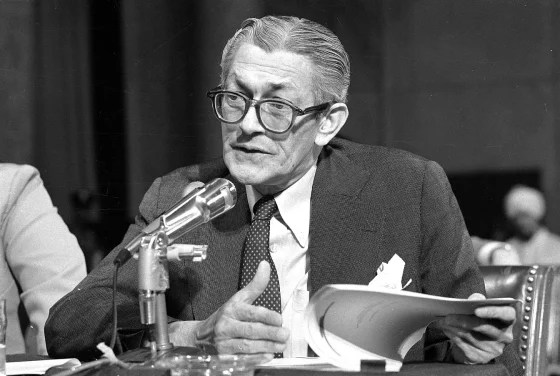
James Angleton testifies to the Senate Intelligence Committee

The memo noted approvingly how “much of the information” provided by Angleton “consists of the actual reports” he received from his sources. This was of significant advantage to the FBI, as the agency was able to “better evaluate the information instead of waiting for the delay and processing through normal channels in the CIA.” Angleton also “frequently” kept the Bureau apprised of Agency activities overseas, “which the CIA sometimes camouflages with some of its cloak and dagger techniques.”

Angleton’s extensive cooperation bought him enormous goodwill within the FBI. He successfully leveraged this in January 1958, when the Bureau serendipitously “flushed out” a scandalous, illegal spying operation targeting US citizens conducted by the CIA’s counterintelligence unit. A memo that month shared between senior FBI officials records how the Bureau was seeking to establish a program to monitor all mail being sent to and from the Soviet Union by American citizens, only to discover Angleton was already doing precisely the same thing.

Angleton in turn learned his scheme had been busted, so approached the Agency’s FBI liaison agent on a “personal basis” to outline the program. He claimed he would be fired if Langley caught wind of his disclosures to the Bureau. Angleton explained how the interception program was “one of the biggest and most secret operations being conducted by CIA,” and “extensive and expensive”. An “elaborate array of IBM machines” catalogued and conducted “complex scientific examinations” of all mail gathered.

In all, “two or three hundred CIA employees” were “exclusively engaged on various facets” of the operation, which cost “well over a million dollars a year” – roughly $11 million today. Angleton said the effort’s “sole purpose…was to identify persons behind the Iron Curtain who might have some ties in the US and who could be approached… as contacts and sources for CIA.” The operation was purportedly a “success”, with numerous valuable assets cultivated.

While FBI higherups questioned whether the effort “invaded our jurisdiction”, it was concluded Angleton’s unit had a “legitimate right” to conduct the mission. Moreover, the Bureau could avoid “the inherent dangers” of conducting a parallel mail intercept program – including “the sensitive nature of it, its complexity, size and expense” – by simply demanding the CIA counterintelligence unit hand over their operation’s vast intelligence yield to them.

Lee Harvey Oswald first came to Angleton’s attention in November 1959, due to news reports of his defection to the Soviet Union the previous month. Thereafter, all mail Oswald sent to and received from the US was opened and read by the CIA, until he returned home in May 1962 with his Russian wife Marina. Angleton’s monitoring of the minutiae of Oswald’s life persisted until Kennedy was killed. Multiple separate CIA operations collected intelligence on the President’s alleged assassin throughout.

‘CIA Project’

The CIA counterintelligence officer who monitored Oswald’s mail was Reuben Efron, part of a personal spying network constructed by Angleton from Jewish émigres from the Soviet Union, outside of formal Agency structures. Eerily, Efron attended a February 1964 hearing of the Warren Commission – officially charged with investigating JFK’s assassination – at which Marina Oswald testified. His presence was noted in an official volume of the investigation’s proceedings, but his employment by the Agency was unmentioned. Was he there on Angleton’s behalf?

This is but one of many mysteries related to Oswald that Angleton’s closed-door testimony to Senate investigators in June 1975 failed to resolve. During his grilling, Angleton had little to say about Kennedy’s assassination, despite being repeatedly probed about “the Oswald situation”. Questioned whether the CIA kept records on Oswald, Angleton prevaricated, “they have a file… I think more than one.” He offered scant further information, beyond claiming the supposed lone nut shooter was likely a Soviet operative.

When asked if there was a “connection between Oswald and the FBI”, Angleton elliptically acknowledged “there was a tremendous flap in the Bureau” following Kennedy’s assassination, and “confusion” the FBI “had not turned over, or had not taken enough initiative in turning over, all the information on Oswald to the local police” in Dallas. Angleton neglected to mention the FBI informed his counterintelligence unit one week prior to November 22nd 1963 Oswald was living and working in the city. By this time, the file collated by Angleton on Oswald ran to 180 pages.

Angleton was even more dishonest when testifying to the House Select Committee on Assassinations in October 1978. Asked point blank by a senior investigator if, to his knowledge, “Oswald [was] ever the subject of any CIA project,” Angleton lied, “no”. Coincidentally or not, he was then asked whether he knew Reuben Efron, and his responsibilities. Angleton responded in the affirmative, explaining Efron’s duties related to mail interception. Angleton was uniquely well-placed to elaborate that Efron was monitoring Oswald’s mail, in an operation he personally oversaw.

Angleton was grilled about his counterintelligence unit providing Israel with technical support for constructing nuclear weapons. He denied the charges, but under questioning admitted Tel Aviv may have conducted clandestine operations to source nuclear material in the US. Asked if he possessed “certain knowledge” of Israeli efforts “to acquire nuclear secrets in the US,” Angleton pleaded, “Do I have to respond to that?”

Kennedy entered office in January 1961 deeply concerned about Tel Aviv’s nuclear ambitions. A CIA assessment the previous month concluded a “major purpose” of Israel’s Dimona nuclear plant was “plutonium production for weapons.” The assessment outlined numerous grave outcomes of Tel Aviv acquiring nukes. Chief among them, exposure of the program would inevitably cause “consternation” in North Africa and West Asia, potentially prompting “threatened” Arab and Muslim states to turn to the Soviet Union for military assistance.

Perhaps spurred by this prospect, from day one of his Presidency, Kennedy made harmonious relations between Washington and Israel contingent on regular U.S. inspections of Dimona. Under intense pressure, Tel Aviv’s then-Prime Minister David Ben-Gurion finally allowed inspections in May 1961. Extensive efforts were conducted to camouflage areas of Dimona dedicated to research and development of nukes. Resultant assessments concluded the facility was solely concerned with nuclear power generation. Kennedy was unconvinced, however. In May 1963, he dispatched an ominous private telegram to Ben-Gurion:

“The dangers in the proliferation of national nuclear weapons systems are so obvious that I am sure I need not repeat them here… We are concerned with the disturbing effects on world stability which would accompany the development of a nuclear weapons capability by Israel… Development of a nuclear weapons capability by Israel would almost certainly lead other larger countries, that have so far refrained from such development, to feel that they must follow suit.”

‘Intelligence Operation’

The House Select Committee on Assassinations’ (HSCA) failure to interrogate Angleton over Israel’s nuke ambitions is all the more inexcusable given the contents of an April 1978 interview, conducted by Committee researcher Gaeton Fonzi with journeyman CIA officer Joseph Burkhalter Smith. Declassified records show Smith made a number of striking disclosures about Angleton’s role and influence within the Agency, and relationship with Tel Aviv. He suggested there was suspicion at the CIA’s highest levels Angleton may have been involved in Kennedy’s assassination, or at least concealed shadowy counterintelligence operations related to the world-changing event.

Smith enjoyed a close relationship with William Colby, who headed the CIA September 1973 – January 1976. A relative dove, Colby was forced out and replaced by George H. W. Bush, due to his candid public criticisms of the Agency’s record, and drive to break open the US intelligence community to greater scrutiny. Henry Kissinger aggressively pressed for his removal, fulminating how every time Colby “gets near Capitol Hill, the damn fool feels an irresistible urge to confess to some horrible crime.”

It is uncertain whether Angleton, Colby’s avowed nemesis, also played any role in Colby’s ouster. Smith claimed “Colby’s problems within the Agency stemmed largely from the conflict he had” with the CIA’s obsessively secretive counterintelligence supremo. Colby was totally in the dark as to what Angleton and his team were doing at any given time. Smith relayed how Colby had said of Kennedy’s assassination, “there could have been operations that Angleton’s staff was running that he wouldn’t even tell the Director.”

Smith went on to record how Angleton’s staff did “strange things”, and “handled all Israeli operations,” despite this not falling under their official purview. This “had a strange effect” on CIA operations in West Asia, “because unlike in other divisions where station chiefs kept each other informed, Angleton wouldn’t pass information to other stations in the Arab countries unless ‘he felt like it’.” It was also a mystery to Smith how Angleton “got all his power”.

Nonetheless, Smith testified Angleton had a “special relationship” with Allen Dulles, the longtime CIA director fired by Kennedy over the 1961 Bay of Pigs fiasco, subsequently appointed to the Warren Commission. Smith also described an “incredible” cult-like ethos among Angleton’s Agency adherents. Universally convinced the CIA had been heavily penetrated by the KGB, they were “confirmed believers in the world Communist conspiracy theory” – to the extent of suspecting the Sino-Soviet split was “a great deceptive operation.”

Asked by Fonzi “to be speculative” as to whether Lee Harvey Oswald could’ve been “a deep cover agent for the Agency,” Smith suggested Oswald may have “worked either for the Soviet Division, which ran operations in the Soviet Union, or the Counter Intelligence staff.” Angleton’s team was furthermore “very interested in the Fair Play for Cuba Committee”, a longstanding target of the CIA and FBI, to the extent “getting a penetration into it would have been a high priority effort.”

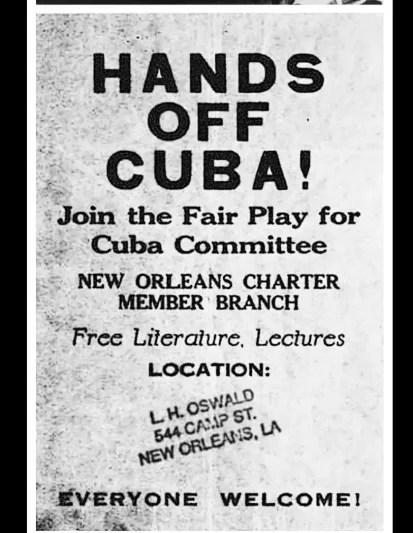
After moving to New Orleans in April 1963, Oswald set up a one-man chapter of the FPCC. In an apparent attempt to attract new members to the group in the virulently anti-Castro city, which was heaving with Cuban exiles, Oswald publicly distributed leaflets promoting the group. He hired random members of the public to assist with the effort, which lasted only 15 minutes, but just so happened to be captured on camera by a local TV station.

Oddly, when testifying to the Warren Commission, Oswald’s half-brother John Pic was “unable to recognize him” in pictures of the leafleting event, raising the prospect Oswald was being impersonated. Even more curiously, as Fonzi noted in his discussion with Smith, some of the leaflets listed the address of Oswald’s FPCC chapter as 544 Camp Street, which housed “some kind of intelligence operation run by Guy Banister, a former FBI agent.” Smith responded, “there were a lot of former FBI men on Angleton’s staff.”
Today, journalists, researchers, and concerned citizens have no choice but “to be speculative” about how and why John F Kennedy was killed, and by whom. The newly-declassified documents offer only further questions – but they all unambiguously point in James Angleton’s direction. His multifaceted role as master of the CIA’s vast Oswald file, chief of Agency relations with Israel, and potential enabler of Tel Aviv’s nuclear weapons program all appear interlinked. And these operations in tandem may account for what occurred on November 22nd 1963.

December 8, 2025 Posted by | Deception, Timeless or most popular | , , , , , , | Leave a comment

The Ukraine War Hawks Sabotaging America First

By Harrison Berger | The American Conservative | December 2, 2025

As the White House moves to negotiate an end to the yearslong Ukraine proxy war, establishment members of Congress, elements of the deep state, and their corporate media allies work overtime to sabotage the president’s efforts.

The aggressive establishment campaign seeks to derail a draft settlement, negotiated largely in Washington, that would bar Ukraine from NATO in exchange for U.S. security guarantees, grant Russia de facto control of Crimea and the Donbas, and limit the size of the Ukrainian armed forces, among other measures.

By pursuing a negotiated resolution to the Ukraine war, the Trump administration is doing exactly what it was democratically elected to do. Voters who wanted to continue the proxy war against Russia were told to—and overwhelmingly did—vote for the defeated candidate, Kamala Harris.

But even though President Donald Trump and voters may prefer restraint and diplomacy with nuclear powers like Russia, the Washington political establishment that drives U.S. foreign policy has long made clear that it does not—and that it will take aggressive measures to subvert democratically decided policies in favor of its own. With a peace deal possibly within reach, this remarkably bipartisan campaign has become increasingly overt.

A bipartisan group of lawmakers last week floated the rumor that the Trump administration’s 28-point peace plan was secretly a Russian-authored “wish list.” The claim has since fallen apart—and never made sense in the first place—because, as Steve Bannon has pointed out, the terms of the deal are, if anything, overly favorable to Kiev, not Moscow. Under the proposal, the Ukrainian military would be permitted to build a fighting force of up to 600,000 troops. “That’s unacceptable to the Russians,” says political scientist John Mearsheimer. And while the draft would formally rule out NATO membership for Ukraine, it nonetheless commits the United States to extending security guarantees, a provision that leaves the door open for future rounds of confrontation between Ukraine and Russia.

Nonetheless, bipartisan factions continue to argue that Trump’s proposal favors Moscow, branding the pursuit of peace as Neville Chamberlain-style appeasement. Joining them to do it has been former Trump official Mike Pompeo, who argued against the 28-point plan on X, saying that “any so-called peace deal that limits Ukraine’s ability to defend itself would look more like a surrender.”

The former CIA director has in recent weeks emerged as a regular guest on Fox News to sabotage Trump’s peace plan, while simultaneously serving on the advisory board of the Ukrainian defense company FirePoint. The Murdoch-owned news network, which previously partly fired Tucker Carlson over his opposition to the Ukraine war, does not disclose that the former CIA director stands to profit directly from the war he goes on air to promote.

The most brazen and revealing effort to derail the Trump administration’s diplomacy comes from anonymous leakers, likely from the U.S. security state, which, through their servants in corporate media, repeatedly leak classified information in what has so far been a failed attempt to embarrass and undermine the president’s lead negotiator, U.S. Special Envoy Steve Witkoff.

The campaign against Witkoff began when Reuters reported that unnamed “U.S. officials” were “increasingly concerned” by Witkoff’s discussions with Russian diplomats to end the war. Soon after, Bloomberg published a selective leak of a classified call transcript, claiming Witkoff had “advised Russia on how to pitch Ukraine plans to Trump,” framing his diplomacy as improper.

The bipartisan pro-war establishment took their cue and seized on the leak, deploying the same strategy wielded against Trump’s first National Security Adviser Michael Flynn in 2017, when classified surveillance material was leaked to derail détente with Moscow. Now in the case of Witkoff, routine diplomatic back-channeling has again been framed as sinister and improper, in a controversy likely manufactured by unelected elites in northern Virginia to sabotage the foreign policy agenda of the elected president.

Their efforts fell flat, however, when the next morning, Trump reassured the press that nothing improper had occurred with Witkoff’s diplomacy. “That’s a standard thing… he’s got to sell this to Ukraine. He’s got to sell Ukraine to Russia. That’s what a dealmaker does,” Trump told reporters aboard Air Force One.

While negotiations with Russia nonetheless continue to advance, the episode reveals an unsustainable tension for the Trump presidency: the figures actively sabotaging its foreign policy agenda are largely the same Republican establishment actors the president continues to defend and campaign for.

At the same time, Trump has now spent several months campaigning against the chief opponents of Ukraine war spending in the House of Representatives—retiring Congresswoman Marjorie Taylor Greene of Georgia and Congressman Thomas Massie of Kentucky—mainly because they dared to consistently apply America First principles. Yet the actual saboteurs in the GOP work hard to subvert Trump’s foreign policy agenda without any consequences.

With the administration’s disapproval ratings now approaching record highs, there has never been a better moment for Trump to cut loose those saboteurs from his coalition and rediscover the America First instincts that first carried him to the White House.

December 4, 2025 Posted by | Mainstream Media, Warmongering, Militarism | , | Leave a comment

National Guard shooter a former CIA asset: why Rahmanullah Lakanwal case is typical

Trump points finger to Biden, but the deeper scandal is about America’s “terror fabric”

By Uriel Araujo | December 3, 2025

Last week, Afghan national Rahmanullah Lakanwal allegedly shot two National Guard officers near the White House, killing one and injuring the other. Authorities swiftly detained him, treating it as an isolated security breach, but the incident predictably fueled national debates on immigration and Islamic extremism.

President Donald Trump and CIA Director John Ratcliffe have pointed fingers at former President Joe Biden, claiming his policies enabled the attack. Interestingly, Ratcliffe himself acknowledged that Lakanwal was resettled in the US due to his prior collaboration with the CIA as part of a partner force in Kandahar, which ended amid the chaotic 2021 evacuation.

That detail alone — linking a suspect in an attack near the nation’s capital to its own intelligence apparatus — barely registered in the news cycle. In most countries, it would spark parliamentary inquiries, mass resignations, and nonstop media scrutiny, especially given the fact that clandestine operations and political assassinations are some of the CIA specialties.

The shooting itself followed a now-familiar script: a sudden act of violence, an almost immediate tightening of security, and official assurances that there was “no broader threat” or plot. Yet the most significant fact remains unexplored. Who exactly is this shooter? Under what circumstances did he work with US intelligence? When did he cease to do so? And more importantly, how does an American intelligence asset end up opening fire in the heart of the capital? Not to mention (in the context of Trump’s new War on Drugs): is this intelligence asset connected to the Afghan dope trade?

In any case, we are not looking at an isolated anomaly. Each time a political assassination attempt, mass shooting, or terrorist threat incident captures national attention in the US, investigators often concede that the suspect had some form of prior contact or connection with federal agencies. Sometimes it is the CIA. At other times the FBI. Thus far, the pattern has been acknowledged only in fragments, but rarely examined as a systemic problem, conspiracy theories aside.

American intelligence agencies (like those of other countries) do not recruit from convents. They often operate in war zones, criminal markets, and militant networks. The question is: are American agencies simply gathering intelligence, or are they also shaping (to some degree) the very threats they claim to prevent?

Back in 2021, I wrote that any  American withdrawal from Afghanistan was likely to stay incomplete, with special forces and covert presence expected to remain, partly due to Afghanistan’s strategic importance and the resurgence of massive opium/heroin production under the US-backed government after 2001.

One may recall that Afghanistan has been a hub for CIA activity for over 40 years, and, as I recently noted, warlords, traffickers, militias, and fixers there were not accidental byproducts of intervention but often operational tools. With American “withdrawal”, these networks did not vanish, but rather scattered. This troubling legacy remains underreported, especially its most profitable pillar: narcotics.

Washington did not just fail to stop the Afghan drug trade. It is fair to say it maintained it. Opium financing sustained armed groups, secured loyalty, and lubricated covert operations long after public rhetoric focused on reconstruction. US intelligence has become structurally entangled with drug revenues during the occupation and the very collapse of this system triggered economic and security chaos inside Afghanistan itself. Considering all of this, I’ve recently written that the Taliban’s sudden shutdown of most the world’s largest illicit heroin supply this year was likely to provoke serious blowback

Thus, when Afghan-linked personnel surface in a national security scandal, American indignation is conveniently selective.

The same logic applies domestically. The FBI has an extensive record of infiltrating extremist groups on US soil, and, in multiple documented cases, actively encouraging or facilitating crimes that otherwise might never have occurred. FBI agents and informants have funded operations, provided materials, and pushed vulnerable individuals toward violence just in time for dramatic arrests (and sometimes not in time for that). Evidence can be thin enough in any single case, but overwhelming in accumulation.

The 2009 Newburgh case is emblematic, when a paid FBI informant induced impoverished Black Muslims from New York to plot a terrorist plan, even providing them cash, and orchestrating the entire plot to bomb Bronx synagogues.

The same can be said of the Fort Dix Five (2007) episode; of the Liberty City Seven case (2006); of the Rezwan Ferdaus affair (2011); of the Cleveland Bridge Plot (2012), and many others, with a clear pattern emerging: studies (like those of award-winning journalist Trevor Aaronson) even estimate federal informants drove nearly half of post 911 terror convictions, in what has been described as a “terror fabric”. This means domestic terrorism in America is largely a product of its own security apparatus.

No wonder public confidence in federal institutions has collapsed. Americans are asked to accept an absurd contradiction: that the intelligence community can monitor global communications in real time but cannot detect local radicals already on its payroll.

Thus, the fact that the Utah Valley University (where the Charlie Kirk assassination took place) is a key intelligence hub triggered a lot of conspiratory speculation. One may also recall, in the context of Trump’s so-called war against the “deep state”, that there were links between federal agencies and two Trump assassination attempt suspects (Thomas Crook and Ryan Routh).

So much for the notion that political violence in America is always the work of random loner shooters. Of course sociological, cultural and psychological factors play a role and much has been written from that angle. But sometimes “deep state” intrigues are also a factor that should not be overlooked.

Uriel Araujo, Anthropology PhD, is a social scientist specializing in ethnic and religious conflicts, with extensive research on geopolitical dynamics and cultural interactions.

December 3, 2025 Posted by | Deception, False Flag Terrorism, Timeless or most popular | , , | Leave a comment

Obama Paved the Way for Trump’s Venezuelan Killings

By Jim Bovard | The Libertarian Institute | December 3, 2025

The Trump administration’s killings of scores of Venezuelans are justifiably provoking outrage. Secretary of War Pete Hegseth recently proclaimed, “We have only just begun to kill narco-terrorists.” Donald Trump and Hegseth are cashing a blank check for carnage that was written years earlier by President Barack Obama.

In his 2017 farewell address, Obama boasted, “We have taken out tens of thousands of terrorists.” Drone strikes increased tenfold under Obama, helping fuel anti–U.S. backlashes in several nations.

As he campaigned for the presidency in 2007, then-Senator Barack Obama declared, “We will again set an example for the world that the law is not subject to the whims of stubborn rulers.” Many Americans who voted for Obama in 2008 expected a seachange in Washington. However, from his first weeks in office, Obama authorized widespread secret attacks against foreign suspects, some of which spurred headlines when drones slaughtered wedding parties or other innocents.

On February 3, 2010, Obama’s Director of National Intelligence Dennis Blair stunned Washington by announcing that the administration was also targeting Americans for killing. Blair revealed to a congressional committee the new standard for extrajudicial killings:

“Whether that American is involved in a group that is trying to attack us, whether that American has—is a threat to other Americans. We don’t target people for free speech. We target them for taking action that threatens Americans.”

But “involved” is a vague standard—as is “action that threatens Americans.” Blair stated that “if we think that direct action will involve killing an American, we get specific permission to do that.” Permission from who?

Obama’s first high-profile American target was Anwar Awlaki, a cleric born in New Mexico. After the 9/11 attacks, Awlaki was showcased as a model moderate Muslim. The New York Times noted that Awlaki “gave interviews to the national news media, preached at the Capitol in Washington and attended a breakfast with Pentagon officials.” He became more radical after he concluded that the Geoge W. Bush administration’s Global War on Terror was actually a war on Islam. After the FBI sought to squeeze him into becoming an informant against other Muslims, Awlaki fled the country. He arrived in Yemen and was arrested and reportedly tortured at the behest of the U.S. government. After he was released from prison eighteen months later, his attitude had worsened and his sermons became more bloodthirsty.

After the Obama administration announced plans to kill Awlaki, his father hired a lawyer to file a challenge in federal court. The ACLU joined the lawsuit, seeking to compel the government “to disclose the legal standard it uses to place U.S. citizens on government kill lists.” The Obama administration labeled the entire case a “State Secret.” This meant that the administration did not even have to explain why federal law no longer constrained its killings. The administration could have indicted Awlaki on numerous charges but it did not want to provide him any traction in federal court.

In September 2010, The New York Times reported that “there is widespread agreement among the administration’s legal team that it is lawful for President Obama to authorize the killing of someone like Mr. Awlaki.” It was comforting to know that top political appointees concurred that Obama could justifiably kill Americans. But that was the same “legal standard” the Bush team used to justify torture.   

The Obama administration asserted a right to kill U.S. citizens without trial, without notice, and without any chance for the marked men to legally object. In November 2010, Justice Department attorney Douglas Letter announced in federal court that no judge had legal authority to be “looking over the shoulder” of Obama’s targeted killing. The letter declared that the program involves “the very core powers of the president as commander in chief.”

The following month, federal judge John Bates dismissed the ACLU’s lawsuit because “there are circumstances in which the Executive’s unilateral decision to kill a U.S. citizen overseas” is “judicially unreviewable.” Bates declared that targeted killing was a “political question” outside the court’s jurisdiction. His deference was stunning: no judge had ever presumed that killing Americans was simply another “political question.” The Obama administration’s position “would allow the executive unreviewable authority to target and kill any U.S. citizen it deems a suspect of terrorism anywhere,” according to Center for Constitutional Rights attorney Pardiss Kebriae.

On September 30, 2011, a U.S. drone attack killed Awlaki along with another American citizen, Samir Khan, who was editing an online Al Qaeda magazine. Obama bragged about the lethal operation at a military base later that day. A few days later, administration officials gave a New York Times reporter extracts, a peek at the fifty-page secret Justice Department memo. The Times noted, “The secret document provided the justification for [killing Awlaki] despite an executive order banning assassinations, a federal law against murder, protections in the Bill of Rights and various strictures of the international laws of war, according to people familiar with the analysis.” The legal case for killing Awlaki was so airtight that it did not even need to be disclosed to the American public.

Two weeks after killing Awlaki, Obama authorized a drone attack that killed his son and six other people as they sat at an outdoor café in Yemen. Anonymous administration officials quickly assured the media that Abdulrahman Awlaki was a 21-year-old Al Qaeda fighter and thus fair game. Four days later, The Washington Post published a birth certificate proving that Awlaki’s son was only 16-years old and had been born in Denver. Nor did the boy have any connection with Al Qaeda or any other terrorist group. Robert Gibbs, Obama’s former White House press secretary and a top advisor for Obama’s reelection campaign, later shrugged that the 16-year-old should have had “a far more responsible father.”

Regardless of that boy’s killing, the media often portrayed Obama and his drones as infallible. A Washington Post poll a few months later revealed that 83% of Americans approved of Obama’s drone killing policy. It made almost no difference whether the suspected terrorists were American citizens; 79% of respondents approved of preemptively killing their fellow countrymen, no judicial niceties required. The Post noted that “77 percent of liberal Democrats endorse the use of drones, meaning that Obama is unlikely to suffer any political consequences as a result of his policy in this election year.” The poll results were largely an echo of official propaganda. Most folks “knew” only what the government wanted them to hear regarding drones. Thanks to pervasive secrecy, top government officials could kill who they chose and say what they pleased. The fact that the federal government had failed to substantiate more than 90% of its terrorist accusations since 9/11 was irrelevant since the president was omniscient.

On March 6, 2012, Attorney General Eric Holder, in a speech on targeted killings to a college audience, declared, “Due process and judicial process are not one and the same, particularly when it comes to national security. The Constitution guarantees due process, it does not guarantee judicial process.” TV comedian Stephen Colbert mocked Holder, quipping “Trial by jury, trial by fire, rock, paper scissors, who cares? Due process just means that there is a process that you do.” One purpose of due process is to allow evidence to be critically examined. But there was no opportunity to debunk statements from anonymous White House officials. For the Obama administration, “due process” meant little more than reciting certain phrases in secret memos prior to executions.

Holder declared that the drone attacks “are not [assassinations], and the use of that loaded term is misplaced; assassinations are unlawful killings. Here, for the reasons I have given, the U.S. government’s use of lethal force in self-defense.” Any termination secretly approved by the president or his top advisers was automatically a “lawful killing.” Holder reassured Americans that Congress was overseeing the targeted killing program. But no one on Capitol Hill demanded a hearing or investigation after U.S. drones killed American citizens in Yemen. The prevailing attitude was exemplified by House Homeland Security Committee Chairman Peter King (R-NY): 

“Drones aren’t evil, people are evil. We are a force of good and we are using those drones to carry out the policy of righteousness and goodness.”

Obama told White House aides that it “turns out I’m really good at killing people. Didn’t know that was gonna be a strong suit of mine.” In April 2012, The New York Times was granted access for a laudatory inside look at “Terror Tuesday” meetings in the White House:

“Every week or so, more than 100 members of the government’s sprawling national security apparatus gather, by secure video teleconference, to pore over terrorist suspects’ biographies and recommend to the president who should be the next to die.”

It was a PowerPoint death parade. The Times stressed that Obama personally selected who to kill next:

“The control he exercises also appears to reflect Mr. Obama’s striking self-confidence: he believes, according to several people who have worked closely with him, that his own judgment should be brought to bear on strikes.”

Commenting on the Times’ revelations, author Tom Engelhardt observed, “We are surely at a new stage in the history of the imperial presidency when a president (or his election team) assembles his aides, advisors and associates to foster a story that’s meant to broadcast the group’s collective pride in the new position of assassin-in-chief.”

On May 23, 2013, Obama, in a speech on his targeted killing program at the National Defense University in Washington, told his fellow Americans that “we know a price must be paid for freedom”—such as permitting the president untrammeled authority to kill threats to freedom. The president declared that “before any strike is taken, there must be near-certainty that no civilians will be killed or injuredthe highest standard we can set.”

Since almost all the data on victims was confidential, it was tricky to prove otherwise. But NBC News acquired classified documents revealing that the CIA was often clueless about who it was killing. NBC noted, “Even while admitting that the identities of many killed by drones were not known, the CIA documents asserted that all those dead were enemy combatants. The logic is twisted: If we kill you, then you were an enemy combatant.” Killings are also exonerated by counting “all military-age males in a strike zone as combatants… unless there is explicit intelligence posthumously proving them innocent.” And U.S. bureaucrats have no incentive to track down evidence exposing their fatal errors. The New York Times revealed that U.S. “counterterrorism officials insist… people in an area of known terrorist activity… are probably up to no good.” The “probably up to no good” standard absolved almost any drone killing within thousands of square miles in Pakistan, Yemen, and Somalia. Daniel Hale, a former Air Force intelligence analyst, leaked information revealing that nearly 90% of people who were killed in drone strikes were not the intended targets. Joe Biden’s Justice Department responded by coercing Hale into pleading guilty to “retention and transmission of national security information,” and he was sent to prison in 2021.

Sovereign immunity entitles presidents to kill with impunity. Or at least that is what presidents have presumed for most of the past century. If the Trump administration can establish a prerogative to preemptively kill anyone suspected of transporting illicit narcotics, millions of Americans could be in the federal cross-hairs. But the Trump administration is already having trouble preserving total secrecy thanks to controversies over who ordered alleged war crimes. Will Trump’s anti-drug carnage end up torpedoing his beloved Secretary of War Hegseth and his own credibility with Congress, the judiciary, and hundreds of millions of Americans who do not view White House statements as divine revelations handed down from Mt. Sinai?

December 3, 2025 Posted by | Civil Liberties, Full Spectrum Dominance, Timeless or most popular | , , , , , , , | Leave a comment

Why Is the Establishment Ignoring the Recently Declassified JFK Files?

By Harrison Berger | The American Conservative | November 28, 2025

Overshadowed by the recent revelations in the Epstein files, the 62nd anniversary of President John F. Kennedy’s assassination came and went with little notice. Yet new documents relating to that still-unsolved murder—released only recently by the Trump administration—deserve far more scrutiny than they have received from corporate media.

From the moment the latest batch of disclosures emerged this past March, the Democratic Party and their allies in corporate media assumed their familiar role as CIA stenographers, either overlooking—or outright refusing to look at—what more than 60,000 documents revealed. At an April 1 House hearing, Rep. Jasmine Crockett (D-TX)—illustrating the Democratic Party’s loyalty to the U.S. security state—confidently insisted that the JFK files “show no evidence of a CIA conspiracy,” and complained that even hearing testimony from Oliver Stone, Jefferson Morley, and Jim DiEugenio amounted to “platform[ing] conspiracy theories.”

The New York Times’ Julian Barnes echoed the Democratic congresswoman nearly word for word, announcing definitively that “the CIA did not kill JFK…Oswald acted alone,” despite the sheer volume of documents that no reporter could have seriously reviewed in such a short span of time. Speed-readers Lalee Ibssa and Diana Paulsen of ABC News likewise asserted that, by calling for Congress to reopen the investigation into Kennedy’s assassination, filmmaker Oliver Stone was “reviv[ing] unfounded conspiracy theories.”

But despite committed insistence from Democrats and their corporate media allies, the Trump administration’s JFK disclosures, along with troves of previously released files, do in fact suggest a CIA conspiracy. We have ample documentation from unsealed congressional records of who worked hard to cover it up—among them a consortium of CIA officials who systematically lied to the Warren Commission, misleading the public investigation about the prime suspect in the president’s murder, Lee Harvey Oswald.

Perhaps the main architect of that cover-up was the CIA spymaster James Jesus Angleton, who, despite being the counterintelligence chief presiding over what was supposedly the worst intelligence failure since Pearl Harbor, wound up deeply involved in the CIA’s official investigation into the assassination.

Though Angleton insisted that the agency was inattentive to Oswald and unaware of the purpose of his activities leading up to Dallas, it has since been disclosed through unclassified JFK assassination records that Angleton personally maintained a classified 201 intelligence/surveillance file on Oswald for the four years preceding Kennedy’s assassination, strictly controlling which officials inside the CIA were permitted to see it through compartmentalization.

Angleton’s deceptions to investigators are so numerous that 60 years later they are still being uncovered; in one notable instance only revealed this year, Angleton committed perjury before the House Select Committee on Assassinations, claiming he knew almost nothing about Lee Harvey Oswald before the shooting. In another, Angleton concealed the fact that Oswald had visited the Cuban embassy in Mexico City—a visit the CIA publicly claimed it only discovered after the assassination. As Jefferson Morley, author of The Ghost: The Secret Life of CIA Spymaster James Jesus Angleton, explained, the  counter-intelligence chief “preferred to wait out the Warren Commission rather than explain the CIA’s knowledge of and interest in Oswald’s visit to the Cuban consulate” in Mexico.

Though Angleton left the CIA in disgrace, dismissed by many colleagues as a paranoid obsessive, his legacy has been consistently venerated by Israel’s intelligence services. In his memoir, the former director of the Mossad, Meir Amit, famously described James Angleton as “the biggest Zionist of the lot,” adding that “his total identification with Israel was an extraordinary asset for us.” As Morley writes, “Angleton’s loyalty to Israel betrayed US policy on an epic scale,” probably allowing the Israelis to build a nuclear bomb using stolen materials from the U.S.-based Nuclear Materials and Equipment Corporation (NUMEC) facility at a time when it was the expressed policy of the U.S. government to prevent Israel from acquiring one.

Angleton had regular professional and personal contact with at least six men aware of Israel’s secret plan to build a bomb. From Asher Ben Natan to Amos de Shalit to Isser Harel to Meir Amit to Moshe Dayan to Yval Ne’eman, his friends were involved in the building of Israel’s nuclear arsenal. If he learned anything of the secret program at Dimona, he reported very little of it. If he didn’t ask questions about Israel’s actions, he wasn’t doing his job. Instead of supporting U.S. nuclear security policy, he ignored it.

Among the most sensitive questions revived by the Trump administration’s releases is whether Israel may have had a role in or foreknowledge of the plot against Kennedy, who spent his final months battling the Israeli government over its nuclear program, its lobby power in the U.S., and the resettlement of Palestinians from the land the Israelis had expelled them from.

The mere suggestion that Israel may have been involved in Kennedy’s assassination, much more so than allegations against the CIA, produces the swiftest denunciations from across the establishment. When podcaster Theo Von made the allegation against Israel on a recent episode of The Joe Rogan Experience, for example, Israel loyalists like Amit Segal rapidly denounced the claim as a “blood libel” and  “antisemitic.” CyberWell, an Israeli-helmed censorship outfit staffed by former Israeli intelligence officials that partners with every major social-media platform, has likewise labeled the allegation an antisemitic conspiracy theory and worked with those platforms to censor it from the internet.

The intensity with which critics denounce anyone who raises the question mirrors the vigor with which the government spent decades scrubbing any trace of the connection from its own files. For decades, dozens of references to “Israel,” “Tel Aviv,” and even the identities of Angleton’s Israeli operatives were blacked out of congressional testimony, including the Church Committee records.

In his 1975 Church Committee testimony, now available with many of the old redactions removed, Angleton confirms that during the CIA’s “Cuban business”—the covert campaign of sabotage and assassination plots against Castro run through Bill Harvey and Task Force W—he arranged for an Israeli intelligence officer in Havana to act as Harvey’s secret channel. According to Angleton, this “Israeli man” sent reports from Havana to Tel Aviv, from where they were passed directly to Angleton and then to Harvey. This setup kept some of the agency’s most sensitive operations outside the normal CIA chain of command. A now-missing page of that same testimony uncovered by Aaron Good shows Angleton downplaying any need to brief CIA Director John McCone about his Israeli liaison, even while admitting that “what they were doing was enormous.”

Good also highlights how Angleton’s Israeli channel intersected with Lee Harvey Oswald. The Counterintelligence Staff officer assigned to read Oswald’s mail and collect it for the 201 surveillance file that Angleton maintained before the assassination was Reuben Efron—a committed Zionist who had lived in Israel, published on espionage in a World Zionist Organization–affiliated journal, and, as Jefferson Morley notes, sat in on Marina Oswald’s Warren Commission interview with no official role listed.

At the very moment a U.S. president was seeking to restrict Israel’s nuclear ambitions and limit the political power of its lobby in Washington, the CIA official in control of the Oswald file was secretly sharing intelligence channels, assassination communications, and off-the-books operatives with Israel—and lying to both Congress and potentially some of his own CIA colleagues about it. The government spent 60 years redacting those facts and Americans have a right to know why.

December 2, 2025 Posted by | Deception, Timeless or most popular | , , , , | Leave a comment

How CIA secretly triggered Sino-Indian war

By Kit Klarenberg | Al Mayadeen | November 26, 2025

From October 20 – November 21, 1962, a little-remembered conflict raged between China and India. The skirmish damaged India’s Non-Aligned Movement affiliation, firmly placing the country in the West’s orbit, while fomenting decades of hostility between the neighbouring countries. Only now are Beijing and New Delhi forging constructive relations, based on shared economic and political interests. A detailed academic investigation, ignored by the mainstream media, exposes how the war was a deliberate product of clandestine CIA meddling, specifically intended to further Anglo-American interests regionally.

In the years preceding the Sino-Indian War, tensions steadily brewed between China and India, in large part due to CIA machinations supporting Tibetan separatist forces. For example, in 1957, Tibetan rebels secretly trained on US soil were parachuted into the territory and inflicted major losses on Beijing’s People’s Liberation Army forces. The next year, these cloak-and-dagger efforts ratcheted significantly, with the agency airdropping weapons and supplies in Tibet to foment violent insurrection. By some estimates, up to 80,000 PLA soldiers were killed.

Mao Zedong was convinced that Tibetan revolutionaries, while ultimately US-sponsored, enjoyed a significant degree of support from India and used the country’s territory as a base of operations. These suspicions were significantly heightened by Tibet’s March 1959 uprising, which saw a vast outflow of refugees from the region to India, and the granting of asylum to the Dalai Lama, their CIA-supported leader, by New Delhi. Weeks later, at a Chinese Communist Party politburo meeting, Mao declared a “counteroffensive against India’s anti-China activities.”

He called for official CPC communications to “sharply criticise” India’s premier Jawaharlal Nehru, stating Beijing “should not be afraid of making him feel agitated or of provoking a break with him,” and “we should carry the struggle through to the end.” For example, it was suggested that “Indian expansionists” be formally accused of acting “in collusion” with “British imperialists” to “intervene openly in China’s internal affairs, in the hope of taking over Tibet.” Mao implored, “we… should not avoid or circumvent this issue.”

Ironically, Nehru was then viewed with intense suspicion by the West due to his Non-Aligned commitment and broadly socialist economic policies. Thus, he could not be trusted to support covert Anglo-American initiatives targeting China. Meanwhile, Soviet leader Nikita Khrushchev considered Nehru an important prospective ally and was keen to maintain positive relations. Simultaneously, the Sino-Soviet Split, which commenced in February 1956 with Khrushchev’s notorious secret speech denouncing the rule of Joseph Stalin, was ever-deepening. Disagreements over India and Tibet only hastened the pair’s acrimonious divorce.

‘A weapon’

After months of official denunciations of Nehru’s policies toward Tibet, Beijing’s information war against India became physical in August 1959, with a series of violent clashes along the countries’ borders. Nehru immediately reached out to Moscow, pleading that they rein in their closest ally. This prompted a tense meeting in October 1959 between Khrushchev, his chief aides, and the CPC’s top leadership, at Mao’s official residence. Khrushchev belligerently asserted to his Chinese counterparts that their confrontations with New Delhi and unrest in Tibet were “your fault”.

The Soviet leader went on to caution about the importance of “preserving good relations” with Nehru and “[helping] him stay in power,” for if he was replaced, “who would be better than him?” Mao countered that India had “acted in Tibet as if it belonged to them,” and while Beijing also supported Nehru, “in the question of Tibet, we should crush him.” Assorted CPC officials then, one by one, forcefully asserted the recent border clashes were initiated by New Delhi. However, Khrushchev was highly dismissive.

“Yes, they began to shoot and they themselves fell dead,” he derisively retorted. A Soviet declaration of neutrality in the Sino-Indian dispute a month prior also provoked anger among the CPC contingent. Mao complained, “[the] announcement made all imperialists happy,” by publicly exposing rifts between Communist countries. Khrushchev et al were again unmoved by the suggestion. Yet, unbeknownst to attendees, they had all unwittingly stepped into a trap laid by the CIA, many years earlier.

In September 1951, a State Department memo declared, “The US should endeavor to use Tibet as a weapon for alerting” India “to the danger of attempting to appease any Communist government and, specially, for maneuvering [India] into a position where it will voluntarily adopt a policy of firmly resisting Chinese Communist pressure in south and east Asia.” In other words, it was believed that supporting Tibetan independence could force a Sino-Indian split. In turn, the Soviets might be compelled to take sides, deepening ruptures with Beijing.

This strategy informed CIA covert action in Tibet over the subsequent decade, which grew turbocharged when Allen Dulles became CIA chief in 1953. A dedicated, top-secret base was constructed for the separatists at Camp Hale, the US military’s World War II-era training facility in the Rocky Mountains. Local terrain – vertiginous, replete with dense forests – was reminiscent of Tibet, providing ample opportunity for insurgency practice. Untold numbers of militants were tutored there over many years.

At any given time, the CIA maintained a secret army of up to 14,000 Tibetan separatists in China. While the guerrillas believed Washington sincerely supported their secessionist crusade, in reality, the agency was solely concerned with creating security problems for Beijing, and resultantly inflicting economic and military costs on their adversary. As the Dalai Lama later lamented, the agency’s assistance was purely “a reflection of their anti-Communist policies rather than genuine support for the restoration of Tibetan independence.”

‘More susceptible’

Come October 1962, the CIA’s Tibetan operations had become such an irritant to China that PLA forces invaded India. Washington was well aware in advance that military action was imminent. A telegram dispatched to Secretary of State Dean Rusk five days prior to the war’s eruption forecast a “serious conflict” and laid out a detailed “line” to take for when the time came. First and foremost, the US would publicly make clear its “sympathy for the Indians and the problems posed by the Chinese intervention.”

However, it was considered vital to “be restrained in our expressions in the matter so as to give the Chinese no pretext for alleging any American involvement.” While New Delhi was already secretly receiving “certain limited purchases” of US military equipment, Washington would not actively “offer assistance” when war broke out. “It is the business of the Indians to ask,” the telegram noted. If such requests were forthcoming, “we will listen sympathetically to requests… [and] move with all promptness and efficiency to supply the items”:

“The US is giving assistance… designed to ease Indian military transport and communications problems. Additionally, the Departments of State and Defense are studying the availability on short notice and on terms acceptable to India of transport, communications and other military equipment in order to be prepared should the government of India request such US equipment.”

As predicted, the Sino-Indian conflict prompted Nehru to urgently reach out to Washington for military aid, a significant policy shift. Much of New Delhi’s political class duly adopted a pro-Western line, with calls for a review of the country’s Non-Aligned stance reverberating widely throughout parliament. Even Communist and Socialist parties that hitherto rejected any alliance with the US eagerly accepted the assistance. The CIA’s Tibetan operations had triumphed.

As a May 1960 Agency National Intelligence Estimate noted, “Chinese aggressiveness” toward New Delhi over Tibet had fostered “a more sympathetic view of US opposition to Communist China” among India’s leaders. This included “greater appreciation of the value of a strong Western – particularly US – position in Asia to counterbalance” Beijing’s influence regionally. However, the CIA noted how, as of writing, “Nehru has no intention of altering India’s basic policy of nonalignment, and the bulk of Indian opinion apparently still shares his attachment to this policy.”

The Sino-Indian War changed all that. A December 1962 Agency analysis of the conflict’s “outlook and implications” hailed New Delhi’s “metamorphosis”, which the CIA forecast would “almost certainly continue to open up new opportunities for the West.” The country was judged “more susceptible than ever before to influence by the US and the UK, particularly in the military field.” Conversely, the War had “seriously complicated the Soviet Union’s relations with India and aggravated its difficulties with China”:

“The USSR will place a high value on a continued close relationship with India. While its opportunity to build up lasting influence in the Indian military has virtually disappeared, it will probably continue to supply some military equipment and to maintain its economic ties with India.”

Subsequently, New Delhi began assisting Anglo-American intelligence gathering on China and became actively involved in CIA wrecking activities in Tibet. The Sino-Indian War’s spectre hung over relations between the two nations for many years thereafter, and border clashes occurred intermittently throughout. Now, though, as Donald Trump bemoaned in September, India appears enduringly “lost” to Beijing and its close partner Russia. Decades of determined US efforts to foment antagonism between the vast neighbours have come spectacularly undone, due to the sheer weight of geopolitical reality.

November 26, 2025 Posted by | Deception, Timeless or most popular | , , , , , , | Leave a comment

Further evidence emerges of Israel’s Mossad links to sex offender Jeffrey Epstein

MEMO | November 12, 2025

In what many view as further evidence of links between convicted sex offender Jeffrey Epstein and Mossad, leaked emails show Israeli spy stayed in his Manhattan home. Newly leaked emails reveal that a senior Israeli intelligence officer with ties to the Israeli military and Mossad stayed at Epstein’s Manhattan residence on multiple occasions between 2013 and 2016.

The documents, reported by Drop Site News, add to growing evidence that Epstein was a key facilitator of sexual exploitation, elite political access and international espionage on behalf of Israeli intelligence interests.

According to the investigation, Yoni Koren—a long-time aide to former Israeli Prime Minister and Defence Minister Ehud Barak and a figure with deep ties to Israeli military intelligence—was hosted by Epstein for weeks at a time.

Koren, who remained active in Israeli intelligence networks long after his formal retirement, was engaged in brokering cybersecurity ventures and coordinating high-level meetings involving former CIA Director Leon Panetta and US defence officials.

Among the documents released are emails showing Barak instructing Epstein to wire funds to Koren’s personal bank account and later coordinating an unusual hand-off of a package involving a bank card. Koren also arranged private access to the Pentagon and White House for Barak’s family, allegedly via his contacts with former CIA and Department of Defence officials.

The revelations form the fourth instalment in a series published by Drop Site News, which has previously reported on Epstein’s alleged involvement in brokering security agreements between Israel and Mongolia, Russia and Côte d’Ivoire. These reports challenge the long-maintained narrative that Epstein’s vast network was confined to financial elites and celebrities, instead pointing toward his role as an informal operator for Israeli intelligence interests.

While speculation around Epstein’s connections to intelligence services has long circulated, including earlier claims that he was protected due to those affiliations, the new material offers a rare glimpse into how deeply embedded he may have been in Israeli intelligence circles. The emails include direct communication between Barak and Epstein, discussions of bank transfers, and requests for covert operational assistance. They also show that Barak used Koren as an intermediary to share information with AMAN, Israel’s military intelligence directorate.

Notably, the US Congress has so far failed to release the full Epstein files. Republican Rep Anna Paulina Luna, who has led efforts to declassify these documents, has accused House Speaker Mike Johnson of deliberately delaying a vote under pressure from President Donald Trump. The files are believed to contain material implicating powerful figures across governments, financial institutions and intelligence networks.

Koren, who passed away from cancer in 2023, was described by Barak in a eulogy as a “talented intelligence officer… with endless loyalty to the state.” Barak has refused to comment on the latest allegations, as has Jeremy Bash, former CIA Chief of Staff and frequent point of contact in Koren’s email correspondence.

November 12, 2025 Posted by | Deception, Ethnic Cleansing, Racism, Zionism | , , , , , | Leave a comment

Kyrgyzstan’s Forgotten Colour Revolution

By Kit Klarenberg | Global Delinquents | November 6, 2025

October 5th marked the 25th anniversary of the world’s first “colour revolution”, in Yugoslavia. A lavishly-funded, multi-pronged CIA, NED and USAID campaign exploited civil society actors, in particular youth groups, to dislodge President Slobodan Milosevic from power. Such was the effort’s success, US officials and media openly boasted about Washington’s central role. A slick ‘documentary’ on the unrest, Bringing Down A Dictator, was even produced. Milosevic’s fall also provided a blueprint for countless future ‘soft coups’, which continue to this day.

So it was, one by one in the early 2000s, insufficiently pro-Western governments throughout the former Soviet sphere were toppled using strategies and tactics identical to those deployed against Belgrade. A common ruse was for the US to fund, via local NGOs, a “parallel vote tabulation” to project an election’s outcome in advance, and publicise the data before results were officially announced. As in Yugoslavia, PVT figures differing from formal tallies were the spark that ignited Georgia’s 2003 ‘Rose Revolution’, and Ukraine’s 2004 ‘Orange Revolution’.

Over subsequent years, much has been written by academics, historians and independent journalists about those colour revolutions. Conversely, Kyrgyzstan’s 2005 ‘Tulip Revolution’ has gone almost entirely unremarked upon, and is largely forgotten now. Yet, its destructive consequences reverberate today. Hitherto the freest and most stable state in Central Asia, post-colour revolution Bishkek careened from crisis to crisis, with multiple governments collapsing along the way. It’s only in recent years – following another Anglo-American coup in 2020 – the country has regained its economic, political, and social balance.

Pre-2005, Kyrgyzstan was not an obvious colour revolution candidate. Upon its 1991 independence from the Soviet Union, the country quickly established itself not only as the most democratic and open in the region, but a dependable US ally. President Askar Akayev, a former scientist with zero political background, was organically popular, and moreover made clear his economic policies were informed by arch-capitalist Adam Smith, not Karl Marx. In other words, Bishkek was primed to do business with the West.

Akayev moreover allowed a relatively free media to develop, and welcomed widespread foreign civil society penetration. Thousands of European and US-funded non-governmental organisations duly opened up shop locally. At one stage, the President quipped, “if the Netherlands is a land of tulips, then Kyrgyzstan is a land of NGOs.” His comments proved bitterly ironic, given the title of the colour revolution that eventually unseated him. In another deeply sour twist, it was precisely Akayev’s welcoming of Western financial and societal infiltration that was his undoing.

A self-laudatory USAID factsheet on the President’s removal notes, from 1994 onwards $68 million was funnelled into Kyrgyzstan. This vast windfall was used to train NGOs “to lobby government,” finance “private newspapers” critical of Akayev, establish an “American University” locally, and much more besides. The Tulip Revolution stands today as a stark warning to governments the world over of the dangers of permitting such entities to operate on their soil with impunity – and how often, even pro-Western leaders can fall victim to their mephitic influence.

‘Defeat Dictators’

Despite much goodwill built up since 1991, in October 2003 Akayev angered Washington by inviting Moscow to open an airbase not far from Bishkek, and just a few dozen kilometres from the Empire’s vast Manas military installation, one of a cluster constructed by the US across Central Asia post-9/11 to facilitate the War On Terror. Such insubordination was sufficient to mark the President for removal, and preparations for a colour revolution according to a by-then well-honed formula began almost immediately.

Akayev was not unwise to this risk, warning in December 2004 of an “orange danger” of the kind that had just engulfed Ukraine threatening Kyrgyzstan, in advance of the country’s elections in February the next year. As it was, the results were far too clean to allege rigging or other shenanigans, as with prior colour revolutions. A detailed investigation by the European Network of Election Monitoring Organizations in fact praised a “positive… lack of reports of vote-buying, voter intimidation, and harassment of journalists.”

Washington’s vast local standing army of civil society insurrectionists began causing havoc anyway. Some operated under the banner of KelKel, a group directly inspired by US-sponsored revolutionary youth factions in Yugoslavia, Georgia and Ukraine, and trained by their alumni. Moreover, as the Wall Street Journal revealed just before the elections, an ostensibly “independent” local printing company in receipt of Freedom House, NED, Soros and USAID cash was responsible for publishing a panoply of opposition pamphlets.

Days earlier, the firm’s electricity was cut off by local authorities. Kyrgyzstan’s US embassy “stepped in with emergency generators” to maintain its anti-government propaganda deluge. This included a prominent newspaper that published “front-page photos of a palatial mansion purportedly owned by the President and of a boy in a decrepit alleyway,” highlighting state embezzlement versus citizen poverty. Another was a handbook produced by CIA-connected Gene Sharp, From Dictatorship to Democracydubbed “the bible” of Ukraine’s US-sponsored youth activists at the forefront of the Orange Revolution.

This “manual on how to defeat dictators, including tips on hunger strikes and civil disobedience,” includes guidance “on nonviolent resistance – such as ‘display of flags and symbolic colors’.” However, the protests that instantly erupted after the elections were highly belligerent from inception, with bomb attacks, police pelted with bricks and beaten with sticks, and government buildings torched and forcibly occupied. The New York Times contemporaneously acknowledged broadcasts by US-funded local TV stations inspired violence in certain areas of Kyrgyzstan.

Upheaval raged for weeks, prompting a personal intervention from UN Secretary General Kofi Annan, who expressed significant alarm over “the use of violence and intimidation to resolve electoral and political disputes.” He welcomed Akayev’s invitation to instigate dialogue with protesters. They demanded he resign instantly – despite the President having already pledged before the election to do so in October that year. In March, Akayev acquiesced and stood down, replaced by Kurmanbek Bakiyev.

‘Terribly Disappointing’

Bakiyev’s seizure of power was initially framed by Western journalists, politicians and pundits as a sparkling victory for people power, and the dawning of a new era of democracy and freedom in Kyrgyzstan. Yet, five years later, he fled the country, following mass protests over his savage, corrupt rule. The tipping point for Bakiyev’s ouster was the April 7th 2010 mass shooting of demonstrators by security forces, which killed up to 100 people and wounded at least 450 more.

As Forbes recorded at the time, the level of graft under his Presidency was “mind-boggling”. Bakiyev appointed close relatives to key positions, allowing his family to profit handsomely from legally questionable privatisation of state industries, and supply of fuel to Washington’s Manas base. Bakiyev’s son Maxim, who oversaw the latter, was described by US diplomats in leaked cables as “smart and corrupt.” By some estimates, companies he ran reaped $1.8 billion from these deals, close to Kyrgyzstan’s total GDP in 2003.

Meanwhile, Bakiyev’s brother Zhanysh ran Bishkek’s security apparatus with an iron fist. Harsh restrictions on political freedoms were enacted, while arbitrary detentions, bogus convictions, torture, and killings of opposition activists, journalists, and politicians became commonplace. For example, in March 2009 Bakivey’s former chief of staff Medet Sadyrkulov died in an alleged road traffic accident. It was later revealed he was brutally slain upon Zhanysh’s order. That December, dissident reporter Gennady Pavlyuk was murdered, thrown out of a sixth-floor apartment with his arms and legs bound.

Bishkek’s Tulip Revolution wasn’t unique in producing such horrors. A March 2013 essay in elite imperial journal Foreign Policy acknowledged the results of every US-orchestrated government overthrow in the first years of the new millennium were “terribly disappointing”, and “far-reaching change never really materialized” resultantly. This is quite an understatement. Most target countries slid into autocracy, chaos and poverty as a result of Washington’s meddling. It has typically taken years for the damage to be corrected, if at all.

Still, despite this disgraceful legacy, the US appetite for fomenting colour revolutions – and the willingness of groomed citizens, particularly youth, the world over to serve as Washington’s regime change footsoldiers – remains undimmed. In September, Nepal’s elected government was overthrown by disaffected ‘Gen Z’ activists, with the full support of the country’s powerful military. The palace coup bore all the hallmarks of a colour revolution. Who and what will replace the felled administration still remains far from clear.

As a September 15th New York Times editorial noted, “Nepalis from all walks were ready to reject the system they had fought for decades to achieve,” but lack “any clear sense of what comes next.” There is an extraordinary political vacuum in Kathmandu presently, which elements within the country are seeking to exploit for malign ends. As before, Nepal’s “revolution” is likely to produce a government far worse than that which preceded it.

November 6, 2025 Posted by | Corruption | , , , , , , | Leave a comment

Taliban unveil five-year plan to help Afghan farmers replace poppy crops

The Cradle | November 3, 2025

The Ministry of Agriculture of the Islamic Emirate of Afghanistan announced on 3 November the approval of a five-year plan to provide alternatives to growing poppies for the country’s farmers.

Afghanistan has traditionally been a hub for growing poppies, which are used to produce heroin, a highly addictive and deadly drug, for consumption in Europe and elsewhere.

After taking power in 2021 following a chaotic US military withdrawal, the Taliban banned the cultivation of the plant.

Poppy cultivation flourished during the 20-year US occupation of the country, with many drug lords connected to the CIA receiving top positions in the Afghan government in Kabul.

According to the Agriculture Ministry, the five-year program will benefit some 149,900 farmers and involve $71 million in funding.

“This plan is designed to provide legal and sustainable economic opportunities for farmers in the sectors of agriculture, livestock, natural resources, and irrigation,” stated Sher Mohammad Hatami, spokesperson for the ministry.

The plan includes projects focused on orchard development, grain production, livestock growth, irrigation system improvements, the establishment of greenhouses, and training centers for farmers.

The ministry stated that other crops, including saffron, asafoetida (hing), cotton, and wheat, will be promoted as alternatives for farmers.

Meanwhile, several farmers told Tolo News that the ban on poppy cultivation had created serious economic challenges for them and called on Afghan authorities to provide help in transitioning to an alternative.

“We were forced to grow this crop, and now the government doesn’t help us even once a year,” said Barat, a farmer from Badakhshan.

Azim, another farmer from Badakhshan, said, “We want support in finding alternatives to drug cultivation, because farmers in this province are in need.”

A June 2023 report published by Alcis, a British-based geographic information services firm, revealed that the Taliban government had largely eliminated opium cultivation in the country, wiping out the base ingredient needed to produce heroin.

This outcome mirrored a similar move by the Taliban in 2000 when they were in power the first time.

Under the guise of the “War on Terror,” the 2001 US and UK invasion of the country was driven in part by the desire to restore the heroin trade, which the Taliban had abruptly terminated after taking power for the first time in 1996.

The western powers sought to re-establish the lucrative flow of billions of dollars that the heroin trade provided to their financial systems.

November 3, 2025 Posted by | Economics | , | Leave a comment

The Role of Snipers in the Arab Spring and Maidan Protests

By William Van Wagenen | The Libertarian Institute | October 15, 2025

As anti-government protests known as the Arab Spring swept through the Middle East in early 2011, observers felt they were witnessing spontaneous, grassroots calls for freedom against decades of tyranny and dictatorship.

While the demands of the protestors were largely sincere, the protests that erupted in Tunisia, Egypt, Yemen, Libya, and crucially, Syria, were nevertheless the product of an unconventional warfare campaign organized by the Barack Obama administration, including the National Security Council (NSC), State Department, CIA, and allied intelligence agencies.

Rooted in Obama’s Presidential Study Directive 11 (PSD-11), the unconventional warfare campaign sought to spark “democratic transitions” in U.S. allied and enemy states alike. The objective was to replace authoritarian, Arab nationalist rulers with Muslim Brotherhood dominated governments even more friendly to American and Israeli interests.

As I have detailed in my book, Creative Chaos: Inside the CIA’s covert war to topple the Syrian government, Obama’s PSD-11 is an outgrowth of the broader American and Israeli effort to topple the government of Bashar al-Assad that began after 9/11.

The unconventional warfare campaign to spark the Arab Spring involved training local activists to use social media and internet privacy technologies such as Facebook and Tor to organize protests highlighting existing grievances.

Snipers were then unleashed to carry out false flag killings of protestors that could be blamed on government security forces.

The killing of protestors created the “martyrs” needed to fuel the fire of the protests and galvanize Arab populations to call for the overthrow of their governments.

Crucially, the false flag killings gave President Obama the necessary pretext to declare that Arab leaders had “lost legitimacy” by “killing their own people” and to demand their ouster.

As Russian military analyst Yuferev Sergey observed, the sniper phenomenon first appeared in Tunisia and then “smoothly migrated” to Egypt, Yemen, Libya, and finally to Syria.

“At first, I didn’t know why people were protesting. Syria was a rich country. Life was very good,” a Christian from Syria who witnessed the early events of the so-called Arab Spring told this author. “But then the government started shooting protestors. It gave people a reason to protest even more.”

The phenomenon appeared again in 2014 in Ukraine when snipers killed more than one hundred protesters, known as the “Heavenly Hundred,” in Kiev’s Maidan square. The killings led to a U.S.-backed coup that ousted the country’s pro-Russian president.

This paper details the role of snipers in efforts to topple governments in Tunisia, Egypt, Libya, Yemen, Syria, and Ukraine.

Presidential Study Directive 11

In August 2010, U.S. President Barack Obama tasked a team of advisors led by National Security Council officials, including Samantha Power, Ben Rhodes, Michael McFaul, and Dennis Ross, to issue a report known as Presidential Study Directive 11.

The report laid the blueprint for regime change in four Arab countries, including Egypt and three others left unnamed.

According to reporting from The New York Times, Obama “pressed his advisors to study popular uprisings in Latin America, Eastern Europe, and Southeast Asia to determine which ones worked and which did not.”

The report, the result of weekly meetings involving experts from the State Department and CIA, then “identified likely flashpoints, most notably Egypt, and solicited proposals for how the administration could push for political change in countries with autocratic rulers who are also valuable allies of the United States.”

The Obama administration was particularly concerned about Egypt due to the expected succession crisis to the rule of the country’s aging and unpopular president, Hosni Mubarak. U.S. officials wanted a way to control who would take Mubarak’s place, rather than leave the outcome to chance or allow Mubarak to place his son in power after him.

The policy advocated assisting the rise to power of Islamist groups, specifically the Muslim Brotherhood.

As David Ignatius of The Washington Post reported in March 2011, after the Arab Spring was well under way, the Obama administration’s “low-key policy” involved “preparing for the prospect that Islamist governments will take hold in North Africa and the Middle East.”

Tacitly endorsing the Brotherhood, a senior Obama administration official argued, “If our policy can’t distinguish between al-Qaeda and the Muslim Brotherhood, we won’t be able to adapt to this change.”

Unconventional Warfare

While states at times engage in direct conflict against one another, they more often wage war covertly through proxies.

To avoid a direct confrontation and the possibility of a nuclear exchange during the Cold War, the United States, Soviet Union, China, France, and the United Kingdom “empowered rebel groups to act as proxies conducting irregular warfare on behalf of the patron state,” wrote Mike Fowler, Associate Professor of Military and Strategic Studies at the U.S. Air Force Academy.

“This empowerment often involved training, equipping, and funding non-state actors to overthrow or undermine governments that supported (whether real or perceived) the opposing power,” he added.

CIA support for Muslim extremists, known as the mujahideen, in Afghanistan to topple the pro-Soviet government in Kabul and to later fight occupying Soviet troops, is well documented.

Turning Members into Martyrs

After the fall of the Soviet Union, American efforts to overthrow post-Soviet states that remained within the Russian sphere of influence involved not only covert military support for “rebel” groups, but also the use of “non-violent” methods to spark anti-government protest movements known as “Color Revolutions.”

The use of non-violence to undermine pro-Russian governments was first theorized by American academic Gene Sharp and implemented by activists from the Center for Applied Non-Violent Action and Strategies (CANVAS) in Serbia.

Inherent to the non-violent strategy is the use of “political jiu-jitsu,” in which activists skillfully make government violence and repression “backfire,” writes Srdja Popovic, the executive director of CANVAS, in Foreign Policy.

Popovic emphasizes that to be successful, a movement must “be ready to capitalize on oppression.”

“Following a repressive act, it’s vital that activists keep the public aware of what has happened and take sustained measures to ensure that they don’t forget. One clever way to achieve this is to turn members of the movement who have faced particular scrutiny by a regime into martyrs,” he explained.

While opposition activists (and the intelligence agencies supporting them) can wait for an oppressive regime to create martyrs to rally around, they can also “create” them through “provocations.”

Employing snipers to carry out false flag killings during protests against an oppressive regime is an effective way to create such martyrs.

Russian analyst Yuferev Sergey stated that the use of snipers is not an effective riot control method for dispersing crowds at protests. If a sniper opens fire at a crowd, demonstrators will not hear or immediately notice the shots. Once they do, they will not know where the shots are coming from, or which way to run to escape them.

But the use of snipers at protests is an effective way to manufacture anger against an existing government or leader.

“[T]he bodies with gunshot wounds to the head or heart are sure to be found by journalists, and all this will go on TV and on the Internet,” Sergey writes. In the confusion of the events, no one will “rush to conduct ballistic examinations, to look for places from which the snipers worked. The answer is ready in advance, and all the blame immediately falls on the head of the ruling regime. This is exactly what the organizers of such provocations are trying to achieve.”

As a result, the presence of snipers has become the “hallmark of unrest” arising in many countries where the United States is seeking to topple an existing government, Sergey adds.

Snipers are used to create the “martyrs” needed by U.S.-trained and funded “non-violent” activists to rally around when calling for a government to be overthrown.

Snipers in Tunisia

The small north African nation of Tunisia was the first country to see its president toppled in the so-called Arab Spring.

The first protests in Tunisia erupted in the city of Sidi Bouzid in December 2010, four months after the Obama administration issued PSD-11.

A few weeks before, on November 28, Wikileaks released more than 250,000 leaked U.S. State Department cables, known as “Cablegate.”

Some of the cables regarded Tunisia, including one from the U.S. ambassador to the country discussing the corruption of President Zine El Abidine Ben Ali, his wife, and a broader circle of government officials.

The release of cables highlighting Ben Ali’s corruption was not part of a random, arbitrary dump of diplomatic documents later seized upon by Tunisians. It was part of a carefully prepared campaign by Wikileaks, which partnered with Tunisian exiles from the dissident website, Nawaat, to promote the cables.

Al-Jazeera reported that Wikileaks provided the cables in advance to Nawaat, whose activists read the documents, added context, translated them to French, and published them on a special website, Tunileaks, to allow Tunisian readers to understand them.

Thanks to this prior coordination, when Wikileaks was ready to release the cables, Nawaat was ready as well.

“As agreed, the first TuniLeaks went live less than an hour after WikiLeaks had published the diplomatic cables on its own site,” Al-Jazeera wrote.

According to Al-Jazeera, “Nawaat helped fertilize the cyber terrain so that when the uprising finally came, dissident networks were in place to battle the censorship regime. Nawaat amplified the protesters’ voices, sending them echoing across the internet and beyond.”

Al-Jazeera Arabic promoted the contents of the leaked cables as well by discussing them in a series of talk shows, helping to ensure Tunisians knew “their government was being run by a corrupt and nepotistic extended family.”

Tom Malinowski, a senior fellow at the McCain Institute, wrote in Foreign Policy that the cables released by Wikileaks had an important effect.

“The candid appraisal of Ben Ali by U.S. diplomats… contradicted the prevailing view among Tunisians that Washington would back Ben Ali to the bloody end, giving them added impetus to take to the streets,” Malinowski wrote.

“They further delegitimized the Tunisian leader and boosted the morale of his opponents at a pivotal moment in the drama that unfolded over the last few week,” he added.

Because the Wikileaks and Nawaat campaign to highlight corruption in Tunisia took place in the context of the PSD-11, this raises the question of whether Wikileaks participated, whether knowingly or unknowingly, in the Obama administration’s unconventional warfare campaign to topple Bin Ali.

On November 30, 2010, two days after Wikileaks released the massive trove of diplomatic cables, Zbigniew Brezinski, former national security adviser in the Jimmy Carter administration, speculated that Wikileaks was being manipulated by foreign intelligence agencies, which likely “seed” the organization’s releases with information to achieve specific objectives.

In July 2010, founder and editor Julian Assange indicated that, for security reasons, Wikileaks prefers not to know the source of leaks to the organization. “We never know the source of the leak,” he told journalists during an event at London’s Frontline Club. “Our whole system is designed such that we don’t have to keep that secret.”

In the past Wikileaks has relied on and promoted privacy software known as Tor, which allows users to browse websites, communicate, and transfer documents anonymously. Journalist Yasha Levine has documented how Tor, although touted as a privacy tool to counter U.S. government surveillance by Assange and National Security Agency (NSA) whistleblower Edward Snowden, was itself developed by the U.S. military.

Tor proved crucial in helping U.S.-trained activists topple Arab governments during the Arab Spring.

On December 17, 2010, roughly three weeks after the release of the Wikileaks cables, a young Tunisian man, Mohammad Bouazizi, lit himself on fire to protest the confiscation of his vegetable cart by a policewoman. He was taken to the hospital, where he died of his burns two weeks later, on January 4.

Anti-government protests erupted following Bouazizi’s act of self-immolation, which was widely viewed as the primary catalyst for the so-called “Tunisian Revolution” that followed.

However, the protests did not gain the momentum needed to force President Ben Ali from power until after snipers killed more than a dozen protestors in the town of Kasserine in western Tunisia between January 8 and 11.

Human Rights Watch (HRW) was able to find hospital and municipal records for seventeen victims killed during protests in Kasserine.

HRW noted the death of Mohammed Amine Mbarki, a 17-year-old son of a mechanic, as typical of the violence there. Mbarki joined an anti-government demonstration on January 8 at the main roundabout in the Zehour district, the poor neighborhood where he lived. While riot police fired tear gas at protestors from the front of a police station, Mbarki was shot by a bullet in the back of the head.

“We were shocked,” said Mbarki’s friend, Hamza Mansouri, who was with him. Mansouri told HRW that police snipers never before seen in Kasserine did the killing.

“Zehour residents quickly sanctified the roundabout with the name Martyrs Square. Young people readily exhibit videos on their mobile phone of chaos and bloody police violence. One shows a frenzied scene in a hospital emergency room, where a victim is shown with his brain blown out,” Daniel Williams of HRW wrote.

Snipers again opened fire at a funeral procession passing through Martyrs Square the next day, January 9. Witnesses told HRW that five or six people died at the roundabout that day, including at least one during the funeral.

Snipers opened fire again on January 10, before “disappearing” from the city that night. “One of the wonders of the uprising is that the more the police shot protesters, the more determined they became,” Williams of HRW concluded.

Al-Jazeera reported that according to witnesses in Kasserine, several people were shot from behind by “unidentified agents wearing different, slicker uniforms” than the regular police or army.

“From the beginning, [the army was] against shooting at people,” said Adel Baccari, a local magistrate.

The Qatari outlet added that the rifles and ammunition were not of the type used by Tunisian security forces.

Al-Jazeera noted that the killing of protestors by live sniper fire made such an impact that President Ben Ali referenced it in his speech on January 13. “Enough firing of real bullets,” Bin Ali said. “I refuse to see new victims fall.”

The speech turned out to be his last.

Tunisian doctor and activist Zied Mhirsi observed that the sniper killings were decisive in shifting public opinion against Ben Ali and pressuring him to resign and flee the country. Mhirsi says that the day after Ben Ali’s speech, January 14, saw a massive protest in the Tunisian capital that was organized through Facebook and which “everyone joined,” including the country’s middle class.

“And that day was crucial in showing that the public opinion has totally shifted and there was nobody supporting [Ben Ali] anymore. And then also that he lost control because he said no more real bullets on January 13th. And on January 14th there were still bullets in the air and snipers,” Mhirsi explained.

As a result, January 14 “was also the day he left,” ending his twenty-three years in power.

Mhirsi explained further to CBS News’ 60 Minutes program, “The turning point, the real one here was the real bullets… And then here we have the ruler, the government asking its police to shoot its own people using snipers, shooting people with real bullets in their heads.”

In addition to helping activists organize protests, Facebook played a key role in spreading awareness of the sniper killings among Tunisians.

“Facebook was the only video-sharing platform that was available to Tunisians. And seeing videos of people shot with real bullets in their heads on Facebook was shocking to many Tunisians,” Mhirsi added.

Before the “revolution,” young activists from Tunisia had joined others from Egypt, Syria, Iran and other Middle East states in attending conferences to learn how to use new technologies such as Facebook, Twitter, and Tor, for these purposes in the years preceding the Arab Spring.

The conferences were sponsored by the U.S. State Department and American tech companies, including Facebook and Google.

The same day Ben Ali was ousted, the White House issued a statement in which Barack Obama condemned the violence against protesters and welcomed Ben Ali’s exit. “I applaud the courage and dignity of the Tunisian people,” Obama claimed, while calling for “free and fair elections in the near future that reflect the true will and aspirations of the Tunisian people.”

As anticipated by Obama’s PSD-11, a new government came to power in Tunisa led by Islamists.

Ben Ali’s rule was replaced by an interim government which removed the ban on Tunisia’s Muslim Brotherhood-linked Al-Nahda party, leading to what Foreign Policy described as the party’s “meteoric rise.”

After Al-Nahda won 41% of the vote in Tunisia’s first parliamentary elections in October 2011, Noah Feldberg of Bloomberg wrote, “It’s official: The Islamists have won the Arab Spring. And the result was as inevitable as it is promising.”

After Ben Ali was toppled, Tunisians called for an investigation to prosecute the officials of the old regime presumed to be responsible for ordering snipers to kill protestors. However, Deutsche Welle (DW) reported in December 2011 that an investigative committee failed to determine the identities of the shooters.

As a result, the mother of one of the victims denounced what she considered a “cover-up” by the transitional government headed by Beji Caid Essebsi for the “killers of the martyrs.”

DW adds that security men in the Ministry of Interior were also angry after being blamed for the sniper killings by members of the Tunisian military. They organized multiple protests in Tunis demanding “the disclosure of the truth about the snipers,” who they said had also killed some security personnel. The men called for the release of their colleagues who had been arrested but not proven guilty of killing demonstrators during the protests.

Snipers in Egypt

After appearing in Tunisia, the sniper phenomenon emerged again two weeks later in Egypt amid anti-government protests seeking to oust President Hosni Mubarak.

The protests in Egypt were spearheaded by activists from the April 6 Youth Movement, which was a member of the U.S. State Department’s Alliance for Youth Movements (AYM).

The AYM was funded by the from the U.S. government-established National Endowment for Democracy (NED) and organized by Jared Cohen, a State Department official working under Secretary of State Hillary Clinton. In September 2010, Cohen left government service to become the first director of Google Ideas, later known as Jigsaw.

According to PBS Frontline, April 6 members had been coordinating directly with the State Department since at least 2008.

According to a diplomatic cable released by Wikileaks, April 6 member Ahmed Saleh visited the U.S. to take part in a State Department-organized “Alliance of Youth Movements Summit” in New York. While at the summit, he discussed techniques with fellow activists to evade government surveillance and harassment.

After the summit, Saleh held meetings with members of Congress and their staffers on Capital Hill in Washington DC. The meetings involved discussions around his ideas for regime change in Egypt before the presidential elections scheduled for 2011.

During the same period, April 6 activist Mohammed Adel traveled to Serbia to take a course on Gene Sharp’s strategies for nonviolent revolutions from activists from OTPOR, Frontline added.

In 2010, activists from the April 6 Youth Movement chose to focus their anti-government organizing campaign around the death of Khalid Said, a young Egyptian man who was brutally beaten to death by police near his home in Alexandria in June of that year.

April 6 activist and Google executive Wael Ghonim created the “We are all Khalid Said” Facebook page, which he used to help organize the first major anti-government protest, the “Day of Revolt” in Cairo’s Tahrir Square on January 25, 2011.

During the Friday “Day of Rage” protest three days later, on January 28, street battles erupted between demonstrators and riot police at Tahrir Square, with police using violent methods, including beating protesters as well as using tear gas, water cannons, rubber bullets, and lethal shotgun ammunition.

But snipers were also present at the January 28 protest. Amnesty International reports, “According to an eyewitness, a boy and his mother, who found themselves in the midst of this chaos, lifted their arms in the air to demonstrate their peaceful intention. Nonetheless, the boy was shot in the neck and fell back on his mother.”

Amnesty reported further, “According to protesters, by 7pm snipers dressed in black or grey standing on top of buildings, including the Prime Minister’s Cabinet office, were among those firing at peaceful demonstrators. According to eyewitnesses, five or six people were shot on Qasr El Einy Street and many more were injured.”

Kamel Anwar, a fifty-six year old doctor with two children, was shot from behind on Qasr El Einy Street. He said snipers opened fire from the Taawun Petrol Station. He saw a teenage boy falling to the ground and remain motionless before he himself was shot.

Snipers appeared again the following day, January 29, as street battles between protestors and security forces escalated near the Ministry of Interior.

“Snipers in the residential buildings on the street also fired at them, shooting a journalist with a camera in the chest, according to an eyewitness… 12 are believed to have been killed,” Amnesty reported.

Evidence later presented in Cairo’s Criminal Court confirmed that snipers were deployed at the height of the eighteen-day revolution.

Al-Ahram newspaper reported, “Evidence included video footage showing men standing atop the ministry building in Cairo’s Lazoughli district on 29 January firing on protesters using live ammunition.”

“Footage also showed an unarmed protester bleeding to death from a head wound. According to medical reports also presented as evidence, the protester died after sustaining two bullet wounds to the head,” Al-Ahram added.

Just three days later, on February 1, President Barack Obama seized on the killings to call for Mubarak to step down. Obama publicly stated that the transition to a new government “must begin now.”

Earlier in the day, Obama had sent a message to Mubarak through Frank Wisner, a former U.S. ambassador to Egypt, telling him to “step down immediately,” Politico reported. Mubarak agreed to give up power ten days later, on February 11.

The deaths of dozens of protestors killed by snipers on January 29 had given Obama the justification to demand a foreign leader and U.S. ally be removed.

While the perception persisted that the Obama administration had sought to keep their old ally in power as long as possible, Politico later reported that a group of White House aides, including Ben Rhodes and Denis McDonough, “gathered for an impromptu party” after Mubarak stepped down. “It was a euphoric night for us, no doubt,” said Michael McFaul, Obama’s top Russia aide and a participant in the PSD-11 strategy meetings.

A year later, in January 2012, the Muslim Brotherhood’s Freedom and Justice Party (FJP) won the largest number of seats in Egypt’s first democratic elections. In June 2012, Muslim Brotherhood candidate Mohammed Morsi was elected president of Egypt.

In March 2013, Morsi’s government commissioned a report claiming that Mubarak’s security forces were responsible for killing eight hundred protesters during the revolution.

“According to the leaked report, police were responsible for most of the deaths—many at the hands of police snipers shooting from the roofs surrounding Tahrir Square,” The Guardian reported.

In 2014, after Morsi had been deposed in a coup by Egyptian general Abdul Fattah Al-Sisi, Judge Mahmoud Al-Rashidy acquitted Mubarak’s former Interior Minister Habib al-Adly and six of his aides on charges of inciting and conspiring in the killing of protesters during the January 25 revolution.

Mada Masr reported that Judge Rashidy said he knew the verdict would “shock many” and therefore released the 280-page judgment to make the evidence of his conclusions public. “The testimonies admitted to the use of live ammunition only around police stations or other strategic buildings [between January 28 and 31], which the judge argues is self-defense and also outside the scope of the case, which specifies the killing of protesters in public squares,” Mada Masr wrote.

Rashidy argued that the Muslim Brotherhood was behind the violence. “It became evidently certain for the court that the group that targeted those security spots occupied by officers and employees went there with a conceived plan by an organized group that hides behind religion to tamper with the security and stability of the country,” the judge stated.

Rashidy’s investigation explains how protestors were confirmed killed by government forces in some places, but not others. This suggests that the Egyptian police may have been responsible for killing protesters with live ammunition to protect ministry buildings, while snipers from unknown parties were killing protestors who died elsewhere, such as at Tahrir Square and on Qasr El Einy Street.

Snipers in Libya

Just one week after Mubarak fell, the sniper phenomenon again appeared, this time in Libya, when protestors took to the streets for another “Day of Rage.”

On February 17, the Human Rights Solidarity campaign group told The Telegraph that snipers on rooftops in the city of Al-Baida had opened fire, killing thirteen protesters and wounding dozens more.

Human Rights Watch (HRW) reported that according to protestors, sixteen attending the demonstrations were killed by gunshot in Al-Baida, while another seventeen were shot and killed in Benghazi, mostly near Abdel Nasser Street.

As in Tunisia and Egypt, it was immediately assumed by western journalists and human rights activists that government security forces were responsible for the killings. “It is remarkable that Gaddafi is still copying the very same tactics that failed Hosni Mubarak so completely just across the border,” said Sarah Leah Whitson, Middle East and North Africa director at HRW, in response to the sniper fire.

On February 18, Salon reported that in Benghazi, snipers killed at least fifteen mourners leaving a funeral for demonstrators killed the day before. “Snipers fired on thousands of people gathered in Benghazi, a focal point of the unrest, to mourn 35 protesters who were shot on Friday,” a hospital official said.

Two weeks later, President Obama again seized on the killing of protestors and repeated the same demand he had made to Mubarak. “Colonel Qaddafi needs to step down from power,” the president said in a press conference at the White House on March 3. “You’ve seen with great clarity that he has lost legitimacy with his people.”

The United Nations passed a resolution for a no-fly zone over Libya two weeks later. Member states voting for the resolution claimed that Qaddafi was “on the verge of even greater violence against civilians,” and “stressed that the objective was solely to protect civilians from further harm.”

NATO then used the UN resolution authorizing a no-fly zone over Benghazi to launch a bombing campaign in support of Al-Qaeda-linked militants on the ground who were seeking to topple Qaddafi.

Members of the February 17 Martyrs Brigade, which was formed by Muslim Brotherhood members, captured the capital Tripoli on August 23. The brigade was led by Abdul Hakim Belhadj, former commander of the Al-Qaeda-linked Libyan Islamic Fighting Group (LIFG).

Unlike Bin Ali and Mubarak, Qaddafi had refused to step down. When he attempted to escape the city of Sirte before it was overrun on October 20, French warplanes bombed his convoy, killing up to ninety-five, including many who burned alive. Qaddafi survived but NATO-backed “rebels” quickly found him hiding in a pipe. He was either murdered on the spot or died while being transported in an ambulance.

The door was now open for the Muslim Brotherhood and other Islamist groups to seek power in a future government, as envisioned by PSD-11.

After Qaddafi’s fall, the country was temporarily governed by the National Transitional Council (NTC), which had been established on February 27, 2011 to act the “political face of the revolution.”

Elections were planned for June of the following year to establish a General National Congress, which would write a constitution and establish a permanent government. In November, the Muslim Brotherhood in Libya held a public conference in Benghazi to restructure its organization, elect a new leader, and form a political party, the Justice and Construction Party (JCP).

The LIFG formed the Libyan Islamic Movement for Change (LIMC), whose members split into two political parties.

U.S. State Department documents obtained under the Freedom of Information Act (FOIA) revealed details of the Obama administration’s support for the Muslim Brotherhood in Libya.

The documents showed that in April 2012, U.S. officials arranged for the Brotherhood’s public relations director, Mohammad Gaair, to visit Washington and speak at a conference hosted by the Carnegie Endowment for International Peace. The conference was entitled, “Islamists in Power.”

An undated State Department cable noted that the ambassadors of the United States, United Kingdom, France, and Italy visited Mohammad Sawan, Chairman of the Brotherhood’s JCP party at his office in Tripoli.

The State Department cable noted, ‘‘On their part, the Ambassadors praised the active role of the [JCP] Party in the political scene and confirmed their standing with the Libyan people and Government despite its weaknesses and they are keen to stabilize the region.”

Ahead of the parliamentary elections in July 2012, The New York Times reported that leading Islamists in Libya had predicted that their parties would win as much as 60% of the seats in the congress. However, the “Islamist wave” that swept through Egypt and Tunisia was broken, the Times noted, when a coalition led by Mustafa Abd al-Jalil, the chairman of the NTC, won the most votes.

Jalil’s success in defeating the Brotherhood owed in part to his own promise to make Islamic law a main source of legislation for the new constitution and through the backing of his tribe, the Warfalla, one of the largest in the country.

Snipers in Yemen

After Libya, the sniper phenomenon soon appeared in Yemen as well, where Arab Spring demonstrations erupted to challenge the rule of President Ali Abdullah Saleh, who had ruled the country for over three decades.

On Friday, March 18, 2011, tens of thousands of protestors gathered in the Yemeni capital of Sana at a large traffic circled dubbed “Taghyir Square” or “Change Square.” The Associated Press (AP) reported, “As snipers hidden on rooftops fired methodically on Yemeni protesters Friday, police sealed off a key escape route with a wall of burning tires, turning the largest of a month of anti-government demonstrations into a killing field in which at least 46 people perished.”

“Many of the victims, who included children, were shot in the head and neck, their bodies left sprawled on the ground or carried off by other protesters desperately pressing scarves to wounds to try to stop the bleeding,” the AP added.

The AP then quoted Mohammad al-Sabri, an opposition spokesman, who immediately attributed the killings directly to President Saleh. “It is a massacre. This is part of a criminal plan to kill off the protesters, and the president and his relatives are responsible for the bloodshed in Yemen today,” Sabri said.

President Obama followed by saying, “Those responsible for today’s violence must be held accountable.”

However, like Ben Ali and Mubarak, President Saleh denied at a press conference that government forces were involved, claiming that the gunmen may have been from among the demonstrators themselves.

The New York Times noted that the sniper massacre would harm the Yemeni president, who had just begun Saudi-brokered negotiations to share power with Yemen’s opposition coalition, which was” dominated” by the Muslim Brotherhood-linked Islah Party.

“It’s not in Saleh’s interest at all to have people get shot,” the Times quoted Charles Schmitz, a Yemen expert at Towson University, as saying. “That fact deepened the mystery over the shootings,” the paper concluded.

The advantage gained by the opposition from the massacre was confirmed by a protestor, Abdul-Ghani Soliman. “I actually expect more than this, because freedom requires martyrs,” said Mr. Soliman. “This will continue, and it will grow.”

In the wake of the massacre, American and Yemeni officials stated that the Obama administration “quietly has shifted positions,” concluding that Saleh “must be eased out of office,” despite his role as a U.S. partner in the so-called Global War on Terror.

“The Obama administration has determined that President Ali Abdullah Saleh, who had his supporters fire on peaceful demonstrators, is unlikely to bring about required reforms,” the Columbus Dispatch wrote, even though “Saleh has been considered a critical ally in fighting the Yemeni branch of al-Qaida.”

The Dispatch wrote further that negotiations for Saleh to hand over power to a provisional government “began after government-linked gunmen killed more than 50 protesters at a rally on March 18, prompting a wave of defections of high-level government officials the following week.”

Notably, the Obama administration was now pushing Saleh to share power with the Muslim Brotherhood-linked Islah Party, which had a relationship with Al-Qaeda.

The Brookings Institution observed that as a result of the transition to a new, post-Saleh government, “Islah enjoyed new opportunities for institutional power,” and “initially seemed ascendant” until it experienced difficulties due to opposition from the Shia Zayid party, Ansar Allah (also known as the Houthis).

The New York Times later noted that Islah was led by Abdul Majid al-Zindani, a onetime mentor to Osama bin Laden who was named a “specially designated global terrorist” by the U.S. Treasury Department in 2004. During protests at Change Square in Sana in March, Zindani gave a speech in which he declared, “An Islamic state is coming!” the Times noted.

Brookings highlighted the relationship as well, writing that Islah’s “murky relationship” with extremist organizations like Al-Qaida in the Arabian Peninsula (AQAP) and the Islamic State (ISIS) also “proved an obstacle to maintain power.”

Snipers in Syria

Arab Spring protests in Syria began in March 2011 after Deraa residents were angered by the detention and alleged torture of several young teenage boys who had written slogans against President Bashar al-Assad on the wall of a school.

Syrian activists and the Arab media promoted exaggerated accounts of the teenage boys’ mistreatment to help spark protests.

“The ‘Daraa children,’ as they were dubbed in the media, weren’t children, and many had nothing to do with the writing on the walls, but tales of their harsh treatment in custody (real and embellished) sparked protests for their release, demonstrations that ignited the Syrian revolution in mid-March and christened Daraa as its birthplace,” Time journalist Rania Abouzeid, who reported from within Syria for several years during the war, noted.

On March 18, the same day snipers killed forty-six in Yemen, protestors gathered at the Al-Omari Mosque in the southern Syrian town of Deraa, for the first large anti-government demonstration in Syria. Four protestors were killed in murky circumstances that evening.

In his book, The Past Decade in Syria: The Dialectic of Stagnation and Reform, Muhammad Jamal Barout reports that according to Abd al-Hamid Tafiq, the Al-Jazeera Damascus bureau chief, “a group of masked militants riding motorcycles opened fire on the demonstrators, killing four people between the hours of six and eight in the evening, including Ahmad al-Jawabra, who was considered the first martyr.”

And who were the masked militants riding motorcycles? Barout takes for granted that they were from the government side. But it is unclear why the government would resort to using masked men on motorbikes in Deraa to suppress protests.

One possibility is that the masked men on motorcycles were “saboteurs” or “infiltrators” from a third party seeking to create martyrs needed to stoke anger, and further protest, against the government.

Five days later, on March 23, Reuters reported the presence of snipers amid the killing of ten more protesters in Deraa, including at a mosque and at the edge of the city during a protest march. “Snipers wearing black masks were seen on rooftops,” Reuters wrote, assuming they were from the government side.

“You didn’t know where the bullets were coming from. No one could carry away any of the fallen, one Deraa resident said.

“Bodies fell in the streets. We do not know how many died,” another witness told the news agency.

Snipers later appeared in the town of Douma in the eastern Ghouta area of the Damascus countryside. The killing of protesters in Douma, coupled with the strong Salafist beliefs of many of its residents, made the town a center of the protest movement in the country.

In his book, Syria: A Way of Suffering to Freedom, Al-Jazeera analyst Azmi Bishara observes that Douma residents organized a small anti-government protest of about one thousand people on Friday, March 25 to show solidarity with demonstrators in Deraa.

AFP reports that six civilians were shot and killed a week later, on April 1, when about three thousand protestors gathered at the Great Mosque in Douma for another protest. Of these events, Bishara writes that, “snipers on the buildings overlooking the square fired live bullets at the protesters, resulting in six martyrs.”

Bishara observed further that, “This was the first time that live bullets were used to suppress protesters in the Damascus countryside” and that it “immediately turned into a catalyst” that pushed the residents “to rise up against the regime” and participate further in demonstrations.

funeral (and de facto protest) for the martyrs was held two days later, on April 3. This time, huge crowds turned out, which Bishara attributes to the work of the snipers, assuming them to come from the government side.

“The scene of the funeral of the martyrs of Douma on April 3, 2011, in which about 60,000 citizens participated, illustrates the adverse effect of the precise solution that the regime followed in confronting the uprising,” Bishara wrote.

In contrast, Syrian state media insisted that an unknown armed group opened fire on the protestors in Douma, killing both civilians and security personnel. However, the killings had a strong effect on how Syrians perceived the chaotic events, turning many against the government.

Yusuf, a Christian from the neighboring town of Irbeen in eastern Ghouta, told this author, “The snipers helped light the fire of the Syrian revolution. After many protestors were killed, the demonstrations got bigger, and more people were against the government.”

Protests spread to many more cities and towns the following week, as did the killings.

On April 8, dubbed the “Friday of Steadfastness,” large demonstrations took place in Deraa and several surrounding villages.

In Deraa, twenty-seven people were killed, Al-Jazeera reported, citing medical sources and witnesses. One witness claimed the security forces opened fire with rubber-coated bullets and live rounds to disperse stone-throwing protesters.

In contrast, state-run SANA news agency reported that nineteen members of the security forces were killed and seventy-five people wounded by “armed groups” in Daraa using live ammunition.

Syrian sociologist Mohammad Jamal Barout stated that demonstrators blamed government affiliated gangs (shabiha) for the killings, while the government blamed “infiltrators.”

Many on the government side began to accept the opposition narrative of government responsibility.

The Deraa representative in the People’s Assembly, Syria’s parliament, held the security services responsible for the killings, while the editor-in-chief of the official Tishreen newspaper was dismissed from her position after questioning the government denial that the snipers came from among its security forces, Barout explained.

During the April 8 demonstration in Deraa, some protestors gathered in front of the Palace of Justice. Most were from the Al-Musalma, Al-Radi, and Aba Zaid families. They were the same families of the protestors killed on March 18 by the masked “motorcycle riders,” Barout noted.

By this time, not only peaceful protestors were being killed, but also armed opposition militants and army soldiers engaged in gunbattles with one another. However, to obscure the nature of the violence and blame it on the government, opposition activists began claiming that dead opposition militants were actually civilian protestors, and that government soldiers were not being killed by the opposition militants, but by fellow soldiers for refusing to fire on protestors and trying to defect.

In one notable case, snipers killed nine soldiers traveling in a bus on the coastal highway near Banias on April 9, the day after the Deraa protests. Opposition activists attempted to blame the army for killing its own soldiers, allegedly for refusing to fire on protestors. But one soldier who survived the attack said he was not shot at by fellow soldiers. He stated that he did not have orders to fire on peaceful protestors, but only at anyone shooting at him first.

By this time, some prominent opposition activists began to acknowledge “infiltrators” may have been behind the killing of some protestors, journalist Alix Van Buren of Italy’s la Repubblica newspaper reported on April 12.

When Van Buren asked eighty-year-old lawyer Haythem al-Maleh, the “father of civil rights” in Syria, about the possibility of “infiltrators,” Maleh spoke of “those who want to poison the relationship between the people and the regime: those who shoot at demonstrators and soldiers, to spread terror.”

On Monday, April 18, opposition activists took the decision to march to the square of the new clock tower in the center of Homs, Syria’s third largest city, and to establish a sit-in there resembling that established in Egypt’s Tahrir Square previously. The sit-in would set the stage for another alleged massacre that was used to suggest that the Syrian government was using appalling levels of violence to suppress peaceful dissent.

Human Rights Watch (HRW) released testimony from an alleged defected intelligence officer who claimed that dozens and dozens of people were killed and wounded at the sit-in in over thirty minutes of shooting by Air Force security, the army, and Alawite gangs.

Shortly after the massacre, “earth diggers and fire trucks arrived. The diggers lifted the bodies and put them in a truck. I don’t know where they took them. The wounded ended up at the military hospital in Homs,” the alleged defector told HRW.

Al-Jazeera similarly reported claims by activists of a “real massacre,” and that “shooting was being carried out directly on the demonstrators.”

Time journalist Rania Abouzeid reported that the alleged clock tower massacre “was a turning point in the struggle for Homs, although years later some of the men present that night would admit that claims of a massacre were exaggerated, even fabricated, by rebel activists to garner sympathy.” But news of the fabricated massacre made an impact on Syrians who believed it to be true.

Ahmed, a man from Homs who owned a shop near the clock tower during the period of the early protests, told this author that when the protests began in 2011, Assad was “beloved.”

However, after seeing that so many protestors had been killed, he became an opponent of the government and joined a Free Syrian Army (FSA) group in Homs. After fighting against the government for two years, he fled to opposition-controlled territory in Idlib to resume his life as a shop owner.

The chaos and killings continued in the weeks after the alleged massacre in Homs. Syrian security forces allegedly killed 103 people across the country during “Great Friday” demonstrations four days later, on April 22. Syrian activists speaking to Al-Jazeera called it the “bloodiest day” of the revolution so far.

In response to the killings, President Obama issued a strong statement, saying the “outrageous use of violence to quell protests must come to an end now.” On May 19, Obama demanded further that Assad either lead the transition to democracy “or get out of the way.”

Snipers soon also appeared in Hama, Syria’s fourth largest city and the site of traditional Muslim Brotherhood opposition to the Assad government, dating back to the events of 1982. On June 4, opposition activists claimed snipers opened fire on protesters gathered in Hama’s old quarter and the nearby Assi Square, killing at least fifty-three.

“The firing began from rooftops on the demonstrators. I saw scores of people falling in Assi square and the streets and alleyways branching out. Blood was everywhere,” one witness told Reuters. “It looked to me as if hundreds of people have been injured but I was in a panic and wanted to find cover. Funerals for the martyrs have already started,” he added.

Finally, on August 18, 2011, President Obama publicly called for Assad to “step aside” while imposing sanctions on the Syrian government, The Washington Post reported.

In a nod to the Muslim Brotherhood, the Post noted that in Syria, the “Sunni majority, however, has an Islamist strain long repressed by the Assads that could demand a larger role in the next government.”

In December 2011, Secretary of State Hillary Clinton declared that the United States viewed the Syrian National Council (SNC) as a “leading and legitimate representative of Syrians seeking a peaceful transition,” after meeting with leaders of the group residing outside Syria.

Reuters later noted that although the public face of the SNC was the secular, Paris-based professor Bourhan Ghalioun, the organization was in fact controlled by the Muslim Brotherhood. “[T]here is little dispute about who calls the shots,” the news agency stated.

As in Tunisia, Egypt, Libya, and Yemen, the bodies of the dead protestors in Syria were paraded on TV and the internet, but no one rushed to conduct a ballistic analysis of who was shooting them.

Instead, the answer was “ready in advance,” and all the blame immediately fell “on the head of the ruling regime,” as the Russian analyst Yuferev Sergey predicted.

However, as journalist Kit Klarenberg observed, “If peaceful protesters were killed in the initial stages of the Syrian ‘revolution,’ the question of who was responsible remains unanswered today.”

Evidence that the Syrian government did not order the killing of protestors in this early period is found in the minutes of the meetings of the Syrian government’s Central Crisis Management Cell, which was organized by Assad to manage the response to the protests.

The Crisis Cell minutes were revealed in the “Assad files,” a massive cache of documents smuggled out of Syria. The documents were preserved by a European funded NGO, the Commission for International Justice and Accountability (CIJA), for the purpose of gathering evidence of the involvement of top government officials in war crimes.

Contrary to what was claimed, the documents do not show that senior Syrian security officials issued orders to shoot protestors. Instead, they contain numerous orders instructing the security forces to avoid shooting civilians, and to only use live fire in cases of self-defense, as the soldier in Banias claimed.

Klarenberg writes that in the days leading up to the mid-March protests, Crisis Cell officials issued explicit instructions to security forces that citizens “should not be provoked.”

Another order from the Crisis Cell states, “In order to avoid the consequences of continued incitement… and foil the attempts of inciters to exploit any pretext, civil police and security agents are requested not to provoke citizens.”

Klarenberg notes further that on April 18, the Crisis Cell ordered the military to only “counter with weapons those who carry weapons against the state, while ensuring that civilians are not harmed.”

In his discussion of the Crisis Cell documents, analyst Adam Larson notes that an order from April 23 states security forces should be “Focusing on arresting inciters, especially those shooting at demonstrators (snipers or infiltrators).”

Because these are internal communications that were never expected to be made public, the Syrian leadership would not have hesitated to discuss orders for snipers to shoot peaceful protestors to suppress the demonstrations, if that had been their strategy.

But they recommended the opposite, perhaps as result of seeing what had already happened in Tunisia, Egypt, Libya, and Yemen.

To supplement the protests, the CIA launched an Al-Qaeda-led insurgency to topple Assad’s government, as detailed in this author’s book, Creative Chaos. War engulfed Syria over the next fourteen years, killing hundreds of thousands and displacing millions.

Known as Operation Timber Sycamore, the CIA effort was finally successful in December 2024 when former Al-Qaeda and Islamic State in Iraq commander Abu Mohammad al-Jolani was installed as president of Syria by the governments of the United States, Israel, the United Kingdom, Russia, and Turkey.

Advisors assigned to Jolani by British intelligence quicky helped him rebrand as Ahmad al-Sharaa, who was warmly greeted by U.S. President Donald Trump in Saudi Arabia in May 2025. The former Al-Qaeda leader then sat down for an intimate talk with a former CIA director, David Petraeus, in New York, not far from the site of destroyed World Trade Center towers, on the sidelines of the UN General Assembly in September 2025.

Snipers in Ukraine

The sniper phenomenon appeared again years later, this time in Ukraine, during U.S.-backed protests in Kiev to topple the pro-Moscow government of President Viktor Yanukovych in February 2014.

Months before, in November 2013, Ukrainian politician Oleg Tsarev accused the U.S. embassy in Kiev of preparing a coup.

While speaking on the floor of the parliament, Tsarov said the U.S. embassy had launched a project called “TechCamp,” which prepares activists for information warfare and to discredit state institutions using modern media. Multiple conferences were organized to train “potential revolutionaries for organizing protests and the toppling of the government,” Tsarov explained.

During the conferences, “American instructors show examples of successful use of social networks to organize protests in Egypt, Tunisia and Libya,” he added.

State Department emails released by Wikileaks report that Alec Ross, the State Department’s Senior Advisor for Innovation, played a key role in organizing the Ukraine Tech Camps.

Along with Hillary Clinton’s State Department advisor, Jared Cohen, Ross had helped train activists from the Middle East to use Facebook and other technologies to organize protests in advance of the Arab Spring.

As part of a delegation of Tech executives, Ross and Cohen visited Syria in 2010 to discreetly explore ways to use new technologies to “create disruptions in society that we could potentially harness for our purposes.”

Shortly after the Syria trip, Fortune magazine noted that Cohen “advocates for the use of technology for social upheaval in the Middle East and elsewhere.”

In December 2013, a month after Ukrainian parliament member Tsarev accused Washington of preparing a coup, activists established a protest camp at Maidan Square in the center of the Ukrainian capital.

On December 13, as anti-government protests were underway, the late U.S. Senator John McCain told CNN during a live interview from Kiev that a U.S. delegation in Ukraine is seeking to “bring about” a “transition” in the country. He expressed how “pleased” he was that Undersecretary of State Victoria Nuland was present in Kiev with him, attempting to achieve the same goal.

Protests continued in the following weeks, with demonstrators maintaining an encampment surrounded by barricades at Maidan Square amid the freezing winter weather.

However, on February 18deadly clashes between police and anti-government protesters in Maidan left at least twenty-five people dead and hundreds injured, the Associated Press reported.

The following day, February 19, Obama said he was watching the violence in Ukraine “very carefully.”

“We expect the Ukrainian government to show restraint and to not resort to violence when dealing with peaceful protesters,” Obama said.

At the same time, Senators McCain and Chris Murphy (D-CT) announced they were preparing legislation that would impose sanctions against Ukrainians who have committed, ordered or supported acts of violence against peaceful protesters. “There must be consequences for the escalation of violence in Ukraine,” they said in a statement. “Unfortunately, that time has now come.”

Unmentioned by Obama, McCain, and Murphy was the fact that thirteen of the victims killed the day before were not protestors, but members of the police.

As Libertarian Institute Director Scott Horton details in Provoked, his exhaustive study of the Russia-Ukraine conflict, false flag snipers from the opposition opened fire on protestors at Maidan just one day after Obama and McCain’s warnings.

The Frankfurter Allgemeine Zeitung (FAZ) later described the events of that day as “a cold-blooded bloodbath.”

“On February 20, a Thursday, the confrontation reaches its climax. Shots lash over the barricades. People collapse… The masked men fire for minutes at anyone who comes into their sights,” reported the FAZ.

Over the course of several days at Maidan, snipers assumed to be from President Yanukovych’s Berkut police units killed 103 protestors. The victims were quickly branded as the “Heavenly Hundred” at a mass funeral the following day.

The “martyrs” needed to topple the pro-Russian Ukrainian government had now been created.

Social media tools promoted at the U.S.-funded TechCamp, in particular Google-owned YouTube, played a key role in publicizing the deaths and establishing the narrative that the Yanukovych government was responsible. “That same day, video images sealing Yanukovych’s fate circulate on YouTube: masked gunmen in police uniforms fire into the crowd,” the FAZ wrote.

Amid the ensuing outrage over the killings, the Ukrainian president fled Kiev to the city of Kharkiv near the Russian border. “Yanukovych was overthrown the very night of the following day, on February 21. The images of the carnage were his downfall,” the German newspaper noted.

Amid attempts by European Union leaders to broker a deal with the opposition that would have kept Yanukovych in power until elections in December, Reuters reported that one of the protestors gave an emotional speech that same night demanding the president be removed in response to the killings.

Speaking at Maidan Square with open coffins behind him, Volodymyr Parasuik stated, “Our kinsmen have been shot, and our leaders shake hands with this killer. This is shame. Tomorrow, by 10 o’clock, he has to be gone.”

As Scott Horton observed, Parasuik publicly mourned the dead at Maidan and accused Yanukovych of their killing, even though he was the same man who commanded snipers to shoot police, and likely fellow protestors, on the morning of February 20 from the Music Conservatory.

The day after Parasuik’s speech, February 22, Ukraine’s parliament passed a resolution stating Yanukovych “is removing himself [from power] because he is not fulfilling his obligations,” and voted to hold early presidential elections.

Just one day later, February 23, Ukraine’s acting interior minister said Yanukovych was wanted for “mass murder,” Reuters added, while calling Parasuik the “toast of Kiev.”

Political scientists Samuel Charap of the Rand Corporation and Timothy Colton of Harvard University note that the U.S. ambassador to Russia at the time, Michael McFaul, later told an audience at the German Marshall Fund in Washington DC that he received numerous “high-five emails” from colleagues in the days after the coup.

As noted above, McFaul participated in the PSD-11 planning meetings as an NSC staffer and celebrated with colleagues when Egypt’s President Mubarak was overthrown.

On May 25, pro-U.S. candidate Petro Poroshenko was elected President of Ukraine. President Obama called Poroshenko the same day to congratulate him on his victory and to “commend the Ukrainian people for making their voices heard.”

Charap and Colton also pointed to the “jubilation in Western capitals” following the coup, as Ukraine’s new government was determined to reverse Yanukovych’s “relatively Russia-friendly foreign policy” and move closer to the EU.

After the successful coup, questions soon arose questioning the identity of the snipers at Maidan.

Scott Horton notes further that in early March, Estonian Foreign Minister Urmas Paet told the EU High Representative for Foreign Affairs and Security, Catherine Ashton, that he was receiving “disturbing” reports from a doctor who treated victims at a first aid station at Maidan.

The doctor said that of the first thirteen gunshot victims brought in, all were shot to the “heart, to neck, to lung.” Crucially, the doctor stated that the bullets that killed protestors were of the same type as those that killed police.

“The evidence appeared to show that the people who were killed by snipers [were] from both sides, among policemen and people in the street. That they were the same snipers killing people from both sides,” Paet stated in a leaked phone call with Ashton.

“So that there is now stronger and stronger understanding that behind the snipers, it was not Yanukovych, but it was somebody from the new coalition,” the Estonian minister concluded.

Just as in Tunisia and Egypt, the new government that came to power courtesy of the snipers showed little interesting in investigating the killings. “And it’s really disturbing that now the new coalition, that they don’t want to investigate what exactly happened,” Paet added.

Commenting on these killings one year later, UN Special Rapporteur on extrajudicial, summary, or arbitrary executions, Christof Heyns, similarly stated that he was “concerned by the apparent shortcomings of the investigation into these events.”

Years later, Ivan Katchanovski, a Ukrainian professor of Political Science at the University of Ottawa in Canada, conducted a detailed forensic investigation of the killings using video and photographic evidence filmed by journalists and protestors and broadcast on TV and on social media.

He concluded that the protestors were not killed by police units loyal to Yanukovych, but by snipers from a far-right opposition group’s occupying positions in the Music Conservatory and upper floors of the Hotel Ukraina above Maidan Square.

“This was the best documented case of mass killing in history, broadcast live on TV and the internet, in presence of thousands of eyewitnesses. It was filmed by hundreds of journalists from major media in the West, Ukraine, Russia, and many other countries as well as by numerous social media users,” Katchanovski wrote. “Yet, to this day, no one has been brought to justice for this major and consequential crime.”

While the Ukrainian and Western governments and mainstream media promoted a narrative placing blame on the Yanukovych government, Katchanovski’s work “found that this was an organized mass killing of both protesters and the police, with the goal of delegitimizing the Yanukovych government and its forces and seizing power in Ukraine.”

The 2014 sniper operation led in part to the current war raging between Ukraine and Russia.

In April 2014, just one month after the Maidan protests, Ukraine’s interim President Olexander Turchynov, launched an “anti-terror” operation to crush ethnic Russian separatists in Donbass in eastern Ukraine who rejected the coup against Yanukovych.

A civil war ensued, leaving 14,000 Ukrainians, civilians and combatants, from both sides dead. The civil war then contributed to Russia launching its invasion in 2022. Hundreds of thousands of Ukrainian and Russian soldiers have since died.

Though the evidence of who killed the Heavenly Hundred at Maidan is clear, the Ukrainian government continues to hide the truth and commemorate them each year as martyrs for the so-called “Revolution of Dignity.”

The Western press also refuses to acknowledge the real culprits, instead blaming Russia.

To commemorate the Maidan events in 2024, Luke Harding of The Guardian wrote that the 103 protesters were killed by “pro-Putin government forces.”

During a trip to Ukraine following the Russian invasion in in 2022, this author had a conversation with a Ukrainian woman, Luba, which illustrated how an unconventional warfare campaign involving false flag killings can influence the political views of the population of a target country. Despite being born in Crimea to ethnic Russian parents and speaking Russian as a first language, Luba was militantly pro-Ukraine and believed that Russian President Vladimir Putin’s 2022 invasion was part of an effort to commit genocide against Ukrainians. Luba said she attended the protests in Maidan in 2014 and that the killing of the protestors by snipers strongly influenced her beliefs about Russia.

Like many Ukrainians, she believed the narrative that police loyal to Yanukovych had killed the protestors. She said she believed the snipers may have even been Russian special forces, sent by Moscow to help Yanukovych suppress the protests to stay in power.

Conclusion

In August 2010, the Obama administration issued Presidential Study Directive 11, calling for “democratic transitions” in Middle East states, including in U.S. allies, that would lead to Islamists from the Muslim Brotherhood taking power. In the following months, protests erupted in Tunisia, Egypt, Libya, Yemen, and Syria, demanding that long-time autocratic rulers be toppled.

The protests were organized and led by activists trained in the use of social media and other technologies, including Tor, Facebook, and YouTube, by the U.S. State Department in cooperation with U.S. technology firms.

In each instance, the phenomenon of the snipers appeared, targeting protestors with precise shots to the head and neck.

The killings were quickly attributed to government security forces, providing the “martyrs” needed to fuel the protestor’s anger further. The protests snowballed as more and more people turned against the Arab rulers they had previously supported.

In each case, the sniper phenomenon gave President Obama the pretext to call for these rulers to leave power, saying the killing of protestors had caused them to lose legitimacy. As a result, opposition movements led by the Muslim Brotherhood either took power, or nearly took power, in each country as well.

Three years later, the same pattern emerged in Ukraine.

In each case, the false flag killings and accompanying activist-backed social media campaigns deeply impacted the views of many people in the target countries. In the cases of Syria and Ukraine, the unconventional warfare campaigns launched by elements within the U.S. government led to major conflicts that have killed hundreds of thousands of people.

Civilians and soldiers in Syria and Ukraine have suffered from crimes carried out by all sides in those conflicts, crimes which would not have occurred had covert measures to effect “democratic transitions” not been implemented by planners in Washington.

October 16, 2025 Posted by | Deception, Timeless or most popular | , , , , , , , , , , , , , | Leave a comment

The Empire’s Assassins

Tales of the American Empire | October 9, 2025

The recent assassination of Charlie Kirk was done by professionals. The FBI story is full of holes and experts agree that he was not shot by a high-power rifle, something our corporate media refuses to report. That would have knocked his head off!

This is not a detailed report of his assassination, but how it matches the proven method used by teams of professional killers, which includes setting up a lone nut patsy.

_______________________________________

“Analysis Solves Kirk Case”; a retired pathologist explains why Kirk was not hit by a high-power rifle bullet; Chris Martenson; September 26, 2025;    • Analysis Solves Kirk Case—Evidence Points …  

“Valhalla VFT” channel; a retired Green Beret soldier with several videos about the magic bullet;    / @valhallavft  

Related Tale; “The American Colony of Thailand”;    • The American Colony of Thailand  

Related Tale; “Football Star Murdered in Afghanistan”;    • Football Star Murdered in Afghanistan  

“Charlie Kirk Assassination: Narrative vs Reality”; a great short video summarizing the odd stories about this killing; RangeDayBro; October 4, 2025;    • Charlie Kirk Assassination: Narrative vs R…  

“PROOF Epstein Jail Video Is A Sham & Doctored By FBI!”; Jimmy Dore Show; August 2, 2025;    • PROOF Epstein Jail Video Is A Sham & Docto…     • Lee Harvey Oswald was a Patsy  

October 10, 2025 Posted by | Deception, Video | , , | Leave a comment