The Spy Game: It Ain’t What It Used to Be
By Philip Giraldi | Strategic Culture Foundation | August 1, 2019
The Tehran government has announced the arrest of seventeen Iranian citizens caught spying for America’s Central Intelligence Agency (CIA). Some of those arrested have already been sentenced to death. It is the third major roll-up of CIA agents in Iran that I have been aware of, the first occurring in 1991 involved 20 American agents. The second episode in 2011 led to the arrest of 30 spies. The earlier arrests reportedly eliminated what were presumed to be the entire networks of American agents operating inside Iran and it is to be presumed that the recent arrests will have the same impact.
The Iranians presented a considerable quantity of evidence, including photos and business cards of US government officials, to back up their claim of American spying but President Trump dismissed the report as “totally false” and “just more lies and propaganda” — while Secretary of State Mike Pompeo said: “I would take with a significant grain of salt any Iranian assertion about actions that they’ve taken.”
Iran’s press release on the arrests together with a briefing by an intelligence official supplemented by local media coverage provided some of the details. The seventeen reportedly had “sophisticated training” but those who had sabotage missions did not succeed. Other objectives included “collecting information at the facilities they worked at, carrying out technical and intelligence activities and transferring and installing monitoring devices.”
Some of the agents had reportedly been recruited by falling into what is referred to as a “visa trap” set by the CIA for Iranians seeking to travel to the US. This has long been the preferred tool for recruiting Iranian agents. The intelligence official handed out a CD with a video recording of an alleged CIA case officer speaking to an Iranian target, which was presumably recorded secretly. The video shows a blonde woman who speaks Persian with an American accent. The disc also included names of several US embassy staff in Dubai, Turkey, India, Zimbabwe and Austria who Iran claims were involved in the recruitment and training of the Iranian spies.
How exactly did the recruitments take place as there is no US Embassy in Tehran and few Americans resident in the country? Many of the Iranians were targeted when they walked into an American Embassy in a country to which they are free to travel, which includes Turkey and Dubai. In the words of the Iranian intelligence official, “Some were approached when they were applying for a visa, while others had visas from before and were pressured by the CIA in order to renew them.”
Others were targeted and recruited as spies while attending scientific conferences around the world. Those recruited received promises of money, eventual resettlement and a job in the US or medical assistance. To maintain contact with its agents inside Iran, the CIA would reportedly conceal spyware and instructions in containers that look like rocks, which would be planted in city parks or in rural areas. The Iranian agents would then recover the material, which might include false identification documents. It should be observed that fake rocks are a standard espionage tool. They are hollowed out to conceal spy-gear and communications. After they are in place, a signal is made to alert the agent that there is something ready to be picked-up. In the trade they are referred to as “dead drops.”
Why does the United States continue to spy on Iran with such ferocity? The Mullahs became a major intelligence target for Washington in the wake of the 1979 US Embassy hostage crisis, in which fifty-two American diplomats and intelligence officers were held for 444 days. The CIA mounted a major intelligence operation run from Europe that collected a wide range of information on the Iranian government and, increasingly, on its technical capabilities, including a suspected nuclear development program. In 2015 the CIA under President Barack Obama and Director John Brennan ramped up collection efforts against Iran as part of the verification process for the Joint Comprehensive Plan of Action (JCPOA). More recently, Mike Pompeo, when CIA Director, further increased efforts against Iran when the Trump Administration withdrew from that agreement in the belief that Iran represented a rogue nation and a threat to United States interests and allies. In reality, of course, there is no real American vital interest relating to Iran and Trump has been acting on behalf of Israel and Saudi Arabia, both of whom are hostile to Iran as a regional rival.
But running intelligence operations in a country without a US Embassy to serve as a base for spies proved difficult. Many spies have been caught, by one Iranian estimate, 290 agents arrested in recent years. Most often the exposure of the spies has been due to human error or technical problems in communications. Iran has benefited by boasting of those arrests and has long promoted its capacity to uncover American spy rings in the country. As the New York Times reports, Iran has recently aired a documentary featuring efforts to expose and rid the country of the CIA agents working there.
A recently produced and very popular Iranian fictional television series called “Gando” has also introduced the narrative of a perpetual fight against American spies into the country’s popular culture. The show features brave Iranian intelligence officials in pursuit of an American spy posing as a journalist.
According to a Yahoo News investigation, Iran was in 2009 enraged by reports that the CIA had possibly penetrated its nuclear program and its counter-intelligence agents immediately went on the hunt for moles. By 2011, Iranian officials had uncovered and arrested a network of 30 CIA sources, a fact that US officials later confirmed. Some of the accused informants were executed. The Iranian government was able to find the operatives because of failures in the systems and techniques that the CIA agents used to communicate with the agents. Once a flaw in communications is detected, it is possible to exploit that so one can sit back and wait and watch for all those linked to the network to reveal themselves.
One might observe that the continued massive American “maximum pressure” spying effort directed against Iran is a bit of an anachronism. It is agreed by nearly all observers that Iran has no nuclear weapons program and is unlikely to start one. The sanctions put in place against the country unilaterally by the US cannot produce a popular uprising that will bring down the regime, but they have indeed hurt the country’s economy badly and the people are suffering. Iran’s military cannot stand up against its neighbors, much less against the United States, and its ability to meddle in the affairs of its neighbors is extremely limited.
So, it is probably just as well that Iran has again rolled up most of the American spies in the country, though it will be a tragedy for the men and women involved. Many critics of the Agency have argued that the CIA has forgotten how to spy in an age of drones and electronic surveillance, which may be true. Certainly, the CIA record regarding Iran is nothing to brag about.
DNI Nominee Intent on Getting to Bottom of Russiagate
By Ray McGovern – Consortium News – July 31, 2019
Shortly before President Donald Trump announced he had nominated Rep. John Ratcliffe (R-TX) to replace Dan Coats as director of national intelligence, Ratcliffe made it clear he intends to hit the deck running on the “crimes” behind Russiagate.
“What I do know as a former federal prosecutor is it does appear that there were crimes committed during the Obama administration,” Ratcliffe told Fox News’ Maria Bartiromo. Mincing few words, he claimed the Democrats “accused Donald Trump of a crime and then tried to reverse engineer a process to justify that accusation.”
It’s an extravagant claim. But it is also true, and the proof is in the pudding of which we should have a steady diet in the months to come.
Ratcliffe sounds partisan speaking of “crimes committed” under Obama. But there could well be documentary evidence to back it up. Some is classified. Trump has given Attorney General William Barr instructions to declassify what is necessary. Barr should be able to count on Ratcliffe, if he is confirmed by the Senate as DNI, to ride herd on those in the intelligence community with huge incentives to cover their tracks and those of their former bosses.

Ratcliffe: Justice will be done. (Fox News screenshot)
This may come as something of a shock to new readers of Consortium News because of the incessant drivel from corporate media “talking heads” for a full three years now. They are not likely to give up any time soon.
Ratcliffe on Where We Are Now
Ratcliffe told Bartiromo:
“The only place we can get the answers is from the Justice Department right now. The American people’s faith and trust has been shaken in our Justice Department, and the only way to get that back is for there to be real accountability with a very fair process. Again, I have supreme confidence in Bill Barr’s ability to deliver that and at the end of the day … as long as we know that the process was fair … justice will be done.”
If Ratcliffe means what he says, his remarks indicate that Barr (a former CIA official and relatively new-sheriff-back-in-town in his second stint as AG) should have in Ratcliffe a no-holds-Barred deputy sheriff, if he takes advantage of him. “Bill Barr has earned my trust already … that there will be a fair process, with John Durham and Michael Horowitz, to getting answers … and to provide accountability where it really belongs,” Ratcliffe said.
Barr has ordered John Durham, U.S. Attorney for Connecticut, to investigate how Russiagate got started. And Michael Horowitz, the Department of Justice Inspector General, is said to be almost ready to report on the roles of the DOJ and FBI in promoting the Trump-Putin “collusion” narrative.
Durham, however, twice essentially covered up for CIA misdeeds. The New York Times reported: “In 2008, Attorney General Michael B. Mukasey assigned Mr. Durham to investigate the C.I.A.’s destruction of videotapes in 2005 showing the torture of terrorism suspects. A year later, Attorney General Eric H. Holder Jr. expanded Mr. Durham’s mandate to also examine whether the agency broke any laws in its abuses of detainees in its custody.”
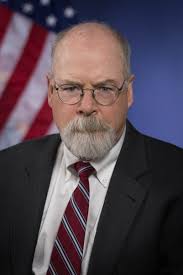
Durham: A good soldier, but with a new commander.
Abundantly clear in those days, however, was the reality that neither Mukasey nor Holder wanted Durham to deliver the goods on CIA people demonstrably involved in well documented death-by-torture of prisoners in Afghanistan and Iraq. Good soldier Durham uttered not a peep when Holder announced that the Department of Justice “declined prosecution because the admissible evidence would not be sufficient to obtain and sustain a conviction beyond a reasonable doubt.”
But Holder added this: “Our inquiry was limited to a determination of whether prosecutable offenses were committed and was not intended to, and does not resolve, broader questions regarding the propriety of the examined conduct.” The Times noted at the time that DOJ’s decision did not amount to “exoneration” of those involved in the prisoners’ treatment and deaths. Does that sound familiar?
Thus, judging from past experience, the question is not so much what Durham will come up with this time around when investigating folks from the same line of (intelligence) work. The more salient question is this: Will Durham’s role be limited by Deep State, gun-shy Trump, or will he be given the latitude to proceed with no-holds-Barred, so to speak.
Horowitz’s investigators, on the other hand, earlier discovered the extremely-damaging-to-the-Russia-gate-yarn text exchanges between senior FBI officials Peter Strzok and Lisa Page, and Horowitz decided to make them public in December 2017. First off the blocks the following day, the late Robert Parry, founder of this website, posted what turned out to be his last substantive article, “The Foundering Russia-gate Scandal.”
Horowitz’s investigators recently interviewed some formerly reluctant witnesses like Christopher Steele, who had been a paid informant of the FBI itself and whom the Clinton campaign later paid to assemble the infamous “dossier” on Trump’s alleged cavorting with prostitutes in Moscow and other scurrilous, since-disproven stories.
With the malleable nonentity Coats as DNI, and with top CIA officials trying to keep former CIA Director John Brennan out of jail (and shield their own derrieres), Barr has — until now — lacked a strong “deputy sheriff” with the requisite prosecutorial skills and courage to investigate the intelligence community to find out where the bodies are buried in Washington.
As soon as Ratcliffe is confirmed, Barr should have what he needs to close that gap and tackle full bore the intelligence part of the Deep State’s role in Russia-gate.
A Parvenu?
But how could Ratcliffe know anything, the corporate media asks, as they paint him as a newcomer, partisan ignoramus and focus on his lack of experience in foreign affairs. Sorry, Rachel Maddow, in case you haven’t noticed, the present focus is on affairs much closer to home. The “parvenu” label will not stick. Serving, as Ratcliffe has, on three key House committees —Intelligence, Judiciary, and Homeland Security — you can learn a whole lot, if you regard your responsibility as oversight, not overlook.
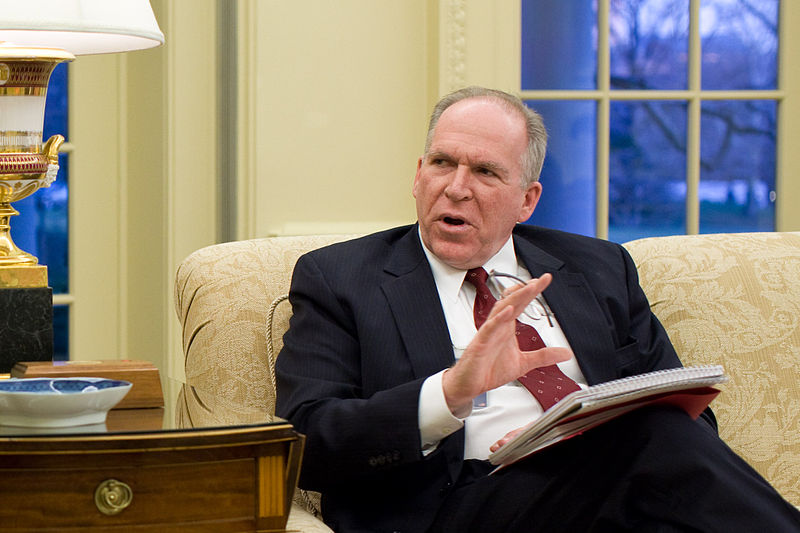
Brennan: Cold on Ratcliffe (White House photo)
Is there documentary evidence? Admittedly, it would seem a stretch to believe that Obama’s top intelligence and law enforcement officials — in “collusion” with the corporate media — would fabricate a Trump-in-Putin’s-pocket story line first to try to prevent Trump from being elected, and then emasculate him as incoming president. But, yes, there should be all manner of documentary evidence indicating that this is precisely what happened.
House Intelligence Committee Ranking Member Devin Nunes (R-CA) claimed in early April 2019, “They [the Democrats] have lied multiple times to the American people. All you have to do is look at their phony memos. They have had the full support of the media, 90 percent of the media in this country. They all have egg on their face.” The way things are now shaping up, we are likely to learn before too long whether the evidence supports Nunes’s accusations.
All the Naiveté That’s Fit to Print
The New York Times reported that many Republican Senators, who must vote on his confirmation, are “cool” to Ratcliffe:
“Democrats said on Monday that they were worried that Mr. Ratcliffe would do little to push back against the Justice Department’s review of the origins of the Russia inquiry, for which Mr. Trump gave Attorney General William P. Barr broad power to declassify relevant documents.”
Democrats don’t watch Fox News, but does the Gray Lady still harbor hope Ratcliffe might “push back” when he says he will push full steam ahead?
None of the leaking, unmasking, surveillance, DNC-hired “opposition research,” or other activities directed against the Trump campaign can be properly understood if one does not bear in mind that it was considered a sure thing that Hillary Clinton would become President, at which point high-risk, illegal activities undertaken to help her win would likely bring gratitude and perhaps a promotion, not an indictment. But Clinton lost.
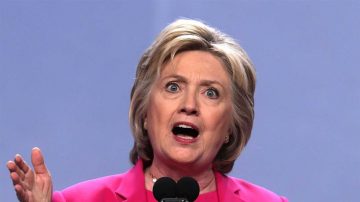
Hillary: She hadda win, but didn’t.
After her loss, Comey himself gave the game away in his book, “A Higher Loyalty” — which amounted to a pre-emptive move motivated by loyalty-to-self and eagerness to secure a Stay-Out-of-Jail card. Comey wrote, “I was making decisions in an environment where Hillary Clinton was sure to be the next president …” [Emphasis added.] This would, of course, confer automatic immunity on key players who may now find themselves criminally referred to the Department of Justice.
Worse still, because they all were convinced a Clinton victory was a sure thing, the plotters did not perform due diligence to hide their tracks. And that largely accounts for the fact that there should be documentary evidence — probably even on not-yet-shredded paper, as well as on computer hard drives.
Given his seats on Intelligence, Judiciary, and Homeland Security, Ratcliffe has seen a lot more of them than most Congress members. In the Sunday interview, he named some of those allegedly engaged in illegalities: former FBI Director James Comey, senior DOJ official Bruce Ohr, and opposition research guru Glenn Simpson. Also mentioned but unnamed were the Obama officials who Ratcliffe said committed a “felony” by leaking highly classified phone transcripts to use against Gen. Michael Flynn, Trump’s short-lived national security adviser.
But Now Running Scared
No one has more to fear from all this than ex-CIA Director Brennan. He eagerly awaited the final report from Mueller, whom Brennan has unctuously praised. Introducing Mueller to an audience at Georgetown University in June 2014, Brennan called him “a remarkable public servant as well as a great friend, a transformative leader, an outstanding partner to CIA, and a source of wise counsel to leaders across the intelligence community.”
In his testimony to the House Judiciary and Intelligence Committees on July 24, Mueller avoided discussing some of the chicanery that bears Brennan’s fingerprints, but he surely failed to “exonerate” him, so to speak. To suggest that the selection of Ratcliffe to become DNI was unwelcome news to Brennan is to state the obvious. Brennan got up early on Monday and at 7:11 AM sent this characteristic tweet — about integrity and subservience, of all things:
Dan Coats served ably & with deep integrity. Ratcliffe showed abject subservience to Trump in Mueller hearings. The women & men in the Intelligence Community deserve a leader like Coats who puts nation first; not a servile Trump loyalist like Ratcliffe. https://t.co/fbYgS3MoOM
— John O. Brennan (@JohnBrennan) July 29, 2019
Sen. Rand Paul (R-KY) has tweeted information from “a high-level source” that it was Brennan who “insisted that the unverified and fake Steele dossier” be given prominent attention in the Russia-gate story.
BREAKING: A high-level source tells me it was Brennan who insisted that the unverified and fake Steele dossier be included in the Intelligence Report… Brennan should be asked to testify under oath in Congress ASAP.
— Senator Rand Paul (@RandPaul) March 27, 2019
Paul has also said he thinks Brennan has been “a partisan” and “abused his office in developing the Trump investigation. I think it was done under false pretenses and done for political reasons.”
Paul has been a strong advocate of investigating the origins of Mueller’s probe, including the dicey question of how witting President Obama was of the Deep State machinations during the last months of his administration. Page did tell Strzok in a Sept. 2, 2016 text that the president “wants to know everything we’re doing.”
So What DID Obama Know?
If anyone knows how much Obama knew, it is one of his closest confidants: Brennan. And it was Obama, of course, who commissioned the misnomered “Intelligence Community Assessment” of Jan. 6, 2017, which Russia-gate aficionados have long regarded as Bible truth. As readers of Consortium News know, candidate Hillary Clinton and her supporters were wrong in saying the ICA was the product of “all 17” U.S. intelligence agencies. The leaders of only three — CIA, FBI, and NSA — signed on to it, plus DNI James Clapper.
Months later, Clapper admitted it was “handpicked analysts” from those three who wrote the report. It is a safe bet that Brennan, Clapper, and perhaps Comey picked the analysts. The ICA is such a shabby piece of work that many — including me — suspect that Brennan took a direct hand in writing it.
Ratcliffe would be well advised to take a priority look into the “Excellent Adventure” of that Intelligence Community Assessment as soon as he is confirmed as Director of National Intelligence, and before Brennan, Clapper, and Comey leave town for parts unknown.
Ray McGovern works with Tell the Word, a publishing arm of the ecumenical Church of the Saviour in inner-city Washington. As a CIA analyst, he served under nine CIA directors and seven presidents, for three of whom he prepared and gave the morning briefing based on The President’s Daily Brief. In retirement, he co-created Veteran Intelligence Professionals for Sanity (VIPS).
The Manson Murders, JFK, 9/11, and the Psychopathy of Power
A Review of CHAOS: Charles Manson, the CIA, and the Secret History of the Sixties by Tom O’Neill
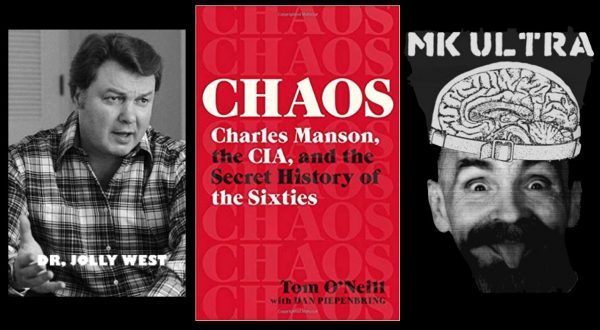
“With Alan Scheflin, a forensic psychologist and law professor who’d written a book on MKULTRA, I laid out a circumstantial case linking (CIA mind control guru Jolly) West to Manson. Was it possible, I asked, that the Manson murders were an MKULTRA experiment gone wrong? ‘No,’ he said, ‘an MKULTRA experiment gone right.’” (CHAOS , p. 369)
By Kevin Barrett • Unz Review • July 29, 2019
I moved out of Southern California in the summer of 1969. I was ten years old, and my parents were fleeing decadence and depravity in favor of the more wholesome Midwest.
Before our move, a story had circulated about some local (Newport Beach) high schoolers who had “gone on an LSD trip” and gotten caught by police. As I understood it, the teenagers had “taken LSD” and started leaping from rooftop to rooftop, “tripping” all over the neighborhood and waking people up to the sound of thundering hoofbeats overhead. At the time I wondered whether LSD conferred a miraculous leaping or flying ability, since the houses in Lido Sands, though rather tightly clustered, were mostly spaced perhaps eight or ten feet apart, which seemed like a long way to jump.
I vaguely recall this “LSD-fueled teenage midnight horsemen of the apocalypse” story having something to do with my parents’ decision to move back to Wisconsin. Southern California circa 1969, a few years after the hippie movement had peaked and turned into a bad trip, didn’t seem like a good place to send your kids to high school. (Little did my parents know that the 60s would hit Wisconsin high schools ten years late, putting me and my siblings directly in the path of the psychedelic hurricane.)
Years later, as an “experienced” (in the Jimi Hendrix sense) subversive teenage wannabe intellectual, I would read about the Manson murders and notice how convenient they had been for the Establishment. From the moment Charlie Manson’s grinning, demonic face started leering from every front page and TV screen in America, the whole hippie-antiwar thing had seemed a whole lot scarier. I read the official version of the Manson myth, Vincent Bugliosi’s Helter Skelter, and thought: This is too crazy to be true. None of the Wisconsin hippies I know are even remotely like these characters. Maybe it’s something they add to the fluoride in the Southern California water.
By 1975 I had seen Mark Lane’s presentation of the Zapruder film and knew that America had experienced an unspeakably evil coup d’état in 1963. In 1979 I read John Marks’ The Search for the Manchurian Candidate: The CIA and Mind Control and discussed it with William S. Burroughs, who told me he had been aware of such activities for many years before they were publicly revealed by the Church and Rockefeller Commissions: “The thing about these secrets is they’re not all that secret.”
Well, maybe not, Bill. But if you had proclaimed in 1960 that the CIA’s most heavily funded program aimed at turning people into killer zombies, you would have gotten blank stares at best. Rumors whispered in bohemian demimondes, blown up into dystopian parody in books like Naked Lunch, are hardly threats to national security secrecy.
Looking back, it seems doubtful that America ever recovered from the bad trip of the 1960s. Indeed, one has to wonder whether potential recovery wasn’t intentionally forestalled. The Kennedy assassinations, along with the killings of Martin Luther King, Malcolm X, Fred Hampton, and so many others, were a national nightmare. So was the pointless carnage in Vietnam. The protest movement that rose up against the nightmare, seeking to awaken the nation and return it to sanity, collapsed into the drug-fueled promiscuity and bloody chaos whose avatar was none other than Charles Manson. Now, on the occasion of the fiftieth anniversary of the Manson murders, we must wonder whether Manson was also an avatar another kind of CHAOS: the CIA’s ultra-secret, ultra-illegal domestic counterinsurgency program.
That notion isn’t entirely new. In 1993, while researching my first book, A Guide to Mysterious San Francisco, I heard rumors that Manson was a CIA mind control slave. But since this was just hearsay, unsupported by citable sources, I left it out of the book, and consigned it to the relatively short list of major conspiracy theories that might actually not be true.
That list keeps getting shorter. Tom O’Neill’s CHAOS: Charles Manson, the CIA, and the Secret History of the Sixties makes a convincing, thoroughly documented case that the official Vincent Bugliosi rendition of the Manson murders is as blatantly bogus as Bugliosi’s “Oswald acted alone” version of the JFK assassination. Though O’Neill doesn’t quite come right out and say so, his evidence suggests that CIA mind control maniac Louis Jolyon “Jolly” West and/or his acolytes brainwashed a psychopathic prisoner named Charles Manson, gave him a CIA get-out-of-jail-free card, set him up next door to Jolly’s safe house in the Haight-Ashbury hippie district of San Francisco, and taught him how to control human minds using drugs and hypnosis. The CIA’s Operation CHAOS, it may be plausibly surmised, first weaponized the Manson family for use against the Black Panthers, then finally turned Manson into the ultimate TV commercial against the antiwar counterculture. When Manson and one of his CIA handlers, Reeve Whitson, rearranged the Tate murders crime scene before anyone else got there, they were literally setting the stage for the upcoming theatrical production.
Tom O’Neill’s twenty years’ research definitively demonstrates that a massive cover-up of the truth about the Manson murders is no longer a hypothesis, it is established fact. Federal, state, and local law enforcement agencies, as well as the courts and big media, have been effectively corrupted and muzzled. But the truth, or at least enough of it for us to get the picture, is tucked away in the documents they forgot to shred. Though the most important Manson-related documents have either “mysteriously disappeared” from various archives or are being stubbornly withheld for undisclosed reasons, O’Neill—an obsessively persistent journalistic gumshoe—managed to get his hands on enough of them, and to find and interview enough witnesses, to turn the conventional picture of the Manson family upside-down and inside-out.
The whole story, in its multilayered complexity of detail and documentation, is beautifully told in O’Neill’s book. Like many authors with mainstream publishers, O’Neill generally refrains from speculating about the big picture; instead, he lays out the hard facts and invites the reader to connect the dots. So let’s accept his invitation and consider the the CIA’s Operation Manson in historical perspective.
Political Demonization and the Creation and Maintenance of Public Myth
The Manson op was an exercise in demonization. Manson, an ordinary psychologically-disturbed small-time criminal with psychopathic tendencies, became, under the expert tutelage of Jolly West & Co., an avatar of the demonic second only to Hitler in the mass mediated popular imagination. Manson’s long hair and scraggly beard became an icon of pure evil, as Hitler’s mustache had before, and as Bin Laden’s beard would later. In literally demonizing Manson, Jolly and The Company (wasn’t that a ‘60s Bay Area band? No, you’re thinking of Big Brother) figuratively demonized the antiwar counterculture that was giving the Establishment fits.
By demonizing Manson, the CIA “skunked” the antiwar counterculture’s message of “peace, love, freedom” by associating it with an image of violence, hatred, and extreme authoritarianism. After all, the people behind such operations know that the best way to discredit a message is to put it in the mouth of an unpleasant spokesperson. That’s why criticism of the world’s worst crime syndicate, the international bankster cartel, has come to be associated with Hitler’s evil mustache. In like fashion, resistance to Zionism and other Western assaults on the Islamic world has come to be associated with Bin Laden’s big black beard. These associations didn’t just happen by accident. They were engineered.
Philip Zelikow, effectively the sole author of that work of fiction known as the 9/11 Commission Report (which he completed in chapter outline before the Commission even convened) is a history professor and self-styled expert in “the creation and maintenance of public myths.” Zelikow defines public myths as “beliefs (1) thought to be true (although not necessarily known to be true with certainty), and (2) shared in common within the relevant political community.” The public myths he is most interested in are those that most powerfully shape political perception and behavior; the first example he gives is the myth of the dastardly Japanese surprise attack on Pearl Harbor, which transformed America from an isolationist republic to an interventionist empire.
Anyone who has studied the alternative literature on such events as Pearl Harbor, the Kennedy assassinations, and 9/11 knows that any overwhelmingly powerful mythic event that changes public perceptions and, in so doing, changes history, ought to be greeted with profound suspicion and subjected to the most painstaking scrutiny. As Philip Zelikow wrote in a 1998 Foreign Affairs article, a catastrophic terror attack on America, such as the destruction of the World Trade Center, would be a “transforming event,” a “watershed event in American history” that would, “like Pearl Harbor… divide our past and future into a before and after.” The “after” would feature “draconian measures, scaling back civil liberties, allowing wider surveillance of citizens, detention of suspects, and use of deadly force.” Zelikow’s 2001 false flag operation would achieve all that and more. It succeeded in demonizing opposition to Zionism and empire, and to tyranny in general, by associating resistance with the fearsome image of a scary looking guy sporting an easily-identifiable villain’s beard.
Indeed, bearded heavies like Bin Laden and Manson seem to come straight out of central casting. They remind us of neoconservative guru Leo Strauss’s advice to Machievellian operators: Make your operation like a B-grade Hollywood Western: slap a big white hat on the good guy and a big black hat on the bad guy. And if you don’t have a real enemy to play the villain’s role, invent one.
The official version of the Manson myth is told by its self-aggrandizing, profiteering hero, Vincent Bugliosi, the prosecutor who put the bad guy behind bars. In somewhat similar fashion, the official version of the 9/11 myth, ventriloquized by Zelikow, seems told by a sort of Greek chorus representing the heroic victims, the American people. But in both cases, the ostensibly heroic narrator is the real villain. In the case of 9/11, Zelikow must be suspected of involvement in writing the script for the 9/11 false flag operation itself, and then plagiarizing that script for his Report. And in the case of Bugliosi, it’s clear that he consciously crafted a big lie for the jury that he later adapted for his bestseller, committing numerous crimes, including subornation of perjury, in the process.
As for the villains, both Manson and Bin Laden were manufactured by the CIA. As O’Neill’s evidence suggests, Manson was Jolly West’s golem, taught by Jolly how to manufacture more golems… preferably 14-year-old female ones. Bin Laden, for his part, was created by the CIA and its Saudi assets as a front man for the CIA-Saudi war to expel the Russians from Afghanistan. Originally assigned the hero role for an audience of Muslims, Osama was later transferred to a different movie in which he played the villain for an audience of Americans.
Though the official Manson narrative demonizes hippies, O’Neill’s revisionist account shows that the worst decadence and depravity was located not at the corner of Haight and Ashbury, but in Hollywood and the entertainment industry; Los Angeles, as Faulkner famously said, is “the plastic asshole of the universe.” The movie and music business, O’Neill shows, was (and presumably remains) infested by gangsters, intelligence agency criminals, and an astonishing variety of perverted human vermin. (There is considerable overlap between those three categories.) The worst part is that these people, the scum of the earth, literally run the show. Real power and authority is invested not in elected officials and the courts, but in supermob gangsters and their intel agency partners in crime. The cops, courts, and media are terrified of such people, and basically do whatever they’re told.
The Manson murders and the JFK assassination, two nightmarish crimes, bookended “the 1960s”: that brief period from 1964 to 1969 that witnessed the meteoric rise and fall of youthful idealism, whose chief expressions were the civil rights and antiwar movements. Like 9/11, the JFK assassination divided time into a more innocent “before” of wholesome family sitcoms and a less innocent “after” of protests, violence, and social breakdown fueled by pills, especially of the psychedelic and birth control varieties. Between JFK and Manson, youthful idealism looked like it might win the day. After Manson, America entered a “whole new world” of extreme disillusionment.
The JFK and Manson murders aren’t just linked in the American mythic imagination; they also intersect by way of a certain already-mentioned CIA mind-control psychopath, Dr. Jolly West. O’Neill’s Chaos presents evidence that Jolly West brainwashed and rendered mad two key figures in the respective dramas, Charles Manson and Jack Rubenstein a.k.a. Ruby. We have already seen how West made a madman of Manson. As for Ruby, it seems he was very likely programmed to kill Lee Harvey Oswald, just as Sirhan Sirhan was later programmed to fire in the general direction of Robert Kennedy. And though there is no hard-and-fast documentation proving West mind-controlled Ruby, O’Neill does document West’s suspiciously quick and intense post-assassination interest in Ruby, which culminated in West getting a private audience with the gun-smuggling cop-bribing Mickey Cohen organization hit man. Prior to West’s closed-door no-witnesses one-on-one with Ruby, the latter had been perfectly sane, though puzzled about being accused of a crime he had no memory of committing. From the moment West stepped out the door of Ruby’s cell, Ruby was stark, raving nuts.
America has real enemies, people like Jolly West and his bosses, psychopathic vermin who have infested the highest echelons of power. In the wake of their murder of JFK, they understandably feared exposure. The biggest threat was coming from honest, idealistic, politically-engaged citizens, most of whom leaned toward the political left in general, and the civil rights and antiwar movements in particular. To neutralize that threat, they flooded the civil rights and antiwar communities with LSD and amphetamines (as well as Cointelpro and CHAOS agents provocateurs). After several years of this, they administered the coup de grace by immortalizing the iconic evil hippie, Charles Manson, in a mass mind-control operation that sounded the death knell of the 1960s and set the stage for the age of dystopian neoliberal authoritarianism that followed.
The takeaway is that our real enemies conceal themselves by fabricating ersatz enemies and elevating them to mythic, iconic status. Their controlled mainstream media summon us daily to engage in the obligatory Orwellian two minutes of hate. When will we wake up and learn to hate not the cartoon figure on the screen, but the psychopath behind the curtain?
Porkins Policy Radio episode 191 Whitney Webb on Jeffrey Epstein and the history of sexual blackmail
Porkins Policy Review
Today I interviewed journalist Whitney Webb who writes for Mint Press news about her recent series “Hidden in Plain Sight: The Shocking Origins of the Jeffrey Epstein Case,” which covers the history of sexual blackmail, its connections to organized crime, intelligence services, and the uncanny parallels between historical blackmail rings and the Jeffrey Epstein case. We then went deeper on historical blackmail rings including Lewis Rosenstiel’s sexual blackmail ring, which connected J. Edgar Hoover and crime boss Meyer Lansky. We explored whether Rosensteil was an intelligence asset or other possibilities. We also talked about the bizarre close personal relations between Hoover and Rosensteil. Webb and I also discussed the historical links between organized crime and the Central Intelligence Agency. Later we talked about how Roy Cohn fits into this, Cohn’s own sexual blackmail ring, his connections to J. Edgar Hoover and Rosenstiel, and of course, Cohn’s role as Donald Trump’s mentor and lawyer. Here we focused on the parallels between Cohn’s blackmail and the Jeffrey Epstein’s case. We discussed the allegations that Jeffrey Epstein is an intelligence asset. We went in depth about his alleged connections to Mossad and the CIA. We also talked about the mega group and their connections to Epstein and organized crime, and Israeli elites.
Show Notes:
Hidden in Plain Sight: The Shocking Origins of the Jeffrey Epstein Case
Hollywood Studios, Networks Cut Ties With Peggy Siegal Over Jeffrey Epstein Scandal
MSNBC host claims Putin helped BoJo become PM
RT | July 25, 2019
Boris Johnson’s political rise has been analyzed and dissected in plenty of ways since he landed in 10 Downing Street this week, but MSNBC put a particularly odd spin on his premiership, calling it a “big win” for Russia.
Recalling the US’ own debunked Russiagate “collusion” narrative, host of ‘The Last Word’ Lawrence O’Donnell dramatically declared that Russia had a hand in Johnson’s rise to power — but in true MSNBC fashion — offered exactly zero evidence to back up his outlandish claim.
“Like Donald Trump, Boris Johnson made it to the top of British politics with the help of Vladimir Putin and Russians who attacked the British voting system and helped deliver an electoral victory for Brexit.”
O’Donnell went on to remind viewers that 51.9 percent of British voters had chosen Brexit in a 2016 referendum, but added a large dollop of fake news, saying the outcome had been delivered “with Russian support.”
It was a reference to rubbished claims that Moscow had interfered in the Brexit vote by posting pro-Brexit messages and memes online. Both Twitter and Facebbok have dismissed the notion that Russian bots had anything to do with the Brexit outcome. Of course, that didn’t stop the fearless O’Donnell from telling his viewers that Russia had “attacked the British voting system” anyway.
Disinformation seems to be totally fine when it’s about Russia, well, according to MSNBC at least.
O’Donnell continued on his lengthy rant denouncing Johnson and Brexit; naturally, two ‘analysts’ were on hand to back up his baseless conspiracy theory.
Jeremy Bash, MSNBC’s ‘national security analyst’ and former chief of staff at the CIA told O’Donnell that there were “strong allegations that Russia interfered in the British selection of Brexit as their future path,” despite no such “strong allegations” actually existing.
Preferring to rely on the always trustworthy CIA, O’Donnell obviously hadn’t heard former deputy UK PM Nick Clegg say in a recent BBC Radio 4 interview that there is “absolutely no evidence” of Russian interference in the Brexit referendum.
Lawrence, like many of his MSNBC colleagues is known for concocting and revelling in extravagant Russia-related conspiracy theories. In 2017, he suggested that Vladimir Putin had orchestrated a chemical weapons attack in Syria to help out Trump by distracting his critics at home. Very reasonable indeed.
It’s not the first time a high-profile American has linked Johnson to Russia. In congressional hearings on Wednesday, Republican Devin Nunes asked former special counsel Robert Mueller if it was possible that the new UK PM had been “compromised” by Russia because of his appearance in a photograph with alleged spy Joseph Mifsud.
A recent Financial Times article also speculated that Johnson may be some kind of Kremlin agent due to his relationship with a Putin-hating Russian oligarch. Go figure.
The Failure of Impeachment Regime Change
By Jacob G. Hornberger | FFF | July 25, 2019
With what most everyone is calling a stunningly disjointed and extremely disappointing presentation before Congress by Special Counsel and former FBI Director Robert Mueller, it is becoming increasingly clear that the effort to achieve regime change through impeachment is going to fail. Democrats are going to have to rely on the traditional electoral means to remove President Trump from office in 2020.
This is the way it should be. Achieving regime change through impeachment would have converted the United States into a standard banana republic.
Ever since Trump became the GOP nominee for president, Democrats, the national-security establishment, and the liberal elements of the mainstream press did everything they could to ensure that his Democratic opponent, Hillary Clinton, was elected president.
Once Trump became president, however, his opponents refused to accept the electoral outcome and began trying to remove him from office through impeachment. That’s where the anti-Russia brouhaha came into play.
During the campaign, it was increasingly clear that Trump and Clinton were on opposite sides of the Russia controversy. Trump desired to establish friendly relations with Russia, which was exactly what Russia wanted.
But that’s not what the national-security establishment wanted. Ever since the sudden and unexpected end of the Cold War, the Pentagon, CIA, and NSA — the three principal components of the national-security state — did everything they could to make Russia, once again, an official enemy of the United States. Clinton was squarely on the side of the national-security establishment.
That’s why the Pentagon, CIA, and NSA kept the Cold War dinosaur NATO in existence instead of dismantling it. It’s also why they had NATO begin absorbing former members of the Warsaw Pact, enabling U.S. forces and missiles to be stationed ever closer to the Russian border, violating assurances that U.S. officials had given Russia not to expand toward Russia. That’s what the effort to absorb Ukraine into NATO was all about, knowing full well that Russia would respond by protecting its longtime military base in Crimea.
Everything was oriented toward making certain that the United States and Russia would never be on friendly terms. Everything was instead oriented toward making Russia, once again, another Cold War official enemy of the United States.
Why is that the goal of the national-security establishment? Because it needs a justification for its own existence and its own ever-growing power and influence. That justification comes in the form of official enemies, ones that can keep Americans fearful. In that way, the Pentagon, CIA, and NSA can say, “Keep flooding us with U.S. taxpayer money because we are the ones who are keeping you safe from America’s official enemies. Keep giving us totalitarian-like powers over you so that we can keep you safe.”
Of course, Russia isn’t the only official enemy. There is also China, which increasingly is being presented as a Cold War-like “hegemon” that is supposedly threatening U.S. “national security.”
And then there are the smaller official enemies, like Iran, North Korea, Cuba, Venezuela, Syria, the Taliban, the Muslims, the terrorists, ISIS, the drug dealers, and the illegal immigrants, all of which, we are told, are threats to “national security.”
As a candidate, Trump was threatening to upend this racket, at least with respect to Russia and perhaps also by threatening to bring an end to America’s forever wars and its policy of regime-change wars. That posed a grave threat to the national-security establishment, which had been grafted onto America’s federal governmental system after World War II to fight the Cold War against the Soviet Union, America’s World War II partner and ally whose principal member was Russia.
Trump’s friendly attitude toward Russia could not be permitted to stand, not as a presidential candidate and especially not as a U.S. president. That’s when the anti-Russia brouhaha was launched, which accused Trump of being an agent of the Russians, just as some people accused President Eisenhower of being a communist agent of the Soviet Union during the Cold War.
It was a ridiculous accusation from the get-go but its primary purpose was to enable Trump’s opponents to remove him from office long before the next election in 2020. It was designed to be regime change through impeachment.
Once Mueller’s investigative team, despite years of intense investigation, was unable to come up with convincing evidence of a Trump-Russia conspiracy, however, Trump’s detractors fell back on a secondary plan for regime change though impeachment — “obstruction of justice,” a federal crime that is so nebulous and subjective that it is the federal version of “disorderly conduct,” a “crime” that local officials use to target people they don’t like. The sham nature of this alternative theory for regime change was exposed through its supporters refusal to seek Trump’s impeachment for real crimes, such as killing people overseas through illegal undeclared wars and illegal assassinations. With Mueller’s dismal performance before Congress, this alternative attempt at regime change appears to be dead in the water as well.
While Trump’s enemies have been unsuccessful in removing him from office through impeachment, they have, unfortunately, been successful in having him become an opponent of Russia, China, and all of the other official enemies of the U.S national-security state. Not only has Trump continued the forever wars in Afghanistan and the Middle East, he has kept up hostile relations with Russia, initiated a destructive trade war with China, and ratcheted up the U.S. wars on Muslims, the terrorists, the illegal immigrants, the drug dealers, ISIS, and the Taliban. He has also ensured that ever-increasing taxpayer-funded largess continues flooding into the Pentagon, the CIA, and the NSA, no matter how much more debt this adds onto the backs of American taxpayers.
In other words, Trump, like George W. Bush and Barack Obama, has been absorbed into the national-security state blob. They have won. Trump has become one of them. That’s the real success of the unsuccessful effort to remove Trump from office through impeachment regime change.
Government by Blackmail: Jeffrey Epstein, Trump’s Mentor and the Dark Secrets of the Reagan Era
By Whitney Webb | MintPress News | July 25, 2019
NEW YORK – Jeffrey Epstein, the billionaire who now sits in jail on federal charges for the sex trafficking of minors, has continued to draw media scrutiny in the weeks after his arrest on July 6. Part of the reason for this continued media interest is related to Epstein’s alleged relationship to the intelligence services and new information about the true extent of the sexual blackmail operation Epstein is believed to have run for decades.
As MintPress reported last week, Epstein was able to run this sordid operation for so long precisely because his was only the latest incarnation of a much older, more extensive operation that began in the 1950s and perhaps even earlier.
Starting first with mob-linked liquor baron Lewis Rosenstiel and later with Roy Cohn, Rosenstiel’s protege and future mentor to Donald Trump, Epstein’s is just one of the many sexual blackmail operations involving children that are all tied to the same network, which includes elements of organized crime, powerful Washington politicians, lobbyists and “fixers,” and clear links to intelligence as well as the FBI.
This report, Part II of this series titled “The Jeffrey Epstein Scandal: Too Big To Fail,” will delve into Cohn’s close ties to the Reagan administration, which was also closely tied to the same organized crime network led by the infamous mob figure Meyer Lansky, which was discussed in Part I. Of particular importance is the “Iran Contra” network, a group of Reagan officials and associates who played key roles in the Iran Contra scandal. Though it has remained relatively unknown for years, many key figures in that same network, and several fronts for the CIA that were involved in funneling money to the Central American Contra paramilitaries, were also trafficking minors for their sexual exploitation and use in sexual blackmail rings.
Several of these rings made headlines at one point or another over the years — from the “call boy ring” run by Washington lobbyist Craig Spence, to the Franklin child-sex and murder ring run by Republican operative Larry King, to the scandal that enveloped the Catholic charity Covenant House in the late 1980s.
Yet, as this report will show, all of these rings — and more — were connected to the same network that involved key figures linked to the Reagan White House and linked to Roy Cohn — revealing the true scope of the sordid sexual blackmail operations and sex rings that involved the trafficking of children within the U.S. and even in Central America for their exploitation by dangerous and powerful pedophiles in the United States.
Appalling for both the villainous abuse of children itself and the chilling implications of government by blackmail, this tangled web of unsavory alliances casts a lurid light on the political history of the United States from the Prohibition Era right up to the present day and the Age of Trump, a fact made increasingly clear as more and more information comes to light in relation to the Jeffrey Epstein case.
“Roy could fix anyone in the city”
Since Donald Trump burst onto the political scene in 2015, the legacy of his mentor, Roy Cohn – as well as Cohn’s influence on his most famous protege — have begun to garner renewed media attention. Many of the profiles on Cohn following Trump’s rise have focused solely on certain shadowy aspects of Cohn’s history, particularly his association with major figures in New York organized crime, his corrupt dealings, and his eventual disbarment. Some of these portrayals even went so far as to label Cohn as politically impotent. While Cohn was known to deal with a sizable amount of sleaze in his career, such depictions of the man fail to note that he had created an influence machine of unrivaled power that included some of the most prominent people in media and politics as well as a cadre of celebrities.
Cohn was closely associated with numerous celebrities, famous politicians and political operatives. Many of his birthday parties over the years attracted such famous figures such as artist Andy Warhol, fashion designer Calvin Klein, and comedian Joey Adams, as well as notable political figures including former Mayor of New York Abraham Beame and then-Assemblyman from Brooklyn and future Senator Chuck Schumer, among others. In 1979 Margaret Trudeau, mother of current Prime Minister of Canada Justin Trudeau, attended Cohn’s birthday party, where she famously toppled his custom birthday cake; and of course Donald Trump, who became Cohn’s protege in the mid-1970s, was a frequent fixture at social events held in Cohn’s honor.
The politicians, journalists and celebrities invited to Cohn’s exclusive parties were said to be those who “had open accounts in Cohn’s ‘favor bank,’” his nickname for his unofficial balance sheet of political favors and debts that was surely informed and influenced by his extensive involvement in sexual blackmail operations from the 1950s well into the 1980s.
Many of Cohn’s celebrity friendships were cultivated through his relationship with and frequent appearances at the famous and famously debaucherous New York nightclub Studio 54, which was described by Vanity Fair as “the giddy epicenter of 70s hedonism, a disco

Studio 54 co-owner Steve Rubell and his attorney Roy Cohn, left, Nov. 2, 1979, after Rubell and his partner, Ian Schrager, pleaded guilty to tax evasion charges. Photo | AP
Among Cohn’s closest friends were Barbara Walters, to whom Cohn often referred as his “fiancee” in public, and whom he later introduced to the head of the U.S. Information Agency, Chad Wick, and other high rollers in the Reagan White House. Yet, Walters was just one of Cohn’s powerful friends in the media, a group that also included Abe Rosenthal, executive editor of the New York Times; William Safire, long-time New York Times columnist and New York Magazine contributor; and George Sokolsky of The New York Herald Tribune, NBC and ABC. Sokolsky was a particularly close friend of both Cohn and former FBI director J. Edgar Hoover, whose involvement in Cohn’s sexual blackmail operation is described in Part I of this investigative series. Sokolsky ran the American Jewish League Against Communism with Cohn for several years and the organization later named its Medal of Honor after Sokolsky.
Cohn was also the attorney and friend of media mogul Rupert Murdoch and, according to New York Magazine, “Whenever Roy wanted a story stopped, item put in, or story exploited, Roy called Murdoch;” and, after Murdoch bought the New York Post, Cohn “wielded the paper as his personal shiv.” According to the late journalist Robert Parry, the friendship between Murdoch and Cohn first began thanks to their mutual support for Israel.
Cohn also leaned on his life-long friend since high school, Si Newhouse Jr., to exert media influence. Newhouse oversaw the media empire that now includes Vanity Fair, Vogue, GQ, The New Yorker, and numerous local newspapers throughout the United States, as well as major interests in cable television. New York Magazine also noted that “Cohn used his influence in the early ’80s to secure favors for himself and his Mob clients in Newhouse publications.” In addition to Newhouse, Cohn’s other high school pals, Generoso Pope Jr. and Richard Berlin, later became the owners of the National Enquirer and the Hearst Corporation, respectively. Cohn was also a close friend of another media mogul, Mort Zuckerman, who – along with Rupert Murdoch – would go on to befriend Jeffrey Epstein.
Cohn’s media confidants, like journalist William Buckley of The National Review and Firing Line, often attacked Cohn’s political enemies – particularly long-time Manhattan District Attorney Robert Morgenthau — in their columns, using Cohn as an anonymous source. Buckley, whom historian George Nash once called “the preeminent voice of American conservatism and its first great ecumenical figure,” received the George Sokolsky medal alongside Cohn’s mob-linked client and “Supreme Commander” Lewis Rosenstiel from the Cohn-run American Jewish League Against Communism in 1966. Buckley later got a heavily discounted $65,000 loan to buy a luxury boat from a bank where Cohn held influence and whose president Cohn had hand picked, according to a 1969 article in LIFE magazine.
Buckley — along with Barbara Walters, Alan Dershowitz and Donald Trump — would later serve as character witnesses for Cohn during his 1986 disbarment hearings and all but Buckley would later draw controversy for their relationships with Jeffrey Epstein.
With connections like this, it’s no wonder that Stanley Friedman — a law partner of Cohn, who was later imprisoned over a kickback and bribery scandal while serving as New York’s deputy mayor — told journalist Marie Brenner in 1980 that “Roy could fix anyone in the city.”
Politically ubiquitous and polygamous
Roy Cohn’s “favor bank” and his unique position as a liaison between the criminal underworld, the rich and famous, and top media influencers made him a force to be reckoned with. Yet, it was his political connections to leadership figures in both the Republican and Democratic parties and his close relationship to long-time FBI Director J. Edgar Hoover, among other figures, that made him and his dark secret “untouchable” for much of his life. Though most of his political influence was forged in the 1950s, Cohn became even more powerful with the rise of Ronald Reagan.
Even though he nominally maintained his affiliation with the Democratic Party throughout his life, Cohn was a well-known “fixer” for Republican candidates and this is clearly seen in his outsized roles during the 1976 and 1980 presidential campaigns of Ronald Reagan. It was during the latter that Cohn would meet another of his proteges, Roger Stone, whom he infamously instructed to leave a hefty bribe tucked in a suitcase at the doorstep of the Liberal Party’s headquarters during the 1980 campaign. During this campaign, Cohn would also meet Paul Manafort — an associate of Stone and later Trump’s 2016 campaign manager — and introduce both to Donald Trump.
Cohn’s law partner, Tom Bolan, was also an influential force in the Reagan campaign and later chaired Reagan’s transition team in 1980. Reagan then named Bolan, whom he considered a friend, a director of the Overseas Private Investment Corporation, the government’s development finance institution, and he was also the New York finance co-chairman in the Reagan campaign in both 1980 and 1984. Bolan was also close to others in Cohn’s circle, such as William F. Buckley Jr., Donald Trump and Rupert Murdoch.
Furthermore, Bolan was instrumental in securing federal judgeships for several individuals who would later become influential, including future FBI Director Louis Freeh. Cohn was also able to get friends of clients appointed as federal judges, including Donald Trump’s sister, Maryanne Trump Barry. After Barry was appointed as a federal judge, Trump called Cohn to thank him for pulling strings on his sister’s behalf.
Though Cohn was not given a public position in the Reagan administration, he was not merely a “dirty trickster” who worked in the shadows during the Reagan campaigns. In fact, he worked closely with some of the more visible faces of the campaign, including the then-communications director for Reagan’s 1980 campaign and later CIA director, William Casey. According to Christine Seymour — Cohn’s long-time switchboard operator from the late 1960s up until his death in 1986, who listened in on his calls — Casey and Cohn were close friends and, during the 1980 campaign, Casey “called Roy almost daily.”
Seymour also noted that one of Cohn’s other most frequent phone pals and closest friends was Nancy Reagan and she was also one of his clients. Reagan, whose influence over her husband was well-known, was so close to Cohn that it was largely his death from AIDS that led her to “encourage her husband to seek more funding for AIDS research.”
Prior to Cohn’s death, Nancy and her husband Ronald secured his spot in an exclusive experimental AIDS treatment program, despite the Reagan administration’s well-documented “non-response” to the AIDS crisis of the era. Ronald Reagan was also a friend of Cohn’s and, according to late journalist Robert Parry, “lavished favors on Cohn, including invitations to White House events, personal thank-you notes and friendly birthday wishes” over the course of his presidency.
Given that Reagan heavily courted the evangelical right and promoted “family values” as president, the close ties between not only himself, but his inner circle, with Cohn may seem odd. However, Reagan, like Cohn, had deep ties to the same organized-crime factions that were among Cohn’s clients and affiliates of the same Mafia figures close to Cohn’s own mentor, Lewis Rosenstiel (see Part I).
Not unlike Cohn, Reagan’s own mentor, Lew Wasserman, had close ties to the mob. Wasserman, the long-time president of MCA and the well-known Hollywood mogul, is known for not only making Reagan’s film and television career, but also supporting his successful push to become president of the Screen Actors Guild, which later launched Reagan’s political career. In addition, MCA was a major financier of Reagan’s successful gubernatorial bid in 1966 and, not long after Reagan became president, his administration controversially shut down a massive Department of Justice (DOJ) probe into MCA’s ties to organized crime.
According to Shawn Swords, a documentary filmmaker who explored Reagan’s ties to MCA in Wages of Spin II: Bring Down That Wall:
“Ronald Reagan was an opportunist. His whole career was guided by MCA — by Wasserman and [MCA founder] Jules Stein, who bragged that Reagan was malleable, that they could do what they wanted with him… That thing about Reagan being tough on [organized] crime — that’s a fallacy.”
Swords’ characterization of this relationship is supported by an unnamed Hollywood source cited in a declassified DOJ document, who called Reagan “a complete slave of MCA who would do their bidding on anything.”
What elements of organized crime were connected to Wasserman? As a young man, Lew Wasserman joined the Mayfield Road Gang, which was run by Moe Dalitz, a close friend of Meyer Lansky who, per the FBI, was a powerful figure in Lansky’s criminal enterprise, second only to Lansky himself among members of the Jewish mob.
Lew Wasserman would later marry Edith Beckerman, whose father was Dalitz’s lawyer. Wasserman’s closest friend and lawyer, Sidney Korshak, also had close ties to Dalitz and once partnered with Lansky in the Acapulco Towers Hotel. Notably, the magazine New West stated in 1976 that Korshak was the “logical successor to Meyer Lansky.” Korshak, as a lawyer, fit a niche similar to Roy Cohn and gained a reputation as the bridge between organized crime and respectable society.
In addition, the DOJ probe into MCA that the Reagan administration quashed was reportedly spurred after the Justice Department learned that an influential member of the Gambino crime family, Salvatore Pisello, was doing business with the massive entertainment company. At that time, the boss of the Gambino crime family, Paul Castellano, was a client of Roy Cohn.
Cohn, Murdoch and the Contras
Though Cohn’s influence in the Reagan administration and his friendship with the Reagan family and their inner circle has been acknowledged, less well-known is how Cohn aided the CIA’s covert propaganda efforts that were part of the larger scandal known as Iran-Contra.
Cohn, whose influence over the press has already been detailed, forged close ties with the director of the U.S. Information Agency, Chad Wick, even hosting a luncheon in Wick’s honor that was widely attended by influential figures in the conservative press, as well as senators and representatives. Soon after, then-CIA Director and Cohn friend William Casey was spearheading an extensive PR campaign aimed at shoring up public support for Reagan’s Latin American policies, including support of the Contra paramilitaries.
This domestic propaganda effort was technically illegal and required that the CIA outsource the job to the private sector to minimize the risk of fall-out. As Robert Parry reported in 2015, Wick took the lead in obtaining private funding for the effort and, just a few days after Wick promised to find private support, Cohn brought his close friend, the media mogul Rupert Murdoch, to the White House.
Parry later noted that, after this meeting, “documents released during the Iran-Contra scandal in 1987 and later from the Reagan Library indicate that Murdoch was soon viewed as a source for the private funding” for the propaganda campaign.
After that initial meeting, Murdoch became the top media ally of this Casey-directed propaganda effort, and also became increasingly close to the Reagan White House. Murdoch, as a consequence, benefited greatly from Reagan’s policies and his friendship with the administration, which allowed Murdoch to increase his U.S. media holdings and to create the Fox Broadcasting Corporation in 1987.
“The man in the black tuxedo”
Roy Cohn was not the only one close to the Reagan administration who was simultaneously running sexual blackmail operations that abused and exploited children. In fact, there were several figures, all of whom shared direct connections to CIA Director William Casey and other close friends and confidants of Cohn.
One of these individuals was Robert Keith Gray, the former chairman and CEO of the powerful Washington-based public relations firm of Hill and Knowlton, which 60 Minutes once called “an unelected shadow government” due to its influence in the capitol. According to the Washington Post, Gray himself was “one of the most sought-after lobbyists in Washington” and a Post reporter once called him “a kind of legend in this town, … the man in the black tuxedo with snow-white hair and a smile like a diamond.”
Yet, Gray was much more than a powerful PR executive.
Gray, who had previously been a close adviser to both Dwight D. Eisenhower and Richard Nixon, was a very successful Republican fundraiser who “collects money in six-figure globs,” according to a 1974 report in the Washingtonian. He first came into close contact with what would become Ronald Reagan’s inner circle during Reagan’s unsuccessful 1976 presidential campaign and later as deputy director of communications during Reagan’s campaign in 1980. The latter position would see him work directly under William Casey, who later became CIA director.
Gray would go on to co-chair Reagan’s Inauguration Committee and afterwards would return to the PR business, taking on several clients including Saudi arms dealer Adnan Khashoggi and hedge fund manager Marc Rich. Both Khashoggi and Rich will be discussed more in detail in Part III of this report — particularly Rich, who was an asset of Israeli intelligence outfit Mossad, and whose later criminal pardon by Bill Clinton was largely orchestrated by members of the Mega Group like Michael Steinhardt and Israeli politicians like Ehud Barak.
The connection between Gray and Casey is particularly telling, as it was later revealed by former Nebraska state senator-turned-investigator John DeCamp that Gray was a specialist in homosexual blackmail operations for the CIA and was reported to have collaborated with Roy Cohn in those activities. Cohn and Gray were likely to have known each other well, as during Reagan’s 1980 presidential campaign Casey — then Gray’s boss — was calling Roy Cohn “every day,” according to Cohn’s former switchboard operator Christine Seymour.
Gray was a known associate of CIA agent and Naval Intelligence officer Edwin Wilson, having served in the 1970s on the board of Consultants International, an organization that Wilson had founded and that the CIA used as a front company. Though Gray attempted to distance himself from Wilson after the latter was caught illegally selling weapons to Libya in 1983, a Navy review of Wilson’s intelligence career, unearthed by journalist Peter Maas, stated that Gray described Wilson as a man of “unqualified trust” and that Gray and Wilson had been in professional contact “two or three times a month” as early as 1963.
Though Wilson’s main specialty was front companies used to covertly ship and smuggle goods on behalf of U.S. intelligence, he also ran sexual blackmail operations for the CIA, particularly around the time of the Watergate scandal, according to his former partner and fellow agent at the CIA, Frank Terpil.
Terpil later told author and investigative journalist Jim Hougan:
“Historically, one of Wilson’s Agency jobs was to subvert members of both houses [of Congress] by any means necessary…. Certain people could be easily coerced by living out their sexual fantasy in the flesh…. A remembrance of these occasions [was] permanently recorded via selected cameras…. The technicians in charge of filming … [were] TSD [Technical Services Division of the CIA]. The unwitting porno stars advanced in their political careers, some of [whom] may still be in office.”
According to Terpil, Wilson ran his operation out of the George Town Club, owned by lobbyist and Korean intelligence asset Tongsun Park. According to the Washington Post, Park set up the club on behalf of the Korean Central Intelligence Agency “as a primary means in an illegal effort to influence U.S. politicians and officials.” The president of the George Town Club at the time of Wilson’s alleged activities at the site was Robert Keith Gray.
DeCamp later reported that Wilson’s activities were a spin-off of the same sexual blackmail operation in which Cohn became involved during the McCarthy era with Lewis Rosenstiel and J. Edgar Hoover.
Father Ritter and his favored youths
The operation allegedly ran by Gray and Wilson was not the only sexual blackmail operation connected to Cohn’s network or to influential American politicians of the era. Another pedophile network that was connected to a close associate of former President George H.W. Bush in the early 1990s was run as an affiliate of the Catholic charity Covenant House, which was founded and run by Father Bruce Ritter.
In 1968, Ritter asked his superior — Cardinal Francis Spellman of the Archdiocese of New York — for permission to take homeless teenagers, boys and girls, into his home in Manhattan. As was noted in Part I of this series, Spellman was accused of pedophilia and ordained known pedophiles while serving as the highest-ranking Catholic priest in the United States. Spellman was also a close associate, client and friend of Roy Cohn, as well as of his law partner Tom Bolan, and Spellman was alleged to have been seen at least one of Cohn’s “blackmail parties.” In addition, Spellman’s nephew, Ned Spellman, worked for Roy Cohn, according to LIFE magazine.
Ritter, like Spellman and other priests who served under Spellman, was eventually accused of having sexual relationships with many of the underaged boys he had taken in, and of spending Covenant House funds on lavish gifts and payments to the vulnerable teenagers he exploited.
One of Ritter’s victims, Darryl Bassile, wrote an open letter to him a year after the priest’s preying on teenage boys was exposed by the press: “You were wrong for inflicting your desires on a 14-year-old . . . I know that someday you will stand before the one who judges all of us and at that time there will be no more denial, just the truth.”
Notably, when Ritter’s activities at Covenant House were exposed in 1989 by the New York Post, Charles M. Sennott, the Post reporter who wrote the story, would later state that “the secular powers more than the archdiocese or the Franciscans protected him [Ritter].” Sennott’s report was attacked viciously by columnists in other New York media outlets, powerful politicians including then-Governor of New York Mario Cuomo, as well as by Cardinal Spellman’s successor, Cardinal John O’Connor.
The likely reason these “secular powers” came to the aid of the embattled Ritter, who was never charged for having sexual relationships with minors and was merely forced to resign from his post, is that Covenant House and Ritter himself were deeply tied to Robert Macauley, Bush Sr.’s roommate at Yale and a long-time friend of the Bush family. Macauley was described by the New York Times as “instrumental” to Covenant House fundraising after he joined its board in 1985 and brought on several “other wealthy or well-connected people,” including former government officials and investment bankers.
Macauley’s organization, the AmeriCares Foundation, which was later accused of funneling money to the Contras in Central America, was one of the main sources of funding of Covenant House. One of the members of AmeriCares advisory board was William E. Simon, former U.S. secretary of the treasury under the Nixon and Ford administrations, who also ran the Nicaraguan Freedom Fund, which sent aid to the Contras.
AmeriCares was also known to work directly with U.S. intelligence. As the Hartford Courant noted in 1991: “Knowledgeable former federal officials, many with backgrounds in intelligence work, help AmeriCares maneuver in delicate international political environments.”
Furthermore, Ritter was known to have visited Macauley’s Connecticut estate and served as Vice President of AmeriCares until he was forced to resign from Covenant House. Notably, George H.W. Bush’s brother, Prescott, was also on the AmeriCares advisory board. After George H.W. Bush died last year, AmeriCares stated that he had been “instrumental in founding the health-focused relief and development organization.”
Years before Ritter was outed as a pedophile who preyed on the disadvantaged and vulnerable teenagers who sought refuge at his charity, Covenant House was praised heavily by President Ronald Reagan, even earning a mention in his 1984 State of the Union address, which called Ritter one of the country’s “unsung heroes.” From 1985 to 1989, Covenant House’s operating budget grew from $27 million to $90 million and its board came to include powerful individuals including top executives at IBM, Chase Manhattan Bank and Bear Stearns.
It was during this time that Covenant House grew into an international organization, opening branches in several countries, including Canada, Mexico and elsewhere in Central America. Its first branch in Central America was opened in Guatemala and was headed by Roberto Alejos Arzu, a CIA asset whose plantation was used to train the troops used in the CIA’s failed “Bay of Pigs” invasion of Cuba. Alejos Arzu was also an associate of the former U.S.-backed dictator of Nicaragua, Anastasio Somoza, and a member of the Knights of Malta, a Catholic order to which former CIA Director William Casey and Roy Cohn’s law partner Tom Bolan also belonged. Alejos Arzu also worked for AmeriCares and was tied to several Central American paramilitary groups.
Intelligence community sources cited by DeCamp assert that the Alejos Arzu-led branch of Covenant House procured children for a pedophile ring based in the United States. Years later, Mi Casa, another U.S.-run charity in Guatemala that George H.W. Bush had personally toured with his wife Barbara in 1994, was accused of rampant pedophilia and child abuse.
The downfall of “Washington’s Jay Gatsby”
After having left his job as an ABC News correspondent in the 1980s, Craig Spence found success as a prominent conservative Washington lobbyist. Spence would soon find his fortunes shift dramatically when, in June 1989, it was revealed that he had been pimping out children to the power elite in the nation’s capital throughout the 1980s in apartments that were bugged with video and audio recording equipment. Much like Jeffrey Epstein, who ran a similar operation, Spence was often likened to Jay Gatsby, the mysterious, wealthy figure from the well-known Fitzgerald novel The Great Gatsby.
A 1982 New York Times article written about Spence said that his “personal phone book and party guest lists constitute a ‘Who’s Who’ in Congress, Government and journalism” and stated that Spence was “hired by his clients as much for whom he knows as what he knows.” Spence was also known to throw lavish parties, which the Times described as “glitter[ed] with notables, from ambassadors to television stars, from senators to senior State Department officials.” Roy Cohn, William Casey and Roy Cohn’s journalist friend William Safire were just some of the other attendees at Spence’s festivities.
“According to Mr. Spence,” the Times article continues, “Richard Nixon is a friend. So is [former Attorney General under Nixon] John Mitchell. [CBS journalist] Eric Sevareid is termed ‘an old, dear friend.’ Senator John Glenn is ‘a good friend’ and Peter Ustinov [British actor and journalist] is ‘an old, old friend.’” Notably, Ustinov wrote for The European newspaper soon after it was founded in 1990 by Robert Maxwell, the father of Epstein’s alleged madam Ghislaine Maxwell and a known Mossad agent.
It was revealed just seven years after the Times’ published its doting profile of Spence that his “glittery parties for key officials of the Reagan and Bush administrations, media stars and top military officers” had been bugged in order “to compromise guests.” According to the explosive report published by the Washington Times, Spence was linked to a “homosexual prostuition ring” whose clients included “government officials, locally based U.S. military officers, businessmen, lawyers, bankers, congressional aides, media representatives and other professionals.” Spence also offered cocaine to his guests as another means of acquiring blackmail.
According to the report, Spence’s home “was bugged and had a secret two-way mirror, and … he attempted to ensnare visitors into compromising sexual encounters that he could then use as leverage.” One man who spoke to the Washington Times said that Spence sent a limousine to his home, which took him to a party where “several young men tried to become friendly with him.” According to DeCamp, Spence was known to offer young children for sex to attendees at his blackmail parties, along with illegal drugs like cocaine.
Several other sources, including a Reagan White House official and an Air Force sergeant who had attended Spence-hosted parties, confirmed that Spence’s house was filled with recording equipment, which he regularly used to spy on and record guests, and his house also included a two-way mirror that he used for eavesdropping.
The report also documented Spence’s connections to U.S. intelligence, particularly the CIA. According to the Washington Times report, Spence “often boasted that he was working for the CIA and on one occasion said he was going to disappear for awhile ‘because he had an important CIA assignment.’” He was also quite paranoid about his alleged work for the agency, as he expressed concern “that the CIA might ‘doublecross him’ and kill him instead and then make it look like a suicide.” Not long after the Washington Times report on his activities was published, Spence was found dead in the Boston Ritz Carlton and his death was quickly ruled a suicide.
The Washington Times report also offers a clue as to what Spence may have done for the CIA, as it cited sources that had claimed that Spence had spoken of smuggling cocaine into the U.S. from El Salvador, an operation that he claimed had involved U.S. military personnel. Given the timing of these comments from Spence, Spence’s powerful connections, and the CIA’s involvement in the exchange of cocaine for weapons in the Iran Contra scandal, his comments may have been much more than just boasts intended to impress his party guests.
One of the most critical parts of the scandal surrounding Spence, however, was the fact that he had been able to enter the White House late at night during the George H.W. Bush administration with young men whom the Washington Times described as “call boys.”
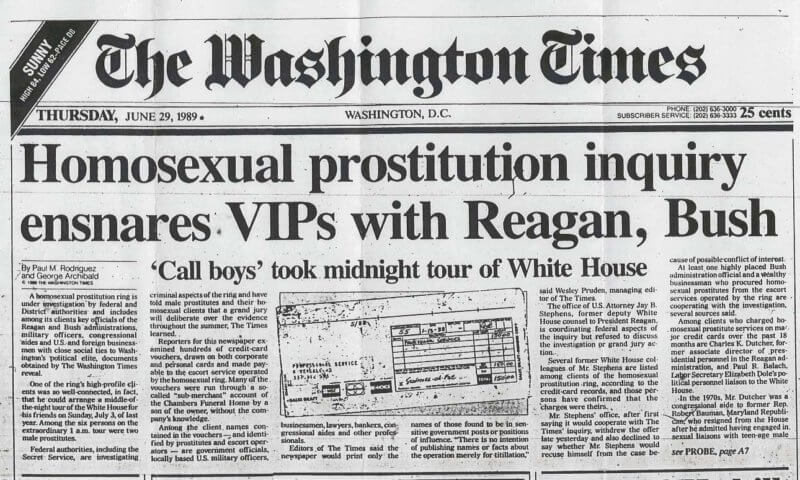
Spence later stated that his contacts within the White House, which allowed him and his “call boys” access, were “top level” officials and he specifically singled out George H.W. Bush’s then-National Security Advisor Donald Gregg. Gregg had worked at the CIA since 1951 before he resigned in 1982 to become National Security Advisor to Bush, who was then vice president. Prior to resigning from his post at the CIA, Gregg had worked directly under William Casey and, in the late 1970s, alongside a young William Barr in stonewalling the congressional Pike Committee and Church Committee, which investigated the CIA beginning in 1975. Among the things that they were tasked with investigating were the CIA’s “love traps,” or sexual blackmail operations used to lure foreign diplomats to bugged apartments, complete with recording equipment and two-way mirrors.
Barr would later become Bush’s Attorney General, rising to that post yet again under Trump. Furthermore, Barr’s father worked for the precursor to the CIA, the Office of Strategic Services (OSS) and recruited a young Jeffrey Epstein, then a high school drop-out, to teach at the elite Dalton School, from which Epstein was later fired. A year prior to hiring Epstein, Donald Barr published a science fiction fantasy novel about sex slavery. Notably, the same year Donald Barr hired Epstein, his son was working for the CIA. Bill Barr has refused calls to recuse himself from the Epstein case, even though he worked at the same law firm that has represented Epstein in the past.
Donald Gregg is also connected to Roy Cohn’s “influence machine” through his daughter’s marriage to Christopher Buckley, the son of conservative journalist William Buckley, close confidant and friend of both Roy Cohn and Cohn’s law partner Tom Bolan.
The Washington Times reports on Spence’s child sex ring also reveal his close ties to none other than the ubiquitous Roy Cohn. One of the Times’ sources for its first story on the scandal alleged that he had attended a birthday party for Roy Cohn that Spence had hosted at his home and that CIA Director William Casey was also in attendance. Spence was also said in the report to often brag about his social companions and regularly mentioned Cohn and claimed to have hosted Cohn at his house on occasions other than the aforementioned birthday party.
“Bodies by God”
The revelation of Craig Spence’s “call boy ring” soon led to the discovery of the infamous Franklin child sex abuse and ritual murder scandal. That sordid operation was run out of Omaha, Nebraska by Larry King, a prominent local Republican activist and lobbyist who ran the Franklin Community Federal Credit Union until it was shut down by federal authorities.
Buried in a May 1989 article in the Omaha World Herald’s probe into King’s Credit Union and sex ring, is a telling revelation: “In the 61/2 months since federal authorities closed Franklin, rumors have persisted that money from the credit union somehow found its way to the Nicaraguan contra rebels.”
The possibility that King’s fraudulent credit union was covertly funding the Contras was supported by subsequent reporting by the Houston Post’s Pete Brewton, who discovered that the CIA, in conjunction with organized crime, had secretly borrowed money from various savings and loans (S&L) institutions to fund covert operations. One of those S&Ls had Neil Bush, George H.W. Bush’s son, on its board and it had done business with King’s organization.
Another link between King and the Iran Contra team is the fact that King had co-founded and subsequently donated over $25,000 to an organization affiliated with the Reagan administration, Citizens for America, which sponsored speaking trips for Lt. Col. Oliver North and Contra leaders. The director of Citizens for America at the time was David Carmen, who simultaneously ran a public relations firm with the former head of covert operations at the Casey-led CIA, his father Gerald, who had also been appointed by Reagan to head the General Services Administration and to a subsequent ambassadorship.
One of the investigative journalists who researched the Craig Spence ring later told DeCamp that Spence’s ring was connected to King:
“The way we discovered Larry King and his Nebraska-based call boy ring, was by looking through the credit card chits of Spence’s ring, where we found King’s name.”
It was later revealed that King and Spence were essentially business partners as their child trafficking rings were operated under a larger group that was nicknamed “Bodies by God.”
Exactly how many groups operated under this umbrella group, “Bodies by God,” is unknown. Yet, what is known is that the rings run by both King and Spence were connected to each other and both were also connected to prominent officials in the Reagan and subsequent George H.W. Bush administrations, including officials with ties to the CIA and Roy Cohn and his network.
Indeed Spence, just months before his alleged suicide in the Boston Ritz Carlton, had hinted to Washington Times reporters Michael Hedges and Jerry Seper, who had originally broken the story, that they had merely scratched the surface of something much darker:
“All this stuff you’ve uncovered [involving call boys, bribery and the White House tours], to be honest with you, is insignificant compared to other things I’ve done. But I’m not going to tell you those things, and somehow the world will carry on.”
It also worth noting the role of the FBI in all of this, particularly in the Franklin child sex abuse scandal. Indeed, Larry King’s child sex abuse ring was quickly and aggressively covered up by the FBI, which used a variety of under-handed tactics to bury the reality of King’s sordid operation. Here, it is important to recall the key role former FBI Director J. Edgar Hoover played in similar sexual blackmail operations that abused children (See Part I) and the close relationship between Hoover, Roy Cohn and Lewis Rosenstiel, who later employed Hoover’s former right-hand man at the FBI, Louis Nichols.
Years later, documents released by the FBI would show that Epstein became an FBI informant in 2008, when Robert Mueller was the Bureau’s director, in exchange for immunity from then-pending federal charges, a deal that fell through with Epstein’s recent arrest on new federal charges. In addition, former FBI Director Louis Freeh would be hired by Alan Dershowitz, who is accused of raping girls at Epstein’s homes and was once a character witness for Roy Cohn, to intimidate Epstein’s victims. As previously mentioned, Freeh’s past appointment as a judge for the United States District Court for the Southern District of New York was orchestrated by Cohn’s law partner Tom Bolan.
Thus, the FBI’s cover-up of the Franklin case is just one example of the Bureau’s long-standing practice of protecting these pedophile rings when they involve members of the American political elite and provide the Bureau with a steady supply of blackmail. It also makes it worth questioning the impartiality of one of the main prosecutors in the Jeffrey Epstein case, Maurene Comey, who is the daughter of former FBI Director James Comey.
The rot at the top
While there were several sexual trafficking operations connected to both Roy Cohn and the halls of power under the Reagan administration, in a matter of months after Cohn’s death it appears that another individual became a central figure in the powerful network that Cohn had cultivated.
That individual, Jeffrey Epstein, would be recruited, after his firing from the Dalton School, by Alan “Ace” Greenberg, a close friend of Cohn, to work at Bear Stearns. After leaving Bear Stearns and working as an alleged financial “bounty hunter” for clients that are said to have included the Iran-Contra-linked arms dealer Adnan Khashoggi, Epstein would come into contact with Leslie Wexner, a billionaire close to the Meyer Lansky-linked Bronfman family, who himself was tied to members of organized crime syndicates once represented by Cohn.
The same year that Wexner would begin his decades-long association with Epstein, another Cohn friend with ties to the Reagan White House and the Trump family, Ronald Lauder, would provide Epstein with an Austrian passport containing Epstein’s picture but a false name.
Lauder, Wexner and the Bronfmans are members of an elite organization known as the Mega Group, which also includes other Meyer Lansky-connected “philanthropists” like hedge fund manager Michael Steinhardt. While Epstein shares considerable overlap with the network described in this report and Part I of this series, he is also deeply connected to the Mega Group as well as its associates, including Ghislaine Maxwell’s father, Robert Maxwell.
Part III of this series will focus on the Mega Group and its ties to the network that has been described in Parts I and II. In addition, the role of the state of Israel, the Mossad, and several global pro-Israel lobby organizations will also be discussed in relation to this network of sexual blackmail operations and Jeffrey Epstein.
It is here that the full breadth of the Epstein scandal comes into view. It is a criminal and unconscionable blackmail operation that has been run by influential figures, hidden in plain sight, for over half a century, exploiting and destroying the lives of untold numbers of children in the process. Over the years, it has grown many branches and spread well beyond the United States, as seen by the activity of Covenant House in Latin America and Epstein’s own international effort to recruit more girls to be abused and exploited.
All of this has taken place with the full knowledge and blessing of top figures in the world of “philanthropy” and in the U.S. government and intelligence communities, with great influence over several presidential administrations, particularly since the rise of Ronald Reagan and continuing through to Donald Trump.
Whitney Webb is a MintPress News journalist based in Chile. She has contributed to several independent media outlets including Global Research, EcoWatch, the Ron Paul Institute and 21st Century Wire, among others. She has made several radio and television appearances and is the 2019 winner of the Serena Shim Award for Uncompromised Integrity in Journalism.
No Accountability in Washington. The CIA Wants to Hide All Its Employees
By Philip Giraldi | Strategic Culture Foundation | July 25, 2019
Government that actually serves the interests of the people who are governed has two essential characteristics: first, it must be transparent in terms of how it debates and develops policies and second, it has to be accountable when it fails in its mandate and ceases to be responsive to the needs of the electorate. Over the past twenty years one might reasonably argue that Washington has become less a “of the people, by the people and for the people” and increasingly a model of how special interests can use money to corrupt government. The recent story about how serial pedophile Jeffrey Epstein avoided any serious punishment by virtue of his wealth and his political connections, including to both ex-president Bill Clinton and to current chief executive Donald Trump, demonstrates how even the most despicable criminals can avoid being brought to justice.
This erosion of what one might describe as republican virtue has been exacerbated by a simultaneous weakening of the US Constitution’s Bill of Rights, which was intended to serve as a guarantee of individual liberties while also serving as a bulwark against government overreach. In recent cases in the United States, a young man had his admission to Harvard revoked over comments posted online when he was fifteen that were considered racist, while a young woman was stripped of a beauty contest title because she refused to don a hijab at a college event and then wrote online about her experience. In both cases, freedom of speech guaranteed by the First Amendment was ruled to be inadmissible by the relevant authorities.
Be that as it may, governmental lack of transparency and accountability is a more serious matter when the government itself becomes a serial manipulator of the truth as it seeks to protect itself from criticism. Reports that the Central Intelligence Agency (C.I.A.) is seeking legislation that will expand government ability to declare it a crime to reveal the identities of undercover intelligence agents will inevitably lead to major abuse when some clever bureaucrat realizes that the new rule can also be used to hide people and cover up malfeasance.
A law to protect intelligence officers already exists. It was passed in 1982 and is referred to as the Intelligence Identities Protection Act (I.I.P.A.). It criminalizes the naming of any C.I.A. officer under cover who has served overseas in the past five years. The new legislation would make the ban on exposure perpetual and would also include Agency sources or agents whose work is classified as well as actual C.I.A. staff employees who exclusively or predominantly work in the United States rather than overseas.
The revised legislation is attached to defense and intelligence bills currently being considered by Congress. If it is passed into law, its expanded range of criminal penalties could be employed to silence whistle blowers inside the Agency who become aware of illegal activity and it might also be directed against journalists that the whistleblowers might contact to tell their story.
The Agency has justified the legislation by claiming in a document obtained by The New York Times that “hundreds of covert officers [serving in the United States] have had their identity and covert affiliation disclosed without authorization… C.I.A. officers place themselves in harm’s way in order to carry out C.I.A.’s mission regardless of where they are based. Protecting officers’ identities from foreign adversaries is critical.”
Some Congressmen are disturbed by the perpetual nature of the identification ban while also believing that the proposed legislation is too broad in general. Senator Ron Wyden expressed reservations over how the C.I.A. provision would apply indefinitely. “I am not yet convinced this expansion is necessary and am concerned that it will be employed to avoid accountability,” he wrote.
Agency insiders have suggested that the new law is in part a response to increasing leaks of classified information by government employees. It is also a warning shot fired at journalists in the wake of the impending prosecution of Julian Assange of WikiLeaks under the seldom used Espionage Act of 1918. Covert identities legislation is less broad than the Espionage Act, which is precisely why it is attractive. It permits prosecution and punishment solely because someone either has revealed a “covert” name or is suspected of having done so.
But up until now, government prosecutors have only used the 1982 identities law twice. The first time was a 1985 case involving a C.I.A. clerk in Ghana and the second time was the 2012 case of John Kiriakou, a former C.I.A. officer who pleaded guilty to providing a reporter with the name of an under-cover case officer who participated in the agency’s illegal overseas interrogations. Kiriakou has always claimed that he had not in fact named anyone, in spite of his plea, which was agreed to as a plea bargain. The covert officer in question had already been identified in the media.
John Kiriakou also observes how the I.I.P.A. has been inevitably applied selectively. He describes how “These two minor prosecutions aside, very few revelations of C.I.A. identities have ever led to court cases. Former Deputy Secretary of State Richard Armitage famously leaked Valerie Plame’s name to two syndicated columnists. He was never charged with a crime. Former C.I.A. Director David Petraeus leaked the names of 10 covert C.I.A. operatives to his adulterous girlfriend, apparently in an attempt to impress her, and was never charged. Former C.I.A. Director Leon Panetta revealed the name of the covert SEAL Team member who killed Osama bin Laden. He apologized and was not prosecuted.”
Kiriakou also explains how the “… implementation of this law is a joke. The C.I.A. doesn’t care when an operative’s identity is revealed — unless they don’t like the politics of the person making the revelation. If they cared, half of the C.I.A. leadership would be in prison. What they do care about, though, is protecting those employees who commit crimes at the behest of the White House or the C.I.A. leadership.” He goes on to describe how some of those involved in the Agency torture program were placed under cover precisely for that reason, to protect them from prosecution for war crimes.
Even team player Joe Biden, when a Senator, voted against the I.I.P.A., explaining in an op-ed in The Christian Science Monitor in 1982 that, “The language (the I.I.P.A.) employs is so broadly drawn that it would subject to prosecution not only the malicious publicizing of agents’ names, but also the efforts of legitimate journalists to expose any corruption, malfeasance, or ineptitude occurring in American intelligence agencies.” And that was with the much weaker 1982 version of the bill.
The new legislation is an intelligence agency dream, a get out of jail card that has no expiry date. And if one wants to know how dangerous it is, consider for a moment that if it turns out that serial pedophile Jeffrey Epstein was indeed a C.I.A. covert source, which is quite possible, he would be covered and would be able to walk away free on procedural grounds.
Hidden in Plain Sight: The Shocking Origins of the Jeffrey Epstein Case

A composite image shows from left to right, Lewis Rosenstiel, Jeffrey Epstein, and Roy Cohn. Graphic | Emma Fiala
By Whitney Webb | MintPress News | July 18, 2019
Despite his “sweetheart” deal and having seemingly evaded justice, billionaire sex offender Jeffrey Epstein was arrested earlier this month on federal charges for sex trafficking minors. Epstein’s arrest has again brought increased media attention to many of his famous friends, the current president among them.
Many questions have since been asked about how much Epstein’s famous friends knew of his activities and exactly what Epstein was up to. The latter arguably received the most attention after it was reported that Alex Acosta — who arranged Epstein’s “sweetheart” deal in 2008 and who recently resigned as Donald Trump’s Labor Secretary following Epstein’s arrest — claimed that the mysterious billionaire had worked for “intelligence.”
Other investigations have made it increasingly clear that Epstein was running a blackmail operation, as he had bugged the venues — whether at his New York mansion or Caribbean island getaway — with microphones and cameras to record the salacious interactions that transpired between his guests and the underage girls that Epstein exploited. Epstein appeared to have stored much of that blackmail in a safe on his private island.
Claims of Epstein’s links and his involvement in a sophisticated, well-funded sexual blackmail operation have, surprisingly, spurred few media outlets to examine the history of intelligence agencies both in the U.S. and abroad conducting similar sexual blackmail operations, many of which also involved underage prostitutes.
In the U.S. alone, the CIA operated numerous sexual blackmail operations throughout the country, employing prostitutes to target foreign diplomats in what the Washington Post once nicknamed the CIA’s “love traps.” If one goes even farther back into the U.S. historical record it becomes apparent that these tactics and their use against powerful political and influential figures significantly predate the CIA and even its precursor, the Office of Strategic Services (OSS). In fact, they were pioneered years earlier by none other than the American mafia.
In the course of this investigation, MintPress discovered that a handful of figures who were influential in American organized crime during and after Prohibition were directly engaged in sexual blackmail operations that they used for their own, often dark, purposes.
In Part I of this exclusive investigation, MintPress will examine how a mob-linked businessman with deep ties to notorious gangster Meyer Lansky developed close ties with the Federal Bureau of Investigation (FBI) while also running a sexual blackmail operation for decades, which later became a covert part of the anti-communist crusade of the 1950s led by Senator Joseph McCarthy (R-WI), himself known throughout Washington for having a habit of drunkenly groping underage teenaged girls.
Yet, it would be one of McCarthy’s closest aides who would take over the ring in later years, trafficking minors and expanding this sexual blackmail operation at the same time he expanded his own political influence, putting him in close contact with prominent figures including former President Ronald Reagan and a man who would later become president, Donald Trump.
As will be revealed in Part II, after his death, this blackmail operation continued under various successors in different cities and there is strong evidence that Jeffrey Epstein became one of them.
Samuel Bronfman and the Mob
The Prohibition Era in the United States is often used as an example of how banning recreational substances not only increases their popularity but also causes a boom in criminal activity. Indeed, it was Prohibition that greatly increased the strength of the American mafia, as the top crime lords of the day grew rich through the clandestine trade and sale of alcohol in addition to gambling and other activities.
It is through the bootlegging trade of the 1920s and the early 1930s that this story begins, as it brought together key figures whose successors and affiliates would eventually create a series of blackmail and sex trafficking rings that would give rise to the likes of Jeffrey Epstein, the “Lolita Express” and “Orgy Island.”
Samuel Bronfman never planned to become a major producer of liquor but true to his family’s last name, which means “brandy man” in Yiddish, he eventually began distributing alcohol as an extension of his family’s hotel business. During Canada’s Prohibition period, which was briefer than and preceded that of its southern neighbor, the Bronfman family business used loopholes to skirt the law and find technically legal ways to sell alcohol in the hotels and stores the family owned. The family relied on its connections with members of the American mafia to illegally smuggle alcohol from the United States.
Soon after Prohibition ended in Canada, it began in the United States and, by the time the flow of illegal alcohol had turned the other way, the Bronfmans – whose business ventures were then being led by Sam Bronfman and his brothers — were relatively late to an already flourishing bootlegging trade.
“We were late starters in the two most lucrative markets – on the high seas and across the Detroit River. What came out of the border trade in Saskatchewan was insignificant by comparison,” Bronfman once told Canadian journalist Terence Robertson, who was then writing a biography of Bronfman. Nonetheless, “this was when we started to make our real money,” Bronfman recounted. Robertson’s biography on Bronfman was never published, as he died under mysterious circumstances soon after warning his colleagues that he had uncovered unsavory information about the Bronfman family.
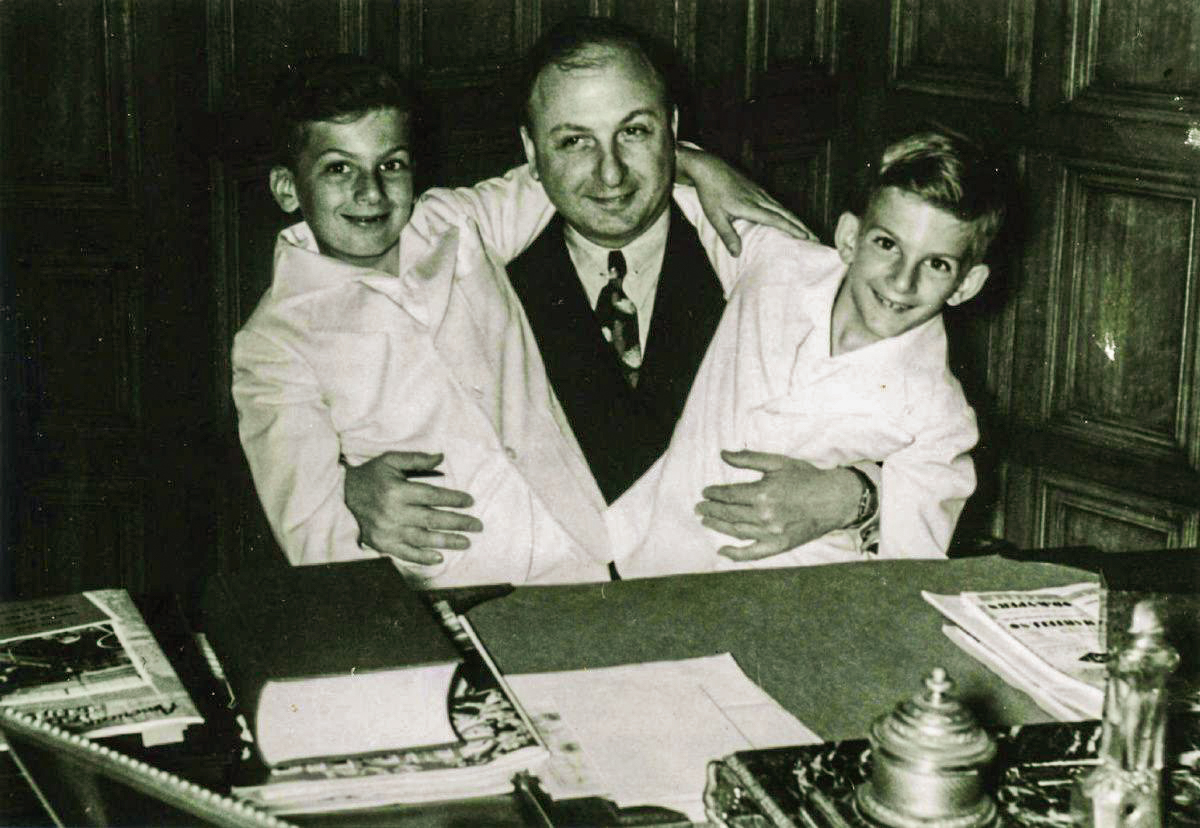
Samuel Bronfman pictured in 1937 with his sons Edgar and Charles
Key to Bronfman’s success during American Prohibition were the ties his family had cultivated with organized crime during Canada’s Prohibition, ties that led many prominent members of the mob in the United States to favor Bronfman as a business partner. Bronfman liquor was purchased in massive quantities by many crime lords who still live on in American legend, including Charles “Lucky” Luciano, Moe Dalitz, Abner “Longy” Zwillman and Meyer Lansky.
Most of Bronfman’s mob associates during Prohibition were members of what became known as the National Crime Syndicate, which a 1950s Senate investigative body known as the Kefauver Committee described as a confederation dominated by Italian-American and Jewish-American mobs. During that investigation, some of the biggest names in the American mafia named Bronfman as a central figure in their bootlegging operations. The widow of notorious American mob boss Meyer Lansky even recounted how Bronfman had thrown lavish dinner parties for her husband.
Years later, Samuel Bronfman’s children and grandchildren, their family’s ties to the criminal underworld intact, would later go on to associate closely with Leslie Wexner, allegedly the source of much of Epstein’s mysterious wealth, and other mob-linked “philanthropists,” and some would even manage their own sexual blackmail operations, including the recently busted blackmail-based “sex cult” NXIVM. The later generations of the Bronfman family, particularly Samuel Bronfman’s sons Edgar and Charles, will be discussed in greater detail in Part II of this report.
Lewis Rosenstiel’s dark secret
Crucial to Bronfman’s Prohibition-era bootlegging operations were two middlemen, one of whom was Lewis “Lew” Rosenstiel. Rosenstiel got his start working at his uncle’s distillery in Kentucky before Prohibition. Once the law banning alcohol was in force, Rosenstiel created the Schenley Products Company, which would later become one of the largest liquor companies in North America.
Though he was a high school drop-out and not particularly well-connected socially at the time, Rosenstiel happened to have a “chance” meeting with Winston Churchill in 1922 while on vacation in the French Riviera. According to the New York Times, Churchill “advised him [Rosenstiel] to prepare for the return of liquor sales in the United States.” Rosenstiel somehow managed to secure the funding of the elite and respected Wall Street firm Lehman Brothers to finance his purchase of shuttered distilleries.
Officially, Rosenstiel is said to have built his company and wealth after Prohibition, by following Churchill’s advice to prepare for Repeal. However, he was clearly involved in bootlegging operations and was even indicted for bootlegging in 1929, though he evaded conviction. Like Bronfman, Rosenstiel was close to organized crime, particularly members of the mostly Jewish-American and Italian-American mob alliance known as the National Crime Syndicate.
Subsequent New York state congressional investigations would allege that Rosenstiel “was part of a ‘consortium’ with underworld figures that bought liquor in Canada [from Samuel Bronfman]”, whose other members were “Meyer Lansky, the reputed organized crime leader; Joseph Fusco, an associate of late Chicago gangster Al Capone and Joseph Linsey, a Boston man Mr. Kelly [the congressional investigator testifying] identified as a convicted bootlegger.” Rosenstiel’s relationship with these men, particularly Lansky, would continue long after Prohibition and Samuel Bronfman, for his part, would also maintain his mob ties.
In addition to his friends in the mob, Rosenstiel also cultivated close ties with the FBI, developing a close relationship with longtime FBI Director J. Edgar Hoover and making Hoover’s right-hand man and longtime assistant at the FBI, Louis Nichols, the Vice President of his Schenley empire in 1957.
Despite their similar backgrounds as bootlegger barons turned “respectable” businessmen, Bronfman’s and Rosenstiel’s personalities were drastically different and their relationship was complicated, at best. One example of the dissimilarities between North America’s top liquor barons was how they treated their staff. Bronfman was not necessarily known for being a cruel boss, whereas Rosenstiel was known for his erratic and “monstrous” behavior towards employees as well as his unusual practice of bugging his offices in order to hear what employees said about him when he wasn’t present.
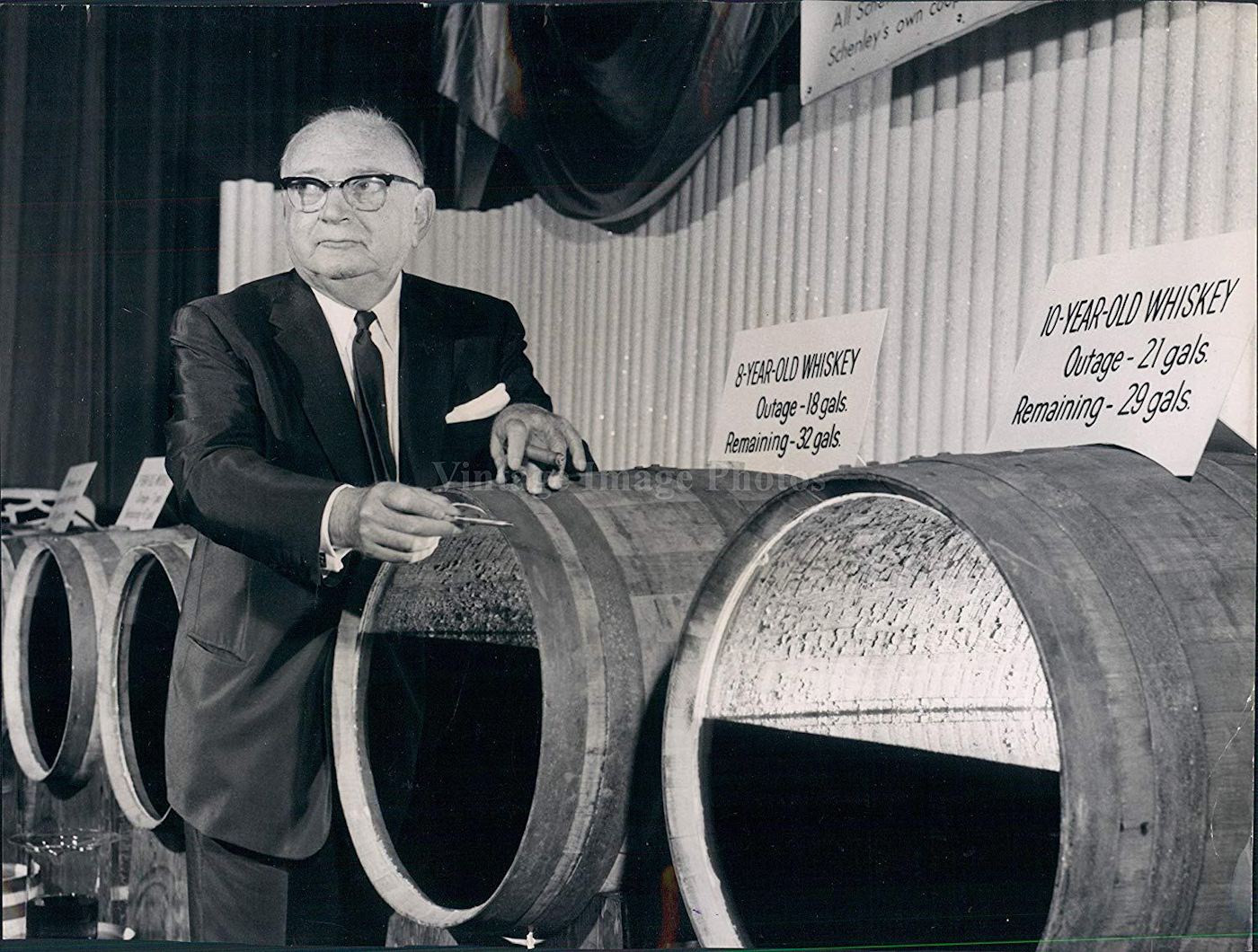
Rosenstiel was connected to both the FBI and to organized crime
Such differences between Bronfman and Rosenstiel were also reflected in their personal lives. While Bronfman married only once and was loyal to his wife, Rosenstiel was married five times and was known for his relatively closeted bisexual antics, a part of his life that was well-known to many of his close associates and employees.
Though for years there were only hints to this other side of the controversial businessman, details emerged years later during a divorce proceeding brought by Rosenstiel’s fourth wife, Susan Kaufman, that would back the claims. Kaufman alleged that Rosenstiel hosted extravagant parties that included “boy prostitutes” that her husband had hired “for the enjoyment” of certain guests, which included important government officials and prominent figures in America’s criminal underworld. Kaufman would later make the same claims under oath during the hearing of the New York’s State Joint Legislative Committee on Crime in the early 1970s.
Not only did Rosenstiel organize these parties, but he also made sure that their venues were bugged with microphones that recorded the antics of his high-profile guests. Those audio recordings, Kaufman alleged, were then kept for the purpose of blackmail. Though Kaufman’s claims are shocking, her testimony was deemed credible and held in high regard by the former chief counsel of the Crime Committee, New York Judge Edward McLaughlin, and committee investigator William Gallinaro and aspects of her testimony were later corroborated by two separate witnesses who were unknown to Kaufman.
These blackmail “parties” offer a window into an operation that would later become more sophisticated and grow dramatically in the 1950s under Rosenstiel’s “field commander” (a nickname given by Rosenstiel to an individual to be named shortly in this report). Many of the people connected to Rosenstiel’s “field commander” during the 70s and 80s have again found their names in the press following the recent arrest of Jeffrey Epstein.
The “Untouchable” Mobster
Bronfman and Rosenstiel became legendary in the North American liquor business, in part due to their fight for supremacy in the industry, which the New York Times described as often erupting “into bitter personal and corporate battles.” Despite their dueling in the corporate world, the one thing that united the two businessmen more than anything else was their close connection to American organized crime, particularly renowned mobster, Meyer Lansky.
Lansky is one of the most notorious gangsters in the history of American organized crime and is notable for being the only famous mobster that rose to notoriety in the 1920s that managed to die an old man and never serve a day in jail.
Lansky’s long life and ability to avoid prison time was largely the result of his close relationships to powerful businessmen like Bronfman and Rosenstiel (among many others), the Federal Bureau of Investigation (FBI) and the U.S. intelligence community as well as his role in establishing several blackmail and extortion rings which helped him keep the law at arm’s length. Indeed, when Lansky was finally charged with a crime in the 1970s, it was the Internal Revenue Service that brought the charges, not the FBI, and he was charged with and acquitted of tax evasion.
Lansky was remarkably close to both Bronfman and Rosenstiel. Bronfman regularly threw “lavish dinner parties” in Lansky’s honor both during and after Prohibition. These parties were remembered fondly by Lansky’s wife, and Lansky, in turn, did favors for Bronfman ranging from exclusive protection of his shipments during Prohibition to getting him tickets to coveted “fight of the century” boxing matches.
Rosenstiel also threw regular dinner parties honoring Lansky. Susan Kaufman, Rosenstiel’s ex-wife, claimed to have taken numerous pictures of her ex-husband and Lansky socializing and partying together, photos that were also seen by Mary Nichols of The Philadelphia Inquirer. In addition, Lansky, per Kaufman’s recollection, was one of the individuals that Rosenstiel sought to protect from legal scrutiny as part of his child prostitution and blackmail ring targeting high-ranking officials, and he was overheard saying that if the government “ever brings pressure against Lansky or any of us, we’ll use this [a specific recording taken at one of the “parties”] as blackmail.”
Lansky was known to address Rosenstiel as “Supreme Commander,” a title that would later be used to refer to Rosenstiel by another individual deeply connected to the mob and sexual blackmail operations, previously referred to in this report as Rosenstiel’s “Field Commander.”
Lansky also had close ties to the CIA and U.S. military intelligence. During World War II, Lansky –along with his associate Benjamin “Bugsy” Siegel — worked with Naval intelligence in what was codenamed “Operation Underworld,” an operation that the government denied for over 40 years.
Journalist and noted chronicler of CIA covert activities, Douglas Valentine, noted in his book The CIA as Organized Crime: How Illegal Operations Corrupt America and the World that the government’s cooperation with the mafia during World War II led to its expansion after the war and set the stage for its future collaboration with U.S. intelligence.
According to Valentine:
Top government officials were also aware that the government’s Faustian pact with the Mafia during World War II had allowed the hoods to insinuate themselves into mainstream America. In return for services rendered during the war, Mafia bosses were protected from prosecution for dozens of unsolved murders. […]
The Mafia was a huge problem in 1951 [when the Kefauver Committee was convened], equivalent to terrorism today. But it was also a protected branch of the CIA, which was co-opting criminal organizations around the world and using them in its secret war against the Soviets and Red Chinese. The Mafia had collaborated with Uncle Sam and had emerged from World War II energized and empowered. They controlled cities across the country.”
Indeed, the CIA forged ties with Lansky not long after its creation at the behest of CIA counterintelligence chief James J. Angleton. The CIA would later turn to the Lansky-linked mob in the early 1960s as part of its consistently fruitless quest to assassinate the Cuban leader, showing that the CIA maintained its contacts with Lansky-controlled elements of the mafia long after the initial meeting with Lansky took place.
The CIA also had close connections to associates of Lansky, such as Edward Moss, who did public relations work for Lansky and was said to be of “interest” to the CIA by the agency’s then-inspector general J.S. Earman. Harry “Happy” Meltzer was also another Lansky associate that was a CIA asset and the CIA asked Meltzer to join an assassination team in December 1960.
In addition to the CIA, Lansky was also connected to a foreign intelligence agency through Tibor Rosenbaum, an arms procurer and high-ranking official in Israel’s Mossad, whose bank – the International Credit Bank of Geneva – laundered much of Lansky’s ill-gotten gains and recycled it into legitimate American businesses.
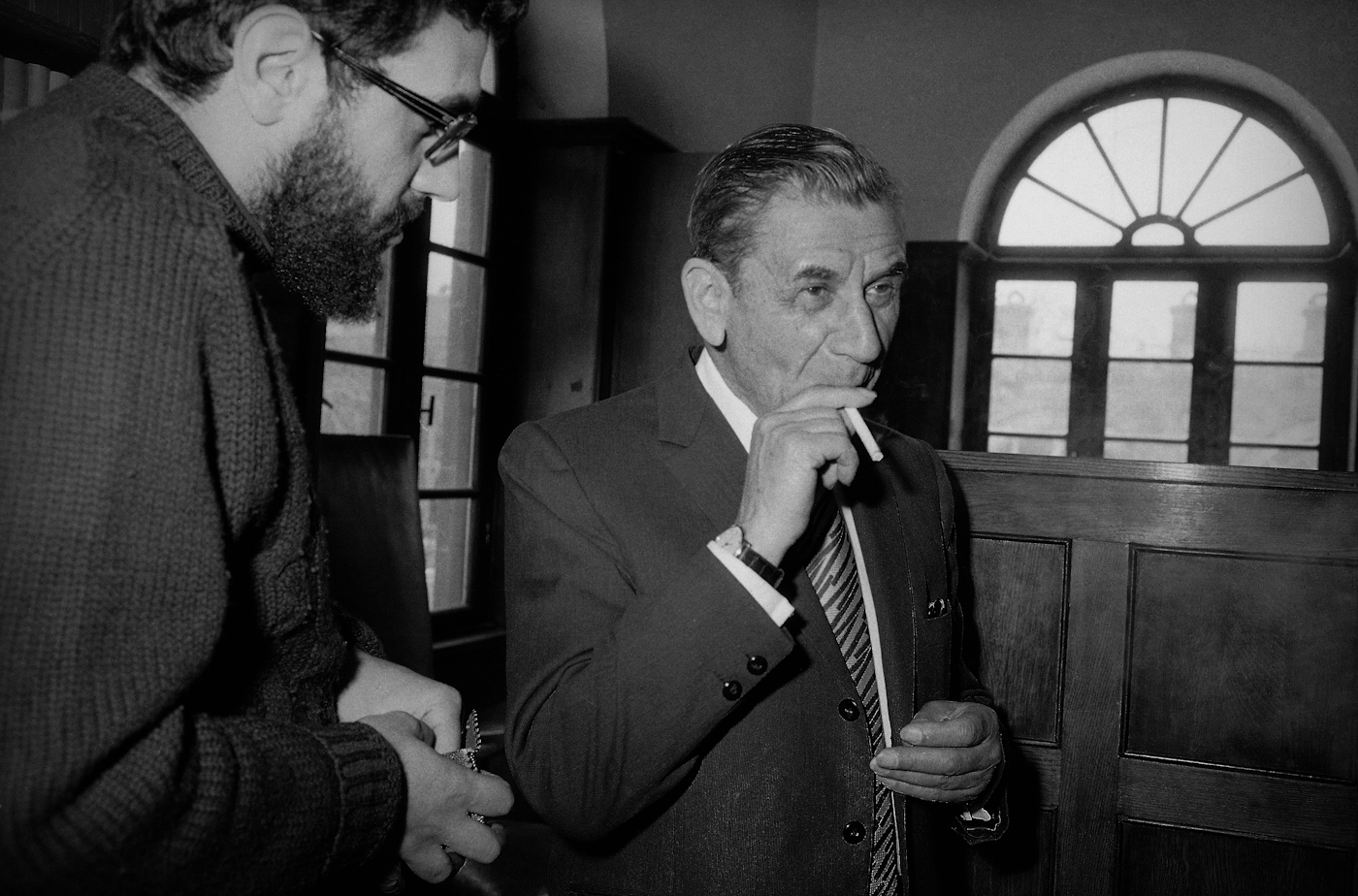
Lansky outside the High Court of Israel where he sought permission to emigrate in 1972. Photo | AP
Journalist Ed Reid, author of the Virginia Hill biography The Mistress and the Mafia, wrote that Lansky was attempting to entrap powerful people through sexual blackmail as far back as 1939. Reid contends that Lansky sent Ms. Hill to Mexico, where his West Coast connections had established a drug ring that later involved the OSS, the forerunner to the CIA, to seduce numerous “top politicians, army officers, diplomats and police officials.”
Eventually, Lansky was credited with obtaining compromising photos of FBI director J. Edgar Hoover sometime in the 1940s, which showed “Hoover in some kind of gay situation”, according to a former Lansky associate who also said that Lansky had often claimed, “I fixed that sonofabitch.” The photos showed Hoover engaged in sexual activity with his long-time friend, FBI deputy director Clyde Tolson.
At some point, these photos fell into the hands of CIA counterintelligence chief James J. Angleton, who later showed the photos to several other CIA officials, including John Weitz and Gordon Novel. Angleton was in charge of the CIA’s relationship with the FBI and Israel’s Mossad until he left the agency in 1972 and, as was recently mentioned, he was also in contact with Lansky.
Anthony Summers , former BBC journalist and author of Official and Confidential: The Secret Life of J. Edgar Hoover, has argued that it was not Lansky, but William Donovan, the director of the OSS, who obtained the original photos of Hoover and later shared them with Lansky.
Summers also stated that “To [gangster Frank] Costello and Lansky, the ability to corrupt politicians, policemen and judges was fundamental to Mafia operations. The way they found to deal with Hoover, according to several mob sources, involved his homosexuality.” This anecdote shows that Lanksy and the CIA maintained a covert relationship, which included, among other things, the sharing of blackmail material (i.e. “intelligence”).
It is also possible that Hoover was ensnared by the mob during one of Rosenstiel’s blackmail “parties,” at which Hoover sometimes found himself in attendance with prominent figures of the mafia. Hoover was said to have worn women’s clothing at the some of the events and Meyer Lansky’s wife later said that her husband had photos of the former FBI director in drag. Furthermore, Hoover is on record showing an unusual concern in the FBI’s handling of Rosenstiel’s criminal links as early as 1939, the same year that his close associate Lansky was actively orchestrating the sexual blackmail of powerful political figures.
The blackmail acquired on Hoover and the mob’s possession of the evidence has been cited as a major factor in Hoover’s decades-long denial that nationwide networks of organized crime were a serious issue. Hoover asserted that it was a decentralized, local issue and therefore outside of the bureau’s jurisdiction. By the time Hoover finally acknowledged the existence of national organized crime networks in 1963, it was so entrenched in the U.S. establishment that it was untouchable.
Congressional crime consultant Ralph Salerno told Summers in 1993 that Hoover’s willful ignorance of organized crime for most of his career as FBI director “allowed organized crime to grow very strong in economic and political terms, so that it became a much bigger threat to the wellbeing of this country than it would have been if it had been addressed much sooner.”
J. Edgar Hoover: Blackmail Victim?
Most records place the beginning of Hoover’s relationship with Rosenstiel in the 1950s, the same decade when Susan Kaufman reported that Hoover was attending Rosenstiel’s blackmail parties. Rosenstiel’s FBI file, obtained by Anthony Summers, cites the first Rosenstiel meeting as taking place in 1956, though Summers notes that there is evidence that they had met much earlier. After requesting the meeting, Rosenstiel was granted a personal face to face with the director in a matter of hours. The FBI file on Rosenstiel also reveals that the liquor baron heavily lobbied Hoover to aid his business interests.
During that time, the salacious details of Hoover’s sex life were already known to the U.S. intelligence community and to the mob, and Hoover was aware that they knew of his closeted sexuality and penchant for women’s clothing. Yet, Hoover apparently seemed to embrace the very type of sexual blackmail operation that had compromised his private life, given that he was seen at many of Rosenstiel’s “blackmail” parties in the 1950s and 1960s, including at venues such as Rosenstiel’s personal home and later at Manhattan’s Plaza Hotel. Hoover’s penchant for dressing in drag was also described by two witnesses who were not connected to Susan Kaufman.
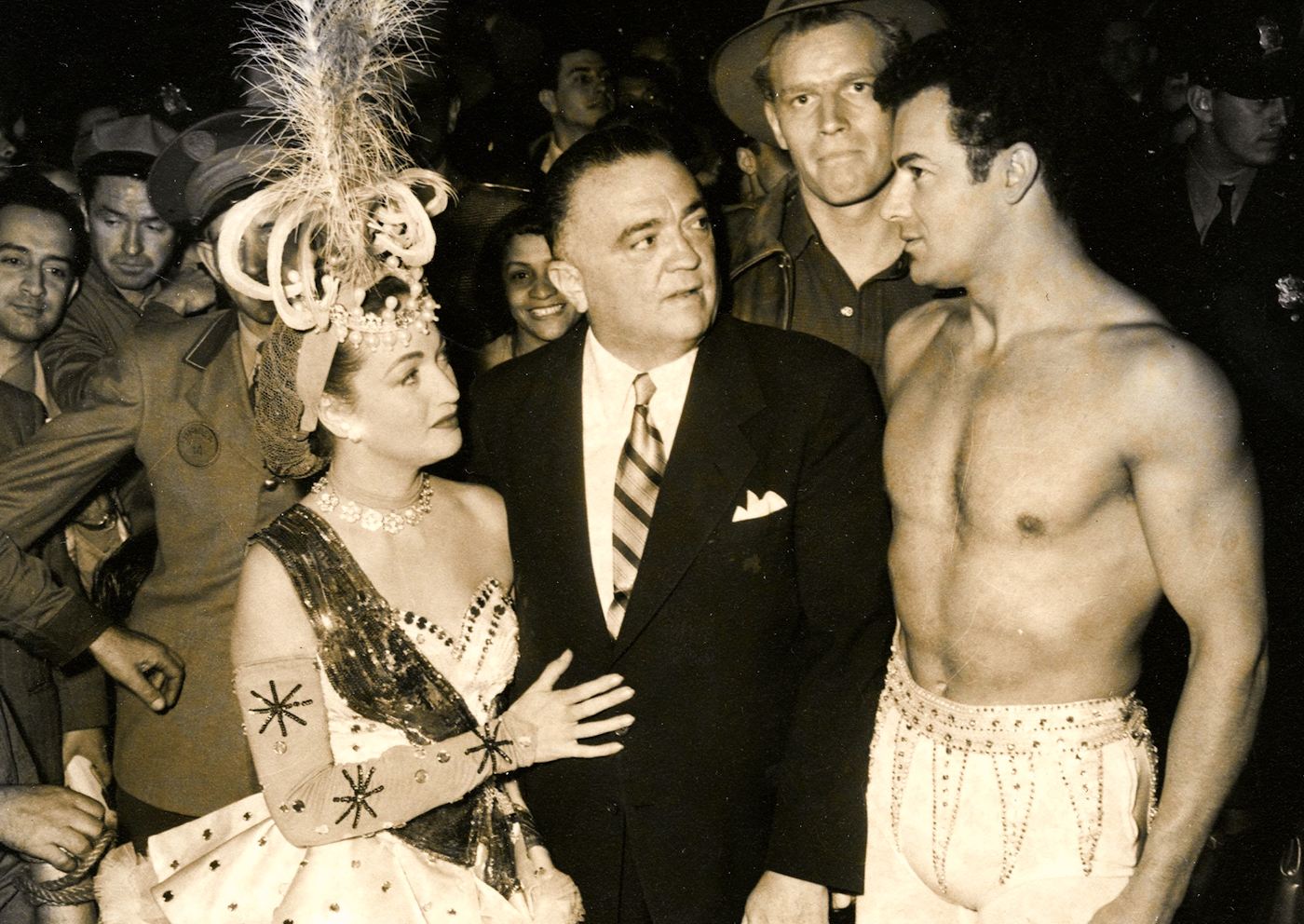
Hoover with Dorothy Lamour on the set of The Greatest Show on Earth in 1951
Soon after their first “official” meeting, the public relationship between the two men quickly flourished, with Hoover even sending Rosenstiel flowers when he fell ill. Summers reported that, in 1957, Rosenstiel was heard telling Hoover during a meeting, “your wish is my command.” Their relationship remained close and intimate throughout the 1960s and beyond.
Like Rosenstiel, Hoover was well-known for amassing blackmail on friend and foe alike. Hoover’s office contained “secret files” on numerous powerful people in Washington and beyond, files he used to gain favors and protect his status as FBI director for as long as he wished.
Hoover’s own propensity for blackmail suggests that he may have associated with Rosenstiel’s sexual blackmail operation more directly, given he already knew he was compromised and his involvement in the operation would have served as a means of procuring the blackmail he coveted for his own purposes. Indeed, if Hoover was merely being blackmailed and extorted by the Lansky-Rosenstiel connected mob, it is unlikely that he would have been so friendly to Rosenstiel, Lansky and the other mobsters at these gatherings and participated in them with such regularity.
According to journalist and author Burton Hersh, Hoover was also tied to Sherman Kaminsky, who ran a sexual blackmail operation in New York involving young male prostitutes. That operation was busted and investigated in 1966 extortion probe led by Manhattan District Attorney Frank Hogan, though the FBI quickly took over the investigation and photos of Hoover and Kaminsky together soon disappeared from the case file.
Hoover and Rosenstiel’s deep ties would continue to develop over the years, an example of which can be seen in Rosenstiel’s hiring of long-time Hoover aide Louis Nichols as the Vice President of his Schenley liquor empire and Rosenstiel’s donation of over $1 million to the J. Edgar Hoover Foundation, which Nichols also ran at the time.
There is also more than one documented occasion wherein Hoover attempted to use blackmail to protect Rosenstiel and his “field commander,” none other than the infamous Roy Cohn, the other key figure in Rosenstiel’s sexual blackmail operation involving minors.
The Making of a Monster
Decades after his death, Roy Cohn remains a controversial figure in large part because of his close, personal relationship with current U.S. President Donald Trump. Yet reports on Cohn, both in recent and in past years, often miss the mark in their characterization of the man who became closely associated with the Reagan White House, the CIA, the FBI, organized crime and, incidentally, many of the figures who would later surround Jeffrey Epstein.
To understand the true nature of the man, it is essential to examine his rise to power in the early 1950s, when at just 23 years old, he became a key figure in the high-profile trial of Soviet spies Ethel and Julius Rosenberg and later in the House Un-American Activities Committee (HUAC) led by Senator Joseph McCarthy.
Cohn’s dedication to anti-communist activities in the 1950s is allegedly what first endeared him to J. Edgar Hoover who he first met in 1952. During that meeting, as described by Hersh in Bobby and J. Edgar: The Historic Face-Off Between the Kennedys and J. Edgar Hoover That Transformed America, Hoover expressed admiration for Cohn’s aggressive and manipulative tactics and told Cohn to “call me directly” whenever he had information worth sharing. From that point on, Cohn and Hoover “traded favors, effusive compliments, gifts and elaborate private dinners. It quickly became ‘Roy’ and ‘Edgar.’” Hersh also describes Hoover as Cohn’s soon to be “consigliere.”
The date and circumstances around Cohn’s introduction to Rosenstiel is harder to come by. It is possible that the connection was made through Roy Cohn’s father, Albert Cohn, a prominent judge and an influential figure in the New York City Democratic Party apparatus then-run by Edward Flynn. It was later revealed that the Democratic organization dominated by Flynn and based in the Bronx had long-standing connections to organized crime, including associates of Meyer Lansky.
Regardless of how or when it began, the relationship between Cohn and Rosenstiel was close and was often likened to that of a father and son. They were said to frequently salute each other in public and remained close until Rosenstiel was near death, at which point Cohn attempted to trick his then-barely conscious and senile “friend” and client into naming him the executor and trustee of the liquor magnate’s estate, valued at $75 million (more than $334 million in today’s dollars).
LIFE magazine reported in 1969 that Cohn and Rosenstiel had for years referred to one another as “Field Commander” and “Supreme Commander,” respectively. Media references to these nicknames appear in other articles from the period.
Though LIFE and other outlets had interpreted this as merely an anecdote about the nicknames shared in jest between close friends, the fact that notorious crime lord Meyer Lansky also called Rosenstiel “Supreme Commander” and the fact that Cohn and Rosenstiel would later become intimately involved in the same pedophile sex ring, suggests that there may have been more to these “nicknames.” After all, the mob to which Rosenstiel was connected often used military-themed titles like “soldier” and “lieutenant” to differentiate the rank and importance of its members.
Once he had made his connection with Hoover, Cohn’s star began to rise even higher in Washington. Hoover’s recommendation of Cohn would become the deciding factor in his appointment as Sen. McCarthy’s general counsel over Robert Kennedy, a rival and bitter enemy of Cohn’s.
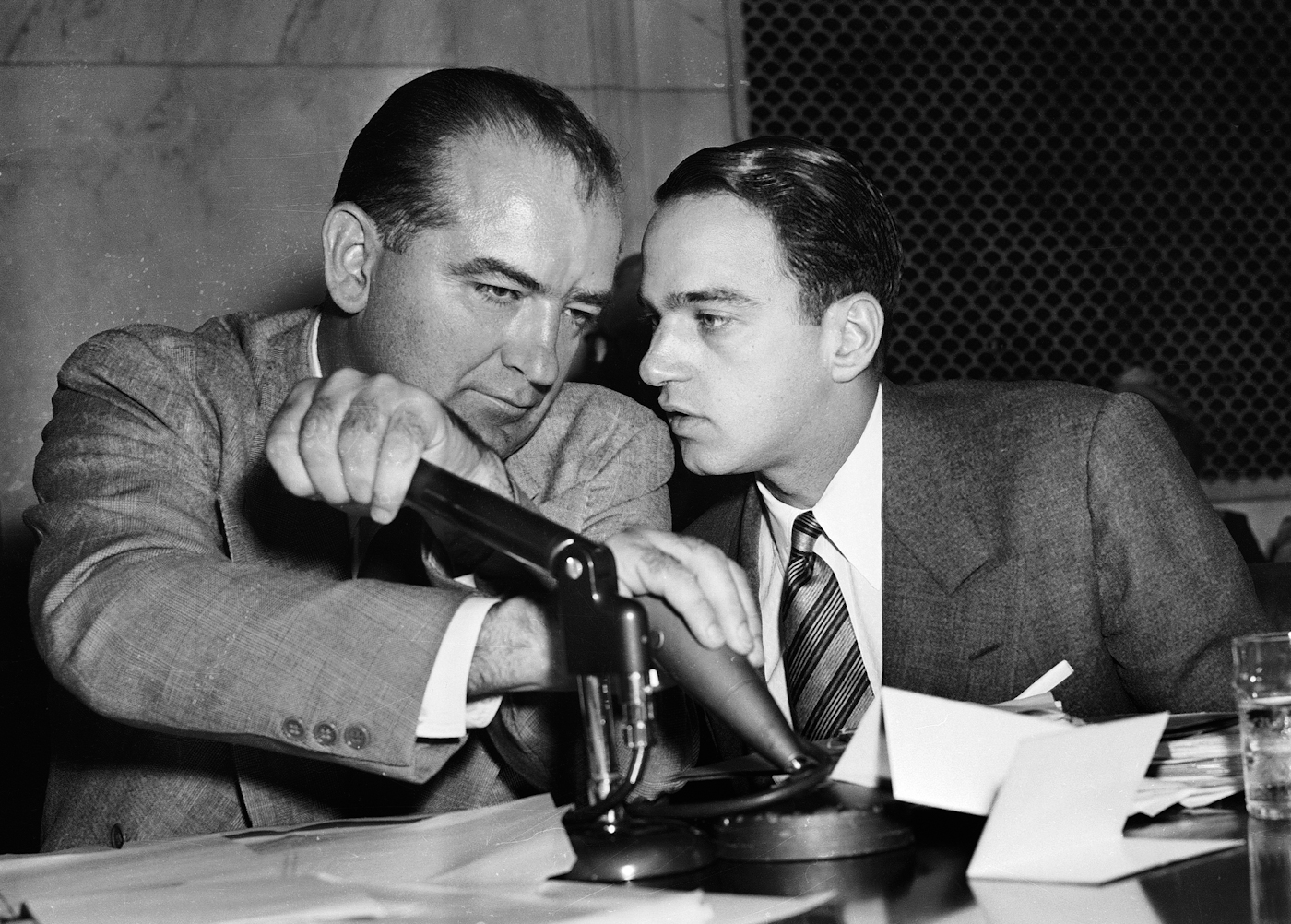
McCarthy covers the mic while having a whispered discussion with Cohn during a 1954 committee hearing. Photo | AP
Though Cohn was ruthless and seemingly untouchable as McCarthy’s counsel and helped the Senator destroy many careers during both the red and lavender scares, his antics in relation to his work on the committee would eventually lead to his downfall after he attempted to blackmail the Army in return for preferential treatment for committee consultant and Cohn’s rumored lover, David Schine.
After he was forced to leave McCarthy’s side due to the scandal, Cohn returned to New York to live with his mother and practice law. A few years later New York Judge David Peck, a long-time associate of former CIA director Alan Dulles, orchestrated Cohn’s hire to the New York law firm, Saxe, Bacon and O’Shea, which would later become Saxe, Bacon and Bolan after Tom Bolan, a friend of Cohn’s, became a partner in the firm. Upon his hire, Cohn brought the firm a slew of mafia-linked clients, including high-ranking members of the Gambino crime family, the Genovese crime family and, of course, Lewis Rosenstiel.
What happened in Suite 233?
The connections Roy Cohn built during the 1950s made him a well-known public figure and translated into great political influence which peaked during the presidency of Ronald Reagan. Yet, as Cohn built his public image, he was also developing a dark private life which would come to be dominated by the same blackmail pedophile racket that appears to have first begun with Lewis Rosenstiel.
One of the “blackmail” parties Susan Kaufman attended with her then-husband Lewis Rosenstiel was hosted by Cohn in 1958 at Manhattan’s Plaza Hotel, suite 233. Kaufman described Cohn’s suite as a “beautiful suite… all done in light blue.” She described being introduced to Hoover, who was in drag, by Cohn, who told her that Hoover’s name was “Mary” in a fit of barely concealed laughter. Kaufman testified that young underage boys were present and Kaufman claimed that Cohn, Hoover and her ex-husband engaged in sexual activity with these minors.
New York attorney John Klotz, tasked with investigating Cohn for a case well after Kaufman’s testimony, also found evidence of the “blue suite” at the Plaza Hotel and its role in a sex extortion ring after combing through local government documents and information gathered by private detectives. Klotz later told journalist and author Burton Hersh what he had learned:
Roy Cohn was providing protection. There were a bunch of pedophiles involved. That’s where Cohn got his power from — blackmail.”
Perhaps the most damning confirmation of Cohn’s activities in Suite 233 comes from statements made by Cohn himself to former NYPD detective and ex-head of the department’s Human-Trafficking and Vice-related Crimes division, James Rothstein. Rothstein later told John Decamp, a former Nebraska state senator who investigated a government-connected child sex ring based in Omaha, among other investigators, that Cohn had admitted to being part of a sexual blackmail operation targeting politicians with child prostitutes during a sit-down interview with the former detective.
Rothstein told John DeCamp the following about Roy Cohn:
Cohn’s job was to run the little boys. Say you had an admiral, a general, a congressman, who did not want to go along with the program. Cohn’s job was to set them up, then they would go along. Cohn told me that himself.”
Rothstein later told Paul David Collins, a former journalist turned researcher, that Cohn had also identified this sexual blackmail operation as being part of the anti-communist crusade of the time.
The fact that Cohn, per Rothstein’s recollection, stated that the child-sex blackmail ring was part of the government-sponsored anticommunist crusade suggests that elements of the government, including Hoover’s FBI, may have been connected at a much broader level than Hoover’s own personal involvement given that the FBI closely coordinated with McCarthy and Cohn for much of the red scare.
It is also worth noting that among Hoover’s many “secret” blackmail files was a sizeable dossier on Senator McCarthy, the contents of which strongly suggested that the Senator himself was interested in underage girls. According to journalist and author David Talbot, Hoover’s file on McCarthy was “filled with disturbing stories about McCarthy’s habit of drunkenly groping young girls’ breasts and buttocks. The stories were so widespread that they became ‘common knowledge’ in the capital, according to one FBI chronicler.”
Talbot, in his book The Devil’s Chessboard, also cites Walter Trohan, Washington Bureau Chief of the Chicago Tribune, as having personally witnessed McCarthy’s habit of molesting young women. “He just couldn’t keep his hands off young girls,” Trohan would later say. “Why the Communist opposition didn’t plant a minor on him and raise the cry of statutory rape, I don’t know.” Perhaps the answer lies in the fact that those “planting” minors on their political foes were McCarthy’s allies and close associates, not his enemies.
The question that necessarily arises from revelations regarding Cohn’s activities in Suite 233 is who else was Cohn “protecting” and servicing with underage prostitutes? One of them could very well have been one of Cohn’s close friends and clients, Cardinal Francis Spellman of the Archdiocese of New York, who was said to have been present at some of these parties Cohn hosted at the Plaza Hotel.
Spellman, one of the most powerful figures in the Catholic Church in North America who was sometimes referred to as “America’s Pope” was accused of not only condoning pedophilia in the Catholic church and ordaining known pedophiles including Cardinal Theodore “Uncle Teddy” McCarrick, but also engaging in it himself to such an extent that many New York area priests widely referred to him as “Mary.” Furthermore, J. Edgar Hoover was said to have a file detailing the Cardinal’s sex life, suggesting Spellman’s involvement in the ring and pedophile protection racket in which Cohn and Hoover were personally involved.
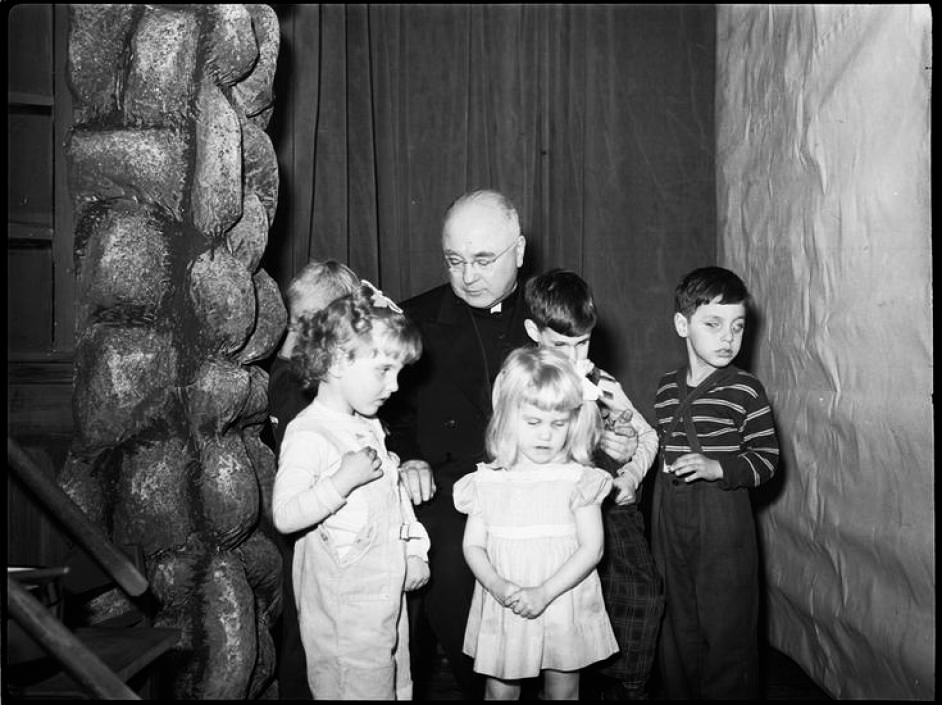
Cardinal Francis ‘Franny’ Spellman. Photo | Museum of the City of New York
People close to Cohn often remarked that he was frequently surrounded by groups of young boys, but seemed to think nothing of it. Similar off-handed comments about Epstein’s penchant for minors were made by those close to him prior to his arrest.
Controversial Republican political operative and “dirty trickster” Roger Stone, who — like Donald Trump — was also a protégé of Cohn, said the following about Cohn’s sex life during an interview with The New Yorker in 2008:
Roy was not gay. He was a man who liked having sex with men. Gays were weak, effeminate. He always seemed to have these young blond boys around. It just wasn’t discussed. He was interested in power and access.” (emphasis added)
Compare this quote from Stone to what Donald Trump, who was also close to Cohn, would later say about Jeffrey Epstein, with whom he was also closely associated:
I’ve known Jeff for 15 years. Terrific guy. He’s a lot of fun to be with. It is even said that he likes beautiful women as much as I do, and many of them are on the younger side. No doubt about it — Jeffrey enjoys his social life.” (emphasis added)
Though it is unknown how long the sex ring at the Plaza Hotel continued, and if it continued after Cohn’s death from AIDS in 1986, it is worth noting that Donald Trump purchased the Plaza Hotel in 1988. It would later be reported and confirmed by then-attendees that Trump “used to host parties in suites at the Plaza Hotel when he owned it, where young women and girls were introduced to older, richer men” and “illegal drugs and young women were passed around and used.”
Andy Lucchesi, a male model who had helped organize some of these Plaza Hotel parties for Trump said the following when asked about the age of the women present: “A lot of girls, 14, look 24. That’s as juicy as I can get. I never asked how old they were; I just partook. I did partake in activities that would be controversial, too.”
The Roy Cohn Machine
Roy Cohn was only at the beginning of his career when he waded his way into the underground sexual blackmail ring apparently led by Lewis Rosenstiel. Indeed, when Cohn first met Hoover, he was only 23 years old. Over the next three decades or so, before his death from AIDS-related complications in 1986 at the age of 56, Cohn built a well-oiled machine, largely through his close friendships with some of the country’s most influential figures.
Among Cohn’s friends were top media personalities like Barbara Walters, former CIA directors, Ronald Reagan and wife Nancy, media moguls Rupert Murdoch and Mort Zuckerman, numerous celebrities, prominent lawyers like Alan Dershowitz, top figures in the Catholic Church and leading Jewish organizations like B’nai B’rith and the World Jewish Congress. Many of the same names that surrounded Cohn until death in the late 1980s would later come to surround Jeffrey Epstein, with their names later appearing in Epstein’s now-infamous “little black book”.
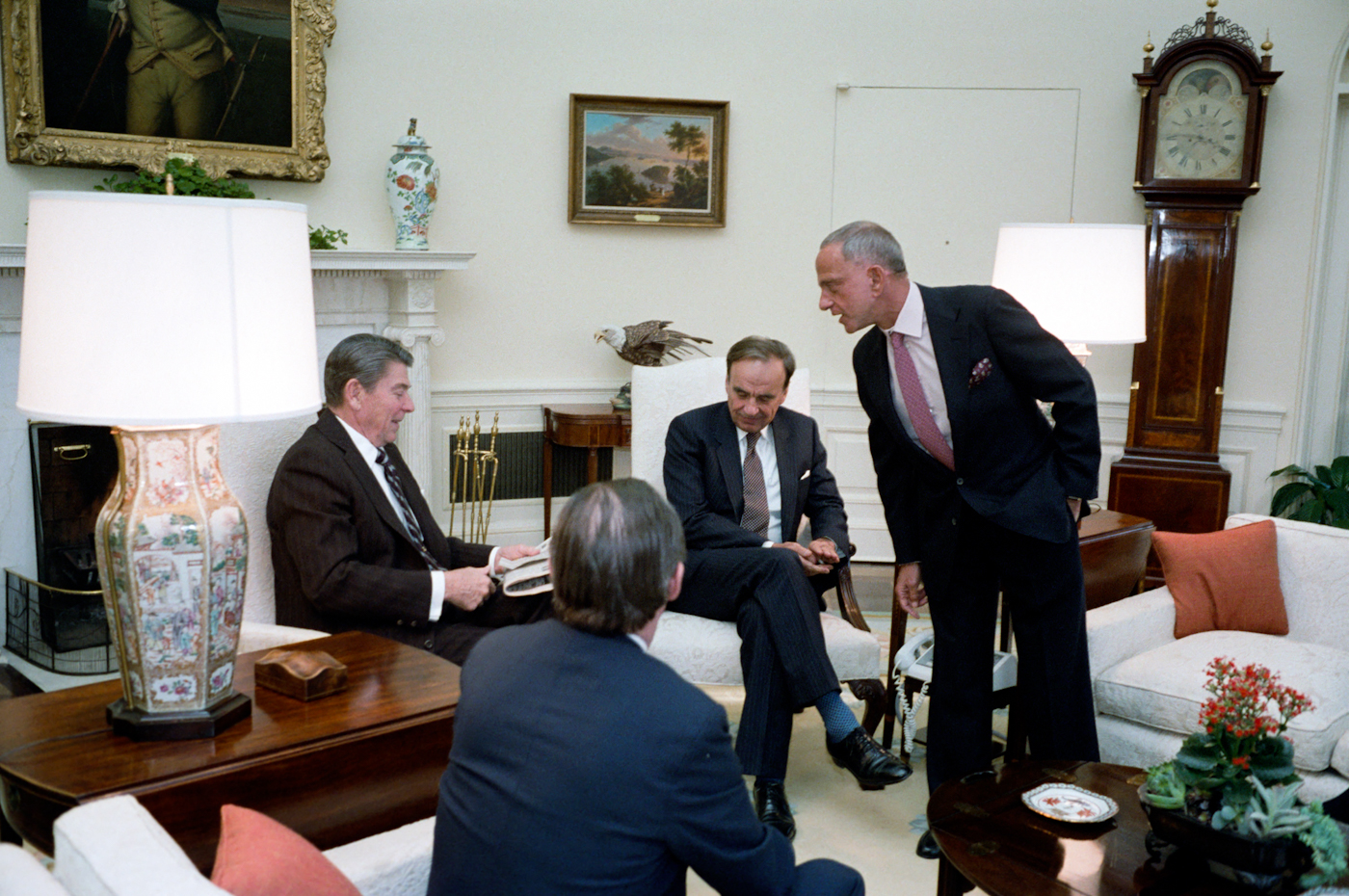
Reagan meets with Rupert Murdoch, U.S. Information Agency Director Charles Wick, and Roy Cohn in the Oval Office in 1983. Photo | Reagan presidential library
While President Trump is clearly connected to both Epstein and Cohn, Cohn’s network also extends to former President Bill Clinton, whose friend and longtime political advisor, Richard “Dirty Dick” Morris, was Cohn’s cousin and close associate. Morris was also close to Clinton’s former communications director, George Stephanopoulos, who is also associated with Jeffrey Epstein.
Yet, these were only Cohn’s connections to respectable members of the establishment. He was also known for his deep connections to the mob and gained prominence largely for his ability to connect key figures in the criminal underworld to respected influential figures acceptable to the public sphere. Ultimately, as New York attorney John Klotz stated, Cohn’s most powerful tool was blackmail, which he used against friend and foe, gangster or public official alike. How much of that blackmail he acquired through his sexual blackmail operation will likely never be known.
As Part II of this exclusive investigation will reveal, Cohn and Epstein, and the sexual blackmail operations they ran share many things in common, including not only many of the same famous friends and patrons, but also connections to intelligence agencies and consortiums of mob-linked businessmen, the modern-day equivalents of Samuel Bronfman and Lewis Rosenstiel who have since rebranded as “philanthropists.”
Part II will also reveal that Cohn’s operation was known to have successors, as revealed by a series of scandals in the early 1990s that have since been swept under the rug. The significant amount of overlap between Epstein’s and Cohn’s covert activities in sexual blackmail and their ties to many of the same powerful individuals and circles of influence strongly suggest that Epstein was one of Cohn’s successors.
As will be shown in the final installment of this report, Epstein is only the latest incarnation of a much older, more extensive and sophisticated operation that offers a frightening window into how deeply tied the U.S. government is to the modern-day equivalents of organized crime, making it a racket truly too big to fail.
Whitney Webb is a MintPress News journalist based in Chile. She has contributed to several independent media outlets including Global Research, EcoWatch, the Ron Paul Institute and 21st Century Wire, among others. She has made several radio and television appearances and is the 2019 winner of the Serena Shim Award for Uncompromised Integrity in Journalism.
VIPS Memo to the President: Is Pompeo’s Agenda the Same As Yours?
VIPS says its direct experience with Mike Pompeo leaves them with strong doubt regarding his trustworthiness on issues of consequence to the President and the nation.
DATE: June 21, 2019
MEMORANDUM FOR: The President.
FROM: Veteran Intelligence Professionals for Sanity (VIPS)
SUBJECT: Is Pompeo’s Agenda the Same As Yours?
We are concerned that you are about to be mousetrapped into war with Iran. You have said you do not want such a war (no sane person would), and the observations below are based on that premise. In a word, we have serious doubts about Secretary Pompeo; it is clear to us that he has his own agenda, and we know from our own experience with him that his agenda is not always the same as yours.
Pompeo’s behavior betrays a strong desire to respond with military force — perhaps even without your express approval — to Iranian provocations (real or imagined), with no discernible strategic goal other than to curry favor with Israel and Saudi Arabia. He is a neophyte compared to his anti-Iran partner John Bolton, whose decades-long dilettante approach to interpreting intelligence, strong advocacy of the misbegotten war on Iraq (and continued pride in its “success”), and fierce pursuit of his own aggressive agenda are a matter of record. Not so with Pompeo, who has now taken the lead on Iran.
Our direct experience with Pompeo leaves us with strong doubt regarding his trustworthiness on issues of consequence to you and the country, including the issue of alleged Russian hacking into the DNC. The sketchy evidence adduced for that story has now completely crumbled, thanks to some unusual candor from the Department of Justice. We refer to the extraordinary revelation in a recent DOJ Court filing that James Comey never required a final report from the DNC-hired cybersecurity company, CrowdStrike, upon which Comey chose to rely for forensics on alleged Russian “hacking.”
Pompeo could have exposed this key lacuna in mid-2017, if he had done what you asked him to do.
In our Memorandum to you of July 24, 2017 entitled “Was the ‘Russian Hack’ an Inside Job?,” we suggested:
“You may wish to ask CIA Director Mike Pompeo what he knows about this.[“This” being the evidence-deprived allegation that “a shadowy entity with the moniker ‘Guccifer 2.0’ hacked the DNC on behalf of Russian intelligence and gave DNC emails to WikiLeaks.”] Our own lengthy intelligence community experience suggests that it is possible that neither former CIA Director John Brennan, nor the cyber-warriors who worked for him, have been completely candid with their new director regarding how this all went down.”
Three months later, Director Pompeo invited William Binney, one of VIPS’ two former NSA technical directors, and a co-author of our July 24, 2017 Memorandum, to CIA headquarters to discuss our findings. On October 24, 2017, Pompeo began an hour-long meeting with Binney explaining the genesis of the unusual invitation: “You are here because the President told me that if I really wanted to know about Russian hacking I needed to talk to you.”
But Did Pompeo “Really Want to Know”?
Apparently not. Binney, a widely respected, plain-spoken scientist, began by telling Pompeo that his (CIA) people were lying to him about Russian hacking and that he (Binney) could prove it. As we explained in our most recent Memorandum for you Pompeo reacted with disbelief and — now get this — tried to put the burden on Binney to pursue the matter with the FBI and NSA.
As for Pompeo, there is no sign he followed up with anyone, including his own CIA cyber sleuths. Pompeo had been around intelligence long enough to realize the risks entailed in asking intrusive questions of his subordinates in the Directorate of Digital Innovation, which was created by CIA Director John Brennan in 2015. CIA malware and hacking tools are built by the Engineering Development Group, part of that relatively new Directorate. (It is a safe guess that offensive cybertool specialists from that Directorate were among those involved in the reported placing of “implants” or software code into the Russian grid, about which The New York Times claims you were not informed.)
If Pompeo failed to report back to you on the conversation you instructed him to have with Binney, you might ask him about it now (even though the flimsy evidence of Russia hacking the DNC has now evaporated, with Binney vindicated). There were two note-takers present, and there is also a good chance the session was also recorded, should Pompeo have difficulty remembering.
Whose Agenda?
The question is whose agenda Pompeo was pursuing — yours or his own. Binney had the impression Pompeo was simply going through the motions — and disingenuously, at that. If he “really wanted to know about Russian hacking,” he would have acquainted himself with the conclusions that VIPS, with Binney in the lead, had reached in mid-2017.
Had he pursued the matter seriously with Binney, we might not have had to wait until the Justice Department itself put nails in the coffin of Russiagate, CrowdStrike, and Comey. In sum, Pompeo could have prevented two additional years of “everyone knows that the Russians hacked into the DNC.” Why did he not?
Pompeo is said to be a bright fellow — Bolton, too. Recent history, though, shows that an Ivy League pedigree can spell disaster in affairs of state. Think of President Lyndon Johnson’s national security adviser, former Harvard Dean McGeorge Bundy, for example, who sold the Tonkin Gulf Resolution to Congress authorizing war in Vietnam based on what he knew was a lie. Millions dead.
Bundy was to LBJ as John Bolton is to you, and it is a bit tiresome watching Bolton brandish his Yale senior ring at every podium. Think, too, of Princeton’s own Donald Rumsfeld concocting and pushing the fraud about Iraqi weapons of mass destruction to “justify” war on Iraq, assuring us all the while that “the absence of evidence is not evidence of absence.”
That dictum is anathema to William Binney, who has shown uncommon patience answering a thousand evidence-free “What if’s” over the past three years. Binney’s shtick? The principles of physics, applied mathematics, and the scientific method. He is widely recognized for his uncanny ability to use these to excellent advantage in separating the chaff from the wheat. No Ivy pedigree wanted or needed.
Binney describes himself as a “country boy” from western Pennsylvania. He studied at Penn State and became a world renowned mathematician/cryptologist as Technical Directorate NSA. Binney’s accomplishments are featured in documentary on YouTube, “A Good American.”
For the Steering Groups of Veteran Intelligence Professionals for Sanity and Sam Adams Associates for Integrity in Intelligence:
Marshall Carter-Tripp, Foreign Service Officer & former Division Director in the State Department Bureau of Intelligence and Research (ret.)
Bogdan Dzakovic, former Team Leader of Federal Air Marshals and Red Team, FAA Security (ret.) (associate VIPS)
Philip Giraldi, CIA, Operations Officer (ret.)
Mike Gravel, former Adjutant, top secret control officer, Communications Intelligence Service; special agent of the Counter Intelligence Corps and former United States Senator
John Kiriakou, former CIA Counterterrorism Officer and former Senior Investigator, Senate Foreign Relations Committee
Karen Kwiatkowski, former Lt. Col., US Air Force (ret.), at Office of Secretary of Defense watching the manufacture of lies on Iraq, 2001-2003
Clement J. Laniewski, LTC, U.S. Army (ret.) (associate VIPS)
Linda Lewis, WMD preparedness policy analyst, USDA (ret.) (associate VIPS)
Ray McGovern, former US Army infantry/intelligence officer & CIA presidential briefer (ret.)
Elizabeth Murray, former Deputy National Intelligence Officer for the Near East & CIA political analyst (ret.)
Todd E. Pierce, MAJ, US Army Judge Advocate (ret.)
Sarah Wilton, Commander, U.S. Naval Reserve (ret.) and Defense Intelligence Agency (ret.)
Ann Wright, U.S. Army Reserve Colonel (ret) and former U.S. Diplomat who resigned in 2003 in opposition to the Iraq War
Originally posted at Consortium News.
US NED-Funded Meddling Exposed in The Philippines

By Joseph Thomas – New Eastern Outlook – 21.06.2019
With little else to offer the nations of Southeast Asia, the US has opted instead to wield the familiar and well-honed weapon of political subversion to peel potential partners away from Beijing in Washington’s continued bid to rescue its waning primacy in Asia-Pacific.
The most recent manifestation of this can be seen in the Philippines where Manila has accused media front Rappler, founded by long-time CNN bureau chief Maria Ressa, and others of representing foreign interests and conspiring with foreign intelligence agencies in direct violation of the nation’s constitution.
The Committee to Protect Journalists (CPJ) in its defense of Rappler would claim:
First were the politically motivated state charges that funding provided to the news website Rappler by a U.S. philanthropic foundation represented a violation of constitutional provisions barring foreign control or ownership of Philippine media.
Then came government allegations in April that journalists from independent media groups, including Rappler, the independent media organization VERA Files, and the non-profit Philippine Center for Investigative Journalism, were involved in a conspiracy to discredit and oust President Rodrigo Duterte’s elected government. All four outlets issued statements denying the allegation.
Now, a pro-government media campaign claims that the same independent news outlets and the Philippine press freedom group Center for Media Freedom and Responsibility are in the pay of the U.S. Central Intelligence Agency (CIA), a potential criminal offense under local law.
The CPJ notes that all of the accused groups are openly and admittedly funded by the US government via the National Endowment for Democracy (NED). The CPJ admits (my emphasis):
All four outlets receive substantial grants from the NED.
Funded largely by Congress, NED was founded in the early 1980s as a way for the U.S. to openly promote democracy worldwide by providing annual grants to non-governmental groups, according to its website.
The CPJ categorically fails to challenge what are the NED’s own assertions that it is merely “promoting democracy worldwide.”
NED: The Public Face of (Often Violent) US Regime Change
The NED’s board of directors includes individuals openly involved in US-backed regime change including in Iraq, Ukraine and ongoing US regime change efforts in Venezuela.
Board members including Francis Fukuyama and Elliott Abrams openly advocated the US invasion of Iraq in 2003 in which the government in Baghdad was toppled and its senior leadership murdered based entirely on now verified lies regarding supposed “weapons of mass destruction.”
Elliott Abrams is listed on the NED’s website as “On Leave,” having been appointed as a US special envoy for Venezuela amid ongoing efforts to overthrow the government there.
The Guardian in an article titled, “US diplomat convicted over Iran-Contra appointed special envoy for Venezuela: Elliott Abrams, who was linked to failed coup against Chávez, to join Pompeo to urge security council to recognize Guaidó as head,” would report:
Elliott Abrams was appointed US special envoy for Venezuela on Friday, as Donald Trump’s administration and European leaders on Saturday further increase the pressure on the socialist president, Nicolás Maduro, to step aside from leading the country he has taken into a deepening crisis.
Abrams will accompany the US secretary of state, Mike Pompeo, to a meeting of the UN security council in New York on Saturday, during which Pompeo will urge members to join the US in declaring Venezuela’s opposition leader Juan Guaidó as the legitimate head of state.
The Guardian also notes:
Abrams is widely remembered in Central America, but particularly from his time in the Reagan administration, when he tried to whitewash a massacre of a thousand men, women and children by US-funded death squads in El Salvador, when he was assistant secretary of state for human rights.
Other NED directors include Victoria Nuland who played a key role in leading US regime change efforts in Ukraine in 2014.
Reuters in its article, “Leaked audio reveals embarrassing U.S. exchange on Ukraine, EU,” would admit:
A conversation between a State Department official and the U.S. ambassador to Ukraine that was posted on YouTube revealed an embarrassing exchange on U.S. strategy for a political transition in that country, including a crude American swipe at the European Union.
The article also admitted:
The audio clip, which was posted on Tuesday but gained wide circulation on Thursday, appears to show the official, Assistant Secretary of State Victoria Nuland, weighing in on the make-up of the next Ukrainian government.
The convergence of senior US representatives openly and repeatedly involved in (often violent) regime change most certainly involving the CIA among myriad other US organisations within the halls of the NED is no coincidence.
The NED exists to promote regime change worldwide, merely under the guise of “promoting democracy worldwide.”
The CPJ Defends US-funded Subversion Under Guise of “Press Freedom”
The CPJ failed categorically to inform readers of facts surrounding the true nature of NED and its activities in its defence of Rappler.
This however should come as no surprise. The CPJ itself is yet another shell organisation likewise funded by US corporate foundations for the purpose of promoting US interests. The CPJ does this by protecting fronts like Rappler under the guise of “press freedom” from the repercussions of engaging in US government-funded subversion.
Fronts like Rappler serve as a propaganda “sword” while the CPJ exists as a “shield” to block efforts by targeted nations to defend themselves.
The CPJ in its 2018 annual report (.pdf) is admittedly funded by corporate foundations like convicted financial criminal George Soros’ Open Society Foundation, US corporations like pharmaceutical giant Pfizer and tech giants Twitter, Microsoft and Yahoo, financial institutions like Mastercard and Morgan Stanley and mainstays of Western media including Reuters, Vice, NPR, PBS, Time, the Washington Post, the New York Times, the Wall Street Journal and NBC.
Many of these interests funding the CPJ are involved in activities at the NED. Anne Applebaum, for example, is a senior columnist at the above mentioned Washington Post and serves as an NED director.
The CPJ’s defence of Rappler continues, claiming:
Manila Times columnist Yen Makabenta, in an April 30 op-ed, called for the enactment of a foreign agents registration law to “tame in a hurry the intrusive criticism and interference in national affairs by these foreign-funded [media] organizations, whose activities are subversive by design.” Makabenta continued, “Indeed, if they are working for a group like the CIA, they could be working to change the government.”
CPJ has chronicled how governments, including in Russia and China, have passed laws that require bloggers, journalists and civil society members to register as foreign agents in moves that threaten to obstruct the free flow of information, including over social media. Makabenta’s op-ed suggested the Philippines should implement similar legislation.
The U.S. government has denied the CIA is involved in any destabilization plot against Duterte. The U.S. ambassador responded to the claims by saying, “There is absolutely no effort by the CIA to undermine the Philippines leadership,” according to reports.
Makabenta’s fears are well-founded.
Even at a glance the NED’s board of directors reflects the organisation’s role in fueling regime change worldwide. NED-funded media fronts are demonstrably biased and transparent in their efforts to undermine targeted governments and to promote US-favoured politicians, political parties and opposition groups.
The Philippines’ Punishment for Building Bridges with Beijing
Philippine President Rodrigo Duterte has demonstrated a pattern of disobedience toward Washington, having previously threatened to expel US forces from Philippine territory, building closer ties with Beijing and even excluding Washington from bilateral talks held with Beijing seeking solutions to disputes over the South China Sea.
For all of these reasons and more, President Duterte and others throughout the Philippines’ establishment have become targets of US-backed subversion, the public face of which being NED-funded media fronts like Rappler.
A similar pattern can be seen throughout Southeast Asia with NED-funded fronts like Prachatai, iLaw, Isaan Record and Benar News targeting the current Thai government headed by a Beijing-friendly military-led faction that twice ousted US proxy Thaksin Shinawatra and his political allies from power.
It is difficult to say how long organisations like the CPJ can continue successfully defending fronts like Rappler under the guise of defending “press freedom.” Only the CPJ’s intentional omission of facts like the nature of the NED’s board of directors and its extensive history of regime change allows the CPJ to portray its defense of Rappler and others taking NED funds as credible.
Were the CPJ truly dedicated to defending press freedom it would note the danger of foreign-funded sedition dressed up as journalism and alert the public to how this above all else threatens to undermine a free press. Instead, the CPJ defends this abuse, thus ironically undermining genuine press freedom in the process.
Should the Philippines enact an effective foreign agents registration law, other nations in the region might follow, delivering a severe blow to US meddling and pose as a further setback to US ambitions to reassert itself vis-à-vis China.
With the US unable to compete with China’s infrastructure-centred regional partnerships, and even lagging behind in the sale of military hardware, security partnerships and investments, political subversion is the last tool on offer. But maybe taking this last tool away from Washington could be a blessing in disguise. Without it, perhaps Washington will reevaluate other, more constructive methods of engaging with Asia-Pacific (and the rest of the world) based on mutual respect and benefits and above all, upon the primacy of national sovereignty.
Joseph Thomas is chief editor of Thailand-based geopolitical journal, The New Atlas.
Featured Video
US IRAN TALKS: Who Are the Crazy Ones Here? /Lt Col Daniel Davis
or go to
Aletho News Archives – Video-Images
From the Archives
Woolsey Fire started at Santa Susana Field Lab — where “radioactive materials released were never accurately measured”
By John Laforge | CounterPunch | November 30, 2018
In my Nov. 16 column, I reported on potential radiation risks posed by California’s Woolsey wildfire having burned over parts or all of the Santa Susana Field Laboratory—south of Simi Valley, Calif., 30 miles outside Los Angeles—site of at least four partial or total nuclear reactor meltdowns.
The field laboratory operated 10 experimental reactors and conducted rocket engine tests. In his 2014 book Atomic Accidents, researcher James Mahaffey writes, “The cores in four experimental reactors on site … melted.” Reactor core melts always result in the release of large amounts of radioactive gases and particles. Clean up of the deeply contaminated site has not been conducted in spite of a 2010 agreement.
Los Angeles’s KABC-7 TV reported Nov. 13 that the Santa Susana lab site “appears to be the origin of the Woolsey Fire” which has torched over 96,000 acres. Southern Calif. Public Radio said, “According to Cal Fire, the Woolsey Fire started on the afternoon of Thursday, Nov. 8 … on the Santa Susana site.” … continue
Blog Roll
 Aletho News
- US IRAN TALKS: Who Are the Crazy Ones Here? /Lt Col Daniel Davis
- Talks with the US end without a deal over excessive US demands: Iran
- Feeling Better, Getting Worse: How Psychiatric Drugs Create the Illusion They Cure
- ‘Nobody Told Me’: Former Mental Health Patient Calls Out Dangerous Side Effects of Psychiatric Drugs
- Dr. Abu-Sitta: Beirut ‘felt like a day in Shifa Hospital’
- Iran Has Won the War, It Will Be Up to the US to Secure the Peace: Mohammad Marandi
- Iran condemns assassination threats against Iranian negotiators amid US talks
- Brussels cannot say where its own pipeline inspectors are as Hungary’s oil lifeline remains shut
- Israel’s Iran War: Myth and Reality
- Between war and industrial breakdown: The US-Israeli attrition crisis
- If Americans Knew
- Pro-Israel ‘Thinktanks’ and Individuals who Influence U.S. Foreign Policy
- Mearsheimer reveals how Israel dictates US policies on Iran, Gaza – video
- After killing 350+, Israel still has a “score to settle” with Lebanon before ceasefire – Daily Update
- Military aid to Israel emerges as the latest political litmus test for Democrats
- The only Palestinian children’s rights organization closes following years-long Israeli campaign against it
- ‘I Can’t Forget the Smell’: Lebanese Reel After Israel Kills Over 300 in Single Day
- DNC Shoots Down Resolutions Calling Out AIPAC and Limiting Arms to Israel
- TCN: Is Israel Blackmailing President Trump?
- Israel killed at least 303 Lebanese yesterday – who were they? Daily Update
- Amnesty: Urgent – Protect Lebanese civilians from brutal escalation in Israeli attacks
- No Tricks Zone
- German Expert: Heat Dome Led To Record Temps In Western USA…Warmer In 1934, 1936
- New Study: No Linear Warming Or Glacier Retreat Along Northern Antarctic Peninsula Since 1980s
- An Inconvenient Tree: Uncovered In Alps… Europe Much Warmer Than Today 6000 Years Ago
- New Study Reports A 60% Slowdown In Greenland’s Ice Loss Rate In The Last Decade
- Low Intensity Tornado Wrecks Major Solar Farm, Creating A Potential Toxic Dump
- New Study Finds Warming Saves Lives…Cold Temperatures 12 Times More Deadly Than Excess Heat
- German Science Blog Accuses PIK Climate Institute Of Hallucinating Climate Tipping Points
- Devastating Assessment Of Comirnaty Vaccine By Former Senior Pfizer Europe Toxicologist
- New Study: CO2 Is ‘Effectively Negligible’ As An Explanatory Climate Change Factor Since 2000
- Former Pfizer Toxicologist Dr. Helmut Sterz Tells Bundestag Hearing Pfizer Vaccine Should Have Never Been Approved
 Aletho News