Deep Blue State: Democrats fielding unprecedented number of ex-CIA candidates
RT | March 9, 2018
Democrats are running a surprising number of former spies in competitive districts in the US 2018 midterms. If successful, as many as half of all new congressional Democrats could come from the national security apparatus.
One quarter of all the Democratic challengers in competitive House of Representative districts have intelligence, State Department or National Security Council backgrounds. This is the revelation of an analysis conducted by the World Socialist Web Site, which reviewed Federal Election Commission reports filed by all the Democratic candidates in 102 competitive House districts. The report reviewed the campaign websites of challengers, which provided their biographical details.
The mere presence of CIA alumni among the Democratic candidates is not news per se: the Washington Post praised it back in October 2017, saying that CIA Democrats were “alarmed by President Trump and galvanized by Russian interference in the 2016 election.”
The sheer number of candidates with a national security background is new, however. Of the 102 primary elections to choose the Democratic nominees in these competitive districts, 44 involve candidates with a “military-intelligence” or State Department background, with 11 districts having two such candidates, and one district having three. The WSWS analysis revealed that 57 candidates claim to have been national security operatives, compared to the 45 who were state and local government officials or the 35 lawyers.
Democrats believe fielding ex-intelligence personnel in tight congressional races will project an impression of pragmatism and efficiency which could sweep up GOP votes, the analysis says.
The report takes a ‘military-intelligence’ background to mean those who formerly had an operational role in the CIA, Pentagon, National Security Council or State Department.
Elissa Slotkin, a former CIA operative and Iraq director for the National Security Council, is one such Democrat hopeful. At the Pentagon she oversaw drone warfare, homeland defense and cyber warfare but is now setting her sights on the Eighth Congressional District of Michigan, a Republican-held seat that the Democrats hope will swing blue in 2018.
Another spook-turned-politico is Jeff Beals, who spent four years as a CIA intelligence officer before moving to the State Department to work on the Middle East in 2002. He’s hoping to oust Republican Rep. John Faso in New York’s Hudson Valley.
He’s not the only spy in that particular race, however. Also hoping to scoop the Democratic nomination for Hudson Valley is Patrick Ryan, who served two combat tours in Iraq and acted as lead intelligence officer for an infantry battalion in Iraq.
Regionally, the Northeast has the highest proportion of military-intelligence candidates seeking Democratic nominations, with 21 of the 31 seats targeted. In the majority of races, the military-intelligence candidates are well placed to win the Democratic nomination, say WSWS.
Democrats have long accused President Donald Trump of being “at war” with the US intelligence community, after he refused to unquestioningly accept the January 2017 report by the Office of the Director of National Intelligence (ODNI) accusing Russia of meddling in the 2016 presidential election, but offering no evidence for the claim.
Senate Minority Leader Chuck Schumer (D-New York) went so far as to warn Trump that he should not cross the spies.
“Let me tell you, you take on the intelligence community, they have six ways from Sunday at getting back at you,” Schumer told MSNBC’s Rachel Maddow in January 2017. “So even for a practical, supposedly hard-nosed businessman, he’s being really dumb to do this.”
During the 2016 election, the so-called NeverTrump wing of the Republican party actually ran an ex-CIA spy Evan McMullin as a spoiler candidate. In the end, he received 700,000 votes nationwide and placed third in Utah.
The Skripal Incident-Another Anti-Russian Provocation
By Christopher Black – New Eastern Outlook – 09.03.2018
The British government is talking war with Russia over a mysterious incident that is claimed to have taken place on Sunday March 4, just a few kilometres from the secrecy shrouded British biological and chemical warfare research and development facility at Porton Down in Wiltshire. I say claimed since we have very little information confirming what exactly took place outside of government statements and we have seen no photographs of the alleged victims in their hospital beds to convince us that the alleged victims did fall ill and are being treated. However, let us assume that the incident as described did take place.
The mystery consists in the fact that the victims, former Russian colonel of military intelligence, Sergei Skripal, and his daughter, were not under any known threat from Russia. Skripal was charged and convicted in Russia in 2006 of being an asset of the British Secret Intelligence Service, MI6, and handing over secret information to the British. He was jailed, but in a spy swap in 2010 was pardoned and allowed to leave Russia for Vienna, then Britain, where he has been living ever since. Why he was pardoned is difficult to determine, unless it was necessary legally to effect the swap with the British. In any even the Russians had washed their hands of him but it seems the British had other uses for him, as their expendable man for a provocation against Russia.
The facts as the British government states them are that Skripal and his daughter, visiting from Russia, met for lunch in Salisbury, the town outside of which Porton Down is located. The purpose of the daughter’s visit is not known. According to ever changing media accounts witnesses in a restaurant reported that Skripal appeared to be agitated and angry and left in that state with his daughter following. Agitated and angry about what we do not know.
Half an hour later it is said that the two of them were found slumped over on a public bench. Some early media accounts state that it was thought they had taken too much fentanyl and were vomiting and that their illness may have been self-induced. But very quickly the British government claimed that they had been poisoned by some chemical or nerve agent and immediately cast the blame on Russia though the investigation had just begun. The incident was immediately taken out of the hands of the local police and handed over to the Counter-Terrorism Police, formerly known as Special Branch, though the government refused to call it a terrorist incident. A meeting of the British government high-level emergency committee, Cobra, was called. Why this was done for what appears to be an assault or attempted murder or a self-induced accident is a good question. But the answer lies in the immediate propaganda campaign mounted in the British press against Russia.
On Thursday the 8th of March the British government claimed that they had identified a “nerve agent” as the substance used. Yet the BBC quotes on the same day a woman physician who attended at the scene saying that she found Mrs. Skripal slumped unconscious on a bench vomiting and fitting. She had lost control of her bodily functions. The physician, who asked not to be named, told the BBC she moved the daughter into the recovery position and opened her airways as others tended to her father. The doctor stated that the she treated her for almost 30 minutes, saying there was no sign of any chemical agent on her face or body and that though she had been worried she would be affected by a nerve agent so far she “feels fine.”
Yet, the British media published on Thursday a photograph of a police officer who they say attended the scene and who they claim was made ill and placed in intensive care but is now stable and recovering. The two stories do not add up, as it would seem the doctor was in closer physical contact with the two victims than the police officer yet the doctor has suffered no symptoms at all.
The Guardian quoted Andrei Lugovoi, another former Russian agent, accused of Litvinenko’s murder by the British as stating that Skripal had been pardoned in Russia so no one from there is after him:
“I don’t rule out that this is another provocation by British. Whatever happens on British territory, they start yelling: ‘He was killed, he was hung, he was poisoned!’ and that Russia is to blame for everything. This is to their advantage.” Igor Sutyagin, yet another Russian traitor flown to Russia in 2010 in an exchange of spies-also said, “I don’t think that Mr. Skripal would be targeted, because he was pardoned.”
To add to the mystery the British government refuses to name the alleged nerve agent. To create more drama the British Home Secretary, Amber Rudd, stated that it was not Sarin or VX but something “very rare.” I think we can expect that they will choose the right dramatic moment to name something and state that only Russian labs can make it. That is their modus operandi. They certainly do not want to state that VX was involved since VX was developed in 1952 at Porton Down near the sight of the incident; for that would lead to necessary investigations into security at that facility and whether personnel there were involved. However, despite the fact that Porton Down is in the business of manufacturing chemical warfare agents including nerve agents and that logic would dictate that the Porton Down authorities would be barred from being investigators into a case in which they could be involved the British government immediately assigned Porton Down to identify the substance that might have been used.
That the Russians may be correct that this incident is another NATO arranged provocation must be seriously considered. Despite the fact there is no evidence whatsoever that Russia had anything to do with this incident, the British government was quick to label Russia as the villain of the piece and the mass media dutifully acted in lock step and put out the word. Boris Johnson called Russia a “malign and disruptive force’ and made threats about pulling the UK out of the World Cup to be held in Russia this year. The attempts by the NATO alliance to throw Russia out of the Olympics on trumped up doping charges were largely successful and now we see another attempt to disrupt a sports event that is important to world football fans and to Russia. Johnson added that Britain would act “robustly’ of Moscow is found to be involved.
The Russian embassy in London stated the allegations of Russian involvement are untrue and that the “script of yet another anti-Russian campaign has already been written.” It seems so and the script has some pages to run yet. One has to wonder what the role of the British intelligence services is in this for the BBC also reports that Skripal still kept the company of British intelligence agents. So one has to ask, for what reason? What was his continuing role as an asset of MI6? What was their role on that day?
But that line of inquiry will not be followed. All the British media are linking this incident to the case of Alexander Litvinenko, another Russian who was supposedly poisoned with radioactive tea. Evidence that cronies of his were involved were ignored in favour the line that Russia was behind it though no evidence has ever been put forward to support that claim. They are also making the claim that this “very rare” substance must be from a state military stockpile, so the statements to come from the British government can be predicted.
This incident has echoes of the case of Georgi Markov, the Bulgarian dissident killed in London in 1978 by a ricin pellet injected into his leg by means of an umbrella it was said, though it was no doubt done with an air pistol. That murder was quickly blamed on the KGB and Bulgarian government agents but there is evidence that in fact the murder was arranged by MI6 as was the murder of media magnate Robert Maxwell in 1991, who had documents relating to the Markov murder in his possession, according sources such as Richard Cottrell in his book Gladio and accounts by former British intelligence agent Gordon Logan.
The Skripal incident also brings to mind the death of Dr. David Kelly in 2003 whose mysterious death in woods near his home, was officially attributed to “suicide.” He is thought by many to have been assassinated by the British secret services and CIA to keep him from revealing secrets about the war in Iraq. He worked at Porton Down as head of microbiology.
He in turn is connected to other scientists at Porton Down who have died under questionable circumstances, for instance, Dr. Richard Holmes, whose body was found in the same woods as Dr. Kelly, in 2012, two days after going for a walk, and one month after resigning from Porton Down, and to Vladimir Pasechnik’s death in November 2001, another Russian defector, who allegedly died of a stroke. His death was not announced until a month later and by British intelligence. Dr. Kelly had been involved in his debriefing when he left Russia.
Sir Edward Leigh, a member of the Parliamentary Defence Committee, in the British Parliament stated, “the circumstantial evidence against Russia is very strong. Who else would have the motive and the means?” The answer to that of course is that the British government has the motive and the means. What would Russia benefit from harming a has-been like Skripal and causing all this fuss? None. What benefit does Britain have and NATO? The answer again is provided by Sir Richard who went on to state “The only way to preserve peace is through strength,” carefully echoing Trump’s foreign policy. He continued, “and if Russia is behind this, this is a brazen act of war, of humiliating our country and defence is the first duty and spending 2% of the budget on defence is not enough.” There is the motive right there. To justify an increase on defence spending and to hit Russia yet again with propaganda warfare to justify NATO’s continuing aggression against Russia.
Russia has volunteered to cooperate in the “investigation” but to what end? The script is already written, the drama will unfold, the consequences will flow and they will lead not to peace and cooperation but to more hostility and war.
Christopher Black is an international criminal lawyer based in Toronto. He is known for a number of high-profile war crimes cases and recently published his novel “Beneath the Clouds.
Establishment alarmed as Trump threatens to gut US ‘democracy promotion’ racket
RT | March 7, 2018
The foreign policy establishment in Washington is crying foul after the Trump administration proposed to cut funding for organizations responsible for “promoting democracy abroad,” often in the guise of color revolutions.
The 2019 State Department budget request cuts the National Endowment for Democracy (NED) budget and separates it from the National Democratic Institute (NDI) and the International Republican Institute (IRI). Funding for the institutes would be moved to the State Department, where NDI and IRI would have to compete with private contractors, according to the Washington Post columnist Josh Rogin, who described the proposal as “an assault not only on their organizations but also on the pro-democracy mission they are dedicated to.”
“If implemented, the proposal would gut the program, force crippling layoffs and the symbolic meaning would also be shattering, sending a signal far and wide that the United States is turning its back on supporting brave people who share our values,” NED President Carl Gershman told Rogin.
“The work our government does to promote democratic values abroad is at the heart of who we are as a country,” Senator John McCain (R-Arizona), chairman of the IRI’s board of directors, told Rogin. The NDI board is chaired by former Secretary of State Madeleine Albright.
McCain actually wrote a letter protesting the proposal to the Office of Management and Budget in December. It was signed by four other senators, including McCain’s close ally Lindsey Graham (R-South Carolina) and Marco Rubio (R-Florida).
Trump’s people “just don’t believe it’s America’s business to push democracy abroad,” Rogin concluded.
His article quickly made the rounds of the Washington establishment circles, where it received praise from former CIA agent and failed presidential candidate Evan McMullin and New Republic columnist Jeet Heer. Nicholas Burns, who served as State Department spokesman under Albright, said the revelations will “make your blood boil.”
.@joshrogin: The Trump administration’s assault on democracy promotion can be expected to continue. Dictatorships are presenting their model as preferable for the developing world. Human rights abuses are rising. Basic freedoms are under attack. https://t.co/IRDT91JZAt
— Evan McMullin (@Evan_McMullin) March 5, 2018
2. Democracy promotion in foreign policy had genuine bipartisan support from Carter to Obama. Trump has broken that consensus.
— Jeet Heer (@HeerJeet) March 6, 2018
This will also make your blood boil. The State Department is giving up on our historic support for democracy promotion that none other than Ronald Reagan pioneered. https://t.co/uQOpWnolme
— Nicholas Burns (@RNicholasBurns) March 5, 2018
It was Burns’s tweet in particular that attracted derision from critics of US foreign policy, such as journalists Glenn Greenwald, Chris Floyd and Jon Schwarz, and former diplomat Peter Van Buren:
This is the kind of blatant, jingoistic historical revisionism that the Trump era has made fashionable again. The idea that the US had been devoted to “democracy promotion” before Trump – and that this was pioneered by tyrant-hugging Reagan – is simply laughable: https://t.co/JrVqWt3CP7
— Glenn Greenwald (@ggreenwald) March 6, 2018
Oh, Mr. Burns, do tell us more about Reagan’s “democracy promotion” with Rios Montt. And did Reagan have a special aide to follow behind him and mop up the innocent blood dripping – pouring – from his hands? Oh, tell us the glorious story, Mr. Burns!
— Chris Floyd (@empireburlesque) March 6, 2018
The confusing thing about Harvard, Yale, etc. is that the job of people working there in the hard sciences actually is to describe reality accurately, whereas the job of many humanities professors like Nicholas Burns is to lie about reality https://t.co/e5EQhQfL5O
— Jon Schwarz (@schwarz) March 6, 2018
Nicky, Nicky… no more day drinking unless you’re going on CNN. Democracy promotion in Nicaragua, Salvador, Guatemala, Lebanon… or maybe Iraq 3x, Afghanistan, Somalia, Pakistan, Libya? What ARE you talking about? https://t.co/D3t2TknjzS
— Peter Van Buren (@WeMeantWell) March 6, 2018
As well as a number of rank-and-file Twitterati:
Libya thanks you for their US installed democracy. The slave market was a bit of a surprise and the fact that there are three waring factions all claiming to be the government, but I’m sure you know what’s best.
— Kropotkin (@DoctorKropotkin) March 7, 2018
Democracy! Promoted! pic.twitter.com/hXnhJsHuxi
— B (@balvertos) March 7, 2018
The NED was founded in 1983, under the Reagan administration. It is theoretically a non-governmental organization, though the bulk of its funding is provided by the US government and American taxpayers. The status has given NED and its institutes plausible deniability against accusations that the US has been meddling in the politics of other countries.
“A lot of what we do today was done covertly 25 years ago by the CIA,” one of the endowment’s founders, Allen Weinstein, told the Washington Post in September 1991.
One example is the wave of “color revolutions,” starting from Serbia in 2000 to the “Arab Spring” revolts of 2011. Ukraine was subjected to this twice, in 2004 and in 2014. During the unrest in Kiev in November 2004, The Guardian’s Ian Traynor described the process, while heaping praise on the people behind it.
“The operation – engineering democracy through the ballot box and civil disobedience – is now so slick that the methods have matured into a template for winning other people’s elections,” Traynor wrote. “The Democratic party’s National Democratic Institute, the Republican party’s International Republican Institute, the US state department and USAid are the main agencies involved in these grassroots campaigns as well as the Freedom House NGO and billionaire George Soros’s open society institute.”
Though campaigns funded by all these external actors are more astroturf than grassroots, there were few objections, as it was all in the name of democracy.
Traynor concluded his 2004 story by saying the “places to watch” were Moldova and Central Asia. Sure enough, the former Soviet republic of Kyrgyzstan went through a “Pink revolution” in February 2005, while the “Grape revolution” took place in Moldova in April 2009.
The Washington establishment’s obsession with democracy may also be explained by the belief that any non-democratic government is automatically anti-Western, as Luis Fleischman of the neoconservative Center for Security Policy argued last month.
If the regime is pro-American, however, it doesn’t matter whether it’s actually democratic or not. On Tuesday, the director of the Foundation for Defense of Democracies Mark Dubowitz tweeted that “inclusive authoritarianism” might be a better fit for Middle Eastern countries, as long as they were “tolerant, respectful of individual liberties & minority rights & pro-American.”
Btw, I said a more “inclusive authoritarianism” *might* be better alternative. Tolerant, respectful of individual liberties & minority rights & pro-American. I suggested should be discussed. So spare me the invective & explain why worse than failed M/E democracies. https://t.co/yQJWKQ5V3z
— Mark Dubowitz (@mdubowitz) March 7, 2018
Read more:
Why Russia’s New Strategic Capabilities Come As a Shock to US Intelligence Community
By Philip M. GIRALDI | Strategic Culture Foundation | 08.03.2018
The United States of America spends something like $80 billion annually on intelligence gathering and analysis. When the CIA was founded by the National Security Act in 1947 the intention was to create a mechanism that would warn about an imminent threat. The memory of Pearl Harbor in 1941, when Japan attacked the U.S. naval base was still fresh, and the legislation was popularized by the slogan “no more Pearl Harbors.”
In spite of the dedication of considerable resources and manpower, there have been some major intelligence failures in the past seventy years, starting with the inability to anticipate the breakout of the Korean War and including the embrace of false intelligence on Saddam Hussein’s alleged weapons of mass destruction. But the most recent failure is perhaps more consequential than either Korea or Iraq.
On March 1st, Russian President Vladimir Putin spoke before his country’s Federal Assembly plus a large group of both local and foreign journalists, outlining his plans for the economy and also dealing with other domestic issues should he be reelected later this month. The final third of the presentation was on national defense and, in its substance, was clearly directed at a global audience, particularly the United States.
He explained:
“During all these years since the unilateral U.S. withdrawal from the ABM Treaty [in 2001] we have been working intensively on advanced equipment and arms, which allowed us to make a breakthrough in developing new models of strategic weapons.”
He was referring to the RS-28 Sarmat ballistic missile, which has almost unlimited range and ultra-high speed, enabling it to employ trajectories including strikes coming over the South Pole that can defeat existing American Anti-Ballistic Defense systems. Russia has also produced and deployed a hypersonic glider weapon system Avangard.
But the real game changer is the Russian ability to negate America’s ability to project power through its navy. The already deployed air-launched Kinzhal anti-ship missile has a range of 2000 kilometers and a hyper-sonic speed that makes it nearly impossible to intercept. The development has made America’s thirteen aircraft carrier groups obsolete. President Putin made clear that Russia now has an overwhelming military advantage in cruise and ballistic missiles that are capable of penetrating U.S. defenses.
The new reality may or may not impel policymakers in Washington to approach Moscow and seek a new round of negotiations for arms control, but the real shock deriving from the Putin announcement is the failure of the intelligence community to anticipate the developments and advise their significance. Some of the new systems were hardly secret, with development of the Sarmat, for example, known to western governments for a number of years.
There will no doubt be a blame game in Washington over the inability to learn of Russia’s arms programs, but the questions that probably will not be asked relate to the intelligence agencies themselves and their capabilities, or lack thereof. It is no secret that organizations like the Central Intelligence Agency (CIA) have seen their basic missions change since 2001. An organization that used to pride itself on its ability to conduct classic espionage operations involving recruiting and running spies suddenly heard from policymakers that those skills were no longer in demand. Many officers who were made redundant or forced to retire were precisely those individuals who had cut their teeth on running operations directed against the old Soviet Union. They had the language and cultural skills necessary to collect information on Russia. With their departure, those capabilities also largely vanished.
Instead of spying, American intelligence agencies working mostly against what was broadly described as “terrorism,” used technology to locate potential targets and kill them. The CIA’s Clandestine Services, once the haven of its spies, became under President Barack Obama, a largely paramilitary operation focused on military solutions rather than espionage. This process was accelerated under Obama’s CIA Director John Brennan, who worked assiduously to reduce the influence of the former spies within the Agency. Brennan reportedly had once wanted to become a spy but was kicked out of the training program as “unsuitable.”
So, has America learned that its intelligence agencies are doing all the wrong things and that the national defense strategy is unsustainable because the Russian-American relationship is now on a new footing? Possibly, but it is perhaps more likely that Washington will avoid asking the hard questions.
‘Progressive’ Journalists Jump the Shark on Russiagate
By Ray McGovern | Consortium News | March 7, 2018

Russiagate’s sensationalist media coverage
Jane Mayer of The New Yorker and Cenk Uygur of The Young Turks are the latest progressives to jump on the anti-Trump, pro-Russiagate bandwagon. They have made it crystal clear that, in Mayer’s words, they are not going to let Republicans, or anyone else, “take down the whole intelligence community,” by God.
Odd? Nothing is too odd when it comes to spinning and dyeing the yarn of Russiagate; especially now that some strands are unraveling from the thin material of the “Steele dossier.”
Before the 2016 election, British ex-spy Christopher Steele was contracted (through a couple of cutouts) by the Clinton campaign and Democratic National Committee to dig up dirt on candidate Donald Trump. They paid him $168,000. They should ask for their money back.
Mayer and Uygur have now joined with other Trump-despisers and new “progressive” fans of the FBI and CIA – among them Amy Goodman and her go-to, lost-in-the-trees journalist, Marcy Wheeler of Emptywheel.net. All of them (well, maybe not Cenk) are staying up nights with needle and thread trying to sew a silk purse out of the sow’s-ear dossier of Steele allegations and then dye it red for danger.
Monday brought a new low, with a truly extraordinary one-two punch by Mayer and Uygur.
A Damning Picture?
Mayer does her part in a New Yorker article, in which she – intentionally or not – cannot seem to see the forest for the trees.
In her article, Mayer explains up front that the Steele dossier “painted a damning picture of collusion between Trump and Russia,” and then goes on to portray him as a paragon of virtue with praise that is fulsome, in the full meaning of that word. For example, a friend of Steele told Mayer that regarding Steele, “Fairness, integrity, and truth, for him, trump any ideology.”
Now, if one refuses to accept this portrait on faith, then you are what Mayer describes as a “Trump defender.” According to Mayer, Trump defenders argue that Steele is “a dishonest Clinton apparatchik who had collaborated with American intelligence and law enforcement officials to fabricate false charges against Trump and his associates, in a dastardly (sic) attempt to nullify the 2016 election. According to this story line, it was not the President who needed to be investigated, but the investigators themselves.”
Can you imagine!
I could not help but think that Mayer wrote her piece some months ago and that she and her editors might have missed more recent documentary evidence that gives considerable support to that “dastardly” story line. But seriously, it should be possible to suspect Steele of misfeasance or malfeasance – or simply telling his contractors what he knows they want to hear – without being labeled a “Trump supporter.” I, for example, am no Trump supporter. I am, however, a former intelligence officer and I have long since concluded that what Steele served up is garbage.
Character References
Mayer reports that Richard Dearlove, head of MI6 from 1999 to 2004, described Steele as “superb.” Personally, I would shun any “recommendation” from that charlatan. Are memories so short? Dearlove was the intelligence chief who briefed Prime Minister Tony Blair on July 23, 2002 after a quick trip to Washington. The official minutes of that meeting were leaked to the London Times and published on May 1, 2005.
Dearlove explained to Blair that President George W. Bush had decided to attack Iraq for regime change and that the war was to be “justified by the conjunction of terrorism and weapons of mass destruction.” Dearlove added matter-of-factly, “The intelligence and facts are being fixed around the policy.”
Another character reference Mayer gives for Steele is former CIA Deputy Director John McLaughlin (from 2000 to 2004) who, with his boss George Tenet, did the fixing of intelligence to “justify” the war on Iraq. State Department intelligence director at the time, Carl Ford, told the authors of “Hubris: The Inside Story of Spin, Scandal, and the Selling of the Iraq War” that both McLaughlin and Tenet “should have been shot” for what they did.
And then there is CIA veteran spy John Sipher who, Mayer says, “ran the Agency’s Russia program before retiring, in 2014.” Sipher tells her he thinks the Steele dossier is “generally credible” in “saying what Russia might be up to.” Sipher may be a good case officer but he has shown himself to be something of a cipher on substance.
Worse still, he displays a distinct inclination toward the remarkable view of former National Intelligence Director James Clapper, who has said that Russians are “typically, almost genetically driven to co-opt, penetrate, gain favor, whatever.” If Mayer wanted to find some ostensibly authoritative figure to endorse the kind of material in Steele’s dossier, she surely picked a good one in Sipher.
Mayer notes, “It’s too early to make a final judgment about how much of Steele’s dossier will be proved wrong, but a number of Steele’s major claims have been backed up by subsequent disclosures. She includes, as flat fact, his claim that the Kremlin and WikiLeaks were working together to release the DNC’s emails, but provides no evidence.
Major Holes
Mayer, however, should know better. There have been lots of holes in the accusation that the Russians hacked the DNC and gave the material to WikiLeaks to publish. Here’s one major gap we reported on Jan. 20, 2017: President Barack Obama told his last press conference on Jan. 18, that the U.S. intelligence community had no idea how the Democratic emails reached WikiLeaks.
Using lawyerly language, Obama admitted that “the conclusions of the intelligence community with respect to the Russian hacking were not conclusive as to whether WikiLeaks was witting or not in being the conduit through which we heard about the DNC e-mails that were leaked.”
It is necessary to carefully parse Obama’s words since he prides himself in his oratorical constructs. He offered a similarly designed comment at a Dec. 16, 2016 press conference when he said: “based on uniform intelligence assessments, the Russians were responsible for hacking the DNC. … the information was in the hands of WikiLeaks.”
Note the disconnect between the confidence about hacking and the stark declarative sentence about the information ending up at WikiLeaks. Obama does not bridge the gap because to do so would be a bald-faced lie, which some honest intelligence officer might call him on. So, he simply presented the two sides of the chasm – implies a connection – but leaves it to the listener to make the leap.
It was, of course, WikiLeaks that published the very damaging Democratic information, for example, on the DNC’s dirty tricks that marginalized Sen. Bernie Sanders and ensured that Secretary of State Hillary Clinton would win the Democratic nomination. What remained to be demonstrated was that it was “the Russians” who gave those emails to WikiLeaks. And that is what the U.S. intelligence community could not honestly say.
Saying it now, without evidence, does not make it true.
Cenk Also in Sync
Cenk Uygur of The Young Turks at once picked up, big time, on the part of Mayer’s article that homes in on an “astonishing” report from Steele in late November 2016 quoting one “senior Russian official.” According to that official, “The Kremlin had intervened to block Trump’s initial choice for secretary of state, Mitt Romney.” Steele’s late November memo alleged that the Kremlin had asked Trump to appoint someone who would be prepared to lift Ukraine-related sanctions and cooperate on security issues like Syria.
Mayer commented, “As fantastical as the memo sounds, subsequent events could be said to support it.” Fantastical or not, Uygur decided to run with it. His amazing 12-minute video is titled: “New Steele Dossier: Putin PICKED Trump’s Secretary of State.” Uygur asks: “Who does Tillerson work for; and that also goes for the President.”
Return to Sanity
As an antidote to all the above, let me offer this cogent piece on the views of Joseph E. diGenova, who speaks out of his unique experience, including as Counsel to the U.S. Senate Select Committee on Intelligence (the Church Committee). The article is entitled: “The Politicization of the FBI.”
“Over the past year,” diGenova wrote, “facts have emerged that suggest there was a plot by high-ranking FBI and Department of Justice (DOJ) officials in the Obama administration, acting under color of law, to exonerate Hillary Clinton of federal crimes and then, if she lost the election, to frame Donald Trump and his campaign for colluding with Russia to steal the presidency.”
He pointed out that nearly half of Americans, according to a CBS poll, believe that Mueller’s Trump-Russia collusion probe is “politically motivated.” And, he noted, 63 percent of polled voters in a Harvard CAPS-Harris Poll believe that the FBI withheld vital information from Congress about the Clinton and Russia collusion investigations.
This skepticism is entirely warranted, as diGenova explains, with the Russiagate probe being characterized by overreach from the beginning.
Ray McGovern works with Tell the Word, a publishing arm of the ecumenical Church of the Saviour in inner-city Washington. He served in Army and CIA intelligence analysis for 30 years and, after retiring, co-founded Veteran Intelligence Professionals for Sanity (VIPS).
Contradictions In Seth Rich Murder Continue To Challenge Hacking Narrative
By Tyler Durden – Zero Hedge – 03/02/2018
As rumors swirl that Special Counsel Robert Mueller is preparing a case against Russians who are alleged to have hacked Democrats during the 2016 election – a conclusion based solely on the analysis of cybersecurity firm Crowdstrike, a Friday op-ed in the Washington Times by retired U.S. Navy admiral James A. Lyons, Jr. asks a simple, yet monumentally significant question: Why haven’t Congressional Investigators or Special Counsel Robert Mueller addressed the murder of DNC staffer Seth Rich – who multiple people have claimed was Wikileaks’ source of emails leaked during the 2016 U.S. presidential election?
Mueller has been incredibly thorough in his ongoing investigations – however he won’t even respond to Kim Dotcom, the New Zealand entrepreneur who clearly knew about the hacked emails long before they were released, claims that Seth Rich obtained them with a memory stick, and has offered to provide proof to the Special Counsel investigation.
Let me assure you, the DNC hack wasn’t even a hack. It was an insider with a memory stick. I know this because I know who did it and why. Special Counsel Mueller is not interested in my evidence. My lawyers wrote to him twice. He never replied. 360 pounds!https://t.co/AGRO0sFx7s https://t.co/epXtv0t1uN
— Kim Dotcom (@KimDotcom) February 18, 2018
#SethRichpic.twitter.com/JjAp0n56JO
— Kim Dotcom (@KimDotcom) March 2, 2018
Reminder: Here’s the first letter my lawyers wrote to Special Counsel Mueller regarding Seth Rich. We never received any reply. It’s astonishing considering my first hand knowledge of the DNC leak. https://t.co/TvpVaLsmzW
— Kim Dotcom (@KimDotcom) March 2, 2018
I knew Seth Rich. I know he was the @Wikileaks source. I was involved. https://t.co/MbGQteHhZM
— Kim Dotcom (@KimDotcom) May 20, 2017
On May 18, 2017, Dotcom proposed that if Congress includes the Seth Rich investigation in their Russia probe, he would provide written testimony with evidence that Seth Rich was WikiLeaks’ source.
In addition to several odd facts surrounding Rich’s still unsolved murder – which officials have deemed a “botched robbery,” forensic technical evidence has emerged which contradicts the Crowdstrike report. The Irvine, CA company partially funded by Google, was the only entity allowed to analyze the DNC servers in relation to claims of election hacking:
Is it true the DNC would not allow the FBI access to check server or other equipment after learning it was hacked? Can that be possible?
— Donald J. Trump (@realDonaldTrump) March 5, 2017
Notably, Crowdstrike has been considered by many to be discredited over their revision and retraction of a report over Russian hacking of Ukrainian military equipment – a report which the government of Ukraine said was fake news.
In connection with the emergence in some media reports which stated that the alleged “80% howitzer D-30 Armed Forces of Ukraine removed through scrapping Russian Ukrainian hackers software gunners,” Land Forces Command of the Armed Forces of Ukraine informs that the said information is incorrect.
Ministry of Defence of Ukraine asks journalists to publish only verified information received from the competent official sources. Spreading false information leads to increased social tension in society and undermines public confidence in the Armed Forces of Ukraine. –mil.gov.ua (translated) (1.6.2017)
CrowdStrike has retracted statements it used to buttress claims of Russian hacking https://t.co/8AZOvoQl0K
— Michael Tracey (@mtracey) March 28, 2017
In fact, several respected journalists have cast serious doubt on CrowdStrike’s report on the DNC servers:
- How To Get To “Reasonable Certainty” on a Russia Finding – Jeffrey Carr, Medium (12.13.2016)
- HERE’S THE PUBLIC EVIDENCE RUSSIA HACKED THE DNC — IT’S NOT ENOUGH – Sam Biddle, The Intercept (12.14.2016)
Pay attention, because Mueller is likely to use the Crowdstrike report to support the rumored upcoming charges against Russian hackers.
Also notable is that Crowdstrike founder and anti-Putin Russian expat Dimitri Alperovitch sits on the Atlantic Council – which is funded by the US State Department, NATO, Latvia, Lithuania, and Ukranian Oligarch Victor Pinchuk. Who else is on the Atlantic Council? Evelyn Farkas – who slipped up during an MSNBC interview with Mika Brzezinski and disclosed that the Obama administration had been spying on the Trump campaign:
The Trump folks, if they found out how we knew what we knew about the Trump staff dealing with Russians, that they would try to compromise those sources and methods, meaning we would not longer have access to that intelligence. –Evelyn Farkas
Odd facts surrounding the murder of Seth Rich
“The facts that we know of in the murder of the DNC staffer, Seth Rich, was that he was gunned down blocks from his home on July 10, 2016. Washington Metro police detectives claim that Mr. Rich was a robbery victim, which is strange since after being shot twice in the back, he was still wearing a $2,000 gold necklace and watch. He still had his wallet, key and phone. Clearly, he was not a victim of robbery,” writes Lyons.
Another unexplained fact muddying the Rich case is that of a 40 caliber Glock 22 handgun stolen from an FBI agent’s car the same day Rich was murdered. D.C. Metro police said that the theft occurred between 5 and 7 a.m., while the FBI said two weeks later that the theft had occurred between Midnight and 2 a.m. – fueling speculation that the FBI gun was used in Rich’s murder.
Furthermore, two men working with the Rich family – private investigator and former D.C. Police detective Rod Wheeler and family acquaintance Ed Butowsky, have previously stated that Rich had contacts with WikiLeaks before his death.
“According to Ed Butowsky, an acquaintance of the family, in his discussions with Joel and Mary Rich, they confirmed that their son transmitted the DNC emails to Wikileaks,” writes Lyons.
While Wheeler initially told TV station Fox5 that proof of Rich’s contact with WikiLeaks lies on the murdered IT staffer’s laptop, he later walked the claim back – though he maintained that there was “some communication between Seth Rich and WikiLeaks.”
Rod Wheeler telling Fox5 his FBI sources linked Seth Rich to Wikileaks. “Absolutely, and that’s confirmed” #RodWheeler #SethRich pic.twitter.com/IGWERgRBkE
— ZeroPointNow (@ZeroPointNow) August 2, 2017
Wheeler also claimed in recently leaked audio that Seth Rich’s brother, Aaron – a Northrup Grumman employee, blocked him from looking at Seth’s computer and stonewalled his investigation.
Wheeler said that brother Aaron Rich tried to block Wheeler from looking at Seth’s computer, even though there could be evidence on it. “He said no, he said I have his computer, meaning him,” Wheeler said. “I said, well can I look at it?…He said, what are you looking for? I said anything that could indicate if Seth was having problems with someone. He said no, I already checked it. Don’t worry about it.”
Aaron also blocked Wheeler from finding out about who was at a party Seth attended the night of the murder.
“All I want you to do is work on the botched robbery theory and that’s it,” Aaron told Wheeler –Big League Politics
Perhaps the most stunning audio evidence, however, comes from leaked audio of a recorded conversation between Ed Butowsky and Pulitzer Prize winning investigative journalist Seymour Hersh, who told him of a “purported FBI report establishing that Seth Rich sent emails to WikiLeaks.”

As transcribed and exclusively reported on by journalist Cassandra Fairbanks last year:
What the report says is that some time in late Spring… he makes contact with WikiLeaks, that’s in his computer,” he says. “Anyway, they found what he had done is that he had submitted a series of documents — of emails, of juicy emails, from the DNC.”
Hersh explains that it was unclear how the negotiations went, but that WikiLeaks did obtain access to a password protected DropBox where Rich had put the files.
“All I know is that he offered a sample, an extensive sample, I’m sure dozens of emails, and said ‘I want money.’ Later, WikiLeaks did get the password, he had a DropBox, a protected DropBox,” he said. They got access to the DropBox.”
Hersh also states that Rich had concerns about something happening to him, and had
“The word was passed, according to the NSA report, he also shared this DropBox with a couple of friends, so that ‘if anything happens to me it’s not going to solve your problems,’” he added. “WikiLeaks got access before he was killed.”
Brennan and Russian disinformation
Hersh also told Butowsky that the DNC made up the Russian hacking story as a disinformation campaign – directly pointing a finger at former CIA director (and now MSNBC/NBC contributor) John Brennan as the architect.
I have a narrative of how that whole f*cking thing began. It’s a Brennan operation, it was an American disinformation, and the fu*kin’ President, at one point, they even started telling the press – they were backfeeding the Press, the head of the NSA was going and telling the press, fu*king c*cksucker Rogers, was telling the press that we even know who in the Russian military intelligence service leaked it.
Listen to Seymour Hersh leaked audio:
(full transcription here and extended audio of the Hersh conversation here)
Hersh denied that he told Butowsky anything before the leaked audio emerged, telling NPR “I hear gossip… [Butowsky] took two and two and made 45 out of it.”
Techincal Evidence
As we mentioned last week, Dotcom’s assertion is backed up by an analysis done last year by a researcher who goes by the name Forensicator, who determined that the DNC files were copied at 22.6 MB/s – a speed virtually impossible to achieve from halfway around the world, much less over a local network – yet a speed typical of file transfers to a memory stick.

The big hint
Last but not least, let’s not forget that Julian Assange heavily implied Seth Rich was a source:
FLASHBACK:@Wikileaks‘ J Assange brought up#SethRich & said “no” whn asked if it was a robbery|Hey media—TAKE A HINT. pic.twitter.com/sxzi8gB55g
— Kyle M Johnson (@McWhorterJ) May 21, 2017
Given that a) the Russian hacking narrative hinges on Crowdstrikes’s questionable reporting, and b) a mountain of evidence pointing to Seth Rich as the source of the leaked emails – it stands to reason that Congressional investigators and Special Counsel Robert Mueller should at minimum explore these leads.
As retired U.S. Navy admiral James A. Lyons, Jr. asks: why aren’t they?
How ‘Operation Merlin’ Poisoned U.S. Intelligence on Iran
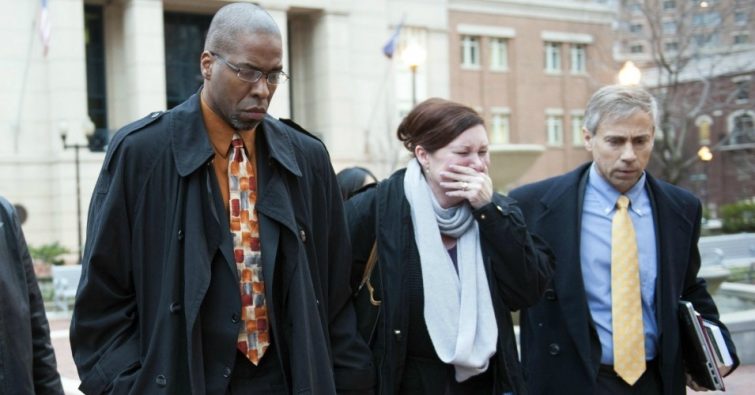
Former CIA officer Jeffrey Sterling, left, leaves the Alexandria Federal Courthouse on Jan. 26, 2016 with his wife Holly, center, and attorney Barry Pollack. Photo: Kevin Wolf/AP
By Gareth Porter | Consortium News | March 3, 2018
Jeffrey Sterling, the case officer for the CIA’s covert “Operation Merlin,” who was convicted in May 2015 for allegedly revealing details of that operation to James Risen of the New York Times, was released from prison in January after serving more than two years of a 42-month sentence. He had been tried and convicted on the premise that the revelation of the operation had harmed U.S. security.
The entire case against him assumed a solid intelligence case that Iran had indeed been working on a nuclear weapon that justified that covert operation.
But the accumulated evidence shows that the intelligence not only did not support the need for Operation Merlin, but that the existence of the CIA’s planned covert operation itself had a profound distorting impact on intelligence assessment of the issue. The very first U.S. national intelligence estimate on the subject in 2001 that Iran had a nuclear weapons program was the result of a heavy-handed intervention by Deputy Director for Operations James L. Pavitt that was arguably more serious than the efforts by Vice-President Dick Cheney to influence the CIA’s 2002 estimate on WMD in Iraq.
The full story of the interaction between the CIA operation and intelligence analysis, shows, moreover, that Pavitt had previously fabricated an alarmist intelligence analysis for the Clinton White House on Iran’s nuclear program in late 1999 in order to get Clinton’s approval for Operation Merlin.
Pavitt Plans Operation Merlin
The story of Operation Merlin and the suppression of crucial intelligence on Iran’s nuclear intentions cannot be understood apart from the close friendship between Pavitt and CIA Director George Tenet. Pavitt’s rise in the Operations Directorate had been so closely linked to his friendship with Tenet that the day after Tenet announced his retirement from the CIA on June 3, 2004, Pavitt announced his own retirement.
Soon after he was assigned to the CIA’s Non-Proliferation Center (NPC) in 1993 Pavitt got the idea of creating a new component within the Directorate of Operations to work solely on proliferation, as former CIA officials recounted for Valerie Plame Wilson’s memoir, Fair Game. Pavitt proposed that the new proliferation division would have the authority not only to collect intelligence but also to carry out covert operations related to proliferation, using its own clandestine case officers working under non-official cover.
Immediately after Tenet was named Deputy Director of the CIA in 1995, Pavitt got the new organization within the operations directorate called the Counter-Proliferation Division, or CPD. Pavitt immediately began the planning for a major operation targeting Iran. According to a CIA cable declassified for the Sterling trial, as early as March 1996 CPD’s “Office of Special Projects” had already devised a scheme to convey to the Iranians a copy of the Russian TBA-486 “fireset” – a system for multiple simultaneous high explosive detonations to set off a nuclear explosion. The trick was that it had built-in flaws that would make it unworkable.
A January 1997 declassified cable described a plan for using a Russian émigré’ former Soviet nuclear weapons engineer recruited in 1996 to gain “operational access” to an Iranian “target.” The cable suggested that it would be for the purpose of intelligence on the Iranian nuclear program, in the light of the fact that the agency had not issued a finding that Iran was working on nuclear weapons.
But in mid-March 1997 the language used by CPD to describe its proposed covert operation suddenly changed. Another declassified CPD cable from May 1997 said the ultimate goal was “to plant this substantial piece of deception information on the Iranian nuclear weapons program.” That shift in language apparently reflected Tenet’s realization that the CIA would need to justify the proposed covert operation to the White House, as required by legislation.
With his ambitious plan for a covert operation against Iran in his pocket, Pavitt was promoted to Associate Deputy Director of Operations in July 1997. On February 2, 1998, CPD announced to other CIA offices, according to the declassified cable, that a technical team from one of the national laboratories had finished building the detonation device that would include “multiple nested flaws,” including a “final fatal flaw” ensuring “that it will not detonate a nuclear weapon.”
An official statement from the national lab certifying that fact was a legal requirement for the CIA to obtain the official Presidential “finding” for any covert operation required by legislation passed in the wake of the Iran-Contra affair.
Pavitt obtained the letter from the national laboratory in mid-1999 a few weeks after it was announced he would be named Deputy Director of the CIA for Operations.
But that left a final political obstacle to a presidential finding: the official position of the CIA’ s Intelligence Directorate remained that Iran did not have a nuclear weapons program. The language of the CIA’s report to Congress for the first half of 1999, which was delivered to Congress in early 2000, contained formulations that showed signs of having been negotiated between those who believed Iran just have a nuclear weapons program and those who did not.
The report referred to nuclear-related projects that “will help Iran augment its nuclear technology infrastructure, which in turn would be useful in supporting nuclear weapons research and development.” The shift from “will” to “would” clearly suggested that nuclear weapons work was not yet an established fact.
A second sentence said, “expertise and technology gained, along with the commercial channels and contacts established-even from cooperation that appears strictly civilian in nature-could be used to advance Iran’s nuclear weapons research and developmental program.” That seemed to hint that maybe Iran already had such a nuclear weapons program.
That was not sufficient for Tenet and Pavitt to justify a covert nuclear weapons program involving handing over a fake nuclear detonation device. So the dynamic duo came up with another way around that obstacle. A new intelligence assessment, reported in a front page article by James Risen and Judith Miller in the New York Times on January 17, 2000, said the CIA could no longer rule out the possibility that Iran now had the capability to build a bomb – or even that it may have actually succeeded in building one.
Risen and Miller reported that Tenet had begun briefings for Clinton administration officials on the new CIA assessment in December 1999 shortly after the document was completed, citing “several U.S. officials” familiar with it. The Tenet briefings made no mention of any evidence of a bomb-making program, according to the sources cited by the Times. It was based instead on the alleged inability of U.S. intelligence to track adequately Iran’s acquisition of nuclear technology and materials from the black market.
But the new assessment had evidently not come from the Intelligence Directorate. John McLaughlin, then Deputy Director for Intelligence, said in e-mail response to a query that he did not recall the assessment. And when this writer asked him whether it was possible that he would not remember or would not have known about an intelligence assessment on such a high profile issue, McLaughlin did not respond. Pavitt and Tenet had obviously gone outside the normal procedure for an intelligence assessment in order to get around the problem of lack of support for their thesis from the analysts.
A declassified CIA cable dated November 18, 1999 instructed the Russian émigré to prepare for a possible trip to Vienna in early 2000, indicating that Tenet hoped to get the finding within a few weeks. Clinton apparently did give the necessary finding in early 2000; in the first days of March 2000 the Russian émigré dropped the falsified fireset plans into the mail chute of the Iranian mission to the United Nations in Vienna.
Pavitt Suppresses Unwelcome Iran Nuclear Intelligence
Pavitt’s CPD was also managing a group of covert operatives who recruited spies to provide information on weapons of mass destruction in Iran and Iraq. CPD not only controlled the targeting of the operatives working on those accounts but the distribution of their reports. CPD’s dual role thus represented a serious conflict of interest, because the CPD had a vested interest in an intelligence estimate that showed Iran had an active nuclear weapons program, and it could prevent intelligence analysts from getting information that conflicted with that interest.
That is exactly what happened in 2001. One especially valuable CPD operative, who was fluent in both Farsi and Arabic, had begun recruiting agents to provide intelligence on both Iran and Iraq since 1995. His talents had been recognized by the CPD and by higher levels of the Operations Directorate: by 2001 he had been promised an intelligence medal and a promotion to GS14 – the second highest grade level in the civil service.
But that same year the operative reported very important intelligence on the Iran nuclear issue that would have caused serious problems for Pavitt and CPD and led ultimately to his being taken out of the field and being fired.
In a November 2005 court filing in a lawsuit against Pavitt, the unnamed head of CPD and then CIA Director Porter Goss, the operative, identified only as “Doe” in court records, said that one of his most highly valued “human assets” – the CIA term for recruited spies – had given him very important intelligence in 2001. That information was the subject of three crucial lines of the key paragraph in the operative’s complaint that were redacted at the demand of the CIA. For years “Doe” sought to declassify the language of that had been redacted, but the CIA had fought it.
It was assumed in press accounts at the time that the redacted lines were related to Iraq. But the lawyer who handled the lawsuit for “Doe,” Roy Krieger, revealed to this writer in interviews that the redacted lines revealed that the CIA “human asset” in question was an Iranian, and that he had told “Doe” that the Iranian government had no intention of “weaponizing” the uranium that it was planning to enrich.
It was the first intelligence from a “highly-valued” U.S. spy – one who was known to be in a position to know he claimed to know – on Iran’s intentions regarding nuclear weapons to become available to the U.S. intelligence community. “Doe” reported what the spy had said to his supervisor at CPD, according to the court filing, and the supervisor immediately met with Pavitt and the head of CPD. After that meeting the CPD supervisor ordered “Doe” not to prepare any written report on the matter and assured him that Pavitt and the head of the CPD would personally brief President Bush on the intelligence.
But “Doe” soon learned from his own contacts at CIA headquarters that no such briefing ever took place. And “Doe” was soon instructed to terminate his relationship with the asset. After another incident involving intelligence he had reported on WMD in Iraq that had also conflicted with the line desired by the Bush administration, CIA management took “Doe” out of the field, put him in a headquarters job and denied him the intelligence medal and promotion to GS-14 that he had been promised, according to his court filing. The CIA fired “Doe” without specifying a reason in 2005.
Pavitt did not respond to requests for an interview for this story both at the Scowcroft Group and, after he retired, at his home in McLean, Virginia.
The intervention by Pavitt to prevent the intelligence from Doe’s Iranian asset from circulating within the U.S. government came as the intelligence community was working on the 2001 National Intelligence Estimate (NIE) on the Iranian nuclear program. That NIE concluded that Iran was working on a nuclear weapon, but the finding was far from being clear-cut. Paul Pillar, the CIA’s National Intelligence Officer for the Middle East and North Africa, who was involved in the 2001 NIE, recalled that the intelligence community had no direct evidence of an Iranian nuclear weapons program. “We’re talking about things that are a matter of inference, not direct evidence,” Pillar said in an interview with this writer.
Furthermore he recalls that there was a deep divide in the intelligence community between the technical analysts, who tended to believe that evidence of uranium enrichment was evidence of a weapons program, and the Iran specialists, including Pillar himself, who believed Iran had adopted a “hedging strategy” and had made no decision in favor or a nuclear weapon. The technical analysts at the CIA’s Weapons Intelligence Non-Proliferation and Arms Control (WINPAC), were given the advantage of writing the first draft not only on Iranian technical capabilities but on Iranian intentions – a subject on which it had no real expertise – as well, according to Pillar.
The introduction of the intelligence from a highly credible Iranian intelligence asset indicating no intention to convert its enriched uranium into nuclear weapons would arguably have changed the dynamic of the estimate dramatically. It would have meant that one side could cite hard intelligence from a valued source in support of its position, while the other side could cite only their own predisposition.
Pillar confirmed that no such intelligence report was made available to the analysts for the 2001 NIE. He noted just how rarely the kind of intelligence that had been obtained by “Doe” was available for an intelligence estimate. “Analysts deal with a range of stuff,” he said, “from a tidbit from technical intelligence to the goldmine well-placed source with an absolutely credible account,“ but the latter kind of intelligence “almost never comes up.”
After reading this account of the intelligence obtained by the CPD operative, Pillar said he is not in a position to judge the value of the intelligence from the Iranian asset, but that the information from the CPD Iranian asset “should have been considered by the NIE team in conjunction with other sources of information.”
That lead to a series of estimates that assumed Iran had a nuclear weapons program.
In 2004, a large cache of purported Iranian documents showing alleged Iranian research related to nuclear weapons was turned over to German intelligence, which the Bush administration claimed came from the laptop of an Iranian scientist or engineer. But former senior German Foreign Official Karsten Voigt later revealed to this writer that the whole story was a fabrication, because the documents had been given those documents by the Mujahedin-E Khalq, the Iranian opposition group that was known to have publicized anti-Iran information fed to it by Israel’s Mossad.
Those documents led directly to another CIA estimate in 2005 asserting the existence of an Iranian nuclear weapons program, which in turn paved the way for all the subsequent estimates – all of which were adopted despite the absence of new evidence of such a program. The CIA swallowed the ruse repeatedly, because it had already been manipulated by Pavitt.
Operation Merlin is the perfect example of powerful bureaucratic interests running amok and creating the intelligence necessary to justify their operations. The net result is that Jeffrey Sterling was unjustly imprisoned and that the United States has gone down a path of Iran policy that poses serious – and unnecessary – threats to American security.
Gareth Porter is an independent journalist and winner of the 2012 Gellhorn Prize for journalism. He is the author of numerous books, including Manufactured Crisis: The Untold Story of the Iran Nuclear Scare (Just World Books, 2014).
Did the CIA Sabotage Russia at the Olympics?
By Rick Sterling | American Herald Tribune | February 26, 2018
There is something very fishy about the Anti Doping Rule Violations (ADRVs) pinned on the Russian curler and Russian bobsledder during the final week of the Peyongchang Winter Olympics.
It makes no logical sense that an athlete would do a one-time consumption of a chemical that is of no value in circumstances where it is almost certain to be detected with huge negative consequences.
That is precisely the situation. The Russian Mixed Curling bronze medal winner, Alexander Krushelnitsky, had to give up his medal, plus that of his partner wife, because traces of meldonium were found in his urine sample. He had previously tested clean. Meldonium is a medication which helps keep the heart healthy by increasing blood flow. That would be of no benefit in a sport like curling which requires accuracy, strategy and focus but is not taxing physically. The “sweeping” to help guide the rock down the ice lasts only 20 seconds or less. International curlers were astounded at the news and bemused at the idea of performance enhancing drugs (PEDs) for curling. The skip of the Danish curling team said ”I think most people will laugh and ask, ‘what could you possibly need doping for?”
Krushelnitsky strongly denies taking banned drugs. “I am categorically opposed to doping …. never, at any time that I have been involved in sport, have I ever used prohibited substances”.
Similar curious circumstances apply in the second ADRV. Russian bobsledder Nadezhda Sergeeva had numerous negative (clean) tests before she was tested positive for banned trimetazidine. Bobsledding is another sport which requires physical and mental skill but not physical endurance.
In the February 25 IOC meeting to close the Pyeongchang Winter Games, the head of the IOC Implementation Group, Nicole Hoevertz, said the Russian athletes had been tested “more than any other athletes”. She and her group were convinced that the 168 member Russian athletic team was clean. At about 82:00 in the video, she says the two Russian doping violations were “very peculiar.” She introduced the Director of the IOC Medical and Scientific Commission, Dr. Bludgett, to provide more detail. He suggested that meldonium would not be of benefit in curling. He then went further and suggested the ADRV regarding trimetazidine may be in error. He said trimetazidine “is a substance where there is a parent compound which is a common headache migraine treatment available particularly in China and Japan and if that is found then it is not considered an ADRV. And if there is a very low level, as there was in this case, that is a possibility.”
Sergeeva denies ever taking banned drugs and even went on social media with a T-shirt declaring her commitment to clean sport.
In summary, it seems highly unlikely that two different Russian athletes would intentionally take medications that have no benefit but which are almost guaranteed to be detected resulting in huge harm to them and their team.
Who Benefits?
Another possibility is that meldonium or trimetazidine powder was surreptitiously put in the food of the athletes. This one time consumption would cause a positive test.
In fact there are forces on the international scene who are pleased that Russia has been battling defamation and charges of “state sponsored doping” for the past two years. They want the current denigration and punishments of Russia to continue, perhaps influencing Russia’s upcoming national election and undermining Russia’s hosting of the Football World Cup this summer.
One such group is the US Central Intelligence Agency (CIA). The CIA has a long history of big and small criminal deeds. Presumably it would not be difficult for them to infiltrate Olympic facilities or bribe a corrupt individual to put traces of meldonium or another powder in someone’s food or drink.
Those who quickly dismiss this possibility probably also thought that Iraq had weapons of mass destruction in 2002. That was a false claim supported by evidence fabricated by the CIA.
It is well documented the CIA carries out murders, coups and major sabotage. The CIA has documented some of their methods in “The Official CIA Manual of Trickery and Deception”. They don’t just carry out assassinations and coups. In the book “In Search of Enemies”, former CIA officer John Stockwell documented how the CIA created a false story about Cuban soldiers raping Angolan women to defame Cuba.
Corrupt police forces sometimes plant evidence on a suspect they wish to convict. It would be essentially the same thing to get a Russian athlete to ingest spiked food or beverage. The CIA has motive and expressed intent:
* In contrast with Russian leaders who call the US a “partner”, US officials increasingly call Russia an “adversary”. The latest US National Security Strategy explicitly says they intend to respond to Russia as an adversary: “The United States will respond to the growing political, economic and military competitions we face around the world. China and Russia challenge American power, influence, and interests, attempting to erode American security and prosperity.”
* Despite the lack of clear evidence, there is widespread belief that Russia “meddled” in the US election. The anti-Russia sentiment has been fanned into the exaggerated claim that the unproven Russian action was “an act of war, an act of hybrid warfare”.
* Neoconservative forces openly talk about “punishing” Russia. The former Deputy Director of the CIA, Michael Morrell, said “We need to make the Russians pay a price”. He confirmed on public television that means killing Russians (and Iranians) in Syria. This is the 33 year veteran CIA leader who publicly campaigned for Hillary Clinton.
Did the CIA plant the doping evidence? We don’t know for certain but it should not be dismissed out of hand. The CIA has the means, opportunity and above all the motive to falsely implicate Russians in new doping cases with the goal of preventing Russia from getting beyond the international sporting sanctions and punishments. They have done vastly more deceitful, manipulative, and outrageous things than this.
Media Bias
Unfortunately, western media will not investigate this possibility. Western media cannot even accurately report on events like the IOC meeting yesterday. The fact that the head of the IOC Implementation Group warmly praised the Russian participation at the Pyeongchang Olympics is not mentioned in western media. The fact that Dr. Bludgett raised questions about the accuracy of the ADRVs against Russia is not mentioned in reports from NY Times, the UK Guardian or Inside the Games. Instead, the writer at Inside the Games once again exaggerated the voice of critics of Russia as he downplayed the voices of international athletes who want to put the doping scandal behind and move forward.
Western media have reported deceptively that the Russian athletes have “admitted” to the violations. In fact, both Russian athletes strongly deny taking banned drugs.
Western media bias is also shown in the focus on alleged Russian doping and minimization or ignoring of other possible violations. For example the story about the Norwegian cross-country ski team and their use of banned asthmatic medications. They get around the restrictions by having their doctor claim that most of their athletes are asthmatic. This situation is a result of the inconsistent rules and regulations. A Therapeutic Use Exemption (TUE) can be given to any athlete designated by a doctor and in secrecy. They are not required to publicly disclose this, giving incentive to corruption and misuse.
Richard McLaren’s Bias
The World Anti-Doping Agency (WADA) has also been biased. Over one year ago, their investigator Richard McLaren claimed “over one thousand Russian athletes benefited” from the alleged Russian conspiracy to cheat the ant-doping system. McLaren said the proof would be provided to the various sport federations. In September 2017 it was revealed that charges had been filed against 96 athletes. Of these, WADA cleared 95 athletes of wrongdoing; only one athlete was proven to be in violation. More recently, the Court of Arbitration in Sport completely overturned the bans on 28 Russian athletes. In summary, it appears that McLaren’s accusation about “over one thousand athletes benefiting” was a huge exaggeration or fabrication.
Where Do Things Go From Here?
The IOC Executive Board has indicated they intend to lift the suspension of the Russian Olympic Committee if no more “anti-doping rule violations” are found in the last batch of athlete samples from the Pyeongchang Olympics. The results are expected in a few days.
Another ADRV may appear. If so, that will greatly complicate the effort to reintegrate Russian athletics. Even if the final tests are all clean, those who oppose Russia will continue trying to delay or prevent the full integration of Russia within the world sporting Community.
The former Moscow Laboratory Director Grigory Rodchenkov is the primary weapon in the campaign accusing Russia of “state sponsored doping”. “Icarus” is a movie about him which has received huge funding and promotion. It is nominated for an an Oscar Academy award. This will serve the campaign well.
The Russian have been accused of trying to murder Rodchenkov. But if he suddenly dies one day, it is more likely to be by the CIA. At this point, Rodchenkov has done all the damage he can to Russian sports. The only thing he could possibly do is to recant or fall apart. His handlers have prevented him from appearing before the various committees looking into the accusations. At this point, Rodchenkov could be more valuable dead than alive. His death would be a powerful weapon to disrupt the normalization of relations with Russia.
In conclusion, going back to the Pyeongchang Olympics, there should be caution before assuming the guilt of the Russian athletes who received ADRVs. It makes no sense that two Russian athletes would take useless medications knowing they will be tested and found out.
The doping incident serves the interests of those in the West who seek more not less conflict and seek to weaken Russia through “hybrid” warfare. It is possible the CIA has a hand in the latest incidents, just as they have a hand in Dr. Grigory Rodchenkov. They have the means, opportunity and motive. They have the experience and history.
If this is true, it’s another example of the dangerous descent in international relations. The Olympics movement has the goal of fostering peaceful relations. The sad truth is there are forces who want to prevent that. They prefer to demonize and divide in a quest for economic and geopolitical supremacy over “adversaries”. International sports is just another arena for them.
America Needs a 21st Century Church Committee
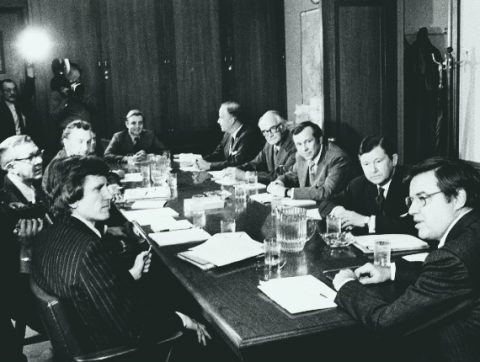
Former members and staffers of the Church Committee | March 17, 2014
Dear Congress, Mr. President and the American public,
In 1975 the public learned that the National Security Agency had been collecting and analyzing international telegrams of U.S. citizens since the 1940s under secret agreements with all the major telegram companies. Years later, the NSA instituted another watch list program to intercept the international communications of key figures in the civil rights and anti–Vietnam War movements among other prominent citizens. Innocent Americans were targeted by their government. These actions were uncovered — and stopped — only because of a special Senate investigative committee known as the United States Senate Select Committee to Study Governmental Operations with Respect to Intelligence Activities, commonly known as the Church Committee.
We are former Church Committee members and staffers and write today as witnesses to history and as citizens with decades of collective experience in Congress, the federal courts, the executive branch and the intelligence community. We write today to encourage Congress to create a Church Committee for the 21st century — a special investigatory committee to undertake a thorough and public examination of current intelligence community practices affecting the rights of Americans and to make specific recommendations for future oversight and reform. Such a committee would work in good faith with the president, hold public and private hearings and be empowered to obtain documents. Such congressional action is urgently needed to restore the faith of citizens in the intelligence community and in our federal government.
The actions uncovered by the Church Committee in the 1970s bear striking similarities to the actions we’ve learned about over the past year. In the early 1970s, allegations of impropriety and illegal activity concerning the intelligence community spurred Congress to create committees to investigate those allegations. Our committee, chaired by Sen. Frank Church, was charged with investigating illegal and unethical conduct of the intelligence community and with making legislative recommendations to govern the intelligence community’s conduct. The bipartisan committee’s reports remain one of the most searching reviews of intelligence agency practices in our nation’s history.
Our findings were startling. Broadly speaking, we determined that sweeping domestic surveillance programs, conducted under the guise of foreign intelligence collection, had repeatedly undermined the privacy rights of U.S. citizens. A number of reforms were implemented as a result, including the creation of permanent intelligence oversight committees in Congress and the passage of the Foreign Intelligence Surveillance Act.
Even though our work was over 30 years ago, our conclusions seem eerily prescient today. For example, our final report noted:
We have seen a consistent pattern in which programs initiated with limited goals, such as preventing criminal violence or identifying foreign spies, were expanded to what witnesses characterized as “vacuum cleaners,” sweeping in information about lawful activities of American citizens. The tendency of intelligence activities to expand beyond their initial scope is a theme, which runs through every aspect of our investigative findings.
The need for another thorough, independent and public congressional investigation of intelligence activity practices that affect the rights of Americans is apparent. There is a crisis of public confidence. Misleading statements by agency officials to Congress, the courts and the public have undermined public trust in the intelligence community and in the capacity of the branches of government to provide meaningful oversight.
The scale of domestic communications surveillance the NSA engages in today dwarfs the programs revealed by the Church Committee. Thirty years ago, the NSA’s surveillance practices raised similar concerns as those today. For instance, Church explained:
In the case of the NSA, which is of particular concern to us today, the rapid development of technology in this area of electronic surveillance has seriously aggravated present ambiguities in the law. The broad sweep of communications interception by NSA takes us far beyond the previous Fourth Amendment controversies where particular individuals and specific telephone lines were the target.
As former members and staffers of the Church Committee, we can authoritatively say the erosion of public trust currently facing our intelligence community is not novel, nor is its solution. A Church Committee for the 21st century — a special congressional investigatory committee that undertakes a significant and public re-examination of intelligence community practices that affect the rights of Americans and the laws governing those actions — is urgently needed. Nothing less than the confidence of the American public in our intelligence agencies and, indeed, the federal government, is at stake.
Sincerely,
Counsel, advisers and professional staff members of the Church Committee, including
Chief Counsel Frederick A.O. Schwarz Jr.
Loch Johnson
John T. Elliff
Burt Wides
Jim Dick
Frederick Baron
Joseph Dennin
Peter Fenn
Anne Karalekas
Michael Madigan
Elliot Maxwell
Gordon Rhea
Eric Richard
Athan Theoharis
Christopher Pyle
Featured Video
Seyed M. Marandi: Negotiations Collapsed – Return to War
or go to
Aletho News Archives – Video-Images
From the Archives
Wartime internment camps in Australia
National Archives of Australia
World War I
During World War I, for security reasons the Australian Government pursued a comprehensive internment policy against enemy aliens living in Australia.
Initially only those born in countries at war with Australia were classed as enemy aliens, but later this was expanded to include people of enemy nations who were naturalised British subjects, Australian-born descendants of migrants born in enemy nations and others who were thought to pose a threat to Australia’s security.
Australia interned almost 7,000 people during World War I, of whom about 4,500 were enemy aliens and British nationals of German ancestry already resident in Australia.
Records of World War I internment camps
World War II
During World War II, Australian authorities established internment camps for three reasons – to prevent residents from assisting Australia’s enemies, to appease public opinion and to house overseas internees sent to Australia for the duration of the war.
Unlike World War I, the initial aim of internment during the later conflict was to identify and intern those who posed a particular threat to the safety or defence of the country. As the war progressed, however, this policy changed and Japanese residents were interned en masse. In the later years of the war, Germans and Italians were also interned on the basis of nationality, particularly those living in the north of Australia. In all, just over 20 per cent of all Italians resident in Australia were interned. … continue
Blog Roll
 Aletho News
- Seyed M. Marandi: Negotiations Collapsed – Return to War
- Tomorrow’s naval blockade showdown
- ‘Israel’ attacks civilians to hide its embarrassing military failures & out of pure sadism
- Any Foreign Military Vessel Approaching Hormuz Under Any Pretext ‘Will Be Dealt With Severely’: IRGC
- Diplomats slam US negotiators’ performance in Iran talks
- Trump Refuses Exit Ramp, War with Iran will Continue
- Trump Says US Naval Blockade in Strait of Hormuz Will Begin Shortly
- US, Iran end 21-hour talks without agreement
- US IRAN TALKS: Who Are the Crazy Ones Here? /Lt Col Daniel Davis
- Talks with the US end without a deal over excessive US demands: Iran
- If Americans Knew
- US-Iran ceasefire negotiations make zero progress – Daily Update
- Pro-Israel ‘Thinktanks’ and Individuals who Influence U.S. Foreign Policy
- Mearsheimer reveals how Israel dictates US policies on Iran, Gaza – video
- After killing 350+, Israel still has a “score to settle” with Lebanon before ceasefire – Daily Update
- Military aid to Israel emerges as the latest political litmus test for Democrats
- The only Palestinian children’s rights organization closes following years-long Israeli campaign against it
- ‘I Can’t Forget the Smell’: Lebanese Reel After Israel Kills Over 300 in Single Day
- DNC Shoots Down Resolutions Calling Out AIPAC and Limiting Arms to Israel
- TCN: Is Israel Blackmailing President Trump?
- Israel killed at least 303 Lebanese yesterday – who were they? Daily Update
- No Tricks Zone
- Cave Discovery Reveals Today’s Desert Climates Were Recently Far Warmer, Wetter, Teeming With Life
- German Expert: Heat Dome Led To Record Temps In Western USA…Warmer In 1934, 1936
- New Study: No Linear Warming Or Glacier Retreat Along Northern Antarctic Peninsula Since 1980s
- An Inconvenient Tree: Uncovered In Alps… Europe Much Warmer Than Today 6000 Years Ago
- New Study Reports A 60% Slowdown In Greenland’s Ice Loss Rate In The Last Decade
- Low Intensity Tornado Wrecks Major Solar Farm, Creating A Potential Toxic Dump
- New Study Finds Warming Saves Lives…Cold Temperatures 12 Times More Deadly Than Excess Heat
- German Science Blog Accuses PIK Climate Institute Of Hallucinating Climate Tipping Points
- Devastating Assessment Of Comirnaty Vaccine By Former Senior Pfizer Europe Toxicologist
- New Study: CO2 Is ‘Effectively Negligible’ As An Explanatory Climate Change Factor Since 2000
 Aletho News