Fake News about Venezuela: A Simple Recipe
 President Hugo Chavez
By Ricardo Vaz | Investig’Action | March 7, 2017
“Journalists” who want to write fake news about Venezuela, or about any other country or group that dares to stand up to US imperialism, only need to follow this simple recipe:
- Choose one or more countries/groups opposed to US imperialism
- If available, have a former official, now being paid by the US government, make the accusations
- Season well with doses of “war on terror” and/or “war on drugs”
- Sprinkle with opinions of “experts” who work in DC think tanks or US-funded NGOs
While this looks like a very unsavoury mix, the results last very long and can be reheated with no problems.
This recipe has been used and re-used plenty of times, either by US officials to justify policies or by media outlets. But given how the media critically accepts everything when it comes to foreign policy, there is hardly a distinction to be made here.
A classical example were the fabricated connections made between Chávez/Venezuela and al-Qaeda. Other variants involve dealings with the FARC1, Mexican cartels, and the favourite dance partner is Hezbollah. On one hand, the US’ relation with al-Qaeda is now a bit more complicated, as extremists may get bombed if they are in Iraq but supported if they cross into Syria. On the other, Hezbollah is the biggest obstacle to Israeli hegemony and the colonisation of Palestine. This kind of propaganda is reminiscent of the effort to fabricate connections between al-Qaeda and Saddam Hussein in order to justify the invasion of Iraq. Some outlets would even have us believe North Korea was supplying arms to Hamas!
The most recent story involves the newly-appointed vice-president, Tareck El Aissami, who is a perfect ingredient because of his Middle Eastern ancestry. Even though he was born and lived all his life in Venezuela, his parents are Druze immigrants from Lebanon. The storm started with a CNN “story” about the Venezuelan embassy in Iraq selling passports to dangerous people, including members of Hezbollah, who would then use them to attack the US or its allies. This operation was claimed to be directed by El Aissami. This story was directly quoted by Marco Rubio during a renewed push by US lawmakers for more sanctions against Venezuela. These came later from the Department of the Treasury, this time linking El Aissami to Mexican cartels. With a little more effort even the North Koreans might have been added to the party.
 Tareck El Aissami with an incriminating Palestinian scarf
All in all, there are many things that do not add up. First of all, there is the issue of Hezbollah plotting terror attacks in the US, but we will not go into detail here. It suffices to say that the evidence of Hezbollah involvement in terror attacks abroad is, at best, very thin. Then there is the sectarian issue. Western media, at the behest of western allies in the Middle East, keep stirring up this supposedly grave Shia threat, with Iran and Hezbollah even conspiring to reshape demographics and create an all-Shia corridor in the Middle East. And yet their man in Venezuela is a Druze. Equally ludicrous are claims that there are Venezuelan training camps in Lebanon and vice-versa. Hezbollah’s main foe is right next door, but somehow it would need training camps halfway around the world! The links to the drug trade presented by the Treasury are equally flimsy, and were picked apart masterfully by Larissa Costas.
The “star witness” of CNN’s expose, Misael López, has since been revealed to be a close associate of Ana Argotti, who is in turn very close to Lilian Tintori and Leopoldo López, the hard-right politician jailed for his role in the violent activities during the 2014 guarimbas that resulted in over 40 deaths. Argotti has defended several members of the opposition charged with violent crimes during this period. As for Misael López, he is also under investigation for alleged sexual harassment and attempting to withdraw funds from the Venezuelan embassy in Baghdad.
Elusive cartels and double standards
Another high-profile fake story, followed by sanctions, involved Diosdado Cabello, an important figure in the ruling PSUV and head of the National Assembly at the time. Based on the account of a former bodyguard turned star-witness, now living comfortably in the US, Cabello was accused of being the boss of the elusive Cartel de los Soles. This is supposedly a very important Latin American drug cartel run by the Venezuelan military. The problem is that, unlike the stories we hear of cartels violently making themselves known and marking territory, here we have a drug cartel run from the highest levels of the Venezuelan state operating without anyone really noticing it. It is like the Illuminati version of drug cartels.
 Diosdado Cabello next to President Nicolás Maduro
Venezuela is often presented as an obstacle in the war on drugs, but the truth is that the main actor in the cocaine trade is neighbouring Colombia, the empire’s best friend and largest recipient of aid in the hemisphere. Any list of officials connected to the drug trade has to start with (former Colombian president) Álvaro Uribe if it is to be taken seriously. We are talking about the country where the para-politics scandal broke, revealing that dozens of elected officials had links to paramilitary groups, the heart and soul of the drug trade. And yet we never hear stories of Colombian politicians or military officials, who cooperate closely with the US military, being involved in illegal activities, nor have sanctions ever been imposed on them.
This double standard is only outrageous if we believe that the war on drugs is actually designed to eradicate the drug trade. Rather, it is supposed to manage it. In fact, drugs have been very useful for US agencies, for instance, to pacify black communities and derail the black liberation movement in the 1970s. Coupled with draconian legislation and harsh sentences, today they serve to feed the very lucrative prison industry. In any case, large amounts of cocaine are consumed in the very place where the drug money is laundered – Wall Street. Even when a massive drug money laundering scheme is uncovered at a major US bank, a mild slap on the wrist and a fine worth a few days’ profit is all that can be expected.
Fake news as background
None of this is intended as an endorsement or an exoneration of El Aissami, Cabello, or anyone else. But these news stories and unproven accusations, as well as others targeting lower-profile officials such as Néstor Reverol, are not meant to prove anything or to lead to any judicial prosecution. They are simply thrown out there and blindly echoed by an uncritical media. They are meant to create background. From now on, whenever Tareck El Aissami appears in the news we will read that he has links to terrorism and the drug trade, and thus whatever he says or does will build on this background.
For the past two decades, Venezuela has been the biggest thorn in the US’ side, a real nuisance in Washington’s “backyard”, striving for an independent course (a “second independence”) and leading the efforts for a regional integration which is not subjected to the interests of the Northern empire. The US responded with its traditional regime-change operation, destabilizing at every turn, funding opposition groups, imposing a de-facto financial blockade on Venezuela, even working to lower oil prices. Their natural allies, the Venezuelan elites, have also been outraged that the country they used to own has been taken away from them, and coup-plotting has become their way of life.
And therefore these fake news stories are pre-emptive justification for a future coup or foreign intervention. Should one of these take place, the media will be ready with plenty of hyperlinks to these fake stories that present Venezuela as a failed, rogue state, connected to terrorism and the drug trade. The coup/foreign intervention would then look like the benign empire saving the world from this threat.
What the empire, the local elites and the media keep underestimating is the power of the masses that were awakened by this project, chavismo, that for the first time sees them placed front and centre. There is now a political conscience, a firm belief that the people should write their own history, and it will take a lot more than fake stories from propaganda outlets to restore Venezuela’s former neo-colonial status. In the words of Chávez:
“Aquí nadie se rinde, carajo!”
Note:
(1) While the FARC have been involved in the drug trade, it has mostly been at the lowest levels of the chain, levying a tax on sales of coca crops. Associating them, and only them, to the Colombian drug trade, is incredibly dishonest and exonerates those who profit the most out of it.
CNN Documentary: Another Vain Attempt to Sow Discord Between Putin, Trump
Sputnik – 14.03.2017
The latest CNN documentary about President Vladimir Putin is the US elite’s last-ditch effort to demonize the Russian leader, Gregory Dobromelov, Director of the Institute of Applied Political Studies, told Radio Sputnik.
The documentary entitled “The Most Powerful Man in the World” was made by CNN’s Fareed Zakaria and presented on March 13.
Commenting on the matter, Kremlin spokesman Dmitry Peskov said that it appears that the documentary was made “with a critical bias in line with the further demonization of our country [Russia] and, possibly, our president [Vladimir Putin].”
“We read some of the press, in fact everything was as predicted: this is another material in line with hysterical, emotional background based on opinions that have nothing substantial, opinions that are most often absolute fiction,” Peskov told reporters.
“Vladimir Vladimirovich [Putin] did not have the time to get acquainted because it came out at night,” he added.
The documentary claims that “Putin is afraid of a popular uprising,” and that “the President controls everything in Russia.” It also focuses on the issue of Russia’s alleged “intervention” in the elections of the United States. However, the authors do not present any evidence to back up their accusations.
Former US Defense Secretary Robert Gates, editor of The New Yorker David Remnick, journalists Masha Gessen and Julia Ioffe acted as experts in the film.
“The West is now trying to use the last window of opportunity, which still exists before Putin meets with [US President Donald] Trump, to demonize the figure of the Russian President,” Dobromelov assumed in an interview with Radio Sputnik.
“First and foremost, this film is intended for the [US] domestic audience; it claims once again that Trump’s attempts to establish a constructive dialogue with Russia are ‘actually’ efforts to cooperate with a man who allegedly has ‘totalitarian habits’,” he suggested.
According to Dobromelov, the documentary won’t impact Russia’s image around the globe, given the fact that many nations have an essentially positive view of Russia and its president.
“In fact, many in the world don’t endorse the US [policies] and are ready to support the foreign policy of Vladimir Putin,” Dobromelov said.
The academic pointed out that citizens of many countries want their governments to protect their own national interests, like the Russians do.
“Citizens of many countries want their governments to begin to defend the interests of their own states,” he said.
“Most likely, the opinion will be divided in two,” Dobromelov assumed, “One half will believe [what the authors of the documentary claim], while the other half will think that all this [narrative] will [in the end] benefit the Russian leader.”
The U.S. Government Did Not Revoke Khizr Khan’s ‘Travel Privileges’

By Peter Van Buren | We Meant Well | March 8, 2017
Here’s the anatomy of a fully made-up “news” story, abetted by a media that could care less to check any fact as long as the story feeds the preconceived notions of its audience.
You remember Khizr Khan (above), the guy who used his soldier son, killed in Iraq, as a prop at the Democratic National Convention to criticize Trump’s immigration policy and help elect Hillary Clinton? Well, like all good Americans, Khan exploited his exploitation into a minor media career. He was booked to talk in Canada by a speaker’s bureau called Ramsey Talks. A decent gig — tickets ran $89 a seat.
Then Trump supposedly struck. Ramsey Talks released a statement on its Facebook page saying:
Late Sunday evening Khizr Khan, an American citizen for over 30 years, was notified that his travel privileges are being reviewed. As a consequence, Mr. Khan will not be traveling to Toronto on March 7th to speak about tolerance, understanding, unity and the rule of law. Very regretfully, Ramsay Talks must cancel its luncheon with Mr. Khan. Guests will be given full refunds.
Mr. Khan offered his sincere apologies to all those who made plans to attend on March 7th. He said: “This turn of events is not just of deep concern to me but to all my fellow Americans who cherish our freedom to travel abroad. I have not been given any reason as to why. I am grateful for your support and look forward to visiting Toronto in the near future.
A major Canadian broadcast outfit (CTV) ran the story based solely, only, 100% on that single unverified and unsubstantiated Facebook posting, saying the Trump administration interfered with Khan’s “travel privileges” to prevent him from speaking, because of some sort of revenge for Khan’s statements this summer.
The Internet then, as expected, lost its shit.
Twitter boomed, and within an hour or two the story appeared in the New York Times, LA Times, Boston Herald, CNN, Maddow, and across the globe. Every one of those stories was based on nothing but that Facebook post. Reuters, the only outfit that apparently bothered to commit a minor act of journalism and reach out to Khan, was told by him no comment. All of the web’s many experts on stuff became experts on passport law, immigration, naturalization, and visa lore. Amazingly creative theories of “denaturalization of Muslims” were concocted out of thin air.
The only problem is that none of this is true. It in fact could not be true.
The U.S. has no law that deals with reviewing or rescinding “travel privileges.” No U.S. government agency calls people at home to tell them their travel privileges are under review. If, in very, very limited specific legal instances a court has ordered someone not to travel, their passport itself can be revoked in response to that court order. The U.S. Customs and Border Protection people, the State Department, and the government of Canada all eventually denied doing anything to Khan in any way or having anything to do with this story, so please stop calling them to ask.
Khan, or Ramsey Talks, seems to have made this all up.
Now, funny thing, this made-up story about Khan being denied travel hit just as Trump’s new Executive Order (“Muslin Ban 2.0”) was announced. Gee willikers Biff, you think this tale of a Muslim patriot denied travel was timed for that news cycle? Maybe so that when Khan’s speech is rescheduled tickets will be more expensive and sell out faster? Maybe so Khan and/or Ramsey Talks could get a zillion dollars of free publicity? Hah hah, coincidence, am I right?
As I write this, not one of the media outlets that ran with the false story has published a correction, update or apology. The Washington Post has semi-backed away, but left itself plenty of wiggle room in not admitting it was wrong.
The problem is if you Google Khan’s name, the story is still flowing around the web, and is now being cited in unrelated stories as “proof” of whatever else the writer believes is fascism and the end of freedom in America.
BONUS: A source inside CBP tells me that what is most likely to have happened is that Khan’s membership in one of the expedited processing programs was set to expire. These are programs run by private companies that gather information and submit members’ names for background checks to allow them to use expedited processing lanes at the airport when re-entering the United States from a foreign country. Khan/Ramsey likely confused, by accident or on purpose, the expiration of that membership with some nefarious U.S. government action, and the media took it from there. Khan’s only privilege under fire was that of standing in a shorter line at the airport.
Wikileaks’ Timely Reminder of our Digital Panopticon

“The Panopticon must not be understood as a dream building: it is the diagram of a mechanism of power reduced to its ideal form.” – Michel Foucault
By Kit | OffGuardian | March 7, 2017
In the late eighteenth century English Utilitarian philosopher and social-theorist Jeremy Bentham devised what he called the “perfect prison” – The Panopticon. The design is simple, a circular prison with one guard in the central room, and all the cells facing the guard tower. In this way the gaoler can have a line of sight to every cell at once, and no inmate can ever be sure he’s not being observed. Bentham described it as:
“… a new mode of obtaining power of mind over mind, in a quantity hitherto without example… a mill for grinding rogues honest.”
Wikileaks latest release of classified documents, entitled Vault 7, comes as a timely reminder to all of us (as if we needed it) that the panopticon – the theorized perfect prison – is now a fibre-optic, digitized, hard-coded reality.
Here’s a run down from Wikileaks’ own analysis page (with some added emphasis):
The increasing sophistication of surveillance techniques has drawn comparisons with George Orwell’s 1984, but “Weeping Angel”, developed by the CIA’s Embedded Devices Branch (EDB), which infests smart TVs, transforming them into covert microphones, is surely its most emblematic realization.
The attack against Samsung smart TVs was developed in cooperation with the United Kingdom’s MI5/BTSS. After infestation, Weeping Angel places the target TV in a ‘Fake-Off’ mode, so that the owner falsely believes the TV is off when it is on. In ‘Fake-Off’ mode the TV operates as a bug, recording conversations in the room and sending them over the Internet to a covert CIA server.
As of October 2014 the CIA was also looking at infecting the vehicle control systems used by modern cars and trucks. The purpose of such control is not specified, but it would permit the CIA to engage in nearly undetectable assassinations.
The CIA’s Mobile Devices Branch (MDB) developed numerous attacks to remotely hack and control popular smart phones. Infected phones can be instructed to send the CIA the user’s geolocation, audio and text communications as well as covertly activate the phone’s camera and microphone.
The CIA’s Remote Devices Branch’s UMBRAGE group collects and maintains a substantial library of attack techniques ‘stolen’ from malware produced in other states including the Russian Federation. With UMBRAGE and related projects the CIA cannot only increase its total number of attack types but also misdirect attribution by leaving behind the “fingerprints” of the groups that the attack techniques were stolen from.
These early analyses show us the powerful trifecta of these operations – the CIA can hear you, find you and…if they deem it necessary…kill you. In fact, the reveal that the CIA has been working on hacking vehicle control systems adds new dimensions to the (as yet unsolved) case of Michael Hastings, a counter-culture voice in the American press who died in an inexplicable car accident four years ago. (A good rundown of the case can be found here.)
The repetition of a now well-established fact – that the CIA, NSA, DHS… whoever… can hack various electrical devices to listen in to our communications is nicely topical, given the current clash between the in-coming and out-going presidential administrations. An interesting thought is that Wikileaks, if it ever was as completely impartial and alternative as it purports to be, might be being used to score political points. The theorized split between the CIA (pro-Hillary) and the FBI (pro-Trump) works well as an explanation for this, as it did with the DNC and Podesta e-mail dumps prior to the elections. Either way, this information is nicely timed to remind the world that, as we already reported, of course Donald Trump was being surveilled. Everyone is.
The final section we’ve highlighted, the proof that “… the CIA cannot only increase its total number of attack types but also misdirect attribution by leaving behind the “fingerprints” of the groups that the attack techniques were stolen from” is an interesting tidbit of information. Worth remembering, because it will almost definitely have fallen down the memory hole next time some “evidence” is produced claiming Russia or China or Iran have hacked this, that or the other.
Further along in Wikileaks’ explanation of the data, and much discussed on CNN and in Congress (who seem rather unfazed by the illegal bugging and possible assassinations), is that the CIA’s arsenal of “cyber-weapons” were unsecured, and probably stolen by unknown parties.
Did state and/or non-state actors access and steal CIA created data-mining programs and spyware? I don’t think it matters. At all. The reasoning behind this is fairly simple. Firstly, there are no groups LESS trustworthy than the American military intelligence institutions. Secondly, and more importantly, I don’t believe it to be true.
I don’t think the CIA had their weapons “stolen”, I think that establishing – in the public eye – that they don’t have sole control of these tools enables them to preserve plausible deniability, in the event they are used.
If the cyber-tools the CIA developed are also in private hands, they were more likely sold than stolen. The CIA has massive corporate ties in the media, defense, pharmaceuticals and countless other big corporate interests. To the extent it is essentially one large family.
So what has the media reaction been? Four years ago I would have answered “disappointing”, these days I would say “predictable”.
CNN chose to focus on the “stolen” angle, suggesting there be a Senate investigation – not into the CIA’s power to illegally surveil and/or kill American citizens – but into their lax security and whether or not they have endangered national security by letting their toys get taken away.
Already the false premise is set and the subject for debate is decided: The question is not whether or not they should have these powers, but whether enough is being done to ensure they are the only people who have them. In this way a public outcry can be generated, the CIA can be brought before the senate and begged to tighten their security (possibly further slipping what little congressional oversight they still endure in the process). Engineering a situation whereby the citizenry plead with you to what you wanted to do all along is one of the oldest tricks of government.
Ewen McAskill, writing in the Guardian, has this to say:
The leak, dubbed “Vault 7” by WikiLeaks, will once again raise questions about the inability of US spy agencies to protect secret documents in the digital age.
He talks about it being an “embarrassment” for the CIA, and “good timing” for Trump. You’ll also be interested to know he considers the sky to be blue, and water wet. In-depth analysis is thin on the ground, as (more troublingly) is any indication that he understands that this is morally repugnant.
The BBC considers Wikileaks revelations to be a smaller story than the Lords voting on small amendments to the article 50 bill, or the Champions League. The story about how the CIA is spying on all of us and researching covert assassination techniques was filed, not under “politics”, but rather “technology”. You can only imagine that, had this modern BBC existed in 1945, they’d have reported the bombing of Hiroshima under “technology” too, perhaps with the headline “US make breakthrough in use of Nuclear energy”.
No one in the media is ready to concede this vindicates Trumps “wire-tap” tweets from a few days ago, or willing to admit that the “that would be illegal!” defence from Obama’s reps was farcical. (They will instead, in the coming days, point to this being another example of WikiLeaks being on Trump’s side and probably in the pay of Russia. Just watch).
All-in-all the media are taking it in their stride, not one source I could find expressed any kind of shock or moral outrage. They take a deliberately apathetic tone chosen very carefully. They tell us the facts, but refuse to analyse them. They address the current reality as the only option.
That the state claims the power to invade our privacy is a given, that they have the tools to do so, an unfortunate fact of life. Set in stone. The way the world works. No thought is given to holding governmental power to account, and no column inches supplied to those with an angry voice. In short the media provide only one message: They are always watching you, and there’s nothing you can do about it.
In that sense the media, and even Wikileaks, provide a valuable service. There’s no point in creating a panopticon if nobody knows they are being watched.
Cheerleading for Israel
Everyone’s doing it

By Philip Giraldi • Unz Review • March 7, 2017
Those of us who voted for Donald Trump in hopes that he would turn out to be the peace candidate are facing disappointment. He has increased the already bloated military budget by $54 billion and has appointed an outspokenly anti-Russian and anti-Iranian active duty general as his National Security Advisor. A retired general with pretty much the same views heads the Pentagon. President Trump meanwhile vows to “extinguish” ISIS without presenting any plan regarding how exactly that might be accomplished.
The most important objective of all, resetting with Moscow to avoid World War 3, is in reverse gear, with the appointment of Fiona Hill, a critic of Vladimir Putin, as Russian specialist at the National Security Council. Meanwhile, our clueless United Nations Ambassador calls for Russia to withdraw from Crimea, where 58% of the population is Russian and only 24% is Ukrainian. Reports circulating in Washington suggest that the one phone call between Trump and Putin was a disaster, with the U.S. president demanding an end to the New START nuclear weapons reduction treaty, which the Kremlin wants to renew, before going off on a tangential monologue about his unexpected electoral victory.
In fact, even though the individual neocons have largely been outed from the foreign and security policy positions they once dominated it would not be completely inappropriate to suggest that their legacy of military interventionism lives on in terms of what the Trump administration has been so far promoting to keep America “safe.” Where all of this will go is anyone’s guess.
But if there is one constant in all of this it is the bright shining beacon of Israel, with Trump recently enthusing over the “unbreakable” bond between the two countries. One hopes that he misspoke and really meant “unbearable” or even “unspeakable” but it is clear from other indications that The Donald has succumbed to the inevitable Washington groupthink regarding America’s greatest ally and best friend in the whole wide world.
On Sunday New York Governor Andrew Cuomo met with Israeli Prime Minister Benjamin Netanyahu to discuss “trade and security issues” without anyone complaining that he was in violation of the Logan Act, which apparently only applies if you are talking to Russians. And a congressional delegation is in Israel right now studying the feasibility of moving the U.S. Embassy to Jerusalem, which most foreign policy pundits consider to be a very bad idea. Meanwhile at the United Nations, the U.S. has blocked the appointment of former Palestinian prime minister Salam Fayyad as special representative to Libya. U.S. Ambassador Nikki Haley explained the veto, saying irrelevantly “For too long the U.N. has been unfairly biased in favor of the Palestinian Authority to the detriment of our allies in Israel. The United States does not currently recognize a Palestinian state or support the signal this appointment would send within the United Nations.”
Ambassador Haley has also denounced the international body in general terms, stating that she was “underscore[ing] the ironclad support of the United States for Israel,” adding that “I am here to emphasize that United States is determined to stand up to the U.N.’s anti-Israel bias.” And if anyone failed to understand, on March 1st, U.S. envoy to the U.N. Human Rights Council in Geneva Erin Barclay told the group that it must drop its “obsession with Israel” or risk Washington withdrawing from the organization. The suggestion that the U.S. might consider departing came, incidentally, directly from Israeli Prime Minister Benjamin Netanyahu, who proposed such action to Donald Trump to “delegitimize” the U.N. body.
It is ironic that in the midst of a media and congressional feeding frenzy on foreign interference in the U.S., the one country in the world that consistently leads Washington by the nose is immune from criticism. The subservient role dutifully played by every U.S. president since JFK when dealing with Tel Aviv has resulted in defining United States national interests in terms of Israeli perceptions. The real irony is that even though Trump is giving the Israelis everything they want and is bowing to the Israel Lobby and Jewish groups at every opportunity, it is still not enough. It is never enough. That is because the neoconservatives, who are mostly Jewish and themselves complete Israel-firsters, hate him, having overwhelmingly favored Hillary Clinton as president due to their conviction that she would be the more aggressive president. They now believe that if they succeed in forcing Trump’s resignation or impeachment they will return to power in whatever new government formulation is put in place, so they continue to pile on.
Israel’s friends characteristically either run or have the ear of the media and they are supported by a formidable Washington based lobbying machine to get their point across. Whenever anything happens in the Middle East or elsewhere that is related to Israel’s perceived interests the machine goes to work with multiple position papers presented to every congressional office the next morning by runners from AIPAC, AEI, FPI, WINEP, JINSA and FDD. No one else has the clout of the Israel Lobby.
And Trump is also being battered by Jewish interests coming from the political left. France’s greatest living poseur-hypocrite Bernard-Henri Levy, described as a “philosopher, filmmaker and activist,” has hammered Trump twice recently, first in The New York Times on January 19th. Levy, who has described the brutal Israel Defense Forces as “a democratic army, which asks itself so many moral questions” and who was a war-on-Libya cheerleader, warns that Trump is a threat to all American Jews. Why? Because even though he has showered benefits on Israel his love for the Jewish people is “insufficient.” Levy explains, “This love is precisely what is required of an American president in dealings affecting Israel.”
The reader might well be astonished by the chutzpah of Levy in demanding love on top of the $38 billion already in the pipeline and wonder even more why the New York Times would print such garbage. But the French whiz kid does not really explain his remark, instead going on to denounce the “betrayal” of Israel by President Barack Obama at the United Nations before explaining that as Trump is “deeply unpopular” it would not do for American Jews to embrace him closely even if it appears he is doing good things for Israel. And Levy provides “evidence” that Trump might not be what he seems, citing inter alia his speech before the Republican Jewish Coalition in which he said he didn’t need their money. Levy sees this as a precursor to genuine, full blooded anti-Semitism, and speculates that Trump will take revenge against Jews to show “that he is indeed smarter than they are.” Why would he do that? Because he “respects only power, money and the perquisites of the palace.”
Levy’s second foray second foray, on CNN a month later, took Trump to task for his “incredible slip” on January 27th, Holocaust Remembrance Day, when he did not single out Jewish victims of Nazi crimes and instead cited all of those exterminated by the Germans. For Levy, Jewish deaths are intrinsically more memorable and valuable than those of others and the failure to grant them special status is a “tell-tale trope of Holocaust deniers” and a “hallmark of the new anti-Semitism.”
Bernard-Henri goes on to cite more evidence of Trump’s closet anti-Semitism, including the assertion that he has failed to address the reality of “Jewish children who go to school full of fear.” While it is possible to dismiss Levy as a completely self-serving bullshit artist who badly needs a haircut and a bath, he is far from alone. Also on the left there is the renowned Professor Alan Dershowitz of Harvard University.
Dershowitz, threatening to leave the Democratic Party if it elected Keith Ellison chair of the party’s central committee, appeared frequently on television and in the print media claiming that Ellison was an enemy of Israel and of the Jewish people. The threat to leave the Democrats produced numerous jokes directed at the abrasive and unpopular lawyer somewhat akin to those crafted at the expense of the Hollywood celebrities who promised to leave the country if Donald Trump were elected president. Unfortunately, I have to note that neither Dershowitz nor Barbra Streisand has yet departed.
Ellison was the preferred candidate of the Bernie Sanders liberal wing of the party and initial opinion polls suggested that he would likely win the position. While Dershowitz’s bombast could be regarded with some amusement, there was another, darker side to the campaign to sideline Ellison, who is black, a Muslim and not openly hostile to the Palestinians. This last attribute inevitably made it possible to start a whispering campaign labeling him as anti-Semitic and a number of Jewish Democratic fundraisers, to include Israeli Haim Saban of Hillary Clinton fame, privately made it known that they would end their donations to the party if Ellison were elected. Barack Obama and the Clintons also piled on, even working the phones to stop Ellison.
When Ellison lost in a close result, Dershowitz announced that he would not be leaving the party after all because the result was a “victory in the war against bigotry, anti-Semitism, [and] the anti-Israel push of the hard left within the Democratic Party.” As evidence of Ellison’s anti-Israel sentiment Dershowitz cited the congressman’s vote against funding Iron Dome, which is the Israel missile defense system. “Can you imagine any reasonable person voting against a missile system designed to protect innocent civilians against terrorist rocket attacks?”
Indeed Dersh, but maybe the Israelis should be paying for it, not the American taxpayer, which is actually the crux of the matter. I for one am tired of the perpetual whining of Alan Dershowitz and international professional Jews like Bernard-Henri Levi, who is frequently in the U.S. doing richly rewarded speaking tours on the so-called “Synagogue circuit.” And someone should wake U.N Ambassador Nikki Haley up to the fact that her job is to take care of the American people, not Israel. Quite frankly, if these folks are so much in love with Israel they should go live there and leave the rest of us as well as the U.S. Treasury alone.
If we are heading into yet another round of Israel-centric foreign policy we will be inevitably involved in new wars, starting with Iran which has always been Netanyahu’s enemy of choice. And then there is Syria, where the Israelis would prefer a continuation of chaos, presumably carried out by Washington which can pay the bills and take the casualties. As Bernard-Henri Levy has made clear and the Talmud asserts, Jewish lives are more important than those of gentiles, so it is fit and proper that Americans should fight and die to make sure that Israel might prosper.
Fake News Calls Russia’s Envoy to Washington a Spy
By Stephen Lendman | March 2, 2017
Reckless US Russia bashing is reminiscent of US propaganda preceding all its wars, vilifying targeted countries and their leaders before attacking them.
The possibility of the world’s dominant nuclear powers clashing militarily should terrify everyone. Nuclear armageddon could follow.
Permanent wars reflect longstanding US policy. The Russian Federation never attacked another nation, fostering world peace and stability instead, threatening no other countries, despite Big Lies claiming otherwise.
Russia’s ambassador to Washington, Sergey Kislyak, is a distinguished diplomat, not an intelligence agent. He joined the Soviet Foreign Affairs Ministry in 1977, serving in many positions – most recently as Deputy Foreign Affairs Minister from 2003 – 2008, since then as envoy to America.
Yet CNN outrageously called him “one of Russia’s top spies and spy-recruiters in Washington” – a disgraceful fake news accusation, related to its coverage of Attorney General Jeff Sessions, having spoken to Kislyak one or more times while serving on the Senate Armed Services Committee.
CNN’s alleged sources: the usual unnamed US officials, past and present, reporting no evidence, the aim part of a diabolical anti-Russia, anti-Trump plot.
The stakes are huge. If officials close to him are eliminated, he’ll be too weak to govern effectively, perhaps more vulnerable to impeachment and removal from office than already.
If he goes, the last vestiges of a free society will go with him, coup d’etat dictatorship replacing him.
If Russia bashing passes a threshold of no return, war between the world’s dominant nuclear powers could follow.
Most Americans are mindless about what’s going on, manipulated by relentless fake news, failing to distinguish between fact and fiction.
Most oppose Trump, according to polls. Most nonsensically believe Russia threatens America. The notion is pounded into the public mind constantly, in NYT and other broadsheet feature stories, round-the-clock on cable television.
Putin spokesman Dmitry Peskov blasted accusations about Kislyak, saying “(y)ou and I have not heard a single statement by the US special services about our ambassador” – just “bogus media speculations that keep fanning tensions,” adding:
“The only piece of advice that I can give is that in a situation like this, avoid reacting to all such anonymous, baseless fake news stories and rely only on official statements by genuine officials.”
If Americans don’t awaken to the clear and present dangers they face and resist, the price for their indifference will be full-blown tyranny – perhaps nuclear war to follow, the ultimate nightmare.
How ‘New Cold Warriors’ Cornered Trump
By Gareth Porter | Consortium News | February 25, 2017
Opponents of the Trump administration have generally accepted as fact the common theme across mainstream media that aides to Donald Trump were involved in some kind of illicit communications with the Russian government that has compromised the independence of the administration from Russian influence.
But close analysis of the entire series of leaks reveals something else that is equally sinister in its implications: an unprecedented campaign by Obama administration intelligence officials, relying on innuendo rather than evidence, to exert pressure on Trump to abandon any idea of ending the New Cold War and to boost the campaign to impeach Trump.
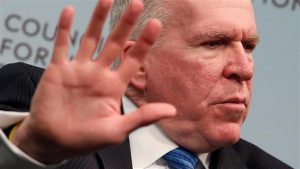 A brazen and unprecedented intervention in domestic U.S. politics by the intelligence community established the basic premise of the cascade of leaks about alleged Trump aides’ shady dealing with Russia. Led by CIA Director John Brennan, the CIA, FBI and NSA issued a 25-page assessment on Jan. 6 asserting for the first time that Russia had sought to help Trump win the election.
Brennan had circulated a CIA memo concluding that Russia had favored Trump and had told CIA staff that he had met separately with Director of National Intelligence James Clapper and FBI Director James Comey and that they had agreed on the “scope, nature and intent of Russian interference in our presidential election.”
In the end, however, Clapper refused to associate himself with the document and the NSA, which agreed to do so, was only willing to express “moderate confidence” in the judgment that the Kremlin had sought to help Trump in the election. In intelligence community parlance, that meant that the NSA considered the idea the Kremlin was working to elect Trump was merely plausible, not actually supported by reliable evidence.
In fact, the intelligence community had not even obtained evidence that Russia was behind the publication by Wikileaks of the e-mails Democratic National Committee, much less that it had done so with the intention of electing Trump. Clapper had testified before Congress in mid-November and again in December that the intelligence community did not know who had provided the e-mails to WikiLeaks and when they were provided.
The claim – by Brennan with the support of Comey – that Russia had “aspired” to help Trump’s election prospects was not a normal intelligence community assessment but an extraordinary exercise of power by Brennan, Comey and NSA Director Mike Rogers.
Brennan and his allies were not merely providing a professional assessment of the election, as was revealed by their embrace of the the dubious dossier compiled by a private intelligence firm hired by one of Trump’s Republican opponents and later by the Clinton campaign for the specific purpose of finding evidence of illicit links between Trump and the Putin regime.
Salacious Gossip
When the three intelligence agencies gave the classified version of their report to senior administration officials in January they appended a two-page summary of the juiciest bits from that dossier – including claims that Russian intelligence had compromising information about Trump’s personal behavior while visiting Russia. The dossier was sent, along with the assessment that Russia was seeking to help Trump get elected, to senior administration officials as well as selected Congressional leaders.
Among the claims in the private intelligence dossier that was summarized for policymakers was the allegation of a deal between the Trump campaign and the Putin government involving full Trump knowledge of the Russian election help and a Trump pledge – months before the election – to sideline the Ukraine issue once in office. The allegation – devoid of any verifiable information – came entirely from an unidentified “Russian emigre” claiming to be a Trump insider, without any evidence provided of the source’s actual relationship to the Trump camp or of his credibility as a source.
After the story of the two-page summary leaked to the press, Clapper publicly expressed “profound dismay” about the leak and said the intelligence community “has not made any judgment that the information in this document is reliable,” nor did it rely on it any way for our conclusions.”
One would expect that acknowledgment to be followed by an admission that he should not have circulated it outside the intelligence community at all. But instead Clapper then justified having passed on the summary as providing policymakers with “the fullest possible picture of any matters that might affect national security.”
By that time, U.S. intelligence agencies had been in possession of the material in the dossier for several months. It was their job to verify the information before bringing it to the attention of policymakers.
A former U.S. intelligence official with decades of experience dealing with the CIA as well other intelligence agencies, who insisted on anonymity because he still has dealings with U.S. government agencies, told this writer that he had never heard of the intelligence agencies making public unverified information on a U.S. citizen.
“The CIA has never played such a open political role,” he said.
The CIA has often tilted its intelligence assessment related to a potential adversary in the direction desired by the White House or the Pentagon and the Joint Chiefs of Staff, but this is the first time that such a slanted report impinges not only on domestic politics but is directed at the President himself.
The egregious triple abuse of the power in publishing a highly partisan opinion on Russia and Trump’s election, appending raw and unverified private allegations impugning Trump’s loyalty and then leaking that fact to the media begs the question of motive. Brennan, who initiated the whole effort, was clearly determined to warn Trump not to reverse the policy toward Russia to which the CIA and other national security organizations were firmly committed.
A few days after the leak of the two-page summary, Brennan publicly warned Trump about his policy toward Russia. In an interview on Fox News, he said, “I think Mr. Trump has to understand that absolving Russia of various actions that it’s taken in the past number of years is a road that he, I think, needs to be very, very careful about moving down.”
Graham Fuller, who was a CIA operations officer for 20 years and was also National Intelligence Officer for the Middle East for four years in the Reagan administration, observed in an e-mail, that Brennan, Clapper and Comey “might legitimately fear Trump as a loose cannon on the national scene,” but they are also “dismayed at any prospect that the official narrative against Russia could start falling apart under Trump, and want to maintain the image of constant and dangerous Russian intervention into affairs of state.”
Flynn in the Bull’s Eye
As Trump’s National Security Adviser, Michael Flynn presented an easy target for a campaign to portray the Trump team as being in Putin’s pocket. He had already drawn heavy criticism not only by attending a Moscow event celebrating the Russian television RT in 2016 but sitting next to Putin and accepting a fee for speaking at the event. More importantly, however, Flynn had argued that the United States and Russia could and should cooperate in their common interest of defeating Islamic State militants.
That idea was anathema to the Pentagon and the CIA. Obama’s Defense Secretary Ashton Carter had attacked Secretary of State John Kerry’s negotiating a Syrian ceasefire that included a provision for coordination of efforts against Islamic State. The official investigation of the U.S. attack on Syrian forces on Sept. 17 turned up evidence that CENTCOM had deliberately targeted the Syrian military sites with the intention of sabotaging the ceasefire agreement.
The campaign to bring down Flynn began with a leak from a “senior U.S. government official” to Washington Post columnist David Ignatius about the now-famous phone conversation between Flynn and Russian Ambassador Sergei Kislyak on Dec. 29. In his column on the leak, Ignatius avoided making any explicit claim about the conversation. Instead, he asked “What did Flynn say, and did it undercut the U.S. sanctions?”
And referring to the Logan Act, the 1799 law forbidding a private citizen from communicating with a foreign government to influence a “dispute” with the United States, Ignatius asked, “Was its spirit violated?”
The implications of the coy revelation of the Flynn conversation with Kislyak were far-reaching. Any interception of a communication by the NSA or the FBI has always been considered one of the most highly classified secrets in the U.S. intelligence universe of secrets. And officers have long been under orders to protect the name of any American involved in any such intercepted communication at all costs.
But the senior official who leaked the story of Flynn-Kislyak conversation to Ignatius – obviously for a domestic political purpose – did not feel bound by any such rule. That leak was the first move in a concerted campaign of using such leaks to suggest that Flynn had discussed the Obama administration’s sanctions with Kislyak in an effort to undermine Obama administration policy.
The revelation brought a series of articles about denials by the Trump transition team, including Vice President-elect Mike Pence, that Flynn had, in fact, discussed sanctions with Kislyak and continued suspicions that Trump’s aides were covering up the truth. But the day after Trump was inaugurated, the Post itself reported that the FBI had begun in late December go back over all communications between Flynn and Russian officials and “had not found evidence of wrongdoing or illicit ties to the Russian government….”
Two weeks later, however, the Post reversed its coverage of the issue, publishing a story citing “nine current and former officials, who were in senior positions at multiple agencies at the time of the calls,” as saying that Flynn had “discussed sanctions” with Kislyak.
The story said Flynn’s conversation with Kislyak was “interpreted by some senior U.S. officials as an inappropriate and potentially illegal signal to the Kremlin that it could expect a reprieve from sanctions that were being imposed by the Obama administration in late December to punish Russia for its alleged interference in the 2016 election.”
The Post did not refer to its own previous reporting of the FBI’s unambiguous view contradicting that claim, which suggested strongly that the FBI was trying to head off a plan by Brennan and Clapper to target Flynn. But it did include a crucial caveat on the phrase “discussed sanctions” that few readers would have noticed. It revealed that the phrase was actually an “interpretation” of the language that Flynn had used. In other words, what Flynn actually said was not necessarily a literal reference to sanctions at all.
Only a few days later, the Post reported a new development: Flynn had been interviewed by the FBI on Jan. 24 – four days after Trump’s inauguration – and had denied that he discussed sanctions in the conversation. But prosecutors were not planning to charge Flynn with lying, according to several officials, in part because they believed he would be able to “parse the definition of the word ‘sanctions’.” That implied that the exchange was actually focused not on sanctions per se but on the expulsion of the Russian diplomats.
Just hours before his resignation on Feb. 13, Flynn claimed in an interview with the Daily Caller that he had indeed referred only to the expulsion of the Russian diplomats.
“It wasn’t about sanctions. It was about the 35 guys who were thrown out,” Flynn said. “It was basically, ‘Look, I know this happened. We’ll review everything.’ I never said anything such as, ‘We’re going to review sanctions,’ or anything like that.”
The Russian Blackmail Ploy
Even as the story of the Flynn’s alleged transgression in the conversation with the Russian Ambassador was becoming a political crisis for Donald Trump, yet another leaked story surfaced that appeared to reveal a shocking new level of the Trump administration’s weakness toward Russia.
The Post reported on Feb. 13 that Acting Attorney General Sally Yates, an Obama holdover, had decided in late January – after discussions with Brennan, Clapper and FBI Director James Comey in the last days of the Obama administration – to inform the White House Counsel Donald McGahn in late January that Flynn had lied to other Trump administration officials – including Vice President Mike Pence – in denying that he discussed sanctions with Kislyak. The Post cited “current and former officials” as the sources.
That story, repeated and amplified by many other news media, led to Flynn’s downfall later that same day. But like all of the other related leaks, the story revealed more about the aims of the leakers than about links between Trump’s team and Russia.
The centerpiece of the new leak was that the former Obama administration officials named in the story had feared that “Flynn put himself in a compromising position” in regard to his account of the conversation with Kislyak to Trump members of the Trump transition.
Yates had told the White House that Flynn might be vulnerable to Russian blackmail because of the discrepancies between his conversation with the Ambassador and his story to Pence, according to the Post story.
But once again the impression created by the leak was very different from the reality behind it. The idea that Flynn had exposed himself to a potential Russian blackmail threat by failing to tell Pence exactly what had transpired in the conversation was fanciful in the extreme.
Even assuming that Flynn had flatly lied to Pence about what he had said in the meeting – which was evidently not the case – it would not have given the Russians something to hold over Flynn, first because it was already revealed publicly and second, because the Russian interest was to cooperate with the new administration.
The ex-Obama administration leakers were obviously citing that clumsy (and preposterous) argument as an excuse to intervene in the internal affairs of the new administration. The Post’s sources also claimed that “Pence had a right to know that he had been misled….” True or not, it was, of course, none of their business.
Pity for Pence
The professed concern of the Intelligence Community and Justice Department officials that Pence deserved the full story from Flynn was obviously based on political considerations, not some legal principle. Pence was a known supporter of the New Cold War with Russia, so the tender concern for Pence not being treated nicely coincided with a strategy of dividing the new administration along the lines of policy toward Russia.
All indications are that Trump and other insiders knew from the beginning exactly what Flynn had actually said in the conversation, but that Flynn had given Pence a flat denial about discussing sanctions without further details.
On Feb. 13, when Trump was still trying to save Flynn, the National Security Adviser apologized to Pence for “inadvertently” having failed to give him a complete account, including his reference to the expulsion of the Russian diplomats. But that was not enough to save Flynn’s job.
The divide-and-conquer strategy, which led to Flynn’s ouster, was made effective because the leakers had already created a political atmosphere of great suspicion about Flynn and the Trump White House as having had illicit dealings with the Russians. The normally pugnacious Trump chose not to respond to the campaign of leaks with a detailed, concerted defense. Instead, he sacrificed Flynn before the end of the very day the Flynn “blackmail” story was published.
But Trump appears to have underestimated the ambitions of the leakers. The campaign against Flynn had been calculated in part to weaken the Trump administration and ensure that the new administration would not dare to reverse the hardline policy of constant pressure on Putin’s Russia.
Many in Washington’s political elite celebrated the fall of Flynn as a turning point in the struggle to maintain the existing policy orientation toward Russia. The day after Flynn was fired the Post’s national political correspondent, James Hohmann, wrote that the Flynn “imbroglio” would now make it “politically untenable for Trump to scale back sanctions to Moscow” because the “political blowback from hawkish Republicans in Congress would be too intense….”
But the ultimate target of the campaign was Trump himself. As neoconservative journalist Eli Lake put it, “Flynn is only the appetizer. Trump is the entree.”
Susan Hennessey, a well-connected former lawyer in the National Security Agency’s Office of General Counsel who writes the Lawfare blog at the Brookings Institution, agreed. “Trump may think Flynn is the sacrificial lamb,” she told The Guardian, “but the reality is that he is the first domino. To the extent the administration believes Flynn’s resignation will make the Russia story go away, they are mistaken.”
The Phony “Constant Contacts” Story
No sooner had Flynn’s firing been announced than the next phase of the campaign of leaks over Trump and Russia began. On Feb. 14, CNN and the New York Times published slight variants of the same apparently scandalous story of numerous contacts between multiple members of the Trump camp with the Russian at the very time the Russians were allegedly acting to influence the election.
There was little subtlety in how mainstream media outlets made their point. CNN’s headline was, “Trump aides were in constant touch with senior Russian officials during campaign.” The Times headline was even more sensational: “Trump Campaign Aides Had Repeated Contacts with Russian Intelligence.”
But the attentive reader would soon discover that the stories did not reflect those headlines. In the very first paragraph of the CNN story, those “senior Russian officials” became “Russians known to U.S. intelligence,” meaning that it included a wide range Russians who are not officials at all but known or suspected intelligence operatives in business and other sectors of society monitored by U.S. intelligence. A Trump associate dealing with such individuals would have no idea, of course, that they are working for Russian intelligence.
The Times story, on the other hand, referred to the Russians with whom Trump aides were said to be in contact last year as “senior Russian intelligence officials,” apparently glossing over a crucial distinction that sources had made to CNN between intelligence officials and Russians being monitored by U.S. intelligence.
But the Times story acknowledged that the Russian contacts also included government officials who were not intelligence officials and that the contacts had been made not only by Trump campaign officials but also associates of Trump who had done business in Russia. It further acknowledged it was “not unusual” for American business to come in contact with foreign intelligence officials, sometimes unwittingly in Russia and Ukraine, where “spy services are deeply embedded in society.”
Even more important, however, the Times story made it clear that the intelligence community was seeking evidence that Trump’s aides or associates were colluding with the Russians on the alleged Russian effort to influence the election, but that it had found no evidence of any such collusion. CNN failed to report that crucial element of the story.
The headlines and lead paragraphs of both stories, therefore, should have conveyed the real story: that the intelligence community had sought evidence of collusion by Trump aides with Russia but had not found it several months after reviewing the intercepted conversations and other intelligence.
Unwitting Allies of the War Complex?
Former CIA Director Brennan and other former Obama administration intelligence officials have used their power to lead a large part of the public to believe that Trump had conducted suspicious contacts with Russian officials without having the slightest evidence to support the contention that such contacts represent a serious threat to the integrity of the U.S. political process.
Many people who oppose Trump for other valid reasons have seized on the shaky Russian accusations because they represent the best possibility for ousting Trump from power. But ignoring the motives and the dishonesty behind the campaign of leaks has far-reaching political implications. Not only does it help to establish a precedent for U.S. intelligence agencies to intervene in domestic politics, as happens in authoritarian regimes all over the world, it also strengthens the hand of the military and intelligence bureaucracies who are determined to maintain the New Cold War with Russia.
Those war bureaucracies view the conflict with Russia as key to the continuation of higher levels of military spending and the more aggressive NATO policy in Europe that has already generated a gusher of arms sales that benefits the Pentagon and its self-dealing officials.
Progressives in the anti-Trump movement are in danger of becoming an unwitting ally of those military and intelligence bureaucracies despite the fundamental conflict between their economic and political interests and the desires of people who care about peace, social justice and the environment.
Venezuela Sanctions CNN in Fight Against ‘Imperialist’ News
teleSUR | February 15, 2017
Venezuela’s National Telecommunications Commission, CONATEL, announced plans Wednesday to begin sanctioning procedures against CNN en Español for its “direct aggression against the Venezuelan people and state.”
The announcement was made in response to a CNN en Español report released last week suggesting that the Bolivarian government “may have given passports to people with ties to terrorism.” More specifically, the report alleges that Venezuelan Vice President Tareck El Aissami is linked to 173 people from the Middle East, including some connected to the Lebanese militant group Hezbollah.
“As part of its traditional interventionist and imperialist policy, this U.S. agency abrogates extraterritorial powers that blatantly violate basic principles of international law,” CONATEL wrote in a statement.
“It (CNN en Español) has the ignoble and Machiavellian purpose of undermining the image of the National Executive Branch and, therefore, institutionality, governance, and stability of the country, as well as the Bolivarian Revolution, a socio-political project contrary to its interests of domination.”
CONATEL’s statement, which points out that CNN en Español’s allegations are based on unsubstantiated evidence, urges journalists around the world to launch an independent investigation of the report.
The statement also questions the validity of government “whistleblower” Misael Lopez’s claims that the government was “scheming” to sell passports and visas for thousands of dollars. Most of CNN en Español’s report is based on alleged testimony by Lopez, a former secretary of the Venezuelan embassy in Iraq who has strong connections with Venezuela’s U.S.-backed opposition.
Lopez is a close friend and business partner of Ana Argotti, a lawyer who defends violent right-wing activists facing charges for the opposition’s “La Salida” campaign. This was the campaign that left 43 people dead and over 800 injured from street blockades known as “guarimbas.”
“Lopez is an agent infiltrated by the Venezuelan opposition based in the United States,” Venezuelan Foreign Minister Delcy Rodriguez confirmed Wednesday, AVN reports.
The Bolivarian Revolution’s battle against fake news has intensified within the last few days.
On Monday, the U.S. placed El Aissami on a sanctions list reserved for “drug kingpins,” without offering any evidence or issuing any criminal charges. The U.S. government based their decision on CNN en Español’s report as well as other unsubstantiated claims parroted by mainstream media outlets.
Last week, the Miami Herald published a story claiming that Venezuelans are killing and eating flamingos amidst food shortages, citing unsubstantiated claims made by a biology student.
Venezuela shuts down CNN, calling it ‘instrument of war’
Press TV – February 16, 2017
Venezuela’s President Nicolas Maduro says CNN is an “instrument of war” after his country pulls the network’s Spanish-language channel off the air.
During a televised Wednesday speech, Maduro claimed that the channel had been spreading “propaganda” over an alleged visa racket at the country’s embassy in Iraq, while adding that the channel was an “instrument of war in the hands of real mafias.”
He also warned US President Donald Trump to “open his eyes and ears” in the face of an “incorrect policy” adopted by CNN and the US State Department, which he said were “promoting a general, massive intervention and aggression against Venezuela.”
Earlier, the Venezuelan government issued a statement, announcing that the country’s National Telecommunications Commission had ordered “the immediate suspension of CNN Spanish broadcasts.”
Venezuelan Foreign Minister Delcy Rodriguez also stressed that the government had “ordered the relevant authorities to take action” against the channel.
She added that the February 6 report was “based absolutely on falsehoods,” and that the channel “has launched an operation of psychological warfare, a war propaganda operation.”
She also referred to one of the report’s sources, embassy employee Misael Lopez, as a “delinquent.”
The report also claimed that new Venezuelan Vice President Tareck El Aissami was behind the racket. Aissami was also recently sanctioned by the US Department of Treasury over alleged drug trafficking into the United States.
Meanwhile, Carlos Lauria, CNN’s senior program coordinator for the Americas, called on Maduro “to stop interfering with the work of the press.”
Venezuela Suspends CNN en Espanol Due to Threat to ‘Peace, Democratic Stability’
Sputnik – 16.02.2017
 Venezuela’s National Telecommunications Commission (CONATEL) has suspended the operation of the CNN en Espanol news channel on the territory of the country, the commission said in a statement.
The suspension of CNN en Espanol, which allegedly generates “a climate of intolerance” and threatens “the peace and democratic stability” of the people of Venezuela is effective immediately starting on Wednesday on all “national territory,” CONATEL said on Wednesday, accusing the channel of “aggression” against Venezuela.
The commission also urged other media actors to offer the Venezuelan people timely and impartial information that corresponds to the values of the Venezuelan society and fulfills the constitutional guarantees of free communication.
The Venezuelan government reportedly launched an investigation into the work of the CNN en Espanol channel in August 2015, accusing it of spreading false reports on violence in the country.
The news comes as US President Donald Trump called CNN “fake news” and refused to give their reporter a question at a press event after the broadcaster had helped to fuel false rumors he had hired prostitutes at a Moscow hotel and engaged in lewd behavior.
The network that markets itself as centrist relief from hyper-partisan outlets Fox and MSNBC aired an uncorroborated, unverified report alleging that Russians had obtained compromising information on Trump. The report originated from a former UK intelligence operative, according to CNN and BuzzFeed, the first outlets to publicize the reports.
Following the national and global embarrassment, CNN desperately tried to distance itself from BuzzFeed. CNN claims their reporting of Russia potentially having compromising financial or personal information against Trump is part of its honorable First Amendment duty of “informing the people of the inner workings of their government.”
US media reports of Trump links to Russian intelligence ‘laughable, cite no facts’ – Kremlin
RT | February 15, 2017
Moscow has criticized news reports alleging associates of Donald Trump had numerous contacts with Russian intelligence during the election, with the Kremlin’s spokesman complaining that it’s hard to distinguish fact from fiction in the US media lately.
“Those reports are not based on concrete facts,” Dmitry Peskov stressed on Wednesday, noting “there are five different sources in the story and none is named. So you see, really laughable stories are now given a go.”
The Russian president’s spokesman added, “Let’s not just believe the press. It’s difficult lately tell the real deal from fakes and hoaxes,” referring to reports in the New York Times and on CNN which cited anonymous US sources as saying that several people close to President Donald Trump had communicated with Russian intelligence officers during the presidential campaign.
Russia’s Foreign Ministry has reacted cautiously, saying the publications indicate a big political game involving power bargaining is being played within the US establishment.
Other Russian officials were more forthcoming, however.
“It’s common tactic to discredit a person,” Senator Vladimir Dzhabarov told RIA Novosti, commenting on expose stories run by the New York Times and CNN, adding that it’s a continuation of the same campaign that forced Michael Flynn’s resignation as National Security Advisor earlier.
“Trump should realize that the real target of such leaks is him. Unless the American president puts an end to this witch-hunt and stops surrendering his people, this will all end bad. The final goal of his enemies is to impeach the president,” he added.
Dzhabarov, who holds a seat in the Russian Senate, is a veteran intelligence officer who retired with the rank of Colonel General.
Leonid Slutsky, a fellow legislator and head of the Parliament’s Foreign Affairs Committee, came to a similar conclusion, saying that the US mainstream media is carrying out a concerted attack on Trump.
“Such outlets use any chance to mar the new president and use this overused and baseless ‘Russian dossier’ for the purpose often because it makes a reliable impact on their readers,” he explained.
The Russian Foreign Intelligence Service, whose agents Trump’s aides were allegedly in contact with, told TASS they were surprised by the reports and would not comment on “media speculations that lack proof.”
In an earlier article, the New York Times cited unnamed current and former US officials as saying that members of Trump’s election campaign had had contacts with senior Russian intelligence officers. The newspaper said US intelligence had intercepted the communications of Trump’s aides as they were collecting information to see if there was any evidence showing collusion between the Republican and Russia on the alleged hack of the Democratic National Convention – evidence that they reportedly failed to find.
The report said that, not only campaign members, but also other associates of Trump had been targeted by the surveillance. The only name it provided was that of Paul Manafort, who had to resign as Trump’s campaign manager after Ukrainian authorities accused him of having been involved in the corruption of the previous Ukrainian government. The evidence of such corruption was later disavowed by the Ukrainian investigators.
Commenting for the NYT report, Manafort denied having any ties with the Russian intelligence.
“This is absurd. I have no idea what this is referring to. I have never knowingly spoken to Russian intelligence officers, and I have never been involved with anything to do with the Russian government or the Putin administration or any other issues under investigation today,” he told the newspaper.
The NYT sources would not disclose any details, including the names of alleged Russian spies or the number of Trump people that had allegedly communicated with them, claiming the data had been collected as part of routine surveillance of the communications of foreign officials.
CNN ran a similar story independently of the newspaper, citing anonymous “law enforcement and administration officials.”
NATO accuses Russia of fake news, while hysterically warning of WWIII
By Finian Cunningham | RT | February 14, 2017
News media organizations in NATO member countries have no qualms about repeating unfounded, reckless claims of an imminent invasion of Europe by the Russian military, even threatening to ignite World War Three.
Yet when it comes to Russian media presenting valid alternative perspectives on a range of international issues, the Western alliance chokes up with accusations of Russian “fake news.”
“NATO says it sees a sharp rise in fake Russian news since the seizure of Crimea,” reported Reuters recently, ignorant of the fact that its own headline was itself purveying fake news.
Such ignorance is rampant among Western media and symptomatic of massive group-think demonizing Russia.
For a start, Russia did not seize Crimea, as is routinely stated in Western media as if fact. The people of the Crimean Peninsula voted in a legally constituted referendum in March 2014 to join Russia’s jurisdiction. But Reuters in the above headline uses the words “seizure of Crimea” without any qualification as if the historic referendum to join Russia was airbrushed out of history.
This is just one example of the daily distortion about Russian relations that is perpetrated in the Western media. If any side is guilty of peddling fake news, it is the Western news media of the NATO military alliance. And on an industrial scale.
For instance, earlier this month, CNN’s Christiane Amanpour conducted an interview with Marine Le Pen, the French leader of the Front National. Amanpour was aghast when Le Pen expressed the view that Russia did not annex Crimea and that the Maidan protests in Kiev in February 2014 were a coup d’état against an elected government. Amanpour’s shocked demeanor was understandable because she has on countless occasions asserted the opposite, as well as claiming Russia has “invaded Ukraine.” In each case, it can be argued the CNN celebrity journalist is wrong in her assertions about Russia-Ukraine relations, which means that she and her cable news employer are guilty of habitually churning out fake news.
Another instance of casual fake news presented as professional journalism was the BBC program GMT presented by Stephen Sackur on 3 February. Sackur, like Amanpour, is another celebrity journalist with preening self-importance. His program was reporting on the surge in violence in eastern Ukraine. Specifically, the report aired by the BBC implicated pro-Russian rebels in Donetsk region for shelling the town of Avdeevka. The insinuation was that Russia was stoking the violence. But only days before, the BBC broadcast video footage showing tanks belonging to the Kiev regime’s military taking up positions near homes in Avdeevka – in violation of the Minsk ceasefire.
Furthermore, the BBC’s Sackur then ran an interview with Kiev’s former prime minister, Arseniy Yatsenyuk, in which he was permitted to spout claims purporting as facts without ever being challenged. Those claims included: “Russian aggression in Ukraine” and “Russia shot down the Malaysian MH17 civilian airliner in July 2014 over eastern Ukraine.”
Again, the point here is just how casually, and routinely Western mainstream media commit acts of fake news, which are presented as if fact by their “star journalists.”
Whatever Russian news media are accused of regarding fake news it is incomparable to the massive, systematic scale of fabrications and distortions churned out by the news media in NATO member countries.
NATO claims that it has listed over 30 “myths” the Russian news media have published. Unhelpfully, the NATO list does not provide links to original Russian news articles where the alleged myths are said to have been published. But a cursory reading of the list quickly shows that the so-called myths are nothing more “offensive” than Russian counter-arguments or what may be deemed as counter-perspective. Is NATO saying that to have a different point of view is somehow illegitimate?
For example, NATO counts Russian “fake news” to include claims that:
NATO tried to “drag” Ukraine into its membership;
NATO provoked the Maidan protests;
NATO is trying to encircle Russia;
NATO’s operation in Afghanistan was a failure;
NATO’s operation in Libya was illegitimate;
These points and more besides are not falsifications or baseless propaganda. They are serious contentions that can be substantiated with documented facts and legal argument as well as maps of proliferating NATO military bases on Russia’s borders.
Indeed, such perspectives completely confound the stereotype views that are promulgated on a daily basis by the Western media. But that in no way qualifies the contrarian Russian view as “fake.” Moreover, one can say that such views presented by Russian media are vital to proper public interest and understanding.
It is an astounding reflection of Western hubris and indoctrination that NATO members’ news media have published the following news stories which are patently false or turn reality on its head.
For instance, Russian and Syrian forces were allegedly committing wholesale slaughter of civilians in the city of Aleppo. For weeks the Western news media were screaming about the alleged massacre, only for the Syrian city to be eventually liberated from Western-backed illegally armed militants, including proscribed terrorist groups. No such civilian massacre occurred, and Western media have not bothered since to visit Aleppo to report on the return to normal civilian life thanks to the liberation by Russian and Syrian forces.
Another instance of rampant fake news carried in Western media is that Russian hackers subverted the US presidential election to get Donald Trump into the White House. No proof of these tendentious claims has ever been presented.
Yet the same claims are now being aired over alleged Russian interference in European elections – even though German state intelligence recently reported there was no evidence of interference.
Let’s put the issue into perspective. Over the past year, British news media have published story after story claiming Russia was about to invade Europe and start World War III.
The Daily Express ran three such stories in June, July, and September.
It wasn’t just throw away tabloids that indulged in such reckless scaremongering. The supposedly more serious Independent ran at least two stories in May and September citing top military officials claiming that nuclear war could break out in 48 hours with Russia because of the latter’s “secret” invasion plans.
In November, the Guardian and other British news outlets, including the Daily Mail, Daily Telegraph, BBC, and Sky, echoed the view of MI5 chief Sir Ian Parker that “Russia is a growing threat to the UK.”
If British media reports were to be believed, then Europe and the whole northern hemisphere should have gone up in nuclear smoke several months ago.
Dealing in false news by NATO members’ media, as exemplified above, is not just wildly erroneous and unethical. It is illustrative of an orchestrated propaganda campaign to demonize Russia and recklessly create an atmosphere for global war.
In this context, to accuse Russian news media of “fake news” is a flagrant inversion of reality.
That NATO chiefs, Western governments, and the dutiful news media can get away with making such accusations is a disturbing sign of collective indoctrination. The irony of Western self-declared “free and independent” politicians and media behaving like an army of robots marching to war while accusing Russia of fake news is too much for words.
Featured Video
Alon Mizrahi: ‘Israel Must Be Dismantled’
or go to
Aletho News Archives – Video-Images
From the Archives
Allies Don’t Need Lobbies
By Jay Knott | Dissident Voice | September 24, 2013
In a recent article on Counterpunch, Rob Urie defended the traditional Marxist analysis of US policy in the Middle East. He argues that support for Israel is driven primarily by economic interest, not the Jewish lobby.
He starts by paying tribute to the idea that Western societies are uniquely racist. He says that the “Western narrative” claims there is an “Arab character”, and that this is “antique racist blather”. He gives no definition of these terms. Further, he establishes his credentials as part of the dominant current in the American left by claiming that “over a million people in Iraq died so ‘we’ in the West can drive SUVs.”1
When he tries to criticize bourgeois economics, he makes it clear he doesn’t understand the developments it has made since Marx’s day, using the mathematical discipline known as “game theory”. He dismisses the basic abstraction of economic theory, the idea of the rational individual, on the grounds that it is “devoid of history, culture and political context”. But abstractions are always devoid of something.
He defends a more concrete economic theory, mostly Marxist, with some input from another theorist of capitalist crisis, Hyman Minsky. This concrete theory leads him to the view that US activity in the Middle East is primarily driven by rational capitalist motives, the need to secure a supply of oil.
“Taking the totality of circumstance — former oil company executives launching war on an oil rich nation on a pretext they publicly proclaimed they didn’t believe shortly before taking office — and that upon launching their war proved to be non-existent, requires a willingness to overlook the obvious — that the war on Iraq was for oil, that is difficult to support.”1
Perhaps I’ve misunderstood him, but based on what he says in the rest of the article, this convoluted sentence seems to argue that, because president Bush and vice-president Cheney attacked Iraq on false premises, and they also said it was all about oil, and they are former oil executives, and Iraq has a lot of oil, it’s difficult to deny US attacks on Iraq are all about oil.
In fact, it’s not hard at all. As Urie points out, at times Bush and co. said that attacking Iraq was “protecting the world’s supply of oil.”1 But, as he also points out, they are congenital liars. Why should we believe them when they say they are trying to “protect” the oil supply? Protect it against what? When politicians “admit” attacks on Middle Eastern countries are wars for oil, they are parroting the neo-con party line, feeding the public, both left and right, with a plausible-sounding pretext. For right-wingers, “it’s a war for oil” is a reason to support war, and for leftists, it’s a way to feel better by complaining impotently about corporate greed. Both approaches help the war drive. … continue
Blog Roll
 Aletho News
- Pakistan ramps up food exports to Persian Gulf nations as war deepens food insecurity
- Iran submits response to US plan, sets terms for war’s end: Tasnim
- US vs Iran: Kharg Island Talk — Bluff or Escalation? Ex-Military Officer Weighs In
- Zelensky unnecessarily involves Ukraine in the Middle East crisis
- Turkish tanker blacklisted by Ukraine hit in drone attack – media
- Canada, the U.S., and NATO: the inescapable trap
- Villains of Judea: Leonid Radvinsky
- Alon Mizrahi: ‘Israel Must Be Dismantled’
- Former Head Of MI6 Admits That The U.S. And Israel Are Losing The Iran War
- Scattered Thoughts on War and Peace
- If Americans Knew
- Israel may be committing war crimes in Lebanon – Not a ceasefire Day 167
- In the West Bank, life is a constant battle – 3 articles
- Jacob Reses, one of the most powerful pro-Israel operatives in Trump’s Washington
- Israeli-US assaults kill or injure 87 children a day – Not a ceasefire Day 166
- ‘Forever live by the sword’: Understanding Israelis’ massive support for Iran war
- UN’s special rapporteur on human rights says Israel is systematically torturing Palestinians
- Trump White House plagiarized Iran war manifesto from Israel-aligned think tank
- Gaza says 6–10 patients die daily waiting for treatment abroad as Israel blocks medical evacuations
- ‘Substantial evidence’ of double-tap strike in killing of Gaza’s Hind Rajab
- ‘Do Not Want To Die For Israel’: Doubts About Trump’s Iran Strategy Spread Among Troops
- No Tricks Zone
- Devastating Assessment Of Comirnaty Vaccine By Former Senior Pfizer Europe Toxicologist
- New Study: CO2 Is ‘Effectively Negligible’ As An Explanatory Climate Change Factor Since 2000
- Former Pfizer Toxicologist Dr. Helmut Sterz Tells Bundestag Hearing Pfizer Vaccine Should Have Never Been Approved
- Energy Expert: Germany’s Nuclear Phaseout Was A “500 Billion Euro Mistake”
- New Research: South Australia’s Mid-Holocene Sea Surface Temperatures Were 4°C Warmer Than Today
- Storing Green Energy To Last Germany 10 Days Would Require A 60-Million Tonne Battery
- New Studies: UK Sea Levels Were 4 Meters Higher Than Today During The Mid-Holocene
- Destructive Green New Deal: German Energy And Metal Group Warns Of Drastic Crisis
- New Study Documents A 20-Year Pause In Arctic Sea Ice Decline – Driven By Internal Variability
- Wake-up Call: Survey Shows Majority Of Germans Now Favor Postponing Climate Targets!
 Aletho News