Secret documents reveal Germany’s public health agency warned lockdowns cause more harm than good
Germany is rocked by confidential RKI files showing the experts were warning against mandatory masks and mass lockdowns
By John Cody | Remix News | March 27, 2024
Following a long legal battle, Germany’s public health agency, the Robert Koch Institute (RKI), has released the confidential protocols that show the RKI was aware that “lockdowns cause more harm than good” and evidence for “making masks mandatory was lacking.”
The RKI voiced concerns in 2020 that shutting down German society could lead to increased child mortality and other negative outcomes. The RKI experts also disagreed with the implementation of FFP2 face masks, saying there was a lack of data to support such a measure.
“Active communication would make sense in order to make clear why the RKI does not recommend this measure,” notes the minute regarding implementing FFP2 mask regulations. The agency even notes in the minutes that it would tell the public it did not support FFP2 mask regulations, but notably, the agency never did so despite mass protests against mandatory masks and other harsh measures.
The 2,500 pages of documents also contain a passage noting that experts warned that lockdowns could “do more harm than good,” with experts citing lockdowns in Africa and the negative outcomes seen there.
The documents have revealed that German politicians dramatized the situation, contrary to the opinions of experts. This was done presumably in order to implement coercive measures and restrict basic rights. There are now calls to release the rest of the documents, as more than a thousand passages are still redacted, representing a third of the total text dating from meeting notes from the “crisis unit” taken between February 2020 and April 2021.
The release of the documents has sent shockwaves through Germany and led even left-wing parties, such as the Greens, to call for a “comprehensive review” of coronavirus policy. Other parties, like the Alternative for Germany (AfD), are calling for more action, including a commission investigation.
Politicians are urging the RKI to lift the redactions and make all findings available to the public, and further court proceedings are pending. In the meantime, debate continues to rage, with the #RKIFiles tag on X already generating 45,000 posts.
An example of just a couple of posts shows the anger many Germans still feel towards the coronavirus-era policies put in place.
“The Bavarian state government tortured children with masks until spring 2022 — even in physical education classes. Not because there was scientific evidence for it, but because Markus Söder liked the role of coronavirus hardliner. #RKIFiles,” wrote one X user.
Another showed video of police brutalizing protesters demonstrating against Covid-19 measures, writing:
“It’s good that the RKI protocols are included in the broader discussion! But there can be no such thing as cheap forgiveness. With the coronavirus, 2/3 of Germans became massively aggressive against 1/3. The handcuffs must click on the main criminals.”
Virologist reacts to report
Virologist Klaus Stöhr, once the WHO pandemic commissioner, said the revealed protocols once again show that the “risk assessment was not based on data.” According to Stöhr, “his hair stood on end when it came to (Germany’s) pandemic plan.”
Stöhr also commented on the fact that the RKI protocols uncovered that experts were telling the government that there is little data to support widespread mask adoption for the public.
“And the fact that what was known about FFP2 masks was completely ignored is just two small building blocks.” There was “a lot more data available where it was seen that the work was not based on evidence,” he said.
The scientist referred to “curfews, border closures, 2G/3G (areas restricted based on vaccination status), and the side effects of lockdowns” as further examples of this. Stöhr noted that “these are all things that were known – including that the vaccines could not halt the spread of the virus.” He said that the vaccines could not end the pandemic, and it was “clear from the beginning that the vaccine couldn’t do that.”
He is now calling for a commission or review process to avoid the mistakes made by the government during the Covid-19 era in the future.
Virologist Hendrik Streeck, who was appointed to the RKI expert council, also stated: “I’m very surprised that entire pages about vaccinations, for example, were blacked out,” he said to Welt. “And I wonder what it says, why the public shouldn’t see it.”
Lauterbach in panic mode?
Federal Health Minister Karl Lauterbach (SPD) reacted with horror to the findings in the report. As federal health minister during a significant portion of the pandemic, he has often been the top target of criticism from those opposed to Germany’s Covid-19 policies.
“Enlightenment is good, but we must not allow conspiracy theories to arise on social media through the interference of foreign governments,” he wrote on the X platform. Why he referred to “foreign governments” remained unclear, but when cornered, left-wing politicians often resort to claims of “foreign interference” and “Russia.”
Despite calls for a review of policy, Lauterbach is desperate to avoid this outcome and is also openly rejecting a commission, as the AfD and BSW parties are calling for.
Lauterbach claims this would only benefit “a small group of politicians, but also people who perhaps represent radical ideas in other areas.” He claims they would use the findings “to politicize against the state.”
Some from the Greens also resorted to claims of “foreign influence” following the release of the RKI protocols.
Green health politician Janosch Dahmen, one of the most aggressive supporters of extreme Covid-19 policies, said: “It seems to me that the virulent spread of such untruthful rumors is also the result of the influence of foreign intelligence services on our society against the background of Russia’s war against Ukraine, to further divide and render politics incapable of action.”
The AfD, FDP and BSW want an investigation
The AfD, Free Democrats and BSW parties all want a more thorough investigation than a simple “review.”
“The public has a right to know what really happened back then,” said the health policy spokesman for the AfD parliamentary group, Martin Sichert, regarding the redactions still in the report. He appealed to the other parliamentary groups: “Take a look at the protocols of the RKI crisis team and set up a coronavirus investigation committee with us.”
Even the FDP, which is in a governing coalition with the ruling government, is calling for a more thorough investigation. FDP vice-president Wolfgang Kubicki announced that he would “work to ensure that the entire basis for decision-making at this time becomes public.” He also said it is becoming increasingly clear “that the Robert Koch Institute for Health Policy served as a scientific façade for former Minister Jens Spahn and probably also Karl Lauterbach.”
Some Greens are conciliatory
Some left-wing politicians believe some kind of review is necessary to improve “social cohesion.”
“It would be good for social cohesion if there were a review of coronavirus policy with a little distance,” said the Green parliamentary group’s legal policy spokesperson, Helge Limburg, to Welt newspaper. “This could be a commission of inquiry, a commission of experts, or another form of debate that signals to people: We are not simply brushing aside the drastic measures of that time.”
Health and budget politician Paula Piechotta said: “Almost exactly four years after the first pandemic measures were introduced in Germany, it is now overdue to address the mistakes of pandemic policy in a wide range of areas, from health and education to financial policy, in a transparent and timely manner for everyone.”
Her party colleague, Vice Chancellor Robert Habeck, also said a review of the coronavirus era was necessary but was short on specifics.
“We should now initiate a phase in which we reflect on the difficult pandemic period with all its effects,” he told the Bild newspaper. The German government at the time had to make far-reaching decisions quickly in an unprecedented situation during the pandemic.
“Certainly mistakes were made, but it would also have been a mistake not to make a decision,” he continued. “I think we should have the courage to learn the lessons, review processes, and evaluate the impact.”
In retrospect, it is fair to ask “whether the advisory bodies for politicians really covered the diversity of perspectives in science,” said Green MP Dieter Janecek. “For example, some encroachments on fundamental rights were certainly questionable: Unvaccinated people were not allowed into restaurants or swimming pools, even though it was already clear that the vaccine did not prevent transmission. Children and young people were unduly disadvantaged.”
Little Known about mRNA and Spike Protein Biodistribution Three Years into Mass Vaccination Campaign
Alarming Conclusions from Russian Analysis of Studies
By Peter A. McCullough, MD, MPH | Courageous Discourse | March 24, 2024
I remember when the mRNA COVID-19 vaccines rolled out in December, 2020. I asked some of the doctors a few questions about the novel products. Where do they go in the body? How long do they last? No one knew the answers yet throngs came forward and took the jab.
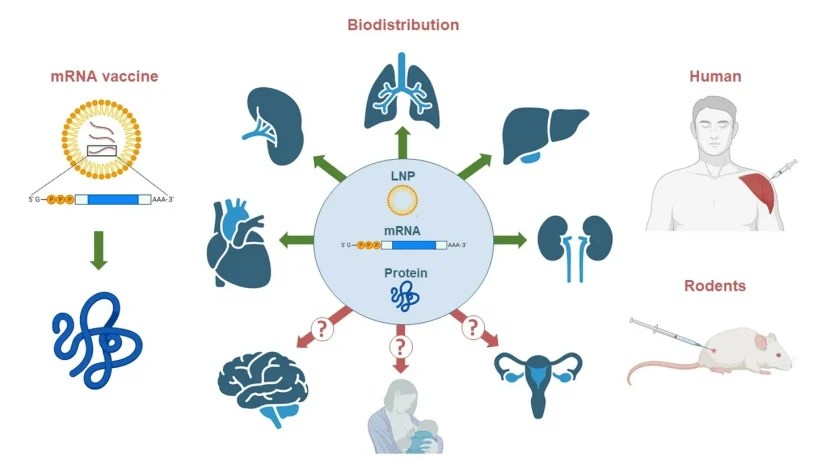
Now a Russian analysis of the biodistribution data on lipid nanoparticles laced with mRNA has been published by Pateev et al. The conclusions are shocking especially considering we are three years into a global mass vaccination campaign with shots every six months.

Pateev, I.; Seregina, K.; Ivanov, R.; Reshetnikov, V. Biodistribution of RNA Vaccines and of Their Products: Evidence from Human and Animal Studies. Biomedicines 2024, 12, 59. https://doi.org/10.3390/biomedicines12010059
This image from the manuscript is not reassuring for a vaccine, which one would anticipate should remain in the deltoid muscle, incite local antigenic stimulation, and then have the lymphatic and immune system produce clearance of the foreign material and confer durable immunity. As you can see, mRNA vaccines do nothing of the sort. The widespread distribution, long duration of action, and dangerous unending production of the damaging and potentially lethal Spike protein continue to cause great alarm among doctors, scientists, and the public who are asking questions regarding the biological fate of these new products.
Pateev, I.; Seregina, K.; Ivanov, R.; Reshetnikov, V. Biodistribution of RNA Vaccines and of Their Products: Evidence from Human and Animal Studies. Biomedicines 2024, 12, 59. https://doi.org/10.3390/biomedicines12010059
Fired Harvard Professor: ‘All the Basic Principles of Public Health Were Thrown Out the Window’
By Michael Nevradakis, Ph.D. | The Defender | March 21, 2024
Martin Kulldorff, Ph.D., co-author of the Great Barrington Declaration said Harvard University’s decision to fire him for non-compliance with the university’s COVID-19 vaccine mandate is just one example of the consequences faced by anyone who questioned the official COVID-19 narratives.
In an appearance on “The Defender In-Depth” podcast, Kulldorff, an epidemiologist, said his firing is part of a broader trend of censorship and intolerance toward people who express diverging views in the broader fields of science, medicine and academia.
Kulldorff is one of the five individual plaintiffs in a lawsuit against the Biden administration alleging key administration officials and government agencies coerced social media platforms to remove content, in violation of the First Amendment.
Kulldorff discussed the latest developments in the suit — Murthy et al. v. Missouri et al. — whose plaintiffs also include the attorneys general of Missouri and Louisiana.
On Monday, the U.S. Supreme Court heard arguments on an injunction, previously granted by lower courts, barring the administration and certain federal agencies from communicating with social media platforms for the removal of content.
He also discussed the COVID-19 pandemic response of his native Sweden, which bucked the global trend by eschewing lockdowns, vaccine and mask mandates, making the country the target of global pressure and widespread media criticism. Yet, Sweden now demonstrates better public health outcomes than most other countries.
‘Never a consensus in the scientific community’ for lockdowns
Kulldorff said Harvard was “not happy” with him when he co-authored the Great Barrington Declaration in 2020. However, it was Kulldorff’s decision not to get a COVID-19 vaccine that ultimately led Harvard to fire him.
“We had a disagreement about infection-acquired immunity,” Kulldorff said. “I was fired because I didn’t want to take the vaccine because I didn’t need it. I had better immunity from having had [COVID-19] already, and so, there was no medical reason for me to do it. And there was certain risk, because with every vaccine and drug, there’s some risk.”
Yet, many of his colleagues at Harvard and other institutions “sort of kept quiet” and “went along with it,” Kulldorff said. He attributed their cooperation to the federal funding many scientists and researchers receive from agencies such as the National Institutes of Health (NIH) and the National Institute of Allergy and Infectious Diseases.
“They sit on the biggest pile of medical research money in the world,” Kulldorff said. “So, it’s pretty scary for a scientist to speak up against their wishes, because you risk losing the resource funds that you depend on to support your family, and also to support the other people that work in your laboratory.”
Still, in personal contacts with fellow epidemiologists, Kulldorff said “The majority were arguing for focused protections over better protecting the older people, by letting kids go to school and so on. So, there was never a consensus in the scientific community, at least not in the epidemiological community, for these lockdown measures.”
Kulldorff said that during the pandemic, “all the basic principles of public health were thrown out the window.” His former institution, Harvard, was no exception, “going to online teaching before there was any government incentive or push to do so.”
This, Kulldorff said, “set the stage, and a lot of other colleges and even high schools and elementary schools sort of followed Harvard’s lead” in locking down.
Similarly, Harvard later imposed a COVID-19 vaccine mandate — which it finally ended on March 5. “There was no public health reason to mandate vaccines for students” in particular, Kulldorff said, because most of them “had COVID, so they have superior immunity. But even those few that haven’t [caught COVID-19] face minuscule risk from COVID.”
Children ‘will never fully recover’ from school closures
Kulldorff cited his native Sweden as an example of a country that bucked the trend and kept schools — and society more broadly — open during the pandemic.
“If you look at the elementary and high school students, we know that the test results went down” in countries that closed their schools, Kulldorff said. “The kids were hurt by this, and they will never fully recover from the damage that we did to them.”
Sweden was the only major Western country that kept schools open for ages 1-15, according to Kulldorff who said test results in Sweden have shown “no comparable drop — it’s just as normal, slightly going up.”
Among 1.8 million children who went to school in Sweden throughout the virus wave during the spring of 2020, “there were exactly zero COVID deaths and only a few hospitalizations,” he said.
Public health outcomes in Sweden also were positive for other population groups. “Sweden has low COVID mortality, less than the average in Europe [and] the lowest excess mortality in the Western world.”
Kulldorff said Swedish authorities were able to resist global pressure to impose lockdowns and mandates because they “had very strong support from other epidemiologists in Sweden” and “very strong support by the public” for their approach.
He noted that Sweden’s then-prime minister, Stefan Löfven, had a working-class background, having begun his career as a welder. Noting that lockdowns favored “the upper class,” Kulldorff said Löfven’s background might have made a difference as he could “understand what the effect these lockdowns had on regular people.”
Science will ‘dwindle down’ without freedom of speech
Yet, in other countries, including the U.S., dissenting views were silenced, Kulldorff said.
“Those of us who tried to speak up were either silenced or, after they couldn’t silence us anymore, we were slandered,” he said, noting that after the Great Barrington Declaration was published, Francis Collins, M.D., Ph.D., then the director of the NIH, called for “a devastating published takedown” in response.
“With scientific or other logical arguments, they have two options: They can sort of silence it by ignoring it or censoring it, which was done, or they can attack it through slander and smears,” Kulldorff said. He said postings he made on Twitter and YouTube critical of mask mandates and school closures, were removed by those platforms.
“They didn’t want the science to be known, the true science, and the true principles of public health,” Kulldorff said.
That’s why Kulldorff joined the Missouri et al. v. Biden et al. (now known as Murthy et al. v. Missouri et al.) lawsuit. He said the central argument the plaintiffs are making in this case “is that the federal government should not be allowed to coerce social media to censor people like myself.”
“They actually censored accurate, correct scientific information from scientists at Harvard and other places. And to me that’s pretty astonishing,” Kulldorff said.
Kulldorff said that during Monday’s Supreme Court hearing, “There were clearly some justices who seemed to be very sympathetic” to the plaintiffs’ position, and “seemed very concerned about the First Amendment.”
But other justices argued that “the government should be allowed to coerce social media to censor” in some instances.
By June, the Supreme Court will issue a ruling on whether or not to uphold the injunctions lower courts previously granted in this case. Kulldorff said the case will then return to the lower courts and is expected to “take years” to resolve, proceeding “in tandem” with Kennedy et al. v. Biden et al. — a similar lawsuit in which Children’s Health Defense is a plaintiff. The two lawsuits were consolidated in July 2023.
“I thought we were in agreement, as a country, as a society, that freedom of speech is important, that it is the foundation for us,” Kulldorff said. “It saddens me greatly that that’s not the case.”
“If we don’t have this freedom of speech, then gradually, science is going to dwindle down … Academia would go there also and society as a whole.”
Watch ‘The Defender In-Depth’ here.
Michael Nevradakis, Ph.D., based in Athens, Greece, is a senior reporter for The Defender and part of the rotation of hosts for CHD.TV’s “Good Morning CHD.”
This article was originally published by The Defender — Children’s Health Defense’s News & Views Website under Creative Commons license CC BY-NC-ND 4.0. Please consider subscribing to The Defender or donating to Children’s Health Defense.
Supreme Court Appears Wary of Blocking Biden Admin-Big Tech Censorship Collusion
By Tom Parker | Reclaim The Net | March 18, 2024
During oral arguments in a major First Amendment case on Monday, the Supreme Court expressed reservations about restricting interactions between the Biden administration and social media platforms. This concern emerged during the Murthy v. Missouri (formerly Missouri v. Biden) case, which delves into the extent of governmental influence over online content.
Brian Fletcher, Principal Deputy Solicitor General of the United States, presented oral arguments for the petitioners in the case, Biden’s Surgeon General Vivek H. Murthy and several other current and former members of the Biden administration.
The respondents in the case, the States of Missouri and Louisiana, and several other individuals who were subject to social media censorship, allege that the federal government had pressured platforms to block or downgrade posts on various topics, including some related to Covid and the Hunter Biden laptop story.
Several lower courts agreed with the respondents, with a district judge describing the Biden administration’s Big Tech-censorship collusion as “Orwellian” and the Fifth Circuit Court of Appeals finding that the Biden admin likely violated the First Amendment when pushing for social media censorship.
During the oral arguments today though, the justices displayed skepticism towards a broad prohibition on governmental communications with social media platforms. They raised concerns that such a ruling could unduly restrain the government’s ability to address pressing issues.
Fletcher defended the Biden admin’s actions and framed them as the government exercising its right to “speak for itself by informing, persuading, or criticizing private speakers.” He argued that the government is entitled to communicate with social media companies to influence their content moderation decisions, as long as these interactions do not veer into coercion. According to Fletcher, the litmus test for legality should be the presence or absence of threats from the government, asserting that using the bully pulpit for exhortations is a right protected under the First Amendment.
Fletcher also tried to argue for the significant power and autonomy of social media companies, noting their capability to resist governmental pressures.
The solicitor general of Louisiana, Benjamin Aguiñaga, representing one of the Republican-led states behind the lawsuit, argued that the government’s actions amounted to coercion, effectively leading to censorship by social media platforms. He highlighted a significant shift in the focus of government-led content moderation. Initially aimed at tackling foreign interference and misinformation, these efforts increasingly targeted speech by American citizens, particularly around the contentious topics of the 2020 election and the pandemic.
Justice Ketanji Brown Jackson challenged Louisiana Solicitor General Benjamin Aguiñaga’s viewpoint. “And so I guess some might say that the government actually has a duty to take steps to protect the citizens of this country. And you seem to be suggesting that that duty cannot manifest itself in the government encouraging or even pressuring platforms to take down harmful information. So, can you help me? Because I’m really worried about that.”
Justice Amy Coney Barrett also voiced concerns, questioning whether the FBI could legally request social media platforms to remove content, such as posts revealing personal information about officials.
Aguiñaga’s argument was that such actions could potentially suppress constitutionally protected speech.
The oral arguments went off into the weeds and into the nuances of what constitutes “coercion” by the government in its interactions with social media platforms, rather than directly addressing the core text of the First Amendment. This focus on “coercion” rather than the First Amendment’s explicit wording – prohibiting the “abridging” of the freedom of speech, or of the press – played into the Biden administration’s hands.
Justices Kavanaugh and Kagan drew a comparison between the case and the interactions that often occur between administration officials and news media. They proposed that efforts by officials to shape media coverage should be seen as constructive dialogue, not necessarily an attempt at censorship, and suggested such actions don’t violate the First Amendment’s provisions.
Kagan challenged the lawyer from Louisiana to demonstrate that the removal of the contentious posts was the result of government intervention rather than actions taken by the social media companies themselves.
“What distinguishes this as an act of the government rather than a decision made by the platforms?” Kagan inquired.
The discussion among the justices also ventured into the standing of the plaintiffs – Missouri and Louisiana, accompanied by five individuals – to bring the lawsuit. They questioned whether these parties had experienced a direct injury that would justify their legal challenge. Furthermore, the justices expressed doubts about the appropriateness of a wide-ranging injunction that would bar various officials from contacting social media platforms as a remedy to the alleged issue.
Justice Sonia Sotomayor specifically addressed concerns regarding the approach taken by the plaintiffs in presenting their case. Directing her comments to Aguiñaga, Justice Sotomayor criticized the framing of their argument. She pointed out that the plaintiff’s brief seemed to leave out crucial information, thereby altering the context of certain claims, a point which she found particularly troubling.
Chief Justice John G. Roberts Jr. appeared to concur with the notion that the federal government’s diverse array of agencies, which often lack a unified stance, weakens the argument of coercion. During a dialogue with the attorney from Louisiana, he observed, “It’s not monolithic.” He then posed a question that implied this multiplicity of voices in the federal government could substantially diminish the idea of coercion: “That has to dilute the concept of coercion significantly. Doesn’t it?”
While the justices mostly appeared skeptical of prohibiting the federal government from pressuring social media platforms to censor speech, there were some moments where they questioned the Biden admin’s arguments.
Justice Sotomayor pressed Fletcher to give her specifics on how the injunction that prohibits officials from coercing or significantly encouraging a platform’s content-moderation decisions would harm the government.
Fletcher responded by claiming that the injunction would prevent the Federal Bureau of Investigation (FBI) from flagging foreign “disinformation” to platforms, prevent White House officials from criticizing the platform’s practices on “misinformation,” and prevent officials complaining about or flagging various other types of legal content on social media.
Justice Samuel Alito also noted that two lower courts have found or accepted that some examples of Big Tech censorship that were highlighted in this case were “traceable to the government’s actions.”
He added: “We don’t usually reverse findings of fact that had been endorsed by two lower courts.”
Additionally, Justice Alito expressed skepticism about the White House and other federal officials constant “pestering” of Facebook and other social media platforms.
“And I thought, wow, I cannot imagine federal officials taking that approach to the print media,” Justice Alito said. “I thought, you know, the only reason why this is taking place is because the federal government has got Section 230 and antitrust in its pocket, and it’s…to mix my metaphors, and it’s got these big clubs available to it. And so it’s treating Facebook and these other platforms like their subordinates.”
After the hearing, the New Civil Liberties Alliance (NCLA), one of the legal groups representing the respondents in this case, urged the justices to recognize that the Biden admin’s censorship pressure violated the First Amendment.
“Our clients, who include top doctors and scientists, were censored for social media posts that turned out to be factually accurate, depriving the public of valuable perspectives during a public health crisis,” Jenin Younes, Litigation Counsel at the NCLA said. “We’re optimistic that the majority will look at the record and recognize that this was a sprawling government censorship enterprise without precedent in this country, and that this cannot be permitted to continue if the First Amendment is to survive.”
Big Tech Alliance Targets Covid-19 “Misinformation,” Links it to “Extremism,” Calls for Content Censorship
By Cindy Harper | Reclaim The Net | March 16, 2024
Big Tech alliance Global Internet Forum to Counter Terrorism (GIFTC) research “partner” Global Network on Extremism and Technology (GNET) has published an article revisiting the pandemic, always, of course, in the context of “misinformation.”
GIFTC’s founding members are Microsoft, Facebook, X (Twitter), and YouTube (Google), while “general members” include these four and pretty much every tech company you’ve ever heard of, from Amazon and Airbnb to BitChute and Giphy.
GIFTC has previously come under criticism for censorship practices without oversight, whereas GIFTC now goes after “Covid misinformation” – including by conflating it with extremism, and is urging “interventions to address the spread of problematic content.”
The piece claims that its goal is to understand the mechanisms that allow for “problematic information” to disseminate across platforms and then spread between the world’s regions, all for the sake of being able to stop that “diffusion.”
It looks into things like the geographical location of different participants in the “diffusion,” their cultural and linguistic similarities, as well as thematic similarity of content (such as religious and political themes).
The study also clearly positions itself ideologically when it, in passing, refers to former US and Brazilian presidents Trump and Bolsonaro as having “extremist predispositions.”
With that in mind, the choice of topics – the pandemic, misinformation, as well as “methodology and findings” become easier to understand.
Regarding the first, the authors chose to look into Facebook groups and organizations and individuals like Doctors for Truth and microbiologist Didier Raoult, collectively accused of sharing “false and misleading content” about coronavirus, vaccines, masks, hydroxychloroquine, etc., in one form or other.
And, the goal is to find out what helped this information travel from “Global North” to “Global South.”
Soon enough, what’s supposed to be countered thanks to the findings from this “research” is referred to as extremism in online networks, suggesting that Covid “misinformation” qualifies.
Because the “findings” show that interplay tied to language, culture, and themes covered by content shared by various groups is not easy to untangle and go after, the recommendation is to come up with “targeted network-informed interventions” that would prevent information flowing from one part of the world to another.
“By identifying key factors influencing tie formation, policymakers, and platform moderators can implement targeted interventions to mitigate the spread of extremist content,” those behind the article said.
DOJ Asks Court to Toss Whistleblower Lawsuit Alleging Pfizer Defrauded U.S. Government
By Michael Nevradakis, Ph.D. | The Defender | March 14, 2024
The U.S. Department of Justice (DOJ) on Tuesday asked to intervene in a lawsuit alleging Pfizer committed fraud during clinical trials for the Pfizer-BioNTech COVID-19 vaccine.
The DOJ simultaneously asked the court to dismiss the lawsuit, which was filed by whistleblower Brook Jackson, against Pfizer.
“The United States should not be required to expend resources on a case that is inconsistent with its public health policy,” the DOJ said in its motion to dismiss.
Jackson told The Defender the DOJ’s motion was “expected” and “will clarify the standards for good cause being applied” regarding the U.S. government’s justification for “allowing Pfizer to commit fraud on the U.S. Food and Drug Administration” (FDA).
“This fraud has undoubtedly cost American taxpayers billions of dollars and has led to an untold number of injuries from the COVID-19 countermeasure, including permanent disability and death among my fellow citizens,” Jackson said.
Jackson is a former employee of the Ventavia Research Group, an independent lab that conducted some of the clinical trials for the Pfizer-BioNTech COVID-19 vaccine.
In January 2021, she sued Pfizer, Ventavia and ICON plc, another Pfizer contractor, alleging the companies committed numerous violations of the False Claims Act during the trials.
In September 2022, Jackson filed an amended complaint, which was dismissed in April 2023. She subsequently filed a second amended complaint in October 2023, prompting the DOJ to claim it “has good cause to intervene and is entitled to dismissal” of the case.
Oral arguments in the case are scheduled for April 17 before the U.S. District Court for the Eastern District of Texas Beaumont Division.
Sasha Latypova, a former pharmaceutical industry executive with 25 years of experience in pharmaceutical research and development, told The Defender, “The case alleges that Pfizer committed fraud in order to get the contract for COVID-19 vaccines from the U.S. government while knowingly delivering a defective product.”
“The fraud that Jackson describes … has not been disputed by Pfizer,” Latypova said.
Robert Barnes, one of the lawyers representing Jackson, spoke at a March 8 presentation of the Vaccine Safety Research Foundation, where he said, “Any and every form of fraud they could commit, they did,” referring to Pfizer.
“[Jackson] discovered it, uncovered it and went through the appropriate internal review protocols and assumed that people would correct the defects,” Barnes said. “And instead of that occurring, she was summarily fired.”
‘Pfizer lied in order to get paid’
The DOJ’s motion to dismiss states that Jackson “alleged that defendants violated the protocol for the Pfizer-BioNTech COVID-19 vaccine clinical trial at three study sites in Texas and that defendant Pfizer misrepresented the safety and efficacy of the Pfizer-BioNTech COVID-19 vaccine to the Food and Drug Administration (FDA).”
Jackson filed her lawsuit under the False Claims Act, which allows the government or a party suing on its behalf, such as Jackson, to attempt to recover money for false claims made by parties in an attempt to secure payment from the government.
Those parties, such as Pfizer-BioNTech, can be held liable under the act if they knowingly made a false claim or used a false record or statement to secure payment.
According to the DOJ’s filing, the False Claims Act “requires the United States to notify the court whether it will intervene in the qui tam action or decline to take over the action,” following “a period of investigation.” A qui tam action refers to any legal case where a private citizen initiates legal action on behalf of a state.
The government may choose whether to intervene in qui tam cases. If it does, it may then proceed with the lawsuit instead of the citizen who originally filed the claim — known as a “relator.”
The government may subsequently opt to settle the case or to file a motion to dismiss, which the DOJ did.
The DOJ claims the U.S. “has good cause to intervene for the purpose of dismissal” based on U.S. Supreme Court precedent in a June 2023 ruling, United States ex rel. Polansky v. Executive Health Resources Inc., et al., that said the government may intervene and move to dismiss a False Claims Act case at any time in the life of the case.
The DOJ further claimed that the U.S. government has good cause to intervene in the case because it has access to the same clinical trial data, adverse event data and other scientific research Jackson refers to in her complaint.
To support the DOJ’s claims, the motion cites a Jan. 5, 2024, JAMA editorial authored by FDA Commissioner Robert Califf and the FDA’s Center for Biologics Evaluation and Research Director Peter Marks, claiming that:
“Contrary to a wealth of misinformation available on social media and the internet, data from various studies indicate that since the beginning of the COVID-19 pandemic tens of millions of lives were saved by vaccination.”
The DOJ also argued that, if the case is allowed to continue, the discovery process and ongoing legal proceedings “will impose a significant burden on FDA, HHS [U.S. Department of Health and Human Services], and DOJ.”
Referring to the Supreme Court’s Polansky ruling, Jackson said:
“The government came in at the very last moment and did what they’re doing in this case, trying to get rid of it.
“So, it went all the way to the Supreme Court and the Supreme Court ruled that based on the False Claims Act, the government has the ultimate authority to do whatever it wants to do in a sense. But again, having to show … good cause.”
Latypova said that once a case is filed under the False Claims Act, “it immediately goes under seal for an initial 60 days.” After this, “The government has 60 days to decide whether to intervene in the case or not. They could have intervened and dismissed or they could have declined to intervene and not dismiss.”
According to Jackson, “In February 2022, after keeping the case sealed and investigating the allegations for nearly 14 months, the government chose not to intervene but did not move to dismiss either. The case was then unsealed, allowing me to proceed with the action on my own, acting on behalf of the U.S.”
“The Justice Department waited until the last minute before the first round of dismissal hearings before the judge, and they made a very rare intervention, but not a full intervention,” Barnes said. “They attempted that and it partially worked,” he added, referring to the initial April 2023 dismissal of Jackson’s lawsuit.
Barnes added:
“We succeeded in getting the judge to reconsider his ruling, and he reinstated the fraud and the inducement claim, because that’s what the claim is fundamentally about — that Pfizer lied in order to get paid. They lied about what they were delivering. They said what they were delivering was safe. It wasn’t.”
Barnes said that under the U.S. government’s contract with Pfizer, the U.S. was “not paying for a therapeutic, they were not paying for a diagnostic, they were paying for something that would inoculate. And of course, this never did.”
According to Latypova, by waiting until now to file a motion to intervene, based on the Polansky ruling, the government opted to wait until “after they had an opportunity to get as many shots in as many arms as they possibly could.”
“This is the second time the DOJ is planning to intervene and to ask the court to dismiss the second amended complaint from Brook,” Latypova said. “This clearly points to the U.S. government’s desire to not investigate the clinical trial fraud for COVID-19 vaccines,” she said.
Jackson said the DOJ still must show good cause, noting that a motion to dismiss “must be done in good faith and they must provide good cause — this is key, and why I am confident that these motions will be denied,” she said.
“The government must show … why they have a reasonable argument that it is more likely than not that the downsides to the case exceed the upsides,” Barnes said. “In a multi-billion-dollar case, what’s that argument going to be from the Justice Department?”
Discovery could show government covered up vaccine adverse events
If the DOJ’s motion to dismiss fails, the process of discovery will proceed and that may reveal more evidence of a possible government cover-up.
“We believe discovery will show the government wasn’t conducting any meaningful investigation at all,” Barnes said. “It was lying to Brook Jackson, it was lying to her counsel, and more importantly, to a certain degree, it was lying to the court.”
“What was really occurring all along is that the Justice Department was deliberately slow-rolling the case for the benefit of Pfizer,” Barnes added.
“We’re going to ask to potentially receive some discovery in what that 14 months of government investigation looked like and why they chose to keep it under seal so long and at that point, dismiss … We want to know why,” Jackson said.
As for what discovery may reveal, Latypova said she is “quite certain” that “it would confirm all allegations of fraud that have been observed by Brook — violations of the clinical trial protocol, unblinding, lack of proper informed consent, manipulation of data, hiding adverse events from the vaccines, and more.”
“I hope that the discovery would also produce unredacted contracts between the Department of Defense and Pfizer,” Latypova added.
The opportunity to file a second amended complaint also allowed more evidence to be incorporated into the case, Jackson said, as the previous complaint only allowed her to “claim what I knew as of September 2020.”
“We found out more about the approval process through the FDA’s release of the clinical trial documents. As more people came forward, as science evolved, we learned more,” Jackson said.
According to Latypova, this new information includes preclinical studies from Pfizer and Moderna, human adverse event data from the Vaccine Adverse Event Reporting System (VAERS) and other databases, and “reports and published studies from thousands of physicians and injured people.”
“The data is overwhelming, showing severe damage caused by these products,” Latypova said. “The documentation also demonstrates that the manufacturers knew that the product is extremely dangerous … Yet, they lied about the product’s safety, efficacy and manufacturing quality and took billions of dollars in taxpayers’ money.”
According to Barnes, constitutional issues will also be at play if the lawsuit proceeds. This includes “whether or not impermissible First Amendment issues are motivating the Justice Department in pursuing this case, a case that might embarrass the current administration that was in bed with Pfizer as to this vaccine.”
“It’s been four years of fighting a system that I thought was on our side,” Jackson said. “We’ve lost sight of what, or rather who, the government serves. It’s the people.”
“I’ll remind the powers-that-be in Washington once again that according to the U.S. Constitution, the government’s job is to protect and serve the people. We are the sole interest, and we demand vindication.”
Michael Nevradakis, Ph.D., based in Athens, Greece, is a senior reporter for The Defender and part of the rotation of hosts for CHD.TV’s “Good Morning CHD.”
This article was originally published by The Defender — Children’s Health Defense’s News & Views Website under Creative Commons license CC BY-NC-ND 4.0. Please consider subscribing to The Defender or donating to Children’s Health Defense.
Confusion reigns between “indemnity” and “immunity”
Health Advisory & Recovery Team | March 12, 2024
We sporadically hear of vaccine injury cases in the UK being contemplated or even launched against covid vaccine manufacturers. We also frequently hear people say that “the covid vaccine manufacturers cannot be sued as they have an indemnity”.
It is very important that this be clarified. An indemnity is not the same as immunity.
In the USA manufacturers have immunity (which can potentially be attacked under certain circumstances – such as in the presence of fraud) imposed by a law known as “The PREP Act”. Immunity is a legal shield. The law simply provides that “these manufacturers shall not have any civil liability”.
But in the UK the manufacturers do not have such immunity. What they have – in their contracts with the UK government – is an indemnity. An indemnity is an agreement that one party shall cover the losses of the other.
In this case it provides that the UK government will pay any damages which the manufacturers are liable to pay to claimants if they are sued. But it doesn’t stop anyone actually suing the manufacturers – it just means that any damages awarded are actually paid by the government (and ultimately by the beleaguered taxpayers). In exchange for this, the government gets to control and direct the defence to any claim – as well as paying the legal bills!
This has a number of implications including these:
- If the government is “on the hook” it may well either directly or indirectly pressure the judicial system so that these cases are impeded in some way. We can hope this is not the case, but experience of other legal cases over the past few years suggests this might be naive.
- If the government sees many claims incoming they may try to “pick off” some more obvious ones and put a “line in the sand”, setting quite a high bar for claimants in an attempt to limit the size of the eventual claims.
- On the other hand, if they see a huge number of claims, they may choose to “fight to the death”.
- One other scenario is that they eventually decide they were duped and they then just tell the manufacturers they are no longer honouring the indemnity.
It is also important to recognise that in the UK Parliament makes, amends, and annuls laws at will. There is nothing – except politics – to stop them just going to the manufacturers and threatening to change the law so as to hold them responsible for claims, and that they will make them easier for claimants (perhaps by extending the “limitation period” – normally 3 years – by which a claim has to be lodged or else it become time-barred). This could, for example, be used as leverage to get the manufacturers to set up schemes of compensation.
Generally speaking, retroactive changes to laws are considered undesirable as they could make companies reluctant to do business in a particular country, since companies prefer legal certainty before committing capital; in this case however it is possible that the political imperative becomes so great that the government is effectively forced into ensuring that the injured receive proper recompense and that the manufacturer – not the taxpayer – foots the bill.
Harvard Fires Professor Who Co-wrote Great Barrington Declaration
By Brenda Baletti, Ph.D. | The Defender | March 12, 2024
Martin Kulldorff, Ph.D., an epidemiologist and professor of Medicine at Harvard University, on Monday confirmed the university fired him.
Kulldorff has been a critic of lockdown policies, school closures and vaccine mandates since early in the COVID-19 pandemic. In October 2020, he published the Great Barrington Declaration, along with co-authors Oxford epidemiologist Sunetra Gupta, Ph.D., and Stanford epidemiologist and health economist Jay Bhattacharya, M.D., Ph.D.
In an essay published Monday in City Journal, Kulldorff wrote that his anti-mandate position got him fired from the Mass General Brigham hospital system, where he also worked, and consequently from his Harvard faculty position.
Kulldorff detailed how his commitment to scientific inquiry put him at odds with a system that he alleged had “lost its way.”
“I am no longer a professor of medicine at Harvard,” Kulldorff wrote. “The Harvard motto is Veritas, Latin for truth. But, as I discovered, truth can get you fired.”
He noted that it was clear from early 2020 that lockdowns would be futile for controlling the pandemic.
“It was also clear that lockdowns would inflict enormous collateral damage, not only on education but also on public health, including treatment for cancer, cardiovascular disease, and mental health,” Kulldorff wrote.
“We will be dealing with the harm done for decades. Our children, the elderly, the middle class, the working class, and the poor around the world — all will suffer.”
That viewpoint got little debate in the mainstream media until the epidemiologist and his colleagues published the Great Barrington Declaration, signed by nearly 1 million public health professionals from across the world.
The document made clear that no scientific consensus existed for lockdown measures in a pandemic. It argued instead for a “focused protection” approach for pandemic management that would protect high-risk populations, such as elderly or medically compromised people, and otherwise allow the COVID-19 virus to circulate among the healthy population.
Although the declaration merely summed up what previously had been conventional wisdom in public health, it was subject to tremendous backlash. Emails obtained through a Freedom of Information Act request revealed that Dr. Francis Collins, then-director of the National Institutes of Health called for a “devastating published takedown” of the declaration and of the authors, who were subsequently slandered in mainstream and social media.
Collins and other figures, including Dr. Rochelle Walensky who would go on to head up the Centers for Disease Control and Prevention (CDC) during the pandemic, sought to undermine their credibility, Kulldorff wrote.
His tweets contradicting CDC policy that people with natural immunity must be vaccinated were flagged by the Virality Project, a government front group, and censored by Twitter.
“At this point, it was clear that I faced a choice between science or my academic career,” Kulldorff wrote. “I chose the former. What is science if we do not humbly pursue the truth?”
Kulldorff said he was also fired from the CDC COVID-19 Vaccine Safety Technical Work Group because he disagreed with the decision to completely pause the Johnson & Johnson adenovirus COVID-19 vaccine after a safety signal was detected for blood clots in women under 50.
He spoke out in op-eds and social media to argue the Johnson & Johnson shot should remain available for older Americans alongside the Pfizer and Moderna shots — the only other shots available in the U.S. market.
While Kulldorff’s arguments advocating the Johnson & Johnson vaccines may be flawed, investigative journalist Jordan Schachtel wrote today on his Substack, Kulldorff’s story reveals a “more powerful truth.”
“He found out the hard way that there is no crossing the tracks of the institutional freight train that is the Big Pharma-Government Health system of institutional capture that persists in America today,” Schachtel wrote.
“He threatened the gravy train that produced hundreds of billions of lawsuit-protected taxpayer dollars that were making their way to Pfizer and Moderna,” Schachtel added. “And for that sin, he was swiftly removed from his role on the CDC working group.”
Harvard also denied Kulldorff’s vaccine exemption requests. He publicly opposed the Harvard mandates and pushed for the university to rehire those who were fired and to eliminate its mandate for students.
The university last week dropped its COVID-19 mandate for students.
“Veritas has not been the guiding principle of Harvard leaders,” Kulldorff concluded. “Nor have academic freedom, intellectual curiosity, independence from external forces, or concern for ordinary people guided their decisions.”
To right the wrongs that have been done, he said, the broader scientific community must restore academic freedom and end “cancel culture.”
“Science cannot survive in a society that does not value truth and strive to discover it,” he wrote. “The scientific community will gradually lose public support and slowly disintegrate in such a culture.”
Harvard Medical School did not respond to The Defender’s request for comment.
Brenda Baletti Ph.D. is a reporter for The Defender. She wrote and taught about capitalism and politics for 10 years in the writing program at Duke University. She holds a Ph.D. in human geography from the University of North Carolina at Chapel Hill and a master’s from the University of Texas at Austin.
This article was originally published by The Defender — Children’s Health Defense’s News & Views Website under Creative Commons license CC BY-NC-ND 4.0. Please consider subscribing to The Defender or donating to Children’s Health Defense.
“WHAT THE NURSES SAW” NOW A MAJOR MOTION PICTURE (WELL, A SHORT VIDEO)
For more info go to www.WhatTheNursesSaw.com
Based on the book by Ken McCarthy.
Artwork by Anne Gibbons.
Video editing by Paul Morrison and Ken McCarthy.
BRASSCHECK
So what about “What the Nurses Saw”?
Over 7,000 copies sold so far. Not only that, the book is now being circulated among staff in TWO different U.S. Senators office: Rand Paul of Kentucky and Ron Johnson of Wisconsin.
What the Nurses Saw
You can order the book here
Featured Video
Rewriting the risk? Inside the government’s vaccine safety messaging
or go to
Aletho News Archives – Video-Images
Book Review
“Davos Can Really Replace the UN”
Inside the book that maps the architecture behind global governance — from the Epstein files to the Pact for the Future
Lies are Unbekoming | April 1, 2026
On June 13, 2019, the United Nations and the World Economic Forum signed a partnership deal to “accelerate the implementation of the 2030 Agenda for Sustainable Development.” That same evening, WEF president Börge Brende — Norway’s former Foreign Minister — had dinner with Jeffrey Epstein at Epstein’s Manhattan townhouse. The Epstein files, released January 2026, contain an exchange between the two from the previous year. Epstein to Brende: “Davos can really replace the UN. C21, cyber, crypto . genetics… intl coordination.” Brende back to Epstein: “Exactly — we need a new global architecture. World Economic Forum (Davos) is uniquely positioned — public private.”
The next day, the UN General Assembly adopted the framework for restructuring global governance.
That sequence — the partnership signing, the Epstein dinner, the candid admission about replacing the UN with a public-private architecture, and then the formal adoption — opens Jacob Nordangård’s The Digital World Brain. Pages two and three. Footnoted to the UN resolution number, the Epstein files, and the General Assembly record.
I keep coming back to it because it captures what this book does that almost nothing else in the independent research space manages. I’ve followed Jacob’s work for years now and interviewed him about his research. Each book peels back another layer of the same institutional architecture, and each time I think he’s reached the limit of what can be documented, the next one goes further. Nordangård doesn’t speculate. He doesn’t editorialize much. He lays institutional actions next to each other in chronological order and lets the pattern announce itself. … continue
Blog Roll
 Aletho News
- How I fell foul of the BBC thought police
- The End of NATO
- 37 days of war on Iran cost US staggering $42bln, tracker shows
- Baghdad tells Asian refiners, traders to begin loading Iraqi crude amid Iranian exemption
- Under fire, Moscow and Tehran close ranks
- Iran, US receive Pakistan-mediated plan for ceasefire then final deal
- Iran submits demands for end to war as mediators scramble ahead of Trump deadline
- Iran Threatens Retaliatory Strike on Stargate AI Project in UAE
- US sent ‘a lot’ of arms to Iranian protesters – Trump
- Barak Ravid Launders Deception To Allow Trump To Back Off Of His Power Plant Threat – Again
- If Americans Knew
- U.N. experts demand Israel release prominent Gaza doctor after reports of ‘severe torture’
- Israel’s Latest Genocide Is Against the Shias of Lebanon. Why Is the World Silent?
- How Eliot Cohen’s influence over U.S. war-making paved the way for Trump’s war crimes in Iran
- Israelis don’t pay for the weapons we ‘sell’ to them — US taxpayers do
- While Distancing from AIPAC, Most 2028 Democratic Hopefuls Are Still Embracing Israel
- A brief history of the Israeli nuclear program, the open secret at the heart of the Iran war
- Israeli Settlers Killed a Palestinian Farmer on His Own Land, in Front of His Father. Yes, Again
- The US-Israeli War on Science is an Assault on our Future
- 100+ International Law Experts Say US Strikes on Iran Violate UN Charter, Could Be War Crimes
- ‘Vile, Horrifying, Evil’: Trump Threatens to Bomb Nation of 90 Million People ‘Back to the Stone Ages’
- No Tricks Zone
- An Inconvenient Tree: Uncovered In Alps… Europe Much Warmer Than Today 6000 Years Ago
- New Study Reports A 60% Slowdown In Greenland’s Ice Loss Rate In The Last Decade
- Low Intensity Tornado Wrecks Major Solar Farm, Creating A Potential Toxic Dump
- New Study Finds Warming Saves Lives…Cold Temperatures 12 Times More Deadly Than Excess Heat
- German Science Blog Accuses PIK Climate Institute Of Hallucinating Climate Tipping Points
- Devastating Assessment Of Comirnaty Vaccine By Former Senior Pfizer Europe Toxicologist
- New Study: CO2 Is ‘Effectively Negligible’ As An Explanatory Climate Change Factor Since 2000
- Former Pfizer Toxicologist Dr. Helmut Sterz Tells Bundestag Hearing Pfizer Vaccine Should Have Never Been Approved
- Energy Expert: Germany’s Nuclear Phaseout Was A “500 Billion Euro Mistake”
- New Research: South Australia’s Mid-Holocene Sea Surface Temperatures Were 4°C Warmer Than Today
 Aletho News