Unexplained deaths skyrocket in highly covid vaccinated Canada
By Rhoda Wilson – The Exposé – December 8, 2023
A report released by Statistics Canada (“StatsCan”) on 27 November showed that the number of covid deaths in highly vaccinated Canada rose by 36% last year.
The largest increase was in Atlantic Canada, where the number of covid deaths per 100,000 population in 2022 was more than seven times higher than in 2021. Atlantic Canada also had the highest uptake of covid “vaccines.”
As well as soaring covid deaths, Canadian government data reveals a staggering 135% death spike classified as “other ill-defined and unspecified causes of mortality.”
The report also reveals that Canadian life expectancy dropped for the third year in a row. The falling life expectancy trend coincidentally started in 2020.
According to StatsCan, the nation recorded a record number of covid deaths, despite high vaccination uptake and the pandemic having ended.
As of 10 September 2023, 83% of Canadians have had at least one dose of the covid injection.
Except for Nova Scotia where 83% of the population had at least one dose, Atlantic Canada – which makes up less than 7% of Canada’s population and comprises the provinces of New Brunswick, Newfoundland and Labrador, Nova Scotia, and Prince Edward Island – had higher vaccination uptake than the national average of 83%: New Brunswick (87%), Newfoundland and Labrador (96%) and Prince Edward Island (90%).
According to StatsCan, Atlantic Canada also had a seven-fold increase in covid deaths last year; 59.5 deaths per 100,000 population in 2022 versus 8.3 deaths per 100,000 in 2021.
Despite the clear safety signal of increased deaths, the Government has an autumn booster campaign recommending that Canadians get “an updated covid vaccine dose.”
Maxime Bernier, the leader of the conservative People’s Party of Canada (“PPC”), broke the story on Twitter about “more shocking data on the number and causes of deaths” in Canada released by StatsCan. He tweeted:
In a PPC newsletter dated 5 December, Bernier delved into the implications of the report, saying, “These deaths have almost TRIPLED since 2020 from 6,841 to 16,043 in 2022.”
“What happened in 2021 that could have caused this explosion of unexplained deaths over the last 2 years? An experimental pharmaceutical product was rushed to market and forced on Canadian society, is what happened. They told us it was ‘safe and effective’ but over the last few years we have learned more and more about how that covid shot was neither,” Bernier said.
The PPC leader then accused the establishment of ignoring such a significant development, saying this breaking news was “ignored by all of our crooked establishment politicians and the dishonest corporate media.”
Sources for this article include:
- Canada Reports 135% Spike in Deaths from ‘Unspecified Causes’, Slay News, 6 December 2023
- StatCan report reveals 135% increase in deaths due to “unspecified causes”, The Counter Signal, 5 December 2023
- These Numbers Should Be Front Page News: Canada Reports 135% Spike in Deaths From ‘Unspecified Causes’, Lioness of Judah Ministry, 7 December 2023
Hungary: EU’s Covid-19 vaccine purchases reek of corruption
Remix News | December 7, 2023
In the European Commission, the procurement of Pfizer vaccines has been surrounded by suspicions of corruption for some time, especially regarding negotiations between EC President Ursula von der Leyen and Pfizer CEO Albert Bourla, which were conducted over text messages that subsequently “disappeared.”
“It is clear that these vaccines were ordered and forced on member states in unnecessarily large quantities,” the Hungarian Government Information Center said in response to a request from daily Magyar Nemzet, after it emerged that Pfizer and BioNTech had filed a lawsuit against the Hungarian government in January this year over the purchase of some of the Covid-19 vaccines.
According to documents obtained by Politico, the plaintiffs are demanding payment from Hungary for 3 million BioNTech/Pfizer vaccines worth around €60 million.
Von der Leyen held preliminary talks with the head of Pfizer in March 2021 on the purchase of the coronavirus vaccine, and virtually agreed to the details by text message with the pharmaceutical giant’s CEO, Albert Bourla. An investigation into the deal, worth around €35 billion, was launched in January 2022, but the European Commission president’s team failed to find the text messages in question.
EU Ombudsman Emily O’Reilly concluded that von der Leyen had deliberately obstructed her work by claiming not to have found any text message between the EU commission president and Bourla. It later emerged that they had allegedly only reviewed internal document registers, not text messages, saying they were too short-lived and therefore not covered by EU law on the retention of policy documents.
The anti-Hungarian EU commissioner Vera Jourová, also previously suspected of corruption, could only defend von der Leyen, citing the short-lived, ephemeral nature of text messages.
However, according to the Ombudsman, Emily O’Reilly, the behavior of the committee members did not comply with the transparency required by EU rules, and no attempt was made to carry out a comprehensive investigation into the matter.
The European Commission president also defended herself by saying that she was not involved in the negotiations and that the messages did not influence the course of the deal. It is no coincidence that von der Leyen has tried to play down the importance of the text message negotiations, as the purchase of Pfizer vaccines has also caused a financial loss for the European Union: Under the terms of the mega-contract with Pfizer and BioNTech, Brussels will buy 900 million doses of vaccines worth $35 billion between the end of 2020 and 2023, with an option for a further 900 million doses.
What We Are Not Allowed to Say
By Christine E. Black | OffGuardian | December 3, 2023
Censorship imperils cultures and civilization. When governments and elites prohibit speaking or writing without threats, shaming, or epithets meant to shut down discussion, free thinking dies. People also die.
A censorship industrial complex grew around Covid hysteria, which began as a war on a virus. New full-blown wars, with guns, bombs, tanks, and planes, and thousands dead now explode around us as free speech is lost in wars’ rubble, and propaganda buries truths.
With money and massive influence, private for-profit industries like pharmaceutical companies, capture US agencies, such as the Food and Drug Administration and the Centers for Disease Control, that then bolster industry profits rather than protect public health. Similarly, captured politicians help corporations profit from wars, as Marine Corp Brigadier General Smedley Butler notes in his book, War is a Racket and as Dwight D. Eisenhower warned against in his 1961 Farewell Address. Corporate and government elites get rich from wars based on lies, such as wars in Iraq and Afghanistan – and they sit rich now in retirement.
What truths might we uncover, sifting through wars’ rubble? Children and young people didn’t need Covid shots as they were at little risk from serious illness from Covid, and some countries stopped recommending them. Yet, vaccines are a main source of revenue for pediatricians. A “pandemic of the unvaccinated” never happened though entertainers, highly paid media figures, and politicians viciously maligned those who waited or declined a Covid shot.
Most people contracted Covid anyway, whether they got multiple shots or not. Shots did not prevent transmission. Thousands of Covid vaccine-injured people have been bullied into silence and rendered invisible. These are all statements we have been forbidden from making in the last few years; those who dare utter them faced rancor or ridicule or worse.
Don’t talk about Covid shots, school and business closings, or the many beloved businesses and churches that closed for good because of bureaucratic mandates.
Don’t talk about vaccine injuries or deaths or children’s learning losses or epidemics of addictions; don’t talk about child and teen suicides.
Don’t talk about Robert F. Kennedy Jr’s astute observations that Haiti and Nigeria had the some of the least restrictive Covid policies on earth, had about a one percent Covid vaccine rate, and have had some of the lowest Covid death rates in the world, observations noted in his book, Letter to Liberals.
Don’t talk about how Covid shots may cause Covid, or how Pfizer’s own product literature states that Covid is one of the side effects of the shot. When we talk about these topics, listeners often stiffen and bristle, their eyes may go blank as they dismiss us with pity or contempt before we even complete a spoken paragraph. Now, new disasters and traumas affect the world, and many insist we not talk about them to avoid snarling and insults or worse.
Violence and war exploded in the Middle East recently, and more unutterable statements come to mind. For instance, criticizing the policies of the Israeli government does not equal anti-Semitism. Great Britain, the same colonial power that colonized and divided the African continent and other countries like poker chips among winners, made The Balfour Declaration in 1917 that declared a “home for the Jews” in Palestine, where Palestinians already lived.
Was this presumptuous and elitist for the British to declare?
Is a single, open, and democratic state in Israel with equal rights for all the best solution to the conflicts and violence, as Israeli American writer, activist, and Israeli Defense Force veteran Miko Peled has stated? Peled is the son of an Israeli general and grandson of one of the signers of the Israeli Declaration of Independence. His father was an Israeli war hero turned peace maker. He changed his thinking on Israel; so did Miko Peled. Peled writes his story in his book, The General’s Son and shares his views in talks and interviews, such as this one on the Katie Halper program.
In spite of how propaganda bombards us, we may note as Miko Peled does, that Palestinians are not simply evil barbarians, beheading babies and raping women. Islam is not a religion of fanatics and terrorists, in Palestine, or anywhere else, as the media often portrays it. It is one of the world’s major religions. The word, Islam, means “submission to the will of God.” The Arabic word, “salaam” which means peace, is part of the common greeting among Muslims all over the world.
Spreading peace is a requirement of the faith. Similarly, sharing God’s peace is expected among Christians and Jews.
Christians have been criticized for their views on Israel. An older and much more well-read peace activist friend shared with me that some evangelical Christians who support Israel, stand with Israel, do so because they believe Israel is the final launching pad for the Rapture when Christians will be zapped up to Heaven, and Jewish people will be too if they convert to Christianity. Jewish people who do not will perish.
What do Jewish people think of this scenario? What if they do not want to “accept Jesus,” but simply wish to remain Jewish? It is confusing. Plenty of the world’s worst violence has been committed and continues in the name of or under the cover of religion.
Statements we are not supposed to make call us to make them now. Statements I make above could be wrong. Many may disagree with them. However, censorship kills with its shaming epithets meant to shut down discussion and thought, like the labels “anti-Semitic” or “conspiracy theorist,” “science denier” or “anti-Vaxxer.”
Censorship imperils us when we are forbidden to speak without threats and insults, such as when we were told, “You don’t care if others die of Covid” if we decided not to wear a mask or to move about freely in 2020 and 2021. Similarly, we were told, “You deserve to be excluded from society if you decline a vaccine” even when some of us had natural immunity or didn’t think we needed it. Even worse, some of us were told, “You deserve to die – or lose your job or friends or education — if you don’t comply.”
Many said such horrible things in the last few years.
Slogans and advertising language often replace free speech and obliterate open thought, as they did during the Covid period, as they do during all wars. Should we be wary of sloganeering and pre-packaged language like “wiped off the map,” “Israel’s 9-11,” “rid the world of evil,” “mushroom cloud,” “weapons of mass destruction,” “pandemic of the unvaccinated,” – sloganeering that stops empathy and reflection, closes debate, and whips populations into war frenzies? Should we question slogans and manipulative phrases?
What questions might we ask about slogans like Israel’s “right to exist”? What does that mean? After a suicide bomber killed his niece in Israel years ago, Miko Peled asked questions. He joined dialogue groups of Israelis and Palestinians and changed his thinking.
US military veteran suicides have been at epidemic levels after soldiers returned from multiple deployments in disastrous wars in Iraq and Afghanistan, ignited by sloganeering after 9-11 and the launch of the so-called “war on terror,” which was to “rid the world of evil.” How might those veterans react now, hearing this same kind of language about “Israel’s 9-11”? This past week, I learned of another veteran who committed suicide.
Can we keep our minds opened, our hearts softened to alternative perspectives? During Covid lockdowns, rigid thinking and censorship caused the US to harm its own children relentlessly as their suicides, addictions, developmental delays, learning losses, and despair increased. Children around the world starved, were abused, exploited, and enslaved because of lockdown policies we were forbidden to question. Has an entire generation of young people been harmed?
Free societies do not ban statements and opinions. Free societies permit questions and debate. Statements above may be phrased as questions as well. For instance, do Covid shots work? Have they worked to stop transmission and illness and death? Was discussion of early Covid treatment suppressed, as Dr. Peter McCollough noted early in lockdowns? Are Covid vaccine-injured people silenced? Where may we find their stories?
Should western cultures have shut down in 2020 in an attempt to avoid a single pathogen? By what authority did bureaucrats suspend the US Constitution in 2020 and forbid assembly, speech, protest, group worship, and community gatherings? What were the harms? Who benefitted from lockdowns and Covid shots and how? How much money changed hands? Who wrote the checks and who got paid?
Why are Palestinians fighting? How do we end the violence and build peace? Should the US fund violence in Israel the ways it does? What has life been like in Gaza and the West Bank of Palestine for the last few decades? Could lockdowns have made life there worse?
Israel has been criticized as one of the most repressive countries in the world for Covid restrictions and Covid shot mandates. Protesting Covid policies is a privilege Palestinians in Gaza would not have had. They have lacked basic medicines, clean water, and schools free of bombings for years.
Was the Balfour Declaration a good idea? Conservative Jewish Rabbi Yisroel Dovid Weiss, speaking at a Let the Quran Speak conference, supports Palestinians and criticizes leaders of the state of Israel on religious grounds.
Documentary films like Occupation 101 and Peace, Propaganda, and the Promised Land provoked my thinking when I helped organize public showings of them while working with peace groups. We led discussions of these films along with War Made Easy, a film based on Norman Solomon’s book by the same name, and The Ground Truth, a film about the horrific effects on the eight-ten percent of the population, sent on multiple deployments to fights those wars.
In the last few years, the same US government that sent military members to fight and die in catastrophic wars forced Covid shots on them until refusers struck down the unlawful mandates.
Stories from outsiders and whistleblowers may teach us, stories from former insiders in the military, in industry, in governments. Soldiers sent to fight disastrous wars may have lost limbs or memory or cognitive function from IEDs. They learned and changed and spoke – what we were not allowed to say.
Describing this latest violence as “Israel’s 9-11” is especially dangerous as we recall the unfathomable destruction and carnage that such language unleashed on the world more than twenty years ago with the launch of the so-called “war on terror”.
What did we learn? Outsiders and independent thinkers — who have said what was forbidden — have often changed history. From the so-called “war on terror,” the war on a virus, the current war in Israel and Palestine, perhaps they will now.
Christine E. Black‘s poetry has been published in Antietam Review, 13th Moon, American Journal of Poetry, New Millennium Writings, Nimrod International, Red Rock Review, The Virginia Journal of Education, Friends Journal, The Veteran, Sojourners Magazine, Iris Magazine, English Journal, Amethyst Review, St. Katherine Review, Dappled Things and other publications.
Citizen Inquiry Report Blasts Canadian Government Response to COVID
‘We Cannot Allow This to Happen to Our Children and Grandchildren’
By John-Michael Dumais | The Defender | December 1, 2023
After months of hearings in nearly every province, Canada’s National Citizens Inquiry (NCI) on Tuesday released its final 643-page report on the country’s COVID-19 response, addressing the societal impacts of lockdowns, school closures, mask and vaccine mandates and other measures.
The report, compiled by four independent commissioners, included nearly 5,000 additional pages of testimony from hundreds of people who experienced adverse vaccine reactions, destruction of their livelihoods and education, diminished mental health, damaged reputations, professional discipline and/or censorship, according to True North.
The report contained over 80 pages of recommendations for lawmakers, public institutions and citizens, and called for the establishment of a National Crisis Oversight Council that would serve as an “independent, multidisciplinary body tasked with monitoring, policing and investigating government actions during crises,” including pandemics.
In an online press conference announcing the report, NCI commissioners and others discussed the division and suffering the pandemic measures caused, the failure of institutions to serve citizens and the overreach of government authority that violated rights and freedoms.
They emphasized the importance of unity, open dialogue, accountability and active democratic participation to heal as a nation.
In his opening comments, NCI Commissioner Ken Drysdale, an expert in forensic engineering and investigations, said, “Our lips may be bloodied, and we may be shamed. But we cannot turn away from the horrors of the past three years. We cannot allow this to happen to our children and grandchildren.”
Commissioner Bernard Massie, Ph.D., author of 138 peer-reviewed papers and owner of 12 patents, said, “One of the greatest dangers to democracy is the tyranny of the majority that has forgotten the primordial importance of truth and liberty grounded in the individual responsibility that cannot and should not be outsourced to the administrative state.”
NCI administrator Ches Crosbie, former leader of the Progressive Conservative Party of Newfoundland and Labrador, called out Health Canada for approving the COVID-19 vaccines without determining they were safe and effective.
“The expression ‘safe and effective’ is a marketing slogan and a deceptive one,” Crosbie said, adding, “Beyond dispute is that [the] vaccines are adulterated … by the presence of foreign DNA fragments and a sequence from a monkey virus called SV40, suspected of causing cancer.”
Denis Rancourt, Ph.D., co-director of CORRELATION Research in the Public Interest in Canada, told The Defender the NCI report “is a masterful in-depth examination of the COVID response in Canada and the world.”
“Through hundreds of testimonies and thousands of exhibits, the picture that emerges could not be more clear,” he said, adding:
“The entire COVID campaign — from CIA–military planning, to initial Wuhan false flag, to the WHO [World Health Organization] declaration of a ‘pandemic,’ to medical institutional responses, to general lockdowns and impositions on personal behavior, to unprecedented censorship and media alignment, to mandatory vaccination accompanied by dismissals from workplaces, to delicensing medical and legal professionals, to completely biased court rulings, to covering up vaccine harm and deaths, to egregious isolation and mistreatment of vulnerable populations, to shredding of constitutional protections, to criminalizing dissent and demonstrations, to locking away political prisoners, and on and on, in a total blanket of actual totalitarianism in Canada and many countries — has been an outright unjustified vicious assault against people, freedom and democracy.”
A citizen-organized, citizen-run, citizen-funded initiative
The NCI — “funded and staffed by volunteers who believe in a better Canada,” said Crosbie — was established in response to the government’s actions during the COVID-19 pandemic and because “no Canadian government has shown an appetite for a fulsome review of the measures implemented,” according to the report.
Hearings took place over 24 days between March and May in eight cities, from British Columbia to Nova Scotia. More than 300 sworn testimonies from both experts and citizens were collected.
NCI heard expert testimony from doctors, scientists, lawyers, economists, teachers, psychologists, morticians, risk management analysts and experts in public policy, emergency management, occupational health and safety, aviation safety, pharmacy, policing and journalism, according to True North.
Among the 147 experts testifying were Rancourt, known for his analysis of all-cause mortality during the pandemic; Dr. Peter McCullough; Dr. Jay Bhattacharya; Dr. Jessica Rose; Dr. Didier Raoult, the French doctor who promoted early treatment with hydroxychloroquine at the beginning of the pandemic; Dr. Sabine Hazan; Michel Chossudovsky of Global Research ; Catherine Austin Fitts; James Corbett; Dr. William Makis; Dr. Charles Hoffe; Edward Dowd; J. Jay Couey, Ph.D., staff scientist for Children’s Health Defense; Jeffrey Tucker of the Brownstone Institute; Steve Kirsch, founder of the Vaccine Safety Research Foundation; and Dr. Jordan Peterson.
The commissioners invited testimony from representatives of all provincial/territorial and federal levels of government across Canada — including “sixty-three members of government, regulators, and authorities” — but none accepted or testified.
However, NCI was able to obtain records of government positions from court proceedings, policy statements, press conferences and other evidence of their actions, and incorporate these into their hearings and findings.
NCI considered testimony on pharmaceutical interventions (use of drugs, vaccines and other treatments) and non-pharmaceutical interventions (masking, lockdowns, closures of public facilities and quarantines), and analyzed their impacts in the following categories:
- Social — including restricted public meetings, movement and ability to interact and meet with other people.
- Civil — the abridgment of rights and freedoms, the imposition of restrictions and forced mandates, assessed at the personal, institutional and organizational levels.
- Economic — the shutdown of businesses and the characterization of “nonessential” businesses, restrictions to employment and overall impacts.
- Health — forced medical procedures, lack of access to patients due to mandates, doctors treating virtually; injuries resulting from forced medical procedures and isolation.
“These testimonies provide irrefutable evidence that an unprecedented assault has been waged against the citizens of Canada. Not since World War II has the nation experienced such a devastating attack on its people,” Drysdale told True North.
Commissioner Janice Kaikkonen, an educator and public policy researcher, said at the press conference that her experience with NCI had been “quite the journey,” and that “the picture being painted was much deeper, all more devastating and divisive, and the response from our public institutions on every Canadian far more destructive” than she expected.
Kaikkonen said society still needs to address “the impact on … children of being isolated from their friends and their social networks and their structures being taken from them.”
“The juncture Canadians face in moving forward must include exposing the forces that willingly subscribed to destroying our beloved country from the inside out,” she said.
Breakdown of legal system
NCI heard extensive evidence that Canadian courts failed to uphold the rule of law during the pandemic, leading to “a breakdown in confidence and an erosion of trust in a Canadian legal system,” according to the report.
None of the legal experts who testified or consulted with NCI reported success in any court across the country against the measures or mandates.
Similar to the U.S., the Canadian system of government is comprised of executive, legislative and judicial branches. However, during the pandemic, “much of the rule-making power in Canada coalesced into the executive, which resulted in unelected public health offices across the country ruling as petty tyrants, without accountability or oversight,” the report stated.
The report attributed this in part to the “overgrowth of the administrative state,” resulting in “Canadian courts … pay[ing] more and more deference to the powers of unelected administrative bodies,” leading to “a perfect storm” where unelected officials who are “not subject to oversight through an election” have “powers over Canadians” that are “largely unchallengeable in court.”
The most obvious example of administrative overreach — enforced by professional bodies that regulate various health professions — was the public health orders, the report stated, which “subvert[ed] rights on the premise of ‘protecting the greater good.’”
Commissioner Heather DiGregorio, senior partner in an Alberta law firm, said during Tuesday’s press conference that her position as a lawyer made her pay particular attention to the testimony about the Canadian legal system, the Canadian Constitution and the Charter of Rights and Freedoms.
“By guaranteeing that the government cannot tread on my neighbor’s rights, we guarantee our own,” she said. “This is never more important than when things are difficult in times of fear and uncertainty.”
The evidence gathered from the NCI hearings “all points one way: to a significant breakdown of Canadian institutions,” DiGregorio said.
She cited such undesirable pandemic outcomes: “The division of our society. Neighbors pitted against neighbors. Families torn apart. Individuals suffering grievous injuries that their own doctors won’t acknowledge. Feelings of isolation. Depression. Suicides. Pain and grief.”
“Canadians have been left with a feeling that there is no person to protect them from government overreach,” the report stated. “This is worrisome evidence of a breakdown of the rule of law.”
Despite the grievous lapses in the legal system during the pandemic, DeGregorio said, “Seeing the strength of ordinary Canadians, even in the darkest times of their lives, gave me renewed hope.”
Proposals, outlook going forward
In addition to the establishment of a National Crisis Oversight Council — which the report said should include enforceable subpoena powers — the NCI report called for a full judicial investigation of the COVID-19 vaccination authorization process in Canada, leaving open the possibility of criminal liability under existing Canadian law.
It also called for an in-depth review of how Canadian courts handled all pandemic-related cases to “rebuild public confidence in the justice system.”
Citing the need to ensure “proper checks and balances,” the report recommended examining and reforming the extent of executive authority during emergencies and establishing laws that require administrative bodies “to demonstrate their expertise and rationale for decisions, particularly when those decisions infringe on individual rights.”
Regarding healthcare, the report called for establishing a clear framework for oversight of public health authorities’ decision-making processes during emergencies, and an “independent, multidisciplinary inquiry into the governance of professional colleges, especially those governing medical professionals,” to ensure transparency, accountability and adherence to the Charter of Rights and Freedoms.
During the press conference, DiGregorio called for “accountability for the actions of others,” but said we also need to “look at our own actions and take accountability for the part that each of us have played.”
Kaikkonen called for “Each and every one of us saying we’ve had enough, this is not going to happen again, and we’re going to stand with people who say no, who have that strength,” and with “people who are being shamed publicly or abused or trodden over.”
Voicing his hopes for the report, Drysdale said, “In the end, it is not the report itself that wields the power of transformation. … It remains just a tool, lying dormant on a shelf … until thousands or millions of people choose to wield that tool.”
Massie said it’s going to take time before things change, but that “it’s not going to take the majority of people to wake up to make a difference. … You just need a critical mass of people … to move [on the] political front, provincial, federal, [and in] court.”
Rancourt told The Defender :
“Canadians may have produced the most comprehensive report, which is an historic landmark. Now, will there be accountability? To what degree, and what form will it take?
“Every citizen’s awakening is one unit of the needed accounting, and this report has been a process that catalyzed more awareness.”
John-Michael Dumais is a news editor for The Defender. He has been a writer and community organizer on a variety of issues, including the death penalty, war, health freedom and all things related to the COVID-19 pandemic.
This article was originally published by The Defender — Children’s Health Defense’s News & Views Website under Creative Commons license CC BY-NC-ND 4.0. Please consider subscribing to The Defender or donating to Children’s Health Defense.
Vaccination rates fall… ‘Quick, let’s vaccinate more people!’
A shallow, disingenuous report from the Grattan Institute.
By Richard Kelly| The view from down here | November 27, 2023
The Grattan (‘We change the nation – for good’) Institute, has released a shallow, disingenuous report calling for the government to spend lots of money, because vaccination rates are not high enough, according to them.
Not once in this report is any consideration given to the personal needs or wishes of individual Australian patients who are the ultimate targets of the recommendations. The recommendations focus solely on getting more people vaccinated, for more illness or conditions, more often.
The report’s authors are either ignorant of, or wilfully blind to, the concept of free will. So much of the language and framing of the report bends in this direction, with many examples where ‘the government’ is exhorted to take this or that action in order to bring about a behaviour change in people which results in more ‘jabs’. Even the use of the term ‘jabs’ is a sneering shorthand and betrays a desire to normalise through colloquialism the idea of blindly accepting participation in a clinical trial of a novel gene-based therapy.
The overview sets the scene. There is no evidence that the authors feel any compunction about using manipulative techniques, like bald assertions, emotional blackmail and appeals to authority:
Each year, vaccines save thousands of lives and prevent countless sick days. But millions of older Australians at high risk of serious illness are missing out.
Then the good cop routine, with a side of gaslighting:
The pandemic has left many of us sick of vaccination, confused about which jabs we need, misled by misinformation, or complacent about the risks of not being vaccinated.
Sick ‘of’ vaccination, or sick from vaccination? Now it’s our fault, because we’re ‘confused’, or ‘misled’ or ‘complacent’.
COVID vaccination rates have plunged. At the start of winter 2023, 2.5 million people over 65 weren’t up-to-date with their vaccinations – two million more than a year earlier.
Again, our fault for not being ‘up-to-date’ – a term which is imbued with more rigour than it deserves.
The tone-deaf nature of this kind of language is astonishing. But the report isn’t really addressed to those who are not ‘up-to-date’. It’s a rent-seeking sales pitch to those who hold the treasury purse strings. Nothing more. Here is a list of the demands for taxpayer money that appear throughout the report.
- Supporting GP clinics, pharmacies, and aged care providers to improve, with $10 million a year, for five years. (p4)
- Piloting Community Health Workers across six PHNs, with $750,000 a year, for five years. (p4)
- States should develop tailored local initiatives with communities that face the biggest barriers to vaccination. Federal and state governments should contribute equally to $20 million a year, for five years. (p4)
- Funding for Aboriginal Community Controlled Health Organisation vaccination programs should be increased by $10 million a year. (p4)
- A budget of $22 million for two years (for a new Australian Centre for Disease Control – Ed.) should be used to raise adult vaccine awareness and acceptance, and to re-set the adult vaccine narrative. (p29)
- Across the PHNs and the states, our total proposed funding is $150 million over five years, for improving access to mainstream services and for tailored initiatives to reach persistently low-vaccination communities.
- We therefore recommend a budget of $3 million per campaign-month for COVID and flu, for three months in each of two years, because the campaign has to reach a wider and potentially less-engaged audience than for childhood vaccines. (p54)
- To raise awareness of shingles and pneumococcal vaccines, we recommend a budget of $2 million for two years’ worth of a two-month campaigns, equivalent to twice the spending per month on adolescent vaccines, to target a broader audience that is not easily reached through school-based vaccination programs. (p54)
Apart from the funding recommendations, the language is the thing that betrays the authors’ utilitarian view of humans, as if we are so many cattle to be herded through the crush with ever-increasing, and frankly unregulated, frequency. To wit:
The federal government should introduce vaccination ‘surges’, resetting community attitudes and making seasonal vaccination easier by:
- Making vaccination intervals flexible for high-risk people, so more people are eligible for vaccination during surges.
What? Just tinker with the intervals so that it doesn’t matter when you get your next shot? They have dropped all pretence to there being some sort of valid reason for a given interval. The underlying motive could not be clearer – more shots for the sake of more shots, and more money, of course.
Only the most fleeting acknowledgement of the intrusions into our personal lives finds its way into this report. Lamenting the drop in vaccination rate, the authors write:
In December 2021, more than nine in 10 high-risk adults had been vaccinated for COVID in the previous six months. At that time, a range of vaccine mandates and restrictions were in place. By the end of February 2023, the share of high-risk people who were vaccinated in the last six months had crashed to below one in 10 (Figure 2.2).
To borrow from Saint Greta, “How dare they!” Blithely dismissing lockdowns and the devastation they inflicted on personal wellbeing, livelihood, and lives, and the outright coercion to give up bodily autonomy on pain of keeping your job, as “a range of vaccine mandates and restrictions” is insulting in the extreme. But they still hold out hope that we can be made to suffer like that again:
It is probably unrealistic to hope to repeat the high vaccination rates achieved during the worst of the pandemic. Those levels of vaccination were supported by vaccine mandates and unprecedented public health restrictions, and came in the context of surges of hospitalisations and deaths from COVID, and constant media coverage.
“Supported by vaccine mandates” is so disingenuous. It implies that mandates were a good thing. Mandates were a bad thing, and people have voted with their feet ever since they were lifted.
In their search for the mystifying reasons why people have shunned the wonder products that are so safe and effective, the authors propose a few reasons:
There are many reasons people don’t get vaccinated. Barriers can be trivial (forgetfulness), logistical (convenience), financial (not being paid for any time off work from side-effects), or even ideological (misinformation and conspiracy theories).
But they leave out a couple of big ones. How about prudence, for a start? Why accept a rushed experimental drug when there are no long term studies, by definition? For another, why trust a TGA which is funded 96% by industry?
This is a bureaucrat’s report lobbying for a bureaucratic gravy train. The patient is nowhere to be seen or heard in the entire 58 pages. New administrative organs are proposed. Experts will be required. New agreements between federal and state governments are demanded. Millions of taxpayer dollars will be needed.
The Agreement should also establish a Vaccine Implementation Committee, to coordinate effort, troubleshoot problems, and evaluate progress. This committee should be made up of experts, and representatives from federal and state governments and the Australian Centre for Disease Control (ACDC). (p24)
For bureaucrats, ‘targets’ are the stuff of dreams. Wet dreams in this case. They want to measure everything, and reward those who hit the targets. Conflict of interest, anyone? Get more vaccinations done in pharmacies? Sure – but who is better placed to advise a patient of risks and benefits?
Pharmacy vaccination should be continued, with red tape removed
The federal government has recently committed to four years of funding support for pharmacists who deliver free COVID and NIP vaccines to eligible people.
This makes it much easier to organise adult vaccines, increasing the number of locations where people can get vaccines by about 60 per cent. Increasing the pool of vaccinators also means people can more easily get vaccinated by someone who speaks their language, or who (sic) they already trust. By the end of 2022 nearly half of all COVID vaccinations were delivered in pharmacies. (p30)
The word ‘adverse’ appears only 4 times in the whole report. The most glaring example here:
Public insurance could cover other vaccination costs
Although vaccines on the National Immunisation Program are free up-front, people might worry about the cost of adverse reactions.
The government should evaluate whether Australia needs a vaccine injury compensation scheme, like 24 other countries already have. These schemes help cover costs if someone has a moderate or severe reaction to a vaccine. (p30)
No – the cost is not what people worry about. It’s the pain, disability, and death that people worry about.
I could go on about this report. But I think you get the drift.
Romanian Prosecutors Request Criminal Inquiry into Former PM’s Billion Dollar Spend on Unused Pfizer Vaccines

By Patricia Harrity | The Exposé | December 1, 2023
Governments worldwide have disbursed substantial sums, amounting to tens of billions of dollars, to pharmaceutical companies such as Pfizer for COVID-19 vaccines that will remain unused due to insufficient demand. In a recent development, the Romanian Senate has granted permission for prosecutors to scrutinize Florin Citu, who served as Romania’s prime minister in 2021, for allocating $1.1 billion towards the purchase of 53 million mRNA COVID-19 vaccine doses from Pfizer. Remarkably, these acquired vaccines were never used in Romania.
Florin Citu, is presently a senator within the ruling Liberal Party, a role that ordinarily grants him immunity from prosecution, however, on Thursday, anti-corruption prosecutors in Romania formally requested parliament and the president to authorise a criminal inquiry into the actions of the former Prime Minister and also of his former health ministers.
Florin Citu led a centrist coalition government after the December 2020 general election which was in power for less than a year amid the peak of the coronavirus pandemic with Vlad Voiculescu and Ioana Mihaila, were both members of the junior party USR, served as health ministers in his administration.
Abuse of Power
The investigation centers on suspected abuse of office related to the procurement of COVID-19 vaccines. The prosecutors aim to scrutinize Citu, Voiculescu, and Mihaila for allegedly acquiring an excessive number of Pfizer and Moderna vaccine doses between January and May 2021 without proper documentation or assessments justifying the scale of the purchase, but Florin Citu has emphasised that he exercised his duties as prime minister “in accordance with Romanian legislation.”
Under Romanian law, prosecutors need parliament’s and the president’s approval to investigate and detain sitting lawmakers and former cabinet ministers for graft offences allegedly committed while they were in office, according to Reuters, who add that “Lawmakers have a patchy record of approving such requests, but Citu has been a vocal critic of the current coalition government which includes his party, ahead of local, European, general and presidential elections in 2024.”
Unfortunately for Citu, but rightly so, the Senate voted 90-2 to lift that immunity to enable the investigation to move forward. Romanian news outlets reported all three may be charged with “abuse of power” (also translated as “abuse of office”), prosecutors have said.

SOURCE
The Fall of the mRNA
The criminal investigation is the latest sign of how far, and how fast, mRNA Covid shots have fallen, particularly in Europe, according to Alex Berenson, who says, “In May 2021, European countries were so desperate to get mRNAs that they agreed to spend over $20 billion to buy 900 million Pfizer shots – on top of 600 million they had already purchased. (The May deal included an option to buy yet another 900 million shots, for 1.8 billion total – four shots for every person in the EU.).” Source
During that period, Europe had been trailing behind both the United States and the United Kingdom in COVID-19 vaccinations, there was significant pressure on European leaders to bridge the gap. It had been initially anticipated that AstraZeneca’s DNA vaccine was to contribute substantially to Europe’s vaccine supply, that was until the product was withdrawn following the safety concerns emerging about its vaccine and the link to blood clots.
As a consequence, the mRNA vaccines from Pfizer and Moderna dominated the market in wealthy nations with Pfizer, in particular, accelerating its manufacturing at a faster pace than Moderna, resulting in a more abundant supply of vaccine doses over the months.
The European Union
The European Union happily agreed to pay 19.5 euros per jab – almost $24 based on exchange rates at the time. (The doses were to be split proportionally among EU members so they would not bid against each other for them.) (Source) “Good news for our long term fight to protect European citizens against the virus and its variants!” Ursula von der Leyen, the president of the European Commission, crowed in a press release announcing the deal. “Production and delivery in the EU of up to 1.8 billion doses are guaranteed.”
In May 2021 a report from Brussels announced that the European Commission had signed a third contract with BioNTech-Pfizer for an additonal 1.8 billion doses. SOURCE
Western European countries passed the United States in the percentage of the adult population they vaccinated, and demand remained relatively high for the first booster dose in winter 2021/22. But after the mRNA jabs proved largely worthless against Omicron infections, demand collapsed in Europe, as it did in the United States. (Europe was always more skeptical than the United States of the value of Covid jabs for infants and children under 12.).
Germany was reported to have binned 83 million doses of coronavirus vaccines in July, at an approximate cost of €1.6 billion and a further 120 million more doses were sitting as unused stock, according to Politico, “even as it is set to receive more jabs at a time when vaccination has flatlined” […] and “according to data provided by the country’s health ministry, Germany scrapped 54 million COVID-19 vaccine doses by the end of 2022 and another 29 million in the first quarter of 2023.”
“However, the real tally is likely to be higher. The ministry didn’t provide waste figures for the second quarter of the year and also stressed that federal states and health care providers aren’t required to report vaccine waste. “Accordingly, a total volume of total disposed COVID-19 vaccine doses acquired by the Federal Republic of Germany cannot be quantified,” it said in an email to POLITICO.
Hundreds of millions of shots bought by the United States have also expired unused, though American health authorities have never provided even ballpark estimates, Alex Berenson writes, “But the oversupply problem is worst in poorer Eastern European countries, where demand for the jabs is lower – and the budget hit harder to tolerate. Last week, Pfizer sued the government of Poland to force it to pay about $1.5 billion for 60 million shots the Poles do not want. In Romania, which is even smaller and poorer and has strong anti-vaccine sentiment, the anger is even deeper.” — Source
The Romanian Sense of Smell
The Romanian vote now means that their National Anticorruption Directorate, or DNA, can officially open an investigation into Citu and the former health ministers, as the DNA requested last week in making a 27-volume-report to the Senate. The prosecutors claimed their initial investigation showed that Citu and the other ministers ordered the shots without considering the demand or need for them.
Health Minister Voiculescu, however, is denying his part, saying the purchase decisions were “exclusively made by the prime minister” and the former Prime Minister Citu too has denied any wrongdoing, and says “I fully trust the justice act and I am convinced the ongoing procedures will uncover the truth” and “he has always respected the law.”
The truth is they are all complicit and were happy enough to follow an agenda without question, lining the pockets of Big Pharma and their stakeholders. While the accused may have respected the law, they certainly did not respect the people of Romania who were the European Union’s second-least vaccinated state after Bulgaria.
Reuters, who still tout the World Health Organization data, which they say showed the “virus has killed 68,590 people to date in the country of 20 million” of course attributed this to “poor vaccine education,” nevertheless, they also say that they have been “plagued by distrust in state institutions” which is certainly more accurate. As one commenter on Unreported Truths stated:

We can only hope the rest of the world has now acquired that “super sensitive” sense of smell.
———————————————————————————————
Sources Used
Alex Berenson – Unreported Truths
Politico –
Pfizer sued for “false and deceptive” COVID-19 vaccine claims
Maryanne Demasi, reports | December 1, 2023
Myself and others have reported on the exaggerated claims made by vaccine manufacturers about the benefits of the COVID-19 vaccines.
In November 2020 for example, Pfizer published results in a press release claiming its mRNA vaccine was “95% effective against COVID-19.” The statistic was widely cited by politicians, academics, and the media.
Several weeks later, when details of the trial were published, it became evident the ‘relative risk reduction’ of 95% corresponded with an ‘absolute risk reduction’ of only 0.84% – a far more conservative number which was never publicly promoted.
The way in which the statistic was communicated to the public was likely to have distorted people’s perception of the vaccine’s benefit and increased their willingness to be vaccinated.
I also wrote about how Pfizer hid its data on waning immunity. Regulatory filings showed Pfizer had evidence, early into the vaccination campaign, that its vaccine’s efficacy waned, but the company waited months before alerting the public.
Pfizer would not explain why it delayed the publication of its data, but if the public was told about the vaccine’s fading efficacy at the time, it would have hampered the uptake of the vaccine.
These deceptive practises are now part of a lawsuit against Pfizer.
Texas Attorney General Ken Paxton announced this week that he’s suing Pfizer, saying the company “intentionally misrepresented the efficacy” of its vaccine and censored people “who threatened to disseminate the truth” about the vaccine in public discussions.
In a statement, Paxton wrote, “We are pursuing justice for the people of Texas, many of whom were coerced by tyrannical vaccine mandates to take a defective product sold by lies…The facts are clear. Pfizer did not tell the truth about their COVID-19 vaccines.”
Paxton is seeking more than $US 10 million in civil fines and a court order barring Pfizer from speaking publicly about the efficacy of its vaccine.
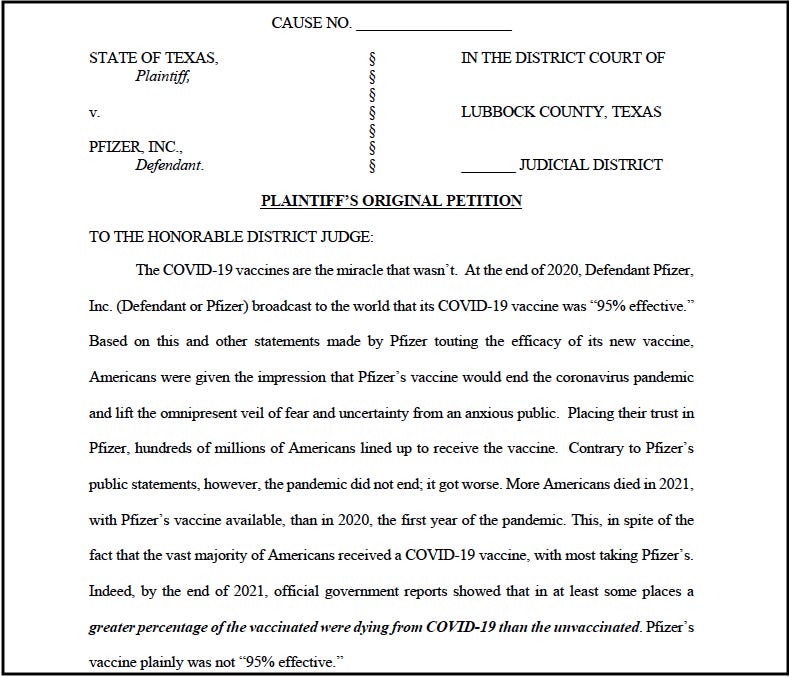
According to the 54-page lawsuit, Pfizer engaged in a “deception campaign across several fronts” and consequently, the company became “grossly and unfairly enriched by its deceptive acts,” namely;
· First, duration of protection: FDA recognized when it first authorized Pfizer’s vaccine that it was “not possible” to know how effective the vaccine would remain beyond two months. But in early 2021, Pfizer deliberately created the false impression that its vaccine had durable and sustained protection, going so far as to withhold highly relevant data and information from the consuming public showing that efficacy waned rapidly.
· Second, transmission: FDA warned Pfizer that it “needed” additional information to determine whether the vaccine protected against “transmission” of COVID-19 between persons. But Pfizer instead engaged in a fear-mongering campaign, exploiting intense public fears over the year-long pandemic by insinuating that vaccination was necessary for Americans to protect their loved ones from contracting COVID-19.
· Third, variant protection: Pfizer knowingly made false and unsupported claims about vaccine performance against variants, including specifically the so-called Delta variant. The vaccine performed remarkably poorly against the Delta variant, and Pfizer’s own data confirmed this fact. Nonetheless, Pfizer told the public that its vaccine was “very, very, very effective against Delta.”
The lawsuit goes on to say that Pfizer also took overt action to intimidate and silence people who posted factual information about the COVID-19 vaccines, in order to “prolong the effectiveness of the company’s deception campaign.”
Paxton said, “When the failure of its product became apparent, Pfizer then pivoted to silencing truth-tellers.”
In the lawsuit, journalist Alex Berenson is named as one of the people censored. It states Berenson posted information that was critical of the mRNA vaccines to his hundreds of thousands of followers, so Pfizer “plotted to silence Berenson and eliminate his speech from public discourse.”
In addition to coercing social media platforms to censor truthful information, the lawsuit states that Pfizer intimidated vaccine skeptics. In November 2021 for example, CEO Albert Bourla labelled them “criminals” who have “literally cost millions of lives.”
In summary, the lawsuit states:
Pfizer knowingly and recklessly engaged in a multi-faceted scheme to mislead the American public about the efficacy of its COVID-19 vaccine, including making affirmative misrepresentations, withholding material information, and taking steps to censor and suppress individuals who disseminated truthful information adverse Pfizer’s deceptive scheme to increase sales and consumption of its vaccine.
Many have welcomed the move saying it could have political ramifications or encourage other States to launch similar lawsuits.
Featured Video
Laith Marouf: Hezbollah’s position on US-Iran ceasefire
or go to
Aletho News Archives – Video-Images
From the Archives
The Dirty Little Secret behind the “Global Terrorism Index”
The Omission of Israeli Terrorism in the Occupied Palestinian Territories
By Karin Brothers | Global Research | December 6, 2014
… The Israeli settlements — all of which are illegal – have been identified as a major impediment to peace. The refusal of a major “global” terrorism report to name the Israeli settlers as one of the groups most responsible for terrorism not only misrepresents a major source of regional violence but exposes the Global Terrorism Index as a propaganda tool that supports a U.S. agenda.
In recent years, governments have been attempting to thwart terrorism by blocking supportive fund-raising. When it comes to Israeli settlements, however, the US and Canada actually encourage fund-raising by giving organizations (such as Christian Friends of Israeli Communities (CFOIC) and the Jewish National Fund) financial support in the form of donor tax-deductions.
Charities which provide funds for the Israeli settlements should be regarded as terror-financing organizations. They should not only lose their tax-deductible status, but they should be banned because they support the violation of international humanitarian law. The terror-financing laws that are being strictly enforced for Muslim charities should be applied to Christian and Jewish charities as well. … Read full article
Blog Roll
 Aletho News
- The ‘Opposition Party’ Has Done Nothing to Stop the Iran War and Much to Goad Trump Into Continuing It
- Moscow backs Tehran on status of Lebanon in US-Iran deal
- How UK Regulator Ofcom Quietly Bypassed International Law to Police American Speech
- The Black Cube Files: How Former Mossad Operatives Flipped a Nation
- Laith Marouf: Hezbollah’s position on US-Iran ceasefire: What you’re not being told
- Israel’s priority lies in destroying chances of peace between Iran, US: Ex-UN nuclear chief
- Ceasefire for all or for none: Iran shuts Hormuz over Lebanon attacks
- Strait of Hormuz is Iran’s ‘nuclear weapon’ that forced US retreat: Medvedev
- Energy crisis will last for months – Kremlin envoy
- Europe’s quiet role in the war on Iran
- If Americans Knew
- This is ceasefire? Israel’s biggest massacre yet in Lebanon, another journalist killed in Gaza – Daily Update
- Tucker Carlson on Israel: This Is the Behavior of an Ally? Really?
- Gazans face a triple crisis: severe shortages of water and bread, healthcare in tatters
- NY Times reports how Netanyahu took the US into Iran War
- A sigh of relief over Iran, but Gaza and Lebanon in dire straits – Daily Update
- Thousands dead and neighborhoods razed to the ground: Aid agencies fear southern Lebanon is becoming the new Gaza
- The war the US is fighting for Israel could cost trillions
- ‘Cigarette Burns, Nail Wounds’: Toddler Tortured in Gaza to Coerce Father
- Trump Says US Sent ‘a Lot of Guns’ to Protesters in Iran
- Israeli forces destroy 17 UN peacekeeper cameras in south Lebanon
- No Tricks Zone
- An Inconvenient Tree: Uncovered In Alps… Europe Much Warmer Than Today 6000 Years Ago
- New Study Reports A 60% Slowdown In Greenland’s Ice Loss Rate In The Last Decade
- Low Intensity Tornado Wrecks Major Solar Farm, Creating A Potential Toxic Dump
- New Study Finds Warming Saves Lives…Cold Temperatures 12 Times More Deadly Than Excess Heat
- German Science Blog Accuses PIK Climate Institute Of Hallucinating Climate Tipping Points
- Devastating Assessment Of Comirnaty Vaccine By Former Senior Pfizer Europe Toxicologist
- New Study: CO2 Is ‘Effectively Negligible’ As An Explanatory Climate Change Factor Since 2000
- Former Pfizer Toxicologist Dr. Helmut Sterz Tells Bundestag Hearing Pfizer Vaccine Should Have Never Been Approved
- Energy Expert: Germany’s Nuclear Phaseout Was A “500 Billion Euro Mistake”
- New Research: South Australia’s Mid-Holocene Sea Surface Temperatures Were 4°C Warmer Than Today
 Aletho News